Dermatology · Medicine
Patch testing and contact dermatitis work-up
Also known as Patch test · Epicutaneous testing · Contact allergy testing · European baseline series · TRUE Test · Photopatch testing · ICDRG reading
Board-level module on diagnostic patch testing: gold-standard investigation for allergic contact dermatitis. Covers ESCD best-practice technique (Finn chambers, upper back, D2/D3–D4/D7 readings), ICDRG grading with relevance assessment, European baseline series and recommended additions, common allergens by category, false-positive and false-negative pitfalls (angry back, steroid suppression, late metal/corticosteroid reactors), photopatch testing, ROAT, occupational documentation, and post-test avoidance counselling integrated with barrier repair and anti-inflammatory care.
On this page & tools
Your progress
Saved locally on this device.
Exam tags
Red flags
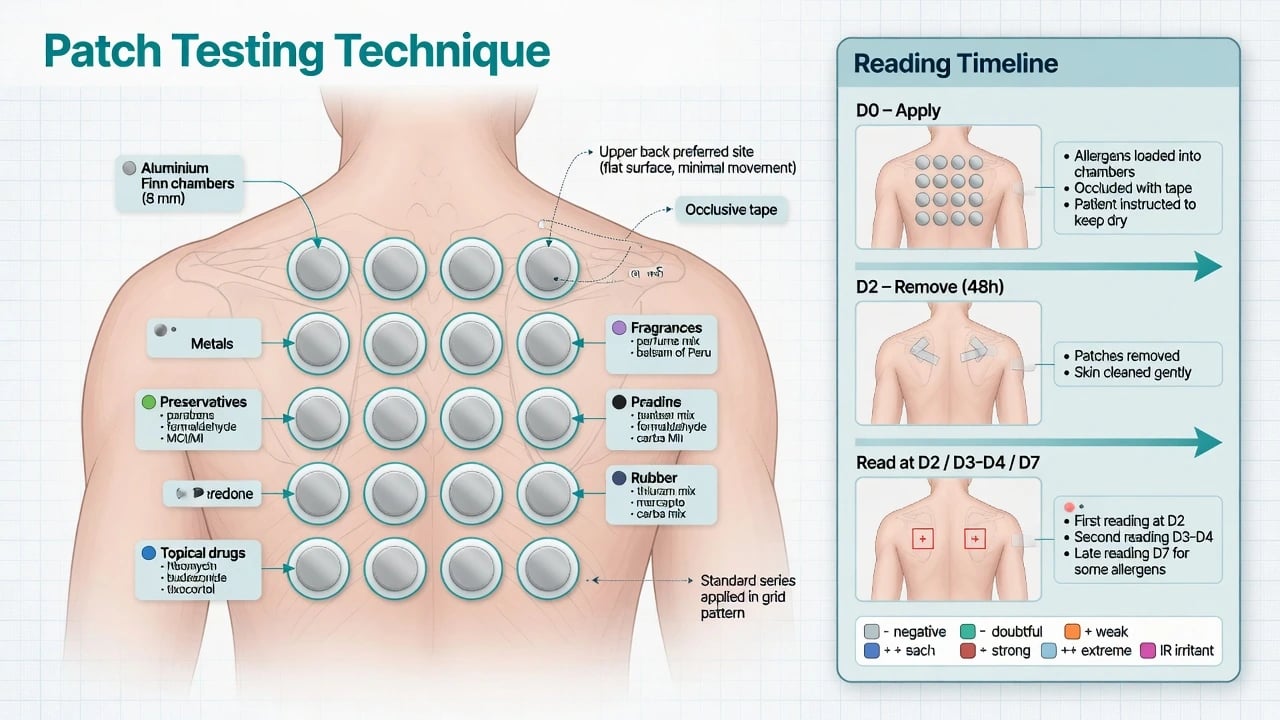
Definition and clinical purpose
Patch testing (epicutaneous testing) reproduces delayed (type IV) contact allergy under controlled occlusion. It answers the clinical question: which exogenous haptens is this patient sensitised to, and which of those explain the current dermatitis? It does not diagnose irritant contact dermatitis (ICD), which is dose-related barrier injury without antigen-specific T-cell memory, although ICD and ACD frequently coexist and share occupational wet-work risk.[3][8][12]
Patch testing is indicated for chronic, recurrent, asymmetric, site-patterned, occupational, eyelid/facial, stasis/ulcer-related, or treatment-resistant eczema when contact allergy is plausible. Lifetime population sensitisation to at least one allergen is substantial (often cited around one in five in European clinic series), so under-testing is a common exam and practice failure mode.[3][4][14]
Pathophysiology that explains the method
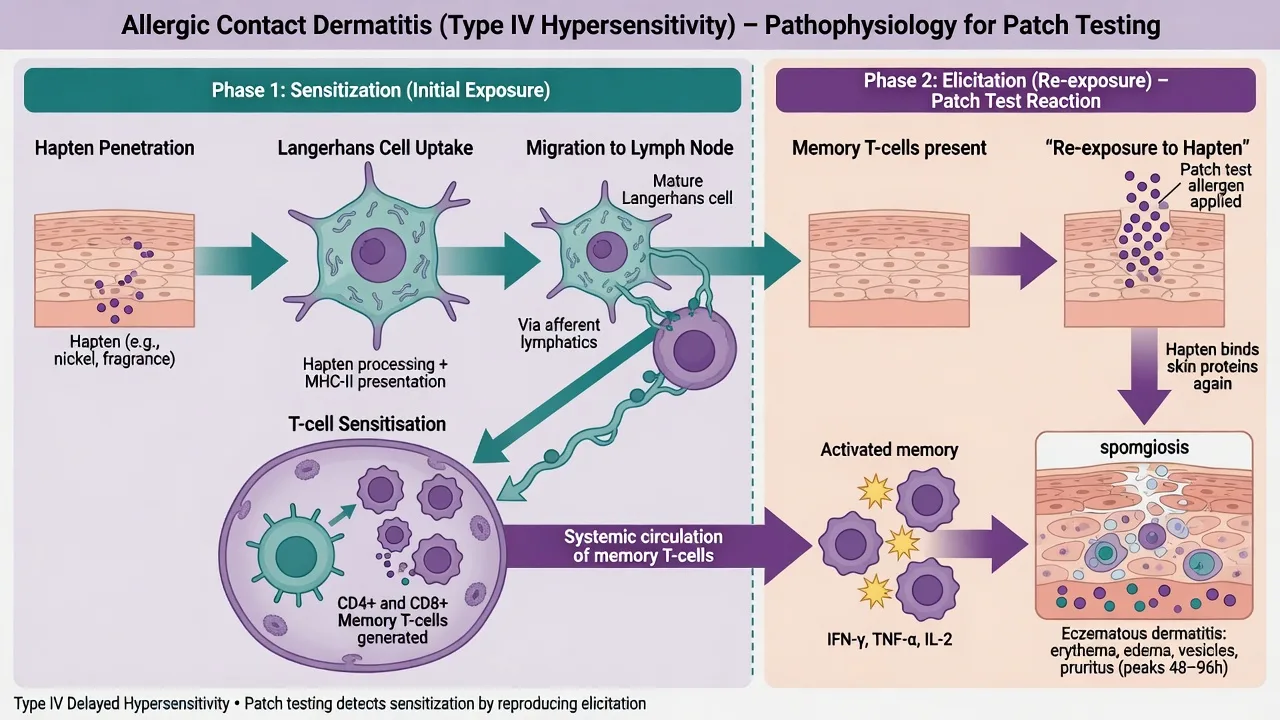
ACD requires two phases: sensitisation (hapten penetration → dendritic-cell presentation → memory T cells) and elicitation (re-exposure → eczematous inflammation, typically peaking after 24–72 hours).[9][3][11] Occlusion for ~48 hours maximises percutaneous hapten delivery while remaining practical; some haptens (metals, corticosteroids, certain drugs) characteristically show late peaking, which is why a D7 reading is non-negotiable in ESCD-aligned practice.[1][2][10]
Barrier integrity modulates risk: wet work, surfactants, solvents and filaggrin-related barrier failure increase both irritant injury and hapten ingress, linking atopic and occupational hand eczema pathways to higher ACD yield on testing.[13][8][4]
Technique (ESCD best practice)
Site, chambers, vehicles
- Preferred site: upper back (flat, low movement); avoid active dermatitis and recent potent topical steroids at the site.[1]
- Chambers: aluminium Finn (or commercial ready-to-use systems such as TRUE Test in some settings) with haptens in validated vehicles and concentrations (usually petrolatum; some aqueous).[1]
- Mark positions clearly; instruct the patient to keep the back dry, avoid sport/sauna, and not remove tapes early.
Reading schedule
| Day | Action | Exam pearl |
|---|---|---|
| D0 | Apply series | Baseline series ± targeted supplements |
| D2 (48 h) | Remove chambers; first reading | Immediate IR vs early allergic morphology |
| D3 or D4 | Second reading | Many true positives strengthen |
| D7 | Late reading | Metals, corticosteroids, some drugs — catch delayed positives and active sensitisation |
Series selection
The European baseline series screens the highest-yield population allergens and is updated with recommended additions as epidemiology shifts (e.g. preservative epidemics, fragrance hydroperoxides).[5][14] Add cosmetic, fragrance, rubber, dental, plant, medicament, or occupational series based on history. Test own products only with safe dilution protocols for leave-ons; rinse-offs and strong irritants often need open/ROAT strategies rather than full occlusion.[1]
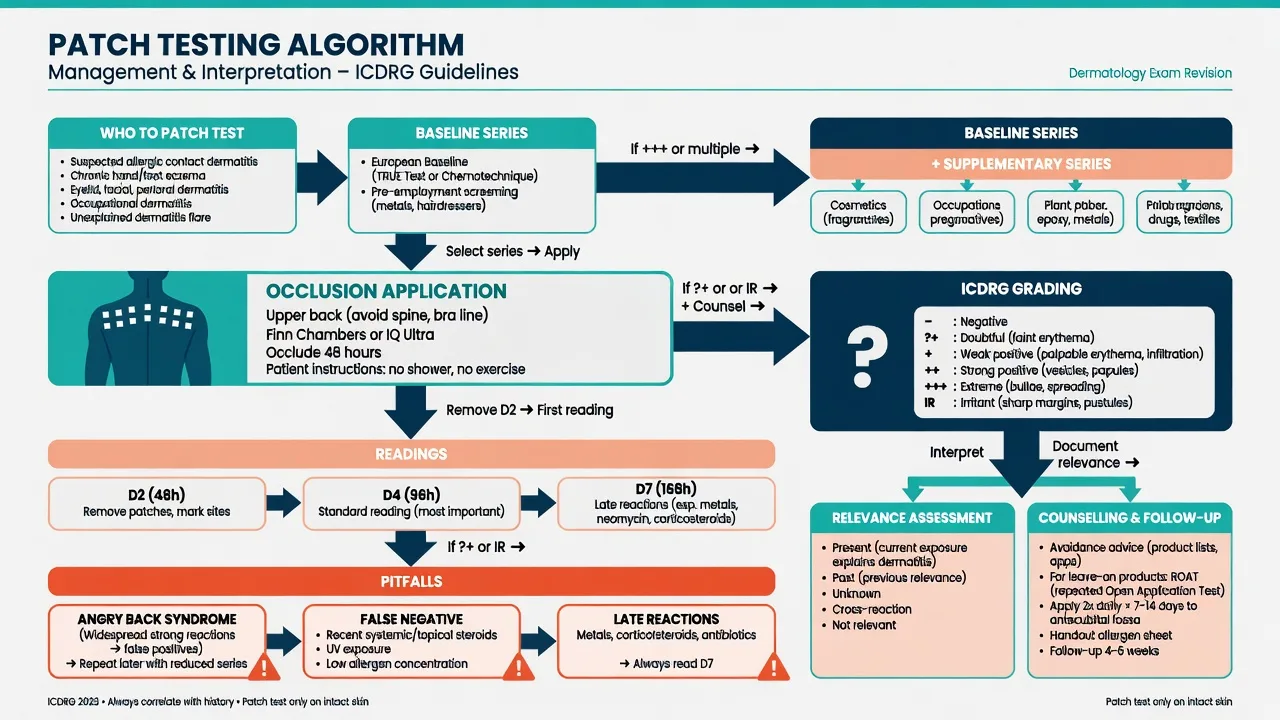
Patch test workflow
APPLY
Chronic/asymmetric/occupational/site-patterned eczema
Baseline + targeted supplements + own products when safe
Validated chambers, vehicles, concentrations
ICDRG grade every site
Present/past/unknown + written avoidance plan
ICDRG grading and relevance
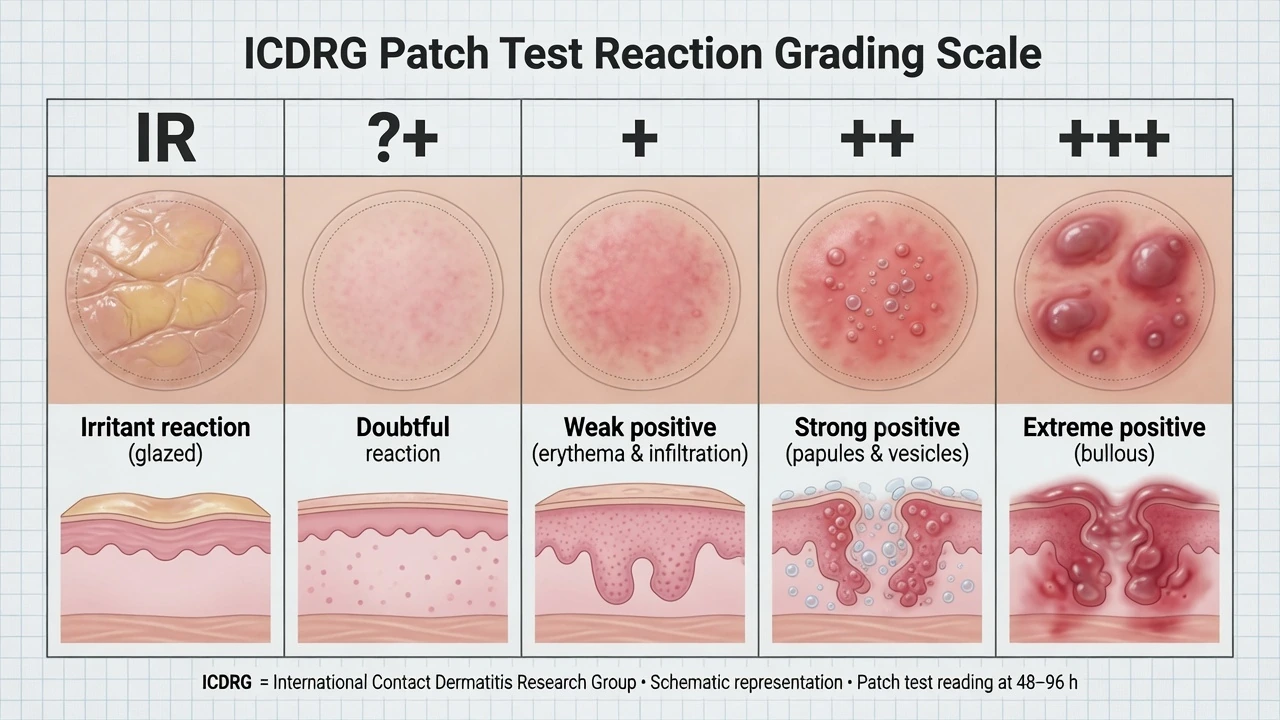
The International Contact Dermatitis Research Group (ICDRG) morphological scale (with recent clarifications) separates irritant morphology from graded allergic positives:[2]
- IR — irritant: glazed, wrinkled, follicular, sharply soap-like; not allergic memory.
- ?+ — doubtful: faint macular erythema only.
- + — weak positive: erythema + infiltration (± papules).
- ++ — strong: papules/vesicles on infiltrated base.
- +++ — extreme: coalescent vesicles / bullae. [1]
Relevance is the second half of the diagnosis: [1]
- Present — current exposure explains the dermatitis pattern.
- Past — historical sensitisation, not current driver.
- Unknown — positive without clear exposure match; reassess history and products. [1]
Distribution clues remain high-yield: nickel (earlobes, periumbilical, wrists), rubber accelerators (glove pattern), chromate (cement/leather hands/feet), PPD (scalp/face after dye), fragrances/preservatives (face, axillae, hands from leave-ons and household products).[7][3][14]
High-yield baseline allergen patterns (clinic series context)
Common allergens — exam skeleton
- Metals: nickel (dominant), cobalt (often co-reactive), chromate (cement, leather).[7][14]
- Fragrances and balsams: fragrance mix I/II, oxidised linalool/limonene hydroperoxides, balsam of Peru cross-reactors.[5][3]
- Preservatives: MI/MCI, formaldehyde and releasers — classic regulatory case studies.[5][14]
- Rubber accelerators and resins: gloves, shoes, adhesives, epoxy/acrylates in occupation-specific series.[1][4]
- Hair dyes: PPD with cross-reactivity to benzocaine, sulphonamides, certain azo dyes.[11]
- Medicaments: neomycin/bacitracin (stasis/ulcer patients), topical corticosteroids (under-recognised; baseline markers may still miss some cross-reactors — history-driven additions matter).[10][11]
Pitfalls, false results, and special tests
False negatives
Under-concentration or wrong vehicle; reading stopped at D2 only; potent topical steroids on the back; significant systemic immunosuppression; testing during an acute generalised flare that blunts local responses; missed own-product testing.[1]
False positives and angry back
Irritant concentrations, adhesive trauma, and excited skin / angry back syndrome (multiple non-specific positives when the back is hyper-reactive) demand sequential retesting of key positives once skin is quiet.[1][3]
Active sensitisation
Potent haptens (classic examples include PPD and certain plant allergens) can induce de novo sensitisation at the test site, sometimes declared after D7. Pre-test consent should mention this rare but real risk.[1][11]
Photopatch testing
For suspected photoallergic contact dermatitis, duplicate allergen panels are applied; one set is irradiated with a defined UVA dose after occlusion per European photopatch recommendations, then both sets are read comparatively.[6] Phototoxic reactions are dose-related and sunburn-like; photoallergic reactions are eczematous and immune-mediated.
ROAT and open tests
The repeat open application test applies a leave-on product twice daily to a defined forearm patch for up to 1–2 weeks to confirm clinical relevance of a weak positive or ambiguous product. Strong irritants are safer with open/semi-open methods than full occlusion.[1]
Occupational work-up
Occupational contact dermatitis is a leading occupational skin disease. High-risk trades: healthcare, hairdressing, food handling, cleaning, construction (wet cement/chromate), printing, metalwork, and resin/epoxy users.[4][8] Document job tasks, glove type, wet-work hours, temporal work-weekend pattern, and provide occupational-health referral with PPE substitution (e.g. accelerator-free gloves when relevant). Medicolegal strength depends on consistent history + relevant positives + improvement on avoidance.[1][3]
Differential diagnosis before and after testing
Always re-check atopic dermatitis, ICD, psoriasis (palmoplantar), tinea (KOH), scabies, dyshidrosis, stasis dermatitis, drug eruption, and dermatitis herpetiformis when morphology or response is atypical.[3][12] Biopsy and scrapings are adjuncts; they do not replace patch testing when ACD is likely.
Management after the report
Three pillars remain: identify and avoid, restore the barrier, treat inflammation.[3][9][13]
- Written allergen education — INCI names, synonyms, hidden sources, cross-reactors, and safe alternatives.
- Barrier programme — soap substitutes, frequent fragrance-free emollients, wet-work reduction, correct gloves with cotton liners as needed.[13][8]
- Anti-inflammatory care — site-appropriate topical corticosteroids or calcineurin inhibitors; short systemic steroid courses for severe flares; phototherapy or systemic agents (including modern options used in refractory chronic hand eczema pathways) when avoidance alone fails — escalate with specialist protocols rather than inventing doses from memory in exams without citing source guidance.[9][4]
If disease persists after apparently perfect avoidance, re-open the file: unknown relevance allergens, airborne/consort exposure, systemic contact (e.g. oral nickel in highly sensitised patients), concurrent dermatoses, or incomplete series. [1]
Regional practice notes
- Europe / UK: ESCD technique + European baseline series updates dominate training exams; BAD/NICE pathways for hand eczema sit downstream of diagnosis.[1][5]
- India / IADVL settings: same principles; expand plant, medicament, and occupational series to local exposures; nickel and hair-dye (PPD) remain high-yield.
- North America: baseline series composition differs in detail (e.g. commercial panels), but ICDRG reading logic and relevance assessment are shared.
Clinical pearl
Red flags
Exam application bank (NEET-PG / INICET)
One-line answer
Board-level module on diagnostic patch testing: gold-standard investigation for allergic contact dermatitis. Covers ESCD best-practice technique (Finn chambers, upper back, D2/D3–D4/D7 readings), ICDRG grading with relevance assessment, European baseline series and recommended additions, common allergens by category, false-positive and false-negative pitfalls (angry back, steroid suppression, late metal/corticosteroid reactors), photopatch testing, ROAT, occupational documentation, and post-test avoidance counselling integrated with barrier repair and anti-inflammatory care.
Worked stems (answer without another resource)
Stem 1 — Classic presentation. Map symptoms to mechanism; name the first investigation and first treatment step with dose/route if drug therapy is standard. [1]
Stem 2 — Unstable / complicated. List red flags that force immediate resuscitation, theatre, ICU, antidote, or reperfusion — and what you do in the first 15 minutes. [1]
Stem 3 — Atypical group. Elderly, pregnancy, child, or immunocompromised: how presentation and thresholds change. [1]
Stem 4 — Differential trap. Name the three closest mimics and one discriminator for each. [1]
Stem 5 — Disposition. Who goes home with safety-netting, who is admitted, who needs HDU/ICU/theatre, and what follow-up is mandatory. [1]
Rapid viva checklist
- Definition + classification
- Pathophysiology chain
- Bedside signs / criteria
- Score with exact components (if any)
- Emergency bundle
- Definitive therapy with doses
- Complications of disease and of treatment
- Special populations
- Guideline/trial name if classic
- Three exam traps
Coverage self-check
If you cannot answer any stem above from this page alone, re-read the matching section — the page is intended to be self-sufficient for final-prof and NEET-PG/INICET questions on Patch testing and contact dermatitis work-up.
Expanded exam teaching (depth pass)
Clinical reasoning
For Patch testing and contact dermatitis work-up, examiners test whether you can prioritise life threats, choose the right first test, and give specific therapy (agent, dose, route, timing). Generic phrases without numbers score poorly.
Mechanism → feature map
Build a short chain: cause → pathophysiologic intermediate → clinical feature → complication. Every major symptom in the classic vignette should sit on that chain.
Investigation strategy
- Bedside/first-line tests that change immediate management
- Confirmatory or staging tests
- What a normal result does not exclude
- When not to delay treatment for imaging (unstable patient)
Management ladder
- Resuscitation / ABC / sepsis or haemorrhage bundle as relevant
- Specific antidote / procedure / antimicrobial / reperfusion / surgery
- Supportive care and monitoring targets
- Definitive long-term therapy and secondary prevention
- Disposition and safety-net advice
Special populations
Always prepare one line each for children, pregnancy, elderly, renal/hepatic impairment, and immunocompromised patients when the topic allows.
Pitfalls that fail candidates
- Treating the number not the patient
- Missing pregnancy status when relevant
- Imaging before stabilisation
- Wrong empiric cover or wrong antidote timing
- Incomplete counselling on recurrence, adherence, or red-flag return
Board-level module on diagnostic patch testing: gold-standard investigation for allergic contact dermatitis. Covers ESCD best-practice technique (Finn chambers, upper back, D2/D3–D4/D7 readings), ICDRG grading with relevance assessment, European baseline series and recommended additions, common allergens by category, false-positive and false-negative pitfalls (angry back, steroid suppression, late metal/corticosteroid reactors), photopatch testing, ROAT, occupational documentation, and post-test [1]
Structured revision sheet
Must-know numbers and names
List every score, size threshold, dose, and time window from this topic on a blank page from memory, then check against the sections above.
Three classic MCQ angles
- Most likely diagnosis given a vignette
- Next best step in management
- Most appropriate investigation
Three classic SAQ angles
- Pathophysiology in five steps
- Management algorithm with doses
- Complications and prevention
Clinical station flow
Greet → focused history → targeted exam → investigations → explain diagnosis → emergency care → definitive plan → safety-net / follow-up → answer examiner questions on mechanism and pitfalls.
References
- [1]Johansen JD, Aalto-Korte K, Agner T, Andersen KE, et al. European Society of Contact Dermatitis guideline for diagnostic patch testing - recommendations on best practice Contact Dermatitis, 2015.PMID 26179009
- [2]Bruze M, Svedman C. Clarification and Modification of the International Contact Dermatitis Research Group Classification of Patch Test Reactions on Behalf of the International Contact Dermatitis Research Group Dermatitis, 2025.PMID 39773000
- [3]Scheinman PL, Vocanson M, Thyssen JP, Johansen JD, et al. Contact dermatitis Nat Rev Dis Primers, 2021.PMID 34045488
- [4]Johansen JD, Bonefeld CM, Schwensen JFB, Thyssen JP, et al. Novel insights into contact dermatitis J Allergy Clin Immunol, 2022.PMID 35183605
- [5]Wilkinson SM, Gonçalo M, Aerts O, Badulici S, et al. The European baseline series and recommended additions: 2023 Contact Dermatitis, 2023.PMID 36443008
- [6]Gonçalo M, Ferguson J, Bonevalle A, Bruynzeel DP, et al. Photopatch testing: recommendations for a European photopatch test baseline series Contact Dermatitis, 2013.PMID 23510344
- [7]Ahlström MG, Thyssen JP, Wennervaldt M, Menné T, et al. Nickel allergy and allergic contact dermatitis: A clinical review of immunology, epidemiology, exposure, and treatment Contact Dermatitis, 2019.PMID 31140194
- [8]Patel K, Nixon R. Irritant Contact Dermatitis - a Review Curr Dermatol Rep, 2022.PMID 35433115
- [9]Tramontana M, Hansel K, Bianchi L, Sensini C, et al. Advancing the understanding of allergic contact dermatitis: from pathophysiology to novel therapeutic approaches Front Med (Lausanne), 2023.PMID 37283623
- [10]Svendsen SV, Bindslev-Jensen C, Mortz CG. Contact allergy to corticosteroids: Is the European baseline series sufficient? Contact Dermatitis, 2023.PMID 37321366
- [11]Kostner L, Anzengruber F, Guillod C, Recher M, et al. Allergic Contact Dermatitis Immunol Allergy Clin North Am, 2017.PMID 27886903
- [12]Bains SN, Nash P, Fonacier L. Irritant Contact Dermatitis Clin Rev Allergy Immunol, 2019.PMID 30293200
- [13]Proksch E, Brandner JM, Jensen JM. The skin: an indispensable barrier Exp Dermatol, 2008.PMID 19043850
- [14]Geier J, Uter W, Lessmann H, Schnuch A. [Current contact allergens] Hautarzt, 2011.PMID 21901563