Dermatology · Medicine
Penile dermatoses
Also known as Balanitis / balanoposthitis · Balanitis xerotica obliterans (BXO) · Male genital lichen sclerosus · Zoon plasma cell balanitis · Pearly penile papules · Penile inflammatory dermatoses
Multi-board penile dermatoses overview: balanitis/balanoposthitis definitions, circumcision status as the pivotal exposure, male genital lichen sclerosus (BXO) with phimosis/meatal stenosis and SCC risk, Zoon plasma-cell balanitis in uncircumcised men, candidal balanitis in diabetes, fixed drug eruption and STI mimics, pearly penile papules as a normal variant, biopsy thresholds for erythroplasia of Queyrat/PIN/SCC, and stepwise medical versus surgical management aligned with BASHH and EuroGuiderm-informed practice.
On this page & tools
Your progress
Saved locally on this device.
Exam tags
Red flags
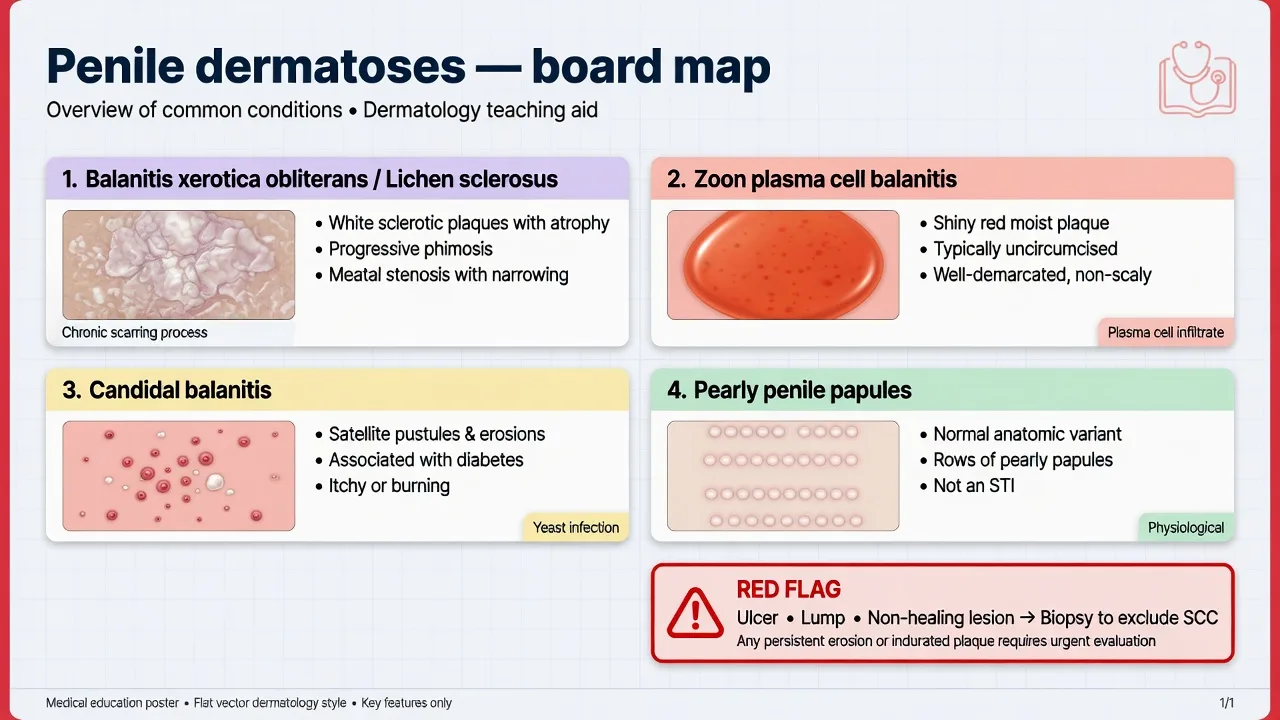
Overview & Definition
Balanitis is inflammation of the glans; posthitis of the prepuce; balanoposthitis of both. These are descriptive, not final diagnoses. The examiner expects you to convert the label into a specific disease: infectious, inflammatory (especially lichen sclerosus / BXO), neoplastic, or a normal variant (pearly penile papules).[2]
Male genital skin shares special-site constraints with the vulva: occlusion under the foreskin, urine moisture, sexual exposure, and high stakes for function and malignancy. [1]
Classification
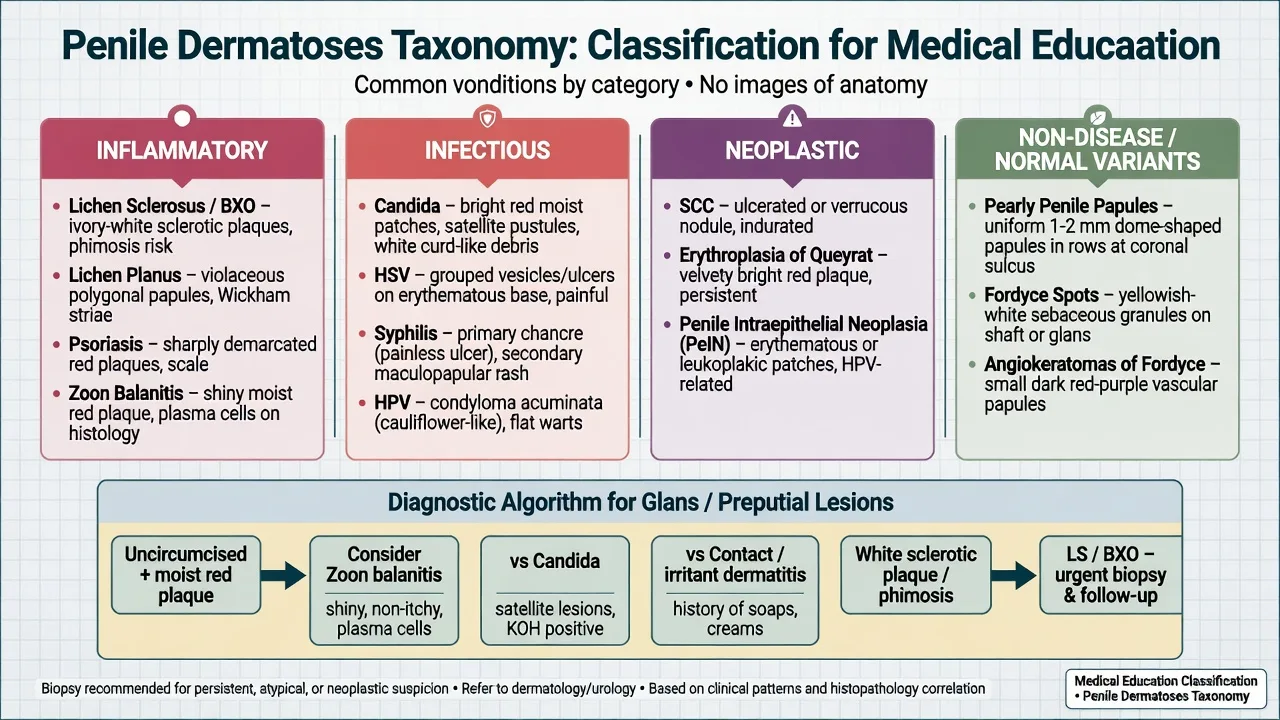
Inflammatory
Infectious
Neoplastic
Normal variants
Drug-related
Epidemiology & Risk Factors
Uncircumcised status, poor hygiene, diabetes mellitus, obesity, and smoking drive much infectious and Zoon disease.[5] Male genital lichen sclerosus is less common than female disease but is the leading cause of pathological adult phimosis in many urology series.[2][3] Pearly penile papules are common in adolescents and young men and decline with age; they are not sexually transmitted.[7][8]
Pathophysiology
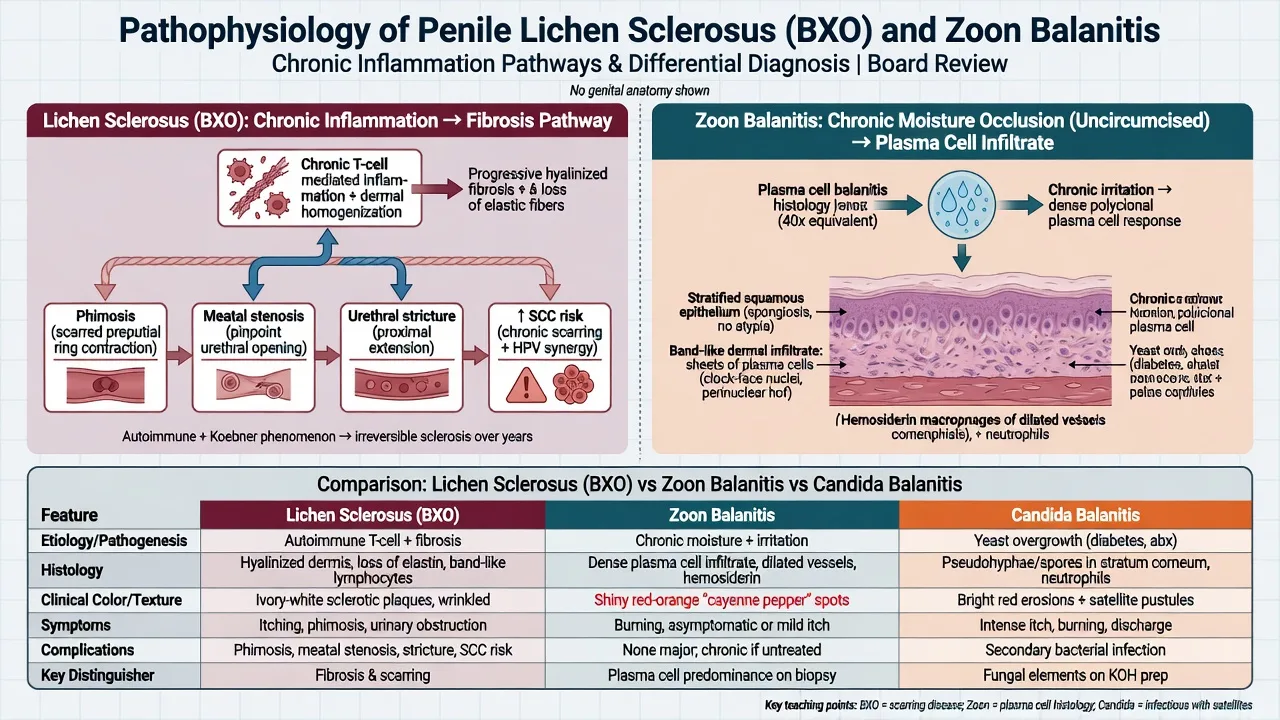
BXO / male genital LS follows the same autoimmune–fibrotic pathway as genital LS elsewhere: chronic inflammation produces sclerosis of prepuce, glans, and meatus, culminating in phimosis, meatal stenosis, and sometimes anterior urethral stricture. Malignant transformation risk is the same order of magnitude as other genital LS fields.[1][2][3]
Zoon plasma-cell balanitis is strongly linked to chronic preputial occlusion and moisture; histopathology shows a dense band of plasma cells with epidermal attenuation. It can coexist with LS.[5][6]
Candidal balanitis exploits hyperglycaemia and local maceration. PPP are angiofibromas of the corona — developmental, not infectious.[7]
Clinical Presentation
Lichen sclerosus / BXO
White sclerotic plaques on glans and inner prepuce, loss of elasticity, fissuring, acquired phimosis, meatal whitening/stenosis, weakened stream, spraying, or retention. Itch or sore tightness is common; long-standing disease may be relatively silent until urinary symptoms dominate.[2][3]
Zoon plasma-cell balanitis
Well-demarcated shiny moist orange-red to brown-red plaque on the glans or coronal sulcus of an uncircumcised man; often asymptomatic or mildly sore; may bleed slightly after retraction trauma.[5]
Candidal balanitis
Erythema, burning, satellite pustules, white exudate; partner thrush history; diabetes or recent antibiotics. [1]
Pearly penile papules
One to several rows of small, smooth, flesh-coloured or pearly papules encircling the corona of the glans — symmetric, monomorphic, long-standing.[8]
Other high-yield
- Psoriasis — well-demarcated red shiny plaques; look at scalp/extensors/nails.
- Lichen planus — violaceous or erosive; check mouth.[9]
- Fixed drug eruption — recurrent round erosion at the same glans site after the same drug (e.g. NSAIDs, tetracyclines, sulphonamides).
- HSV / syphilis — vesicles or indurated ulcer; risk assessment and testing.
Differential Diagnosis
| Finding | Prefer | Key distinguisher |
|---|---|---|
| Acquired phimosis + white sclerosis | BXO/LS | Meatal involvement, sclerotic prepuce |
| Shiny moist red glans, uncircumcised | Zoon | Plasma cells on histology; circumcision curative often |
| Satellite pustules + diabetes | Candida | Microscopy/culture; systemic risk factors |
| Rows of coronal papules | PPP | Lifelong, symmetric; not HPV |
| Soft filiform/cauliflower lesions | Condyloma | HPV; STI context |
| Velvety persistent red plaque | Queyrat / PIN | Biopsy mandatory |
| Recurrent round glans erosion | Fixed drug | Drug timeline |
Clinical & Bedside Assessment
- Circumcision status, diabetes, products used for hygiene, sexual history, partner symptoms, urinary stream.
- Gentle foreskin retraction (never force a tight prepuce in children).
- Inspect glans, coronal sulcus, meatus, shaft, scrotum; extragenital skin and oral mucosa.
- Palpate for induration (neoplasia).
- Document with consented photography for follow-up of chronic inflammatory disease. [1]
Investigations
Usually clinical. Swab for candida/bacteria when infectious features dominate; HSV PCR for vesicles/ulcers; full STI screen when indicated. Biopsy any atypical, indurated, ulcerated, or treatment-refractory plaque — histology separates Zoon, LS, PIN, and invasive SCC.[2][5] Blood glucose/HbA1c in recurrent candidal disease.
Management — Resuscitation
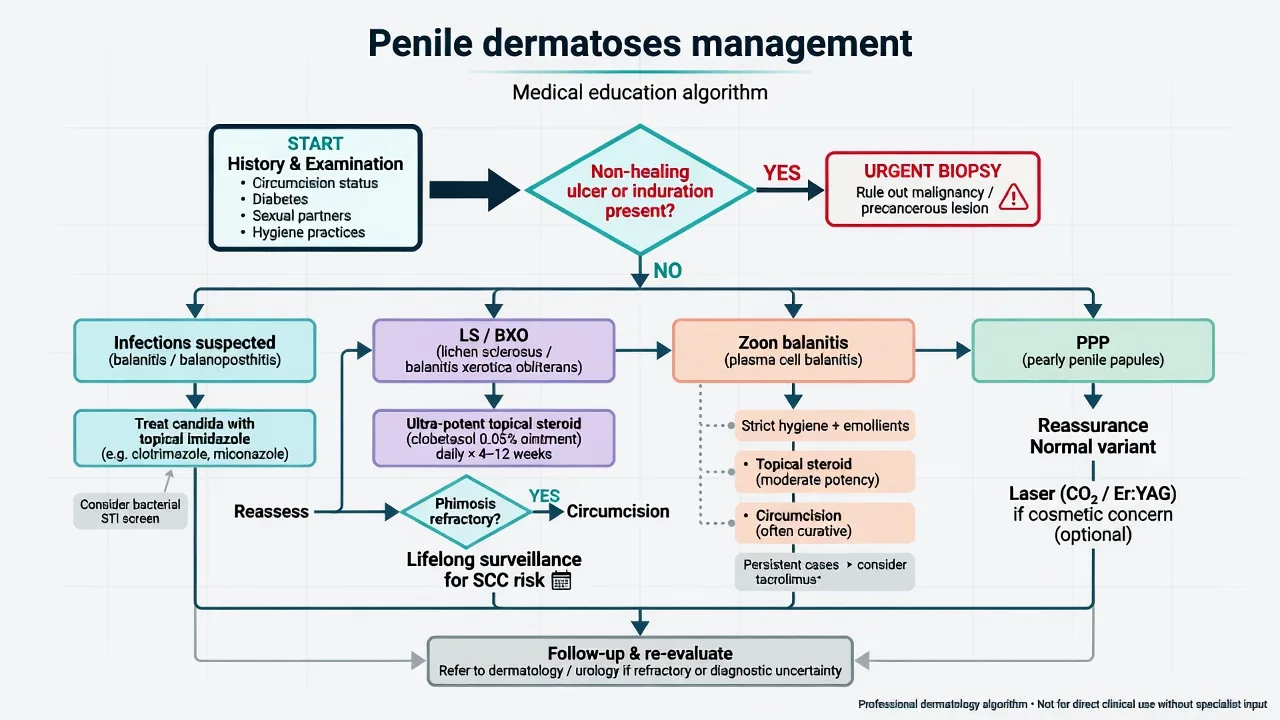
Acute retention from severe phimosis/meatal stenosis is a urological emergency. Rapidly progressive necrotic infection of the perineum is a surgical emergency (Fournier pathway). Painful vesicles with systemic features need HSV treatment without delay. [1]
Management — Definitive & Stepwise
Shared care: soap substitutes, dry carefully, treat hyperglycaemia, avoid irritants. [1]
Candidal balanitis: topical imidazole (e.g. clotrimazole 1% cream applied thinly 2–3 times daily for 1–2 weeks is a typical primary-care regimen) plus partner assessment when recurrent; oral fluconazole only when indicated by severity/recurrence and local protocol. [1]
Male genital LS / BXO: ultra-potent topical corticosteroid (commonly clobetasol propionate 0.05% ointment) on a structured induction/maintenance plan analogous to female genital LS; escalate to circumcision for refractory phimosis — often diagnostic and therapeutic; urology for meatal stenosis/stricture; lifelong surveillance for SCC.[1][2][4][10]
Zoon balanitis: improve hygiene; short courses of mild-to-potent topical steroid under review; circumcision is frequently curative for persistent disease.[5]
PPP: reassurance is first-line. Ablative options (laser, electrosurgery) only for significant distress after counselling that this is cosmetic.[7][8]
Lichen planus / psoriasis: treat as mucosal/special-site inflammatory disease with topical steroids and systemic agents when extensive; align with LP guideline principles.[9]
Specific Subtypes & Scenarios
Boys: physiological phimosis is common; pathological white scarring suggests paediatric BXO and needs specialist review rather than forced retraction.[2]
HIV / immunosuppression: lower threshold for biopsy and STI testing. [1]
Zoon + LS overlap: treat the LS component seriously and do not dismiss as “simple balanitis.”[6]
Complications & Pitfalls
- Urethral stricture and chronic urinary morbidity from BXO.[2]
- SCC arising in chronic LS fields.[1]
- Labelling PPP as warts → unnecessary treatment and stigma.[8]
- Endless antifungals without examining for LS/Zoon.
- Circumcision without histopathology when neoplasia is possible — send the prepuce.
Prognosis & Disposition
Infectious balanitis usually resolves with hygiene and targeted therapy. Zoon often remits after circumcision. Genital LS is chronic: maintenance care and cancer vigilance continue after surgery.[3][4] Refer dermatology/urology for phimosis, meatal disease, diagnostic uncertainty, or suspected PIN/SCC.
Special Populations
Elderly diabetic uncircumcised men accumulate candidal and Zoon disease. Athletes and men using harsh antiseptic washes develop irritant balanitis. MSM pathways require low thresholds for syphilis/HSV/HPV-related disease work-up without abandoning non-STI dermatoses. [1]
Evidence, Guidelines & Regional Differences
EuroGuiderm/S3 LS documents underpin ultra-potent topical steroid use for anogenital LS including males.[4][10] Penile LS reviews emphasise circumcision for structural disease and surveillance.[2][3] PPP literature supports reassurance as standard of care.[7] Regional circumcision rates change the local case-mix of Zoon and candidal balanitis.
Exam Pearls
PENIS pearls
- Zoon is almost a disease of the uncircumcised.[5]
- Histology of Zoon = plasma cells; LS = sclerosis.[5][1]
- Send circumcision specimens to pathology.
- Meatal assessment is part of every BXO exam.[2]
Exam application bank (NEET-PG / INICET)
One-line answer
Multi-board penile dermatoses overview: balanitis/balanoposthitis definitions, circumcision status as the pivotal exposure, male genital lichen sclerosus (BXO) with phimosis/meatal stenosis and SCC risk, Zoon plasma-cell balanitis in uncircumcised men, candidal balanitis in diabetes, fixed drug eruption and STI mimics, pearly penile papules as a normal variant, biopsy thresholds for erythroplasia of Queyrat/PIN/SCC, and stepwise medical versus surgical management aligned with BASHH and EuroGuiderm-informed practice.
Worked stems (answer without another resource)
Stem 1 — Classic presentation. Map symptoms to mechanism; name the first investigation and first treatment step with dose/route if drug therapy is standard. [1]
Stem 2 — Unstable / complicated. List red flags that force immediate resuscitation, theatre, ICU, antidote, or reperfusion — and what you do in the first 15 minutes. [1]
Stem 3 — Atypical group. Elderly, pregnancy, child, or immunocompromised: how presentation and thresholds change. [1]
Stem 4 — Differential trap. Name the three closest mimics and one discriminator for each. [1]
Stem 5 — Disposition. Who goes home with safety-netting, who is admitted, who needs HDU/ICU/theatre, and what follow-up is mandatory. [1]
Rapid viva checklist
- Definition + classification
- Pathophysiology chain
- Bedside signs / criteria
- Score with exact components (if any)
- Emergency bundle
- Definitive therapy with doses
- Complications of disease and of treatment
- Special populations
- Guideline/trial name if classic
- Three exam traps
Coverage self-check
If you cannot answer any stem above from this page alone, re-read the matching section — the page is intended to be self-sufficient for final-prof and NEET-PG/INICET questions on Penile dermatoses.
Expanded exam teaching (depth pass)
Clinical reasoning
For Penile dermatoses, examiners test whether you can prioritise life threats, choose the right first test, and give specific therapy (agent, dose, route, timing). Generic phrases without numbers score poorly.
Mechanism → feature map
Build a short chain: cause → pathophysiologic intermediate → clinical feature → complication. Every major symptom in the classic vignette should sit on that chain.
Investigation strategy
- Bedside/first-line tests that change immediate management
- Confirmatory or staging tests
- What a normal result does not exclude
- When not to delay treatment for imaging (unstable patient)
Management ladder
- Resuscitation / ABC / sepsis or haemorrhage bundle as relevant
- Specific antidote / procedure / antimicrobial / reperfusion / surgery
- Supportive care and monitoring targets
- Definitive long-term therapy and secondary prevention
- Disposition and safety-net advice
Special populations
Always prepare one line each for children, pregnancy, elderly, renal/hepatic impairment, and immunocompromised patients when the topic allows.
Pitfalls that fail candidates
- Treating the number not the patient
- Missing pregnancy status when relevant
- Imaging before stabilisation
- Wrong empiric cover or wrong antidote timing
- Incomplete counselling on recurrence, adherence, or red-flag return
Multi-board penile dermatoses overview: balanitis/balanoposthitis definitions, circumcision status as the pivotal exposure, male genital lichen sclerosus (BXO) with phimosis/meatal stenosis and SCC risk, Zoon plasma-cell balanitis in uncircumcised men, candidal balanitis in diabetes, fixed drug eruption and STI mimics, pearly penile papules as a normal variant, biopsy thresholds for erythroplasia of Queyrat/PIN/SCC, and stepwise medical versus surgical management aligned with BASHH and EuroGuide [1]
Structured revision sheet
Must-know numbers and names
List every score, size threshold, dose, and time window from this topic on a blank page from memory, then check against the sections above.
Three classic MCQ angles
- Most likely diagnosis given a vignette
- Next best step in management
- Most appropriate investigation
Three classic SAQ angles
- Pathophysiology in five steps
- Management algorithm with doses
- Complications and prevention
Clinical station flow
Greet → focused history → targeted exam → investigations → explain diagnosis → emergency care → definitive plan → safety-net / follow-up → answer examiner questions on mechanism and pitfalls.
Exam anchors
References
- [1]De Luca DA, Papara C, Vorobyev A, et al. Lichen sclerosus: The 2023 update Front Med (Lausanne), 2023.PMID 36873861
- [2]Clouston D, Hall A, Lawrentschuk N. Penile lichen sclerosus (balanitis xerotica obliterans) BJU Int, 2011.PMID 22085120
- [3]Fistarol SK, Itin PH. Diagnosis and treatment of lichen sclerosus: an update Am J Clin Dermatol, 2013.PMID 23329078
- [4]Kirtschig G, Kinberger M, Kreuter A, et al. EuroGuiderm guideline on lichen sclerosus-Treatment of lichen sclerosus J Eur Acad Dermatol Venereol, 2024.PMID 38822598
- [5]Pastar Z, Rados J, Lipozencic J, Skerlev M, Loncaric D. Zoon plasma cell balanitis: an overview and role of histopathology Acta Dermatovenerol Croat, 2004.PMID 15588560
- [6]Delaleu J, Cavelier-Balloy B, Bagot M, et al. Zoon's plasma cell balanitis associated with male genital lichen sclerosus JAAD Case Rep, 2020.PMID 32617384
- [7]Honigman AD, Dubin DP, Chu J, Lin MJ. Management of Pearly Penile Papules: A Review of the Literature J Cutan Med Surg, 2020.PMID 31690111
- [8]Ramirez-Lluch M, Hernandez-Martin A. Pearly Penile Papules N Engl J Med, 2021.PMID 34614332
- [9]Ioannides D, Vakirlis E, Kemeny L, et al. European S1 guidelines on the management of lichen planus: a cooperation of the European Dermatology Forum with the European Academy of Dermatology and Venereology J Eur Acad Dermatol Venereol, 2020.PMID 32678513
- [10]Kirtschig G, Becker K, Günthert A, et al. Evidence-based (S3) Guideline on (anogenital) Lichen sclerosus J Eur Acad Dermatol Venereol, 2015.PMID 26202852