Dermatology · Medicine
Perianal dermatoses
Also known as Pruritus ani · Perianal dermatitis · Anogenital dermatoses (perianal) · Perianal lichen sclerosus · Perianal streptococcal dermatitis
Multi-board perianal dermatoses atlas: pruritus ani as a symptom not a diagnosis, inflammatory (lichen sclerosus, inverse psoriasis, contact), infectious (candida, group A streptococcus, pinworm, HSV/HPV), structural colorectal mimics (fissure, fistula, Crohn tags), neoplastic red flags (EMPD, AIN, SCC), bedside assessment, swab/tape/biopsy thresholds, and stepwise hygiene–steroid–antimicrobial–surgical management aligned with anogenital LS guidance and primary-care anorectal frameworks.
On this page & tools
Your progress
Saved locally on this device.
Exam tags
Red flags
Overview & Definition
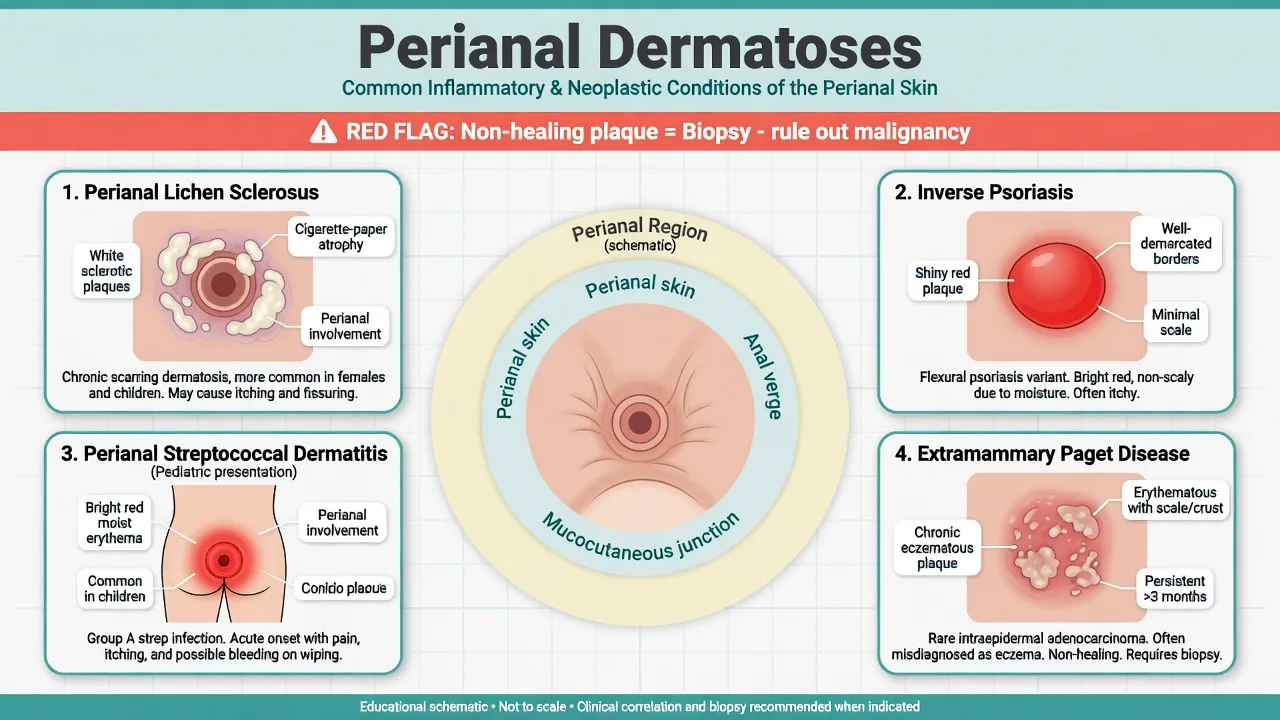
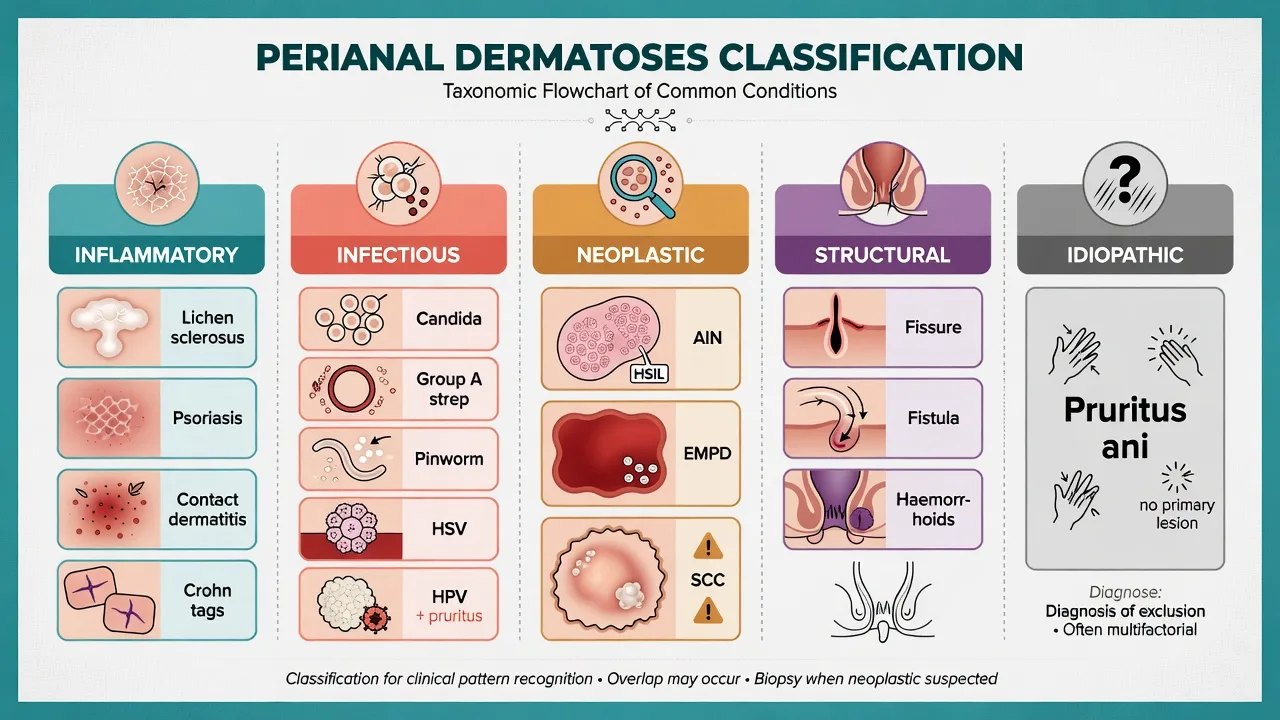
Perianal dermatoses are disorders of the anal verge, perianal skin, and natal cleft. Pruritus ani means itch in this territory; it is a presentation that must be decomposed into a cause.[4][5] Special-site constraints — moisture, faecal enzymes, occlusion, friction, and sexual exposure — amplify irritant, infectious, and neoplastic risk compared with dry truncal skin.
Classification
Inflammatory
Infectious
Neoplastic
Structural / IBD
Idiopathic
Epidemiology & Risk Factors
Moisture-associated skin damage, obesity, diabetes, diarrhoea or constipation with soiling, aggressive cleansing, and topical sensitizers drive much primary-care disease.[4][10] Pinworm peaks in school-age children with nocturnal itch and household clustering.[11] Perianal streptococcal dermatitis is a paediatric classic.[6][7] EMPD and SCC are diseases of mid-to-late adulthood; chronic anogenital LS fields carry malignancy risk shared with other genital LS sites.[1][8]
Pathophysiology
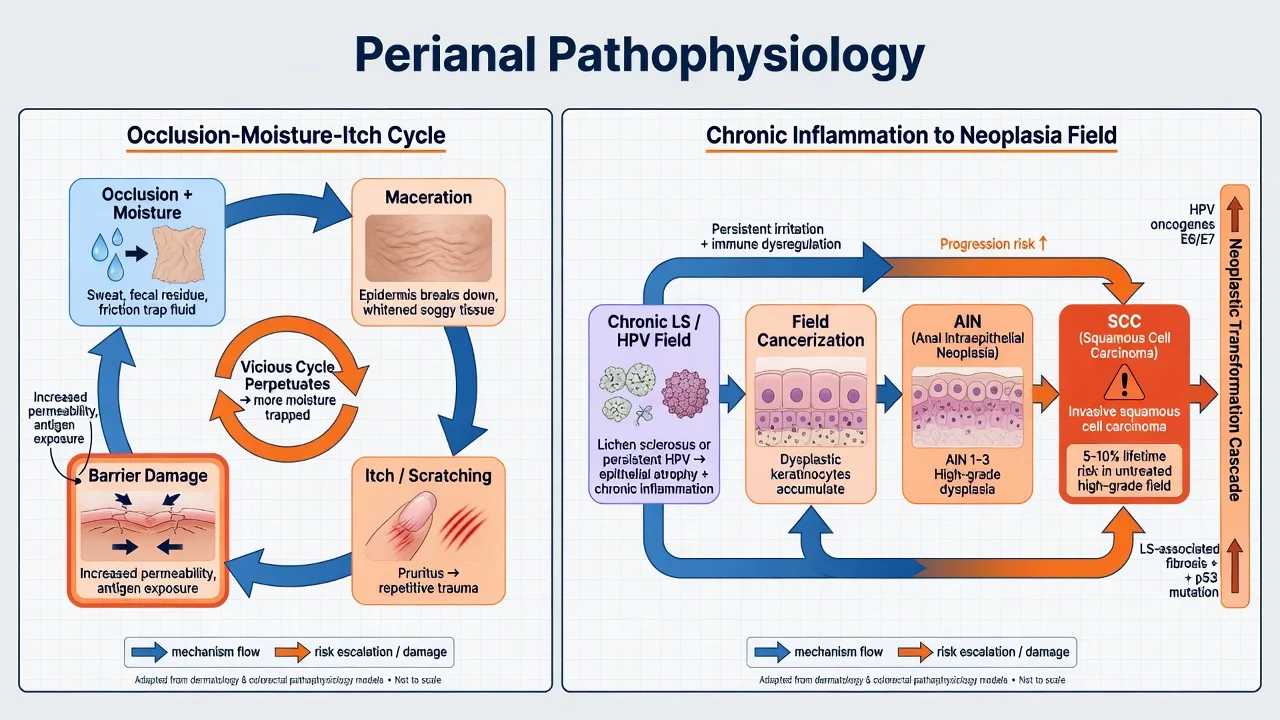
The itch–scratch cycle perpetuates barrier failure: faecal enzymes and moisture macerate skin; scratching thickens and fissures the verge; more itch follows.[4][5] Anogenital lichen sclerosus follows autoimmune–fibrotic pathways with white sclerosis, fissuring, and field cancerisation risk analogous to genital LS.[1][2] Group A streptococcus thrives on moist paediatric perianal skin; Enterobius causes nocturnal mechanical and allergic itch from gravid females migrating to the perianal skin.[6][11]
Clinical Presentation
Pruritus ani (symptom complex)
Burning, rawness, and night worsening are common. Look for lichenification, excoriations, and secondary infection rather than stopping at the itch label.[4]
Lichen sclerosus (perianal)
White sclerotic plaques, cigarette-paper atrophy, fissures, and figure-of-eight anogenital patterns when contiguous with vulval/penile disease. Painful defecation and secondary constipation may dominate.[1][2]
Inverse psoriasis
Well-demarcated shiny red plaques of the natal cleft/perianal skin, often with minimal scale; check scalp, nails, and extensors. [1]
Perianal streptococcal dermatitis
Bright red, moist, well-marginated perianal erythema in a child — often mislabelled as candidiasis or eczema.[6][7]
Pinworm
Intense nocturnal perianal itch in a school-age child; may see restless sleep or secondary dermatitis; household members often share exposure.[11]
Extramammary Paget disease
Chronic eczematous, oozing, or scaly plaque that fails appropriate anti-inflammatory therapy — a classic delayed diagnosis.[8][9]
Structural / IBD
Sentinel tags, fissures, and fistulae point to colorectal disease; complex tags and fistulae raise Crohn concern and need specialist pathways rather than endless topical steroids alone.[10]
Differential Diagnosis
| Finding | Prefer | Key distinguisher |
|---|---|---|
| White sclerosis + fissures | Perianal LS | Contiguous genital LS; figure-of-eight pattern |
| Shiny red plaque ± other psoriasis sites | Inverse psoriasis | Well-demarcated; nail/scalp clues |
| Bright red moist child | GAS dermatitis | Swab culture; systemic antibiotics |
| Night itch school-age | Pinworm | Tape test; household treatment |
| Satellite pustules + diabetes | Candida | Microscopy/culture |
| Chronic steroid-refractory plaque | EMPD / AIN | Biopsy mandatory |
| Fistula / complex tags | Crohn / structural | Colorectal assessment |
Clinical & Bedside Assessment
- Duration, night predominance, bowel habit, incontinence, products used for cleansing, sexual history, systemic features.
- Inspect perianal skin, natal cleft, genitalia, intertriginous folds, scalp/nails for psoriasis.
- Palpate for induration or nodules.
- In children: ask specifically about nocturnal itch and contacts.
- Document and photograph with consent for chronic inflammatory disease follow-up. [1]
Investigations
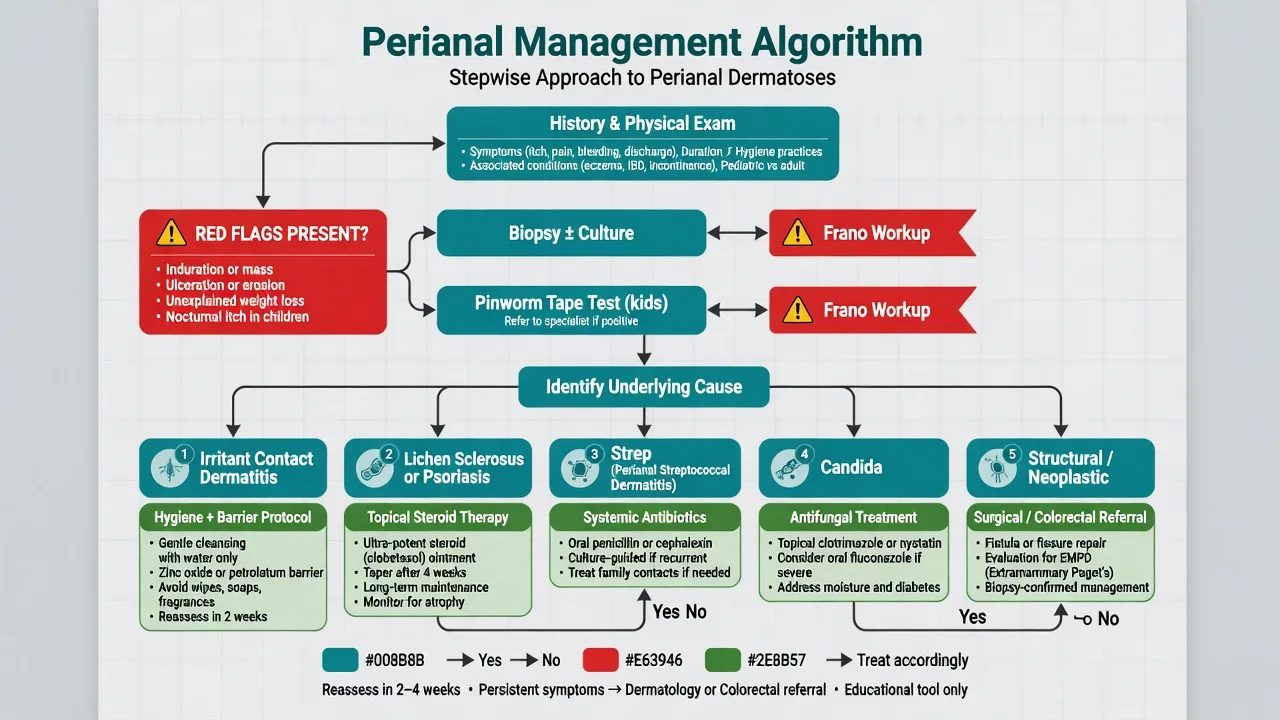
Targeted, not shotgun. Swab when infectious morphology dominates (especially paediatric bright erythema for GAS).[6][7] Cellophane-tape test in the morning for pinworm suspicion.[11] Biopsy indurated, ulcerated, pigmented, or treatment-refractory plaques for EMPD/AIN/SCC.[8] Refer for colorectal assessment when fissure/fistula/haemorrhoid disease or IBD features dominate.[10]
Management — Resuscitation
Abscess, necrotising infection, or severe systemic sepsis is a surgical emergency. Acute severe anorectal pain with fever is not managed as idiopathic pruritus ani. [1]
Management — Definitive & Stepwise
Shared care: gentle cleansing, pat dry, soft toilet tissue or water wash, barrier ointment, treat diarrhoea/constipation, stop harsh antiseptics and fragranced wipes.[5][10]
Anogenital LS: ultra-potent topical corticosteroid ointment on a structured induction/maintenance plan per EuroGuiderm/S3 principles; lifelong surveillance for neoplastic change.[1][2][3]
Inverse psoriasis: special-site topical anti-inflammatory strategy (often lower-irritancy vehicles; escalate per psoriasis pathways when extensive). [1]
Candida: topical imidazole plus glucose control when relevant; avoid chronic empirical antifungal without reassessment. [1]
Perianal strep: culture-guided systemic antibiotic therapy appropriate to local protocols; topical measures alone are insufficient for classic disease.[6][7]
Pinworm: anthelmintic therapy for the index case and usually household contacts, plus morning hygiene and nail care to interrupt autoinfection.[11]
EMPD / AIN / SCC: biopsy-confirmed multidisciplinary management (dermatology, colorectal, oncology as indicated).[8][9]
Specific Subtypes & Scenarios
Paediatric: think strep and pinworm before chronic steroid labelling.[6][11]
IBD: non-fistulising tags still need Crohn awareness when other clues exist; fistulising disease is not a primary steroid-only dermatosis. [1]
Immunosuppression / HIV: lower threshold for HSV PCR, HPV-related neoplasia work-up, and biopsy. [1]
Complications & Pitfalls
- Masking EMPD with years of topical steroid.[8]
- Calling every red bottom candida.
- Missing LS field risk and fissure-related constipation cycle.[1]
- Treating structural disease with dermatology topicals alone.[10]
- Overcalling child abuse when strep or pinworm explain the findings — but escalate safeguarding when history and exam do not fit.
Prognosis & Disposition
Infectious and irritant disease usually remits with cause-directed care. LS is chronic and needs maintenance plus surveillance.[2][3] EMPD and AIN require specialty follow-up after definitive therapy.[8]
Special Populations
Infants overlap with nappy dermatitis pathways. Elderly patients with incontinence need moisture-associated skin damage protocols. Athletes and cyclists get friction–occlusion dermatitis. [1]
Evidence, Guidelines & Regional Differences
S3/EuroGuiderm LS documents anchor ultra-potent topical steroid use for anogenital disease including perianal involvement.[2][3] Primary-care anorectal frameworks triage fissure, fistula, and haemorrhoids away from pure dermatology silos.[10] Pinworm remains a high-yield community paediatrics problem worldwide.[11]
Exam Pearls
ANUS pearls
- Perianal LS shares the ultra-potent steroid + surveillance doctrine of genital LS.[1][3]
- EMPD looks like eczema that will not die.[8]
- GAS needs culture and systemic antibiotics.[6]
- Structural disease needs colorectal eyes.[10]
Exam application bank (NEET-PG / INICET)
One-line answer
Multi-board perianal dermatoses atlas: pruritus ani as a symptom not a diagnosis, inflammatory (lichen sclerosus, inverse psoriasis, contact), infectious (candida, group A streptococcus, pinworm, HSV/HPV), structural colorectal mimics (fissure, fistula, Crohn tags), neoplastic red flags (EMPD, AIN, SCC), bedside assessment, swab/tape/biopsy thresholds, and stepwise hygiene–steroid–antimicrobial–surgical management aligned with anogenital LS guidance and primary-care anorectal frameworks.
Worked stems (answer without another resource)
Stem 1 — Classic presentation. Map symptoms to mechanism; name the first investigation and first treatment step with dose/route if drug therapy is standard. [1]
Stem 2 — Unstable / complicated. List red flags that force immediate resuscitation, theatre, ICU, antidote, or reperfusion — and what you do in the first 15 minutes. [1]
Stem 3 — Atypical group. Elderly, pregnancy, child, or immunocompromised: how presentation and thresholds change. [1]
Stem 4 — Differential trap. Name the three closest mimics and one discriminator for each. [1]
Stem 5 — Disposition. Who goes home with safety-netting, who is admitted, who needs HDU/ICU/theatre, and what follow-up is mandatory. [1]
Rapid viva checklist
- Definition + classification
- Pathophysiology chain
- Bedside signs / criteria
- Score with exact components (if any)
- Emergency bundle
- Definitive therapy with doses
- Complications of disease and of treatment
- Special populations
- Guideline/trial name if classic
- Three exam traps
Coverage self-check
If you cannot answer any stem above from this page alone, re-read the matching section — the page is intended to be self-sufficient for final-prof and NEET-PG/INICET questions on Perianal dermatoses.
Expanded exam teaching (depth pass)
Clinical reasoning
For Perianal dermatoses, examiners test whether you can prioritise life threats, choose the right first test, and give specific therapy (agent, dose, route, timing). Generic phrases without numbers score poorly.
Mechanism → feature map
Build a short chain: cause → pathophysiologic intermediate → clinical feature → complication. Every major symptom in the classic vignette should sit on that chain.
Investigation strategy
- Bedside/first-line tests that change immediate management
- Confirmatory or staging tests
- What a normal result does not exclude
- When not to delay treatment for imaging (unstable patient)
Management ladder
- Resuscitation / ABC / sepsis or haemorrhage bundle as relevant
- Specific antidote / procedure / antimicrobial / reperfusion / surgery
- Supportive care and monitoring targets
- Definitive long-term therapy and secondary prevention
- Disposition and safety-net advice
Special populations
Always prepare one line each for children, pregnancy, elderly, renal/hepatic impairment, and immunocompromised patients when the topic allows.
Pitfalls that fail candidates
- Treating the number not the patient
- Missing pregnancy status when relevant
- Imaging before stabilisation
- Wrong empiric cover or wrong antidote timing
- Incomplete counselling on recurrence, adherence, or red-flag return
Multi-board perianal dermatoses atlas: pruritus ani as a symptom not a diagnosis, inflammatory (lichen sclerosus, inverse psoriasis, contact), infectious (candida, group A streptococcus, pinworm, HSV/HPV), structural colorectal mimics (fissure, fistula, Crohn tags), neoplastic red flags (EMPD, AIN, SCC), bedside assessment, swab/tape/biopsy thresholds, and stepwise hygiene–steroid–antimicrobial–surgical management aligned with anogenital LS guidance and primary-care anorectal frameworks. [1]
Structured revision sheet
Must-know numbers and names
List every score, size threshold, dose, and time window from this topic on a blank page from memory, then check against the sections above.
Three classic MCQ angles
- Most likely diagnosis given a vignette
- Next best step in management
- Most appropriate investigation
Three classic SAQ angles
- Pathophysiology in five steps
- Management algorithm with doses
- Complications and prevention
Clinical station flow
Greet → focused history → targeted exam → investigations → explain diagnosis → emergency care → definitive plan → safety-net / follow-up → answer examiner questions on mechanism and pitfalls.
Exam anchors
References
- [1]De Luca DA, Papara C, Vorobyev A, et al. Lichen sclerosus: The 2023 update Front Med (Lausanne), 2023.PMID 36873861
- [2]Kirtschig G, Becker K, Günthert A, et al. Evidence-based (S3) Guideline on (anogenital) Lichen sclerosus J Eur Acad Dermatol Venereol, 2015.PMID 26202852
- [3]Kirtschig G, Kinberger M, Kreuter A, et al. EuroGuiderm guideline on lichen sclerosus-Treatment of lichen sclerosus J Eur Acad Dermatol Venereol, 2024.PMID 38822598
- [4]Swamiappan M. Anogenital Pruritus - An Overview J Clin Diagn Res, 2016.PMID 27190932
- [5]Weichert GE. An approach to the treatment of anogenital pruritus Dermatol Ther, 2004.PMID 14756897
- [6]Krol AL. Perianal streptococcal dermatitis Pediatr Dermatol, 1990.PMID 2359737
- [7]Palha MJ, Limão S, Santos MC, et al. Perianal streptococcal dermatitis Pediatr Neonatol, 2019.PMID 31036462
- [8]St Claire K, Hoover A, Ashack K, et al. Extramammary Paget disease Dermatol Online J, 2019.PMID 31046904
- [9]Navajas Hernández P, Valdés Delgado T, Machuca Aguado J, et al. Perianal Paget's disease Rev Esp Enferm Dig, 2023.PMID 36412481
- [10]Cohee MW, Hurff A, Gazewood JD. Benign Anorectal Conditions: Evaluation and Management Am Fam Physician, 2020.PMID 31894930
- [11]Leung AKC, Lam JM, Barankin B, et al. Pinworm (Enterobius Vermicularis) Infestation: An Updated Review Curr Pediatr Rev, 2025.PMID 38288810