Dermatology · Medicine
Phototherapy
Also known as Phototherapy · UV therapy · UVB phototherapy · Narrowband UVB · PUVA · UVA1 · Excimer 308 nm · Light therapy
Phototherapy is the therapeutic use of non-ionising ultraviolet (UV) radiation, alone or with a photosensitising psoralen, to treat inflammatory and neoplastic skin disease. Narrowband UVB (nbUVB) 311-313 nm is the gold-standard first-line modality for psoriasis, atopic dermatitis and vitiligo; it is safe in pregnancy and children, has no drug interactions, and is delivered two to three times weekly. PUVA (psoralen + UVA 320-400 nm) is more potent and reaches deeper dermal infiltrates but carries a strongly cumulative squamous-cell carcinoma risk (especially beyond 200 treatments) and is contraindicated in pregnancy. UVA1 340-400 nm treats localised scleroderma and mastocytosis. Excimer 308 nm delivers targeted narrowband UVB to localised psoriasis and vitiligo. Safety demands UV eye protection for patient and staff, genital shielding, cumulative dose tracking, annual skin-cancer screening, and exclusion of lupus, xeroderma pigmentosum and photosensitising drugs.
On this page & tools
Your progress
Saved locally on this device.
Exam tags
Red flags
Overview & Definition
Phototherapy is the deliberate, controlled therapeutic use of non-ionising ultraviolet (UV) radiation — either alone or combined with a photosensitising drug — to treat skin disease. It exploits a paradox that is the cornerstone of its efficacy: the same wavelengths that damage skin in sunlight are, when delivered in measured doses, powerfully anti-inflammatory, immunosuppressive and anti-proliferative. The clinical birth of modern phototherapy was the 1925 observation by William Goeckerman at the Mayo Clinic that combining crude coal tar with UV light cleared psoriasis; half a century later, in 1974, John Parrish and colleagues introduced PUVA (psoralen plus UVA), which transformed the treatment of widespread psoriasis and cutaneous T-cell lymphoma.[1]
The pivotal advance of the modern era was the introduction of narrowband UVB (nbUVB) at 311-313 nm in the late 1980s. A single emission line, concentrated at the most therapeutically active and least erythemogenic part of the UVB spectrum, gave nbUVB a markedly better efficacy-to-safety ratio than broadband UVB, and it has displaced broadband UVB and, in many indications, PUVA, as the workhorse of phototherapy units worldwide.[1]
[1]UV physics: why wavelength is everything
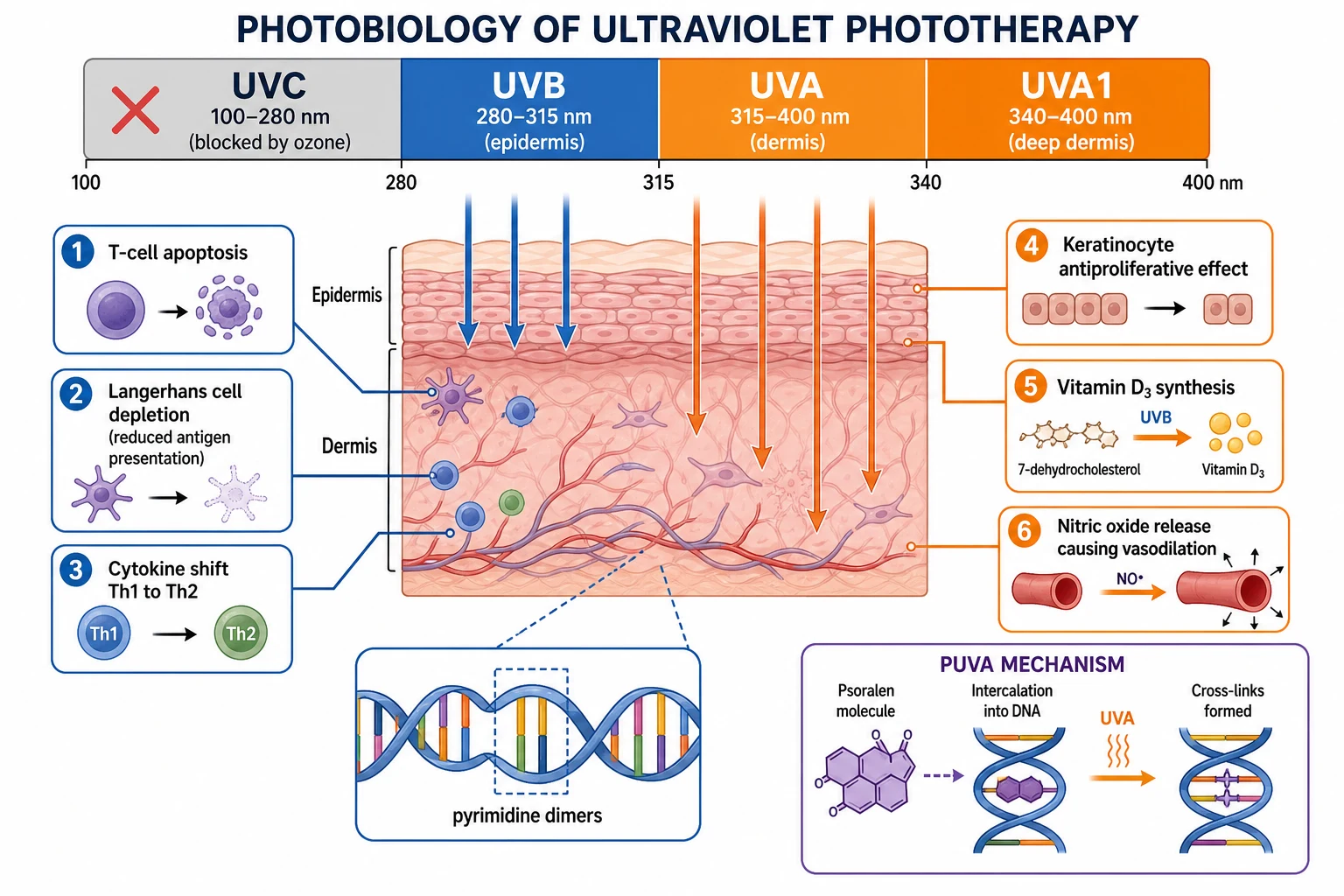
The UV spectrum reaching or used in clinical practice divides into three bands distinguished by penetration depth and biological effect. UVC (100-280 nm) is almost completely absorbed by stratospheric ozone and is clinically irrelevant except as a germicidal lamp — it never reaches the skin in nature and is not used therapeutically. UVB (280-315 nm) is absorbed largely in the epidermis and papillary dermis; it is the most erythemogenic band and the one responsible for sunburn and most of vitamin D synthesis. UVA (315-400 nm) penetrates into the dermis and is less erythemogenic but deeply immunosuppressive; UVA1 (340-400 nm) is the longest, deepest-penetrating therapeutic subdivision.[1]
Therapeutic phototherapy exploits three discrete windows within these bands. Broadband UVB (280-320 nm), the original Goeckerman-era source, is now largely obsolete because its broad emission includes shorter, more burning wavelengths that add erythema without adding efficacy. Narrowband UVB (311-313 nm), delivered by fluorescent tubes (TL-01) or LEDs that emit a single peak, concentrates the dose at the most biologically effective wavelength and is the modern gold standard. PUVA combines a psoralen (a furocoumarin, almost always 8-methoxypsoralen, 8-MOP / methoxsalen) with UVA 320-400 nm; the psoralen intercalates into DNA and, on absorbing a UVA photon, forms covalent interstrand cross-links, dramatically amplifying the anti-proliferative effect deep into the dermis.[1][6]
Epidemiology & Risk Factors
Phototherapy use has shifted over the past two decades. The arrival of highly effective targeted biologics and small-molecule inhibitors for psoriasis and atopic dermatitis has reduced phototherapy's share of first-line systemic therapy in well-funded systems, but it remains among the most cost-effective, globally accessible and pregnancy-safe options, and many patients who fail, cannot afford, or decline injectable therapy are excellent candidates.[2] A randomised trial published in 2024 confirmed that home-based nbUVB is non-inferior to office-based treatment for psoriasis, expanding access further.[15]
The epidemiology of risk in phototherapy is the epidemiology of cumulative UV exposure. The landmark PUVA follow-up cohort assembled by Stern and colleagues in the United States has tracked the same patients for over four decades and established the dose-response relationship that governs all phototherapy prescribing. The risk of squamous cell carcinoma (SCC) rises in clear proportion to the number of PUVA treatments, with a marked inflection beyond approximately 200 sessions; high cumulative exposure is associated with a roughly 100-fold increase in SCC risk.[4] Melanoma risk becomes significantly elevated after 250 treatments, with the excess appearing approximately fifteen years after first exposure.[5] Even within the supposedly safer nbUVB arm, Lim and Stern showed that high cumulative UVB exposure also raises non-melanoma skin cancer risk in the PUVA cohort — nbUVB is much safer than PUVA but is not entirely cancer-free.[7]
The principal patient-level risk factors for an adverse outcome are: Fitzpatrick skin type I-II (burns easily — lower starting dose, slower escalation); the use of photosensitising drugs (thiazides, tetracyclines, sulphonamides, fluoroquinolones, retinoids, NSAIDs, St John's wort, amiodarone); a personal or family history of melanoma or multiple non-melanoma skin cancers; and the photosensitivity dermatoses themselves — lupus erythematosus, chronic actinic dermatitis, solar urticaria and the porphyrias — in which UV provokes rather than treats disease.[1]
Pathophysiology — How Ultraviolet Light Treats Skin Disease
The therapeutic action of UV is not a single mechanism but a convergent set of photobiological events. Understanding them is the key to choosing the right modality and predicting the patient who will respond. [1]
1. DNA is the primary chromophore for UVB
UVB photons are absorbed by nucleic acids, producing cyclobutane pyrimidine dimers and 6-4 photoproducts. Far from being mere damage, this is therapeutic: the dimers trigger apoptosis of pathogenic T-cells residing in the epidermis and papillary dermis in psoriasis, atopic dermatitis and cutaneous T-cell lymphoma. The activated, disease-driving T-cell clone is selectively more vulnerable to UV-induced apoptosis than resting T-cells because it is already in a high-turnover state. For UVA, the chromophore is different: reactive oxygen species rather than direct DNA photoproducts, and Morita and colleagues demonstrated that singlet-oxygen-induced T-helper cell apoptosis is the basic mechanism of UVA1 phototherapy.[6]
2. Immunosuppression: Langerhans cells and the cytokine shift
UV depletes epidermal Langerhans cells — the principal antigen-presenting cells of the skin — and impairs their ability to present antigen to T-cells in draining lymph nodes. This local immunosuppression dampens the T-cell-driven inflammation that underlies psoriasis and eczema. UV also induces a cytokine shift away from the Th1/Th17 axis (interleukin-17, interleukin-23, tumour necrosis factor-alpha — the central drivers of psoriasis) toward a Th2 profile (interleukin-4, interleukin-10), and expands regulatory T-cells (Tregs) that actively suppress inflammation.[2][6] This immune rebalancing is why phototherapy works for autoimmune skin disease and also why it transiently reduces vaccination responses and increases susceptibility to herpesvirus reactivation.
3. Anti-proliferative effect on keratinocytes
In psoriasis the epidermis turns over every three to five days rather than every twenty-eight. UVB, and more potently PUVA, slows this runaway keratinocyte proliferation by halting cell-cycle progression; the psoralen-DNA interstrand cross-links formed by PUVA are particularly effective because they physically block DNA replication in rapidly dividing cells.[1]
4. Vitamin D synthesis and nitric oxide
UVB converts 7-dehydrocholesterol in the skin to previtamin D3, which equilibrates to vitamin D3; this contributes to the anti-proliferative effect and partly explains why topical vitamin D analogues (calcipotriol, calcitriol) synergise with nbUVB. UVA also triggers release of nitric oxide from skin stores, causing vasodilation and a modest systemic blood-pressure-lowering effect — an unrelated but genuine cardiovascular side-benefit of phototherapy courses.[1]
5. PUVA: amplifying the effect
Psoralen (8-MOP) is ingested or applied topically and intercalates between DNA base pairs. On absorbing a UVA photon, it reacts with a pyrimidine base on the opposite strand, forming a covalent interstrand cross-link that is far more cytotoxic than a single-strand dimer. This is why PUVA clears thicker plaques, deeper atrophic and infiltrative disease (such as cutaneous T-cell lymphoma), and recalcitrant palmoplantar psoriasis that nbUVB cannot reach.[1]
Classification of Modalities
A working classification groups the modalities by wavelength and by whether a photosensitiser is used. The categories below cover every form of phototherapy an examiner will name. [1]
Narrowband UVB (nbUVB) 311-313 nm
Broadband UVB 280-320 nm
PUVA (psoralen + UVA 320-400 nm)
UVA1 340-400 nm
Targeted phototherapy (excimer 308 nm)
Whole-body cabinet nbUVB is the most common delivery system, but regional units extend phototherapy to difficult sites: hand-foot units for palmoplantar psoriasis and dermatitis, scalp units with a comb applicator for scalp disease, and targeted excimer for discrete lesions.[1]
Clinical Presentation — When Is Phototherapy the Right Answer?
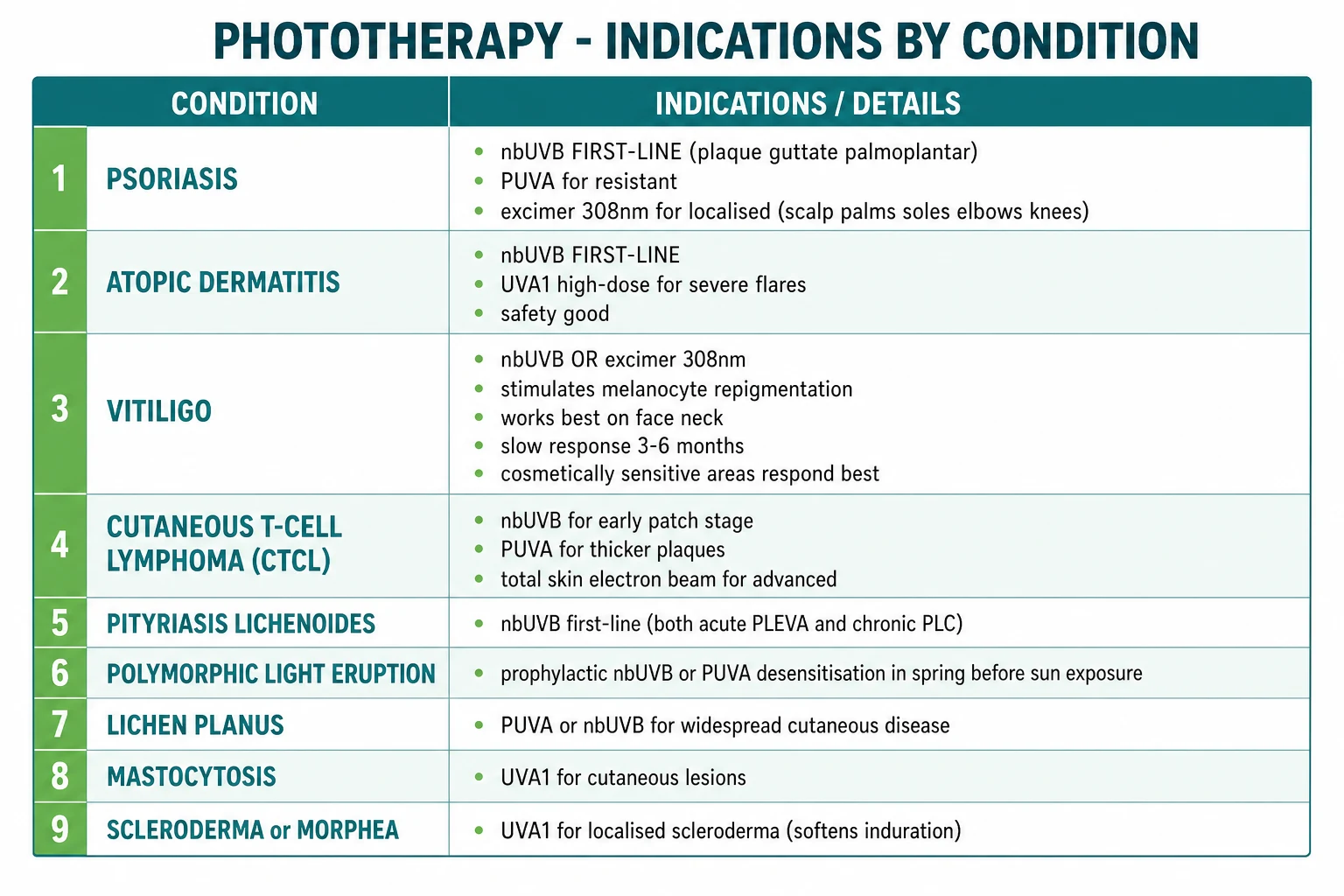
Because phototherapy treats manifestations rather than a single disease, the "presentation" is the patient whose skin disease has outgrown topical therapy. The common referral scenarios, and the questions each raises, are: [1]
- Widespread plaque psoriasis unresponsive to topicals or where topical burden is intolerable — nbUVB is first-line; acitretin or methotrexate may be added.[2]
- Guttate psoriasis following streptococcal pharyngitis — often exquisitely nbUVB-responsive, sometimes clearing completely after a short course.[2]
- Moderate-to-severe atopic dermatitis where topical steroids and calcineurin inhibitors are insufficient — nbUVB is first-line phototherapy; UVA1 may be used for acute flares.[10]
- Vitiligo on the face, neck or trunk in a motivated patient — nbUVB or excimer 308 nm, accepting that response is slow (months) and incomplete on hands and feet.[3]
- Early cutaneous T-cell lymphoma (mycosis fungoides) patch stage — nbUVB or PUVA are skin-directed first-line; PUVA preferred for thicker infiltrate.[1]
- Polymorphic light eruption — a short spring course of prophylactic desensitisation (hardening) before sun exposure.[14]
- Palmoplantar psoriasis or pompholyx — hand-foot nbUVB or PUVA.
- Pruritus, prurigo nodularis, and uraemic or HIV-related pruritus — nbUVB can relieve itch.
- Graft-versus-host disease and chronic GVHD — nbUVB and extracorporeal photopheresis respectively.
Atypical presentations examiners test deliberately: the pregnant woman with severe psoriasis (nbUVB is safe — PUVA is not); the child with widespread atopic dermatitis (nbUVB is safe and effective, with care to avoid cumulative-dose concerns over a lifetime); the patient with psoriasis and a history of melanoma (avoid PUVA, weigh cumulative nbUVB); and the patient with a photosensitivity disorder referred in error for "phototherapy" — lupus, chronic actinic dermatitis and porphyria must be excluded before any course begins, because UV will provoke, not treat, their disease.[1]
Differential Diagnosis and Modality Selection
Because phototherapy is a treatment rather than a diagnosis, the "differential" question becomes: which modality, and is UV even appropriate? The decision hinges on disease, depth of infiltrate, patient factors, and cumulative UV history. [1]
A patient with superficial inflammatory disease — psoriasis, atopic dermatitis, vitiligo, PMLE, pityriasis lichenoides — is best served by nbUVB first-line. A patient with deeper or more infiltrative disease — thick palmoplantar psoriasis, plaque-stage mycosis fungoides, lichen planus, and disease that has failed nbUVB — moves to PUVA. A patient with scleroderma or mastocytosis is offered UVA1, which has a distinct mechanistic rationale (deep dermal penetration, collagen-modulating and mast-cell-suppressive effects).[11][12] A patient with discrete, localised lesions (a few stubborn plaques, segmental vitiligo on the face) is best served by targeted excimer 308 nm, which spares uninvolved skin and delivers a higher fluence per lesion.[8][9]
The critical exclusion differential is the photosensitivity dermatosis that mimics a phototherapy-responsive disease but will be provoked by UV. Lupus erythematosus (systemic and subacute cutaneous) is the paradigm: UV provokes both skin lesions and systemic flares, and phototherapy is contraindicated. Chronic actinic dermatitis and solar urticaria are likewise excluded. The porphyrias (porphyria cutanea tarda, erythropoietic protoporphyria) are aggravated by light, and a phototherapy course in an undiagnosed porphyric patient can precipitate severe skin pain and liver injury. Any patient with a history of photoaggravated skin lesions deserves an antinuclear antibody and porphyrin screen before a course is begun.[1]
Clinical & Bedside Assessment
The pre-treatment assessment is short but critical, because almost every serious adverse event in phototherapy is preventable at this visit. [1]
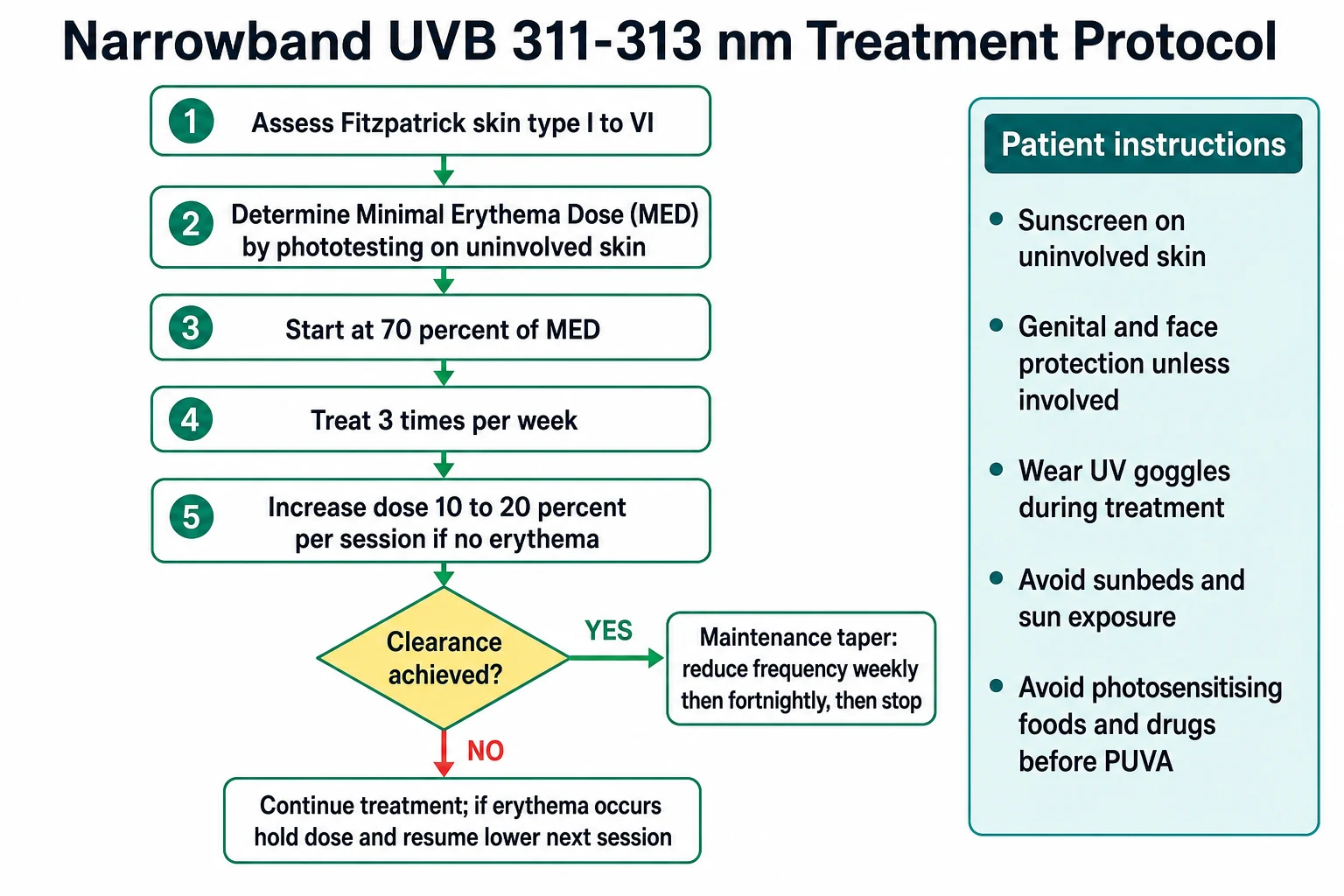
Fitzpatrick skin typing is the master determinant of dose and is performed on every patient. The scale runs from type I (always burns, never tans, very fair) through type VI (deeply pigmented, never burns). It determines the minimal erythema dose (MED) — the lowest UV dose producing minimally perceptible erythema at twenty-four hours — and therefore the starting dose and the size of each increment.[1]
The MED is measured directly by phototesting on uninvolved buttock or back skin with a calibrated template delivering a logarithmic series of doses, read at twenty-four hours; in busy units a skin-type-based starting dose (around 70 percent of the expected MED) is used instead and the patient's erythema response to the first treatments substitutes for formal phototesting.[1]
The focused assessment also documents: baseline disease severity (PASI and body surface area for psoriasis, EASI for atopic dermatitis); a full medication history flagging photosensitisers; cumulative prior phototherapy and PUVA sessions (to calculate remaining lifetime allowance); a full skin examination to detect any lesion that warrants biopsy before a course begins; and pregnancy status. Standardised baseline photographs anchor objective response assessment at each subsequent visit.[1]
Investigations
Phototherapy is a clinical decision and most patients need no investigations beyond the bedside assessment. Three targeted work-ups, however, are essential in defined situations.[1]
When photosensitivity is suspected — a history of rash on sun-exposed sites, unexplained "sun allergy", or a known connective tissue disease — an antinuclear antibody (ANA) with extractable nuclear antigens (Ro/La) is sent to exclude subacute cutaneous or systemic lupus, and plasma and urine porphyrins to exclude porphyria. A positive Ro antibody is a particular red flag: subacute cutaneous lupus is intensely photosensitive and a phototherapy course would be catastrophic. [1]
When the diagnosis is uncertain — particularly the distinction between early mycosis fungoides and a benign eczematous or psoriasiform eruption — a skin biopsy with histopathology and, if necessary, T-cell receptor gene rearrangement studies is performed before committing to phototherapy, which can mask but not cure lymphoma. In suspected Sézary syndrome, flow cytometry of peripheral blood for the neoplastic CD4+/CD7- or CD4+/CD26- T-cell clone is added.[1]
Baseline investigations for PUVA (oral 8-MOP) include liver function tests (psoralen is hepatically metabolised; severe impairment is a contraindication) and, where relevant, an ophthalmology assessment to document baseline lens status before a course that will require twenty-four-hour UVA eye protection. [1]
Management — Resuscitation: The Acute Phototoxic Reaction
Phototherapy is elective and ambulatory, and the indication itself is never an emergency — but two genuine acute events can arise during a course and the operator must recognise and manage both.[1]
Acute UV burn (phototoxicity). Overexposure from a miscalibrated dose, a missed erythema read, or an undisclosed photosensitising drug can produce confluent erythema with tenderness, blistering and, in severe cases, systemic upset within eight to twenty-four hours of treatment. The patient typically telephones the next morning. Management is that of any thermal-UV burn: stop the course immediately, cool the affected skin with cool compresses, apply a potent topical corticosteroid (for example betamethasone valerate 0.1 percent) twice daily to blunt inflammation, give oral analgesia (paracetamol with or without a short course of codeine), and cover erosions with non-adherent dressings. Extensive blistering warrants assessment of fluid status and, rarely, admission for intravenous fluids along the same principles as a thermal burn. The patient returns to treatment only once fully healed, restarting at a dose at least one step below that which caused the burn, with a careful review of the medication list for a missed photosensitiser.[1]
PUVA-induced nausea. Oral 8-MOP commonly causes nausea and, less often, vomiting, typically one to three hours after ingestion. Management is stepwise: take the dose with food, reduce the dose, switch to bath PUVA (which avoids systemic psoralen and the nausea), or use 5-MOP (bergapten), which is less emetogenic but less widely available. An antiemetic such as ondansetron 4 mg orally thirty minutes before the psoralen helps the patient who cannot otherwise tolerate oral PUVA.[1]
Acute phototherapy burn — immediate steps
Stop further treatment; assess extent and depth of erythema and blistering
Cool compresses to affected skin for 15-20 minutes; reassure
Apply a potent topical corticosteroid (e.g. betamethasone valerate 0.1%) twice daily; cover erosions with non-adherent dressings
Oral analgesia (paracetamol +/- codeine); assess hydration if blistering is extensive
Re-check the medication list for a photosensitising drug (thiazide, tetracycline, sulphonamide, fluoroquinolone, St John's wort)
On recovery, resume at a reduced dose (one step below the causative dose) and review the cause to prevent recurrence
Management — Narrowband UVB: The First-Line Protocol
Narrowband UVB is the first-line phototherapy for most indications and its protocol is the one every candidate must be able to recite.[1]
Dosing. Treatment is delivered two to three times weekly (never on consecutive days, to allow erythema assessment). The starting dose is either 70 percent of the measured MED or a skin-type-based estimate. Each subsequent dose is increased by 10 to 20 percent (typically 10 percent in fair skin, 20 percent in dark skin) provided there was no erythema after the previous session. If a mild asymptomatic erythema appears, the dose is held constant; if symptomatic erythema or blistering occurs, treatment is withheld until resolution and resumed at a lower dose.[1]
Course length and maintenance. A typical clearance course is fifteen to thirty treatments over six to ten weeks. Once clearance (PASI-90 or physician global assessment of clear/almost clear) is achieved, the patient may taper: weekly treatments for four weeks, then fortnightly for four weeks, then stop. Open-ended maintenance is avoided because every treatment adds to lifetime cumulative dose; a planned taper with a clear end-point is preferred.[1]
Combination with topical and systemic therapy. nbUVB is most effective when combined with adjuncts. Topical calcipotriol or a vitamin D analogue plus nbUVB clears psoriasis faster than either alone. A topical corticosteroid continues through the course for atopic dermatitis. Systemic acitretin 25-50 mg daily (a "Re-UVB" or "Re-PUVA" combination) markedly improves psoriasis clearance and reduces the cumulative UV dose required; it is the classic combination for difficult plaque psoriasis, though acitretin is teratogenic and excluded in women of childbearing potential. Methotrexate can be combined cautiously with nbUVB. The combination of biologics with phototherapy is increasingly studied; it may accelerate clearance but raises theoretical immunosuppression concerns and is not routine.[2]
Acitretin + nbUVB (Re-UVB)
Dose
Acitretin 25-50 mg once daily, started 1-2 weeks before phototherapy and continued through the course
Management — PUVA: The More Potent Second-Line
PUVA is reserved for disease that is too thick, too deep, or has failed nbUVB. Its protocol differs in three respects: a photosensitising drug, deeper-penetrating UVA, and a strict lifetime ceiling.[1]
Oral PUVA. 8-Methoxypsoralen (methoxsalen) is given orally at 0.4 to 0.6 mg per kilogram (typically 0.6 mg/kg), one to two hours before UVA exposure, taken with food or milk to reduce nausea. The initial UVA dose is based on Fitzpatrick skin type and prior burning history, typically 1 to 3 J/cm2 for skin types I-IV and 3-5 J/cm2 for types V-VI. Treatments are given two to four times weekly (never two days in a row), with doses increased by 0.5 to 1.5 J/cm2 per session as tolerated. Clearance typically takes fifteen to twenty-five treatments.[1]
Bath PUVA. A dilute solution of 8-MOP (around 0.5-1 mg/L of bathwater) is used to soak the affected skin for fifteen minutes, followed immediately by UVA. Bath PUVA delivers high skin psoralen levels with negligible systemic absorption, eliminating nausea and the twenty-four-hour ocular protection requirement, and is the preferred route for palmoplantar disease and in patients who cannot tolerate oral psoralen. [1]
Cream PUVA is a further variant, applying a psoralen cream to localised areas before UVA. [1]
Lifetime ceiling. Because SCC risk rises steeply beyond approximately 200 sessions, a practical lifetime maximum of 200 PUVA sessions is observed, with many units preferring fewer than 150. The cumulative dose and session count are recorded in the patient's notes and at the phototherapy unit.[4]
Oral PUVA
Bath/soak PUVA
Cream PUVA
Management — UVA1, Excimer, Daycare Regimens and Combination Therapy
UVA1 (340-400 nm)
UVA1 phototherapy delivers the longest therapeutic wavelengths without a psoralen, reaching deep dermis and acting chiefly through reactive-oxygen-species-mediated T-cell apoptosis and collagen modulation. It is the first-line phototherapy for localised scleroderma and morphea, where it softens induration over several months, and for mastocytosis, where it suppresses cutaneous mast-cell burden.[11][12] High-dose UVA1 (up to 130 J/cm2) is also used for severe atopic dermatitis flares. Treatment is given three to five times weekly for several weeks. A five-year retrospective single-centre study found UVA1 carcinogenic risk to be low, supporting its use in chronic inflammatory disease.[16]
Targeted phototherapy: excimer 308 nm
The xenon-chloride excimer laser (and, more recently, excimer lamp) emits monochromatic 308 nm ultraviolet B — essentially the most effective wavelength of nbUVB — delivered to discrete lesions via a handpiece. It is used to clear localised plaque, scalp and palmoplantar psoriasis and to repigment localised vitiligo, particularly on the face and neck, with a fraction of the cumulative UV dose of whole-body phototherapy and sparing of uninvolved skin. Treatment is twice or thrice weekly with incremental fluence, typically twenty to thirty sessions. Systematic reviews confirm efficacy in both vitiligo and psoriasis with a lower cumulative UV burden.[8][9]
Daycare and inpatient regimens
For severe, recalcitrant or erythrodermic psoriasis, intensive daycare or inpatient regimens combine phototherapy with topical tar or anthralin around the clock. The Goeckerman regimen applies crude coal tar to the skin continuously, combined with UVB two to three times daily, over three to four weeks; it achieves clearance in over 90 percent of severe psoriasis and remains a powerful option for erythrodermic or biologic-resistant disease, as illustrated by reports of its successful use in erythrodermic psoriasis resistant to multiple biologics.[13] The Ingram regimen uses dithranol (anthralin) in a zinc oxide paste combined with UVB and a tar bath. Both are intensive and reserved for severe disease; modified outpatient Goeckerman regimens retain a role where biologics are unavailable or contraindicated.[13]
Combination therapy
The art of phototherapy is combination. Acitretin plus UVB (Re-UVB) is the classic psoriasis combination. Calcipotriol or a potent topical corticosteroid is continued through nbUVB to accelerate clearance. Methotrexate can be combined with UVB cautiously. Calcineurin inhibitors (tacrolimus, pimecrolimus) are compatible with phototherapy for face and flexural disease. Combination PUVA with ciclosporin is avoided because the combination multiplies skin-cancer risk dramatically.[4]
Home phototherapy
Calibrated home nbUVB units, prescribed and supervised by the phototherapy unit, expand access for patients in remote areas or with work commitments. A 2024 randomised trial confirmed home-based nbUVB is non-inferior to office-based treatment for psoriasis clearance, with comparable safety — making it an increasingly important modality.[15]
Specific Subtypes and Scenarios
Whole-body versus regional. A whole-body cabinet delivers nbUVB to all skin; hand-foot units treat palmoplantar psoriasis and pompholyx; scalp units with a comb applicator part the hair to deliver UV to the scalp; targeted excimer treats discrete lesions. The modality is chosen to maximise dose to involved skin and spare uninvolved skin.[1]
Polymorphic light eruption desensitisation. A short prophylactic course of three to four nbUVB treatments in spring, before sun exposure begins, desensitises ("hardens") the skin and prevents or attenuates the eruption through the summer. PUVA is an alternative. Man and colleagues described the practical points from a decade of experience.[14]
Cutaneous T-cell lymphoma. Early patch-stage mycosis fungoides responds well to nbUVB or PUVA as skin-directed therapy; PUVA is preferred for thicker infiltrate. Maintenance is often needed. Erythrodermic CTCL (Sézary syndrome) is treated with extracorporeal photopheresis (ECP) — leukapheresis, ex-vivo 8-MOP and UVA treatment of the leukocyte fraction, and reinfusion — which induces T-cell apoptosis and immune modulation without delivering UV to the skin.[1]
Pityriasis lichenoides (both acute PLEVA and chronic PLC) responds to nbUVB, which is first-line phototherapy. [1]
Lichen planus with widespread cutaneous involvement responds to PUVA or nbUVB when topical therapy is insufficient. [1]
Patient Instructions — What Every Patient Must Know Before the First Treatment
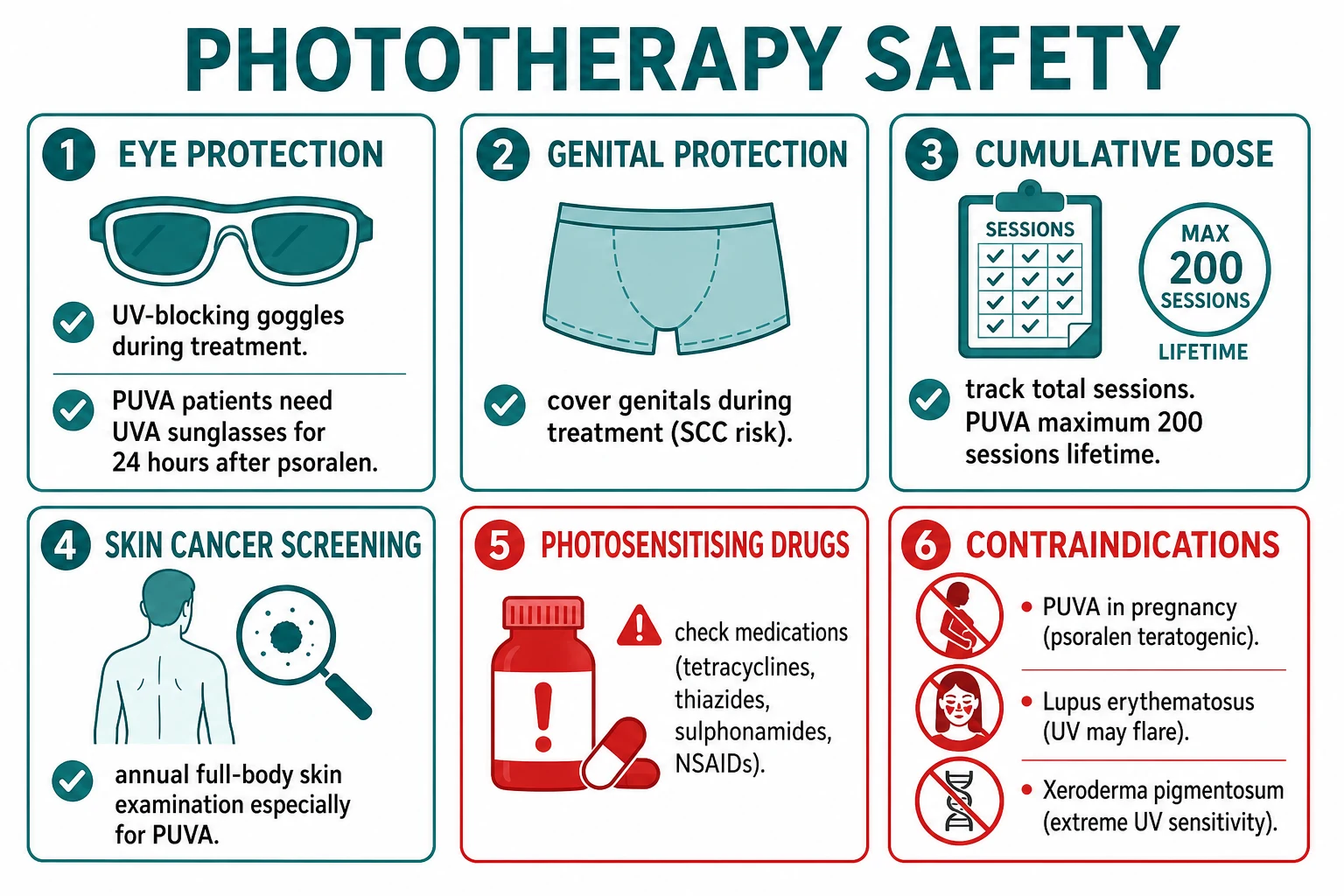
Clear patient instructions prevent the majority of adverse events. The pre-course counselling covers: [1]
- Sun protection on uninvolved skin during the course — broad-spectrum SPF 50 sunscreen on uninvolved areas on treatment days, so that only the prescribed UV dose reaches the skin.
- Genital protection during treatment — the genitals are shielded unless they are specifically involved, because genital SCC risk (especially in males, and especially with PUVA) is markedly elevated.[4]
- Face protection unless the face is involved by psoriasis or eczema; the face accumulates photoaging and skin-cancer risk disproportionately.
- Eye protection during every treatment — UV-blocking goggles for the patient and for every member of staff in the room. After oral PUVA, UVA-blocking sunglasses are worn for 24 hours (and in some protocols up to 48 hours) whenever the patient is outdoors or near a window, because psoralen deposits in the lens and UVA exposure causes cataracts.[1]
- No sunbeds, no deliberate sun exposure during the course — these add uncontrolled cumulative dose.
- No photosensitising foods before oral PUVA — psoralen-rich foods (celery, figs, parsnips, parsley, limes, and St John's wort) can add to the systemic psoralen load and should be avoided on treatment days.
- Report any new medication to the phototherapy unit before the next session; a thiazide, tetracycline or fluoroquinolone started by another clinician can turn a routine dose into a severe burn.
- Avoid fragrances and cosmetics on treatment days, as many contain photosensitising components.[1]
nbUVB versus PUVA — The Key Comparison
The single most examined phototherapy comparison is nbUVB against PUVA. The principle is straightforward: nbUVB is safer and is first-line; PUVA is more potent but carries a much higher cumulative cancer risk and more contraindications. [1]
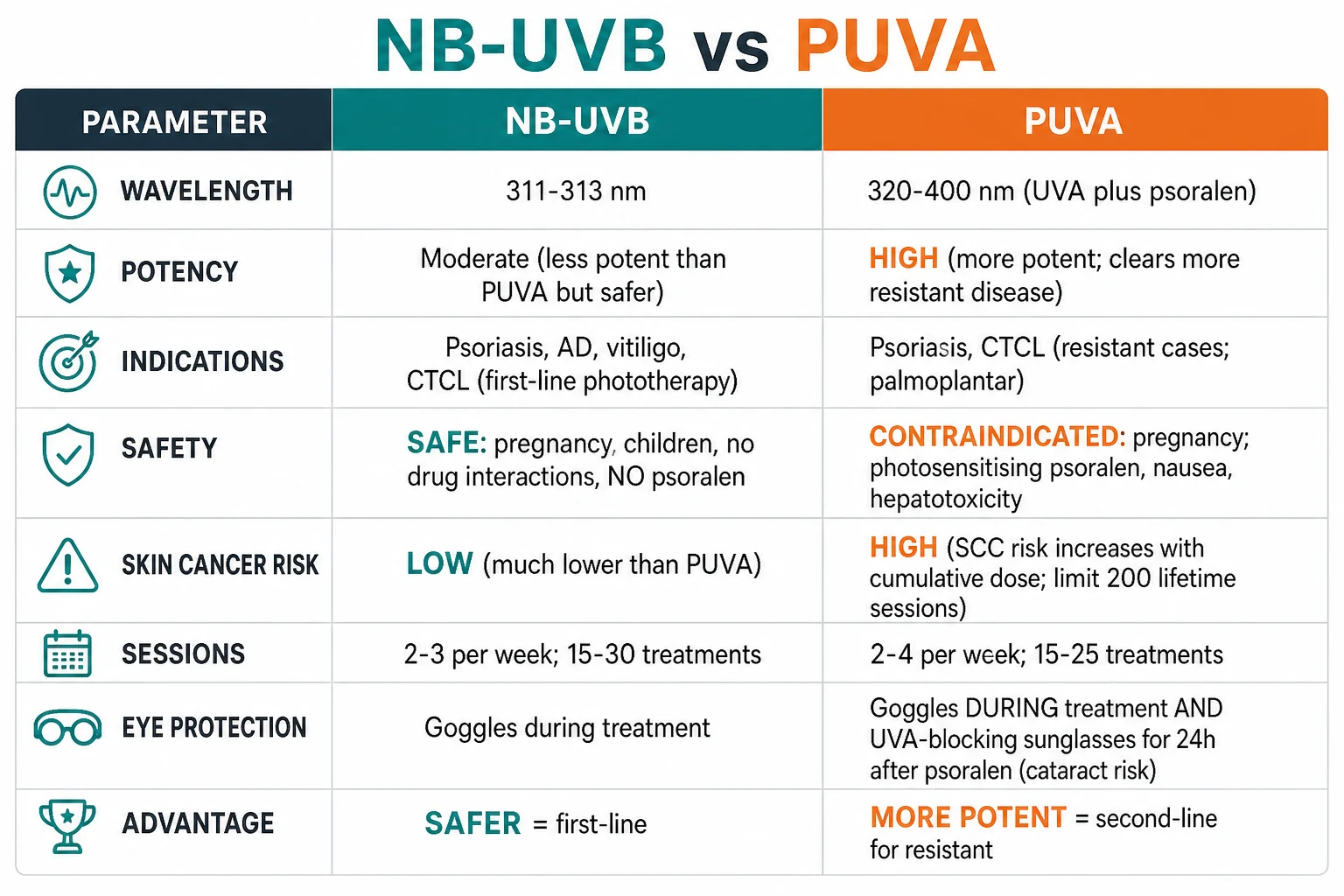
| Feature | nbUVB 311-313 nm | PUVA (psoralen + UVA) |
|---|---|---|
| Depth | Epidermis + superficial dermis | Deep dermis |
| Potency | Moderate | Higher (more potent) |
| First-line for | Psoriasis, AD, vitiligo, PMLE, CTCL patch stage | nbUVB failures; thick/disease with deep infiltrate |
| Pregnancy | SAFE (no systemic drug) | CONTRAINDICATED (psoralen teratogenic) |
| Children | Safe and effective | Avoid (long-term cancer risk) |
| Skin cancer risk | Low (cumulative-dose-dependent) | High — SCC strongly dose-dependent beyond ~200 treatments; melanoma beyond ~250 |
| Lifetime ceiling | No absolute limit (minimise cumulative) | 200 sessions (ideally under 150) |
| Drug interactions | None | Photosensitisers additive; psoralen hepatotoxicity |
| Side effects | Erythema, photoaging, herpes reactivation | Nausea (8-MOP), pruritus, cataract risk, lentigines |
| Eye protection | UV goggles during treatment | UV goggles + UVA sunglasses for 24 h after oral psoralen |
Complications and Pitfalls
Phototherapy adverse events divide into acute, cumulative and modality-specific. [1]
Acute. Erythema and burning is the commonest adverse event, ranging from mild asymptomatic pink to painful confluent blistering. The cause is almost always a dose miscalculation, a missed erythema read, or an undisclosed photosensitising drug. Pruritus and xerosis are common and managed with emollients and an oral antihistamine. Reactivation of herpes simplex is UV-triggered; patients with a history of recurrent HSV undergoing facial phototherapy may need prophylactic aciclovir. A burn may provoke Koebner phenomenon, worsening the very disease being treated.[1]
Cumulative — the defining risk. Squamous cell carcinoma risk rises in clear proportion to cumulative PUVA dose, with the steepest inflection beyond approximately 200 treatments; patients with more than 200 treatments have a roughly hundred-fold increase in SCC risk, and the risk persists even after PUVA is discontinued.[4] Basal cell carcinoma risk is also increased, though less dramatically. Melanoma risk becomes significantly elevated after approximately 250 PUVA treatments, with the excess appearing about fifteen years after first exposure.[5] High cumulative UVB also contributes to non-melanoma skin cancer risk, so nbUVB is not entirely cancer-free — cumulative dose is minimised in every patient.[7] Photoaging — PUVA lentigines (speckled brown macules), wrinkles and solar elastosis — is the cosmetic price of high cumulative dose. The combination of PUVA with ciclosporin multiplies SCC risk and must be avoided.[4]
PUVA-specific. Nausea (8-MOP), headache, transient hepatotoxicity, and the cataract risk from systemic psoralen deposition in the lens (prevented by 24-hour UVA eye protection). PUVA lentigines are characteristic speckled macules on treated skin after many sessions. [1]
PUVA RISKS
Pitfalls. The classic errors are: starting a course without checking the medication list (a missed photosensitiser causes the next burn); failing to exclude lupus or porphyria in a "sun-sensitive" patient; treating undiagnosed cutaneous T-cell lymphoma with phototherapy that masks but does not cure it; giving PUVA in pregnancy; and exceeding the 200-session PUVA lifetime ceiling without documenting cumulative dose. [1]
Prognosis and Disposition
Outcomes are disease- and modality-dependent. Psoriasis clears (PASI-90 or near) in approximately 70 to 80 percent of patients with a full nbUVB course; relapse typically occurs within weeks to months of stopping, so a planned maintenance taper or transition to systemic therapy is discussed at clearance.[2] Vitiligo repigments slowly over three to six months or more of nbUVB or excimer, with the best response on the face and neck (around 50 percent achieving useful repigmentation) and poor response on the hands, feet and bony prominences; the landmark Yones randomised trial established that nbUVB outperforms PUVA for vitiligo (about 57 percent versus 27 percent repigmentation), making nbUVB first-line.[3] Atopic dermatitis responds in around 60 to 70 percent with nbUVB; UVA1 may be used for acute flares.[10] Early cutaneous T-cell lymphoma responds well to nbUVB or PUVA but maintenance is often needed and the disease is not cured.[1] Polymorphic light eruption desensitisation succeeds in most patients for the subsequent summer season.[14]
Disposition is to the phototherapy unit two to three times weekly for the course duration, with a clear plan for taper and transition to maintenance or systemic therapy at clearance. Patients are followed annually for full-skin examination (skin-cancer surveillance) lifelong, with cumulative dose documented in the record.[1]
Special Populations
Pregnancy. nbUVB is the phototherapy of choice in pregnancy — it is safe, with no systemic absorption, no teratogenicity and no drug interaction, and is first-line for psoriasis and atopic dermatitis that has outgrown topical therapy. PUVA is contraindicated because psoralen is teratogenic. Systemic alternatives in pregnancy are limited (ciclosporin is the safest systemic for severe psoriasis in pregnancy), which elevates nbUVB's role.[1]
Children. nbUVB is safe and effective in children for psoriasis, atopic dermatitis and vitiligo, with appropriate eye protection and parental counselling. PUVA is avoided in children because the long-term cumulative cancer risk spans a much longer remaining lifetime; the lifetime PUVA ceiling is best preserved for adulthood.[1]
Skin of colour (Fitzpatrick V-VI). Patients with darker skin have a higher MED, tolerate larger dose increments, and respond well to nbUVB; post-inflammatory pigment change is the main concern, and vitiligo repigmentation is often cosmetically good because contrast is high. Dosing starts higher and escalates faster than in fair skin.[1]
The elderly. Lifetime cumulative UV exposure is already higher, and baseline skin-cancer risk is greater; cumulative dose is minimised, PUVA is used sparingly, and annual skin-cancer surveillance is emphasised. [1]
Immunocompromised patients (HIV, transplant). nbUVB is safe in HIV and may improve HIV-related eosinophilic folliculitis and pruritus. Transplant recipients on ciclosporin or azathioprine carry a markedly higher baseline skin-cancer risk, and phototherapy is weighed carefully against further photocarcinogenic increment; PUVA combined with ciclosporin is particularly hazardous.[4]
Evidence, Guidelines and Regional Differences
The evidentiary backbone of phototherapy rests on a few landmark sources. Morita and colleagues (1997) established the mechanism of UVA1 phototherapy by demonstrating singlet-oxygen-induced T-helper cell apoptosis, the molecular basis that explains why phototherapy clears T-cell-driven disease.[6] The PUVA follow-up cohort assembled by Stern is the single most important source on long-term safety: it established the dose-response relationship between cumulative PUVA and squamous cell carcinoma (about a hundred-fold increase in high-dose patients, persisting after discontinuation)[4], the excess melanoma risk beyond 250 treatments appearing after a fifteen-year latency,[5] and the contribution of high UVB exposure to non-melanoma skin cancer.[7]
Yones and colleagues (2007) published the randomised double-blind trial that established nbUVB as first-line for vitiligo, showing it outperforms PUVA (around 57 percent versus 27 percent repigmentation) with a markedly better safety profile.[3] Systematic reviews of 308-nm excimer confirm efficacy in both vitiligo and psoriasis with a lower cumulative UV burden than whole-body treatment.[8][9] The 2024 randomised trial by Gelfand and colleagues established that home-based nbUVB is non-inferior to office-based treatment, expanding access.[15] UVA1 efficacy in localised scleroderma, mastocytosis and inflammatory disease is supported by single-centre series and a five-year carcinogenic-risk study showing low risk.[11][12][16] The Goeckerman regimen retains a role in erythrodermic or biologic-resistant psoriasis.[13]
Yones SS et al, Arch Dermatol 2007
Randomised double-blind trial, 102 patients with non-segmental vitiligo
Key finding
nbUVB 3x weekly vs oral PUVA 2x weekly for up to 48 treatments. nbUVB achieved 57% repigmentation vs 27% with PUVA, with fewer side effects and greater patient convenience.
Stern RS et al, 16-centre PUVA cohort (1975-)
Prospective cohort of 1380 patients followed for 40+ years after PUVA
Key finding
SCC risk proportional to cumulative PUVA dose; ~100-fold increase in SCC in high-dose patients; melanoma excess beyond 250 treatments with 15-year latency; risk persists after PUVA stops.
Gelfand JM et al, JAMA Dermatol 2024
Randomised trial, home-based vs office-based nbUVB in psoriasis
Key finding
Home nbUVB non-inferior to office-based for psoriasis clearance, with comparable safety and markedly greater patient convenience and access.
Regional guidelines broadly converge. The British Association of Dermatologists (BAD) and NICE in the UK recommend nbUVB as first-line phototherapy for psoriasis, atopic dermatitis and vitiligo, with PUVA as second-line and a 200-session lifetime ceiling; home phototherapy is endorsed. The American Academy of Dermatology (AAD) guidance is similar. The European Dermatology Forum (EDF) and the German JDDG 2023 practice review codify the same hierarchy.[1] In lower-resource settings (including much of South Asia and Africa), phototherapy remains a mainstay because biologics are inaccessible — and modified Goeckerman daycare retains a particular role there.[13]The principal controversies are: the exact magnitude of nbUVB cancer risk (much lower than PUVA but not zero, and harder to quantify because patients are not followed in a single cohort); whether biologics and phototherapy should be combined for difficult disease (potential for faster clearance balanced against cumulative immunosuppression); and the role of UVA1, whose evidence base is smaller than nbUVB/PUVA and is confined to specialised centres.
Exam Pearls
Quick self-test: which modality for each scenario?
- Pregnant woman with severe plaque psoriasis — nbUVB 311-313 nm (PUVA contraindicated).
- Child with widespread atopic dermatitis — nbUVB (PUVA avoided in children).
- Vitiligo on the face and neck — nbUVB or excimer 308 nm (best cosmetic response).
- Thick palmoplantar psoriasis refractory to topicals — bath PUVA or hand-foot nbUVB.
- Localised scleroderma (morphea) — UVA1 340-400 nm.
- Patient who develops nausea after oral PUVA — switch to bath PUVA, 5-MOP, or ondansetron.
- Polymorphic light eruption before summer — prophylactic nbUVB desensitisation in spring.
- Patient with psoriasis and a history of melanoma — nbUVB, avoid PUVA.
- Erythrodermic psoriasis resistant to multiple biologics — Goeckerman regimen.[13]
- Patient on ciclosporin for psoriasis asks about PUVA — do not combine (multiplied SCC risk).[4]
Red Flags
Exam application bank (NEET-PG / INICET)
One-line answer
Phototherapy is the therapeutic use of non-ionising ultraviolet (UV) radiation, alone or with a photosensitising psoralen, to treat inflammatory and neoplastic skin disease. Narrowband UVB (nbUVB) 311-313 nm is the gold-standard first-line modality for psoriasis, atopic dermatitis and vitiligo; it is safe in pregnancy and children, has no drug interactions, and is delivered two to three times weekly. PUVA (psoralen + UVA 320-400 nm) is more potent and reaches deeper dermal infiltrates but carries a strongly cumulative squamous-cell carcinoma risk (especially beyond 200 treatments) and is contraindicated in pregnancy. UVA1 340-400 nm treats localised scleroderma and mastocytosis. Excimer 308 nm delivers targeted narrowband UVB to localised psoriasis and vitiligo. Safety demands UV eye protection for patient and staff, genital shielding, cumulative dose tracking, annual skin-cancer screeni
Worked stems (answer without another resource)
Stem 1 — Classic presentation. Map symptoms to mechanism; name the first investigation and first treatment step with dose/route if drug therapy is standard. [1]
Stem 2 — Unstable / complicated. List red flags that force immediate resuscitation, theatre, ICU, antidote, or reperfusion — and what you do in the first 15 minutes. [1]
Stem 3 — Atypical group. Elderly, pregnancy, child, or immunocompromised: how presentation and thresholds change. [1]
Stem 4 — Differential trap. Name the three closest mimics and one discriminator for each. [1]
Stem 5 — Disposition. Who goes home with safety-netting, who is admitted, who needs HDU/ICU/theatre, and what follow-up is mandatory. [1]
Rapid viva checklist
- Definition + classification
- Pathophysiology chain
- Bedside signs / criteria
- Score with exact components (if any)
- Emergency bundle
- Definitive therapy with doses
- Complications of disease and of treatment
- Special populations
- Guideline/trial name if classic
- Three exam traps
Coverage self-check
If you cannot answer any stem above from this page alone, re-read the matching section — the page is intended to be self-sufficient for final-prof and NEET-PG/INICET questions on Phototherapy.
References
- [1]Kurz B, Berneburg M, Bäumler W, et al. Phototherapy: Theory and practice J Dtsch Dermatol Ges, 2023.PMID 37485907
- [2]Armstrong AW, Read C. Pathophysiology, Clinical Presentation, and Treatment of Psoriasis: A Review JAMA, 2020.PMID 32427307
- [3]Yones SS, Palmer RA, Garibaldinos TM, Hawk JLM. Randomized double-blind trial of treatment of vitiligo: efficacy of psoralen-UV-A therapy vs Narrowband-UV-B therapy Arch Dermatol, 2007.PMID 17519217
- [4]Stern RS, Lunder EJ. Risk of squamous cell carcinoma and methoxsalen (psoralen) and UV-A radiation (PUVA). A meta-analysis Arch Dermatol, 1998.PMID 9875197
- [5]Stern RS, Nichols KT, Våkevä LH. The risk of melanoma in association with long-term exposure to PUVA J Am Acad Dermatol, 2001.PMID 11312420
- [6]Morita A, Werfel T, Stege H, et al. Evidence that singlet oxygen-induced human T helper cell apoptosis is the basic mechanism of ultraviolet-A radiation phototherapy J Exp Med, 1997.PMID 9362536
- [7]Lim JL, Stern RS. High levels of ultraviolet B exposure increase the risk of non-melanoma skin cancer in psoralen and ultraviolet A-treated patients J Invest Dermatol, 2005.PMID 15737190
- [8]Sun Y, Wu Y, Xiao B, et al. Treatment of 308-nm excimer laser on vitiligo: A systemic review of randomized controlled trials J Dermatolog Treat, 2015.PMID 25428573
- [9]Mudigonda T, Dabade TS, Feldman SR. A review of protocols for 308 nm excimer laser phototherapy in psoriasis J Drugs Dermatol, 2012.PMID 22206083
- [10]AAAAI/ACAAI JTF Atopic Dermatitis Guideline Panel, Chu DK, Schneider L, et al. Atopic dermatitis (eczema) guidelines: 2023 American Academy of Allergy, Asthma and Immunology/American College of Allergy, Asthma and Immunology Joint Task Force on Practice Parameters GRADE- and Institute of Medicine-based recommendations Ann Allergy Asthma Immunol, 2024.PMID 38108679
- [11]Ronen S, Shemer A, Sugarman J, et al. Efficacy of ultraviolet A1 phototherapy for inflammatory, sclerotic and neoplastic dermatological diseases: A 10-year tertiary referral center experience Photodermatol Photoimmunol Photomed, 2023.PMID 36052749
- [12]Furuhashi T, Torii K, Kato H, et al. Ultraviolet A1 phototherapy for the treatment of localized scleroderma J Dermatol, 2020.PMID 32383187
- [13]Myers B, Bhatia N, O'Neill JL, Feldman SR. The use of Goeckerman therapy in managing erythrodermic psoriasis resistant to multiple medications Dermatol Online J, 2021.PMID 33818983
- [14]Man I, Dawe RS, Ferguson J, Ibbotson SH. Artificial hardening for polymorphic light eruption: practical points from ten years' experience Photodermatol Photoimmunol Photomed, 1999.PMID 10404717
- [15]Gelfand JM, Shin DB, Li T, et al. Home- vs Office-Based Narrowband UV-B Phototherapy for Patients With Psoriasis: The LITE Randomized Clinical Trial JAMA Dermatol, 2024.PMID 39319513
- [16]Cosetti D, Ramelyte E, Dusan P, et al. Carcinogenic risk in patients treated with UVA-1 phototherapy: A 5-year retrospective study Photodermatol Photoimmunol Photomed, 2024.PMID 38787937