Dermatology · Medicine
Topical retinoids
Also known as Topical retinoids · Tretinoin · Adapalene · Tazarotene · Trifarotene · Retinol · Retinaldehyde · Retin-A · Differin
Topical retinoids are vitamin A (retinol) derivatives that bind nuclear retinoic acid receptors (RAR-alpha/beta/gamma) and retinoid X receptors (RXR). Four prescription generations: tretinoin (1st, all-trans-retinoic acid; gold standard for photoaging; photolabile — apply at night; Category C pregnancy), tazarotene (2nd, acetylenic prodrug; most potent; psoriasis + acne; most irritating; Category X pregnancy — absolute contraindication), adapalene (3rd, naphthoic acid; RAR-beta/gamma selective; photostable; least irritating; first-line for acne; 0.1% OTC FDA 2016; Category C), trifarotene (4th; RAR-gamma selective; FDA 2019 for facial + truncal acne). OTC cosmeceuticals: retinol and retinaldehyde (converted intracellularly to retinoic acid, gentler). Mechanism: normalise follicular keratinocyte desquamation (comedolysis), anti-inflammatory (suppress neutrophil chemotaxis/cytokines), stimulate dermal fibroblast collagen I/III synthesis (anti-ageing), inhibit melanin transfer. Indications: acne vulgaris (comedonal first-line), photoaging, psoriasis, melasma/PIH, actinic keratosis (combination field therapy), keratosis pilaris, ichthyosis, oral leukoplakia. Application: pea-sized amount, to DRY skin 20 min after washing, NIGHTLY (start every other night), moisturiser (sandwich method), sunscreen SPF30+ AM. Side effects: retinoid dermatitis (erythema/dryness/peeling/burning, worst 2-6 weeks), initial acne flare (purging, 2-4 weeks), photosensitivity, hyperpigmentation in darker skin. Pregnancy: Category X for tazarotene (avoid 1 month pre-conception); Category C for tretinoin/adapalene/trifarotene (avoid). Drug interaction: benzoyl peroxide OXIDISES tretinoin (apply at different times); adapalene is BPO-stable (combination fixed-dose — Epiduo). Counselling: start low, go slow; persist 8-12 weeks.
On this page & tools
Your progress
Saved locally on this device.
Exam tags
Red flags
Topical retinoids are among the most widely used and best-evidenced agents in dermatology, straddling the boundary between a prescription pharmacotherapy and a near-universal cosmeceutical. They are first-line for comedonal acne, the gold standard topical anti-ageing therapy, an established option for localised psoriasis and melasma, and a foundational component of combination regimens across the photoaging and acne disease spectra.[11][2] Understanding them well requires mastering a compact set of receptor pharmacology, a small drug-specific table of potencies and pregnancy categories, and a counselling script that converts the notorious first-month irritation into long-term adherence. This topic covers all of that at fellowship depth — the receptor biology, the drug-by-drug profile, the application protocol that determines success, the side-effect differential, and the pregnancy and drug-interaction pitfalls that examiners probe relentlessly.
Classification and Pharmacology
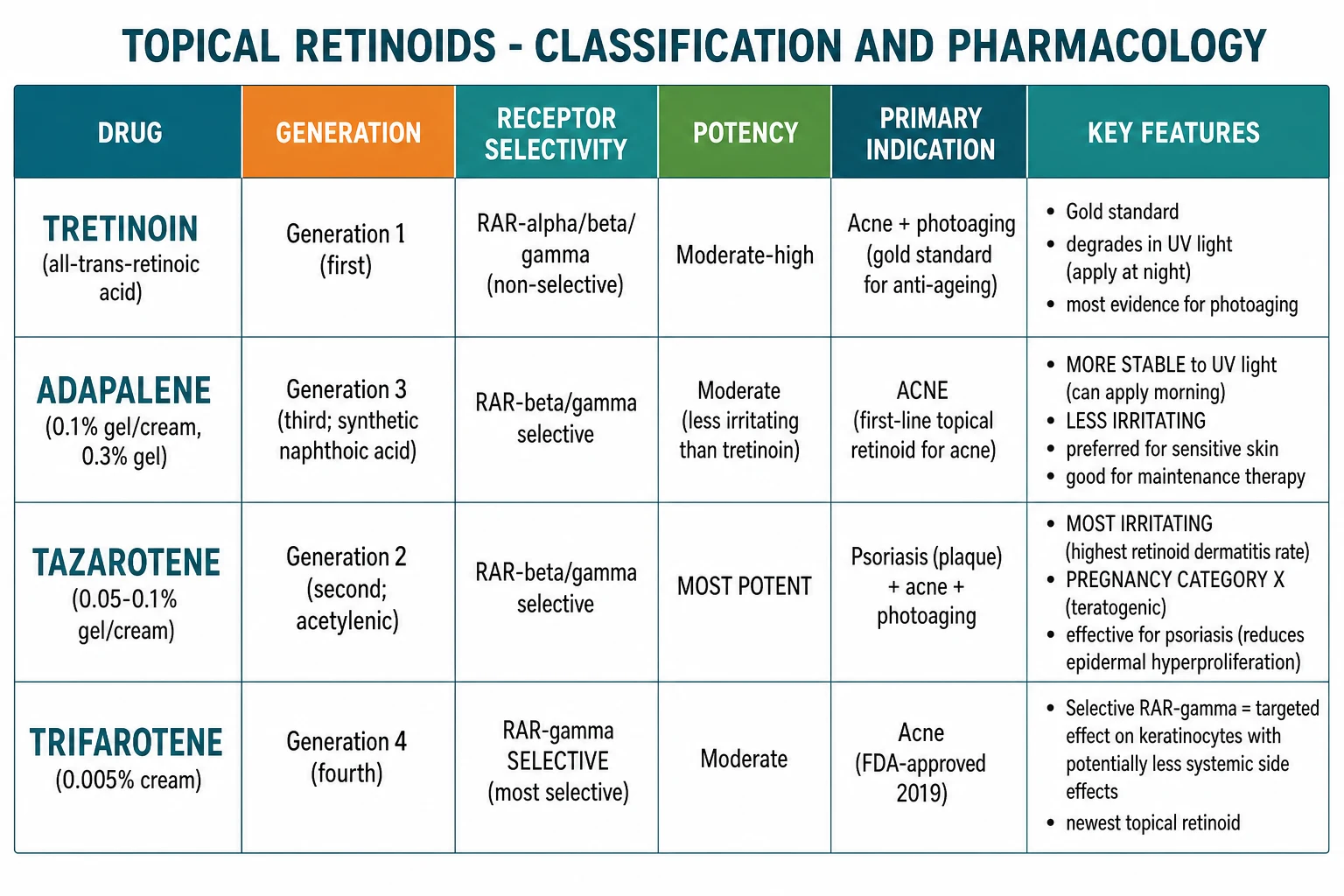
Topical retinoids are classified by chemical generation, receptor selectivity and clinical potency. The four prescription agents are structurally distinct: tretinoin is all-trans-retinoic acid (the native active ligand); tazarotene is an acetylenic prodrug hydrolysed in skin to its active acid; adapalene is a synthetic naphthoic acid derivative engineered for receptor selectivity and photostability; and trifarotene is a fourth-generation diarylamine engineered for high RAR-gamma selectivity.[1][7] Two cosmeceutical precursors sit below these: retinol (vitamin A alcohol) and retinaldehyde, both of which require intracellular two-step oxidation to retinoic acid and are therefore weaker but gentler, dominating the over-the-counter anti-ageing market.
The four prescription topical retinoids — at a glance
- Generation: 1st (natural ligand)
- Receptor: RAR-alpha/beta/gamma (non-selective)
- Concentrations: 0.025%, 0.05%, 0.1% cream/gel; microsphere 0.04%/0.1%
- Strength: moderate-high
- Photostability: PHOTOLABILE — apply at night
- Lead indication: PHOTOAGING (gold standard); also acne
- Irritation: moderate-high
- Pregnancy: Category C (avoid)
- Generation: 2nd (acetylenic prodrug)
- Receptor: RAR-beta/gamma
- Concentrations: 0.05%, 0.1% cream/gel/foam
- Strength: MOST POTENT
- Photostability: photostable
- Lead indication: PSORIASIS + acne
- Irritation: HIGHEST
- Pregnancy: Category X (absolute contraindication)
- Generation: 3rd (naphthoic acid; synthetic)
- Receptor: RAR-beta/gamma selective
- Concentrations: 0.1%, 0.3% gel/cream; 0.1% OTC (FDA 2016)
- Strength: moderate
- Photostability: PHOTOSTABLE — AM or PM
- Lead indication: ACNE (first-line); favourable efficacy/irritation ratio
- Irritation: LOWEST
- Pregnancy: Category C (avoid)
- Generation: 4th (diarylamine; synthetic)
- Receptor: RAR-GAMMA SELECTIVE
- Concentrations: 0.005% (50 microg/g) cream
- Strength: moderate
- Photostability: photostable
- Lead indication: ACNE — facial + TRUNCAL (FDA 2019)
- Irritation: low-moderate
- Pregnancy: Category C (avoid)
The concentrations look small because retinoids act at true nuclear-receptor ligand concentrations: trifarotene at 0.005% is a potent drug, not a homeopathic dose. The microsphere formulation of tretinoin (0.04% and 0.1%) entraps the drug in a porous microsphere that releases it slowly, reducing peak irritation while preserving efficacy — a vehicle innovation that effectively lowers the irritation-to-efficacy ratio.[1]
Vehicle, Formulation and Concentration Selection
The choice of vehicle is as important as the choice of molecule, because it determines penetration, irritation profile and patient adherence. The same drug in different vehicles behaves differently on the skin.[1]
Vehicle selection for topical retinoids
- Oil-in-water emulsion; moisturising; moderate penetration
- Preferred for DRY or sensitive skin and for photoaging patients
- Tretinoin 0.025-0.05% cream is the photoaging standard
- Contains preservatives (rare contact allergy)
- Water- or alcohol-based; drying; high penetration
- Preferred for OILY skin and acne (most adapalene/tazarotene acne formulations)
- More irritating than the cream equivalent
- Alcohol-based gels may sting on application
- Low residue; cosmetically elegant; preferred for hair-bearing areas (scalp, chest, back)
- Tazarotene 0.1% foam available for psoriasis
- Rapidly absorbed; less greasy
- Drug entrapped in porous methyl methacrylate/glycol dimethacrylate microspheres
- Slow release reduces peak irritation while preserving cumulative efficacy
- Tretinoin 0.04% and 0.1% microsphere (Retin-A Micro)
- Preferred for patients who could not tolerate standard tretinoin
Concentration titration strategy. Always start with the lowest effective concentration of the chosen agent and titrate upwards only if efficacy is inadequate and tolerance has been achieved. For tretinoin, begin at 0.025% cream; for adapalene, 0.1% gel; for tazarotene, 0.05% cream; for trifarotene, the single 0.005% concentration. Escalate concentration (tretinoin 0.05% then 0.1%; adapalene 0.3%; tazarotene 0.1%) only after 8-12 weeks at the lower strength without adequate response.[2][4] The most common prescribing error is starting at 0.1% tretinoin nightly in a retinoid-naive patient, which guarantees a severe retinoid reaction and non-adherence.
Cosmeceutical precursors: retinol and retinaldehyde. These over-the-counter agents are not metabolically active themselves and require intracellular oxidation: retinol → retinaldehyde → all-trans-retinoic acid (tretinoin). Because each step is rate-limiting and partial, the effective retinoic acid dose at the receptor is much lower than from applying tretinoin directly, producing a gentler effect with less irritation — the basis for their dominance in the consumer anti-ageing market.[1][14] Retinaldehyde (one step from retinoic acid) is somewhat more potent than retinol (two steps). Clinically, both produce visible improvement in photoaging but require 6-12 months of nightly use and are inferior to prescription tretinoin 0.025-0.05%.
Retinoid Receptors and Gene Transcription
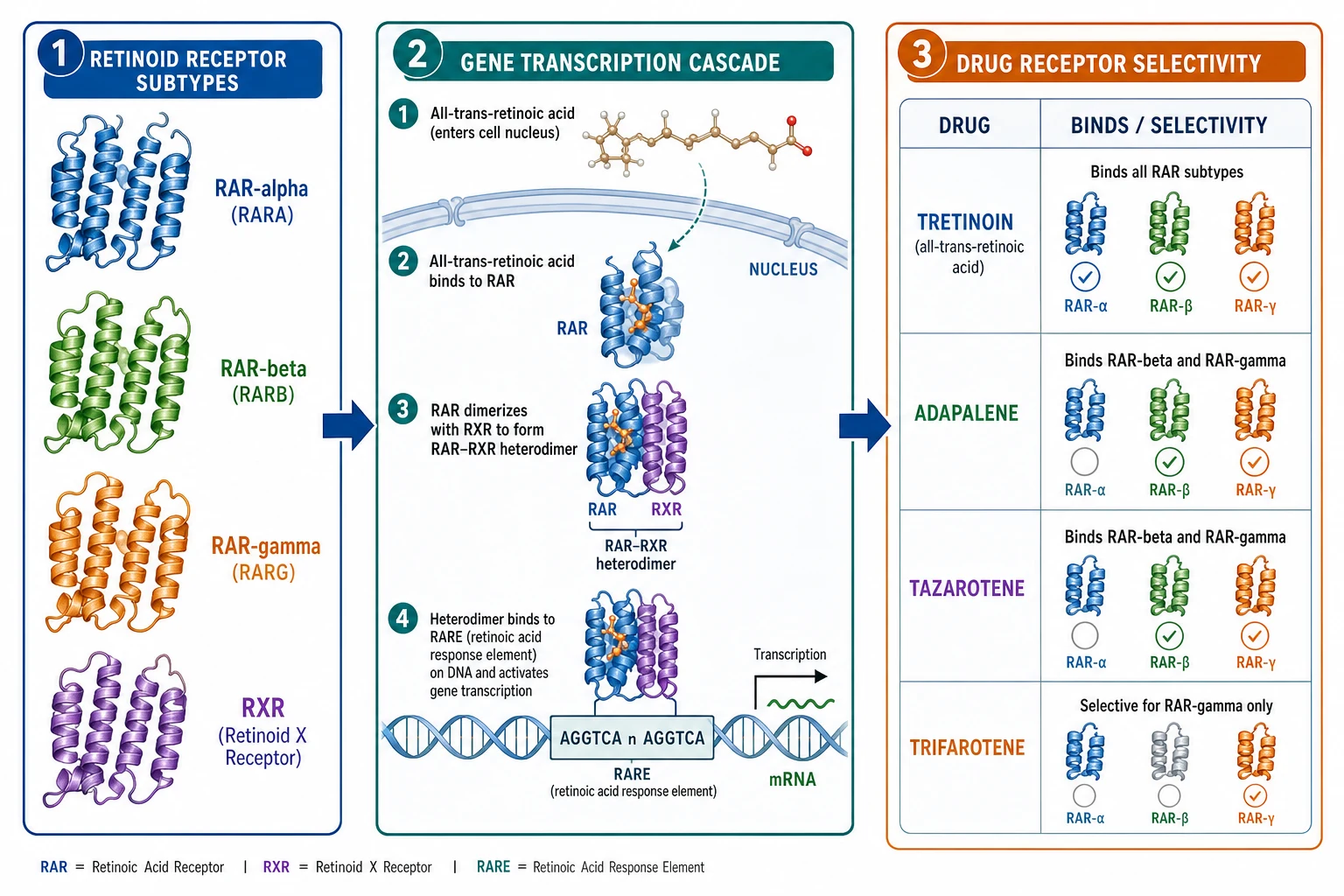
Retinoids act through two families of ligand-activated nuclear transcription factors: the retinoic acid receptors (RAR-alpha, RAR-beta, RAR-gamma) and the retinoid X receptors (RXR-alpha, RXR-beta, RXR-gamma).[1] RARs bind all-trans-retinoic acid (the active metabolite of tretinoin, adapalene, tazarotene and trifarotene); RXRs bind the 9-cis isomer of retinoic acid. A retinoid does not switch a single gene on or off — it modulates networks of genes through canonical retinoic acid response elements (RAREs) in promoter regions, which is why a single molecule produces comedolysis, anti-inflammatory effects and collagen stimulation simultaneously.[1]
The molecular cascade is worth knowing in detail because it explains the drug-selectivity differences an examiner can probe:[1]
Retinoid molecular mechanism — skin keratinocyte
Topical retinoid crosses the stratum corneum and enters the keratinocyte (tazarotene is a prodrug, hydrolysed by esterases to active tazarotenic acid)
All-trans-retinoic acid (or its analogue) diffuses into the nucleus and binds the ligand-binding domain of RAR-gamma (the dominant epidermal subtype, ~90% of epidermal RARs)
Ligand-bound RAR heterodimerises with RXR; the permissive RAR-RXR heterodimer binds retinoic acid response elements (RAREs) in the promoter regions of target genes
Co-repressor complex (NCoR/SMRT) is released and a co-activator complex (p160/CBP) is recruited; RNA polymerase II initiates transcription
Downstream gene products normalise keratinocyte differentiation (transglutaminase, involucrin, filaggrin), suppress inflammatory cytokines (IL-1, IL-6, TNF-alpha) and reduce Toll-like receptor-2 expression
In dermal fibroblasts, RAR activation upregulates type I and type III procollagen and downregulates matrix metalloproteinases (MMP-1, MMP-3, MMP-9), reversing UV-induced collagen loss
In melanocytes/keratinocytes, retinoids accelerate epidermal turnover and reduce melanin transfer via reduced tyrosinase activity and faster keratinocyte transit — the basis for PIH and melasma benefit
This distribution of receptors explains why drug selectivity matters clinically. RAR-gamma is the predominant subtype in epidermal keratinocytes (~90% of epidermal RAR expression), which is why trifarotene — engineered to be RAR-gamma-selective — achieves comparable acne efficacy to older non-selective agents while potentially reducing off-target effects mediated by RAR-alpha.[7] RAR-beta is expressed in dermal fibroblasts and is the receptor through which collagen synthesis is upregulated. RAR-alpha is widely distributed and mediates more of the irritant and systemic side effects, which is why RAR-alpha-sparing agents (adapalene, tazarotene) are less irritating than non-selective tretinoin.[1]
RXR is the unsung partner: it forms heterodimers not only with RAR but also with other nuclear receptors (peroxisome proliferator-activated receptor-gamma, vitamin D receptor, thyroid hormone receptor, liver X receptor). This promiscuity underlies "rexinoid" biology and explains some drug interactions, although for topical monotherapy it is the RAR-RXR axis that dominates the clinical phenotype.[1]
Mechanism of Action — Clinical Translation
The molecular cascade translates into four clinically useful effects, each anchored to a specific indication:[1][2]
-
Comedolysis (normalisation of follicular keratinisation). In acne, abnormal desquamation of the infrainfundibular keratinocytes produces a microcomedone — the precursor of all acne lesions. Retinoids restore normal desquamation by upregulating filaggrin and transglutaminase, reducing keratinocyte cohesion at the follicular ostium. This dissolves existing microcomedones and prevents new ones. This is the primary mechanism by which all retinoids treat comedonal acne and is why they are foundational, not optional, in acne regimens.[2]
-
Anti-inflammatory effect. Retinoids suppress neutrophil chemotaxis, downregulate Toll-like receptor 2 (TLR-2) expression on keratinocytes and macrophages, and reduce pro-inflammatory cytokines (IL-1alpha, IL-6, TNF-alpha). This is why retinoids help inflammatory acne, not just comedonal acne, and why they synergise with benzoyl peroxide and topical antibiotics in combination therapy.[2]
-
Collagen synthesis stimulation (anti-ageing). In dermal fibroblasts, retinoids upregulate transforming growth factor-beta and procollagen I/III, and downregulate the matrix metalloproteinases (MMP-1/collagenase, MMP-3, MMP-9) that UV irradiation induces. The net effect is partial reversal of the collagen loss that defines photoaging, producing measurable increases in dermal collagen content, epidermal thickening and improvement in fine wrinkles.[9][14]
-
Melanin transfer inhibition / accelerated epidermal turnover. Retinoids accelerate the transit of keratinocytes through the epidermis and reduce melanosome transfer from melanocytes to keratinocytes. This disperses existing melanin and brightens post-inflammatory hyperpigmentation and melasma — the rationale for tretinoin's place in Kligman's triple-combination cream.[1]
Indications
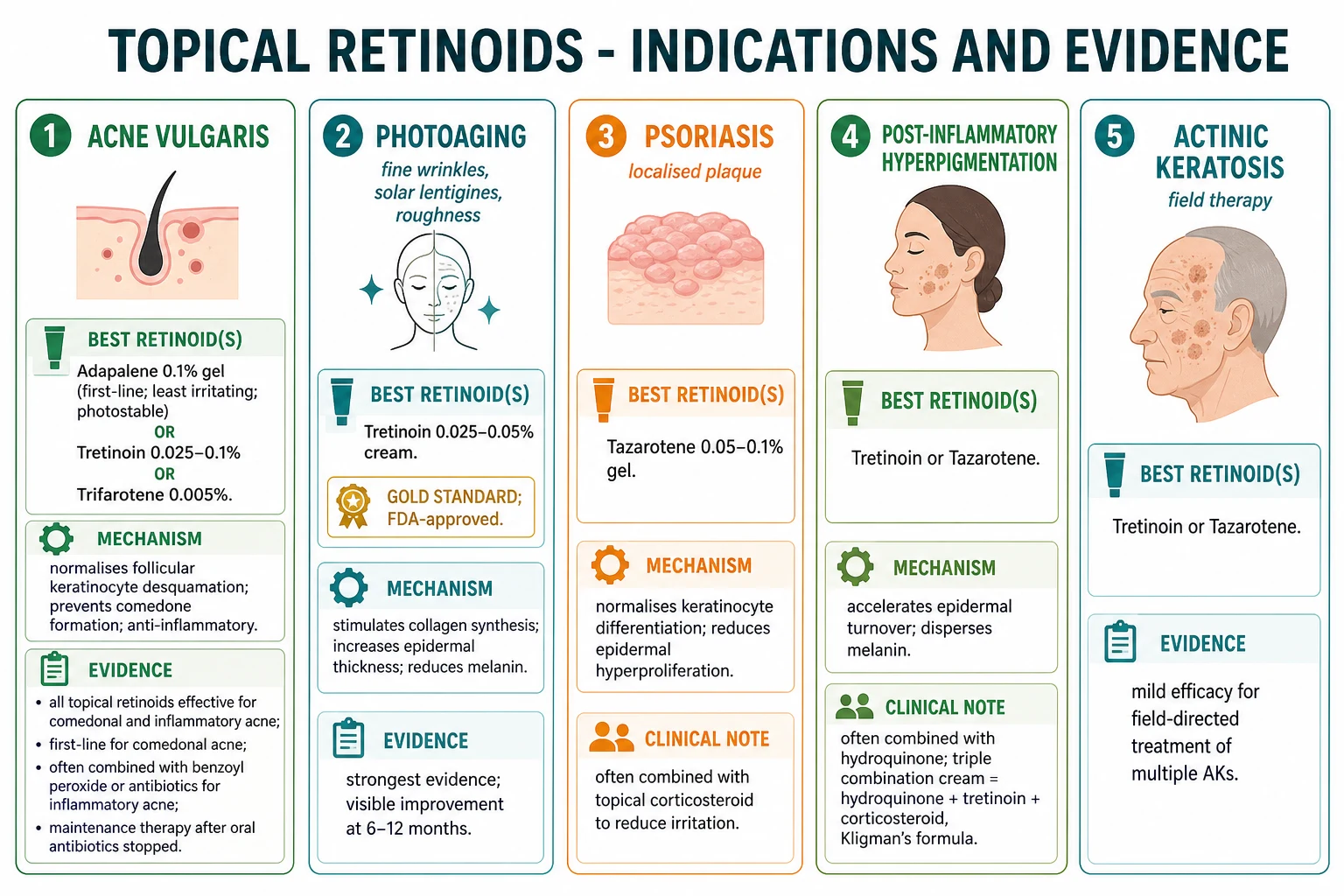
Acne vulgaris
All four topical retinoids are effective for both comedonal and inflammatory acne and are recommended as foundational first-line therapy in the American Academy of Dermatology 2024 guidelines and the European/French algorithms.[11][2][3] For purely comedonal acne, a topical retinoid ± benzoyl peroxide is sufficient. For inflammatory acne, retinoids are combined with benzoyl peroxide and/or a topical antibiotic (clindamycin, erythromycin) to address Cutibacterium acnes; fixed-dose combinations such as adapalene 0.1% + benzoyl peroxide 2.5% (Epiduo) are convenient and counter the antibiotic-resistance problem by adding the non-antibiotic BPO.[13]
Adapalene 0.1% is the preferred starting retinoid for acne because of its favourable efficacy-to-irritation ratio and photostability.[4] Trifarotene 0.005% received FDA approval in October 2019 on the basis of the PERFECT 1 and PERFECT 2 phase 3 trials, which demonstrated superiority over vehicle for both facial and — uniquely among topical retinoids — truncal acne, making it the agent of choice when back/shoulder involvement is prominent.[6][7]
Adapalene 0.1% gel (first-line acne retinoid)
Dose
Pea-sized amount per region (face ~0.25 g)
Photoaging (fine wrinkles, solar lentigines, roughness)
Tretinoin 0.025-0.05% cream is the gold standard topical anti-ageing agent and is FDA-approved for photoaging (marketed as Renova, Altreno).[9][14] A 2022 systematic review of randomised trials confirmed that tretinoin 0.05% produces statistically significant improvement in fine wrinkling, roughness and hyperpigmentation compared with vehicle, with a consistent onset of visible benefit at 6-12 months and continued improvement up to 1-2 years of nightly use.[9] Mechanistically, tretinoin partially reverses UV-induced collagen loss by upregulating procollagen I/III and suppressing collagenase (MMP-1).[14] Effects reverse on cessation, so photoaging treatment is long-term maintenance, not a course.
Psoriasis (localised plaque)
Tazarotene 0.05% or 0.1% gel/cream/foam is FDA-approved for localised plaque psoriasis and is the most potent of the topical retinoids.[8] It normalises keratinocyte hyperproliferation and differentiation through RAR-beta/gamma agonism, reducing plaque scale, thickness and erythema. Because it is highly irritating, it is almost always combined with a topical corticosteroid (the steroid suppresses the retinoid-induced inflammation and the two act synergistically).[8] Application is to the plaque only, avoiding surrounding uninvolved skin. Tazarotene is Category X and requires a negative pregnancy test plus reliable contraception.[8]
Post-inflammatory hyperpigmentation, melasma and hyperpigmentation disorders
Retinoids accelerate epidermal turnover and inhibit melanosome transfer, dispersing melanin. Tretinoin is the retinoid component of Kligman's triple-combination cream (5% hydroquinone + 0.025% tretinoin + a mild corticosteroid), the prototype anti-melasma regimen; the retinoid both depigments and prevents hydroquinone oxidation.[1] In darker Fitzpatrick skin types (IV-VI), retinoids carry a paradoxical risk of post-inflammatory hyperpigmentation themselves, so lower concentrations and slower titration are required.[2]
Actinic keratosis (field therapy, combination)
Topical retinoids have a role as field therapy for actinic keratosis on chronically sun-exposed skin, reducing the burden of subclinical keratinocytic atypia. Tretinoin 0.1% and adapalene 0.1-0.3% have demonstrated efficacy in reducing AK lesion counts, but they are less effective than 5-fluorouracil, imiquimod or ingenol mebutate; their main role is in combination with these agents or as long-term chemoprevention in patients with photodamage.[1]
Other indications
- Keratosis pilaris — modest benefit from tretinoin or adapalene in the rough follicular papules on the extensor arms/thighs, typically combined with a keratolytic (urea, salicylic acid).[1]
- Ichthyosis (especially lamellar ichthyosis and X-linked ichthyosis) — tazarotene and tretinoin reduce scale; systemic retinoids are preferred for severe disease.[1]
- Oral leukoplakia — topical/systemic retinoids induce regression of premalignant oral lesions (chemoprevention); mostly an oral isotretinoin/etretinate role.[1]
- Mycosis fungoides (early-stage cutaneous T-cell lymphoma) — tazarotene gel and bexarotene (a rexinoid) have niche roles.[1]
Combination therapy regimens
Topical retinoids are almost never the sole agent beyond purely comedonal acne. Modern acne algorithms use them as the comedolytic backbone and add a second agent for inflammatory coverage. The rationale is mechanistic complementarity: retinoids normalise follicular keratinisation (prevent comedones), benzoyl peroxide kills Cutibacterium acnes, and topical antibiotics suppress inflammation — together they address all four acne pathogenic factors.[3][11]
| Regimen | Indication | Application |[3][11] |---|---|---| | Adapalene 0.1% + BPO 2.5% fixed-dose (Epiduo) | Moderate inflammatory acne; first-line combination | Apply once nightly; BPO-stable so no degradation; counter antibiotic resistance | | Retinoid PM + BPO wash or leave-on AM | Moderate acne where tretinoin is the preferred retinoid (also photoaging) | Tretinoin at NIGHT, BPO in MORNING (12-hour separation prevents oxidation) | | Retinoid + topical clindamycin/erythromycin | Inflammatory acne; antibiotic stewardship (always combine with BPO) | Apply together at night; antibiotic non-irritating; limit antibiotic to 3-4 months | | Triple combination (Kligman) | Melasma, post-inflammatory hyperpigmentation | Hydroquinone 4-5% + tretinoin 0.025% + hydrocortisone 1% (compounded); apply nightly to pigmented areas; 8-12 week cycles with breaks | | Tazarotene + topical corticosteroid | Localised plaque psoriasis | Tazarotene AM or PM to plaque; steroid different time; steroid suppresses retinoid irritation |
Sequential monotherapy versus fixed-dose combinations. Fixed-dose combinations (Epiduo = adapalene + BPO; Acanya/Benz-a-Clin = clindamycin + BPO) improve adherence by reducing the number of products and applications, and are preferred when insurance/formulary permits. Sequential monotherapy (separate products at different times) offers more flexibility for titrating each component but requires more patient education and risks non-adherence.[11]
Differential Diagnosis — When It Is NOT Retinoid Dermatitis
The "retinoid reaction" is clinically distinctive but has several mimics that the candidate must be able to distinguish at follow-up. Misattributing an allergic contact dermatitis to expected retinoid intolerance leads to weeks of worsening when a simple vehicle switch would resolve it.[2]
| Mimic | Distinguishing features | Action |[2] |---|---|---| | Allergic contact dermatitis (vehicle excipient) | Pruritus dominant (retinoid dermatitis is burning/stinging, NOT itch); well-demarcated beyond application area; vesicles; does not improve with continued use | Stop; switch vehicle or agent; patch test | | Irritant contact dermatitis (concurrent AHAs/BHAs/astringents) | History of concurrent irritant use; sharply limited to contact areas | Withdraw other irritants; restart retinoid more slowly | | Rosacea flare | Central facial erythema, papulopustules without comedones; triggered by retinoid (rosacea skin is retinoid-intolerant) | Stop retinoid; consider anti-rosacea therapy | | Seborrhoeic dermatitis | Greasy scale in nasolabial folds, eyebrows, scalp; less sharply related to retinoid start | Treat seborrhoeic dermatitis; retinoid may continue | | Phototoxic reaction (drug-induced) | Sharp sun-exposed distribution; history of photosensitiser (doxycycline, hydrochlorothiazide, NSAIDs) | Withdraw photosensitiser; sun protection |
The other key clinical judgement is acne purge versus true treatment failure. A purge occurs at the patient's usual acne sites (where comedones were already forming), is transient (peaks at 2-4 weeks, resolves by 6-8 weeks), and is followed by net improvement. A true treatment failure is the appearance of new deep nodules or cysts beyond 8 weeks of adherence, often at new sites — this warrants escalation to oral therapy (combined oral contraceptive, spironolactone in women, oral antibiotic, or oral isotretinoin).[10]
Application Technique — The Protocol That Determines Success
More than for almost any other topical therapy, the application protocol determines whether a retinoid succeeds or is abandoned. The technique below is the standard counselling script used to maximise efficacy and minimise the retinoid reaction that drives discontinuation.[2][4]
Standard retinoid application protocol (counselling script)
Cleanse the face with a gentle, non-soap cleanser; pat dry — DO NOT rub
WAIT 20-30 MINUTES after washing. Applying to wet or damp skin dramatically increases penetration and irritation — the most common preventable cause of severe retinoid dermatitis
Dispense a PEA-SIZED AMOUNT (~0.25 g for the face) onto the fingertip
Dot the cream/gel onto forehead, cheeks and chin, then spread as a thin film over the ENTIRE affected area — NOT as spot treatment (retinoids work on microcomedones that are not yet visible)
Avoid the immediate periorbital area, lips, nasolabial folds and corners of the nose (thinnest skin, most irritation)
Apply at NIGHT (especially tretinoin, which is photolabile; UV degrades it and increases irritation)
For the first 2 weeks apply EVERY OTHER NIGHT; if tolerated, increase to NIGHTLY from week 3
Apply a non-comedogenic moisturiser BEFORE (and/or after) the retinoid — the 'sandwich method' (moisturiser-retinoid-moisturiser) reduces irritation without reducing efficacy
Apply SUNSCREEN SPF 30+ EVERY MORNING — retinoids thin the stratum corneum and increase UV sensitivity; this is non-negotiable
Things to avoid during initiation
Concurrent skincare to avoid during retinoid initiation
- Benzoyl peroxide + tretinoin at same time — BPO oxidises tretinoin to inactive products (separate by 12 hours, or use BPO-stable adapalene)
- Alpha-hydroxy acids (glycolic, lactic) — additive irritancy
- Beta-hydroxy acids (salicylic acid) — additive irritancy
- Astringents, toners with alcohol — barrier disruption
- Physical scrubs and exfoliants — barrier disruption
- Waxing on treated areas — risk of epidermal tearing (skin is more fragile)
- Other retinoids — never stack
- Adapalene + benzoyl peroxide (BPO-stable; fixed-dose Epiduo available)
- Topical antibiotics (clindamycin, erythromycin) — synergistic, non-irritating
- Hyaluronic acid moisturisers — soothing, barrier-supporting
- Niacinamide — generally well tolerated
- Ceramide-containing emollients — barrier repair
- Gentle chemical exfoliants — only after tolerance established (week 6+)
Side Effects and the Retinoid Reaction
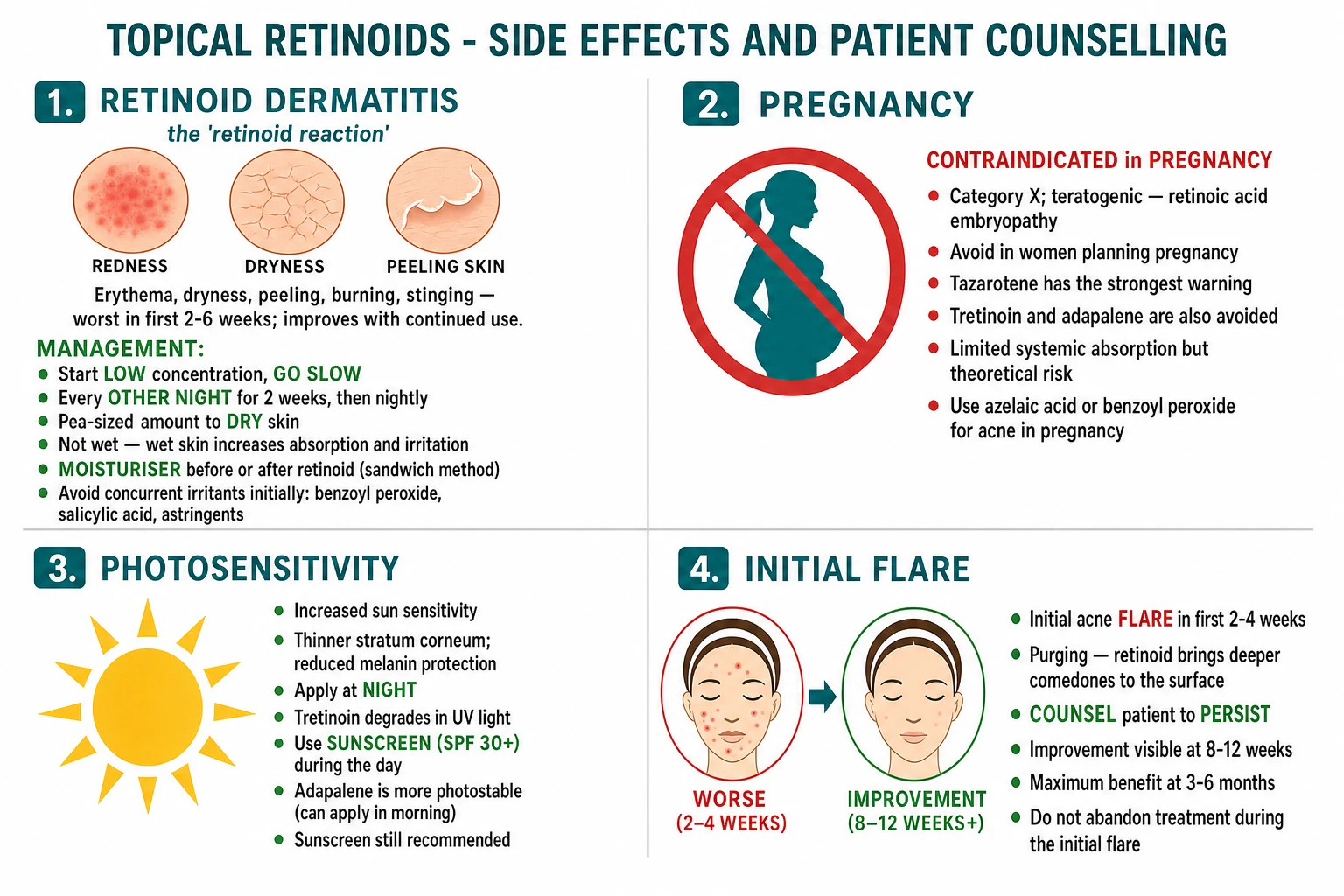
Retinoid dermatitis (the 'retinoid reaction')
The hallmark adverse effect is retinoid dermatitis — a predictable, dose-dependent irritant reaction of erythema, dryness, fine peeling, burning and stinging that peaks at weeks 2-6 and resolves with continued use as the epidermis adapts.[2] It is the single biggest driver of premature discontinuation and is the side effect most amenable to mitigation through the application protocol above. Severity follows the potency/irritation axis: tazarotene (worst) greater than tretinoin greater than trifarotene greater than adapalene (least).[2]
Retinoid dermatitis — severity ladder (with management)
Severe
3 — Marked erythema, oedema, crusting, blistering. Action: STOP; cool compresses; short course mild topical corticosteroid; reintroduce later at lowest strength every third night
Initial acne flare ('purging' or 'retinisation')
A transient worsening of acne in the first 2-4 weeks is expected and reflects the retinoid bringing deeper microcomedones to the surface as inflammatory papules/pustules.[2] It is NOT a reason to stop; counselling the patient to persist through the flare, with net improvement visible at 8-12 weeks, is essential. A purge occurs at the patient's usual acne sites; new deep nodules at new sites after 8 weeks is treatment failure, not purging.[10]
Photosensitivity
Retinoids thin the stratum corneum (at least initially) and increase UV sensitivity. Tretinoin is additionally photolabile — UV light degrades the molecule itself, which is why it is applied at night.[1] Adapalene, tazarotene and trifarotene are photostable, but daily sunscreen remains mandatory for all retinoids because UV exposure both worsens the irritation and drives the photoaging the patient is being treated for.[4]
Pigmentary changes
In darker skin types (Fitzpatrick IV-VI), the retinoid reaction can itself trigger post-inflammatory hyperpigmentation, paradoxically worsening the pigmentary complaint that prompted treatment. Prevention is through lower starting concentrations, slower titration and preference for the gentler agents (adapalene, trifarotene).[2] Hypopigmentation is rarer.
Contact dermatitis (allergic, rare)
True allergic contact dermatitis to the retinoid molecule is rare; allergic reactions to vehicle excipients (propylene glycol, preservatives) are more common and present as pruritus (not the burning/stinging of irritant dermatitis) extending beyond the application area. Patch testing identifies the culprit and a vehicle switch usually resolves it.[1]
Ocular irritation
Application too close to the eyes causes conjunctival irritation; counsel to avoid the immediate periorbital area. The nasolabial folds, lips and corners of the nose are similarly vulnerable.[1]
Pregnancy, Lactation and the Teratogenicity Question
Pregnancy safety is the most heavily examined aspect of topical retinoid pharmacology. The principle is straightforward: all topical retinoids should be avoided in pregnancy and in women planning conception, even though the absolute teratogenic risk from topical application is far lower than from oral isotretinoin or acitretin.[1][10]
The teratogenic phenotype, retinoic acid embryopathy, includes craniofacial defects (microtia/anotia, facial asymmetry, cleft palate), conotruncal cardiac defects (transposition of the great arteries, tetralogy of Fallot), CNS abnormalities (hydrocephalus, microcephaly, neural tube defects) and thymic aplasia/hypoplasia. The risk is firmly established for oral isotretinoin; for topical retinoids the systemic absorption is low and epidemiological studies have not consistently demonstrated increased teratogenicity, but the consensus — and the labelling — is one of avoidance.[1]
Acne management in pregnancy. Switch to pregnancy-safe options: azelaic acid 15-20% (Category B; safe throughout pregnancy), benzoyl peroxide 2.5-10% (limited systemic absorption, considered safe), topical clindamycin/erythromycin (Category B), and glycolic acid. Salicylic acid is avoided in high concentrations. Oral treatments that are safe in pregnancy include the combined oral contraceptive is NOT safe in pregnancy — but in the pre-conception window, women can use topical azelaic acid + BPO.[10]
Lactation
Topical tretinoin and adapalene have minimal systemic absorption and are considered compatible with breastfeeding by the American Academy of Pediatrics, with the caveat that application to the nipple/areola is avoided. Tazarotene and trifarotene data are limited; conservative practice is to avoid.[1]
Drug Interactions
The most examined and most practically important retinoid interaction is with benzoyl peroxide (BPO).[2][13]
BPO OXIDISES TRETINOIN
Other interactions to know:[1]
- Photosensitising drugs (doxycycline, hydrochlorothiazide, sulphonamides, NSAIDs, fluoroquinolones) — additive photosensitivity; review concurrent medication.[1]
- Topical antibiotics (clindamycin, erythromycin) — safe and synergistic in combination with retinoids for inflammatory acne.
- Salicylic acid, AHAs (glycolic, lactic), astringents — additive irritancy during initiation; space them out or hold during titration.
- Other retinoids — never combine two topical retinoids, and never combine a topical retinoid with oral isotretinoin (additive toxicity, dryness, teratogenicity).
- Waxing — discontinue retinoid 1 week before facial waxing to avoid epidermal tearing.
Special Populations
Paediatric acne
Age-licensed lower bounds: adapalene approved from 9 years; trifarotene from 9 years (PERFECT trials enrolled subjects from 9 years); tazarotene from 12 years; tretinoin from 12 years.[7][11] Pre-adolescent acne (7-11 years) is increasingly common and warrants evaluation for precocious puberty when it precedes other pubertal signs.[10]
Pregnancy and pre-conception
As above: all topical retinoids avoided; tazarotene absolute contraindication with mandatory contraception and pre-treatment pregnancy test; stop all retinoids 1 month before planned conception.[8]
Elderly / photoaged skin
Tretinoin 0.025% cream is the standard for photoaging in older adults, but the skin barrier is more fragile and the titration must be more cautious; consider the microsphere formulation for reduced peak irritation.[14]
Darker Fitzpatrick skin types (IV-VI)
Higher risk of retinoid-induced post-inflammatory hyperpigmentation. Start with the lowest concentration of the least irritating agent (adapalene 0.1% or trifarotene 0.005%), titrate slowly (every third night for 2 weeks, then every other night), and prioritise daily sunscreen and moisturiser.[2]
Sensitive skin / rosacea / atopic dermatitis
Rosacea skin is intrinsically retinoid-intolerant and topical retinoids are generally avoided in active rosacea. In atopic dermatitis, retinoids are avoided during flares (they will worsen barrier disruption) but have a limited role in comedonal acne overlapping with eczema. The microsphere tretinoin and adapalene formulations are the best-tolerated options when a retinoid must be used in barrier-compromised skin.[1]
Monitoring and Follow-up
Monitoring schedule for a patient started on a topical retinoid
Baseline: confirm not pregnant (tazarotene) and counsel on the 8-12 week timeline; demonstrate application technique; prescribe SPF 30+ and moisturiser
Phone or review at WEEK 2-4: enquire about retinoid dermatitis severity; check adherence and technique (dry skin, pea-sized amount); reinforce persistence through initial flare
Review at WEEK 6-8: assess tolerance; if dermatitis intolerable, reduce frequency or switch to adapalene/microsphere tretinoin; assess initial acne response
Review at WEEK 12: assess efficacy (lesion count, GAGS/IGA); if inadequate, add benzoyl peroxide +/- topical antibiotic, or escalate to oral therapy (combined oral contraceptive, spironolactone, oral antibiotic, isotretinoin)
Maintenance: continue retinoid +/- BPO long-term; for post-isotretinoin patients, adapalene-BPO maintenance for 12 months reduces relapse
For tazarotene, a baseline pregnancy test and reliable contraception are mandatory, with periodic reassessment.[8] For photoaging, review at 6 and 12 months to assess response and reinforce adherence; benefits are gradual and adherence-dependent.
Evidence, Guidelines and Controversies
PERFECT 1 and PERFECT 2 (Tan 2019)
PMID 30802558
Two identical phase 3 RCTs; 2420 patients aged 9+ with moderate facial AND truncal acne; trifarotene 0.005% cream vs vehicle once daily for 12 weeks
Key finding
Trifarotene superior to vehicle for facial acne (treatment success ~30% vs ~20%) and — uniquely for a topical retinoid — for truncal acne; basis for FDA approval Oct 2019
Khalil 2022 — tretinoin for photoaging systematic review
PMID 35620028
Systematic review of RCTs of topical tretinoin for photoaging
Key finding
Tretinoin 0.05% cream superior to vehicle for fine wrinkling, roughness and hyperpigmentation; onset of visible benefit 6-12 months; benefits maintained with continued use, reverse on cessation
Mavranezouli 2022 — acne network meta-analysis
PMID 35789996
Systematic review and network meta-analysis of topical, oral and physical treatments for acne
Key finding
Topical retinoid + benzoyl peroxide combinations rank among the most effective interventions for moderate acne; supports retinoids as foundational in combination regimens
The American Academy of Dermatology 2024 guidelines position topical retinoids as foundational first-line therapy for acne at all severities, used alone (comedonal) or in combination with BPO and/or topical antibiotics (inflammatory).[11] The European/French guidelines converge on the same position.[4] Antibiotic stewardship is now central: limiting antibiotic duration (oral typically 3-4 months) and combining with BPO throughout to suppress Cutibacterium acnes resistance.[13]
Maintenance therapy
Controversies
The pregnancy risk of topical retinoids is the principal controversy. Systemic absorption from topical application is low (tretinoin blood levels barely rise above baseline), and several large epidemiological series have not shown a measurable increase in birth defects above background rates — leading some authors to argue the Category C label is overly cautious. The consensus, however, remains one of avoidance, especially because safer alternatives (azelaic acid, benzoyl peroxide) exist.[1][10] A second controversy is whether OTC retinol and retinaldehyde, which dominate the consumer market, deliver clinically meaningful benefit; the evidence is that they do, but more slowly and less potently than prescription tretinoin, requiring 6-12 months for visible effect.
Exam Pearls
Red Flags
Exam application bank (NEET-PG / INICET)
One-line answer
Topical retinoids are vitamin A (retinol) derivatives that bind nuclear retinoic acid receptors (RAR-alpha/beta/gamma) and retinoid X receptors (RXR). Four prescription generations: tretinoin (1st, all-trans-retinoic acid; gold standard for photoaging; photolabile — apply at night; Category C pregnancy), tazarotene (2nd, acetylenic prodrug; most potent; psoriasis + acne; most irritating; Category X pregnancy — absolute contraindication), adapalene (3rd, naphthoic acid; RAR-beta/gamma selective; photostable; least irritating; first-line for acne; 0.1% OTC FDA 2016; Category C), trifarotene (4th; RAR-gamma selective; FDA 2019 for facial + truncal acne). OTC cosmeceuticals: retinol and retinaldehyde (converted intracellularly to retinoic acid, gentler). Mechanism: normalise follicular keratinocyte desquamation (comedolysis), anti-inflammatory (suppress neutrophil chemotaxis/cytokines), stim
Worked stems (answer without another resource)
Stem 1 — Classic presentation. Map symptoms to mechanism; name the first investigation and first treatment step with dose/route if drug therapy is standard. [1]
Stem 2 — Unstable / complicated. List red flags that force immediate resuscitation, theatre, ICU, antidote, or reperfusion — and what you do in the first 15 minutes. [1]
Stem 3 — Atypical group. Elderly, pregnancy, child, or immunocompromised: how presentation and thresholds change. [1]
Stem 4 — Differential trap. Name the three closest mimics and one discriminator for each. [1]
Stem 5 — Disposition. Who goes home with safety-netting, who is admitted, who needs HDU/ICU/theatre, and what follow-up is mandatory. [1]
Rapid viva checklist
- Definition + classification
- Pathophysiology chain
- Bedside signs / criteria
- Score with exact components (if any)
- Emergency bundle
- Definitive therapy with doses
- Complications of disease and of treatment
- Special populations
- Guideline/trial name if classic
- Three exam traps
Coverage self-check
If you cannot answer any stem above from this page alone, re-read the matching section — the page is intended to be self-sufficient for final-prof and NEET-PG/INICET questions on Topical retinoids.
Key Takeaways
References
- [1]Khalil S, Bardawil T, Stephan C, et al. Retinoids: a journey from the molecular structures and mechanisms of action to clinical uses in dermatology and adverse effects J Dermatolog Treat, 2017.PMID 28318351
- [2]Kolli SS, Pecone D, Pona A, Cline A, Feldman SR, Taylor SL. Topical Retinoids in Acne Vulgaris: A Systematic Review Am J Clin Dermatol, 2019.PMID 30674002
- [3]Mavranezouli I, Daly CH, Welton NJ, et al. A systematic review and network meta-analysis of topical pharmacological, oral pharmacological, physical and combined treatments for acne vulgaris Br J Dermatol, 2022.PMID 35789996
- [4]Santer M, Burden-Teh E, Ravenscroft J. Managing acne vulgaris: an update Drug Ther Bull, 2023.PMID 38154809
- [5]Tan J, Chavda R, Baldwin H, et al. Management of Acne Vulgaris With Trifarotene J Cutan Med Surg, 2023.PMID 36927117
- [6]Tan J, Thiboutot D, Popp G, et al. Randomized phase 3 evaluation of trifarotene 50 μg/g cream treatment of moderate facial and truncal acne J Am Acad Dermatol, 2019.PMID 30802558
- [7]Blume-Peytavi U, Kruse R, Lutz V, et al. Trifarotene: First Approval Drugs, 2019.PMID 31713811
- [8]Lebwohl M, Ali S. Topical tazarotene: a review of its use in the treatment of plaque psoriasis Am J Clin Dermatol, 2005.PMID 16060713
- [9]Khalil S, Bardou A, Becherini P, et al. Topical tretinoin for treating photoaging: A systematic review of randomized controlled trials Int J Womens Dermatol, 2022.PMID 35620028
- [10]Reynolds RV, Yeung H, Lee CH, et al. Management of Acne Vulgaris: A Review JAMA, 2021.PMID 34812859
- [11]Reynolds RV, Yeung H, Cheng CE, et al. Guidelines of care for the management of acne vulgaris J Am Acad Dermatol, 2024.PMID 38300170
- [12]Gollnick H, Layton A, Thiboutot D, et al. Maintenance therapy for acne vulgaris: efficacy of a 12-month treatment with adapalene-benzoyl peroxide after oral isotretinoin and a review of the literature Dermatology, 2013.PMID 24029411
- [13]Walsh TR, Efthimiou J, Dréno B. Systematic review of antibiotic resistance in acne: an increasing topical and oral threat Lancet Infect Dis, 2016.PMID 26852728
- [14]Babamiri K, Nassab R. Retinoids in the treatment of skin aging: an overview of clinical efficacy and safety Clin Interv Aging, 2006.PMID 18046911