Dermatology · Medicine
Traction alopecia
Also known as Traction alopecia · Marginal traction alopecia · Mechanical alopecia · Tension alopecia · Cultural hair-loss
Traction alopecia is a form of mechanical hair loss — and eventually scarring alopecia — caused by sustained or repeated tension on hair roots over weeks, months, or years. It predominantly affects women and girls of African descent (tight braids, cornrows, weaves, extensions, chemical relaxers), Sikh men (turban knot), ballet dancers, athletes, and any patient whose hairstyle, headwear, or occupational load applies chronic traction. Early (reversible) disease: perifollicular erythema, scaling, papules, broken hairs, tenderness, traction folliculitis at the hair margin. Late (irreversible) disease: scarring with loss of follicular ostia, smooth shiny scalp, vellus hairs only, the pathognomonic 'fringe sign' may be retained. Management hinges on the single most important intervention — STOP THE TRACTION — plus topical/intralesional corticosteroids, minoxidil, antibiotics for folliculitis, and follicular unit transplantation (FUE/FUT) for scarring disease. Prevention (looser hairstyles, satin/silk sleep caps, breaks between tight styles, no chemicals on fragile hair) is the only true cure.
On this page & tools
Your progress
Saved locally on this device.
Exam tags
Red flags
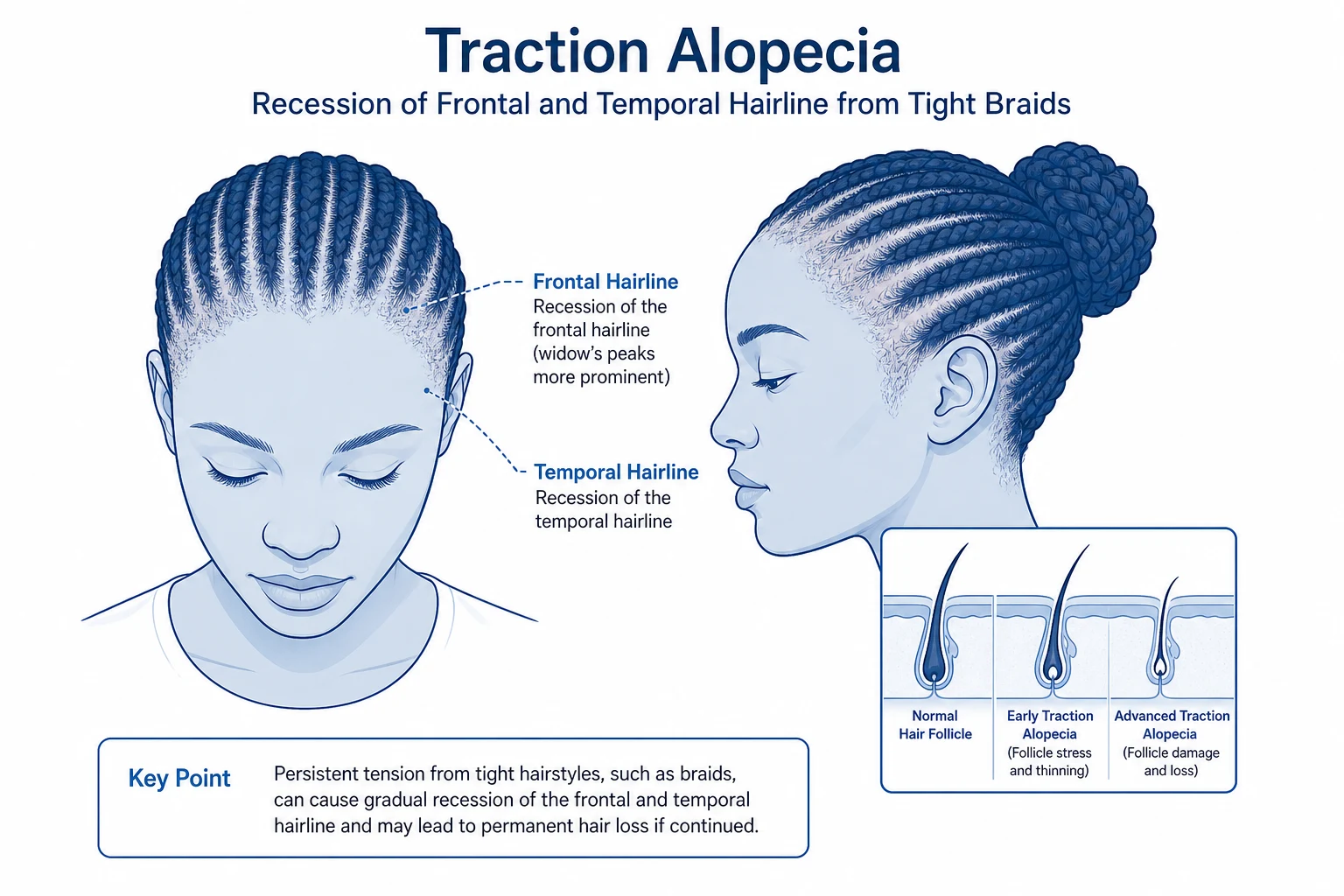
Overview & Definition
Traction alopecia is a form of mechanical hair loss caused by prolonged or repeated tension on hair shafts from tight hairstyles, headwear, or occupational load.[1][4] It begins as a non-scarring, reversible process but, if the tension is not relieved, it progresses over months to years into an irreversible scarring (cicatricial) alopecia with permanent destruction of hair follicles. It is one of the most common — and most under-recognised causes of hair loss in women and girls of African descent, in whom the combined mechanical and chemical injury (relaxers + tight braids) drives a spectrum of disease that may culminate in central centrifugal cicatricial alopecia (CCCA). It is also the paradigmatic "occupational and cultural" hair disorder, affecting Sikh men, ballet dancers, wrestlers, footballers, cyclists, swimmers, and Orthodox Jewish women.[1][2][3]
The condition is biphasic and the examiner's task is to recognise the moment at which the disease crosses from reversible to irreversible: once follicular ostia are lost, no medical therapy will regrow hair — only surgical transplantation. [1]
Classification
Traction alopecia is classified in three clinically useful ways: by phase (acute vs chronic), by distribution (marginal vs non-marginal/patchy), and by aetiology (mechanical alone vs mechanical + chemical).[4]
Epidemiology & Risk Factors
Traction alopecia is highly prevalent in women and girls of African descent and is increasingly reported in South Asian, Sikh, Orthodox Jewish, and athletic populations. The most-cited prevalence data come from the Cape Town school surveys of Khumalo and colleagues.[5]
Populations and risk practices
- Sub-Saharan African women and girls — tight braids, cornrows, plaits, weaves, glued-in extensions, and chemical relaxers (sodium hydroxide, guanidine hydroxide, ammonium thioglycolate) applied to fragile hair. Highest risk when chemical relaxation is followed by tight braiding within days.[5]
- South Asian women — sari-pinning tension, oil-induced folliculitis, hair-binding at the crown.
- Sikh men — submandibular and beard patch from the turban knot (the small twisted bun at the side or front of the head that anchors the turban cloth).
- Ballet dancers — temporal rim band from the classical "ballet bun" held with elastic and pins at very high tension.
- Athletes — wrestlers (occipital friction from mats and headgear), swimmers (chlorinated cap pressure), footballers and rugby players (boots and scrum caps), weightlifters and rowers (headbands).
- Orthodox Jewish women — post-partum sheitel (wig) attachment and tight headscarves; in some communities a tight cap worn under the sheitel.
- Hijab wearers — occipital pressure alopecia from tight underscarves and turbans.
- Children — primary-school age when braids are first applied; the Cape Town survey shows the prevalence doubles between first and last year of school.[2][5]
Modifiable and non-modifiable risk factors
Pathophysiology
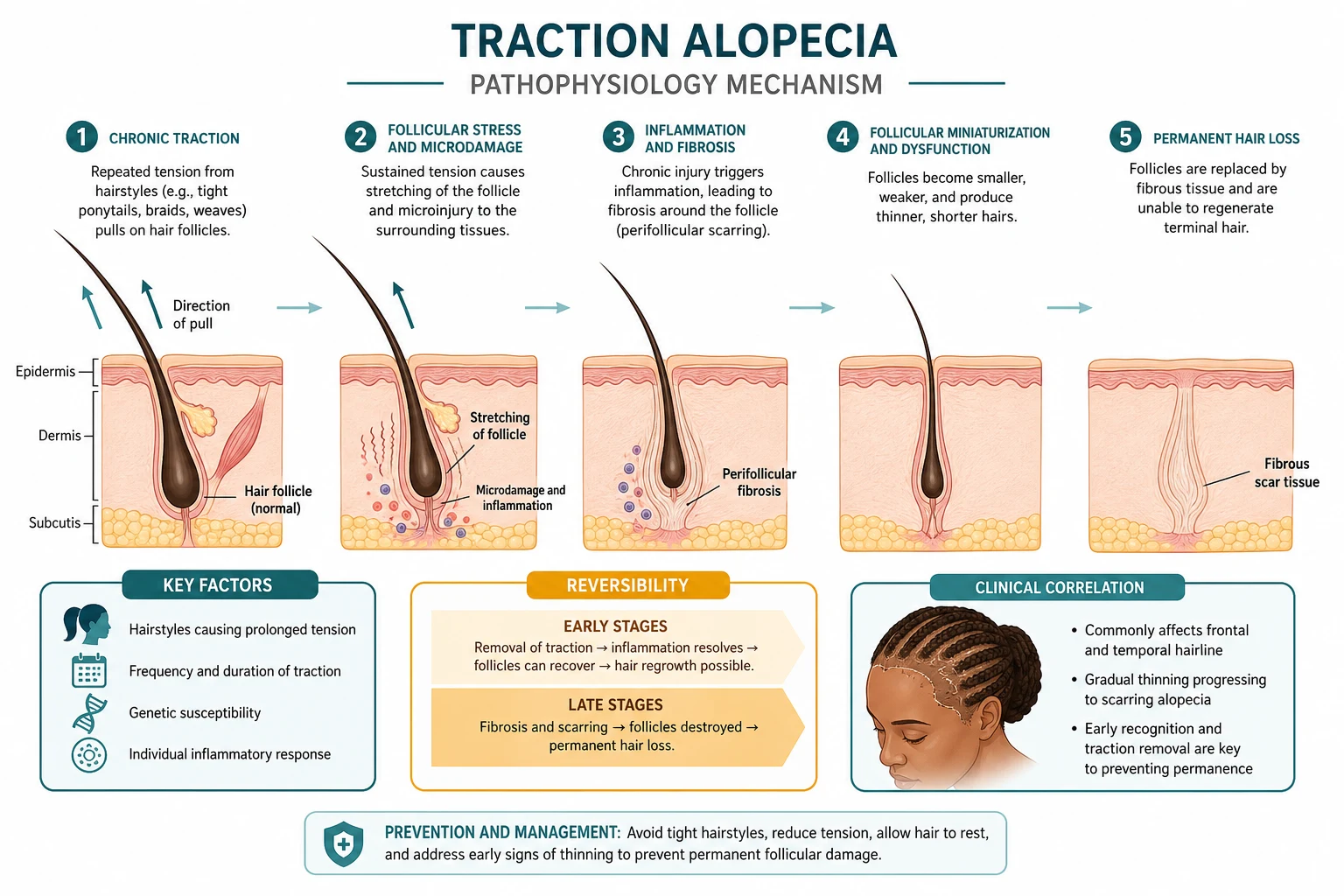
The mechanism is a mechanical cascade that starts with tension on the hair shaft and ends, if unrelieved, in the destruction of the follicle. The cascade is the same whether the patient is a ballerina, a Sikh man, or a woman with extensions — only the vector of force changes.[3][4]
Step 1 — Mechanical tension
Sustained or repeated pull on the hair shaft transmits force to the follicular epithelium, the arrector pili muscle, and the perifollicular connective-tissue sheath. The hair margin (frontal, temporal, occipital rim) is most vulnerable because the follicles there are smaller, more superficially anchored, and bear the highest load when the hair is pulled back.
Step 2 — Follicular microtrauma and inflammation
Repetitive microtrauma triggers perifollicular lymphocytic and neutrophilic inflammation, with erythema, scaling, papules, and oedema. Follicular plugging and the broken-hair 'hair cast' (peripilar keratin cast) appear. This is the ACUTE / REVERSIBLE phase; the follicle is still viable.
Step 3 — Trichomalacia and miniaturisation
On histology, terminal hairs show trichomalacia — distorted, kinked, pigmented hair shafts within the follicular canal — and progressive follicular miniaturisation (terminal → vellus). Vellus hairs are spared because they are not anchored to the tensional hairstyle.
Step 4 — Perifollicular fibrosis
Continued inflammation drives concentric perifollicular fibrosis at the level of the isthmus and infundibulum, where the arrector pili inserts. The follicular ostium narrows; the follicle is gradually replaced by a fibrous tract.
Step 5 — Permanent follicular destruction
End-stage: follicular ostia are lost; the scalp appears smooth, shiny, and atrophic ('footprints in the snow'). The disease is now CICATRICIAL and IRREVERSIBLE. No medical therapy regrows hair.
Trichomalacia
Trichomalacia is the histopathological hallmark of mechanical follicular injury. It is a distortion of the hair shaft within the follicular canal — bent, kinked, or corkscrew-shaped hairs, often with intra-follicular pigment casts and broken terminal hairs. The presence of trichomalacia in a horizontally sectioned biopsy is considered diagnostic of ongoing traction. [1]
Why the hair margin is most vulnerable
Follicles on the frontal and temporal hairline have a shallower, less robust attachment to the underlying galea than those on the vertex or occiput. The arrector pili muscle, sebaceous gland, and follicular stem-cell niche at the bulge are clustered at the isthmus, and chronic traction at this level preferentially destroys the bulge, where the follicle's regenerative capacity resides. Once the bulge is destroyed, the follicle cannot regenerate. [1]
Chemical–mechanical synergy
Chemical relaxers (sodium hydroxide, calcium hydroxide, guanidine hydroxide, ammonium thioglycolate) denature hair keratin, lift the cuticle, reduce elasticity, and increase friction. When traction is then applied within days of chemical processing, the weakened shaft elongates, snaps, and pulls the follicle with it. The risk of traction alopecia is highest when chemical relaxation is combined with tight braiding in the same styling episode — the dominant pattern in CCCA.[4][5]
Relationship to CCCA
Central centrifugal cicatricial alopecia (CCCA) is a scarring alopecia of the vertex that progresses centrifugally. It is now widely regarded as the end-stage of chronic chemical + mechanical injury in genetically susceptible women of African descent. The histological overlap is striking — both show perifollicular fibrosis, premature desquamation of the inner root sheath, and reduced terminal-to-vellus ratios. A patient with vertex-centred scarring hair loss and a history of relaxer + weave use should be considered to be on the traction–CCCA spectrum rather than as a separate disease. [1]
Clinical Presentation
The clinical picture is dictated by the phase (acute vs chronic) and the distribution (marginal vs non-marginal). The patient's hairstyle history is the single most diagnostic piece of information. [1]
Acute / early (reversible) disease
- Perifollicular erythema and fine scaling at the hair margin, especially frontal and temporal.
- Papules and pustules at the follicle — traction folliculitis — often culture-positive for Staphylococcus aureus; can mimic acne.
- Broken hairs of varying length within the tension zone; hair casts (peripilar keratin casts, or "pseudonits") sliding along the shaft.
- Tenderness, pruritus, or burning at the hairline, often worse after the style is redone.
- Pain on styling is the clinical warning sign that should prompt immediate cessation of the hairstyle (Khumalo).[5]
- Follicular ostia are preserved; trichoscopy shows erythema, broken hairs, and early miniaturisation.
Chronic / late (irreversible) disease
- Loss of follicular ostia on the affected scalp — the diagnostic hallmark of scarring alopecia.
- Smooth, shiny, atrophic patches with a "footprints in the snow" appearance.
- Vellus hairs may persist as the fringe sign — a retained band of fine, short hairs along the very rim of the hairline, which Khumalo and Samrao use both as a diagnostic clue and as a public-health message ("the fringe means the follicle is still alive").[6]
- No active inflammation in burnt-out disease; no erythema or pustules.
- Decreased follicular density with empty follicular openings on trichoscopy.[8]
Distribution patterns
The "fringe sign" (Samrao 2011)
The fringe sign is a band of retained short, often vellus, hairs along the frontal and/or temporal rim, while the immediately-post-fringe scalp has thinned or scarred.[6] Samrao and colleagues described it in 2011 as a sensitive and specific clinical finding for marginal traction alopecia, useful when the patient cannot recall or is reluctant to disclose the hairstyle history. Histology of the fringe area shows retained sebaceous glands, a decreased number of terminal hairs, an increased number of vellus hairs, and fibrotic tracts — the follicles are miniaturised but not destroyed. The fringe therefore represents the last recoverable follicles and a clinical imperative to stop the traction now.
Atypical presentations
- Sikh man with submandibular / beard patch from the turban knot.
- Ballerina with a temporal rim band from the classical bun.
- Hijab-wearing woman with occipital pressure alopecia from a tight underscarf.
- Wrestler with occipital loss from mat friction and headgear.
- Child with frontal hairline thinning where braids were applied from age 4 — a safeguarding and counselling scenario for the paediatrician.[2]
- Adult woman with a CCCA-overlap pattern — vertex-centred scarring that began as a marginal traction alopecia a decade earlier.
Management — Resuscitation
Traction alopecia is not a dermatological emergency. The only indications for same-day review are: [1]
- Secondary bacterial infection with cellulitis, abscess, or systemic upset (flucloxacillin 500 mg QDS oral × 7 days; IV if septicaemia).
- Suspected kerion (tinea capitis with boggy swelling — swab, Wood's light, fungal culture, oral itraconazole or griseofulvin).
- Severe psychosocial distress with suicidal ideation — urgent mental-health assessment. [1]
For all other presentations, the management is outpatient, stepwise, and centred on STOPPING THE TRACTION. [1]
Differential Diagnosis
The five conditions that most often mimic traction alopecia, and the one feature that distinguishes each. [1]
Clinical & Bedside Assessment
History
The history is 80% of the diagnosis. Ask directly and non-judgementally: [1]
- Hairstyle: braids, cornrows, weaves, extensions, dreadlocks, ponytails, buns, headbands, wigs (and how they are attached).
- Frequency: how often is the style redone or re-tightened? (Every 1–2 weeks dramatically increases risk.)
- Chemicals: relaxer (sodium hydroxide, calcium hydroxide, guanidine), perm, bleach, dye; in the past 2–4 weeks?
- Heat: flat iron, hot comb, curling wand; how hot and how often?
- Weight: how much added hair? Are there heavy beads, ornaments, or extensions?
- Pain: was the style painful when applied or redone? (Khumalo's warning sign.)
- Headwear: caps, headbands, hijab undercap, helmet, turban; how tight and for how long?
- Occupation and sport: dancer, wrestler, swimmer, footballer, cyclist, weightlifter, model.
- Cultural and religious practices: Sikh, Orthodox Jewish, hijab, headcovering.
- Family history: CCCA, FFA, AGA.
- Age of onset: when did the style start? When did hair loss start?
- Past treatment: minoxidil, steroids, antibiotics, oils, home remedies.
- Psychosocial impact: anxiety, depression, social withdrawal. [1]
Examination
A focused scalp examination should be systematic: pattern, follicular ostia, erythema, scaling, broken hairs, vellus hairs, scarring, and pain on gentle traction. [1]
Step 1 — Pattern
Marginal (frontal + temporal), non-marginal occipital, vertex, parietal, or beard. Document with photography.
Step 2 — Follicular ostia
Use a magnifier or dermatoscope. Are the follicular openings PRESENT (reversible) or ABSENT (scarring, irreversible)?
Step 3 — Inflammation
Perifollicular erythema, papules, pustules (traction folliculitis), scaling, broken hairs, hair casts (pseudonits).
Step 4 — Fringe sign
Look for a retained band of fine vellus hairs along the very frontal or temporal rim. If present → traction alopecia until proven otherwise.
Step 5 — Pull test
Grasp 50–60 hairs between thumb and forefinger and pull firmly. In traction alopecia, the pull test is typically NEGATIVE once scarring is established; positive in early disease.
Step 6 — Other sites
Eyebrows (FFA), beard (Sikh turban knot), nails (trichorrhexis nodosa), perifollicular hyperkeratosis (LPP), exclamation-mark hairs (AA), pitting (AA).
The Marginal Traction Alopecia Severity (M-TAS) score
The M-TAS score (Khumalo) grades marginal traction alopecia on a four-point scale by measuring the width of the alopecic fringe at the temples relative to the scalp: [1]
- Stage 0 (none) — no visible hair loss.
- Stage 1 (mild) — patches of barely visible hair loss.
- Stage 2 (moderate) — patches of obvious hair loss.
- Stage 3 (severe) — patches of advanced hair loss. [1]
The score is used in research and counselling, and provides a reproducible way to monitor progression or response to intervention. [1]
Investigations
Diagnosis is clinical. Investigations are reserved for diagnostic uncertainty, suspected scarring alopecia, and pre-transplant assessment. [1]
Trichoscopy
Trichoscopy (dermatoscopy of the scalp, usually at 10–70× magnification) is the most useful non-invasive investigation. It distinguishes the early reversible disease from late scarring disease, and helps to exclude look-alikes.[8]
- Early (reversible) disease — perifollicular erythema, broken hairs of varying length, hair casts (white peripilar keratin cylinders sliding along the shaft — the "pseudonit" sign), preserved follicular openings, occasional black dots, decreased hair density.
- Late (scarring) disease — loss of follicular openings, white patches (fibrosis), peripilar white halos, pauci-follicular units (PFU) — a follicular unit with an intact sebaceous gland but fewer than two follicles; vellus hairs only; bare follicular ostia with no hair shaft emerging.
- Fringe sign — retained thin vellus hairs at the rim; serves as a sign of ongoing recoverability. [1]
Biopsy and histopathology
A 4 mm punch biopsy from the active marginal edge (NOT the scarred centre, which shows only end-stage fibrosis) is the standard. Horizontal sectioning at the level of the isthmus and infundibulum allows calculation of the terminal-to-vellus ratio (normal ≈ 7:1; traction alopecia may drop to 2:1 or 1:1), quantifies follicular miniaturisation, and identifies trichomalacia.[4]
Management — Resuscitation
Traction alopecia is not a dermatological emergency. The only indications for same-day review are: [1]
- Secondary bacterial infection with cellulitis, abscess, or systemic upset (flucloxacillin 500 mg QDS oral × 7 days; IV if septicaemia).
- Suspected kerion (tinea capitis with boggy swelling — swab, Wood's light, fungal culture, oral itraconazole or griseofulvin).
- Severe psychosocial distress with suicidal ideation — urgent mental-health assessment. [1]
For all other presentations, the management is outpatient, stepwise, and centred on STOPPING THE TRACTION. [1]
Management — Definitive & Stepwise
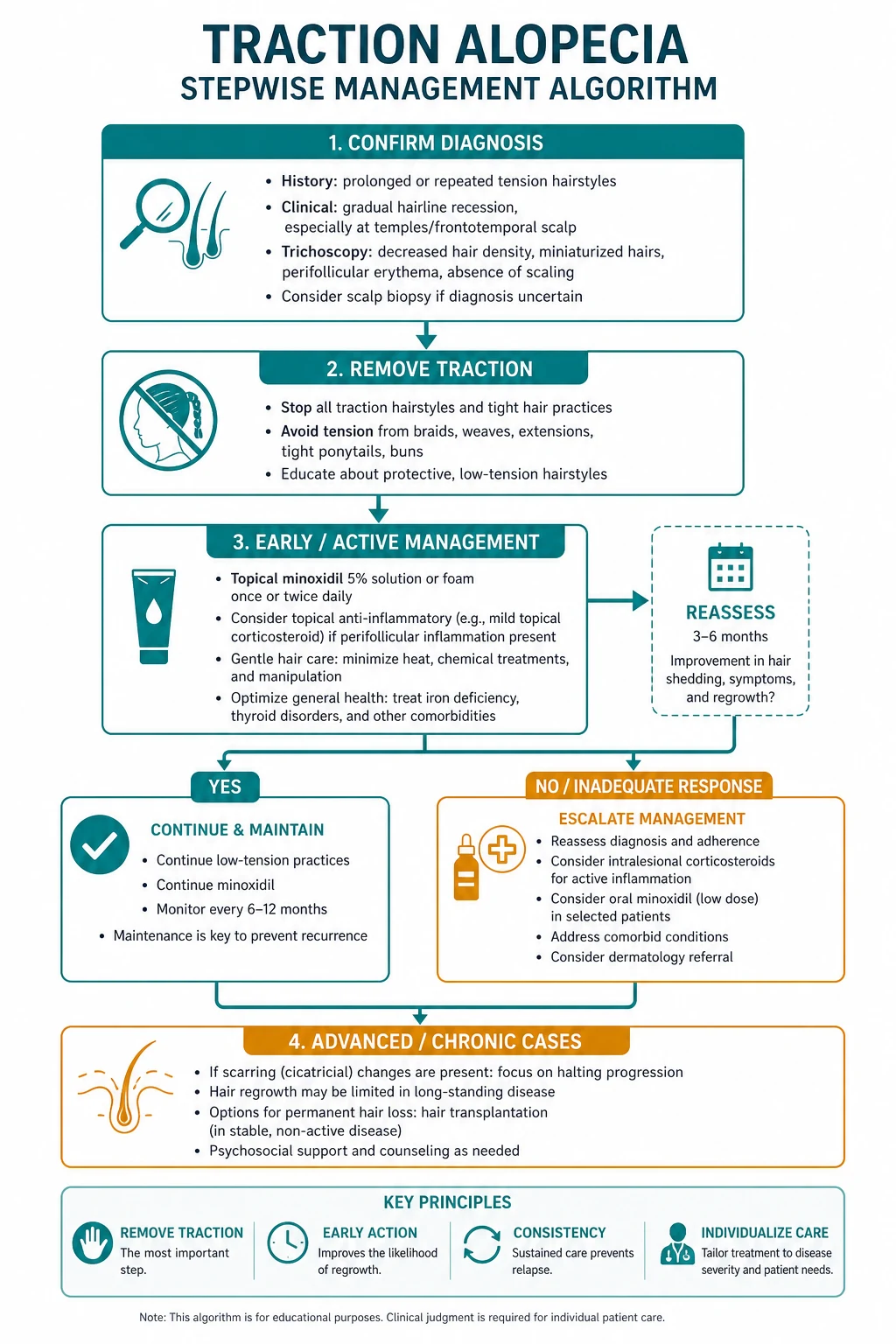
The single most important intervention is to STOP THE TRACTION — no other treatment compensates for continued pulling.[1][3][4] Every adjunct is layered on top of this.
Step 1 — STOP THE TRACTION
Discontinue tight braids, weaves, extensions, ponytails, headbands, headwear. Allow hair to rest in loose, natural styles. Set a 3–6 month trial of hairstyle change before assessing regrowth. This is the only intervention with proven reversibility.
Step 2 — Treat inflammation (if present)
For perifollicular erythema, papules, and active folliculitis: topical corticosteroid (mometasone furoate 0.1% or betamethasone dipropionate 0.05% lotion/solution, OD–BD, 2–4 weeks) OR intralesional triamcinolone acetonide 2.5–5 mg/mL into the active margin (every 4–6 weeks, max 3–4 sessions). Add a topical antibiotic (fusidic acid or mupirocin) for staphylococcal superinfection; oral flucloxacillin 500 mg QDS × 7 days or doxycycline 100 mg BD × 6 weeks if folliculitis is established.
Step 3 — Stimulate regrowth
Topical minoxidil 2% (women, BID) or 5% (men, BID; or women who tolerate 2%) to the affected margin, for at least 6–12 months. Counsel on initial shedding (weeks 2–6) and on the need for indefinite continuation; cessation reverses benefit. Adjunct: low-level laser / LED devices, platelet-rich plasma, microneedling — evidence is weak and case-series only.
Step 4 — Treat folliculitis
Traction folliculitis is usually Staphylococcal. First-line: topical fusidic acid or mupirocin 0.5%; second-line: oral flucloxacillin 500 mg QDS × 7 days or clarithromycin 250–500 mg BD × 7 days; chronic/relapsing: doxycycline 40 mg modified-release OD × 6–8 weeks (anti-inflammatory dose) or 100 mg BD × 4–6 weeks.
Step 5 — Address chemical and thermal injury
STOP chemical relaxers, perms, bleaches, dyes for at least 6 months. Avoid flat irons, hot combs, and curling wands. Allow chemical-free regrowth for 6–12 months before considering transplantation.
Step 6 — Surgical restoration (scarring disease)
Follicular unit extraction (FUE) or follicular unit transplantation (FUT/strip) from the occipital donor. Pre-requisites: disease BURNT-OUT (no active inflammation for 12+ months), ADEQUATE DONOR (occipital density ≥ 60 FU/cm²), NO CCCA in donor area, REALISTIC expectations (single session 1500–3000 grafts; full restoration may need 2–3 sessions over 18–24 months). Juri flaps and scalp reductions are reserved for severe disease with insufficient donor.
Step 7 — Cosmetic camouflage
Wigs (synthetic or human-hair), hairpieces, scalp micropigmentation (medical tattooing of dot-pattern to mimic shaved follicles), keratin fibres, hair-thickening powders, micro-beads, and customised hair systems. Refer to a hair-prosthesis service; psychological support is often required.
Step 8 — Prevent recurrence
Looser hairstyles, no chemicals on fragile hair, breaks between tight styles (≥ 4–6 weeks per year without traction), satin or silk sleep cap or pillowcase to reduce friction, no traction during sleep. Educate parents and caregivers in the paediatric population.
Drug doses — adult, paediatric, and pregnancy
Specific Subtypes & Scenarios
Sub-Saharan African women — chemical + mechanical spectrum
The dominant patient population. The Cape Town surveys documented 17.1% prevalence in schoolgirls and 31.7% in adult women — a doubling from first to last year of school. Risk is highest when chemical relaxation (sodium hydroxide, calcium hydroxide, guanidine) is followed by tight braiding within days.[5] The end-stage is the traction–CCCA spectrum: vertex scarring, perifollicular fibrosis at the isthmus, premature desquamation of the inner root sheath, and progressive centrifugal expansion. Management is stop the chemicals, stop the braids, and consider transplantation only when the disease is burnt-out and the occipital donor is uninvolved.
Sikh men — turban knot and beard
The Sikh turban knot is a small twisted bun that anchors the turban cloth. The sustained tension produces a beard or submandibular patch in many men, and a frontal or occipital patch in others. The disease is often misdiagnosed as alopecia areata. The Sikh community is increasingly aware of the issue; the practical management is to redistribute the knot's position periodically and to use a softer under-cloth. [1]
Ballet dancers — the classical bun
The classical "ballet bun" is held with multiple elastics and pins at the centre or off-centre, and pulled extremely tight. The disease presents as a temporal rim band (most common) or parietal band (less common). Most cases are early and reversible if the bun is loosened; late disease is uncommon because dancers usually stop performing before chronic damage sets in. [1]
Athletes — wrestlers, swimmers, cyclists, footballers
- Wrestlers — occipital friction from mats and headgear; co-exists with acne keloidalis nuchae in men of African descent.
- Swimmers — chlorinated cap pressure; chronic friction.
- Cyclists and footballers — helmet straps over the temples and occiput.
- Rugby players — scrum caps.
- Weightlifters, rowers, gymnasts — tight headbands and ponytails. [1]
Hijab wearers — occipital pressure alopecia
Tight underscarves and turbans produce a midline occipital band of pressure alopecia. The condition is under-reported. Practical management: rotate the position of the undercap, use softer fabrics, and avoid hairpins under tension. [1]
Children — safeguarding and counselling
The Cape Town survey found traction alopecia in 8.6% of first-year schoolgirls — before the age at which most children can advocate for themselves.[2][5] Paediatricians, school nurses, and dermatologists have a duty to identify and counsel. The management is education, hairstyle change, and follow-up, with safeguarding referral only if the hairstyle is being imposed against the child's interest.[2]
Trichorrhexis nodosa — the chemical-thermal-mechanical overlap
Trichorrhexis nodosa is a hair-shaft disorder characterised by nodal swellings and fractures under tension. It is common in patients with traction alopecia, particularly after chemical and thermal processing. It reinforces the message that fragile hair plus traction equals follicular destruction. [1]
TIGHT
Complications & Pitfalls
Prognosis & Disposition
- Early disease (reversible) — full regrowth expected if the hairstyle is changed and the chemical-thermal insult is stopped. Most patients show visible regrowth within 3–6 months; full regrowth takes 12–18 months because the hair growth cycle is long (anagen 2–6 years; catagen 2–3 weeks; telogen 3 months).
- Late disease (scarring) — no medical therapy regrows hair. Follicular unit extraction (FUE) or transplantation (FUT) from the occipital donor achieves 70–90% graft survival at 12 months in experienced hands; full cosmetic restoration may require 2–3 sessions over 18–24 months.
- CCCA overlap — guarded prognosis; the disease may progress despite hairstyle change because genetic susceptibility plays a larger role.
- Determinants of outcome — duration of traction, age of onset, severity at presentation, adherence to hairstyle change, donor density, surgical expertise, psychosocial support. [1]
Special Populations
Paediatric
- The Cape Town survey found traction alopecia in 17.1% of schoolgirls aged 6–21 and 8.6% in first-year schoolgirls.[5]
- The paediatrician's role is identification, education, and family counselling — the disease is reversible in the vast majority if recognised early.
- Minoxidil is not routinely licensed under 18; intralesional triamcinolone at 2.5 mg/mL is acceptable in older children and adolescents.
- Antibiotics for folliculitis are weight-based (flucloxacillin 12.5–25 mg/kg QDS).
- Safeguarding: refer to social services only if the hairstyle is being imposed in a way that is causing harm; in most cases, education and family engagement suffice.[2]
Pregnancy and breastfeeding
- Traction alopecia can worsen during pregnancy and the post-partum period (superimposed telogen effluvium).
- Topical minoxidil is AVOIDED in pregnancy (category C) and during breastfeeding (limited safety data; theoretical neonatal hypotensive effect).
- Topical corticosteroids (mometasone, betamethasone) — safe in pregnancy in short courses.
- Antibiotics — flucloxacillin, erythromycin, and cephalosporins are safe; doxycycline is CONTRAINDICATED (teeth discoloration, bone growth).
- Surgical transplantation is deferred until at least 6–12 months post-partum and after breastfeeding has stopped. [1]
Elderly
- Overlap with senescent alopecia, androgenetic alopecia, and FFA.
- Biopsy the active margin in any atypical presentation.
- Surgical transplantation is acceptable in the elderly if fitness and donor density permit.
- Co-existing medical therapy (antihypertensives, anticoagulants, thyroid disease) should be reviewed. [1]
Immunocompromised
- Atypical and severe infections; fungal kerion and dissecting cellulitis more common.
- Biopsy with special stains (PAS, Grocott) if tinea is suspected.
- Avoid potent immunosuppression; consult microbiology early. [1]
Anticoagulated
- Avoid biopsies, intralesional steroids, and surgery if INR is uncontrolled.
- Continue anticoagulation for most biopsies; consult haematology for high-risk patients. [1]
Evidence, Guidelines & Regional Differences
Landmark studies
- Khumalo 2007 (BJD) — Cape Town school survey: 1,042 schoolchildren; 9.4% overall prevalence, 17.1% in girls, increasing from 8.6% in first year to 21.7% in last year; TA associated with chemically relaxed hair.[5]
- Khumalo 2008 (JAAD) — determinants in African girls and women: 574 schoolgirls and 604 women; prevalence 17.1% in schoolgirls, 31.7% in women; risk highest with chemical relaxation + tight traction.
- Samrao 2011 (Dermatol Online J) — the 'fringe sign': retained hairs along the frontal/temporal rim as a sensitive and specific clinical marker of marginal traction alopecia.[6]
- Billero & Miteva 2018 (CCID) — 'the root of the problem': a comprehensive review of the biphasic pathophysiology and the role of clinician education in prevention.[4]
- Akintilo 2021 (J Drugs Dermatol) — management experience: institutional experience from a New York trichology centre; supports traction cessation as the cornerstone of management.[3]
- Afifi 2021 (Pediatr Dermatol) — paediatric review: highlights the role of education and the need for early intervention in children.[2]
- Balazic 2023 (Clin Exp Dermatol) — diverse urban population: 216 patients, 98.6% female, 72.7% Black; mean age 41.3 years; 42.5% improved at follow-up.[1]
- Jimenez 2021 (JAAD) — hair transplantation overview: foundational reference for FUE and FUT techniques.[7]
- Pirmez 2023 (JAAD) — dermatoscope in the hair clinic: trichoscopy of scarring and non-scarring alopecia, including traction alopecia.[8]
Regional differences
Exam Pearls
[1] [1] [1] [1]Red Flags
Exam application bank (NEET-PG / INICET)
One-line answer
Traction alopecia is a form of mechanical hair loss — and eventually scarring alopecia — caused by sustained or repeated tension on hair roots over weeks, months, or years. It predominantly affects women and girls of African descent (tight braids, cornrows, weaves, extensions, chemical relaxers), Sikh men (turban knot), ballet dancers, athletes, and any patient whose hairstyle, headwear, or occupational load applies chronic traction. Early (reversible) disease: perifollicular erythema, scaling, papules, broken hairs, tenderness, traction folliculitis at the hair margin. Late (irreversible) disease: scarring with loss of follicular ostia, smooth shiny scalp, vellus hairs only, the pathognomonic 'fringe sign' may be retained. Management hinges on the single most important intervention — STOP THE TRACTION — plus topical/intralesional corticosteroids, minoxidil, antibiotics for folliculitis,
Worked stems (answer without another resource)
Stem 1 — Classic presentation. Map symptoms to mechanism; name the first investigation and first treatment step with dose/route if drug therapy is standard. [1]
Stem 2 — Unstable / complicated. List red flags that force immediate resuscitation, theatre, ICU, antidote, or reperfusion — and what you do in the first 15 minutes. [1]
Stem 3 — Atypical group. Elderly, pregnancy, child, or immunocompromised: how presentation and thresholds change. [1]
Stem 4 — Differential trap. Name the three closest mimics and one discriminator for each. [1]
Stem 5 — Disposition. Who goes home with safety-netting, who is admitted, who needs HDU/ICU/theatre, and what follow-up is mandatory. [1]
Rapid viva checklist
- Definition + classification
- Pathophysiology chain
- Bedside signs / criteria
- Score with exact components (if any)
- Emergency bundle
- Definitive therapy with doses
- Complications of disease and of treatment
- Special populations
- Guideline/trial name if classic
- Three exam traps
Coverage self-check
If you cannot answer any stem above from this page alone, re-read the matching section — the page is intended to be self-sufficient for final-prof and NEET-PG/INICET questions on Traction alopecia.
[1]Prevention
Looser hairstyles
Loose braids, loose buns, low-tension ponytails, no elastics directly on the hair margin. Distribute tension across the whole scalp rather than at the hairline.
No chemicals on fragile hair
No chemical relaxers, perms, bleaches, or dyes within 2–4 weeks of braiding or weaving. Avoid overlapping chemical + mechanical insults.
Break time between tight styles
≥ 4–6 weeks per year without any traction-based hairstyle. Allow the follicles to recover.
Weight reduction
Limit the weight of added hair (extensions, weaves, beadwork). Lighter is better.
Heat avoidance
Flat irons, hot combs, and curling wands at low heat, infrequent use, and never on chemically processed hair.
Satin or silk sleep cap / pillowcase
Reduces friction at night; protects the hair margin from repeated abrasion.
Position rotation
Rotate the position of any sustained tension point (Sikh knot, hijab undercap, ballet bun, weave track).
Pain = stop
Tell every patient — child, adolescent, and adult — that pain on styling is a warning sign that the hairstyle is causing damage.
Self-completeness test (examiner's mental map)
Re-read the topic as a candidate who has read nothing else on traction alopecia. For each of the following examiner prompts, the answer must be in the topic: [1]
- Define traction alopecia and classify the two phases. ✅
- Name the populations at risk and the hairstyles that drive disease. ✅
- Describe the mechanical cascade from tension to scarring. ✅
- Reproduce the diagnostic features of acute and chronic disease. ✅
- State the pathognomonic clinical sign of marginal disease (fringe sign). ✅
- Distinguish traction alopecia from alopecia areata, trichotillomania, telogen effluvium, FFA, LPP, and AGA. ✅
- State the trichoscopy and histopathology features. ✅
- Name the single most important intervention. ✅
- Give the topical, intralesional, antibiotic, and surgical regimens with doses. ✅
- Discuss the special populations (paediatric, pregnancy, elderly, immunocompromised, anticoagulated). ✅
- Describe the regional differences and the landmark studies. ✅
- State the public-health message. ✅ [1]
References
- [1]Balazic E, Hawkins K, Choi J, Konisky H, Chen A, Kobets K Traction alopecia: assessing the presentation, management and outcomes in a diverse urban population Clin Exp Dermatol, 2023.PMID 37098178
- [2]Afifi L, Oparaugo NC, Hogeling M Review of traction alopecia in the pediatric patient: Diagnosis, prevention, and management Pediatr Dermatol, 2021.PMID 34467569
- [3]Akintilo L, Yin L, Svigos K, Kakpovbia E, Shapiro J, Sicco KL Management of Traction Alopecia: Our Experience and a Brief Review of Current Literature Recommendations J Drugs Dermatol, 2021.PMID 33938696
- [4]Billero V, Miteva M Traction alopecia: the root of the problem Clin Cosmet Investig Dermatol, 2018.PMID 29670386
- [5]Khumalo NP, Jessop S, Gumedze F, Ehrlich R Hairdressing is associated with scalp disease in African schoolchildren Br J Dermatol, 2007.PMID 17553035
- [6]Samrao A, Price VH, Zedek D, Mirmirani P The Fringe Sign - A useful clinical finding in traction alopecia of the marginal hair line Dermatol Online J, 2011.PMID 22136857
- [7]Jimenez F, Alam M, Vogel JE, et al. Hair transplantation: Basic overview J Am Acad Dermatol, 2021.PMID 33905785
- [8]Pirmez R The dermatoscope in the hair clinic: Trichoscopy of scarring and nonscarring alopecia J Am Acad Dermatol, 2023.PMID 37591567