Dermatology · Medicine
Trichotillomania
Also known as Hair-pulling disorder · Trichotillosis · Compulsive hair pulling · BFRB hair pulling
Trichotillomania (hair-pulling disorder) is a body-focused repetitive behaviour causing irregular non-scarring hair loss with hairs of varying lengths. Dermatology exams test trichoscopic signs (flame hairs, V-sign, hair powder, tulip hairs), differentiation from alopecia areata and tinea capitis, first-line habit reversal training / ComB, adult N-acetylcysteine RCT evidence versus paediatric null results, limited SSRI signal, and trichobezoar/Rapunzel emergencies.
On this page & tools
Your progress
Saved locally on this device.
Exam tags
Red flags
Definition & Classification
Trichotillomania (TTM; hair-pulling disorder) is recurrent pulling of one’s own hair resulting in hair loss, repeated attempts to decrease or stop, and clinically significant distress or impairment, not better explained by another medical or mental disorder.[1][9] In modern nosology it sits with body-focused repetitive behaviours (BFRBs) and is related to the obsessive-compulsive and related disorders spectrum, alongside excoriation (skin-picking) disorder.[1]
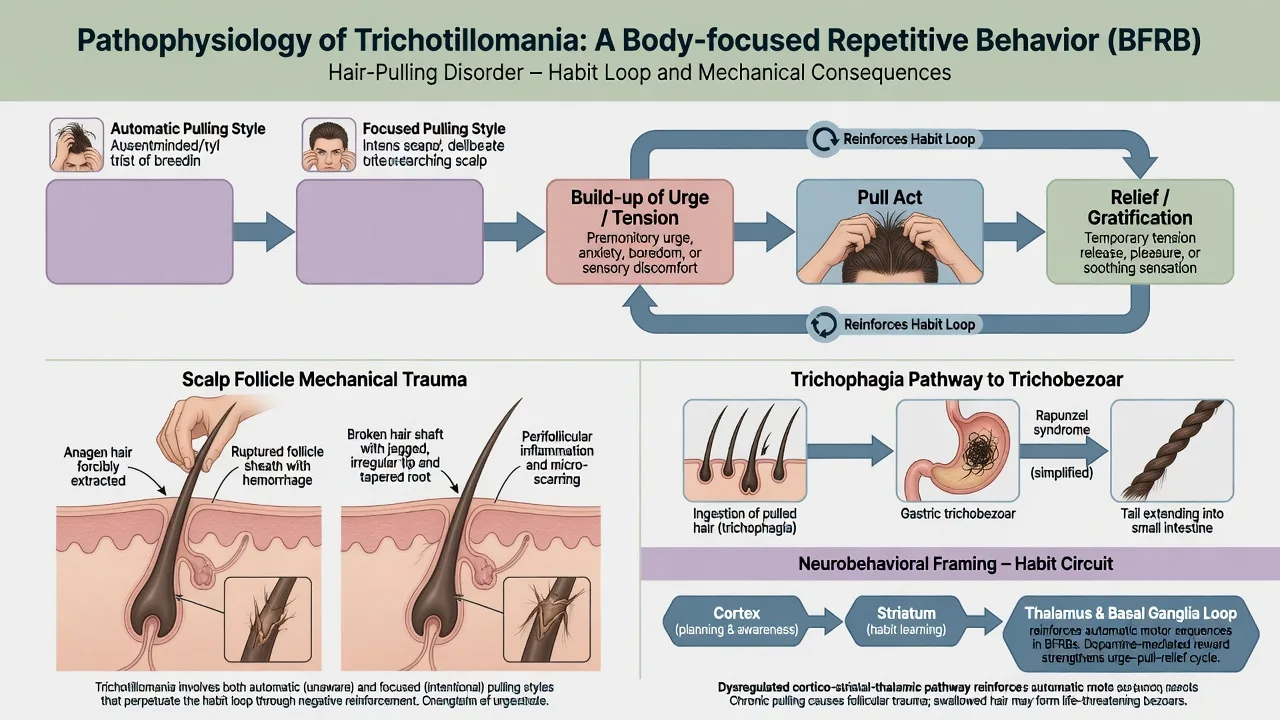
Two behavioural styles are examinable: [1]
| Style | Features |
|---|---|
| Automatic | Pulling outside full awareness (while reading, watching screens) |
| Focused | Pulling in response to urge, tension, or negative affect; more deliberate |
Many patients show a mixed pattern over time.[1]
Epidemiology & Risk Factors
Classic college surveys suggested meaningful lifetime rates of clinically significant hair pulling; modern population analyses reaffirm that TTM is not rare, with female predominance in clinical samples and frequent psychiatric comorbidity (anxiety, depression, other BFRBs, OCD-spectrum traits).[8][9] Onset is often in childhood or adolescence. Under-reporting driven by shame means dermatology presentations may be labelled “areata” until trichoscopy is performed.[1][9]
Pathophysiology
TTM is a behavioural–habit disorder with secondary mechanical injury to hair shafts and follicles, not a primary autoimmune attack on the hair bulb (contrast alopecia areata).[1] Repeated traction produces broken shafts, catagen shift, trichomalacia, and pigment casts. Trichophagia (swallowing hair) can accumulate into a trichobezoar; extension beyond the pylorus is Rapunzel syndrome — a surgical emergency pathway.[12]
Clinical Presentation
- Scalp most often (vertex, frontoparietal); also eyebrows, eyelashes, pubic or body hair.[1]
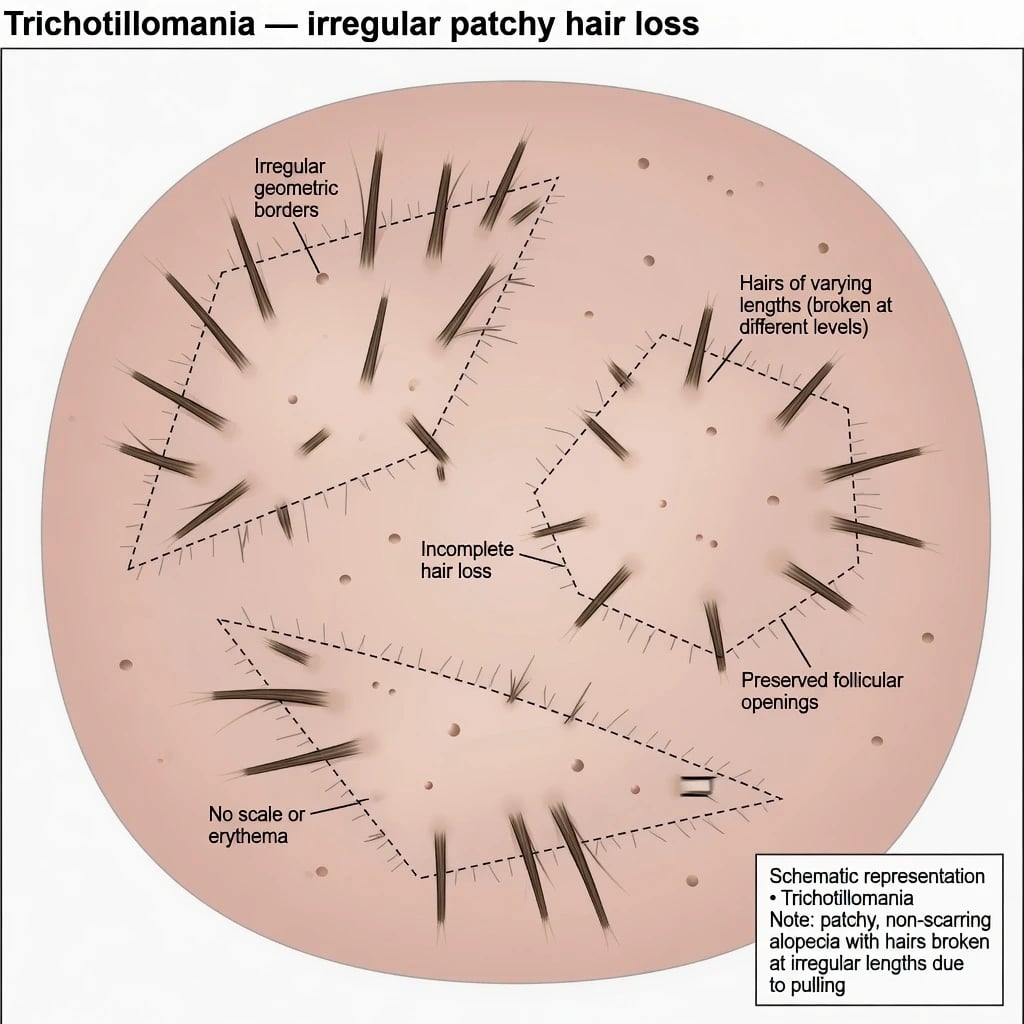
- Incomplete bald patches with short residual hairs of many lengths; bizarre geometric shapes; opposite side or non-dominant-hand patterns sometimes noted.
- Skin surface usually non-scaly (unless secondary infection or concurrent seborrhoea); follicular ostia preserved.
- Patients may minimise or deny pulling; family members often observe the behaviour.
- Concurrent nail biting or skin picking supports a BFRB formulation.[1][9]
Differential Diagnosis
| Mimic | Distinguishing feature |
|---|---|
| Alopecia areata | Smooth patch; exclamation-mark hairs; yellow dots; often positive margin pull; nail pitting may co-exist |
| Tinea capitis | Scale, black dots, lymphadenopathy; KOH/culture positive |
| Traction alopecia | Marginal pattern tied to tight hairstyles |
| Telogen effluvium | Diffuse shedding; no focal bizarre patches |
| Secondary syphilis | Moth-eaten pattern; systemic/STI clues; serology |
| Scarring alopecias | Loss of ostia, inflammation, permanent loss |
Trichoscopy & Investigations
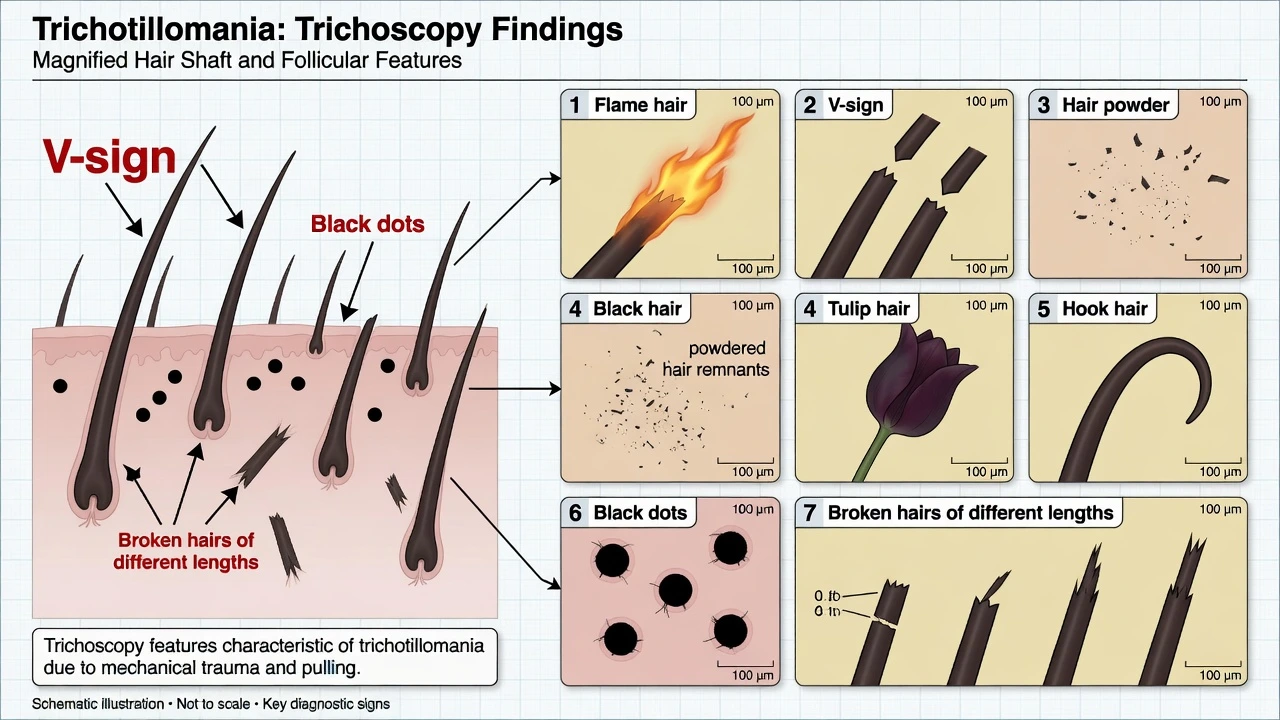
Trichoscopy is high-yield. Findings supporting TTM include flame hairs, V-sign (two broken hairs from one follicle), hair powder, tulip hairs, hook hairs, black dots, and broken hairs of different lengths.[2][3] These complement clinical pattern recognition and reduce unnecessary immunosuppression for misdiagnosed areata.
Investigations are selective:
- KOH / culture if scale or paediatric black-dot disease possible
- Syphilis serology if moth-eaten pattern
- Biopsy if scarring, diagnostic uncertainty, or medicolegal clarity needed
- Abdominal imaging / surgical review if trichophagia with GI symptoms[12]
Histopathology
Expect increased catagen/telogen hairs, trichomalacia, pigment casts, empty follicles, and usually sparse inflammation. Scarring is uncommon unless chronic severe trauma or secondary infection. Histology supports diagnosis when denial is firm but is not mandatory if clinical–trichoscopic correlation is clear.[1]
Management — Behavioural (first line)
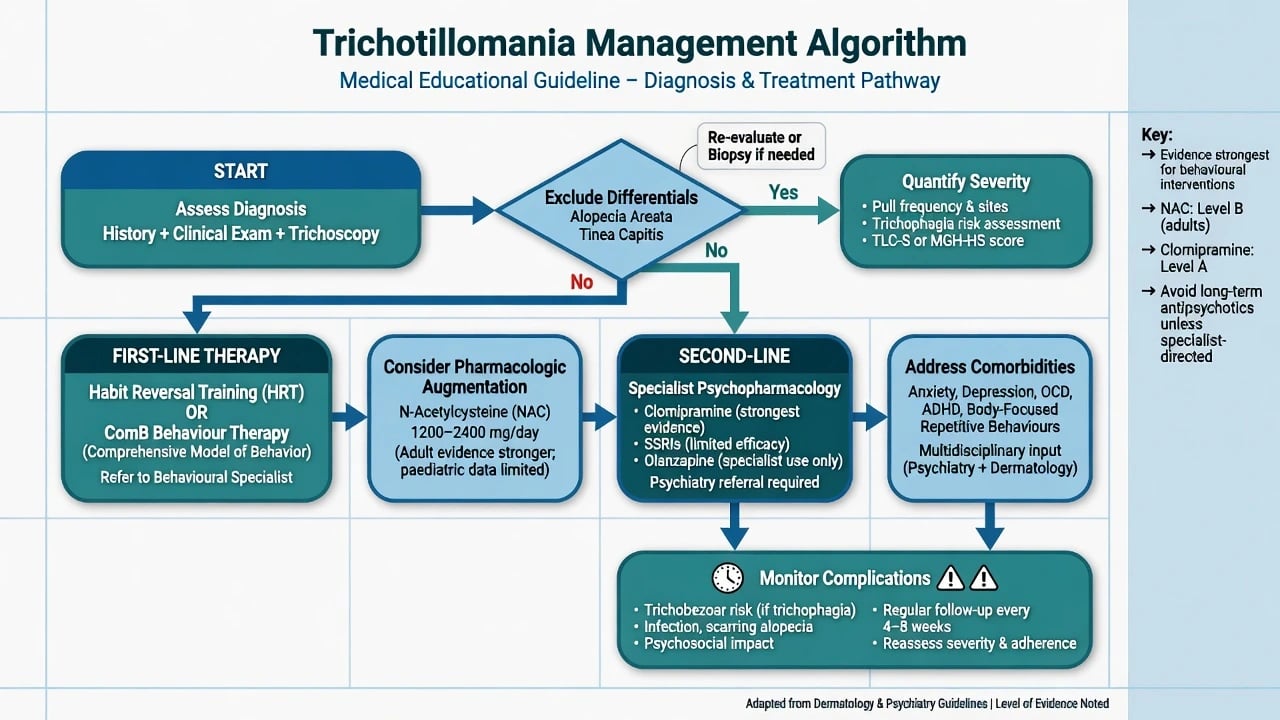
Habit reversal training (HRT) remains the behavioural cornerstone: awareness training, competing response, stimulus control, and social support.[6][7] ACT-enhanced HRT and Comprehensive Behavioural (ComB) models address sensory, cognitive, affective, motor and environmental domains.[11] Meta-analytic synthesis shows behaviour therapy effects larger and more consistent than SRI monotherapy for TTM.[6][7]
Dermatology role: confirm diagnosis, exclude mimics, counsel non-judgementally, treat secondary skin injury, and refer early to psychology/psychiatry skilled in BFRBs. [1]
Management — Pharmacotherapy
| Approach | Evidence framing | Exam caution |
|---|---|---|
| N-acetylcysteine (adults) | Grant 2009 RCT: glutamate modulation improved hair-pulling vs placebo in adults[4] | Paediatric Bloch 2013 add-on RCT did not show benefit over placebo — do not over-extrapolate adult data to children[5] |
| Clomipramine | Superior to desipramine in classic Swedo RCT[10] | Anticholinergic/cardiac toxicity; specialist use |
| SSRIs | Weak as sole therapy for pure TTM; useful for comorbid OCD/depression[6][7] | Do not promise hair regrowth from SSRI alone |
| Olanzapine | Positive small RCT signal exists in literature base reviewed in meta-analyses/updates | Metabolic cost limits first-line use |
Always document trichophagia, school/work function, and suicide risk when relevant. [1]
Complications, Emergencies & Pitfalls
- Trichobezoar / Rapunzel syndrome — pain, vomiting, mass, obstruction; surgical/GI emergency.[12]
- Secondary infection, permanent follicle damage with years of trauma.
- Psychosocial morbidity: bullying, isolation, depression.
- Pitfall: treating as areata with systemic steroids/JAK inhibitors without trichoscopy.
Special Populations
Children: parent-assisted HRT; screen school functioning; paediatric NAC evidence is negative in the key RCT — prioritise behaviour therapy.[5]
Pregnancy: prefer non-drug behavioural approaches; review any psychotropic with perinatal psychiatry.
Adults: workplace concealment, eyebrow/eyelash cosmesis, comorbid BFRBs.
Prognosis & Follow-Up
Course is often chronic-fluctuating. Track pull-free days, photographs, and validated severity concepts (e.g. MGH-HPS used in research settings). Relapse prevention and long-term psychological support matter more than short “clearance” visits.[1][7]
Evidence, Guidelines & Regional Notes
There is no single global dermatology monograph equivalent to psoriasis biologics guidance; practice synthesises dermatology diagnosis with psychiatric behavioural evidence. Exam-safe anchors: JAAD review framing of TTM,[1] trichoscopy series,[2][3] Grant NAC adult RCT,[4] Bloch paediatric null NAC,[5] and behaviour-therapy meta-analyses.[6][7] Regional pathways (IADVL/FACD/FRCDerm/ABD) share the same hierarchy: behaviour first, drugs adjunctive, medical emergencies not missed.
Exam Pearls
Red Flags
Exam application bank (NEET-PG / INICET)
One-line answer
Trichotillomania (hair-pulling disorder) is a body-focused repetitive behaviour causing irregular non-scarring hair loss with hairs of varying lengths. Dermatology exams test trichoscopic signs (flame hairs, V-sign, hair powder, tulip hairs), differentiation from alopecia areata and tinea capitis, first-line habit reversal training / ComB, adult N-acetylcysteine RCT evidence versus paediatric null results, limited SSRI signal, and trichobezoar/Rapunzel emergencies.
Worked stems (answer without another resource)
Stem 1 — Classic presentation. Map symptoms to mechanism; name the first investigation and first treatment step with dose/route if drug therapy is standard. [1]
Stem 2 — Unstable / complicated. List red flags that force immediate resuscitation, theatre, ICU, antidote, or reperfusion — and what you do in the first 15 minutes. [1]
Stem 3 — Atypical group. Elderly, pregnancy, child, or immunocompromised: how presentation and thresholds change. [1]
Stem 4 — Differential trap. Name the three closest mimics and one discriminator for each. [1]
Stem 5 — Disposition. Who goes home with safety-netting, who is admitted, who needs HDU/ICU/theatre, and what follow-up is mandatory. [1]
Rapid viva checklist
- Definition + classification
- Pathophysiology chain
- Bedside signs / criteria
- Score with exact components (if any)
- Emergency bundle
- Definitive therapy with doses
- Complications of disease and of treatment
- Special populations
- Guideline/trial name if classic
- Three exam traps
Coverage self-check
If you cannot answer any stem above from this page alone, re-read the matching section — the page is intended to be self-sufficient for final-prof and NEET-PG/INICET questions on Trichotillomania.
Expanded exam teaching (depth pass)
Clinical reasoning
For Trichotillomania, examiners test whether you can prioritise life threats, choose the right first test, and give specific therapy (agent, dose, route, timing). Generic phrases without numbers score poorly.
Mechanism → feature map
Build a short chain: cause → pathophysiologic intermediate → clinical feature → complication. Every major symptom in the classic vignette should sit on that chain.
Investigation strategy
- Bedside/first-line tests that change immediate management
- Confirmatory or staging tests
- What a normal result does not exclude
- When not to delay treatment for imaging (unstable patient)
Management ladder
- Resuscitation / ABC / sepsis or haemorrhage bundle as relevant
- Specific antidote / procedure / antimicrobial / reperfusion / surgery
- Supportive care and monitoring targets
- Definitive long-term therapy and secondary prevention
- Disposition and safety-net advice
Special populations
Always prepare one line each for children, pregnancy, elderly, renal/hepatic impairment, and immunocompromised patients when the topic allows.
Pitfalls that fail candidates
- Treating the number not the patient
- Missing pregnancy status when relevant
- Imaging before stabilisation
- Wrong empiric cover or wrong antidote timing
- Incomplete counselling on recurrence, adherence, or red-flag return
Trichotillomania (hair-pulling disorder) is a body-focused repetitive behaviour causing irregular non-scarring hair loss with hairs of varying lengths. Dermatology exams test trichoscopic signs (flame hairs, V-sign, hair powder, tulip hairs), differentiation from alopecia areata and tinea capitis, first-line habit reversal training / ComB, adult N-acetylcysteine RCT evidence versus paediatric null results, limited SSRI signal, and trichobezoar/Rapunzel emergencies. [1]
Structured revision sheet
Must-know numbers and names
List every score, size threshold, dose, and time window from this topic on a blank page from memory, then check against the sections above.
Three classic MCQ angles
- Most likely diagnosis given a vignette
- Next best step in management
- Most appropriate investigation
Three classic SAQ angles
- Pathophysiology in five steps
- Management algorithm with doses
- Complications and prevention
Clinical station flow
Greet → focused history → targeted exam → investigations → explain diagnosis → emergency care → definitive plan → safety-net / follow-up → answer examiner questions on mechanism and pitfalls.
[1]Exam anchors
References
- [1]Hautmann G, Hercogova J, Lotti T. Trichotillomania J Am Acad Dermatol, 2002.PMID 12063477
- [2]Rakowska A, Slowinska M, Olszewska M, et al. New trichoscopy findings in trichotillomania: flame hairs, V-sign, hook hairs, hair powder, tulip hairs Acta Derm Venereol, 2014.PMID 24096547
- [3]Miteva M, Tosti A. Flame Hair Skin Appendage Disord, 2015.PMID 27171360
- [4]Grant JE, Odlaug BL, Kim SW. N-acetylcysteine, a glutamate modulator, in the treatment of trichotillomania: a double-blind, placebo-controlled study Arch Gen Psychiatry, 2009.PMID 19581567
- [5]Bloch MH, Panza KE, Grant JE, et al. N-Acetylcysteine in the treatment of pediatric trichotillomania: a randomized, double-blind, placebo-controlled add-on trial J Am Acad Child Adolesc Psychiatry, 2013.PMID 23452680
- [6]McGuire JF, Ung D, Selles RR, et al. Treating trichotillomania: a meta-analysis of treatment effects and moderators for behavior therapy and serotonin reuptake inhibitors J Psychiatr Res, 2014.PMID 25108618
- [7]Farhat LC, Olfson E, Nasir M, et al. Pharmacological and behavioral treatment for trichotillomania: An updated systematic review with meta-analysis Depress Anxiety, 2020.PMID 32390221
- [8]Christenson GA, Pyle RL, Mitchell JE. Estimated lifetime prevalence of trichotillomania in college students J Clin Psychiatry, 1991.PMID 1938977
- [9]Grant JE, Dougherty DD, Chamberlain SR. Prevalence, gender correlates, and co-morbidity of trichotillomania Psychiatry Res, 2020.PMID 32334275
- [10]Swedo SE, Leonard HL, Rapoport JL, et al. A double-blind comparison of clomipramine and desipramine in the treatment of trichotillomania (hair pulling) N Engl J Med, 1989.PMID 2761586
- [11]Woods DW, Wetterneck CT, Flessner CA. A controlled evaluation of acceptance and commitment therapy plus habit reversal for trichotillomania Behav Res Ther, 2006.PMID 16039603
- [12]Balawender K, Pliszka A, Możdżeń K, et al. Trichopsychodermatology: trichotillomania and trichophagia leading to Rapunzel syndrome Postepy Dermatol Alergol, 2022.PMID 36090734