Emergency & Toxicology · Emergency & Toxicology
Beta-Blocker & Calcium-Channel Blocker Overdose
Also known as Beta-blocker overdose · Calcium-channel blocker overdose · CCB overdose · Verapamil overdose · High-dose insulin euglycaemia therapy · HIET · Lipid emulsion therapy · Glucagon antidote
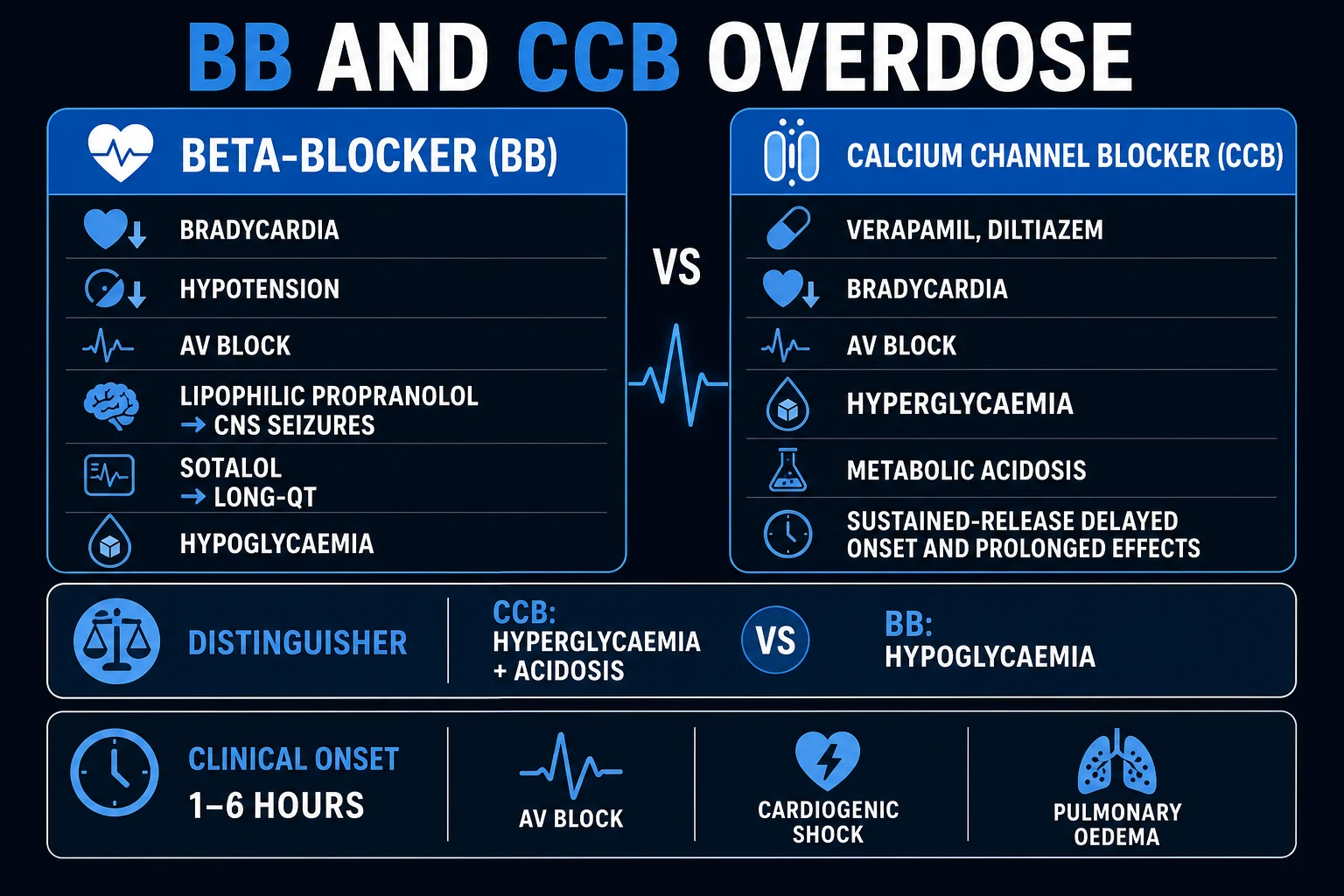
Beta-blocker (BB) and calcium-channel blocker (CCB) overdoses are two of the most lethal prescription drug poisonings and are taught together because they produce an overlapping toxidrome — bradycardia, hypotension, AV conduction block and cardiogenic shock refractory to standard ACLS — and share an overlapping antidote ladder (IV calcium, high-dose insulin euglycaemia therapy, glucagon, vasopressors, lipid emulsion, pacing, ECMO). Beta-blockers antagonise beta-adrenergic G-protein-coupled receptors - reduced cAMP/PKA - reduced L-type calcium-channel opening - negative inotropy, chronotropy and dromotropy; lipophilic agents (propranolol, metoprolol, carvedilol) cross the blood-brain barrier causing CNS depression, seizures and coma (membrane-stabilising Na-channel effect), and sotalol uniquely prolongs the QT (torsades risk). Calcium-channel blockers directly block the L-type voltage-gated calcium channel: the non-dihydropyridines (verapamil, diltiazem) are predominantly cardiac (negative inotropy/chronotropy/dromotropy and AV block) and are the most lethal in overdose, while the dihydropyridines (amlodipine, nifedipine) are predominantly vasodilatory. The single most exam-relevant discriminator is that CCBs block calcium entry into pancreatic beta cells - impaired insulin release - HYPERGLYCAEMIA + metabolic acidosis, a clue that distinguishes CCB from BB overdose (BBs do not cause hyperglycaemia and may instead cause hypoglycaemia). The most effective single inotropic therapy is high-dose insulin euglycaemia therapy (HIET). Sustained-release verapamil/diltiazem is the lethal subtype with delayed and prolonged toxicity.
On this page & tools
Your progress
Saved locally on this device.
Exam tags
Red flags
Overview & Definition
Beta-blocker overdose is the clinical syndrome of excess beta-adrenergic receptor antagonism producing bradycardia, hypotension, AV conduction block, reduced myocardial contractility, and — with the lipophilic membrane-stabilising agents — CNS depression, seizures and coma. Calcium-channel blocker (CCB) overdose is excess L-type voltage-gated calcium-channel blockade producing negative inotropy, negative chronotropy, negative dromotropy, vasodilation and (especially with the non-dihydropyridines) hyperglycaemia from inhibition of pancreatic beta-cell insulin release.[1]
These two drug classes are taught together for four reasons. First, the toxidrome overlaps almost completely — both produce bradycardia, hypotension, AV conduction block and cardiogenic shock that is refractory to standard ACLS (atropine and adrenaline boluses alone fail). Second, the antidote ladder overlaps — both respond to intravenous calcium, high-dose insulin euglycaemia therapy (HIET), vasopressors, lipid emulsion, pacing and ECMO; glucagon is specific to BB. Third, co-ingestion is common (a patient taking both a BB and a CCB for hypertension or angina), and the combination is dramatically more lethal than either alone. Fourth, the diagnostic discriminator — hyperglycaemia with metabolic acidosis points to CCB, while BB does not cause hyperglycaemia (and may cause hypoglycaemia) — is one of the highest-yield facts in toxicology and is examined relentlessly.[2]
Of the two, sustained-release verapamil/diltiazem overdose is one of the most lethal of all prescription drug overdoses, with a reported mortality in severe series of up to 20-30 per cent even in young, previously well patients. The lethal subtype has a deceptive latent phase (the patient looks well for 6-12 h while the tablet continues to absorb) followed by sudden refractory cardiovascular collapse — early, aggressive, multimodal therapy and 24 h of intensive monitoring are essential.[1]
The topic is high-yield because it tests three layers: the molecular pharmacology (beta-receptor/G-protein cascade; L-type calcium channel; pancreatic beta-cell insulin release), the bedside discriminator (hyperglycaemia = CCB), and the stepwise management ladder with verbatim drug doses (calcium, HIET, glucagon, lipid, ECMO). [1]
Classification
Beta-blockers and calcium-channel blockers each have a classification that directly predicts overdose severity.[2]
Beta-blockers — three classification axes that matter in overdose
Lipophilicity (determines CNS toxicity)
- LIPID-SOLUBLE (cross BBB, cause CNS effects): propranolol, metoprolol, carvedilol, timolol — CNS depression, seizures, coma
- WATER-SOLUBLE (restricted to cardiovascular): atenolol, nadolol, sotalol, esmolol — pure cardiovascular effects (except sotalol's class III action)
- Propranolol is the MOST neurotoxic (seizures, coma, QRS widening from fast Na-channel blockade)
- Lipid solubility also makes lipid emulsion a candidate rescue therapy
Cardioselectivity (determines beta-2 effects)
- Beta-1 SELECTIVE: bisoprolol, metoprolol, atenolol, esmolol — relatively bronchospasm-sparing at therapeutic dose; selectivity LOST in overdose
- NON-selective: propranolol, nadolol, timolol, sotalol, carvedilol — block beta-2 too (bronchospasm, masked hypoglycaemia)
- Carvedilol and labetalol ALSO block alpha-1 -> vasodilation component
- Nebivolol causes nitric-oxide-mediated vasodilation
Membrane-stabilising activity (determines QRS widening)
- Agents WITH MSA: propranolol, acebutolol, carvedilol, labetalol, sotalol — quinidine-like fast Na-channel blockade -> QRS widening, seizures, ventricular arrhythmia
- Agents WITHOUT MSA: atenolol, metoprolol, bisoprolol, esmolol, nadolol — pure beta-blockade, narrow QRS
- MSA is the beta-blocker feature that makes an overdose resemble TCA toxicity (QRS widening, sodium bicarbonate responsiveness)
Calcium-channel blockers — the dihydropyridine/non-dihydropyridine split is the whole story
Non-dihydropyridines (verapamil, diltiazem) — THE LETHAL SUBTYPE
- Predominantly CARDIAC effect: SA node slowing, AV nodal block, marked negative inotropy
- Directly block L-type calcium channels in nodal (slow-response) tissue -> flattened phase 0, slowed conduction, AV block
- Most lethal in overdose — sustained-release verapamil/diltiazem carry the highest mortality of any prescription overdose
- Also block calcium entry into pancreatic beta cells -> HYPERGLYCAEMIA + metabolic acidosis
- Also cause mesenteric vasospasm (bowel ischaemia)
Dihydropyridines (amlodipine, nifedipine, felodipine, nicardipine) — vasoplegic
- Predominantly VASCULAR effect: vasodilation of arteriolar smooth muscle -> hypotension
- Initial REFLEX TACHYCARDIA (baroreceptor response to vasodilation) — a clue
- In SEVERE overdose the myocardium is also depressed -> late bradycardia and collapse
- Lethal in large ingestions but generally better prognosis than non-DHP
It is essential to know the sustained-release (SR/ER/CD) formulations by name — verapamil SR, diltiazem CD, nifedipine GITS, amlodipine — because they produce delayed peak (6-24 h) and prolonged, biphasic severe toxicity, and they require whole-bowel irrigation and prolonged (24 h) intensive observation.[1]
Epidemiology & Risk Factors
CCB overdose (especially verapamil/diltiazem) is one of the most lethal of all prescription overdoses; BB overdose is also common and lethal. The typical demographic is deliberate self-harm in adults (often with psychiatric comorbidity), accidental paediatric ingestion (a few tablets are lethal in a toddler), and iatrogenic error in the elderly.[1]
Patient-related risk factors for severity:
- Co-ingestants — a second cardiovascular drug (BB + CCB, or with digoxin, TCA, alcohol) dramatically increases mortality; always screen for co-ingestants (paracetamol, salicylate, ethanol).
- Advanced age and pre-existing cardiac disease — lower baseline contractility, less reserve, worse outcomes.
- Hepatic or renal impairment — affects clearance of the drug (verapamil/diltiazem are hepatically cleared; atenolol/nadolol are renally cleared).
- Drug interactions — CYP3A4 inhibitors (macrolides — clarithromycin/erythromycin, itraconazole, grapefruit juice, HIV protease inhibitors) raise verapamil/diltiazem levels and can precipitate chronic toxicity at a previously tolerated dose. [1]
Formulation-related risk:
- SUSTAINED-RELEASE verapamil/diltiazem carries the highest mortality. The delayed absorption produces a deceptive latent phase followed by refractory cardiogenic shock; small numbers of tablets can be lethal. [1]
Agent-specific risk:
- Propranolol is the most neurotoxic beta-blocker — it is highly lipophilic and exerts membrane-stabilising (fast Na-channel) activity at high concentration, causing seizures, coma and QRS widening.
- Sotalol has a prolonged half-life (12-16 h) and a class III antiarrhythmic action (potassium-channel blockade) that produces a long QT with torsades de pointes — a distinct management challenge.
- Verapamil is the most cardiotoxic CCB — profound negative inotropy and AV nodal block. [1]
Paediatric lethality: even one or two adult verapamil/diltiazem/propranolol tablets can produce life-threatening toxicity in a toddler — accidental grandparent-pill ingestion is a classic presentation and a safeguarding concern.[2]
[1]Pathophysiology
The molecular mechanism is the most frequently examined concept and must be reproduced in full, for BOTH drug classes.[2]
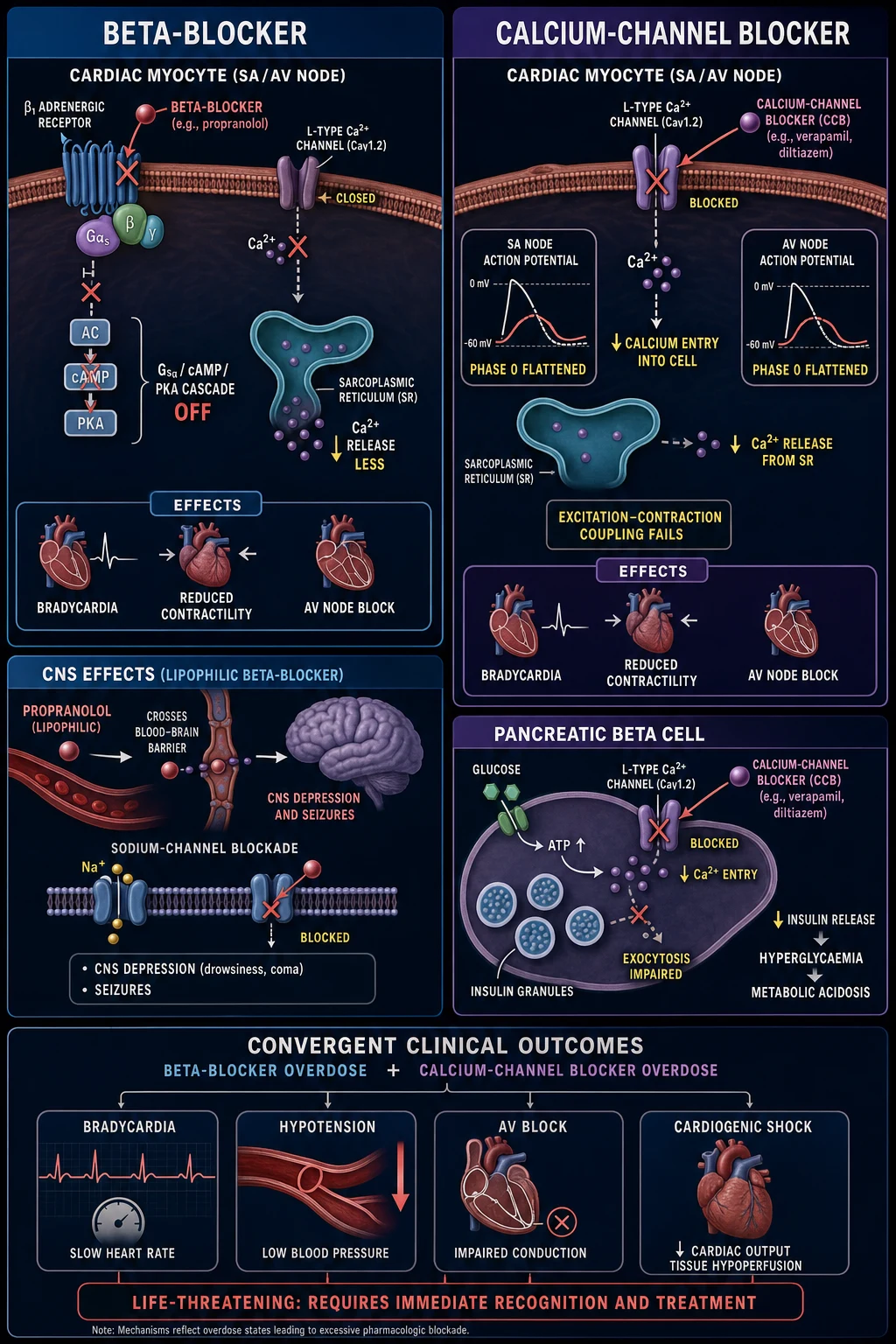
Beta-blocker mechanism (receptor -> cAMP -> calcium channel)
Step 1 — receptor antagonism. Beta-blockers are competitive antagonists of the beta-adrenergic receptors (beta-1 in the heart and juxtaglomerular apparatus; beta-2 in bronchial and vascular smooth muscle, liver, uterus; beta-3 in adipose tissue and bladder). These receptors are Gs-protein-coupled; their stimulation normally activates adenylyl cyclase, raising intracellular cAMP, which activates protein kinase A (PKA). PKA phosphorylates the L-type voltage-gated calcium channel (increasing calcium entry during the action potential plateau) and phospholamban (releasing SERCA from inhibition, increasing sarcoplasmic reticulum calcium re-uptake and release). Beta-blockade reverses all of this: cAMP falls, PKA activity falls, the L-type channel opens less readily, and less calcium enters the myocyte and is released from the SR. [1]
Step 2 — the haemodynamic consequence. Reduced calcium entry and reduced SR calcium release produce the three cardinal cardiac effects: negative chronotropy (slower SA node firing — the If 'funny' current in the SA node is also cAMP-dependent), negative dromotropy (slower AV nodal conduction — AV nodal cells are slow-response tissue dependent on calcium 'I_Ca-L' for the upstroke), and negative inotropy (reduced contractility). The net effect is bradycardia, hypotension, AV conduction block and reduced cardiac output. [1]
Step 3 — beta-2 effects. Non-selective beta-blockers also block beta-2 receptors, causing bronchospasm (in susceptible asthmatics), unopposed alpha vasoconstriction (with combined alpha/beta blockers this is less of an issue), and masking of hypoglycaemia — the adrenergic WARNING signs of hypoglycaemia (tachycardia, tremor, sweating, anxiety) are beta-mediated and are blunted by beta-blockade. Beta-blockers also inhibit hepatic gluconeogenesis and glycogenolysis, so they can both cause hypoglycaemia (especially in children and starved adults) AND hide it. [1]
Step 4 — membrane-stabilising activity (MSA). The lipophilic agents (propranolol, acebutolol, carvedilol, labetalol, sotalol) have, at high concentration, a quinidine-like fast-sodium-channel-blocking (class I) effect — the so-called membrane-stabilising activity. This produces QRS widening, ventricular arrhythmia, and (because these drugs cross the blood-brain barrier) seizures and coma. Propranolol is the most dangerous because it is both the most lipid-soluble and the most potent MSA agent.[2]
Step 5 — sotalol's class III action. Sotalol is a non-selective beta-blocker that ALSO blocks the delayed-rectifier potassium channel (I_Kr), prolonging the cardiac action potential and the QT interval. Overdose therefore produces torsades de pointes — a polymorphic VT — managed quite differently (magnesium, overdrive pacing). Its long half-life (12-16 h) makes toxicity prolonged. [1]
Calcium-channel blocker mechanism (direct channel blockade)
Step 1 — channel blockade. CCBs directly block the L-type voltage-gated calcium channel. In the heart, this channel carries the slow inward calcium current (I_Ca-L) that is responsible for the upstroke (phase 0) of the action potential in the SA and AV nodes (which are slow-response tissue) and for the plateau (phase 2) calcium influx that drives excitation-contraction coupling in atrial and ventricular myocytes. [1]
Step 2 — non-dihydropyridine cardiac effect. Verapamil and diltiazem have relative cardiac selectivity: blocking I_Ca-L in the SA node slows the rate (negative chronotropy); blocking it in the AV node slows conduction (negative dromotropy -> PR prolongation, AV block); blocking it in the working myocardium reduces calcium entry during the plateau, weakening excitation-contraction coupling (negative inotropy). The result is bradycardia, AV block, hypotension and cardiogenic shock. [1]
Step 3 — dihydropyridine vascular effect. Amlodipine and nifedipine have relative vascular selectivity: blocking I_Ca-L in arteriolar smooth muscle produces vasodilation and hypotension. The initial baroreceptor response is a reflex tachycardia (an early clue to a dihydropyridine). In severe overdose, however, myocardial depression also supervenes and the patient becomes bradycardic and collapses. [1]
Step 4 — the pancreatic discriminator (the exam fact). L-type calcium channels on pancreatic beta cells mediate the calcium influx that triggers insulin granule exocytosis. CCBs block this calcium entry -> insulin release is impaired -> hyperglycaemia. In addition, impaired cardiac carbohydrate metabolism and shock-induced hypoperfusion produce a metabolic (lactic) acidosis. The combination of hyperglycaemia + metabolic acidosis in a bradycardic, hypotensive overdose patient is essentially pathognomonic for CCB overdose and is the single most important discriminator from BB overdose (which does not cause hyperglycaemia and may instead cause hypoglycaemia).[1]
Step 5 — why standard ACLS fails. Standard ACLS for bradycardia and shock relies on atropine (to block vagal tone) and adrenaline (to stimulate beta-receptors). In severe BB/CCB toxicity the receptor (BB) or the channel (CCB) is directly blocked, so increasing vagal withdrawal (atropine) or beta-receptor stimulation (adrenaline) is insufficient. This is why the antidote ladder adds calcium (to provide a supraphysiological calcium gradient that overcomes the channel blockade), HIET (to restore inotropy via a beta-receptor/channel-independent metabolic pathway), glucagon (for BB — to bypass the blocked receptor and directly activate adenylyl cyclase), lipid emulsion (to sequester lipophilic drug) and ultimately ECMO (to bridge the patient while the drug clears). [1]
Clinical Presentation
The presentation spans the cardiovascular system (shared) and agent-specific extras (CNS, metabolic, respiratory).[1]
Shared cardiovascular features (both BB and CCB)
- Bradycardia — sinus bradycardia, junctional escape, or idioventricular rhythm.
- Hypotension — from reduced cardiac output (negative inotropy/chronotropy) and, in CCB, vasodilation.
- AV conduction block — PR prolongation progressing through 1st-degree, 2nd-degree (Mobitz I or II) and complete (3rd-degree) heart block.
- Cardiogenic shock — cool peripheries, weak pulse, prolonged capillary refill, oliguria, impaired consciousness; rising lactate.
- Cardiovascular collapse and cardiac arrest (PEA) in severe poisoning. [1]
Beta-blocker-specific features
- CNS depression — drowsiness, confusion, coma (especially with lipophilic agents).
- Seizures — especially propranolol (membrane-stabilising effect); may be refractory.
- QRS widening — membrane-stabilising (fast Na-channel) effect of propranolol, acebutolol, carvedilol, labetalol, sotalol; resembles TCA toxicity.
- Bronchospasm — in patients with asthma/COPD, non-selective BB can precipitate severe bronchospasm.
- Hypoglycaemia — especially in children; presents with sweating, confusion, seizures, coma, and the warning signs (tachycardia, tremor) may be masked by the beta-blockade itself.
- Hyperkalaemia (occasionally) — beta-2 blockade inhibits cellular potassium uptake.
- Long QT and torsades de pointes — with sotalol (class III potassium-channel effect). [1]
Calcium-channel-blocker-specific features
- Hyperglycaemia — the discriminator; may be modest (8-12 mmol/L) or marked.
- Metabolic (lactic) acidosis — from impaired carbohydrate metabolism and shock.
- Vasodilation — warm, well-perfused peripheries initially, especially with dihydropyridines (reflex tachycardia early).
- Nausea and vomiting (verapamil).
- Bowel ischaemia/infarction — mesenteric vasospasm (especially verapamil); abdominal pain out of proportion.
- Cerebral vasodilation headache (sometimes). [1]
Time course — the critical concept
- Immediate-release preparations produce toxicity within 1-6 hours of ingestion.
- Sustained-release (SR/ER/CD) verapamil/diltiazem can have a latent phase of 6-12 hours (sometimes up to 24 h) followed by sudden cardiovascular collapse. The patient who looks well at 4 h can arrest at 12 h — admit for 24 h observation.[1]
Atypical presentation — the elderly
A patient on chronic verapamil for hypertension who presents with vague dizziness, falls, or 'slow' symptoms and is found to have bradycardia and hypotension may have iatrogenic or dose-error toxicity, often precipitated by a new CYP3A4 inhibitor (clarithromycin, itraconazole) raising the verapamil level. The diagnosis is missed if the medication history is not actively taken. [1]
Paediatric presentation
Accidental ingestion of a grandparent's tablets — lethargy, hypotension, bradycardia, sometimes hypoglycaemia (with BB). A high index of suspicion, a finger-prick glucose, and a thorough pill count (with the family bringing in all household medications) are essential. [1]
BB + CCB overdose — high-yield numbers
Differential Diagnosis
The differential of an undifferentiated bradycardia + hypotension + AV block overdose is driven by recognising the toxin and excluding mimics.[2]
Other bradycardic toxins
- DIGOXIN: nausea/vomiting, visual halos (xanthopsia), arrhythmia with automaticity (atrial tach WITH AV block, bidirectional VT); HYPERkalaemia in acute overdose; check digoxin level; Fab is the antidote
- CLONIDINE: central alpha-2 agonist; bradycardia + hypotension + CNS depression + miosis (resembles opioid); transient hypertension first
- OPIOID: pinpoint pupils, CNS depression, responsive to naloxone; bradycardia is mild
- ORGANOPHOSPHATE: cholinergic (SLUDGE/miosis); bradycardia + bronchospasm + secretions; atropine + pralidoxime
Wide-QRS / Na-channel toxins (if QRS widened)
- TCA (amitriptyline): ANTICHOLINERGIC toxidrome (dry, hot, dilated pupils, urinary retention), WIDE QRS, long QT; responds to SODIUM BICARBONATE
- Propranolol (MSA): wide QRS + seizures — can resemble TCA but no anticholinergic signs
- Class Ia/Ic antiarrhythmics (quinidine, flecainide), cocaine (Na-channel + sympathomimetic)
Non-toxic causes of bradycardic shock
- Inferior MI with heart block, cardiogenic shock from large MI (check troponin, ECG)
- Myocarditis, cardiomyopathy decompensation
- Sick sinus syndrome, AV nodal disease
- Severe HYPERkalaemia (peaked T, wide QRS) or HYPOTHERmia
- Always actively EXCLUDE a precipitating toxin in any unexplained bradycardic shock
The bedside discriminator within the topic
- CCB: HYPERGLYCAEMIA + metabolic acidosis (blocks insulin release)
- BB: normal or LOW glucose; may mask hypoglycaemia; CNS depression/seizures (lipophilic); bronchospasm
- Check a finger-prick GLUCOSE immediately — it is the fastest discriminator
- Co-ingestion with digoxin/TCA is common and changes the antidote plan
The decisive question at the bedside: is the overdose a BB, a CCB, both, or another bradycardic toxin? The finger-prick glucose is the fastest discriminator (hyperglycaemia = CCB). The ECG adds information (long QT = sotalol or TCA; wide QRS = propranolol or TCA; peaked T = hyperkalaemia). The medication history from the family (pill-bottle count, household medications) usually identifies the agent.[1]
Clinical & Bedside Assessment
Focused history:
- Drug name and formulation — which agent, and is it immediate-release or sustained-release (SR/ER/CD)? This single fact changes the entire management (whole-bowel irrigation, 24 h ICU).
- Number of tablets and time of ingestion — estimate the ingested dose; note the time for charcoal window.
- Co-ingestants — always ask and screen (paracetamol, salicylate, ethanol, other cardiovascular drugs).
- Reason — deliberate vs accidental; in a child, a household-pill inventory and safeguarding review.
- The patient's usual medications and cardiac history — for baseline function and potential drug interactions.
- Renal/hepatic function — affects clearance. [1]
Focused examination:
- Vital signs — heart rate (bradycardia), blood pressure, respiratory rate, oxygen saturation, GCS, temperature, capillary refill, finger-prick glucose (the discriminator).
- Respiratory — wheeze (bronchospasm in non-selective BB), effort (CNS depression).
- Cardiovascular — cool peripheries and weak pulse (cardiogenic shock) vs warm vasodilated peripheries (dihydropyridine CCB); murmur, gallop.
- Abdomen — distension, bowel sounds (verapamil slows gut; bowel ischaemia is a complication).
- Neurological — GCS, pupils (pinpoint in opioid co-ingestion), focal signs. [1]
ECG — obtain a 12-lead and a continuous rhythm strip and recognise:
- Sinus or junctional bradycardia, PR prolongation, 1st/2nd/3rd-degree AV block.
- QRS widening — membrane-stabilising (propranolol) or TCA co-ingestion.
- Long QT — sotalol; risk of torsades de pointes.
- Ischaemic changes if hypoperfusion. [1]
Establish continuous cardiac monitoring, two large-bore IV cannulae, and a urinary catheter (for output monitoring in shock). Identify the severity markers that trigger escalation: rising lactate, worsening base excess, hypotension unresponsive to fluid/calcium, GCS depression requiring intubation, sustained-release ingestion.[1][2]
Investigations
First-line investigations: 12-lead ECG with continuous cardiac monitoring, venous blood gas (pH, lactate, base excess), finger-prick and laboratory glucose (the discriminator), serum electrolytes (Na+, K+, Mg2+, Ca2+), urea/creatinine, LFTs, troponin (if ischaemia suspected), FBC, beta-hCG in women of childbearing potential, and a co-ingestant screen (paracetamol and salicylate levels in any deliberate overdose).[1]
Serum drug levels are NOT routinely useful for management of BB/CCB overdose — levels correlate poorly with severity, turnaround is slow, and treatment is driven entirely by haemodynamics and ECG, not by the number. Levels may help confirm exposure retrospectively or in medicolegal cases.[2]
[1]Lactate and base excess are markers of perfusion and severity — a rising lactate and worsening base excess indicate worsening cardiogenic shock and are triggers for escalation to HIET, vasopressors, lipid emulsion and ECMO. [1]
Bedside echocardiography shows severe global myocardial depression (low ejection fraction, small collapsing LV) in severe BB/CCB toxicity and helps distinguish toxin-induced cardiogenic shock from distributive shock (normal/high EF in vasoplegia) and from obstructive shock (PE, tamponade). [1]
Repeat 12-lead ECG is required with any change in haemodynamics, before/after calcium or HIET boluses, and at defined intervals in sustained-release overdose to detect evolving AV block or QRS/QT change. [1]
Management — Resuscitation
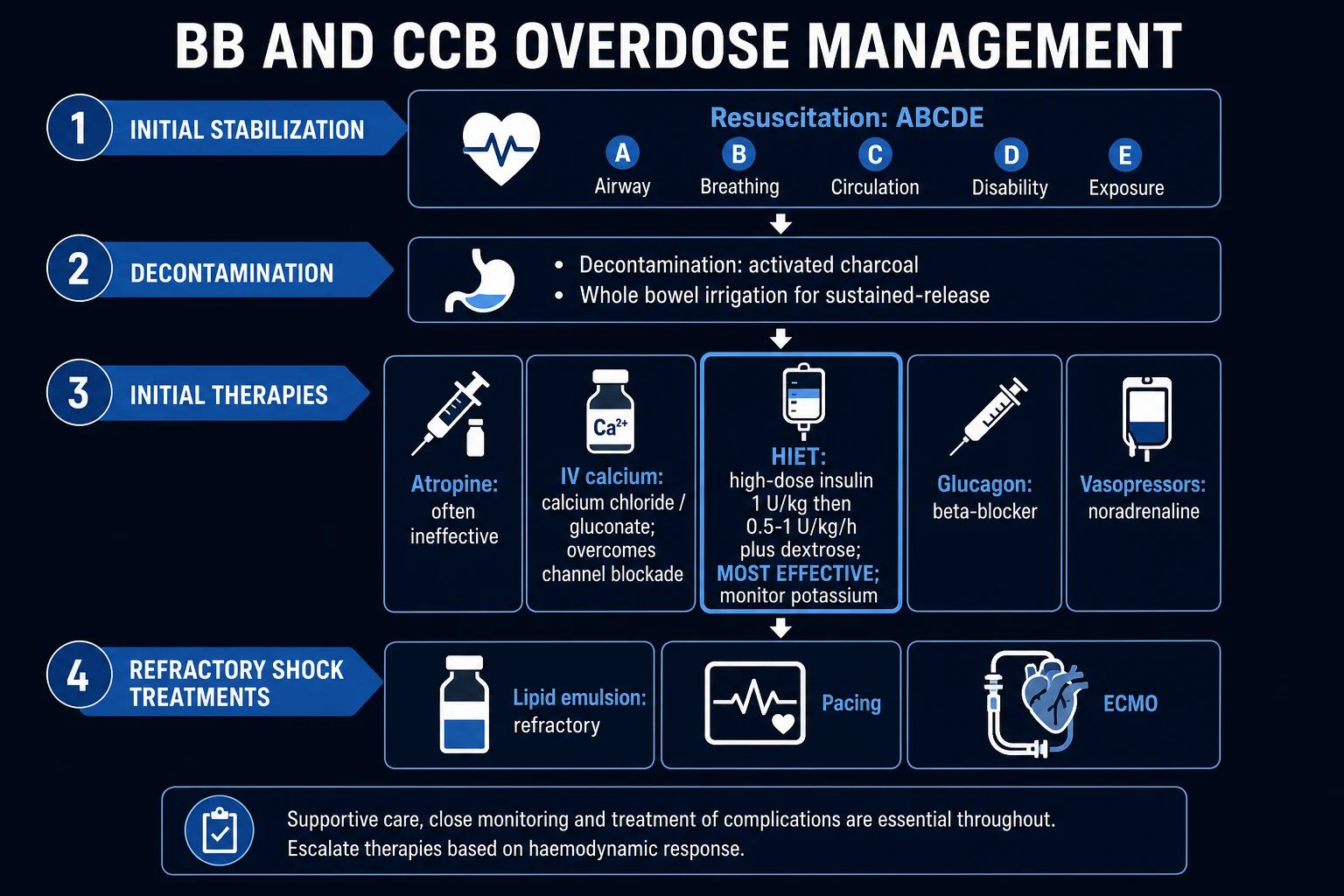
Begin with ABCDE: secure the airway early (intubate if GCS is depressed — sustained-release verapamil patients deteriorate suddenly), give high-flow oxygen if hypoxic, establish two large-bore IV cannulae, attach continuous cardiac monitoring, and identify and treat the immediately life-threatening bradyarrhythmia or shock first.[1]
Immediate fluid and glucose measures:
- Cautious IV crystalloid boluses — 250-500 mL aliquots of balanced crystalloid. The myocardium is failing; over-resuscitation worsens pulmonary oedema. Titrate to blood pressure and signs of overload.
- Check and treat hypoglycaemia — IV dextrose; especially important in children with BB overdose, where hypoglycaemia may be masked and is a major cause of morbidity. [1]
Atropine for symptomatic bradycardia:
- Atropine 0.5-1 mg IV every 3-5 min up to 3 mg (30 microgram/kg in children).
- Atropine is OFTEN INEFFECTIVE in severe BB/CCB toxicity because the toxin directly blocks the channel or receptor downstream of vagal tone. Do not waste time escalating atropine in a deteriorating patient — move to calcium and HIET. [1]
IV calcium for cardiotoxicity — the first specific antidote:
- Calcium chloride 10% 10-20 mL (1 g) IV over 5-10 min via a CENTRAL line (preferred — it is caustic to peripheral veins), OR
- Calcium gluconate 10% 30-60 mL (3-6 g) IV via a PERIPHERAL line (each 10 mL of 10% calcium gluconate contains about one-third the elemental calcium of 10 mL of 10% calcium chloride).
- Repeat every 10-20 min to clinical effect (up to 3-4 doses), then an infusion (calcium chloride 0.6-1.2 mmol/kg/h or equivalent).
- Rationale: provides a supraphysiological extracellular calcium gradient that overcomes the L-type channel blockade and restores some contractility. The effect can be dramatic in CCB overdose.
- Monitor: ionised calcium (target high-normal); watch the ECG for QT shortening/hypercalcaemia. [1]
Pacing for symptomatic bradycardia unresponsive to atropine/calcium:
- Transcutaneous then transvenous pacing.
- Mechanical capture is often poor because the myocardium is failing; the underlying inotropic failure must ALSO be treated (HIET, vasopressors). [1]
The principle in severe toxicity: escalate RAPIDLY through calcium -> HIET -> vasopressors -> lipid -> ECMO. In a deteriorating patient do not wait for each therapy to 'fail' before adding the next — these are complementary, not sequential.[1][2]
Management — Definitive & Stepwise
The stepwise ladder, with escalation triggers, is the most frequently examined aspect of this topic.[1][2]
- ABCDE + decontamination — airway (intubate early if depressed), oxygen, IV access, monitoring.
- IV calcium for cardiotoxicity (doses above).
- High-dose insulin euglycaemia therapy (HIET) — the most effective single inotropic therapy; do not delay.
- Vasopressors/inotropes — noradrenaline, adrenaline, often in combination and in high doses.
- Glucagon — for BB overdose.
- Lipid emulsion — for refractory collapse (especially lipophilic drugs).
- Pacing — for refractory bradycardia/AV block.
- VA-ECMO — for refractory cardiogenic shock, as a bridge to drug clearance. [1]
Decontamination
- Activated charcoal 50 g (1 g/kg in children) within 1-2 h of ingestion IF the airway is protected (or will be imminently). Beyond 1-2 h it is of limited benefit for immediate-release, but may still help for sustained-release preparations.
- Whole-bowel irrigation with polyethylene glycol 1-2 L/h in adults (20-40 mL/kg/h in children), via nasogastric tube, for sustained-release preparations or large ingestions — continue until the rectal effluent is clear (typically 4-6 h). This is essential for sustained-release verapamil/diltiazem and reduces drug absorption. [1]
High-dose insulin euglycaemia therapy (HIET) — the most effective inotrope
HIET protocol — reproduce verbatim
- Bolus: regular insulin 1 unit/kg IV, followed by an infusion of 0.5-1 unit/kg/h (titrate up to 10 units/kg/h in severe).
- Concurrent dextrose: 25 g bolus (e.g. 50 mL of 50% dextrose) then an infusion of 0.5-1 g/kg/h, titrated to keep glucose 5-10 mmol/L.
- Potassium: supplement to keep serum K+ at least 2.5-2.8 mmol/L initially — insulin drives potassium into cells and hypokalaemia is a major complication. As HIET is weaned, stop potassium supplementation.
- Monitor: glucose every 30-60 min; potassium every 1-2 h; the patient needs an ICU bed.
- Onset: 15-45 min; continue for 12-24 h after haemodynamic stability, then wean gradually (abrupt cessation can cause rebound hypoglycaemia or recrudescence of toxicity).
- Mechanism: the poisoned myocardium is in carbohydrate-metabolism failure (it shifts to inefficient fatty-acid oxidation). HIET shifts cardiac metabolism back toward more efficient carbohydrate (glucose) oxidation, which yields more ATP per unit oxygen consumed, and provides a positive inotropy that is INDEPENDENT of the blocked beta-receptor or calcium channel. This is why HIET works when receptor agonists fail. [1]
Glucagon (for beta-blocker overdose)
- Bolus: 5-10 mg IV over 1-2 min (50-150 microgram/kg in children), followed by an infusion of 1-5 mg/h titrated to effect.
- Mechanism: glucagon bypasses the blocked beta-receptor by directly activating adenylyl cyclase (via its own Gs-protein-coupled receptor) -> cAMP -> PKA -> positive inotropy and chronotropy.
- Adverse effects: vomiting (give an antiemetic first), hyperglycaemia, and the large volumes required (glucagon is supplied as a powder that must be reconstituted — a 10 mg dose requires many vials).
- Note: glucagon has been historically the first-line antidote for BB overdose, but its efficacy is modest and HIET has superseded it in many centres; it is still useful as an adjunct. [1]
Vasopressors/inotropes
- Noradrenaline 0.05-1 microgram/kg/min for vasoplegia/hypotension (especially dihydropyridine CCB).
- Adrenaline for combined inotropy and chronotropy.
- High-dose vasopressors/inotropes are frequently required and may be used in combination; do not be afraid of high doses in refractory toxin-induced shock. Some patients need multiple agents at high doses plus HIET plus calcium — this is expected, not a failure. [1]
Intravenous lipid emulsion therapy (ILE)
- 20% lipid emulsion 1.5 mL/kg IV bolus, followed by an infusion of 0.25 mL/kg/min for 30-60 min; repeat the bolus for refractory collapse; maximum about 10 mL/kg in the first 30 min.
- Mechanism: creates a 'lipid sink' — an intravascular lipid phase that sequesters lipophilic drug away from receptors and tissues, lowering the effective free-drug concentration; also provides fatty-acid substrate to the poisoned myocardium.
- Use for refractory collapse, especially with lipophilic agents (propranolol, verapamil). Concerns: fat embolism, pancreatitis, lipaemia interfering with laboratory assays, ARDS — reserved for refractory cases, not routine. [1]
ECMO (veno-arterial)
- For refractory cardiogenic shock unresponsive to calcium, HIET, vasopressors and lipid — a bridge to recovery as the drug is cleared.
- Early referral to an ECMO centre is essential because survival is good even in profoundly toxic patients whose haemodynamics are supported by the circuit while the drug clears (often 24-72 h). [1]
Escalation triggers
Bradycardia/hypotension unresponsive to atropine + calcium; rising lactate/worsening perfusion; need for two or more vasopressors; sustained-release ingestion; QRS widening or long-QT arrhythmia; any sign of cardiovascular collapse. [1]
Specific Subtypes & Scenarios
- Sustained-release verapamil/diltiazem overdose (the lethal subtype): delayed and prolonged toxicity, biphasic course (well then collapse), high mortality. Mandatory 24 h ICU observation, whole-bowel irrigation, early and prolonged HIET, low threshold for ECMO. The most important single decision is to not be reassured by the initially well patient.[1]
- Dihydropyridine (amlodipine/nifedipine) overdose: predominantly vasodilatory (warm, vasoplegic shock) with initial relative/reflex tachycardia, then bradycardia and collapse in severe poisoning. High fluid and vasopressor requirement; calcium and HIET are effective.
- Sotalol overdose: long QT -> torsades de pointes. Treatment is IV magnesium sulphate 2 g, correction of electrolytes (K+, Mg2+), isoprenaline infusion or overdrive pacing to shorten the QT by increasing the heart rate, and AVOID other QT-prolonging drugs. Half-life 12-16 h so prolonged monitoring is essential.
- Propranolol overdose (the neurotoxic BB): seizures and coma from membrane-stabilising (fast Na-channel) effect, QRS widening. Treat seizures with benzodiazepines; consider sodium bicarbonate for QRS widening (as in TCA toxicity); lipid emulsion for refractory collapse (propranolol is highly lipophilic).
- Paediatric ingestion: weight-based dosing for all therapies (insulin, calcium, glucagon, lipid); hypoglycaemia is a particular risk with BB overdose (check glucose frequently, give dextrose); small tablet numbers are lethal; child-safeguarding review.
- Co-ingestion with digoxin or another cardiovascular drug: dramatically higher mortality; treat BOTH toxidromes — calcium for the CCB, Fab fragments for the digoxin, sodium bicarbonate for TCA QRS widening. Note the digoxin caveat: the classic (though contested) 'stone heart' teaching cautions against IV calcium when digoxin co-toxicity is suspected — in pure BB/CCB toxicity calcium is safe and indicated, but where digoxin co-ingestion is plausible, weigh the indication.[2]
Complications & Pitfalls
Cardiovascular complications: refractory cardiogenic shock, complete heart block/asystole, ventricular tachyarrhythmia (sotalol torsades; propranolol QRS widening), pulseless electrical activity arrest. [1]
Non-cardiovascular complications: aspiration pneumonitis (from CNS depression/vomiting), acute kidney injury (shock), bowel ischaemia/infarction (verapamil mesenteric vasoconstriction), hypoglycaemic brain injury (children with BB), hypoxic brain injury after cardiac arrest. [1]
Classic pitfalls (high-yield):
- Being reassured by the well-appearing sustained-release verapamil patient who later collapses — admit for 24 h observation.
- Relying on atropine alone — it is often ineffective; do not delay calcium/HIET.
- Under-dosing calcium, insulin and vasopressors — severe toxicity requires supraphysiological doses; high-dose combination therapy is expected.
- Omitting whole-bowel irrigation for sustained-release preparations.
- Failing to check and treat glucose (BB hypoglycaemia) and potassium (HIET-induced hypokalaemia).
- Late referral for ECMO — early referral saves lives in refractory shock.
- Missing co-ingestants (digoxin, TCA, paracetamel) that change the antidote plan.
- Treating digoxin co-toxicity with IV calcium — the 'stone-heart' caveat. [1]
HIET-specific pitfalls: hypoglycaemia (if dextrose is not co-administered) and hypokalaemia (insulin drives K+ into cells) — both require monitoring and replacement; volume overload from the dextrose vehicle in heart failure. [1]
Lipid-emulsion pitfalls: fat embolism, pancreatitis, lipaemia interfering with laboratory assays, ARDS — used only for refractory collapse, not routinely. [1]
Rebound/recrudescence: after apparent stabilisation, the drug (especially sustained-release) continues to absorb and toxicity can recur. Wean HIET and vasopressors slowly and observe for at least 12-24 h after the last vasopressor dose. [1]
Prognosis & Disposition
Overall mortality: sustained-release verapamil/diltiazem overdose has the highest mortality of any prescription drug overdose (reported up to 20-30 per cent in severe series); BB overdose mortality is lower but still significant. Survival with early aggressive therapy including ECMO is good even in profoundly toxic patients.[1]
Predictors of severity / poor outcome: sustained-release formulation, large ingested dose, delay to presentation/treatment, co-ingestants, advanced age, pre-existing cardiac disease, severe acidosis/hyperlactataemia, and the need for multiple vasopressors. [1]
Disposition rule for sustained-release preparations: admit to a high-dependency/ICU setting for at least 24 h of observation even if initially well, because of the delayed peak and biphasic course. [1]
Disposition for immediate-release preparations: observe for 6 h; asymptomatic with a normal ECG and haemodynamics can be discharged (after psychiatric assessment if deliberate); any symptoms, ECG change or haemodynamic compromise -> admit.[2]
Prevention/psychiatric strategy: all deliberate overdoses require psychiatric assessment after medical stabilisation; secure the medication supply; involve child-safeguarding in paediatric accidental ingestion. [1]
Special Populations
- Paediatrics: accidental ingestion; weight-based dosing for ALL antidotes; particular risk of hypoglycaemia with BB overdose (give dextrose, monitor glucose every 30 min); a few tablets are lethal; child-safeguarding review.
- Pregnancy: management is unchanged — calcium, HIET, vasopressors, lipid and ECMO are all used. The fetus is at risk from maternal hypotension/acidosis; urgent delivery (perimortem Caesarean) may be needed in refractory maternal arrest after 20 weeks gestation.
- Elderly: worse outcomes; polypharmacy and drug interactions (CYP3A4 inhibitors — macrolides, grapefruit — raise verapamil/diltiazem levels); lower threshold for ICU and HIET; sarcopenia reduces the buffer for hypotension.
- Pre-existing cardiac disease: lower baseline contractility; worse outcomes; pace capture may be poor; low threshold for ECMO.
- Renal/hepatic impairment: affects drug clearance; HIET dose is unchanged but glucose/potassium monitoring is more critical; dialysis does NOT remove BB/CCB (high protein binding, large volume of distribution) but may be needed for the resulting AKI. [1]
Evidence, Guidelines & Regional Differences
- St-Onge et al. 2017 expert consensus (Critical Care Medicine, PMID 27749343): the international consensus recommendations for the management of CCB poisoning — a graded set of recommendations for calcium, HIET, vasopressors, lipid emulsion, ECMO and decontamination. It establishes HIET as the most effective single inotropic therapy and supports the early, multimodal approach.[1]
- Graudins & Najib 2016 review (British Journal of Clinical Pharmacology, PMID 26344579): a comparative review of antidotes and adjunct therapies for CCB and BB overdose — sets out the rationale for each therapy and the shift from glucagon toward HIET.[2]
- Controversy on glucagon: historically the first-line antidote for BB overdose, but its efficacy is modest, doses are enormous (vomiting-inducing), and HIET has superseded it; many centres now use HIET first and glucagon as an adjunct.
- Controversy on lipid emulsion: evidence is largely animal/case-report based; some guidelines reserve it for refractory collapse, others use it earlier for lipophilic agents; concerns about pancreatitis, ARDS and assay interference.
- Controversy on ECMO timing: some centres use VA-ECMO early for severe sustained-release verapamil toxicity (as a bridge), others only as a last resort; observational data suggest good outcomes and an early-referral policy is increasingly favoured.
- Regional practice deltas: AACT/ACMT guidance on whole-bowel irrigation; Toxbase/NPIS (UK); in resource-limited settings without ECMO, the practical mainstay is calcium + HIET + vasopressors + lipid; the 'stone-heart' caveat applies to digoxin co-toxicity (avoid IV calcium), not to pure BB/CCB toxicity (where calcium is safe and indicated).
- Indian/South-Asian context: easy availability of verapamil/diltiazem/propranolol and amlodipine makes deliberate self-harm with these agents common; resource-limited ECMO access makes HIET + calcium + pressors the practical mainstay; cross-toxicity with oleander (a cardiac glycoside) is a regional consideration that mandates checking for co-ingestion.
Exam Pearls
BB + CCB overdose — manage the bradycardic shock
CALCIUM
CaCl2 10% 10-20 mL central OR calcium gluconate 10% 30-60 mL peripheral — overcome the channel blockade
0.5-1 mg IV — often useless but try first for symptomatic brady
1.5 mL/kg of 20% lipid — refractory collapse, lipophilic drugs
HIET — insulin 1 U/kg then 0.5-1 U/kg/h + dextrose; the most effective inotrope
noradrenaline/adrenaline, high-dose, often combined
5-10 mg IV for BB — bypasses the blocked beta-receptor
VA-ECMO for refractory cardiogenic shock — bridge to drug clearance
- Discriminator one-liner: hyperglycaemia + metabolic acidosis in a bradycardic hypotensive overdose = CCB (inhibits insulin release); BB does not (and may cause hypoglycaemia).
- Lethal subtype: sustained-release verapamil/diltiazem — delayed, prolonged, biphasic severe toxicity; whole-bowel irrigation + 24 h ICU + prolonged HIET.
- Most effective therapy: HIET (insulin 1 U/kg bolus then 0.5-1 U/kg/h + dextrose) — shifts cardiac metabolism to carbohydrate oxidation -> inotropy independent of the blocked receptor/channel.
- Atropine is often useless — the toxin blocks downstream of vagal tone.
- IV calcium: CaCl2 10% 10-20 mL CENTRAL line, OR calcium gluconate 10% 30-60 mL PERIPHERAL; provides exogenous calcium to overcome channel blockade.
- Glucagon (for BB): 5-10 mg IV bolus then infusion — bypasses the beta-receptor (direct adenylyl cyclase activation); causes vomiting.
- Sotalol: long QT -> torsades; treat with magnesium and overdrive pacing; half-life 12-16 h.
- Propranolol: most neurotoxic BB — seizures/coma from membrane-stabilising (Na-channel) effect; QRS widening; highly lipophilic (lipid emulsion candidate).
- Lipid emulsion: 1.5 mL/kg bolus then 0.25 mL/kg/min — 'lipid sink' for lipophilic drugs; refractory collapse.
- Refractory cardiogenic shock: VA-ECMO as bridge to recovery.
- AVOID in BB/CCB toxicity (other than digoxin co-toxicity): beta-agonists alone are insufficient; do not delay HIET waiting for pressors to work; do not discharge sustained-release ingestions early; do not give IV calcium if digoxin co-toxicity is the leading diagnosis (stone-heart caveat). [1]
Exam application bank (NEET-PG / INICET)
One-line answer
Beta-blocker (BB) and calcium-channel blocker (CCB) overdoses are two of the most lethal prescription drug poisonings and are taught together because they produce an overlapping toxidrome — bradycardia, hypotension, AV conduction block and cardiogenic shock refractory to standard ACLS — and share an overlapping antidote ladder (IV calcium, high-dose insulin euglycaemia therapy, glucagon, vasopressors, lipid emulsion, pacing, ECMO). Beta-blockers antagonise beta-adrenergic G-protein-coupled receptors -> reduced cAMP/PKA -> reduced L-type calcium-channel opening -> negative inotropy, chronotropy and dromotropy; lipophilic agents (propranolol, metoprolol, carvedilol) cross the blood-brain barrier causing CNS depression, seizures and coma (membrane-stabilising Na-channel effect), and sotalol uniquely prolongs the QT (torsades risk). Calcium-channel blockers directly block the L-type voltage-
Worked stems (answer without another resource)
Stem 1 — Classic presentation. Map symptoms to mechanism; name the first investigation and first treatment step with dose/route if drug therapy is standard. [1]
Stem 2 — Unstable / complicated. List red flags that force immediate resuscitation, theatre, ICU, antidote, or reperfusion — and what you do in the first 15 minutes. [1]
Stem 3 — Atypical group. Elderly, pregnancy, child, or immunocompromised: how presentation and thresholds change. [1]
Stem 4 — Differential trap. Name the three closest mimics and one discriminator for each. [1]
Stem 5 — Disposition. Who goes home with safety-netting, who is admitted, who needs HDU/ICU/theatre, and what follow-up is mandatory. [1]
Rapid viva checklist
- Definition + classification
- Pathophysiology chain
- Bedside signs / criteria
- Score with exact components (if any)
- Emergency bundle
- Definitive therapy with doses
- Complications of disease and of treatment
- Special populations
- Guideline/trial name if classic
- Three exam traps
Coverage self-check
If you cannot answer any stem above from this page alone, re-read the matching section — the page is intended to be self-sufficient for final-prof and NEET-PG/INICET questions on Beta-Blocker & Calcium-Channel Blocker Overdose.
[1] [1]References
- [1]St-Onge M, Anseeuw K, Cantrell FL, et al. Experts Consensus Recommendations for the Management of Calcium Channel Blocker Poisoning in Adults Crit Care Med, 2017.PMID 27749343
- [2]Graudins A, Najib Z. Calcium channel antagonist and beta-blocker overdose: antidotes and adjunct therapies Br J Clin Pharmacol, 2016.PMID 26344579