Emergency & Toxicology · General Medicine
Heat Stroke
Also known as Heat stroke · Heat illness · Exertional heat stroke · Classic heat stroke · Non-exertional heat stroke · Epidemic heat stroke · Hyperthermia
Heat stroke is a life-threatening hyperthermic emergency defined by a core body temperature above 40 degrees C (104 F) with central nervous system dysfunction (confusion, agitation, seizures, ataxia, coma) and, in many cases, multi-organ failure. It is the severe end of the heat-illness spectrum (heat cramps, heat exhaustion, heat stroke). Two forms: (1) Classic (non-exertional, epidemic) — elderly and chronically ill patients during heatwaves, with impaired thermoregulation, polypharmacy and hot dry skin; (2) Exertional — young, fit individuals (athletes, military, firefighters, labourers) during strenuous exercise in heat, in whom sweating is often still present. The mechanism is thermoregulatory failure: environmental heat gain plus endogenous heat production exceed sweating and radiation capacity, producing direct heat injury to proteins and a gut-ischaemia / endotoxaemia-driven cytokine storm that mimics sepsis, driving disseminated intravascular coagulation, rhabdomyolysis, acute kidney injury, hepatic necrosis and ARDS. Heat stroke is a hyperthermia, not a pyrexia — the hypothalamic set-point is normal, so antipyretics are useless. Treatment is RAPID COOLING started within the first 30 minutes: cold-water immersion (gold standard for exertional), evaporative cooling (spray plus fans, preferred for classic), ice packs, and cooled IV fluids; cool to below 39 C then stop to avoid overshoot hypothermia.
On this page & tools
Your progress
Saved locally on this device.
Exam tags
Red flags
Overview & Definition
Heat stroke is the most severe end of the heat-illness spectrum and a true time-critical emergency. It is defined by two features operating together: a core body temperature above 40 degrees C (104 F) and central-nervous-system dysfunction — confusion, agitation, delirium, ataxia, seizures, or coma — frequently accompanied by multi-organ failure. The mortality of untreated heat stroke exceeds 50 per cent, and it rises minute by minute the core temperature stays above 40 C; the single most important determinant of survival is how fast you cool the patient.[1][3]
The clinical skill in heat stroke is not the temperature reading (that is a thermometer) but five interlocking judgements that decide outcome: [1]
- Recognise it — core temp above 40 C with CNS dysfunction is heat stroke; cool now, investigate later.
- Distinguish classic from exertional — the population, the precipitant, and crucially the best cooling method differ.
- Cool rapidly and by the right method — cold-water immersion for exertional, evaporative for classic.
- Stop at the target — cool to below 39 C then halt, to avoid overshoot hypothermia.
- Anticipate and treat the organ fallout — rhabdomyolysis, AKI, DIC, hepatic failure, ARDS. [1]
The pivotal concept — one that examiners test relentlessly — is that heat stroke is a hyperthermia, not a pyrexia. In fever, pyrogens (IL-1, IL-6, TNF-alpha) drive prostaglandin-E2 synthesis in the hypothalamus, which raises the hypothalamic set-point; antipyretics work by lowering it back. In heat stroke the set-point is normal — the body is doing everything it can to lose heat, but environmental heat gain and endogenous heat production exceed its capacity. There is no prostaglandin excess to inhibit, which is why paracetamol and NSAIDs do not work and physical heat removal is the only effective treatment.[1][3]

Classification
Heat stroke is classified along three axes: severity (the heat-illness spectrum), aetiology (classic vs exertional), and the presence of anhidrosis. The examiner-critical classification is classic vs exertional, because it dictates the population you look for, the precipitant, and the optimum cooling method.[1][2]
The heat-illness spectrum (severity): [1]
- Heat cramps — brief, painful, voluntary-muscle cramps during or after exertion in heat, from salt and water depletion. The patient is conscious, afebrile, and haemodynamically stable. Management: rest, oral rehydration with electrolyte solution.
- Heat exhaustion — core temperature is raised but under 40 C, with profuse sweating, headache, nausea, dizziness, weakness, tachycardia, and intact mental state. No end-organ damage. Management: rest in a cool place, remove clothing, oral or IV rehydration, cooling by fans. The defining feature separating heat exhaustion from heat stroke is CNS dysfunction — if the patient is confused or has ataxia, it is heat stroke.
- Heat stroke — core temperature above 40 C with CNS dysfunction (the line in the sand), with or without anhidrosis and multi-organ failure. [1]
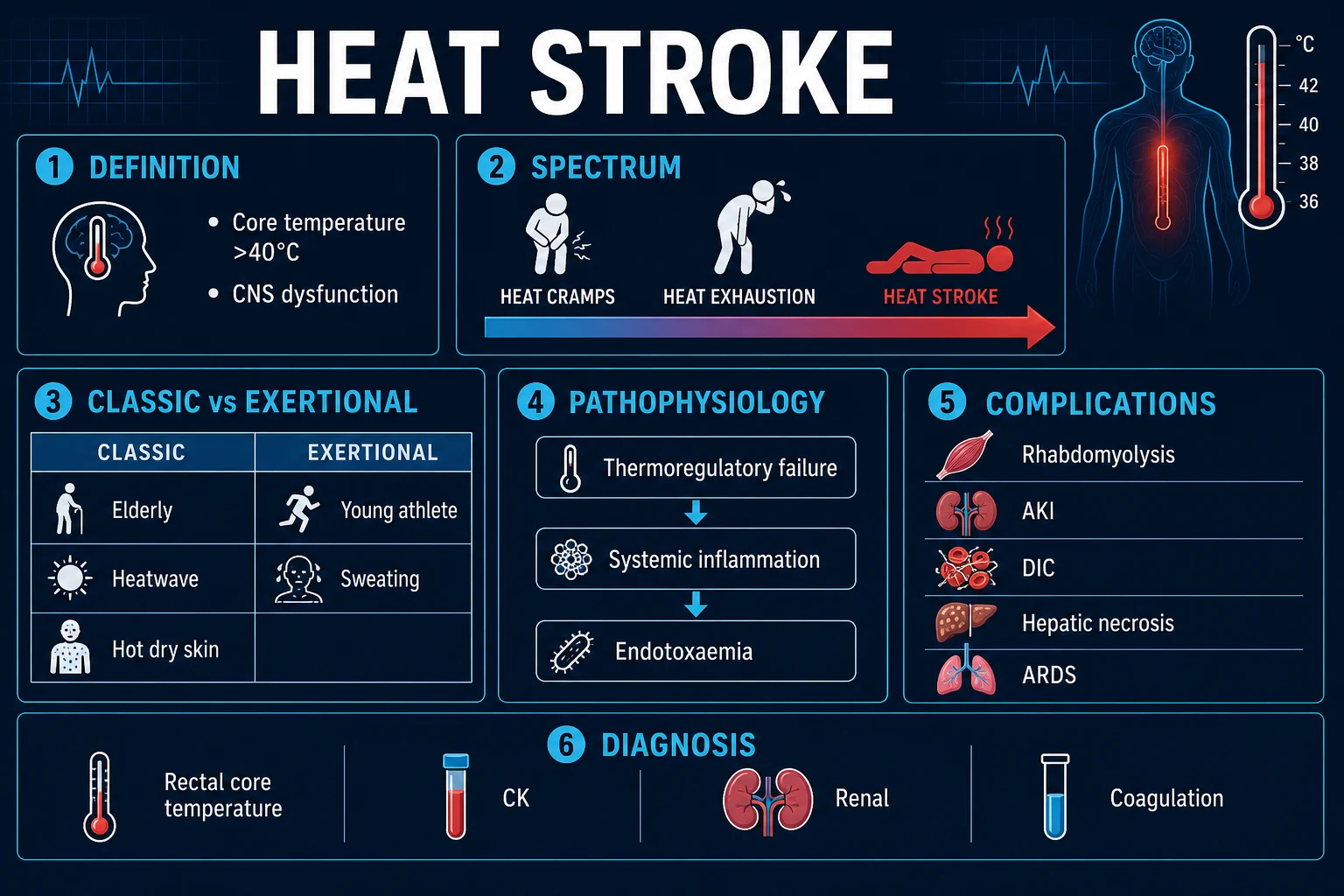
Classic (non-exertional / epidemic) vs exertional heat stroke — reproduced in full: [1]
Classic (non-exertional)
- Elderly, chronically ill, socially isolated, poor
- During HEATWAVES (epidemic) — indoors, no air conditioning
- Impaired thermoregulation; polypharmacy (anticholinergics, diuretics, antipsychotics, beta-blockers)
- HOT DRY SKIN (anhidrosis) typical; gradual onset over hours-days
- Predominant: DIC, hepatic, CNS; less rhabdomyolysis
- Mortality HIGH (over 50 per cent untreated); comorbidity-driven
- Cooling: EVAPORATIVE (spray + fans); cooled IV fluids
Exertional
- Young, fit, acclimatised or pushing limits
- STRENUOUS EXERCISE in heat (athletes, military, firefighters, miners)
- High endogenous heat production overwhelms intact thermoregulation
- SWEATING OFTEN PRESENT (early); abrupt collapse during exertion
- Predominant: RHABDOMYOLYSIS, AKI, hyperkalaemia, hypoglycaemia
- Mortality LOW (under 5 per cent) IF cooled by CWI within 30 minutes
- Cooling: COLD-WATER IMMERSION (gold standard, on site)
By anhidrosis: [1]
- Anhidrotic — dry, hot skin; the classic textbook picture, characteristic of classic heat stroke late in its course when sweating has failed.
- Diaphoretic — sweating still present; common in early exertional heat stroke. Anhidrosis is NOT required for the diagnosis — waiting for the skin to dry before calling it heat stroke is a classic and lethal error.[1]
Epidemiology & Risk Factors
Heat stroke has two distinct epidemiological faces. Classic (epidemic) heat stroke strikes the elderly, the chronically ill and the socially isolated during heatwaves, and its burden is measured in mass-casualty events: the 2003 European heatwave killed an estimated over 70,000 people across the continent, the majority elderly urban residents without air conditioning. Exertional heat stroke strikes the young and fit — athletes, military recruits and labourers — and is the leading cause of preventable non-traumatic death in athletes in hot climates.[1][8]
Host risk factors for classic heat stroke cluster into impaired thermoregulation, reduced cardiac reserve, and reduced access to cooling: [1]
- Age — the very young (high surface-area-to-mass ratio, immature sweating) and the elderly (blunted sweating, reduced cardiac reserve, comorbidity).
- Chronic illness — cardiovascular disease (limited cardiac reserve to perfuse the skin), renal failure, diabetes, psychiatric illness, dementia, obesity (insulation, lower heat loss), skin disease or burns that impair sweating.
- Dehydration and poor fitness.
- Social determinants — poverty, social isolation, homelessness, lack of air conditioning, upper-floor city apartments, antipsychotic polypharmacy (the elderly psychiatric patient on phenothiazines in a heatwave is a textbook victim). [1]
Drugs that impair thermoregulation (high-yield — examiners love this list): [1]
Reduce heat LOSS
- Anticholinergics (atropine, antihistamines, tricyclics) — suppress sweating
- Sympathomimetics / alpha-agonists — cutaneous vasoconstriction
- Beta-blockers — limit cardiac output available to perfuse the skin
Increase heat PRODUCTION
- Stimulants — MDMA (ecstasy), amphetamine, cocaine (exertional-type at raves)
- Thyroxine, salicylates (uncoupling of oxidative phosphorylation)
- Withdrawal states — alcohol, sedative withdrawal (agitation and rigidity)
Impair central thermoregulation
- Antipsychotics / phenothiazines — abolish sweating and behaviour
- Diuretics — dehydration
- Alcohol — vasodilation, impaired judgement, hypoglycaemia
Heat stroke — the numbers that decide management
Climate context. The annual Lancet Countdown on health and climate change documents a relentless rise in heat exposure: the average person now experiences substantially more days of heatwave than three decades ago, and heat-related mortality in people over 65 has risen by approximately 85 per cent since the 1990s. Climate change is widening the population exposed and lengthening the heat-stroke season, making the condition a global public-health priority.[8]
Pathophysiology
Normal core temperature is held within a narrow band (approximately 36.5 to 37.5 C) by the pre-optic area of the anterior hypothalamus, which integrates afferent input from peripheral (skin) and central (core) thermoreceptors and mounts three efferent heat-loss responses when heat is sensed: cutaneous vasodilation (sympathetic withdrawal to the skin, shunting blood to the surface to radiate heat away — requires a raised cardiac output to perfuse both skin and vital organs), sweating (evaporative heat loss — the dominant route in a hot environment, since once ambient temperature exceeds body temperature, radiation and convection reverse into heat gain), and behavioural responses (seek shade, drink, remove clothing — the most powerful, and the first lost with intoxication or CNS depression).[1][3]
Heat stroke is fundamentally a heat-balance failure: environmental heat gain plus endogenous heat production exceed heat-loss capacity. Two situations defeat the system: a hot environment that overwhelms even a healthy thermoregulator (classic heat stroke), and exertion that generates heat faster than even a healthy, sweating, vasodilated athlete can shed it (exertional heat stroke). The decisive role of humidity deserves emphasis: evaporation is the main route of heat loss when ambient temperature exceeds skin temperature, and high humidity abolishes it — a wet-bulb temperature above approximately 35 degrees C is considered unsurvivable even for a resting, healthy, unclothed person.[3]
The two-hit pathogenesis — once the core exceeds roughly 40 C, injury proceeds by two mechanisms operating together: [1]
- Direct heat injury (thermal maximum). Proteins begin to denature and lipids to peroxidise above about 41 to 42 C; mitochondrial oxidative phosphorylation fails and cell membranes lose integrity. This is why the duration of hyperthermia predicts organ damage so tightly — minutes matter.
- The systemic inflammatory response (the sepsis-mimic). Heat stress triggers intense splanchnic vasoconstriction to maintain central perfusion; the gut mucosa becomes ischaemic, the barrier breaks down, and bacterial endotoxin translocates into the circulation. Endotoxin plus direct heat-injured tissues activate a massive cytokine release (IL-1, IL-6, TNF-alpha), complement and coagulation cascades, and endothelial activation — producing a syndrome that is clinically and biochemically indistinguishable from septic shock, with vasodilation, capillary leak, and microvascular thrombosis. [1]
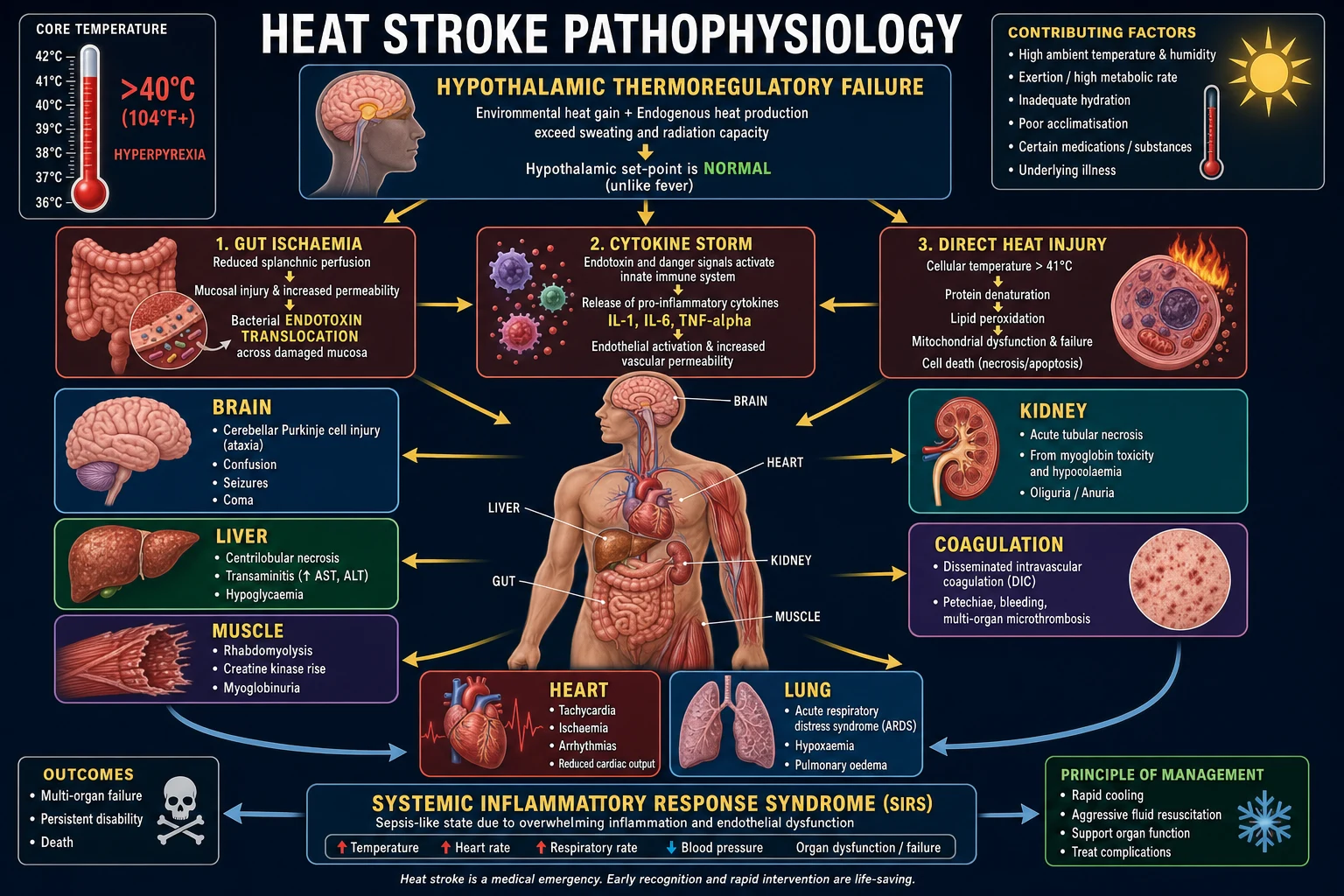
Organ-specific injury (mechanism, high-yield): [1]
- Brain — the cerebellar Purkinje cells are uniquely heat-sensitive, which is why ataxia, dysarthria and nystagmus are early hallmarks of heat stroke (an examiner favourite). Higher temperatures produce confusion, seizures, coma and, in survivors, sometimes permanent cerebellar ataxia.
- Liver — centrilobular (zone 3) necrosis from the metabolic demands of heat plus hypoxic injury; transaminases (AST, ALT) commonly exceed 1,000 U/L in the first day; hypoglycaemia from impaired gluconeogenesis.
- Skeletal muscle — rhabdomyolysis (especially exertional, from direct heat injury plus exertion); creatine kinase often over 1,000 and sometimes over 100,000 U/L; myoglobinuria turns the urine dark and precipitates acute tubular necrosis; hyperkalaemia from released intracellular contents can be life-threatening.
- Kidney — acute kidney injury from a combination of hypovolaemia (dehydration, redistribution), myoglobin cast nephropathy, and direct heat injury; renal replacement therapy is often needed.
- Coagulation — heat-activated endothelium plus cytokines trigger disseminated intravascular coagulation (DIC): consumption of platelets and clotting factors produces bleeding (petechiae, GI, IV-site oozing), while microvascular thrombosis worsens organ failure. Peak DIC is typically 24 to 48 hours after onset.
- Heart and lung — tachycardia, myocardial ischaemia and arrhythmias; ARDS from capillary leak and aspiration. [1]
Why antipyretics and dantrolene fail (high-yield). Because the hypothalamic set-point is normal, there is no prostaglandin-E2-driven mechanism for paracetamol or NSAIDs to inhibit — they are inert in heat stroke and merely waste time and risk hepatic/renal toxicity (paracetamol adds to heat-injured liver). Dantrolene (the ryanodine-receptor blocker used in malignant hyperthermia) does not improve outcome in heat stroke — randomised trials show no benefit — because heat stroke is not a primary calcium-mediated muscle syndrome; do not use it.[3][4]
Clinical Presentation
The picture is hot skin, a core temperature above 40 C, and CNS dysfunction, with multi-organ features evolving over hours. The central-nervous-system signs are what separate heat stroke from heat exhaustion and they are wide-ranging: irritability, confusion, agitation, bizarre behaviour that can mimic psychiatric illness, slurred speech, ataxia and dysarthria (cerebellar — Purkinje-cell susceptibility), hallucinations, seizures, and coma.[1][2]
Skin findings — hot skin is universal; sweating may be present or absent. The textbook hot dry skin of anhidrosis is the classic heat stroke picture late in the course; in early exertional heat stroke the athlete is often still sweating profusely at the moment of collapse. Do not require anhidrosis to make the diagnosis — a sweating athlete with a core temperature above 40 C and confusion has heat stroke. [1]
Vital signs — tachycardia (from heat stress, vasodilation, and dehydration), hypotension (vasodilatory, sepsis-like), tachypnoea and hyperpnoea (respiratory alkalosis, then metabolic acidosis), and the core temperature above 40 C. The pulse may be thready; the patient is often volume-depleted. [1]
Evolving multi-organ features over hours: [1]
- Dark 'cola' urine from myoglobinuria (rhabdomyolysis).
- Jaundice and bleeding from hepatic failure and DIC.
- Oliguria from AKI.
- Hypoglycaemia (especially exertional, from depleted glycogen and hepatic failure).
- Hyperventilation / hypoxia from ARDS.
- Vomiting and diarrhoea (common in exertional, and a fluid-loss amplifier). [1]
Atypical presentations (deliberately examined): [1]
- The elderly during a heatwave — insidious onset indoors, confusion mistaken for delirium or dementia, multiple medications, dry hot skin. The oral or tympanic reading may be falsely reassuring (these devices bottom out or read low in vasoconstricted or hot patients) — always confirm with a core (rectal) temperature. Heat stroke in the elderly is a sentinel for serious underlying illness (infection, dehydration, cardiac decompensation) and carries high mortality.
- The collapsed athlete or recruit — sudden collapse during exertion in heat, often still sweating, vomiting, diarrhoea, agitation; prominent rhabdomyolysis and hyperkalaemia. Tympanic and temporal thermometers are unreliable during exercise — only a rectal temperature is reliable in the field.
- Heat stroke masquerading as a psychiatric emergency — agitation, hallucinations, aggression — the heat exposure history and the core temperature settle it.
- Drug-driven heat stroke at a rave — MDMA/amphetamine cause exertional-type heat stroke by muscle activity, dopamine-mediated set-point disturbance and serotonin effects; overlap with serotonin syndrome (clonus, hyperreflexia, autonomic instability). [1]
Differential Diagnosis
A high core temperature with CNS dysfunction is not always heat stroke — but the rule is: if there is heat exposure or exertion in heat and the core temperature is above 40 C, cool first and differentiate in parallel, because delaying cooling while working up alternatives kills the heat-stroke patient. Distinguish:[1][2]
- Heat exhaustion — core temperature under 40 C, intact mental state, profuse sweating, no end-organ damage. The mental state and the temperature threshold are the lines — cross either and it is heat stroke.
- Sepsis / septic shock — overlaps biochemically (cytokines, DIC, multi-organ failure) and clinically. Both can coexist (sepsis precipitating classic heat stroke). Look for a source, take blood cultures, give empiric antibiotics if any doubt — but do not delay cooling.
- Malignant hyperthermia (MH) — triggered by volatile anaesthetics or suxamethonium, perioperative or in ICU; masseter rigidity, rising CO2, hyperkalaemia; treated with dantrolene (which does NOT work in heat stroke). History is decisive.
- Neuroleptic malignant syndrome (NMS) — antipsychotic drug, lead-pipe rigidity, bradyreflexia, slow onset over days, raised CK; treated with dantrolene and bromocriptine.
- Serotonin syndrome — serotonergic drug (SSRI, MAOI, tramadol, MDMA), clonus (especially inducible/ocular), hyperreflexia, autonomic instability, mydriasis, diarrhoea; rapid onset; treated with benzodiazepines and cyproheptadine.
- Thyroid storm — known or occult hyperthyroidism, tachycardia out of proportion to fever, atrial fibrillation, goitre, thyroid eye disease, high T4/T3, suppressed TSH; treated with beta-blocker, thionamide, iodine, steroids.
- Anticholinergic and sympathomimetic toxicity — dry hot flushed skin and mydriasis (anticholinergic, e.g. atropine, antihistamines); agitation, mydriasis, hypertension (sympathomimetic, e.g. cocaine, amphetamine).
- Meningitis / encephalitis, cerebral malaria, intracranial haemorrhage — must not be missed; lumbar puncture and CT after the patient is stable and cooling is under way. [1]
The discriminating principle: the history of heat exposure or exertion plus a core temperature above 40 C is itself diagnostic of heat stroke until proven otherwise — cool first, then confirm there is no alternative or additional diagnosis.[3]
Clinical & Bedside Assessment
The first measured number must be a CORE (rectal) temperature. Oral, axillary, tympanic and temporal-artery readings all underestimate core temperature in the hot, vasoconstricted, or sweating patient and can miss the diagnosis entirely. Use a low-reading rectal probe (or oesophageal/bladder in the intubated patient); in the field, a rectal thermometer is the only reliable measure in a collapsed athlete.[1][5]
Focused assessment (ABCDE): [1]
- Airway and breathing — protect the airway in the comatose or seizing patient; high-flow oxygen; intubate for coma, status epilepticus, or loss of airway reflexes.
- Circulation — pulse (tachycardia, hypotension, thready), capillary refill; IV access.
- Disability — GCS and a rapid neuro exam looking for cerebellar signs (ataxia, dysarthria, nystagmus) that support heat stroke; check capillary glucose immediately (hypoglycaemia, especially exertional).
- Exposure — hot skin; is it dry or sweating? Look for petechiae or bleeding (DIC), dark urine (myoglobin), jaundice.
- History — heat exposure or exertion, precipitating drugs, comorbidity, time of onset. The single most prognostic history item is how long the core temperature has been above 40 C. [1]
The pivotal reflex — when you find a core temperature above 40 C with CNS dysfunction, start cooling immediately, before investigations. The duration of hyperthermia predicts mortality, so every minute spent waiting for blood tests worsens outcome. [1]
Investigations
Investigations serve two purposes: to stage the patient (quantify organ injury) and to find precipitants and mimics. None of them should delay cooling.[1][3]
Mandatory at presentation: [1]
- Capillary glucose — hypoglycaemia is common (especially exertional) and easily missed.
- Core temperature — continuous monitoring during cooling.
- ECG and continuous cardiac monitoring — ischaemia, arrhythmia, electrolyte effects.
- Arterial blood gas — metabolic (lactic) acidosis, respiratory alkalosis, hypoxaemia.
- Full blood count — leukocytosis (stress), thrombocytopenia (DIC).
- Urea and electrolytes, creatinine — AKI; hyperkalaemia from rhabdomyolysis; hyponatraemia (from over-hydration with water in endurance events).
- Liver function tests — transaminitis (AST/ALT often over 1,000 U/L) is a hallmark; hypoglycaemia; hypoalbuminaemia.
- Creatine kinase — rhabdomyolysis (often over 1,000, may exceed 100,000 U/L).
- Coagulation — PT/INR, APTT, fibrinogen, D-dimer — for DIC.
- Calcium, phosphate, urate — deranged in rhabdomyolysis and tumour lysis-like picture.
- Lactate, troponin — lactic acidosis, myocardial injury.
- Urinalysis — blood-positive dipstick with no red cells on microscopy suggests myoglobinuria (rhabdomyolysis); look for casts.
- Pregnancy test in women of reproductive age.
- Blood cultures, septic screen, drug/toxin screen — to identify mimics and co-pathology; TSH if thyroid storm is plausible. [1]
Key laboratory patterns (high-yield): [1]
Heat-stroke laboratory pattern
Reproducing the ISTH overt-DIC score (used to grade heat-stroke coagulopathy): the International Society on Thrombosis and Haemostasis score sums points from platelet count (over 100 = 0; under 100 = 1; under 50 = 2), fibrin-related markers (none raised = 0; moderate = 2; marked = 3), prolonged PT (under 3 s = 0; 3 to 6 s = 1; over 6 s = 2), and fibrinogen (over 1 g/L = 0; under 1 g/L = 1). A score of 5 or more (with an underlying disorder such as heat stroke) defines overt DIC and predicts mortality.[3]
Imaging — CT brain to exclude alternative causes of coma (haemorrhage, infarct) once the patient is stable; chest X-ray for aspiration, pulmonary oedema, ARDS. [1]
Management — Resuscitation
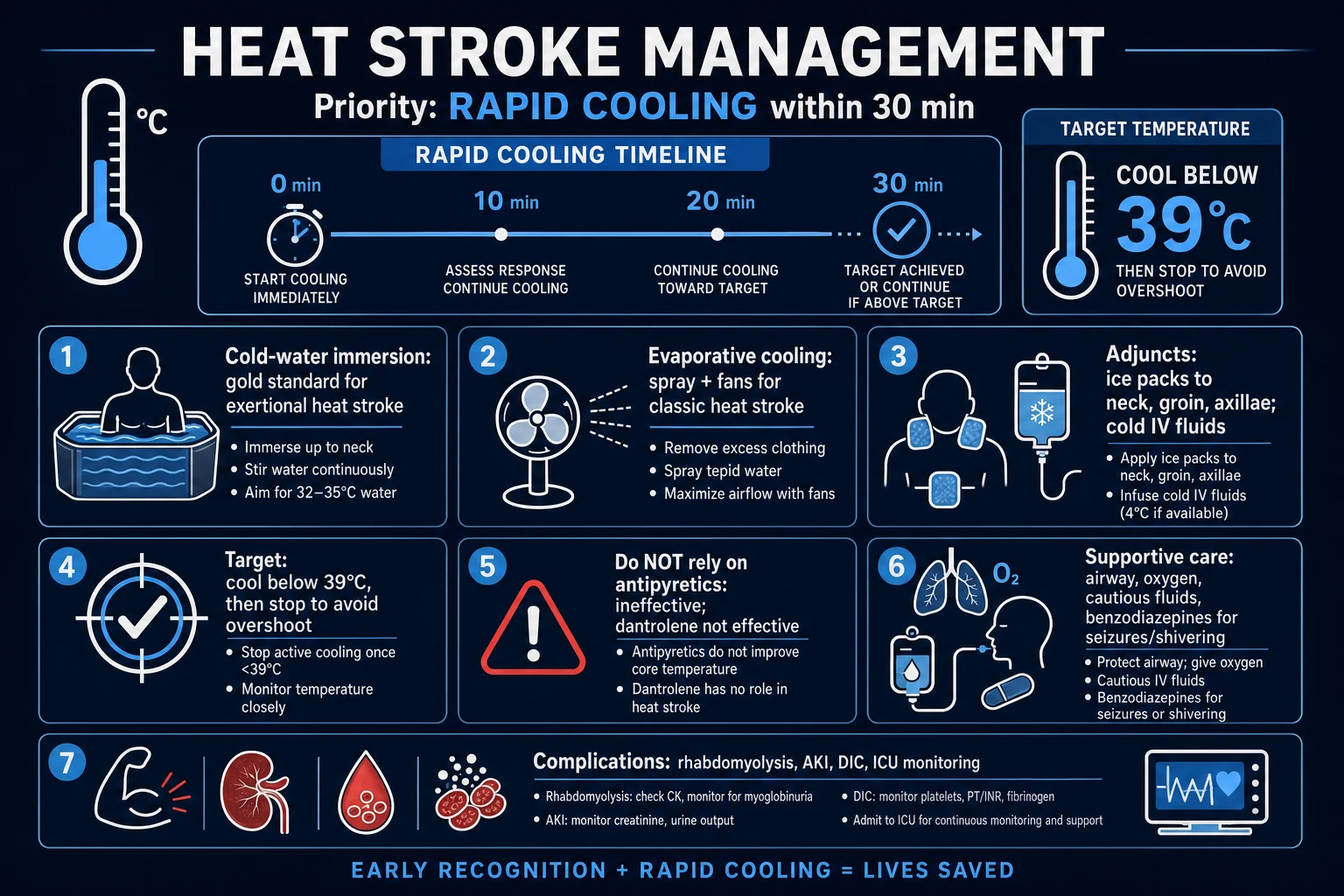
The single most important intervention in heat stroke is rapid cooling, started within the first 30 minutes — the 'golden half-hour'. The mortality of exertional heat stroke falls to under 5 per cent when cold-water immersion begins within 30 minutes; it rises steeply thereafter. Cool first, transport second is the field rule for exertional heat stroke.[4][5][6]
The immediate bundle (apply to every patient): [1]
- Remove from the heat; remove all clothing. Get the patient out of the hot environment or stop the exertion.
- Start cooling by the appropriate method WITHOUT DELAY — cold-water immersion for exertional, evaporative for classic (detailed in the next section). Do not wait for tests, an ICU bed, or IV access.
- ABCDE: high-flow oxygen; intubate for coma, seizures, or airway loss; IV access.
- Check capillary glucose and correct hypoglycaemia.
- IV fluids: cooled crystalloid (e.g. 0.9 per cent saline at 4 C, up to 30 mL/kg) — both cools and corrects hypovolaemia; titrate to blood pressure, lactate and urine output, watching for volume overload in the elderly.
- Continuous core-temperature and ECG monitoring; serial glucose, potassium, CK, coagulation. [1]
Target: cool to a core temperature of 39 C then STOP active cooling — overshoot hypothermia causes arrhythmia, coagulopathy and infection, and is a recognised pitfall. [1]
Seizures and agitation — treat with IV benzodiazepines: lorazepam 4 mg IV (repeated up to 8 mg) or diazepam 10 mg IV, repeated as needed. Benzodiazepines are preferred because they also suppress shivering (which generates heat and opposes cooling) and provide sedation for the agitated, intubated patient. Do not give antipyretics. [1]
Shivering — counter-productive (it generates heat). Suppress with benzodiazepines (lorazepam/diazepam) or, where used, skin counter-warming; a single dose of IV magnesium is sometimes used but the evidence is weak. [1]
Hyperkalaemia from rhabdomyolysis can be immediately life-threatening — treat per protocol: calcium gluconate 10 mL of 10 per cent IV for membrane stabilisation, insulin-dextrose (10 units Actrapid in 50 mL of 50 per cent dextrose IV), nebulised salbutamol 10 to 20 mg, sodium bicarbonate (especially if acidotic), and ultimately renal replacement therapy. [1]
Management — Definitive & Stepwise
Cooling is stratified by the heat-stroke type — the method that is gold-standard for exertional is impractical for the elderly classic patient with lines and comorbidity. The principle for both is maximise the temperature gradient between the skin and the environment and maximise evaporation, and stop at 39 C.[1][4]
1. Cold-water immersion (CWI) — the gold standard for EXERTIONAL heat stroke:[4][5][7]
- Indication: exertional heat stroke (athlete, military, firefighter) — on site, before transport ('cool first, transport second').
- Method: immerse the patient in a tub or tank of ice and water at 2 to 15 C, up to the neck; circulate or agitate the water (stirring or aeration improves convective heat transfer by disrupting the warm water boundary layer); monitor core temperature continuously with a rectal probe.
- Cooling rate: the fastest available — approximately 0.15 to 0.35 C per minute.
- Stop: remove from the water when the core temperature reaches 38.5 to 39 C (allow for a small afterdrop), to avoid overshoot hypothermia.
- Outcome evidence: the Falmouth Road Race series and military data show survival approaching 100 per cent when CWI is begun within 30 minutes — the strongest cooling-outcome evidence in medicine. A tub of ice water at the training ground is now the standard of care for organised sport in hot conditions.[7]
2. Evaporative cooling — the preferred method for CLASSIC heat stroke:[1][3]
- Indication: classic heat stroke in the elderly/comorbid patient where ice-water immersion is impractical (lines, tubes, monitoring, frailty) and may not be tolerated.
- Method: strip the patient; spray the skin continuously with lukewarm (tepid) water (not ice water, which causes vasoconstriction and shivering that slow cooling) and direct continuous high-velocity fans over the body; maximise skin-to-air temperature and humidity gradient. Cooling rate approximately 0.1 C per minute.
- Rationale: exploits evaporation, the most efficient heat-loss route in a hot environment; better tolerated in the elderly than ice. [1]
3. Adjunctive and alternative cooling methods:[1][4]
- Ice packs to the neck, axillae and groins (over major vessels) — modest adjunct; less effective alone, useful combined with evaporative cooling.
- Cooled IV fluids — 0.9 per cent saline at 4 C, up to 30 mL/kg — an effective adjunct that both cools and resuscitates; useful in any setting with refrigeration.
- Body-ice wraps (BAC, body Arctic sun / cooling wraps), intravascular cooling catheters (ICU), gastric and bladder lavage with iced saline, peritoneal lavage, and haemodialysis — used when CWI/evaporative are inadequate or as ICU adjuncts.
- TTM (targeted temperature management) surface devices — same hardware as post-arrest cooling, useful for controlled cooling and to hold temperature. [1]
DrugDoseCard — supportive drugs in heat-stroke management: [1]
- Lorazepam 4 mg IV (repeat to 8 mg) — seizures and agitation; also suppresses shivering. Cited.[2]
- Diazepam 10 mg IV — alternative for seizures/shivering.
- Calcium gluconate 10 mL of 10 per cent IV — hyperkalaemia membrane stabilisation.
- Insulin 10 units + 50 per cent dextrose 50 mL IV — hyperkalaemia.
- Nebulised salbutamol 10 to 20 mg — hyperkalaemia.
- Cooled 0.9 per cent saline 30 mL/kg IV at 4 C — cooling and resuscitation.
- Blood products (platelets, FFP, cryoprecipitate) per ISTH — for overt DIC with bleeding.
Interventions that do NOT work — do not use (high-yield): antipyretics (paracetamol, NSAIDs) — no prostaglandin target; dantrolene — no outcome benefit in trials; prophylactic antibiotics — no role without infection; corticosteroids — no benefit.[3][4]
Management of complications (stepwise): [1]
- Rhabdomyolysis — aggressive IV fluid resuscitation to a target urine output of 1 to 2 mL/kg/h; alkalinise the urine with sodium bicarbonate only if there is severe metabolic acidosis (evidence weak); monitor CK, potassium, renal function; renal replacement therapy for established AKI or refractory hyperkalaemia.
- DIC — treat the cause (cool the patient); transfuse platelets, fresh-frozen plasma and cryoprecipitate guided by the ISTH score and bleeding; give vitamin K for prolonged INR.
- Acute liver failure — supportive; rarely transplantation has been reported for fulminant hepatic failure.
- ARDS — lung-protective ventilation (tidal volume 6 mL/kg ideal body weight, plateau pressure under 30 cm H2O).
- Compartment syndrome — monitor in severe rhabdomyolysis; fasciotomy if pressures raised. [1]
De-escalation and disposition — after cooling to 39 C, admit to ICU for multi-organ monitoring; watch for rebound hyperthermia (transient loss of thermoregulation for days), evolving rhabdomyolysis, AKI and DIC over 24 to 48 hours. [1]
Specific Subtypes & Scenarios
- Classic heat stroke in the elderly during a heatwave — recognise the insidious presentation (confusion mistaken for delirium); manage with evaporative cooling; search for and treat precipitants (infection, dehydration, cardiac decompensation, drug effect); notify public health (a single case during a heatwave predicts many).[2][8]
- Exertional heat stroke in the athlete / military — the standard of care is cold-water immersion on site, begun within 30 minutes; a tub of ice water must be available at hot-weather training and events. Return-to-play follows a graded protocol: rest, normalise labs, an exertional heat-tolerance test, and heat acclimatisation before return.[4][5]
- Enclosed-vehicle heat stroke in children — a closed car can reach over 50 C in minutes even in mild weather; the child's large surface-area-to-mass ratio drives rapid hyperthermia. Mortality is high. Manage as classic heat stroke with rapid cooling; prevention is paramount — never leave a child unattended in a vehicle.[2]
- Drug-driven heat stroke at a rave (MDMA / amphetamine) — exertional-type with serotonin features (clonus, hyperreflexia); cool aggressively, treat agitation with benzodiazepines, watch for overlap with serotonin syndrome, rhabdomyolysis and hyponatraemia (MDMA-driven water intake).[1]
- Occupational heat stroke (firefighters in turnout gear, foundry and mine workers) — treat as exertional with CWI; prevent with heat acclimatisation, work-rest cycles and hydration.[4]
- Mass-casualty heatwave planning — cooling centres, check on the vulnerable (a phone call to an isolated elderly neighbour saves lives), and city heat action plans (the Ahmedabad model in India is the textbook public-health intervention, with documented mortality reduction after introduction).[8]
Complications & Pitfalls
Complications of heat stroke itself:[1][3]
- Brain — cerebellar ataxia (may be permanent), seizures, coma, cognitive impairment in survivors.
- Liver — acute liver failure (centrilobular necrosis); rarely needs transplantation.
- Kidney — AKI from myoglobin cast nephropathy and hypovolaemia.
- Muscle — rhabdomyolysis; compartment syndrome in severe cases.
- Blood — DIC with bleeding and microvascular thrombosis.
- Heart — arrhythmia, myocardial injury.
- Lung — ARDS, aspiration pneumonia.
- Gut — ischaemia, ileus, mucosal injury. [1]
Complications of rapid cooling: [1]
- Overshoot hypothermia — avoid by stopping at 39 C; causes arrhythmia, coagulopathy, infection.
- Shivering — generates heat and opposes cooling; suppress with benzodiazepines and skin counter-warming.
- Peripheral vasoconstriction — slows convective/evaporative cooling; the rationale for stirring/aerating the immersion water and for tepid (not iced) spray in evaporative cooling.
- Cold-induced arrhythmia — rare but described with very cold immersion in unstable patients. [1]
Classic pitfalls (high-yield):[1][5]
- Relying on oral/tympanic/temporal temperature — under-reads in the hot/vasoconstricted patient and misses the diagnosis. Use a core (rectal) probe.
- Delaying cooling to wait for tests/ICU/IV access — the cardinal error; duration of hyperthermia predicts mortality, so cool now.
- Giving antipyretics or dantrolene — inert in heat stroke; wastes time and adds toxicity.
- Requiring anhidrosis for the diagnosis — exertional heat stroke often presents with sweating present; waiting for dry skin kills.
- Missing the diagnosis in the elderly with 'confusion' during a heatwave — always check a core temperature.
- Not searching for and treating precipitants (infection, dehydration, drugs, cardiac decompensation).
- Forgetting to check glucose (hypoglycaemia in exertional and hepatic-failure states). [1]
Prognosis & Disposition
Determinants of outcome — the depth and DURATION of hyperthermia (the single strongest predictor; mortality rises minute by minute above 40 C), the speed of cooling, the patient's age and comorbidity, and the degree of multi-organ failure (DIC, AKI, hepatic failure, ARDS).[1][3]
- Untreated classic heat stroke carries mortality over 50 per cent, dominated by comorbidity and delayed cooling.
- Exertional heat stroke cooled by cold-water immersion within 30 minutes has mortality under 5 per cent — among the strongest cooling-outcome relationships in medicine.
- With established multi-organ failure, mortality remains high even with optimal cooling. [1]
Disposition: any patient with CNS dysfunction, multi-organ failure, severe rhabdomyolysis or coagulopathy needs ICU admission. The cooled, alert exertional-heat-stroke survivor with normal labs can be observed for 24 to 48 hours and discharged with a return-to-play protocol.[5]
Long-term sequelae — survivors may have persistent cerebellar ataxia, cognitive impairment, and transient heat intolerance (loss of thermoregulatory adaptation for weeks to months). Return to sport is graded and guided by an exertional heat-tolerance test.[1]
Special Populations
- Elderly — impaired thermoregulation (blunted sweating, reduced cardiac reserve), polypharmacy, comorbidity, indoor/heatwave classic heat stroke; lower threshold to admit and to search for sepsis and cardiac decompensation; watch for fluid overload during cooling.[2]
- Paediatric — enclosed vehicles (rapid heating, high mortality), exertional in sports; lower cooling threshold; weight-based fluids; never leave a child in a car. Children also have a high surface-area-to-mass ratio and immature sweating, raising risk in heat.
- Pregnant — higher baseline temperature and reduced heat tolerance; treat aggressively (mother and fetus); fetal monitoring; prematura labour may be precipitated.
- Athletes / military / occupational — exertional; on-site cold-water immersion is the standard; heat acclimatisation and work-rest cycles prevent; return-to-play protocols.
- Skin disease / anhidrosis — anhidrotic ectodermal dysplasia, extensive psoriasis, burns, scleroderma: impaired sweating, high risk.
- The anticoagulated patient — heat-stroke coagulopathy/DIC compounds the bleeding risk; reverse anticoagulation per protocol and transfuse aggressively.
Evidence, Guidelines & Regional Differences
- Wilderness Medical Society 2024 Guidelines (Eifling et al.) set the international standard: cold-water immersion is the gold-standard cooling for exertional heat stroke; evaporative cooling for classic; the 'cool first, transport second' principle for exertional; prevention by heat acclimatisation, hydration and work-rest cycles.[4]
- Belval et al. (2018) NATA / prehospital consensus — cold-water immersion before transport; rectal thermometry in the field; do not delay cooling.[5]
- Falmouth Road Race / military data (Stearns et al.) — near-100 per cent survival of exertional heat stroke cooled by CWI within 30 minutes; the empirical foundation of the 'cool first, transport second' rule.[7]
- Dantrolene trials — randomised data show no benefit of dantrolene in heat stroke; do not use.[3]
- Antipyretics, steroids, prophylactic antibiotics — no demonstrated benefit; do not use routinely.[4]
Regional deltas in heat-stroke prevention. US: WMS, NATA and ACSM sports guidance drive on-site CWI; OSHA heat standards for workers. UK: the PHE/NHS Heatwave Plan operates a Level 0-4 alert system and triggers 'heat-health watch' actions for the vulnerable. India: the NDMA Heat Action Plans (the Ahmedabad model is the textbook example) combine early warning, public cooling centres, and 'check on the vulnerable' programmes, with documented reduction in heat-associated mortality after roll-out. Global climate: the annual Lancet Countdown documents rising heat exposure and heat-related mortality as a climate-driven public-health emergency.[8]
Where the evidence is weak — the ideal cooling method for classic heat stroke has no large RCT (CWI is impractical in the elderly); the role of sodium bicarbonate in rhabdomyolysis is debated; extracorporeal cooling and dantrolene have no proven mortality benefit. Prevention, by contrast, has the strongest evidence base of all. [1]
Exam Pearls
- Definition: core temp above 40 C (104 F) PLUS CNS dysfunction (confusion, agitation, ataxia, seizures, coma), with or without anhidrosis. The mental state (not the temperature alone) separates heat stroke from heat exhaustion.
- Heat stroke is a HYPERTHERMIA, not a FEVER — the hypothalamic set-point is NORMAL. Therefore antipyretics (paracetamol, NSAIDs) are USELESS, and dantrolene does NOT work. This is the most tested concept.
- Spectrum: heat cramps → heat exhaustion → heat stroke. Heat exhaustion: temp under 40 C, sweating, intact mental state. Heat stroke: temp over 40 C, CNS dysfunction.
- Classic vs exertional: classic = elderly/heatwave/hot dry skin/gradual/DIC-liver-CNS; exertional = young/athlete/exertion/sweating present/abrupt/rhabdo-AKI-hyperkalaemia. The cooling method follows the type: CWI for exertional, evaporative for classic.
- Cold-water immersion is the GOLD STANDARD for exertional heat stroke — cooling rate 0.15 to 0.35 C/min, survival near 100% within 30 minutes. Evaporative cooling (spray + fan) is preferred for classic in the elderly.
- Cool to BELOW 39 C then STOP — overshoot hypothermia is a recognised pitfall. Suppress shivering with benzodiazepines.
- Sweating may be PRESENT (especially early exertional) — do NOT require anhidrosis for the diagnosis.
- Cerebellar signs (ataxia, dysarthria) are early and characteristic — heat-sensitive Purkinje cells.
- Always measure CORE (rectal) temperature — oral/tympanic/temporal under-read and miss the diagnosis.
- Drugs that cause heat stroke: impair heat loss (anticholinergics, antipsychotics, beta-blockers, antihistamines) vs increase heat production (MDMA, amphetamine, cocaine, salicylates).
- Bouchama & Knochel, NEJM 2002 and Epstein & Yanovich, Nat Rev Dis Primers 2022 are the canonical reviews; the Falmouth Road Race data underpin the CWI-survival rule. [1]
Heat stroke — the 'COOL-D' bundle
COOL-D
Measure CORE (rectal) temperature; over 40 C + CNS dysfunction = heat stroke
ONSET type: classic (elderly/heatwave, evaporative) vs exertional (athlete, cold-water immersion)
OFF heat and out of clothes; begin cooling IMMEDIATELY, within 30 minutes
LIMIT cooling at 39 C then STOP — avoid overshoot hypothermia; antipyretics/dantrolene useless
DETECT and treat rhabdomyolysis (fluids), AKI, DIC, hyperkalaemia, hypoglycaemia, seizures (benzodiazepines)
Drug causes of heat stroke — 'STIMULANTS' raise production, 'BLOCKERS' lose heat
DUAL
DRY skin from anticholinergics (atropine, antihistamines, tricyclics) — abolish sweating
UNLOAD volume — diuretics cause dehydration; beta-blockers limit skin perfusion
ANTIPSYCHOTICS (phenothiazines) abolish central thermoregulation and sweating
LOUD stimulants (MDMA, amphetamine, cocaine) raise heat production at raves
Exam application bank (NEET-PG / INICET)
One-line answer
Heat stroke is a life-threatening hyperthermic emergency defined by a core body temperature above 40 degrees C (104 F) with central nervous system dysfunction (confusion, agitation, seizures, ataxia, coma) and, in many cases, multi-organ failure. It is the severe end of the heat-illness spectrum (heat cramps, heat exhaustion, heat stroke). Two forms: (1) Classic (non-exertional, epidemic) — elderly and chronically ill patients during heatwaves, with impaired thermoregulation, polypharmacy and hot dry skin; (2) Exertional — young, fit individuals (athletes, military, firefighters, labourers) during strenuous exercise in heat, in whom sweating is often still present. The mechanism is thermoregulatory failure: environmental heat gain plus endogenous heat production exceed sweating and radiation capacity, producing direct heat injury to proteins and a gut-ischaemia / endotoxaemia-driven cyto
Worked stems (answer without another resource)
Stem 1 — Classic presentation. Map symptoms to mechanism; name the first investigation and first treatment step with dose/route if drug therapy is standard. [1]
Stem 2 — Unstable / complicated. List red flags that force immediate resuscitation, theatre, ICU, antidote, or reperfusion — and what you do in the first 15 minutes. [1]
Stem 3 — Atypical group. Elderly, pregnancy, child, or immunocompromised: how presentation and thresholds change. [1]
Stem 4 — Differential trap. Name the three closest mimics and one discriminator for each. [1]
Stem 5 — Disposition. Who goes home with safety-netting, who is admitted, who needs HDU/ICU/theatre, and what follow-up is mandatory. [1]
Rapid viva checklist
- Definition + classification
- Pathophysiology chain
- Bedside signs / criteria
- Score with exact components (if any)
- Emergency bundle
- Definitive therapy with doses
- Complications of disease and of treatment
- Special populations
- Guideline/trial name if classic
- Three exam traps
Coverage self-check
If you cannot answer any stem above from this page alone, re-read the matching section — the page is intended to be self-sufficient for final-prof and NEET-PG/INICET questions on Heat Stroke.
References
- [1]Epstein Y, Yanovich R. Classic and exertional heatstroke Nat Rev Dis Primers, 2022.PMID 35115565
- [2]Bearer CF, Cushing ML, Sankar KN. Heat-Related Illnesses Ann Intern Med, 2025.PMID 40569698
- [3]Bouchama A, Knochel JP. Heat stroke N Engl J Med, 2002.PMID 12075060
- [4]Eifling KP, Lipman GS, Knaut AL, et al. Wilderness Medical Society Clinical Practice Guidelines for the Prevention and Treatment of Heat Illness: 2024 Update Wilderness Environ Med, 2024.PMID 38425235
- [5]Belval LN, Casa DJ, Adams WM, et al. Consensus Statement- Prehospital Care of Exertional Heat Stroke Prehosp Emerg Care, 2018.PMID 29336710
- [6]Tishukaj F, St Hill J, Barger JC, et al. Exertional Heat Stroke Best Practices in U.S. Emergency Medical Services Guidelines J Emerg Med, 2024.PMID 39183116
- [7]Stearns RL, Casa DJ, O'Connor FG, et al. Exertional Heat Stroke Survival at the Falmouth Road Race: 180 New Cases With Expanded Analysis J Athl Train, 2024.PMID 37655801
- [8]Romanello M, Napoli CD, Green C, et al. The 2024 report of the Lancet Countdown on health and climate change: facing record-breaking threats from delayed action Lancet, 2024.PMID 39488222