Emergency & Toxicology · General Medicine
Organophosphate Poisoning
Also known as Organophosphate poisoning · OP poisoning · Pesticide poisoning · Cholinergic crisis · Nerve agent poisoning · Intermediate syndrome · OPIDP
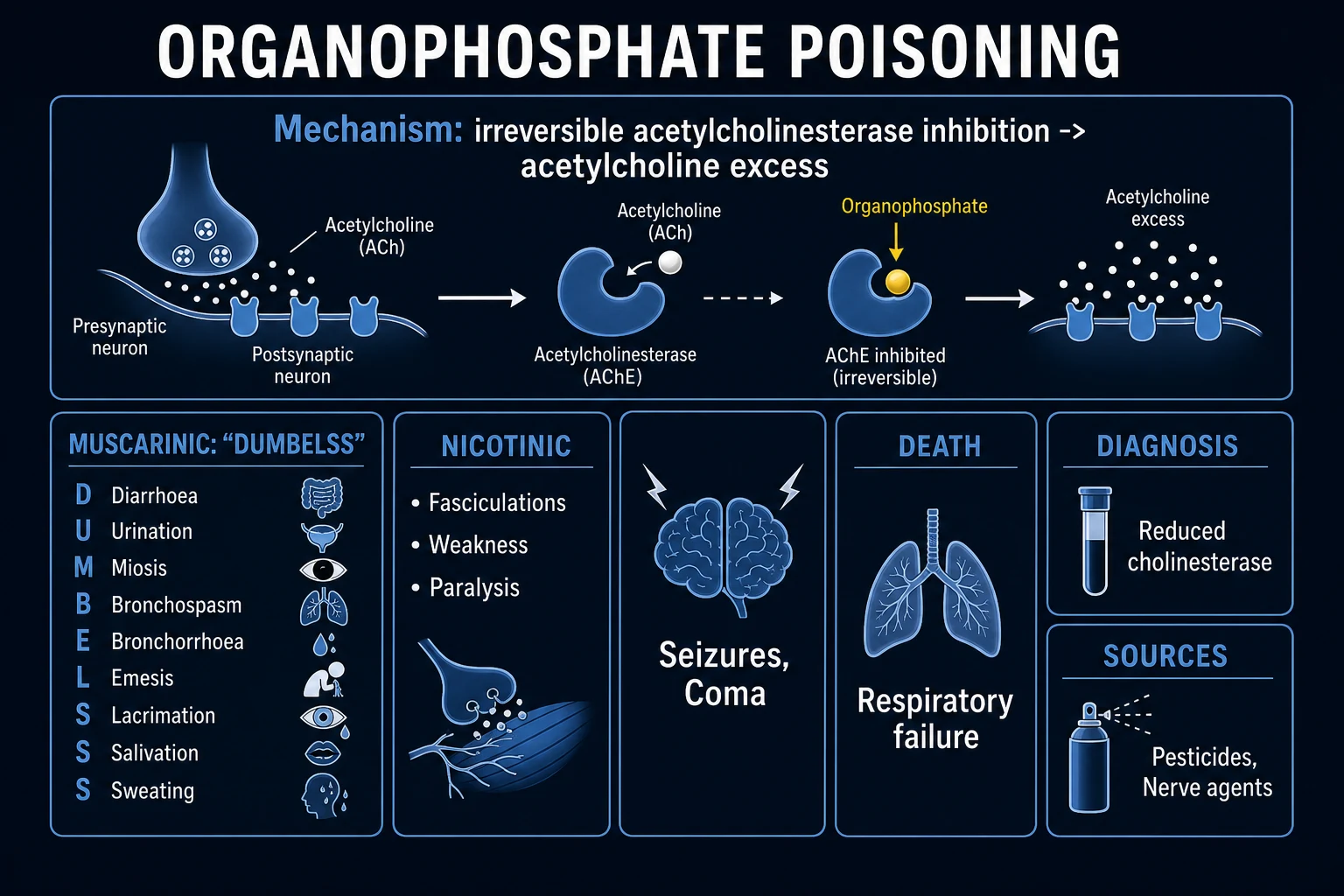
Organophosphate (OP) poisoning (agricultural pesticides such as malathion, parathion, chlorpyrifos, dimethoate, monocrotophos, profenofos; military nerve agents such as sarin, soman, tabun, VX) is one of the commonest causes of deliberate self-harm death in agricultural regions of South and South-East Asia. OPs irreversibly phosphorylate and inhibit acetylcholinesterase (AChE), causing accumulation of acetylcholine at muscarinic, nicotinic and central receptors — a cholinergic crisis. The classic muscarinic toxidrome is the DUMBELSS / SLUDGE mnemonic (Diarrhoea, Urination, Miosis, Bronchorrhoea/bronchospasm, Emesis, Lacrimation, Salivation, Sweating); nicotinic effects include muscle fasciculations, weakness, paralysis; central effects include seizures, coma, central respiratory depression. Death is from respiratory failure. Treatment is the two-antidote doctrine — atropine (muscarinic antagonist; titrate to a dry patient) PLUS pralidoxime (reactivates AChE; nicotinic effects; give EARLY before enzyme ageing), plus benzodiazepines (seizures), decontamination with staff PPE and ventilation. Three phases follow: acute cholinergic crisis (minutes to hours), intermediate syndrome (24 to 96 hours) and organophosphate-induced delayed polyneuropathy, OPIDP (1 to 3 weeks).
On this page & tools
Your progress
Saved locally on this device.
Exam tags
Red flags
Overview & Definition
Organophosphate (OP) poisoning is acute toxicity caused by irreversible inhibition of acetylcholinesterase (AChE) by an organophosphorus compound, producing a cholinergic crisis in which acetylcholine accumulates at muscarinic, nicotinic and central receptors.[1][9] It is a major global health problem — particularly in the agricultural regions of South and South-East Asia, where pesticide self-harm is among the commonest causes of deliberate self-poisoning death. Nerve agents (sarin, soman, tabun, VX) cause the identical syndrome at a thousand-fold lower dose and are the chemical-warfare and terrorism exemplar (Tokyo subway 1995, Ghouta 2013).[1]
The topic is high-yield for three reasons. First, the distinctive cholinergic toxidrome (DUMBELSS / SLUDGE) is recognisable at the bedside from across the resuscitation bay. Second, it is one of the few toxidromes with a specific two-antidote therapy — atropine for muscarinic effects and pralidoxime for nicotinic effects — and the timing of pralidoxime, before the enzyme 'ages', is a favourite MCQ discriminator. Third, the central danger is respiratory failure, the sum of bronchorrhoea, bronchospasm, respiratory-muscle paralysis and central apnoea, so aggressive atropinisation and early ventilation are the interventions that save lives.[1][3]
The clinical task is to recognise the cholinergic crisis, protect the staff during decontamination, titrate atropine to a dry patient, give pralidoxime early, ventilate before respiratory arrest, and then anticipate the intermediate syndrome that may appear a day later in a patient who seemed to have recovered.[5]
Classification
OP poisoning is classified along three axes — agent class, clinical phase and severity — and the closely related carbamates must be distinguished because they change management.[1]
Organophosphates (OP)
Irreversible AChE inhibition
- Phosphorylate serine-203 of AChE — covalent, essentially irreversible bond
- Enzyme 'ages' (dealkylation) over minutes (soman) to days (parathion); once aged, oximes cannot reactivate
- Agricultural: malathion, parathion, chlorpyrifos, dimethoate, monocrotophos, profenofos, phorate
- Nerve agents: sarin, soman, tabun, VX (1000-fold more potent)
- Three phases: acute crisis, intermediate syndrome, OPIDP
- Treated with atropine PLUS pralidoxime, ventilation, decontamination
Carbamates
Reversible AChE inhibition
- Carbamylate the active-site serine — bond hydrolyses spontaneously within hours
- NO ageing — enzyme spontaneously reactivates; oximes unnecessary
- Agents: carbaryl, propoxur, aldicarb, carbofuran, methomyl
- Milder, self-limiting (4 to 6 h); rarely intermediate syndrome or OPIDP
- Treat with atropine alone; pralidoxime given empirically only if OP cannot be excluded
- Recovery of RBC AChE within 24 to 48 h as carbamyl bond cleaves
The three clinical phases are the heart of the topic and the most-tested classification:[5][9]
- Acute cholinergic crisis — onset within minutes (inhalational, nerve agent) to 30 minutes to 6 hours (ingestion). This is the DUMBELSS / nicotinic / central syndrome discussed under Pathophysiology. Most deaths occur in this phase from respiratory failure.
- Intermediate syndrome — appears at 24 to 96 hours after exposure, after the acute muscarinic features have settled. Characterised by proximal and cranial-nerve weakness with respiratory-muscle involvement but WITHOUT recurrent muscarinic features. Patients who seemed to recover suddenly need reintubation. The mechanism is prolonged depolarisation block at the neuromuscular junction.[5][6]
- OP-induced delayed polyneuropathy (OPIDP) — appears 1 to 3 weeks after exposure. A symmetrical distal sensorimotor polyneuropathy (calf cramping, paraesthesia, foot-drop, wrist-drop) caused by inhibition and ageing of neuropathy target esterase (NTE) in axons. Not all OPs cause OPIDP — only those that inhibit and age NTE (e.g. tri-ortho-cresyl phosphate, mipafox, leptophos; chlorpyrifos, methamidophos). Over months the flaccid weakness may evolve into spasticity.[9]
Severity grading (the bedside Perera/IPCS scale) — examinable:[1]
- Mild — only muscarinic features (miosis, salivation, mild bronchorrhoea), conscious and oriented.
- Moderate — muscarinic plus nicotinic features (fasciculations, weakness), conscious.
- Severe — coma, seizures, respiratory failure, marked bronchorrhoea/bronchospasm. [1]
Epidemiology & Risk Factors
OP pesticide poisoning is one of the commonest methods of suicide death worldwide, with an estimated 100,000 to 200,000 deaths per year globally, the bulk in rural South and South-East Asia (India, Sri Lanka, Bangladesh).[1][2] The case fatality in developing-country hospitals is 10 to 20 percent, against under 5 percent in well-resourced ICUs with ventilation, atropine and pralidoxime — the entire gap is explained by ventilation access and time to atropine.[1]
Organophosphate poisoning — the numbers that matter
High-risk populations (examiner favourite list):[2][9]
- Agricultural workers and farmers — occupational dermal and inhalational exposure during spraying; chronic low-dose exposure causing neuropsychiatric symptoms.
- Rural South Asian populations — cheap, widely available pesticides (monocrotophos, chlorpyrifos, phorate, dimethoate) and limited access to ICU care.
- Adolescents and young adults in deliberate self-harm — the dominant presentation; large-volume ingestion.
- Children — accidental skin or food contamination; lower toxic threshold; atypical presentation.
- Military and civilian victims of nerve-agent terrorism/warfare — sarin (Tokyo 1995, Ghouta 2013), VX assassination (Kuala Lumpur 2017). [1]
Risk modifiers for severity and outcome (the high-yield list every examiner probes):[1][2]
- The specific agent and its intrinsic toxicity — dimethoate and profenofos carry roughly 20 percent mortality, against under 1 percent for malathion; this reframed OP poisoning as a heterogeneous condition, not one disease.
- Quantity ingested and route — ingestion is far more severe than dermal or inhalational; dermal absorption may continue for hours after exposure.
- Co-ingestion of alcohol — common in deliberate self-harm; biphasic effect (delays dimethoate absorption but worsens overall outcome, especially hypoglycaemia and aspiration).
- Delay to hospital, to atropine and to ventilation — the dominant modifiable factor.
- Pre-existing cardiac or respiratory disease — worsens OP cardiotoxicity and respiratory reserve. [1]
Indian epidemiology: OP pesticides are among the commonest agents taken in deliberate self-harm and a leading cause of poisoning-related death; presentation is often delayed due to rural geography; access to ventilators and pralidoxime is the practical bottleneck. WHO's 2020 call to phase out highly hazardous pesticides (HHPs) — banning monocrotophos, parathion and dimethoate — is the single most effective primary-prevention lever and is the correct public-health answer in any viva.[1]
Pathophysiology
Understanding the molecular mechanism unlocks every clinical, diagnostic and therapeutic fact in the topic — this is where examiners test deepest.[1]
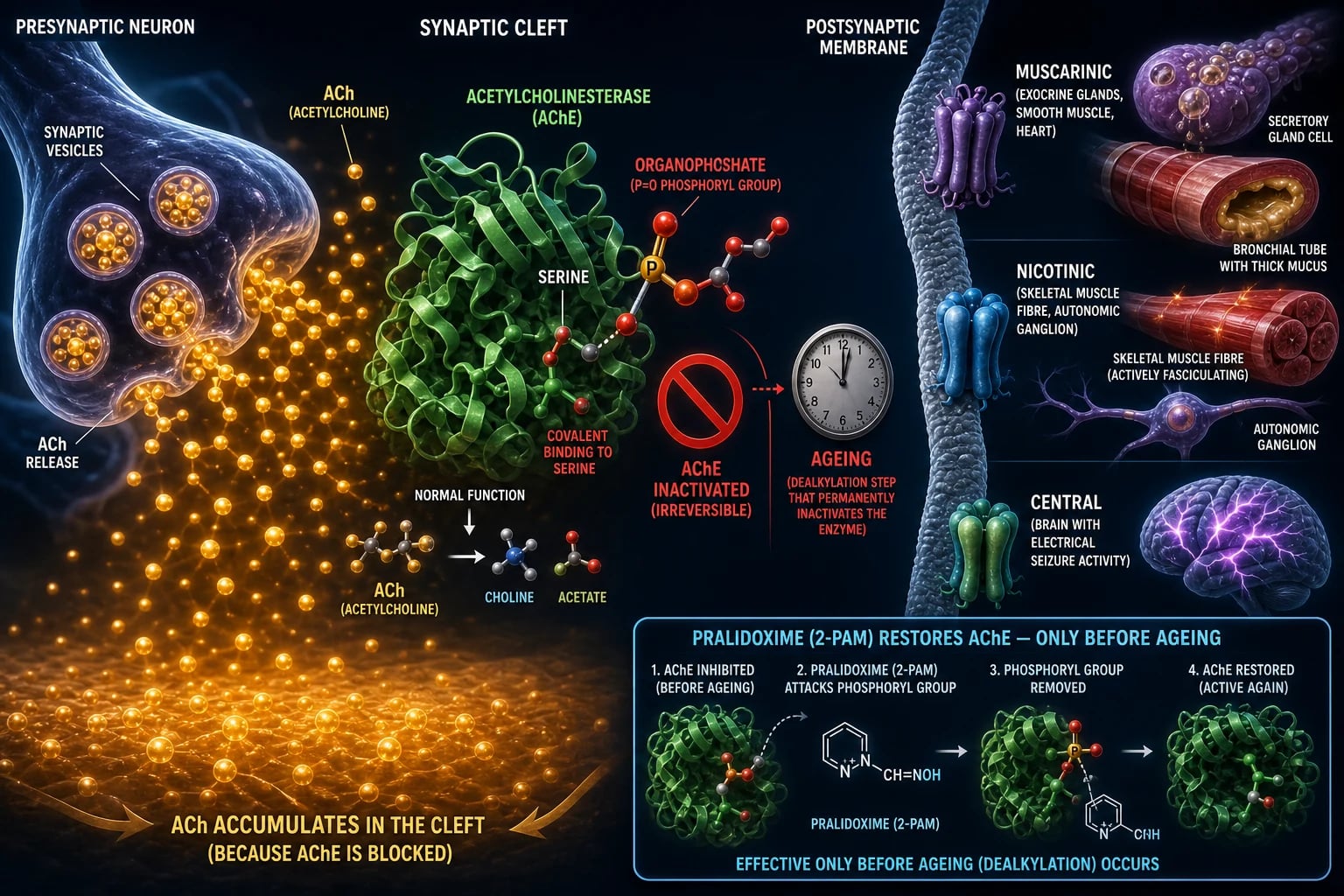
Step 1 — Normal cholinergic neurotransmission. Acetylcholine is synthesised from choline and acetyl-CoA by choline acetyltransferase, packaged into vesicles, released into the synapse, binds three receptor families — muscarinic (G-protein coupled M1 to M5), nicotinic (ligand-gated cation channels; Nn at ganglia, Nm at the neuromuscular junction) and central (cortical and brainstem receptors) — and is hydrolysed within milliseconds by AChE into choline and acetate to terminate the signal. The speed of hydrolysis is the whole point: AChE keeps synaptic ACh low and the signal sharp.[1]
Step 2 — The molecular target. The OP binds the active-site serine-203 residue in the catalytic gorge of AChE and phosphorylates it through its P=O phosphoryl group, forming a stable, covalent phosphoryl-enzyme intermediate that is essentially irreversible. Synaptic AChE activity falls, synaptic ACh rises roughly 100-fold, and continuous receptor stimulation follows.[1]
Step 3 — Ageing (the exam-defining concept). Over time (minutes for soman, hours for sarin and dimethoate, days for parathion and malathion) one alkyl group is hydrolysed off the phosphoryl moiety, leaving a negatively charged species that oximes can no longer displace. The enzyme is permanently inactivated and recovery then depends on de novo AChE synthesis at only 1 to 2 percent per day. This single fact — that ageing converts a reactivatable enzyme into a dead one — dictates the clinical rule: pralidoxime must be given as early as possible, ideally within 12 to 24 hours, and continued as long as features persist. Soman ages within minutes, which is why soman is the hardest nerve agent to treat and why military doctrine carries auto-injectors.[1][7]
Step 4 — Receptor overstimulation (the three families). ACh excess produces sustained then depolarising overstimulation at three receptor families:[1][9]
- Muscarinic — exocrine glands (salivation, lacrimation, sweating, bronchorrhoea), smooth muscle (miosis, bronchospasm, GI cramps, diarrhoea, urination), and the heart (bradycardia, AV block).
- Nicotinic (biphasic) — initial excitation (fasciculations, tachycardia, mydriasis, hypertension via ganglionic and adrenal stimulation) followed by depolarisation block and paralysis (weakness, respiratory-muscle paralysis, eventual flaccidity). This biphasic effect explains the paradox of a patient with both bradycardia (muscarinic) and tachycardia (nicotinic ganglionic).
- Central — anxiety, confusion, ataxia, slurred speech, tremor, generalised tonic-clonic seizures, coma, and depression of brainstem respiratory centres. [1]
Step 5 — Why respiratory failure is the killer. Death is rarely from any single mechanism; it is the sum of (a) muscarinic bronchorrhoea and bronchospasm flooding and constricting the airway, (b) nicotinic paralysis of the diaphragm and intercostals, and (c) central depression of the brainstem respiratory centres — all three operating at once. This is why ventilation plus atropine (which dries and bronchodilates) is the life-saving bundle, and why a falling vital capacity predicts intubation better than any blood test.[1]
Step 6 — Mechanism of the intermediate syndrome. Prolonged AChE inhibition at the neuromuscular junction produces sustained endplate depolarisation, receptor downregulation and deficient ACh resynthesis, manifesting at 24 to 96 hours as proximal and cranial-nerve-sparing weakness with respiratory-muscle involvement. The syndrome is a disorder of neuromuscular transmission, not of the central nervous system, which is why miosis and secretions are typically absent.[5][6]
Step 7 — Mechanism of OPIDP. Some OPs inhibit and age a distinct enzyme, neuropathy target esterase (NTE), in axons. The inhibition-and-ageing of NTE triggers a central-peripheral distal axonopathy that appears 1 to 3 weeks after exposure as a symmetrical sensorimotor polyneuropathy. Only OPs that inhibit and age NTE (tri-ortho-cresyl phosphate, mipafox, leptophos, chlorpyrifos, methamidophos) cause OPIDP — malathion and dimethoate generally do not. Over months the flaccid weakness may evolve into upper-motor-neuron spasticity.[9]
[1]Clinical Presentation
The classic presentation is a farmer or young adult brought to the emergency department unconscious, with pinpoint pupils, frothing at the mouth and nose, wheezing, fasciculating, smelling of solvent or garlic, with a history or circumstantial evidence of pesticide exposure. The syndrome divides cleanly into muscarinic, nicotinic and central.[1][9]
Muscarinic — DUMBELSS / SLUDGE
Muscarinic toxidrome — DUMBELSS (the wet picture)
DUMBELSS
Add bradycardia, hypotension, abdominal cramps, miosis. The diagnostic shortcut is "muscarinic = wet" — except that the skin is sweaty (a sympathetic output that examiners like to query). The most reliable bedside signs are miosis (present in over 90 percent of symptomatic cases), bronchorrhoea and bronchospasm.[1]
Nicotinic — MTWtHF (days of the week)
Nicotinic effects — MTWtHF (days of the week)
MTWtHF
The examiner trap is the paradox: nicotinic ganglionic stimulation may produce tachycardia, hypertension and even mydriasis that oppose the muscarinic bradycardia and miosis. A patient with a tachycardia and dilated pupils can still have severe OP poisoning if ganglionic stimulation dominates.[1]
Central nervous system
Anxiety, confusion, ataxia, slurred speech, tremor, generalised tonic-clonic seizures, coma, and central respiratory depression. Seizures themselves worsen brain injury and must be terminated promptly with benzodiazepines.[1]
Timing of the acute crisis
Onset within minutes for inhalational or nerve-agent exposure, 30 minutes to 6 hours for ingestion, and several hours for dermal/occupational exposure as absorption continues. A worker may present only after hours of dermal absorption with progressive miosis and weakness.[1]
Atypical presentations (examiner favourites)
- The elderly — predominant CNS depression, falls rather than the classic wet picture; lower threshold for intubation.
- The diabetic — OP-induced hyperglycaemia may mimic diabetic ketoacidosis; check glucose, but do not be misled.
- The pregnant — uterine contractions, fetal distress, risk of placental transfer of OP; antidotes are still given.
- The chronically OP-exposed worker — chronic low-dose exposure presents with neuropsychiatric symptoms (anxiety, depression, cognitive impairment — the "organic affective syndrome") and peripheral neuropathy rather than acute crisis.
- The child — may present with seizures, hypotonia, coma WITHOUT the classic secretions, because the history of exposure is unwitnessed; high index of suspicion. [1]
Intermediate syndrome (24 to 96 hours)
After apparent recovery from the acute crisis, the patient develops weakness of neck-flexors, proximal limb muscles, cranial nerves (especially III, VI, VII, IX, X, XII) and respiratory muscles, with depressed tendon reflexes but WITHOUT muscarinic features. The patient who was weaned from the ventilator a day earlier suddenly needs reintubation. This is the classic intermediate syndrome of Senanayake and Karalliedde.[5][6]
OPIDP (1 to 3 weeks)
Cramping calf pain, distal paraesthesia, progressive symmetrical flaccid weakness (foot-drop, wrist-drop) appearing weeks after exposure. Over months the flaccid picture evolves into spasticity with upper-motor-neuron signs.[9]
Cardiotoxicity
A leading cause of sudden early death: sinus bradycardia, AV block, QT prolongation, torsades de pointes, ventricular tachycardia and fibrillation — the so-called OP cardiotoxicity. Continuous ECG monitoring is mandatory.[1]
Differential Diagnosis
The central exam task is distinguishing OP poisoning from the other causes of cholinergic or paralysis syndromes. Reproduce this differential with the distinguishing features.[1]
Carbamate poisoning
Reversible cholinergic
- Identical muscarinic/nicotinic picture but MILD and SELF-LIMITING (4 to 6 h)
- Enzyme spontaneously reactivates; no ageing; no intermediate syndrome; no OPIDP
- Atropine alone sufficient; pralidoxime only if OP cannot be excluded
- History of carbaryl, propoxur, aldicarb, carbofuran exposure
Cholinergic mushroom (muscarine)
Pure muscarinic
- Inocybe and Clitocybe species contain muscarine
- Pure muscarinic picture — wet but NO nicotinic fasciculations, NO CNS effects
- Onset within 30 min of mushroom ingestion
- Treated with atropine alone
Botulism
Descending dry paralysis
- Descending symmetric flaccid paralysis with cranial nerve palsies
- DILATED (not mitotic) pupils, DRY (not wet) mucous membranes, clear sensorium
- OP is wet, mitotic and encephalopathic; botulism is dry, dilated and alert
- Food/wound history; treated with antitoxin and ventilation
Myasthenia / cholinergic crisis on therapy
Excess AChE-inhibitor
- Known myasthenia gravis on pyridostigmine or neostigmine
- Fasciculations and weakness with SLUDGE features
- Bedside Tensilon (edrophonium) test is DANGEROUS and NOT used in OP context
- Stop the cholinesterase inhibitor; atropine for muscarinic effects; supportive care
Additional mimics worth knowing:[1]
- Brainstem stroke causing coma with pinpoint pupils — OP also has the cholinergic secretory state, fasciculations and a history of exposure; brainstem stroke has focal signs and absent secretions.
- Asthma or COPD exacerbation, cardiogenic pulmonary oedema — both are "dry" compared to the torrential bronchorrhoea and miosis of OP; pulmonary oedema has pink frothy sputum and cardiac findings.
- Sepsis with multi-organ failure — both cause hypotension and altered mental state; OP has the cholinergic triad (miosis, secretions, fasciculations) and a history of pesticide exposure.
- OP-induced pancreatitis (a recognised complication, particularly of dimethoate) — distinguish from other causes of acute pancreatitis by serum lipase and CT abdomen.[2]
Clinical & Bedside Assessment
The focused assessment is an ABCDE with OP-specific add-ons.[1][9]
- Airway — suction the copious secretions; assess for the garlic/solvent smell; secure early if comatose.
- Breathing — rate, accessory-muscle use, SpO2, auscultate for wheeze (bronchospasm) and crepitations (bronchorrhoea/pulmonary oedema); serial vital capacity (falling below 15 mL/kg or 1 L predicts ventilation).
- Circulation — HR, BP, continuous ECG (QT, arrhythmias); IV access; bloods.
- Disability — GCS, pupils (miosis), fasciculations (especially tongue, eyelids, proximal muscles), bedside glucose (OP-induced hyperglycaemia).
- Exposure — skin contamination, solvent/garlic smell; remove clothing with PPE on. [1]
The cardinal bedside signs (the combination is pathognomonic): miosis (pinpoint pupils), bronchorrhoea (torrential watery chest secretions), bronchospasm (wheeze with prolonged expiration), muscle fasciculations, bradycardia, hypersalivation and hyperhidrosis.[1]
Severity grading at the bedside (the Perera/IPCS scale): mild (only muscarinic), moderate (muscarinic plus nicotinic fasciculations), severe (coma, seizures, respiratory failure). Grade the patient, because it determines the intensity of monitoring and the pralidoxime regimen.[1]
Daily assessment for the intermediate syndrome — once admitted, examine daily for neck-flexor weakness, proximal limb weakness, cranial-nerve palsies, and monitor vital capacity; a falling vital capacity predicts impending respiratory failure and the need for (re-)intubation.[5]
Healthcare-worker secondary contamination assessment — staff MUST wear PPE (gown, double gloves, mask with eye protection); remove and double-bag the patient's clothing; wash skin and hair with soap and water; ventilate the resuscitation room. Staff who develop miosis or headache during decontamination must be removed and assessed.[1]
Assess for complications — atelectasis, aspiration pneumonitis, pancreatitis, hepatitis, AKI, decubitus ulcers in prolonged ventilation, and contractures. [1]
Investigations
OP poisoning is fundamentally a clinical diagnosis based on the cholinergic toxidrome plus a history of exposure. Laboratory confirmation is supportive, not required to start treatment — waiting for a cholinesterase assay before giving atropine is a fatal error.[1]
First-line tests:[1]
- Arterial blood gas — type 1 respiratory failure with respiratory acidosis.
- FBC, U&E, LFT, lipase/amylase, creatine kinase, troponin.
- ECG — QT prolongation, sinus bradycardia, AV block, torsades, VT/VF.
- Chest X-ray — pulmonary oedema, atelectasis, ARDS pattern.
- Bedside capillary glucose — OP-induced hyperglycaemia; rule out hypoglycaemia in the unconscious patient. [1]
Cholinesterase assays (the diagnostic confirmation):[1][7]
- Red blood cell (RBC) acetylcholinesterase — reflects true synaptic AChE, the more specific marker; RBC AChE under 50 percent of normal is severe; takes weeks to recover (1 to 2 percent new synthesis per day).
- Plasma butyrylcholinesterase (pseudocholinesterase) — synthesised by the liver, the more sensitive but less specific marker (also falls in liver disease, pregnancy, after suxamethonium); recovers in days. [1]
Both fall in OP poisoning; baseline and trend guide severity and recovery. They are NOT needed to start treatment. [1]
Agent confirmation — gastric contents, blood and urine sent for gas chromatography–mass spectrometry for the OP parent compound and the dialkyl-phosphate metabolites. The specific agent predicts outcome (dimethoate and profenofos carry the highest mortality).[2]
The 'atropine responsiveness' bedside test — a test dose of atropine 1.2 mg IV that produces drying of secretions and a rise in heart rate confirms OP poisoning; failure to respond suggests an alternative diagnosis or an overwhelming dose.[1]
Monitoring — serial vital capacity (falling below 15 mL/kg or 1 L predicts ventilation), peak flow, ABG, continuous ECG; serial chest X-rays for ARDS and atelectasis.[1]
Management — Resuscitation
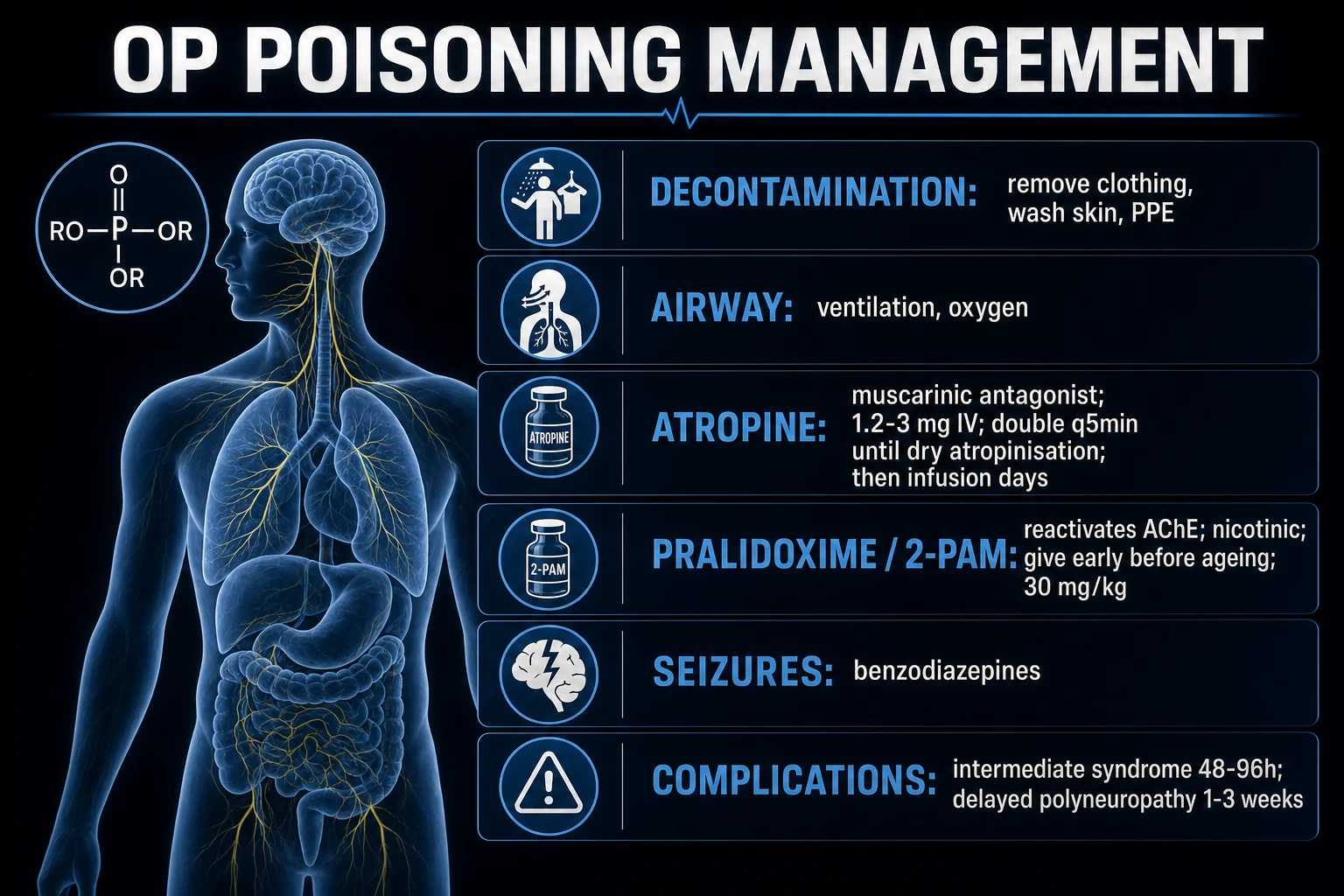
The time-critical resuscitation bundle is protect staff, secure airway, atropine early, prepare for ventilation, pralidoxime if nicotinic features, benzodiazepines for seizures, GI decontamination if early ingestion.[1]
- Protect the staff. PPE (gown, double gloves, mask with eye protection) on everyone in the bay; remove and double-bag the patient's clothing; wash skin and hair with soap and water; ventilate the resuscitation room. Atropine and pralidoxime protect the patient, NOT the staff — staff protection requires PPE.[1]
- Airway and breathing. Suction the copious secretions; high-flow oxygen; prepare for intubation and ventilation early — respiratory failure is the killer. Intubation triggers: SpO2 under 90 percent on oxygen, rising PaCO2, vital capacity below 15 mL/kg, coma with inability to protect airway, refractory seizures. Use rocuronium or vecuronium — NOT suxamethonium (prolonged apnoea because butyrylcholinesterase is depleted by the OP).[1]
- Atropine — first-line antidote (muscarinic only). Atropine is a competitive muscarinic antagonist. It dries secretions, bronchodilates, and raises the heart rate; it does NOT reverse nicotinic paralysis or (fully) central effects. The regimen:[1]
Atropine — titrate to a dry patient
- Pralidoxime (2-PAM) — reactivates AChE (nicotinic effects). Indicated for any moderate or severe poisoning (fasciculations, weakness, respiratory failure, coma, seizures). It reactivates AChE by nucleophilic attack on the phosphorylated serine, before ageing; it reverses fasciculations and paralysis and improves muscle strength, and (less effectively) crosses the blood-brain barrier to reduce central effects. The regimen (see Definitive management for the full WHO high-dose protocol).[3]
- Seizures — benzodiazepines. Lorazepam 4 mg IV (or diazepam 10 mg IV, or midazolam 10 mg IM) repeated; benzodiazepines also reduce OP-induced CNS excitotoxicity and are the first-line anticonvulsant.[1]
- GI decontamination (if ingestion within 1 hour). Gastric lavage within 1 hour ONLY after the airway is protected and atropine started (OP is a hydrocarbon solvent — lavage risk if the airway is unprotected); single-dose activated charcoal 50 g NG (1 g/kg in children) within 1 to 2 hours. No ipecac; whole-bowel irrigation is not recommended.[1]
- Treat complications as they arise — arrhythmias (avoid Class Ia — quinidine, procainamide, disopyramide — which worsen OP toxicity; use magnesium for QT/torsades), pancreatitis, AKI, electrolyte disturbance.
Management — Definitive & Stepwise
Once the patient is resuscitated, the management ladder is atropine infusion titrated for days, pralidoxime infusion, ongoing ventilation and decontamination, complication management, and anticipation of the intermediate syndrome.[1][3]
The first 24 hours — a stepwise bundle
Recognise the cholinergic crisis (DUMBELSS, miosis, fasciculations). Don full PPE. Remove and double-bag clothing. Wash skin and hair with soap and water. Suction the airway, high-flow oxygen, IV access.
Atropine 1.2 to 3 mg IV bolus, doubled every 5 min until the patient is dry (dry mouth/axillae, clear chest, HR over 80, SBP over 80). Then start the atropine infusion at 10 to 20 percent of the loading dose per hour.
For moderate/severe poisoning: pralidoxime 30 mg/kg IV bolus over 15 to 30 min, then 8 mg/kg/h infusion for at least 24 to 48 h. Continue until no fasciculations, clear chest, off ventilation for over 12 h.
Intubate and ventilate for respiratory failure (use rocuronium, not suxamethonium). If ingestion within 1 h and airway protected: gastric lavage then activated charcoal 50 g NG.
Lorazepam 4 mg IV for seizures (repeat). Continuous ECG; avoid Class Ia antiarrhythmics; magnesium for QT prolongation.
Daily exam for neck-flexor and proximal weakness, cranial nerve palsies; serial vital capacity. Re-intubate promptly for respiratory weakness.
Pralidoxime — the two regimens
The WHO high-dose regimen (the Eddleston 2009 PLoS Medicine RCT, now WHO standard):[3][8]
Pralidoxime chloride — WHO high-dose regimen (severe poisoning)
The older Indian/British bolus regimen still widely used:[1]
- Pralidoxime 1 to 2 g IV over 15 to 30 minutes, repeated in 30 min if no response, then 1 g every 8 to 12 hours or a 500 mg/h infusion for up to 7 days. [1]
Why pralidoxime must be given early. It reactivates AChE only before the enzyme has aged — soman ages within minutes (pralidoxime futile unless immediate), sarin and dimethoate over hours, parathion and malathion over days. The earlier pralidoxime is given the better; give it within the first few hours and continue as long as features persist, because ongoing absorption continues to inhibit newly synthesised enzyme.[3][7]
Atropine infusion — days to weeks
The atropine infusion may be required for days to weeks because OP is lipid-soluble and redistributes from fat stores, producing the rebound phenomenon (recurrent cholinergic features hours to days after apparent recovery). The infusion rate at steady state may be 1 to 5 mg/h or much higher; titrate continuously. Sudden cessation risks rebound cholinergic crisis — taper slowly.[1]
Management of intermediate syndrome
There is no specific antidote. The cornerstone is supportive ventilation, often for 7 to 21 days, while de novo AChE synthesis restores neuromuscular transmission. Continue pralidoxime and atropine; aggressive chest physiotherapy, DVT prophylaxis, nutrition (NG or jejunostomy), and pressure-area care. Recovery is by enzyme resynthesis.[5][6]
Management of OPIDP
No specific antidote. Supportive rehabilitation — physiotherapy, orthotics, analgesia (avoid opioids in respiratory depression). The role of early high-dose pralidoxime to prevent NTE ageing is theoretical and unproven.[9]
Escalation, de-escalation and adjuncts
- Escalation to ICU — all severe cases, any patient on ventilation or a high atropine infusion, intermediate syndrome, pancreatitis, AKI, cardiac arrhythmias, pregnancy.
- De-escalation criteria — patient off ventilation for over 24 h, no fasciculations, no secretions, clear chest, normal mental state, atropine infusion weaned to zero, RBC AChE recovering.
- Adjuncts (not standard of care) — fresh frozen plasma (contains butyrylcholinesterase, a scavenger — biological rationale, studied but not routine), intravenous lipid emulsion, magnesium sulphate — case reports and small series only. [1]
Surgical and procedural triggers
- Bronchoscopy for mucus plugging and atelectasis.
- Tracheostomy for prolonged ventilation (over 7 to 14 days).
- Feeding jejunostomy or NG for prolonged immobility. [1]
Specific Subtypes & Scenarios
- Agricultural pesticide ingestion (the Indian / South Asian scenario). Typically large-volume ingestion, severe cholinergic crisis, high risk of intermediate syndrome and pancreatitis. Aggressive early atropine, pralidoxime, ventilation. Agent-specific mortality (dimethoate and profenofos around 20 percent; malathion under 1 percent).[2]
- Nerve-agent exposure (terrorism / warfare — sarin, soman, tabun, VX). Far higher potency; immediate military MARK I or DuoDote auto-injector (atropine 2 mg plus pralidoxime 600 mg IM, repeated up to three kits); mass-casualty decontamination doctrine (strip and shower). Soman ages within minutes so pralidoxime MUST be given immediately.[1]
- Dermal / occupational exposure. Remove contaminated clothing, wash skin and hair with soap and water (NOT bleach on skin), observe for at least 12 h as absorption continues; miosis alone may persist for days and is NOT an indication for atropine.[1]
- Carbamate poisoning. Cholinergic picture but milder and self-limiting (4 to 6 h); atropine alone is usually sufficient; pralidoxime given empirically only if OP cannot be excluded (carbamates do not age, so oximes are safe but unnecessary).[1]
- Mixed poisoning (OP plus alcohol, OP plus organochlorine). Alcohol co-ingestion is common and worsens overall outcome in dimethoate; manage both; monitor for hypoglycaemia and aspiration.[2]
- Pregnancy. Atropine and pralidoxime cross the placenta and are SAFE in OP poisoning; the priority is maternal stabilisation; OP may trigger premature labour; fetal monitoring; do NOT withhold antidotes.[1]
- Paediatric OP poisoning. Usually accidental skin or food contamination; lower toxic threshold; weight-based atropine (0.05 mg/kg) and pralidoxime (25 to 50 mg/kg); watch for atypical presentations (seizures, hypotonia) without classic secretions.[9]
Complications & Pitfalls
- Respiratory failure — the leading cause of death.
- Intermediate syndrome (24 to 96 h) and OPIDP (1 to 3 weeks).
- Aspiration pneumonitis, ARDS, ventilator-associated pneumonia.
- Cardiac arrhythmias — QT prolongation, torsades, VT/VF.
- Pancreatitis (particularly dimethoate), hepatitis, AKI.
- Sepsis, decubitus ulcers, critical-illness polyneuromyopathy, prolonged ICU-acquired weakness. [1]
The classical pitfalls (each is examinable):[1][3]
- Giving too little atropine — the commonest error, by an order of magnitude. Auscultate the chest; if it is wet, give more.
- Stopping atropine too early — rebound cholinergic crisis from ongoing absorption.
- Failing to give pralidoxime early — the enzyme ages and becomes unreactivatable.
- Misreading the 'atropine-responsive' dry lung as pulmonary oedema and giving diuretics — a fatal mistake.
- Using suxamethonium for intubation — prolonged apnoea (butyrylcholinesterase is depleted).
- Neglecting staff PPE — healthcare workers develop miosis and symptoms from off-gassing or dermal contact.
- Forgetting to watch for the intermediate syndrome — a patient weaned from the ventilator at 48 h suddenly needs re-intubation.
- Over-treating mild cases to fixed dilated pupils, hyperthermia and atropine toxicity. [1]
Atropine toxicity presents with fixed dilated pupils, hyperthermia, ileus, urinary retention, tachycardia, delirium, dry hot skin. Distinguish from ongoing OP poisoning; management is to PAUSE atropine and re-titrate, NOT to give physostigmine.[1]
The 'rebound' phenomenon — recurrence of cholinergic features hours to days after apparent recovery, due to ongoing absorption (lipid-soluble OP from fat stores) or redistribution; managed by resuming atropine.[1]
The medicolegal pitfall — OP pesticide ingestion is usually deliberate self-harm; ALL cases require psychiatric assessment once stable; in many Indian states it is a notifiable medicolegal case — preserve gastric contents and inform police.[9]
Prognosis & Disposition
The overall mortality in well-resourced ICUs is under 5 percent; in resource-limited settings it is 10 to 20 percent; case fatality for dimethoate and profenofos ingestion approaches 20 to 30 percent.[1][2]
Predictors of poor outcome
Disposition — ICU for all severe cases and any patient on ventilation or a high atropine infusion; ward care for mild cases observed for at least 24 to 48 h with atropine available; psychiatric assessment before discharge for all deliberate self-harm cases.[9]
The safety-net on discharge — advise the patient (and family) on the risk of OPIDP (delayed weakness) and to return if it develops; counsel agricultural workers on protective equipment and pesticide handling; consider social work and pesticide-access restriction.[9]
Recovery of RBC AChE takes weeks to months — patients may feel fatigued and cognitively impaired for weeks (the post-OP syndrome); driving and return-to-work advice accordingly. [1]
Special Populations
- Paediatric. Accidental dermal/oral contamination is common in agricultural households. Atropine 0.02 to 0.05 mg/kg IV (minimum 0.1 mg), doubled every 5 minutes until secretions dry and bronchospasm clears (not until pupils dilate). Pralidoxime 25 to 50 mg/kg IV over 30 min, then 10 to 20 mg/kg/h infusion where used. Seizures: lorazepam 0.1 mg/kg IV (or midazolam). Watch for hypoglycaemia, hypothermia, and silent hypoventilation; non-verbal children cannot report dyspnoea — continuous SpO2/ETCO2 and early ICU.[9]
- Pregnant. Do not withhold atropine or pralidoxime — maternal hypoxia and seizures devastate the fetus. Use left-lateral tilt, fetal monitoring, and obstetric co-management. Avoid magnesium for “tocholysis/seizure mimic” pathways that worsen neuromuscular weakness. OP may trigger preterm labour — stabilise mother first.[1]
- Elderly. Presentation may be dominated by CNS depression, falls, aspiration pneumonia, or arrhythmia rather than classic SLUDGE. Lower starting atropine with careful titration; higher intubation risk; reconcile QT-prolonging drugs and ischaemic heart disease.
- Agricultural worker with chronic low-dose exposure. Subacute neuropsychiatric symptoms (anxiety, depression, cognitive slowing), peripheral neuropathy, and intermediate-range AChE depression. Remove from exposure, check RBC AChE, counsel PPE and safe storage (locked, labelled, away from children/food).[9]
- On therapeutic cholinesterase inhibitors (pyridostigmine for myasthenia; donepezil for dementia). Additive cholinergic crisis risk; do not abruptly stop pyridostigmine in MG without specialist advice (myasthenic crisis). Seek toxicology/neurology input early.[1]
- Self-harm / intentional ingestion. Large dose, co-ingestants, delayed presentation, and higher rates of intermediate syndrome and ventilation. Parallel psychiatric risk assessment once medically stable is mandatory; do not discharge from ED after “looks well” without observation for recurrent cholinergic features and delayed weakness (typically 24–96 h).
Evidence, Guidelines & Regional Differences
WHO 2020 policy on highly hazardous pesticides is the single most effective primary-prevention lever — phasing out monocrotophos, parathion and dimethoate could prevent tens of thousands of deaths annually. WHO/ATSDR international guidelines on OP pesticide poisoning management underpin the atropine + pralidoxime + ventilation + decontamination framework.[1]
Indian rural protocols favour aggressive atropine infusions for days and high-dose oxime infusions, reflecting the severe, large-volume pesticide ingestions seen in practice. APCC (Asian Pacific Clinical Toxicology) and INASL/WHO South-East Asia guidance. Access to ventilators, pralidoxime and intensive care is the practical bottleneck; the Sri Lankan SACTRC research group (Eddleston, Dawson, Buckley) generated the pivotal trials.[2][3]
Landmark trials and what they changed:[2][3]
Eddleston 2005 — Lancet
Key finding
Dimethoate and profenofos carry roughly 20% mortality compared with under 1% for malathion. Reframed OP poisoning as a HETEROGENEOUS condition — the agent matters as much as the dose.
Practice change
Outcome prediction and agent-specific counselling; supports the WHO HHP phase-out for the most lethal pesticides.
Eddleston 2009 — PLoS Medicine (RCT)
Key finding
The WHO high-dose pralidoxime regimen (30 mg/kg bolus then 8 mg/kg/h for 48 h) reactivated cholinesterase and was safe; superior to the older low-dose saline placebo regimen.
Practice change
Changed WHO and global practice toward HIGH-DOSE pralidoxime infusions, replacing the older low-dose bolus regimens.
Buckley 2011 — Cochrane
Key finding
The evidence for oximes remains WEAK and INCONCLUSIVE, with no clear mortality benefit. The controversy: in diethyl-OP (dimethoate) poisoning, ageing is rapid and reactivation may be futile.
Practice change
Oximes are still given (especially in Indian rural practice) but the evidence base is acknowledged to be weak; practice varies by region.
Controversies: whether oximes help at all in diethyl-OP poisoning (rapid ageing); the optimal duration and dose of pralidoxime; whether gastric lavage and activated charcoal add benefit beyond airway-protected early lavage; the role of FFP, magnesium and intravenous lipid emulsion as adjuncts; and the primary-prevention question of pesticide-access restriction.[1][4]
Exam Pearls
The three-phase timeline — high-yield
PHASES
- One-liner: OP irreversibly inhibits acetylcholinesterase; ACh accumulates at muscarinic, nicotinic and central receptors; death is from respiratory failure; treat with atropine (muscarinic) + pralidoxime (nicotinic, give early before ageing) + benzodiazepines (seizures) + decontamination + ventilation.[1]
- DUMBELSS / SLUDGE for muscarinic; MTWtHF (days of the week) for nicotinic.[1]
- Miosis is the single most reliable bedside sign (over 90 percent of symptomatic cases), but is absent in pure nicotinic or early dermal exposure.
- The two-antidote doctrine — atropine (muscarinic only) and pralidoxime (nicotinic, reactivates AChE); never give one without considering the other in significant poisoning.
- Atropine is titrated to the dry lung and HR over 80, NOT to dilated pupils or dry skin — the latter is atropine toxicity.[1]
- Ageing half-lives — soman minutes (pralidoxime must be immediate), sarin hours, dimethoate hours to a day, parathion/malathion longer. This is why soman is the hardest nerve agent to treat.
- Atropine infusion may be needed for days to weeks; sudden cessation risks rebound.
- The three phases — acute cholinergic crisis (minutes to hours), intermediate syndrome (24 to 96 h), OPIDP (1 to 3 weeks).[5][9]
- OP poisoning is a clinical diagnosis — do not wait for RBC AChE to treat.[1]
- Carbamates are reversible (no ageing), need atropine alone, rarely cause intermediate syndrome or OPIDP.
- Suxamethonium causes prolonged apnoea in OP (butyrylcholinesterase depleted) — use rocuronium for intubation.
- Avoid Class Ia antiarrhythmics (quinidine, procainamide, disopyramide) — they worsen OP toxicity.[1]
- Agricultural OP pesticide self-harm is a leading cause of suicide death in rural India; primary prevention is pesticide-access restriction and the WHO HHP phase-out.[1]
- OP-induced pancreatitis is particularly associated with dimethoate.[2]
- Neuropathy target esterase (NTE) is the enzyme whose inhibition-and-ageing causes OPIDP — distinct from AChE.[9]
Exam application bank (NEET-PG / INICET)
One-line answer
Organophosphate (OP) poisoning (agricultural pesticides such as malathion, parathion, chlorpyrifos, dimethoate, monocrotophos, profenofos; military nerve agents such as sarin, soman, tabun, VX) is one of the commonest causes of deliberate self-harm death in agricultural regions of South and South-East Asia. OPs irreversibly phosphorylate and inhibit acetylcholinesterase (AChE), causing accumulation of acetylcholine at muscarinic, nicotinic and central receptors — a cholinergic crisis. The classic muscarinic toxidrome is the DUMBELSS / SLUDGE mnemonic (Diarrhoea, Urination, Miosis, Bronchorrhoea/bronchospasm, Emesis, Lacrimation, Salivation, Sweating); nicotinic effects include muscle fasciculations, weakness, paralysis; central effects include seizures, coma, central respiratory depression. Death is from respiratory failure. Treatment is the two-antidote doctrine — atropine (muscarinic a
Worked stems (answer without another resource)
Stem 1 — Classic presentation. Map symptoms to mechanism; name the first investigation and first treatment step with dose/route if drug therapy is standard. [1]
Stem 2 — Unstable / complicated. List red flags that force immediate resuscitation, theatre, ICU, antidote, or reperfusion — and what you do in the first 15 minutes. [1]
Stem 3 — Atypical group. Elderly, pregnancy, child, or immunocompromised: how presentation and thresholds change. [1]
Stem 4 — Differential trap. Name the three closest mimics and one discriminator for each. [1]
Stem 5 — Disposition. Who goes home with safety-netting, who is admitted, who needs HDU/ICU/theatre, and what follow-up is mandatory. [1]
Rapid viva checklist
- Definition + classification
- Pathophysiology chain
- Bedside signs / criteria
- Score with exact components (if any)
- Emergency bundle
- Definitive therapy with doses
- Complications of disease and of treatment
- Special populations
- Guideline/trial name if classic
- Three exam traps
Coverage self-check
If you cannot answer any stem above from this page alone, re-read the matching section — the page is intended to be self-sufficient for final-prof and NEET-PG/INICET questions on Organophosphate Poisoning.
References
- [1]Eddleston M, Clark PI, Worek F, et al. Management of acute organophosphorus pesticide poisoning Lancet, 2008.PMID 17706760
- [2]Eddleston M, Dawson AH, Karalliedde L, et al. Differences between organophosphorus insecticides in human self-poisoning: a prospective cohort study Lancet, 2005.PMID 16243090
- [3]Eddleston M, Eyer P, Worek F, et al. Pralidoxime in acute organophosphorus insecticide poisoning--a randomised controlled trial PLoS Med, 2009.PMID 19564902
- [4]Buckley NA, Eddleston M, Li Y, Bevan M, Robertson J. Oximes for acute organophosphate pesticide poisoning Cochrane Database Syst Rev, 2011.PMID 21328273
- [5]Senanayake N, Karalliedde L. Neurotoxic effects of organophosphorus insecticides. An intermediate syndrome N Engl J Med, 1987.PMID 3029588
- [6]Sedgwick EM, Senanayake N. Pathophysiology of the intermediate syndrome of organophosphorus poisoning J Neurol Neurosurg Psychiatry, 1997.PMID 9048731
- [7]Konickx LA, Smith AJ, Bawaskar HS, Bawaskar PH, Wiener SW, Eddleston M, Buckley NA. Reactivation of plasma butyrylcholinesterase by pralidoxime chloride in patients poisoned by WHO class II toxicity organophosphorus insecticides Toxicol Sci, 2013.PMID 24052565
- [8]Syed S, Raza K. Is the World Health Organization-recommended dose of pralidoxime effective in the treatment of organophosphorus poisoning? A randomized, double-blinded and placebo-controlled trial Saudi J Anaesth, 2015.PMID 25558199
- [9]Patel A, Chavan G, Nagpal AK. Navigating the Neurological Abyss: A Comprehensive Review of Organophosphate Poisoning Complications Cureus, 2024.PMID 38510851
- [10]Goel A, Aggarwal P. Pesticide poisoning Natl Med J India, 2007.PMID 18085124