Emergency & Toxicology · General Medicine
Snake Envenomation
Also known as Snakebite · Snake bite · Antivenom therapy · Elapid envenomation · Viper envenomation · ASV · Venom-induced consumption coagulopathy
Snake envenomation is a WHO category-A neglected tropical disease and a leading cause of accidental rural death in the tropics — India alone bears the largest global burden (~45,000 deaths/year). Medically important snakes divide into two clinical families. Elapids (cobra, krait, mamba, coral, Australian taipan/brown) deliver neurotoxic venom — alpha-neurotoxins block the postsynaptic nicotinic acetylcholine receptor and phospholipase A2 destroys the presynaptic nerve terminal, producing descending flaccid paralysis (ptosis, ophthalmoplegia, bulbar palsy, respiratory failure) with little local swelling. Vipers (Russell's, saw-scaled, puff adder, rattlesnake) deliver haemato/cytotoxic venom — procoagulant enzymes activate prothrombin/factor X causing venom-induced consumption coagulopathy (VICC) with incoagulable blood, spontaneous bleeding, and AKI, shock and local necrosis. Sea snakes / Australian elapids add rhabdomyolysis (myoglobinuric AKI). First aid: reassure, immobilise the limb, pressure-immobilisation bandage for elapids, rapid transport; avoid cut/suck/tourniquet/ice. Diagnosis is clinical + 20-minute whole blood clotting test (20WBCT). Treatment is resuscitation + specific antivenom (ASV) IV for significant envenomation (neurotoxicity, VICC, bleeding, shock, AKI, rhabdomyolysis, severe local), early ventilation for respiratory failure, dialysis for AKI, blood products after antivenom, and fasciotomy only after coagulopathy is corrected.
On this page & tools
Your progress
Saved locally on this device.
Exam tags
Red flags
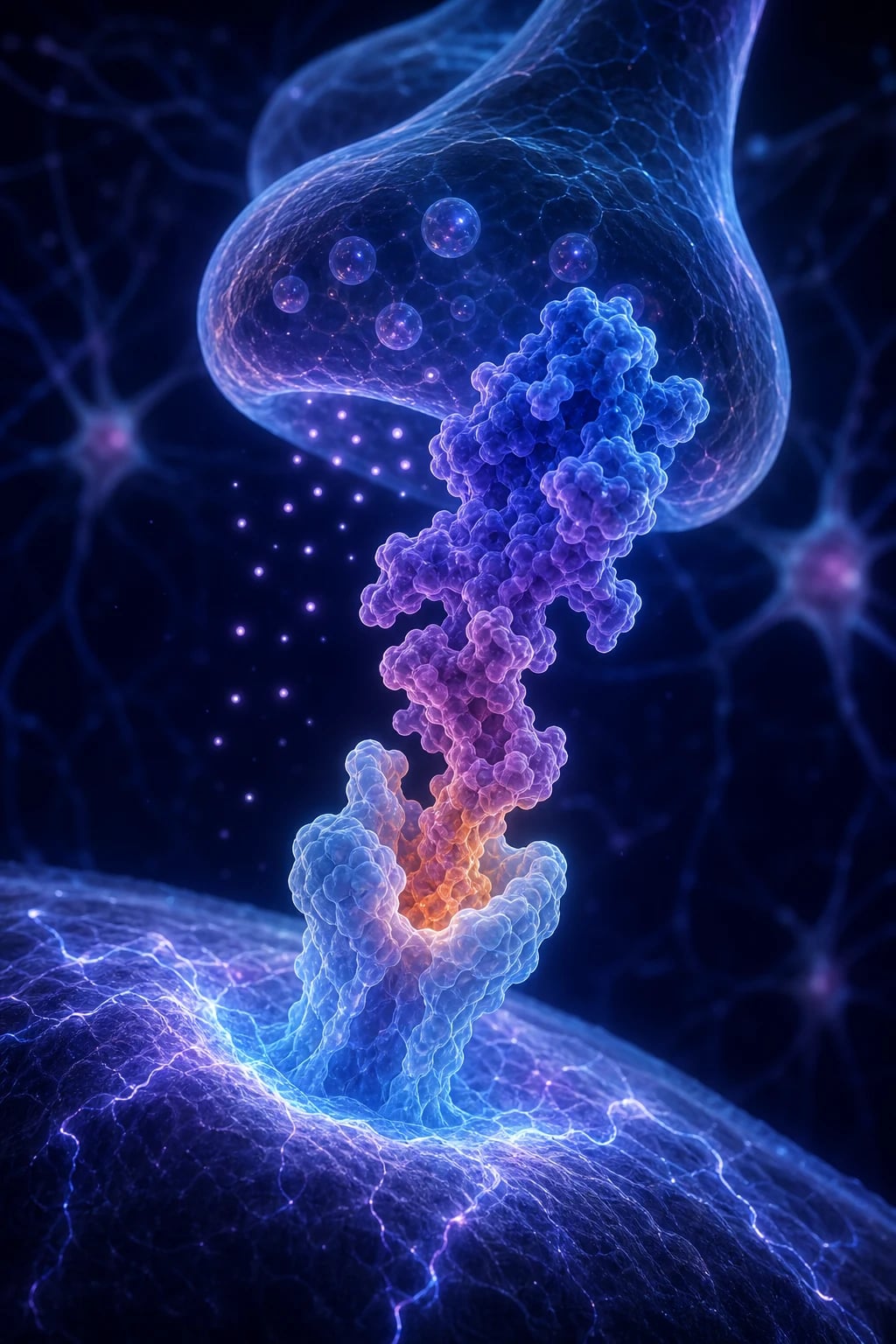
Overview & Definition
Snake envenomation is the clinical syndrome caused by the injection of venom into human tissues by the fangs of a venomous snake. It is distinguished from a dry bite — a bite by a venomous snake in which no venom is injected (which accounts for roughly 20 to 50 per cent of bites by some species, particularly cobras). A bite mark alone does not equal envenomation; systemic or severe local signs do.[1][2]
Snakebite is a WHO category-A neglected tropical disease (designated 2017) and one of the most lethal accidental rural emergencies in South and Southeast Asia, sub-Saharan Africa and Latin America. The Million Death Study estimated approximately 45,000 deaths per year in India alone, with three times as many survivors left with amputation or chronic disability — the largest national burden of any country in the world.[3]
The clinical skill in snakebite is threefold: (1) recognise the syndrome (neurotoxic vs haematotoxic/cytotoxic vs myotoxic), (2) give specific antivenom promptly for significant envenomation while preparing for anaphylaxis, and (3) support the complications — respiratory failure (ventilation), AKI (dialysis), coagulopathy (blood products after antivenom) and compartment syndrome (fasciotomy only after correction of coagulation). The single most important process lever is rapid transport to a hospital with antivenom.[1][4]
Classification
By clinical family (the distinction that drives the bedside syndrome):[1][2]
- Elapidae (elapids) — fixed, short front fangs; predominantly neurotoxic venom. Includes the cobra (Naja), krait (Bungarus), mamba (Dendroaspis), coral snake (Micrurus), and the Australian elapids (taipan, brown snake, tiger snake, death adder, black snake). Most cause descending flaccid paralysis with little or no local swelling; Australian elapids additionally cause VICC and rhabdomyolysis.
- Viperidae (vipers) — long, hinged, folding front fangs; predominantly haemato/cytotoxic venom. Two subfamilies: Viperinae (true vipers — Russell's viper, saw-scaled viper, puff adder) and Crotalinae (pit vipers — rattlesnake, lancehead, hump-nosed pit viper). Cause local necrosis, VICC, bleeding, AKI and shock.
- Hydrophiidae (sea snakes) — short fixed fangs; myotoxic and neurotoxic venom; cause rhabdomyolysis with myoglobinuric AKI and paralysis. Bites occur in fishermen and sea bathers. [1]
The 'Big Four' of India — the medically most important Indian terrestrial snakes, all covered by the Indian polyvalent antivenom (ASV):[1][3]
| Snake | Family | Dominant syndrome |
|---|---|---|
| Russell's viper (Daboia russelii) | Viperidae | VICC, AKI, capillary leak, pituitary haemorrhage, shock |
| Saw-scaled viper (Echis carinatus) | Viperidae | VICC, local swelling, bleeding |
| Common krait (Bungarus caeruleus) | Elapidae | Painless nocturnal neurotoxicity, abdominal pain |
| Indian cobra (Naja naja) | Elapidae | Local necrosis + postsynaptic neurotoxicity |
The 'Fab Five' of Australia — brown snake, tiger snake, taipan, death adder, mulga (king brown) snake — covered by the Australian CSL polyvalent antivenom (or monovalent antivenoms when the species is known, guided by the venom detection kit). [1]
By severity (drives antivenom dose and disposition):[1]
- Mild (non-envenoming / dry bite) — fang marks only, no local or systemic features; no antivenom, observe at least 24 h.
- Moderate — local swelling extending beyond the bite site, or early systemic features (vomiting, mild coagulopathy).
- Severe — neurotoxicity, VICC (positive 20WBCT), spontaneous bleeding, shock, AKI, rhabdomyolysis, rapidly extending local swelling or necrosis — antivenom indicated. [1]
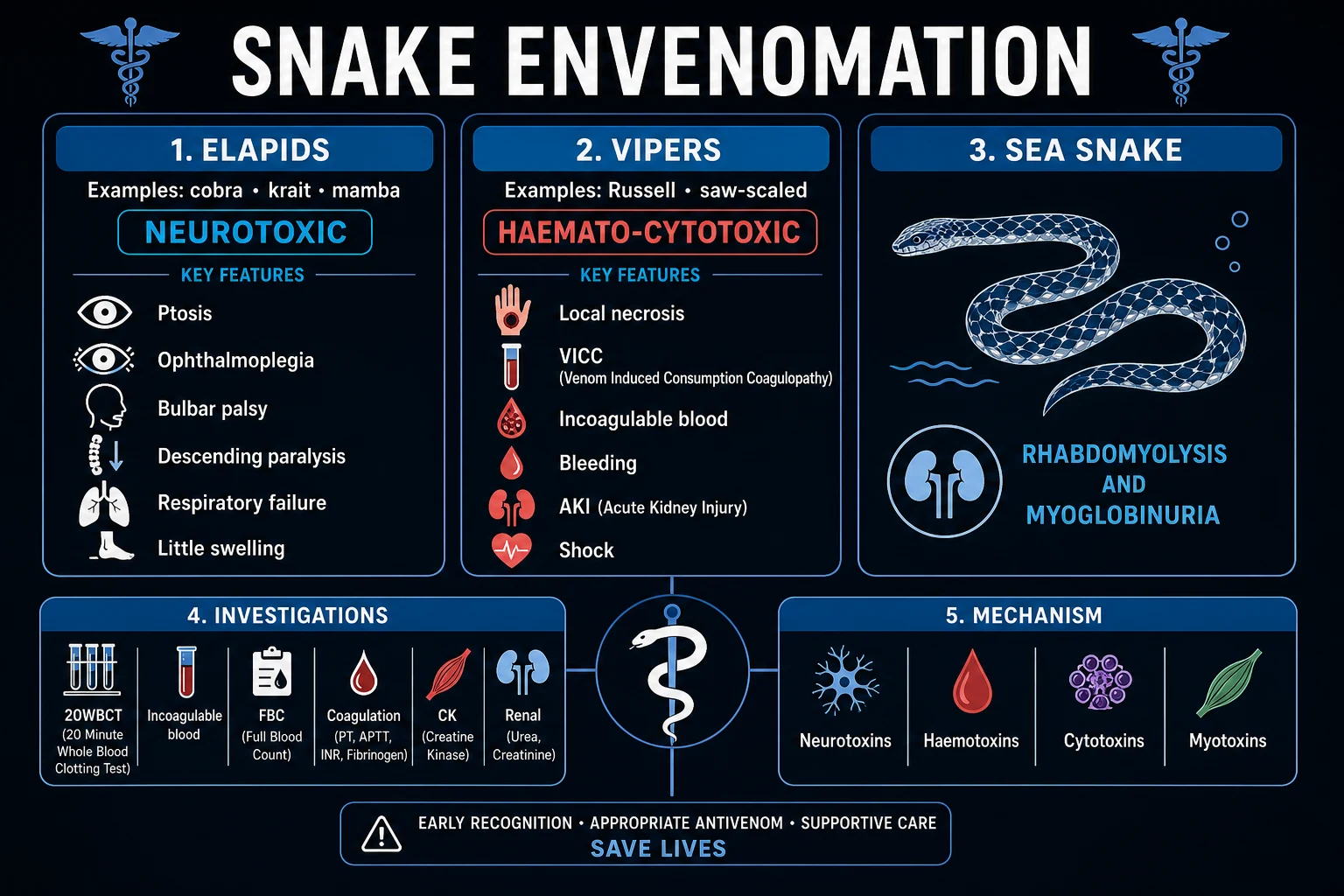
ELAPID (neurotoxic)
- Short fixed front fangs (cobra, krait, mamba, coral, Australian elapids)
- Little or NO local swelling; krait bite is painless
- Descending flaccid paralysis: ptosis, ophthalmoplegia, bulbar palsy, respiratory failure
- Onset 30 min to several hours; sensorium and pupils spared
- Australian elapids ALSO cause VICC + rhabdomyolysis
- Pressure-immobilisation bandage is the key first aid
VIPER (haemato/cytotoxic)
- Long hinged folding front fangs (Russell's, saw-scaled, puff adder, rattlesnake)
- Immediate local pain, swelling, blistering, necrosis
- VICC: positive 20WBCT, incoagulable blood, bleeding (gums, haematuria, intracranial)
- Shock, AKI (Russell's), compartment syndrome
- Platelets NORMAL — distinguishes VICC from DIC
- Antivenom IV; fasciotomy only after coagulopathy corrected
Epidemiology & Risk Factors
Globally the WHO estimates 81,000 to 138,000 deaths and about three times as many amputations/disabilities per year, overwhelmingly in rural agricultural communities of South/Southeast Asia, sub-Saharan Africa and Latin America.[1][2] India carries the largest single burden — the nationally representative Million Death Study recorded ~45,000 snakebite deaths per year (2000–2019), with the highest mortality in Uttar Pradesh, Bihar, Andhra Pradesh, Madhya Pradesh and Odisha, and a marked seasonal monsoon peak.[3]
Snakebite — the numbers that matter
Host and environmental risk factors:[1][3]
- Rural, agricultural occupation — farmers, plantation workers, herders (knee/hand bites during fieldwork).
- Sleeping on the floor / on a mat — classic for krait bites, which enter dwellings at night.
- Walking barefoot at night without a light.
- Monsoon season — flooding drives snakes into dwellings; peak incidence June to September in India.
- Alcohol intoxication — delays presentation and impairs first aid.
- Children and low body weight — receive a higher venom dose per kilogram; rapid, severe progression.
- Immobilisation/lymphatic factors — vigorous limb movement accelerates systemic venom absorption. [1]
Snake–region associations (exam pearl):[1][3]
| Region | Predominant medically important snake(s) |
|---|---|
| North & plains India | Common krait (nocturnal, sleeping on floor), cobra |
| Peninsular India | Russell's viper, saw-scaled viper |
| Southwest India (Kerala, coastal Karnataka) | Hump-nosed pit viper (Hypnale) — under-recognised VICC + AKI |
| Australia | Brown snake, tiger snake, taipan, death adder, mulga |
| Sub-Saharan Africa | Puff adder, mamba, carpet/saw-scaled viper |
| Americas | Rattlesnake (N. America), lancehead Bothrops (S. America) |
Pathophysiology
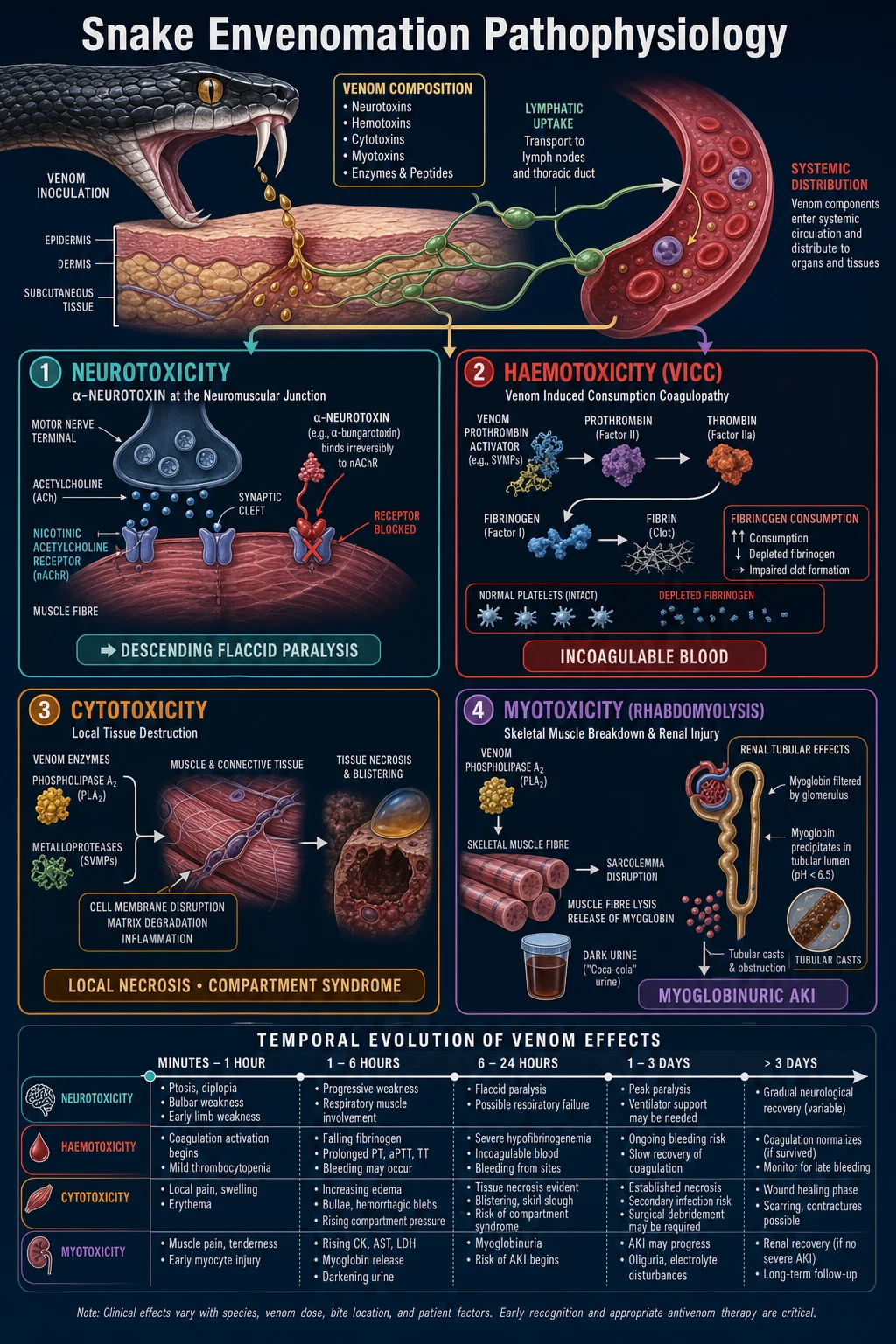
Venom is injected by the grooved or hollow fangs into subcutaneous tissue (rarely intravascular). Systemic spread occurs predominantly via the lymphatic system (for most terrestrial elapids and vipers) and to a lesser extent directly into blood; this is the mechanistic basis of the pressure-immobilisation bandage, which compresses superficial lymphatics and arrests lymph flow, delaying systemic absorption for many hours.[1][2]
Venom is not one toxin but a complex mixture of proteins and enzymes. The four dominant toxin classes and their molecular targets:[1][2]
- Neurotoxins (predominantly elapid):
- Postsynaptic — alpha-neurotoxins (e.g. alpha-bungarotoxin of krait, alpha-cobratoxin): three-finger proteins that bind irreversibly/competitively to the nicotinic acetylcholine receptor at the neuromuscular junction, blocking neuromuscular transmission → flaccid paralysis. Because the receptor itself is intact, paralysis is at least partially reversible by antivenom and may respond transiently to neostigmine (an acetylcholinesterase inhibitor).
- Presynaptic — phospholipase A2 neurotoxins (e.g. beta-bungarotoxin of krait, taipoxin, notexin): destroy the presynaptic nerve terminal by lysing the synaptic membrane and depleting vesicles → irreversible paralysis that does NOT respond well to antivenom or neostigmine (the terminal must regrow, which takes days to weeks). Krait and Russell's viper venoms contain presynaptic toxins.
- Haemotoxins / procoagulant enzymes (predominantly viper, also Australian elapids): prothrombin activators and factor X activators (metal loproteinases and serine proteases) directly activate the coagulation cascade → massive thrombin generation → consumption of fibrinogen and factors V, VIII → venom-induced consumption coagulopathy (VICC). The result is incoagulable blood (PT/INR unrecordable, aPTT prolonged, fibrinogen unrecordable, D-dimer massively elevated). Crucially, platelets are characteristically normal or only mildly reduced — because venom directly activates the clotting cascade but does not cause the diffuse platelet activation and microvascular thrombosis of true DIC. Recovery of coagulation depends on hepatic resynthesis of clotting factors (factor VII half-life ~6 h improves first; prothrombin half-life ~72 h takes longest), so the INR may remain abnormal for days after antivenom has neutralised the venom.[2]
- Cytotoxins (vipers, spitting cobras): phospholipase A2, metalloproteases (which degrade extracellular matrix) and hyaluronidase (the 'spreading factor') destroy local skin, subcutaneous tissue and muscle → pain, oedema, blistering, tissue necrosis; massive local oedema within a tight fascial compartment produces compartment syndrome.
- Myotoxins (sea snakes, Australian elapids, some vipers): phospholipase A2 lyses skeletal muscle sarcolemma → rhabdomyolysis, release of myoglobin and potassium, dark 'tea-coloured' urine (myoglobinuria), hyperkalaemia, and pigment (myoglobin) tubular cast nephropathy → acute kidney injury.
Why VICC differs from DIC (a high-yield distinction): both share an elevated INR/aPTT, low fibrinogen and high D-dimer; the key difference is that VICC platelet count is normal (venom directly activates the clotting cascade without diffuse platelet consumption), whereas DIC thrombocytopenia is the rule. VICC is also self-limited once antivenom halts venom activity and recovery is by hepatic factor resynthesis — heparin is ineffective and is not given.[1][2]
Clinical Presentation
Clinical presentation is dictated by the family, the species, the venom load, and the time since bite. Recognising the syndrome is the key bedside skill. [1]
Elapid neurotoxic syndrome (cobra, krait, mamba, coral, Australian elapids):[1][2]
- Latency — onset of systemic features from 30 min to several hours after the bite; krait paralysis may develop overnight after a painless bite.
- Early hallmarks — ptosis (often the first sign), ophthalmoplegia, diplopia, blurred vision.
- Bulbar palsy — dysarthria, dysphagia, pooling of secretions and drooling (a precursor of airway compromise), weak gag.
- Limb weakness — proximal more than distal, descending flaccid paralysis.
- Respiratory failure — the killer; diaphragmatic and intercostal paralysis. Assess with single breath count, peak flow and forced vital capacity — intubate before arrest.
- Local signs — usually minimal or absent with kraits and many Australian elapids; cobra bites may show local necrosis and tissue blistering.
- Sensorium and pupils are typically spared until the terminal event — the patient remains awake while paralysed. [1]
Viper haemato/cytotoxic syndrome (Russell's, saw-scaled, puff adder, rattlesnake):[1][2]
- Immediate local pain, swelling, tenderness at the bite site; swelling extends proximally over hours (measure circumference and mark the leading edge every 15–30 min). Blistering, echymosis, necrosis of skin and muscle follow in severe cases.
- Bleeding (VICC) — from gums, bite site, haematuria, haemoptysis, haematemesis, melena, and catastrophic intracranial or intra-abdominal haemorrhage.
- Shock — from hypovolaemia (third-space losses, capillary leak, bleeding) and direct cardiotoxicity.
- AKI — oliguria, uraemia (Russell's viper classically).
- Regional lymphadenopathy may indicate systemic absorption. [1]
Krait bite — the atypical 'missed' presentation:[1][3]
- Bites occur at night while the victim sleeps on the floor/mat; the bite is painless with negligible local signs, so the victim often wakes already envenomed.
- Abdominal pain is a frequent early feature and may be misdiagnosed as an acute abdomen (exploratory laparotomy is harmful and must be avoided).
- Descending paralysis develops over hours; the airway is the threat. [1]
Sea snake / Australian elapid myotoxic syndrome:[1][2]
- Generalised muscle pain, tenderness and stiffness within 30 min to a few hours.
- Dark 'tea-/cola-coloured' urine (myoglobinuria), generalised weakness.
- Hyperkalaemia (from muscle lysis — can cause arrhythmia), rising creatinine and CK, AKI.
- Australian elapids may show a combined neurotoxicity + VICC + rhabdomyolysis picture. [1]
Atypical / delayed presentations:[1][4]
- Delayed envenomation — systemic features appearing many hours after an apparently minor bite, particularly once a pressure-immobilisation bandage is removed.
- Recurrent VICC — coagulopathy recurring 24–48 h after apparent response to antivenom (ongoing or released venom depot).
- Dry bite — fang marks but no envenomation; observe a minimum of 24 h before declaring safe.
- Spitting-cobra venom ophthalmia — a jet of venom aimed at the eyes causes intense pain, lacrimation, chemosis, corneal erosions; treat with copious irrigation. [1]
Differential Diagnosis
A swollen, painful limb after a rural 'bite or sting' is not always snakebite; a flaccid paralysis is not always neurotoxic; and an incoagulable blood sample is not always VICC. [1]
Differentials of a swollen painful limb / bite:[1][4]
- Scorpion sting — severe local pain, autonomic storm (hypertension, sweating, priapism), no coagulopathy, characteristic puncture.
- Spider bite (widow, recluse) — dermonecrotic lesion, systemic latrodectism; no VICC.
- Hymenoptera sting (bee, wasp) — local reaction or anaphylaxis; multiple stings may cause rhabdomyolysis.
- Cellulitis / abscess of another cause — spreading erythema, fever; no coagulopathy.
- Compartment syndrome from any cause — tense compartment, pain on passive stretch; measure compartment pressure. [1]
Differentials of an incoagulable blood sample / coagulopathy:[1][2]
- DIC (sepsis, trauma, obstetric) — thrombocytopenia is the rule (platelets low); VICC platelets are normal.
- Warfarin / DOAC — therapeutic history; isolated factor blockade, no D-dimer surge.
- Severe liver disease — impaired factor synthesis; low platelets (hypersplenism); clinical context.
- Haemophilia — isolated aPTT prolongation from childhood; no PT/INR or fibrinogen derangement. [1]
Differentials of acute descending flaccid paralysis:[1]
- Myasthenia gravis — fatigable weakness, positive response to edrophonium (Tensilon), ACh receptor antibodies; slower onset.
- Guillain-Barre syndrome — ascending (not descending) paralysis, areflexia, albuminocytologic dissociation in CSF, days–weeks course.
- Botulism — descending paralysis with cranial nerve palsies and dilated pupils, food/wound history.
- Tick paralysis — ascending paralysis; tick attached.
- Organophosphate poisoning — cholinergic crisis (miosis, salivation, fasciculations, bradycardia); low plasma cholinesterase.
- Periodic paralysis — recurrent episodes, family history, K disturbance. [1]
Krait abdominal pain vs acute abdomen — krait envenomation may mimic an acute abdomen; the key clues are ptosis and other evolving neurological signs, the nocturnal setting, and absence of true peritonism. Imaging is normal; laparotomy is harmful.[3]
Clinical & Bedside Assessment
A standardised bedside assessment drives both severity grading and the decision to give antivenom. [1]
- Airway / Breathing — RR, SpO2, single breath count, peak flow, forced vital capacity (intubate once FVC falls below ~12–15 mL/kg or secretions pool).
- Circulation — BP, HR, capillary refill, peripheral perfusion; signs of shock.
- Bite site — number and pattern of fang marks, local pain, swelling. Measure limb circumference at fixed reference points (e.g. wrist, forearm, mid-arm; ankle, calf, mid-thigh) every 15–30 min and mark the leading edge of swelling with a time stamp — the rate of proximal extension is a severity marker.
- Regional lymph nodes — tender nodes draining the limb indicate systemic absorption. [1]
Focused neurological examination for evolving paralysis:[1][2]
- Ptosis (ask the patient to look up and sustain — ptosis appears within minutes of sustained upgaze).
- Extraocular movements and diplopia.
- Bulbar function — voice quality (nasal, hoarse), swallow (sips of water), gag reflex, tongue protrusion; pooling of secretions.
- Limb power (MRC grade), proximal more than distal.
- Respiratory reserve — RR, SpO2, single breath count (under 30 suggests neuromuscular respiratory compromise), peak flow, FVC.
- Sensorium and pupils — characteristically preserved in elapid neurotoxicity until terminal. [1]
Bedside severity markers and escalation triggers:[1]
- Respiratory rate rising, SpO2 falling, single breath count dropping → prepare to intubate.
- BP falling, lactate rising, oliguria → shock/AKI pathway.
- Bleeding from gums or IV sites, dark urine, positive 20WBCT → VICC pathway → antivenom.
- Rapid proximal extension of swelling (e.g. more than half the limb in a few hours), blistering, compartment tightness → severe local envenomation → antivenom + surgical assessment. [1]
The 20-minute whole blood clotting test (20WBCT) — the bedside cornerstone where venom detection kits are unavailable (most of India and Africa):[1][2]
- Place 2–3 mL of fresh venous blood in a clean, dry, plain glass tube (no anticoagulant).
- Leave undisturbed at room temperature for 20 minutes.
- Tilt the tube gently at 20 min.
- Blood has clotted (tilt-resistant) = NEGATIVE (coagulation intact).
- Blood remains liquid (pours/tilts freely) = POSITIVE = VICC (profound hypofibrinogenaemia).
- Pitfalls: plastic tube (will not clot — gives false positive); inadequate volume; delayed testing after blood has cooled; failing to repeat — a single normal 20WBCT does not exclude VICC because coagulopathy may develop later. Repeat every 6 h and whenever clinical status changes. [1]
Investigations
Investigations both confirm the syndrome and grade its complications. [1]
First-line panel in every suspected envenomation:[1][2]
- Full blood count — Hb (haemoconcentration from capillary leak, or fall with bleeding), platelet count (normal in VICC, may fall in viper bite or DIC), WCC (stress leucocytosis).
- Coagulation — PT/INR, aPTT, fibrinogen, D-dimer; bedside 20WBCT.
- Urea, creatinine, electrolytes (K, Na, bicarbonate) — for AKI and hyperkalaemia of rhabdomyolysis.
- Creatine kinase (CK) — for rhabdomyolysis (may exceed 10,000 U/L).
- LFT — hepatic involvement (transaminitis).
- Urine — dipstick (blood-positive with few/no RBC on microscopy = myoglobinuria); appearance (dark 'tea'/'cola').
- Blood group and cross-match — before antivenom (in case of bleeding or transfusion).
- ECG — hyperkalaemia changes, arrhythmia.
- Venous/arterial blood gas — in the shocked or ventilated patient. [1]
VICC laboratory signature:[1][2]
| Parameter | VICC finding |
|---|---|
| PT / INR | Markedly prolonged / unrecordable (often more than 10) |
| aPTT | Prolonged |
| Fibrinogen | Unrecordable (under 0.5 g/L) |
| D-dimer | Massively elevated |
| Platelets | Usually normal (the distinguishing feature from DIC) |
Recovery kinetics (high-yield): once antivenom halts venom activity, the liver resynthesises factors. Factor VII (half-life ~6 h) recovers first → INR begins to improve within 24 h; prothrombin (half-life ~72 h) recovers last → full normalisation may take 1 to 2 weeks. The INR may therefore remain abnormal for days despite adequate antivenom — this is not failure of treatment, and antivenom should not be endlessly repeated for an isolated abnormal INR in a clinically stable patient.[2]
Rhabdomyolysis biochemical signature: CK more than 1000 U/L (often over 10,000), myoglobinuria, hyperkalaemia, hyperphosphataemia, hypocalcaemia, rising creatinine with disproportionately high creatinine relative to urea.[1]
When are imaging and special tests indicated?[1]
- CT brain if intracranial haemorrhage or altered sensorium with VICC.
- Abdominal ultrasound for suspected intra-abdominal bleed or AKI assessment.
- Compartment pressure measurement if compartment syndrome suspected (delta pressure — diastolic BP minus compartment pressure — under 30 mmHg).
- Snake venom detection kit (VDK) — in Australia (CSL VDK on bite-site swab or urine) to guide monovalent antivenom; not available in India/Africa where management is clinical + 20WBCT.
- Secondary infection cultures if necrotic wound becomes infected. [1]
Management — Resuscitation
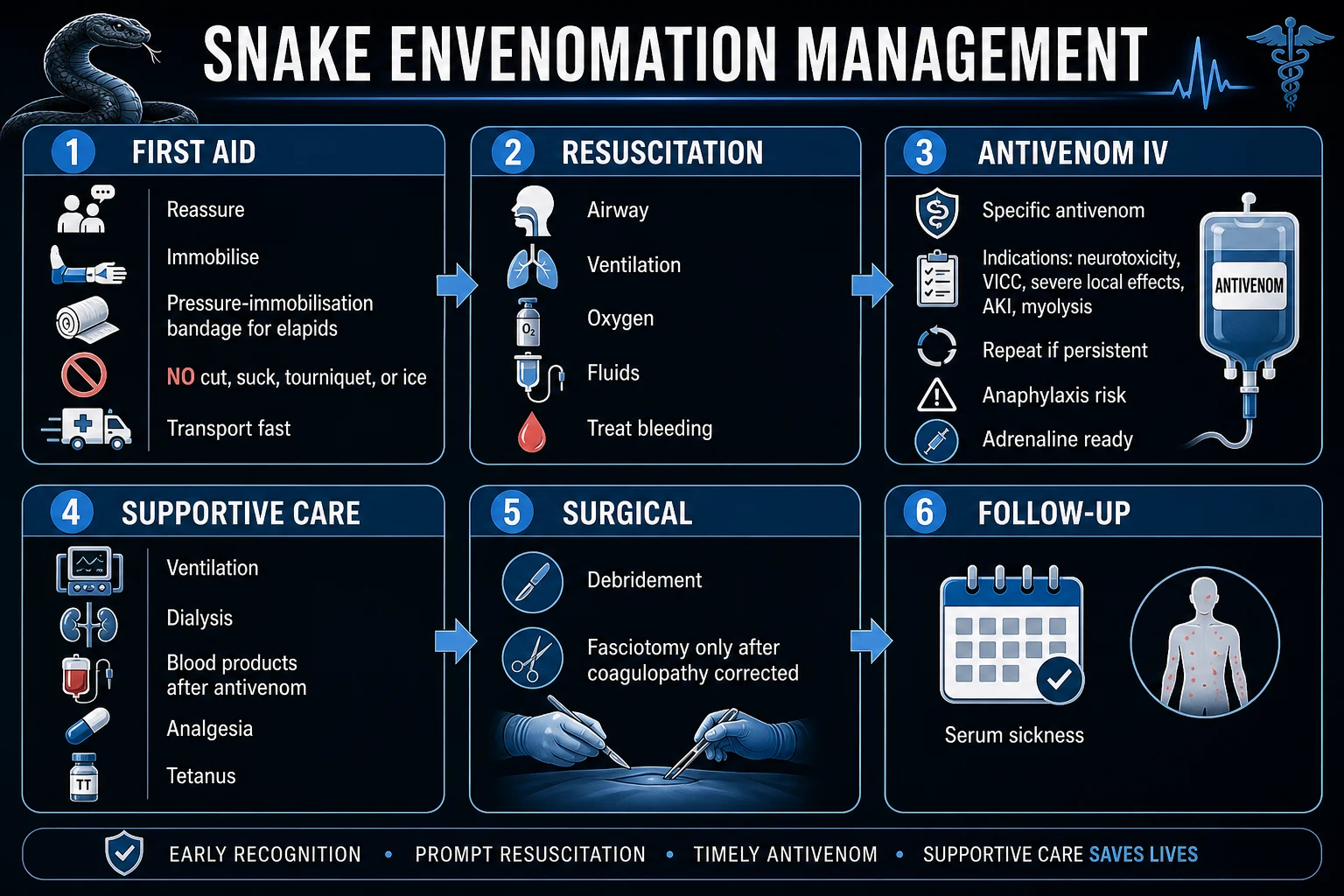
ABCDE first. Establish airway, give oxygen, secure two large-bore IV cannulae, take bloods (including 20WBCT) and cross-match, and start IV access BEFORE removing any pressure-immobilisation bandage — removal can trigger sudden systemic venom release.[1][2]
Respiratory failure (elapid neurotoxicity):[1][2]
- Watch single breath count, peak flow and FVC; intubate early (electively) when bulbar secretions pool or FVC falls below ~12–15 mL/kg — do not wait for arrest.
- Ventilate — paralysis may last days to weeks with presynaptic toxins; this is the single most life-saving supportive measure after antivenom.
- Neostigmine–atropine (see Definitive) may transiently improve postsynaptic (cobra) neurotoxicity while antivenom works, but does not help presynaptic (krait) paralysis. [1]
Shock: IV crystalloid boluses (10–15 mL/kg, reassess) for hypovolaemia from third-space loss, capillary leak and bleeding; add vasopressors (noradrenaline) if fluid-refractory; transfuse blood for anaemia from haemorrhage once antivenom is running.[1]
First aid (community / pre-hospital) — WHO and ASI principles:[1][4]
- Reassure the patient (most bites are survivable; panic increases venom spread).
- Immobilise the bitten limb — splint at heart level; immobility slows lymphatic flow.
- Pressure-immobilisation bandage (PIB) for elapid and neurotoxic bites (and Australian snakes): wrap the entire limb firmly (not tightly — a finger should slip under) from the bite site proximally, combined with a splint. This compresses lymphatics and delays systemic venom absorption for many hours. Do NOT remove until hospital + IV access + antivenom at the bedside.
- Rapid transport to hospital — the most important community action. [1]
Prohibited / harmful first-aid actions:[1][4]
- Cutting the bite site (no proven benefit; increases infection and bleeding especially with VICC).
- Oral or mechanical suction (does not remove meaningful venom; introduces infection).
- Tourniquet — may cause ischaemia, reperfusion injury and worsened local necrosis; if one is in place on arrival, be prepared for sudden envenomation on its removal (have IV access and antivenom ready).
- Ice / cryotherapy (increases tissue necrosis).
- Electric shock (no scientific basis).
- Traditional remedies, herbal pastes, alcohol (delay definitive care, increase infection).
- Giving food or drink (in case intubation or surgery is needed). [1]
Management — Definitive & Stepwise
The definitive treatment is specific antivenom (antivenom immunoglobulin) plus supportive management of complications. Antivenom is indicated only for significant envenomation, not for a dry bite or trivial local signs.[1][2]
Indications for antivenom (any one):[1][2]
- Haematotoxicity — positive 20WBCT (incoagulable blood), spontaneous bleeding, or unequivocal VICC on laboratory coagulation.
- Neurotoxicity — ptosis, ophthalmoplegia, bulbar palsy, or any weakness progressing to respiratory compromise.
- Cardiovascular — hypotension/shock, arrhythmia.
- Renal — acute kidney injury, haematuria, myoglobinuria.
- Myotoxicity / rhabdomyolysis — raised CK, dark urine, generalised muscle pain.
- Severe local envenomation — swelling that extends beyond the bite site (e.g. beyond the wrist or ankle within hours, or more than half the limb), blistering, necrosis. [1]
When antivenom is NOT indicated:[1]
- Dry bite — fang marks with no local or systemic features and a negative 20WBCT — observe at least 24 h (coagulopathy may develop late).
- Mild local swelling confined to the bite site without systemic features. [1]
Indian polyvalent antivenom (ASV) — drug, dose, route, timing, rationale:[1][3]
- Agent — polyvalent anti-snake venom (raised in horses; Haffkine BioPharmaceuticals, Bharat Serums and Vaccines, VINS Bioproducts), active against the Big Four (cobra, krait, Russell's, saw-scaled). Supplied as lyophilised powder in 10 mL vials (each neutralises a defined amount of venom).
- Reconstitution — dissolve each vial in 10 mL sterile water for injection (gentle rolling, avoid foaming); then dilute the total dose in normal saline (e.g. 10 vials in 100–200 mL).
- Dose — initial 8 to 10 vials IV for haematotoxic/viper or neurotoxic envenomation; some Indian protocols use 10 vials as a standard initial dose in VICC. The dose is the same in adults and children (antivenom neutralises venom, not body weight — a child receives the same number of vials).
- Route and timing — IV infusion over 1 hour; give as soon as an indication is met.
- Reassessment — repeat 20WBCT and coagulation at 6 hours. If VICC persists (positive 20WBCT, incoagulable blood), repeat 5–10 vials. Continue to reassess every 6 h until coagulation stabilises, watching for recurrent VICC over the next 24–48 h (may need further doses).
- Neurotoxicity — if paralysis is progressing despite two doses of ASV, particularly from presynaptic toxins (krait), antivenom may have limited efficacy and the priority shifts to ventilation. Recovery, when it occurs, follows nerve-terminal regeneration over days to weeks. [1]
Antivenom adverse reactions — prepare and treat:[1][2][5]
- Early (anaphylactic/anaphylactoid) reactions — within minutes to a few hours of starting the infusion: urticaria, pruritus, hypotension, bronchospasm, angioedema, vomiting. Reported in roughly 10 to 40 per cent of Indian ASV recipients (whole-IgG horse antivenom).
- Pyrogenic/endotoxin reactions — fever, rigors, hypotension.
- Late serum sickness — at 5 to 14 days: fever, arthralgia, urticarial rash, lymphadenopathy, glomerulonephritis. Treat with antihistamines and a short course of oral corticosteroid; self-limiting.
- Set up before starting ASV: adrenaline drawn up, oxygen and IV fluids running, a doctor at the bedside, resuscitation equipment ready. [1]
Managing anaphylaxis to antivenom:[1][2]
- Stop or slow the infusion immediately.
- IM adrenaline 0.5 mg (0.5 mL of 1:1000) into the anterolateral mid-thigh; repeat every 5 min as needed.
- High-flow oxygen, IV crystalloid bolus (10–15 mL/kg), IV hydrocortisone 200 mg and chlorphenamine 10 mg.
- Once the patient is stable, resume ASV cautiously (slower rate, sometimes with premedication) — the indication for antivenom has not disappeared and untreated envenomation is more dangerous than a controlled reaction. [1]
Premedication controversy:[5] a systematic review and meta-analysis (Habib et al, 2011) found that premedication with adrenaline, antihistamine or hydrocortisone modestly reduced early antivenom reactions, particularly with lower-quality antivenoms. Practice varies — many Indian centres do not routinely premedicate (it may delay treatment), but have adrenaline ready. The move to more purified Fab and F(ab')2 fragment antivenoms is reducing reaction rates.
Neostigmine–atropine for postsynaptic neurotoxicity:[1][2]
- Neostigmine 0.5–2.5 mg IV (adult) plus atropine 0.6 mg IV (to block muscarinic side-effects) can transiently improve weakness from postsynaptic blockade (cobra, Asian common krait postsynaptic component) by raising synaptic acetylcholine.
- It does not work for presynaptic toxins (krait presynaptic beta-bungarotoxin, Russell's) where the nerve terminal is destroyed — the priority is ventilation.
- Always given with atropine to prevent bradycardia, bronchospasm and excessive secretions. [1]
Supportive definitive measures:[1][4]
- Ventilation for respiratory failure — often days to weeks; this is the life-saving measure after antivenom.
- Renal replacement therapy (haemodialysis) for established AKI with refractory hyperkalaemia, acidosis, fluid overload or uraemia.
- Blood products AFTER antivenom for active bleeding — cryoprecipitate (for fibrinogen) and fresh-frozen plasma (for factors); transfuse packed red cells for anaemia. Giving blood products before antivenom is futile because ongoing venom continues to consume the new factors.
- Tetanus prophylaxis if not immune.
- Antibiotics only for secondary wound infection (not routinely — most bites are not initially infected; consider Staphylococcus, Streptococcus, and Gram-negatives including in sea-snake bites).
- Surgical debridement of frankly necrotic tissue once coagulopathy is corrected.
- Fasciotomy for compartment syndrome — only AFTER coagulopathy has been corrected with antivenom and blood products. Operating on an anticoagulated (incoagulable) patient is catastrophic; the indication is a confirmed compartment syndrome (clinically tight compartment with neurovascular compromise, or delta pressure under 30 mmHg) that persists after haematological stabilisation.[4]
- Wound care, physiotherapy to prevent contracture.
Monitoring and escalation triggers after ASV:[1]
- Repeat 20WBCT/coagulation every 6 h until stable; watch for recurrent VICC at 24–48 h (re-dose ASV).
- Renal watch — urine output, creatinine, K.
- Respiratory watch — single breath count, peak flow, ABG; intubate early.
- Wound watch — extension of swelling, compartment tightness, necrosis. [1]
Specific Subtypes & Scenarios
Common krait (Bungarus caeruleus) bite:[1][3]
- Nocturnal, painless bite while sleeping on the floor; victim often wakes already envenomed.
- Pressure-immobilisation bandage is essential; rapid transport.
- Descending paralysis with prominent abdominal pain; airway/respiratory failure is the threat.
- ASV efficacy is limited (presynaptic beta-bungarotoxin) — ventilation is the life-saver; recovery may take weeks. [1]
Russell's viper (Daboia russelii) bite — the most lethal Indian viper:[1][2]
- VICC (positive 20WBCT, bleeding), acute kidney injury (direct nephrotoxicity + capillary leak + hypovolaemia), shock, anterior pituitary haemorrhage (a Sheehan-like syndrome with subsequent hypopituitarism), and rarely neurotoxicity (presynaptic).
- Seasonal clustering in the monsoon; characteristic loud hiss.
- ASV 10 vials IV, repeat per 20WBCT; meticulous renal and fluid management. [1]
Saw-scaled viper (Echis carinatus) bite:[1]
- Small snake, large venom yield per body weight; VICC, local swelling, bleeding (gingival, haematuria, intracranial); significant case fatality from haemorrhage.
- Common in dry scrubland; nocturnal. [1]
Indian cobra (Naja naja) bite:[1]
- Local necrosis at the bite site (cytotoxic) plus postsynaptic neurotoxicity — ptosis, ophthalmoplegia, bulbar and respiratory paralysis.
- Neostigmine-atropine may transiently help while ASV works.
- Pressure-immobilisation bandage useful. [1]
Spitting-cobra venom ophthalmia:[1]
- A jet of venom aimed at the eyes causes intense pain, blepharospasm, lacrimation, chemosis and corneal erosions.
- Copious irrigation with water or saline for 10–15 min, topical local anaesthetic and antibiotic, ophthalmology referral; do NOT instil antivenom into the eye; systemic antivenom only if there is corneal abrasion with systemic features. [1]
Sea snake / Australian elapid bite:[1][2]
- Pressure-immobilisation bandage is mandatory (delays both neurotoxin and myotoxin absorption).
- Combined neurotoxicity + VICC + rhabdomyolysis; dark urine, hyperkalaemia, AKI.
- Monovalent or polyvalent antivenom (CSL) guided by venom detection kit where available; supportive ventilation and dialysis. [1]
Complications & Pitfalls
- Respiratory failure (elapid neurotoxicity) — the leading cause of death.
- Shock — hypovolaemia, capillary leak, haemorrhage, cardiotoxicity.
- Acute kidney injury — Russell's viper (direct nephrotoxicity + VICC), sea snake (myoglobinuric), hypovolaemic.
- Intracranial / intra-abdominal haemorrhage from VICC — sudden headache, collapse, abdominal pain.
- Compartment syndrome from massive local oedema (viper).
- Secondary wound infection (Staph, Strep, Gram-negatives).
- Antivenom anaphylaxis (10–40 per cent of Indian ASV). [1]
Late complications:[1]
- Serum sickness (5–14 days) — fever, rash, arthralgia; self-limiting.
- Chronic kidney disease after severe AKI.
- Limb amputation, contracture, chronic ulcer from necrosis.
- Anterior pituitary insufficiency (hypopituitarism) after Russell's viper pituitary haemorrhage.
- Psychological sequelae — phobia, post-traumatic stress. [1]
- Giving ASV for a dry bite — exposes the patient to anaphylaxis with no benefit.
- NOT giving ASV when indicated — waiting too long for 'absolute' indications while the patient deteriorates.
- Fasciotomy before correcting coagulopathy — catastrophic bleeding.
- Tourniquet harm — ischaemia, reperfusion, worsened necrosis.
- Relying on a single 20WBCT — coagulopathy may develop later; repeat at 6 h.
- Missing delayed or recurrent VICC at 24–48 h.
- Missing a krait bite because of absent local signs — a paralysis with a clean limb, nocturnal history and abdominal pain is krait envenomation until proven otherwise.
- Oral suction / incision of the bite site.
- Exploratory laparotomy for krait abdominal pain. [1]
Prognosis & Disposition
Determinants of outcome:[1][3]
- Time to antivenom — earlier is better; delay is the strongest predictor of death.
- Time to hospital and to ventilation (for neurotoxicity).
- Species and venom dose — Russell's viper and krait carry high mortality; children receive more venom per kg.
- Age and comorbidity — elderly, malnourished, pregnant, and those with renal or cardiac disease do worse. [1]
Disposition:[1]
- ICU — neurotoxicity (for ventilation), shock, severe AKI (dialysis), severe VICC with bleeding, severe local envenomation/compartment syndrome.
- Ward — moderate envenomation under observation, post-ASV stabilisation.
- Discharge criteria: asymptomatic; 20WBCT/coagulation stable and improving over at least 24 h; renal function stable; wound healing; counselled to return for serum sickness at 5–14 days (fever, rash, joint pain). Reinforce community advice on footwear, lighting at night, sleeping off the floor, and rapid transport. [1]
Special Populations
- Children[1][3] — receive a higher venom dose per kilogram → more rapid, severe progression (earlier paralysis, shock, or swelling). Antivenom dose is the same as the adult vial count because ASV neutralises a fixed venom load, not body weight — under-dosing children is a classic error. Give weight-based fluid boluses (e.g. 10–20 mL/kg crystalloid for shock, reassess), monitor work of breathing continuously, and prepare for early intubation. If a neostigmine trial is used for postsynaptic elapid toxicity: neostigmine 0.025–0.1 mg/kg with atropine 0.02 mg/kg. Avoid IM injections when coagulopathic; use IV routes.
- Pregnant women[1] — risks include miscarriage, preterm labour, placental abruption from coagulopathy, and fetal distress secondary to maternal hypoxia or shock. Do not withhold antivenom when indicated — maternal stabilisation is fetal stabilisation; ASV benefit exceeds theoretical fetal risk. Monitor with cardiotocography when gestation allows; involve obstetrics early; give Anti-D if indicated for sensitising events per obstetric protocol. Positioning and airway readiness matter if bulbar weakness develops.
- Elderly and comorbid — reduced respiratory and renal reserve, higher mortality from VICC, AKI, and aspiration during paralysis. Use cautious fluids if heart failure risk; dose renally cleared supportive drugs carefully; lower threshold for critical-care admission and dialysis planning after Russell’s viper envenoming.
- Remote / rural tropical settings (India, Africa, SE Asia)[1][3] — most deaths occur before hospital arrival. Prevention: footwear, torch at night, sleep on a raised bed/mosquito-proofed platform, reduce rodent attractants. Health-system priorities: rapid transport (“snakebite rescue”), uninterrupted polyvalent ASV supply, staff training in 20WBCT and airway, and partnership with traditional healers for early referral rather than harmful local first aid (incision, herbs, tourniquets).
- Patients with known ASV allergy / prior serum sickness — still give ASV if life-threatening envenoming; pretreat only if local protocol supports; always have adrenaline 0.5 mg IM (adult) drawn and airway kit ready; manage anaphylaxis with the standard ALS pathway, then restart ASV slowly once stabilised because venom remains the greater threat.
Evidence, Guidelines & Regional Differences
WHO 2019 snakebite envenoming guidelines and the 2017 NTD designation:[1] the WHO classifies snakebite as a category-A neglected tropical disease, drives antivenom stockpiles, training and surveillance, and published the 2019 guidelines on the management of snakebite in the African and South-East Asian regions — endorsing the 20WBCT, polyvalent antivenom, pressure-immobilisation bandage for elapids, and avoidance of harmful first aid.
Indian national protocol (ASI / National Snakebite Initiative):[1][3]
- Polyvalent ASV (Big Four) — 8 to 10 vials IV as the initial dose in VICC, repeated per 20WBCT.
- 20WBCT as the bedside coagulopathy test.
- Avoid tourniquet, incision, suction.
- Hospital-based management with ASV stocking; snakebite is a notifiable condition in several Indian states. [1]
- Monovalent or polyvalent antivenom (CSL) guided by the venom detection kit (VDK) on bite-site swab or urine.
- Pressure-immobilisation bandage for all suspected Australian snakebites (universal, because all Australian elapids are neurotoxic).
- Lower reaction rates with highly purified antivenoms; monovalent used when species identified (less volume, fewer reactions). [1]
- Premedication before ASV — meta-analysis (Habib 2011) shows a modest reduction in early reactions with adrenaline, antihistamine or hydrocortisone; not universally adopted but increasingly considered where low-purity antivenom is used.
- Low-dose vs high-dose ASV — randomised trials (notably from Sri Lanka and India) suggest lower initial doses may be as effective as the traditional high dose in some settings, with fewer reactions; practice is evolving.
- Fab and F(ab')2 fragment antivenoms — purer, smaller, with fewer reactions and faster distribution; increasingly preferred where available.
- Prehospital antivenom — generally not recommended (anaphylaxis risk without resuscitation facilities) except in carefully resourced remote settings. [1]
Exam Pearls
First aid for snakebite — mnemonic
RIGHT
calm the patient; panic accelerates venom spread
splint the limb at heart level; immobility slows lymphatic flow
rapid transport — the single most important community action
for elapid/neurotoxic bites; do NOT remove until IV access and antivenom are ready
avoid cut, suck, tourniquet, ice, electric shock, herbal pastes and alcohol
- Elapids (cobra, krait, mamba) = neurotoxic: ptosis → descending flaccid paralysis → respiratory failure. Krait bites are painless and nocturnal, while sleeping on the floor.[1]
- Vipers (Russell's, saw-scaled) = haemato/cytotoxic: local necrosis, VICC (incoagulable blood, bleeding), AKI, shock. Russell's viper also causes pituitary haemorrhage.[2]
- Sea snake / Australian elapids = neurotoxic + VICC + rhabdomyolysis (myoglobinuria, dark urine, raised CK, AKI).[1]
- First aid: immobilise + pressure-immobilisation bandage (elapids) + transport. NEVER cut, suck, apply a tourniquet, or use ice.[4]
- 20WBCT: 2 to 3 mL fresh venous blood in a clean dry glass tube for 20 min; blood still liquid at 20 min = positive = VICC. Platelets normal (unlike DIC).[2]
- Antivenom (polyvalent ASV) 8 to 10 vials IV over 1 hour for significant envenomation; same adult dose in children. Have adrenaline ready (anaphylaxis 10 to 40 per cent).[1]
- Anaphylaxis to ASV: stop/slow infusion + IM adrenaline 0.5 mg mid-thigh + oxygen + IV fluids + hydrocortisone/chlorphenamine; resume ASV once stable.[2]
- Neostigmine + atropine helps postsynaptic (cobra) neurotoxicity; not presynaptic (krait, Russell's).[1]
- Ventilate for respiratory failure (often days). Dialyse AKI. Blood products AFTER antivenom. Fasciotomy ONLY after coagulopathy corrected. Serum sickness at 5 to 14 days.[4]
- India bears ~45,000 deaths/year — the largest burden in the world; snakebite is a WHO category-A neglected tropical disease.[3]
Exam application bank (NEET-PG / INICET)
One-line answer
Snake envenomation is a WHO category-A neglected tropical disease and a leading cause of accidental rural death in the tropics — India alone bears the largest global burden (~45,000 deaths/year). Medically important snakes divide into two clinical families. Elapids (cobra, krait, mamba, coral, Australian taipan/brown) deliver neurotoxic venom — alpha-neurotoxins block the postsynaptic nicotinic acetylcholine receptor and phospholipase A2 destroys the presynaptic nerve terminal, producing descending flaccid paralysis (ptosis, ophthalmoplegia, bulbar palsy, respiratory failure) with little local swelling. Vipers (Russell's, saw-scaled, puff adder, rattlesnake) deliver haemato/cytotoxic venom — procoagulant enzymes activate prothrombin/factor X causing venom-induced consumption coagulopathy (VICC) with incoagulable blood, spontaneous bleeding, and AKI, shock and local necrosis. Sea snakes /
Worked stems (answer without another resource)
Stem 1 — Classic presentation. Map symptoms to mechanism; name the first investigation and first treatment step with dose/route if drug therapy is standard. [1]
Stem 2 — Unstable / complicated. List red flags that force immediate resuscitation, theatre, ICU, antidote, or reperfusion — and what you do in the first 15 minutes. [1]
Stem 3 — Atypical group. Elderly, pregnancy, child, or immunocompromised: how presentation and thresholds change. [1]
Stem 4 — Differential trap. Name the three closest mimics and one discriminator for each. [1]
Stem 5 — Disposition. Who goes home with safety-netting, who is admitted, who needs HDU/ICU/theatre, and what follow-up is mandatory. [1]
Rapid viva checklist
- Definition + classification
- Pathophysiology chain
- Bedside signs / criteria
- Score with exact components (if any)
- Emergency bundle
- Definitive therapy with doses
- Complications of disease and of treatment
- Special populations
- Guideline/trial name if classic
- Three exam traps
Coverage self-check
If you cannot answer any stem above from this page alone, re-read the matching section — the page is intended to be self-sufficient for final-prof and NEET-PG/INICET questions on Snake Envenomation.
References
- [1]Gutierrez JM, Calvete JJ, Habib AG, Harrison RA, Williams DJ, Warrell DA Snakebite envenoming Nat Rev Dis Primers, 2017.PMID 28980622
- [2]Seifert SA, Armitage JO, Sanchez EE Snake Envenomation N Engl J Med, 2022.PMID 34986287
- [3]Suraweera W, Warrell D, Whitaker R, Menon G, Rodrigues R, Fu SH, et al. Trends in snakebite deaths in India from 2000 to 2019 in a nationally representative mortality study Elife, 2020.PMID 32633232
- [4]Russell JJ, Schoenbrunner A, Janis JE Snake Bite Management: A Scoping Review of the Literature Plast Reconstr Surg Glob Open, 2021.PMID 33936914
- [5]Habib AG, Lamorde M, Dalhat MM, Habib ZG, Kuznik A Effect of pre-medication on early adverse reactions following antivenom use in snakebite: a systematic review and meta-analysis Drug Saf, 2011.PMID 21879781