haematology · haematology
Chronic Leukaemia (CLL & CML)
Also known as Chronic lymphocytic leukaemia · CLL · Chronic myeloid leukaemia · CML · Chronic myelogenous leukaemia
Chronic leukaemia encompasses two distinct indolent clonal marrow stem-cell disorders. Chronic lymphocytic leukaemia (CLL) is a CD5-positive B-cell neoplasm of mature-appearing lymphocytes (lymphocytosis over 5×10⁹/L, smudge cells, lymphadenopathy, splenomegaly), staged by Rai or Binet, treated only when symptomatic (watch-and-wait early), with FCR chemoimmunotherapy or targeted agents (ibrutinib BTK inhibitor, venetoclax BCL2 inhibitor). Chronic myeloid leukaemia (CML) is a BCR-ABL1 myeloproliferative neoplasm driven by the Philadelphia chromosome t(9;22), characterised by leucocytosis with left shift, basophilia, splenomegaly and low LAP score, divided into chronic, accelerated and blast-crisis phases, and transformed by imatinib and other tyrosine-kinase inhibitors (dasatinib, nilotinib, bosutinib, ponatinib, asciminib). CML molecular response is monitored by BCR-ABL1 transcript PCR.
On this page & tools
Your progress
Saved locally on this device.
Practise this topic
Exam tags
Red flags
Overview & Definition
The chronic leukaemias are a group of clonal haematological malignancies of marrow stem cells in which mature-appearing cells accumulate in the blood, marrow and lymphoid tissues over a protracted (months to years) course, in contrast to acute leukaemias, which are dominated by immature blasts and progress in days to weeks.[3]
Two diseases dominate clinical practice and exam scenarios: [1]
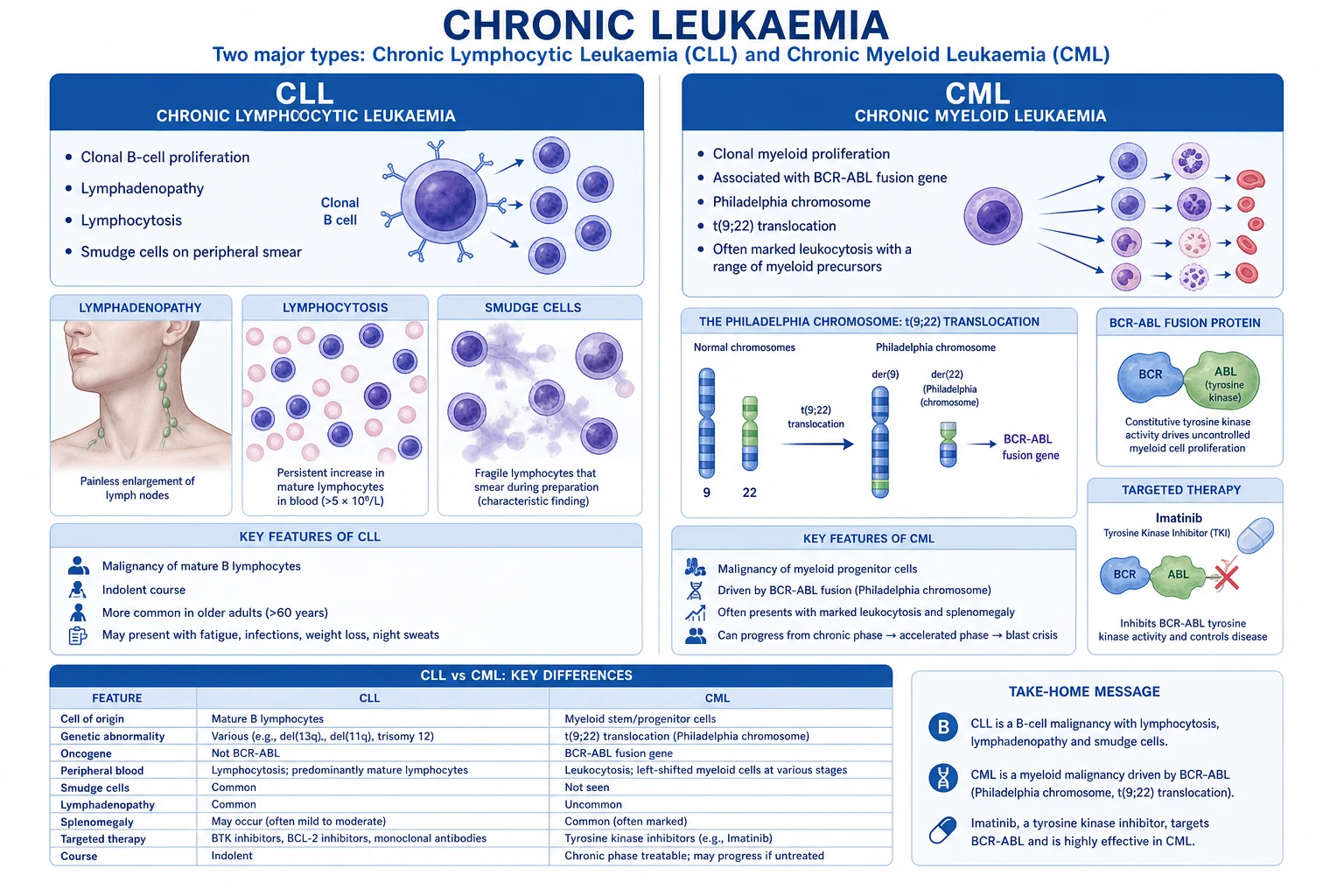
- Chronic lymphocytic leukaemia (CLL) — a B-cell lymphoproliferative disorder (the commonest adult leukaemia in the Western world). Small mature-appearing lymphocytes accumulate in blood, marrow and lymph nodes because they are programmed to survive (anti-apoptotic BCL2 over-expression) rather than to divide rapidly.
- Chronic myeloid leukaemia (CML) — a myeloid stem-cell disorder defined molecularly by the BCR-ABL1 fusion gene (Philadelphia chromosome), driven by a constitutively active tyrosine kinase.[4]
The clinical skill in chronic leukaemia is not the diagnosis (which is established by blood film, flow cytometry and molecular testing), but recognising when NOT to treat (early-stage CLL), choosing the right first-line agent (TKI choice in CML, chemoimmunotherapy vs targeted therapy in CLL), staging to predict prognosis, monitoring molecular response (BCR-ABL1 PCR in CML, minimal residual disease in CLL), and recognising transformation (Richter transformation in CLL; blast crisis in CML). [1]
Classification
Chronic leukaemias are classified by lineage (lymphoid vs myeloid) and then by molecular/cytogenetic driver: [1]
CLL (lymphoid, B-cell)
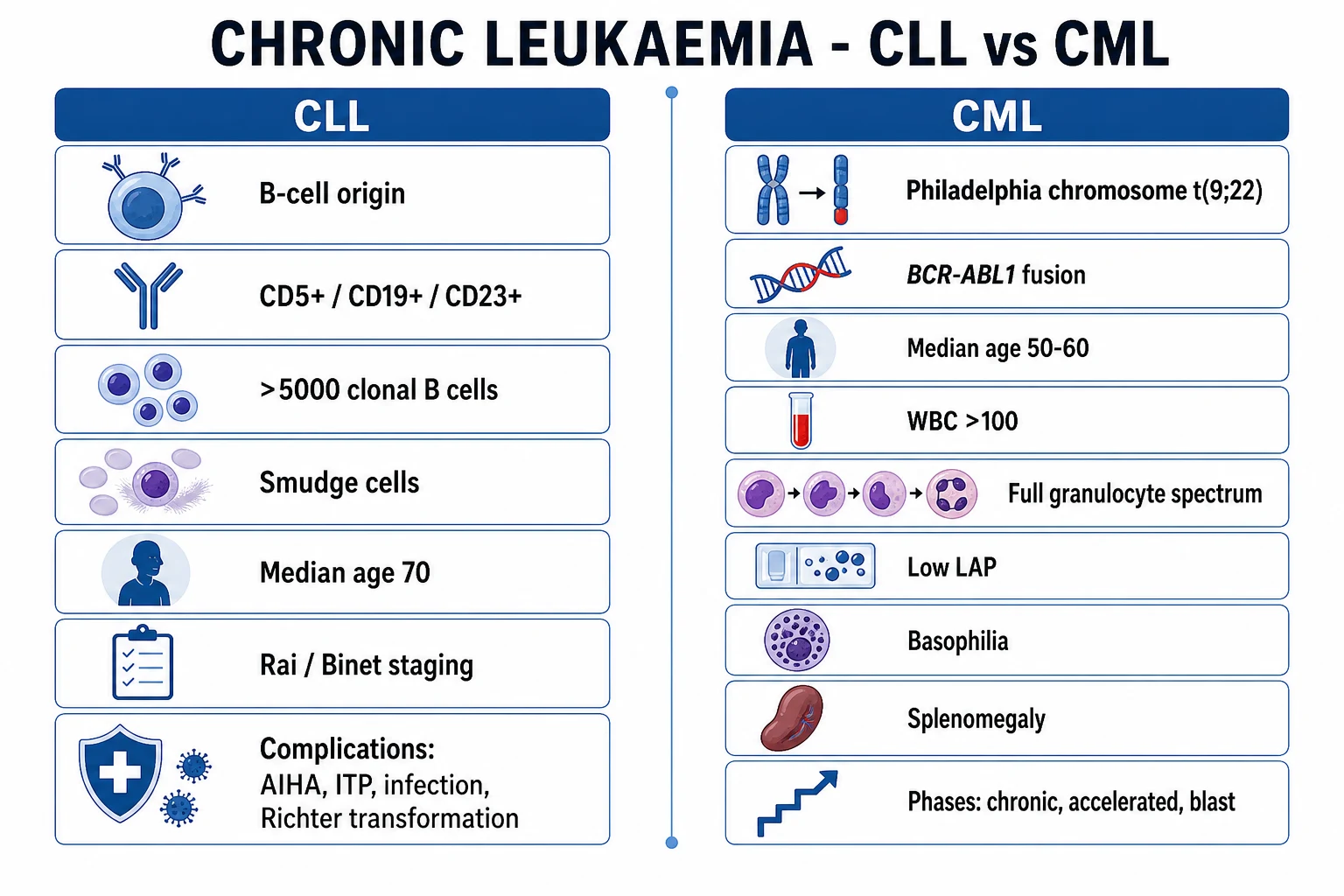
- Mature B-cell neoplasm — CD5+, CD19+, CD23+, dim CD20, dim surface Ig
- Commonest adult leukaemia in Western countries
- Smudge (basket) cells on blood film
- Staging: Rai (modified) or Binet — driven by lymphoid areas and cytopenias
- Hallmark: BCL2 over-expression (anti-apoptosis), IGHV mutational status splits prognosis
- Treatment: watch-and-wait early; FCR or ibrutinib/venetoclax when active
CML (myeloid)
- Myeloproliferative neoplasm — BCR-ABL1 fusion, Philadelphia chromosome t(9;22)
- Granulocytic leucocytosis with full spectrum (myelocyte to neutrophil), basophilia
- LAP score LOW (vs HIGH in leukemoid reaction)
- Three phases: chronic, accelerated, blast crisis — defined by blast % and basophil %
- Treatment: TKI from day 1 (imatinib/dasatinib/nilotinib/bosutinib/ponatinib)
- Monitor with BCR-ABL1 transcript PCR (IS) — early molecular response, MMR, MR4.5
CML phases (WHO, ELN-referenced) — the phase drives urgency and treatment choice:[5]
- Chronic phase — blasts under 5 percent in blood and marrow; patient usually well; responds well to TKI.
- Accelerated phase — one or more of: blasts 10–19 percent in blood or marrow; peripheral-blood basophils at least 20 percent; persistent thrombocytopenia (under 100×10⁹/L) unrelated to therapy OR thrombocytosis (over 1000×10⁹/L) unresponsive to therapy; cytogenetic clonal evolution (new chromosomal abnormalities other than the Ph chromosome); progressive splenomegaly/leucocytosis unresponsive to therapy.
- Blast crisis — blasts at least 20 percent in blood or marrow (WHO threshold); extramedullary blast proliferation (chloroma, blastic skin infiltration); usually myeloid (about 70 percent) or lymphoid (about 30 percent, B-ALL phenotype). Behaves like acute leukaemia, prognosis poor. [1]
Rare mature lymphoid leukaemias (examinable as differentials):
- Hairy-cell leukaemia — B-cell, BRAF V600E, TRAP+, "hairy" cytoplasmic projections, pancytopenia, dry tap on marrow, splenomegaly, monocytopenia; treated with cladribine or pentostatin.[10]
- T-cell prolymphocytic leukaemia (T-PLL) — aggressive T-cell leukaemia (T-PLL/MTCP1 and ATM aberrations), marked WBC, marked splenomegaly, skin and serous effusions; treat with alemtuzumab.
- Large granular lymphocytic leukaemia (LGL) — indolent T-cell (TCRαβ+) or NK-cell clonal expansion; chronic neutropenia (recurrent oral ulcers), pure red cell aplasia, autoimmune disease (rheumatoid arthritis → Felty-like); often watch-and-wait, methotrexate/ciclosporin, or low-dose therapy.
- Chronic neutrophilic leukaemia — rare myeloproliferative neoplasm with CSF3R mutation, sustained neutrophilia, splenomegaly, often complicated by transformation.
Epidemiology & Risk Factors
Chronic lymphocytic leukaemia (CLL): [1]
- Commonest leukaemia in the Western world (about 25–30 percent of all leukaemias in adults).
- Median age 70 years (over 80 percent of cases aged over 60 years); rare under 40 years.
- Male:female ≈ 1.3–2:1.
- Striking geographic variation: rare in East Asia (China, Japan, Korea); incidence in Asian immigrants to the West remains low, suggesting genetic susceptibility.
- Strong familial aggregation — first-degree relatives carry a roughly 5–7-fold increased risk; one of the strongest inherited predispositions of any adult cancer.
- Recognised risk factors: Agent Orange / herbicide exposure (Vietnam veterans, agricultural workers), benzene and some solvents, hepatitis C infection (controversial), prior radiotherapy/chemotherapy.
- No clear link to ionising radiation (unlike CML).
- Monoclonal B-cell lymphocytosis (MBL) — the pre-neoplastic precursor of CLL: present in 5–10 percent of people over 60 years; progression risk about 1–2 percent per year if count over 0.5×10⁹/L. [1]
Chronic myeloid leukaemia (CML): [1]
- About 15 percent of all adult leukaemias; incidence 1–2 per 100 000 per year.
- Median age 55–60 years (slightly younger than CLL); can occur at any age including, rarely, in children.
- Male:female ≈ 1.2–1.5:1.
- Established risk factor: ionising radiation (the only firmly linked exposure — atomic-bomb survivors had a 5–10-fold increased risk with a 5–10-year latency).
- Other associations (weaker): benzene, high-dose chemotherapy, possible pesticides and herbicides, obesity. Most cases have NO identifiable risk factor.
- Not inherited and not associated with classic familial syndromes; siblings have only a 2–4-fold increased risk. [1]
Pathophysiology
The two diseases have opposite biology: CLL is a disease of cell survival (failed apoptosis); CML is a disease of a hyperactive signalling kinase (driven proliferation). [1]
Chronic lymphocytic leukaemia
CLL arises from a mature B-cell that has undergone antigen selection in the germinal centre (or its naive counterpart). Two immunophenotypically identical but biologically distinct subtypes exist: [1]
- IGHV-mutated CLL — derived from a post-germinal-centre memory B-cell; carries somatic hypermutation in the immunoglobulin heavy-chain variable region (IGHV) (more than 2 percent difference from germline). Indolent, median survival over 20 years.
- IGHV-unmutated CLL — derived from a naive (pre-germinal-centre) B-cell; IGHV is at or near germline. Aggressive, median survival about 8 years. [1]
Two molecular defects drive the disease: [1]
- BCL2 over-expression — the anti-apoptotic protein BCL2 is over-expressed (driven by deletion of miR-15a/16-1 at 13q14.3, which normally suppresses BCL2, and by epigenetic changes). Lymphocytes therefore survive but do not proliferate rapidly — accumulation in marrow, blood, nodes, spleen. This is why CLL is slow and why BCL2-targeted venetoclax is so effective.
- Recurrent cytogenetic lesions (best detected by interphase FISH on blood) — Döhner's hierarchical prognostic model (worst lesion governs prognosis):[2]
- del(17p13.1) / TP53 disruption — worst prognosis (TP53 deleted/mutated → defective apoptosis → chemo-refractory; median survival about 30 months). About 5–10 percent at diagnosis, rising with relapse.
- del(11q22-23) / ATM deletion — adverse; bulky nodes, more rapid progression.
- Trisomy 12 — intermediate; atypical morphology (prolymphocytes), higher risk of Richter.
- Normal karyotype — intermediate.
- del(13q14.3) as sole abnormality — best prognosis (median over 15 years).
Additional mutations (NOTCH1, SF3B1, BIRC3, POT1, XPO1) further modify prognosis and are commonly tested by targeted next-generation sequencing panels. [1]
Microenvironment — nurselike cells, T-cells (CD4⁺PD-1high), stromal CXCL12, and BCR (B-cell receptor) signalling support the CLL clone. The B-cell receptor signalling pathway is the target of BTK inhibitors (ibrutinib, acalabrutinib) and PI3K-δ inhibitors (idelalisib, duvelisib). [1]
Chronic myeloid leukaemia
The disease is defined by the Philadelphia chromosome:[4]
- A balanced reciprocal translocation t(9;22)(q34;q11.2) between the long arms of chromosomes 9 and 22.
- ABL1 (chromosome 9) fuses with BCR (chromosome 22) to form the BCR-ABL1 fusion gene on the derivative chromosome 22 (the Philadelphia chromosome).
- The fusion mRNA is translated into a constitutively active tyrosine kinase (p210 in classic CML; p190 in Ph-positive ALL; p230 in chronic neutrophilic leukaemia).
- Constitutive kinase activity phosphorylates multiple downstream substrates — RAS–RAF–MEK–ERK (proliferation), PI3K–AKT (survival), STAT5 (transcription), JUN/FOS, MYC — driving uncontrolled granulocytic proliferation, reduced apoptosis and impaired DNA-repair adhesion. [1]
This single molecular lesion explains every feature of CML: [1]
- Massive granulocytic expansion (WBC commonly 50–400×10⁹/L) with the full spectrum of granulocytic maturation (myeloblasts through myelocytes, metamyelocytes, bands, neutrophils).
- Basophilia is essentially pathognomonic of myeloproliferative neoplasm (especially CML); its presence is an exam clue.
- Low leucocyte alkaline phosphatase (LAP) score — the BCR-ABL1 kinase suppresses LAP activity, distinguishing CML from a leukemoid reaction (where LAP is high).
- Splenomegaly (extramedullary haematopoiesis in the red pulp) — often massive.
- Progression to blast crisis — driven by genomic instability (additional mutations in TP53, RUNX1, ASXL1, IKZF1, ABL1 kinase-domain mutations). [1]
The discovery that CML was driven by a single oncogenic kinase made it the paradigm disease for targeted therapy — inhibition of BCR-ABL1 by imatinib (a small-molecule ATP-competitive inhibitor that binds the ABL1 kinase domain) transformed CML from a near-fatal disease into a chronic condition with near-normal life expectancy.[4]
Clinical Presentation
Chronic lymphocytic leukaemia
About 70 percent of patients are asymptomatic at diagnosis — picked up on a routine blood count showing lymphocytosis.[3]
Symptomatic presentation: [1]
- Constitutional ("B") symptoms — fatigue (commonest), weight loss (over 10 percent in 6 months), drenching night sweats, fever without infection (38°C or higher, at least 2 weeks). (iwCLL B-symptom definition.)
- Lymphadenopathy — painless, symmetrical, rubbery, mobile; cervical, supraclavicular, axillary, inguinal. Occasionally massive.
- Splenomegaly and/or hepatomegaly — usually mild to moderate; massive in advanced disease.
- Infections — recurrent bacterial (sinopulmonary, herpes zoster) due to hypogammaglobulinaemia and impaired T-cell function. Pneumocystis, listeria, CMV, herpes when neutropenic or on BTK therapy.
- Autoimmune cytopenias — warm-antibody autoimmune haemolytic anaemia (AIHA) in 10–15 percent (positive direct Coombs, spherocytes, high reticulocytes, high LDH, low haptoglobin), immune thrombocytopenia (ITP), pure red-cell aplasia; Evans syndrome = AIHA + ITP together. The cytopenia is immune-mediated, NOT marrow failure (and not a stage criterion).
- Marked or rapidly enlarging lymph node, rising LDH, new B-symptoms in a known CLL patient → suspect Richter transformation to diffuse large B-cell lymphoma (about 2–10 percent lifetime risk; sudden deterioration, often extranodal; median survival under 1 year).[2]
Atypical presentations: [1]
- Younger patient (under 40) — uncommon; consider familial CLL, HIV-related lymphocytosis (CD4 lymphocytosis), or T-PLL.
- Elderly with isolated anaemia — autoimmune haemolysis can be the first sign.
- Prolymphocytic transformation / leukaemic phase of mantle cell lymphoma — high WBC, very high lymphocyte count with prolymphocytes; requires flow cytometry and t(11;14)/cyclin D1 testing to distinguish. [1]
Chronic myeloid leukaemia
CML in chronic phase often presents insidiously, but with more constitutional symptoms than CLL because the WBC is typically much higher: [1]
- Fatigue, weight loss, early satiety (from splenomegaly), low-grade fever, night sweats — the metabolic cost of a huge granulocyte mass.
- Splenomegaly — present in over 90 percent of patients, often massive (extending below the umbilicus into the pelvis); left-upper-quadrant fullness, pain from splenic infarction.
- Symptoms of hypermetabolism / leucocyte excess:
- Gout or hyperuricaemia (high cell turnover).
- Priapism (leucostasis in the corpora cavernosa — rare but classic).
- Visual disturbances, headache, dyspnoea, confusion — leukostasis when WBC exceeds about 200×10⁹/L.
- Bleeding, easy bruising, menorrhagia — from platelet dysfunction (basophil histamine release) or, in advanced phase, thrombocytopenia.
- Asymptomatic detection on a routine blood count in about 40–50 percent of modern cases. [1]
Atypical presentation in accelerated/blast phase: [1]
- Fever, bone pain, increasing splenomegaly, new cytopenia, bleeding, infection, lymphadenopathy, skin/chloroma infiltration. [1]
Differential Diagnosis
An asymptomatic lymphocytosis or a marked granulocytic leucocytosis is not always CLL or CML. The high-yield differentials, with their distinguishing features: [1]
Lymphocytosis (the CLL differential): [1]
- Reactive lymphocytosis (infection) — atypical lymphocytes on film; acute viral illness (EBV, CMV, HIV, hepatitis), pertussis (marked lymphocytosis with a paroxysmal cough in an unvaccinated child/adult), toxoplasmosis, tuberculosis. Flow cytometry is polyclonal, CD5-negative, and resolves over weeks.
- Mantle-cell lymphoma (leukaemic phase) — CD5+, CD19+, CD23-, FMC7+, cyclin D1+, SOX11+, t(11;14) with CCND1-IGH fusion; aggressive, worse prognosis. The exam trap — both CD5+ CLL and MCL are CD5+, but MCL is cyclin D1+ and CD23-.
- Hairy-cell leukaemia — pancytopenia (not lymphocytosis), monocytopenia, dry tap, TRAP+ hairy cells, BRAF V600E, splenomegaly without lymphadenopathy.[10]
- Splenic marginal-zone lymphoma / splenic lymphoma with villous lymphocytes — villous lymphocytes on film, splenomegaly without nodal disease, often with hepatitis C.
- Lymphoplasmacytic lymphoma (Waldenström macroglobulinaemia) — IgM paraprotein, hyperviscosity, CD5-/CD10-, MYD88 L265P mutation.
- Follicular lymphoma, marginal-zone lymphoma (leukaemic phase) — typically CD5-, often t(14;18) (FL).
- T-cell prolymphocytic leukaemia (T-PLL) — aggressive, CD3+, CD4/CD8, TCL1+.
Marked granulocytic leucocytosis (the CML differential): [1]
- Leukemoid reaction — the classic mimic. Features that distinguish it from CML: toxic granulation and Döhle bodies, left shift but no basophilia, LAP score HIGH, underlying infection/inflammation/malignancy, no splenomegaly (usually), and no BCR-ABL1. The single best discriminator is the LAP score.
- Other myeloproliferative neoplasms — polycythaemia vera (JAK2 V617F, raised haematocrit), essential thrombocythaemia (extreme thrombocytosis, JAK2/CALR/MPL), primary myelofibrosis (teardrop cells, fibrotic marrow, JAK2). All BCR-ABL1-negative.
- Chronic neutrophilic leukaemia — persistent isolated neutrophilia, CSF3R mutation, BCR-ABL1-negative.
- Chronic myelomonocytic leukaemia (CMML) — monocytosis over 1×10⁹/L for at least 3 months, dysplasia, BCR-ABL1-negative.
- Infection-driven neutrophilia (sepsis, abscess, clostridial infection), corticosteroid response, ** marrow-stimulating solid cancers** (paraneoplastic). [1]
Splenomegaly differential for both — portal hypertension, tropical splenomegaly, visceral leishmaniasis (kala-azar, in India/exam common), malaria, glycogen storage disease, Felty syndrome (RA + splenomegaly + neutropenia), myelofibrosis. [1]
Clinical & Bedside Assessment
History — onset, B-symptoms (weight, fever, sweats), infections (frequency, type, organism), autoimmune symptoms (jaundice suggesting haemolysis), early satiety/abdominal fullness (spleen), gout, priapism, bleeding, bone pain (advanced disease), family history (CLL), exposures (radiation, benzene, Agent Orange), performance status (ECOG/Cumulative Illness Rating Scale for fitness assessment), comorbidity (renal, hepatic, cardiac), prior malignancy and chemo-radiotherapy. [1]
Examination — general: pallor, bruising, cachexia, fever; lymph nodes in all regions (cervical, supraclavicular, axillary, epitrochlear, inguinal — note size, consistency, mobility, tenderness); abdomen for spleen and liver (use the Hackett grading for splenomegaly); sternal tenderness (marrow infiltration); skin (chloroma, vasculitis, paraneoplastic pemphigus, leukaemia cutis in advanced disease); signs of haemolysis (jaundice); signs of hyperviscosity (visual disturbance, focal neurology) in very high-count CML. [1]
Hackett grading of splenomegaly (1–6):
- Grade 1 — palpable just below costal margin.
- Grade 2 — to midway between costal margin and umbilicus.
- Grade 3 — to umbilicus.
- Grade 4 — below umbilicus but not into pelvis.
- Grade 5 — into pelvis.
- Grade 6 — to the right of midline. [1]
Bedside red flags that mandate urgent action: WBC over 100×10⁹/L with symptoms of leukostasis; suspected blast crisis (new cytopenia, increasing blasts); suspected Richter transformation (rapidly enlarging node, rising LDH, B-symptoms in known CLL); suspected tumour lysis at treatment initiation (high tumour burden, high LDH, bulky nodes); severe autoimmune haemolysis with falling haemoglobin. [1]
Investigations
Chronic lymphocytic leukaemia
The diagnostic criterion (iwCLL 2018) requires all three:[3]
-
Peripheral-blood B-lymphocyte count at least 5×10⁹/L sustained for at least 3 months.
-
Clonality confirmed by flow cytometry (kappa or lambda light-chain restriction).
-
Characteristic immunophenotype (the CLL score ≥ 3, Matutes score):
- CD5+
- CD19+ and CD20 (dim)
- CD23+
- Surface Ig (dim) (sIgM/sIgD dim)
- CD79b/CD22 (dim) and FMC7 negative. [1]
Each positive criterion = 1 point; CLL score of 4 or 5 confirms CLL. A score of 3 is equivocal and warrants cyclin D1/FISH for t(11;14) to exclude mantle-cell lymphoma. [1]
First-line tests: [1]
- Full blood count and film — lymphocytosis; smudge (basket) cells (fragile lymphocytes ruptured during smear preparation — pathognomonic clue but not diagnostic), normal or low haemoglobin/platelets depending on stage; spherocytes if AIHA.
- Flow cytometry (peripheral blood) — as above; does not require a bone-marrow sample to make the diagnosis.
- Direct antiglobulin (Coombs) test — screen for autoimmune haemolysis; reticulocytes, LDH, haptoglobin, bilirubin if positive.
- Serum immunoglobulins — hypogammaglobulinaemia is common and predicts infection risk; paraprotein occasionally (small IgM).
- Renal, hepatic, LDH, beta-2 microglobulin — prognostic.
- CT neck/chest/abdomen/pelvis — for bulky or symptomatic disease; not required for staging in early disease (clinical exam sufficient for Binet A). [1]
Genetic / prognostic tests (performed before treatment): [1]
- Interphase FISH for del(17p13.1/TP53), del(11q/ATM), trisomy 12, del(13q14.3), del(6q) — Döhner hierarchical model.[2]
- TP53 sequencing — del(17p) and TP53 mutation are tested together; both portend poor outcome and steer therapy to targeted agents (ibrutinib, venetoclax) rather than chemoimmunotherapy.
- IGHV mutational status — mutated (over 2 percent deviation from germline) = good; unmutated = poor.
- Targeted NGS panel — NOTCH1, SF3B1, BIRC3, POT1, XPO1, MYD88.
- Bone-marrow aspirate/trephine — not required for diagnosis but useful for: cytopenia of unclear cause (marrow failure vs immune), Richter suspicion, pretreatment staging. Pattern: nodular, interstitial, mixed, or diffuse infiltration; diffuse pattern is the worst.
- Lymph-node biopsy — only if Richter transformation suspected (rapidly enlarging node).
Chronic myeloid leukaemia
Diagnosis requires demonstration of BCR-ABL1. Work-up: [1]
- Full blood count — marked leucocytosis (median 100×10⁹/L at presentation; can exceed 500×10⁹/L), with full granulocytic spectrum; basophilia and eosinophilia (basophilia is the single most useful film clue); thrombocytosis (about 50 percent) or, in accelerated phase, thrombocytopenia; anaemia is mild in chronic phase.
- Peripheral blood film — myelocytes, metamyelocytes, promyelocytes, few myeloblasts (under 10 percent in chronic phase), basophils, eosinophils, normal-looking neutrophils; no dysplasia; minimal toxic granulation.
- Leucocyte alkaline phosphatase (LAP) score — LOW in CML (under 20), HIGH in leukemoid reaction (over 100). Largely historical but still examined.
- Bone-marrow aspirate and trephine biopsy — marked hypercellularity, granulocytic hyperplasia with full maturation, increased megakaryocytes (small, dysplastic-appearing "dwarf" megakaryocytes), reticulin fibrosis variable, blast count defines the phase.
- Cytogenetics (karyotype) on marrow — t(9;22) in over 90 percent; the remainder have variant translocations or cryptic BCR-ABL1 (detected only by FISH/PCR).
- FISH for BCR-ABL1 — uses the Vysis probe; positive in marrow or peripheral blood.
- Quantitative RT-PCR for BCR-ABL1 transcripts (e13a2/e14a2, p210) — establishes the baseline transcript level against which molecular response is measured. Reported on the International Scale (IS).
- Sokal / Hasford / EUTOS long-term survival (ELTS) score — risk-stratify at diagnosis (see below). [1]
Named scores — reproduced verbatim
Rai staging of CLL (original 5-tier, 1975; still used in the US): [1]
| Stage | Criteria | Risk | Median survival |
|---|---|---|---|
| 0 | Lymphocytosis only (blood over 5×10⁹/L or marrow over 40 percent lymphocytes) | Low | Over 12 years |
| I | Stage 0 plus lymphadenopathy | Intermediate | About 8 years |
| II | Stage 0/I plus splenomegaly and/or hepatomegaly (with or without nodes) | Intermediate | About 6 years |
| III | Stage 0/I/II plus anaemia (Hb under 11 g/dL) (with or without organomegaly/nodes) | High | About 4 years |
| IV | Stage 0/I/II/III plus thrombocytopenia (Plt under 100×10⁹/L) | High | About 4 years |
Modified Rai (3-risk) — simpler, recommended: [1]
| Risk group | Stages | Features | Median survival |
|---|---|---|---|
| Low | 0 | Lymphocytosis only | Over 12 years |
| Intermediate | I, II | Lymphadenopathy and/or organomegaly | About 7 years |
| High | III, IV | Anaemia (Hb under 11) and/or thrombocytopenia (Plt under 100) | About 1.5–4 years |
Binet staging of CLL (3-tier, used in Europe; based on the number of involved lymphoid areas out of 5 — cervical, axillary, inguinal nodes count each region as one whether unilateral or bilateral, plus spleen and liver): [1]
| Stage | Areas involved | Hb / Plt | Median survival |
|---|---|---|---|
| A | Fewer than 3 areas | Hb at least 10 g/dL AND Plt at least 100×10⁹/L | Over 10 years |
| B | 3 or more areas | Hb at least 10 g/dL AND Plt at least 100×10⁹/L | About 5–7 years |
| C | Any number | Hb below 10 g/dL AND/OR Plt below 100×10⁹/L ( marrow failure) | About 2–4 years |
(Note: autoimmune cytopenias do NOT count toward Binet C; they are treated in their own right.) [1]
Sokal score (CML, 1984) — based on age, spleen size (cm below costal margin), platelet count, and blast percentage in peripheral blood at diagnosis. The formula: Sokal = 0.0117 × (age − 50.3 if age over 50) + 0.188 × (spleen size − 7.51) + 0.0388 × (blast % − 2.10) + 0.0187 × (platelet count − 152) (with platelets expressed in 10⁹/L, capped at 700). Risk: under 0.8 low, 0.8–1.2 intermediate, over 1.2 high. [1]
Hasford (Euro) score — adds eosinophil and basophil percentages; EUTOS score predicts cytogenetic response; EUTOS long-term survival (ELTS) score (Pfirrmann 2020) — based on age, spleen size, blast %, platelet count — is superior to Sokal for predicting CML-related mortality and is now preferred by the ELN.[11]
Molecular response milestones in CML (ELN 2020)
| Timepoint | Target response | Definition |
|---|---|---|
| 3 months | Early molecular response (EMR) | BCR-ABL1 (IS) at most 10 percent |
| 6 months | Response | BCR-ABL1 (IS) at most 1 percent |
| 12 months | Major molecular response (MMR) | BCR-ABL1 (IS) at most 0.1 percent (3-log reduction from standardised baseline) |
| Sustained | MR4 | BCR-ABL1 at most 0.01 percent |
| Sustained | MR4.5 | BCR-ABL1 at most 0.0032 percent (deep molecular response — eligibility for treatment-free remission) |
Failure to achieve EMR at 3 months (BCR-ABL1 over 10 percent) or MMR by 12 months triggers ABL1 kinase-domain mutation testing and TKI switch.[5]
Management — Resuscitation
Chronic leukaemias rarely present as emergencies, but four acute scenarios need immediate recognition: [1]
- Leukostasis (CML with WBC over ~200×10⁹/L or CLL with very high count) — headache, visual disturbance, confusion, dyspnoea, priapism, stroke. Treat with aggressive hydration, hydroxycarbamide 50–100 mg/kg/day orally to lower WBC rapidly, leukapheresis (mechanical cytoreduction) in extreme cases, and prompt initiation of disease-directed therapy (imatinib/TKI). Avoid allopurinol-only waiting — TLS is the bigger risk.
- Tumour lysis syndrome (TLS) — at initiation of therapy in bulky disease (high WBC, bulky nodes, high LDH). Prophylaxis: aggressive IV hydration, rasburicase 0.15–0.2 mg/kg/day (or single 3–6 mg fixed dose) for high-risk, or allopurinol 300 mg/day PO for intermediate risk; monitor K⁺, phosphate, calcium, uric acid, creatinine 4–6-hourly for 24–48 hours.
- Severe autoimmune haemolysis / ITP in CLL — prednisolone 1 mg/kg/day PO (methylprednisolone 1 g/day IV if severe); rituximab 375 mg/m² IV weekly × 4 for ITP/refractory AIHA; transfuse for symptomatic anaemia; IVIG 0.4 g/kg/day × 5 days if refractory or post-splenectomy.
- Sepsis in immunosuppressed patient — neutropenic sepsis (especially after chemo or on BTK therapy): blood cultures, broad-spectrum IV piperacillin-tazobactam 4.5 g 6-hourly within 1 hour; check CMV/HSV/EBV; consider PCP prophylaxis (co-trimoxazole 480 mg OD) on BTK therapy. [1]
Management — Definitive & Stepwise
Chronic lymphocytic leukaemia — the principle: NOT every CLL needs treatment
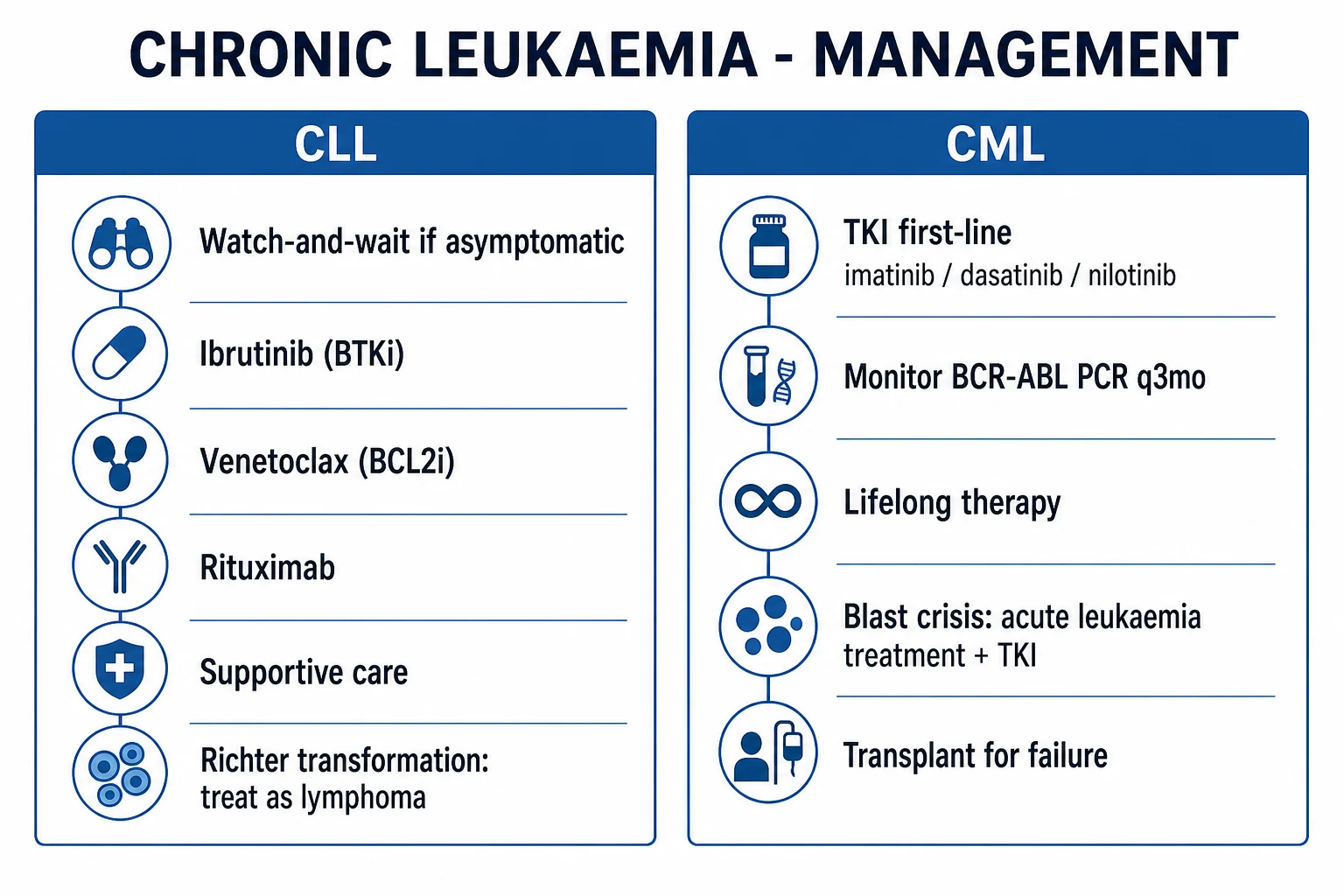
Stage A (Binet) / Rai low or intermediate (0, I, II) without active disease → WATCH-AND-WAIT. Multiple randomised trials (CLL Cooperative Group, NEJM 1988 onward) have shown no survival benefit to early treatment with chlorambucil or even modern agents. The patient is followed 6–12-monthly with blood count and examination; treatment is reserved for active disease.[3]
iwCLL 2018 indications for treatment (any one):[3]
- Progressive marrow failure — worsening anaemia (Hb below 10 g/dL) or thrombocytopenia (Plt below 100×10⁹/L).
- Massive (over 6 cm), progressive or symptomatic splenomegaly.
- Massive (over 10 cm), progressive or symptomatic lymphadenopathy.
- Progressive lymphocytosis — over 50 percent increase in 2 weeks, or lymphocyte doubling time under 6 months (baseline count over 30×10⁹/L).
- Autoimmune cytopenias (AIHA/ITP) refractory to corticosteroids.
- Symptomatic extranodal involvement (skin, kidney, lung, GI).
- Disease-related B-symptoms — unintentional weight loss at least 10 percent in 6 months; fever at least 38°C for at least 2 weeks without infection; drenching night sweats for at least 1 month; or severe fatigue (ECOG over 1) preventing work or activities. [1]
First-line therapy — risk-adapted (depends on fitness, IGHV, TP53, del(17p)): [1]
[1]- Fit patient (CIRS under 6, CrCl at least 70 mL/min), TP53-wildtype, IGHV-mutated → FCR (fludarabine + cyclophosphamide + rituximab) for 6 cycles. FCR is potentially curative in this subset (about 50 percent remain MRD-negative and progression-free at 10+ years). CLL8 established FCR over FC.[1]
- Fludarabine 25 mg/m²/day PO or IV days 1–3; cyclophosphamide 250 mg/m²/day PO or IV days 1–3; rituximab 375 mg/m² IV cycle 1 day 1, then 500 mg/m² IV day 1 cycles 2–6. Cycles every 28 days.
- Fit patient with comorbidity (often older) → BR (bendamustine + rituximab): bendamustine 90 mg/m² IV days 1 and 2, rituximab 375 mg/m² IV day 1 cycle 1 then 500 mg/m², every 28 days × 6.
- TP53-mutated / del(17p) (any fitness), or unfit, or preferred oral therapy → BTK inhibitor (B-cell receptor pathway):
- Ibrutinib 420 mg PO once daily (continuous until progression). RESONATE-2 established ibrutinib in first line.[6]
- Acalabrutinib 100 mg PO twice daily (continuous) — more selective BTK inhibitor, fewer off-target effects.
- OR BCL2 inhibitor → venetoclax + obinutuzumab (fixed-duration, 12 months): venetoclax ramp-up (20 mg week 1 → 50 mg week 2 → 100 mg week 3 → 200 mg week 4 → 400 mg PO daily thereafter) plus obinutuzumab 1000 mg IV (cycle 1 days 1/8/15, then day 1 cycles 2–12). CLL14 established this combination; durable MRD-negative responses.[12]
- Elderly / frail with comorbidity → chlorambucil + obinutuzumab (chlorambucil 0.5 mg/kg PO days 1 and 15, every 28 days × 6, with obinutuzumab) — historical standard, still used where targeted therapy is unavailable.
Relapsed/refractory CLL: [1]
- Venetoclax + rituximab (24 months) — MURANO trial established this as standard for relapsed disease (venetoclax ramp-up then 400 mg PO daily × 24 months, rituximab 375 mg/m² then 500 mg/m² IV monthly × 6).[7]
- PI3K-δ inhibitors — idelalisib 150 mg PO BD (± rituximab), duvelisib 25 mg PO BD (PI3K-δ/γ) — used in multiply-relapsed disease; boxed warnings for colitis, hepatitis, infection (monitor LFTs, consider prophylaxis).
- BTK inhibitors continued; zanubrutinib (next-generation BTK) where available.
- Allogeneic stem-cell transplant — historically the only curative option; now reserved for multiply-relapsed, young, fit patients with high-risk disease after targeted therapy failure (reduced-intensity conditioning).
Supportive care: [1]
- IVIG replacement (400 mg/kg/month) for recurrent bacterial infections with hypogammaglobulinaemia (IgG below 4 g/L).
- Vaccination — annual influenza, pneumococcal (PCV13/15/20 + PPSV23), COVID-19, recombinant zoster (Shingrix); avoid live vaccines (BCG, MMR, yellow fever, oral polio).
- Antimicrobial prophylaxis on therapy: aciclovir for HSV/VZV, co-trimoxazole 480 mg OD for PCP (especially on BTK/PI3K therapy), fluconazole as needed, hepatitis B reactivation prophylaxis (entecavir/tenofovir) in anti-CD20-treated HBsAg-positive or anti-HBc-positive patients.
- Richter transformation — DLBCL-type therapy (R-CHOP or R-EPOCH); venetoclax; consider allogeneic SCT in responders; prognosis poor (median under 12 months). [1]
Chronic myeloid leukaemia — start a TKI from day 1
The treatment of chronic-phase CML is an oral TKI, started within days of diagnosis, continued long-term (often lifelong). Imatinib 400 mg once daily is the standard first-line; second-generation TKIs (dasatinib, nilotinib, bosutinib) achieve faster and deeper responses and are first-line options, especially in high-risk Sokal/ELTS disease. [1]
| TKI | Standard dose | First-line? | Notable toxicities | Caveats |
|---|---|---|---|---|
| Imatinib (1st-gen) | 400 mg PO OD | Yes | Periorbital/peripheral oedema, nausea, muscle cramps, cytopenias, raised LFTs, hypophosphataemia | Best safety profile; the IRIS paradigm |
| Dasatinib (2nd-gen) | 100 mg PO OD | Yes | Pleural effusion, pulmonary hypertension, cytopenias, bleeding | Caution in cardiac/pleural disease |
| Nilotinib (2nd-gen) | 300 mg PO BD (fasted) | Yes | QT prolongation, sudden death, hyperglycaemia, pancreatitis, raised bilirubin | ECG, lipid/glucose monitoring; not in cardiac disease |
| Bosutinib (2nd-gen) | 500 mg PO OD | Yes (in some guidelines) | Diarrhoea, transaminitis | Avoid baseline hepatic dysfunction |
| Ponatinib (3rd-gen) | 45 mg then 15 mg PO OD | Not first line; T315I mutation; resistant disease | Arterial thrombosis (cardiac, cerebrovascular, PAD), hepatic, pancreatitis | Reserve for T315I or resistance |
| Asciminib (allosteric inhibitor) | 40 mg PO BD or 200 mg BIW | After failure; T315I | Fewer off-target effects | Novel "switch-pocket" mechanism |
Monitoring response (ELN 2020):[5]
- Haematology every 2 weeks until complete haematological response (CHR: WBC normal, no immature cells, platelet normal, no splenomegaly, Hb normal), then every 3 months.
- Cytogenetics at 3 and 6 months (marrow karyotype or FISH).
- BCR-ABL1 transcript (IS) PCR at 3, 6, 9, 12 months, then every 3–6 months when in MMR.
- Targets (see Investigations): EMR (BCR-ABL1 at most 10 percent) at 3 months, response at 6 months (at most 1 percent), MMR (at most 0.1 percent) at 12 months.
- Failure → check adherence, drug interactions, ABL1 kinase-domain mutation testing, switch TKI (e.g. imatinib → dasatinib/nilotinib; T315I → ponatinib/asciminib). [1]
Treatment-free remission (TFR) — patients on dasatinib or nilotinib (and increasingly imatinib) in sustained deep molecular response (MR4 or MR4.5 for at least 2 years) can attempt TKI discontinuation under monitoring; about 40–60 percent remain in TFR; BCR-ABL1 monitored monthly × 6, then 2-monthly × 3, then 3-monthly long-term, with re-initiation on molecular relapse (loss of MMR).[5]
Accelerated phase — optimise/switch TKI (2nd-gen), proceed to allogeneic haematopoietic stem-cell transplant (HSCT) once in second chronic phase. [1]
Blast crisis — lymphoid type: treat as B-ALL (steroids, vincristine, anthracycline ± TKI; consider blinatumomab); myeloid type: treat as AML (7+3 cytarabine + anthracycline + TKI). Bridge to allogeneic HSCT in responders. Prognosis remains poor (median survival 6–12 months). [1]
Specific Subtypes & Scenarios
- Hairy-cell leukaemia — rare B-cell leukaemia (about 2 percent of adult leukaemias); median age 50–55; marked male predominance (4:1). Presentation: pancytopenia with monocytopenia, splenomegaly (often massive) without lymphadenopathy, dry tap on marrow (reticulin fibrosis). Classic film: hairy cytoplasmic projections, TRAP (tartrate-resistant acid phosphatase) positive, annexin A1+ (specific), BRAF V600E mutation (near-universal, target of vemurafenib).[10] First-line: cladribine 0.09 mg/kg/day IV × 7 days (single course) or pentostatin 4 mg/m² IV every 2 weeks — produces long-lasting complete remissions in over 80 percent. Recurrent/refractory: moxetumomab pasudotox, vemurafenib (BRAF), rituximab.
- T-cell prolymphocytic leukaemia (T-PLL) — aggressive; marked lymphocytosis, hepatosplenomegaly, serous effusions, skin infiltration; CD3+, CD4+/CD8+ (or CD4/CD8 double-positive), TCL1+, ATM/T-PLL mutations. Treat with alemtuzumab (anti-CD52), then allogeneic SCT in responders; prognosis poor (median under 2 years).
- Large granular lymphocytic leukaemia (LGL) — indolent clonal T-cell or NK-cell expansion; chronic neutropenia with recurrent oral ulcers, pure red-cell aplasia, rheumatoid arthritis (Felty-like); STAT3 mutations common. Often watch-and-wait; treat symptomatic cytopenias with low-dose methotrexate, ciclosporin, or low-dose cyclophosphamide; alemtuzumab in refractory.
- Chronic neutrophilic leukaemia — rare myeloproliferative neoplasm; sustained neutrophilia, splenomegaly, CSF3R mutation, BCR-ABL1-negative; treat with hydroxycarbamide, JAK inhibitors (ruxolitinib); risk of transformation to AML.
- CML in pregnancy — interferon-alfa is the only agent considered safe in pregnancy (does not cross the placenta); avoid TKIs especially in the first trimester (teratogenic — dasatinib, nilotinib, ponatinib); imatinib has been used in the second/third trimester in selected cases with counselling; leukapheresis and hydroxycarbamide for short-term cytoreduction.
- CML in children/adolescents — same TKI-based therapy as adults; growth retardation is a recognised concern with long-term TKI use in children; consider TFR or HSCT in selected cases.
Complications & Pitfalls
CLL complications: [1]
- Infections — leading cause of morbidity/mortality; hypogammaglobulinaemia, neutropenia (disease and treatment), T-cell dysfunction (especially herpes zoster, PCP on therapy).
- Autoimmune cytopenias — AIHA (10–15 percent), ITP, pure red-cell aplasia; must be distinguished from marrow-failure cytopenia (autoimmune does not count toward Binet C and is treated separately).
- Richter transformation — to DLBCL (about 80 percent), classic Hodgkin lymphoma (Hodgkin variant, about 15 percent), or, rarely, lymphoblastic lymphoma; suspicion = rising LDH, rapidly enlarging node, new B-symptoms, constitutional deterioration in previously stable CLL; PET-CT (SUV max over 5) and node biopsy; treat as DLBCL but prognosis poor.
- Second cancers — increased incidence of skin (melanoma, SCC), lung, GI cancers (immune dysregulation and chemotherapy).
- Hyperviscosity — rare (with very high WBC or paraproteinaemia).
- TLS — at treatment initiation. [1]
CML complications: [1]
- Disease progression — chronic → accelerated → blast crisis (the natural history without therapy was 3–5 years; now near-normal with TKI).
- TKI toxicities (drug-specific) — see Management; classic pitfalls: dasatinib → pleural effusion; nilotinib → QT/sudden death/pancreatitis; ponatinib → arterial thrombosis (MI, stroke, PAD); imatinib → fluid retention/cramps.
- Drug interactions — all TKIs metabolised by CYP3A4; avoid strong inducers (rifampicin, phenytoin, carbamazepine, St John's wort) and caution with strong inhibitors (ketoconazole/itraconazole/posaconazole, clarithromycin, grapefruit).
- ABL1 kinase-domain mutations causing resistance — the most infamous is T315I ("gatekeeper" mutation) — resistant to all 1st/2nd-gen TKIs; sensitive only to ponatinib and asciminib.
- Pregnancy — TKI teratogenicity. [1]
Common diagnostic pitfalls: [1]
- Diagnosing CLL when it is mantle-cell lymphoma — both CD5+, but MCL is CD23-, cyclin D1+, t(11;14).
- Treating leukemoid reaction as CML — check LAP score and BCR-ABL1 before starting a TKI.
- Treating early-stage CLL — early chemo does not improve survival; watch-and-wait is correct.[3]
- Missing Richter transformation in a CLL patient with new B-symptoms and rising LDH.
- Underestimating infection risk in CLL — vaccinate and offer IVIG.
- Forgetting HBV reactivation prophylaxis before anti-CD20 therapy (rituximab/obinutuzumab).
- Confusing autoimmune cytopenia with marrow-failure progression in CLL — the former does NOT alter Binet stage and is treated with steroids/rituximab, not CLL-directed therapy.
Prognosis & Disposition
CLL prognosis — highly heterogeneous, governed by stage, IGHV status, TP53/del(17p), beta-2 microglobulin, LDH, and the Döhner cytogenetic hierarchy: median overall survival ranges from over 15 years (del 13q, Binet A, IGHV-mutated) to under 3 years (del 17p/TP53-mutated, refractory).[2][3] Modern targeted therapy (ibrutinib, venetoclax) has substantially improved even TP53-mutated disease. The CLL International Prognostic Index (CLL-IPI) combines TP53, IGHV, beta-2 microglobulin, clinical stage and age into a 4-tier score (low, intermediate, high, very high risk).[3]
CML prognosis — in the TKI era, age-adjusted life expectancy is near-normal for chronic-phase patients achieving optimal molecular response; the annual mortality has fallen from 10–20 percent (pre-imatinib) to under 2 percent. Adverse prognostic features: high Sokal/ELTS score at diagnosis, failure to achieve EMR/MMR milestones, accelerated/blast phase at diagnosis, clonal evolution, older age, comorbidity, suboptimal adherence.[5][11]
Disposition — most chronic-phase CML and early-stage CLL patients are managed as outpatients. Indications for admission: suspected/impending leukostasis or TLS at presentation; severe autoimmune haemolysis with falling haemoglobin; neutropenic sepsis; Richter transformation requiring urgent work-up; blast crisis. [1]
Special Populations
- Young, fit patient with TP53-wildtype IGHV-mutated CLL — FCR offers a chance of long-term MRD-negative remission (potentially curative); consider allogeneic SCT for very high-risk disease.
- Elderly / comorbid patient with CLL — prefer oral targeted therapy (ibrutinib, acalabrutinib, or venetoclax-obinutuzumab) over chemoimmunotherapy; chlorambucil-obinutuzumab where targeted therapy is unavailable.
- TP53-mutated / del(17p) CLL — never chemoimmunotherapy; first-line ibrutinib or venetoclax-obinutuzumab.
- Pregnancy and CLL — CLL is rare in pregnancy (median age mismatch); if treatment required, prefer rituximab (avoid in first trimester if possible) or steroids for autoimmune cytopenia; defer chemo/targeted therapy where possible.
- Pregnancy and CML — interferon-alfa is safe; avoid TKIs in first trimester; leukapheresis and hydroxycarbamide for short-term control; imatinib may be used in 2nd/3rd trimester with counselling (small risk of fetal renal/ skeletal anomalies).[5]
- Renal impairment — most TKIs and CLL agents need dose adjustment; ibrutinib and venetoclax preferred where appropriate.
- HBsAg-positive or anti-HBc-positive patient — antiviral prophylaxis (entecavir 0.5 mg OD or tenofovir 300 mg OD) throughout anti-CD20 therapy and for at least 12 months after — prevents HBV reactivation.
- Children with CML — TKIs as in adults, with attention to growth; consider HSCT in selected cases.
Evidence, Guidelines & Regional Differences
Landmark trials (chronic leukaemia): [1]
- CLL8 (Hallek 2010, Lancet) — addition of rituximab to FC (FCR) improved response, PFS and OS in fit, untreated CLL → FCR became standard.[1]
- Döhner 2000 (NEJM) — defined the cytogenetic FISH hierarchy (del 17p worst → del 13q best) that still governs CLL prognostication.[2]
- iwCLL 2018 (Blood) — international diagnostic and treatment guidelines; defines diagnostic thresholds, Binet/Rai staging, IWCLL treatment criteria, and response criteria.[3]
- RESONATE-2 (Burger 2015, NEJM) — ibrutinib monotherapy as first-line therapy in older CLL patients.[6]
- MURANO (Seymour 2022, Blood) — venetoclax-rituximab (24 months) in relapsed/refractory CLL → durable MRD-negative remissions.[7]
- CLL14 (Al-Sawaf 2024, Blood) — venetoclax-obinutuzumab first-line, fixed-duration, with 6-year durability → preferred in comorbid/unfit disease.[12]
- IRIS (O'Brien 2003, NEJM) — imatinib vs interferon + cytarabine → 87 percent complete haematological response, dramatic survival benefit; transformed CML management.[4]
- DASISION (Kantarjian 2010, NEJM) — dasatinib vs imatinib first-line → faster/deeper responses.[8]
- ENESTnd (Saglio 2010, NEJM) — nilotinib vs imatinib first-line → faster/deeper responses.[9]
- ELN 2020 (Hochhaus, Leukemia) — international CML treatment and monitoring recommendations; defines EMR/MMR milestones, TFR criteria.[5]
- ELTS score (Pfirrmann 2020, Leukemia) — validated as superior to Sokal for predicting CML-related mortality.[11]
- Tiacci 2011 (NEJM) — BRAF V600E in hairy-cell leukaemia, opening the way for vemurafenib in refractory disease.[10]
Regional differences: [1]
- CLL is rare in South/East Asia (including India) compared with the West; CML incidence is similar worldwide.
- Resource-limited settings — chlorambucil ± rituximab remains a reasonable first-line for elderly CLL; imatinib (cheapest TKI, now generic) is the workhorse first-line for CML in India and much of the world; access to dasatinib/nilotinib/ponatinib may be limited by cost.
- TKI availability — imatinib is now generic (the Gleevec patent expired 2015 in India and 2016 globally); 2nd/3rd-gen TKIs are restricted by cost and funding.
- Treatment-free remission programmes are increasingly adopted in well-resourced settings; access to sensitive standardised BCR-ABL1 PCR (IS) is a prerequisite.
- Indian / ICMR / NMC context — chronic-leukaemia management follows international guidelines (BSH, ESMO, ELN); imatinib as first-line CML is standard and widely available; targeted agents for CLL are used in tertiary centres. [1]
Exam Pearls
- Smudge (basket) cells = artefactual rupture of fragile CLL lymphocytes — classic film clue.
- Lymphocytosis over 5×10⁹/L with CD5+CD23+ B-cells = CLL.
- CD5+CD23- cyclin D1+ t(11;14) = mantle-cell lymphoma (the trap when "CD5-positive leukaemia" is described).
- BRAF V600E, TRAP+, pancytopenia, dry tap, monocytopenia, splenomegaly without nodes = hairy-cell leukaemia; treat with cladribine.
- Rai 0 / Binet A = watch-and-wait — early treatment does not improve survival.[3]
- Binet stages — A fewer than 3 areas, B 3+ areas, C cytopenic (Hb below 10 OR Plt below 100); autoimmune cytopenia does not count toward C.
- Rai — 0 lymphocytosis; I + nodes; II + spleen/liver; III + anaemia (Hb below 11); IV + platelets (Plt below 100).
- FCR = fludarabine + cyclophosphamide + rituximab — fit, TP53-wildtype CLL.
- Ibrutinib = BTK inhibitor; venetoclax = BCL2 inhibitor; idelalisib/duvelisib = PI3K inhibitors.
- Del(17p)/TP53 mutation = worst CLL cytogenetics; never chemoimmunotherapy — use ibrutinib or venetoclax-obinutuzumab.
- Del(13q) as sole abnormality = best CLL cytogenetics.
- t(9;22) Philadelphia chromosome → BCR-ABL1 → p210 kinase → CML (p190 = Ph+ ALL; p230 = chronic neutrophilic leukaemia).[4]
- LAP score LOW in CML, HIGH in leukemoid reaction — single best discriminator.
- Basophilia = myeloproliferative neoplasm (CML until proven otherwise).
- Imatinib (1st-gen TKI) 400 mg OD; dasatinib 100 mg OD; nilotinib 300 mg BD; bosutinib 500 mg OD; ponatinib for T315I; asciminib = allosteric.
- BCR-ABL1 PCR (IS) milestones: EMR (at most 10 percent) at 3 months; response (at most 1 percent) at 6 months; MMR (at most 0.1 percent) at 12 months; MR4.5 (at most 0.0032 percent) for treatment-free remission.
- ELTS score is superior to Sokal for predicting CML mortality.[11]
- Richter transformation = CLL → DLBCL; rising LDH, rapidly enlarging node, B-symptoms; poor prognosis.
- Dasatinib → pleural effusion; nilotinib → QT prolongation; ponatinib → arterial thrombosis; imatinib → periorbital oedema/cramps.
- Treatment-free remission — sustained MR4.5 for at least 2 years; ~40–60 percent remain off TKI.
- HBV reactivation prophylaxis (entecavir/tenofovir) before any anti-CD20 therapy.
CLL immunophenotype — CD5+ CD23+
5C-2
CLL is CD5-positive B-cell (shared with mantle cell, but mantle is CD23-negative)
B-cell marker, but CD20 expression is WEAK (dim) — a Matutes-score point
CD23 positivity distinguishes CLL from mantle-cell lymphoma (CD23-negative)
Surface immunoglobulin and CD79b are also dim/weak
CML phases — blast percentages
CAB
Blasts under 5 percent in blood and marrow — patient well, responds to TKI
Blasts 10–19 percent, or basophils at least 20 percent, or clonal evolution, or therapy-resistant cytopenia/thrombocytosis
Blasts at least 20 percent (WHO), or extramedullary blast proliferation — behaves like acute leukaemia
Chronic leukaemia — key numbers
Exam application bank (NEET-PG / INICET)
One-line answer
Chronic leukaemia encompasses two distinct indolent clonal marrow stem-cell disorders. Chronic lymphocytic leukaemia (CLL) is a CD5-positive B-cell neoplasm of mature-appearing lymphocytes (lymphocytosis over 5×10⁹/L, smudge cells, lymphadenopathy, splenomegaly), staged by Rai or Binet, treated only when symptomatic (watch-and-wait early), with FCR chemoimmunotherapy or targeted agents (ibrutinib BTK inhibitor, venetoclax BCL2 inhibitor). Chronic myeloid leukaemia (CML) is a BCR-ABL1 myeloproliferative neoplasm driven by the Philadelphia chromosome t(9;22), characterised by leucocytosis with left shift, basophilia, splenomegaly and low LAP score, divided into chronic, accelerated and blast-crisis phases, and transformed by imatinib and other tyrosine-kinase inhibitors (dasatinib, nilotinib, bosutinib, ponatinib, asciminib). CML molecular response is monitored by BCR-ABL1 transcript PCR.
Worked stems (answer without another resource)
Stem 1 — Classic presentation. Map symptoms to mechanism; name the first investigation and first treatment step with dose/route if drug therapy is standard. [1]
Stem 2 — Unstable / complicated. List red flags that force immediate resuscitation, theatre, ICU, antidote, or reperfusion — and what you do in the first 15 minutes. [1]
Stem 3 — Atypical group. Elderly, pregnancy, child, or immunocompromised: how presentation and thresholds change. [1]
Stem 4 — Differential trap. Name the three closest mimics and one discriminator for each. [1]
Stem 5 — Disposition. Who goes home with safety-netting, who is admitted, who needs HDU/ICU/theatre, and what follow-up is mandatory. [1]
Rapid viva checklist
- Definition + classification
- Pathophysiology chain
- Bedside signs / criteria
- Score with exact components (if any)
- Emergency bundle
- Definitive therapy with doses
- Complications of disease and of treatment
- Special populations
- Guideline/trial name if classic
- Three exam traps
Coverage self-check
If you cannot answer any stem above from this page alone, re-read the matching section — the page is intended to be self-sufficient for final-prof and NEET-PG/INICET questions on Chronic Leukaemia (CLL & CML).
References
- [1]Hallek M, Fischer K, Fingerle-Rowson G, et al. Addition of rituximab to fludarabine and cyclophosphamide in patients with chronic lymphocytic leukaemia: a randomised, open-label, phase 3 trial Lancet, 2010.PMID 20888994
- [2]Döhner H, Stilgenbauer S, Benner A, et al. Genomic aberrations and survival in chronic lymphocytic leukemia N Engl J Med, 2000.PMID 11136261
- [3]Hallek M, Cheson BD, Catovsky D, et al. iwCLL guidelines for diagnosis, indications for treatment, response assessment, and supportive management of CLL Blood, 2018.PMID 29540348
- [4]O'Brien SG, Guilhot F, Larson RA, et al. Imatinib compared with interferon and low-dose cytarabine for newly diagnosed chronic-phase chronic myeloid leukemia N Engl J Med, 2003.PMID 12637609
- [5]Hochhaus A, Baccarani M, Silver RT, et al. European LeukemiaNet 2020 recommendations for treating chronic myeloid leukemia Leukemia, 2020.PMID 32127639
- [6]Burger JA, Tedeschi A, Barr PM, et al. Ibrutinib as Initial Therapy for Patients with Chronic Lymphocytic Leukemia N Engl J Med, 2015.PMID 26639149
- [7]Seymour JF, Kipps TJ, Eichhorst B, et al. Enduring undetectable MRD and updated outcomes in relapsed/refractory CLL after fixed-duration venetoclax-rituximab Blood, 2022.PMID 35605176
- [8]Kantarjian H, Shah NP, Hochhaus A, et al. Dasatinib versus imatinib in newly diagnosed chronic-phase chronic myeloid leukemia N Engl J Med, 2010.PMID 20525995
- [9]Saglio G, Kim DW, Issaragrisil S, et al. Nilotinib versus imatinib for newly diagnosed chronic myeloid leukemia N Engl J Med, 2010.PMID 20525993
- [10]Tiacci E, Trifonov V, Schiavoni G, et al. BRAF mutations in hairy-cell leukemia N Engl J Med, 2011.PMID 21663470
- [11]Pfirrmann M, Baccarani M, Saussele S, et al. The EUTOS long-term survival (ELTS) score is superior to the Sokal score for predicting survival in chronic myeloid leukemia Leukemia, 2020.PMID 32601376
- [12]Al-Sawaf O, Zhang S, Hallek M, et al. Venetoclax-obinutuzumab for previously untreated chronic lymphocytic leukemia: 6-year results of the randomized phase 3 CLL14 study Blood, 2024.PMID 39082668