Paediatrics · Paediatrics
Childhood Immunisation
Also known as Vaccination · Immunisation schedule · National immunisation programme · Vaccine-preventable diseases · Cold chain
Childhood immunisation prevents an estimated 2 to 3 million deaths per year worldwide. Active immunity (vaccine drives own antibody and memory-cell production) is contrasted with passive (pre-formed antibody: IVIG, tetanus immunoglobulin, transplacental). Live attenuated vaccines (BCG, OPV, MMR, rotavirus, varicella, yellow fever, LAIV) are contraindicated in severe immunocompromise and in pregnancy; inactivated, toxoid, conjugate, and recombinant vaccines are safe. UK routine schedule (verbatim): birth BCG/HepB for at-risk; 8wk 6-in-1 + MenB + rotavirus; 12wk 6-in-1 + PCV + rotavirus; 16wk 6-in-1 + MenB; 1yr Hib/MenC + MMR + PCV + MenB; 2 to 4yr influenza nasal; 3yr4mo MMR-2 + DTaP/IPV pre-school booster; 12 to 13yr HPV 2 doses; 14yr Td/IPV + MenACWY; pregnancy pertussis 16 to 32wk + influenza. BCG: intradermal, prevents TB meningitis and miliary TB (not pulmonary). OPV (Sabin) carries VAPP risk — global switch to IPV (Salk). Cold chain: 2 to 8 degrees C with VVM monitoring. Premature: vaccinate by chronological age. MMR does NOT cause autism (Wakefield retracted; Madsen, Hviid, Cochrane).
On this page & tools
Your progress
Saved locally on this device.
Exam tags
Red flags
Overview & Definition
Immunisation is the process by which a person is made resistant to an infectious disease, typically by the administration of a vaccine that stimulates the body's own adaptive immune system to produce antibodies and long-lived memory cells. The term distinguishes active immunisation (vaccination: the host produces their own antibodies and memory cells, conferring durable protection) from passive immunisation (administration of pre-formed antibody, as in hepatitis B immunoglobulin after exposure, tetanus immunoglobulin in wound management, rabies immunoglobulin around a bite wound, IVIG in immunodeficiency, or the transplacental transfer of maternal IgG). Active immunisation takes days to weeks to develop but lasts years to decades; passive immunisation confers immediate but short-lived protection (weeks to a few months) and produces no immunological memory.[1]
Immunisation prevents an estimated 2 to 3 million deaths every year and is among the most successful and cost-effective public health interventions ever deployed. The mechanism underlying its population-level success is herd immunity (also called community or indirect immunity): when a sufficient proportion of the population is immune, transmission of the organism is interrupted, protecting even those who cannot be vaccinated — newborns too young to respond, the immunocompromised in whom live vaccines are contraindicated, and the rare vaccine non-responder. The herd immunity threshold is set by the basic reproductive number (R0) of the organism, and measles, with an R0 of 12 to 18, demands the highest threshold of any vaccine-targeted disease: around 95 percent coverage.[1]
The clinical skill that this topic examines is the ability to (a) reproduce the routine childhood schedule for the country you practise in, (b) select the correct vaccine type for a given antigen and clinical situation, (c) identify the rare true contraindications and confidently vaccinate through the many false contraindications that lead to under-vaccination, and (d) recognise and manage adverse events, including the rare vaccine-anaphylaxis. The candidate who can answer "should this child be vaccinated today?" correctly, in any country, has mastered the topic.[14]
Classification of Vaccine Types
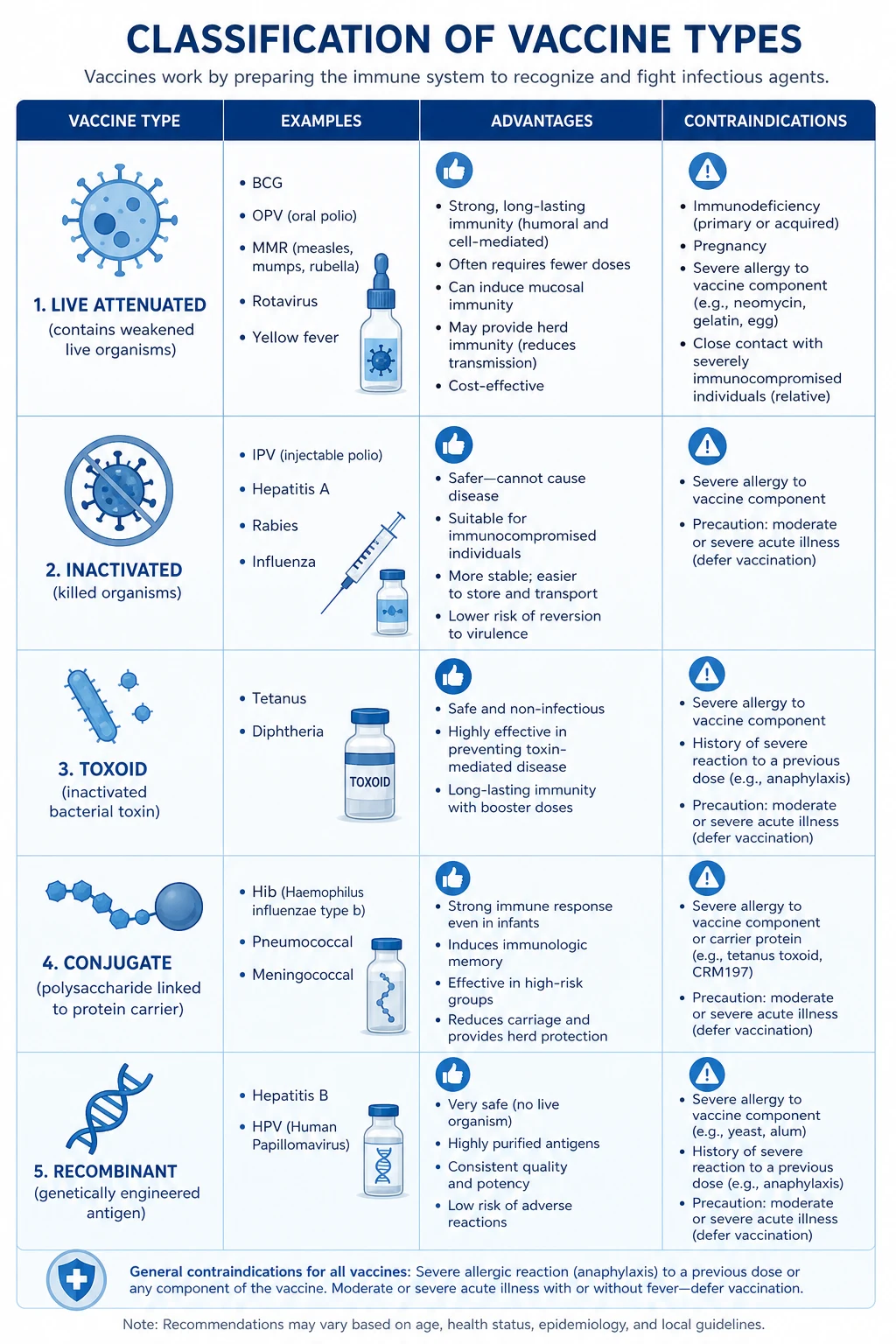
Vaccines are classified by how the antigen is prepared. The single most consequential distinction — and the one most often examined — is whether the vaccine is live attenuated (replicates within the host) or inactivated/subunit (does not). Live vaccines induce a broader, more durable, often single-dose immunity but carry a small risk of uncontrolled replication in the immunocompromised host; inactivated vaccines are safe in immunocompromise but typically require adjuvants and multiple doses to achieve comparable titres.[1]
Live attenuated
replicates in the host
- **BCG** (TB), **OPV** (polio, oral Sabin), **MMR** (measles, mumps, rubella)
- **Rotavirus** (oral), **varicella**, **yellow fever**, **live-attenuated influenza (LAIV)**, oral typhoid Ty21a
- Strong, durable, often single-dose immunity (mucosal and humoral for OPV/rotavirus)
- **CONTRAINDICATED in severe immunocompromise** (symptomatic HIV, chemo, high-dose steroids) — risk of uncontrolled replication
- **CONTRAINDICATED in pregnancy** — theoretical risk of fetal infection
- Replication interfered by recent immunoglobulin; minimum 3 month interval after IVIG before live vaccine
- Must be given on same day OR separated by at least 4 weeks (interference if live vaccines given closer)
Inactivated (whole killed)
intact killed organism
- **IPV** (polio, injectable Salk), **rabies**, **hepatitis A**, whole-virion influenza, whole-cell pertussis (wP, now replaced by aP)
- Safe in immunocompromise and pregnancy
- Cannot replicate — no risk of reversion to virulence
- Generally less immunogenic than live; need adjuvant and boosters
- Stable in storage; less cold-chain sensitive than live
Subunit / recombinant
selected antigen(s)
- **Recombinant Hepatitis B** (HBsAg produced in yeast)
- **HPV** (L1 virus-like particles, Gardasil-9)
- **Acellular pertussis** (2 to 5 detoxified pertussis antigens, e.g. PT, FHA, PRN, FIM)
- **Recombinant zoster (RZV/Shingrix)** and **COVID-19 mRNA** vaccines are subunit/mRNA analogues
- Highly purified, lower reactogenicity than whole-cell, very safe in immunocompromise
Toxoid
inactivated bacterial toxin
- **Tetanus toxoid**, **diphtheria toxoid** (formaldehyde-inactivated toxins)
- Induces anti-toxin neutralising antibody; no protection against colonisation
- Aluminium-adjuvanted; very immunogenic; boosters every 10 years through life
- Cornerstone of DTP/DTaP/Tdap/Td combination products
Conjugate
polysaccharide + protein carrier
- **Hib** (Haemophilus influenzae type b), **PCV13** (pneumococcal conjugate), **MenACWY**, **MenB** (Bexsero, Trumenba)
- Capsular polysaccharide is T-independent antigen — does NOT induce memory in infants under 2y
- Conjugation to a protein carrier (e.g. diphtheria/tetanus toxoid, CRM197) converts it to T-dependent — induces memory and works in infants
- Huge impact: Hib meningitis near-eliminated; PCV reduced invasive pneumococcal disease and otitis media
mRNA
lipid-nanopacket mRNA
- **COVID-19 mRNA vaccines** (BRespo, Spikevax) — encode spike protein
- Cannot integrate into host DNA; no live virus
- Strong humoral and cellular response; safe in immunocompromise
- Cold chain more demanding (ultra-cold for early formulations)
Headline numbers — global impact and herd immunity thresholds
Epidemiology & Risk Factors
Vaccination has been the dominant driver of the global decline in child mortality over the last half-century. Diphtheria-tetanus-pertussis third-dose (DTP3) coverage, the WHO tracer for programme performance, sits at around 84 percent globally — meaning roughly 1 in 6 children is still not fully protected against three of the most lethal but entirely vaccine-preventable diseases. First-dose measles (MCV1) coverage is similar (around 83 percent); second-dose coverage (MCV2) lags at around 74 percent, leaving large pockets of measles susceptibility that drive outbreaks wherever coverage falls below the 95 percent threshold. HPV full-course coverage among eligible girls is under 30 percent globally and below 10 percent in many low-income countries — the single largest gap between an existing, highly effective vaccine and its uptake.[1]
The diseases targeted by routine immunisation remain the major killers of children under 5 in unvaccinated populations. Measles kills around 140,000 people per year globally, almost all children in countries with MCV1 coverage under 80 percent; rotavirus causes around 200,000 under-5 deaths per year from acute gastroenteritis; pertussis an estimated 160,000; Haemophilus influenzae type b around 200,000 (over 90 percent pre-conjugate vaccine); pneumococcal disease around 300,000; tetanus of the newborn around 34,000 (down from over 800,000 in 1980); and hepatitis B causes around 820,000 deaths per year from chronic infection, cirrhosis, and hepatocellular carcinoma — most acquired perinatally or in early childhood, which is why the birth dose is the single most important intervention. Polio is on the brink of eradication, with wild-type cases confined to two countries.[16]
Risk factors for under-vaccination (the most examined epidemiology question) cluster into three groups: (1) access — rural residence, distance from clinic, absence of cold chain, conflict, displacement, cost; (2) systems — missed opportunities at every clinical contact, lack of reminder-recall, poor record-keeping, healthcare-worker vaccine hesitancy; and (3) attitudes — parental vaccine hesitancy (the "3 Cs": Complacency, Convenience, Confidence), religious or philosophical objection, misinformation (especially the persistent MMR-autism myth), and prior adverse-event experiences. Premature infants, low-birthweight babies, and children with chronic conditions are at disproportionate risk of under-vaccination despite being at greatest risk from vaccine-preventable disease.[14]
Pathophysiology — the Immunology of Vaccination
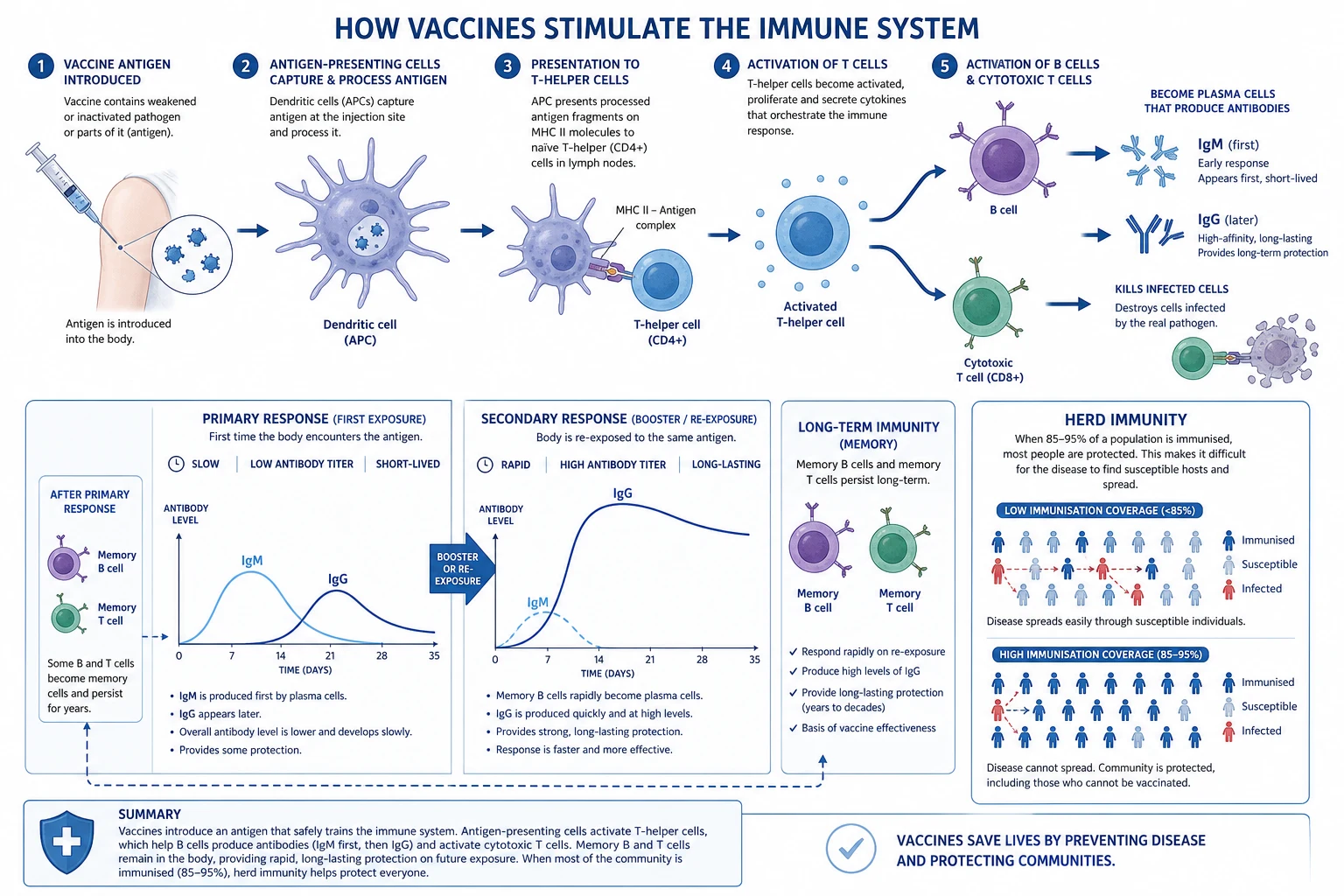
Vaccination mimics natural infection without causing disease, exploiting the adaptive immune system's capacity for specificity (recognising one antigen among millions) and memory (mounting a faster, larger response on re-exposure). The cascade proceeds as follows.[1]
1. Antigen uptake and presentation. The vaccine antigen — whether a live replicating virus, a killed whole organism, a purified protein, a conjugated polysaccharide, or a toxoid — is taken up by antigen-presenting cells (dendritic cells, macrophages, Langerhans cells in the skin) at the injection or mucosal site. Live and adjuvanted vaccines also trigger the innate immune sensors (Toll-like receptors, inflammasomes) whose cytokine output licenses the dendritic cell to migrate to the draining lymph node, upregulate MHC and co-stimulatory molecules, and present antigen effectively.[1]
2. T-cell activation. In the lymph node, the mature dendritic cell presents peptide antigen on MHC class II to naïve CD4 T-helper cells, providing three signals: antigen (TCR–MHC-peptide), co-stimulation (CD28–CD80/86), and cytokine polarisation. Depending on the cytokine milieu, CD4 cells differentiate into Th1 (cell-mediated, IFN-gamma), Th2 (humoral, IL-4/IL-5), Tfh (follicular helper, which drives the germinal centre reaction), or Treg subsets. CD8 cytotoxic T cells are induced particularly by live vaccines that replicate intracellularly and present on MHC class I.[1]
3. B-cell activation and the germinal centre. Antigen-specific naïve B cells recognise native antigen via surface immunoglobulin (the B-cell receptor), internalise and process it, and present peptide to the Tfh cell in the lymph-node follicle. With Tfh help, B cells enter the germinal centre reaction, where they undergo somatic hypermutation (affinity maturation) and class-switch recombination (from IgM to IgG, IgA, or IgE). Two outputs emerge: short-lived plasma cells that secrete a burst of antibody within 1 to 3 weeks, and long-lived plasma cells plus memory B cells that home to the bone marrow and persist for years to decades.[1]
4. Primary vs secondary response. The first vaccine dose (or first natural infection) elicits a primary response: IgM appears first, peaking around day 7 to 10, followed by class-switching to IgG that rises more slowly and at lower titre. A second (booster) dose or natural re-exposure triggers the secondary (anamnestic) response: memory B cells recognise antigen within hours, differentiate rapidly into plasma cells, and produce a high-titre, high-affinity IgG response peaking within 3 to 7 days. This is the immunological rationale for booster doses, for multi-dose primary series (3 doses of DTaP/IPV/Hib spaced by 4 to 8 weeks to build memory), and for the persistence of immunity for decades after vaccination.[1]
5. T-dependent vs T-independent antigens — why conjugation matters. Pure capsular polysaccharides (the slippery sugar coats of Hib, pneumococcus, meningococcus) are T-independent antigens: they cross-link B-cell receptors directly, bypassing T-cell help, and induce only a transient IgM response with no memory and no response in infants under 18 to 24 months (whose B cells are immature). The breakthrough was conjugation: chemically linking the polysaccharide to a protein carrier (diphtheria toxoid, tetanus toxoid, CRM197) converts it to a T-dependent antigen, recruits Tfh help, drives germinal-centre memory, and works from 6 weeks of age. This is why Hib, PCV, and MenACWY are all conjugate vaccines, and why the introduction of Hib conjugate in the 1990s near-eliminated Hib meningitis in high-income countries within a decade.[1]
6. Herd immunity — the population-level outcome. When a sufficient proportion of the population is immune, transmission chains are interrupted. The herd immunity threshold (H) is approximately 1 minus 1 over R0. Because measles has R0 of 12 to 18, H is 92 to 95 percent — the highest of any vaccine-targeted disease and the reason any coverage dip below 95 percent produces outbreaks. Polio (R0 5 to 7) needs 80 percent, rubella 80 to 85, diphtheria 80 to 85, pertussis 92 to 94 (because acellular pertussis protects against disease but less against colonisation). Herd immunity protects those who cannot be vaccinated and is the ethical basis for high-coverage programmes.[14]
Clinical Presentation — the Immunisation Schedule
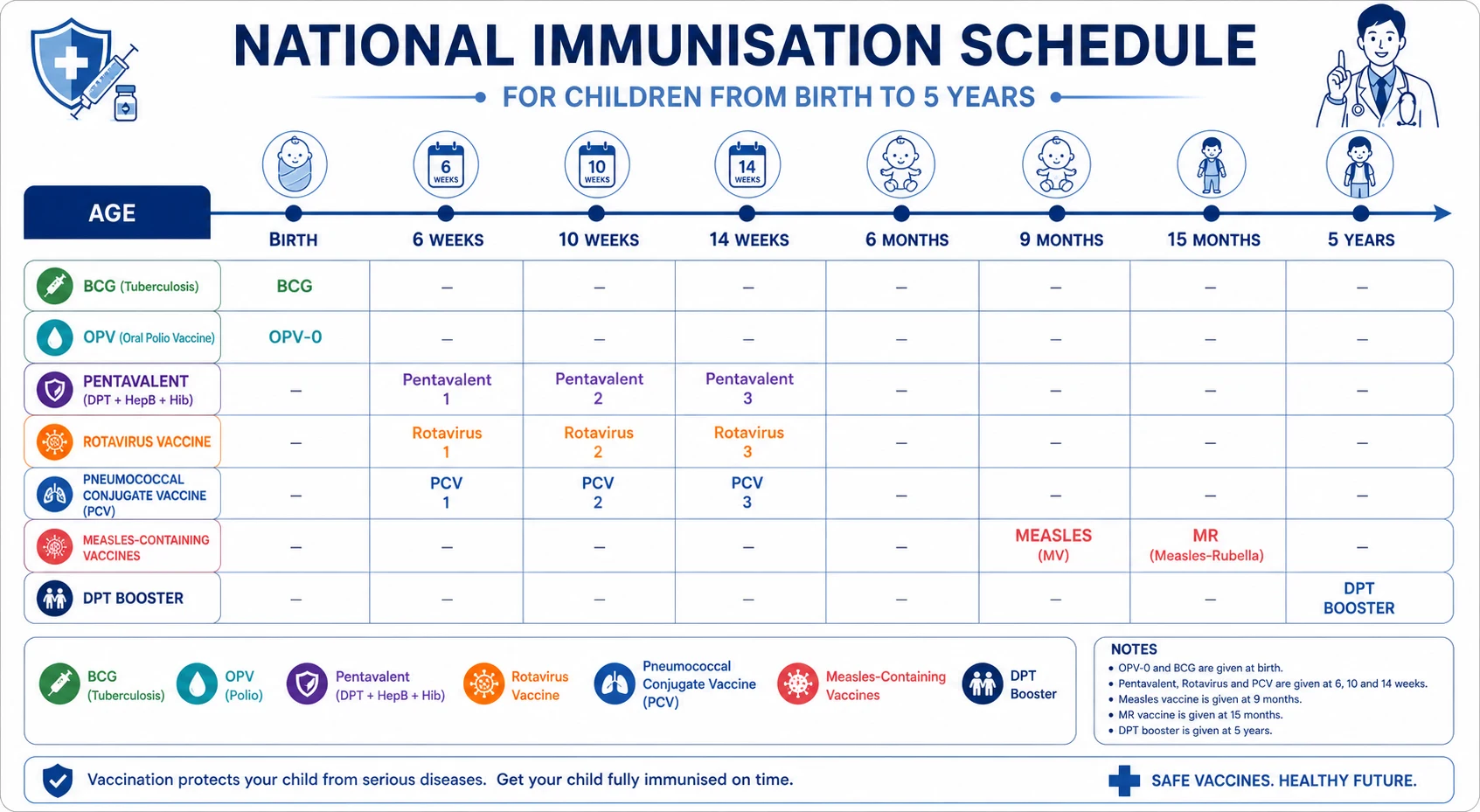
The "clinical presentation" of immunisation is the schedule itself — a precisely timed sequence of antigens calibrated to the maturing infant immune system, the epidemiology of the target disease, the risk of vertical transmission, and the safety profile of each vaccine. Schedules differ by country but share the same backbone: a birth dose (BCG, HepB for at-risk), a primary series at 6 to 16 weeks (DTaP, IPV, Hib, HepB, PCV, rotavirus, MenB), measles-containing vaccine at 9 to 15 months, boosters in the second year and at pre-school entry, and adolescent vaccines (HPV, Tdap, MenACWY).[15]
WHO Expanded Programme on Immunization (EPI) establishes the global backbone: BCG, polio, DTP, HepB, Hib, pneumococcal, rotavirus, measles (often as MR), rubella, HPV, and yellow fever in endemic countries. EPI was launched in 1974 and now covers every country; the Immunization Agenda 2030 targets over 90 percent coverage for the core antigens and over 50 percent HPV coverage. Country schedules add region-specific vaccines: Japanese encephalitis in South and Southeast Asia, yellow fever in sub-Saharan Africa and the Amazon, tick-borne encephalitis in Central Europe, meningococcal A in the African meningitis belt (MenAfriVac near-eliminated MenA epidemics), cholera in outbreak settings, and typhoid conjugate in high-burden countries.[15]
Differential Diagnosis — Choosing the Vaccine Type for a Given Antigen
For a prevention topic, the "differential" reframes as: for each antigen, which vaccine type is used and why? The choice is rarely arbitrary — it is driven by the immunology of the pathogen, the age of the recipient, and the safety profile. The candidate who can explain why pneumococcus is conjugate, why tetanus is toxoid, and why measles is live attenuated has internalised the topic.[1]
TB — BCG (live)
- Live attenuated Mycobacterium bovis (Bacille Calmette-Guerin, 1921)
- Intradermal, left deltoid, at birth or first contact
- Variable efficacy 0 to 80 percent against pulmonary TB (Colditz 1994 meta), but **consistently 70 to 80 percent against TB meningitis and miliary TB in children**
- Produces local papule then ulcer then characteristic scar at 6 to 12 weeks; scar indicates successful take but absence does NOT equal failure
- Contraindicated in symptomatic HIV / severe immunodeficiency (risk of disseminated BCGitis)
Polio — OPV (live) vs IPV (inactivated)
- **OPV (Sabin):** live attenuated trivalent oral drops — cheap, mucosal immunity, herd effect via faecal shedding, mass-campaign friendly. BUT: vaccine-associated paralytic polio (VAPP) 1 in 2 to 3 million doses, and circulating vaccine-derived poliovirus (cVDPV) where coverage is low
- **IPV (Salk):** inactivated injectable — no VAPP, no cVDPV, but only humoral (no mucosal), more expensive, needs trained injector
- **Global switch:** tOPV (trivalent) withdrawn April to May 2016; bOPV plus IPV sequential schedules now standard; OPV cessation planned post-eradication
- Immunocompromised household contacts should NOT receive OPV (contact VAPP risk)
Measles-mumps-rubella — MMR (live)
- Live attenuated combined vaccine: measles (Edmonston-Zagreb or Moraten strain), mumps (Jeryl Lynn or RIT 4385), rubella (RA27/3)
- Subcutaneous, two doses (1st at 12 to 15 months, 2nd at 4 to 6 years in US; 1st at 1 year, 2nd at 3y4m in UK; 1st at 9 months, 2nd at 15 to 18 months in India as MR)
- Measles component most reactogenic: fever and rash at day 6 to 12 (post-vaccine measles), febrile seizures 1 in 2500, ITP 1 in 25,000 to 40,000, rare encephalopathy
- **Does NOT cause autism** — Wakefield 1998 retracted as fraudulent; Madsen 2002, Taylor 1999, Smeeth 2004, Hviid 2019, Cochrane 2021 all show no association
- MMRV (with varicella) increases febrile-seizure risk vs separate MMR + V at first dose; first dose usually given as MMR
Pneumococcus — PCV (conjugate)
- PCV13 or higher-valent PCV15/20 — capsular polysaccharide conjugated to CRM197 (PCV13) or diphtheria/tetanus toxoid
- Works in infants under 2y (where pure polysaccharide PPSV23 fails)
- Primary 3 plus 1 (3, 5, 12 months plus booster) or reduced 2 plus 1 (UK, India, many countries) schedule
- Massive impact on invasive pneumococcal disease (IPD), pneumonia, and otitis media — both directly (vaccinated) and via herd effect on unvaccinated adults
- PPSV23 (23-valent unconjugated polysaccharide) still used in over-2y high-risk and over-65y — no memory, repeat dosing wanes
Meningococcus — MenACWY + MenB
- **MenACWY:** conjugate quadrivalent (MenA/C/Y/W), IM, single adolescent dose (UK 14y, US 11 to 12y + 16y booster)
- **MenB:** either 4CMenB (Bexsero, 4 antigen) or MenB-FHbp (Trumenba, 2 fHbp) — recombinant subunit; UK gives Bexsero at 8 and 16 weeks plus 1y; US shared decision at 16y
- Complement deficiency, asplenia, HIV, cochlear implants, eculizumab therapy — both MenACWY and MenB plus boosters
- Bexsero induces cross-protection against gonorrhoea (around 30 to 40 percent effectiveness observed in real-world data)
Rotavirus — oral live
- Live attenuated oral: RotaTeq (pentavalent human-bovine, 3 doses) or Rotarix (monovalent, 2 doses)
- Given at 6, 10, 14 weeks (or 8 and 12 weeks UK); **first dose by 14 to 15 weeks; course complete by 24 to 32 weeks** — later dosing raises intussusception risk
- Reduces severe rotavirus gastroenteritis by 75 to 90 percent and rotavirus hospitalisation and death in low-income settings
- Small increased intussusception risk 1 to 6 per 100,000 — vastly outweighed by benefit. RotaShield (1998) withdrawn for intussusception 1 in 10,000 (Murphy 2001)
- **Contraindicated in SCID** (vaccine-strain diarrhoea) and caution in moderate-to-severe immunocompromise
Hepatitis B — recombinant
- Recombinant HBsAg produced in yeast (Saccharomyces), IM, 3-dose schedule at 0, 1, 6 months (or as part of 6-in-1 / pentavalent)
- **Birth dose within 24 hours critical** for babies of HBsAg-positive mothers (with HBIG) — prevents 70 to 95 percent of perinatal transmission
- Anti-HBs titre over 10 mIU per mL after primary series = seroprotection; boosters not needed in immunocompetent
- HIV, dialysis, immunocompromised: double dose and check serology
HPV — recombinant VLP
- **Gardasil-9 (9vHPV):** L1 virus-like particles for HPV 6, 11, 16, 18, 31, 33, 45, 52, 58 — IM
- 2-dose schedule if started before 15th birthday (0 and 6 to 24 months); 3-dose if 15 or older or immunocompromised (0, 1 to 2, 6 months)
- 97 percent efficacy against vaccine-type cervical intraepithelial neoplasia (Huh 2017 Lancet)
- Gender-neutral in most high-income countries; protects against cervical, anal, oropharyngeal, penile, vulvar, vaginal cancers and genital warts
Varicella — live (US, not UK)
- Live attenuated Oka strain, subcutaneous, 2 doses at 12 to 15 months and 4 to 6 years (US, Australia, Canada, Germany)
- UK does NOT routinely varicella-vaccinate (concern it would shift disease to older, more severe ages with low coverage)
- Given as MMRV at 4 to 6 years or as separate VZV
- **Contraindicated in pregnancy and severe immunocompromise**
Influenza — inactivated or LAIV
- **Inactivated IM** (IIV): from 6 months annually; 2 doses first season under 9y in some schedules
- **Live attenuated intranasal (LAIV):** UK default for 2 to 17y; US prefers IIV (LAIV limited efficacy against H1N1 in some seasons)
- Annual composition reviewed by WHO (Northern and Southern hemisphere strains)
- Egg-grown — caution in anaphylaxis to egg (most can still receive; specialist assessment for severe egg allergy in some schedules)
- Recommended for all over 6 months (universal in US/UK); prioritised for high-risk (asthma, cardiac, immunocompromised, pregnancy, over 65y)
Tetanus-diphtheria-pertussis — toxoid + subunit
- **DTaP** (under 7y): diphtheria and tetanus toxoids + acellular pertussis (2 to 5 antigens: PT, FHA, PRN, FIM)
- **Tdap** (over 7y, including adolescence and pregnancy): reduced diphtheria and pertussis content
- **Td** (booster every 10y through life)
- Pregnancy Tdap 16 to 32 weeks (UK) or 27 to 36 weeks (US) — every pregnancy — protects the newborn via transplacental antibody until infant DTaP series begins
- Whole-cell pertussis (wP) more reactogenic (fever, seizures) but better mucosal immunity; still used in India and many LMICs
Clinical & Bedside Assessment — the Pre-Vaccination Encounter
Every immunisation encounter is a brief clinical consultation that should answer four questions: (1) Is the child well enough to vaccinate? (2) What is due today? (3) Are there any true contraindications? (4) Is the vaccine itself safe to give (cold chain, VVM)? The order matters: a missed vaccination opportunity is the commonest cause of under-immunisation, and most "illness today" deferrals are false contraindications.[14]
History should establish the child's chronological age (NOT corrected for prematurity), the vaccine record (paper card, electronic registry, parental recall — verify when possible), prior doses given and dates, prior adverse events to vaccines, allergies (especially to egg, gelatin, yeast, latex, neomycin, polymyxin), chronic conditions (asthma, cardiac, neurological, immunodeficiency, HIV, asplenia, cochlear implant, CSF leak, splenectomy), pregnancy status in adolescent girls, current illness and its severity, current medications (especially steroids, immunosuppressants, recent IVIG or blood products), household immunocompromise (contacts who should not be exposed to OPV), and parental concerns. The specific question "is the child systemically unwell with a fever?" distinguishes a precaution (defer until recovered) from a non-contraindication (vaccinate).[14]
Examination is brief and focused on whether the child looks well, is afebrile or has only a low-grade fever, and has no acute severe illness. Temperature should be checked. The injection site should be free of infection. There is no role for routine chest auscultation, blood tests, or imaging before vaccination in a well child.[14]
The vaccine encounter workflow
Confirm identity, age, and what is due today (check the record, not recall)
Screen for true contraindications and precautions (anaphylaxis history, immunocompromise, pregnancy, encephalopathy after pertussis, severe acute illness)
Verify the vaccine: correct product, within expiry, VVM in the safe range (inner square not darker than outer), not frozen
Confirm route and site: IM anterolateral thigh (under 2y) or deltoid (over 2y); oral (rotavirus, OPV); intradermal (BCG over 1y or percutaneous in infants); subcutaneous (MMR, varicella, MenACWY)
Draw up with a separate needle for injection (not the one used to draw); use a 25 mm 23 to 25 G needle for IM in infants
Document the vaccine (name, batch, lot, site, date, giver) in the record and on the parent-held card
Advise on common expected reactions (fever, local reaction, irritability) and paracetamol dosing; advise when to return
Observe for 15 minutes (anaphylaxis usually within minutes; 30 minutes for high-risk)
Schedule the next visit and give reminder
VACCINE
Investigations — Selective Pre-Vaccination Testing
Routine serology or blood tests are not required before vaccination in a well child. A small set of selective investigations is indicated in specific clinical situations:[14]
- Hepatitis B in the infant of an HBsAg-positive mother: check HBsAg and anti-HBs at 9 to 12 months (after completion of the primary series) to confirm protection and exclude infection. If anti-HBs is under 10 mIU per mL, give a booster and recheck; if still negative, evaluate for HBsAg carrier state or non-response.[16]
- HIV status in infants of HIV-positive mothers and in children of unknown status in high-prevalence settings — determines whether live vaccines (BCG, rotavirus, MMR, varicella, yellow fever) can be given. Severe immunosuppression (CD4 under 15 percent or under 200 cells per microlitre, or clinical AIDS) contraindicates live vaccines.[14]
- Immunoglobulin levels in suspected immunodeficiency before live vaccines (especially severe combined immunodeficiency before rotavirus, chronic granulomatous disease before BCG).[14]
- Tuberculosis screening (IGRA or TST) is not required before BCG in routine neonatal vaccination but is recommended before BCG in older children from high-prevalence settings to avoid vaccinating a child already infected.[2]
- Pregnancy test before a live vaccine (MMR, varicella, LAIV, yellow fever) in a woman of childbearing age who might be pregnant; not required for inactivated vaccines.[14]
- Anti-diphtheria and anti-tetanus titres are not checked routinely but may guide management of an unimmunised or incompletely immunised wound.[14]
Management — Anaphylaxis (the Time-Critical Resuscitation)
Vaccine-associated anaphylaxis is rare (around 1 per million doses across all vaccines) but can be fatal if untreated. Onset is typically within 5 to 30 minutes of the injection — hence the requirement to observe every vaccine recipient for at least 15 minutes (30 minutes for those with prior reactions or severe allergy). A clear anaphylaxis kit and a trained team must be available wherever vaccines are given.[14]
The resuscitation bundle, applied immediately:[14]
- Recognise — airway compromise, bronchospasm (wheeze, distress), cardiovascular collapse (pallor, hypotension, tachycardia), urticaria, angioedema, GI symptoms. Skin signs alone (urticaria without systemic features) is NOT anaphylaxis — manage with antihistamine.
- IM adrenaline — the first-line, life-saving drug. 0.15 mg IM (0.15 mL of 1:1000) for under 6 years; 0.3 mg IM (0.3 mL of 1:1000) for 6 to 12 years; 0.5 mg IM (0.5 mL of 1:1000) for over 12 years and adults. Inject into the anterolateral thigh. Repeat every 5 minutes if no response, up to 3 doses.
- Airway, oxygen, IV access — high-flow oxygen 15 L per min via non-rebreather; IV/IO access; isotonic crystalloid 10 mL per kg bolus if hypotensive.
- Adjuncts — IV hydrocortisone 4 mg per kg (or 100 mg adult) and chlorphenamine 0.2 mg per kg (or 10 mg adult); these are second-line and never delay adrenaline.
- Call for help — senior paediatrician, anaesthetist, PICU, and ambulance transfer.
- Admit and observe 6 to 12 hours after a single-dose response; biphasic reactions occur in up to 5 percent.
- Report — to the national pharmacovigilance system (VAERS in the US, Yellow Card in the UK), refer to allergy specialist for confirmation of trigger, and document clearly. Future doses of that vaccine are contraindicated; alternative products may be considered under specialist supervision.[21]
Adrenaline dosing for vaccine anaphylaxis (IM, 1:1000)
Management — Contraindications, Precautions, and the False Contraindications
The single most examinable skill in immunisation is distinguishing the rare true contraindications from the long list of false contraindications that cause under-vaccination. Examiners test this directly: a parent brings a mildly unwell, breastfed, premature baby with a family history of febrile seizures — the correct answer is vaccinate, all of the above are NOT contraindications.[14]
TRUE contraindications
withhold this vaccine
- **Anaphylaxis to a previous dose** of the same vaccine OR to a vaccine component (e.g. neomycin, gelatin, yeast, latex vial stopper)
- **Severe immunocompromise** for LIVE vaccines only (BCG, OPV, MMR, rotavirus, varicella, yellow fever, LAIV): symptomatic HIV with CD4 under 15 percent; leukaemia/lymphoma on chemo; high-dose steroids (over 2 mg per kg per day or over 20 mg per day prednisolone for over 14 days); most biologics; SCID; primary immunodeficiency
- **Pregnancy** for LIVE vaccines (theoretical risk of fetal infection) — if given inadvertently, do NOT terminate pregnancy, document and counsel
- **Encephalopathy within 7 days of a pertussis-containing vaccine** with no alternative cause = no further pertussis (give DT for subsequent doses)
- **SCID** — no rotavirus (vaccine-strain persistent diarrhoea)
- **Severe egg anaphylaxis** — yellow fever and some influenza vaccines (most MMR is egg-free; specialist assessment)
Precautions (defer, not contraindicate)
vaccinate later
- **Moderate or severe acute illness** (with or without fever) — defer until recovered to avoid confusing vaccine reaction with illness
- **Recent immunoglobulin or blood product** — defer live vaccines (interferes with replication): 3 months after standard IVIG, longer after high-dose or specific IG
- **Personal or family history of seizures** — give vaccine with antipyretic cover and counsel; NOT a contraindication
- **Stable neurological condition** (cerebral palsy, Down syndrome, well-controlled epilepsy) — vaccinate, with precautions
- **Pregnancy** — defer live vaccines until after delivery; give inactivated influenza and Tdap
- **Immunocompromise** — defer live vaccines; give inactivated alternatives; vaccinate household contacts to provide indirect protection
FALSE contraindications (VACCINATE)
commonly mistaken
- **Mild acute illness** — upper respiratory infection, otitis media, low-grade fever under 38.5 degrees C, common cold, runny nose
- **Mild to moderate diarrhoea** (rotavirus still given unless severe)
- **Breastfeeding** (no interference with any vaccine)
- **Prematurity** — vaccinate by CHRONOLOGICAL age, full doses, same schedule (do NOT correct for gestational age)
- **Low birth weight** (with the HepB birth-dose exception: under 2 kg babies of HBsAg-positive mothers should still get vaccine plus HBIG within 12 hours)
- **Jaundice** — including neonatal jaundice
- **Antibiotic therapy**
- **Family history of seizures, SIDS, autism, or vaccine adverse events**
- **Eczema, asthma, hay fever, atopy** (avoid LAIV only in severe active wheeze)
- **Malnutrition** — vaccinate urgently (high risk of severe disease)
- **Pregnant or immunosuppressed household contact** — vaccinate the child (inactivated always; MMR and varicella do NOT spread; avoid OPV)
- **Locally-acting steroids** (inhaled, topical)
- **Surgery planned or recent**
- **Multiple vaccines on the same day** — encouraged, different sites
The two errors that examiners reward identifying are: (1) deferring vaccination for a mild illness (the commonest cause of under-immunisation) and (2) withholding MMR from a child whose sibling had autism (a false contraindication rooted in the debunked MMR-autism myth).[14]
Adverse Events — the AEFI Spectrum
Adverse events following immunisation (AEFI) are classified by causality: vaccine reaction (caused by the vaccine), programme error (wrong dose, wrong route, contaminated), coincidental (unrelated event after vaccination), anxiety (vasovagal), and unknown. The Brighton Collaboration provides standardised case definitions. Most are minor, expected, and self-limiting.[21]
Common, expected reactions (occur within hours to days, self-limiting):[14]
- Local: pain, swelling, redness, induration at the injection site — most after aluminium-adjuvanted vaccines (DTaP, HepB, HPV); apply cold compress.
- Systemic: fever (often 38 to 39 degrees C), irritability, malaise, myalgia, headache — peak at 6 to 24 hours, resolve by 48 hours. Paracetamol 15 mg per kg q4 to 6h or ibuprofen 10 mg per kg q6 to 8h.
- Measles-specific: fever and faint rash at 6 to 12 days post-MMR (the post-vaccine measles — mildly infectious to none, no isolation needed).
- Rotavirus-specific: mild diarrhoea, irritability for 1 to 2 days.
- BCG-specific: local papule then ulcer then scar over 6 to 12 weeks; ipsilateral axillary lymphadenopathy in up to 10 percent (mostly self-limiting).[21]
Rare, serious adverse events:[21]
Rare adverse events — rates per million doses
- Febrile seizures after DTaP and MMR — usually brief, generalised, self-limiting; managed with positioning, antipyretics, and observation; no long-term sequelae. Not a contraindication to further doses.[14]
- Vaccine-associated paralytic polio (VAPP) — from OPV, 1 in 2 to 3 million doses, either in the recipient or a close contact; the rationale for the global switch from OPV to IPV.[15]
- Intussusception after rotavirus — small excess risk 1 to 6 per 100,000 vaccinated, peaking 3 to 7 days after the first dose; vastly outweighed by the 75 to 90 percent reduction in severe rotavirus gastroenteritis. The first RotaShield (1998) was withdrawn for a higher risk of around 1 in 10,000 (Murphy 2001, NEJM).[9][10]
- Immune thrombocytopenic purpura (ITP) after MMR — around 1 in 25,000 to 40,000 doses, self-limiting in two-thirds. A second dose is still recommended if the first was well-tolerated, because the natural rate of ITP after wild measles is higher.[13]
- BCG lymphadenitis (BCGitis) — suppurative ipsilateral axillary or cervical lymphadenitis, more common in immunodeficiency; managed conservatively or with anti-TB therapy; surgical drainage risks sinus formation.[2]
- Yellow fever vaccine-associated viscerotropic and neurotropic disease — rare but serious; restrict yellow fever to truly at-risk travellers; thymus disorder, immunosuppression, over 60 years, and pregnancy are precautions.
- Anaphylaxis — 1 per million; managed as above; the affected vaccine is then contraindicated.[21]
Specific Subtypes & Scenarios
The MMR-autism myth — the evidence
The claim that MMR causes autism originated in a 1998 Lancet case series by Andrew Wakefield involving 12 children. The paper was retracted by the Lancet in 2010 after the General Medical Council found Wakefield guilty of misconduct, undisclosed conflicts of interest, and ethical violations; the work was subsequently shown to be fraudulent. The hypothesis (measles vaccine virus in gut causing "leaky gut" and opioid-peptide absorption leading to autism) has no biological plausibility and has been refuted by at least seven large, well-conducted epidemiological studies.[20]
The landmark disproving studies:[20]
- Taylor 1999 (Lancet) — 498 children with autism in North Thames; no temporal clustering of regression or bowel symptoms after MMR; no association between MMR and autism onset.[5]
- Madsen 2002 (NEJM) — population-based cohort of 537,303 Danish children (the largest to date); 738 children with autism; relative risk of autism in vaccinated vs unvaccinated 0.92, with no dose-response. Disproved the association definitively.[3]
- Smeeth 2004 (Lancet) — case-control using the General Practice Research Database, 1294 cases and 4469 controls; adjusted OR 0.86 (95 percent CI 0.68 to 1.09) for MMR and pervasive developmental disorder.[6]
- Hviid 2019 (Annals of Internal Medicine) — nationwide Danish cohort of 657,461 children over 10 years; MMR-vaccinated vs unvaccinated MMR autism risk HR 0.93, no sub-group effect, including in children with sibling autism (the highest-risk group).[4]
- Di Pietrantonj 2021 (Cochrane) — systematic review of 138 studies with 23 million children; MMR not associated with autism, ITP (rare, self-limiting), febrile seizures (small excess), or any new serious adverse event.[7]
The myth's persistence despite overwhelming refutation illustrates how vaccine hesitancy is sustained by anecdote, mistrust, and confirmation bias. The clinician's role is to acknowledge the parent's concern, state the evidence clearly and without judgement, document the discussion, and offer vaccination. Refusal is not absolute — the door stays open.[20]
Special populations
Premature infants — vaccinate at chronological age, full doses (do NOT reduce dose or correct for gestational age), same schedule, from 6 to 8 weeks. Exception: HepB birth dose in babies under 2 kg of HBsAg-positive mothers — give vaccine plus HBIG within 12 hours, but if the maternal status is unknown, give the vaccine regardless of weight and check maternal status urgently. Premature babies have lower intra-muscle mass — use the anterolateral thigh and a 25 mm 23 to 25 G needle; consider the smaller deltoid in over 1 year. Hospitalised preterms should be monitored for apnoea for 48 to 72 hours after the first DTaP-containing dose (small increased apnoea risk in extremely preterm).[14]
HIV-positive children — give all inactivated vaccines on schedule (DTaP/IPV/Hib/HepB, PCV, rotavirus is OK if not severely immunosuppressed, HepA, influenza annually). Avoid BCG if symptomatic or severe immunosuppression (disseminated BCGitis risk); some high-burden countries still give BCG at birth pending HIV confirmation. MMR and varicella may be given if clinically stable and CD4 over 15 percent; yellow fever caution; rotavirus generally OK if not severely immunosuppressed. Check annual influenza and pneumococcal boosters.[14]
Immunocompromised children (non-HIV) — oncology on chemotherapy, post-transplant (especially within 24 months of HSCT), on high-dose steroids (over 2 mg per kg per day prednisolone for over 14 days), on biologics (TNF inhibitors, rituximab): no live vaccines; inactivated vaccines on schedule but check serological response (may be blunted). Household contacts: vaccinate fully (including MMR, varicella, rotavirus) — they CANNOT transmit MMR/varicella vaccine virus to the immunocompromised contact in any meaningful way; avoid OPV for contacts (VAPP risk).[14]
Asplenia, complement deficiency, cochlear implants, persistent CSF leaks — these children are at markedly increased risk of encapsulated bacterial infection (pneumococcus, meningococcus, Hib). They should receive: full routine PCV series plus PPSV23 at age 2 years and a second dose 5 years later; MenACWY 2-dose primary at 2 months plus boosters; MenB (Bexsero or Trumenba) from age 2 months; Hib full series; plus lifelong oral penicillin V (under 5 years: 12.5 mg per kg bid; over 5 years: 250 mg bid) or alternative in penicillin allergy.[17]
Pregnancy — live vaccines are contraindicated (MMR, varicella, LAIV, yellow fever, BCG, OPV). Inactivated influenza in any trimester during flu season; Tdap 16 to 32 weeks (UK) or 27 to 36 weeks (US), every pregnancy, to protect the newborn from pertussis via transplacental antibody until the infant series begins at 8 weeks. If a live vaccine was given inadvertently in pregnancy, do NOT recommend termination — counsel and document, and seek specialist advice.[19]
Adolescents — gender-neutral HPV from age 11 to 12 (US) or 12 to 13 (UK); Tdap; MenACWY; annual influenza; consider MenB shared decision at 16 years. Booster tetanus-diphtheria every 10 years through life. Pregnancy test before any live vaccine in a sexually active adolescent girl.[18]
Missed doses — never restart a vaccine series; resume where it left off, respecting minimum intervals. The minimum interval between DTP doses 1 to 2 and 2 to 3 is 4 weeks; the minimum age for MMR1 is 12 months (9 months in some high-burden settings); the minimum interval between live vaccines given on different days is 4 weeks.[14]
The cold chain and VVM
Cold chain is the system that maintains vaccines at 2 to 8 degrees Celsius from manufacture to the point of administration, protecting potency. Breaks — either freezing (destroys aluminium-adjuvanted vaccines like DTP, HepB, HPV; the adsorbed antigen precipitates and is irreversibly damaged) or overheating (reduces titre of live vaccines, especially OPV and measles) — render vaccines useless but do not visibly change them. Maintained by vaccine refrigerators (purpose-built, with temperature alarms and twice-daily monitoring), vaccine carriers with conditioned ice packs for outreach, and the Vaccine Vial Monitor (VVM) on each vial.[14]
VVM is a heat-sensitive label — an inner square within an outer reference circle — printed on each vial. The inner square darkens as heat exposure accumulates. If the inner square is the same colour as or lighter than the outer circle, the vaccine is safe to use. If the inner square is darker than the outer circle, discard the vial (cumulative heat exposure exceeds safe limits). The VVM does NOT detect freezing — that requires the shake test for adsorbed vaccines: a frozen-and-thawed DTP/HepB vial settles more slowly than never-frozen, leaving a granular sediment.[14]
Complications & Pitfalls
The complications of immunisation are the adverse events above. The pitfalls — the clinical and programme errors that fail the patient — are the more examinable content:[14]
- Deferring for a mild illness — the single most common cause of under-vaccination; a low-grade fever or cold is NOT a contraindication.
- Withholding MMR in a child with a family history of autism or febrile seizures — a false contraindication rooted in the debunked Wakefield myth.
- Correcting for prematurity — premature babies are vaccinated by chronological age, full dose.
- Restarting a missed-dose series — never; resume where it left off.
- Giving live vaccines on different days less than 4 weeks apart — the second may be immunologically blunted; if both cannot be given on the same day, separate by at least 4 weeks.
- Giving OPV to a household contact of an immunocompromised person — VAPP risk to the contact; switch to IPV for all household members.
- Missing the rotavirus age window — first dose by 14 to 15 weeks, complete by 24 to 32 weeks; later dosing raises intussusception risk disproportionately.
- Missing the HepB birth dose within 24 hours in a baby of an HBsAg-positive or status-unknown mother — the single most effective perinatal-transmission intervention.
- Failing to check the VVM or to detect a freeze break — administering a useless vaccine that the parent believes was protective.
- Using the wrong injection site (gluteal in infants — risks sciatic nerve injury and reduces immunogenicity; subcutaneous instead of IM for adjuvanted vaccines — increases local reaction).
- Failing to record batch/lot — compromises pharmacovigilance and recall.
- Failing to give Tdap in pregnancy — the most effective pertussis prevention for the newborn.[14]
Prognosis & Disposition
The prognosis of routine childhood immunisation is excellent: it prevents an estimated 2 to 3 million deaths per year globally, has driven wild polio to the brink of eradication, near-eliminated Hib meningitis in high-coverage countries, and is on track to make cervical cancer a preventable disease through HPV vaccination. Herd immunity, where coverage is sustained above threshold, protects those who cannot be vaccinated and produces the dramatic population-level effects (measles elimination, IPD decline, MenA epidemic control in the African meningitis belt).[1]
Disposition of the immunisation encounter: most children are vaccinated and discharged the same day with safety-net advice. Observe for 15 minutes (30 for high-risk). Children with a faint or vasovagal reaction recover within minutes. Children with a true anaphylactic reaction are admitted or observed 6 to 12 hours, referred to allergy, and the vaccine is recorded as contraindicated. Children with a moderate-to-severe acute illness are deferred and recalled. Children with a true contraindication to one vaccine should still receive all others for which they are eligible, and the contraindication documented clearly.[14]
The public-health disposition is the coverage target: a country or district below 95 percent measles coverage is at risk of outbreaks and must intensify catch-up, school-entry checks, reminder-recall, and address hesitancy through clear, evidence-based communication.[14]
Catch-Up Vaccination and the Accelerated Schedule
The default rule of thumb — never restart a series — is the anchor: a child who missed the 14-week OPV at 14 weeks can receive it at 14 months with no loss of protection, because immunologic memory is initiated by the first dose and amplified by each subsequent dose. The ACIP/CDC catch-up schedule provides a minimum-interval table for every vaccine; the WHO "missed-dose" algorithm summarises it for low-resource settings. For catch-up use the chronological age, not the corrected age, and respect these minima: [1]
Minimum intervals between doses
- DTP1 to DTP2: **4 weeks**
- DTP2 to DTP3: **4 weeks**
- DTP3 to booster 1: **6 months (and at least 12 months of age for the booster)**
- MMR1 to MMR2: **4 weeks** (and second dose at least 12 months of age, or 28 days after first)
- HepB dose 1 to 2: **4 weeks**
- HepB dose 2 to 3: **8 weeks** (and dose 3 at least 16 weeks after dose 1)
- HPV dose 1 to 2: **6 to 12 months** (5-month minimum)
- Varicella 1 to 2: **3 months under 12y; 4 weeks 13y and over**
- Live vaccines given separately: **4 weeks** minimum apart, or give on the SAME day
Maximum age for first dose
- **Rotavirus**: first dose by **14 weeks 6 days** (UK 15 weeks); last dose by **24 weeks** (UK) or **8 months 0 days** (US)
- **HepB birth dose**: within **24 hours** of birth if mother HBsAg-positive
- **MMR1**: minimum **12 months** (9 months in high-burden measles-outbreak settings, with a later second dose)
- **HPV**: routine start **9 to 12 years**, but effective through **26 years**; shared decision through **45 years** in adults
- **DTaP**: only for under 7 years; switch to **Tdap** at 7 years
The accelerated (compressed) schedule is occasionally needed for travel, outbreak control, or catch-up when an older child must catch up multiple antigens in the shortest time. The minimum-interval table is used (no interval can be shorter); DTaP-containing vaccines can be given at 4-week intervals down to a minimum age of 6 weeks for dose 1 and 10 weeks for dose 2; MMR can be given from 6 months of age in outbreak settings (the dose given before 12 months does not count toward the two-dose requirement and must be repeated at 12 to 15 months). The accelerated schedule still produces robust seroconversion because the immune system mounts a primary response within days. Where catch-up is very delayed, give all due vaccines simultaneously at different sites — there is no upper limit on the number of vaccines given together, and the antigen-presenting-cell pool is not exhausted.[14]
Travel Vaccination
Travel vaccination sits at the seam between routine immunisation and geography-specific risk. The standard framework, applied at any pre-travel consultation: [1]
Pre-travel vaccination framework
Confirm the routine immunisation status (children should be fully up to date with UK/US/India schedule before any travel vaccine is added)
Consult destination-specific requirements (e.g. yellow fever certificate for many African and South American countries; meningococcal ACWY for Hajj/Umrah pilgrimage to Saudi Arabia; polio booster for some polio-exporting countries)
Vaccinate at least 10 to 14 days before travel where possible (some vaccines — yellow fever, rabies — need a longer lead time for seroconversion)
Address accelerated schedules for last-minute travel and pediatric age restrictions (some live vaccines such as yellow fever have minimum age limits and relative contraindications in infants under 9 months)
Provide the International Certificate of Vaccination or Prophylaxis (ICVP / 'yellow card') for yellow fever, and a written record for all vaccines given
Travel-relevant vaccines and their roles: [1]
- Yellow fever (live attenuated 17D) — required for entry to many African and South American countries; single dose gives lifelong protection; minimum age 9 months (1 year US); contraindicated in immunocompromise, thymectomy, thymic disease, severe egg allergy; live and pregnancy-contraindicated; risk of viscerotropic disease (0.3 per 100,000) and neurotropic disease (0.8 per 100,000) increases over 60 years and in thymic disorders.[14]
- Typhoid — Vi polysaccharide (injectable, IM, single dose, ≥2 years, lasts 2 to 3 years) or Ty21a oral live (capsules ≥6 years, 4 doses over 7 days, lasts 5 years); recommended for South Asia, parts of Africa, Central/South America; the Vi conjugate (TCV, Typbar-TCV) is now WHO-prequalified for ≥6 months and is replacing Vi polysaccharide in many endemic countries because it works in young children and produces longer-lasting immunity.[14]
- Hepatitis A — inactivated IM, 2 doses 6 to 12 months apart, from 12 months of age; recommended for most low-income country destinations and outbreak settings; provide within 2 weeks of exposure as post-exposure prophylaxis in unvaccinated 12 months to 40 years.[14]
- Cholera — oral killed (Dukoral, ≥2 years; Shanchol, ≥1 year) or live-attenuated (CVD 103-HgR, ≥2 years, single dose); recommended for outbreak response, humanitarian workers, and travellers to endemic areas with limited access to safe water.[14]
- Rabies — inactivated IM (VERO cell or HDCV), 3-dose pre-exposure schedule (day 0, 7, 21/28) from any age including infants; recommended for extended travel to endemic areas (especially rural South Asia and Africa) where post-exposure immunoglobulin may be unavailable; post-exposure: 4 doses over 14 days plus HRIG/ERIG infiltration into the wound.[14]
- Japanese encephalitis — inactivated Vero cell (Ixiaro, ≥2 months) 2 doses 28 days apart with booster at 12 to 24 months; recommended for prolonged rural travel to South and Southeast Asia during the transmission season; live attenuated SA 14-14-2 used in China and many endemic countries from 8 months.[14]
- Tick-borne encephalitis — inactivated IM (FSME-Immun, Encepur) ≥1 year; recommended for forested Central/Eastern Europe and Russia in spring/summer.[14]
- Meningococcal ACWY (conjugate) — required for Hajj/Umrah, recommended for travel to the African meningitis belt in dry season; single dose protects for 5 years; ensure child has had their routine MenACWY before travel.[17]
- Dengue vaccine (Qdenga, TAK-003) — live-attenuated tetravalent, ≥4 years (4 to 16 in initial label; later extended to adults), 2 doses 3 months apart; WHO recommends use in children 6 to 16 years in high-transmission settings regardless of serostatus; for travellers, evidence base is still emerging; caution in immunocompromise and pregnancy.[14]
Vaccine Hesitancy, Confidence, and Communication
Vaccine hesitancy — the 3 Cs model of Complacency (low perceived risk), Convenience (access, time, cost), and Confidence (trust in the vaccine, the provider, and the system) — is now a WHO-listed top-10 threat to global health. The clinical response is not persuasion but informed choice: present risks and benefits clearly, acknowledge parental authority, avoid confrontation, document the discussion, and keep the door open for re-discussion at a subsequent visit.[14]
Communication framework (WHO Tailoring Immunization Programmes) — for every hesitant parent: [1]
- Acknowledge the concern ("I understand you are worried about possible side effects"). Avoid dismissing or countering immediately.
- Elicit the specific concern ("Tell me what worries you most" — the answer is usually a specific anecdote, a relative's claim, or a piece of social media).
- Name the myth explicitly ("The idea that MMR causes autism has been studied in more than 7 million children and has never been supported; the 1998 paper that suggested it was retracted as fraudulent").[20]
- Provide the facts in plain language ("The risk of a febrile seizure after MMR is about 1 in 2,500; the risk of a febrile seizure after natural measles is about 1 in 200").
- Offer a strong recommendation ("I vaccinate my own children on this schedule").
- Document the discussion and offer the vaccine.
Common parental concerns and the evidence-based answers: [1]
- "The MMR vaccines as three separate shots is safer": false — no evidence, and separating increases the window of susceptibility without reducing adverse events; the combined MMR is the standard.[7]
- "My child got a fever after the last vaccine — I don't want this one": manageable — paracetamol 15 mg per kg q4 to 6h around the time of the next dose (prophylactic paracetamol reduces fever and local reactions after DTaP-containing vaccines).
- "I prefer 'natural' immunity": not safer — natural measles infection carries encephalitis (1 in 1,000), SSPE (1 in 10,000), pneumonia, and death; the vaccine produces robust immunity without any of these risks.[20]
- "Aluminium in vaccines is toxic": no — vaccines contain 0.1 to 1 mg aluminium per dose, far below any toxic threshold; aluminium adjuvants increase the immune response and have been used in billions of doses with no signal of harm.[14]
- "Too many vaccines overwhelm the immune system": no — the theoretical antigen load of the modern schedule (around 150 antigens across 14 vaccines by age 2) is trivial compared to the antigen load of an everyday respiratory infection (around 100 to 1,000 antigens per infection); the immune system handles thousands of antigens daily.[14]
- "I don't need vaccines because everyone else is vaccinated (herd immunity)": free-rider problem — when coverage falls, outbreaks return, most visibly with measles; the herd threshold is biological, not negotiable.[14]
Mandates and behavioural nudges — school-entry MMR requirements (US, Italy, Australia) raise coverage by 5 to 15 percentage points; mandatory school-entry checks and GP-led reminder-recall also work. Mandates raise ethical concerns about individual liberty and may harden hesitancy in resistant communities; their effect is best when paired with easy access and respectful communication.[14]
AEFI Surveillance and Reporting
Every national immunisation programme has a parallel pharmacovigilance system that captures, classifies, and analyses adverse events. The candidate should know the structure, not the specifics of the form. [1]
WHO AEFI causality classification (the global standard): A. Vaccine product-related reaction, B. Quality defect-related reaction, C. Programme error, D. Coincidental, E. Anxiety-related (vasovagal, hyperventilation), F. Indeterminate / unknown. Each AEFI is classified after investigation; rates of coincidental events rise as background incidence rises — for example, infant apnoea and febrile seizures occur naturally at a rate that exceeds any plausible vaccine-attributable rate, so individual case investigation is essential.[21]
Reporting systems (by country)
- **UK — Yellow Card Scheme** (MHRA): online yellowcard.mhra.gov.uk or app; for HCPs and patients; signal-detection by the Commission on Human Medicines
- **US — VAERS** (Vaccine Adverse Event Reporting System): vaers.hhs.gov; jointly run by CDC and FDA; passive surveillance used for SIGNAL detection only, not causality
- **India — AEFI surveillance under UIP**: district/state/national reporting via the Safe Access for Every Vaccine (SAFE-VAC) portal and the AEFI Secretariat at MoHFW
- **EU — EudraVigilance** (EMA); **Australia — TGA Adverse Event Management System**; **Canada — CAEFISS**
- WHO Uppsala Monitoring Centre (UMC) VigiBase aggregates national reports globally — the world's largest vaccine-safety database
What must be reported
- Any **serious** event (death, hospitalisation, persistent or significant disability, congenital anomaly, life-threatening event) regardless of suspected causality
- Any event that is **unexpected** with respect to the vaccine's known safety profile
- Any **cluster** of events (two or more linked cases) — same vaccine, same batch, same setting
- Any **programme error** regardless of consequence (wrong dose, wrong route, wrong patient, wrong vaccine)
- Any **anaphylaxis** — always report (for the patient, the vaccine becomes lifelong contraindicated)
- Events of **public concern** even if mechanistically unrelated — for transparency
Surveillance methodologies
- **Passive reporting** (VAERS, Yellow Card): the workhorse; comprehensive but under-reports by an order of magnitude; used for SIGNAL detection
- **Active surveillance** (Vaccine Safety Datalink, VSD; Post-licensure Rapid Immunization Safety Monitoring, PRISM): linked health-record systems in defined populations
- **Rapid cycle analysis** (RCA): weekly analyses of pre-specified outcomes in VSD/PRISM to detect safety signals in near-real-time; used to investigate COVID-19 vaccines
- **Brighton Collaboration**: standardised case definitions so investigators in different countries classify events consistently — used for AEFI definitions globally
The practical rule for clinicians: report, then manage. The clinician's job is to report the event to the national system (Yellow Card in UK, VAERS in US, AEFI portal in India), refer the patient to specialist care where relevant, document the contraindication in the record, and counsel the family. Causality is the epidemiologist's job.[21]
Common Clinical Scenarios
These are the cases the exam will pose. Each has a correct answer that requires distinguishing true from false contraindications and applying the schedule in a real child. [1]
Scenario 1: A 6-week-old premature baby with a runny nose and low-grade fever (37.9°C), brought by a breastfeeding mother whose older child had a febrile seizure at 18 months.
Vaccinate with the 6-week schedule (pentavalent, OPV, rotavirus, PCV, IPV). Prematurity, mild URTI/low-grade fever, breastfeeding, and family history of febrile seizures are all NOT contraindications. The family-history-of-seizure component is a common false contraindication rooted in the debunked Wakefield myth; give paracetamol around the dose if fever has been a problem, but do not defer.
Scenario 2: A 4-month-old whose sibling is on chemotherapy for ALL (post-induction). The parents are asking whether MMR or varicella at 12 months will put the sibling at risk.
Yes, vaccinate the index child on schedule. MMR and varicella vaccine viruses do not transmit to contacts in any meaningful way (the rare transmission reported is with the Oka varicella vaccine strain, with subclinical infection in the contact and no clinical disease). The OPV vaccine virus CAN transmit (and causes contact VAPP) — switch the contact's polio dose to IPV only. No OPV for the index child while the household contains an immunocompromised member (some guidelines permit OPV to the child if the immunocompromised contact is on barrier isolation and compliant with hygiene; UK practice is IPV-only in any household with an immunocompromised contact).[14]
Scenario 3: A 9-month-old well baby whose mother is HBsAg-positive (HBeAg negative, viral load low). The mother received the birth dose at 1 hour and HBIG within 12 hours. When do you check serology?
At 9 to 12 months (after the primary HepB series at 0, 1, and 6 months is complete): check HBsAg and anti-HBs. If anti-HBs over 10 mIU per mL and HBsAg negative, infant is protected. If anti-HBs under 10 mIU per mL despite complete series, give a booster and recheck; persistent non-response (over 10 percent of birth-dose recipients in some series) deserves specialist review for occult HBV infection. Avoid HBIG if vaccine response is documented.[16]
Scenario 4: A 14-year-old with no prior vaccines (the family has just arrived in your country) — what is the catch-up plan?
Use the ACIP/WHO catch-up table. Give the due adolescent immunisations today: Tdap (1 dose), MenACWY (1 dose; booster at 16 if reached), HPV (start 3-dose series from age 15 — 0, 1 to 2, 6 months), annual influenza. Add MMR (2 doses 4 weeks apart), HepB (3-dose series), HepA (2 doses), varicella (2 doses if no history of disease), IPV (3-dose series), Tdap-IPV if needed. No OPV if there is an immunocompromised household contact (use IPV). Consider MenB if available and country-recommended. Schedule follow-up every 4 weeks to give the next due doses; respect minimum intervals.[15]
Scenario 5: Anaphylaxis 10 minutes after the 8-week 6-in-1 in a healthy 8-week-old. Steps.
IM adrenaline 0.15 mg (0.15 mL of 1:1000) into the anterolateral thigh, repeat every 5 minutes if no response; high-flow oxygen; IV access; 10 mL per kg isotonic crystalloid bolus if hypotensive; second-line hydrocortisone 4 mg per kg IV and chlorphenamine 0.2 mg per kg IV; call senior paediatrician/PICU/anaesthetist; admit for 6 to 12 hours observation (biphasic risk up to 5 percent). Report to Yellow Card/VAERS/national AEFI portal; document 6-in-1 absolutely contraindicated for this patient in the record; refer to allergy for confirmation testing (often under specialist supervision the individual components — DTaP, IPV, Hib, HepB — can be administered separately to identify the trigger). All other vaccines without the implicated component remain available.[14][21]
Scenario 6: The mother is 18 weeks pregnant and asks about pertussis vaccination.
Tdap (Boostrix or Adacel) one dose 16 to 32 weeks of every pregnancy — UK NHS and US ACIP guidance. Maximum transplacental antibody transfer occurs when the dose is given at least 2 weeks before delivery; protection against neonatal pertussis is in the range of 78 to 91 percent in the first 3 months of life, before the infant DTaP series begins. Inactivated influenza in any trimester during flu season. Live vaccines (MMR, varicella, LAIV) are contraindicated in pregnancy; yellow fever may be given if travel exposure is unavoidable. If a live vaccine was given inadvertently in early pregnancy, do NOT recommend termination — counsel and document.[19]
Scenario 7: A 7-year-old with HIV (vertically acquired, on antiretroviral therapy, CD4 25 percent, viral load suppressed) due for the school vaccinations.
Routine DTaP (or Tdap), IPV, MMR, varicella, HPV, HepB at the appropriate ages — all are safe in virologically suppressed HIV with preserved CD4 count. LAIV contraindicated (inactivated influenza preferred). Yellow fever contraindicated unless travel essential and CD4 over 200. Varicella may be given if CD4 over 15 percent (15 percent in children under 6, 200 cells per microlitre in older children). BCG was contraindicated from infancy — never give. Household contacts must be fully vaccinated with MMR and varicella (no MMR/varicella transmission risk).[14]
Scenario 8: A newborn whose mother received OPV in pregnancy by mistake (mother travelled to a country where OPV campaign was running).
Document and counsel; no termination. OPV is live attenuated and theoretically transmissible to the fetus but the actual risk is extremely low and there is no documented teratogenicity. The newborn should receive IPV on schedule rather than OPV to avoid the negligible risk of contact VAPP via the now-vaccinated mother's faeces (in practice the household polio schedule should be IPV-only for the next few weeks).[15]
Scenario 9: A 2-year-old with asplenia (sickle cell disease, splenectomy at 18 months) — what extra vaccines?
Full routine PCV13/15/20 series by age 2; then PPSV23 at 24 months (at least 8 weeks after last PCV) with a single PPSV23 booster 5 years later. MenACWY conjugate 2-dose primary starting at 2 months with boosters every 5 years. MenB (Bexsero or Trumenba) from 2 months. Hib full series if not already given. Annual influenza from 6 months. Confirm completion of HepB primary. Lifelong oral penicillin V (under 5 years 125 mg bid; 5 years and over 250 mg bid) or macrolide if allergic.[17]
Scenario 10: An 18-month-old missed all rotavirus doses (first presentation to UK primary care). What is the correct action?
Do not give rotavirus. Maximum age for the first dose is 14 weeks 6 days (UK 15 weeks); the course must complete by 24 weeks. The 18-month-old is outside both windows. Document the deferral, advise on hygiene and oral rehydration for gastroenteritis, and confirm the rest of the schedule is up to date. Do not attempt a catch-up rotavirus series.[14]
COVID-19 Vaccination in Children
Paediatric COVID-19 vaccination has been refined since the 2020 emergency-use authorisations. Current WHO/CDC/NHS guidance, as of 2024 to 2025: children at higher risk (immunocompromise, chronic cardiac/respiratory/renal/neurological disease, severe obesity, severe neurodisability) should receive an age-appropriate mRNA primary series plus updated booster, aligned with the seasonal schedule for older adults. mRNA COVID-19 vaccines encode spike protein and use a lipid nanoparticle; they are not live and are safe in immunocompromise. Healthy children at lower risk have a smaller absolute benefit than adults but may still be offered vaccination following national guidance; many low-risk children have already had infection-induced immunity in addition to vaccine-induced immunity. Myocarditis is a rare adverse event (around 1 in 100,000 young male adults after second dose), usually mild and self-limiting; the risk-benefit favours vaccination in higher-risk children and in those without prior infection. The Novavax adjuvanted protein-subunit COVID-19 vaccine is an alternative for those with mRNA contraindication or preference.[14]
RSV — Nirsevimab and Palivizumab
Respiratory syncytial virus (RSV) lower respiratory tract infection is the leading cause of infant hospitalisation in high-income countries and a major killer of infants in low- and middle-income countries. Two passive immunisation approaches now exist for infants: [1]
- Nirsevimab (Beyfortus) — a long-acting monoclonal antibody targeting the RSV F protein; one IM dose for all infants entering their first RSV season (UK: born during or entering their first season; US: all under 8 months entering their first season unless the mother received the maternal RSV vaccine at least 14 days before delivery). Protection lasts ~5 months (one full season). Approved 2022/23.[14]
- Palivizumab (Synagis) — a shorter-acting monoclonal antibody given monthly IM (5 doses per season) to high-risk infants only (extreme prematurity under 29 weeks, chronic lung disease of prematurity, haemodynamically significant congenital heart disease). Used where nirsevimab is unavailable or in infants under 1 year with ongoing risk (second season of palivizumab in some chronic-lung-disease patients).[14]
- Abrysvo (maternal RSV vaccine) — a non-live protein subunit vaccine given to the pregnant person at 24 to 36 weeks gestation for prevention of RSV in their infant from birth through 6 months; one dose per pregnancy; not a vaccine to the infant directly, but provides passive immunity via transplacental antibody transfer.[14]
These are mAb-based passive immunisation (nirsevimab, palivizumab) or maternal immunisation (Abrysvo); they are not vaccines for the infant. The UK 2024 to 2025 season introduced nirsevimab as a universal infant programme for the first time.[14]
Future Vaccines and the Pipeline
The pipeline that will reshape this topic in the next 5 to 10 years (candidates that have advanced to phase 3 trials or have regulatory submissions): [1]
- TB — M72/AS01E (GlaxoSmithKline) showed 54 percent efficacy against pulmonary TB in M72-positive adults in phase 2b (Tait 2024 NEJM-adjacent); phase 3 underway. MVA85A and other vectored candidates are earlier. The challenge is that infant BCG is a partially effective baseline; a new TB vaccine will need to demonstrate superiority or replacement strategy.[2]
- Malaria — R21/Matrix-M (Oxford/Serum Institute) showed 75 percent efficacy against clinical malaria at 12 months and 67 percent at 18 months in a phase 3 trial in African children (Datoo 2024 Lancet); WHO prequalified in 2023 and rolled out in 12 African countries. RTS,S/AS01 (Mosquirix) is the first WHO-prequalified malaria vaccine; both will be deployed alongside seasonal chemo-prevention.[14]
- HIV — no effective vaccine yet. The Imbokodo (Ad26.Mos4.HIV + gp140) efficacy trial did not protect against infection (NEJM 2023). Mosaico discontinued. The PrEPVacc trial and HVTN 706 are exploring new prime-boost strategies. A safe, effective preventive HIV vaccine remains the field's holy grail.[14]
- Universal influenza — M2e-based candidates and computationally designed hemagglutinin antigens (Calderwood/Sayama/BI Heli-NP) aim to provide broad protection across strains, eliminating the need for annual reformulation. Phase 2/3 trials ongoing. Would simplify the infant schedule and the annual programme logistics.[14]
- Streptococcus pneumoniae — PCV15 and PCV20 are licensed; PCV21 (higher-valent, MERCK V116) and broader serotype-coverage candidates in trials will further reduce IPD. The challenge is serotype replacement — non-vaccine serotypes become more prevalent and require next-generation vaccines to chase them.[14]
- Group B streptococcus — a hexavalent CPS conjugate vaccine (GBS6, Pfizer) is in phase 3; maternal immunisation to prevent neonatal sepsis and meningitis.[14]
- CMV — mRNA-1647 (Moderna) is in phase 3 for prevention of congenital CMV; an mRNA vaccine against the pentamer complex, the vaccine would be given to adolescents or women of childbearing age.[14]
- Nontyphoidal Salmonella — a bivalent O-antigen conjugate is in phase 1/2, targeting the major cause of bacteraemia in African children.[14]
The regulatory and equity landscape is moving as fast as the science: WHO prequalification has accelerated access in low-income countries, Gavi-supported introductions (HPV, malaria, typhoid conjugate, RSV mAbs) are negotiated alongside dossier submission, and local manufacturers in low- and middle-income countries (Serum Institute of India, Bharat Biotech, Biological E, Sinovac) now produce over half the world's vaccines, dramatically reducing cost and improving access.[14]
Evidence, Guidelines & Regional Differences
The evidence base for immunisation is among the strongest in all of medicine, anchored in randomised trials (RotaTeq NEJM Vesikari 2006; Gardasil-9 Lancet Huh 2017), systematic reviews (Cochrane MMR Di Pietrantonj 2021; BCG meta-analysis Colditz 1994), and enormous real-world cohorts (Hviid 2019 Danish 657,461; Madsen 2002 Danish 537,303).[7][8][2]
WHO Position Papers provide global evidence-based recommendations for each antigen. EPI backbone: BCG, polio, DTP, HepB, Hib, pneumococcal, rotavirus, measles (MR), rubella, HPV, and yellow fever in endemic areas. Region-specific additions: MenAfriVac in the African meningitis belt; Japanese encephalitis in South and Southeast Asia; cholera in outbreak settings; typhoid conjugate in high-burden countries; dengue (CYD-TDV) in high-seroprevalence settings (only seropositive individuals, per WHO). The Immunization Agenda 2030 targets 90 percent DTP3 coverage and over 50 percent HPV coverage globally.[15]
Controversies include: spacing of multiple injections (combined products reduce injection count and improve coverage — the rationale for hexavalent vaccines); fractional IPV dose-sparing in low-supply settings; single-dose HPV schedules (emerging evidence from India, Kenya supports non-inferiority of one dose, leading WHO to recommend 1 plus 1 with a catch-up); MenB for gonorrhoea (cross-protection observed); delaying the second MMR to address hesitancy (no benefit); ** aluminium adjuvant safety** (no evidence of harm at vaccine doses); and vaccine mandates (effective at raising coverage in some countries, ethically complex).[14]
Exam Pearls
LIVE-VIP
- Live vaccines: BCG, OPV, MMR, rotavirus, varicella, yellow fever, LAIV. Contraindicated in severe immunocompromise and pregnancy.
- BCG: intradermal, prevents TB meningitis and miliary TB (NOT pulmonary). Scar indicates take (absence does NOT mean failure).
- OPV (Sabin, live, oral) → VAPP → global switch to IPV (Salk, inactivated). Avoid OPV in immunocompromised household contacts.
- Pentavalent: DPT + HepB + Hib. UK 6-in-1 adds IPV.
- NOT contraindications: mild illness, low fever, cold, diarrhoea, breastfeeding, prematurity, jaundice, antibiotics, stable neuro conditions, family history of seizures/autism.
- Premature: vaccinate by CHRONOLOGICAL age, full doses, same schedule.
- Cold chain: 2 to 8 degrees C. VVM: inner square not darker than outer = safe. Shake test for freeze-detection in adsorbed vaccines.
- Anaphylaxis: IM adrenaline 0.15 mg under 6y, 0.3 mg 6 to 12y, 0.5 mg over 12y — repeat every 5 min.
- MMR does NOT cause autism. Wakefield retracted (fraudulent). Madsen 2002 NEJM, Hviid 2019 Annals, Smeeth 2004 Lancet, Taylor 1999 Lancet, Cochrane 2021 — all no association.
- HepB birth dose within 24 hours (with HBIG if mother HBsAg-positive) — prevents perinatal transmission.
- Rotavirus: oral, first dose by 14 to 15 weeks, complete by 24 to 32 weeks (intussusception risk). Contraindicated in SCID.
- Herd immunity thresholds: measles 95 percent (highest), pertussis 92 to 94, polio 80, rubella 80 to 85, diphtheria 80 to 85.
- ITP after MMR: 1 per 25,000 to 40,000 — even then, give second dose if mild.
- Missed doses: NEVER restart the series — give at minimum intervals.
- HPV: Gardasil-9, 2-dose if under 15, 3-dose if 15 or older or immunocompromised.
- Pregnancy Tdap: 16 to 32 weeks (UK) or 27 to 36 weeks (US), every pregnancy — protects newborn from pertussis.
- Asplenia/complement deficiency/cochlear implant/CSF leak: PCV + PPSV23 + MenACWY + MenB + lifelong penicillin prophylaxis.
- Two live injectable vaccines on different days: separate by at least 4 weeks (else interference). Same day is fine. [1]
Exam application bank (NEET-PG / INICET)
One-line answer
Childhood immunisation prevents an estimated 2 to 3 million deaths per year worldwide. Active immunity (vaccine drives own antibody and memory-cell production) is contrasted with passive (pre-formed antibody: IVIG, tetanus immunoglobulin, transplacental). Live attenuated vaccines (BCG, OPV, MMR, rotavirus, varicella, yellow fever, LAIV) are contraindicated in severe immunocompromise and in pregnancy; inactivated, toxoid, conjugate, and recombinant vaccines are safe. UK routine schedule (verbatim): birth BCG/HepB for at-risk; 8wk 6-in-1 + MenB + rotavirus; 12wk 6-in-1 + PCV + rotavirus; 16wk 6-in-1 + MenB; 1yr Hib/MenC + MMR + PCV + MenB; 2 to 4yr influenza nasal; 3yr4mo MMR-2 + DTaP/IPV pre-school booster; 12 to 13yr HPV 2 doses; 14yr Td/IPV + MenACWY; pregnancy pertussis 16 to 32wk + influenza. BCG: intradermal, prevents TB meningitis and miliary TB (not pulmonary). OPV (Sabin) carries
Worked stems (answer without another resource)
Stem 1 — Classic presentation. Map symptoms to mechanism; name the first investigation and first treatment step with dose/route if drug therapy is standard. [1]
Stem 2 — Unstable / complicated. List red flags that force immediate resuscitation, theatre, ICU, antidote, or reperfusion — and what you do in the first 15 minutes. [1]
Stem 3 — Atypical group. Elderly, pregnancy, child, or immunocompromised: how presentation and thresholds change. [1]
Stem 4 — Differential trap. Name the three closest mimics and one discriminator for each. [1]
Stem 5 — Disposition. Who goes home with safety-netting, who is admitted, who needs HDU/ICU/theatre, and what follow-up is mandatory. [1]
Rapid viva checklist
- Definition + classification
- Pathophysiology chain
- Bedside signs / criteria
- Score with exact components (if any)
- Emergency bundle
- Definitive therapy with doses
- Complications of disease and of treatment
- Special populations
- Guideline/trial name if classic
- Three exam traps
Coverage self-check
If you cannot answer any stem above from this page alone, re-read the matching section — the page is intended to be self-sufficient for final-prof and NEET-PG/INICET questions on Childhood Immunisation.
References
- [1]Pulendran B, Ahmed R. Immunological mechanisms of vaccination Nat Immunol, 2011.PMID 21739679
- [2]Colditz GA, Brewer TF, Berkey CS, Wilson ME, Burdick E, Fineberg HV, Mosteller F. Efficacy of BCG vaccine in the prevention of tuberculosis. Meta-analysis of the published literature JAMA, 1994.PMID 8309034
- [3]Madsen KM, Hviid A, Vestergaard M, Schendel D, Wohlfahrt J, Thorsen P, Olsen J, Melbye M. A population-based study of measles, mumps, and rubella vaccination and autism N Engl J Med, 2002.PMID 12421889
- [4]Hviid A, Hansen JV, Frisch M, Melbye M. Measles, Mumps, Rubella Vaccination and Autism: A Nationwide Cohort Study Ann Intern Med, 2019.PMID 30831578
- [5]Taylor B, Miller E, Farrington CP, Petropoulos MC, Favot-Mayaud I, Li J, Waight PA. Autism and measles, mumps, and rubella vaccine: no epidemiological evidence for a causal association Lancet, 1999.PMID 10376617
- [6]Smeeth L, Cook C, Fombonne E, Heavey L, Rodrigues LC, Smith PG, Hall AJ. MMR vaccination and pervasive developmental disorders: a case-control study Lancet, 2004.PMID 15364187
- [7]Di Pietrantonj C, Rivetti A, Marchione P, Debalini MG, Demicheli V. Vaccines for measles, mumps, rubella, and varicella in children Cochrane Database Syst Rev, 2021.PMID 34806766
- [8]Vesikari T, Matson DO, Dennehy P, Van Damme P, Santosham M, Rodriguez Z, et al. Safety and efficacy of a pentavalent human-bovine (WC3) reassortant rotavirus vaccine N Engl J Med, 2006.PMID 16394299
- [9]Haber P, Patel M, Pan Y, Baggs J, Haber M, Museru O, Lewis P, Broder K, Parashar U. Postlicensure monitoring of intussusception after RotaTeq vaccination in the United States, February 1, 2006, to September 25, 2007 Pediatrics, 2008.PMID 18519491
- [10]Murphy TV, Gargiullo PM, Massoudi MS, Nelson DB, Jumaan AO, Okoro CA, et al. The first rotavirus vaccine and intussusception: epidemiological studies and policy decisions J Infect Dis, 2003.PMID 12696011
- [11]Huh WK, Ault KA, Chelmow D, Davey DD, Goulart RA, Garcia FA, et al. Final efficacy, immunogenicity, and safety analyses of a nine-valent human papillomavirus vaccine in women aged 16-26 years: a randomised, double-blind trial Lancet, 2017.PMID 28886907
- [12]Wang B, Giles L, Andraweera P, McMillan M, et al. Effectiveness and impact of the 4CMenB vaccine against invasive serogroup B meningococcal disease and gonorrhoea in an infant, child, and adolescent programme: an observational cohort and case-control study Lancet Infect Dis, 2022.PMID 35427492
- [13]France EK, Glanz J, Xu S, Davis R, Black SB, Shinefield HR, Zangwill KM, Marcy SM, Mullooly JP, Jackson LA, Nordin J, Belongia EA, Hohman K, Chen RT, DeStefano F; Vaccine Safety Datalink Team. Risk of immune thrombocytopenic purpura after measles-mumps-rubella immunization in children Pediatrics, 2008.PMID 18310189
- [14]Kroger AT, Atkinson WL, Marcuse EK, Pickering LK; Advisory Committee on Immunization Practices (ACIP). General recommendations on immunization: recommendations of the Advisory Committee on Immunization Practices (ACIP) MMWR Recomm Rep, 2006.PMID 17136024
- [15]Wodi AP, Murthy N, McNally VV, Cineas S, Ault K; Advisory Committee on Immunization Practices. Advisory Committee on Immunization Practices Recommended Immunization Schedule for Children and Adolescents Aged 18 Years or Younger - United States, 2024 MMWR Morb Mortal Wkly Rep, 2024.PMID 38206855
- [16]Schillie S, Vellozzi C, Reingold A, Harris A, Haber P, Ward JW, Nelson NP. Prevention of Hepatitis B Virus Infection in the United States: Recommendations of the Advisory Committee on Immunization Practices MMWR Recomm Rep, 2018.PMID 29939980
- [17]Mbaeyi SA, Bozio CH, Duffy J, Rubin LG, Hariri S, Stephens DS, MacNeil JR; CDC. Meningococcal Vaccination: Recommendations of the Advisory Committee on Immunization Practices, United States, 2020 MMWR Recomm Rep, 2020.PMID 33417592
- [18]Meites E, Szilagyi PG, Chesson HW, Unger ER, Romero JR, Markowitz LE; CDC. Human Papillomavirus Vaccination for Adults: Updated Recommendations of the Advisory Committee on Immunization Practices MMWR Morb Mortal Wkly Rep, 2019.PMID 31415491
- [19]Broder KR, Cortese MM, Iskander JK, Joyce P, Murphy TV; ACIP. Preventing tetanus, diphtheria, and pertussis among adolescents: use of tetanus toxoid, reduced diphtheria toxoid and acellular pertussis vaccines recommendations of the Advisory Committee on Immunization Practices (ACIP) MMWR Recomm Rep, 2006.PMID 16557217
- [20]Gerber JS, Offit PA. Vaccines and autism: a tale of shifting hypotheses Clin Infect Dis, 2009.PMID 19128068
- [21]Varricchio F, Iskander J, DeStefano F, Boyd R, Beeler J, Braun MM, Chen RT. Understanding vaccine safety information from the Vaccine Adverse Event Reporting System Pediatr Infect Dis J, 2004.PMID 15071280