Paediatrics · Paediatrics
Febrile Seizures
Also known as Febrile convulsion · Fever seizure · Simple febrile seizure · Complex febrile seizure · Febrile status epilepticus · Generalized epilepsy with febrile seizures plus (GEFS+)
Febrile seizure = a seizure accompanied by fever (over 38 C / 100.4 F) in a child aged 6 months to 60 months (5 years), without evidence of central nervous system infection or a prior afebrile seizure, and without a defined acute neurological cause. Simple febrile seizure (SFS, about 70%): primary generalized, lasts under 15 minutes, does not recur within 24 hours. Complex febrile seizure (CFS, about 30%): any of focal onset, duration over 15 minutes, or recurs within 24 hours. Febrile status epilepticus: a febrile seizure lasting over 30 minutes. Affects 2 to 5% of children; peak age 12 to 18 months. Affects boys slightly more. Does NOT cause brain damage, cognitive impairment or epilepsy in the vast majority. Recurrence risk after a first febrile seizure is about 30% (50% if under 12 months). Subsequent epilepsy risk is 2 to 5% (simple) and 4 to 15% (complex). Active seizure lasting over 5 minutes: terminate with a benzodiazepine — IV lorazepam 0.1 mg/kg, buccal midazolam 0.5 mg/kg, or rectal diazepam 0.5 mg/kg. Always exclude meningitis (lumbar puncture in any child under 12 months with fever and seizure). No routine EEG, neuroimaging, or prophylactic antiepileptic drugs for simple febrile seizures.
On this page & tools
Your progress
Saved locally on this device.
Exam tags
Red flags

Overview & Definition
A febrile seizure is, in the words of the International League Against Epilepsy (ILAE) Ad Hoc Task Force, "a seizure associated with a febrile illness, in the absence of a CNS infection or acute electrolyte imbalance, occurring in a child aged 6 months to 60 months (5 years) who has not had a previous afebrile seizure."[5] The American Academy of Pediatrics (AAP) endorses a definition that is operationally identical and adds the explicit temperature threshold: a documented or historical body temperature over 38 C / 100.4 F (axillary, tympanic, or rectal) at the time of, or in the hours preceding, the seizure.[1]
Three operational points define the syndrome and separate it from mimics, and examiners probe each: [1]
- The age window is absolute. A convulsion with fever under 6 months is not a febrile seizure — bacterial meningitis, neonatal sepsis, electrolyte disturbance, and metabolic disease must be excluded. A convulsion with fever over 5 years is not a febrile seizure either — the diagnosis is now afebrile epilepsy precipitated by fever, an unprovoked seizure, or another cause (intracranial infection, trauma, toxidrome). Outside the window, the differential changes completely.
- Fever is a definitional prerequisite, but its source is usually banal. The seizure is triggered by a rapid rise in body temperature rather than the absolute height of fever. The source of fever is most often viral upper respiratory tract infection, acute otitis media, roseola infantum (human herpesvirus 6, classically after the fever defervesces), viral gastroenteritis, or a post-vaccination febrile response. The fever is what matters; the pathogen does not — except that meningitis and encephalitis must always be considered and explicitly excluded.[1]
- CNS infection must be absent. A seizure in a febrile child is meningitis or encephalitis until proven otherwise in any infant whose meningeal signs are unreliable. The clinician's central cognitive task at first contact is not to diagnose a febrile seizure but to exclude meningitis, and only then to label the event a febrile seizure.[5]
The clinical skill lies in three further steps: (a) classification of the event as simple or complex (which dictates investigation and prognosis), (b) safe termination of any seizure lasting over five minutes (status prevention), and (c) parental counselling — because the most common "complication" of a febrile seizure is not neurological damage but the parental terror that the child is dying or will develop epilepsy, both of which are, in the great majority of cases, unfounded.[2][12]
Classification
Febrile seizures are classified along three axes — duration, semiology, and recurrence — and any single qualifying feature moves an episode into the complex category.[1][5]
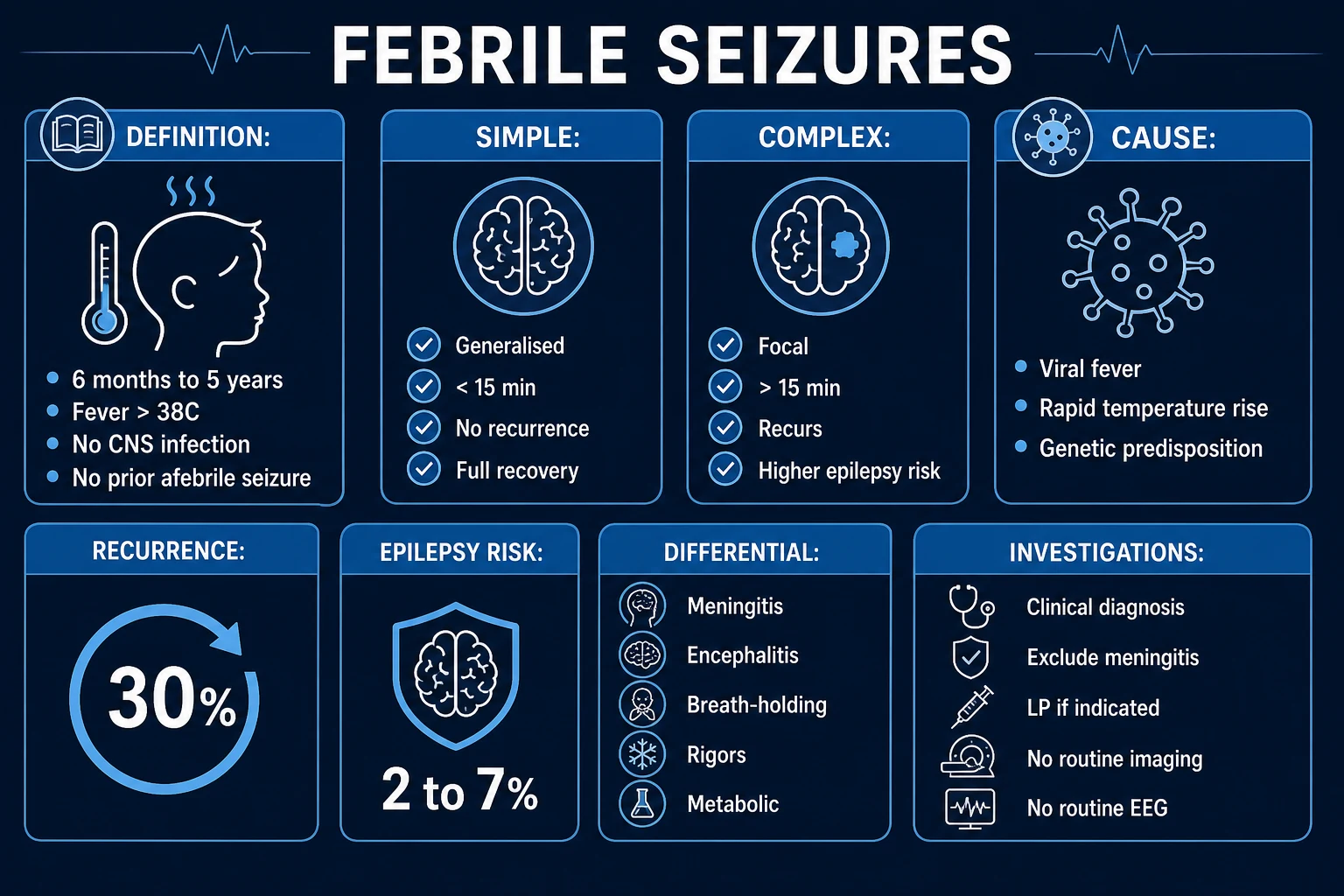
Simple febrile seizure (about 70%)
benign prototype
- **Primary generalized** onset (tonic, clonic, tonic-clonic, or atonic) — **not focal**
- Duration **under 15 minutes** (most last **1 to 3 minutes**)
- Does **not** recur within **24 hours**
- **Full recovery** within minutes to one hour
- **No** routine EEG, neuroimaging, or prophylactic antiepileptics required
- Epilepsy risk later in life: **2 to 5%** (close to the population baseline)
- Manage at home after assessment; counsel parents
Complex febrile seizure (about 30%)
higher risk
- **Focal** onset or focal features during the seizure (e.g. eye deviation, clonic jerking confined to one limb)
- Duration **over 15 minutes**, OR
- **Recurrence** within the same 24-hour febrile illness
- Approximately **4 to 15%** later develop epilepsy (each complex feature adds risk)
- Consider **EEG** (especially if repeated or neurocutaneous stigmata) and **neuroimaging** if focal deficit or prolonged post-ictal state
- Observe in hospital; consider intermittent rescue therapy at home for future fevers
A third category — febrile status epilepticus (FSE) — is defined by the ILAE Task Force as a febrile seizure lasting over 30 minutes, or a series of febrile seizures without full recovery of consciousness in between, in a child with fever and no CNS infection.[9] FSE accounts for roughly 5% of febrile seizures but over 25% of all childhood status epilepticus, carries a measurable risk of hippocampal injury, and demands aggressive protocol-driven termination identical to any convulsive status epilepticus pathway.
Epidemiology & Risk Factors
Febrile seizures are the most common neurological disorder of early childhood.[13]
Febrile seizure — the key numbers
Prevalence is 2 to 5% of all children in North America and Europe; it rises to 8 to 10% in Japan (a striking genetic predilection) and falls below 1 to 3% in some studies from the Indian subcontinent. Boys are affected slightly more than girls (around 1.2 to 1).[13]
Peak incidence is at 12 to 18 months, with about half of all first febrile seizures occurring between 12 and 24 months. Fewer than 5% present before 6 months, and fewer than 10% after 4 years. The first febrile seizure after 5 years is, by definition, not a febrile seizure.[12]
Risk factors for a FIRST febrile seizure (the case-control data of Berg and colleagues) cluster into four additive categories — the more that are present, the higher the chance of a febrile seizure during any febrile illness:[6]
- Family history of febrile seizures — the dominant risk factor; odds ratio around 4 to 5. A first-degree relative with febrile seizures raises the chance roughly four-fold. About 10 to 20% of affected children have an affected first-degree relative.
- Developmental delay or neurological abnormality at baseline — a two- to three-fold increase, and a marker that some of these are not really "febrile seizures" at all but first presentations of structural or genetic epilepsy.
- High peak temperature during the febrile illness — counter-intuitively, the risk of a febrile seizure falls as the temperature rises above 40 C; seizures cluster with lower-grade fevers around 38 to 39 C because these reflect the steep, rising part of the fever curve where the rate of temperature change is greatest.
- Attendance at day care (proxy for frequent viral exposures) and a shorter interval between fever onset and seizure (under one to two hours). [1]
Risk factors for RECURRENCE after a first febrile seizure are among the most frequently examined facts in paediatrics vivas:[6]
Risk factors for later EPILEPSY (the febrile-seizure-to-epilepsy transition) are also additive:[5][13]
- Complex features (focal, prolonged, recurrent) — strongest single predictor.
- Abnormal neurodevelopment before the first febrile seizure (cerebral palsy, intellectual disability, structural brain lesion).
- Family history of afebrile epilepsy (not febrile seizures) in a first-degree relative.
- Febrile status epilepticus at first presentation.
- Multiple recurrences of febrile seizures. [1]
A child with none of these has a subsequent epilepsy risk of about 1% (close to the background population risk). A child with two or more of these features has a risk of about 15% or more.[13]
Pathophysiology
The febrile seizure is the consequence of a developmentally immature brain being driven past its seizure threshold by a rapidly rising temperature, on a background of genetic susceptibility. Three intersecting mechanisms are responsible.[12]
1. The immature neuronal network
Between 6 months and 5 years, the child's cerebral cortex is a hyper-excitable electrical network. Several developmental features converge to lower the seizure threshold during this exact window: [1]
- Excitatory/inhibitory imbalance. Glutamatergic (excitatory) synaptogenesis runs ahead of GABAergic (inhibitory) maturation. The NMDA, AMPA, and kainate receptor subunit composition is developmentally skewed towards calcium-permeable, slowly-desensitising forms that promote prolonged depolarisation. GABA — the mature inhibitory transmitter — is paradoxically depolarising and excitatory in early development because of a high intracellular chloride concentration maintained by the NKCC1 chloride importer (which the mature brain downregulates, swapping to the KCC2 exporter). This is why response to benzodiazepines is preserved (the GABA-A channel still opens) but the substrate is intrinsically excitable.
- Incomplete myelination of intracortical and commissural fibres allows synchronous firing of large neuronal populations — favouring generalisation of any focal discharge.
- Immature ion channel expression (sodium, potassium, calcium, and HCN "pacemaker" channels) increases neuronal excitability and predisposes to temperature-dependent firing. [1]
By age 5, maturation of these systems — especially the GABAergic switch — raises the seizure threshold sufficiently that fever no longer triggers clinical seizures in the vast majority of children. This is why the definition closes at 60 months.[12]
2. The fever trigger
Fever is necessary but the rate of rise matters more than the absolute temperature. A steep rise shifts the temperature-sensitivity curves of voltage-gated sodium and calcium channels and lowers the threshold for action-potential generation. This explains two clinical patterns:[6]
- The seizure often occurs early in the febrile illness, when the temperature is climbing fastest (the "short fever-to-seizure interval" is both a recurrence risk factor and a pathophysiological signature).
- The classic HHV-6 roseola pattern: the child has high fever for 3 to 4 days, then defervesces and seizures as the temperature falls — the rapid fall in temperature is itself a strong trigger in susceptible children. [1]
3. Genetic predisposition
Febrile seizures have the highest heritability of any seizure type. The sibling recurrence risk is 3 to 4 times the population rate, and a positive family history in a first-degree relative is the dominant risk factor.[6]
Two Mendelian syndromes anchor the genetic story and are examinable: [1]
- Familial febrile seizures (autosomal dominant, incomplete penetrance) — linkage to chromosomes 8q13 (FEB1), 19p13 (FEB2), 2q23 (FEB3), and 5q14 (FEB4), among others. Most encode or regulate neuronal ion channels.
- Generalized epilepsy with febrile seizures plus (GEFS+) — first described by Scheffer, an autosomal dominant trait in which febrile seizures persist beyond age 5 or are accompanied by afebrile generalised or focal seizures of varying severity within the same family — from mild febrile seizures at one end to Dravet syndrome (severe myoclonic epilepsy of infancy) at the other. The prototype mutations are in SCN1A (loss-of-function of the alpha subunit of the voltage-gated sodium channel Nav1.1) — over 80% of Dravet syndrome is SCN1A — with SCN1B and GABRG2 mutations in a minority.[10][14]
The clinical correlate is important: a child with multiple prolonged febrile seizures in the first year, focal features, developmental slowing, or a family history of severe epilepsy is not a straightforward simple febrile seizure — think GEFS+ or Dravet and refer to a paediatric neurologist for genetic testing.[10]
Clinical Presentation
The stereotyped simple febrile seizure is one of the most recognisable events in paediatrics. A previously well child, aged typically 1 to 3 years, develops a febrile illness (viral URTI, otitis media, or simply "a temperature"), and within hours of the fever starting — sometimes before the parents even register the fever — the child suddenly stiffens, loses consciousness, and has a generalized tonic-clonic convulsion lasting one to three minutes. The seizure terminates spontaneously; the child is post-ictally sleepy for 10 to 60 minutes, then returns to a normal conscious level and activity.[1]
A detailed semiological history is the cornerstone of classification, and examiners expect the candidate to extract each of the following:[5]
- Prodrome / fever source — runny nose, cough, ear-tugging, rash, vomiting, diarrhoea, recent immunisation. The fever source is usually evident.
- Onset — generalised from the start (whole body stiffening) or focal (eye deviation, twitching of one limb or one side, head turning) — focal onset is a complex feature.
- Duration — measured by the parent's clock (parents notoriously overestimate; ask "what time did it start and what time did it stop, and how did you time it?"). Under 15 minutes is simple; over 15 minutes is complex.
- Semiology — tonic (stiffening), clonic (rhythmic jerking), tonic-clonic, atonic (sudden loss of tone — rare in febrile seizures). Eye deviation, incontinence, mouth twitching, colour change (cyanosis, pallor), and automatisms.
- Recovery — back to baseline within one hour suggests a simple febrile seizure; prolonged obtundation or focal deficit raises concern for meningitis, encephalitis, structural lesion, or ongoing subclinical status.
- Recurrence within 24 hours — a second seizure in the same febrile illness is a complex feature.
- Past history — prior febrile or afebrile seizures, development, immunisation status, family history.
- Antibiotic exposure before the seizure — bacterial meningitis partially treated with oral antibiotics may be masked. [1]
Simple febrile seizure
- Onset **generalized** from the very start — whole body tonic-clonic
- Duration **under 15 minutes** (median 3 to 5 min)
- **No recurrence** in the same 24-hour illness
- Post-ictal state: sleepy but **back to baseline within 1 hour**
- Child has a **viral-type febrile illness**, looks well between seizures
Complex febrile seizure
- **Focal** semiology at any point (eye deviation, asymmetric jerking)
- Duration **over 15 minutes** — prolonged, may need rescue therapy
- **Recurrent** within 24 hours of the same febrile illness
- Higher subsequent epilepsy risk; lower threshold for EEG and imaging
Febrile status epilepticus
- A single febrile seizure lasting **over 30 minutes**, OR a series without recovery in between
- Approximately 5% of febrile seizures; **over 25%** of all childhood status epilepticus
- Treat with the **convulsive status pathway** — escalating benzodiazepines, then second-line AED
- Risk of hippocampal injury and later mesial temporal sclerosis — needs follow-up imaging
Atypical presentations that must NOT be labelled febrile seizures: [1]
- A febrile infant under 6 months with a seizure — exclude neonatal sepsis, meningitis, hypoglycaemia, hyponatraemia, and inborn errors of metabolism.
- A febrile child over 5 years with a convulsion — the diagnosis is unprovoked epilepsy precipitated by fever, intracranial infection, or another defined cause.
- A child who is already encephalopathic, irritable, photophobic, or bulging fontanelle before the seizure — meningitis or encephalitis.
- A focal seizure that does not generalise, has a Todd's paresis, or follows a known neurocutaneous syndrome (tuberous sclerosis, Sturge-Weber) — structural epilepsy, not febrile.
- Shaking with rigors or shivering with a high fever — rigors, not a seizure (rigors stop with warming, consciousness is preserved, the movement is coarse and stops on passive holding).[5]
Differential Diagnosis
The febrile convulsion is a diagnosis of exclusion, and the differential is broad. Each mimic has distinguishing features:[5][12]
Bacterial meningitis
- **The diagnosis you must never miss.** Fever plus seizure plus altered mental state, irritability, bulging fontanelle (infant), neck stiffness, photophobia, petechial/purpuric rash (meningococcaemia), or prolonged post-ictal drowsiness
- Infants under 12 months may show **no meningeal signs** — low threshold for LP
- **Lumbar puncture** (after CT if focal signs / raised ICP) — CSF Gram stain, cell count, protein, glucose, culture; PCR for viruses if indicated
- Empirical IV antibiotics (cefotaxime + vancomycin) within one hour if suspected
Viral encephalitis
- Fever, altered behaviour, confusion, **focal seizures**, movement disorders, **Herpes simplex** (temporal involvement), enterovirus, Japanese encephalitis (endemic India/Asia)
- CSF: lymphocytic pleocytosis, **positive HSV PCR**; EEG: periodic lateralised epileptiform discharges (PLEDs) over temporal lobe; MRI: temporal oedema
- Empirical **IV aciclovir** 10 mg/kg three times daily until HSV excluded
Breath-holding spell (cyanotic)
- Triggered by **minor trauma, fright, or anger**; the child cries briefly, holds breath in expiration, becomes cyanotic, and may lose consciousness briefly with anoxic convulsive movements
- **Always precipitated**; not during sleep; fever is NOT required
- Reassurance; iron studies if pallid or anaemic
Rigors / shivering
- Coarse, symmetric **shivering** with a high fever — **consciousness preserved**, movement **stops on passive holding or warming**
- No post-ictal drowsiness; not a seizure
Vasovagal syncope
- Older child, **standing**, prodrome of pallor, nausea, blurred vision, brief loss of consciousness; **brief** anoxic convulsive movements may occur if held upright
- **Rapid complete recovery** on lying flat; not associated with post-ictal confusion
Shuddering attacks
- Brief, frequent, **shiver-like** movements of head and trunk in infants, **fully conscious**, no post-ictal phase, normal EEG; benign and self-limiting
Electrolyte/metabolic
- **Hypoglycaemia, hyponatraemia (under 125 mmol/L), hypocalcaemia, hypomagnesaemia** — febrile illness can precipitate; check glucose and electrolytes in any atypical or prolonged febrile seizure
- Inborn errors of metabolism in the under-6-month febrile convulsion
First presentation of epilepsy
- Afebrile seizure history missed; developmental delay; neurocutaneous stigmata; focal seizures; family history of epilepsy; **out of the 6 month to 5 year window**
Clinical & Bedside Assessment
A structured ABCDE assessment is mandatory at first contact, particularly if the child is still seizing.[1]
- Airway — patent; position the child in the left lateral position to protect the airway and prevent aspiration of vomit; do not insert objects or fingers into the mouth.
- Breathing — give high-flow oxygen by face mask; observe rate, effort, colour, SpO2 (target over 94%); be prepared to bag-mask-ventilate if apnoeic or cyanosed.
- Circulation — heart rate, capillary refill, pulses, blood pressure; obtain IV access if the seizure is prolonged.
- Disability — blood glucose (seizure + hypoglycaemia = give 5 mL/kg of 10% dextrose), pupil size and reactivity, AVPU/GCS, post-ictal recovery.
- Exposure — full removal of clothing to look for rash (meningococcaemia), source of fever (otitis, cellulitis, petechiae), signs of trauma, and neurocutaneous stigmata (ash-leaf macules, cafe-au-lait patches, port-wine stain). [1]
Focused history should establish: the age (definitional), the fever source and peak temperature, the duration and semiology of the seizure (for simple-versus-complex classification), any recurrence in 24 hours, prior febrile or afebrile seizures, developmental history, family history of febrile seizures and epilepsy, immunisation status, antibiotic exposure, and the parents' account of the post-ictal state. [1]
Targeted examination must look for: [1]
- Temperature and the source of fever (ears, throat, chest, abdomen, skin, urine).
- Meningeal signs — neck stiffness, Kernig's sign (resistance to knee extension with hip flexed), Brudzinski's sign (involuntary hip flexion on neck flexion), bulging fontanelle in the infant. Note that these are unreliable before 12 to 18 months.
- Focal neurological deficit (Todd's paresis) or persistent asymmetry.
- Skin — petechiae/purpura (meningococcaemia), rash of viral exanthem, neurocutaneous stigmata.
- Glasgow Coma Scale — should recover to the child's baseline within one hour in a simple febrile seizure. [1]
The clinical skill is to decide, on the basis of age, semiology, recovery, and exam, whether this is a straightforward simple febrile seizure that needs no investigation and reassurance, or a child who needs a septic workup, LP, EEG, or imaging. [1]
Investigations
The cardinal principle, codified by the AAP 2011 guideline, is that most children with a simple febrile seizure need no investigations at all — the diagnosis is clinical.[1]
Blood tests
- Routine blood tests (FBC, CRP, electrolytes, glucose) are NOT routinely indicated after a simple febrile seizure. They do not predict recurrence or alter management, and a fever source is sought clinically.[1]
- Blood glucose is mandatory at the bedside in any actively seizing or post-ictal child (seizure plus hypoglycaemia = treat the hypoglycaemia first).
- Electrolytes (sodium, calcium, magnesium) if the seizure is prolonged, atypical, recurrent, or the child is under 6 months — hyponatraemia from gastroenteritis is a treatable mimic.
- Blood culture and inflammatory markers only if meningitis or sepsis is suspected.
Lumbar puncture (LP)
LP is performed to exclude bacterial meningitis. The AAP 2011 indications:[1]
When to do a lumbar puncture — LAMP
LAMP
**under 12 months** with fever and seizure — meningeal signs are unreliable in infants
**prior antibiotic treatment** may mask meningeal signs and lower CSF yield
neck stiffness, bulging fontanelle, photophobia, petechiae — at any age
child not recovering to baseline within 1 hour, or persistently altered
Concretely, the AAP 2011 guideline states:[1]
- Strongly consider LP in any child under 12 months who presents with fever and seizure, because meningeal signs are unreliable before this age.
- Consider LP in children 12 to 18 months, as signs remain incompletely reliable.
- LP is generally not required in well-appearing children over 18 months with a simple febrile seizure, unless meningeal signs are present.
- LP should be performed at any age when meningeal signs are present, when the child is critically ill, when there is a petechial rash, or when prior antibiotic treatment may have masked meningitis. [1]
Contraindications to LP — focal neurological deficit, signs of raised intracranial pressure (bulging fontanelle, papilloedema, Cushing's triad), prolonged post-ictal state, coagulopathy, or a critically unstable child. CT brain before LP if raised ICP or focal signs are present; empirical antibiotics should never be delayed while awaiting LP or imaging.[5]
EEG (electroencephalogram)
EEG is NOT routinely indicated after a simple febrile seizure.[1][2] It does not predict recurrence, does not predict later epilepsy, and is abnormal in some otherwise healthy young children without clinical relevance. The AAP and ILAE reserve EEG for:[1][5]
- Complex febrile seizure (especially prolonged or focal).
- Children with abnormal neurodevelopment or focal neurological signs.
- Children with febrile status epilepticus.
- Suspected non-convulsive status in a child not recovering as expected. [1]
Neuroimaging
CT or MRI is NOT routinely indicated after a simple febrile seizure — it does not change management and exposes the child to radiation (CT) or sedation (MRI).[1] Imaging is reserved for:
- Focal, prolonged, or recurrent seizures with abnormal neurological examination.
- Prolonged post-ictal state or focal deficit persisting after the seizure.
- Signs of raised ICP — bulging fontanelle, papilloedema, vomiting, altered consciousness.
- Suspected structural lesion, neurocutaneous syndrome, or trauma.
- Febrile status epilepticus — MRI at follow-up for hippocampal signal change.[9]
Management — Resuscitation
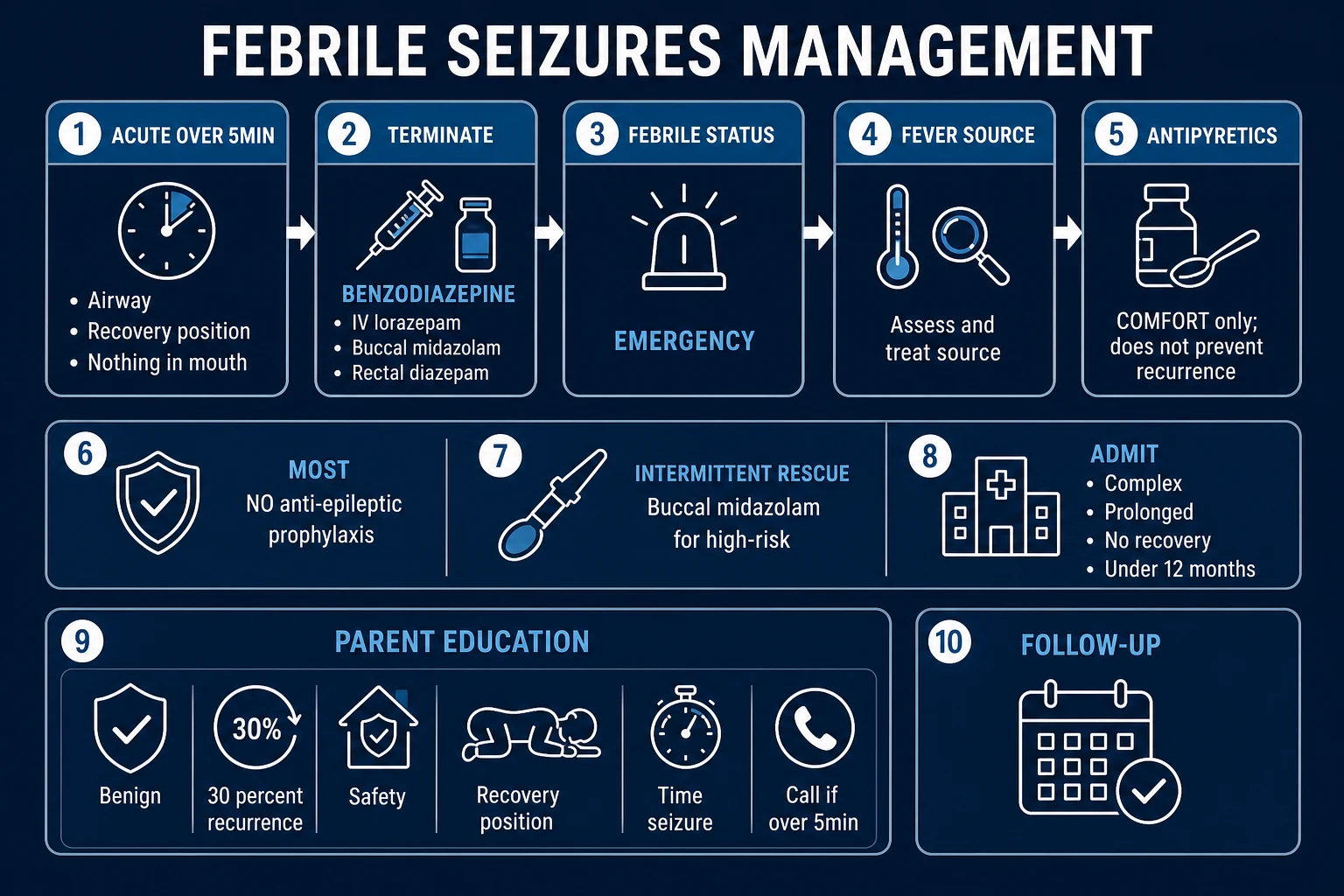
A febrile seizure that has stopped within five minutes needs no acute drug therapy — only ABC support, fever reduction, and exclusion of meningitis. A febrile seizure that is still ongoing at five minutes is convulsive status epilepticus in evolution and must be terminated.[1][7]
Airway, breathing, circulation
- Position the child in the left lateral position to protect the airway.
- High-flow oxygen by face mask (target SpO2 over 94%).
- Airway — suction secretions; do NOT insert objects or fingers into the mouth (risk of dental trauma and airway occlusion); bag-mask-ventilate if apnoeic or cyanosed.
- IV / IO access as soon as feasible; check bedside glucose.
- Treat hypoglycaemia (5 mL/kg of 10% dextrose IV) if present.
- Vital signs — temperature, heart rate, blood pressure, SpO2, capillary refill, GCS. [1]
First-line abortive therapy (seizure over 5 minutes)
A benzodiazepine is first-line; the choice depends on availability, age, and IV access:[7][11]
| Agent | Route | Dose | Onset | Notes |
|---|---|---|---|---|
| Lorazepam | IV/IO | 0.1 mg/kg (max 4 mg), repeat at 5 min | 2 to 3 min | Preferred if IV access; longer duration than diazepam, less respiratory depression |
| Midazolam | Buccal or intranasal | 0.5 mg/kg buccal (max 10 mg); 0.2 to 0.5 mg/kg intranasal | 3 to 5 min | First-line when no IV; safe and effective |
| Diazepam | IV or rectal (PR) | 0.5 mg/kg PR (max 20 mg); 0.3 mg/kg IV | 2 to 5 min (IV), 5 to 10 min (PR) | Rectal formulation (Stesolid) for home/school use |
The McIntyre randomised trial (Lancet 2005) established that buccal midazolam terminates twice as many febrile seizure episodes as rectal diazepam in the emergency setting, with no excess of respiratory depression.[7]
Second-line and beyond (status epilepticus pathway)
If the seizure persists 5 minutes after a benzodiazepine, escalate:[9]
- Levetiracetam 40 to 60 mg/kg IV over 5 min, OR
- Phenytoin / fosphenytoin 20 mg/kg IV (phenytoin equivalents) over 20 min with cardiac monitoring, OR
- Sodium valproate 20 to 40 mg/kg IV (avoid in girls of childbearing potential; check local policy).
- Third-line: intubation, propofol / midazolam infusion, PICU; treat the underlying cause (hypoglycaemia, hyponatraemia, infection). [1]
Fever control during resuscitation
- Remove clothing, tepid sponging (lukewarm water, not cold), fanning.
- Paracetamol 15 mg/kg orally or rectally (maximum 60 mg/kg/day, four doses).
- Ibuprofen 5 to 10 mg/kg orally (maximum 30 mg/kg/day, three doses) if over 3 months. [1]
Antipyretics do NOT prevent febrile seizures — they make the child comfortable but do not change the recurrence rate. This is a frequent viva question.[2]
Management — Definitive & Stepwise
Once the seizure has terminated, the definitive management of a febrile seizure is dominated by parental counselling, fever source identification, and — for selected subgroups — intermittent rescue therapy.[2][3]
Step 1 — terminate any ongoing seizure (above)
Step 2 — identify and treat the source of fever
Examine ears, throat, chest, abdomen, skin, urine. Treat the underlying infection appropriately (antibiotics for otitis media, UTI, pneumonia as indicated). Roseola (HHV-6) needs no specific therapy. [1]
Step 3 — exclude meningitis (LP per AAP indications above)
Step 4 — parental counselling (the single most important step)
The counselling message must be explicit, scripted, and reassuring, because parental terror is the dominant complication:[2]
- A febrile seizure is not epilepsy and does not cause brain damage, intellectual disability, or developmental regression.
- The child will outgrow the tendency by age 5 or 6.
- Recurrence is common — about one in three children will have another, higher if under 12 months — but this does not change the prognosis.
- If a seizure recurs: place the child on the side, time it, do not put anything in the mouth, and call emergency services if it lasts over 5 minutes.
- Treat fever during illnesses with paracetamol and clothing removal — but recognise that this will not prevent a recurrence.
- Provide a home rescue benzodiazepine (buccal midazolam or rectal diazepam) if the child has had a prolonged seizure or the family lives far from hospital; teach the parents when and how to use it.
- The child can return to nursery/school once the febrile illness has resolved. [1]
Step 5 — prophylaxis (what NOT to do)
The AAP and ILAE are explicit: daily prophylactic antiepileptic drugs (phenobarbitone, valproate) are NOT recommended for simple febrile seizures.[2][3][4]
- Phenobarbitone is effective at reducing recurrence but at the cost of hyperactivity, irritability, sleep disturbance, and impaired cognition in up to 20 to 40% of children — risks that grossly outweigh the benefit of preventing a benign event.
- Sodium valproate reduces recurrence but carries hepatotoxicity, thrombocytopenia, and (in girls) teratogenicity risks inappropriate for a benign condition.
- Carbamazepine and phenytoin are ineffective for febrile seizure prophylaxis (they do not reduce recurrence). [1]
Intermittent prophylaxis during fever (oral clobazam 0.75 mg/kg/day for 2 days, or oral diazepam 0.33 mg/kg every 8 hours for 2 to 3 days at the onset of each fever) reduces recurrence by about 50% but is associated with ataxia, drowsiness, and irritability. The AAP 2008 long-term guideline does not recommend it routinely for simple febrile seizures — the side effects outweigh the benefit. It is reserved for selected children with frequent, prolonged, or very distressing recurrent complex febrile seizures, decided jointly with a paediatrician or neurologist.[2][3]
Intermittent intranasal / buccal midazolam or rectal diazepam at home at the start of any seizure over 5 minutes is a reasonable and increasingly used strategy for children who have had a prolonged febrile seizure or febrile status epilepticus — it shortens seizure duration and reduces hospital admissions without the burden of daily prophylaxis.[7][11]
Step 6 — disposition
- Simple febrile seizure, well child, source identified, no red flags: discharge after counselling and observation.
- Complex febrile seizure, prolonged recovery, infant, or unclear diagnosis: observe in hospital; consider EEG and imaging as above; paediatric review.
- Febrile status epilepticus: PICU admission after stabilization; MRI follow-up for hippocampal changes; neurology referral. [1]
Specific Subtypes & Scenarios
- Simple febrile seizure (the prototype) — brief, generalized, no recurrence. No investigation beyond fever source; reassure and discharge. Recurrence risk about 30%; epilepsy risk about 1%.
- Complex febrile seizure (any of focal, prolonged over 15 min, or recurrent in 24 h) — observe in hospital; consider EEG; neuroimaging if focal deficit or prolonged post-ictal state; lower threshold for LP. Epilepsy risk 4 to 15%. Provide home rescue benzodiazepine.[5]
- Febrile status epilepticus (over 30 min) — convulsive status pathway; levetiracetam or phenytoin as second-line after benzodiazepine; intubate if refractory; PICU. Approximately 5% of febrile seizures; hippocampal imaging follow-up. The FEBSTAT study showed that FSE is associated with hippocampal injury and a substantially elevated risk of mesial temporal sclerosis and later temporal lobe epilepsy.[9]
- Febrile seizure plus (FS+) — a child whose febrile seizures persist beyond age 6 or are accompanied by afebrile seizures; the mildest end of the GEFS+ spectrum. Often SCN1A-related. Refer for neurology evaluation and genetic testing if there is developmental concern or a family history of epilepsy.[10][14]
- Generalized epilepsy with febrile seizures plus (GEFS+) — autosomal dominant channelopathy; SCN1A loss-of-function in the majority, SCN1B and GABRG2 in a minority. Within the same family, the phenotype ranges from typical febrile seizures through FS+ to severe myoclonic epilepsy of infancy (Dravet syndrome). Genetic counselling and neurology referral are essential.[10]
- Dravet syndrome (severe myoclonic epilepsy of infancy) — begins in the first year of life with prolonged febrile hemiclonic seizures triggered by fever or vaccination, later complicated by afebrile seizures, developmental slowing, and ataxia. Over 80% are SCN1A mutation-positive. A child with recurrent prolonged febrile seizures in infancy, especially focal or alternating sides, with developmental concern, must be referred urgently — early diagnosis changes management (avoid sodium-channel blockers like lamotrigine and carbamazepine; use valproate, clobazam, stiripentol, cannabidiol).[14]
- Post-vaccination febrile seizure — febrile seizures may follow any vaccine that causes fever (most commonly the DTP / whole-cell pertussis component on day 1 to 3, and the MMR on day 6 to 14). The seizure is a febrile response, not a direct vaccine adverse event. The risk is tiny (approximately 1 in 1500 to 3000 doses) and the prognosis identical to any other febrile seizure. Vaccination should not be withheld, and febrile seizures are not a contraindication to further immunisation.[12]
Complications & Pitfalls
Acute complications: [1]
- Status epilepticus — a febrile seizure persisting over 30 minutes is a neurocritical emergency; risk of hypoxia, hypotension, aspiration, and hippocampal injury.[9]
- Injury during the seizure — tongue biting (rare and minor), falls, aspiration of vomit (minimised by left lateral position).
- Hypoxia and respiratory depression from prolonged seizure or over-treatment with benzodiazepines.
- Misdiagnosis — the single most important pitfall is labelling meningitis or encephalitis as a febrile seizure, particularly in the under-12-month infant or the partially treated child. Always exclude CNS infection.[1]
Long-term complications: [1]
- Recurrence — about 30% overall, rising to 50% if the first seizure is under 12 months. Recurrence does not predict later epilepsy in the absence of complex features.[6]
- Epilepsy — 2 to 5% after a simple febrile seizure (close to the population baseline of about 1%); 4 to 15% after a complex febrile seizure; substantially higher after febrile status epilepticus. The risk is concentrated in children with abnormal baseline development, family history of afebrile epilepsy, focal features, or multiple recurrences.[13]
- Hippocampal sclerosis after prolonged febrile seizures (FEBSTAT data) — a possible (and debated) precursor of mesial temporal lobe epilepsy.[9]
- Sudden unexplained death — population data (Vestergaard, Lancet 2008) show that children with febrile seizures do not have an excess mortality compared with the general population, except a small subgroup with complex features and underlying neurological abnormality.[8]
- Cognitive and behavioural outcome — multiple large cohort studies (including the National Collaborative Perinatal Project and the UK CHILD cohort) confirm no long-term cognitive or behavioural impairment after simple febrile seizures.[8]
Parental impact — the most common "complication" of a febrile seizure is parental anxiety, post-traumatic stress symptoms, and overprotective behaviour. Effective structured counselling reduces recurrent healthcare utilisation and improves quality of life.[2]
Classic pitfalls to avoid in the exam and at the bedside:[1][2]
- Calling a febrile seizure "epilepsy" — it is not, unless it becomes recurrent afebrile seizures.
- Ordering an EEG, CT, or routine bloods after every simple febrile seizure — the AAP 2011 guideline explicitly advises against this.
- Starting daily phenobarbitone or valproate for simple febrile seizure — risk outweighs benefit.
- Failing to LP an infant under 12 months with fever and seizure — meningeal signs are unreliable.
- Believing antipyretics prevent febrile seizures — they do not; they relieve discomfort.
- Mistaking rigors for a seizure, or a breath-holding spell for a febrile seizure.
- Missing Dravet syndrome in an infant with recurrent prolonged febrile seizures — the window for disease-modifying therapy is early. [1]
Prognosis & Disposition
The prognosis of febrile seizures is, in the great majority of cases, excellent.[2][8]
- Most children outgrow the tendency by age 5 to 6 as the brain matures and the GABAergic system takes over from NKCC1-mediated excitatory GABA.
- No cognitive impairment, no behavioural disturbance, no structural brain damage after a simple febrile seizure.
- Recurrence: about 30% overall after a first febrile seizure; the recurrence risk falls with each passing year of age and is negligible after 4 to 5 years.[6]
- Epilepsy: lifetime risk is approximately 1% in the general population, 2 to 5% after a simple febrile seizure, and 4 to 15% after a complex febrile seizure. The risk is concentrated in those with abnormal neurodevelopment, family history of afebrile epilepsy, focal features, or febrile status epilepticus.[13]
- Mortality: no excess mortality in children with febrile seizures in population cohort data, except for the small subgroup with underlying neurological abnormality and complex seizures.[8]
Disposition decisions: [1]
- Simple febrile seizure, well child: discharge with parental counselling; no follow-up investigations unless recurrence.
- Complex febrile seizure: inpatient observation; EEG and/or imaging as indicated; paediatric or neurology review; consider home rescue therapy.
- Febrile status epilepticus: PICU; neurology follow-up; MRI brain at 3 to 6 months for hippocampal assessment. [1]
Special Populations
- Child under 6 months — by definition not a febrile seizure. Differential includes neonatal sepsis, bacterial meningitis, hypoglycaemia, hyponatraemia, hypocalcaemia, inborn errors of metabolism, structural brain lesion. Full septic workup, LP, EEG, and imaging are usually required.
- Child over 5 years — by definition not a febrile seizure. The diagnosis is unprovoked epilepsy precipitated by fever, intracranial infection, or another defined cause. EEG, neuroimaging, and neurology referral.
- Developmental delay / pre-existing neurological abnormality (cerebral palsy, post-hypoxic, post-meningitis) — these children are at higher risk of underlying structural epilepsy; lower threshold for EEG, imaging, and neurology referral. Some will, in retrospect, have had their first seizure of a structural/genetic epilepsy, not a febrile seizure.
- Neurocutaneous syndromes — tuberous sclerosis complex (infantile spasms, focal seizures), Sturge-Weber syndrome (port-wine stain, leptomeningeal angioma, contralateral seizures), neurofibromatosis type 1 — a "febrile seizure" in these contexts is likely a focal structural seizure and merits neuroimaging and neurology referral.
- Children with GEFS+ / Dravet spectrum — recurrent prolonged febrile seizures in infancy, especially alternating hemiclonic, with developmental slowing or family history of severe epilepsy, mandate urgent SCN1A testing and neurology referral. Avoid sodium-channel blockers (lamotrigine, carbamazepine) in confirmed Dravet.[10][14]
- The immunocompromised child — fever plus seizure in a child on chemotherapy, post-transplant, or with HIV: full septic workup, LP, and empirical broad-spectrum antibiotics and aciclovir.
- The recently vaccinated child — see above; the prognosis is identical and further immunisation should continue.
- Living in a remote location / parental anxiety — provide a home rescue benzodiazepine (buccal midazolam 0.5 mg/kg or rectal diazepam 0.5 mg/kg) and a written emergency plan.[7]
Evidence, Guidelines & Regional Differences
The two foundational AAP guidelines govern practice worldwide:[1][2]
- AAP 2011 (Subcommittee on Febrile Seizures) — Neurodiagnostic evaluation of the child with a simple febrile seizure, Pediatrics 2011. Conclusion: a simple febrile seizure in a well child does not warrant routine blood tests, EEG, neuroimaging, or LP (provided the child is over 18 months, has no meningeal signs, and has not had prior antibiotics).[1]
- AAP 2008 (Subcommittee on Febrile Seizures) — Clinical practice guideline for the long-term management of the child with simple febrile seizures, Pediatrics 2008. Conclusion: prophylactic antiepileptics (phenobarbitone, valproate) are not recommended for simple febrile seizures because the risks outweigh the benefits; intermittent diazepam during fever is effective but limited by side effects; antipyretics alone do not prevent recurrence.[2][3][4]
The ILAE Ad Hoc Task Force (Capovilla, Epilepsia 2009) produced the operational definition and management recommendations adopted across Europe and India:[5]
- Confirms the 6-month-to-5-year window, the fever threshold over 38 C, and the simple/complex split.
- Recommends no routine EEG or neuroimaging for simple febrile seizures.
- Endorses parental counselling and reserve intermittent clobazam or benzodiazepines for selected complex cases. [1]
The ILAE Task Force on Status Epilepticus (Trinka, Epilepsia 2015) defined febrile status epilepticus and aligned its management with the generalised convulsive status pathway.[9]
The McIntyre randomised controlled trial (Lancet 2005) established buccal midazolam as superior to rectal diazepam for terminating acute seizures in children, including febrile seizures, with no excess respiratory depression. This is the evidence base for the modern preference for buccal midazolam in children without IV access.[7]
Population cohort evidence (Vestergaard, Lancet 2008; Hauser, Mayo Clinic Proceedings 1996) provides the reassuring mortality, recurrence, and epilepsy-risk figures used in counselling.[8][13]
[1] [1]Exam Pearls
DEFINES a febrile seizure
DEFINES
or under 30 min = not status; over 30 min = febrile status epilepticus
LP if under 12 mo, prior antibiotics, meningeal signs, prolonged post-ictal
rapid rise matters more than the absolute height
outside the window = not a febrile seizure
if present, the diagnosis is epilepsy, not febrile seizure
always the cognitive priority at first contact
any deviation = complex
Recurrence risk factors — the AAP 4
RISK
recurrence risk rises to about 50%
first-degree relative doubles the risk
reflects steep temperature rise
heightened seizure threshold signature
Simple vs complex — at a glance
- **Simple**: generalized, **under 15 min**, no recurrence in 24 h, full recovery, **no** investigations, prognosis excellent
- **Complex**: any of focal, **over 15 min**, recurrence in 24 h — **4 to 15%** epilepsy risk, consider EEG/imaging
- **Febrile status epilepticus**: **over 30 min** — convulsive status pathway, hippocampal follow-up imaging
The numbers an examiner wants
- **Age window: 6 months to 5 years**
- **Fever threshold: over 38 C**
- **Prevalence: 2 to 5%**
- **Recurrence: about 30% (50% if under 12 mo)**
- **Epilepsy risk: 1% (simple), 4 to 15% (complex)**
- **Buccal midazolam 0.5 mg/kg; rectal diazepam 0.5 mg/kg; IV lorazepam 0.1 mg/kg**
- **Most children outgrow by age 5**
What NOT to do
- Do NOT routinely order EEG, CT, or bloods for a simple febrile seizure
- Do NOT start daily phenobarbitone or valproate for simple febrile seizure
- Do NOT skip LP in an infant under 12 months with fever and seizure
- Do NOT believe antipyretics prevent febrile seizures — they do not
- Do NOT call a febrile seizure 'epilepsy'
Drug doses that decide a febrile-seizure answer
Exam application bank (NEET-PG / INICET)
One-line answer
Febrile seizure = a seizure accompanied by fever (over 38 C / 100.4 F) in a child aged 6 months to 60 months (5 years), without evidence of central nervous system infection or a prior afebrile seizure, and without a defined acute neurological cause. Simple febrile seizure (SFS, about 70%): primary generalized, lasts under 15 minutes, does not recur within 24 hours. Complex febrile seizure (CFS, about 30%): any of focal onset, duration over 15 minutes, or recurs within 24 hours. Febrile status epilepticus: a febrile seizure lasting over 30 minutes. Affects 2 to 5% of children; peak age 12 to 18 months. Affects boys slightly more. Does NOT cause brain damage, cognitive impairment or epilepsy in the vast majority. Recurrence risk after a first febrile seizure is about 30% (50% if under 12 months). Subsequent epilepsy risk is 2 to 5% (simple) and 4 to 15% (complex). Active seizure lasting ov
Worked stems (answer without another resource)
Stem 1 — Classic presentation. Map symptoms to mechanism; name the first investigation and first treatment step with dose/route if drug therapy is standard. [1]
Stem 2 — Unstable / complicated. List red flags that force immediate resuscitation, theatre, ICU, antidote, or reperfusion — and what you do in the first 15 minutes. [1]
Stem 3 — Atypical group. Elderly, pregnancy, child, or immunocompromised: how presentation and thresholds change. [1]
Stem 4 — Differential trap. Name the three closest mimics and one discriminator for each. [1]
Stem 5 — Disposition. Who goes home with safety-netting, who is admitted, who needs HDU/ICU/theatre, and what follow-up is mandatory. [1]
Rapid viva checklist
- Definition + classification
- Pathophysiology chain
- Bedside signs / criteria
- Score with exact components (if any)
- Emergency bundle
- Definitive therapy with doses
- Complications of disease and of treatment
- Special populations
- Guideline/trial name if classic
- Three exam traps
Coverage self-check
If you cannot answer any stem above from this page alone, re-read the matching section — the page is intended to be self-sufficient for final-prof and NEET-PG/INICET questions on Febrile Seizures.
References
- [1]Subcommittee on Febrile Seizures, American Academy of Pediatrics. Neurodiagnostic evaluation of the child with a simple febrile seizure Pediatrics, 2011.PMID 21285335
- [2]Steering Committee on Quality Improvement and Management, Subcommittee on Febrile Seizures, American Academy of Pediatrics. Febrile seizures: clinical practice guideline for the long-term management of the child with simple febrile seizures Pediatrics, 2008.PMID 18519501
- [3]Baumann RJ. Technical report: treatment of the child with simple febrile seizures Pediatrics, 1999.PMID 10353983
- [4]Baumann RJ, Duffner PK. Treatment of children with simple febrile seizures: the AAP practice parameter. American Academy of Pediatrics Pediatr Neurol, 2000.PMID 10963965
- [5]Capovilla G, Mastrangelo M, Romeo A, et al.; Ad Hoc Task Force of LIAE Commission on Paediatrics. Recommendations for the management of febrile seizures: Ad Hoc Task Force of LICE Guidelines Commission Epilepsia, 2009.PMID 19125841
- [6]Berg AT, Shinnar S, Shapiro ED, Salomon ME, Crain EF, Hauser WA. Predictors of recurrent febrile seizures. A prospective cohort study Arch Pediatr Adolesc Med, 1997.PMID 9111436
- [7]McIntyre J, Robertson S, Norris E, et al. Safety and efficacy of buccal midazolam versus rectal diazepam for emergency treatment of seizures in children: a randomised controlled trial Lancet, 2005.PMID 16023510
- [8]Vestergaard M, Pedersen MG, Ostergaard JR, et al. Death in children with febrile seizures: a population-based cohort study Lancet, 2008.PMID 18692714
- [9]Trinka E, Cock H, Hesdorffer D, et al. A definition and classification of status epilepticus--Report of the ILAE Task Force on Classification of Status Epilepticus Epilepsia, 2015.PMID 26336950
- [10]Zhang YH, Burgess R, Malone JP, et al. Genetic epilepsy with febrile seizures plus: Refining the spectrum Neurology, 2017.PMID 28842445
- [11]Brigo F, Nardone R, Tezzon F, Trinka E. A Common Reference-Based Indirect Comparison Meta-Analysis of Buccal versus Intranasal Midazolam for Early Status Epilepticus CNS Drugs, 2015.PMID 26293745
- [12]Tiwari A, Kaur J, Kaur J. Febrile Seizures in Children: A Review Cureus, 2022.PMID 36540525
- [13]Hauser WA, Annegers JF, Kurland LT. Descriptive epidemiology of epilepsy: contributions of population-based studies from Rochester, Minnesota Mayo Clin Proc, 1996.PMID 8642887
- [14]Lossin C. SCN1A Seizure Disorders 1993.PMID 20301494