Psychiatry · General Medicine
ECT & Brain Stimulation Therapies
Also known as Electroconvulsive therapy · ECT · Brain stimulation · rTMS · Vagus nerve stimulation · Deep brain stimulation · Transcranial direct current stimulation
Electroconvulsive therapy (ECT) is the most effective acute treatment in psychiatry: a generalised, therapeutically-adequate seizure is induced under general anaesthesia and a muscle relaxant, with continuous EEG monitoring, to treat severe mental illness. First-line indications: severe depression with psychotic features, catatonia, treatment-resistant depression, severe mania, postpartum psychosis, life-threatening psychiatric illness (refusal of food/fluids, active suicidality), Parkinson disease (refractory motor and affective symptoms), and neuroleptic malignant syndrome. The index course is 2 to 3 sessions per week, 6 to 12 treatments in total, continued until sustained improvement. Main side effect is short-term cognitive disturbance — anterograde amnesia resolves within weeks; retrograde autobiographical amnesia may persist in some. Modern ECT uses anaesthesia + muscle relaxant + continuous EEG — there are no visible convulsions and mortality is about 1 in 80,000. rTMS is a non-invasive outpatient alternative for depression and OCD (no anaesthesia, no cognitive side effects). Esketamine nasal spray is a rapid-acting NMDA antagonist for treatment-resistant depression. VNS and DBS are last-resort options for refractory depression. ECT is safe in pregnancy and the elderly.
On this page & tools
Your progress
Saved locally on this device.
Exam tags
Red flags
Overview & Definition
Electroconvulsive therapy (ECT) is a treatment in which a therapeutically-adequate generalised seizure is induced by passing a brief, carefully-dosed electrical current across the brain, under general anaesthesia and a short-acting muscle relaxant, with continuous electroencephalographic (EEG) monitoring. The visible convulsion of early (unmodified) ECT is abolished by the muscle relaxant — the therapeutic effect comes from the seizure in the brain, not the bodily convulsion.[1]
ECT is stigmatised, feared, and systematically underused, yet it is, paradoxically, the single most effective acute treatment in psychiatry — more effective than any antidepressant for severe depression, the definitive treatment for catatonia, and a life-saving intervention in psychiatric emergencies. The clinical skill is knowing when to reach for it early rather than as a last resort, and reassuring patients and families that modern ECT bears no resemblance to its cinematic depiction. The decision to recommend ECT is always one of informed consent (or, rarely, statutory authorisation under mental health legislation), weighing the severity and urgency of the illness against the burden of treatment — chiefly its cognitive side effects.[1][3]

Classification
Brain stimulation therapies are classified along two axes — whether they provoke a seizure (convulsive vs non-convulsive) and whether they require surgery or anaesthesia (invasive vs non-invasive). ECT is the prototype convulsive therapy; rTMS, tDCS, tACS and MST are non-invasive; VNS and DBS are surgical (invasive).[3]
The brain stimulation modalities at a glance
ECT
- Convulsive, requires general anaesthesia + muscle relaxant
- Most effective acute psychiatric treatment
- Indications: severe/psychotic depression, catatonia, life-threatening illness, severe mania, postpartum psychosis, NMS, Parkinson (refractory)
- Main side effect: short-term cognitive disturbance
- Index course: 2 to 3 per week, 6 to 12 treatments
- Safe in pregnancy and the elderly
rTMS
- Non-convulsive, non-invasive, awake outpatient procedure
- Magnetic pulses to cortex (no anaesthesia)
- Indications: treatment-resistant depression, OCD, smoking cessation; emerging in anxiety, PTSD
- Target: left dorsolateral prefrontal cortex (DLPFC)
- Course: about 36 sessions over 6 weeks
- Side effects: headache, scalp discomfort, seizure (under 0.1 percent); no cognitive side effects
tDCS
- Non-invasive, weak direct current (1 to 2 mA) modulates cortical excitability
- Investigational for depression, cognitive and pain disorders
- Portable, low cost, very benign side-effect profile
- Effect size modest — still emerging
Esketamine
- NMDA-receptor antagonist, rapid-acting antidepressant
- Nasal spray (SPRAVATO), supervised in REMS-certified centre
- Indication: treatment-resistant depression, MDD with acute suicidal ideation
- Onset within hours; main side effects: dissociation, sedation, hypertension, potential for misuse
- Used WITH a new oral antidepressant
VNS
- Surgical implant, intermittent stimulation of left vagus nerve
- Indication: chronic/recurrent treatment-resistant depression (slow benefit over months)
- Also used in drug-resistant epilepsy
DBS
- Stereotactic implanted electrodes (e.g. subcallosal cingulate, nucleus accumbens)
- Investigational/research for refractory depression and OCD
- Reversible and programmable; risks of surgery and infection
MST
- Magnetic seizure therapy — induces seizure with magnetic pulses (not electrical)
- Investigational; aims for ECT-like efficacy with fewer cognitive side effects
Epidemiology & Risk Factors
ECT is used worldwide but rates vary widely between countries and even between centres in the same country, reflecting differences in stigma, service configuration, and guideline interpretation. Recipients are predominantly older adults, women (reflecting the higher prevalence of depression), and patients with severe, recurrent or psychotic mood disorders. In India and South Asia, ECT is also used (sometimes as unmodified ECT in resource-limited settings, though this is discouraged by international guidelines) for a broad range of severe presentations including treatment-resistant schizophrenia.[7]
Factors that predict a strong ECT response (high-yield — these are the indications examiners reward): [1]
ECT efficacy markers at a glance
Strong predictors of response: psychotic features (delusions/hallucinations within a depressive episode), catatonia, acute suicidality, marked psychomotor disturbance (agitation or retardation), postpartum onset, shorter episode duration, and a history of prior ECT response.[1]
Predictors of poorer or attenuated response: chronic, low-grade dysthymic presentations, prominent personality pathology, comorbid substance use, marked cognitive impairment at baseline (especially degenerative dementia, where cognitive side effects compound), and a long duration of the current episode. [1]
Pathophysiology
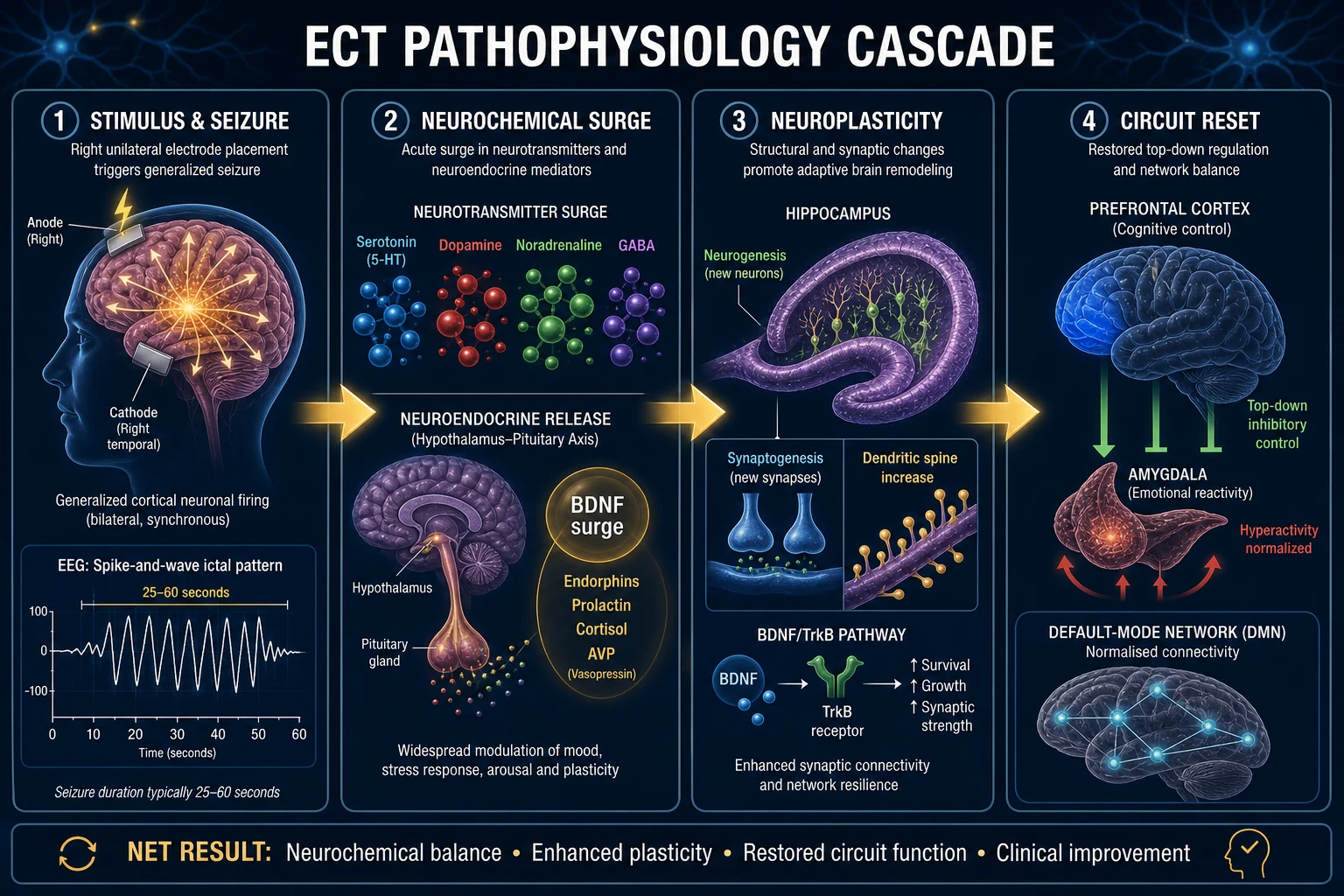
The therapeutic principle is deceptively simple: a generalised seizure of adequate duration must occur, and the seizure itself — not the visible motor convulsion — carries the antidepressant and anti-catatonic effect. The muscle relaxant abolishes the peripheral convulsion but the central seizure proceeds, monitored by EEG. Exactly how the seizure translates into clinical benefit is incompletely understood, but several converging mechanisms are well established.[1]
1. The stimulus and the seizure. A brief-pulse electrical stimulus (modern ECT uses a bidirectional brief pulse, 0.5 to 1.5 ms per phase at standard settings, or an ultra-brief pulse of 0.25 to 0.3 ms) is delivered through scalp electrodes. The minimum current that produces a seizure is the seizure threshold, which varies 40-fold between individuals (higher in men, older patients, and those on anticonvulsants) and typically rises over a treatment course, so dose titration is required. The therapeutic seizure must be generalised, bilateral, and of adequate duration — conventionally at least 25 seconds of total (EEG plus motor) seizure activity, with an EEG pattern of highly synchronous high-amplitude polyspike activity followed by post-ictal suppression. An inadequate seizure is restimulated at a higher dose at the same session.[2]
2. Neurochemical effects. The seizure modulates monoamine systems: enhancement of serotonergic and noradrenergic transmission, downregulation of presynaptic alpha-2 autoreceptors (disinhibiting release), and changes in dopamine (beneficial in Parkinson disease and depression). GABAergic and glutamatergic transmission is reset — a likely contributor to anti-catatonic and anticonvulsant effects.[1]
3. Neuroendocrine surge. The seizure provokes a hypothalamic-pituitary release of prolactin, cortisol, ACTH, endorphins, and vasopressin (AVP). The prolactin surge (a marker used to confirm an adequate generalised seizure) and the HPA-axis normalisation are linked to antidepressant effect.[1]
4. Neuroplasticity — the leading modern hypothesis. ECT produces one of the largest surges of brain-derived neurotrophic factor (BDNF) achievable therapeutically, activating the TrkB receptor and driving hippocampal neurogenesis, synaptogenesis, dendritic arborisation, and increased dendritic spine density. This growth-factor hypothesis mirrors what antidepressants achieve, but more rapidly and more powerfully, and is the leading explanation for the structural and functional changes seen on MRI (volume increase in limbic and prefrontal regions).[1]
5. Network reset. Functional imaging shows that ECT normalises the hyperactive default-mode network (overactive in depression and rumination) and restores top-down regulation of the limbic system by the prefrontal cortex — the same circuits targeted (more focally) by rTMS, VNS and DBS, which is why these modalities share indications despite different delivery.[3]
Mechanistic comparison with the other modalities: rTMS delivers a focal magnetic pulse that induces a small electrical current in superficial cortex (no seizure, no anaesthesia); tDCS applies a weak tonic current that shifts resting membrane potential; esketamine blocks NMDA receptors on cortical interneurons, producing a glutamate surge and rapid synaptogenesis (hence onset within hours); VNS and DBS deliver chronic electrical stimulation to the vagus nerve or deep brain targets. All ultimately converge on the same prefrontal-limbic circuits — only the route of access and the breadth of effect differ.[3]
Clinical Presentation
There is no "presentation of ECT" — patients present with the psychiatric illness, and the treating team decides whether brain stimulation is indicated. The clinical scenarios that should trigger early ECT consideration are: [1]
Severe depression with psychotic features. A patient with profound depressive stupor, nihilistic or somatic delusions (e.g. believing their organs are rotting, or that they are already dead — Cotard syndrome), and active suicidality. This presentation responds more reliably and more rapidly to ECT than to pharmacotherapy.[1]
Catatonia. A syndrome of psychomotor dysregulation manifesting as stupor, mutism, posturing, negativism, waxy flexibility, stereotypy, echolalia/echopraxia, and — in its malignant form — hyperpyrexia, autonomic instability, rigidity and raised creatine kinase. Catatonia complicates mood disorders, schizophrenia, and organic brain disease, and is rapidly lethal if untreated (dehydration, venous thromboembolism, aspiration, pressure injury). Lorazepam is first-line; ECT is the definitive treatment when lorazepam fails or the presentation is malignant.[8][11]
Life-threatening psychiatric illness. A depressed or psychotic patient refusing food and fluids to the point of physiological compromise, or with active, intent-laden suicidal behaviour that cannot be safely contained — ECT can be delivered under mental health legislation and may be life-saving within days.[1]
Severe mania unresponsive to or precluded from medication. Where antipsychotics or lithium are contraindicated (e.g. pregnancy, severe medical comorbidity) or have failed, ECT is effective for mania.[12]
Postpartum psychosis. A psychiatric emergency of rapid onset in the first two postpartum weeks, with delusions, mood lability, confusion and a high risk of infanticide and suicide. ECT is safe in pregnancy and postpartum and can abort the episode rapidly.[13]
Treatment-resistant depression. Failure of two or more adequate antidepressant trials of different classes. ECT is the most effective option; rTMS and esketamine are alternatives depending on urgency, patient preference, and cognitive risk profile.[3][6]
Parkinson disease and neuroleptic malignant syndrome. ECT improves both the motor symptoms of Parkinson disease (especially the "off" periods and levodopa-induced dyskinesia) and associated depression, and is a rescue therapy for NMS refractory to supportive care and dantrolene/bromocriptine.[8]
Atypical and important presentations. In the elderly, ECT is often preferred because it avoids drug-drug interactions, is faster than pharmacotherapy, and is safe in cardiac disease with monitoring — but baseline cognitive impairment must be weighed. In pregnancy, ECT avoids teratogenic drugs and is safe for mother and fetus. In adolescents, ECT is reserved for severe, life-threatening illness, with careful consent and safeguarding.[10][13]
Differential Diagnosis
The relevant "differential" for ECT is which treatment to choose for a given severe psychiatric presentation, and which organic states mimic catatonia and must be excluded before ECT. [1]
Distinguishing the catatonic-look-alikes (must exclude before ECT)
Catatonia (primary)
- BFCRS-positive; responds to lorazepam test dose
- Stupor, posturing, waxy flexibility, mutism, negativism, stereotypy
- A complication of mood disorder, schizophrenia, or medical illness
- ECT is the definitive treatment when refractory
Neuroleptic malignant syndrome (NMS)
- Recent antipsychotic exposure; lead-pipe rigidity, high fever (above 38), autonomic instability
- Raised creatine kinase, leucocytosis, low serum iron
- Often overlaps with malignant catatonia — supportive care + dantrolene/bromocriptine; ECT if refractory
Serotonin syndrome
- Recent serotonergic drug; clonus (especially lower limbs), hyperreflexia, mydriasis, GI upset
- Onset within 24 hours; rapidly progressive
- Treat with cessation, benzodiazepines, cyproheptadine — NOT ECT
Malignant hyperthermia
- Triggered by volatile anaesthetics or succinylcholine (relevant to ECT anaesthesia)
- Rapid rise of CO2, rigidity, fever
- Treat with dantrolene — a reason to avoid succinylcholine in known MH
Organic stupor / encephalopathy
- Encephalitis (incl. anti-NMDAR), autoimmune, metabolic, structural lesion
- Focal neurology, seizure, fever, CSF pleocytosis, MRI changes
- Investigate with neuroimaging, EEG, bloods and CSF — treat the cause, not ECT first
Psychotic depression vs schizophrenia-with-depression
- Mood-congruent delusions, prominent depressive affect, psychomotor change favour psychotic depression (ECT-responsive)
- Schneiderian first-rank symptoms, blunted affect, thought disorder favour schizophrenia
- ECT is adjunctive in TRS; first-line in catatonic or affective presentations
The other key "differential" decision is between the brain stimulation modalities themselves for treatment-resistant depression — covered in Management below. [1]
Clinical & Bedside Assessment
A patient being assessed for ECT requires a structured psychiatric, cognitive and physical work-up, because candidacy depends on balancing indication against anaesthetic and cognitive risk. [1]
Psychiatric assessment. Confirm the diagnosis and indication (use DSM-5-TR or ICD-11 criteria), document severity with a validated rating scale (HAM-D, MADRS, BPRS, YMRS for mania), record the duration of illness and prior treatment trials (drug, dose, duration, adherence, response — to establish treatment resistance where relevant), and document the rationale for ECT (failure of, or inability to use, pharmacotherapy; urgency). Establish capacity and discuss consent.[1]
Cognitive baseline (mandatory). A pre-ECT cognitive screen (MMSE or MoCA, plus a brief test of autobiographical memory such as the Columbia Autobiographical Memory Interview — AMI) documents the starting point against which treatment-related cognitive change is measured. Baseline impairment does not preclude ECT but informs electrode placement, pulse width and dosing choices.[1]
Catatonia assessment. Apply the Bush-Francis Catatonia Rating Scale (BFCRS) — a 23-item scale scoring signs from stupor, immobility, mutism and staring through to waxy flexibility, ambitendency, gegenhalten and automatic obedience. A screening score of 2 or more on the 14-item BFCRS screening supports the diagnosis. Confirm with the lorazepam challenge test — give lorazepam 2 mg intramuscularly (or 1 mg IV) and observe for a partial or complete resolution of catatonic signs within 5 to 10 minutes. A positive response predicts both lorazepam responsiveness and a good ECT response.[8]
Physical and anaesthetic assessment. Focused history (cardiac disease, recent MI/stroke, intracranial mass/hydrocephalus, pheochromocytoma, anaesthetic complications, drug allergies), examination (BP, heart sounds, airway, dentition, neurological), and review of intercurrent medications (lithium, anticoagulants, diuretics, insulin, theophylline, benzodiazepines — each with implications, see below). The anaesthetist assesses ASA grade and airway.[1]
Pre-procedure monitoring at each session. Continuous ECG, blood pressure (often arterial line in cardiac disease), pulse oximetry, and EEG (two-channel, to record and confirm seizure activity and duration). A blood-pressure cuff is inflated around an ankle before the muscle relaxant is given (isolating it from the circulation) so that the motor seizure is observed and timed at that limb even though the body is paralysed — this is the "motor cuff" or "isolated-arm technique". A bite block protects the teeth and tongue from the clonic jaw contraction.[1]
Investigations
Mandatory pre-ECT investigations are deliberately limited — ECT is not a diagnosis of exclusion, and over-investigation delays treatment:[1]
- Bloods — full blood count, urea and electrolytes (correct any severe hyponatraemia, hypokalaemia), glucose, LFTs.
- ECG — in all patients over 50 and anyone with cardiac disease; ECT causes an acute haemodynamic surge (parasympathetic bradycardia or asystole followed by sympathetic hypertension/tachycardia) that stresses the myocardium.
- Pregnancy test (beta-hCG) — in all women of reproductive potential.
- Chest X-ray — if respiratory or cardiac disease present.
- Neuroimaging (CT or MRI brain) — only if there is focal neurology, raised intracranial pressure, a recent head injury, new-onset seizures, immunocompromise, or cognitive decline of uncertain cause. A known stable, non-raised-ICP brain lesion (e.g. old infarct, meningioma) is not an absolute contraindication to ECT — discuss with neurosurgery/anaesthesia.
- Baseline cognitive test (MMSE/MoCA, AMI) — as above. [1]
Contraindications to ECT — there are very few absolute contraindications; the only ones widely cited are a recent (under about 3 months) myocardial infarction or stroke, a space-occupying intracranial lesion with raised intracranial pressure (risk of herniation), recent intracranial neurosurgery, and phaeochromocytoma (uncontrolled catecholamine surge). All others — cardiac disease, pacemakers/ICDs, aortic aneurysm, severe COPD, pregnancy, old stroke, brain tumour without raised ICP, anticoagulation — are relative contraindications: ECT can be performed with modification (cardiology review, reprogramming pacemakers to a fixed mode, anticoagulation bridging, left-lateral tilt in pregnancy, dose-titration, ultra-brief pulse RUL). The benefit-to-risk decision is individualised.[1]
Stimulus dosing and adequacy (high-yield — reproduced principles, not a single score): [1]
- Electrode placement: bilateral (bitemporal or bifrontal) — most efficacious, fastest response, but more cognitive side effects. Right unilateral (RUL) — fewer cognitive side effects, but only as effective as bilateral when given at high dose (6 to 8 times seizure threshold).
- Pulse width: brief-pulse (0.5 to 1.5 ms) standard; ultra-brief pulse (0.25 to 0.3 ms) — least cognitive side effects, especially combined with RUL, but may need more treatments.
- Dose relative to threshold: empirical dose-titration at the first session establishes the threshold; subsequent treatments are delivered at a multiple of threshold (e.g. RUL at 6x threshold; bilateral at 1.5 to 2x threshold).
- Adequate seizure: at least 25 seconds total (EEG plus motor), with bilateral generalisation and a clear EEG endpoint (post-ictal suppression). If inadequate, restimulate at a higher dose after a short interval.[2]
Stimulus and seizure parameters at a glance
Management — Resuscitation
ECT does not involve the sepsis-style resuscitation bundles of acute medicine, but it has its own time-critical pre-procedure protocol, and several psychiatric presentations are emergencies in which ECT is itself the resuscitative intervention. [1]
Medical stabilisation before ECT. A patient referred for ECT in catatonic stupor refusing fluids or with severe self-neglect needs immediate medical stabilisation — intravenous fluids, electrolyte correction (especially sodium — severe hyponatraemia from dehydration or SIADH), venous thromboembolism prophylaxis (catatonia is a high-VTE state), pressure-area care, and treatment of any intercurrent infection — in parallel with arranging urgent ECT. Do not delay ECT for normalisation of every abnormal result; correct the immediately dangerous ones (Na, K, glucose) and proceed.[8][11]
Pre-procedure fasting. Standard 6-2 fasting rule: nothing to eat or drink (apart from sips of water with essential medication) for 6 hours for food, 2 hours for clear fluids, as for any general anaesthetic.[1]
Medication management before each session. Omit diuretics on the morning of treatment (volume depletion worsens the post-stimulus hypotension). Insulin and oral hypoglycaemics are reduced/omitted to avoid hypoglycaemia with fasting. Lithium is often held or reduced (it prolongs the seizure and increases post-ictal confusion; many units hold the evening dose before each treatment). Benzodiazepines raise seizure threshold and should be avoided where possible (or antagonised with flumazenil) — they attenuate the therapeutic seizure. Theophylline lowers seizure threshold and risks prolonged seizures — reduce or hold. Anticoagulants (warfarin, DOACs) are managed per local bridging protocol (INL typically under 2.5 for warfarin).[1]
Anaesthetic management of a single ECT session (reproduced in full — this is examined):[1]
- Fasting confirmed, IV access, full monitoring attached (ECG, BP, SpO2, EEG).
- Pre-oxygenation with 100 percent oxygen for 3 to 5 minutes (the apnoea after succinylcholine and the seizure increase oxygen demand).
- Pre-emptive haemodynamic control — atropine or glycopyrrolate (anticholinergic) to blunt the parasympathetic bradycardia/asystole; consider beta-blocker (e.g. esmolol, labetalol) or short-acting antihypertensive for the sympathetic surge in cardiac disease.
- Induction — a short-acting IV agent: propofol (most common; lowers seizure threshold), methohexital (raises threshold less, traditional agent), etomidate (preserves seizure duration, used when threshold high), or ketamine (augments antidepressant effect and seizure duration; emerging).
- Tourniquet to one ankle / blood-pressure cuff inflated to isolate that limb from the succinylcholine — the motor cuff / isolated-arm technique, so the motor seizure is visible and timed at that limb.
- Muscle relaxant — succinylcholine (about 0.5 to 1 mg/kg IV, depolarising, rapid onset and offset) abolishes the peripheral convulsion while preserving the central seizure. In malignant hyperthermia susceptibility or hyperkalaemia risk, use a non-depolarising alternative (rocuronium) with sugammadex reversal.
- Bite block inserted once the patient is unconscious and before the stimulus — protects teeth, tongue and lips from the clonic jaw contraction.
- Hyperventilation (manual, to mild hypocapnia) lowers seizure threshold and augments seizure quality.
- Electrical stimulus delivered at the predetermined placement and dose.
- Motor and EEG seizure observed and timed. The anaesthetist ventilates with oxygen until spontaneous respiration returns.
- Recovery — monitored until fully awake; treat headache, nausea, agitation, and post-ictal confusion. [1]
Management — Definitive & Stepwise
ECT — the index course
The index (acute) course of ECT is delivered two to three times per week (a Monday-Wednesday-Friday schedule is typical), for a total of 6 to 12 treatments (occasionally more in refractory cases), continued until the patient has achieved a sustained response (typically two consecutive treatments with no further improvement — the "plateau"). Response is assessed clinically and with serial rating scales (HAM-D, MADRS). Improvement is often detectable within 3 to 4 treatments (1 to 2 weeks) and is maximal by the end of the course.[1][10]
Choice of placement and pulse width balances efficacy against cognitive side effects. A reasonable default for severe depression is bilateral (bitemporal) brief-pulse for the most efficacious, fastest response, switching to right unilateral ultra-brief pulse when cognitive side effects are prominent or the patient is elderly or cognitively impaired. If response is inadequate after 6 to 8 treatments with one placement, switch placement or escalate dose.[2]
Pharmacotherapy during and after the course. ECT is not a stand-alone cure: it should be delivered with continued pharmacotherapy (the patient's antidepressant, optimised; an antipsychotic for psychotic depression; lithium for bipolar depression/mania — with the holding precautions above). After a successful index course, all patients need ongoing pharmacotherapy plus a continuation plan, because the relapse rate without continuation therapy is 50 to 80 percent at 6 months.[1]
Continuation and maintenance ECT. For patients who have responded to an index course but are at high relapse risk (history of rapid relapse, medication-resistant illness), continuation ECT (treatments at progressively lengthening intervals — weekly, then fortnightly, then monthly — for 6 months) and maintenance ECT (beyond 6 months) reduce relapse. Continuation ECT is combined with optimised pharmacotherapy.[10]
[1]rTMS — repetitive transcranial magnetic stimulation
rTMS is a non-invasive, outpatient, awake procedure. A coil held against the scalp delivers focal magnetic pulses that induce a small electrical current in superficial cortex, modulating the activity of the targeted region. It is NICE-approved and FDA-approved for treatment-resistant depression and OCD, and emerging in anxiety disorders, PTSD, smoking cessation, and (in accelerated protocols) suicidal crisis.[4][5]
Protocol for depression: [1]
- Target: left dorsolateral prefrontal cortex (DLPFC), localised by a standard scalp measurement (5 cm anterior to the motor thumb hotspot) or, increasingly, by MRI-guided neuronavigation.
- Stimulation parameters: high-frequency (10 Hz) stimulation of the left DLPFC OR low-frequency (1 Hz) stimulation of the right DLPFC. A typical session delivers 3,000 pulses over about 20 to 40 minutes.
- Course: daily (5 days per week) for 4 to 6 weeks — about 36 sessions total. Newer intermittent theta-burst stimulation (iTBS) delivers the same dose in about 3 minutes, enabling same-day protocols.
- Efficacy: response rates about 30 to 50 percent, remission about 20 to 30 percent in treatment-resistant depression — less than ECT but without anaesthesia, without cognitive side effects, and delivered as an outpatient. ECT is more effective than rTMS for severe depression.[3][9]
- Adverse effects: headache, scalp discomfort, facial twitching, transient hearing change; seizure (rare, under 0.1 percent — lower than the general population risk for a first seizure); hypomania (in bipolar depression). No cognitive side effects.[4]
Accelerated rTMS — Stanford SAINT/SNT: an intensive protocol (50 iTBS sessions per day for 5 days, neuronavigated) reported very high remission rates (about 79 percent) in early open and sham-controlled trials for treatment-resistant depression. The approach is promising but still being validated; it represents the leading edge of accelerated brain stimulation.[3]
Esketamine (and ketamine) — the rapid glutamatergic option
Esketamine (the S-enantiomer of ketamine) is a non-competitive NMDA-receptor antagonist that, by blocking NMDA receptors on GABAergic interneurons, produces a glutamate surge, BDNF release, and rapid synaptogenesis — producing antidepressant effect within hours rather than weeks.[6]
Protocol (SPRAVATO): [1]
- Formulation: nasal spray device delivering 14 mg per spray.
- Dose: 56 mg (4 sprays) on day 1, then 84 mg (6 sprays) for subsequent sessions in the induction phase.
- Induction frequency: twice weekly for 4 weeks (8 sessions).
- Maintenance frequency: weekly or every other week during months 2 to 4, then individualised.
- MUST be co-administered with a newly-initiated oral antidepressant (the FDA approval is for the combination).
- Setting: administered only in a REMS-certified healthcare setting, with 2 hours of post-dose monitoring (BP, dissociation, sedation) because of the dissociative/sedative and hypertensive effects; patients must not drive for the rest of the day.
- Indications: treatment-resistant depression and depressive symptoms in adults with major depressive disorder with acute suicidal ideation or behaviour (the latter as an adjunct, not a substitute for comprehensive suicide-prevention care).
- Efficacy: rapid reduction of symptoms (within 24 hours) compared with oral antidepressant plus nasal placebo; the suicidal-ideation indication showed rapid reduction of symptoms but the registrational trials were mixed on durability.[6]
- Adverse effects: dissociation, dizziness, sedation, nausea, increased blood pressure, vertigo, anaesthesia-like sensations, potential for misuse/dependence (hence the REMS restriction and the Schedule III classification in the US).
Intravenous racemic ketamine (typically 0.5 mg/kg over 40 minutes) is used off-label with similar rapid antidepressant and anti-suicidal effects. [1]
Choosing between the modalities in treatment-resistant depression
Which modality for treatment-resistant depression?
ECT
- Most effective; fastest onset; inpatient
- Choose when: severe, psychotic, suicidal, catatonic, life-threatening, or rapid response needed
- Cost: cognitive side effects, anaesthesia, inpatient stay
rTMS
- Non-invasive, outpatient, no cognitive side effects
- Choose when: moderate TRD, intact cognition, prefers to avoid anaesthesia
- Cost: 6-week daily commitment; lower remission than ECT
Esketamine
- Rapid (hours); outpatient but monitored 2 hours
- Choose when: rapid onset desired, TRD or acute suicidal ideation, suitability for REMS setting
- Cost: dissociation/sedation, cost, lack of durability without maintenance, abuse potential
VNS
- Surgical implant; slow benefit (months); chronic
- Choose when: chronic recurrent TRD failing ECT, rTMS, esketamine
- Reserved for highly refractory cases
DBS
- Stereotactic; investigational; programmable
- Choose when: research-protocol refractory depression or OCD
- Reversible but carries surgical risk
Specific Subtypes & Scenarios
Catatonia. First-line is lorazepam — give a 2 mg IM test dose (or 1 mg IV) and observe; responders are then placed on scheduled lorazepam (often 1 to 2 mg every 6 to 8 hours, titrated up to 20 mg/day in severe cases). If catatonia is malignant (fever, autonomic instability, rigidity, raised CK) or refractory to lorazepam after 5 to 7 days, ECT is the definitive treatment with response rates of about 80 percent.[8][11]
Severe psychotic depression. ECT is first-line where the episode is severe, life-threatening, or has failed an adequate trial of an antidepressant plus an antipsychotic. Response rates are among the highest in psychiatry (about 80 to 90 percent), and ECT is more effective than pharmacotherapy for this subtype specifically.[1]
Treatment-resistant depression. Defined as failure of two or more adequate antidepressant trials of different classes (adequate = therapeutic dose for at least 6 weeks). Stepwise options: optimise/augment pharmacotherapy (lithium, an atypical antipsychotic, thyroid hormone) → rTMS or esketamine for moderate TRD → ECT for severe, urgent, or refractory TRD. VNS and DBS are reserved for highly refractory chronic cases.[3][6]
Bipolar depression and mania. ECT is effective for both poles, including severe bipolar depression, psychotic bipolar depression, and severe or medication-contraindicated mania. There is a small risk of treatment-emergent affective switch (manage by continuing or initiating a mood stabiliser — lithium, with the holding precautions above — and an atypical antipsychotic). Network meta-analysis supports ECT and rTMS in bipolar depression.[12]
Postpartum psychosis and depression in pregnancy. Postpartum psychosis is a psychiatric emergency; ECT is safe and effective in both pregnancy and the postpartum, with modifications in pregnancy (left-lateral tilt to avoid aortocaval compression, aspiration precaution, fetal heart-rate monitoring in the third trimester, modified anaesthetic dosing). ECT avoids teratogenic drugs (lithium, antipsychotics, antiepileptics) and aborts the episode rapidly. Esketamine is avoided in pregnancy (insufficient safety data).[13]
Schizophrenia. ECT is not first-line for schizophrenia but is an effective adjunct in: treatment-resistant schizophrenia (TRS) unresponsive to clozapine (the "clozapine-ECT combination" can boost response), catatonic schizophrenia, and schizophrenia with prominent affective features. The Cochrane review shows ECT as an adjunct can improve global function and reduce symptom severity, with the strongest signal when combined with clozapine.[7]
Parkinson disease. ECT improves both motor symptoms (especially "off" periods, freezing, and levodopa-induced dyskinesia) and depression/psychosis in Parkinson disease. The antiparkinsonian effect can be dramatic but is usually transient; maintenance ECT is sometimes used. [1]
Neuroleptic malignant syndrome. Standard management is cessation of the antipsychotic, supportive care (cooling, fluids), benzodiazepines, dantrolene, and bromocriptine. In refractory or malignant-catatonic NMS, ECT is a recognised rescue therapy — reflecting the overlap between NMS and malignant catatonia.[8]
Complications & Pitfalls
Cognitive side effects are the most important and most examined complication of ECT.[1]
- Anterograde amnesia — difficulty forming new memories for the period of the course and shortly after. This resolves within days to weeks of completing the course in the great majority of patients.
- Retrograde amnesia — loss of autobiographical memories from the months around the treatment (and sometimes from more remote periods). This is the most persistent cognitive complaint: it resolves fully in most patients but may persist, sometimes permanently, in a minority. Bilateral placement and higher stimulus intensity carry the greatest risk; RUL ultra-brief pulse the least.
- Post-ictal confusion and agitation — common immediately after a session, especially in the elderly; usually settles within an hour. Severe agitation may need benzodiazepine (after the seizure is over) or haloperidol.
- The myth of brain damage: modern ECT, with brief-pulse stimulus, anaesthesia and EEG monitoring, does not cause structural brain damage. MRI shows reversible volume increases in limbic and prefrontal regions (consistent with neuroplasticity), not atrophy. [1]
Non-cognitive side effects: [1]
- Headache, nausea, muscle ache — common, mild, self-limiting; treat symptomatically (paracetamol, ondansetron).
- Dental or oral trauma — bite-block-related; minimise by correct bite-block placement.
- Prolonged or tardive seizure — seizure activity lasting more than 180 seconds or a delayed second seizure; treated with IV benzodiazepine and review of the stimulus dose and concurrent drugs (especially theophylline). [1]
Serious anaesthetic/cardiovascular complications (rare): [1]
- Bradyasystole — brief pauses in the immediate post-stimulus period (parasympathetic); usually self-limiting but severe in cardiac disease — anticholinergic premedication mitigates.
- Myocardial ischaemia/infarction, arrhythmia, stroke — very rare overall; the catastrophic complications are largely confined to patients with significant pre-existing cardiac or cerebrovascular disease (hence the relative-contraindication framework).
- Aspiration — minimise with fasting and airway protection. [1]
Classic clinical pitfalls: using ECT only as a last resort (denying patients an effective first-line treatment); delivering an inadequate seizure and not restimulating; failing to address a rising seizure threshold over the course; not planning relapse prevention after a successful index course (the single biggest cause of treatment "failure" — relapse is expected without continuation therapy); failing to counsel patients about retrograde autobiographical memory in the consent process.[1][10]
Prognosis & Disposition
Response and remission rates (high-yield figures):[1][8]
ECT response and remission by indication
ECT acts rapidly — suicidality, catatonic stupor, and the acute disturbance of psychotic depression often improve within the first week (3 to 4 treatments), far faster than pharmacotherapy.[1]
Relapse prevention is the central post-ECT problem. Without continuation therapy, about 50 to 80 percent of responders relapse within 6 months, most in the first month. The evidence-based strategy is continued optimised pharmacotherapy (antidepressant plus an antipsychotic for psychotic depression, or lithium for bipolar presentations) combined with continuation/maintenance ECT for high-risk patients. The PRIDE / CORE studies of continuation ECT in elderly depressed patients demonstrated reduced relapse and improved quality of life compared with pharmacotherapy alone.[10]
Predictors of durable remission: rapid initial response, use of continuation pharmacotherapy, absence of marked personality or substance comorbidity, and shorter index-episode duration. Predictors of early relapse: medication-resistant illness before ECT, recurrent depression, inadequate continuation therapy.[1]
Cognitive recovery trajectory: anterograde amnesia resolves within days to weeks. Patients are advised not to drive during the course and for at least a week after; many return to work within a few weeks of completion, with advice to ease back gradually. The minority with persistent retrograde autobiographical amnesia benefit from supportive counselling and memory aids.[1]
Special Populations
Pregnancy. ECT is safe and effective in all three trimesters and the postpartum; it avoids teratogenic drugs (lithium in the first trimester — Ebstein anomaly; antiepileptics; benzodiazepines late in pregnancy). Modifications: left-lateral tilt (15 to 30 degrees) to avoid aortocaval compression, aspiration precaution (increased gastric pressure, reduced tone — consider H2-blocker/sodium citrate), fetal heart-rate monitoring in the third trimester and post-treatment, and modified anaesthetic dosing (higher cardiac output, reduced MAC). The risk-benefit strongly favours ECT for severe perinatal psychiatric illness. Esketamine is avoided in pregnancy; rTMS data are accumulating but ECT remains first-line.[13]
Elderly. ECT is often the preferred modality in older adults — it avoids drug-drug interactions (polypharmacy), is faster than pharmacotherapy, and is safe in cardiac and cerebrovascular disease with monitoring. Cognitive reserve is the key consideration: baseline impairment predicts more treatment-related cognitive disturbance, so RUL ultra-brief pulse is preferred where possible, with close cognitive monitoring. Depression in the elderly with psychotic features, severe agitation, or refusal of food/fluids is a classic ECT indication.[10]
Children and adolescents. ECT is used rarely and reserved for severe, life-threatening psychiatric illness unresponsive to pharmacotherapy — severe psychotic depression, malignant catatonia, severe mania. Consent involves parental/guardian consent plus the young person's assent, with multidisciplinary and often legal/safeguarding input. ECT is not contraindicated by age per se. [1]
Cardiac disease, pacemakers, and ICDs. Cardiac disease is the leading source of ECT-related morbidity but is a relative, not absolute, contraindication. Management: pre-procedure cardiology review, optimise cardiac failure, beta-blockade for the sympathetic surge, anticholinergic for bradycardia, arterial-line monitoring for severe disease. Pacemakers are reprogrammed to a fixed-rate (asynchronous) mode for the treatment to prevent electrical interference; ICDs are deactivated during the stimulus and reactivated afterwards.[1]
Raised intracranial pressure, brain tumour, recent stroke, recent MI, aneurysm, anticoagulation. These are the relative contraindications. The general principle: where the benefit of treating a life-threatening psychiatric illness exceeds the procedural risk, proceed with modification (neurosurgical input, BP control to avoid surges, anticoagulation bridging, hyperventilation). A known stable brain tumour or vascular malformation without raised ICP is not an absolute barrier.[1]
Evidence, Guidelines & Regional Differences
Landmark ECT evidence: [1]
- The UK ECT Review Group (2003, Lancet) systematic review and meta-analysis established that real ECT is superior to sham ECT, and bilateral ECT is more effective than unilateral at low dose, for depressive disorders — the foundational efficacy evidence.[1]
- The Sackeim (2000, Arch Gen Psychiatry) RCT showed that right unilateral ECT is only as effective as bilateral when delivered at high dose (6 times threshold), and that stimulus intensity, not placement alone, determines both efficacy and cognitive side effects — the basis of modern dosing.[2]
Landmark rTMS evidence: [1]
- The O'Reardon (2007, Biol Psychiatry) multisite RCT and the George (2010, Arch Gen Psychiatry) sham-controlled trial established efficacy of high-frequency left DLPFC rTMS in major depression.[4][5]
- The Mutz (2019, BMJ) network meta-analysis compared all non-surgical brain stimulation modalities for acute major depression and found ECT, rTMS, and (to a lesser extent) tDCS all effective versus sham, with ECT the most effective in head-to-head rankings.[3]
Landmark esketamine evidence: [1]
- The TRANSFORM-1 trial (Fedgchin 2019) — fixed-dose esketamine nasal spray combined with a new oral antidepressant — showed superior efficacy versus oral antidepressant plus placebo nasal spray in treatment-resistant depression.[6]
Other landmark evidence: [1]
- The Tharyan & Adams (2005, Cochrane) review of ECT for schizophrenia established it as an effective adjunct (not stand-alone) for TRS and catatonic schizophrenia.[7]
- Fink & Taylor (2009) and van Waarde (2010) established the catatonia-ECT relationship and ECT's role in refractory and malignant catatonia.[8][11]
- The PRIDE / CORE studies (McCall 2018) established the role of continuation ECT in elderly depressed patients for relapse prevention and quality of life.[10]
Regional guideline differences: [1]
[1] [1]The Indian Psychiatric Society endorses ECT for the standard severe/urgent indications and has campaigned against unmodified ECT (ECT without anaesthesia/muscle relaxant), which is discouraged internationally. Practice varies with resource availability; modified ECT is the standard of care.
Controversies: [1]
- Consent and capacity, and forced ECT under mental health legislation — particularly contested where a patient lacks capacity and refuses; jurisdictions vary widely in safeguards.
- Retrograde autobiographical amnesia — a minority of patients report persistent, sometimes distressing, autobiographical memory loss; patient-advocacy groups campaign for greater acknowledgement of this harm.
- Public perception and stigma — the cinematic depiction of ECT (force, restraint, unmodified convulsions) is decades out of date; modern ECT is humane, anaesthetised, and closely monitored, but stigma continues to drive underuse.
- Place of accelerated rTMS (SAINT/SNT) and esketamine — promising rapid-onset options; the durability of esketamine and the generalisability of SAINT are still being established. [1]
Exam Pearls
ECT: the seven one-liners examiners reward
- ECT is the most effective acute treatment in psychiatry; it is first-line (not last-resort) for catatonia, severe psychotic depression, and life-threatening psychiatric illness.[1]
- Modern ECT = general anaesthesia + muscle relaxant + EEG monitoring; no visible convulsion; mortality about 1 in 80,000.[1]
- Index course: 2 to 3 sessions per week, 6 to 12 treatments. Efficacy comes from the seizure in the brain, not the convulsion — which is abolished by succinylcholine.[2]
- Catatonia = lorazepam first-line (2 mg IM test dose); ECT if refractory or malignant (~80 percent response).[8]
- Main side effect of ECT is short-term cognitive disturbance — anterograde amnesia resolves in weeks; retrograde autobiographical amnesia may persist in a minority. Minimise with RUL ultra-brief pulse.[2]
- ECT is safe in pregnancy and the elderly (often preferred). Contraindications: recent MI/stroke, raised ICP, phaeochromocytoma — all relative except a raised-ICP mass.[13]
- rTMS = non-invasive, outpatient, left DLPFC, about 36 sessions, no anaesthesia, no cognitive side effects, seizure risk under 0.1 percent. Esketamine = NMDA antagonist, rapid, REMS-monitored, nasal spray, WITH a new oral antidepressant.[3][6]
CATP
ECT IS SAFE
Exam application bank (NEET-PG / INICET)
One-line answer
Electroconvulsive therapy (ECT) is the most effective acute treatment in psychiatry: a generalised, therapeutically-adequate seizure is induced under general anaesthesia and a muscle relaxant, with continuous EEG monitoring, to treat severe mental illness. First-line indications: severe depression with psychotic features, catatonia, treatment-resistant depression, severe mania, postpartum psychosis, life-threatening psychiatric illness (refusal of food/fluids, active suicidality), Parkinson disease (refractory motor and affective symptoms), and neuroleptic malignant syndrome. The index course is 2 to 3 sessions per week, 6 to 12 treatments in total, continued until sustained improvement. Main side effect is short-term cognitive disturbance — anterograde amnesia resolves within weeks; retrograde autobiographical amnesia may persist in some. Modern ECT uses anaesthesia + muscle relaxant +
Worked stems (answer without another resource)
Stem 1 — Classic presentation. Map symptoms to mechanism; name the first investigation and first treatment step with dose/route if drug therapy is standard. [1]
Stem 2 — Unstable / complicated. List red flags that force immediate resuscitation, theatre, ICU, antidote, or reperfusion — and what you do in the first 15 minutes. [1]
Stem 3 — Atypical group. Elderly, pregnancy, child, or immunocompromised: how presentation and thresholds change. [1]
Stem 4 — Differential trap. Name the three closest mimics and one discriminator for each. [1]
Stem 5 — Disposition. Who goes home with safety-netting, who is admitted, who needs HDU/ICU/theatre, and what follow-up is mandatory. [1]
Rapid viva checklist
- Definition + classification
- Pathophysiology chain
- Bedside signs / criteria
- Score with exact components (if any)
- Emergency bundle
- Definitive therapy with doses
- Complications of disease and of treatment
- Special populations
- Guideline/trial name if classic
- Three exam traps
Coverage self-check
If you cannot answer any stem above from this page alone, re-read the matching section — the page is intended to be self-sufficient for final-prof and NEET-PG/INICET questions on ECT & Brain Stimulation Therapies.
References
- [1]UK ECT Review Group Efficacy and safety of electroconvulsive therapy in depressive disorders: a systematic review and meta-analysis Lancet, 2003.PMID 12642045
- [2]Sackeim HA, Prudic J, Devanand DP, et al. A prospective, randomized, double-blind comparison of bilateral and right unilateral electroconvulsive therapy at different stimulus intensities Arch Gen Psychiatry, 2000.PMID 10807482
- [3]Mutz J, Vipulananthan V, Carter B, et al. Comparative efficacy and acceptability of non-surgical brain stimulation for the acute treatment of major depressive episodes in adults: systematic review and network meta-analysis BMJ, 2019.PMID 30917990
- [4]O'Reardon JP, Solvason HB, Janicak PG, et al. Efficacy and safety of transcranial magnetic stimulation in the acute treatment of major depression: a multisite randomized controlled trial Biol Psychiatry, 2007.PMID 17573044
- [5]George MS, Lisanby SH, Avery D, et al. Daily left prefrontal transcranial magnetic stimulation therapy for major depressive disorder: a sham-controlled randomized trial Arch Gen Psychiatry, 2010.PMID 20439832
- [6]Fedgchin M, Trivedi M, Daly EJ, et al. Efficacy and Safety of Fixed-Dose Esketamine Nasal Spray Combined With a New Oral Antidepressant in Treatment-Resistant Depression: Results of a Randomized, Double-Blind, Active-Controlled Study (TRANSFORM-1) Int J Neuropsychopharmacol, 2019.PMID 31290965
- [7]Tharyan P, Adams CE Electroconvulsive therapy for schizophrenia Cochrane Database Syst Rev, 2005.PMID 15846598
- [8]Fink M, Taylor MA The catatonia syndrome: forgotten but not gone Arch Gen Psychiatry, 2009.PMID 19884605
- [9]Somani A, Kar SK Efficacy of repetitive transcranial magnetic stimulation in treatment-resistant depression: the evidence thus far Gen Psychiatr, 2019.PMID 31552384
- [10]McCall WV, Lisanby SH, Rosenquist PB, et al. Effects of continuation electroconvulsive therapy on quality of life in elderly depressed patients: A randomized clinical trial J Psychiatr Res, 2018.PMID 29195125
- [11]van Waarde JA, Tuerlings JH, Verwijk E, Koot HM Electroconvulsive therapy for catatonia: treatment characteristics and outcomes in 27 patients J ECT, 2010.PMID 19935090
- [12]Mutz J Brain stimulation treatment for bipolar disorder Bipolar Disord, 2023.PMID 36515461
- [13]Bobo WV, Latta RJ, Mischoulon D, et al. Modified electroconvulsive therapy for perinatal depression: scoping review Front Psychiatry, 2025.PMID 40901266