Psychiatry · General Medicine
Substance Use Disorders (Alcohol & Opioids)
Also known as Substance use disorder · Addiction · Alcohol use disorder · Opioid use disorder · Withdrawal syndrome · Medication-assisted treatment
Substance use disorders (SUD) are chronic relapsing brain diseases defined by pathological substance use despite harm, with tolerance, withdrawal, craving, loss of control, and continued use despite consequences (DSM-5: 2+ of 11 criteria over 12 months — mild 2 to 3, moderate 4 to 5, severe 6+). The two highest-yield subtypes are alcohol use disorder (AUD) and opioid use disorder (OUD). Alcohol withdrawal ranges from tremor to generalised seizures (24 to 48 h) to delirium tremens (48 to 72 h, mortality 5 percent untreated); treated with benzodiazepines via CIWA-Ar scoring (chlordiazepoxide preferred; lorazepam if liver disease) plus IV thiamine BEFORE any glucose (Wernicke encephalopathy). Opioid overdose is the triad of coma + pinpoint pupils + respiratory depression — naloxone 0.4 to 0.8 mg IV/IM/IN immediately, repeat and observe for long-acting agents. Opioid withdrawal (lacrimation, rhinorrhoea, myalgia, piloerection, diarrhoea, yawning, mydriasis) is miserable but rarely fatal. Maintenance therapy (methadone, buprenorphine-naloxone, naltrexone) is the single most effective intervention for OUD, reducing mortality by over 50 percent. AUD relapse prevention: naltrexone, acamprosate, disulfiram alongside CBT, motivational interviewing and AA/NA.
On this page & tools
Your progress
Saved locally on this device.
Exam tags
Red flags
Overview & Definition
Substance use disorder (SUD) is a chronic relapsing brain disease characterised by a cluster of cognitive, behavioural and physiological symptoms indicating that the individual continues using a substance despite significant substance-related problems. The disorder is operationally defined in DSM-5 as meeting 2 or more of 11 criteria within a 12-month period; severity is graded by criterion count — mild 2 to 3, moderate 4 to 5, severe 6 or more.[2]
The clinical skill in SUD is not making the diagnosis (most patients are never asked); it is screening (AUDIT-C, CAGE, single-item drug-use question, DAST-10), recognising and treating withdrawal (alcohol withdrawal kills; opioid withdrawal is miserable but rarely fatal), initiating maintenance therapy for OUD (the single most effective intervention, yet chronically under-prescribed), and treating the psychiatric and medical comorbidity that drives 50 percent of mortality and morbidity.[1][10]
Three exam-defining distinctions: [1]
- Misuse / hazardous use / harmful use = use that causes or risks harm, without the loss-of-control and pharmacological features of a disorder.
- Dependence syndrome (ICD-10) — 3 or more of 6 features in 12 months (tolerance, withdrawal, salience / primacy of substance use over other activities, impaired control, continued use despite harm, reinstatement after abstinence). ICD-11 and DSM-5 collapse this into a single dimensional SUD continuum.
- Addiction = the most severe form of SUD, with compulsive drug-seeking and use despite catastrophic harm.[2]
Two further definitions every student must hold ready: intoxication = a reversible, substance-specific syndrome developing during or shortly after use; withdrawal = a substance-specific, maladaptive behavioural and physiological change that emerges on cessation or reduction of heavy and prolonged use, relieved by further substance intake.[2]
Classification
SUD is classified by substance (each DSM-5 chapter), by severity (mild/moderate/severe), and by stage of the natural history (intoxication, withdrawal, early remission 3 to 12 months, sustained remission over 12 months, on maintenance therapy, in a controlled environment).[2]
DSM-5 substance-specific SUD categories: alcohol, caffeine (intoxication only — not a use disorder), cannabis, hallucinogens (phencyclidine and others), inhalants, opioids, sedative-hypnotic-anxiolytics, stimulants (cocaine and amphetamine-type, separate categories), tobacco, and other (or unknown). For gambling disorder — the first behavioural (non-substance) addiction to enter DSM-5.[2]
By clinical presentation (the classification that decides management): [1]
Hazardous / at-risk use
- Use increasing risk of harm (no DSM-5 SUD yet)
- Management: brief intervention, motivational interviewing, harm reduction
- Screening: AUDIT-C positive (men 4+, women 3+); single-item drug question
Mild to moderate SUD
- DSM-5: 2 to 5 criteria over 12 months
- Often outpatient; CBT + pharmacotherapy as appropriate
- Strong psychosocial focus, motivational enhancement
Severe SUD / active dependence
- DSM-5: 6+ criteria; physiological dependence (tolerance + withdrawal)
- Detoxification (managed withdrawal) → maintenance pharmacotherapy (MAT)
- Intensive psychosocial treatment, residential rehab, treat comorbidity
Acute withdrawal / intoxication
- Time-critical medical presentations (seizures, DTs, overdose)
- CIWA-Ar (alcohol) / COWS (opioid) scored; benzodiazepine or naloxone protocols
- Resuscitation first, then plan long-term care
Epidemiology & Risk Factors
SUD is among the commonest and most under-recognised conditions in medicine. The UNODC World Drug Report 2023 estimates around 296 million people used an illicit drug in the prior year (about 6 percent of the global adult population) and around 64 million have a substance use disorder. Alcohol accounts for the largest share of harm: roughly 400 million people live with alcohol use disorder worldwide and alcohol causes around 3 million deaths annually.[2]
Indian epidemiology (NEET-PG relevance): alcohol use disorder prevalence is approximately 4.9 percent of the adult population; opioid use is around 2.1 percent (well above the global average of about 1 percent), with the highest prevalence in Punjab and the north-eastern states; cannabis use around 3 percent; increasing prescription-opioid and inhalant use in adolescents. The NDPS Act 1985 governs narcotic control; de-addiction services are expanding under the National Mental Health Programme.[1]
The North American opioid epidemic has reshaped global practice: over 80,000 opioid-overdose deaths per year (2022, US), driven by fentanyl and, increasingly, fentanyl-xylazine ('tranq') mixtures. Injecting drug use remains a principal driver of HIV and hepatitis C transmission.[2]
Risk factors and the substances they predict (exam-relevant pairings): [1]
| Risk factor / host | Consider |
|---|---|
| Male sex, age 15 to 35, family history | Polysubstance, alcohol, cannabis |
| Conduct disorder, ADHD, early antisocial traits | Alcohol, stimulant, polysubstance |
| Childhood trauma, ACEs, PTSD | Alcohol, opioids, sedatives |
| Psychiatric comorbidity (depression, bipolar, schizophrenia) | All categories, especially alcohol and cannabis |
| Chronic pain, prescription opioids | Opioid use disorder |
| Social deprivation, homelessness, incarceration | Heroin, crack cocaine, alcohol |
| Healthcare professionals with controlled-drug access | Opioids (fentanyl, pethidine) |
| Veterans, trauma-exposed populations | Alcohol, opioids |
Genetics: heritability of SUD is approximately 50 percent (polygenic). Specific protective/risk variants include ALDH2*2 (the East Asian aldehyde-dehydrogenase variant causing facial flushing — strongly protective against alcoholism) and ADH polymorphisms; CHRNA5 variants for nicotine; OPRM1 A118G for variable opioid response. Age of first use is a powerful prognostic variable — earlier onset predicts a more severe trajectory.[2]
Pathophysiology
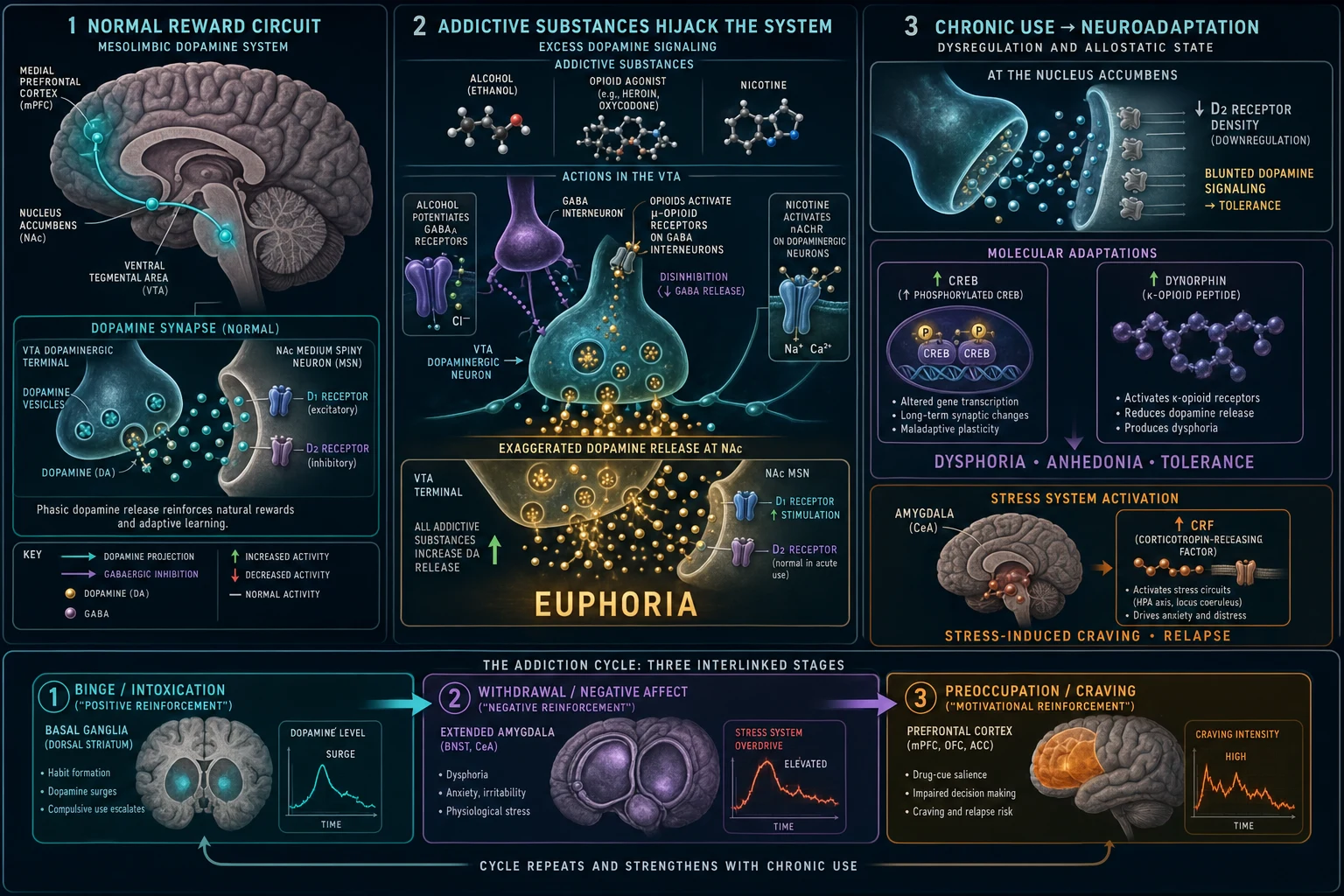
All addictive substances — despite disparate chemistry — converge on a shared final common pathway: the mesolimbic dopamine reward circuit. Neurons originating in the ventral tegmental area (VTA) of the midbrain project along the medial forebrain bundle to the nucleus accumbens (NAc) and prefrontal cortex, signalling reward, salience and motivation. Acute substance exposure produces a surge of dopamine in the NAc — experienced subjectively as euphoria — that hijacks the brain's natural reward system.[2]
Koob and Volkow's three-stage addiction cycle captures the chronic illness:[2]
- Binge / intoxication (basal ganglia) — dopamine and opioid peptides drive positive reinforcement and habit formation.
- Withdrawal / negative affect (extended amygdala) — recruitment of corticotropin-releasing factor (CRF), dynorphin and noradrenaline produces dysphoria, anxiety and the aversive state that drives continued use to relieve it (negative reinforcement).
- Preoccupation / craving (prefrontal cortex) — glutamatergic projections to the NAc drive cue-induced craving and compulsive drug-seeking, with impaired top-down inhibitory control. [1]
Neuroadaptation underlies tolerance and the chronic relapsing course: chronic use downregulates dopamine D2 receptors (so natural rewards feel blunted — anhedonia, the tolerance of reward); upregulated CREB and dynorphin in the NAc produce dysphoria; upregulated CRF in the amygdala sensitises stress-induced craving; and glutamatergic dysregulation between prefrontal cortex and nucleus accumbens underlies cue-triggered relapse years after detox.[2]
Substance-specific neurochemistry (mechanism examiners love): [1]
- Alcohol — a positive allosteric modulator of GABA-A receptors (enhances inhibitory tone) and an inhibitor of NMDA glutamate receptors and L-type calcium channels. With chronic use the brain downregulates GABA-A and upregulates NMDA / calcium channels to maintain consciousness — so on cessation, the brain is suddenly hyperexcitable, producing withdrawal seizures, hallucinosis and the autonomic storm of delirium tremens.
- Opioids — mu-opioid receptor agonists. In the VTA they inhibit GABA interneurons, disinhibiting dopamine neurons (euphoria); they also mediate analgesia (descending pain-modulating pathways), respiratory depression (mu receptors on the pre-Bötzinger complex of the medulla), miosis (parasympathetic Edinger-Westphal nucleus), constipation and cough suppression. Tolerance develops via receptor desensitisation and beta-arrestin recruitment.[2]
- Stimulants (cocaine, amphetamine) — cocaine blocks the dopamine transporter (DAT), amphetamine reverses DAT and vesicular monoamine transporter (VMAT2) — both cause massive synaptic dopamine, noradrenaline and serotonin.
- Cannabis — CB1 receptor partial agonists (THC); modulates GABA and glutamate release.
- Nicotine — agonist at alpha-4-beta-2 nicotinic acetylcholine receptors, triggering VTA dopamine release.
- Benzodiazepines — positive allosteric modulators of GABA-A (similar to alcohol — withdrawal can be fatal).
Cue conditioning is what makes addiction chronic: the amygdala, hippocampus and dorsal striatum encode drug-paired cues (people, places, paraphernalia, mood states) that trigger relapse decades after detox. This is why the disease is not cured by detoxification alone. [1]
Clinical Presentation
General SUD presentation clusters under four DSM-5 domains — impaired control, social impairment, risky use, and pharmacological indicators (tolerance, withdrawal). The patient typically minimises and conceals use; collateral history is critical.[2]
Alcohol intoxication — disinhibition, slurred speech, ataxia, impaired judgment, nystagmus, flushed face; blood ethanol over 80 mg/dL (0.08 percent, the legal driving limit in most jurisdictions); levels over 400 mg/dL potentially lethal in non-tolerant individuals (tolerant patients may walk and talk at much higher levels). [1]
Alcohol withdrawal — the staged timeline is an exam favourite:[4]
| Stage | Time since last drink | Features |
|---|---|---|
| Minor withdrawal | 6 to 12 h | Tremor ('the shakes'), anxiety, insomnia, nausea, anorexia, palpitations, sweating, mild hypertension and tachycardia |
| Alcoholic hallucinosis | 12 to 48 h | Vivid, usually visual (also auditory/tactile) hallucinations with an otherwise clear sensorium and minimal autonomic signs — distinct from DTs |
| Withdrawal seizures ('rum fits') | 24 to 48 h | Generalised tonic-clonic, usually 1 to 6 in a row; rare after 48 h; status epilepticus uncommon — investigate other causes |
| Delirium tremens (DTs) | 48 to 72 h (up to 5 days) | Confusion, vivid hallucinations, agitation, fever, severe tachycardia, hypertension, diaphoresis — autonomic storm; mortality 5 percent untreated |
Wernicke encephalopathy (acute, largely reversible with prompt IV thiamine) — the classic triad of (1) confusion / disorientation, (2) ataxia (wide-based gait) and (3) ophthalmoplegia (lateral rectus palsy, horizontal nystagmus, conjugate gaze palsy). The triad is incomplete in the majority — a high index of suspicion and empirical IV thiamine are essential in any malnourished or chronic-misusing patient with confusion. Untreated Wernicke progresses to Korsakoff syndrome — anterograde amnesia with confabulation, often irreversible, the prototype amnestic disorder.[2]
Opioid intoxication — euphoria and analgesia, pinpoint pupils (under 2 mm, unresponsive to light), drowsiness ('nodding off'), slurred speech, respiratory depression, hypotension, constipation, miosis, hypothermia, hyporeflexia. The opioid overdose triad = coma + pinpoint pupils + respiratory depression — pinpoint pupils may be lost if severe anoxia or co-ingestion of a mydriatic occurs.[2]
Opioid withdrawal ('cold turkey') — begins at 6 to 12 h after a short-acting opioid (24 to 30 h after methadone), peaks at 36 to 72 h, and resolves over 5 to 10 days (longer for methadone). Features: lacrimation, rhinorrhoea, myalgia, piloerection ('goosebumps' — the source of 'cold turkey'), yawning, diarrhoea and abdominal cramps, mydriasis, sweating, tachycardia, hypertension, dilated pupils, anxiety, restlessness, insomnia, hot/cold flushes. The clinical picture resembles a severe 'flu × 10'; it is uncomfortable but rarely fatal in adults (unlike alcohol or benzodiazepine withdrawal). In pregnancy it can precipitate miscarriage or fetal distress; in coronary artery disease the autonomic surge can precipitate ischaemia.[9]
Cannabis intoxication — euphoria, altered time perception, conjunctival injection, increased appetite ('munchies'), dry mouth, tachycardia; in susceptible individuals anxiety, panic, depersonalisation and cannabis-induced psychosis. Withdrawal (cannabis use disorder): irritability, anxiety, insomnia, anorexia and abdominal pain emerging within a day or two of cessation. [1]
Stimulant intoxication (cocaine, amphetamine, methamphetamine) — euphoria, psychomotor agitation, mydriasis, hypertension, tachycardia, hyperthermia, paranoia and stimulant psychosis (indistinguishable from paranoid schizophrenia), formication ('cocaine bugs'), nystagmus. The post-binge crash: hypersomnia, hyperphagia, anhedonia, depression and suicidal ideation. [1]
Benzodiazepine intoxication — sedation, ataxia, dysarthria, anterograde amnesia; withdrawal mirrors alcohol withdrawal (GABA-A withdrawal) and can be fatal (seizures, psychosis, DT-like syndrome). [1]
Hallucinogens — LSD/psilocybin cause perceptual distortions, synaesthesia, panic ('bad trip'); PCP and ketamine cause dissociation, nystagmus, hypertension, aggression and emergence delirium; hallucinogen persisting perception disorder (HPPD, 'flashbacks') persists for months-years. [1]
Inhalant/solvent abuse — common in street youth and adolescents; intoxication resembles alcohol; chronic toluene causes peripheral neuropathy, cerebellar ataxia, hepatotoxicity and bone-marrow failure; sudden sniffing death (fatal arrhythmia from myocardial sensitisation). [1]
Atypical presentations — elderly (falls, delirium, prescription-drug interactions, atypical withdrawal with muted autonomic signs); pregnancy (fetal alcohol spectrum disorder, neonatal abstinence syndrome); polysubstance (fentanyl-laced heroin, xylazine 'tranq' causing necrotic skin ulcers and naloxone-unresponsive bradycardia); hepatic encephalopathy masquerading as withdrawal.[10]
Differential Diagnosis
A substance-related presentation is rarely "just withdrawal" until the alternatives are actively excluded.[10]
Alcohol withdrawal vs other causes of acute agitation / tremor / seizures / delirium:
- Benzodiazepine or barbiturate withdrawal — history is decisive; clinically similar and can produce seizures / DT-like state.
- Delirium from medical cause — sepsis, hypoglycaemia, hyponatraemia, hepatic encephalopathy, uraemia, hypoxia, Wernicke, intracranial bleed, meningitis / encephalitis. A withdrawal diagnosis does not exclude these — investigate the confused or fitting patient.
- Alcohol hallucinosis vs schizophrenia / psychotic disorder — clear sensorium and minimal autonomic signs in hallucinosis; primary psychosis lacks autonomic instability and the withdrawal timeline.
- Serotonin syndrome vs neuroleptic malignant syndrome — drug history (SSRI, MAOI; antipsychotic), clonus / rigidity / hyperreflexia vs lead-pipe rigidity, distinct treatment. [1]
Opioid overdose vs other causes of coma with miosis:
- Pontine stroke / haemorrhage — focal signs, Cheyne-Stokes breathing, no response to naloxone.
- Clonidine overdose (central alpha-2 agonist) — miosis, bradycardia, hypotension, may respond partially to naloxone.
- Beta-blocker overdose — bradycardia, hypotension, normal or small pupils.
- Organophosphate / carbamate poisoning (cholinergic) — miosis with profuse secretions, lacrimation, urination, defecation, bradycardia, fasciculations (SLUDGE/MUD); treat with atropine and pralidoxime.
- Botulism, Miller-Fisher syndrome — descending paralysis, areflexia. [1]
Wernicke encephalopathy vs other acute confusional states with ataxia/ophthalmoplegia: brainstem stroke, cerebellar lesion, intoxication, botulism, Miller-Fisher syndrome. When in doubt, empirical IV thiamine is safe and mandatory.[2]
Substance-induced vs primary psychiatric disorder: the cardinal question is temporal relationship — onset during intoxication or within 4 weeks of cessation favours substance-induced; persistent symptoms well beyond this window, prominent negative symptoms, and a family history favour primary disorder. Treat both — they coexist in roughly half of patients.[10]
Clinical & Bedside Assessment
Screening first. A single AUDIT-C (the first three AUDIT questions, scored 0 to 12; positive in men at 4 or more, women at 3 or more) detects hazardous drinking in under a minute and is the screening tool of choice in primary care and on admission. CAGE / CAGE-AID (Cut down, Annoyed, Guilty, Eye-opener; 2 or more positive is a red flag) and FAST are alternatives. A single-item drug-use question ("How many times in the past year have you used an illegal drug or prescription medication for non-medical reasons?") — any positive answer warrants further assessment. DAST-10 quantifies drug-use severity. SBIRT (Screening, Brief Intervention, Referral to Treatment) is the public-health framework.[1]
Bedside severity scoring drives treatment. Two named scales are reproduced verbatim below. [1]
CIWA-Ar (Clinical Institute Withdrawal Assessment — Alcohol revised) — 10 items, each scored 0 to 7 (orientation 0 to 4), maximum 67:[3]
- Nausea and vomiting (0 none → 7 constant)
- Tremor (0 none → 7 severe)
- Paroxysmal sweats (0 none → 7 drenching)
- Anxiety (0 none → 7 panic)
- Agitation (0 normal → 7 frenetic)
- Tactile disturbances (0 none → 7 continuous)
- Auditory disturbances (0 none → 7 continuous)
- Visual disturbances (0 none → 7 continuous)
- Headache, fullness in head (0 none → 7 unbearable)
- Orientation (0 oriented → 4 disoriented) [1]
CIWA-Ar interpretation: under 8 mild or no withdrawal — supportive care, monitor; 8 to 15 moderate — consider benzodiazepine, often ward-based; over 15 severe — inpatient, IV benzodiazepine, high risk of seizures/DTs. [1]
COWS (Clinical Opiate Withdrawal Scale) — 11 items, maximum 48:[9]
- Resting pulse rate (0 under 80 → 3 over 120)
- Sweating (0 none → 4 sweat streaming off)
- Restlessness (0 able to sit still → 3 constantly shifts)
- Pupil size (0 pinned → 5 dilated)
- Bone or joint aches (0 none → 4 unbearable)
- Runny nose or tearing (0 none → 3 prominent)
- GI upset (0 none → 5 multiple vomiting/diarrhoea)
- Tremor (0 none → 2 severe)
- Yawning (0 none → 4 frequent)
- Anxiety or irritability (0 none → 4 panic)
- Gooseflesh (0 none → 3 prominent) [1]
COWS interpretation: 5 to 12 mild, 13 to 24 moderate, 25 to 36 moderately severe, over 36 severe. Moderate or worse is the threshold at which buprenorphine induction is safe (giving it too early precipitates withdrawal).[9]
Focused physical examination: vital signs (HR, BP, temperature, RR, SpO2, GCS); pupils (miosis vs mydriasis); needle marks / track marks / skin ulcers (xylazine); evidence of complications — cellulitis, abscess, septic emboli, decompensated chronic liver disease, cerebellar signs (Wernicke), heart murmurs (endocarditis), hydration and nutrition; mental state including mood, psychosis and suicide risk. [1]
Functional and harm assessment: the Addiction Severity Index (ASI) assesses seven domains (medical, employment, alcohol, drug, legal, family/social, psychiatric). Always screen for HIV, HBV, HCV risk; trauma; suicide risk; child safeguarding and domestic violence; and for comorbid psychiatric disorder (depression, PTSD, bipolar, ADHD, personality disorder) in every SUD patient.[10]
Investigations
Investigations serve three purposes — exclude mimics, detect complications, and confirm the substance.[1]
Bedside / immediate: capillary glucose (exclude hypoglycaemia before thiamine); ECG (arrhythmia, methadone QT prolongation, TCA changes if co-ingested); pregnancy test in women of reproductive age; temperature. [1]
Toxicology: urine drug screen (immunoassay for opioids, cannabis, amphetamine, cocaine metabolite [benzoylecgonine], benzodiazepines, barbiturates, PCP); blood ethanol; paracetamol and salicylate levels if co-ingestion or self-harm; serum methadone, buprenorphine, fentanyl where available; serum osmolality and anion gap if toxic alcohol (methanol / ethylene glycol) suspected. [1]
Bloods: FBC (MCV raised in chronic alcohol misuse — macrocytosis), U&E, Mg, Ca, PO4 (replete during withdrawal), LFTs (AST greater than ALT with a ratio over 2 to 1 is the classic alcoholic pattern; GGT is a sensitive marker of recent heavy drinking), coagulation, glucose, lipase/amylase, troponin if chest pain, albumin (nutrition). [1]
Microbiology: HIV, HBV, HCV serology in all injecting drug users; blood cultures if febrile; TB screening (sputum, IGRA, CXR); VDRL/RPR, HBV / HAV vaccination status check. [1]
Imaging: CXR (aspiration pneumonia, TB, septic emboli); CT brain if focal neurology, head trauma, seizures, or prolonged altered consciousness; abdominal ultrasound for liver disease, ascites, pancreatitis; echocardiography if endocarditis suspected (right-sided S. aureus in IDU). Lumbar puncture if meningitis/encephalitis cannot be excluded — do not attribute delirium to withdrawal alone until infection is excluded. [1]
AUDIT interpretation (alcohol screening): [1]
AUDIT score thresholds
Management — Resuscitation
ABCDE first. In the intoxicated or overdosed patient, protect the airway, place in the recovery position, and intubate if GCS 8 or less or respiratory failure.[2]
Opioid overdose — naloxone immediately. Naloxone 0.4 to 0.8 mg IV / IM / intranasal (intranasal commercial preparation is 4 mg per spray). Repeat every 2 to 3 minutes up to a total of 10 mg. The goal is adequate respiration, not full alertness — over-resuscitation precipitates acute withdrawal. Because most opioids outlast naloxone (half-life 30 to 80 minutes), set up a naloxone infusion (0.4 to 0.8 mg/h, or two-thirds of the effective bolus dose per hour) and observe for a minimum of 6 to 12 hours (24 hours for long-acting agents — methadone, fentanyl, sustained-release formulations). Xylazine ('tranq', a veterinary alpha-2 sedative increasingly mixed with fentanyl) is naloxone-unresponsive — bradycardia and necrotic skin ulcers are clues; supportive care is the only option.[2]
Hypoglycaemia — give glucose, but only after thiamine. Check glucose immediately. Treat with IV dextrose, but in any malnourished or chronic-misusing patient give IV thiamine first (or concurrently) — glucose alone precipitates or exacerbates Wernicke encephalopathy by driving the last thiamine reserves into carbohydrate metabolism. [1]
Severe alcohol withdrawal / DTs / withdrawal seizure — IV benzodiazepine. Lorazepam 2 mg IV or diazepam 10 mg IV, repeated every 5 to 15 minutes until lightly sedated; very high cumulative doses may be required in DTs. Phenobarbital is a useful second-line / refractory option. Escalate to ICU for severe autonomic instability (fever, refractory hypertension, delirium).[4]
Supportive care: IV fluids for dehydration; correct magnesium, potassium, phosphate; treat hypothermia / hyperthermia. Investigate fever aggressively — do not assume withdrawal; in an injecting drug user consider endocarditis, epidural abscess, septic emboli, pneumonia.[4]
Take-home naloxone and harm-reduction counselling at every contact. Naloxone access laws and community naloxone distribution reduce opioid-overdose mortality at population level.[2]
Management — Definitive & Stepwise
The four universal pillars: (1) brief intervention and motivational interviewing for hazardous use; (2) managed withdrawal (detoxification) for physical dependence; (3) relapse-prevention pharmacotherapy (medication-assisted treatment, MAT / MOUD); (4) psychosocial interventions and long-term follow-up.[1]
Alcohol withdrawal (detoxification) — benzodiazepines
Benzodiazepines are first-line for alcohol withdrawal prophylaxis and treatment.[4] Chlordiazepoxide (long-acting, smooth taper) is preferred in uncomplicated withdrawal; lorazepam (or oxazepam) is preferred when there is significant hepatic impairment because these are glucuronide-conjugated only, with no oxidative metabolism — safer in cirrhosis. A typical chlordiazepoxide taper: 10 to 20 mg four times daily on day 1, reducing over 5 to 7 days.
Symptom-triggered dosing via CIWA-Ar is superior to a fixed taper: it reduces total benzodiazepine dose, treatment duration, and complication rates — give a dose (e.g. chlordiazepoxide 10 mg if CIWA-Ar 8 to 15, 20 mg if over 15) and reassess hourly. Avoid phenothiazines (lower seizure threshold) and clomethiazole (respiratory depression). Phenobarbital is a useful second-line/ICU agent.[4]
Adjuncts in alcohol withdrawal — every patient gets these:
- IV thiamine 300 to 500 mg TDS for 3 to 5 days (Pabrinex; before any glucose), then oral thiamine lifelong in chronic misuse.
- Folic acid 5 mg daily.
- Replete magnesium, potassium, phosphate.
- Hydration with oral or IV fluids.
- Treat intercurrent infection, dehydration, electrolyte disturbance. [1]
AUD relapse-prevention pharmacotherapy
Three first-line agents — choose based on patient profile.[5][6]
Naltrexone
- Mu-opioid antagonist — blocks reward, reduces heavy drinking and craving
- Dose: 50 mg PO daily (or 380 mg IM monthly [Vivitrol])
- Baseline LFTs; avoid in opioid use (will precipitate withdrawal) and acute hepatitis / decompensated cirrhosis
- COMBINE study: naltrexone + medical management effective
Acamprosate
- Modulates glutamate (NMDA antagonist / GABA-A agonist); reduces post-detox craving
- Dose: 666 mg (two 333 mg tablets) three times daily; reduce in renal impairment
- Best started after detoxification and abstinence achieved
- Good safety; diarrhoea is the main side-effect
Disulfiram
- Inhibits aldehyde dehydrogenase → acetaldehyde accumulation → aversive reaction (flushing, nausea, hypotension)
- Dose: 200 mg PO daily (supervised dosing improves adherence)
- Avoid in cardiovascular disease, psychosis, severe hepatic impairment
- Acts as a psychological deterrent; needs motivated, abstinent patient
NICE (UK) recommends consider acamprosate or oral naltrexone for relapse prevention in AUD; avoid benzodiazepines long-term. The COMBINE study (Anton 2006) showed naltrexone plus medical management was effective; acamprosate did not separate from placebo in this US sample, but European trials and the Jonas 2014 JAMA meta-analysis confirm efficacy of both.[5][6]
Opioid withdrawal (detoxification) — options
- Methadone — full mu-agonist; taper over 7 to 21 days. Best in moderate-severe dependence, supervised settings.
- Buprenorphine — partial mu-agonist with a ceiling effect on respiratory depression (safer in overdose); induce only when COWS is moderate-severe (over 12) to avoid precipitated withdrawal. Combined with naloxone (Suboxone) to deter intravenous misuse (naloxone has minimal sublingual bioavailability).
- Lofexidine 0.6 mg QDS — a centrally acting alpha-2 agonist (clonidine analogue) that suppresses autonomic withdrawal symptoms; non-opioid, so preferred for unsupervised outpatient detoxification in the UK (NICE). Clonidine is an alternative but causes more hypotension.
- Symptomatic agents — loperamide for diarrhoea, ondansetron for nausea, NSAIDs/paracetamol for myalgia, clonidine for autonomic symptoms, short-course benzodiazepine for anxiety/insomnia, hyoscine for cramps.[8]
OUD maintenance (MAT / MOUD) — the lifesaver
MAT reduces all-cause mortality in OUD by over 50%
Three evidence-based options (Cochrane; SAMHSA):[7][8]
- Methadone 60 to 120 mg daily — full mu-agonist; supervised dispensing (often OTP — opioid treatment programme). ECG for QT prolongation / Torsades; caution with other QT-prolonging drugs. Reduces mortality, HIV transmission and crime.
- Buprenorphine-naloxone (Suboxone) 8 to 24 mg sublingual daily — partial agonist with ceiling on respiratory depression; can be prescribed in office-based settings (US DATA 2000 waiver, now no longer X-waiver limited). Comparable efficacy to methadone at adequate doses.
- Extended-release naltrexone (Vivitrol) 380 mg IM monthly — for patients already opioid-free (7 to 10 days) before first dose; antagonist approach, no abuse potential; lower retention than agonists but useful in motivated, abstinence-oriented patients. [1]
MAT is the single highest-yield exam point in opioid use disorder: it works, it is under-prescribed, and stigmatising attitudes to agonist treatment cost lives.[7]
Other substance-specific pharmacotherapy
- Stimulant use disorder (cocaine, amphetamine, methamphetamine): no FDA-approved pharmacotherapy. Cognitive behavioural therapy and contingency management (the most evidence-based psychosocial intervention) are first-line; treat stimulant psychosis with antipsychotics; manage the crash supportively.
- Cannabis use disorder: CBT and motivational enhancement; no approved pharmacotherapy.
- Benzodiazepine withdrawal: slow taper over weeks to months of a long-acting benzodiazepine (convert to diazepam equivalent) — never abrupt cessation (seizures, psychosis).
- Tobacco / nicotine use disorder: nicotine replacement therapy (patch + short-acting gum/lozenge/spray), varenicline (partial alpha-4-beta-2 nicotinic agonist — the single most effective agent), bupropion (contraindicated in epilepsy and eating disorders); behavioural support. The biggest preventable cause of death globally. [1]
Psychosocial and harm-reduction interventions
CBT, motivational interviewing, contingency management, 12-step facilitation (AA, NA, SMART Recovery), family therapy, and residential rehabilitation are essential adjuncts to pharmacotherapy at every stage — medication without psychosocial support has lower retention and outcomes.[1]
Harm reduction (the public-health backbone): needle and syringe exchange programmes, supervised consumption sites, take-home naloxone, fentanyl test strips, and methadone maintenance — proven to reduce overdose death, HIV/HCV transmission, and crime without increasing drug use.[2]
Specific Subtypes & Scenarios
- Alcohol use disorder (AUD) — commonest SUD; withdrawal is the killer (seizures, DTs, Wernicke). Thiamine, benzodiazepine, then naltrexone / acamprosate / disulfiram.[1]
- Opioid use disorder (OUD) — prescription opioids, heroin, fentanyl. Overdose is the killer; MAT is lifesaving; screen for HIV/HCV.[7]
- Cannabis use disorder — emerging with high-potency products; mild withdrawal; can precipitate psychosis in the vulnerable (adolescents, family history of schizophrenia).
- Stimulant use disorder — cocaine (crack), amphetamine, methamphetamine, cathinones ('bath salts'); no pharmacotherapy; cardiovascular and psychiatric complications dominate.
- Sedative-hypnotic / anxiolytic use disorder (benzodiazepine, Z-drug, barbiturate) — withdrawal can be fatal; long, supervised taper required.
- Hallucinogen use — LSD, psilocybin, PCP, ketamine; intoxication psychosis, HPPD flashbacks, PCP delirium and dangerous agitation.
- Inhalant / solvent use — street youth and adolescents; sudden sniffing death (arrhythmia), peripheral neuropathy, hepatotoxicity, toluene neurotoxicity.
- Tobacco / nicotine use disorder — biggest preventable cause of death; varenicline, NRT, bupropion.
- Polysubstance use and the fentanyl-xylazine ('tranq') era — naloxone-resistant components, necrotic skin ulcers, treatment-resistant overdose.[2]
- Behavioural addictions — gambling disorder (DSM-5), gaming disorder (ICD-11), internet/sex/pornography under study; shared neurobiology with substance addictions (dopamine, cue conditioning, tolerance-like escalation).
Complications & Pitfalls
Acute complications: overdose (respiratory depression, anoxia, death), trauma (falls, road-traffic accidents, violence, self-harm), aspiration, withdrawal seizures, delirium tremens, Wernicke-Korsakoff, stimulant cardiovascular events (MI, arrhythmia, aortic dissection, stroke).[2]
Alcohol — chronic complications (the body-systems tour):
- Hepatic: fatty liver → alcoholic hepatitis → cirrhosis → hepatocellular carcinoma.
- GI: gastritis, Mallory-Weiss tear, oesophageal varices, chronic pancreatitis, malabsorption, colorectal cancer.
- Cardiovascular: dilated cardiomyopathy, hypertension, atrial fibrillation, stroke.
- Neurological: peripheral neuropathy, cerebellar degeneration (anterior superior vermis), Wernicke-Korsakoff, Marchiafava-Bignami (corpus callosum demyelination), central pontine myelinolysis (with rapid Na correction), pellagra.
- Endocrine / metabolic: hypogonadism, gynaecomastia, osteoporosis, hyperuricaemia (gout).
- Reproductive: infertility, fetal alcohol spectrum disorder (FASD).
- Malignancy: oropharynx, oesophagus, liver, breast, colorectum.
- Haematological: macrocytosis, thrombocytopenia (splenomegaly / direct marrow toxicity), coagulopathy. [1]
Opioid — chronic complications:
- Infectious: HIV, HBV, HCV; right-sided infective endocarditis (Staphylococcus aureus), septic emboli and septic pulmonary infarct, vertebral osteomyelitis, epidural abscess, necrotising skin ulcers (xylazine), cellulitis, abscess, tetanus.
- Other: chronic constipation, hypogonadism / sexual dysfunction, neonatal abstinence syndrome, QT prolongation (methadone), dental caries, anoxic brain injury after non-fatal overdose. [1]
Cocaine / stimulant: MI, arrhythmia, aortic dissection, haemorrhagic and ischaemic stroke, hypertensive crisis, rhabdomyolysis and AKI, perforated nasal septum (snorting), 'meth mouth' (severe caries), stimulant psychosis, suicide. [1]
Inhalants: sudden sniffing death, bone-marrow suppression, peripheral neuropathy, hepatotoxicity, cerebral atrophy. [1]
Psychosocial: unemployment, homelessness, family breakdown, incarceration, child neglect, domestic violence, suicide (greatly elevated — assess every patient).[10]
Treatment-related complications: methadone QT prolongation / Torsades; naltrexone hepatotoxicity (rare, monitor LFTs); disulfiram hepatotoxicity and disulfiram-ethanol reaction; buprenorphine-precipitated withdrawal if given too early; benzodiazepine over-sedation and respiratory depression (especially combined with opioids). [1]
Classic pitfalls: assuming altered mental status is 'just withdrawal' (missing meningitis, intracranial bleed, hypoglycaemia, sepsis, hepatic encephalopathy); giving glucose before thiamine (precipitating Wernicke); using short-acting / low-potency benzodiazepines in hepatic failure; discharging an opioid-overdose patient too early (re-sedation when naloxone wears off); failing to screen for and treat psychiatric comorbidity; withholding MAT because of stigma. [1]
Prognosis & Disposition
SUD is a chronic relapsing-remitting illness — the disease model frames relapse as a clinical event to manage, not a moral failure. Retention in treatment predicts survival.[2]
Alcohol: AUD remission rates approach 50 percent over decades with sustained treatment; untreated mortality is elevated with 10 to 12 years of life-shortening; cirrhosis and hepatocellular carcinoma are the dominant killers. Delirium tremens has an untreated mortality of 15 to 20 percent, falling to 1 to 5 percent with treatment; withdrawal seizures are usually self-limiting but herald DTs. [1]
Wernicke encephalopathy is largely reversible with prompt IV thiamine (within hours of presentation); Korsakoff syndrome recovers fully in only around 25 percent, partially in 25 percent, and is permanent in roughly half.[2]
Opioid use disorder: MAT reduces all-cause mortality by over 50 percent. Opioid-overdose survival depends on the time to naloxone — anoxia beyond 4 to 6 minutes causes brain injury; long-acting agents demand prolonged observation. [1]
Predictors of relapse: untreated comorbid psychiatric illness, unemployment, homelessness, social stress, cue exposure, untreated craving, early treatment dropout. Good-prognosis factors: treatment engagement, social support, stable housing, employment, treatment of comorbidity, MAT adherence. [1]
Disposition: outpatient for mild withdrawal (CIWA-Ar under 8) with daily review; inpatient for moderate-to-severe withdrawal (CIWA-Ar 8 or more), significant comorbidity, history of seizures or DTs, polysubstance, pregnancy, social instability; ICU for delirium tremens, severe autonomic instability, refractory withdrawal, overdose with airway compromise. Refer to specialist addiction services for maintenance pharmacotherapy and structured psychosocial intervention. [1]
Special Populations
- Pregnancy: there is no safe alcohol level — fetal alcohol spectrum disorder (FASD: growth restriction, characteristic facies [smooth philtrum, thin vermilion border, small palpebral fissures], neurodevelopmental impairment). For opioid-dependent pregnant women, methadone or buprenorphine maintenance is preferred over detoxification (detox risks relapse and fetal distress); do not initiate naltrexone in pregnancy. The neonate develops neonatal abstinence syndrome (NAS) — scored with the Modified Finnegan Neonatal Abstinence Scoring Tool; treat with oral morphine or methadone solution, weaning over weeks. Breastfeeding is encouraged on stable methadone / buprenorphine (low milk transfer).
- Elderly: increased sensitivity, drug interactions, atypical withdrawal (delirium, falls), Beers criteria benzodiazepine caution, prescription-opioid misuse. Lower medication doses, longer taper.
- Adolescents: brain still developing — earlier onset predicts worse trajectory; screen with CRAFFT; family-based therapy preferred; reserve MAT for moderate-to-severe OUD.
- Hepatic impairment: avoid chlordiazepoxide (oxidative metabolism) — use lorazepam / oxazepam (glucuronide-conjugated). Avoid disulfiram and naltrexone in decompensated cirrhosis. Dose-reduce acamprosate in renal impairment.
- Renal impairment: dose-adjust acamprosate and methadone.
- Injecting drug users: screen for HIV, HBV, HCV; vaccinate (HBV, HAV, pneumococcal, influenza); maintain vigilance for endocarditis, epidural abscess, osteomyelitis, septic emboli; provide harm reduction.
- Pain management in OUD on MAT: do not stop MAT; use multi-modal analgesia (paracetamol, NSAIDs, regional blocks); opioids may require higher doses because of tolerance; full agonists (fentanyl) for acute severe pain.
- Perioperative: continue methadone / buprenorphine through surgery; avoid abrupt cessation (precipitated withdrawal, relapse risk).
- Dual diagnosis (SUD + mental illness): integrated treatment of both; ~50 percent of SUD patients have a comorbid mental disorder and vice-versa. Avoid controlled substances where possible; check interactions (methadone + QT-prolonging drugs, SSRI + tramadol → serotonin syndrome, buprenorphine + full agonist).[10]
Evidence, Guidelines & Regional Differences
Diagnostic frameworks: DSM-5 (2013) replaced the abuse / dependence dichotomy with a single dimensional SUD continuum (mild / moderate / severe); ICD-11 (2022) adopted a similar dimensional approach.[2]
Major guidelines:
- ASAM (American Society of Addiction Medicine) National Practice Guideline (2015, updated 2020) — comprehensive framework for MAT.
- NICE CG115 (alcohol-use disorders: diagnosis and management), NICE CG51 / TA114 (opioid detoxification — prefers lofexidine for unsupervised detox).
- SAMHSA (Substance Abuse and Mental Health Services Administration, US) — TIP 63 on MAT, OTP regulations, naloxone standing-order policies, the DATA 2000 / X-waiver removal (2023) for buprenorphine prescribing. [1]
Landmark evidence:
- COMBINE study (Anton 2006, JAMA): naltrexone + medical management reduced heavy drinking; acamprosate did not separate from placebo in this US sample.[5]
- Jonas 2014 JAMA meta-analysis: confirmed efficacy of both naltrexone and acamprosate for AUD in outpatient settings; topiramate emerging.[6]
- Mattick 2014 Cochrane: buprenorphine maintenance superior to placebo and comparable to methadone at adequate doses.[7]
- Gowing 2017 Cochrane: opioid antagonists and partial agonists (buprenorphine, naloxone combinations) for opioid withdrawal.[8]
- Volkow / Koob / McLellan (NEJM 2016): the brain-disease model and the three-stage addiction cycle.[2]
- Mayo-Smith 1997 JAMA (ASAM): benzodiazepines are first-line and superior for alcohol withdrawal prophylaxis; symptom-triggered dosing reduces total benzodiazepine dose and treatment duration.[4]
- Community naloxone distribution studies: population-level reduction in opioid-overdose mortality.
Regional deltas (exam-relevant):
- United States: prescription-opioid → heroin → fentanyl epidemic; naloxone standing orders and take-home naloxone; SAMHSA OTP regulations; office-based buprenorphine (DATA 2000, now X-waiver-free).
- United Kingdom (NICE): lofexidine first-line for unsupervised opioid detoxification; supervised methadone consumption initially; tight controlled-drug prescribing.
- India (NDPS Act 1985, NDDTC, NIMHANS): de-addiction centres under the National Mental Health Programme; OST (opioid substitution therapy) scaling up; naltrexone implants and buprenorphine patches available but access limited; rising prescription-opioid and inhalant misuse.
- WHO: Essential Medicines List includes methadone, buprenorphine and naloxone. [1]
Controversies: the brain-disease model has critics (Heyman, Lewis) who frame addiction as a disorder of choice / development; supervised consumption site legality and heroin-assisted treatment (Switzerland, Canada); emerging psychedelic-assisted therapy (psilocybin for AUD, MDMA for PTSD) under investigation; cannabis legalisation and its impact on psychosis prevalence; xylazine and other adulterants complicating overdose management. [1]
Exam Pearls
DSM-5 SUD — 11 criteria
DISORDER
hazardous use in physically dangerous situations
larger amount / longer than intended
social / interpersonal problems from use
major role obligations neglected
persistent desire / failed attempts to cut down
great deal of time spent obtaining / using / recovering
use despite knowing it causes physical / psychological harm
important activities given up because of use
Alcohol withdrawal timeline
3-3-3-3
minor withdrawal: tremor, anxiety, insomnia, palpitations
alcoholic hallucinosis (clear sensorium)
withdrawal seizures ('rum fits')
delirium tremens: confusion + hallucinations + autonomic storm, mortality 5 percent untreated
- DSM-5 SUD = 2+ of 11 criteria over 12 months (mild 2 to 3, moderate 4 to 5, severe 6+) — single continuum; dependence alone is NOT sufficient.[2]
- Alcohol withdrawal timeline (exam favourite): minor 6 to 12 h → hallucinosis 12 to 48 h → seizures 24 to 48 h → DTs 48 to 72 h.[4]
- DTs = confusion + vivid hallucinations + autonomic storm (fever, tachycardia, hypertension) — mortality 5 percent untreated; ICU, IV benzodiazepine.
- Wernicke triad = CONFUSION + ATAXIA + OPHTHALMOPLEGIA. Give IV thiamine BEFORE glucose. Korsakoff = anterograde amnesia + confabulation, largely irreversible.
- CIWA-Ar (10 items, max 67): under 8 none, 8 to 15 moderate, over 15 severe. Symptom-triggered beats fixed schedule.[3]
- Alcohol withdrawal = benzodiazepines (chlordiazepoxide preferred; LORAZEPAM if liver disease).
- AUD maintenance: NALTREXONE (craving), ACAMPROSATE (craving), DISULFIRAM (aversion).
- AST greater than ALT (ratio over 2 to 1) and raised GGT = alcoholic liver disease pattern. Macrocytosis.
- Opioid overdose TRIAD = COMA + PINPOINT PUPILS (under 2 mm) + RESPIRATORY DEPRESSION. NALOXONE 0.4 to 0.8 mg IV/IM/IN; repeat; infusion; observe.[2]
- Opioid withdrawal: lacrimation, rhinorrhoea, myalgia, piloerection ('cold turkey'), diarrhoea, yawning, mydriasis. COWS scale. Miserable but rarely fatal.
- Buprenorphine = PARTIAL agonist (ceiling on respiratory depression = safer); induce only at COWS over 12 to avoid precipitated withdrawal.
- Methadone = full agonist; QT prolongation / Torsades — ECG at baseline and dose changes.
- MAT for OUD reduces mortality OVER 50 PERCENT — single most effective intervention; under-prescribed.
- Cocaine / stimulant intoxication: mydriasis, tachycardia, hypertension, paranoia / psychosis; chest pain → MI / arrhythmia / aortic dissection / stroke; NO specific antidote.
- Cannabis intoxication: conjunctival injection, tachycardia, increased appetite, altered time sense; can precipitate psychosis in vulnerable.
- Naloxone does NOT reverse xylazine ('tranq') — alpha-2 agonist; bradycardia + necrotic skin ulcers + treatment-resistant overdose.
- Pregnancy: no safe alcohol; methadone / buprenorphine maintenance preferred; NAS (Finnegan score, oral morphine / methadone).
- Harm reduction: needle exchange, take-home naloxone, supervised consumption, fentanyl test strips — reduces death, HIV, crime; MAT first.
Exam application bank (NEET-PG / INICET)
One-line answer
Substance use disorders (SUD) are chronic relapsing brain diseases defined by pathological substance use despite harm, with tolerance, withdrawal, craving, loss of control, and continued use despite consequences (DSM-5: 2+ of 11 criteria over 12 months — mild 2 to 3, moderate 4 to 5, severe 6+). The two highest-yield subtypes are alcohol use disorder (AUD) and opioid use disorder (OUD). Alcohol withdrawal ranges from tremor to generalised seizures (24 to 48 h) to delirium tremens (48 to 72 h, mortality 5 percent untreated); treated with benzodiazepines via CIWA-Ar scoring (chlordiazepoxide preferred; lorazepam if liver disease) plus IV thiamine BEFORE any glucose (Wernicke encephalopathy). Opioid overdose is the triad of coma + pinpoint pupils + respiratory depression — naloxone 0.4 to 0.8 mg IV/IM/IN immediately, repeat and observe for long-acting agents. Opioid withdrawal (lacrimation, [1]
Worked stems (answer without another resource)
Stem 1 — Classic presentation. Map symptoms to mechanism; name the first investigation and first treatment step with dose/route if drug therapy is standard. [1]
Stem 2 — Unstable / complicated. List red flags that force immediate resuscitation, theatre, ICU, antidote, or reperfusion — and what you do in the first 15 minutes. [1]
Stem 3 — Atypical group. Elderly, pregnancy, child, or immunocompromised: how presentation and thresholds change. [1]
Stem 4 — Differential trap. Name the three closest mimics and one discriminator for each. [1]
Stem 5 — Disposition. Who goes home with safety-netting, who is admitted, who needs HDU/ICU/theatre, and what follow-up is mandatory. [1]
Rapid viva checklist
- Definition + classification
- Pathophysiology chain
- Bedside signs / criteria
- Score with exact components (if any)
- Emergency bundle
- Definitive therapy with doses
- Complications of disease and of treatment
- Special populations
- Guideline/trial name if classic
- Three exam traps
Coverage self-check
If you cannot answer any stem above from this page alone, re-read the matching section — the page is intended to be self-sufficient for final-prof and NEET-PG/INICET questions on Substance Use Disorders (Alcohol & Opioids).
References
- [1]Kranzler HR. Overview of Alcohol Use Disorder Am J Psychiatry, 2023.PMID 37525595
- [2]Volkow ND, Koob GF, McLellan AT. Neurobiologic Advances from the Brain Disease Model of Addiction N Engl J Med, 2016.PMID 26816013
- [3]Sullivan JT, Sykora K, Schneiderman J, Naranjo CA, Sellers EM. Assessment of alcohol withdrawal: the revised clinical institute withdrawal assessment for alcohol scale (CIWA-Ar) Br J Addict, 1989.PMID 2597811
- [4]Mayo-Smith MF, for the American Society of Addiction Medicine Working Group. Pharmacological management of alcohol withdrawal. A meta-analysis and evidence-based practice guideline. American Society of Addiction Medicine Working Group on Pharmacological Management of Alcohol Withdrawal JAMA, 1997.PMID 9214531
- [5]Anton RF, O'Malley SS, Ciraulo DA, et al. (COMBINE Study Research Group). Combined pharmacotherapies and behavioral interventions for alcohol dependence: the COMBINE study: a randomized controlled trial JAMA, 2006.PMID 16670409
- [6]Jonas DE, Amick HR, Feltner C, et al. Pharmacotherapy for adults with alcohol use disorders in outpatient settings: a systematic review and meta-analysis JAMA, 2014.PMID 24825644
- [7]Mattick RP, Breen C, Kimber J, Davoli M. Buprenorphine maintenance versus placebo or methadone maintenance for opioid dependence Cochrane Database Syst Rev, 2014.PMID 24500948
- [8]Gowing L, White JM, Ali R, Ling W, Hill D. Opioid antagonists with minimal sedation for opioid withdrawal Cochrane Database Syst Rev, 2017.PMID 28553701
- [9]Wesson DR, Ling W. The Clinical Opiate Withdrawal Scale (COWS) J Psychoactive Drugs, 2003.PMID 12924748
- [10]Schuckit MA. Comorbidity between substance use disorders and psychiatric conditions Addiction, 2006.PMID 16930163