Psychiatry · Psychiatry
Tourette Syndrome & Tic Disorders
Also known as Tourette syndrome · Gilles de la Tourette syndrome · Tourette disorder · Tic disorder · Motor and vocal tic disorder
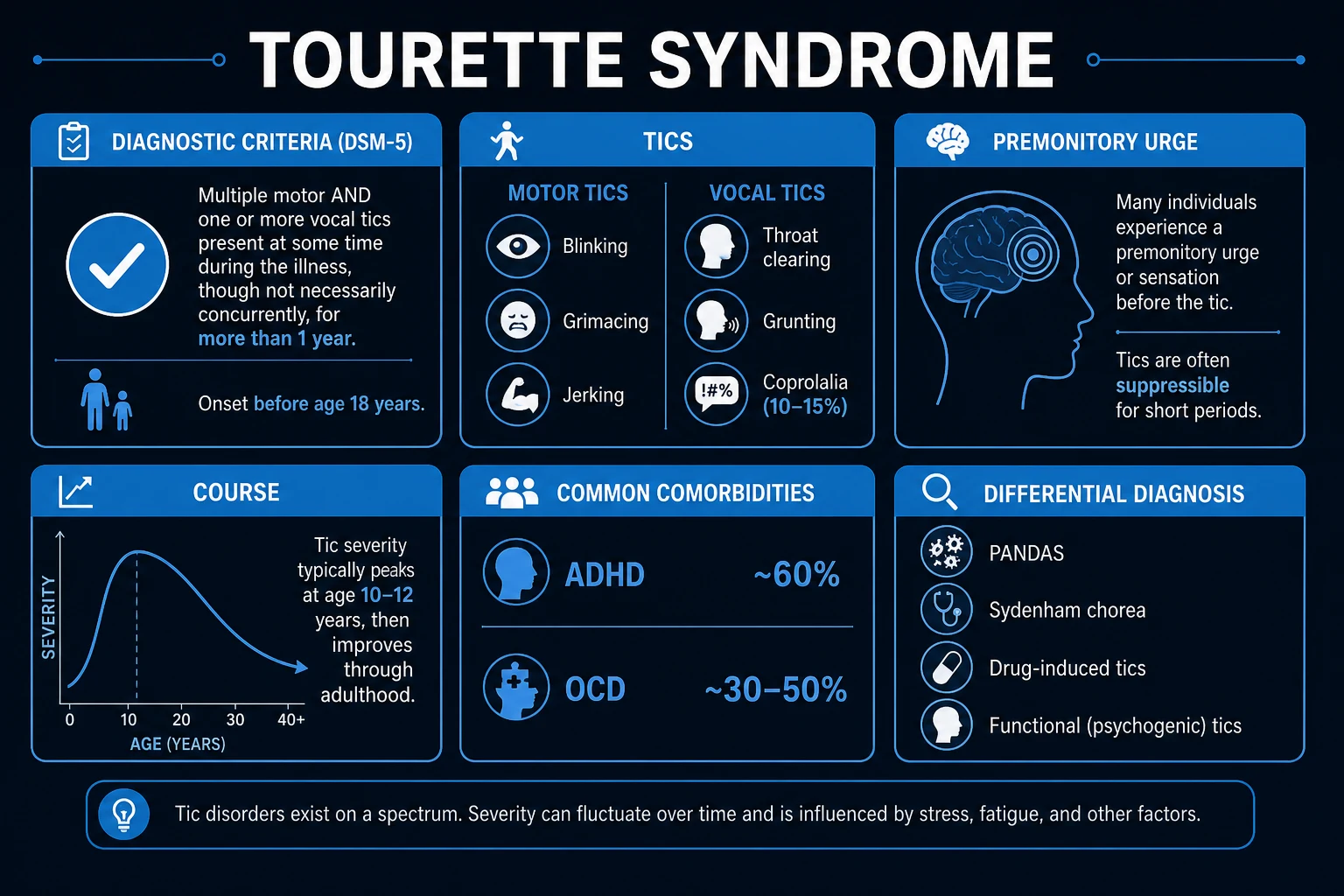
Tourette syndrome (TS) is a neurodevelopmental disorder defined by multiple motor tics and one or more vocal (phonic) tics, present for at least 1 year, with onset before age 18. Tics are sudden, rapid, recurrent, non-rhythmic movements or vocalisations that are temporarily suppressible and usually preceded by a premonitory urge (a building internal sensation that the tic transiently relieves). Motor tics classically begin in the head and neck (eye blinking, facial grimacing, head jerking, shoulder shrugging) and march caudally over years; vocal tics follow (throat clearing, sniffing, grunting; coprolalia in only 8 to 15 percent). Tics wax and wane, peak in severity around 10 to 12 years, and improve substantially in adolescence and adulthood in about two-thirds. Comorbidity is the rule: ADHD in about 60 percent (the commonest and most impairing comorbidity) and OCD in 30 to 50 percent. The popular stereotype of involuntary swearing affects only a minority and is the single biggest misconception. Management is stepwise: education and reassurance for mild tics; Comprehensive Behavioural Intervention for Tics (CBIT) / Habit Reversal Training (HRT) first-line for impairing tics; alpha-2 agonists (clonidine, guanfacine) first-line drug (also treat ADHD); antipsychotics (risperidone, aripiprazole) for severe tics; botulinum toxin for focal disabling tics; deep brain stimulation only for severe refractory adult disease.
On this page & tools
Your progress
Saved locally on this device.
Exam tags
Red flags
Overview & Definition
Tourette syndrome (TS) — named after Georges Gilles de la Tourette, who described nine cases in 1885 — is a childhood-onset neurodevelopmental disorder characterised by chronic, fluctuating multiple motor tics and one or more vocal (phonic) tics.[7][8] It is the most severe end of the tic-disorder spectrum: a tic is defined as a sudden, rapid, recurrent, non-rhythmic motor movement or vocalisation that is temporarily suppressible (voluntily held back at the cost of mounting internal tension) and is usually preceded by a premonitory urge — a building localised sensation (an itch, pressure, tickle, or "not just right" feeling) that the tic transiently relieves, much as scratching relieves an itch.[1][4]
Tourette syndrome is widely misunderstood and stigmatised because its popular caricature is coprolalia (the involuntary utterance of obscenities) — which in reality affects only 8 to 15 percent of patients.[8] The clinical reality is that most tics are mild, that the natural history is favourable (tics peak in severity at 10 to 12 years and improve substantially in adolescence and adulthood in roughly two-thirds of patients), and that the biggest sources of functional impairment are the comorbidities — ADHD and OCD — not the tics themselves.[1][8]
The clinical skill in TS rests on five habits: (1) recognise the tic pattern (motor and vocal, waxing/waning, suppressible, premonitory urge); (2) screen every patient for ADHD and OCD, which drive most of the impairment; (3) start with behavioural therapy (CBIT/HRT) before reaching for medication; (4) use the least impactful effective drug (alpha-2 agonists before antipsychotics, given the metabolic and extrapyramidal burden of the latter); and (5) educate the family, school and patient — a strong psychoeducational foundation is itself therapeutic and often the only intervention required.[2][12]
Classification
Tic disorders are classified by the DSM-5 (and the harmonised ICD-11) along a single axis of phenomenology and chronicity. The distinction between Tourette disorder and the other tic disorders is purely a matter of which and how many tic types are present, and for how long; the underlying pathophysiology and management principles overlap.[1][4]
Tourette disorder
- Multiple MOTOR tics + one or more VOCAL tics
- Duration at least 1 year; no tic-free interval over 3 months
- Onset before 18 years
- Most severe end of the tic-disorder spectrum
Persistent (chronic) motor OR vocal tic disorder
- ONLY motor OR ONLY vocal tics (never both)
- Duration at least 1 year; onset before 18
- Often milder than Tourette disorder
Provisional tic disorder
- Tics present for UNDER 1 year
- Common in young children (up to 20 percent of primary-school age)
- Usually resolves spontaneously; reclassify if persists over 1 year
Other / specified / functional
- Tics due to another medical condition (PANDAS, neurodegenerative, post-stroke)
- Substance- or medication-induced (stimulants, neuroleptics)
- Functional (psychogenic) tic disorder — sudden adult onset, no premonitory urge
Tics themselves are subtyped by complexity (whether the tic is a single meaningless movement/sound or a coordinated, seemingly purposeful sequence) and by modality (motor vs vocal/phonic):[1][8]
Simple motor tics
- Brief, meaningless, single-muscle or muscle-group movements
- Eye blinking, facial grimacing, head jerking, shoulder shrugging, jaw opening, abdominal tensing
Complex motor tics
- Coordinated, seemingly purposeful sequences
- Touching, hitting self, jumping, hopping, smelling objects
- Copropraxia (obscene gestures), echopraxia (imitating another's gestures)
Simple vocal (phonic) tics
- Single, meaningless sounds
- Throat clearing, sniffing, grunting, coughing, barking, squeaking, hissing
Complex vocal tics
- Words or phrases with linguistic meaning
- Coprolalia (obscene words — only 8 to 15 percent), echolalia (repeating others), palilalia (repeating own final words), coprolalia
Epidemiology & Risk Factors
Tourette syndrome is the most common cause of tics in children after transient/provisional tics. A 2022 systematic review and meta-analysis of studies spanning 1986 to 2022 estimated a pooled prevalence of about 0.3 to 1 percent of school-age children for Tourette disorder specifically, with any tic disorder (including chronic and provisional) affecting up to 20 percent of primary-school children.[6][8]
Tourette syndrome by the numbers
Sex: the male-to-female ratio is 3 to 4 : 1; girls more often have a comorbid OCD picture and a more persistent course into adulthood.[8]
Risk factors and precipitants. TS is highly heritable (twin-study heritability 50 to 70 percent), with a polygenic, non-Mendelian inheritance pattern; first-degree relatives have a roughly 10- to 100-fold increased risk.[1][7] Identified contributors include family history of tics, ADHD or OCD, male sex, perinatal complications (prematurity, low birthweight, maternal smoking, prenatal stress), psychosocial stress, anxiety, and — relevant to the post-infectious sub-variant — recent group-A streptococcal infection (PANDAS/PANS).[4][8] Tics characteristically worsen with stress, excitement, anxiety, fatigue, caffeine and stimulant exposure, and diminish during sleep and during absorbing focused activity (a hallmark feature that distinguishes tics from many hyperkinetic movement disorders).[1]
The comorbidity burden is the central clinical fact. In specialist cohorts ADHD occurs in about 60 percent (the commonest and most functionally impairing comorbidity), OCD in 30 to 50 percent, anxiety disorders in roughly 30 percent, depression in 20 to 30 percent, plus sleep disturbance, learning difficulties, rage attacks in 25 to 70 percent, and an increased lifetime risk of substance-use disorders.[8][11] Treating the tics without addressing these comorbidities leaves most of the impairment untouched.
Pathophysiology
Tourette syndrome is a disorder of the cortico-striato-thalamo-cortical (CSTC) loops — the same circuits that govern action selection, habit formation, and inhibitory control of unwanted motor programmes, and that are also implicated in OCD.[1][4]
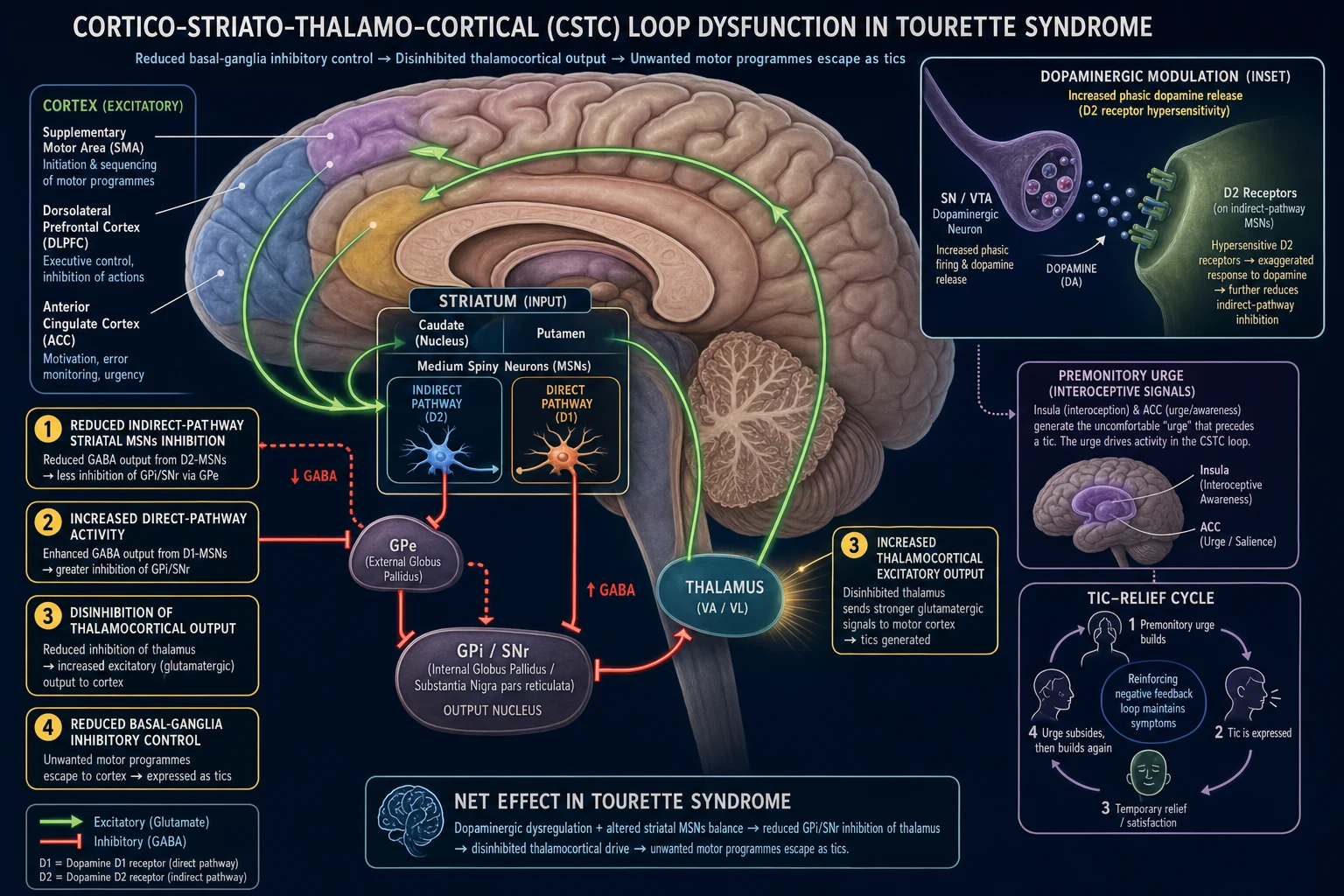
Three converging mechanisms explain the phenotype:[1][4]
- Basal-ganglia inhibitory failure. The striatum (caudate, putamen) normally gates competing motor programmes through its direct (D1, Go) and indirect (D2, No-Go) output pathways onto the globus pallidus internus / substantia nigra pars reticulata (GPi/SNr), which in turn inhibits the thalamus. In TS there is relative over-activity of the direct pathway and under-activity of the indirect pathway, so the GPi/SNr under-inhibits the thalamus and excessive excitatory thalamocortical drive reaches the SMA and motor cortex, allowing unwanted motor plans (tics) to be expressed. Structural imaging consistently shows caudate and putamen volume reductions, and post-mortem studies report reduced striatal GABAergic interneurons — a deficit of local inhibition.[4]
- Dopaminergic dysregulation. There is increased phasic dopamine release in the striatum and evidence of D2-receptor supersensitivity. This is the pharmacological anchor of the disease: D2-blocking antipsychotics (haloperidol, risperidone, aripiprazole, pimozide) reliably reduce tic severity, while dopamine agonists and stimulants can transiently worsen them. The shared dopaminergic and CSTC-loop biology explains why the OCD–Tourette border is fuzzy: both involve the same circuits, with OCD weighted toward cortico-striatal affective loops and TS toward motor loops.[1]
- Sensorimotor and interoceptive dysfunction — the premonitory urge. Functional imaging shows abnormal activity in the supplementary motor area, anterior cingulate cortex (ACC), insula and somatosensory cortex. The premonitory urge is a building interoceptive sensation (an itch, pressure, "not just right" feeling) localised to the body region of the impending tic; the tic transiently relieves it, and this relief acts as a negative reinforcer — operantly strengthening the tic. This urge-tic-relief loop is the explicit target of Habit Reversal Training: by substituting an incompatible behaviour (the competing response), the patient learns to discharge the urge without performing the tic.[1][4]
Genetics. TS is polygenic and highly heritable (50 to 70 percent in twin studies); first-degree relatives carry a 10- to 100-fold elevated risk. Rare candidate genes (SLITRK1, HDC histidine decarboxylase, CNTNAP2, neuroligin-3/4) and copy-number variants have been identified, but no single locus accounts for more than a small fraction of cases — there is no clinical genetic test.[1][7]
Neuroimmunity — PANDAS / PANS. A subset of children develop sudden explosive onset or exacerbation of tics and/or OCD over 24 to 72 hours, in temporal association with group-A beta-haemolytic streptococcal infection, hypothesised to reflect molecular mimicry and basal-ganglia autoimmunity (analogous to Sydenham chorea). This entity — Paediatric Autoimmune Neuropsychiatric Disorders Associated with Streptococcal infections (PANDAS), or the broader Paediatric Acute-onset Neuropsychiatric Syndrome (PANS) — remains clinically and nosologically controversial.[4]
Clinical Features & Presentation
The classic natural history
Tourette syndrome follows a remarkably stereotyped longitudinal course that examiners test directly:[1][8]
- Onset 5 to 7 years — first motor tics, almost always in the face and head (eye blinking, facial grimacing, head turning, jaw opening).
- Caudal march — over years the tics spread down the body: neck (jerking, shoulder shrugging), trunk (abdominal tensing, twisting), and finally the limbs (arm jerking, kicking).
- Vocal tics appear later, typically several years after the motor tics, beginning with simple sounds (throat clearing, sniffing, grunting, coughing).
- Peak severity 10 to 12 years — the period of greatest tic burden and greatest comorbidity-driven impairment.
- Improvement in adolescence and early adulthood — tics diminish in about two-thirds of patients; a minority have severe persistent adult TS.
- Waxing and waning throughout — tics fluctuate in frequency, type and severity over days to weeks, with old tics replaced by new ones. [1]
Tic phenomenology — recognise each
The four signature features of a tic
TICS
Suppressible for a short time at the cost of mounting internal tension
Premonitory urge (an itch/pressure) precedes the tic; the tic transiently relieves it
Waxing and waning course; old tics replaced by new ones over time
Tics abate during sleep and during absorbing focused activity
Motor tics are described as simple (eye blinking, facial grimacing, head jerking, shoulder shrugging, jaw opening, abdominal tensing, limb jerking, kicking — brief, meaningless) or complex (coordinated sequences: touching, hitting oneself, jumping, hopping, smelling objects, copropraxia — obscene gestures, echopraxia — imitating another's gestures).[1]
Vocal (phonic) tics are likewise simple (throat clearing, sniffing, grunting, coughing, barking, squeaking, hissing) or complex (linguistically meaningful: coprolalia — uttering obscenities, only 8 to 15 percent; echolalia — repeating others' words; palilalia — repeating one's own final words or phrases, often with decreasing volume).[8]
Modifiers and precipitants
Tics worsen with stress, anxiety, excitement, fatigue, caffeine, stimulants and fever, and improve with sleep and absorbing focused activity (a classic and discriminating feature). They are typically suggestible — watching someone else tic, or even discussing tics, can transiently increase them.[1]
The premonitory urge (examinable)
A building internal sensation (likened to the urge to sneeze, scratch an itch, or "the feeling just before a hiccup") localised to the body region of the impending tic precedes most tics in patients over about 10 years. The tic transiently relieves the urge, which operantly reinforces the tic — the explicit target of Habit Reversal Training. The Premonitory Urge for Tics Scale (PUTS) quantifies this.[1]
Atypical presentations (examiners test these deliberately)
- PANDAS / PANS — sudden explosive onset or dramatic exacerbation of tics and/or OCD over 24 to 72 hours in a prepubertal child, temporally linked to group-A streptococcal infection; check ASO titre and anti-DNase B.[4]
- Adult-onset tics — atypical for Tourette; strongly consider drug-induced (stimulants, neuroleptic-induced tardive tics), neurodegenerative (Huntington, Wilson, neuroacanthocytosis), structural (post-stroke), or functional (psychogenic / "TikTok" tic-like) disorder.[1]
- Functional (psychogenic / "TikTok") tic-like disorder — sudden onset in adolescent girls and young women, often with a heavy social-media exposure; tics are atypical (complex, coprolalia-predominant, context-bound, no premonitory urge, no waxing/waning); management is CBT for functional neurological disorder, not antipsychotics.[1]
- Comorbidity dominating the picture — the patient (or parent) may present with inattention/hyperactivity (ADHD), obsessions/compulsions (OCD), rage attacks, anxiety, or sleep disturbance rather than with the tics themselves. Screen for these actively.[8][11]
Differential Diagnosis
A wide differential must be navigated, separating other tic disorders from hyperkinetic movement disorders, drug-induced and functional causes, and the neurodegenerative mimics.[1][4]
Other tic disorders
- Provisional tic disorder — under 1 year (often resolves)
- Persistent (chronic) motor OR vocal tic disorder — only one modality, over 1 year
- Tic disorder due to another medical condition — PANDAS, post-stroke, neurodegenerative
Drug-induced (tardive) tics
- Stimulants — methylphenidate, amphetamines, cocaine
- Antipsychotics — tardive Tourette-like syndrome (Fountoulakis 2011 systematic review)
- Lamotrigine, levodopa, carbamazepine (rarely)
- Distinguish: temporal relationship to drug; resolution on withdrawal
Sydenham chorea (rheumatic fever)
- Chorea (flowing, non-suppressible), NOT tics
- Hypotonia, emotional lability, 'milkmaid grip'
- Positive ASO, recent strep; Jones criteria; carditis is the danger
Huntington disease
- Adult onset chorea, family history (autosomal dominant)
- Cognitive decline, psychiatric symptoms
- CAG repeat expansion on HTT gene (over 36 repeats)
Wilson disease
- Hepatic dysfunction, parkinsonism, chorea, dystonia
- Kayser-Fleischer rings, low serum caeruloplasmin, raised 24-h urinary copper
Functional (psychogenic) tic disorder
- Sudden adolescent/young-adult female onset (e.g. TikTok tics)
- Atypical complex/coprolalia-predominant tics, no premonitory urge, no waxing/waning
- Manage with CBT for functional neurological disorder, NOT antipsychotics
Other mimics
- Stereotypies in autism / intellectual disability
- Myoclonus (brief shock-like jerk, not suppressible)
- Essential tremor, restless legs syndrome
- Lesch-Nyhan (self-mutilation), neuroacanthocytosis, NBIA
The discriminating features are: the premonitory urge and suppressibility (favour tics), waxing/waning and sleep-diminution (favour tics), age and tempo of onset (5 to 7 years slow accrual vs. sudden in PANDAS / functional), the presence of coprolalia and copropraxia (highly characteristic of tics), and — critically — the comorbid ADHD and OCD that travel with Tourette.[1]
Clinical & Bedside Assessment
The diagnosis is clinical. Take a focused history of age of onset, the body regions involved, motor versus vocal tics, the waxing and waning pattern, suppressibility, and the premonitory urge.[1][12]
Screen every patient for comorbidities — this is non-negotiable and is where most of the functional impairment lies: [1]
- ADHD — inattention, hyperactivity, impulsivity interfering with function (use Conners-3, Vanderbilt scales).
- OCD — obsessions and compulsions (use Children's Yale-Brown Obsessive Compulsive Scale, CY-BOCS, or adult Y-BOCS).
- Anxiety and depression (GAD-7, PHQ-9 / PHQ-A).
- Rage attacks — brief, explosive, out-of-proportion outbursts; very distressing to families.[11]
- Sleep disturbance, learning difficulties, psychoeducational needs.
Observation and video. Directly observe the tics during the consultation, and ask the family for home video recordings — tics may be suppressed in clinic. Document the distribution, frequency, complexity and interference of motor and vocal tics.[1]
The Yale Global Tic Severity Scale (YGTSS) — reproduced verbatim
The YGTSS is the standard research and clinical severity scale. It has three components giving a total score of 0 to 100:[1][4]
- Motor Tic Score (0 to 25) = sum of five dimensions, each scored 0 to 5:
- Number of motor tics (0 none; 5 multiple complex tics).
- Frequency (0 none; 1 rarely; 2 several times; 3 hourly; 4 constant; 5 always, score during waking hours).
- Intensity (0 not present; 5 severe, with self-injury).
- Complexity (0 simple; 5 elaborate, sequenced, seemingly purposeful).
- Interference (0 none; 5 causes complete interruption of ongoing action).
- Vocal (Phonic) Tic Score (0 to 25) — same five dimensions applied to vocal tics.
- Global Impairment (0 to 50) — overall impairment in self-esteem, family life, social acceptance, school or occupational functioning (0 none; 10 minimal; 20 mild; 30 moderate; 40 marked; 50 severe). [1]
A total of 50 or more typically defines moderate-to-severe disease warranting active treatment.[1]
Impact and risk assessment. Assess the impact on school, social and family life, occupation and quality of life; document any pain or injury from tics (neck pain, retinal or corneal injury, self-injury); and always assess risk — self-harm, suicidality (raised in TS), and harm to others from severe tics.[8]
Investigations
Tourette syndrome is a clinical diagnosis; there is no confirmatory laboratory test. When the history is classic and the neurological examination is normal, no investigations are required.[1][4]
Targeted laboratory exclusion of mimics is warranted when the presentation is atypical:[4]
- ASO titre and anti-DNase B, plus a throat swab — if PANDAS/PANS is suspected (sudden explosive onset, prepubertal).
- Thyroid function (TSH, free T4) — hyperthyroidism can mimic tic-like restlessness.
- Copper studies — serum caeruloplasmin, 24-hour urinary copper, slit-lamp examination for Kayser-Fleischer rings — if Wilson disease is plausible (hepatic dysfunction, parkinsonism, dystonia).
- Genetic testing — HTT CAG repeat (Huntington), only if neurodegeneration suspected.
- Lactate, metabolic and lysosomal enzyme studies, and neuroacanthocytosis (peripheral blood film for acanthocytes) — for rare neurodegenerative mimics. [1]
Neuroimaging (MRI brain) is not required for routine TS but is indicated if there are focal neurological signs, adult onset, a progressive course, or features suggesting a structural lesion.[4]
Other tests as context demands: EEG if seizure-like events; polysomnography if sleep disturbance is severe or OSA is suspected; audiology and vision screening if relevant; psychoeducational assessment (IQ, specific learning disabilities) when there are school difficulties.[8]
Psychometric scales to document and track:[1]
- YGTSS — severity and treatment response (above).
- Premonitory Urge for Tics Scale (PUTS) — quantifies the urge (useful for HRT).
- CY-BOCS / Y-BOCS for OCD severity; Conners-3 / Vanderbilt for ADHD; GAD-7, PHQ-9 for anxiety and depression. [1]
Management — Resuscitation
Tourette syndrome is rarely a medical emergency, but specific emergencies within it must be recognised at once:[1][2]
- Malignant Tourette syndrome / status tic disorder — continuous, severe, exhausting tics producing rhabdomyolysis (check serum creatine kinase), dehydration, exhaustion, self-injury, or airway compromise. Management: urgent hospital admission, IV sedation with an antipsychotic (e.g. haloperidol 2 to 5 mg IV/IM) ± a benzodiazepine (lorazepam 1 to 2 mg or midazolam), intravenous fluids, CK and renal-function monitoring, and an inpatient multidisciplinary review.
- Severe self-injurious tics — eye-gouging, head-banging, neck-jerking with cervical myelopathy, or hitting producing tissue injury. Management: urgent focal botulinum toxin injection, protective measures (helmet, padding, eye protection), and inpatient psychiatric / neurology admission.
- Acute suicidality or dangerous rage attacks — formal risk assessment, a safe environment, urgent psychiatric review, and admission under the Mental Health Act (UK) / Mental Healthcare Act 2017 (India) / equivalent if the patient lacks capacity or risk is imminent.
- Drug-induced emergencies: acute dystonic reaction to an antipsychotic — IM/IV procyclidine 5 to 10 mg or benztropine 1 to 2 mg; neuroleptic malignant syndrome (NMS) — STOP the antipsychotic, supportive care (cooling, fluids), dantrolene 1 to 3 mg/kg IV and/or bromocriptine, ICU admission. [1]
Management — Definitive & Stepwise
Treatment is stepwise and severity-driven, with the explicit principle that the least impactful effective intervention should be used — and that comorbidity (ADHD, OCD, rage, anxiety, depression) is often treated before, or instead of, the tics themselves.[2][3]
Step 1 — Education, reassurance and watchful waiting (mild tics)
For mild, non-impairing tics the right answer is often no medical treatment at all. Explain the neurobiology (a wiring difference in the basal-ganglia gating circuits), the natural history (tics peak around 10 to 12 years and improve substantially in adolescence and adulthood in two-thirds), and that most people do NOT need medication.[2][12] Provide school accommodations (time-outs for tics during class and examinations, a separate testing room, movement breaks, and a written education plan such as an Individualised Education Program / 504 plan in the US, or an Education, Health and Care Plan in the UK), peer education, and support-group signposting (e.g. Tourettes Action in the UK, Tourette Association of America).
Step 2 — Behavioural therapy (first-line for impairing tics)
Comprehensive Behavioural Intervention for Tics (CBIT), the evidence-based package built around Habit Reversal Training (HRT), is the first-line treatment for impairing tics and is comparable in efficacy to antipsychotics without their side-effect burden.[2][3] CBIT comprises four components:[1]
- Awareness training — the patient learns to recognise the premonitory urge and the earliest sign of each tic.
- Competing response training — the patient learns an incompatible behaviour to perform instead of the tic for about one minute whenever the urge arises (e.g. slow rhythmic breathing or pushing the tongue against the palate instead of throat-clearing; clenching the hands in the lap instead of head-jerking; tensing the opposing muscle group instead of eye-blinking). The competing response is held until the urge subsides.
- Relaxation training — diaphragmatic breathing, progressive muscle relaxation, to reduce the background tension that amplifies tics.
- Contingency management / social support — a parent or partner prompts and reinforces correct use of the competing response. [1]
The landmark trial: Piacentini et al. (JAMA 2010) showed CBIT produced a YGTSS reduction of about 24.7 percent versus 7.6 percent with supportive therapy in children.[1][2] CBIT/HRT should be offered to every patient with impairing tics before or alongside medication.
Step 3 — Alpha-2 adrenergic agonists (first-line drug)
When medication is needed, alpha-2 agonists are first-line — chiefly because they are also effective for comorbid ADHD, avoiding an antipsychotic. They are modestly less effective than antipsychotics for tics but carry far less risk.[2][3]
- Clonidine — start 0.05 mg PO at bedtime, titrate every 3 to 7 days to a total of 0.05 to 0.3 mg/day PO in divided doses (or transdermal patch 0.1 to 0.3 mg/day, weekly patch). Onset of tic benefit may take 4 to 6 weeks. Adverse effects: sedation, dry mouth, hypotension, bradycardia, constipation, and depression; rebound hypertension if abruptly withdrawn — taper.
- Guanfacine extended-release — 1 to 4 mg/day PO (start 1 mg, titrate weekly). Better tolerated than clonidine (longer half-life, less sedation); preferred by many specialists as first-line alpha-2 agonist, including in the 2022 European guideline.[2]
Monitoring: blood pressure and heart rate at baseline and after each dose titration; warn about sedation and about not stopping abruptly. [1]
Step 4 — Antipsychotics (most effective class; for severe tics)
For severe, impairing tics refractory to behavioural therapy and alpha-2 agonists, an antipsychotic is indicated — the most effective class for tic reduction. They act by D2 (and 5-HT2A) receptor blockade in the striatum.[9][10]
Aripiprazole (preferred)
- Partial D2 agonist / 5HT2A antagonist — partial-agonist profile
- 2 to 20 mg/day PO (start 1 to 2 mg, titrate slowly)
- Preferred first antipsychotic in 2022 European guideline — best efficacy-tolerability profile
- Less weight gain and EPSE than risperidone; main adverse effect is akathisia
Risperidone
- D2 + 5HT2A antagonist; best-evidenced antipsychotic in the 2019 AAN guideline
- 0.25 to 3 mg/day PO (start 0.25 mg at night, titrate)
- Effective; adverse effects: weight gain, sedation, EPSE, hyperprolactinaemia, metabolic syndrome
Haloperidol (FDA-approved but rarely first-line)
- One of only two FDA-approved drugs for TS (with pimozide); potent D2 blocker
- 0.5 to 5 mg/day PO; effective but now rarely first-line because of EPSE, NMS, tardive dyskinesia
Pimozide (FDA-approved)
- D2 blocker; 1 to 10 mg/day PO
- QT prolongation (baseline + periodic ECG), EPSE; less used since aripiprazole
Others
- Tiapride (Europe) — selective D2/D3, fewer metabolic effects
- Sulpiride, fluphenazine, ziprasidone (QT), olanzapine, quetiapine
Baseline and monitoring for ALL antipsychotics: weight, BMI, waist circumference, blood pressure, fasting glucose and lipid profile, ECG (especially pimozide, ziprasidone), prolactin; examine for EPSE (Simpson-Angus), akathisia (Barnes), tardive dyskinesia (AIMS) at every visit; educate about the metabolic syndrome and about NMS.[2]
Step 5 — Botulinum toxin for focal disabling tics
OnabotulinumtoxinA injection is useful for focal, painful or socially disabling tics — particularly dystonic neck-jerking tics (with myelopathy risk), eye-blinking tics, and vocal tics (laryngeal injection). It reduces both the amplitude of the tic and the premonitory urge in the injected territory, with benefit lasting about 3 to 4 months. Adverse effects: transient focal weakness, and dysphagia or dysphonia with cervical/laryngeal injections.[1]
Step 6 — Deep brain stimulation (last resort, adults only)
DBS (most commonly centromedian-parafascicular nucleus of the thalamus, or globus pallidus internus) is reserved for severe, treatment-refractory Tourette syndrome in adults who have failed an adequate trial of behavioural therapy plus at least two drugs (one an antipsychotic). The 2015 international Tourette-syndrome DBS recommendations (Schrock et al.) and the 2022 European guideline require a multidisciplinary assessment (neurology, neurosurgery, psychiatry, psychology) and registration in a database.[5][2] Risks: infection, haemorrhage, hardware failure, hypophonia, and mood disturbance including suicidality.
Treat the comorbidity first (often the most impairing problem)
- ADHD — methylphenidate (immediate-release 5 to 20 mg twice daily, or long-acting formulations) does NOT routinely worsen tics per the Tourette Syndrome Study Group 2002 randomised trial, and should not be withheld when ADHD is the dominant impairment; atomoxetine (0.5 to 1.2 mg/kg/day, up to 100 mg/day) is an effective non-stimulant alternative.[1][3] Alpha-2 agonists treat both ADHD and tics and are a sensible first drug when both are present.
- OCD — CBT with exposure and response prevention (ERP) first-line; SSRIs (sertraline, fluoxetine, fluvoxamine) for moderate-to-severe OCD; allow 8 to 12 weeks for effect.[2]
- Rage attacks — parent-management training, behavioural strategies, treating comorbid ADHD/anxiety; a low-dose alpha-2 agonist or antipsychotic can reduce frequency.[11]
- Anxiety and depression — CBT, SSRIs as needed.
Specific Subtypes & Scenarios
- Provisional tic disorder — tics for under 1 year. Reassure; no investigations if typical; re-evaluate only if tics persist beyond 1 year (then re-classify as Tourette disorder or chronic tic disorder).[4]
- Persistent (chronic) motor or vocal tic disorder — only motor OR only vocal tics, over 1 year, before 18. Milder than Tourette; management identical in principle.[1]
- PANDAS / PANS — sudden explosive onset or exacerbation of tics and/or OCD over 24 to 72 hours in a prepubertal child, temporally linked to group-A streptococcal infection. Diagnostic criteria include the abrupt onset, a documented streptococcal infection (positive throat culture or raised/rising ASO and anti-DNase B), and a fluctuating course. Treat the strep with antibiotics (penicillin V, or amoxicillin; azithromycin if penicillin-allergic). Immunomodulatory therapy (IVIG, plasmapheresis, corticosteroids) is reserved for severe, selected cases under specialist guidance — the diagnosis and its treatment remain controversial.[4]
- Functional (psychogenic) tic-like disorder / "TikTok tics" — sudden adolescent or young-adult female onset, often with heavy social-media exposure, complex and coprolalia-predominant tics without a premonitory urge, without waxing/waning, and context-bound. Management is CBT for functional neurological disorder / physiotherapy, NOT antipsychotics.[1]
- Adult-onset tics — atypical; systematically exclude drug-induced (stimulants, neuroleptic-induced tardive tics — Fountoulakis 2011 systematic review), neurodegenerative (Huntington, Wilson, neuroacanthocytosis, NBIA), and structural causes (post-stroke, traumatic brain injury) before diagnosing adult-onset Tourette.[1]
- Malignant Tourette syndrome — a severe subtype with continuous, exhausting, self-injurious tics causing rhabdomyolysis, exhaustion or airway compromise; needs urgent inpatient management (see Resuscitation).[1]
Complications & Pitfalls
Psychosocial complications dominate and are often the patient's main concern: stigma, bullying, low self-esteem, school avoidance, family stress, social isolation and reduced quality of life.[8]
Physical complications arise from severe or self-injurious tics: neck and back pain and cervical myelopathy from violent neck-jerking, retinal detachment and corneal abrasion from severe eye tics, self-injurious tics (slapping, hitting, eye-gouging), and pain.[1]
Comorbidity-driven complications: academic and occupational underachievement from untreated ADHD; functional impairment from OCD; and a raised lifetime risk of mood, anxiety and substance-use disorders, and of suicide.[8][11]
Rage attacks — brief, explosive, out-of-proportion outbursts of temper that are very distressing to families and a frequent reason for clinical contact.[11]
Treatment complications: [1]
- Antipsychotics — extrapyramidal side effects (acute dystonia, akathisia, parkinsonism, tardive dyskinesia — potentially irreversible), metabolic syndrome (weight gain, hyperglycaemia, dyslipidaemia, raised cardiovascular risk), hyperprolactinaemia (galactorrhoea, gynaecomastia, sexual dysfunction), QT prolongation (pimozide, ziprasidone), sedation, and neuroleptic malignant syndrome.
- Alpha-2 agonists — sedation, dry mouth, hypotension, bradycardia, constipation, depression, and rebound hypertension on abrupt withdrawal.
- Botulinum toxin — transient focal weakness, dysphagia (cervical injections), dysphonia (laryngeal injections), antibody formation with repeated use.
- DBS — infection, haemorrhage, hardware failure, hypophonia, mood disturbance and suicidality. [1]
Classic pitfalls — missing the comorbid ADHD or OCD (which then drives most of the impairment); overusing antipsychotics when behavioural therapy would suffice; not offering CBIT/HRT as first-line; misdiagnosing tics as a hyperkinetic movement disorder (e.g. chorea) or as OCD-only; ignoring the psychosocial impact and school needs; withholding methylphenidate for ADHD on the mistaken belief that stimulants reliably worsen tics; and failing to consider PANDAS/PANS in the sudden-onset child or functional tics / TikTok tics in the adolescent girl.[1][4]
Prognosis & Disposition
The natural history of Tourette syndrome is favourable. Tics peak in severity around 10 to 12 years of age and improve substantially in adolescence and early adulthood in about two-thirds of patients; only a minority have severe persistent adult Tourette syndrome.[1][8] The comorbidities, however, often persist: ADHD symptoms attenuate but many adults retain some attentional difficulty, and OCD frequently persists into adulthood as the dominant long-term concern.[8]
Predictors of a poorer tic outcome: severe childhood tics, small caudate volume on MRI, baseline severe ADHD/OCD, poor impulse control, comorbid anxiety/depression, female sex (more persistent), and low family support.[1][8]
Most patients live independent, functional lives; many require no long-term medication, and a substantial proportion find that their tics become covert in adulthood (suppressible in public but expressed in private).[8] A raised lifetime risk of mood, anxiety and substance-use disorders, and of suicide warrants proactive monitoring and treatment.[8]
Disposition is outpatient in nearly all cases; inpatient care is reserved for malignant Tourette / status tic disorder, severe self-injurious tics, and acute psychiatric crisis (suicidality, dangerous rage).[1]
Special Populations
- Children — CBIT/HRT adapted for age, school accommodations, and family education are the mainstays; most improve by adulthood, so first-line treatment is non-pharmacological wherever possible.[1][12]
- Comorbid ADHD — stimulants (methylphenidate) do NOT routinely worsen tics (Tourette Syndrome Study Group 2002 trial); atomoxetine is an effective non-stimulant alternative; alpha-2 agonists treat both tics and ADHD and are a sensible first drug when both are present.[3]
- Pregnancy — avoid teratogenic antipsychotics where possible; weigh benefit and risk. Haloperidol has the most reproductive-safety data among antipsychotics; involve a perinatal psychiatrist; avoid clonidine in late pregnancy (neonatal hypotension).[1]
- Adults with persistent tics — medication if impairing; comorbid depression, anxiety and substance-use disorders are more common; consider occupational impact and support groups; reserve DBS for severe refractory disease.[1][5]
- PANDAS / PANS — sudden-onset tics/OCD after group-A strep; check ASO and anti-DNase B; treat the strep with antibiotics; reserve immunomodulatory therapy (IVIG, plasmapheresis, corticosteroids) for severe selected cases under specialist guidance — controversial diagnosis.[4]
- Elderly with new-onset tics — atypical; systematically exclude drug-induced, cerebrovascular and neurodegenerative causes.[1]
- Learning disability / autism spectrum disorder — stereotypies may be hard to distinguish from tics; behavioural therapy is adapted; use medication with extra caution for adverse effects.
Evidence, Guidelines & Regional Differences
Landmark behavioural trial. Piacentini et al. (JAMA 2010) — CBIT produced a YGTSS reduction of 24.7 percent vs 7.6 percent with supportive therapy in children, establishing CBIT/HRT as first-line behavioural therapy.[1][2]
Stimulants and tics. The Tourette Syndrome Study Group 2002 (JAMA) randomised trial demonstrated that methylphenidate did not significantly worsen tics when treating comorbid ADHD, overturning the prior dogma and permitting stimulant use for ADHD in TS.[1][3]
Network meta-analysis of drugs (Farhat et al., Lancet Child and Adolescent Health 2023). Antipsychotics are the most effective class for tic reduction; aripiprazole and risperidone offer the best balance of efficacy and tolerability.[9]
2019 American Academy of Neurology (AAN) guideline (Pringsheim et al.) — evidence-based recommendations supporting clonidine, guanfacine, risperidone, aripiprazole and behavioural therapy, with a clear emphasis on treating the comorbidity.[3]
2022 European clinical guidelines (Muller-Vahl et al., ESSTS) — recommend CBIT/HRT as first-line therapy for impairing tics; aripiprazole and risperidone as preferred antipsychotics; avoid haloperidol as first-line; and restrict DBS to severe refractory adults under multidisciplinary assessment and registry.[2]
Deep brain stimulation (Schrock et al. 2015 international recommendations) — DBS is only for severe, treatment-refractory adult Tourette syndrome, requires multidisciplinary assessment, and should be registered.[5]
Rage attacks are a recognised comorbidity with a systematic-review evidence base (Conte et al. 2020), best managed with behavioural strategies plus treatment of the underlying ADHD/OCD/anxiety.[11]
Regional deltas. US (AAN 2019 guideline, APA DSM-5) and European (ESSTS 2022) guidelines are broadly concordant. India lacks a national Tourette-specific guideline; apply European / AAN principles using locally available drugs (risperidone, haloperidol, clonidine, trihexyphenidyl; guanfacine and aripiprazole may be cost-limited). CBIT-trained therapists are scarce in many regions — telehealth-delivered CBIT is an emerging solution.
Controversies. The existence, diagnostic criteria and treatment of PANDAS/PANS remain debated; the role of antibiotics and immunomodulation is unresolved. Cannabis-based medicines (delta-9-tetrahydrocannabinol, THC) show some evidence of tic reduction in adult TS but are limited by psychoactive effects and legal restrictions. Functional/"TikTok" tic-like disorder has surged since 2020 and requires behavioural (not pharmacological) management.[1][10]
Exam Pearls
- TS = multiple motor tics + one or more vocal tics, present for at least 1 year, onset before 18. Coprolalia only 8 to 15 percent. Suppressible; premonitory urge; waxing/waning.[1]
- Peak severity 10 to 12 years; improves in adolescence/adulthood in two-thirds. ADHD ~60 percent (commonest, most impairing); OCD 30 to 50 percent.[8]
- CBIT / Habit Reversal Training (competing response) is first-line for impairing tics — comparable to medication, no side effects.[2]
- Alpha-2 agonists (clonidine, guanfacine) are first-line DRUG — also treat ADHD; monitor BP and HR.[2]
- Antipsychotics (risperidone, aripiprazole) for severe tics — most effective class. Aripiprazole preferred in 2022 European guideline (less metabolic/EPSE). Haloperidol FDA-approved but rarely first-line.[9][2]
- Methylphenidate does NOT routinely worsen tics — Tourette Syndrome Study Group 2002 trial.[3]
- Distinguish from: PANDAS (sudden post-strep), Sydenham chorea, drug-induced tardive tics, functional/TikTok tics, Huntington, Wilson.[1]
- YGTSS is the severity scale (0 to 100): motor 0 to 25, vocal 0 to 25, impairment 0 to 50.[4]
- Complications are mostly comorbidity-driven (ADHD, OCD, rage, depression, suicide) — treat the most impairing condition first.[8][11]
- Malignant Tourette / status tic disorder is the medical emergency — continuous severe tics, rhabdomyolysis, self-injury; admit and sedate.[1]
- DBS only for severe refractory ADULT TS (failed behavioural + 2 drugs), multidisciplinary, registry.[5]
- Botulinum toxin for focal disabling tics (e.g. dystonic neck-jerking, eye-blinking).[1]
- Premonitory urge → tic → relief is the operant loop that Habit Reversal Training breaks with the competing response.[1]
Exam application bank (NEET-PG / INICET)
One-line answer
Tourette syndrome (TS) is a neurodevelopmental disorder defined by multiple motor tics and one or more vocal (phonic) tics, present for at least 1 year, with onset before age 18. Tics are sudden, rapid, recurrent, non-rhythmic movements or vocalisations that are temporarily suppressible and usually preceded by a premonitory urge (a building internal sensation that the tic transiently relieves). Motor tics classically begin in the head and neck (eye blinking, facial grimacing, head jerking, shoulder shrugging) and march caudally over years; vocal tics follow (throat clearing, sniffing, grunting; coprolalia in only 8 to 15 percent). Tics wax and wane, peak in severity around 10 to 12 years, and improve substantially in adolescence and adulthood in about two-thirds. Comorbidity is the rule: ADHD in about 60 percent (the commonest and most impairing comorbidity) and OCD in 30 to 50 percent.
Worked stems (answer without another resource)
Stem 1 — Classic presentation. Map symptoms to mechanism; name the first investigation and first treatment step with dose/route if drug therapy is standard. [1]
Stem 2 — Unstable / complicated. List red flags that force immediate resuscitation, theatre, ICU, antidote, or reperfusion — and what you do in the first 15 minutes. [1]
Stem 3 — Atypical group. Elderly, pregnancy, child, or immunocompromised: how presentation and thresholds change. [1]
Stem 4 — Differential trap. Name the three closest mimics and one discriminator for each. [1]
Stem 5 — Disposition. Who goes home with safety-netting, who is admitted, who needs HDU/ICU/theatre, and what follow-up is mandatory. [1]
Rapid viva checklist
- Definition + classification
- Pathophysiology chain
- Bedside signs / criteria
- Score with exact components (if any)
- Emergency bundle
- Definitive therapy with doses
- Complications of disease and of treatment
- Special populations
- Guideline/trial name if classic
- Three exam traps
Coverage self-check
If you cannot answer any stem above from this page alone, re-read the matching section — the page is intended to be self-sufficient for final-prof and NEET-PG/INICET questions on Tourette Syndrome & Tic Disorders.
References
- [1]Johnson KA, Worbe Y, Foote KD. Tourette syndrome: clinical features, pathophysiology, and treatment Lancet Neurol, 2023.PMID 36354027
- [2]Muller-Vahl KR, Szejko N, Verdellen C, et al. European clinical guidelines for Tourette syndrome and other tic disorders: summary statement Eur Child Adolesc Psychiatry, 2022.PMID 34244849
- [3]Pringsheim T, Okun MS, Muller-Vahl KR, et al. Practice guideline recommendations summary: Treatment of tics in people with Tourette syndrome and chronic tic disorders Neurology, 2019.PMID 31061208
- [4]Singer HS. Tics and Tourette Syndrome Continuum (Minneap Minn), 2019.PMID 31356288
- [5]Schrock LE, Mink JW, Woods DW, et al. Tourette syndrome deep brain stimulation: a review and updated recommendations Mov Disord, 2015.PMID 25476818
- [6]Jafari F, Khaiboubi M, Kabiri P, et al. Systematic Review and Meta-Analysis of Tourette Syndrome Prevalence; 1986 to 2022 Pediatr Neurol, 2022.PMID 36182698
- [7]Leckman JF. Tourette's syndrome Lancet, 2002.PMID 12443611
- [8]Robertson MM. A personal 35 year perspective on Gilles de la Tourette syndrome: prevalence, phenomenology, comorbidities, and coexistent psychopathologies Lancet Psychiatry, 2015.PMID 26359614
- [9]Farhat LC, Olfson E, Geller DA, et al. Comparative efficacy, tolerability, and acceptability of pharmacological interventions for the treatment of children, adolescents, and young adults with Tourette's syndrome: a systematic review and network meta-analysis Lancet Child Adolesc Health, 2023.PMID 36528030
- [10]Frey J, Rizvi S, Real CG, et al. Tourette Syndrome Treatment Updates: a Review and Discussion of the Current and Upcoming Literature Curr Neurol Neurosci Rep, 2022.PMID 35107785
- [11]Conte G, Cavanna AE, et al. Rage attacks in Tourette Syndrome and Chronic Tic Disorder: a systematic review Neurosci Biobehav Rev, 2020.PMID 32980398
- [12]Kenney C, Kuo SH, Jimenez-Shahed J. Tourette's syndrome Am Fam Physician, 2008.PMID 18350763