Respiratory · General Medicine
Chronic Cough
Also known as Chronic cough · Refractory chronic cough · Persistent cough · Cough-variant asthma · Cough-reflex hypersensitivity
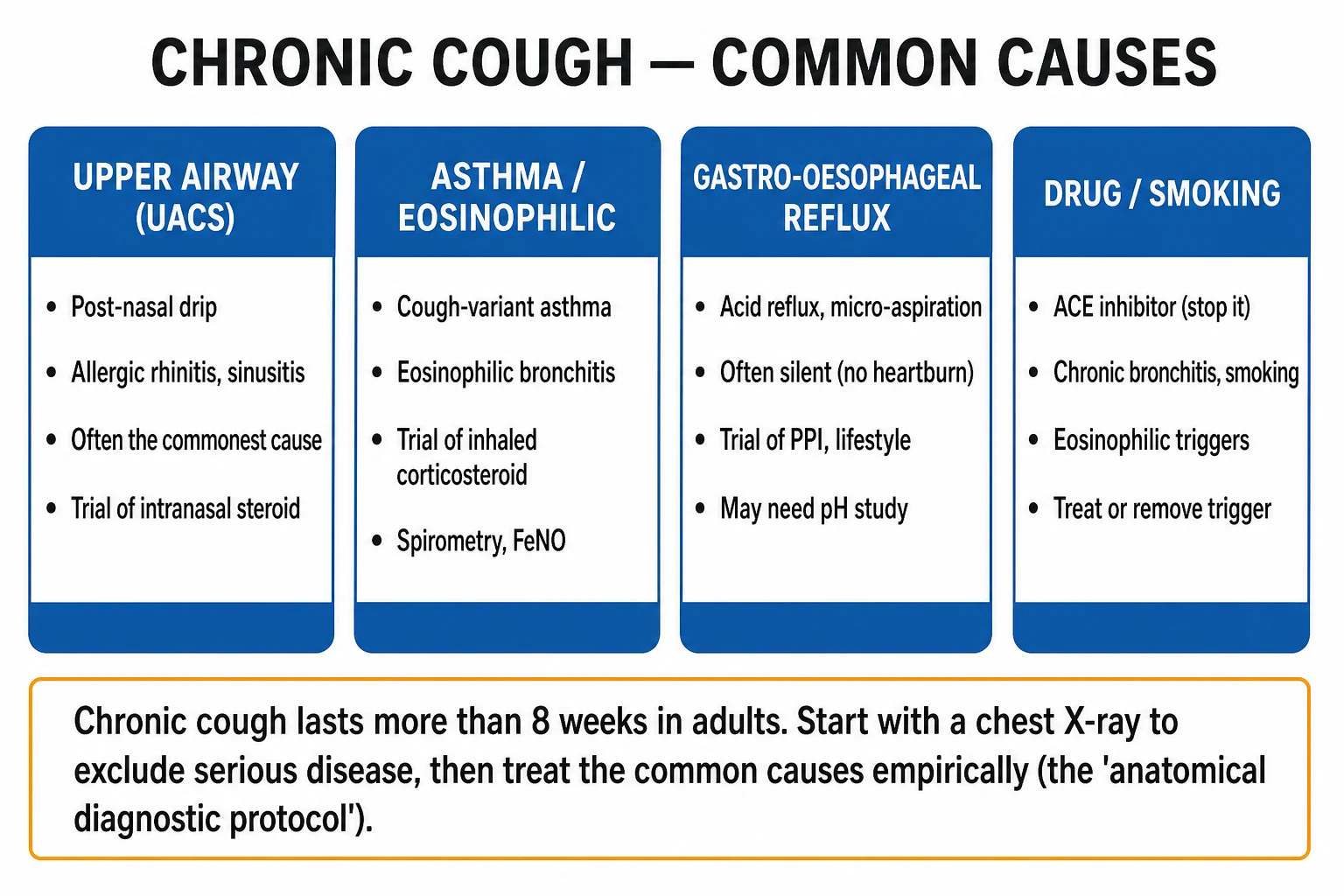
Chronic cough is a cough lasting more than 8 weeks in an adult. After a chest X-ray to exclude serious disease (lung cancer, TB, ILD, heart failure, bronchiectasis) and review of smoking and the drug list (especially ACE inhibitors, which must be stopped), a non-smoker with a normal X-ray off ACE inhibitors has one of the 'big three' common, treatable causes in most cases: upper-airway cough syndrome (UACS, post-nasal drip), asthma / eosinophilic bronchitis, and gastro-oesophageal reflux disease (GORD, often silent). Work-up is the 'anatomical diagnostic protocol' — empirical, sequential therapy of each cause, re-assessing response. Cough that persists despite this is refractory and reflects cough-reflex hypersensitivity (sensitisation of vagal afferents TRPV1, TRPA1, P2X3); it is treated with speech-language therapy and neuromodulators (gabapentin, pregabalin, low-dose morphine), or P2X3 antagonists (gegapixant), at a specialist cough clinic.
On this page & tools
Your progress
Saved locally on this device.
Exam tags
Red flags
Overview & Definition
Chronic cough is defined purely by duration — more than 8 weeks in an adult (in children the cut-off is 4 to 8 weeks). It is among the commonest reasons for outpatient consultation worldwide and carries a quality-of-life burden comparable to a severe chronic disease: sleep loss, urinary incontinence, social embarrassment, and depression are the rule rather than the exception.[1]
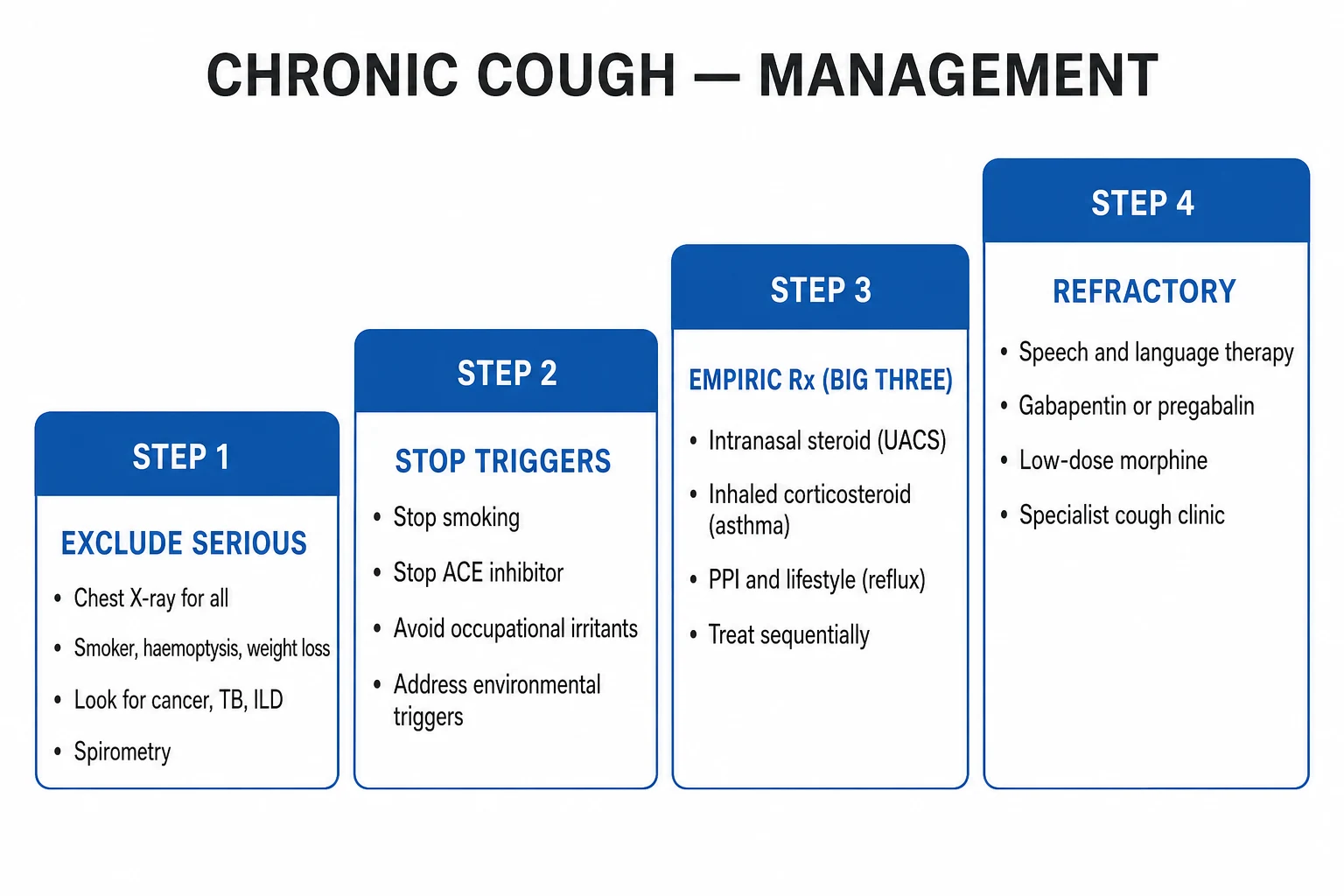
The clinical skill in chronic cough is not memorising a long list of causes. It is a structured, three-step discipline. First, exclude serious disease with a chest X-ray and a focused search for red flags — never assume a smoker's cough or a cough with haemoptysis is benign. Second, remove iatrogenic and behavioural triggers — stop ACE inhibitors and tobacco. Third, in the remainder (non-smoker, normal X-ray, off ACE inhibitors), pursue the common, treatable 'big three' causes empirically and sequentially, re-assessing the response to each therapy. Only when this structured protocol has failed is the cough termed refractory and managed with speech-language therapy and neuromodulators at a specialist cough clinic.[1]
The unifying concept across all of this is cough-reflex hypersensitivity: whatever the upstream cause, the symptoms arise from a sensitised, over-responsive cough reflex in which vagal airway afferents fire too readily to innocuous stimuli (talking, cold air, a change in temperature). Treating the cause removes the sensitiser; when no cause is found, the reflex itself becomes the target of therapy.[1]
Classification
Chronic cough is classified along three axes: by duration, by aetiology, and by its response to therapy.[1]
By duration (the classification that frames the work-up):[1]
- Acute cough — less than 3 weeks; usually viral upper-respiratory-tract infection, but also includes acute bronchitis, exacerbations of asthma/COPD/bronchiectasis, pneumonia, pulmonary embolism, and foreign body.
- Subacute cough — 3 to 8 weeks; most often post-infectious (post-viral cough following rhinovirus, influenza, Mycoplasma, Bordetella pertussis, or COVID-19) but the common causes of chronic cough also begin to appear here.
- Chronic cough — more than 8 weeks; the subject of this chapter.[1]
By aetiology — the high-yield, examinable grouping:[1]
- The common 'big three' (account for the great majority of chronic cough in a non-smoker with a normal chest X-ray): upper-airway cough syndrome (UACS / post-nasal drip), asthma / eosinophilic bronchitis, and gastro-oesophageal reflux disease (GORD).
- Iatrogenic / behavioural — ACE inhibitors, tobacco smoking (chronic bronchitis), occupational and environmental irritants.
- Serious / dangerous causes (excluded by the chest X-ray and red-flag screen) — lung cancer, tuberculosis, interstitial lung disease, bronchiectasis, chronic heart failure, aspiration.
- Rarer causes — pertussis, sarcoidosis, tracheobronchomalacia, eosinophilic granulomatosis with polyangiitis, recurrent pulmonary embolism, a mediastinal or thyroid mass compressing the trachea, and the ear-cough (Arnold) reflex.[1]
By response to therapy (ERS 2020 definitions that examiners test):[1]
- Refractory chronic cough (RCC) — cough that persists despite optimal treatment of all identified causes.
- Unexplained chronic cough (UCC) (previously 'idiopathic') — cough for which no cause can be identified despite a full diagnostic work-up.[1]
Epidemiology & Risk Factors
Chronic cough is a global public-health problem. Population surveys put its adult prevalence at roughly 10 percent worldwide (and up to 12 percent in some cohorts), making it one of the commonest single reasons for an outpatient visit.[1]
Chronic cough at a glance
Host and environmental risk factors: female sex (the female predilection of refractory cough reflects a lower cough threshold and hormonal modulation of TRPV1 receptors), obesity (raises intra-abdominal pressure and reflux), atopy, smoking (active and passive), occupational dust/fume exposure, air pollution and biomass-fuel smoke, gastro-oesophageal reflux, and ACE-inhibitor therapy.[1]
Post-viral cough is a special epidemiological entity: after an upper respiratory infection (rhinovirus, influenza, Mycoplasma, Bordetella pertussis, or COVID-19) a cough can persist for 3 to 8 weeks through virus-induced vagal neuropathy and transient airway hyperresponsiveness, and is one of the commonest triggers of a subacute-to-chronic cough presentation.[1]
Predictors of a serious underlying cause (the screen that frames the whole assessment): a smoker, age over 50, haemoptysis, weight loss, abnormal chest X-ray, and significant comorbidity. Any of these shifts the patient out of the 'big three' empirical pathway and into investigation.[1]
Pathophysiology
Cough is a protective reflex that clears the airway of secretions, irritants, and foreign material. In chronic cough this reflex becomes pathologically sensitised — it fires to innocuous stimuli (talking, cold air, eating) and persists long after the initiating injury has gone.[1]
The cough reflex arc has three limbs:[1]
- Afferent (sensory) limb. Vagal sensory neurones innervate the larynx, trachea, and bronchial tree. Two fibre populations carry the signal: rapidly-adapting Adelta fibres (low-threshold mechanoreceptors) and unmyelinated C-fibres (chemosensitive polymodal nociceptors). On these terminals sit the molecular transducers that examiners reward by name:
- TRPV1 (transient receptor potential vanilloid-1) — activated by capsaicin, noxious heat, acid, and endovanilloids; the receptor probed by the capsaicin cough challenge.
- TRPA1 — activated by oxidative irritants, cinnamaldehyde, allicin, and isothiocyanates.
- TRPV4 — osmotic and mechanical stimuli.
- P2X3 — an ATP-gated ion channel; the target of the new P2X3 antagonists (gegapixant).
- Central processing. Afferents synapse in the nucleus tractus solitarius (NTS) of the medulla, where a cough pattern generator assembles the motor sequence. Higher cortical centres (insula, cingulate, sensory cortex) provide the conscious sensation and the ability to suppress or voluntarily initiate cough.
- Efferent (motor) limb. A coordinated sequence: deep inspiration, glottic closure (laryngeal adductors), expiratory muscle contraction against the closed glottis generating high intrathoracic pressure, then sudden glottic opening producing the explosive expulsive airflow of the cough.[1] />
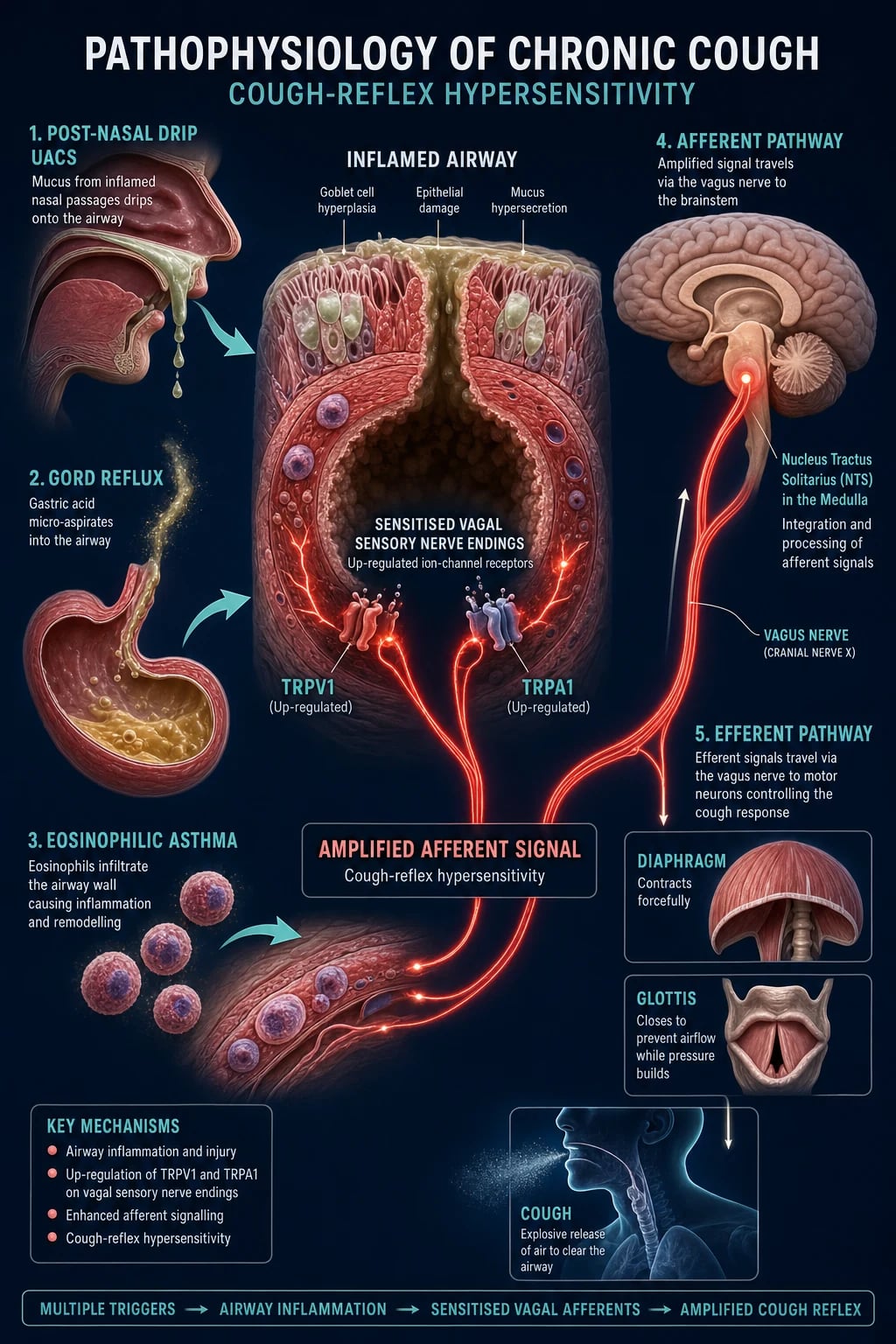
Cough-reflex hypersensitivity (CRH) — the unifying mechanism of refractory and unexplained chronic cough — has two components. Peripheral sensitisation occurs when inflammatory mediators (bradykinin, prostaglandin E2, neurotrophin nerve-growth-factor NGF) up-regulate and phosphorylate the TRP/P2X3 channels so they fire at lower thresholds. Central sensitisation in the NTS and higher centres amplifies the perceived urge-to-cough. The result is a cough triggered by talking, cold air, a change in temperature, or even a deep breath.[1]
Why each 'big three' cause drives cough:[1]
- UACS / post-nasal drip — nasal secretions and inflammatory mediants drip onto the pharynx and larynx, directly stimulating pharyngeal and laryngeal branches of the vagus and glossopharyngeal nerves.
- Asthma / eosinophilic bronchitis — eosinophil granule proteins (major basic protein, eosinophil cationic protein) and leukotrienes sensitise airway C-fibres and up-regulate TRPV1.
- GORD — a dual mechanism: (i) a vagally-mediated oesophageal-tracheobronchial reflex triggered by acid in the distal oesophagus (so the cough can occur with no acid reaching the airway), and (ii) micro-aspiration of gastric contents (acid, pepsin, bile) onto the laryngeal and tracheal mucosa, producing direct chemical injury. This is why GORD-cough is so often 'silent' — there need be no heartburn.[1]
ACE-inhibitor cough is pharmacological, not inflammatory. ACE is identical to kininase II, the enzyme that degrades bradykinin and substance P. Inhibiting ACE allows these peptides to accumulate in airway tissues, where they sensitise pulmonary C-fibres and trigger cough. The cough affects roughly 5 to 15 percent of patients, can begin days to months after starting the drug, and resolves within 1 to 4 weeks of stopping. It is a class effect of all ACE inhibitors, so switching to a different ACE inhibitor does not help; the substitute must be an angiotensin receptor blocker (ARB), which does not inhibit kininase II and therefore does not cause cough.[1]
Clinical Presentation
The history is the diagnostic engine in chronic cough. Take a focused cough history:[1]
- Duration (the 8-week threshold defines the syndrome) and onset (insidious vs after a viral illness, after starting a new drug, after a dietary/lifestyle change).
- Character — dry vs productive; the volume, colour, and consistency of any sputum.
- Pattern — diurnal/nocturnal; worse on lying, on waking, after meals, on talking, on exercise, in cold air.
- Triggers — cold air, talking, eating/drinking, strong smells, position change.
- Associated features pointing to a cause: post-nasal drip, nasal/sinus congestion, throat clearing (UACS); wheeze, atopy, nocturnal/early-morning symptoms, exercise/cold-air trigger (asthma); heartburn, regurgitation, water brash, hoarseness, worse lying or after meals (GORD).
- Drug history — ACE inhibitors, beta-blockers, NSAIDs, inhaled drugs.
- Social history — smoking (active and passive), occupation, pets, biomass-fuel exposure.[1]
UACS / post-nasal drip
- Nasal/sinus congestion, drip sensation, throat clearing
- Worse in the morning, on lying
- Allergic rhinitis, chronic sinusitis history
- Trial of **intranasal corticosteroid + antihistamine**
Asthma / eosinophilic
- **Dry nocturnal cough**, atopy
- Triggered by cold air, exercise, talking
- Cough-variant: reversibility/hyperresponsiveness
- Eosinophilic bronchitis: no obstruction; **FeNO at least 50 ppb**; trial of **ICS**
GORD
- **Often silent** — no heartburn in many
- Worse lying down, after meals, after alcohol/coffee
- Hoarseness, throat clearing, regurgitation
- Trial of **PPI + lifestyle** for at least 8 weeks
Red flags that demand investigation rather than empirical therapy (memorise these — they re-orient the whole assessment):[1]
- Haemoptysis
- Weight loss (and other systemic features — fever, night sweats)
- A smoker, or a change in a chronic 'smoker's cough'
- Significant dyspnoea
- Hoarseness persisting more than 3 weeks
- Swallowing difficulty (aspiration, or a compressing mediastinal/thyroid mass)[1]
Atypical presentations examiners test deliberately:[1]
- The elderly — ACE-inhibitor cough is common and easily missed on a casual drug review; chronic cough may be the sole sign of heart failure (interstitial oedema irritating C-fibres); and a change in a long-standing 'smoker's cough' may be the only clue to a developing cancer.
- Silent reflux — the patient denies heartburn entirely; cough, throat clearing, and hoarseness are the only features.
- Post-viral cough — a dry cough persisting 3 to 8 weeks after an otherwise resolved URTI; usually self-limiting.
- The immunocompromised — cough may be the presenting feature of an opportunistic infection (CMV, pneumocystis, fungal, TB) with an atypical or minimal CXR.[1]
Differential Diagnosis
The differential of chronic cough is best organised into the common/treatable, the serious/dangerous, and the rarer causes. The art is in distinguishing each by history, exam, and simple tests — at least three discriminating features per cause.[1]
Upper-airway cough syndrome
Commonest in many series
- Post-nasal drip, sinus congestion, throat clearing
- No wheeze; normal spirometry
- Responds to intranasal corticosteroid + antihistamine
- CXR normal
Cough-variant asthma
- Dry nocturnal cough, atopy, cold-air/exercise trigger
- Bronchodilator reversibility (FEV1 at least 12% and 200 mL) or positive provocation
- FeNO raised; responds to ICS
- May evolve into classic asthma
Eosinophilic bronchitis
- Dry cough, eosinophils in sputum (at least 3%)
- **No airflow obstruction, no reversibility**
- FeNO raised; responds to ICS
- A distinct entity, not asthma
GORD-related cough
- Often silent; worse lying/after meals
- Hoarseness, regurgitation
- pH/impedance may confirm; empirical PPI trial
- No wheeze; normal spirometry
ACE-inhibitor cough
- Onset weeks to months after starting the drug
- Dry, tickly, resolves 1 to 4 weeks after stopping
- **Switch to an ARB**, not another ACE inhibitor
- Class effect — all ACE inhibitors
Smoking / chronic bronchitis
- Productive cough most days for 3 months in 2 successive years
- Spirometry may show fixed obstruction (COPD)
- Exclude cancer before attributing to 'smoker's cough'
- Smoking cessation is therapy
The dangerous causes (excluded by CXR and red-flag screen):[1]
- Lung cancer — smoker, haemoptysis, weight loss, a new or changing cough, a persistent non-resolving opacity on CXR; refer on the suspected-cancer (two-week-wait) pathway with CT and bronchoscopy.
- Tuberculosis — night sweats, fever, weight loss, risk factors (endemic exposure, HIV, immunosuppression); smear/culture, NAAT (CBNAAT/GeneXpert), and CXR (apical cavitation, pleural effusion, miliary pattern).
- Interstitial lung disease — fine 'Velcro' crackles, finger clubbing, restrictive spirometry, reticulonodular/honeycomb CXR; confirmed on high-resolution CT.
- Bronchiectasis — chronic productive cough with purulent sputum, recurrent infections, crackles, finger clubbing; tram-track and signet-ring signs on high-resolution CT.
- Chronic heart failure — orthopnoea, exertional dyspnoea, bibasal crackles, peripheral oedema, raised JVP; 'cardiac cough' from interstitial oedema.
- Aspiration — swallowing disorder, neurological disease, post-prandial nocturnal symptoms, dependent-segment infiltrates.[1]
Rarer causes worth knowing for the viva: pertussis (whoop, post-tussive vomiting, lymphocytosis — PCR/serology), sarcoidosis (bihilar lymphadenopathy, erythema nodosum, uveitis), tracheobronchomalacia (dynamic airway collapse on CT/bronchoscopy), eosinophilic granulomatosis with polyangiitis (asthma, rhinosinusitis, eosinophilia, neuropathy), recurrent pulmonary embolism (dyspnoea out of proportion), a mediastinal or thyroid mass compressing the trachea, and the ear-cough (Arnold) reflex (stimulation of the external auditory canal via the auricular branch of the vagus).[1]
Clinical & Bedside Assessment
A normal chest examination does not exclude any of the big three causes — UACS, cough-variant asthma, and GORD-cough are largely airway/mucosal phenomena. The examination targets causes of the cough and red flags for serious disease.[1]
Focused respiratory examination: chest expansion, percussion (dullness of effusion/consolidation/collapse), breath sounds, added sounds (polyphonic wheeze of asthma/COPD; fine 'Velcro' crackles of ILD; coarse crackles of bronchiectasis), and signs of consolidation, collapse, or effusion.[1]
ENT examination: inspect the nasal cavity and nasopharynx for polyps, mucosal congestion, and a stream of post-nasal mucus; palpate the sinuses for tenderness.[1]
General examination for the dangerous clues: finger clubbing (lung cancer, bronchiectasis, ILD, rarely TB), cervical/supraclavicular lymphadenopathy (malignancy, TB), cyanosis and signs of cor pulmonale (advanced chronic lung disease), signs of heart failure (raised JVP, bibasal crackles, peripheral oedema, S3 gallop), signs of aspiration (bulbar weakness, swallow impairment).[1]
Interpret the sputum:[1]
- Mucoid (clear/white) — asthma, viral, chronic bronchitis.
- Purulent (yellow/green) — bacterial infection, bronchiectasis.
- Blood-streaked (haemoptysis) — cancer, TB, bronchiectasis, PE; red flag.
- Frothy pink — pulmonary oedema.
- Foul-smelling — anaerobes, aspiration, lung abscess.[1]
Quantifying cough severity (used in clinic and trials): the validated Leicester Cough Questionnaire (LCQ), the Cough Quality-of-Life Questionnaire (CQLQ), a cough visual-analogue scale (VAS), and objective 24-hour ambulatory cough monitoring (cough frequency, intensity).[1]
The capsaicin cough challenge — increasing inhaled concentrations of capsaicin until the patient coughs twice (C2) and five times (C5) — quantifies cough-reflex sensitivity. It is a research and specialist-cough-clinic tool, not a routine bedside test, but examiners ask for the principle: a lower C2/C5 threshold indicates a more sensitive cough reflex, the hallmark of refractory cough.[1]
Investigations
The investigation strategy is tiered: exclude serious disease first, confirm common causes next, and reserve complex tests for refractory/unexplained cases.[1]
First-line (all patients):[1]
- Chest X-ray — mandatory for everyone with chronic cough. Its job is to exclude the dangerous causes: lung cancer, TB, ILD, pleural effusion, heart failure, and bronchiectasis. A normal CXR re-opens the empirical 'big three' pathway.
- Spirometry with bronchodilator reversibility — to detect obstructive disease (asthma/COPD) and reversibility (FEV1 rise of at least 12 percent and 200 mL after 400 mcg inhaled salbutamol).
- Drug and smoking review — stop ACE inhibitors; address smoking.[1]
Targeted tests when clinically indicated:[1]
- FeNO (fractional exhaled nitric oxide) — at least 50 ppb supports eosinophilic type-2 airway inflammation (asthma or eosinophilic bronchitis) and predicts a response to inhaled corticosteroid.
- Induced-sputum eosinophil count — at least 3 percent supports eosinophilic bronchitis.
- Bronchial provocation test (methacholine or histamine challenge) — when cough-variant asthma is suspected but spirometry is normal; a positive test (PC20 fall in FEV1) supports airway hyperresponsiveness.
- CT paranasal sinuses — for refractory UACS/chronic sinusitis.
- 24-hour oesophageal pH/multichannel intraluminal impedance monitoring — for refractory cough suspected to be reflux-related, or before invasive anti-reflux therapy.[1]
Second-line (abnormal CXR, red flags, or refractory/unexplained cough):[1]
- High-resolution chest CT — for suspected ILD, bronchiectasis, a mass, or to clarify an abnormal CXR.
- Bronchoscopy — for suspected foreign body, an endobronchial lesion, atypical infection, or unexplained haemoptysis with a normal CT; not first-line.
- Echo, BNP/NT-proBNP — for suspected heart failure.[1]
The ERS 2020 diagnostic algorithm — reproduced
The ERS 2020 guideline frames chronic cough as a structured protocol:[1]
- History and examination, with attention to the cough pattern, associated features, drugs, and red flags.
- Chest X-ray for all to exclude serious disease.
- Review and remove smoking and iatrogenic triggers — stop smoking; stop ACE inhibitors.
- In a non-smoker with a normal CXR off ACE inhibitors, treat the common causes sequentially and empirically:
- UACS — intranasal corticosteroid ± antihistamine.
- Asthma / eosinophilic bronchitis — inhaled corticosteroid, ± leukotriene antagonist.
- GORD — PPI plus lifestyle measures.
- If still unresponsive, refer to a specialist cough clinic — consider high-resolution CT, bronchoscopy, pH/impedance, induced sputum, and the capsaicin cough challenge; pursue refractory-cough therapy.
- Define the cough as refractory (RCC) or unexplained (UCC) and manage accordingly.[1]
Management — Resuscitation
Chronic cough is, in the great majority of cases, not a time-critical emergency. Two situations do demand urgent action:[1]
- Massive haemoptysis (more than 200 mL in 24 hours) or cough with syncope and injury — ABCDE, protect and position the airway (injured-side down), high-flow oxygen, large-bore IV access, cross-match, and urgent imaging/bronchoscopy with a respiratory/thoracic-surgery team.
- A red-flag presentation at first contact (haemoptysis, weight loss, abnormal CXR, a smoker over 50 with a changing cough) — same-day chest X-ray if not done, CT, and a two-week-wait suspected-cancer referral; do not bury the patient in empirical therapy.[1]
Immediate safety actions for every chronic-cough patient at first presentation:[1]
- Stop ACE inhibitors and substitute an ARB (e.g., losartan 50 mg once daily).
- Smoking-cessation advice and support — behavioural support plus nicotine-replacement therapy, varenicline, or bupropion per local guidelines.
- Review and remove other triggers — occupational irritants, exacerbating drugs (non-selective beta-blockers in asthma), and allergens.[1]
Management — Definitive & Stepwise
The bedrock is the 'anatomical diagnostic protocol' described by Irwin, operationalised by the ERS and ACCP guidelines: treat each cause sequentially and empirically, re-assess the response, and only then move on. Overlap of causes is common, so treating one does not always abolish the cough.[1]
Treating the common causes — drug, dose, route, rationale
Upper-airway cough syndrome (UACS) / post-nasal drip:[1]
- Intranasal corticosteroid — mometasone 50 mcg, 2 sprays into each nostril once daily, or fluticasone propionate 50 mcg, 2 sprays each nostril once daily; review at 2 to 4 weeks.
- Antihistamine — a first-generation or non-sedating oral antihistamine (e.g., cetirizine 10 mg once daily, loratadine 10 mg once daily; or chlorphenamine 4 mg up to four times daily) for the allergic component; in classic post-nasal-drip syndrome the older first-generation agents (e.g., dexbrompheniramine) are traditionally favoured.
- Saline nasal irrigation — mechanical clearance.
- Treat underlying chronic sinusitis (nasal steroid, saline; antibiotics only if bacterial sinusitis is present — UACS is not usually bacterial).[1]
Asthma / cough-variant asthma / eosinophilic bronchitis:[1]
- Inhaled corticosteroid (ICS) — budesonide 400 mcg twice daily or fluticasone propionate 250 mcg twice daily for at least 4 weeks, then review.
- Short-acting beta-agonist as reliever (salbutamol 100 to 200 mcg as required) for cough-variant asthma with confirmed reversibility.
- Leukotriene receptor antagonist — montelukast 10 mg orally at night as add-on, particularly for cough-variant asthma and exercise-induced symptoms.
- Step up the standard GINA asthma ladder if overt asthma is confirmed.[1]
GORD-related cough:[1]
- Proton-pump inhibitor (PPI) — omeprazole 20 to 40 mg orally once daily (or esomeprazole 40 mg once daily, or lansoprazole 30 mg once daily) for at least 8 weeks.
- Lifestyle — weight loss, elevate the head of the bed, avoid late meals (more than 3 hours before lying down), reduce alcohol, coffee, fatty foods, and smoking.
- Alginates (Gaviscon) for breakthrough symptoms; an H2-receptor antagonist (e.g., ranitidine where available, or famotidine) as an alternative/add-on.
- Do not refer routinely for anti-reflux surgery (fundoplication) on the basis of cough alone — it does not reliably improve cough and carries operative risk; reserve it for objectively confirmed, severe, PPI-refractory reflux.[1]
Refractory chronic cough (RCC) — the therapy ladder
When the structured protocol has failed, the target shifts from the cause to the sensitised reflex itself. Refer to a specialist cough clinic and apply the ladder:[1][2]
- Speech-language pathology (SLP) therapy / cough-suppression physiotherapy — education about cough-reflex hypersensitivity, vocal hygiene, hydration, controlled breathing, and cough-suppression techniques. Randomised-trial-supported; first-line.
- Neuromodulators (evidence-based pharmacotherapy):
- Gabapentin — titrated up to a maximum of 1800 mg per day in three divided doses over 2 weeks, continued for up to 10 weeks; the dose proven in the Ryan RCT. Main adverse effects: somnolence and dizziness.[2]
- Pregabalin — 75 to 300 mg per day in divided doses; an alternative with a similar GABA-analogue mechanism and a cleaner titration.
- Low-dose slow-release morphine sulfate — 5 to 10 mg twice daily, slow-release formulation, for a short course in carefully selected patients; opioid centrally dampens the cough reflex. Reserve for specialist use given dependence and sedation.
- P2X3 receptor antagonists — gegapixant (AF-219) 45 to 90 mg twice daily — selectively blocks ATP signalling on P2X3 (and P2X2/3) receptors and reduces objective cough frequency in phase 2 and 3 trials. The principal adverse effect is taste disturbance (dysgeusia), because P2X3 also functions in gustatory nerves; this limits continuation. Regulatory status varies (approved in the EU and Japan; withdrawn from the US FDA application pathway as of the last review).
- Avoid long-term codeine, dextromethorphan, and over-the-counter antitussives — limited efficacy over placebo in chronic cough, with significant adverse effects (constipation, sedation, dependence). They have no place in long-term management.
- Address the complications and comorbidities — anxiety, depression, sleep disturbance, urinary incontinence, and the social/occupational impact.
Why is gabapentin the evidence-based drug for refractory cough (and not codeine)?
Gabapentin modulates central voltage-gated calcium channels (the alpha-2-delta subunit), dampening the central sensitisation that underlies cough-reflex hypersensitivity. In the double-blind randomised placebo-controlled trial by Ryan, Birring and Gibson (Lancet 2012), gabapentin titrated to a maximum of 1800 mg daily for 10 weeks significantly improved cough-specific quality of life in refractory chronic cough. Codeine and dextromethorphan, by contrast, are short-acting opioid/NMDA antitussives with limited efficacy over placebo in chronic cough and a clear burden of dependence, constipation and sedation — they are not recommended long-term.
Specific Subtypes & Scenarios
- The 'normal CXR, non-smoker, off ACE inhibitors' patient — the classic stem. Apply the sequential empirical protocol: intranasal steroid for UACS, ICS for asthma/eosinophilic, PPI plus lifestyle for GORD; re-assess at each step. Most resolve.[1]
- Post-infectious (post-viral) cough — defined as cough lasting 3 to 8 weeks after an upper respiratory infection. Mechanism: virus-induced vagal neuropathy and transient airway hyperresponsiveness. Usually self-limiting; short courses of inhaled ipratropium bromide or inhaled corticosteroid may help; reassure.[1]
- ACE-inhibitor cough — stop the drug; substitute an ARB (losartan, valsartan). Resolution typically within 1 to 4 weeks.
- Chronic cough in confirmed bronchiectasis — treat the underlying disease: airway-clearance physiotherapy, mucolytics, treatment of exacerbations with antibiotics guided by sputum culture (often Pseudomonas), and long-term azithromycin prophylaxis where indicated.
- The immunocompromised patient — a lower threshold for high-resolution CT and bronchoscopy; broaden the differential to opportunistic infection (CMV pneumonitis, pneumocystis, fungal, TB).
- Refractory / unexplained chronic cough — specialist cough clinic; speech-language therapy; neuromodulators (gabapentin/pregabalin/low-dose morphine); consider a P2X3 antagonist trial.[1][2]
Complications & Pitfalls
Physical and social complications of chronic cough — the four classic plus the psychosocial:[1]
- Urinary incontinence (stress-type, especially in middle-aged and older women) — from raised intra-abdominal pressure with each paroxysm.
- Rib fractures ('cough fractures') — typically the lower ribs, from repetitive mechanical stress; more common in osteoporotic bone.
- Cough (tussive) syncope — a sudden loss of consciousness during a paroxysm: the very high intrathoracic pressure obstructs venous return and lowers cardiac output and cerebral perfusion, akin to a Valsalva. Advise sitting or lying during paroxysms; advise against driving until controlled.
- Sleep disturbance, depression, anxiety, social embarrassment, and work loss — the quality-of-life burden is substantial.
- Pneumothorax, pneumomediastinum, and retinal/subconjunctival haemorrhage — rare but recognised.[1]
Classic diagnostic pitfalls (the errors examiners reward you for avoiding):[1]
- Attributing a smoker's cough to 'smoker's cough' and missing lung cancer — always image and pursue red flags.
- Missing ACE-inhibitor cough — always review the drug list; the cough may begin months after initiation.
- Over-diagnosing GORD on symptoms alone — symptoms are poor predictors; an empirical PPI trial is reasonable, but anti-reflux surgery on cough alone is not.
- Missing cough-variant asthma because there is no wheeze — a dry nocturnal cough in an atopic patient is cough-variant asthma until proven otherwise.
- Treating 'post-nasal drip' with antibiotics — UACS is usually non-bacterial; treat with intranasal steroid and antihistamine.
- Long-term codeine or dextromethorphan — limited efficacy, real harm (dependence, constipation, sedation).
- Unnecessary anti-reflux surgery for non-confirmed GORD-cough — fundoplication does not reliably improve cough and carries operative risk.[1]
Prognosis & Disposition
Overall prognosis is good. Most chronic cough resolves with identification and treatment of the underlying cause; the sequential empirical 'big three' protocol succeeds in the majority of cases. A minority progress to refractory (neuropathic) cough, which improves with speech-language therapy and neuromodulators but can be difficult to abolish completely. Prognosis worsens whenever a serious cause is missed.[1]
Predictors of poor outcome in refractory cough: older age, female sex, long symptom duration, high baseline cough-reflex sensitivity (low C2/C5 on capsaicin challenge), and comorbid anxiety or depression.[1]
Disposition pathway:[1]
- Primary care — initial work-up (CXR, spirometry, drug and smoking review) and empirical therapy.
- Respiratory clinic — abnormal CXR, red flags, or failure of empirical therapy; CT, bronchoscopy, and specialist testing.
- Specialist cough clinic — refractory and unexplained cases; speech-language therapy, neuromodulators, P2X3 antagonists.[1] />
Expected time course of response before declaring empirical therapy a failure:[1]
- Intranasal corticosteroid (UACS): 2 to 4 weeks.
- Inhaled corticosteroid (asthma/eosinophilic): 4 weeks.
- PPI plus lifestyle (GORD): at least 8 weeks.[1]
Special Populations
- Elderly — ACE-inhibitor cough is common and easily missed on a drug review; chronic cough may be the sole sign of heart failure or of an evolving cancer; lower threshold for CXR; review polypharmacy (aspiration risk from sedatives, anticholinergics).[1]
- Children — chronic cough is defined differently (more than 4 to 8 weeks), and the algorithm differs from the adult one. Common causes are post-viral cough, protracted bacterial bronchitis, asthma, inhaled foreign body, and congenital airway anomalies (tracheo-oesophageal fistula, ciliary dyskinesia, cystic fibrosis). Use a 'cough pointer' / treatable-trait approach and refer to a paediatric respiratory specialist; do not use adult neuromodulators, opioids, or codeine in children.[1]
- Pregnancy — adapt the work-up (avoid CXR/CT where possible; CXR is a low-dose examination if essential); manage GORD with lifestyle and pregnancy-safe antacids/PPIs (omeprazole is widely used in pregnancy); manage asthma with the usual pregnancy-safe ICS and SABA (the risk of uncontrolled asthma exceeds the risk of treatment).
- Immunocompromised — lower threshold for CT and bronchoscopy; broaden the differential to opportunistic infection.
- Smokers — always exclude COPD and lung cancer before attributing cough to 'smoker's cough'; offer smoking-cessation support (this is itself therapy).[1]
Evidence, Guidelines & Regional Differences
Key guidelines and what they say:[1]
- ERS 2020 (Morice AH et al., European Respiratory Journal 2020) — the most current international guideline; defines RCC and UCC; recommends the structured empirical protocol and, for refractory cough, speech-language therapy and a trial of neuromodulators (gabapentin, pregabalin, morphine). It explicitly cautions against long-term opioids and against unselected anti-reflux surgery.
- ACCP 2006 / CHEST 2016 (US) — the original 'anatomical diagnostic protocol' (Irwin) and its update; broadly aligned with ERS, with a US-centric emphasis on empirical therapy and a degree of caution on PPI over-use.
- NICE CG191 (UK) and BTS — guidance on chronic cough, with a defined place for speech-language therapy and neuromodulators in the NHS pathway; NICE NG121 covers reflux management.
- GINA 2024 — informs the asthma/cough-variant-asthma arm of the protocol (ICS-formoterol as reliever/maintenance in the preferred tracks).[2]
- Ryan NM, Birring SS, Gibson PG. Gabapentin for refractory chronic cough: a randomised, double-blind, placebo-controlled trial. Lancet 2012. — gabapentin titrated to a maximum of 1800 mg daily for 10 weeks significantly improved cough-specific quality of life; the foundation of neuromodulator therapy.
- P2X3 antagonist programme (gepapixant) — phase 2 and 3 RCTs demonstrated a reduction in objective cough frequency, at the cost of a high rate of taste disturbance (dysgeusia); the central role of ATP-mediated P2X3 signalling in human cough was thereby confirmed.[1] />
Controversies:[1]
- Single-cause vs multi-cause — the original 'anatomical protocol' treated causes one at a time, but causes frequently overlap; some clinics treat in parallel.
- The limits of empirical anti-reflux therapy — symptoms and even pH studies correlate poorly with cough response to PPIs; surgery for cough alone is not supported.
- Is refractory chronic cough a primary sensory neuropathy? — an emerging view reframes RCC as a laryngeal/vagal neuropathy (analogous to post-herpetic neuralgia) to be treated in its own right with neuromodulation, rather than as a failure to find a cause.[1] />
Indian / South-Asian delta: tuberculosis is a much higher-priority differential than in the West — a chronic cough with weight loss, night sweats, or an abnormal CXR mandates sputum smear, CBNAAT/GeneXpert and culture early, and bronchiectasis (often post-TB) is over-represented; biomass-fuel smoke exposure is an additional risk factor in women.
Exam Pearls
The three common causes of chronic cough (non-smoker, normal CXR, off ACE-i)
BIG 3
Asthma / cough-variant asthma / eosinophilic bronchitis — trial of inhaled corticosteroid
GORD (gastro-oesophageal reflux) — often silent; trial of PPI + lifestyle for at least 8 weeks
Upper-airway cough syndrome / post-nasal drip — intranasal steroid + antihistamine
Stop ACE inhibitor (switch to ARB) and smoking — the two removable triggers
The four classic complications of chronic cough
COUGH
Urinary (stress) incontinence — raised intra-abdominal pressure
Sleep disturbance; rib ('cough') fractures
Cough (tussive) syncope — venous return obstructed by high intrathoracic pressure
Depression, anxiety, social embarrassment, work loss
Retinal/subconjunctival, rarely pneumothorax/pneumomediastinum
The one-liners examiners reward:[1][2]
- "Chronic cough = more than 8 weeks in an adult; chest X-ray for everyone to exclude serious disease."
- "Big three (non-smoker, normal CXR, off ACE-i): UACS/post-nasal drip, asthma/eosinophilic bronchitis, GORD."
- "Always stop ACE inhibitors — switch to an ARB, not another ACE inhibitor — and stop smoking."
- "Empiric sequential Rx: intranasal steroid, inhaled corticosteroid, PPI/lifestyle."
- "Refractory cough = cough-reflex hypersensitivity of vagal afferents (TRPV1, TRPA1, P2X3); treat with speech-language therapy and neuromodulators (gabapentin, pregabalin, low-dose morphine)."
- "The molecular transducers: TRPV1 (capsaicin), TRPA1 (oxidants), P2X3 (ATP — blocked by gefapixant)."
- "ACE = kininase II; blocking it accumulates bradykinin and substance P, sensitising airway C-fibres."
- "Cough-variant asthma (reversible, eosinophilic) vs eosinophilic bronchitis (no obstruction, no reversibility) vs post-viral cough (self-limiting)."[1] />
Exam application bank (NEET-PG / INICET)
One-line answer
Chronic cough is a cough lasting more than 8 weeks in an adult. After a chest X-ray to exclude serious disease (lung cancer, TB, ILD, heart failure, bronchiectasis) and review of smoking and the drug list (especially ACE inhibitors, which must be stopped), a non-smoker with a normal X-ray off ACE inhibitors has one of the 'big three' common, treatable causes in most cases: upper-airway cough syndrome (UACS, post-nasal drip), asthma / eosinophilic bronchitis, and gastro-oesophageal reflux disease (GORD, often silent). Work-up is the 'anatomical diagnostic protocol' — empirical, sequential therapy of each cause, re-assessing response. Cough that persists despite this is refractory and reflects cough-reflex hypersensitivity (sensitisation of vagal afferents TRPV1, TRPA1, P2X3); it is treated with speech-language therapy and neuromodulators (gabapentin, pregabalin, low-dose morphine), or P2X
Worked stems (answer without another resource)
Stem 1 — Classic presentation. Map symptoms to mechanism; name the first investigation and first treatment step with dose/route if drug therapy is standard. [1]
Stem 2 — Unstable / complicated. List red flags that force immediate resuscitation, theatre, ICU, antidote, or reperfusion — and what you do in the first 15 minutes. [1]
Stem 3 — Atypical group. Elderly, pregnancy, child, or immunocompromised: how presentation and thresholds change. [1]
Stem 4 — Differential trap. Name the three closest mimics and one discriminator for each. [1]
Stem 5 — Disposition. Who goes home with safety-netting, who is admitted, who needs HDU/ICU/theatre, and what follow-up is mandatory. [1]
Rapid viva checklist
- Definition + classification
- Pathophysiology chain
- Bedside signs / criteria
- Score with exact components (if any)
- Emergency bundle
- Definitive therapy with doses
- Complications of disease and of treatment
- Special populations
- Guideline/trial name if classic
- Three exam traps
Coverage self-check
If you cannot answer any stem above from this page alone, re-read the matching section — the page is intended to be self-sufficient for final-prof and NEET-PG/INICET questions on Chronic Cough.
References
- [1]Morice AH, Millqvist E, Bieksiene K, et al. ERS guidelines on the diagnosis and treatment of chronic cough in adults and children. Alyn H. Morice, Eva Millqvist, Kristina Bieksiene, Surinder S. Birring, Peter Dicpinigaitis, Christian Domingo Ribas, Michele Hilton Boon, Ahmad Kantar, Kefang Lai, Lorcan McGarvey, David Rigau, Imran Satia, Jacky Smith, Woo-Jung Song, Thomy Tonia, Jan W.K. van den Berg, Mirjam J.G. van Manen and Angela Zacharasiewicz. Eur Respir J 2020; 55: 1901136 Eur Respir J, 2020.PMID 33214170
- [2]Ryan NM, Birring SS, Gibson PG. Gabapentin for refractory chronic cough: a randomised, double-blind, placebo-controlled trial Lancet, 2012.PMID 22951084