EM · Postpartum haemorrhage
Postpartum haemorrhage
Also known as PPH · Primary postpartum haemorrhage · Obstetric haemorrhage
The postpartum haemorrhage — the primary PPH (the blood loss over 500 mL within the 24 hours of the delivery, or the over 1000 mL after the Caesarean) and the secondary PPH (the bleeding from the 24 hours to the 12 weeks postpartum). The four Ts of the cause (the Tone — the uterine atony, the commonest at 70 per cent; the Trauma — the vaginal or the cervical tear; the Tissue — the retained products; the Thrombin — the coagulopathy). The management: the ABCDE, the two large-bore cannulae, the crossmatch 4 units, the fluid resuscitation, the uterotonics (the oxytocin 10 IU IM or 5 IU IV, the ergometrine 500 mcg IM — avoid in the hypertension; the carboprost 250 mcg IM every 15 minutes up to 8 doses — avoid in the asthma; the misoprostol 800 mcg per rectum), the tranexamic acid 1 g IV, the Bakri balloon, the bimanual compression, the surgical ligation, the hysterectomy for the refractory. ACEM-primary, globally tagged.
On this page & tools
Your progress
Saved locally on this device.
Target exams
Red flags
The postpartum haemorrhage is the loss of the blood from the genital tract after the delivery, and the major primary PPH is one of the most time-critical obstetric emergencies that the emergency physician will encounter — the patient can lose litres in minutes, and the under-recognition and the under-resuscitation are the recurring drivers of the maternal death. The Fellowship candidate must know the definition (the primary and the secondary), the four Ts of the cause, the simultaneous resuscitation and the source control, the uterotonic doses with their contraindications, and the escalation ladder from the uterine massage to the hysterectomy. The tranexamic acid 1 g IV and the early call for the obstetric and the haematology help are the non-negotiables.[1][3]
Definition and the classification
The postpartum haemorrhage is divided into the primary and the secondary by the timing. [1]
The primary PPH is the blood loss from the genital tract of 500 mL or more within the 24 hours of the delivery (vaginal), or 1000 mL or more after a Caesarean section. It is further graded into the minor (the 500 to 1000 mL) and the major (the over 1000 mL, subdivided into the 1000 to 2000 mL and the over 2000 mL). The major PPH with the haemodynamic compromise is the life-threatening emergency. [1]
The secondary PPH (the late or the delayed PPH) is the abnormal bleeding from the genital tract from the 24 hours to the 12 weeks after the delivery. It is less dramatic but is the common reason for the postnatal re-presentation to the emergency department. [1]
[1]The caveat that costs the marks: the estimated blood loss is systematically underestimated by up to 30 to 50 per cent, particularly after the vaginal delivery and in the larger woman. The diagnosis is not made on the drip count — it is made on the physiological derangement (the tachycardia, the rising respiratory rate, the hypotension, the raised lactate) and the ongoing bleeding. A woman who is tachycardic and climbing off the bed with the clots is in the major PPH regardless of the estimated volume.[3]
The epidemiology and the risk factors
The primary PPH complicates approximately 2 to 5 per cent of the deliveries, and the incidence is rising in the high-income countries — the driver is the rising Caesarean rate, the older maternal age, the obesity, and the multiple gestation. It remains a leading cause of the direct maternal death worldwide, and in the ANZ and the UK context it is the commonest single cause of the severe maternal morbidity and the admission to the intensive care. [1]
The risk factors cluster around the four Ts and should be sought in the history: the overdistended uterus (the multiple pregnancy, the polyhydramnios, the macrosomia), the exhausted or the overstimulated myometrium (the prolonged or the augmented labour, the oxytocin infusion, the chorioamnionitis), the placental factors (the previous Caesarean, the placenta praevia, the placenta accreta spectrum), the coagulopathy (the pre-eclampsia, the HELLP, the abruption, the sepsis, the inherited or the anticoagulant-induced coagulation defect), and the previous PPH (the strongest single predictor of the recurrence). The critical point for the exam: a woman with the placenta accreta and the previous Caesarean is the catastrophe waiting — the interventional radiology and the cell salvage must be pre-alerted.[3]
The pathophysiology — the four Ts
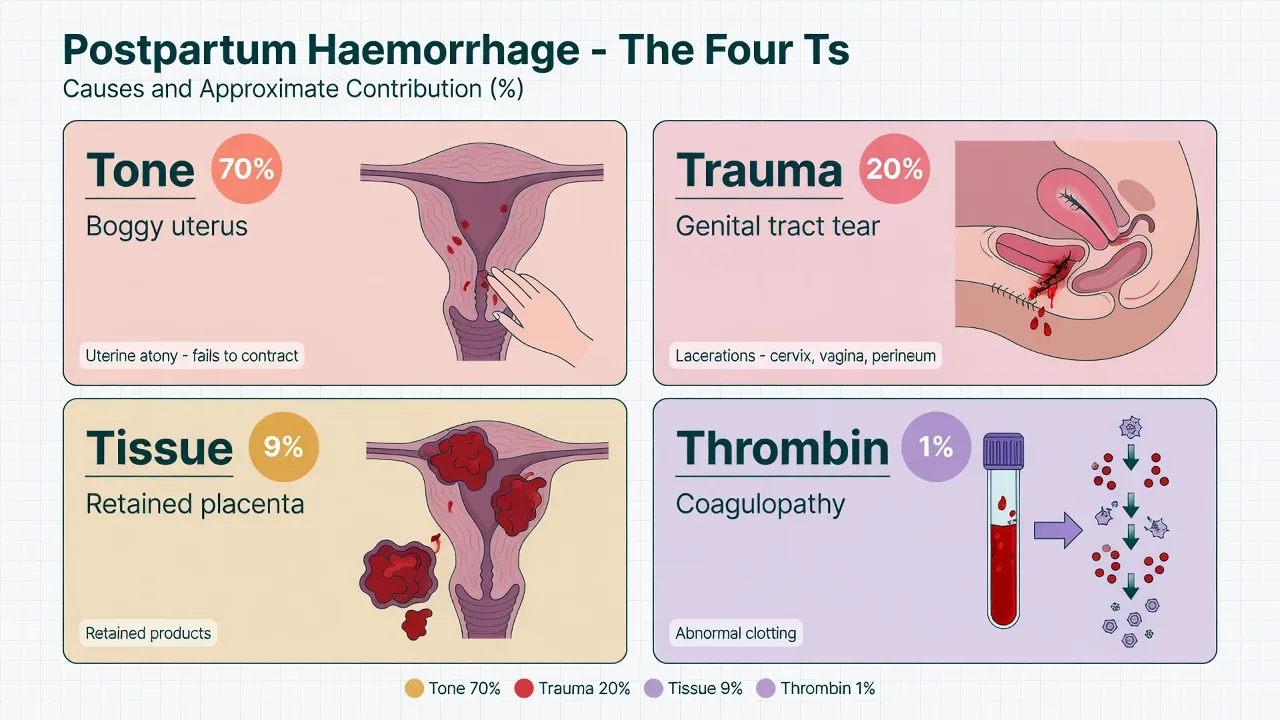
The cause of the primary PPH is best recalled with the four Ts, because each T dictates a different intervention. The examiner will ask for them by name. [1]
THE 4 Ts
The Tone (the uterine atony) is the commonest cause at 70 per cent. The haemostasis after the delivery depends on the living ligatures — the myometrial fibres that contract and retract around the spiral arteries of the placental bed. When the myometrium is exhausted, overdistended, or infiltrated, the arteries bleed freely. The atony is the diagnosis of the palpably soft, boggy uterus with the heavy lochia, and it is the first cause to address — the uterine massage and the oxytocin. [1]
The Trauma (the 20 per cent) is the laceration of the cervix, the vagina, or the perineum sustained during the delivery, the extension of the episiotomy, the uterine rupture (the previous Caesarean scar), and the acute uterine inversion. The atony has been excluded and the uterus is well contracted, but the bright red bleeding continues — the speculum examination of the cervix and the vagina under good light is the diagnostic step. [1]
The Tissue (the 9 per cent) is the retained placenta or the retained products. The placenta or a fragment of it remains in the uterus and prevents the retraction; the uterus cannot clamp down on the placental bed. The history of the incomplete or the manual removal of the placenta, and the ultrasound showing the intrauterine echogenic material, are the clues. [1]
The Thrombin (the 1 per cent) is the coagulopathy. It may be the pre-existing (the von Willebrand disease, the anticoagulant, the thrombocytopenia) or the acquired in the course of the haemorrhage — the dilutional coagulopathy of the massive transfusion, the consumptive coagulopathy of the placental abruption, the severe pre-eclampsia and the HELLP, the sepsis, and the amniotic fluid embolism. The thrombin is the diagnosis of the abnormal coagulation and the platelets, and it is the reason the clotting studies are sent early and repeated.[3]
The clinical presentation
The primary PPH presents as the heavy, bright red vaginal bleeding in the immediate postpartum period, with the clots and the failure of the bleeding to settle. The physiological signs track the blood loss and the compensation: the tachycardia is the earliest sign, then the rising respiratory rate, the narrow pulse pressure (the diastolic climbing as the vasoconstriction compensates), the cool peripheries and the delayed capillary refill, the hypotension (a late and ominous sign), and the altered mental state (the agitation, then the drowsiness). The raised lactate and the base deficit on the venous gas quantify the occult shock that the blood pressure has not yet revealed. [1]
The abdominal examination is the key to the atony: a soft, boggy, fundally difficult-to-palpate uterus with the heavy flow is the atony; a well-contracted, firm uterus with the continued bright bleeding points to the trauma or the tissue. The speculum and the vaginal examination (in theatre if needed) identifies the cervical or the vaginal tear. The uterine inversion presents with the sudden severe pain, the cardiovascular collapse out of proportion to the visible blood loss, and the mass in the vagina. The uterine rupture presents with the cessation of the contractions, the fetal distress, the loss of the station, and the abdominal tenderness.[3]
Differential diagnosis
The differential of the postpartum bleeding is the four Ts themselves, but the examiner also wants the non-obstetric causes that can masquerade, and the secondary-PPH causes distinguished. [1]
Uterine atony (Tone)
- The soft boggy uterus; 70 per cent of the primary PPH
- The overdistended or the exhausted uterus (the twins, the polyhydramnios, the prolonged labour)
- The uterine massage and the oxytocin first; the escalation to the second-line uterotonics
- The first cause to address in every PPH
Genital tract trauma
- The well-contracted uterus with the bright bleeding; 20 per cent
- The cervical or the vaginal tear, the episiotomy, the uterine rupture
- The speculum examination under good light; the surgical repair in theatre
- Suspect after the instrumental or the rapid delivery
Retained tissue
- The incomplete or the difficult placental delivery; 9 per cent
- The ultrasound shows the intrauterine echogenic material
- The manual removal in theatre; the antibiotic cover
- The leading cause of the secondary PPH
Coagulopathy (Thrombin)
- The abnormal clotting and the platelets; 1 per cent primary, commoner as the secondary phenomenon
- The abruption, the HELLP, the amniotic fluid embolus, the massive transfusion
- The blood products — the FFP, the cryoprecipitate, the platelets; the tranexamic acid
- Send the coagulation, the fibrinogen and the platelets early
Uterine rupture
- The previous Caesarean scar; the cessation of the contractions, the fetal distress
- The loss of the station, the abdominal tenderness, the cardiovascular collapse
- The urgent laparotomy; the repair or the hysterectomy
- The catastrophic cause — do not delay for the imaging
The investigations
The investigations run in parallel with the resuscitation — they never delay the management. [1]
The venous gas (the lactate, the base deficit, the haemoglobin) is the immediate bedside marker of the perfusion and the occult shock. The full blood count (the haemoglobin, the platelets) and the group and hold or the crossmatch 4 units (the crossmatch if the major PPH, the group-and-hold if the minor) are the first bloods. The coagulation (the INR, the APTT), the fibrinogen (the most sensitive clotting marker in the obstetric haemorrhage — the fibrinogen below 2 g per litre predicts the severe ongoing bleeding), and the calcium (chelated by the citrate in the transfused blood, the hypocalcaemia impairs the cardiac and the uterine contractility) are sent and repeated at intervals. The renal function and the liver function complete the panel. [1]
The imaging is limited and targeted: the pelvic ultrasound (the bedside or in theatre) identifies the retained products and the placenta, but it must not delay the resuscitation of the unstable patient. The history and the examination remain the primary diagnostic tools — the four Ts are a clinical framework, not an imaging diagnosis.[3]
The immediate management — the resuscitation and the uterotonics
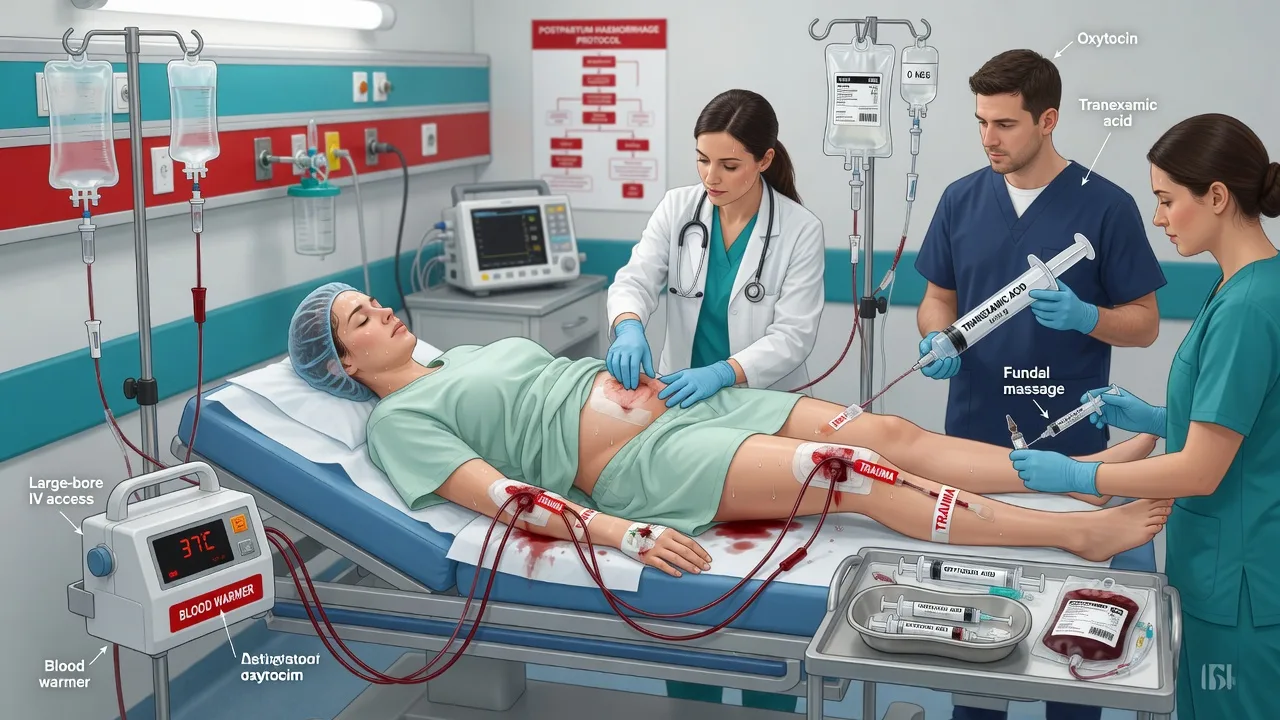
The management is the simultaneous resuscitation and the source control, run by a team and a team leader, with the early call for the obstetric, the anaesthetic, and the haematology help. The massive transfusion protocol is activated for the major PPH. [1]
- The ABCDE. The airway and the breathing — the high-flow oxygen, the assessment of the work of breathing. The circulation — the two large-bore cannulae (the 14 or 16 gauge), the bloods drawn, the balanced crystalloid 500 mL boluses titrated to the response (avoid the over-resuscitation that worsens the dilutional coagulopathy), the warming of all the fluids, and the crossmatch 4 units with the activation of the massive transfusion protocol. The tranexamic acid 1 g IV is given as early as possible — the WOMAN trial showed the mortality benefit and the effect falls with every hour of delay.[1][2]
- The uterine massage (the fundal massage to stimulate the contraction) and the uterotonics while the ABCDE proceeds — this addresses the Tone, the commonest cause.
- The examination of the genital tract to exclude the Trauma, and the inspection of the placenta for the completeness (the Tissue).
- The blood products guided by the coagulation, the fibrinogen and the platelets — the fresh frozen plasma, the cryoprecipitate (the fibrinogen below 2 g per litre), and the platelets.
The uterotonic and the haemostatic doses
The oxytocin is the first-line uterotonic — the 5 IU IV slowly (or the 10 IU IM) causes the sustained myometrial contraction; it is followed by the infusion of 40 IU in 500 mL of the crystalloid over 4 hours. The oxytocin is the agent of the prophylaxis and the first agent of the treatment. [1]
The ergometrine (or the combined oxytocin-ergometrine, the Syntometrine) is the second-line — the 500 mcg IM produces the powerful sustained tetanic contraction. It is contraindicated in the hypertension and the pre-eclampsia (it is a potent vasopressor that can precipitate the hypertensive crisis, the stroke, and the pulmonary oedema), and it causes the nausea and the vomiting. [1]
The carboprost (the 15-methyl prostaglandin F2 alpha) is the third-line for the refractory atony — the 250 mcg IM every 15 minutes up to the maximum of 8 doses (the 2 mg total). It is contraindicated in the asthma (it is a bronchoconstrictor that can precipitate the severe bronchospasm) and it is used with the caution in the cardiac disease. [1]
The misoprostol (the prostaglandin E1 analogue) is the 800 mcg per rectum — the cheap, heat-stable, oral-active agent that is the fourth-line and the agent of choice in the resource-limited setting where the cold chain is unreliable. It causes the diarrhoea, the shivering, and the pyrexia. [1]
The tranexamic acid 1 g IV (repeated at 30 minutes if the bleeding continues) is the antifibrinolytic. The WOMAN trial demonstrated the reduction in the death from the bleeding and the time-critical benefit — the treatment delay analysis showed the survival benefit is greatest in the first hour and falls steadily thereafter, so the tranexamic acid is given as early as the cannula is sited.[1][2]
The escalation ladder — the mechanical and the surgical management
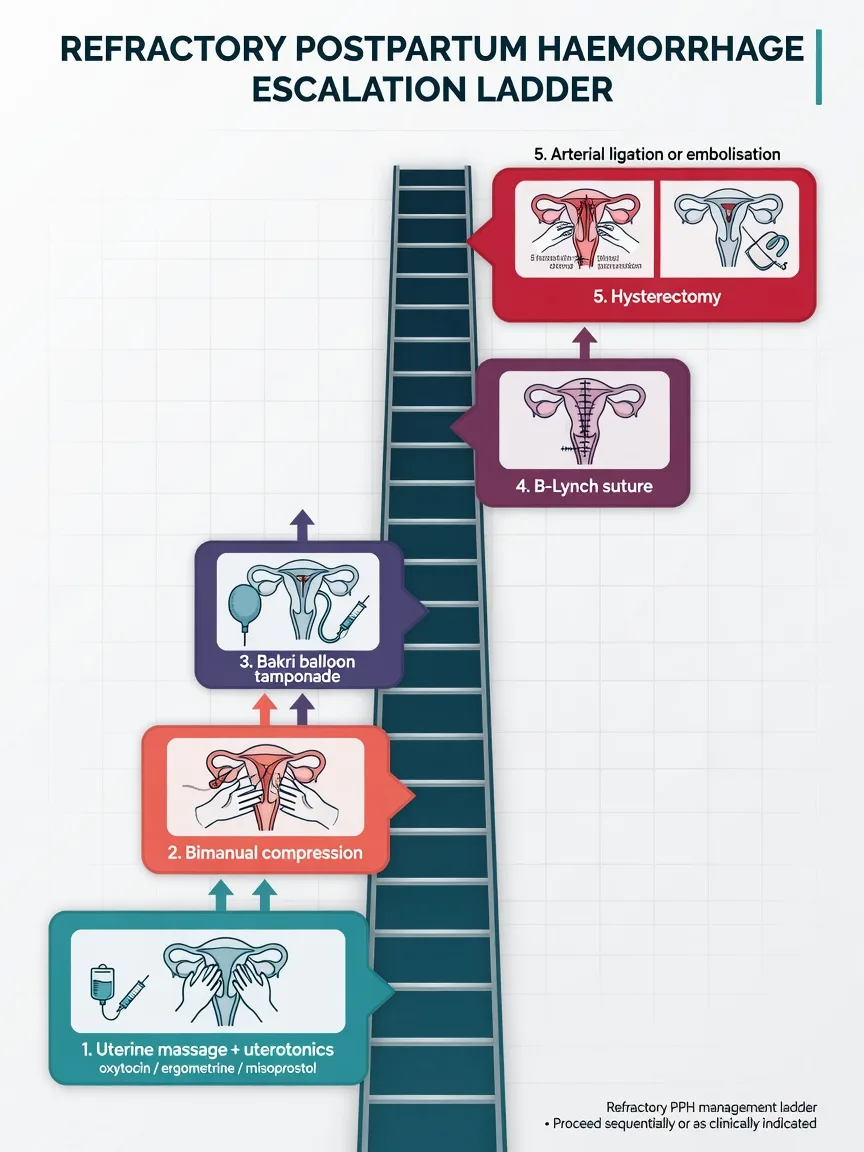
When the uterotonics fail to control the atony, the escalation proceeds up a defined ladder, with the obstetric team in the lead. [1]
The bimanual uterine compression (the external hand on the fundus, the internal fist in the anterior vaginal fornix compressing the uterus between the two hands) is the immediate temporising manoeuvre that buys the time while the drugs and the team assemble. [1]
The uterine packing and the Bakri balloon tamponade (the hydrostatic balloon inflated in the uterine cavity to exert the direct pressure on the placental bed) is the effective and the uterine-sparing intervention for the refractory atony — the balloon is left in situ for 12 to 24 hours and then deflated progressively. [1]
The surgical options, in the escalating order, are the uterine sutures (the B-Lynch or the Cho compression suture that apposes the anterior and the posterior uterine walls), the uterine artery or the ovarian artery ligation, the internal iliac (hypogastric) artery ligation (the reduction of the pulse pressure to the pelvis), the selective pelvic arterial embolisation (the interventional radiology, in the stable patient), and the hysterectomy as the life-saving last resort for the refractory haemorrhage. The hysterectomy is the decision that should be made early and decisively — the delay to the hysterectomy is the recurring cause of the maternal death in the Confidential Enquiries. [1]
The secondary postpartum haemorrhage
The secondary PPH — the bleeding from the 24 hours to the 12 weeks postpartum — is the common reason for the postnatal re-presentation to the emergency department. The cause is overwhelmingly the retained products of conception and the uterine infection (the endometritis), and the two frequently coexist. [1]
The presentation is the heavy, smelly, or the persistent lochia, the pelvic pain, the fever, and the tender enlarged uterus. The investigation is the full blood count (the anaemia, the raised WCC), the C-reactive protein, the high vaginal and the endocervical swab (with the chlamydia and the gonorrhoea nucleic acid amplification — do NOT forget the sexually transmitted infection in the postnatal woman), the beta-hCG to exclude the rare gestational trophoblastic disease, and the pelvic ultrasound for the retained products. [1]
The management is the antibiotics (the clindamycin and the gentamicin, or the amoxicillin-clavulanate with the doxycycline and the metronidazole, for the polymicrobial endometritis), the resuscitation and the transfusion if the anaemia is severe, and the surgical evacuation (the curettage) for the confirmed retained products — with the caution that the curettage in the infected or the very soft postpartum uterus carries the risk of the perforation. The rare and the dangerous cause of the secondary PPH is the subinvolution of the placental bed (the failure of the obliteration of the placental-site vessels) and the gestational trophoblastic neoplasia — the persistently raised beta-hCG is the red flag. [1]
The complications and the pitfalls
The complications are the consequences of the haemorrhage and the transfusion. The haemorrhagic shock with the multi-organ failure (the acute kidney injury, the hepatic dysfunction, the adult respiratory distress syndrome, the Sheehan syndrome — the pituitary infarction and the hypopituitarism from the profound hypovolaemia) is the worst. The transfusion-related complications (the transfusion-associated circulatory overload, the transfusion-related acute lung injury, the acute haemolytic reaction, the citrate-induced hypocalcaemia) and the dilutional coagulopathy complicate the massive transfusion. The renal failure from the prolonged hypotension and the the venous thromboembolism (the postpartum hypercoagulability compounded by the immobility) are the late complications. [1]
The recurring pitfalls are: the underestimation of the blood loss (manage on the physiology, not the drip count); the failure to call for help early (the obstetric, the anaesthetic, and the haematology team, and the massive transfusion protocol); the delay to the tranexamic acid (give it at the moment of the cannulation); the ergometrine in the hypertensive woman; the carboprost in the asthmatic; the failure to send and to repeat the fibrinogen (the fibrinogen below 2 g per litre predicts the severe ongoing bleeding); the over-resuscitation with the crystalloid (the dilutional coagulopathy); the failure to examine the genital tract (the missed cervical tear); and the late decision for the hysterectomy. [1]
[1]The prognosis and the disposition
The prognosis depends on the speed of the recognition and the resuscitation. The PPH that is recognised early and managed aggressively has a good prognosis; the under-recognised and the under-resuscitated PPH is the cause of the maternal death. The mortality in the developed world is low (under 1 per cent) but the morbidity — the transfusion, the intensive care, the hysterectomy, the Sheehan syndrome, and the psychological trauma — is substantial. [1]
The disposition is the intensive care or the high-dependency unit for the major PPH and the patient who has received the massive transfusion or the surgery. The post-PPH care includes the correction of the anaemia, the venous thromboembolism prophylaxis (the postpartum hypercoagulability), the psychological debrief, and the counselling about the recurrence risk (the previous PPH confers the increased risk in the next pregnancy) and the plan for the next delivery. [1]
The special populations
The woman with the placenta accreta spectrum and the previous Caesarean is the highest-risk patient — the placenta invades the scar and cannot separate, and the attempted removal causes the catastrophic haemorrhage. The diagnosis is made antenatally on the ultrasound (the loss of the retroplacental clear space, the lacunae, the bladder wall disruption), and the planned delivery is in the tertiary centre with the interventional radiology, the cell salvage, and the consent for the elective hysterectomy. The emergency physician receiving the undiagnosed accreta must call the most senior obstetric help immediately. [1]
The woman on the anticoagulant (the low-molecular-weight heparin for the thromboprophylaxis, or the warfarin or the direct oral anticoagulant for the valvular disease) is at the increased risk of the thrombin cause — the coagulation and the anticoagulant reversal are part of the immediate workup. [1]
The woman with the inherited bleeding disorder (the von Willebrand disease, the haemophilia carrier) needs the specific factor replacement in the lead-up to and the aftermath of the delivery, and the haematology team is involved early. [1]
The evidence and the regional guidelines
The contemporary evidence base is dominated by the WOMAN trial — the international, randomised, double-blind, placebo-controlled trial that demonstrated the early tranexamic acid reduced the death from the bleeding in the postpartum haemorrhage, with the treatment-delay analysis confirming the time-critical benefit.[1][2] The guidelines are the WHO recommendations on the prevention and the treatment of the postpartum haemorrhage, the RCOG green-top guideline on the postpartum haemorrhage, the FIGO consensus, and the ANZ practice articulated in the national guidance on the massive haemorrhage in obstetrics.[3]
ANZ practice note. The postpartum haemorrhage is managed with the simultaneous resuscitation and the source control, the four Ts as the diagnostic framework, the oxytocin as the first-line uterotonic, the tranexamic acid 1 g IV at the moment of the cannulation, the Bakri balloon as the uterine-sparing intervention, and the early call for the obstetric and the haematology help and the massive transfusion protocol. The ergometrine is withheld in the hypertension and the pre-eclampsia; the carboprost is withheld in the asthma. The fibrinogen below 2 g per litre triggers the cryoprecipitate. [1]
The exam pearls
- The four Ts by name and the percentage — Tone 70, Trauma 20, Tissue 9, Thrombin 1. The examiner wants the atony addressed first in every case.
- The uterotonic doses with the contraindication — oxytocin 5 IU IV or 10 IU IM (first), ergometrine 500 mcg IM (avoid the hypertension), carboprost 250 mcg IM q15 min to 8 doses (avoid the asthma), misoprostol 800 mcg PR (fourth).
- The tranexamic acid 1 g IV is time-critical — the WOMAN trial, the earlier the better, give it at the cannulation.
- Manage on the physiology, not the drip count — the estimated blood loss is underestimated by up to 50 per cent.
- The fibrinogen is the obstetric clotting marker — below 2 g per litre predicts the severe ongoing bleeding, give the cryoprecipitate.
- The Bakri balloon is the uterine-sparing step; the hysterectomy is the decisive last resort — make the decision early.
- The secondary PPH from the 24 hours to the 12 weeks — the retained products and the endometritis, do NOT forget the chlamydia and the gonorrhoea swab and the beta-hCG for the trophoblastic disease. [1]
Exam practice
SAQ — Major primary postpartum haemorrhage from uterine atony
10 minutes · 10 marks
A 32-year-old multigravida delivers vaginally at 41 weeks after an oxytocin-augmented 18-hour labour. Thirty minutes after the delivery of a 4.2 kg infant and a complete placenta, she has lost an estimated 1500 mL of blood with clots. She is anxious and pale, HR 124, BP 92/58, RR 24, SpO2 97 per cent. The uterus is soft and boggy, palpable at the umbilicus, with heavy bright-red lochia.
SAQ — Postpartum haemorrhage in the pre-eclamptic, asthmatic woman
10 minutes · 10 marks
A 28-year-old woman has an emergency Caesarean section for severe pre-eclampsia at 34 weeks; she is also a chronic asthmatic with an audible wheeze. She loses 1800 mL postoperatively from an atonic uterus. BP 168/106, HR 130, SpO2 95 per cent, with wheeze throughout both lung fields.
Red flags
[1]References
- [1]WOMAN Trial Collaborators Effect of early tranexamic acid administration on mortality, hysterectomy, and other morbidities in women with post-partum haemorrhage (WOMAN): an international, randomised, double-blind, placebo-controlled trial Lancet, 2017.PMID 28456509
- [2]Gayet-Ageron A, Prieto-Merino D, Ker K, et al. Effect of treatment delay on the effectiveness and safety of antifibrinolytics in acute severe haemorrhage: a meta-analysis of individual patient-level data from 40 138 bleeding patients Lancet, 2018.PMID 29126600
- [3]Zúñiga Gómez E, Blanco Rodríguez N, Arjona Berral J, et al. Contemporary Approach to Postpartum Hemorrhage: Early Diagnosis and Evidence-Based Therapeutic Management Cureus, 2026.PMID 42147550