EM · Anaphylaxis
Anaphylaxis (the emergency of the IM adrenaline)
Also known as Anaphylactic shock · Allergic emergency · Severe allergic reaction
Anaphylaxis — the rapid, severe, multi-system allergic reaction; the IgE-mediated mast cell degranulation; the clinical diagnostic criteria (the sudden onset with the skin or the mucosal change and the respiratory and/or the cardiovascular involvement); the triggers (the food, the venom, the drug, the contrast, the latex, the exercise); the emergency management (the intramuscular adrenaline 500 micrograms into the anterolateral thigh, repeated every 5 minutes; the high-flow oxygen; the intravenous fluid; the chlorphenamine; the hydrocortisone; the observation for the biphasic reaction); the refractory anaphylaxis (the intravenous adrenaline infusion); and the beta-blocker patient (the glucagon). ACEM-primary, globally tagged.
On this page & tools
Your progress
Saved locally on this device.
Target exams
Red flags
Related topics
Anaphylaxis is the prototype of the time-critical emergency that every emergency physician must manage automatically — the IM adrenaline dose and the route must be as reflexive as the defibrillation for the VF, because the under-dosing, the delayed dosing and the wrong route are the recurring fatal errors. The Fellowship candidate must know the diagnostic criteria, the immediate algorithm with the doses, the refractory-anaphylaxis escalation, and the beta-blocker trap, because these are the decisions that separate the candidate who saves from the one who loses the preventable death.[1][2]
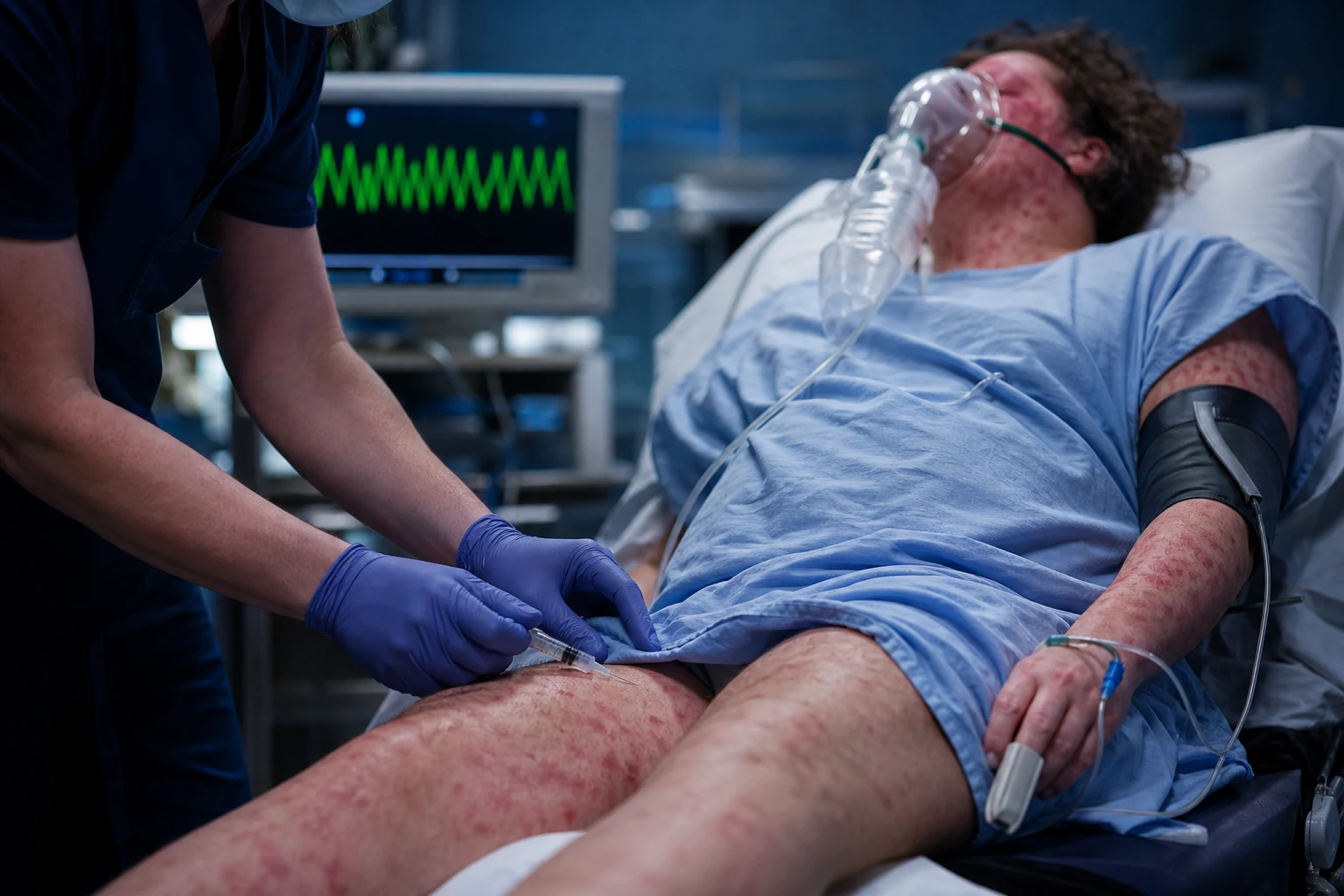
Definition and the mechanism
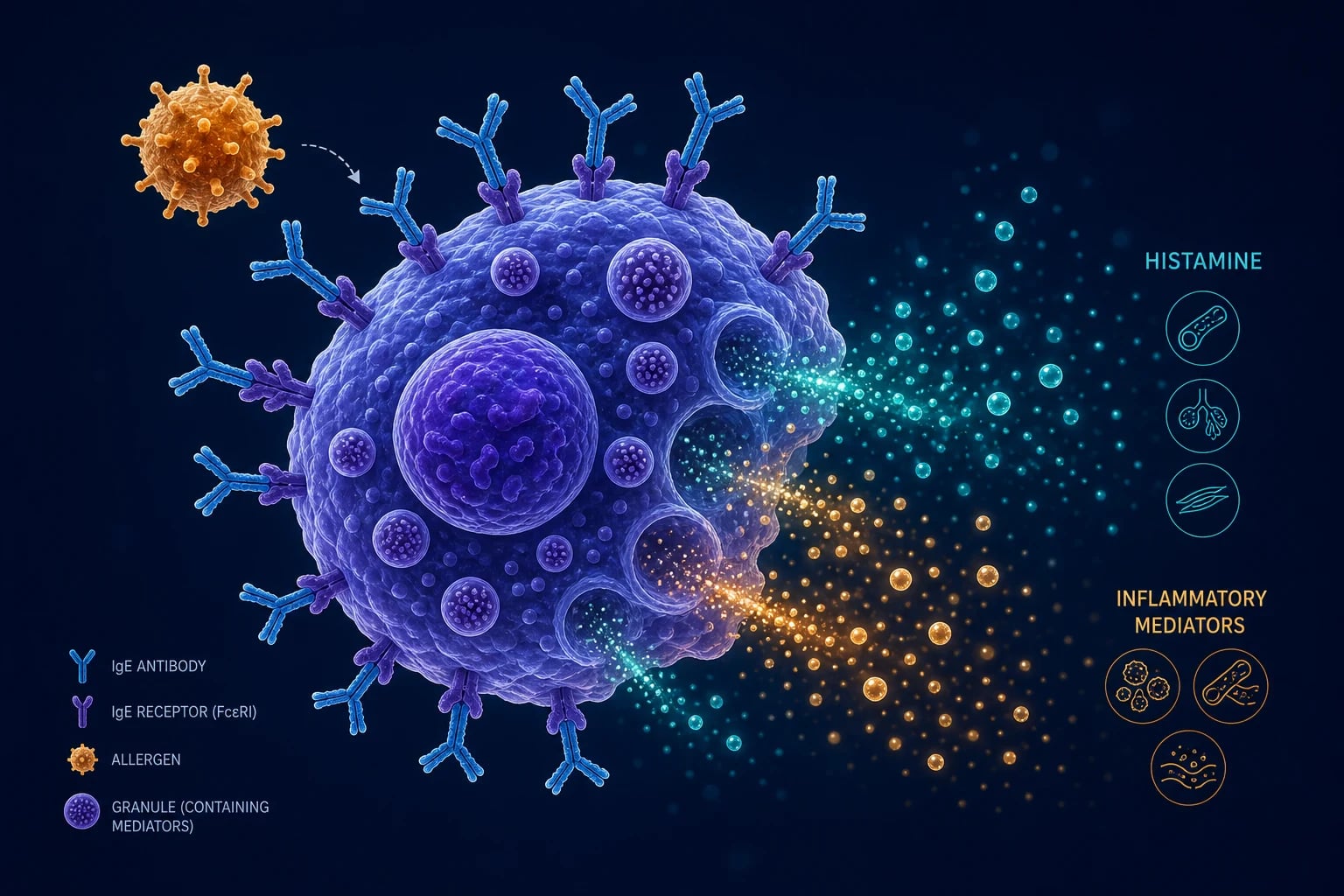
Anaphylaxis is a rapid, severe, life-threatening systemic hypersensitivity reaction. It is most commonly IgE-mediated — the allergen cross-links the IgE on the mast cells and the basophils, triggering the explosive degranulation and the release of the histamine, the tryptase, the leukotrienes, the prostaglandins and the platelet-activating factor. These mediators produce the vasodilation (the shock), the bronchoconstriction (the wheeze), the increased vascular permeability (the angioedema, the urticaria) and the mucus secretion (the upper-airway obstruction). The non-IgE-mediated (the anaphylactoid) reactions — from the radiocontrast, the NSAID, the opiate, the exercise and the idiopathic — share the same clinical presentation and the same management. [1]
Triggers
The common triggers, in the order of the frequency: the drug (the antibiotic — the penicillin is the commonest; the NSAID; the neuromuscular blocker in the anaesthesia; the radiocontrast), the food (the peanut, the tree nut, the shellfish, the egg, the milk, the sesame), the venom (the bee, the wasp), the latex, and the exercise (the food-dependent exercise-induced anaphylaxis). In up to 30 per cent the trigger is idiopathic — no cause is identified despite the investigation. [1]
Differential diagnosis — the mimic of the anaphylaxis
The anaphylaxis is mimicked by several conditions, and the distinction matters because the management differs. [1]
Anaphylaxis
- Rapid, multi-system: skin + respiratory ± cardiovascular
- A clear trigger or a temporal relationship
- IM adrenaline 500 mcg is the first-line
- Observe 6-12 h for the biphasic reaction
Vasovagal syncope
- Pallor, bradycardia, hypotension — NO urticaria, NO wheeze
- A clear trigger (the emotion, the pain, the procedure)
- The bradycardia distinguishes it (anaphylaxis is tachycardic)
- Supine, legs elevated; no adrenaline
Asthma / panic
- Wheeze and dyspnoea but no hypotension, no urticaria
- Panic: hyperventilation with a normal blood pressure and no rash
- Treat the bronchodilator (asthma) or the reassurance (panic)
- No adrenaline unless anaphylaxis is confirmed
Carcinoid / scombroid
- Flushing, diarrhoea, wheeze (carcinoid); from the spoiled fish (scombroid)
- The scombroid responds to the antihistamine
- No hypotension (usually); a different mechanism
- Treat the specific cause
The diagnostic criteria
The NICE and the ASCIA criteria for the anaphylaxis diagnosis require the sudden onset and rapid progression of symptoms, plus one of:
- Skin and/or mucosal change (urticaria, angioedema, flushing) PLUS either respiratory difficulty or hypotension.
- Hypotension after a known allergen exposure.
- Two or more of: skin/mucosal, respiratory, cardiovascular, or persistent gastrointestinal symptoms after a likely allergen. [1]
The serum tryptase (the mast cell enzyme) rises within 1 to 2 hours and peaks at the time of the reaction; a paired sample (the acute and the baseline at 24 hours) confirms the mast cell degranulation.[2] The tryptase is not needed for the acute diagnosis — it is a retrospective tool for the confirmation.
Immediate management — the algorithm with the doses
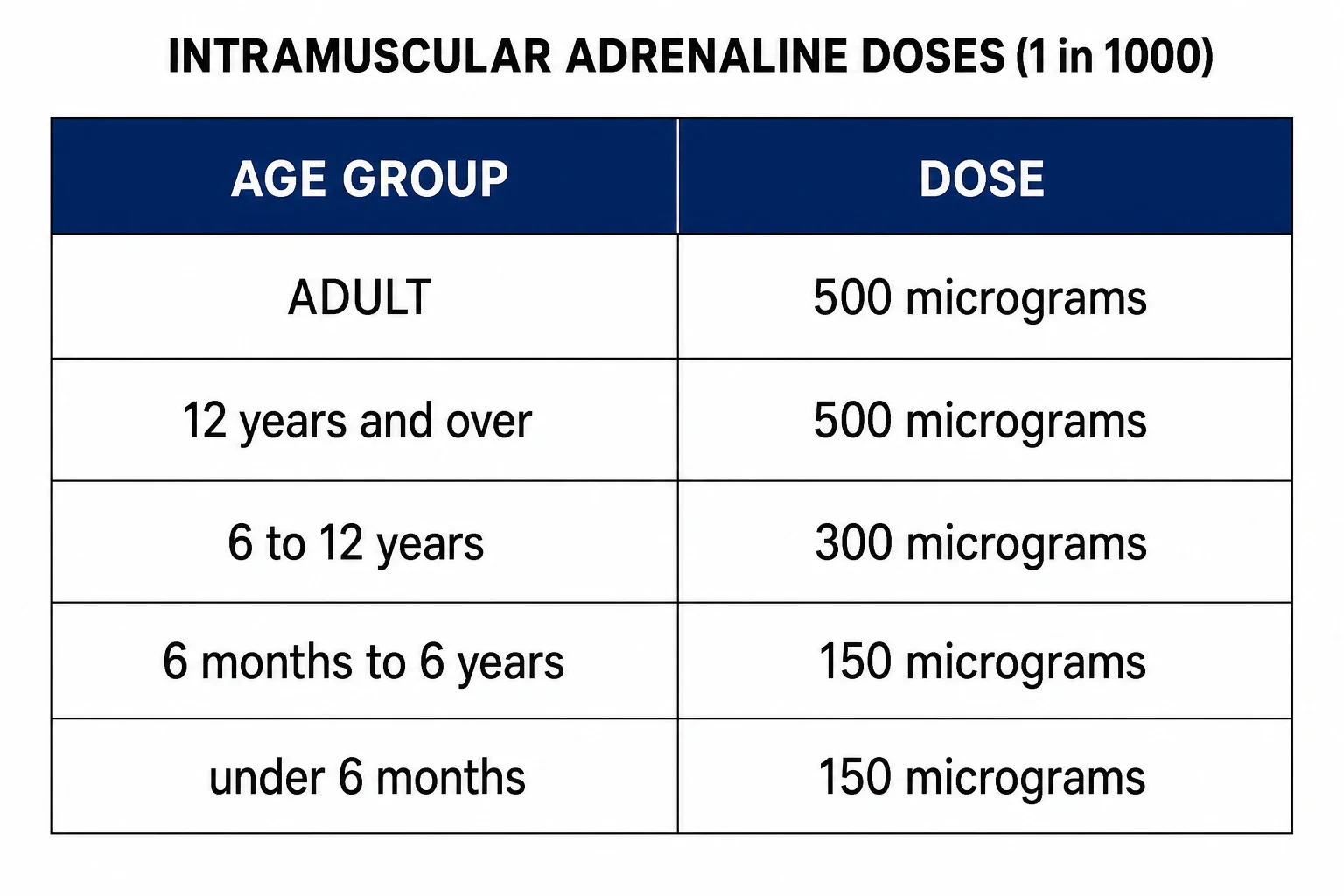
The management is a sequence, and the Fellowship candidate must know the doses exactly. [1]
[1]The anaphylaxis drug doses
Management — the drug doses and the approach
The adrenaline is the only drug that reduces the mortality. The alpha-1 vasoconstriction reverses the vasodilation and the oedema; the beta-2 bronchodilates; the beta-1 supports the cardiac output. The anterolateral thigh is the site — the vastus lateralis has the richest blood supply and the most rapid absorption; the deltoid and the subcutaneous route are slower and the absorption is unreliable in the shocked patient. The 500 micrograms (the adult dose) is from the ampoule (the 1:1000 adrenaline); the EpiPen (the auto-injector) delivers only 300 micrograms and is for the self-administration by the patient, not for the emergency department. [1]
The fluid is the second priority — the massive vasodilation and the capillary leak produce a relative hypovolaemia, and the blood pressure may not recover with the adrenaline alone. A 500 to 1000 mL bolus of the balanced crystalloid is given rapidly. [1]
The chlorphenamine (the H1 blocker) and the hydrocortisone (the corticosteroid) are given routinely but they are NOT the life-saving drugs — the adrenaline is. The chlorphenamine controls the itch and the urticaria; the hydrocortisone may prevent the biphasic reaction (the evidence is weak but the practice is universal). They do NOT treat the hypotension or the bronchospasm — only the adrenaline does that. [1]
The refractory anaphylaxis and the beta-blocker trap
The refractory anaphylaxis — the failure to respond to two doses of the IM adrenaline — is the escalation point. The options: the IV adrenaline infusion (the 1 mg of adrenaline in 100 mL of 5 per cent dextrose, infused at 0.05 to 0.1 micrograms per kilogram per minute, titrated to the response; the bolus of 50 micrograms of 1:10000 IV if the patient is peri-arrest); the IM adrenaline 1:1000 0.5 mg repeated; and the glucagon 1 to 5 mg intravenously for the beta-blocker patient. [1]
The beta-blocker patient is the trap: the beta-blockade blunts the beta-1 and the beta-2 effects of the adrenaline, and the patient may not respond. The glucagon (the 1 to 5 mg intravenously, followed by an infusion of 5 to 15 micrograms per minute) bypasses the beta-receptor — it directly activates the adenyl cyclase and the cAMP pathway, producing the positive inotropy and the bronchodilation. The glucagon may cause vomiting — the airway must be protected. [1]
The biphasic reaction and the observation
The biphasic reaction — the recurrence of the symptoms 4 to 10 hours after the initial episode, without the re-exposure to the trigger — occurs in 3 to 20 per cent of the patients. The risk factors for the biphasic reaction include the severe initial reaction (the hypotension, the need for multiple adrenaline doses), the delayed presentation, and the unknown trigger. The observation for 6 to 12 hours after the resolution is the standard for the moderate-to-severe anaphylaxis. The patient with the mild reaction (a single IM adrenaline dose, a rapid and complete response) may be observed for 4 to 6 hours. [1]
Complications and pitfalls
The complications are the hypoxia and the hypotension from the under-treated reaction, the cardiac arrest (the prolonged shock, the arrhythmia from the adrenaline), the pulmonary oedema (from the fluid overload and the high-dose adrenaline), the aspiration (from the vomiting in the obtunded patient), and the recurrence (the biphasic reaction). The pitfalls are: giving the subcutaneous or the IV adrenaline instead of the IM; under-dosing (the 300 mcg auto-injector instead of the 500 mcg ampoule); delaying the adrenaline for the "more investigations"; not repeating the adrenaline when the response is inadequate; not giving the fluid; not considering the beta-blocker in the non-responder; and discharging the patient too early (before the 6 to 12 hour observation). [1]
Prognosis and disposition
The mortality is low (0.05 per cent) but the fatal cases are consistently associated with the delayed adrenaline — the median time to the death from the food-induced anaphylaxis is 30 minutes, the venom-induced anaphylaxis is 15 minutes. The patient is observed for 6 to 12 hours; the mild responder is discharged with the EpiPen prescription (the 300 micrograms for the adult), the written action plan, and the urgent allergy referral within 2 weeks; the severe or the biphasic patient is admitted overnight under the medical team for the ongoing observation and the investigation of the trigger. [1]
Special populations
The child receives the weight-based dose: the 10 micrograms per kilogram IM, or the age-banded (the under 6 years: 150 micrograms; the 6 to 12 years: 300 micrograms; the over 12 years: 500 micrograms). The beta-blocker patient receives the glucagon. The pregnant patient receives the same dose (the adrenaline is safe in pregnancy; the untreated anaphylaxis is not). The asthmatic patient is at a higher risk of the severe bronchospasm and the fatal outcome — the early adrenaline is even more critical. [1]
Evidence and regional guidelines
The contemporary framework is the NICE/ASCIA/Resuscitation Council guideline for the anaphylaxis.[1] The IM adrenaline 500 micrograms first-line, the repeated dosing, the fluid, the antihistamine and the corticosteroid, and the 6-to-12-hour observation are the global standards. The drug doses, the routes and the observation period follow the local resuscitation-council protocol.
ANZ practice note. The anaphylaxis management follows the ASCIA (the Australasian Society of Clinical Immunology and Allergy) guideline via the local resuscitation protocol; the IM adrenaline 500 micrograms into the anterolateral thigh, repeated every 5 minutes, is the first-line; the glucagon is given for the beta-blocker patient; and the observation for 6 to 12 hours for the biphasic reaction is the standard. [1]
Exam pearls
- IM adrenaline 500 micrograms (0.5 mL of 1:1000) into the anterolateral thigh — the first, the second, the third line.
- Repeat every 5 minutes if the response is inadequate — the under-dosing and the delayed dosing are the fatal errors.
- High-flow oxygen 15 L/min; IV fluid 500-1000 mL; chlorphenamine 10 mg IV; hydrocortisone 200 mg IV.
- The beta-blocker patient → glucagon 1-5 mg IV (the adrenaline may not work).
- The refractory → IV adrenaline infusion (0.05-0.1 mcg/kg/min).
- The biphasic reaction: 3-20 per cent, at 4-10 hours → observe 6-12 hours.
- The child: 10 mcg/kg IM (or the age-banded: 150/300/500 mcg).
- The serum tryptase (the acute + the 24-hour baseline) confirms the mast cell degranulation retrospectively. [1]
Red flags
[1]Epidemiology and the ED burden
Anaphylaxis is increasing in incidence worldwide — the global lifetime prevalence is now estimated at 1.6 to 5 per cent, with food-triggered anaphylaxis rising most sharply in children and young adults.[3] The ED sees an estimated 1 in 1000 attendances for anaphylaxis, and the in-hospital fatality rate is low but the out-of-hospital fatality — from the delayed adrenaline — remains the preventable tragedy. The risk of death is concentrated in four groups: the teenager/young adult with the food allergy (risk-taking, the under-carried auto-injector), the older patient with the cardiovascular comorbidity (the mast-cell mediator load onto the diseased heart), the asthmatic (the fatal bronchospasm masquerading as the asthma attack), and the patient on the beta-blocker or the ACE inhibitor (the refractory hypotension and the angioedema).[9]
The pathophysiology — the mediator cascade
The clinical syndrome is the downstream effect of the mast-cell and basophil mediator release. The Fellowship candidate should understand the cascade, because each mediator maps to a clinical sign and a therapy. [1]
Histamine
- The H1 effect: the vasodilation, the increased vascular permeability, the bronchoconstriction, the pruritus
- The H2 effect: the coronary vasoconstriction, the increased gastric acid, the tachycardia
- Why the H1 + H2 blockade is given together
Tryptase
- The mast-cell protease released alongside the histamine
- Peaks at 1 to 2 hours; the serum level confirms the mast-cell degranulation
- A normal tryptase does NOT exclude the anaphylaxis — the food reactions often have a low tryptase
Leukotrienes / prostaglandins
- The slow-reacting bronchoconstrictors (the LTD4)
- The prolonged bronchospasm that does not respond to the antihistamine
- The rationale for the corticosteroid
Platelet-activating factor
- The potent vasodilator and the bronchoconstrictor
- A target for the experimental PAF antagonists
- The mediator most linked to the severe cardiovascular collapse
The mediator release is explosive — the symptoms begin within minutes of the exposure and reach the maximum severity within 5 to 30 minutes. The slow-onset reaction (after hours) is uncommon and atypical; it raises the question of a different diagnosis or a delayed absorption (the oral food challenge).[5]
The three clinical phenotypes (the WAO 2020 update)
The WAO 2020 guidance recognises three anaphylaxis phenotypes — the Fellowship candidate must know them because the management timing and the risk of the biphasic reaction differ.[3]
Uniphasic
- The single episode resolves with the adrenaline and does not recur
- 60 to 80 per cent of the cases
- Observe 4 to 6 hours after the full recovery
Biphasic
- The recurrence 4 to 10 hours (rarely up to 72 h) after the initial recovery, without the re-exposure
- 3 to 20 per cent; the median onset is 10 to 12 hours
- Risk: the severe initial reaction, the multiple adrenaline doses, the wide pulse pressure
Protracted / refractory
- The symptoms persist despite the two doses of the IM adrenaline
- Requires the IV adrenaline infusion
- High mortality; usually the beta-blocker or the massive antigen load
The triggers — in the ED order
The Fellowship candidate must know the trigger by the frequency and the population, because the trigger predicts the severity and the recurrence. [1]
Food (the #1 in children)
- The peanut, the tree nut, the shellfish, the egg, the milk, the sesame, the kiwi
- The commonest trigger in the paediatric ED; the recurrent exposure is common
- The fatal food anaphylaxis: the median time to death is 30 minutes
Drug (the #1 in adults)
- The antibiotic (the penicillin, the cephalosporin); the NSAID; the neuromuscular blocker; the chlorhexidine
- The perioperative anaphylaxis is rising — the rocuronium and the suxamethonium
- The cross-reactivity: the penicillin-cephalosporin is ~1 to 10 per cent
Insect venom
- The bee, the wasp, the hornet, the jumper ant (the Myrmecia in ANZ)
- The venom anaphylaxis is the commonest cause of the adult death from the anaphylaxis
- The venom immunotherapy is 90 to 98 per cent protective
Radiocontrast
- The non-IgE (the anaphylactoid) — the direct mast-cell activation
- The modern low-osmolar agents have a low reaction rate (0.04 per cent)
- Premedication is given for the prior moderate-to-severe reaction
Idiopathic
- No trigger identified despite the full investigation
- 20 to 30 per cent of the adult ED anaphylaxis
- Consider the mastocytosis and the systemic syndrome — the tryptase is persistently elevated
Other / cofactor
- The exercise (food-dependent exercise-induced); the cold; the latex; the seminal fluid
- The cofactors amplify: the NSAID, the alcohol, the exercise, the intercurrent infection
- The cofactor-triggered reaction is often more severe
The diagnostic criteria — the NIAID/FAAN and the WAO
The NIAID/FAAN criteria (validated for the ED use) require ONE of the three following patterns, with the acute onset (minutes to hours):[6]
- The acute onset of the skin/mucosal change (the urticaria, the angioedema, the flushing, the pruritus) PLUS either the respiratory compromise OR the hypotension (or the end-organ dysfunction).
- Two or more of the following after the likely allergen exposure: the skin/mucosal, the respiratory, the cardiovascular (hypotension, collapse), the persistent gastrointestinal (the vomiting, the cramping, the diarrhoea).
- The hypotension after the known allergen for that patient. [1]
The criteria are sensitive (97 per cent) and specific (82 per cent). The 80 to 90 per cent of the ED anaphylaxis presents with the cutaneous features — but the absence of the rash does NOT exclude the anaphylaxis: up to 20 per cent of the severe reactions (especially the perioperative) have NO skin signs. The Fellowship candidate must treat the anaphylaxis on the respiratory and the cardiovascular criteria alone if the situation demands. [1]
The ED triage and the team response
The anaphylaxis is the time-critical emergency — the ED triage to the resuscitation bay is the immediate action. The triage nurse applies the ABCDE and the call for help. [1]
The ED anaphylaxis first 5 minutes
Triage to the resuscitation bay; the high-flow oxygen 15 L/min via the NRB; the full monitoring (the SpO2, the ECG, the NIBP q3 min).
Assess the A, B, C, D, E — the airway oedema, the wheeze, the hypotension, the rash. Lie the patient flat with the legs elevated (sitting up if breathless).
Identify the trigger if obvious (the sting, the food, the IV drug, the contrast) and remove it — stop the infusion, leave the sting in if visible.
Call for the senior emergency physician and the nurse team; prepare the adrenaline ampoule, the IV fluid, the airway trolley.
Two large-bore IV cannulae; take the blood for the serum tryptase (the acute), the venous gas, the FBC, the U&E, the lactate.
The immediate management — the detailed algorithm
The management is the sequence, and the Fellowship candidate must know the dose, the route, the timing and the rationale for each step.[8]
[1] [1]The ED drug doses — the complete card
The anaphylaxis drug doses — adult and paediatric
The H1 and the H2 blockers — the rationale
The H1 blockade (the chlorphenamine, the cetirizine) addresses the histamine H1 effects: the pruritus, the urticaria, the flushing, the mild bronchoconstriction. The H2 blockade (the famotidine, the ranitidine — though the ranitidine is withdrawn in many markets) addresses the H2 effects: the tachycardia, the coronary vasoconstriction, the gastric acid. The combination of the H1 and the H2 is synergistic for the cutaneous symptoms but does NOT treat the hypotension or the airway oedema — only the adrenaline does that. The Fellowship candidate must not delay the adrenaline for the antihistamine.[4]
The airway management — the difficult airway of the anaphylaxis
The laryngeal oedema of the anaphylaxis is one of the most feared airway emergencies — the swelling progresses rapidly, and the intubation may become impossible. The Fellowship candidate must anticipate the difficult airway and the early senior anaesthetic involvement. [1]
[1]The refractory anaphylaxis — the escalation
The refractory anaphylaxis — the failure to respond to the two doses of the IM adrenaline — is the indication for the IV adrenaline and the search for the amplifier.[3]
The refractory anaphylaxis escalation
Confirm the adequate IM dosing (500 mcg into the anterolateral thigh, not the subcutaneous or the under-dose).
Give the IV fluid bolus — the 1 to 2 L of the balanced crystalloid rapidly; the refractory hypotension is often the hypovolaemia.
Start the IV adrenaline infusion — the 1 mg in 100 mL of the 5% dextrose, at 0.05 to 0.1 mcg/kg/min, titrated to the response (the MAP, the airway).
Check the beta-blocker / the ACE inhibitor — give the glucagon 1 to 2 mg IV over 5 min, followed by the infusion 5 to 15 mcg/min.
Consider the alternative diagnosis — the vasovagal, the carcinoid, the septic shock, the pulmonary embolism, the scombroid.
Prepare for the intubation if the airway oedema progresses; the surgical airway standby.
The beta-blocker and the ACE-inhibitor patient
The beta-blocker blunts the beta-1 (the cardiac output) and the beta-2 (the bronchodilation) effects of the adrenaline — the patient may not respond to the standard doses, and the high-dose adrenaline may precipitate the unopposed alpha hypertension or the arrhythmia. The glucagon is the antidote: it bypasses the beta-receptor and directly activates the adenyl cyclase, producing the positive inotropy, the chronotropy and the bronchodilation. The dose is 1 to 5 mg IV over 5 minutes, followed by the infusion 5 to 15 mcg/min. The glucagon causes the vomiting — the airway must be protected, and the antiemetic is given. [1]
The ACE inhibitor is the other amplifier — it predisposes to the bradykinin-mediated angioedema (a different mechanism, but it complicates the airway management) and it worsens the refractory hypotension. The bradykinin angioedema does NOT respond to the adrenaline — the airway management is the only therapy. The icatibant (the bradykinin B2 antagonist) is used for the hereditary angioedema and may be trialled for the ACE-inhibitor angioedema. [1]
The paediatric anaphylaxis — the weight-based dosing
The child presents the same way as the adult but the doses are weight-based, and the food trigger dominates. The Fellowship candidate must know the age-banded doses (the practical ED doses) and the weight-based dose (the precise). [1]
The paediatric anaphylaxis — the age-banded doses
The child with the severe atopic dermatitis, the asthma and the food allergy (the atopic march) is the high-risk profile for the severe paediatric anaphylaxis — the early adrenaline is even more critical, and the asthma control is the secondary prevention. [1]
The pregnant patient
The pregnant patient with the anaphylaxis is the rare but high-stakes scenario — the maternal hypotension produces the uterine hypoperfusion and the fetal compromise within minutes. The adrenaline is safe in pregnancy — the untreated anaphylaxis is not. The doses are the same as the non-pregnant adult. The patient is tilted to the left lateral position (the uterine displacement to relieve the aortocaval compression). The c-section is reserved for the maternal cardiac arrest refractory to the resuscitation (the 4-minute rule — the peri-mortem c-section). The common triggers in pregnancy are the antibiotic (the penicillin for the GBS), the oxytocin, and the chlorhexidine. [1]
The perioperative anaphylaxis
The perioperative anaphylaxis is a distinct entity — the patient is anaesthetised (the cutaneous signs are missed), the trigger is the IV drug (the neuromuscular blocker in 60 per cent of the cases; the antibiotic; the chlorhexidine; the latex; the patent blue dye), and the presentation is the sudden cardiovascular collapse with the bronchospasm on the anaesthetic monitor. The Fellowship candidate must recognise the intraoperative cardiovascular collapse as the anaphylaxis until proven otherwise — give the IM adrenaline (the deltoid if the surgical drape blocks the thigh), stop the trigger, call for help, give the fluid, and prepare for the prolonged resuscitation. The serum tryptase at 1 to 2 hours, at 4 hours, and at 24 hours (the baseline) confirms the diagnosis and the subsequent allergy referral.[3]
The biphasic reaction — the risk stratification and the observation
The biphasic reaction is the recurrence of the symptoms 4 to 10 hours (rarely up to 72 hours) after the initial recovery, without the re-exposure. The incidence is 3 to 20 per cent (the meta-analysis estimate is ~5 per cent), and the median onset is 10 to 12 hours.[7] The risk factors for the biphasic reaction:
High-risk (observe overnight)
- The severe initial reaction (the hypotension, the hypoxia, the need for >1 adrenaline)
- The refractory anaphylaxis (the IV adrenaline required)
- The unknown trigger or the idiopathic anaphylaxis
- The patient on the beta-blocker
- The wide pulse pressure at the triage (> 40 mmHg)
- Observe 12 to 24 hours; admit under the medical team
Moderate-risk (observe 6-12 h)
- The moderate reaction (the single IM adrenaline, the good response)
- The food trigger with the prior severe reaction
- The asthmatic patient
- Observe 6 to 12 hours in the ED observation unit
Low-risk (observe 4-6 h)
- The mild reaction (the single IM adrenaline, the rapid and complete response)
- The clear trigger, the no cofactor
- Observe 4 to 6 hours; discharge with the auto-injector and the action plan
The observation rule of thumb
The Fellowship candidate must know the observation rule: the 4 to 6 hour minimum for the mild responder, the 6 to 12 hour for the moderate, the overnight for the severe or the high-risk. The patient is observed from the time of the full resolution — not from the time of the first dose. The discharge criteria: the asymptomatic, the normal vital signs for 2 hours, the no adrenaline in the last 4 hours, and the patient (or the parent) is competent with the auto-injector. [1]
The discharge bundle and the follow-up
The discharge after the ED anaphylaxis is the bundle — the Fellowship candidate must not discharge the patient without the full set.[4]
The anaphylaxis discharge bundle
The adrenaline auto-injector — the EpiPen 300 mcg for the adult (the 500 mcg ampoule is for the hospital); the 150 mcg for the under-6 child. Two devices prescribed.
The written anaphylaxis action plan (the ASCIA plan in ANZ; the patient-held card with the trigger, the signs and the auto-injector instructions).
The avoidance advice — the trigger, the label reading, the cross-reactive foods, the medical alert jewellery.
The H1 antihistamine for the home (the cetirizine, the loratadine) for the recurrent urticaria.
The referral to the allergist / the clinical immunology within 2 weeks — for the trigger identification, the immunotherapy (the venom) and the long-term management.
The medical alert application (the bracelet or the card) with the trigger and the auto-injector.
The education — the auto-injector technique (the trainer device), the early use (do not wait for the severity), the biphasic awareness, the call for the ambulance.
The fatal anaphylaxis — the lessons
The fatal anaphylaxis is rare (the mortality 0.05 per cent) but the lessons are consistent.[9] The fatal cases are associated with the delayed adrenaline (the median time to the death from the food is 30 minutes, the venom is 15 minutes), the asthma (the fatal bronchospasm), the upright position (the empty vena cava syndrome — the venous return collapses, the patient arrests; always lie the patient flat), the beta-blocker or the ACE inhibitor (the refractory hypotension), and the absent or the late auto-injector (the under-carried device in the teenagers and the young adults).
The investigations — the acute and the retrospective
The anaphylaxis is a clinical diagnosis — the investigations do NOT delay the treatment. The acute investigations are limited: the serum tryptase (the acute, within 1 to 2 hours of the onset), the venous gas (the lactate, the acidosis of the shock), the ECG (the arrhythmia, the ischaemia from the hypotension or the adrenaline), and the FBC, U&E, glucose (the differential). The paired tryptase — the acute and the baseline at 24 hours (or the convalescent) — confirms the mast-cell degranulation; a rise of the 2 + 20% above the baseline is the diagnostic.[2]
[1]The ECG in the anaphylaxis
The ECG is not diagnostic but it is essential for the management. The findings: the sinus tachycardia (the commonest, the mediator and the compensatory), the non-specific ST changes (the coronary vasospasm from the histamine and the leukotrienes — the Kounis syndrome, the "allergic myocardial infarction"), the arrhythmia (the atrial fibrillation, the ventricular ectopy from the hypoxia and the high-dose adrenaline), and the bradycardia (the late sign of the severe shock and the pre-arrest). The Fellowship candidate must distinguish the Kounis syndrome (the troponin rise with the ST changes in the anaphylaxis) from the primary ACS — the treatment is the anaphylaxis management plus the standard ACS therapy. [1]
The point-of-care ultrasound (POCUS)
The POCUS in the anaphylaxis supports the diagnosis and the management: the IVC collapse (the hypovolaemia — the capillary leak), the hyperdynamic left ventricle (the low SVR state, the empty hypercontractile heart), the B-lines (the pulmonary oedema from the fluid overload and the high-dose adrenaline), the pericardial effusion (the rare — the exclusion of the tamponade as the cause of the shock), and the subcutaneous oedema (the soft-tissue swelling of the angioedema). The POCUS is not a substitute for the clinical diagnosis — it confirms the shock state and the volume status. [1]
The differential diagnosis — the extended
Vasovagal syncope
- Pallor, the bradycardia, the hypotension; NO urticaria, NO wheeze
- Triggered by the emotion, the pain, the procedure
- Supine, the legs elevated; no adrenaline
Asthma / the COPD exacerbation
- The wheeze and the dyspnoea but the normal blood pressure, no rash
- Treat with the bronchodilator, the steroid
- No adrenaline unless the anaphylaxis is confirmed
Panic attack
- The hyperventilation with the normal SpO2 and the normal blood pressure
- The carpopedal spasm from the respiratory alkalosis
- Reassurance; no adrenaline
Carcinoid syndrome
- The flushing, the diarrhoea, the wheeze; the gradual onset
- The 5-HIAA confirms; the somatostatin analogue treats
- No adrenaline (may precipitate the carcinoid crisis)
Scombroid
- The flushing and the wheeze within 30 min of the spoiled fish (the tuna, the mahi-mahi)
- The histamine poisoning — responds to the antihistamine
- Often self-limited; the severe case gets the adrenaline
Hereditary / the acquired angioedema (C1-INH deficiency)
- The recurrent angioedema WITHOUT the urticaria and WITHOUT the hypotension
- Does NOT respond to the adrenaline — the C1-INH concentrate or the icatibant
- The family history; the low C4
ACE-inhibitor angioedema
- The bradykinin-mediated; the lips, the tongue, the airway
- Does NOT respond to the adrenaline — the airway management
- Stop the ACE inhibitor; the icatibant may help
Septic shock
- The fever, the source, the warm shock initially
- The lactate, the cultures, the antibiotic
- The adrenaline infusion may be needed for the shock
Pulmonary embolism
- The sudden dyspnoea, the hypoxia, the hypotension
- The D-dimer, the CTPA
- The anticoagulation / the thrombolysis
The trial evidence and the controversies
Brown et al — the CEC (the criterion-based cohort)
J Allergy Clin Immunol Pract
PMID 32107565
Key finding
The characterisation of the three anaphylaxis phenotypes (the uniphasic, the biphasic, the protracted); the biphasic reaction in 4 to 5 per cent of the ED cases; the risk factors the severe initial reaction and the wide pulse pressure.
Practice change
The observation period is stratified by the severity — the high-risk gets the overnight admission.
Lee et al — the biphasic meta-analysis
J Allergy Clin Immunol Pract
PMID 25174939
Key finding
The systematic review of the biphasic anaphylaxis; the pooled incidence 4.6 per cent; the onset within 72 hours (most within 10 hours); the corticosteroid did NOT prevent the biphasic reaction.
Practice change
The observation is the safety net, not the corticosteroid — do not rely on the steroid for the prevention.
The adrenaline route and the absorption
N Engl J Med / J Allergy Clin Immunol
PMID 11136424
Key finding
The IM route into the vastus lateralis produces the faster and the higher peak adrenaline level than the subcutaneous or the deltoid IM; the absorption is unreliable in the shocked patient.
Practice change
The anterolateral thigh is the site — never the subcutaneous, never the deltoid.
The glucagon for the beta-blocker anaphylaxis
Emergency Medicine Journal
PMID 15775778
Key finding
The glucagon bypasses the beta-receptor and the cAMP pathway; the case series and the pharmacological rationale.
Practice change
The glucagon 1 to 5 mg IV is the antidote for the refractory anaphylaxis in the beta-blocker patient.
The pitfalls — the recurring ED errors
[1]The Kounis syndrome — the allergic ACS
The Kounis syndrome is the allergic myocardial infarction — the coronary vasospasm from the mast-cell mediators (the histamine, the leukotrienes) in the setting of the anaphylaxis. The patient presents with the chest pain, the ST changes and the troponin rise during the anaphylactic reaction. The three types: the type I (the coronary spasm in the normal coronaries — the mast-cell mediator), the type II (the plaque erosion or the rupture in the pre-existing coronary disease), and the type III (the stent thrombosis). The treatment is the anaphylaxis management (the adrenaline, the fluid) PLUS the standard ACS therapy (the aspirin, the nitrate, the morphine — though the morphine may release the histamine; the fentanyl is preferred). The adrenaline is not contraindicated in the Kounis syndrome — the vasoconstriction helps the spasm. [1]
The MAS report — the perioperative anaphylaxis
The perioperative anaphylaxis is reported to the anaesthetic audit (the NAP6 in the UK, the ASA in ANZ). The common triggers in the NAP6 report: the neuromuscular blocker (the rocuronium, the suxamethonium, the vecuronium — 60 per cent), the antibiotic (the teicoplanin, the vancomycin, the penicillin — 30 per cent), the chlorhexidine (the surgical prep, the central line — the rising cause), the patent blue dye (the sentinel lymph node biopsy), the oxytocin. The mortality is 3 to 4 per cent. The Fellowship candidate must know the immediate action — the IM adrenaline (the deltoid if the surgical drape blocks the thigh), the IV fluid, the stop the trigger, and the tryptase sampling.[3]
The venom immunotherapy — the long-term
The venom immunotherapy (the VIT) is the 90 to 98 per cent protective against the further systemic reaction in the venom-allergic patient. The indication: the systemic reaction (the anaphylaxis) to the venom in the adult, or the moderate-to-severe systemic reaction in the child, with the positive diagnostic test (the skin prick or the specific IgE). The protocol: the build-up (the conventional over weeks to months, or the rush over days), the maintenance (the 100 mcg monthly for 3 to 5 years). The Fellowship candidate must know the indication and the referral — the VIT is the most effective allergy treatment available. [1]
The mastocytosis — the hidden amplifier
The systemic mastocytosis is the clonal mast-cell disorder — the elevated baseline tryptase (> 20 ng/mL), the skin lesions (the urticaria pigmentosa), and the severe anaphylaxis to the low-grade trigger (the insect venom, the drug). The patient with the recurrent idiopathic anaphylaxis and the elevated baseline tryptase must be investigated for the mastocytosis (the KIT mutation, the bone marrow biopsy). The mastocytosis patient is the high-risk for the severe anaphylaxis — the auto-injector is mandatory, and the venom immunotherapy is lifelong. [1]
The mnemonic — the SAMPLE for the trigger
[1]The coding and the audit
The anaphylaxis is coded for the audit and the trigger surveillance. The ICD-10 codes: the T78.2 (the anaphylactic shock, unspecified), the T78.0 (the anaphylactic shock from the food), the T80.5 (the anaphylactic shock from the serum), the T88.6 (the anaphylactic shock from the correct drug), the T63 (the toxic effect of the venom). The severe case (the IM adrenaline, the admission) is reported to the local surveillance for the epidemiology and the trigger trends. The death from the anaphylaxis is the coroner-reportable event in most jurisdictions. [1]
The summary — the 10 non-negotiables
[1]The high-yield exam pearls — the Fellowship viva
- The single most important intervention in the anaphylaxis is the IM adrenaline 500 mcg into the anterolateral thigh — within minutes of the onset.
- The adrenaline is the only drug that reduces the mortality — the antihistamine and the steroid are the adjuncts.
- The route is the IM, the site is the anterolateral thigh, the dose is 500 mcg, the repeat is every 5 minutes.
- The 1:1000 (1 mg/mL) is the IM ampoule; the 1:10000 (0.1 mg/mL) is the IV resuscitation concentration — do not confuse them.
- The child: 10 mcg/kg IM, or the age-banded 150 / 300 / 500 mcg; max 500 mcg.
- The beta-blocker: the glucagon 1 to 5 mg IV — bypasses the beta-receptor.
- The refractory: the IV adrenaline infusion 0.05 to 0.1 mcg/kg/min.
- The biphasic: 3 to 20 per cent, at 4 to 10 hours — observe 6 to 12 hours minimum; the high-risk overnight.
- The serum tryptase: the acute at 1 to 2 hours, the baseline at 24 hours; the rise confirms the mast-cell degranulation.
- The empty vena cava syndrome: the upright position precipitates the arrest — lie the patient flat.
- The Kounis syndrome: the allergic ACS — treat the anaphylaxis PLUS the standard ACS therapy.
- The perioperative anaphylaxis: the neuromuscular blocker is the #1 trigger; the IM adrenaline (the deltoid if the drape blocks the thigh).
- The hereditary angioedema: the angioedema WITHOUT the urticaria and WITHOUT the hypotension — the C1-INH concentrate, NOT the adrenaline.
- The discharge: the auto-injector (two devices), the written action plan, the allergist referral within 2 weeks, the medical alert.
- The venom immunotherapy: 90 to 98 per cent protective — the most effective allergy treatment available.
- The fatal anaphylaxis: the delayed adrenaline, the asthma, the upright position, the beta-blocker, the absent auto-injector. [1]
The red flags — the extended
[1]SAQs — exam practice
SAQ — Refractory anaphylaxis in the beta-blocker patient
10 minutes · 10 marks
A 68-year-old man is brought to the emergency department five minutes after an intravenous iodinated contrast load administered for a CT pulmonary angiogram. He is on metoprolol 50 mg twice daily for ischaemic heart disease and perindopril 5 mg daily for hypertension. Within two minutes of the contrast he becomes flushed and distressed, develops widespread urticaria, an expiratory wheeze and tongue swelling, and his blood pressure falls to 72/40 with a heart rate of 92 (inappropriately bradycardic for the degree of shock). He has received two doses of intramuscular adrenaline 500 micrograms into the anterolateral thigh five minutes apart, two litres of balanced crystalloid, high-flow oxygen and chlorphenamine 10 mg intravenously, yet he remains hypotensive at 76/44 with worsening bronchospasm and progressive facial angioedema. Outline your ongoing management.
SAQ — Refractory anaphylaxis: the escalation pathway after two doses of IM adrenaline
10 minutes · 10 marks
A 34-year-old woman with a known peanut allergy is brought to the emergency department by ambulance after accidentally eating a peanut-containing biscuit. She is globally flushed with widespread urticaria, an inspiratory and expiratory stridor, a tight expiratory wheeze and a blood pressure of 64/38. She has received intramuscular adrenaline 500 micrograms into the anterolateral thigh in the ambulance and a further 500 micrograms on arrival, high-flow oxygen, chlorphenamine 10 mg intravenously, hydrocortisone 200 mg intravenously and 2 litres of balanced crystalloid. Ten minutes after the second dose she remains hypotensive at 70/42 with worsening stridor and bronchospasm and is becoming drowsy. Outline the management of her refractory anaphylaxis.
References
- [1]Nasr I, Egbuniwe F, Saif A, et al. Real World Management of Anaphylaxis Versus the National Institute for Health and Clinical Excellence (NICE) Guidelines Cureus, 2022.PMID 36277549
- [2]Srivastava S, Youings J, Bennett N, et al. Systemic reactions and anaphylaxis with an acute serum tryptase ≥14 μg/L: retrospective characterisation of aetiology, severity and adherence to National Institute of Health and Care Excellence (NICE) guidelines for serial tryptase measurements and specialist referral J Clin Pathol, 2014.PMID 24782357
- [3]Cardona V, Ansotegui IJ, Ebisawa M, et al. Adjuvant therapy is associated with improved overall survival in patients with pancreatobiliary or mixed subtype ampullary cancer after pancreatoduodenectomy - A multicenter cohort study Pancreatology, 2020.PMID 31987649
- [4]Shaker MS, Wallace DV, Golden DBK, et al. Targeting NRF2 to suppress ferroptosis in brain injury Histol Histopathol, 2021.PMID 33242213
- [5]Brown SGA, Stone SF, Fatovich DM, et al. Dilated cardiomyopathies and non-compaction cardiomyopathy Herz, 2020.PMID 32107565
- [6]Loprinzi Brauer CE, Motosue MS, Li JT, et al. Preservation and reactivation of Candidatus Jettenia asiatica and Anammoxoglobus propionicus using different preservative agents Chemosphere, 2017.PMID 28806673
- [7]Lee S, Bellolio MF, Hess EP, et al. Biceps tenodesis for long head of the biceps after auto-rupture or failed surgical tenotomy: results in an active population J Shoulder Elbow Surg, 2015.PMID 25174939
- [8]Campbell RL, Li JT, Nicklas RA, Sadosty AT. Novel 2-Thioxanthine and Dipyrimidopyridine Derivatives: Synthesis and Antimicrobial Activity Molecules, 2015.PMID 26506337
- [9]Turner PJ, Jerschow E, Umasunthar T, et al. Dinutuximab approved for high-risk neuroblastoma Cancer Discov, 2015.PMID 25851859