Paeds · clinical-assessment-and-reasoning
Paediatric history and age-adapted consultation
Also known as Paediatric history taking · Age-adapted paediatric consultation · HEADSS interview · SSHADESS psychosocial screen · Adolescent confidential history
A fellowship-level, age-aware approach to paediatric history and consultation technique from neonate to transition, covering multi-party interviewing, HEADSS/SSHADESS, interpreters, trauma-informed care, consent and assent, teach-back, safety-netting, safeguarding cues and exam performance.
On this page & tools
Your progress
Saved locally on this device.
Practise this topic
Target exams
Red flags
Life stages
Care settings
Clinical exam formats
Board mappings
These consent distinctions follow AAP paediatric decision-making guidance. [3] [4]
AMPLE in the crashing child
Use AMPLE only as a focused emergency history while treatment continues. [13] [14]
Overview & Definition
You are not taking an adult history with a smaller person in the room. A paediatric history is a structured conversation with a child or young person, the people who know their baseline, and the documents that fill the gaps. The aim is a usable problem representation: age, baseline, what changed, what threatens now, and what must happen next. [2] [13]
Think of the consultation as three jobs that run together. First, keep the child safe while you talk. Second, collect the story with the right voice for that age. Third, turn the story into a plan the family can use after they leave. If any of those jobs fails, good medical knowledge still produces bad care. [7] [11] [14]
This page owns consultation technique and history structure. It does not replace dedicated pages on the Paediatric Assessment Triangle, physical examination, growth charting, developmental surveillance or disease-specific management. Cross-link those pages rather than hiding a second chapter inside this one. [13] [2]
Classification
Classify the consultation by purpose before you open your mouth. A problem-focused acute visit, a comprehensive new-patient history, an emergency AMPLE history, a preventive well-child visit, a telehealth review and a transition visit need different depth. Trying to run a full long-case history during airway compromise is not thoroughness. It is delay. [13] [14]
Classify the historians next. The child may self-report. The primary caregiver may hold timeline and baseline. Other adults, school, allied health, devices, prior discharge summaries and a professional interpreter all count as sources. Document who said what. Source attribution prevents later confusion when stories diverge. [5] [12]
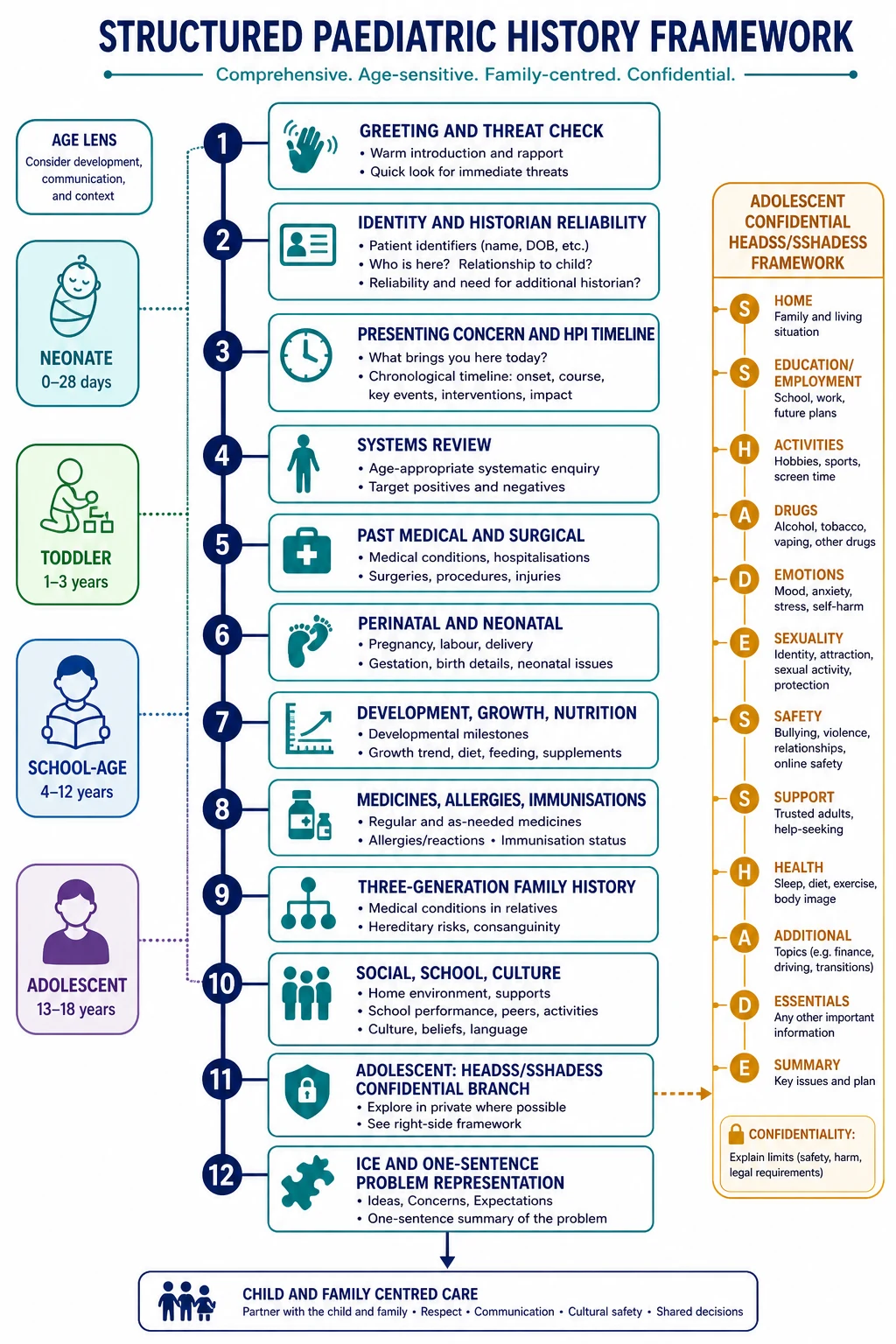
Classify communication mode by developmental stage. Neonates and young infants are observed while caregivers speak. Toddlers need parallel play and lap-based history. School-age children can locate symptoms and describe school impact. Adolescents need confidential time for psychosocial risk. HEADSS and SSHADESS are scaffolds for that confidential work, not interrogation scripts. SSHADESS teaching has been linked with broader psychosocial assessment in learners compared with HEADSS alone in one educational study, but either framework fails if rapport is absent. [1] [2]
Permission, assent and consent are related but not identical. Permission is the caregiver authorisation for a child who cannot yet consent. Assent is the child’s affirmative agreement as development allows. Consent is the informed authorisation of a person with decision-making capacity. The American Academy of Pediatrics technical report and policy statement set these principles; local statutes define mature-minor and emergency exceptions. Do not invent a universal age number in the viva. State the principle and name the local law. [3] [4]
Epidemiology & Risk Factors
Consultation failure is a patient-safety problem. Incomplete history, missed psychosocial risk, language discordance and poor discharge communication all raise the chance of diagnostic delay, medication error and unsafe disposition. Structured handoff work shows that communication design changes measurable medical-error rates; the same logic applies at the bedside and at discharge. [12] [6]
Language discordance without a professional interpreter is a high-yield risk factor. Systematic review evidence in hospitalised children from migrant and refugee families supports professional interpreter use for safer outcomes, and paediatric emergency work links professional interpreters with better discharge communication than ad-hoc approaches. Never use the child as interpreter for clinical content. [5] [6]
Caregiver concern, repeated presentation and missing past history raise the pre-test probability of serious disease. Medical complexity multiplies information risk because the true baseline lives with the caregiver and the emergency plan, not only in the electronic record. Social determinants — housing, food insecurity, transport, racism, out-of-home care and disability — change both access and the quality of the history you can collect in one sitting. [10] [13]
Missed adolescent psychosocial screens leave mental health, sexual health and substance-use needs invisible. Missed family history leaves genetic and cardiometabolic risk invisible. Rurality, telehealth and fragmented records increase handover risk because fewer collateral sources are immediately available. [1] [2] [12]
Pathophysiology
Developmental stage changes what a child can report. A preschooler can point to pain but will invent a tidy story if you lead them. A school-age child can describe school absence but still needs a caregiver for timeline. An adolescent can describe mood and risk behaviours only if trust and privacy exist. These are cognitive and social facts, not soft extras. [1] [2]
Fear, pain, stranger anxiety and separation alter appearance and reported symptoms while you take history. Trauma responses — hyperarousal, freeze, dissociation and avoidance — reshape what is said and how it is said. Trauma-informed paediatric care treats those responses as expected physiology under threat, not as proof of fabrication. The AAP clinical report and policy statement on trauma-informed care give the systems and bedside framing. [15] [16] [17]
Language discordance without professional interpreting degrades diagnostic accuracy because both history content and discharge instructions fail to encode. Limited health literacy has the same effect even when language matches: jargon never becomes a usable plan. Confidentiality expectations in adolescence enable disclosure; absolute secrecy promises that you cannot keep destroy trust later. [5] [6] [2]
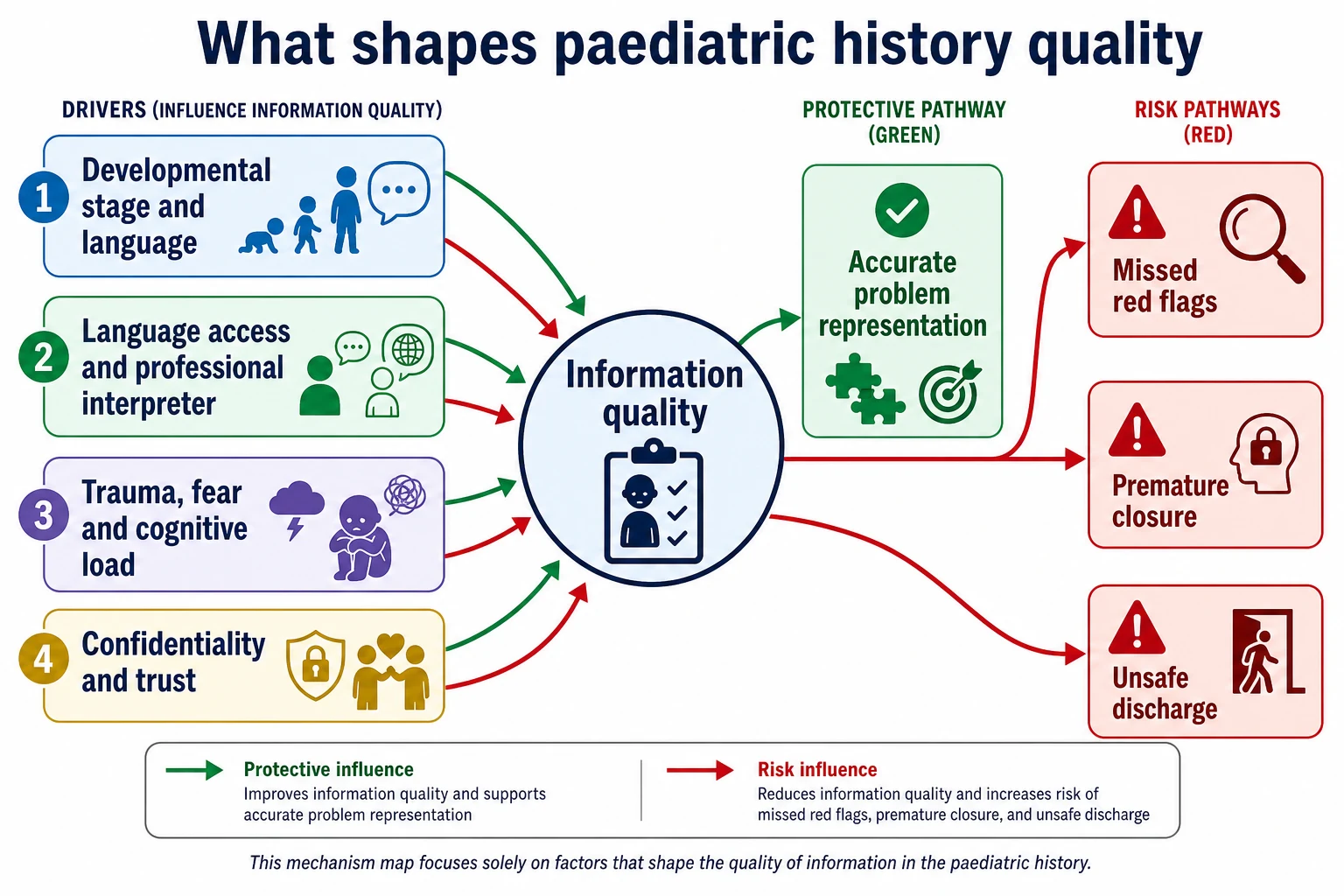
Caregiver–child narrative discordance has several causes. Perspective difference is common and often benign. Communication disability, mental health, secondary gain and safeguarding concerns are less common and more serious. Your job is curious clarification, not corridor accusation. Cognitive load during emergencies also degrades closed-loop communication, which is why AMPLE history and role allocation matter when ABCDE is running. [14] [15]
Clinical Presentation
From the doorway, the consultation has already started. Who is holding the child? Who looks frightened? Is the adolescent silent while a parent answers every question? Is there an interpreter present or a sibling translating? Those observations are part of history. [5] [14]
Neonates and young infants force history toward feeding, wet nappies, colour, tone, cry, temperature and change from usual. Toddlers present through play, separation behaviour and caregiver proxy. School-age children can contribute location, severity and school impact. Adolescents often bring mixed medical and psychosocial agendas and may delay help-seeking until a confidential space opens. [2] [13]
Serious illness may present mainly as caregiver concern that the child is different from baseline. Maltreatment may present as delayed care, inconsistent mechanism or an injury story that does not match developmental stage. Cultural explanatory models may reshape how symptoms are described without changing physiology. Children with communication disability present through behavioural change, alternative communication and carer expertise. Reassuring fragments of history never cancel a high-risk whole. [10] [15] [13]
Differential Diagnosis
After history, sort the problem into threat-first categories rather than specialty silos. Is this primarily biomedical, psychosocial, educational, safeguarding-related, or mixed? Is the change acute on chronic or a new event? Is developmental regression more likely than acute encephalopathy or mood change? Feeding refusal, pain, dyspnoea and fear can sound similar from a caregiver’s mouth; the timeline and associated features separate them. [13]
Fever plus behavioural change raises serious infection concern more than fever alone. Injury narratives need developmental plausibility. Ingestion histories differ by age: exploratory toddler ingestion, intentional adolescent overdose and caregiver dosing error are different problems. Functional symptoms and organic disease overlap in school-age children and adolescents; history expands or narrows that differential before you order tests. Prioritise by threat, likelihood, reversibility and harm of delay. [10] [3]
Clinical & Bedside Assessment
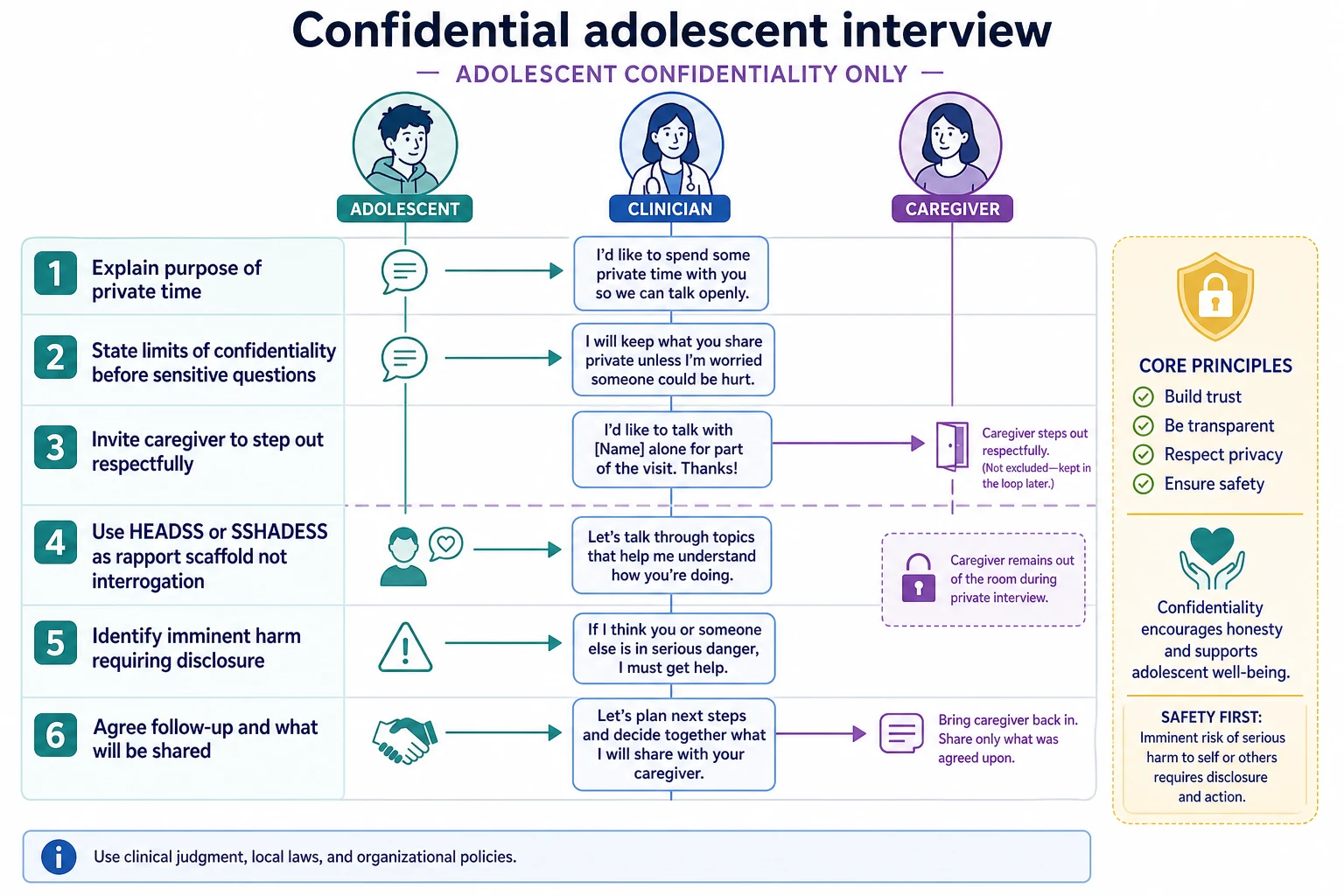
Set the room up so the child can stay regulated. Sit at eye level. Greet the child first when development allows, then the caregivers. Name your role. Set a joint agenda. For toddlers, history often happens on the caregiver’s lap with toys available. For adolescents, plan private time early rather than bolting it on at the end. [2] [14]
Use a reliable spine every time, then deepen the branches that the presentation demands. [1] [2] [13]
- Identity, age, developmental stage and reliability of each historian.
- Presenting concern and history of the present illness with timeline, severity, triggers, treatments already tried and caregiver concern.
- Systems review matched to age and complaint.
- Past medical and surgical history, including medical complexity and devices.
- Perinatal and neonatal history when relevant.
- Development, growth and nutrition.
- Medications, allergies, immunisations, complementary therapies and who gives medicines at home.
- Three-generation family history when genetics, cardiac risk or recurrent disease matter.
- Social, school, housing, food security, cultural context and supports.
- Adolescent confidential HEADSS or SSHADESS when indicated.
- Ideas, concerns and expectations of child and caregiver.
- One-sentence problem representation before examination or investigations. [1] [2] [13]
HEADSS classically covers Home, Education/Employment, Activities, Drugs, Sexuality and Suicide/depression/safety. SSHADESS expands Strengths, School, Home, Activities, Drugs/substance use, Emotions/Eating/Depression, Sexuality and Safety. Teach either framework as a conversation map. Strengths-first SSHADESS can open rapport before risk questions. Explain confidentiality limits before sensitive items: you will keep private information private unless there is risk of serious harm to the young person or someone else, or another mandatory reporting duty applies. Exact statutory wording is local. [1] [2] [3]
Use professional interpreters for clinical content. Brief the interpreter on goals. Speak to the family, not to the interpreter as if the family were absent. Check understanding with teach-back in the preferred language. Ad-hoc family interpreting, especially by children, is a safety failure. [5] [6]
Trauma-informed technique means predicting that questions about injury, home, sex or substances may activate threat physiology. Give choice where possible. Explain why you need a detail. Avoid forcing a full trauma narrative in an acute bay when only the safety-relevant facts are required now. Continue mandatory safeguarding duties without humiliation. [15] [16] [17]
Common technique errors are examiner favourites: leading preschool questions, adult jargon, ignoring the child, talking only to the mother, promising absolute secrecy, skipping perinatal or medication history, and failing to ask what has already been tried. [2] [3] [7]
Investigations
History should drive tests, not follow a reflex panel. Some history findings create immediate bedside checks while the story continues: glucose when consciousness or feeding is off, oximetry when breathing is the concern, pregnancy testing when adolescent abdominal pain or amenorrhoea appears and local consent rules allow. Incomplete immunisation, travel, exposures and sexual history change infection testing. Safeguarding-relevant history may change photography, skeletal survey or specialist pathway decisions under local protocol. [3] [10]
Records, growth charts, school reports, device downloads and discharge summaries are investigation adjuncts to history. “Normal” old tests do not cancel a high-risk new story. Indiscriminate panels ordered because history was incomplete create harm through false positives, delay and distress. Explain sample volume and distress preparation as part of the history-to-test bridge. [13]
Management — Resuscitation
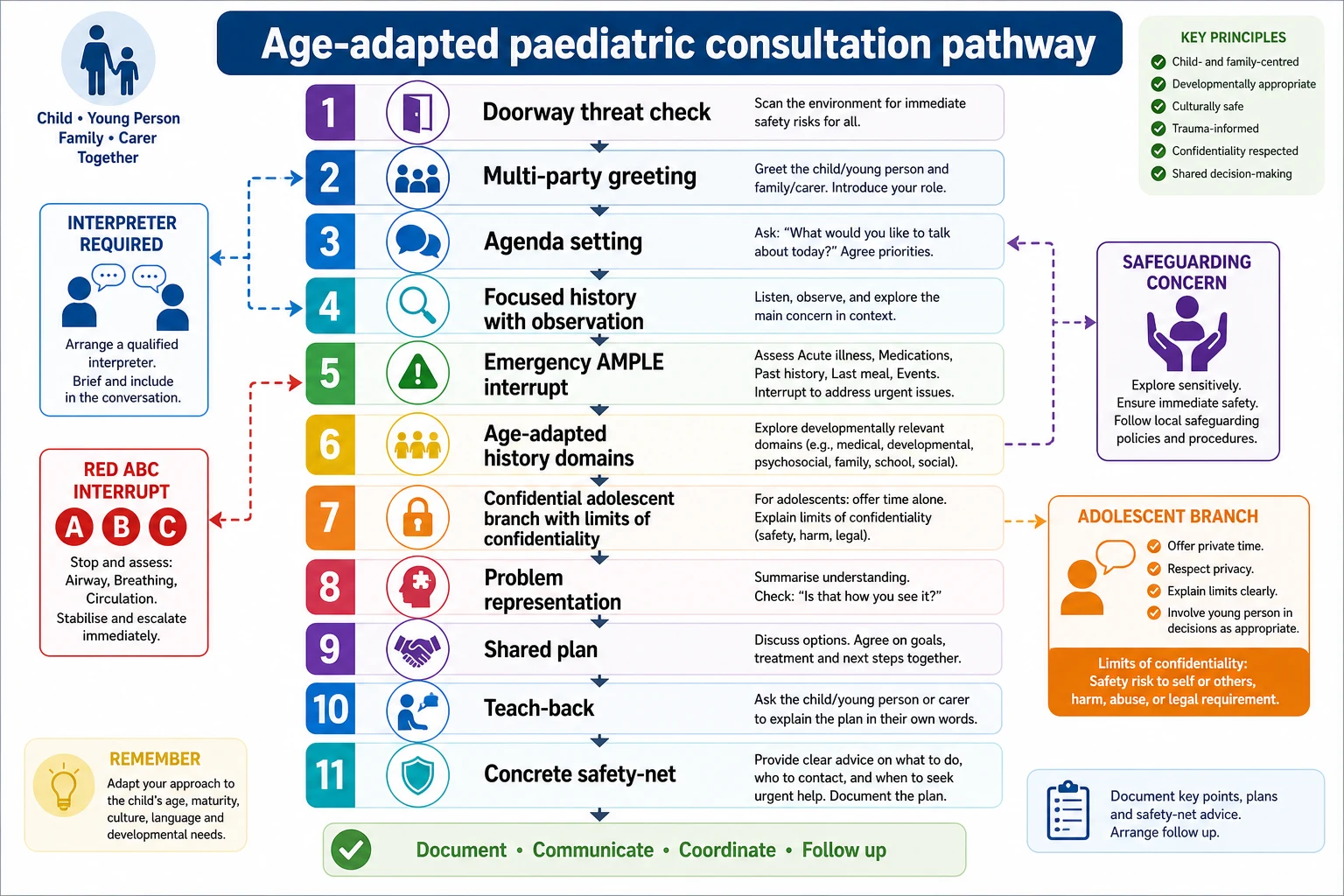
If history reveals airway threat, breathing failure, shock features, ongoing seizure, severe hypoglycaemia concern or active safety threat, stop the leisurely interview. Call for help. Start age-adapted ABCDE. Take a focused AMPLE history in parallel: Allergies, Medications, Past history, Last meal, Events. Use caregiver emergency plans, steroid cards, device settings and allergy alerts immediately. [13] [14]
Family presence during resuscitation needs a brief explanation and a support person, not a debate that blocks care. Disclosure of suicidal intent, assault or imminent harm during confidential history triggers safety action and appropriate information sharing. Hand critical history to the responding team with source attribution. In rural or telehealth settings, convert concerning history into remote advice and retrieval activation early rather than waiting for perfect certainty. [12] [15]
Management — Definitive & Stepwise
After threats are controlled, move through a repeatable consultation algorithm. [7] [11] [12]
- Synthesise history into a problem representation.
- Agree examination and investigation permissions in child-accessible language.
- Share the working impression and options.
- Co-produce a plan that fits literacy, language, transport and home capacity.
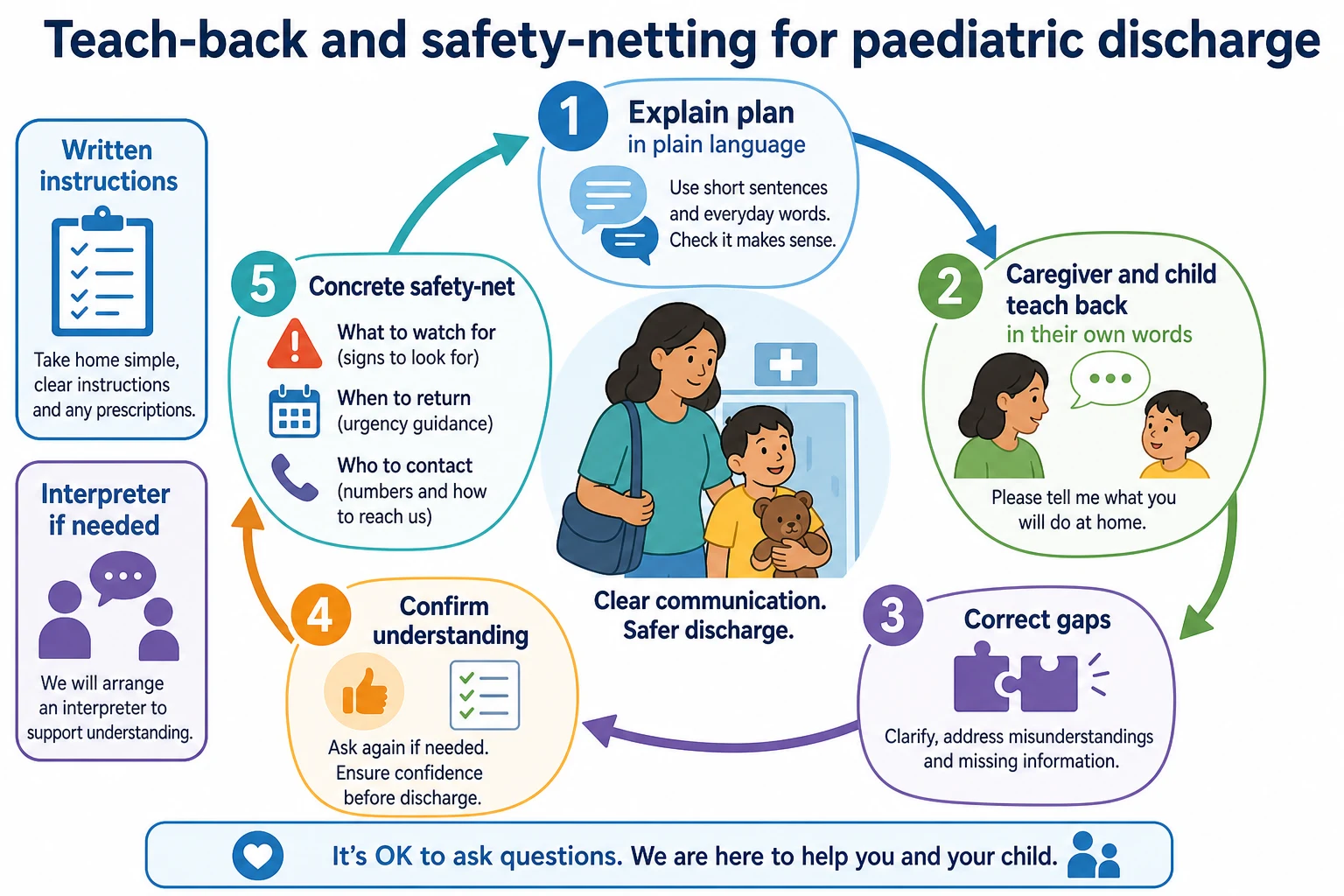
- Use teach-back: ask the caregiver and, when appropriate, the child to explain the plan in their own words.
- Give concrete safety-net advice: what to watch for, when to return, who to contact, and how soon.
- Document uncertainty, source attribution and the agreed plan for the next clinician. [7] [11] [12]
Teach-back is not a trick question. Emergency department qualitative work describes it as a dialogue that exposes misunderstanding before discharge. Medication-education trials and later safety interventions in paediatric emergency care show that structured communication around dosing can be operationalised; use the principle even when your local tool differs. Safety-netting approaches for acutely ill children have been compared in network meta-analysis; the practical bedside rule is still concrete, time-bounded advice plus a clear return pathway. [7] [8] [9] [11]
Motivational interviewing techniques help when the issue is behaviour change rather than missing facts: open questions, affirmations, reflections and summaries. Keep them short in acute care. Family-centred care principles from critical-care guidance still transfer: respect family knowledge, share information usefully and support partnership without abandoning clinical responsibility. [14]
Specific Subtypes & Scenarios
Neonatal feeding concern after discharge. Prioritise wet nappies, weight trajectory if known, colour, tone, temperature, maternal health and birth complications. Support frightened parents while you still ask precise questions. [13] [14]
Toddler with fever and “not right”. Put caregiver concern near the top of the problem representation. Ask about oral intake, wet nappies, lethargy, rash, immunisations and prior presentations. [10]
School-age recurrent abdominal pain and school absence. Separate acute red-flag history from chronic pattern. Ask the child directly about pain, bullying, toileting and what they fear. Add caregiver timeline and school function. [2] [1]
Adolescent confidential concern. Open private time early. State limits. Use HEADSS or SSHADESS. Negotiate what will be shared. Arrange follow-up that does not depend on a parent reading every message. [1] [2]
Gender-diverse or LGBTQ+ young person. Use affirmed name and pronouns. Protect privacy. Screen risk and protective factors without voyeuristic detail. [2] [3]
Medical complexity. Invite caregiver expertise: “What is different from their usual?” Ask for emergency plans, baseline seizures or oxygen need, device settings and who knows the child best. [13]
Neurodiversity. Reduce sensory load. Allow processing time. Accept alternative communication. Do not equate eye contact with honesty or capacity. [15] [13]
Language-discordant or refugee family. Book a professional interpreter. Expect interrupted records and missing immunisation proof. Screen trauma gently. [5] [15]
Indigenous families. Practise cultural safety: ask who should be present, avoid stereotypes, and make space for family structures and community supports without assuming one script. [14] [16]
Out-of-home care or youth justice. Clarify legal decision-makers. Expect fragmented history. Screen safeguarding and mental health carefully. [15] [3]
Possible maltreatment. Take a calm, detailed, non-accusatory history. Record exact words. Follow mandatory reporting pathways. Do not confront in a corridor. [15] [16]
Telehealth. State the limits of remote assessment. Escalate earlier when history is high risk and examination is incomplete. [10] [12]
Breaking serious news. Short chunks, silence, child-accessible language, and a support person. Check understanding before logistics. [14] [7]
Transition. Shift the historian role toward the young person while preserving useful collateral. Clarify capacity, guardianship and what travels to adult services. [3]
Complications & Pitfalls
Premature diagnostic closure from a tidy but incomplete story. Using a child as interpreter. Promising absolute confidentiality you cannot keep. Ignoring caregiver concern. Leading preschool children. Rapid-fire interrogation of adolescents. Omitting perinatal, developmental, immunisation, medication or social history when it matters. Missing complementary medicines and dosing devices. Accepting implausible injury mechanisms without curious clarification. Unsafe discharge without teach-back. Documentation that loses source and timeline. Handover that drops psychosocial, safeguarding or device data. Cultural stereotyping instead of individual enquiry. [5] [7] [10] [12]
Prognosis & Disposition
History features that often push toward admission, prolonged observation, retrieval or urgent community follow-up include unresolved caregiver concern, inability to re-present easily, complex technology dependence without a safe home plan, major safeguarding risk and incomplete understanding of red flags. Safety-net quality influences whether families return early enough. Discharge after acute illness is unsafe when understanding is not checked, transport is impossible, or the next observation step is undefined. [10] [11] [13]
Longitudinal care needs a living history: what changed since last time, who is the expert caregiver, and which goals matter to the family. Transition packages must carry diagnosis list, medicines, devices, legal decision-making status and preferred communication methods. Language access and literacy change post-discharge prognosis because instructions that cannot be used are not a plan. Structured communication at handoff reduces error; use the same discipline when you send a family home. [12] [5]
Special Populations
Neonates and ex-preterm infants need perinatal precision. Infants and toddlers need proxy history and ingestion-risk questions. School-age children need direct voice plus school function. Adolescents need confidential care and psychosocial depth. Gender and sexually diverse youth need affirming language and privacy. Complex chronic and technology-dependent children need baseline expertise and emergency plans. Disability and neurodiversity need communication access. Immunocompromised children need exposure histories. Indigenous families need cultural safety. Migrant and refugee families need interpreters and trauma-aware care. Out-of-home care and youth justice need legal clarity. Maltreatment contexts need careful documentation and reporting. Socioeconomic disadvantage needs realistic safety-nets. [13] [15] [5]
Evidence, Guidelines & Regional Differences
Educational evidence supports structured adolescent psychosocial frameworks and shows that SSHADESS teaching can broaden psychosocial enquiry in learners. Communication guidance for adolescent care emphasises private time, limits of confidentiality and developmentally appropriate language. [1] [2]
Consent and assent principles are set out in AAP policy and technical reports. Trauma-informed care is defined for paediatric clinicians and child health systems in AAP statements, with later primary-care strategy work expanding practical application. Family-centred care guidelines from critical care support partnership and information sharing that general paediatrics still uses outside ICU. [3] [4] [14] [15] [16] [17]
Interpreter evidence in hospitalised and emergency paediatric populations supports professional interpreting for communication-sensitive outcomes. Teach-back and medication-communication studies support checking understanding rather than assuming it. Caregiver concern has prospective association with critical illness. Safety-netting approaches for acutely ill children have comparative evidence, though local tools differ. Handoff redesign reduces medical errors in multicentre paediatric work. Medical complexity guidance explains why caregiver expertise is not optional colour. [5] [6] [7] [8] [9] [10] [11] [12] [13]
Use mature-minor and consent principles with state, territory or New Zealand legal detail rather than a memorised universal age. Mandatory reporting duties are local. Cultural safety for Aboriginal and Torres Strait Islander families, and Te Tiriti-informed care for Māori whānau, are core consultation competencies, not optional extras. ACSQHC partnering-with-consumers expectations reinforce shared decision-making and understandable information. [3] [4]
Gillick competence and Fraser guidelines shape confidential contraceptive and related care discussions. Four-nation safeguarding and information-sharing rules affect documentation. MRCPCH History and Communication stations reward structure, prioritisation, child engagement and clear safety-netting rather than encyclopaedic digression. [3] [2]
State and provincial privacy rules affect adolescent chart access and sensitive history. Bright Futures frames preventive history in US ambulatory care. ABP ethics and equity expectations, ACGME communication milestones, and RCPSC communicator EPAs all treat history and counselling as entrustable skills, not soft add-ons. [3] [2] [4]
Exam Pearls
- Greet the child first when development allows, then the caregivers. [2]
- State a one-sentence problem representation before listing differentials. [13]
- Caregiver concern that the child is not themselves is a red flag until proven otherwise. [10]
- Never use a child as interpreter for clinical content. [5]
- Explain limits of confidentiality before HEADSS or SSHADESS questions. [1] [2]
- HEADSS/SSHADESS is a scaffold, not a machine-gun checklist. [1]
- Document who said what. [12]
- Safety-net in concrete, time-bounded language and check with teach-back. [7] [11]
- In emergency, AMPLE history runs with ABCDE; history must not delay oxygen, glucose or seizure control. [13] [14]
- Ask about complementary medicines, dosing devices and who administers medicines. [8] [9]
- Inconsistent injury history needs calm detail and safeguarding pathway, not public confrontation. [15]
- For medical complexity, ask what is different from usual. [13]
- Close every acute consultation with what you think, what you will do, what to watch for, and how to get help. [7] [11]
References
- [1]Coble C Teaching SSHADESS Versus HEADSS to Medical Students: An Association With Improved Communication Skills and Increased Psychosocial Factor Assessments Acad Pediatr, 2023.PMID 36130691
- [2]Svetaz MV Adolescent Health: Communication With Adolescent Patients FP Essent, 2021.PMID 34410092
- [3]Katz AL Informed Consent in Decision-Making in Pediatric Practice Pediatrics, 2016.PMID 27456510
- [4]COMMITTEE ON BIOETHICS Informed Consent in Decision-Making in Pediatric Practice Pediatrics, 2016.PMID 27456514
- [5]Boylen S Impact of professional interpreters on outcomes for hospitalized children from migrant and refugee families with limited English proficiency: a systematic review JBI Evid Synth, 2020.PMID 32813387
- [6]Gutman CK Professional Interpreter Use and Discharge Communication in the Pediatric Emergency Department Acad Pediatr, 2018.PMID 30048713
- [7]Samuels-Kalow M Like a dialogue: Teach-back in the emergency department Patient Educ Couns, 2016.PMID 26597382
- [8]Naureckas Li C Medication Education for Dosing Safety: A Randomized Controlled Trial Ann Emerg Med, 2020.PMID 32807539
- [9]Samuels-Kalow ME Analysis of a Medication Safety Intervention in the Pediatric Emergency Department JAMA Netw Open, 2024.PMID 38214929
- [10]Mills E Association between caregiver concern for clinical deterioration and critical illness in children presenting to hospital: a prospective cohort study Lancet Child Adolesc Health, 2025.PMID 40451224
- [11]Burvenich R Effectiveness of safety-netting approaches for acutely ill children: a network meta-analysis Br J Gen Pract, 2025.PMID 39117428
- [12]Starmer AJ Changes in medical errors after implementation of a handoff program N Engl J Med, 2014.PMID 25372088
- [13]Kuo DZ Recognition and Management of Medical Complexity Pediatrics, 2016.PMID 27940731
- [14]Davidson JE Guidelines for Family-Centered Care in the Neonatal, Pediatric, and Adult ICU Crit Care Med, 2017.PMID 27984278
- [15]Forkey H Trauma-Informed Care Pediatrics, 2021.PMID 34312292
- [16]Duffee J Trauma-Informed Care in Child Health Systems Pediatrics, 2021.PMID 34312294
- [17]Forkey H Trauma-Informed Strategies in Pediatric Primary Care Pediatr Clin North Am, 2024.PMID 39433381