Paeds · preventive-and-community-paediatrics
Infant health supervision: 6 to 12 months
Also known as 6 to 12 month well-child visit · Infant health check 6-12 months · Late infancy preventive care · 9 month well baby review · Complementary feeding visit
Fellowship guide to 6-, 9- and 12-month infant health supervision: growth, developmental surveillance, complementary feeding and iron, safe sleep, injury prevention, oral health, targeted screens, family psychosocial care and conversion of a well visit to acute care.
On this page & tools
Your progress
Saved locally on this device.
Practise this topic
Target exams
Red flags
Life stages
Care settings
Clinical exam formats
Board mappings
Overview & Definition
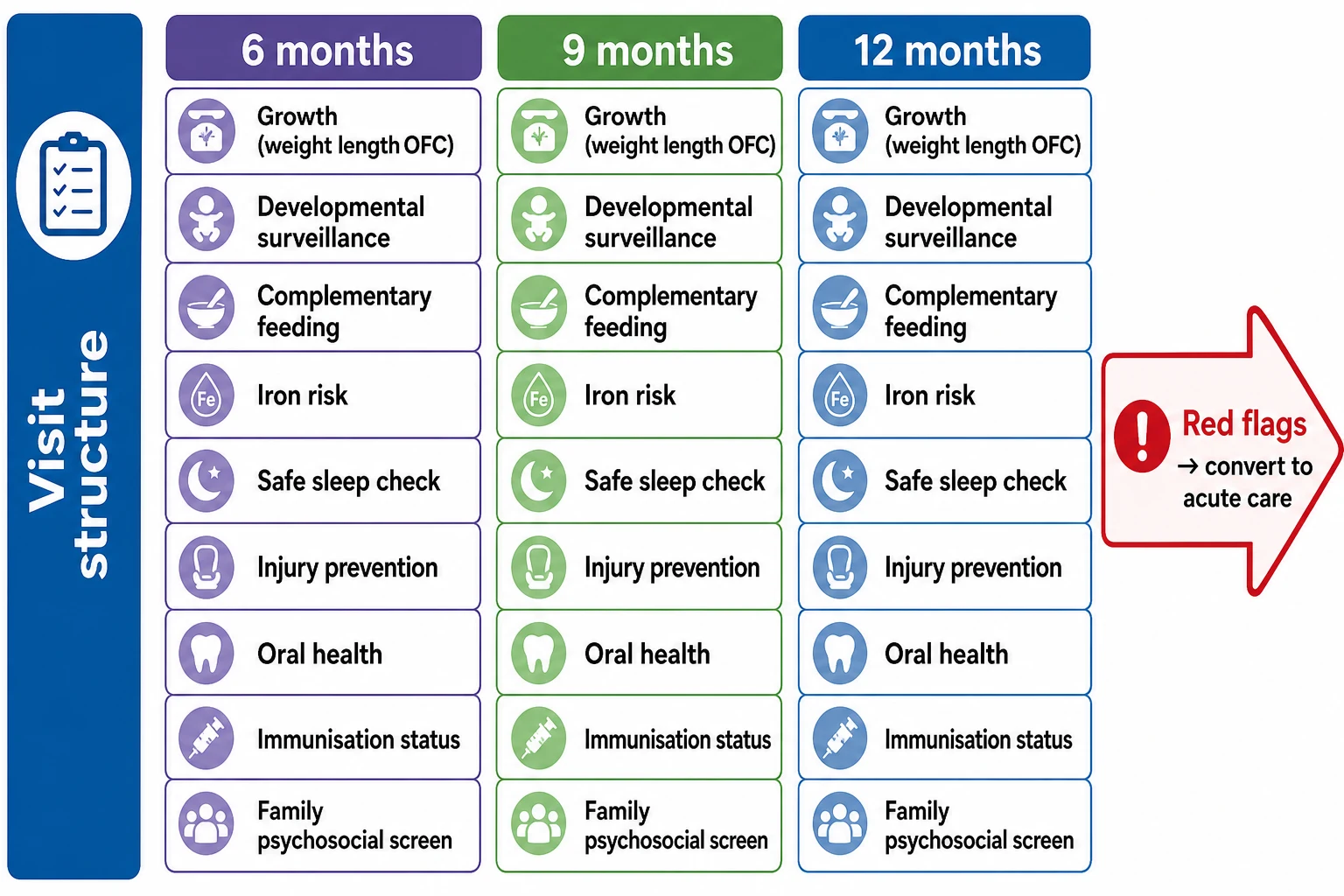
A 6–12-month health-supervision visit is planned preventive care for a late infant. It is not only a vaccine appointment. You are checking whether this child is growing, learning, feeding, sleeping and staying safe — and whether the caregivers have enough support to keep doing that work. [1] [16]
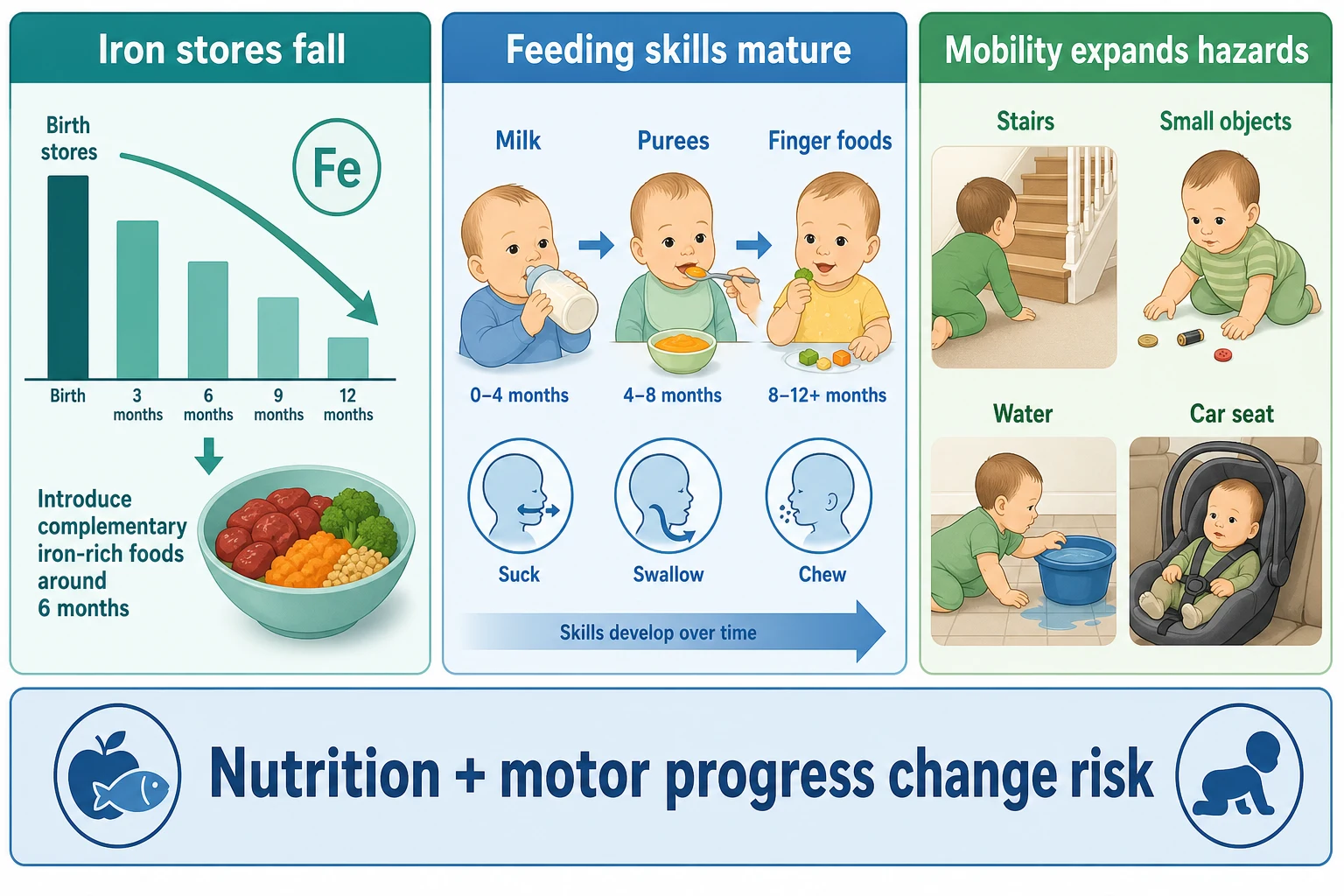
Think of this age band as a transition window. Milk alone no longer meets iron needs for many infants. Sitting, crawling and cruising open injury doors that did not exist at three months. Teeth appear. Night waking continues. Caregiver mood may still be fragile. Your job is to notice which of those changes is going well and which needs a plan before the family leaves. [4] [5] [10]
Doorway-to-plan pathway for a 6–12-month visit
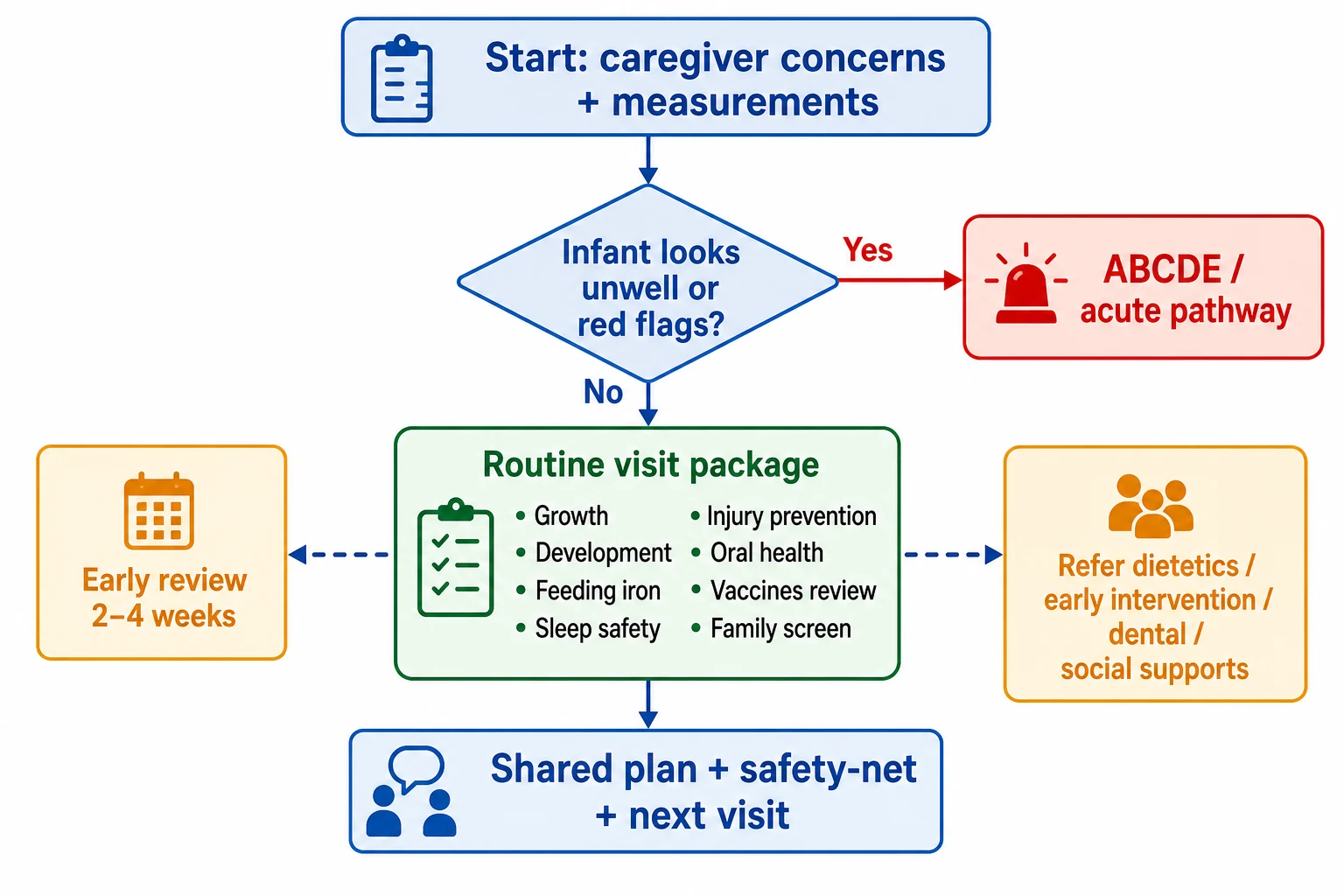
First look
Is this infant well enough for a preventive visit? If appearance, work of breathing or circulation worry you, convert to acute assessment.
Caregiver agenda
Ask what worries them most before you open the checklist. Caregiver concern is clinical data.
Measure and observe
Weight, length, OFC; watch interaction, posture, interest in objects and people; examine with age-adapted technique.
Age-band package
Feeding and iron, development, sleep, injury safety, oral health, immunisation status, family psychosocial screen.
Plan and safety-net
Agree what changes today, who to call, when to return early, and the next scheduled visit.
Classification
Health supervision at this age is best classified by visit intent and acuity, not by a single diagnosis. [1]
Routine preventive visit. The infant is well. You complete growth, development, feeding, safety, oral health, immunisation review and anticipatory guidance. Follow national or practice periodicity (commonly 6, 9 and 12 months in Bright Futures–style schedules; local blue-book timing may differ). [1] [16]
Preventive visit with embedded concern. Growth is off trend, milestones lag, feeding is iron-poor, or the caregiver is depressed. You still finish the visit, but you add early review, targeted tests or referral. [3] [5] [10]
Converted acute visit. The booked “well baby” is febrile, lethargic, dyspnoeic or injured. Stop the checklist. Use threat-first assessment. Vaccines wait. [1]
Domain classification inside every visit. Use six working domains: growth; development; nutrition and iron; sleep and SIDS-risk environment; injury and passenger safety; oral health and family psychosocial context. Immunisation status sits across domains as a systems check, with full schedule detail owned by the immunisation topics. [1] [6] [8]
Epidemiology & Risk Factors
Missed or late 6–12-month visits cluster where transport, language, housing instability, out-of-home care or rural access are hard. Those same infants often carry higher nutrition, injury and developmental risk — so the children who need the visit most are easiest to lose to follow-up. [1] [10]
Iron deficiency becomes common in the second half of infancy when fetal iron stores fall and growth remains fast. Exclusive milk feeding without iron-rich complementary foods, early use of unmodified cow’s milk as a main drink, prematurity and low birth weight raise risk. [5]
Lead exposure risk is not evenly distributed. Older housing, renovation dust, contaminated products and some occupational or environmental settings concentrate risk; screening strategy is therefore often risk-based rather than purely universal, depending on jurisdiction. [9]
Injury opportunity expands as rolling becomes crawling, cruising and early walking. Falls, choking on small objects, water hazards, burns and incorrect car-seat use rise with mobility even when parents feel “more confident” than they did with a newborn. [7]
Perinatal mood disorders remain clinically important at 6 and 9 months. They impair feeding support, safety behaviours and help-seeking. Screening in paediatric settings is justified because many caregivers attend infant visits more reliably than adult mental-health appointments. [10] [15]
Pathophysiology
Three linked mechanisms explain why this age band is high yield. [4] [5]
Iron economy. Term infants are born with iron stores that usually cover early infancy. By around six months, rapid growth and declining stores mean milk alone often cannot keep up. Without iron-rich complementary foods (or appropriate formula/supplementation strategies where indicated), iron deficiency develops before frank anaemia is obvious. Anaemia is a late marker, not the first injury. [5] [4]
Oral-motor and gut readiness. Around six months, head control, loss of early extrusion reflex, interest in food and progressive swallow skill allow complementary feeding. Texture progression trains chewing and reduces later feeding difficulty. Introducing iron-rich foods and common allergens according to current guidance is a developmental skill pathway as well as a nutrition pathway. [4]
Motor freedom versus hazard density. As trunk control and locomotion improve, the infant reaches stairs, cords, coins, hot drinks and water. Cognitive curiosity outruns hazard recognition. Sleep remains a vulnerability because unsafe soft bedding, side/prone sleep and smoke exposure still raise sleep-related death risk after the early months. [6] [7]
Clinical Presentation
A well 6-month-old typically shows improving head control and trunk support, social smile and reciprocal interaction, babbling beginnings, and interest in objects. A well 9-month-old often sits more securely, may crawl or pivot, uses more varied sounds, and shows stranger wariness or secure-base behaviour. A well 12-month-old may cruise or take first steps, use a few intentional sounds or words, and point or reach to share interest — but normal ranges are wide, so use evidence-informed milestone tools rather than memory folklore. [2] [14]
High-yield caregiver phrases include solids still not started, delayed sitting compared with a twin, mouthing everything, unsafe shared sleep for logistics, diluted formula to stretch supply, and loss of enjoyment of the infant. Treat each phrase as a clinical lead, not small talk. [3] [5] [10]
Subtle conversion signs inside a booked visit include longer feed times with sweat and tachypnoea, flat affect with poor tracking, rapidly crossing weight centiles, or an infant who is quieter than the parent describes as usual. [3] [5]
Differential Diagnosis
Keep differentials threat-first, then developmental, then nutritional/behavioural. [1] [3]
Looks unwell at check-in. Sepsis, pneumonia, bronchiolitis, meningitis, cardiac failure, non-accidental injury, severe dehydration or metabolic crisis. These are not “defer vaccines and review next week” problems. [1]
Slow development. Normal wide variation versus true motor delay, hearing loss presenting as quietness, visual impairment, global developmental delay, neuromuscular disease, severe psychosocial deprivation. Regression is never normal. [3] [12]
Feeding concern. Normal texture transition friction versus iron-poor diet, oromotor difficulty, pain (otitis, teething is often over-blamed), cow’s milk protein issues, reflux disease, cardiac work of feeding, food insecurity, forced-feeding aversion. [4] [5]
Sleep complaint. Normal night waking versus unsafe sleep environment, eczema itch, otitis, reflux, overstuffed day schedules, caregiver anxiety, or rare medical drivers. Fix the unsafe environment first. [6]
Social-communication concern before 18 months. Formal autism-specific screening tools such as M-CHAT-R/F are validated around the toddler window, not as a 6-month routine. That does not mean you ignore absent social engagement or regression now — act early on clear concern. [13] [3]
Clinical & Bedside Assessment
1. Set the agenda. “What do you most want us to cover today?” Then add your non-negotiables. [1]
2. Measure properly. Naked or lightly clothed weight, recumbent length with two people when possible, occipital-frontal circumference. Plot on the correct chart. Correct for prematurity in developmental interpretation as local practice directs; still look at growth trajectory carefully. [1] [2]
3. Developmental surveillance every visit. Combine parent report, structured questions and direct observation. Use evidence-informed milestone frameworks rather than outdated lists that delayed referral. Formal screening tools are added at recommended ages or when surveillance is abnormal. [2] [3] [14]
4. Examine with purpose. Skin (bruising, eczema, pallor), fontanelle, heart, hips and lower-limb posture, tone and strength, red reflex/visual attention, response to sound, mouth and emerging teeth, genitalia as indicated, and parent–infant handling. [1] [12] [8]
5. Family and social screen. Perinatal mood questions or validated tools as local pathway allows; food security; housing; intimate-partner safety; who else cares for the infant; cultural feeding practices. Use a professional interpreter when language differs. [10] [15]
Investigations
Most thriving infants with normal surveillance need no blood tests at a routine visit. Investigations should answer a question raised by risk, examination or trajectory. [1]
Iron / haemoglobin. Many systems screen for anaemia around 9–12 months, especially with prematurity, low iron diet, cow’s milk as main drink, or pallor/poor growth. Strategy (universal versus selective) is regional — state your jurisdiction and follow local guidance. A normal colour on a brief glance does not exclude iron deficiency. [5]
Blood lead. Use risk-based testing where recommended: older housing, known local prevalence, migrant pathways, pica, or other exposure history. Interpret action levels with current public-health guidance, not memory. [9]
Hearing and vision pathways. Failed newborn screen follow-up, caregiver concern about response to sound, or language delay triggers audiology. Poor visual attention or abnormal red reflex needs urgent ophthalmology pathways rather than “review at next well visit only.” [12]
Avoid shotgun panels in a well, growing, developing infant with no red flags. Tests without a hypothesis create false positives and family fear. [1]
Management — Resuscitation
A booked well-child slot does not protect the infant from critical illness. If the infant is lethargic, mottled, working hard to breathe, seizing, or unresponsive to the caregiver: call for help and open the airway; support breathing and oxygen as indicated; assess circulation and obtain urgent glucose when consciousness is altered; move to local sepsis or emergency pathways; defer routine vaccines and long anticipatory guidance; and document the conversion clearly so the “missed well visit” is not later misread as non-attendance. [1]
Suspected severe safeguarding risk, inability to feed safely, or caregiver incapacity may also prevent safe discharge even if vital signs are currently normal. Escalate to senior staff and child-protection pathways according to local law. [10]
Management — Definitive & Stepwise
The standard package
Complete growth interpretation, developmental surveillance, feeding and iron plan, safe-sleep review, injury and car-seat counselling, oral health, immunisation status check, family psychosocial screen, and a written or clearly spoken safety-net with the next appointment. [1] [16]
Feeding and iron (the centrepiece at this age)
Start complementary foods around 6 months, not so early that milk intake collapses, and not so late that iron risk climbs without a plan. Continue breastfeeding where possible, or appropriate infant formula. Offer iron-rich foods early in the complementary-feeding sequence (iron-fortified cereals, pureed meats, legumes as culturally appropriate). Progress textures. Do not use unmodified cow’s milk as the main milk drink before 12 months. Avoid honey under 12 months because of infant botulism risk. Discuss common allergen introduction using current regional guidance rather than outdated long delays for every infant. [4] [5] [11]
If diet remains iron-poor, the infant was preterm/low birth weight, or screening suggests deficiency, follow local investigation and supplementation pathways rather than generic “multivitamins.” [5]
Safe sleep
Re-teach after 6 months because families often relax rules. Back to sleep, firm flat surface, no soft bedding or loose objects, avoid smoke exposure, and room-sharing principles per current local guidance. Address bed-sharing pressures honestly: tired parents need a workable plan, not only a lecture. [6]
Injury and passenger safety
As mobility rises: stair gates, window locks, hot-drink height, small-object sweep, water supervision, poison storage. Rear-facing car seats for as long as the seat allows within local law and manufacturer limits; emphasise correct harness and installation over brand names. [7]
Oral health
As teeth erupt: clean with a soft brush and age-appropriate fluoride toothpaste amount; avoid bottles of milk or sweet liquids in bed; establish a dental home according to local programs; fluoride varnish where primary-care or dental pathways provide it. [8]
Immunisation status
Review what is due, overdue or uncertain. Deliver due vaccines if the infant is well enough. Full schedule comparison and hesitancy counselling live in dedicated immunisation topics — here, do not let paperwork eclipse growth, development and safety. [1]
Family supports
Positive mood screens need more than a leaflet: clear referral, safety assessment if needed, and a review plan. Food insecurity needs practical linkage (local food supports, social work, formula access pathways). [10] [15]
Specific Subtypes & Scenarios
6 months, exclusive breastfeeds, no solids yet. Praise milk feeding. Explain iron timing. Agree a practical first-foods plan this week, not “sometime soon.” Offer lactation support if milk supply anxiety is driving delay. [4] [11]
9 months, not sitting, caregiver unworried. Do not accept “boys are slow” as assessment. Examine tone, strength, hips, hearing response and interaction. Use corrected age if preterm. Plan early review or therapy referral rather than waiting for the 12-month visit by default. [2] [3]
11 months, cow’s milk in a bottle as main intake, pale. Treat as iron-risk feeding pattern. Shift to appropriate milk strategy for age, iron-rich solids, and investigate per local pathway. [5]
12 months, sweet bottle in bed, early white-spot lesions. Stop nocturnal sugar exposure, start structured tooth cleaning, arrange dental care, reinforce fluoride. [8]
Ex-preterm at 9 months chronological. Interpret milestones with correction as indicated; still act on red flags. Growth charts and nutrition may need neonatal-graduate nuance. [2] [3]
Uncertain vaccines, refugee family. Complete the preventive visit domains and start a documented catch-up plan with interpreter support; do not reduce the visit to injection catch-up alone. [1]
Positive perinatal depression screen. Assess infant safety and caregiver support today. Refer. Arrange earlier review. Document shared plan. [10]
Complications & Pitfalls
Other traps: over-calling teething as the cause of true illness; under-calling hearing loss as “quiet personality”; treating baby-led weaning as either mandatory or forbidden rather than assessing safety and iron density of the actual diet; and forgetting that out-of-home care means you must identify who will actually implement the plan. [4] [12]
Prognosis & Disposition
Routine disposition. Well infant, open issues closed or safely deferred, vaccines handled, family understands safety-net and next scheduled visit. [1]
Early review (days to a few weeks). Borderline growth, new feeding change, mild developmental concern with a clear observation plan, recovering illness, fragile social situation, or medication/supplement start that needs checking. [3] [5]
Same-day acute or emergency pathway. Unwell infant, significant injury, unsafe discharge environment, severe caregiver incapacity, or safeguarding emergency. [1]
Referral triggers. Dietetics/lactation for persistent feeding-iron problems; early intervention/physiotherapy/speech for developmental delay; audiology/ophthalmology for sensory concern; dental pathways for caries risk; social work/mental health for family risk; child protection where mandated. [3] [8] [10]
Good 12-month outcomes look like: growth on a plausible trajectory, iron-aware diet, developmental progress without ignored red flags, safer sleep and home, teeth care started, immunisations not silently overdue, and a caregiver who knows when to come back. [1] [5]
Special Populations
Preterm and NICU graduates. Correct age for development as indicated; watch feeding fatigue and iron closely; coordinate with existing specialist plans. [3] [5]
Complex chronic disease / technology dependence. Preventive domains still apply. Schedule longer visits. Avoid diagnostic overshadowing (“it’s just the syndrome”) when new fever or behaviour change appears. [1]
Indigenous families. Practise cultural safety, continuity, and local program linkage. In some regions, ear health and other community priorities deserve extra attention inside the same visit structure. [1]
Migrant and refugee families. Interpreter first. Clarify feeding practices, housing, prior vaccines and trauma-informed approach. [1] [10]
Out-of-home care. Identify legal consent, who brings the infant, which screens are missing, and how information will reach all caregivers. [10]
Disability risk / evolving neurodiversity. Earlier therapy is not a label crisis; it is time-sensitive brain and skill support. [3]
Evidence, Guidelines & Regional Differences
ANZ. Use local child personal health records / blue books and national immunisation handbook timing. Complementary feeding and iron messages align with WHO/ESPGHAN-style timing around 6 months, with local public-health wording. Developmental services and dental programs vary by state/territory and DHB/Te Whatu Ora pathways. [4]
United States. Bright Futures periodicity commonly structures 6-, 9- and 12-month visits with explicit screening rows that are updated in AAP recommendations for preventive pediatric health care. Iron and lead strategies are often protocolised by clinic and public-health jurisdiction. [1] [16] [9]
United Kingdom. Healthy Child Programme schedules and health-visitor contacts differ from pure medical-home visit lists; GPs and paediatricians still must recognise the same red flags, feeding-iron issues and developmental concerns. NICE pathways influence autism recognition and other referrals. [3]
Canada. Primary-care periodicity and provincial programs vary; core clinical content (growth, development, feeding, safety, family context) remains the same. [1]
Evidence anchors for this page include AAP preventive periodicity updates, ESPGHAN complementary-feeding guidance, iron-deficiency prevention reviews, AAP safe-sleep and child-passenger statements, oral-health clinical reports, lead-toxicity prevention, perinatal depression incorporation into paediatric practice, and evidence-informed milestone surveillance tools. [1] [4] [5] [6] [2]
Controversies to handle honestly: universal versus selective iron and lead testing; how strictly bed-sharing is framed; and baby-led weaning versus traditional spoon feeding — judge the actual diet’s iron density and choking safety rather than brand loyalty. [5] [4] [6]
Exam Pearls
6–12 month visit pack: GROW-SAFE
- Complementary feeding around 6 months with iron-rich foods; continue breastmilk or formula. [4]
- No unmodified cow’s milk as main drink before 12 months. [5]
- No honey under 12 months. [4]
- Surveillance every visit; autism-specific tools later — but regression now is urgent. [3] [13]
- Safe sleep teaching is not “newborn only.” [6]
- Rear-face car seats as long as the seat correctly allows. [7]
- Caregiver mood is part of infant health. [10]
- A well-child visit can become resuscitation — do not miss the doorway look. [1]
References
- [1]COMMITTEE ON PRACTICE AND AMBULATORY MEDICINE 2023 Recommendations for Preventive Pediatric Health Care Pediatrics, 2023.PMID 36938620
- [2]Zubler, Jennifer M Evidence-Informed Milestones for Developmental Surveillance Tools Pediatrics, 2022.PMID 35132439
- [3]Lipkin, Paul H Promoting Optimal Development: Identifying Infants and Young Children With Developmental Disorders Through Developmental Surveillance and Screening Pediatrics, 2020.PMID 31843861
- [4]Fewtrell, Mary Complementary Feeding: A Position Paper by the European Society for Paediatric Gastroenterology, Hepatology, and Nutrition (ESPGHAN) Committee on Nutrition J Pediatr Gastroenterol Nutr, 2017.PMID 28027215
- [5]Sundararajan, Sripriya Prevention of iron deficiency anemia in infants and toddlers Pediatr Res, 2021.PMID 32330927
- [6]Task Force on Sudden Infant Death Syndrome SIDS and other sleep-related infant deaths: expansion of recommendations for a safe infant sleeping environment Pediatrics, 2011.PMID 22007004
- [7]Durbin, Dennis R Child Passenger Safety Pediatrics, 2018.PMID 30166367
- [8]Krol, David M Maintaining and Improving the Oral Health of Young Children Pediatrics, 2023.PMID 36530159
- [9]COUNCIL ON ENVIRONMENTAL HEALTH Prevention of Childhood Lead Toxicity Pediatrics, 2016.PMID 27325637
- [10]Rafferty, Jason Incorporating Recognition and Management of Perinatal Depression Into Pediatric Practice Pediatrics, 2019.PMID 30559118
- [11]Cohen, Sarah S Factors Associated with Breastfeeding Initiation and Continuation: A Meta-Analysis J Pediatr, 2018.PMID 30293638
- [12]Bower, Charles Hearing Assessment in Infants, Children, and Adolescents: Recommendations Beyond Neonatal Screening Pediatrics, 2023.PMID 37635686
- [13]Robins, Diana L Validation of the modified checklist for Autism in toddlers, revised with follow-up (M-CHAT-R/F) Pediatrics, 2014.PMID 24366990
- [14]Kretch, Kari S Learn the Signs. Act Early.: Updates and Implications for Physical Therapists Pediatr Phys Ther, 2022.PMID 35876833
- [15]Earls, Marian F Incorporating recognition and management of perinatal and postpartum depression into pediatric practice Pediatrics, 2010.PMID 20974776
- [16]COMMITTEE ON PRACTICE AND AMBULATORY MEDICINE, BRIGHT FUTURES PERIODICITY SCHEDULE WORKGROUP 2021 Recommendations for Preventive Pediatric Health Care Pediatrics, 2021.PMID 33593848