Paeds · professional-practice-and-evidence
Developmentally appropriate communication
Also known as Age-appropriate paediatric communication · Developmental communication technique · Play-based paediatric engagement · Communicating with children and young people · Augmentative and alternative communication in paediatrics
A fellowship-level guide to matching communication register, engagement tool and privacy to a child's developmental stage — from behavioural reading of the neonate through play-based preschool engagement, confidential adolescent interviewing, augmentative and alternative communication, identity-respecting language, trauma-informed technique, teach-back and age-appropriate safety-netting.
On this page & tools
Your progress
Saved locally on this device.
Practise this topic
Target exams
Red flags
Life stages
Care settings
Clinical exam formats
Board mappings
MATCH the channel
Overview & Definition
A four-year-old who draws where it hurts has just told you more than a yes-or-no question ever could. Developmentally appropriate communication is the deliberate matching of your language, engagement tool and privacy to a child's cognitive, linguistic and emotional stage. You are not simplifying an adult conversation. You are choosing a different channel for a different mind. [1] [9]
Think of it as three decisions before the first question. Decide the child's developmental stage, not just the age on the chart. Decide the channel — spoken word, play, drawing, behavioural observation, augmentative device or interpreter. Decide the privacy the conversation needs, especially for adolescents. Get one wrong and good clinical knowledge still produces a poor encounter. [1] [16]
This page owns communication technique and developmental register-matching. It does not replace the history-structure page, the consent-law page, or disease-specific management. Cross-link those rather than hiding a second chapter here. [9] [10]
Classification
Sort the child's communication capacity along a developmental ladder before you decide how to talk. A neonate communicates behaviourally through cry, gaze, tone and feeding. An infant adds social smile, stranger anxiety and turn-taking. A toddler brings parallel play, single words and protest. A preschooler offers imaginative play, drawing and concrete logic — but is highly suggestible. A school-age child gives direct voice, school-function language and growing inclusion in decisions. An adolescent brings autonomy, privacy needs and psychosocial depth. A young adult in transition owns the conversation while you preserve useful caregiver collateral. [1] [16]
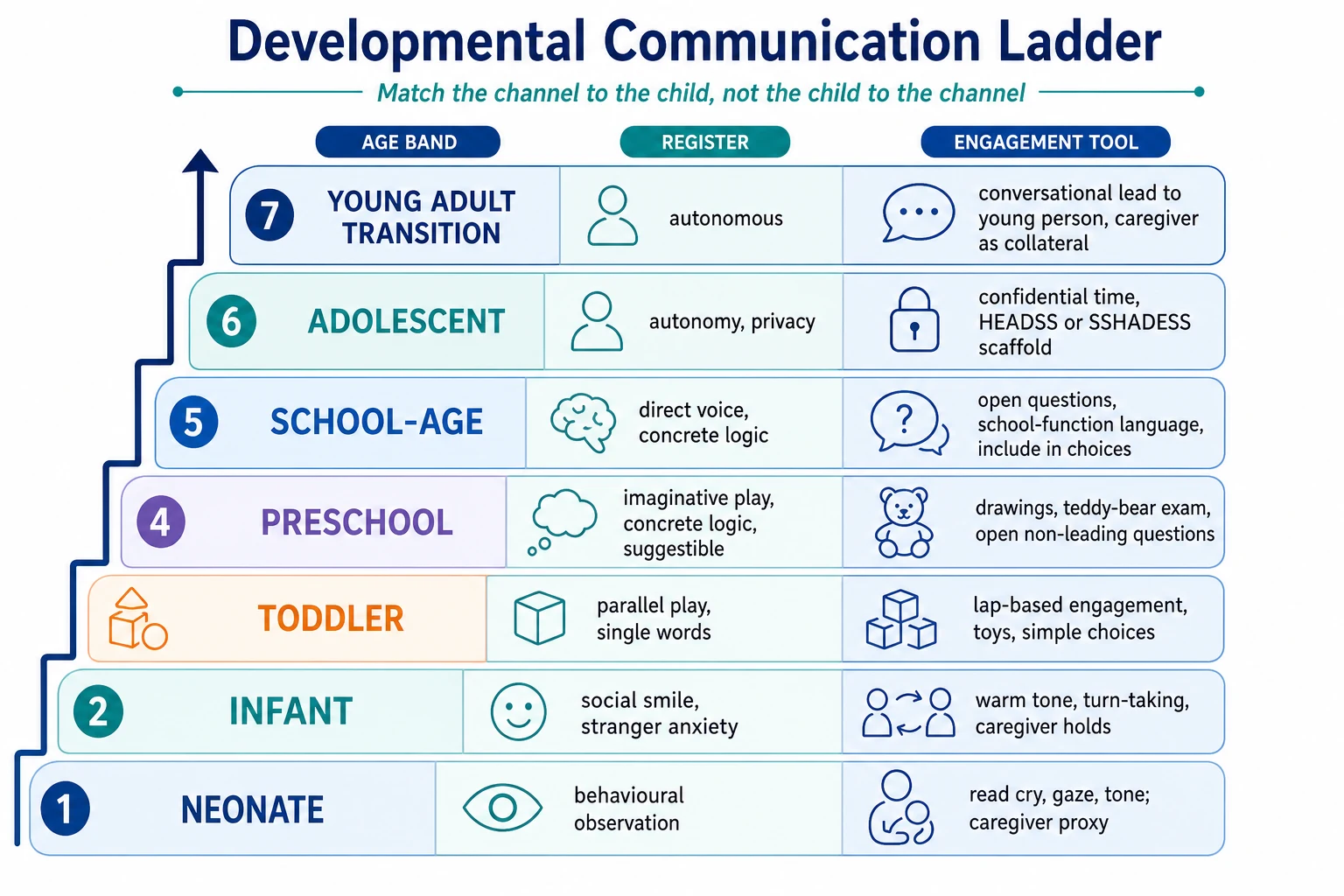
Sort the channel separately. Spoken word fails a deaf child without sign or captions. Play and drawing succeed where words fail a frightened preschooler. A visual schedule or social story calms an autistic child who cannot decode rapid verbal instructions. An augmentative and alternative communication device gives voice to a non-speaking child. Behavioural observation is the only channel for a sedated or acutely distressed infant. Name the channel you are using and adapt when it fails. [14] [15]
Sort the privacy need last. A preschooler needs a safe lap and a familiar adult nearby. A school-age child benefits from some private time as trust builds. An adolescent needs confidential space opened early, with limits of confidentiality stated before sensitive questions. [1] [2]
Epidemiology & Risk Factors
Communication failure is a patient-safety problem with its own taxonomy. When paediatric quaternary-care safety events are characterised, communication problems cluster around register mismatch, jargon overload, interpreter absence, information loss at handover and broken confidentiality. These are preventable and measurable. [12]
Language discordance without a professional interpreter is a high-yield risk factor. Systematic review evidence in hospitalised children from migrant and refugee families supports professional interpreter use for safer outcomes, and emergency-department work links professional interpreters with better discharge communication than ad-hoc approaches. Never use a child as interpreter for clinical content. [3] [4]
Limited health literacy degrades spoken instructions even when language matches. Jargon never becomes a usable plan. Cognitive and communication disability raises the risk of under-recognised pain, because behavioural signals are missed or misattributed to baseline. Sensory overload in hospitalised or autistic children shuts down the communication channel before you ask a single question. [5] [13]
Missed adolescent psychosocial conversations leave mental-health, sexual-health and substance-use needs invisible. Rurality and telehealth reduce the channels available and increase escalation risk when the conversation is high-stakes but the examination is incomplete. [1] [2]
Pathophysiology
Developmental cognitive stage sets the ceiling on what a child can hear and report. A sensorimotor infant lives in the immediate sensory present. A preoperational preschooler thinks concretely and magicaly, blending cause and coincidence. A concrete-operational school-age child reasons logically about real events but struggles with pure abstraction. A formal-operations adolescent can weigh probability, future consequence and identity. Match your register to the stage or the message bounces off. [1] [16]
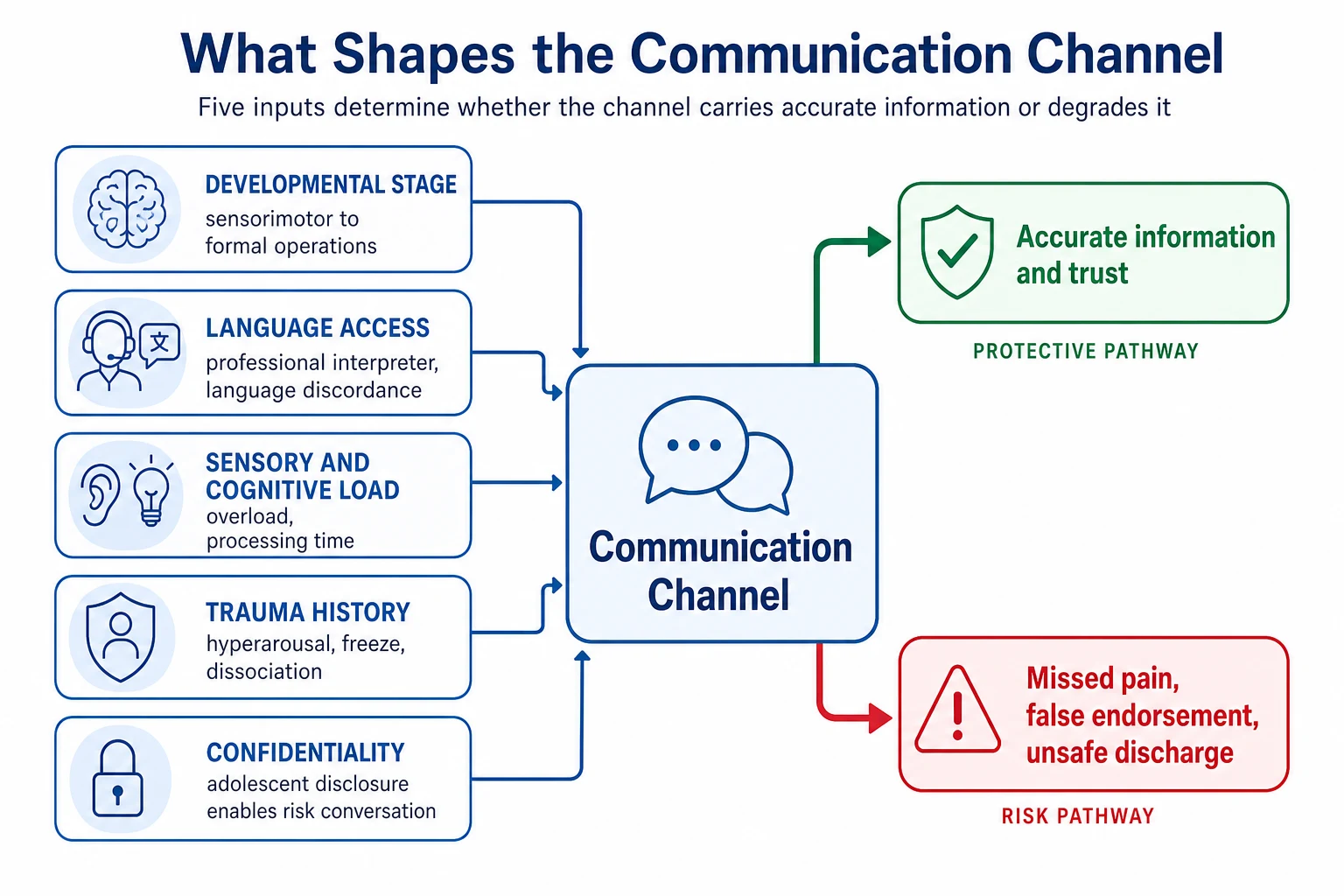
Stranger anxiety peaks in late infancy and reshapes how you must approach. A toddler who clings and cries is not refusing care — the attachment system is doing its job. Theory of mind emerges in the preschool years, slowly letting the child report internal states and grasp that the clinician holds different knowledge. Leading questions exploit the preoperational child's suggestibility and manufacture false symptoms. [1]
Trauma responses — hyperarousal, freeze, dissociation and avoidance — reshape what a child can hear, process and say during an encounter. Trauma-informed paediatric care treats these as expected physiology under threat, not as proof of fabrication or non-compliance. Pain and fear replace words in young or distressed children, so behavioural observation must supplement or override verbal report. [6] [8]
The double empathy problem reframes autistic communication difficulty as a bidirectional mismatch between autistic and non-autistic interlocutors, not a one-way deficit sitting inside the autistic person. When you treat the mismatch as shared and adjust your own channel, the conversation opens. Limited health literacy and jargon cognitively block the encoding of instructions, which is exactly why teach-back works — it exposes the gap before the family leaves. [5] [17]
Clinical Presentation
From the doorway, the encounter has already started. Who holds the child? Who looks frightened? Is the adolescent silent while a parent answers everything? Is there an interpreter, or a sibling being recruited to translate? Those observations are the first communication data. [3] [4]
Neonates and young infants present through feeding, wet nappies, colour, tone, cry quality and caregiver-reported change. Your job is behavioural reading — does the cry sound high-pitched and inconsolable, is the gaze absent, is the tone floppy — paired with clear calm language to frightened parents. [9]
Toddlers present through play, separation protest, pointing, single words and refusal. Engage through parallel play on the caregiver's lap rather than forcing eye contact. Preschoolers offer imaginative play and drawings but will invent a tidy story if you lead them. School-age children give direct voice and school-function language and want to be included. Adolescents bring mixed medical and psychosocial agendas and may delay help-seeking until a confidential space opens. [1] [2]
A non-speaking child presents through an augmentative device, behaviour change, alternative communication and carer interpretation. An autistic child may show atypical eye contact, echolalia, literal interpretation or sensory overwhelm. Behaviour change in a cognitively diverse child may be the only signal of pain. Reassuring fragments — a smile, a nod, "I'm fine" — never cancel a high-risk whole. [13] [14] [17]
Differential Diagnosis
After observing the channel, sort whether the problem is the channel itself, the stage, or something else. Is this a language-channel problem — language discordance, hearing loss, or AAC need? Is it a developmental-stage mismatch — you are using a register two stages too old? Or is the behaviour change signalling something organic? [1] [16]
Distinguish age-appropriate limited report from speech-language disorder or developmental delay that needs referral. Separate a shy or selectively mute child from one with autism, anxiety or trauma-driven withdrawal. When a non-verbal child changes behaviour, ask whether unrecognised pain is driving it before assuming baseline fluctuation. Separate sensory-overload shutdown from fatigue or acute illness — each needs a different adaptation. [13]
Sort regression carefully. A child who loses communication skills may be situational, but regression can signal a serious neurological, developmental or safeguarding concern. Prioritise adaptations by threat, developmental need and reversibility. [6]
Clinical & Bedside Assessment
Set the environment before you set the agenda. Sit at eye level. Reduce noise and crowding. Have toys, drawing materials and a teddy available. Brief the interpreter if one is needed. For an autistic or sensory-sensitive child, dim bright lights and allow processing time. The room is part of the communication channel. [9] [17]
Engagement by stage
Match register deliberately. For a preschooler, use short concrete sentences, honest sensory language and choices. Avoid jargon and never lead. For a school-age child, ask open questions, include them in simple decisions, and use school-function language. For an adolescent, open confidential time early, state the limits of confidentiality, then use HEADSS or SSHADESS as a scaffold. [1] [2]
HEADSS covers Home, Education or Employment, Activities, Drugs, Sexuality, and Suicide or depression and safety. SSHADESS expands with Strengths, School, Home, Activities, Drugs, Emotions or Eating or Depression, Sexuality, and Safety. Teach either as a conversation map. Strengths-first SSHADESS can open rapport before risk questions. Explain confidentiality limits before sensitive items: ordinary private information stays private unless there is risk of serious harm to the young person or someone else, or another mandatory duty applies. Exact wording is local. [1] [2] [10]
For a non-speaking or cognitively diverse child, integrate the augmentative device, visual schedule and carer expertise. Read behaviour as communication. Ask the autistic young person whether they prefer identity-first language ("autistic person") or person-first language ("person with autism"); preference varies and systematic review shows many autistic adults prefer identity-first. Do not equate lack of eye contact with dishonesty or lack of capacity. [14] [15] [17]
Use professional interpreters so the family — not the interpreter — is the conversational partner. Brief the interpreter on goals. Speak to the family directly. Check understanding with teach-back in the preferred language. Trauma-informed technique means predicting that questions about injury, home, sex or substances may activate threat physiology: give choice, explain why you need a detail, and avoid forcing a full trauma narrative in an acute bay when only safety-relevant facts are required. [3] [4] [6]
Investigations
Communication assessment drives, not follows, the investigation plan. Some findings demand an immediate bedside check: a behavioural pain reading in a non-verbal child triggers a validated pain tool; a hearing concern triggers a bedside screen and audiology referral; a developmental concern triggers milestone review and referral. [13] [16]
When a child cannot give reliable self-report, lean on caregiver proxy, behavioural observation and objective monitoring. Decide early whether speech-language assessment, audiology or developmental evaluation is needed, and whether an augmentative and alternative communication referral to a speech-language pathologist applies. Match the pain-assessment tool to the cognitive stage: a revised-FLACC scale for a cognitively impaired non-verbal child, a Faces scale for a preschooler, a numeric scale for a school-age child. [13]
Indiscriminate panels ordered because communication was too degraded to localise the problem create harm through false positives, delay and distress. Explain procedural-distress preparation as part of the bridge from conversation to test. "Normal" old results never cancel a high-risk new story. [12]
Management — Resuscitation
If a child deteriorates mid-conversation, your voice is part of the treatment. Keep it calm. Name the change aloud. Call for help. Keep the caregiver briefly informed without abandoning the ABCDE sequence. A frightened child who hears a steady voice regulates better than one surrounded by silent alarm. [9]
Explain a scary intervention in developmentally appropriate real time. Tell a preschooler the oxygen mask is "space air that helps you breathe." Tell a school-age child the cannula is "a tiny straw for medicine." Do not promise it will not hurt — honesty preserves trust for next time. Use play or distraction while the team works. [9]
Obtain a focused emergency history — Allergies, Medications, Past history, Last meal, Events — through whatever channel works: caregiver, interpreter, or device. Handle disclosure of imminent self-harm, assault or abuse during confidential adolescent communication by acting on safety first, sharing only what duty requires, and never promising absolute secrecy. Closed-loop communication and clear role allocation keep treatment and information flowing in parallel. [6] [10]
Management — Definitive & Stepwise
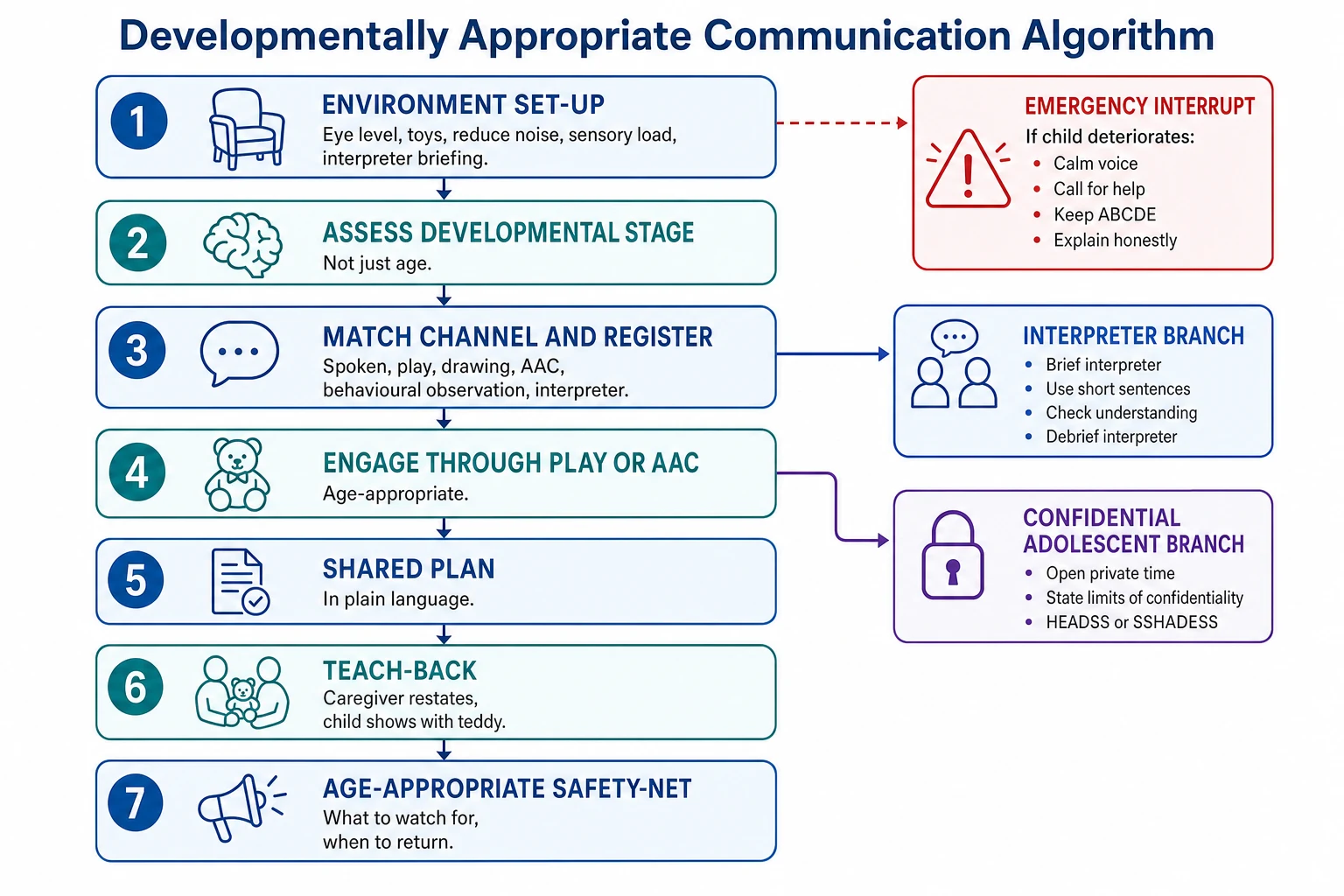
Once the child is stable, build a communication plan that travels home with the family. Move through a repeatable sequence. [5] [12]
- State the child's communication capacity and the adaptations you used.
- Match register and channel to the developmental stage for the plan discussion.
- Explain procedural preparation in age-appropriate sensory language if a procedure is ahead.
- Share the working impression and options in plain language.
- Co-produce a plan that fits literacy, language, transport and home capacity.
- Use teach-back — ask the child to show you with the teddy, the caregiver to restate, the adolescent to summarise.
- Give a concrete, time-bounded safety-net in age-appropriate language.
- Document communication capacity, interpreter identity, adaptations and understanding-check results. [5] [9]
Procedural preparation is calibrated by stage. A preschooler needs simple, honest, sensory description and distraction. A school-age child wants an honest step-by-step walk-through and some control. An adolescent wants collaborative planning and privacy. Motivational interviewing helps when the issue is behaviour change: open questions, affirmations, reflections and summaries. Keep them short in acute care. [1] [5]
Specific Subtypes & Scenarios
Neonate and frightened parents. Read cry, gaze, tone and feeding behaviourally. Deliver clear, calm language to parents who are terrified. Anchor every statement in what you see. [9]
Febrile toddler on a caregiver's lap. Engage through play while you gather history from the anxious caregiver. Parallel play sustains the child's regulation while you work. [1]
Preschooler and pain drawings. Ask the child to point or draw where it hurts. Use a teddy-bear examination. Avoid leading questions — accept "I don't know" as a real answer. [1]
School-age direct interview. Give the child the floor for location, severity and school impact. Keep the caregiver as the timeline anchor. Include the child in simple choices. [16]
Confidential adolescent interview. Open private time early. State limits of confidentiality. Use HEADSS or SSHADESS as a scaffold. Negotiate what will be shared and how follow-up will work. [1] [2]
Non-speaking child with an AAC device. Integrate the device, visual supports and carer expertise. Do not speak over the child. Wait for the device-mediated answer. [15]
Autistic child. Reduce sensory load. Allow processing time. Accept atypical eye contact and echolalia as communication. Use visual schedules and social stories. Frame the conversation as a shared double-empathy adjustment, not a deficit to correct. [14] [17]
Gender-diverse young person. Use the affirmed name and pronouns. Protect privacy. Screen risk and protective factors without voyeuristic detail. [1]
Interpreter-supported family. Book a professional interpreter. Never use a child. Brief the interpreter. Speak to the family. Check understanding with teach-back. [3] [4]
Indigenous family. Practise cultural safety. Ask who should be present. Avoid stereotypes. Make space for family structures and community supports. [9]
Procedural preparation. Calibrate explanation to age. Use distraction, honest sensory language and, where available, child-life support. [1]
Pain in a cognitively impaired non-verbal child. Use a validated behavioural tool such as r-FLACC. Read behaviour as communication. Treat the pain you find. [13]
Transition. Shift the conversational lead to the young person while preserving useful caregiver collateral. Clarify capacity, guardianship and adult-service communication preferences. [18]
Complications & Pitfalls
Adult jargon that the child or caregiver cannot decode. Over-leading questions that manufacture false symptoms in suggestible preschoolers. Treating the caregiver as the only partner and ignoring the child's voice. Breaking a confidentiality promise and destroying adolescent trust. Using a child as interpreter. Sensory overload that shuts down an autistic child. Equating lack of eye contact with dishonesty. Imposing person-first language when the young person prefers identity-first. Missing behavioural pain in a non-verbal child. Unsafe discharge without teach-back. Documentation that drops communication capacity and interpreter identity. Cultural stereotyping instead of individual enquiry. Forcing a trauma narrative when only safety facts are needed. [5] [12] [14]
Prognosis & Disposition
Communication findings change disposition. A child who needs an interpreter, an augmentative device referral, audiology or developmental evaluation must have that booked before discharge. Teach-back quality at discharge predicts whether the family returns early enough. Discharge is unsafe when understanding was not checked in the family's preferred language and register. [5] [3]
Longitudinal care needs a living communication record: what changed since last time, what channel works, what adaptations were used, who the expert carer is. Transition packages must carry diagnosis, medicines, devices, legal decision-making status and communication preferences to adult services. Unmet communication needs — interpreter access, AAC, sensory accommodation — change long-term health equity because instructions that cannot be used are not a plan. [18] [12]
Special Populations
Neonates and ex-preterm infants need behavioural reading and calm caregiver language. Infants and toddlers need play, lap-based engagement and separation-anxiety awareness. Preschoolers need imaginative play, drawings and non-leading questions. School-age children need direct voice and inclusion. Adolescents need confidential care and psychosocial depth. Gender and sexually diverse youth need affirming language and privacy. Non-speaking and minimally verbal children need AAC, visual supports and carer partnership. Autistic and neurodiverse children need reduced sensory load, processing time and double-empathy framing. Cognitively diverse children need matched register and validated pain tools. Deaf and hard-of-hearing children need sign language, captions and audiology partnership. Indigenous families need cultural safety. Migrant and refugee families need interpreters and trauma-aware care. Out-of-home care and youth justice need legal clarity about decision-makers. Maltreatment contexts need trauma-informed communication and careful documentation. Socioeconomic disadvantage needs health-literacy-aware plain language and concrete return pathways. [1] [14] [17]
Evidence, Guidelines & Regional Differences
Communication-related safety events in paediatric quaternary care are now characterised as a classifiable, preventable failure type. Professional interpreter evidence in hospitalised and emergency paediatric populations supports interpreter use for communication-sensitive outcomes. Teach-back work in the emergency department frames it as a dialogue that exposes misunderstanding before discharge. [3] [4] [5] [12]
Augmentative and alternative communication evidence, including systematic review of speech-generating devices for autistic preschoolers, supports AAC as a communication channel — not a cure — with specialist assessment. The double empathy problem reframes autistic communication as bidirectional. Identity-first versus person-first language preference is evidence-based: many autistic adults prefer identity-first, so ask rather than assume. Validated pain tools for cognitively impaired non-verbal children, including r-FLACC, are reviewed and support behavioural pain reading. [13] [14] [15] [17]
Consent and assent principles are set in AAP policy and technical reports. Trauma-informed care is defined for paediatric clinicians and systems. Family-centred care guidelines from critical care transfer to general paediatrics. Promoting optimal development through screening is an AAP clinical report. Transition communication is supported by medical-home guidance. [6] [7] [8] [9] [10] [16] [18]
Use mature-minor and consent principles with state, territory or New Zealand legal detail rather than a memorised universal age. Mandatory reporting duties are local. Cultural safety for Aboriginal and Torres Strait Islander families, and Te Tiriti-informed care for Māori whānau, are core communication competencies. ACSQHC partnering-with-consumers expectations reinforce plain-language shared decisions. [10] [11]
Gillick competence and Fraser guidelines shape confidential adolescent communication. Four-nation safeguarding and information-sharing rules affect what you communicate and document. The MRCPCH Communication station rewards developmentally appropriate, structured, teach-back-confirmed dialogue rather than encyclopaedic digression. [10] [1]
State and provincial privacy rules affect adolescent chart access and sensitive communication. Bright Futures frames developmentally staged anticipatory guidance. ABP family-centred-care and ethics expectations, ACGME communication milestones, and RCPSC communicator EPAs all treat developmentally appropriate communication as an entrustable skill. [10] [1]
Exam Pearls
- Match your register to developmental stage, not just chronological age. [1]
- Greet and address the child first whenever development allows, then the caregivers. [9]
- Use play, drawing and a teddy-bear examination to engage a preschooler. [1]
- Never lead a suggestible preschooler — use open prompts and accept "I don't know". [1]
- Open confidential adolescent time early and state limits of confidentiality before sensitive questions. [1] [2]
- HEADSS and SSHADESS are rapport scaffolds, not interrogation checklists. [2]
- Ask an autistic young person their language preference: identity-first or person-first. [14]
- Never use a child as interpreter for clinical content. [3]
- Read behavioural pain in non-verbal children with a validated tool such as r-FLACC. [13]
- Reduce sensory load for an autistic or overwhelmed child before expecting communication. [17]
- Use teach-back after every plan — ask the family to restate it in their own words. [5]
- Close every encounter with what we think, what we will do, what to watch for, and how to get help — in age-appropriate language. [5] [9]
References
- [1]Svetaz MV Adolescent Health: Communication With Adolescent Patients FP Essent, 2021.PMID 34410092
- [2]Coble C Teaching SSHADESS Versus HEADSS to Medical Students: An Association With Improved Communication Skills and Increased Psychosocial Factor Assessments Acad Pediatr, 2023.PMID 36130691
- [3]Boylen S Impact of professional interpreters on outcomes for hospitalized children from migrant and refugee families with limited English proficiency: a systematic review JBI Evid Synth, 2020.PMID 32813387
- [4]Gutman CK Professional Interpreter Use and Discharge Communication in the Pediatric Emergency Department Acad Pediatr, 2018.PMID 30048713
- [5]Samuels-Kalow M Like a dialogue: Teach-back in the emergency department Patient Educ Couns, 2016.PMID 26597382
- [6]Forkey H Trauma-Informed Care Pediatrics, 2021.PMID 34312292
- [7]Duffee J Trauma-Informed Care in Child Health Systems Pediatrics, 2021.PMID 34312294
- [8]Forkey H Trauma-Informed Strategies in Pediatric Primary Care Pediatr Clin North Am, 2024.PMID 39433381
- [9]Davidson JE Guidelines for Family-Centered Care in the Neonatal, Pediatric, and Adult ICU Crit Care Med, 2017.PMID 27984278
- [10]Katz AL Informed Consent in Decision-Making in Pediatric Practice Pediatrics, 2016.PMID 27456510
- [11]COMMITTEE ON BIOETHICS Informed Consent in Decision-Making in Pediatric Practice Pediatrics, 2016.PMID 27456514
- [12]Simmons P Characterization of Communication-Related Safety Events in a Pediatric Quaternary Care Hospital J Patient Saf, 2026.PMID 42008794
- [13]Shaban R Pain assessment in non-verbal children with neurocognitive impairment: a review on current tools, challenges, and clinical perspectives Front Pain Res (Lausanne), 2026.PMID 41987884
- [14]Schuck RK Preferences for Identity-First and Person-First Language: A Systematic Review of Research With Autistic Adults/Adults With Autism J Autism Dev Disord, 2025.PMID 41389164
- [15]Therrien MCS A Systematic review of AAC interventions using speech generating devices for autistic preschoolers Augment Altern Commun, 2025.PMID 40164143
- [16]Weitzman, Carl Promoting Optimal Development: Screening for Mental Health, Emotional, and Behavioral Problems: Clinical Report Pediatrics, 2025.PMID 40850690
- [17]Milton D The 'double empathy problem': Ten years on Autism, 2022.PMID 36263746
- [18]White, Patience H Supporting the Health Care Transition From Adolescence to Adulthood in the Medical Home Pediatrics, 2018.PMID 30348754