EM · Non-invasive ventilation
Non-invasive ventilation in the emergency department (CPAP and BiPAP)
Also known as NIV · CPAP · BiPAP · Non-invasive positive pressure ventilation
Non-invasive ventilation — the CPAP (continuous) and the BiPAP (bilevel), the evidence-based indications (the COPD type 2 acidosis and the cardiogenic pulmonary oedema — the two strongest), the contraindications (the unprotected airway, the cardiac arrest), the settings (IPAP 12 to 20, EPAP 4 to 6 for the BiPAP; 5 to 10 cm water for the CPAP), the monitoring, the failure-to-respond escalation to the intubation, and the palliative NIV. ACEM-primary, globally tagged.
On this page & tools
Your progress
Saved locally on this device.
Target exams
Red flags
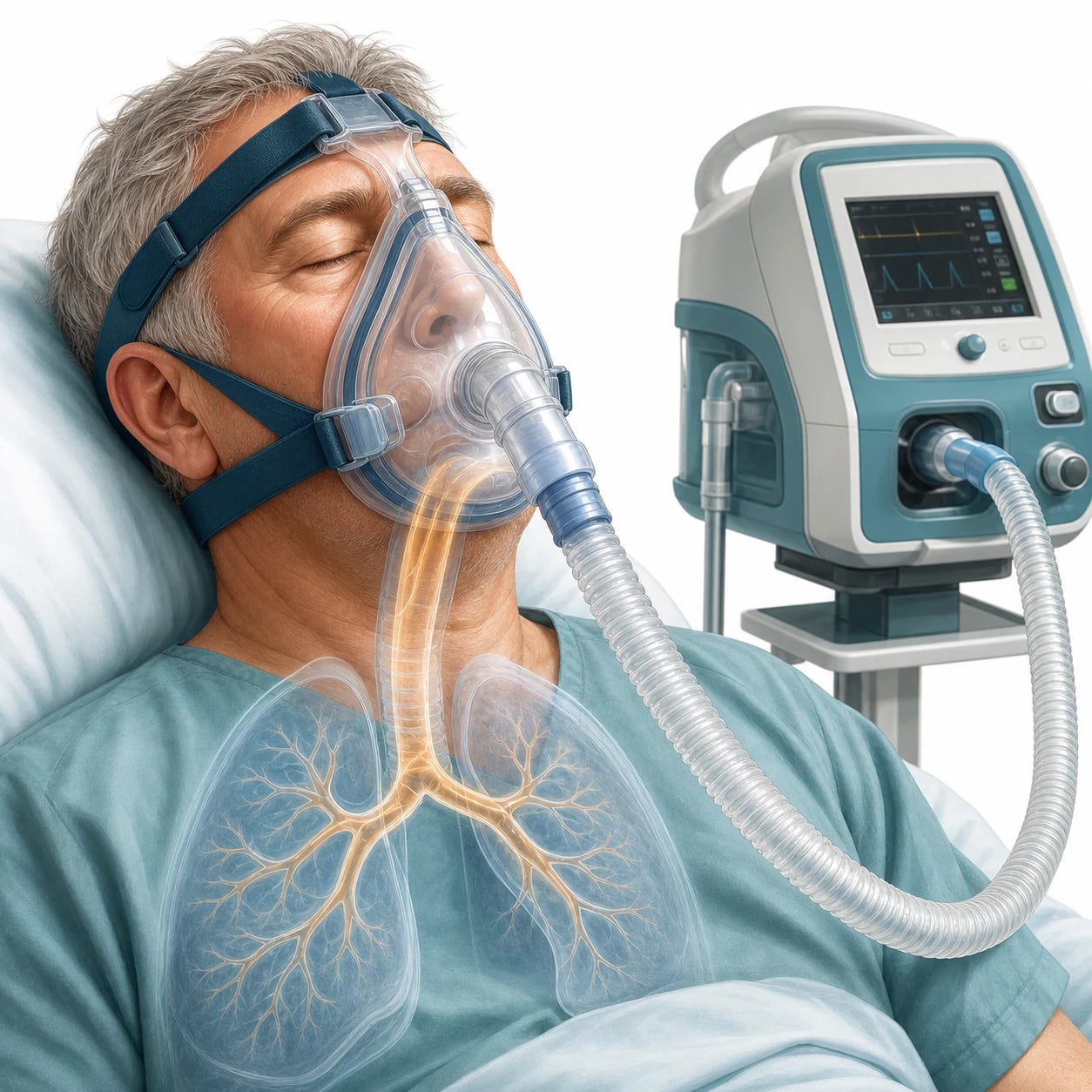
Non-invasive ventilation is the delivery of a positive airway pressure via a mask (without an endotracheal tube), and it is the most important respiratory-support modality the emergency physician has — the bridge between the oxygen and the intubation, and for two conditions (the COPD type 2 acidosis and the cardiogenic pulmonary oedema) the evidence-based, mortality-reducing first choice. The Fellowship candidate must know the CPAP from the BiPAP, the indications, the settings, the monitoring and the escalation, because the right NIV applied early saves the intubation.[1][2]
Definition — CPAP and BiPAP
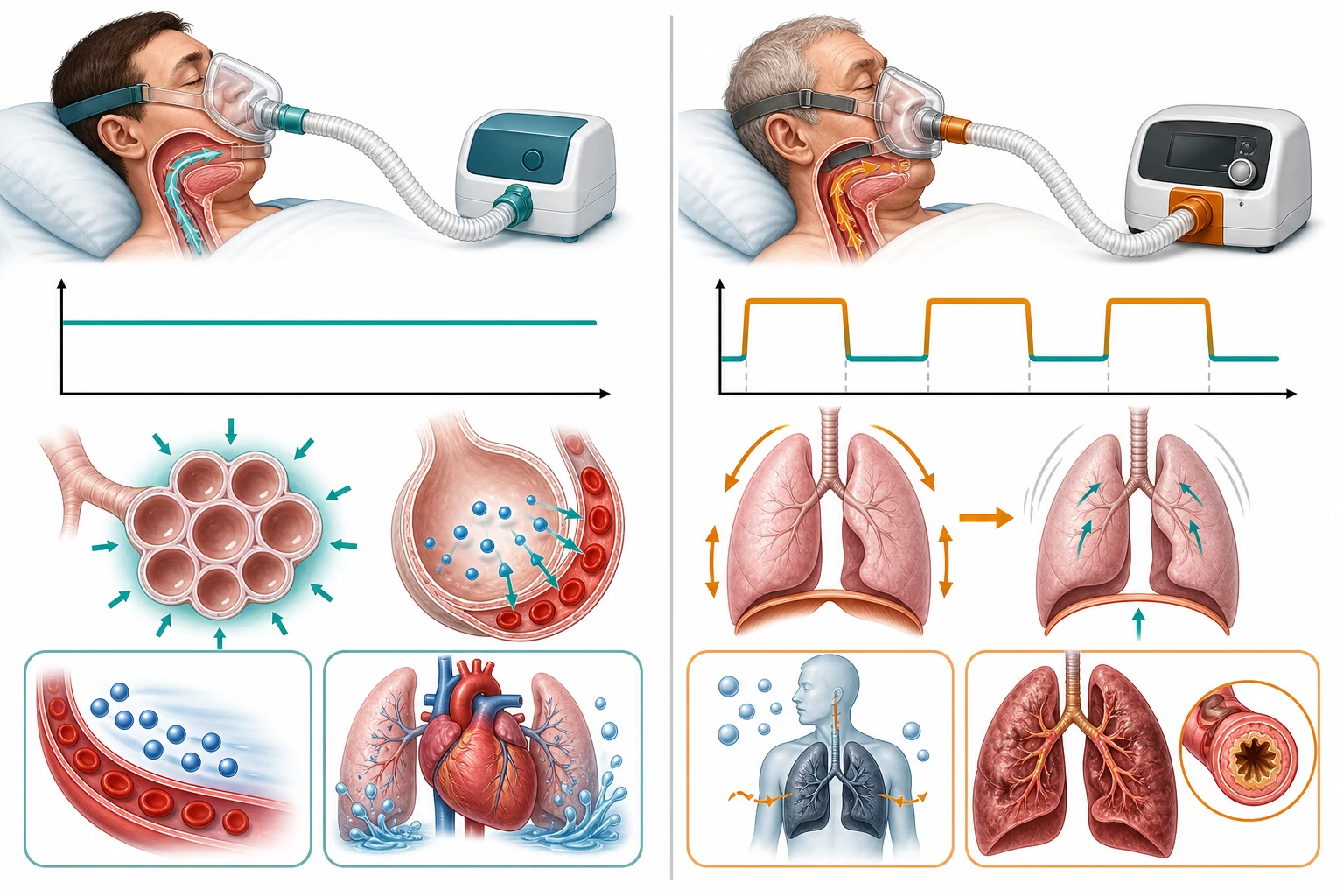
The CPAP (the continuous positive airway pressure) delivers a single, constant pressure throughout the respiratory cycle — it splints the alveoli open, recruits the collapsed lung, reduces the work of breathing, and, in the cardiogenic pulmonary oedema, reduces the preload (by increasing the intrathoracic pressure and reducing the venous return) and the afterload (by reducing the left-ventricular transmural pressure). It does NOT provide an inspiratory pressure support — it does not augment the tidal volume. The BiPAP (the bilevel positive airway pressure) delivers two pressures — an inspiratory (the IPAP, providing the pressure support that augments the tidal volume and the ventilation) and an expiratory (the EPAP, the PEEP that splints the alveoli). The BiPAP is the ventilator for the type 2 respiratory failure (it increases the ventilation and clears the CO₂), while the CPAP is the support for the type 1 (it recruits the alveoli and reduces the preload). [1]
Mechanism of action — the physiology of the positive pressure
The NIV works by two mechanisms — the alveolar recruitment (the pressure splints the collapsed and the fluid-filled alveoli open, increasing the functional residual capacity and the gas-exchange surface, and so improving the V/Q matching and the oxygenation) and the work-of-breathing reduction (the pressure support offloads the fatiguing respiratory muscles, reduces the oxygen cost of the breathing, and so breaks the spiral of the fatigue, the hypercapnia and the worsening acidosis). In the cardiogenic pulmonary oedema the CPAP has a third, haemodynamic mechanism — the preload reduction (the raised intrathoracic pressure reduces the venous return and so the LV filling in the over-filled ventricle) and the afterload reduction (the raised intrathoracic pressure reduces the LV transmural pressure, the external pressure on the LV wall, and so increases the stroke volume). The net effect in the failing, over-filled heart is an improved cardiac output — the CPAP is, in this sense, an inotrope delivered through a mask. [1]
The BiPAP adds the inspiratory pressure support (the IPAP minus the EPAP is the pressure support, the driving pressure that augments each tidal volume). A higher IPAP increases the tidal volume and so the minute ventilation, blowing off the CO₂ and correcting the respiratory acidosis — this is why the BiPAP, and not the CPAP, is the right choice for the type 2 respiratory failure.[8]
CPAP
the one continuous pressure
- A single pressure, 5 to 10 cm H₂O, throughout the whole respiratory cycle — no inspiratory assistance
- Recruits the alveoli and reduces the work of the breathing by the PEEP effect
- Reduces the LV preload and the afterload — the haemodynamic benefit in the cardiogenic oedema
- The first-line for the acute cardiogenic pulmonary oedema (the type 1)
- Does NOT augment the ventilation — it does not clear the CO₂, so it is the wrong choice for the pure type 2
BiPAP
the IPAP and the EPAP
- Two pressures — the IPAP (inspiratory, the pressure support) and the EPAP (expiratory, the PEEP)
- The pressure support (the IPAP minus the EPAP) augments the tidal volume and the ventilation
- Clears the CO₂ and corrects the respiratory acidosis — the choice for the type 2
- The first-line for the COPD exacerbation with the pH under 7.35
- Titrate the IPAP to the PaCO₂ (the rising IPAP lowers it) and the EPAP to the oxygenation
AVAPS
the volume-assured mode
- A volume-targeted BiPAP mode — the ventilator adjusts the IPAP to deliver a set tidal volume
- Useful where the ventilation is erratic (the neuromuscular, the obesity hypoventilation)
- Not the routine ED mode — the standard pressure-targeted BiPAP is the default
- Ensures a minimum minute ventilation in the fatiguing patient
Differential diagnosis — which NIV for which condition
The choice between the CPAP and the BiPAP depends on the condition. [1]
BiPAP (type 2)
- COPD exacerbation with a pH <7.35 — the strongest evidence
- Hypercapnic respiratory acidosis from any cause
- The neuromuscular weakness (GBS, MG) with a rising CO2
- The obesity hypoventilation with a decompensation
CPAP (type 1)
- Cardiogenic pulmonary oedema — the 3CPO trial evidence
- The pneumonia with hypoxia (selected, not routine)
- The ARDS (as a bridge to the intubation)
- The post-extubation hypoxia prevention
Palliative NIV
- The Do-not-intubate patient with a respiratory failure
- Relieves the dyspnoea without the intubation
- May improve the comfort in the terminal respiratory failure
- The goals of care guide the application
Contraindicated
- The cardiac or the respiratory arrest
- The inability to protect the airway (the coma, the GCS <8)
- The severe facial deformity or the trauma
- The copious secretions or the vomiting risk
Indications — the evidence-based list
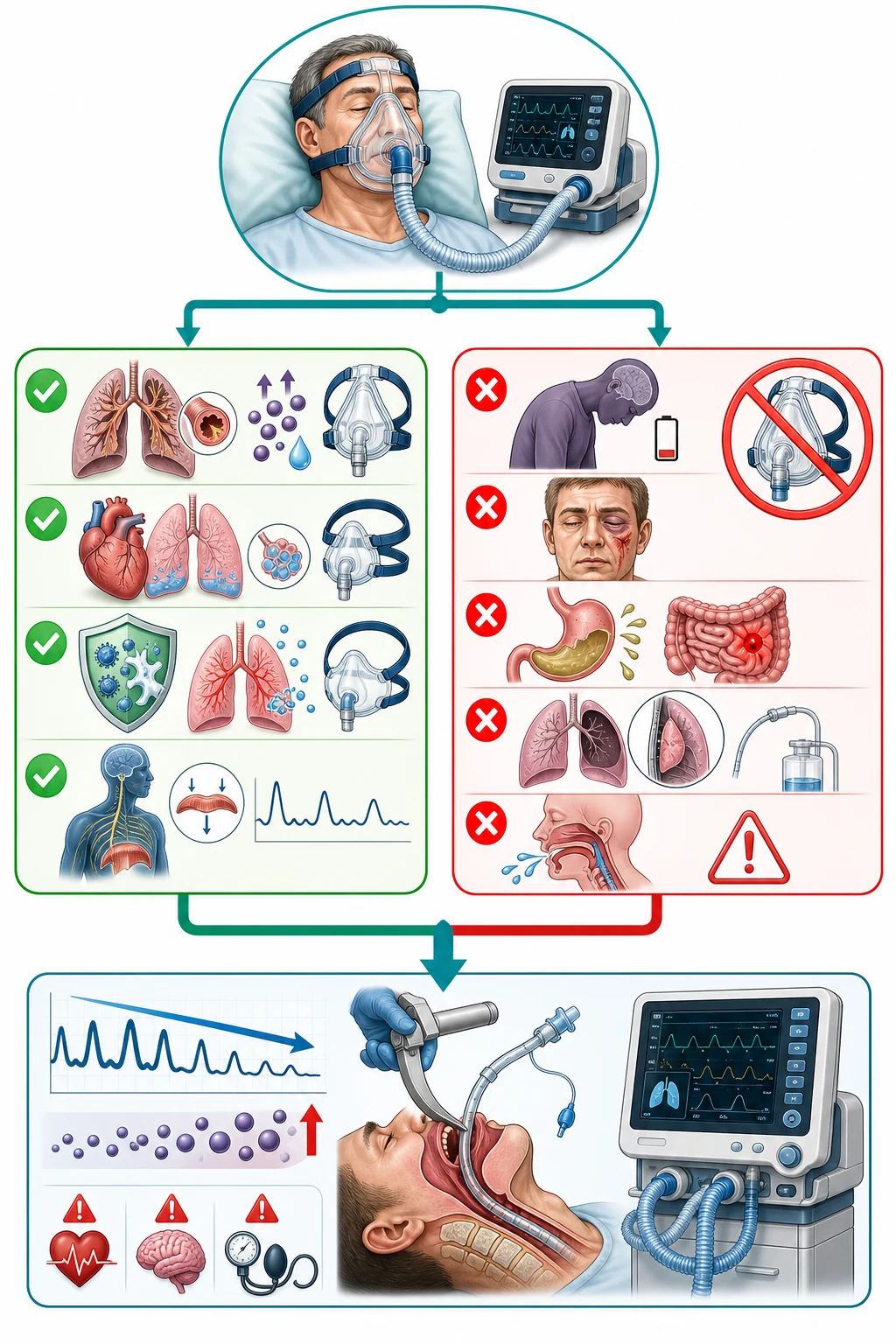
The NIV is the right choice for the respiratory failure that is potentially reversible, where the patient can protect the airway and synchronise with the mask. The four strongest ED indications are the COPD exacerbation with the respiratory acidosis, the acute cardiogenic pulmonary oedema, the immunocompromised patient with the hypoxaemic respiratory failure, and the do-not-intubate patient with the reversible element of the respiratory failure. [1]
1. The COPD exacerbation with the respiratory acidosis (the pH under 7.35). This is the single strongest NIV indication. The Plant trial (the 236 patients, the pH 7.25 to 7.35) showed a reduced intubation rate (from 27 to 15 per cent), a reduced mortality and a shorter stay; the Brochard trial and the Ram Cochrane meta-analysis (the 14 trials, the NNT around 10 for the mortality) confirmed it.[3][4][5] The BiPAP is started within 60 minutes of the acidotic ABG — the earlier the better, and the under-7.35 pH is the trigger, not the absolute PaCO₂.
2. The acute cardiogenic pulmonary oedema. The CPAP (or the BiPAP) reduces the intubation rate and improves the breathlessness and the physiology faster than the standard oxygen. The 3CPO trial (the 1,069 patients) showed no mortality difference but a clear reduction in the intubation; the Bersten trial and the Vital Cochrane meta-analysis confirmed the benefit (a mortality reduction in the pooled analysis).[2][6][7] The CPAP is the default, the BiPAP if the hypercapnia coexists.
3. The immunocompromised patient with the hypoxaemic respiratory failure. The NIV avoids the intubation and the ventilator-associated infection in the vulnerable host. The Hilbert trial (the neutropenic patients with the infiltrates and the fever) showed a reduced intubation rate, fewer complications and a lower mortality with the early NIV.[9] The ERS/ATS guideline recommends the NIV (or the high-flow nasal cannula) as the first-line support in the immunocompromised.[8]
4. The do-not-intubate patient with the reversible element. The palliative NIV relieves the dyspnoea, improves the comfort and may tide the patient over a reversible component (the opiate load reduced, the oedema diuresed) without the intubation. The goals of care guide the application — the NIV is titrated to the comfort, not the gas, and the plan for the de-escalation is agreed at the outset. [1]
Selecting the NIV in the ED — the decision at the bedside
Confirm the indication and the reversibility
The COPD acidosis (pH under 7.35), the cardiogenic oedema, the immunocompromised hypoxaemia, the palliative — the four evidence-based ED indications. The reversible cause addressed in parallel (the bronchodilator, the diuretic, the antibiotic, the GTN).
Exclude the contraindications
The cardiac or the respiratory arrest, the coma (GCS under 8), the inability to protect the airway, the vomiting or the copious secretions, the severe agitation, the facial trauma or the burns, the undrained pneumothorax. Any one of these → intubate or the alternative support.
Choose the CPAP or the BiPAP
The type 2 (the hypercapnia, the COPD, the neuromuscular) → the BiPAP. The type 1 (the cardiogenic oedema, the pure hypoxaemia) → the CPAP. The mixed or the uncertain → the BiPAP (it covers both the recruitment and the ventilation).
Explain and fit the mask
The explanation reduces the claustrophobia and the intolerance — the patient must opt in. The full-face (the oronasal) mask for the acute, the nasal for the chronic. The fit checked for the leak — the leak is the commonest cause of the failure.
Set and titrate
The BiPAP at the IPAP 10 to 15, the EPAP 4 to 6; the CPAP at 5 cm H₂O. The pressures titrated up over the first 10 to 15 minutes to the comfort and the response. The oxygen bled in to the target SpO₂ (88 to 92 for the COPD, 94 to 98 for the oedema).
The evidence — the two strongest indications
The COPD exacerbation with a pH under 7.35 is the single most evidence-supported NIV indication in the emergency medicine — the Plant trial and its confirmations showed a reduced need for the intubation, a reduced mortality and a reduced length of stay. The BiPAP is started within 60 minutes of the acidotic ABG. The cardiogenic pulmonary oedema is the second strongest indication — the 3CPO trial showed no mortality benefit but a real reduction in the breathlessness and the intubation rate, so the CPAP (or the BiPAP) is applied early for the symptom relief and the respiratory support.[2]
The landmark trials
Plant 2000 (Lancet) — the COPD acidosis on the ward
Lancet
PMID 10859037
Key finding
A multicentre randomised trial of 236 patients with the acidotic COPD exacerbation (the pH 7.25 to 7.35), comparing the early BiPAP on the general respiratory ward against the standard care. The NIV reduced the need for the intubation (27 to 15 per cent), the in-hospital mortality and the length of the stay.
Practice change
The BiPAP within 60 minutes of the acidotic ABG is the standard of care — the single strongest evidence in the emergency respiratory medicine, and the trial that brought the NIV out of the ICU and onto the ward.
Brochard 1995 (NEJM) — the BiPAP in the COPD exacerbation
New England Journal of Medicine
PMID 7651472
Key finding
A randomised trial of 85 patients with the severe COPD exacerbation, comparing the pressure-support BiPAP against the standard care. The BiPAP reduced the intubation rate (from 74 to 26 per cent), the complications, the in-hospital mortality and the length of the stay.
Practice change
The foundational trial — the pressure-support BiPAP reduces the work of the breathing and the fatigue, and so avoids the intubation in the severe COPD exacerbation.
Ram 2004 — Cochrane (NIV in the COPD exacerbation)
Cochrane Database of Systematic Reviews
PMID 15266518
Key finding
A meta-analysis of 14 randomised trials of the NIV for the acidotic COPD exacerbation. The NIV reduced the mortality (the number-needed-to-treat around 10), the need for the intubation, the treatment failure and the length of the hospital stay.
Practice change
The pooled evidence — the NIV is the most supported respiratory intervention in the ED for the acidotic COPD exacerbation, and the benefit is consistent across the trials.
3CPO — Gray 2008 (NEJM) — the cardiogenic pulmonary oedema
New England Journal of Medicine
PMID 18614781
Key finding
A multicentre randomised trial of 1,069 patients with the acute cardiogenic pulmonary oedema, comparing the CPAP, the BiPAP and the standard oxygen. No significant difference in the 7-day mortality between the NIV and the oxygen (around 9.5 per cent), but a real reduction in the intubation rate and the faster resolution of the breathlessness and the physiological derangement.
Practice change
The NIV (the CPAP or the BiPAP) is the first-line for the acute cardiogenic pulmonary oedema — the benefit is the reduced intubation and the faster relief, not the mortality. The CPAP and the BiPAP are equivalent.
Bersten 1991 (NEJM) — the CPAP in the cardiogenic oedema
New England Journal of Medicine
PMID 1961221
Key finding
A randomised trial of 39 patients with the severe cardiogenic pulmonary oedema, comparing the CPAP (10 cm H₂O) against the standard oxygen. The CPAP reduced the need for the intubation and the ICU admission, and improved the physiology (the respiratory rate, the PaO₂, the PaCO₂) faster than the oxygen alone.
Practice change
The seminal trial — the CPAP recruits the alveoli, reduces the preload and the afterload, and so relieves the oedema faster than the oxygen alone.
Vital 2013 — Cochrane (the NIV in the cardiogenic oedema)
Cochrane Database of Systematic Reviews
PMID 23728654
Key finding
A meta-analysis of 32 trials of the CPAP or the BiPAP for the cardiogenic pulmonary oedema. The NIV reduced the mortality (the relative risk around 0.67) and the intubation rate compared with the standard therapy; the CPAP and the BiPAP were equivalent.
Practice change
The pooled benefit — the NIV reduces both the mortality and the intubation in the cardiogenic oedema, more than the 3CPO alone suggested. The CPAP is the simpler default.
Hilbert 2001 (NEJM) — the NIV in the immunocompromised
New England Journal of Medicine
PMID 11172189
Key finding
A randomised trial of 52 immunosuppressed patients with the pulmonary infiltrates, the fever and the acute respiratory failure, comparing the early BiPAP against the standard oxygen with the late intubation. The NIV reduced the intubation rate, the serious complications and the in-hospital and the 90-day mortality.
Practice change
The NIV is the first-line for the hypoxaemic respiratory failure in the immunocompromised — it avoids the intubation and its infectious complications in the vulnerable host.
Rochwerg 2017 — the ERS/ATS guideline (the NIV for the acute respiratory failure)
European Respiratory Journal
PMID 28860265
Key finding
The joint European Respiratory Society and American Thoracic Society clinical practice guideline for the NIV in the acute respiratory failure. It strongly recommends the NIV for the COPD exacerbation with the acidosis and the cardiogenic pulmonary oedema, and conditionally recommends it for the immunocompromised, the post-extubation and the pre-oxygenation for the intubation.
Practice change
The contemporary international framework — the NIV is the standard for the COPD acidosis and the cardiogenic oedema, and the reasonable first choice in the selected other indications. The settings and the escalation follow the local protocol.
Management — the NIV settings, the monitoring and the adjunct drugs
The BiPAP starts at an IPAP of 12 to 20 and an EPAP of 4 to 6 (cm of water), titrated to the CO₂ clearance (the PaCO₂ falls with the rising IPAP) and the patient's comfort. The CPAP starts at 5 to 10 cm of water, titrated to the oxygenation. The oxygen is bled into the circuit (via the mask port or the ventilator), titrated to a target SpO₂. The fraction of inspired oxygen is controlled by the ventilator or estimated from the flow. The patient is monitored continuously — the SpO₂, the heart rate, the blood pressure, the respiratory rate, the ABG (repeated at 1 to 2 hours to assess the response), the comfort and the mask fit. The morphine 2.5 to 5 mg intravenously or a low-dose midazolam 1 to 2 mg intravenously may be used for the anxious, intolerant patient (with close monitoring for the respiratory depression). The salbutamol 5 mg is nebulised through the NIV circuit for the concurrent bronchospasm. [1]
The NIV settings and the targets
The settings — the CPAP, the BiPAP and the titration
The CPAP is set at a single continuous pressure of 5 to 10 cm H₂O — start at 5, titrate up to the response and the comfort. The cardiogenic pulmonary oedema typically needs 7.5 to 10 cm H₂O. The BiPAP is set with the two pressures — the IPAP 10 to 15 (the inspiratory pressure support) and the EPAP 4 to 6 (the expiratory PEEP) for the COPD exacerbation. For the cardiogenic oedema on the BiPAP, the EPAP is set higher (8 to 10 cm H₂O) to recruit the alveoli and reduce the preload, with a lower IPAP (10 to 12) for the modest ventilation support. The pressure support (the IPAP minus the EPAP) is what augments the tidal volume — a higher pressure support increases the ventilation and lowers the PaCO₂. [1]
The titration is the gradual ramp over the first 10 to 20 minutes — the pressures increased in the 2 to 3 cm H₂O steps, the patient reassessed for the comfort and the response at each step. The EPAP above 8 in the COPD risks the hypotension and the over-inflation; the IPAP above 20 risks the leak, the gastric insufflation and the intolerance. The backup rate (the BPM) is set just below the patient's own rate for the BiPAP — the spontaneous mode (the S mode) for the COPD, the timed or the spontaneous-timed (the T or the S/T mode) for the neuromuscular or the apnoeic patient. The trigger (the sensitivity) is set so the ventilator detects the patient's inspiration — the under-triggering misses the breath, the over-triggering auto-cycles. [1]
The oxygen is bled into the circuit — via the ventilator's blender (the controlled FiO₂) or via the mask port (the estimated FiO₂ from the flow). The target SpO₂ is 88 to 92 per cent for the COPD (the controlled oxygen — the over-oxygenation worsens the hypercapnia by the V/Q mismatch and the Haldane effect) and 94 to 98 per cent for the cardiogenic oedema and the other type 1 failures.[1]
The first hour of the NIV — the setup, the titration and the first reassessment
Minute 0 to 5 — the mask and the initial settings
The full-face mask fitted with the explanation. The CPAP at 5 cm H₂O or the BiPAP at the IPAP 10, the EPAP 4. The oxygen to the target SpO₂. The monitor — the SpO₂, the ECG, the NIBP, the respiratory rate, the continuous capnography if available.
Minute 5 to 15 — the titration
The pressures titrated up in the 2 cm H₂O steps — the CPAP to 7.5 to 10, the BiPAP IPAP to 15 to 20 and the EPAP to 5 to 6 (the COPD) or 8 to 10 (the oedema). The patient reassessed at each step for the comfort, the leak and the synchrony.
Minute 15 to 60 — the clinical reassessment
The respiratory rate (the falling rate is the response), the SpO₂, the heart rate, the blood pressure, the accessory-muscle use, the comfort. The falling RR, the reduced accessory-muscle use and the rising SpO₂ are the early response. The persisting distress escalates the pressure or moves to the intubation.
Minute 60 — the repeat ABG
The arterial gas at the 1 hour to confirm the response — the rising pH, the falling PaCO₂, the improving PaO₂. The improving ABG with the clinical improvement → continue. The worsening ABG or the clinical deterioration → escalate to the intubation.
The adjuncts in parallel
The bronchodilator (the salbutamol 5 mg nebulised through the circuit) for the COPD; the GTN, the furosemide and the cause-treatment for the oedema; the explanation and the low-dose opiate for the anxiety; the warmed humidifier for the comfort and the secretion clearance.
Monitoring the response — the clinical and the gas
The NIV response is monitored on two axes — the clinical (the respiratory rate, the SpO₂, the heart rate, the blood pressure, the work of the breathing, the accessory-muscle use, the comfort, the mask fit and the synchrony) and the gas (the ABG at the 1 hour, and the repeat at the 2 to 4 hours for the stable patient). The early response (within the first 30 to 60 minutes) is the falling respiratory rate, the reduced accessory-muscle use, the rising SpO₂, the falling heart rate and the improved comfort — this predicts the success. The ABG at the 1 hour should show the rising pH and the falling PaCO₂ (the COPD) or the rising PaO₂ (the oedema). [1]
The patient on the NIV is monitored in the resuscitation bay or the high-dependency unit — the continuous SpO₂, the ECG, the NIBP, and the staff able to recognise the failure and the intubate. The NIV is NOT a ward therapy in the acutely decompensated patient — the close monitoring is the non-negotiable. The mask is removed for the meals, the medications and the breaks only when the patient is stable; the nasal bridge protected from the pressure necrosis with the hydrocolloid dressing.[8]
Response (continue)
- The respiratory rate falling (the RR below 25 within 1 hour)
- The SpO₂ rising to the target, the FiO₂ weaned
- The accessory-muscle use reduced, the comfort improved
- The ABG at 1 hour: the pH rising, the PaCO₂ falling (the COPD), the PaO₂ rising (the oedema)
- The heart rate and the blood pressure stable or improving
Failure (intubate)
- The pH not improving or the PaCO₂ rising at the 1 to 2 hours
- The GCS falling (the rising CO₂ and the drowsiness)
- The persisting or worsening respiratory distress and the exhaustion
- The refractory hypoxaemia (the SpO₂ under 90 at the FiO₂ 1.0)
- The new or the worsening hypotension, the mask intolerance
The failure-to-respond and the escalation
The NIV fails in about 10 to 20 per cent of the patients. The signs of the failure are the persisting or worsening acidosis (the pH not improving after 1 to 2 hours), the drowsiness (the rising CO₂ and the loss of the consciousness), the exhaustion (the patient tiring despite the pressure support), the hypoxia (the SpO₂ not maintained despite the FiO₂), the haemodynamic instability (the hypotension from the positive-pressure effect on the venous return), and the mask intolerance (the patient pulling the mask off). The failing patient is intubated — the NIV does not delay the inevitable intubation; it avoids the unnecessary one. The intubation is performed with the RSI (the ketamine preferred — it bronchodilates and maintains the blood pressure). The morphine 5 to 10 mg and the fentanyl 50 to 100 micrograms are the analgesia options. [1]
Contraindications — the absolute and the relative
The NIV requires the patient who can protect the airway, clear the secretions and synchronise with the mask. The absolute contraindications are the conditions that defeat one of these. [1]
Absolute
- The cardiac or the respiratory arrest — the NIV does not protect the airway in the arrest
- The inability to protect the airway — the coma (the GCS under 8), the profound sedation
- The copious secretions that the patient cannot clear — the NIV dries and the inspissates them
- The vomiting or the high aspiration risk — the mask traps the vomitus against the airway
- The severe facial trauma, the burns or the deformity — the mask cannot seal
- The undrained pneumothorax — the positive pressure worsens it
Relative
- The severe agitation or the confusion — the patient removes the mask; the sedation risks the airway
- The haemodynamic instability (the SBP under 90) — the NIV reduces the venous return further
- The fixed upper-airway obstruction — the NIV cannot overcome it
- The recent upper-GI surgery — the gastric insufflation risks the anastomotic disruption
- The confusion that waxes and wanes — the mask removed at the worst moment
The relative contraindications are the judgement calls — the agitated patient may tolerate the NIV with the explanation and the low-dose opiate; the hypotensive patient may benefit from the low-EPAP NIV with the vasopressor; the key is the close monitoring and the early intubation if the NIV is not tolerated.[8]
The failure criteria — when to abandon the mask and intubate
The NIV fails in about 10 to 20 per cent of the patients — the recognition of the failure is the skill. The failure is declared when ANY of the following appear within the first 1 to 2 hours: the worsening ABG (the pH falling, the PaCO₂ rising despite the adequate pressures), the falling GCS (the rising CO₂ and the loss of the consciousness — the patient is slipping into the coma and the airway is lost), the persisting or worsening respiratory distress (the rising RR, the increasing accessory-muscle use, the exhaustion), the refractory hypoxaemia (the SpO₂ under 90 despite the FiO₂ of 1.0 and the adequate pressure), and the haemodynamic instability (the new or the worsening hypotension). The moment the failure is recognised, the NIV is converted to the intubation — the delay worsens the outcome, and the NIV must never become a reason to defer the necessary intubation.[8]
The NIV failure — the recognition and the escalation
Recognise the failure at the 1 to 2 hour mark
The worsening ABG (the pH not rising, the PaCO₂ rising), the falling GCS, the exhaustion, the refractory hypoxaemia, the haemodynamic instability, or the mask intolerance. Any one → the failure is declared.
Prepare for the intubation without delay
The airway trolley, the RSI drugs, the experienced operator, the vasopressor ready. The NIV continued as the pre-oxygenation while the team assembles — the mask provides the positive-pressure oxygenation right up to the induction.
The RSI — the ketamine preferred
The ketamine 1 to 2 mg per kg — it bronchodilates (the benefit in the COPD and the asthma), it maintains the blood pressure (the benefit in the oedema and the shock), and it preserves the respiratory drive until the paralytic. The rocuronium 1.2 mg per kg or the suxamethonium 1.5 mg per kg for the paralysis.
The post-intubation — the lung-protective ventilation
The tidal volume of 6 mL per kg of the ideal body weight, the plateau pressure under 30 cm H₂O, the PEEP titrated to the oxygenation, the FiO₂ weaned to the target. The cause treated in parallel — the bronchodilator, the diuretic, the antibiotic, the cause of the oedema.
The debrief — why did the NIV fail
The late application, the inadequate pressures, the mask leak, the wrong modality (the CPAP for the type 2), or the truly refractory disease. The honest review improves the next decision.
The mask interfaces — the seal, the comfort and the choice
The mask is the determinant of the success and the complication. The full-face (the oronasal) mask is the default for the acute ED patient — it covers the nose and the mouth, it seals the mouth-leak, and it is the most effective for the distressed mouth-breather. The total-face mask (covering the whole face) is the alternative for the difficult seal or the claustrophobia. The nasal mask is for the chronic or the stable patient (the long-term or the sleep) — it is less effective in the acute mouth-breather. The helmet (the transparent hood with the seal at the neck) is an alternative where the mask is not tolerated or the leak is unmanageable — commoner in the European ICU, less so in the ANZ ED. [1]
The mask is fitted for the comfort and the seal — the straps snug but not tight (the overtightening causes the skin necrosis), the leak checked at the bridge and the chin. The nasal bridge protected with the hydrocolloid dressing — the skin breakdown at the bridge is the commonest complication and the reason for the mask changes. The mask is removed for the breaks, the mouth-care and the feeding when the patient is stable, with the close observation through the break. [1]
Complications and pitfalls
The complications are the mask intolerance and the skin breakdown (the nasal bridge), the gastric insufflation (from the swallowed air), the hypotension (from the reduced venous return), the pneumothorax (rare but possible in the high-pressure, the hyperinflated lung), the drying of the mucosa (the heated humidifier reduces it), and the aspiration (if the airway is not protected). The pitfalls are: not starting the NIV early in the COPD acidosis; using the CPAP when the BiPAP is needed (the type 2 needs the IPAP); not titrating the pressures (the under-dosing leaves the patient acidotic); not monitoring the ABG response; not escalating to the intubation when the NIV fails; and not fitting the mask properly (the leak is the commonest cause of the failure). [1]
Prognosis and disposition
The COPD exacerbation on the BiPAP has a reduced mortality (about 10 per cent) and a shorter hospital stay; the pulmonary oedema on the CPAP resolves the symptoms rapidly and may avoid the intubation. The patient on the NIV is admitted to the high-dependency or the ICU for the monitoring; the patient who improves is stepped down to the oxygen when the pH normalises and the respiratory rate settles. The patient who fails is intubated and transferred to the ICU. [1]
Special populations
The COPD patient is the classic BiPAP candidate. The cardiogenic pulmonary oedema patient is the classic CPAP candidate. The immunocompromised patient with a pneumonia may benefit from the NIV (it avoids the intubation and its infectious complications). The neuromuscular patient (the GBS, the MG) uses the BiPAP for the rising CO₂ from the weakness. The Do-not-intubate patient may receive a palliative NIV for the symptom relief. The paediatric patient uses the weight-based pressures and the paediatric mask. [1]
Evidence and regional guidelines
The contemporary framework is the BTS oxygen guideline and the BTS NIV guideline, with the 3CPO trial for the pulmonary oedema and the Plant trial for the COPD.[1][2] The settings, the monitoring and the escalation thresholds follow the local respiratory and the critical-care pathway.
ANZ practice note. The BiPAP for the COPD type 2 acidosis (IPAP 12 to 20, EPAP 4 to 6, within 60 minutes of the ABG) and the CPAP for the cardiogenic pulmonary oedema (5 to 10 cm H₂O) follow the BTS/ANZTS framework via the local respiratory pathway; the patient on the NIV is admitted to the HDU or the ICU, and the failing patient is intubated without delay. [1]
SAQs
SAQ — COPD exacerbation with respiratory acidosis
10 minutes · 10 marks
A 68-year-old man with known COPD (FEV₁ 40% predicted) presents to the ED with a 3-day viral upper respiratory tract infection and worsening dyspnoea. He is using accessory muscles, RR 32, SpO₂ 88% on room air, and is drowsy but rousable (GCS 14). Venous blood gas: pH 7.28, PaCO₂ 75 mmHg, HCO₃⁻ 32 mmol/L. Chest X-ray shows hyperinflation, no pneumothorax.
SAQ — NIV settings, titration and monitoring
10 minutes · 10 marks
A 75-year-old woman presents with acute cardiogenic pulmonary oedema (crackles to apices, bilateral fluffy infiltrates). HR 118, BP 168/95, RR 30, SpO₂ 88% on high-flow oxygen. The senior asks you to set up and monitor non-invasive ventilation.
Exam pearls
- BiPAP for the type 2 (COPD acidosis pH <7.35 — the strongest single evidence in the ED respiratory medicine; IPAP 10-15 to 20, EPAP 4-6; within 60 minutes of the ABG).
- CPAP for the type 1 (the cardiogenic oedema — the 3CPO; 5-10 cm H₂O, often 7.5-10). The 3CPO showed no mortality benefit but a real reduction in the intubation — the pooled Vital Cochrane showed the mortality benefit.
- The CPAP does NOT augment the ventilation — it does not clear the CO₂. Using the CPAP for the pure type 2 is the classic exam trap; the BiPAP with the IPAP is the one that blows off the CO₂.
- The pressure support = the IPAP minus the EPAP. This is the driving pressure that augments the tidal volume — raise the IPAP to lower the PaCO₂.
- The NIV is started within 60 minutes of the acidotic ABG in the COPD — the Plant trial. The earlier the better; the under-7.35 pH is the trigger, not the absolute PaCO₂.
- The drowsy NIV patient is failing → intubate. The falling GCS is the rising CO₂ and the lost airway — do NOT increase the EPAP, prepare the RSI.
- The repeat ABG at 1 hour is the objective measure of the response — the rising pH and the falling PaCO₂ (the COPD) or the rising PaO₂ (the oedema). The falling respiratory rate and the reduced accessory-muscle use are the clinical correlates.
- The NIV fails in 10-20 per cent — declare the failure and intubate at 1-2 hours if the ABG worsens, the GCS falls, the distress persists, the SpO₂ is refractory, or the patient becomes hypotensive. The NIV must never defer the necessary intubation.
- The ketamine is the RSI induction agent of choice for the NIV-failure intubation — it bronchodilates and maintains the blood pressure. The NIV is continued as the pre-oxygenation right up to the induction.
- The CPAP reduces the preload (the venous return) and the afterload (the LV transmural pressure) in the cardiogenic oedema — the failing over-filled heart benefits from the reduced load; in this sense the CPAP is an inotrope through a mask.
- The controlled oxygen for the COPD — the target SpO₂ 88-92 per cent. The over-oxygenation worsens the hypercapnia by the V/Q mismatch and the Haldane effect; bleed the oxygen into the NIV circuit, titrate.
- The mask leak is the commonest cause of the NIV failure; the skin breakdown at the nasal bridge is the commonest complication. The full-face mask is the default for the acute; the hydrocolloid dressing protects the bridge.
- The absolute contraindications — the arrest, the coma (GCS <8), the inability to protect the airway, the copious secretions, the vomiting, the facial trauma or the burns, the undrained pneumothorax. Any one → intubate or the alternative.
- The EPAP above 8 in the COPD risks the hypotension and the over-inflation; the IPAP above 20 risks the leak and the gastric insufflation. Titrate in the 2 cm H₂O steps, reassess at each.
- The morphine 2.5-5 mg (or the low-dose midazolam 1-2 mg) for the anxious NIV patient; the salbutamol 5 mg nebulised through the circuit for the bronchospasm. The morphine also venodilates — useful in the oedema, but watch the respiratory depression.
- The immunocompromised patient benefits from the early NIV (the Hilbert trial) — it avoids the intubation and its infectious complications; the ERS/ATS guideline recommends it as the first-line support. [1]
Red flags
[1]References
- [1]O'Driscoll BR, Howard LS, Earis J, et al. BTS guideline for oxygen use in adults in healthcare and emergency settings Thorax, 2017.PMID 28507176
- [2]Gray A, Goodacre S, Newby DE, et al. Noninvasive ventilation in acute cardiogenic pulmonary edema N Engl J Med, 2008.PMID 18614781
- [3]Plant PK, Owen JL, Elliott MW. Early use of non-invasive ventilation for acute exacerbations of chronic obstructive pulmonary disease on general respiratory wards: a multicentre randomised controlled trial Lancet, 2000.PMID 10859037
- [4]Ram FSF, Picot J, Lightowler J, Wedzicha JA. Non-invasive positive pressure ventilation for treatment of respiratory failure due to exacerbations of chronic obstructive pulmonary disease Cochrane Database Syst Rev, 2004.PMID 15266518
- [5]Brochard L, Mancebo J, Wysocki M, et al. Noninvasive ventilation for acute exacerbations of chronic obstructive pulmonary disease N Engl J Med, 1995.PMID 7651472
- [6]Bersten AD, Holt AW. Treatment of severe cardiogenic pulmonary edema with continuous positive airway pressure delivered by face mask N Engl J Med, 1991.PMID 1961221
- [7]Vital FMR, Ladeira MT, Atallah AN. Non-invasive positive pressure ventilation (CPAP or bilevel NPPV) for cardiogenic pulmonary oedema Cochrane Database Syst Rev, 2013.PMID 23728654
- [8]Rochwerg B, Brochard L, Elliott MW, et al. Official ERS/ATS clinical practice guidelines: noninvasive ventilation for acute respiratory failure Eur Respir J, 2017.PMID 28860265
- [9]Hilbert G, Gruson D, Vargas F, et al. Noninvasive ventilation in immunosuppressed patients with pulmonary infiltrates, fever, and acute respiratory failure N Engl J Med, 2001.PMID 11172189