EM · Status epilepticus
Status epilepticus
Also known as Convulsive status epilepticus · Non-convulsive status epilepticus · Refractory status epilepticus
Status epilepticus — a continuous seizure lasting over 5 minutes, or recurrent seizures without recovery of consciousness, stratified into early (0-5 min), established (5-30 min) and refractory (over 30 min) phases, managed up a pharmacological ladder of benzodiazepine (lorazepam 4 mg IV or midazolam 10 mg IM), then a second-line anti-seizure medication (fosphenytoin 20 mg PE/kg, levetiracetam 60 mg/kg, valproate 30 mg/kg), then anaesthetic infusion (propofol, midazolam, thiopentone) for refractory disease. The causes (non-compliance, alcohol withdrawal, intracranial pathology, metabolic), the airway (recovery position, oxygen, intubation for refractory), and the complications (hypoxia, aspiration, rhabdomyolysis, hyperthermia). ACEM-primary, globally tagged.
On this page & tools
Your progress
Saved locally on this device.
10 MCQs with explanations
Target exams
Red flags
Related topics
Status epilepticus is a continuous seizure that fails to self-terminate, and it is a time-critical, reversible neurological emergency in which every minute of delay lowers the chance that the next drug will work. The Fellowship candidate must apply the operational definition — a seizure lasting over five minutes, or recurrent seizures without recovery of consciousness — run the pharmacological ladder in lock-step with the clock, protect the airway, and hunt the cause in parallel. The ESETT trial settled the second-line question: levetiracetam, fosphenytoin and valproate are equally effective at terminating established status, so any one is acceptable when the benzodiazepine has failed.[1][2][3]
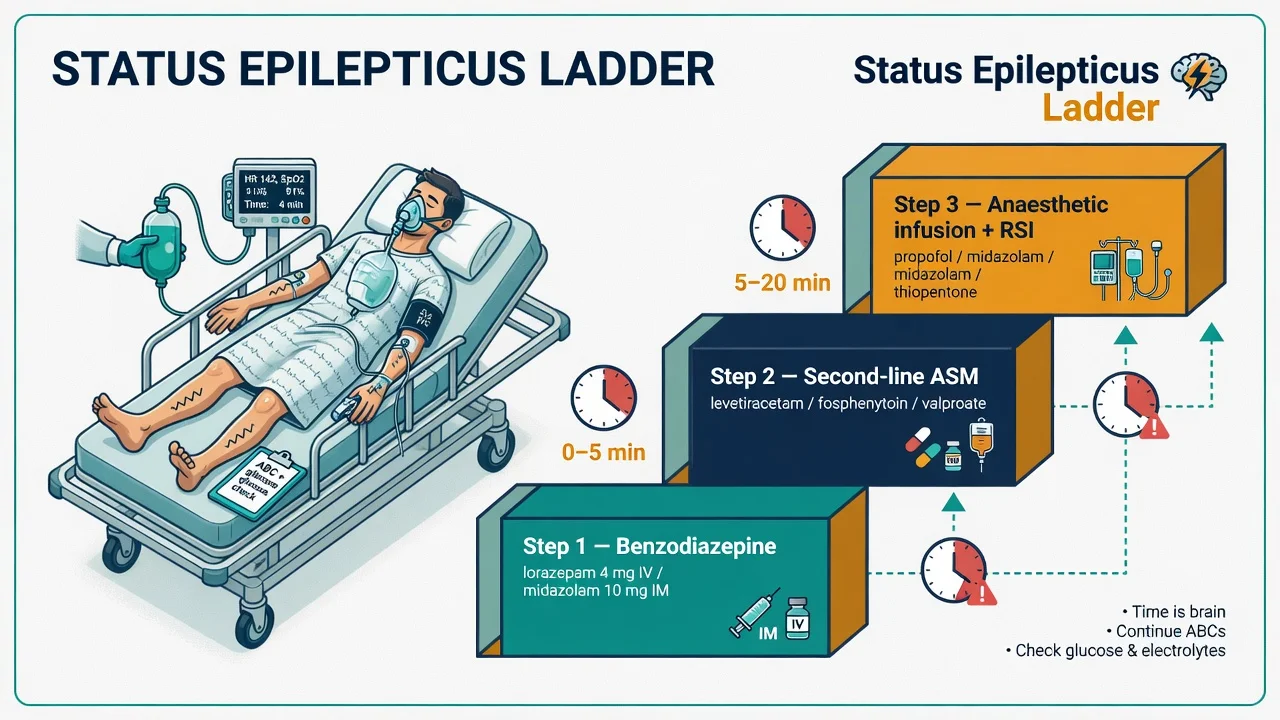
Definition and classification
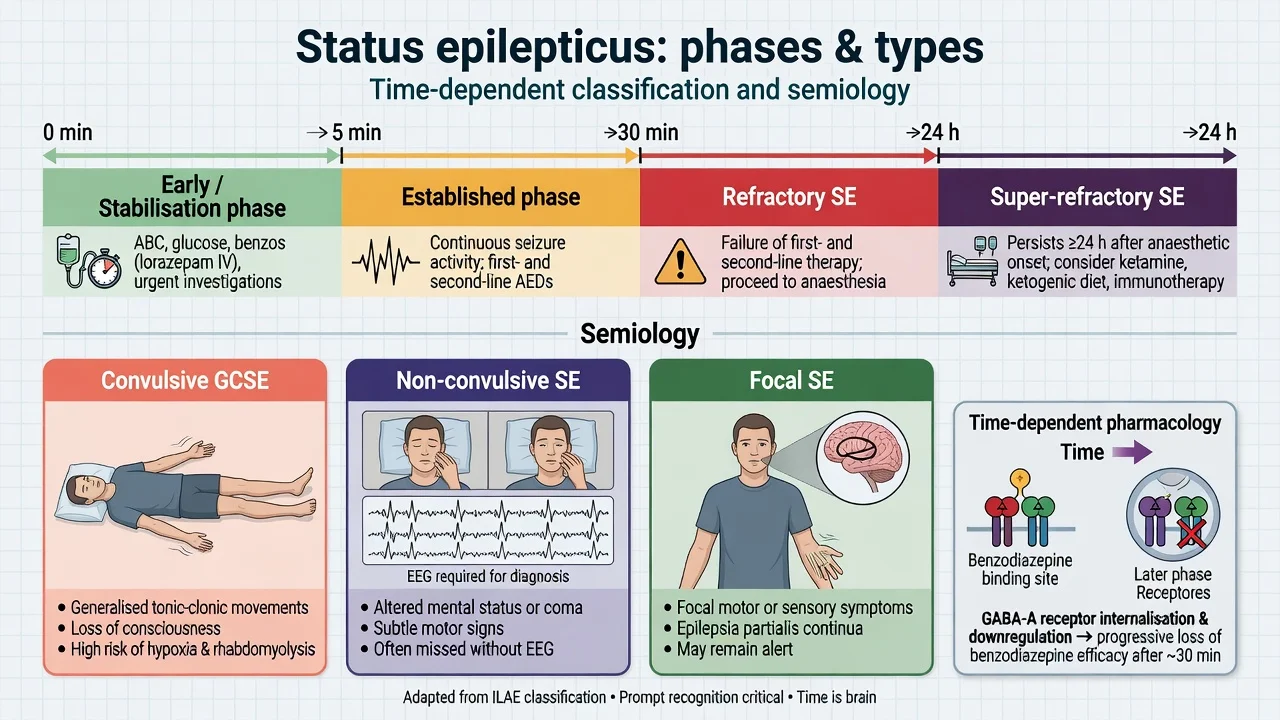
Status epilepticus is defined operationally as a continuous seizure lasting over 5 minutes, or two or more seizures without recovery of consciousness between them. This operational threshold replaced the older 30-minute definition because irreversible neuronal injury begins well before 30 minutes, and because a seizure that has not stopped at 5 minutes is unlikely to self-terminate. The International League Against Epilepsy (ILAE) distinguishes t1, the time beyond which a seizure is likely to be prolonged (about 5 minutes for the convulsive type), from t2, the time beyond which ongoing seizure activity risks long-term consequences (about 30 minutes).[3]
The condition is stratified into phases that drive the ladder: [1]
Phases of status epilepticus
It is further classified by semiology: convulsive (generalised tonic-clonic, the emergency), non-convulsive (altered awareness with subtle motor activity or none, diagnosable only by EEG), and focal (epilepsia partialis continua). The convulsive form is the one that brings the patient in by ambulance and the one that drives the clock; non-convulsive status is the diagnosis the Fellowship candidate must not miss in the post-ictal patient who fails to wake up. [1]
Epidemiology and risk
Status epilepticus carries an annual incidence of around 10 to 40 per 100,000 and a mortality of 10 to 30 per cent that rises sharply with age, aetiology and duration. Half of cases occur in people with a known epilepsy, and half present de novo. The risk is bimodal — highest in young children (febrile, infectious) and in older adults (stroke, dementia, metabolic) — and a longer duration, an acute symptomatic cause, and refractory disease each worsen the outlook. [1]
Pathophysiology — why the ladder has a clock
A seizure is sustained by excessive glutamatergic (excitatory) drive and a failure of GABAergic (inhibitory) control. As a seizure continues, the GABA-A receptors are internalised into the neuronal membrane and the NMDA and AMPA receptors are recruited to the surface, producing a state of time-dependent pharmacoresistance: benzodiazepines lose efficacy after about 10 to 15 minutes because they have fewer surface GABA-A receptors to potentiate, while NMDA-targeted and other agents become relatively more important. This is the molecular justification for the ladder — the longer the seizure runs, the harder it is to stop with the same drug.[3]
Ongoing seizure activity burns energy: the brain consumes ATP faster than it can be supplied, intracellular calcium accumulates, excitotoxic cell death follows, and the systemic stress generates lactate, hyperthermia, rhabdomyolysis and a sympathetic surge. The longer the convulsion, the greater the secondary brain injury and the systemic damage — which is why the clock, not the symptom, decides the next step. [1]
Causes
The causes cluster into four groups, summarised by the mnemonic AIMS (Acute symptomatic, Idiopathic / chronic epilepsy, Metabolic, Substance / withdrawal), and identifying the cause is as important as stopping the seizure because several are rapidly reversible.[3]
Causes of status epilepticus — AIMS
AIMS
In the patient with known epilepsy, non-adherence or a subtherapeutic antiepileptic drug level is by far the commonest cause and the easiest to fix. In the de novo adult, suspect an intracranial structural cause (stroke, haemorrhage, tumour) or alcohol withdrawal. In the febrile child, febrile or infectious. Always consider the rapidly reversible metabolic causes — hypoglycaemia above all — because giving anticonvulsants to a hypoglycaemic patient does not treat the seizure. [1]
Clinical presentation
The convulsive form is unmistakable: a prolonged or repeated generalised tonic-clonic seizure with loss of consciousness, rhythmic limb jerking, eye deviation, cyanosis, frothing at the mouth and autonomic disturbance (tachycardia, hypertension, hyperpyrexia, hypersalivation). After the convulsion, failure to regain consciousness within 20 to 30 minutes suggests ongoing non-convulsive status — subtle eyelid or facial twitching, nystagmoid eye movements, or simply a vacant unresponsive state — and warrants an urgent EEG. Focal status (epilepsia partialis continua) presents with continuous rhythmic jerking of one limb or side without loss of consciousness. [1]
Differential diagnosis
Not everything that shakes is a seizure, and the wrong diagnosis wastes the most valuable resource — time. The differentials are distinguished by the history, the examination and (when needed) the EEG. [1]
Convulsive status epilepticus
- Stereotyped tonic-clonic, loss of consciousness, post-ictal confusion
- Often incontinence, tongue bite, cyanosis
- EEG: ongoing ictal pattern
- Responds to the benzodiazepine ladder
Syncope with convulsive features
- Brief, provoked (standing, pain, fright), rapid recovery
- A few myoclonic jerks, not a sustained tonic-clonic
- No post-ictal state, normal examination
- Cardiac work-up, not anticonvulsants
Psychogenic non-epileptic seizures
- Out-of-phase, asynchronous limb movements, eyes clenched shut
- No cyanosis, preserved consciousness, resistance to eye opening
- EEG normal during the event
- Benzodiazepines ineffective and harmful — avoid the refractory ladder
Hypoglycaemia / metabolic
- Diabetic, insulin or sulfonylurea; sweaty, confused pre-event
- Low capillary glucose; may mimic any seizure
- Correct glucose — seizure stops
- Treat the cause, not the convulsion
Rigors / shivering / dystonia
- Sepsis with rigors; drug-induced dystonia
- Conscious, no post-ictal state
- No epileptiform EEG
- Treat the sepsis or the drug
Bedside assessment
Assess and stabilise in parallel, not in sequence. Airway — open the airway, position laterally (recovery position) once the cervical spine is cleared, suction secretions, and give high-flow oxygen by a non-rebreather mask. Breathing — monitor oxygen saturation and capnography; bag-valve-mask ventilate if apnoeic, and prepare for rapid sequence intubation once the second-line agent is running or the airway is lost. Circulation — IV access, blood pressure and heart rate; treat hypotension with a balanced crystalloid bolus. Disability — check the capillary glucose at once, the pupils, and the temperature, and document the Glasgow Coma Scale (GCS), reproduced here because it is examined. The GCS sums three responses: Eye opening (4 spontaneous, 3 to voice, 2 to pain, 1 none), Verbal response (5 oriented, 4 confused, 3 inappropriate words, 2 incomprehensible sounds, 1 none), and Motor response (6 obeys commands, 5 localises pain, 4 withdraws, 3 abnormal flexion, 2 abnormal extension, 1 none), for a maximum of 15 and a minimum of 3. Take blood for sodium, calcium, magnesium, renal and liver function, a beta-hCG in women, antiepileptic drug levels if known epilepsy, a toxicology screen, and a blood gas for the lactate and the pH. Establish the time of onset and any known epilepsy, adherence, recent illness or withdrawal. [1]
Investigations and the targets
Investigations run in parallel with treatment and never delay the first drug. The capillary glucose is the single most important bedside test — hypoglycaemia is rapidly reversible and lethal if missed. Bloods identify the metabolic and toxic causes (sodium, calcium, magnesium, glucose, renal and hepatic function, beta-hCG, anticonvulsant levels, a tox screen). A venous or arterial blood gas shows a lactate that is typically high during a convulsion and falls as the seizure stops — a persistently elevated lactate after cessation suggests ongoing non-convulsive status, sepsis or ischaemia. An EEG is mandatory when the patient does not wake after the convulsion stops (to exclude non-convulsive status), in refractory status to guide anaesthetic titration to burst-suppression, and whenever the diagnosis is in doubt. A non-contrast CT brain is performed once the patient is stabilised to seek a structural cause (haemorrhage, tumour, mass effect), and a lumbar puncture is reserved for suspected CNS infection or subarachnoid haemorrhage after the imaging. Do not send an unstable patient to the scanner — stabilise and treat first. [1]
Immediate management — the first five minutes (early / stabilisation)
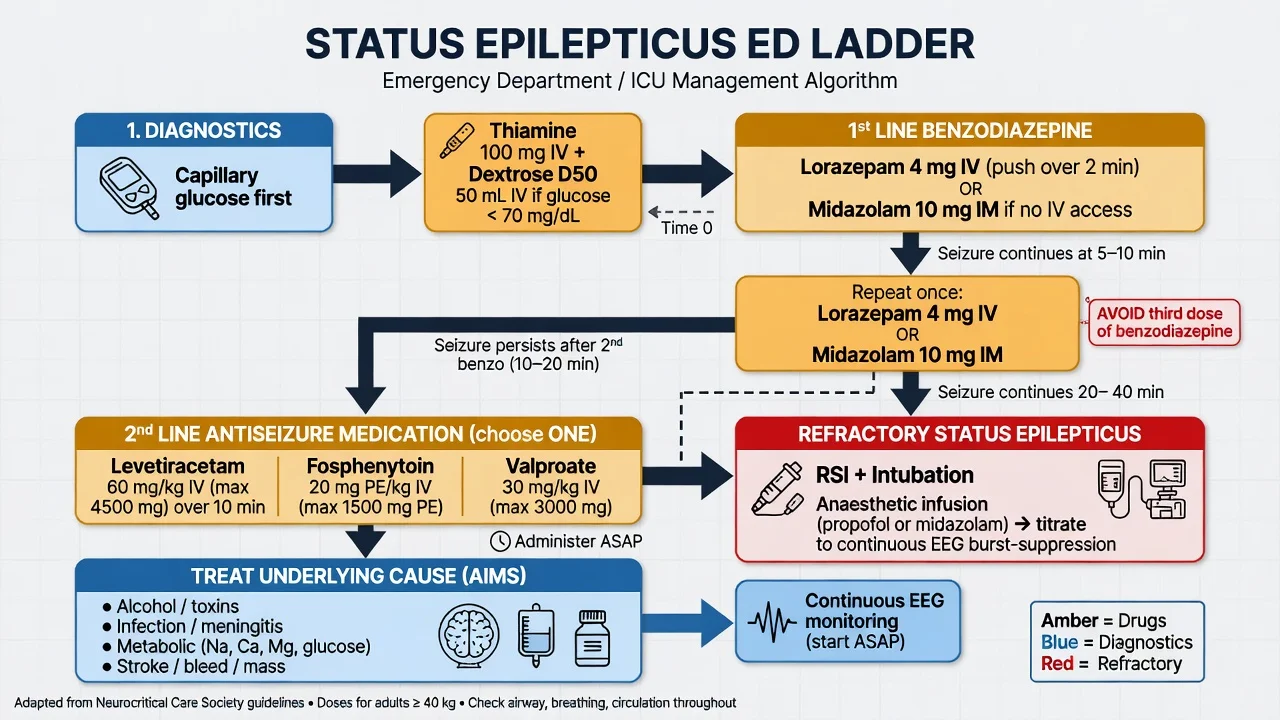
In the first five minutes the priority is airway, breathing, glucose and the clock. Place the patient in the lateral recovery position, give high-flow oxygen, suction the airway, obtain IV access and check the capillary glucose immediately. If the glucose is low (below 3 mmol/L, or clinically hypoglycaemic), give 50 mL of 50 per cent dextrose IV (or 250 mL of 10 per cent dextrose in the child, avoiding concentrated solutions in small veins), and thiamine 100 mg IV in the alcoholic or malnourished patient before or alongside the glucose to prevent Wernicke encephalopathy. Draw blood, establish the time of onset, and prepare the benzodiazepine. [1]
Definitive management — the pharmacological ladder
Treatment is escalated by the clock, not by waiting to see whether a dose has worked. The standard three-step ladder follows. [1]
The pharmacological ladder
First-line — a benzodiazepine. Give lorazepam 4 mg IV (0.1 mg/kg in the adult; 0.1 mg/kg in the child) over two minutes; lorazepam is preferred because it is less lipophilic than diazepam and redistributes less, giving a longer duration of action. Repeat the dose at 10 minutes if the seizure continues. If IV access is impossible, give midazolam 10 mg IM (5 mg in the child, or by autoinjector), which the RAMPART trial showed to be at least as effective as IV lorazepam in the prehospital setting. A second benzodiazepine dose is reasonable; a third adds respiratory depression without benefit — move on. [1]
Second-line — an anti-seizure medication. Once the second benzodiazepine dose is running, or at the 5-minute mark if IV is established and the seizure continues, give one of three agents. The ESETT trial showed they are equivalent at terminating established status, with cessation in roughly half of patients by 10 minutes after infusion.[1][2][3]
- Fosphenytoin 20 mg PE/kg IV at up to 150 mg PE/min (phenytoin-equivalent; fosphenytoin is preferred over phenytoin because it can be infused three times faster, is water-soluble so extravasation does not cause tissue necrosis, and has a lower rate of hypotension). Phenytoin 20 mg/kg IV at a maximum of 50 mg/min is the older alternative and carries the risk of purple-glove syndrome and hypotension.
- Levetiracetam 60 mg/kg IV (maximum around 4.5 g) over 10 to 15 minutes — no cardiac or respiratory depression, no interactions, increasingly the agent of choice in the elderly and the haemodynamically unstable.
- Valproate 30 mg/kg IV (maximum around 3 g) over 10 minutes — effective and sedation-sparing, but avoided in pregnancy and in women of childbearing potential because of the teratogenic risk. [1]
Refractory — anaesthetic infusion. Seizure activity persisting beyond 30 minutes despite a benzodiazepine and a second-line ASM is refractory status epilepticus and mandates rapid sequence intubation and ventilation with a continuous anaesthetic infusion titrated to burst-suppression on continuous EEG. The agents, any one of which is acceptable: [1]
- Propofol — bolus 1 to 2 mg/kg, then infusion 30 to 200 micrograms per kilogram per minute; rapid onset and offset, but watch for the propofol infusion syndrome (metabolic acidosis, rhabdomyolysis, cardiac failure) on prolonged high-dose infusion.
- Midazolam infusion — bolus 0.2 mg/kg, then 0.05 to 2 mg/kg/hour; rapid titratable, tachyphylaxis on prolonged use.
- Thiopentone — bolus 3 to 5 mg/kg, then infusion 3 to 7 mg/kg/hour; profound burst-suppression but a long half-life with accumulation, hypotension, and prolonged ICU stay, and it can itself precipitate propofol-resistant hypotension.
- Ketamine is an emerging NMDA-antagonist option for super-refractory disease, exploiting the molecular shift toward excitatory receptor dominance.[3]
The refractory patient is managed in the intensive care unit with continuous EEG, invasive cardiovascular monitoring, mechanical ventilation, careful attention to the cause (treat the infection, correct the electrolytes, withdraw the offending drug), and a planned wean of the anaesthetic against the EEG over 24 to 48 hours. [1]
[1]Refractory status — the intensive-care escalation
Seizure that has not terminated by the time the second-line agent is running is refractory, and the patient is intubated, ventilated and managed in the ICU with a continuous anaesthetic infusion titrated to burst-suppression on continuous EEG. The Fellowship candidate must know the sequence, the induction agent, the infusion choice and the pitfalls — the commonest error is intubating without preparing the anaesthetic infusion, leaving the patient paralysed and unprotected, and the second is failing to recognise ongoing non-convulsive status behind the paralysis because the EEG was never requested. [1]
Refractory SE — the ED to ICU handoff
Recognise refractory status — seizure beyond 30 minutes despite a benzodiazepine and a second-line ASM; call ICU and neurology in parallel.
Pre-oxygenase and prepare the anaesthetic infusion (propofol or midazolam drawn up) before induction — do not paralyse without a plan for ongoing sedation.
Rapid sequence intubation — induction with propofol or thiopentone (both contribute to seizure control) plus a paralysing agent; confirm tube placement with waveform capnography.
Start the anaesthetic infusion — propofol 30 to 200 mcg/kg/min or midazolam 0.05 to 2 mg/kg/hour; titrate to burst-suppression on continuous EEG.
Request continuous EEG within 1 hour of intubation — the paralysed patient can only be assessed for ongoing seizure electrically.
Search and treat the cause in parallel — glucose, electrolytes, infection screen, toxicology, CT brain, antiepileptic levels; correct the reversible before it is missed.
Plan the wean — maintain burst-suppression for 24 to 48 hours, then reduce the infusion against the EEG; recurrence triggers re-induction and a slower wean.
The four anaesthetic infusions differ in onset, offset, titratability and side-effects, and the choice is guided by the patient and the unit protocol. [1]
Propofol
- Rapid onset and offset, highly titratable
- Bolus 1 to 2 mg/kg, infusion 30 to 200 mcg/kg/min
- Risk of propofol infusion syndrome at high dose for over 48 h
- Preferred first-line anaesthetic infusion
Midazolam
- Rapid onset, titratable, familiar
- Bolus 0.2 mg/kg, infusion 0.05 to 2 mg/kg/hour
- Tachyphylaxis on prolonged use; high doses accumulate
- Useful when propofol causes hypotension
Thiopentone
- Profound burst-suppression, potent anticonvulsant
- Bolus 3 to 5 mg/kg, infusion 3 to 7 mg/kg/hour
- Long half-life, accumulation, hypotension, prolonged ICU stay
- Reserved for the most refractory cases
Ketamine
- NMDA antagonist — exploits the excitatory receptor shift
- Bolus 1 to 2 mg/kg, infusion 0.5 to 5 mg/kg/hour
- Emerging role in super-refractory disease
- Sympathomimetic; preserves blood pressure
Super-refractory status — persisting or recurring on the anaesthetic wean beyond 24 hours — is a separate entity with its own algorithm. Beyond escalating and rotating the anaesthetic infusions, the options include ketamine for the NMDA-receptor dominance, immunomodulation (intravenous immunoglobulin, methylprednisolone, plasma exchange) for the autoimmune and antibody-mediated causes (anti-NMDA-receptor, anti-LGI1, anti-GAD), the ketogenic diet, hypothermia, and the search for an occult infective, metabolic or autoimmune cause. The mortality is high and the recovery is slow, and early neurology and ICU involvement is essential.[3]
Subtypes and scenarios
Non-convulsive status epilepticus presents as altered awareness, confusion or coma with subtle or no motor activity, and is diagnosable only by EEG; it is the explanation for the patient who does not wake up after a convulsion has apparently stopped. Treat with a benzodiazepine and a second-line ASM, and arrange urgent EEG. Eclampsia in the pregnant patient with a seizure is treated with magnesium sulfate 4 g IV over 5 minutes, then 1 g/hour infusion (with a loading alternative of 10 g IM, 5 g into each buttock) — magnesium is first-line for eclampsia, not the standard ladder, and the obstetric team is involved for delivery. Paediatric status follows the same ladder with weight-based dosing; febrile status in the young child demands a search for infection including meningitis. Alcohol withdrawal seizures are typically self-limiting, but progression to status is treated with the benzodiazepine ladder at higher cumulative doses (symptom-triggered lorazepam). Toxin-related status (tricyclic antidepressant, theophylline, isoniazid, cocaine) may resist the standard ladder: treat the toxin (sodium bicarbonate for the TCA; pyridoxine / vitamin B6 for isoniazid overdose), and consider levetiracetam, which the ESETT subgroup analysis found favourable in toxin-related disease.[3]
Complications and pitfalls
The complications of untreated status are systemic and cerebral. Hypoxia from apnoea and hypoventilation is the immediate threat; aspiration of gastric contents, facilitated by the depressed consciousness and the absent gag reflex, causes a pneumonitis and a pneumonia; rhabdomyolysis from sustained muscle activity releases myoglobin and may precipitate acute kidney injury, managed with aggressive isotonic crystalloid hydration and urine alkalinisation; hyperthermia from the muscle activity worsens brain injury and is treated with active cooling; lactic acidosis is expected and usually self-corrects as the seizure stops; and cerebral oedema, hippocampal sclerosis and permanent neurological injury follow prolonged or refractory disease. The pitfalls are the inverse of the management: failing to treat the seizure as time-critical; giving repeated benzodiazepines without escalating to a second-line agent; forgetting the glucose and missing hypoglycaemia; sending an unstable patient to CT; intubating without preparing the anaesthetic infusion; and missing non-convulsive status in the patient who does not wake up. [1]
Prognosis and disposition
Mortality is 10 to 30 per cent overall, driven by the aetiology and the duration — acute symptomatic causes (stroke, hypoxia, infection) and refractory disease carry the worst outlook, while withdrawal and metabolic causes do better once corrected. The patient who terminates with the first or second drug and recovers consciousness is admitted to a monitored bed for the work-up and the ASM optimisation; the refractory patient goes to the ICU intubated and ventilated with continuous EEG. The underlying cause determines the long-term prognosis and the secondary prevention, and a recurrence is prevented by ensuring a therapeutic antiepileptic level before discharge and by counselling on adherence. [1]
Special populations
The elderly present more often with non-convulsive status and with acute symptomatic causes (stroke, dementia, metabolic), tolerate benzodiazepines poorly (respiratory depression, falls), and benefit from levetiracetam as the second-line agent. The pregnant patient with a seizure is presumed to have eclampsia until proven otherwise and is treated first with magnesium sulfate. The child is dosed by weight; febrile status demands a search for infection, and the possibility of an inherited or metabolic cause is considered. The alcoholic is at risk of withdrawal seizures, Wernicke encephalopathy and thiamine deficiency, and receives thiamine before glucose. The known-epilepsy patient with non-adherence is reloaded and counselled, and the level is checked and corrected. [1]
Evidence and regional guidelines
The contemporary evidence base is the ESETT trial (NEJM 2019) and its age-stratified secondary analysis (Lancet 2020), which established the equivalence of levetiracetam, fosphenytoin and valproate for established status epilepticus in adults and children.[1][2] The RAMPART trial established IM midazolam as effective as IV lorazepam in the prehospital setting. The American Epilepsy Society guideline codifies the three-step ladder used here, and the NICE and Scottish Intercollegiate Guidelines Network guidelines align in the United Kingdom. The Neurocritical Care Society guideline covers refractory and super-refractory management.[3]
Landmark trials
ESETT — three second-line agents compared
New England Journal of Medicine, 2019
A double-blind randomised trial of levetiracetam 60 mg/kg, fosphenytoin 20 mg PE/kg and valproate 40 mg/kg in 384 adults and children with established status epilepticus (seizure ongoing despite adequate benzodiazepine).
Key finding
Seizure cessation by 10 minutes without recurrence occurred in roughly 47 per cent (levetiracetam), 45 per cent (fosphenytoin) and 46 per cent (valproate) — no significant difference between agents.
Practice change
Established that levetiracetam, fosphenytoin and valproate are equivalent second-line agents; choose by patient factors (age, haemodynamics, pregnancy, comorbidity), not by efficacy.
ESETT age-stratified analysis
Lancet, 2020
A secondary analysis of ESETT comparing the three agents across age groups (children, adults, older adults) in the same 384 patients.
Key finding
Efficacy was similar across the three drugs within each age band; older adults responded less often overall but with no difference between agents.
Practice change
Levetiracetam is increasingly preferred in the elderly and the haemodynamically fragile; no age-based preference for fosphenytoin or valproate was found.
RAMPART — IM midazolam versus IV lorazepam
New England Journal of Medicine, 2012
A prehospital randomised trial of intramuscular midazolam 10 mg versus intravenous lorazepam 4 mg in 893 adults and children with status epilepticus.
Key finding
IM midazolam was at least as effective as IV lorazepam — seizures stopped before arrival in 73 per cent (IM) versus 63 per cent (IV), reflecting faster administration when IV access was difficult.
Practice change
IM midazolam is first-line when IV access is unavailable; it removed the delay of cannulating a seizing patient.
VA Cooperative — the first-line benzodiazepine
New England Journal of Medicine, 1998
A randomised trial comparing diazepam plus phenytoin, lorazepam alone, phenobarbital alone and placebo in 205 adults with generalised convulsive status epilepticus.
Key finding
Lorazepam alone and the diazepam-phenytoin combination were superior to placebo; phenobarbital was also effective.
Practice change
Codified lorazepam as the preferred first-line IV benzodiazepine and the role of an additional ASM after a benzodiazepine.
Regional practice
ANZ practice note. The ladder follows the American Epilepsy Society and Neurocritical Care Society framework via the local neurology and intensive-care protocols. Lorazepam 4 mg IV is first-line; where IV access is unavailable, midazolam 10 mg IM is the standard prehospital and ED alternative. Second-line is a clinician choice between fosphenytoin 20 mg PE/kg, levetiracetam 60 mg/kg and valproate 30 mg/kg, with levetiracetam increasingly favoured in the elderly and the haemodynamically fragile. Refractory status triggers rapid sequence intubation and a propofol or midazolam infusion titrated to burst-suppression, with neurology and ICU involvement early. Eclampsia in any pregnant seizure patient is treated first with magnesium sulfate. [1]
Exam practice
SAQ — Generalised convulsive status epilepticus: the treatment ladder
12 minutes · 10 marks
A 52-year-old man is brought to the emergency department by ambulance having a generalised tonic-clonic seizure that began 12 minutes before arrival. He has a history of epilepsy but ran out of his levetiracetam one week ago. He has intravenous access. BP 168/96, HR 124, SpO2 96 per cent on high-flow oxygen, capillary glucose 6.2 mmol/L.
SAQ — Refractory status epilepticus and the special situations
10 minutes · 10 marks
A 34-year-old woman who is 32 weeks pregnant is brought in having a generalised tonic-clonic seizure that has lasted 18 minutes despite two doses of IV lorazepam (4 mg each) in the prehospital setting. Her BP is 164/108, proteinuria 3+ on dipstick, and she has facial and hand oedema. Capillary glucose 5.8 mmol/L.
Exam pearls
- Definition: a seizure over 5 minutes, or recurrent seizures without recovery of consciousness. The 5-minute threshold is operational and drives the first drug.
- Phases: early 0–5 min, established 5–30 min, refractory over 30 min, super-refractory over 24 h.
- First-line: lorazepam 4 mg IV, repeat at 10 min; midazolam 10 mg IM if no IV.
- Second-line (ESETT): fosphenytoin 20 mg PE/kg, levetiracetam 60 mg/kg, or valproate 30 mg/kg — all equivalent.
- Refractory: intubate, ventilate, anaesthetic infusion (propofol / midazolam / thiopentone) to burst-suppression on EEG.
- Always check glucose — hypoglycaemia is rapidly reversible and lethal if missed.
- AIMS for the causes: Acute symptomatic, Idiopathic/known epilepsy, Metabolic, Substance/withdrawal.
- Eclampsia is treated with magnesium sulfate first, not the standard ladder.
- Non-convulsive status is the diagnosis in the patient who does not wake — get the EEG. [1]
High-yield clinical pearls
[1] [1] [1] [1] [1] [1] [1] [1] [1] [1] [1] [1] [1] [1] [1] [1]Red flags
[1]References
- [1]Kapur J, Elm J, Chamberlain JM, et al. Randomized Trial of Three Anticonvulsant Medications for Status Epilepticus N Engl J Med, 2019.PMID 31774955
- [2]Chamberlain JM, Okada P, Holsti M, et al. Efficacy of levetiracetam, fosphenytoin, and valproate for established status epilepticus by age group (ESETT): a double-blind, responsive-adaptive, randomised controlled trial Lancet, 2020.PMID 32203691
- [3]Vossler DG, Modur P. First Seizures, Acute Repetitive Seizures, and Status Epilepticus Continuum (Minneap Minn), 2025.PMID 39899098