Paeds · growth-development-and-behaviour
Neurodiversity-affirming developmental care
Also known as Neurodiversity affirming care · Neurodiversity paradigm paediatric care · Strengths-based developmental care · Anti-ableist paediatric developmental practice · Person-environment fit developmental disability
A fellowship approach to neurodiversity-affirming developmental care: person-environment fit, double empathy, language preference, anti-ableism, camouflaging and burnout recognition, clinic and hospital adjustments, co-occurring medical care, and closed-loop school supports without abandoning diagnosis or safety.
On this page & tools
Your progress
Saved locally on this device.
Practise this topic
Target exams
Red flags
Life stages
Care settings
Clinical exam formats
Board mappings
Overview & Definition
A 10-year-old sits in your clinic with noise-cancelling headphones. Mum says the school wants a letter for “better behaviour.” The child says, “I am autistic. Please do not make me look people in the eye.” Your job is not to pick a culture war. Your job is neurodiversity-affirming developmental care: partner with this child and family, reduce remediable environmental harm, open real supports, and still practise safe medicine. [1] [2] [12]
Neurodiversity names natural variation in human neurocognitive functioning. Neurodivergence names people whose cognition, sensory processing or communication sits outside the statistical majority — commonly autistic, ADHD, learning-different or intellectually disabled profiles, often with overlap. The neurodiversity paradigm treats that variation as part of human diversity while still recognising disability when environments and support systems fail. It is not a claim that biology is irrelevant. [1] [2]
Neurodiversity-affirming developmental care is the paediatric practice of: [1] [6]
- Respecting identity and preferred language.
- Designing person–environment fit rather than forcing a child to pass as typical.
- Teaching skills that the child and family actually want.
- Treating co-occurring medical and mental-health needs without diagnostic overshadowing.
- Coordinating school, community and hospital systems with closed loops. [1] [6] [16]
This leaf owns the professional-practice framework. Condition-specific diagnosis and drug pathways live on linked autism, ADHD, early-intervention and school-disability pages. Cross-link them. Do not hide a second autism chapter here. [12] [13]
First five minutes of an affirming encounter
Safety first
Unwell, regressing, suicidal or unsafe? Convert to acute pathway.
Ask how to talk
Name, pronouns, identity-first vs person-first preference, AAC method.
Reduce load
Lights, noise, wait strategy, one question at a time.
Map the mismatch
What works at home? What fails at school or hospital?
Plan with both voices
Child goals plus caregiver goals; write owners and dates.
Classification
You need three working categories in your head before you open a behaviour form. [1] [2]
Three care postures
| Posture | What it optimises | Classic error | Fellowship use |
|---|---|---|---|
| Pure deficit remediation | Make the child look typical | Compliance goals erase identity; camouflage rewarded | Skills only when they reduce harm or open participation |
| Neurodiversity-affirming care | Person–environment fit + support needs + medical safety | Token language change without adjustments | Default paediatric posture on this page |
| Anti-diagnostic neglect | Avoid labels and services | Misses epilepsy, ADHD treatment, funding, safeguarding | Never the answer in a viva |
Core constructs to classify at the bedside
Person–environment fit. Ask whether the room, timetable, sensory load and communication method match the child. Many “behaviour plans” fail because the environment is the problem. [1] [3]
Double empathy problem. Misunderstanding between autistic and non-autistic people is often mutual, not a one-way social deficit in the autistic child. That changes how you interpret “poor social skills” and how you coach staff. [3]
Language preference. Many autistic adults prefer identity-first language (“autistic child”). Some families prefer person-first (“child with autism”). Preferences vary; ask and document. Do not scold a family for either form. [9]
Ableism in systems. Ableism is the assumption that typical bodies and minds are the default standard of value. In paediatrics it shows up as forced eye contact, punishment of stimming that harms nobody, inaccessible clinics, and research that talks about autistic people without them. Anti-ableism and scientific accuracy are not opposites. [7] [8]
Diagnostic overshadowing. Every new symptom is blamed on “the autism” or “the ADHD,” so treatable disease is missed. Classify this as a system failure, not a personality trait of the child. [12] [14]
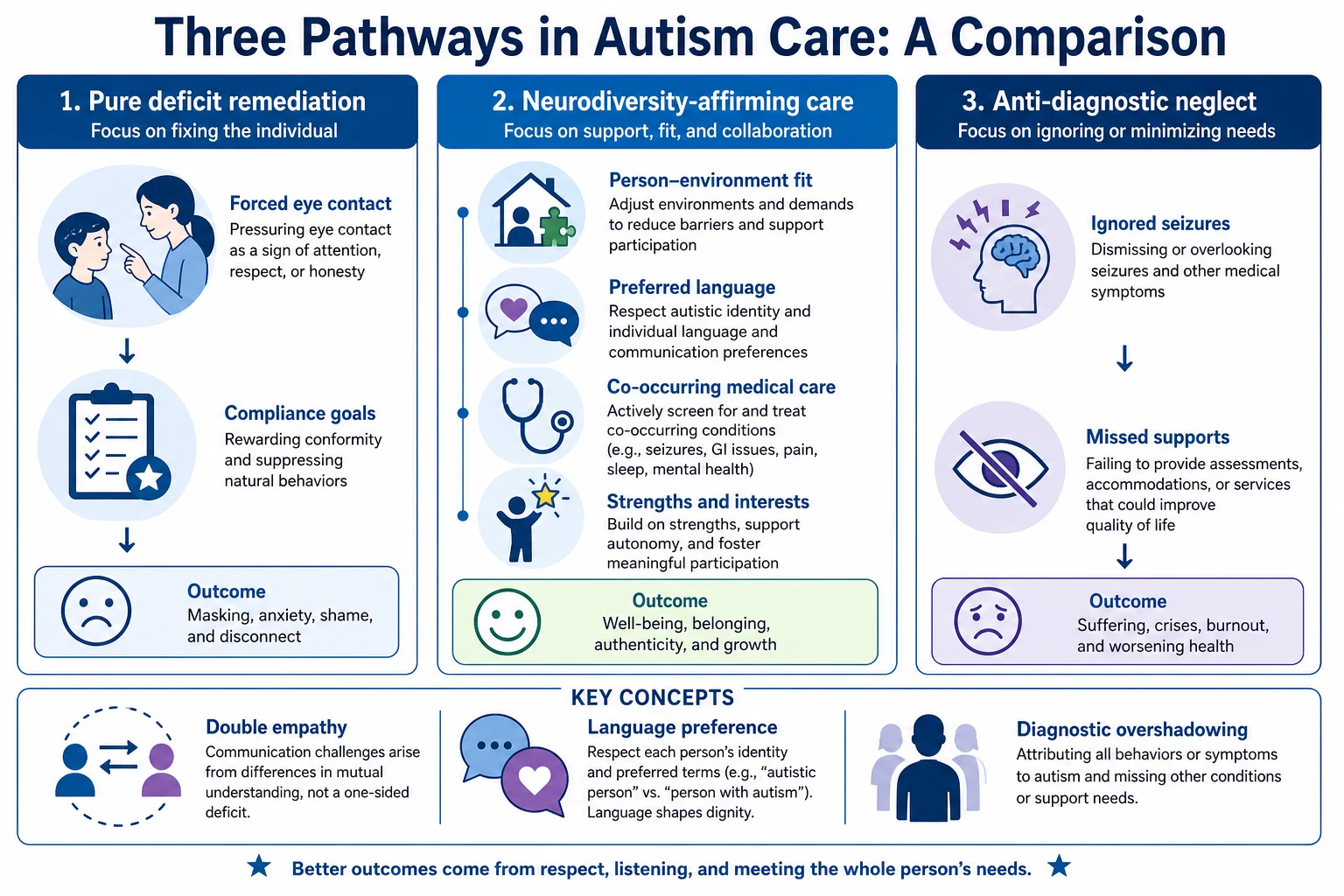
Read the figure like this: the middle path is the exam answer. Left path without ethics fails. Right path without medicine fails. [1] [2]
Who is “in scope”?
Autistic children and young people; ADHD; learning disorders; intellectual disability; dual diagnosis; and undiagnosed children whose sensory or communication profile already needs adjustments. Affirming practice starts when the mismatch is clear, not only after a formal label. [12] [13] [17]
Epidemiology & Risk Factors
Neurodivergence is common enough that affirming systems are mainstream paediatrics, not a boutique interest. Autism and ADHD pathways now sit inside routine medical-home work, school health and hospital care. Late recognition remains patterned: girls and gender-diverse young people, intellectually able camouflagers, and children outside stereotype phenotypes wait longer. [4] [10] [12] [18]
Risk of non-affirming harm rises when: [8] [11]
- clinics are loud, bright and time-pressured;
- staff reward camouflage as “good behaviour”;
- families face poverty, transport barriers or language discordance;
- racism or cultural stereotyping shapes who is “difficult” versus “disabled”;
- research and services exclude autistic and ADHD voices. [8] [11] [19] [20]
Mental-health comorbidity clusters with stigma and camouflaging cost. Autistic burnout is not laziness; it is described by autistic adults as chronic exhaustion, reduced function and increased sensory sensitivity after sustained overload. Adolescents in high-demand schools are a high-yield group. [5] [4]
Out-of-home care and placement moves destroy communication profiles. Rural and telehealth settings can either improve access or strip sensory control if poorly designed. [16]
Pathophysiology
Why does a clinic script that “just expects typical social behaviour” injure some children? Three linked mechanisms matter for viva answers. [1] [3]
1. Person–environment mismatch
Sensory channels, prediction needs and communication style differ. Unpredictable waiting rooms, fluorescent glare, forced conversation and multi-step verbal instructions raise physiological arousal. The child then flees, freezes, stims harder or appears “defiant.” The mechanism is load, not original sin. [1] [3]
2. Camouflaging cost
Camouflaging (masking) means suppressing autistic traits or performing non-autistic social scripts to fit in. Systematic review work shows it is common, multi-component and linked to mental-health burden. Gender analyses find higher self-reported camouflaging in autistic women and girls in several samples. Stigma is one driver: camouflage can be a response to devalued identity, not a free lifestyle choice. [4] [10] [11]
3. Burnout and overshadowing
When internal resources stay exhausted, autistic burnout features chronic exhaustion, reduced function and intensified sensory sensitivity. Parallel system failure — diagnostic overshadowing — means staff attribute pain, seizure, constipation or abuse to “behaviour.” Both pathways convert remediable problems into chronic disability. Toxic stress from adversity and ableism can stack on top. [5] [12] [19]
Poorly designed interventions that prioritise compliance over communication can worsen anxiety and self-advocacy silence. That is why outcome choice in early intervention research is contested and why Project AIM updates urge careful interpretation of effect sizes and target domains. [6] [15]
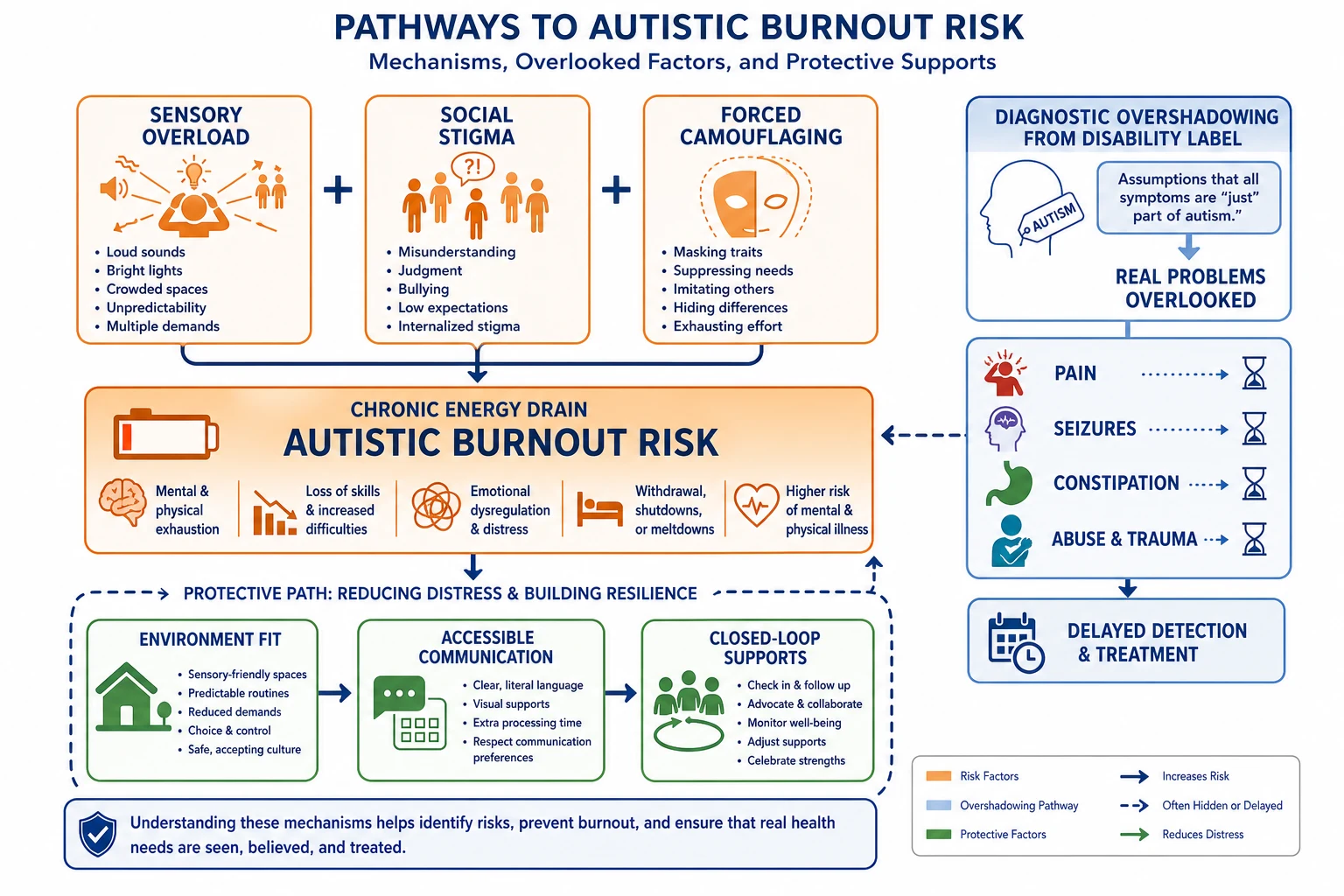
Read the figure like this: if your plan only teaches the child to hide, you may improve the room’s comfort and worsen the child’s health. [4] [5]
Clinical Presentation
Affirming-care presentations are often administrative on the surface and clinical underneath. [12] [16]
Common entry tickets
- “School wants a behaviour letter.”
- “He melts down after school every day.”
- “She is exhausted from pretending to be normal.”
- “Please use identity-first language.”
- “Hospital blood tests always end in restraint.”
- “New foster placement — nobody knows her AAC.” [1]
What you see
In clinic: headphones, pacing, scripting, reduced eye contact, delayed answers, shutdown after small talk, or a “perfectly behaved” child who later collapses at home. [4]
In ED: sensory meltdown mislabelled as aggression; pain ignored because the child is non-speaking; parents advocating for a quiet bay. [12]
In adolescence: school refusal, identity distress, anxiety, depression, burnout features, or conflict over whether to disclose diagnosis. Girls may present late after years of camouflage. [5] [10]
In families after harmful care: distrust, refusal of all therapy, or the opposite — requests for intensive “normalisation” programmes. Both need careful listening, not slogans. [6] [8]
Red-flag presentations that exit routine affirming counselling
Regression with loss of skills, encephalopathy, new seizures, severe self-injury, suicidal ideation, unexplained injury, or medical instability. Convert. Affirming language does not delay ABCDE. [12] [18]
Differential Diagnosis
Hold two truths: environment can create “behaviour,” and medical disease can hide under a disability label. [12] [14]
Other forks examiners love: [1] [14]
- Family advocacy for rights versus avoidance of indicated evaluation.
- Strengths-based framing versus minimisation of real support needs.
- Late autism/ADHD recognition versus trauma-only formulation — both can be true.
- Pure medical model missing environment versus pure social model missing epilepsy. [1] [6] [14]
Clinical & Bedside Assessment
Open the encounter
Use the child’s preferred name. Ask language preference. Ask how they communicate best — speech, typing, AAC, writing, caregiver interpretation with the child’s assent. Reduce sensory load before you take a long history. One question at a time. Offer movement breaks. [3] [9]
History that scores marks
- Strengths, interests and what already works.
- Support needs at home, school and community.
- Sensory profile: seek, avoid, overload triggers.
- Camouflaging cost: who can the child “be themselves” with?
- Sleep, gut, seizures, pain, self-injury, mood, bullying.
- Prior interventions: goals, hours, harm, benefit.
- Family goals and the child’s goals — list both. [4] [5] [6] [12]
Examination without force
Explain each step. Offer choices of order. Avoid surprising touch. Do not demand eye contact as a cooperation test. For procedures, plan comfort, distraction, topical anaesthesia and, when needed, specialist behavioural support — least restrictive first. Document baseline communication and personal signs of pain or distress. [12] [16]
Synthesis
Write a problem representation that includes neurotype, environment mismatch, co-occurring medical issues and risk. Example: “Autistic school-age child with high sensory sensitivity, school noise mismatch, chronic constipation, and after-school meltdowns; no regression; safe at home.” That sentence drives the plan. [12] [16]
Investigations
Neurodivergence itself is not a blood test. Investigations follow co-occurring risk and differential diagnosis. [12]
Usually early when indicated by history or screen pathway: hearing and vision when communication is at issue; sleep history (and sleep study when indicated); developmental evaluation per surveillance/screening pathways. [17] [18]
Medical workup as for any child: targeted labs, EEG, imaging or genetics when red flags or specific syndromes are in play — not as a ritual after every meltdown. Hyman’s AAP autism clinical report remains a practical anchor for medical evaluation and co-occurring care in autistic children. [12]
Functional and environmental data count as investigations: school observation summaries, OT sensory profiles, psychology formulations, AAC trials, and a clinic environment audit. They often change management more than another blood panel. [1] [16]
Mental-health screening matters in camouflaging adolescents and in burnout presentations. Use accessible formats; do not rely on eye contact or rapid verbal interviews alone. [5] [4]
Avoid low-value repetition when prior notes are missing — retrieve records first. Adjust how tests are delivered (quiet room, visual schedule, longer slots). [16]
Management — Resuscitation
“Resuscitation” on this leaf means stop preventable harm now. [12]
- ABCDE and medical emergency first. Disability never explains fever with shock, status epilepticus, serious head injury or anaphylaxis.
- Sensory crisis: move to a quieter space, reduce people and noise, offer known calming tools, keep safety for self-injury, avoid punitive first responses.
- Suicidality or severe burnout collapse: urgent mental-health pathway, safety planning, remove access to means as appropriate, do not minimise as “autistic behaviour.”
- Safeguarding concern: standard child-protection process. Affirming care does not mean uncritical acceptance of every caregiver narrative.
- Transfer package: baseline communication, AAC, triggers, successful supports, usual meds, hospital passport. [5] [12] [16]
Management — Definitive & Stepwise
Build a written affirming care plan with owners and review dates. [6] [16]
Step 1 — Shared goals
Ask the child what would make life better. Ask the family the same. Common high-value goals: functional communication, sleep, toilet participation, safe school attendance, reduced meltdowns, friendships on their terms, less bullying, accessible healthcare. Leadbitter’s self-advocacy framing pushes early intervention research and practice toward autistic priorities, not only adult comfort. [6] [14]
Step 2 — Environment before compliance theatre
Clinic and hospital adjustments: longer appointments, reduced waiting in noisy areas, visual schedules, written instructions, dimmer lighting where safe, one clinician speaking at a time, procedure planning. School adjustments: seating, noise, movement breaks, exam access arrangements, clear instructions, safe space, anti-bullying action. Home supports: sleep routine scaffolding, predictable transitions, caregiver coaching that is respectful. [1] [16]
Step 3 — Skills and therapies with ethical goals
Therapies can be affirming when they teach requested skills, expand communication, reduce distress and increase participation. They become non-affirming when the only success metric is looking non-autistic. Review goals every cycle. Project AIM updates show that early autism intervention evidence must be read with attention to outcome type and study quality — do not oversell. Naturalistic developmental behavioural approaches appear in that evidence ecosystem; still judge any programme by the child’s lived goals. [15] [6] [12]
Step 4 — Co-occurring medical and mental-health care
Treat ADHD when criteria and impairment are met, using guideline-directed multimodal care on the ADHD pathway. Address anxiety, depression, sleep disorders, epilepsy, constipation, dental pain and nutritional issues as standard paediatrics. Do not withhold indicated treatment because a family uses neurodiversity language — and do not force medication as a behaviour shortcut without assessment. [13] [12]
Step 5 — Coordination and closed loops
Write to school and allied health with concrete adjustments, not vague “please support.” Name the owner, the review date and the escalation path. Medical-home care coordination frameworks exist for a reason. [16]
Step 6 — Safety-net and review
Teach when to return: regression, new seizures, self-injury escalation, suicidal thoughts, school exclusion crisis, procedure trauma. Review plans at developmental transitions: school entry, secondary school, adolescence, adult services. [14] [16]
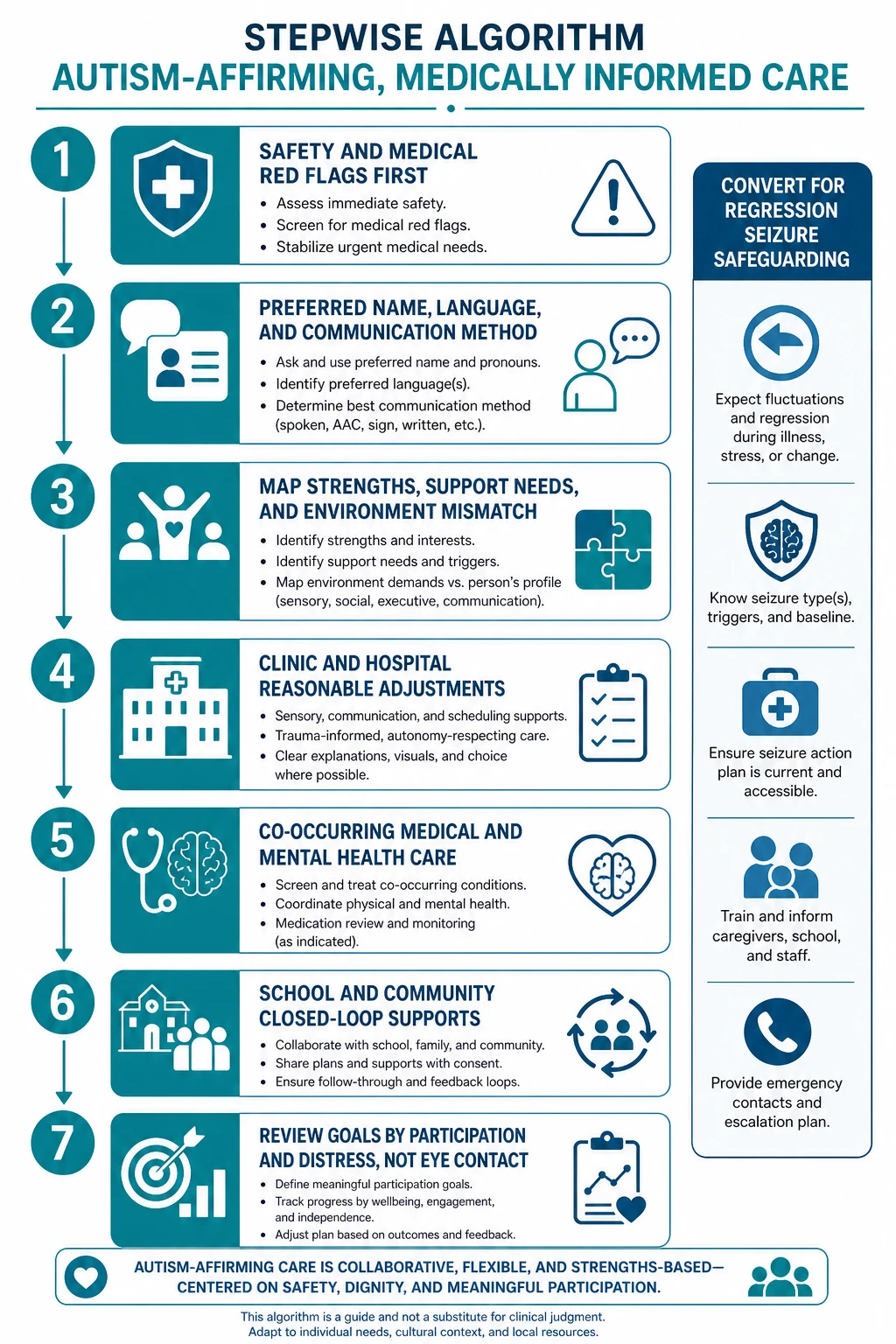
Read the figure like this: if step 2 (how to talk) is skipped, every later letter will be slightly wrong. [9] [16]
Specific Subtypes & Scenarios
Autistic preschooler after new diagnosis
Lead with what the child already does well. Explain autism in plain language without catastrophe scripts. Start early supports that expand communication and participation. Offer peer-support pathways for parents. Keep medical evaluation for co-occurring conditions. [12] [6] [18]
ADHD school-age classroom mismatch
Map executive demands of the classroom against the child’s working memory and attention profile. Combine environmental redesign, behavioural supports and, when indicated, medication per ADHD guidance. Strengths in creativity or energy are real data, not consolation prizes. [13]
Camouflaging adolescent
Look past high marks and “polite clinic behaviour.” Ask about after-school collapse, identity, friendships and exhaustion. Screen mental health. Reduce camouflage demand where possible; do not celebrate masking as the treatment goal. [4] [5] [10]
Intellectual disability and AAC users
Affirming care means communication access, presumed competence for preference, and high vigilance for pain and abuse. Dual diagnosis (mental health plus intellectual disability) needs specialist partnership, not diagnostic overshadowing. [12] [14]
ED sensory meltdown
Quiet bay, fewer staff, known calming tools, medical triage for pain and injury, avoid framing the child as violent by default. Document what worked for the next team. [16]
Family only wants a “cure” narrative
Stay curious. Explain that skills and medical care matter, and that dignity and environment fit also matter. Offer both service access and affirming framing. Do not mock parental grief. [2] [6]
Family rejects all assessment
Explore harm history. Offer low-threat starting points: sleep, hearing, school adjustments, safety. Document capacity and safeguarding considerations if a child is endangered by refusal. [12]
Cultural and Indigenous contexts
Do not assume Western advocacy language is universal. Ask what words the family uses. Practise cultural safety without stereotyping. Interpreter access is non-negotiable when language discordance exists. [20] [16]
Transition-age young person
Shift toward the young person’s consent and goals. Plan adult service handovers, healthcare self-advocacy and employment or education adjustments. Burnout risk can rise when scaffolding is suddenly removed. [14] [5]
Complications & Pitfalls
- Tokenism: changing “with autism” to “autistic” while keeping inaccessible clinics.
- Forced normalisation goals: eye contact quotas, still hands, suppression of harmless stimming.
- Camouflage-as-success: school praises the child who is burning out.
- Diagnostic overshadowing: missed appendicitis, dental abscess, constipation, seizure, abuse.
- Open-loop letters: no owner, no date, no follow-up.
- Restraint first: skipping least-restrictive sensory and communication strategies.
- Anti-diagnosis ideology: blocking indicated evaluation and treatment.
- Ignoring ADHD, anxiety, sleep and epilepsy because the visit was labelled “neurodiversity counselling.”
- Research and service exclusion of neurodivergent voices that then poisons local protocols.
- Cultural stereotyping of who “deserves” affirming care. [4] [5] [7] [8] [12]
Prognosis & Disposition
Prognosis talk should name participation, mental health, communication access, safety and autonomy — not only IQ or “severity labels.” Early identification and support can change trajectories; they do not erase neurotype. The Lancet Commission emphasises improving lives of autistic people across the life course and reforming care systems, not promising cure as the only good outcome. [14] [18]
Safe community disposition after crisis requires a crisis plan, environment changes, follow-up owner and mental-health access when needed. Follow-up cadence tightens after new diagnosis, school exclusion risk, medication starts (on condition pages), burnout and transition points. [16] [13]
Document strengths in the same letter that documents support needs. Families reread these letters for years. [6]
Special Populations
Girls and gender-diverse young people: higher camouflage burden in many samples; later recognition; mental-health cost. [10] [4]
Minimally speaking children: AAC access is urgent care, not optional enrichment. [12]
Intellectual disability: high overshadowing risk; pain and abuse vigilance; dual diagnosis pathways. [12] [14]
Indigenous families: culturally safe partnership; local supports; no stereotype of either “stoicism” or “non-compliance.” [20]
Migrant and language-discordant families: professional interpreters; translated materials; do not use children as interpreters for identity-laden counselling. [16]
Out-of-home care and youth justice: rebuild communication profiles; high trauma prevalence; continuity of medical home. [16] [19]
Rural and telehealth: pre-send visual schedules; reduce sensory surprises on arrival; use video when travel destroys regulation. [16]
Complex chronic disease plus neurodivergence: separate new symptoms from baseline; written care plans that both teams can use. [12] [16]
Socioeconomic disadvantage: adjustments that cost nothing (wait strategy, written plans) still matter; help navigate funded supports without gatekeeping dignity. [16] [19]
Evidence, Guidelines & Regional Differences
Landmark frames
Pellicano describes a shift from “normal science” that centres non-autistic norms toward neurodiversity-informed autism science. den Houting offers an insider perspective that clinicians can quote without caricature. Milton’s double empathy problem reframes social disability as relational. Cook’s systematic review and Hull’s gender analyses make camouflaging examinable. Raymaker’s autistic burnout work gives language for exhaustion syndromes autistic people already recognised. Leadbitter connects self-advocacy to early intervention ethics. Bottema-Beutel and Botha challenge ableist research culture without discarding rigorous evidence. Schuck’s systematic review supports asking about identity-first versus person-first preference rather than imposing one form. [1] [2] [3] [4] [5] [6] [7] [8] [9] [10]
Clinical anchors
Hyman’s AAP autism clinical report and Zwaigenbaum’s early identification recommendations still guide medical evaluation and early detection. Wolraich’s AAP ADHD guideline anchors multimodal ADHD care. Lipkin’s surveillance/screening report keeps identification programmes honest. Lord’s Lancet Commission sets a life-course care and research agenda. Sandbank’s Project AIM update is the cautionary evidence read for early intervention claims. Fletcher-Watson’s inclusive research principles help when local services co-design with families. [12] [13] [17] [18] [14] [15] [20]
Regional practice (name the jurisdiction)
In Australia and Aotearoa New Zealand, affirming care meets NDIS/early childhood supports, education reasonable adjustments and local child development services. Use local toolkits and funding rules; do not invent hour entitlements. Cultural safety for Māori, Aboriginal and Torres Strait Islander families is part of affirming practice, not an add-on. [16]
Controversies to handle cleanly
ABA intensity and goals; whether identity-first language should be mandated; how far social-model framing can go without medical neglect; evidence gaps for “affirming intervention” trial packages; and who sets outcomes in research. Your viva answer: transparent goals, child/family priorities, outcome humility, no cruelty, no abandonment of medicine. [6] [7] [15] [14]
Exam Pearls
- Affirming care = fit + supports + medical vigilance.
- Double empathy is mutual, not one-way deficit. [3]
- Camouflage can look like success and still predict burnout. [4] [5]
- Ask language preference; many autistic adults prefer identity-first. [9]
- Measure progress by participation and distress, not eye contact. [6]
- Diagnostic overshadowing is a never-event mindset. [12]
- Hospital passport / communication profile scores marks. [16]
- Least restrictive sensory-informed crisis care before punitive restraint narratives.
- Early intervention goals need autistic/family priorities. [6]
- Cross-link condition leaves; this page owns the practice framework.
AFFIRM
References
- [1]Pellicano E Annual Research Review: Shifting from 'normal science' to neurodiversity in autism science J Child Psychol Psychiatry, 2022.PMID 34730840
- [2]den Houting J Neurodiversity: An insider's perspective Autism, 2019.PMID 30556743
- [3]Milton D The 'double empathy problem': Ten years on Autism, 2022.PMID 36263746
- [4]Cook J Camouflaging in autism: A systematic review Clin Psychol Rev, 2021.PMID 34563942
- [5]Raymaker DM Having All of Your Internal Resources Exhausted Beyond Measure and Being Left with No Clean-Up Crew: Defining Autistic Burnout Autism Adulthood, 2020.PMID 32851204
- [6]Leadbitter K Autistic Self-Advocacy and the Neurodiversity Movement: Implications for Autism Early Intervention Research and Practice Front Psychol, 2021.PMID 33912110
- [7]Bottema-Beutel K Anti-ableism and scientific accuracy in autism research: a false dichotomy Front Psychiatry, 2023.PMID 37743979
- [8]Botha M Autism research is in crisis: A mixed method study of researcher's constructions of autistic people and autism research Front Psychol, 2022.PMID 36506950
- [9]Schuck RK Preferences for Identity-First and Person-First Language: A Systematic Review of Research With Autistic Adults/Adults With Autism J Autism Dev Disord, 2025.PMID 41389164
- [10]Hull L Gender differences in self-reported camouflaging in autistic and non-autistic adults Autism, 2020.PMID 31319684
- [11]Perry E Understanding Camouflaging as a Response to Autism-Related Stigma: A Social Identity Theory Approach J Autism Dev Disord, 2022.PMID 33788076
- [12]Hyman SL Identification, Evaluation, and Management of Children With Autism Spectrum Disorder Pediatrics, 2020.PMID 31843864
- [13]Wolraich ML Clinical Practice Guideline for the Diagnosis, Evaluation, and Treatment of Attention-Deficit/Hyperactivity Disorder in Children and Adolescents Pediatrics, 2019.PMID 31570648
- [14]Lord C The Lancet Commission on the future of care and clinical research in autism Lancet, 2022.PMID 34883054
- [15]Sandbank M Autism intervention meta-analysis of early childhood studies (Project AIM): updated systematic review and secondary analysis BMJ, 2023.PMID 37963634
- [16]Council on Children with Disabilities and Medical Home Implementation Project Advisory Committee Patient- and family-centered care coordination: a framework for integrating care for children and youth across multiple systems Pediatrics, 2014.PMID 24777209
- [17]Lipkin PH Promoting Optimal Development: Identifying Infants and Young Children With Developmental Disorders Through Developmental Surveillance and Screening Pediatrics, 2020.PMID 31843861
- [18]Zwaigenbaum L Early Identification of Autism Spectrum Disorder: Recommendations for Practice and Research Pediatrics, 2015.PMID 26430168
- [19]Garner AS Early childhood adversity, toxic stress, and the role of the pediatrician: translating developmental science into lifelong health Pediatrics, 2012.PMID 22201148
- [20]Fletcher-Watson S Applied Principles for Inclusive Practice in Neurodevelopmental Research: A Selection and Report of Illustrative Case Studies Curr Dev Disord Rep, 2024.PMID 39974555