EM · Diabetic emergencies
DKA, HHS and hypoglycaemia
Also known as Diabetic ketoacidosis · Hyperosmolar hyperglycaemic state · Severe hypoglycaemia · Diabetic emergencies
The three diabetic emergencies — diabetic ketoacidosis (the ketosis, the metabolic acidosis and the hyperglycaemia), hyperosmolar hyperglycaemic state (the severe hyperglycaemia, the marked hyperosmolality, minimal ketosis) and severe hypoglycaemia (glucose below 3 mmol/L). The Fellowship-critical doses and rationale: the fixed-rate insulin infusion 0.1 units/kg/h for DKA, the fluid-first 0.9% saline 1 L over the first hour, the glucose switch at 14 mmol/L, the potassium 40 mmol/L per bag once under 5.5 mmol/L; the lower HHS insulin 0.05 units/kg/h with fluid as the primary therapy; and the hypoglycaemia rescue (glucose 25 g IV, glucagon 1 mg IM). ACEM-primary, globally tagged.
On this page & tools
Your progress
Saved locally on this device.
8 MCQs with explanations
Target exams
Red flags
The diabetic emergencies divide by the direction of the glucose and the presence of ketones. Diabetic ketoacidosis (DKA) is absolute insulin deficiency producing the triad of ketosis, metabolic acidosis and hyperglycaemia. Hyperosmolar hyperglycaemic state (HHS) is severe relative insulin deficiency producing marked hyperglycaemia and hyperosmolality with minimal ketosis, typically in the older type-2 patient. Severe hypoglycaemia is glucose below 3 mmol/L — the iatrogenic mirror image, where insulin or a sulfonylurea has outstripped intake. The Fellowship candidate must distinguish the three at the bedside within minutes (the glucose, the ketones, the venous gas), then run the correct protocol with the right drugs at the right doses: the fixed-rate insulin infusion at 0.1 units per kilogram per hour for DKA, the lower 0.05 units per kilogram per hour and fluid-first approach for HHS, and glucose or glucagon for the hypoglycaemic patient.[1][2][3]
Definition and classification
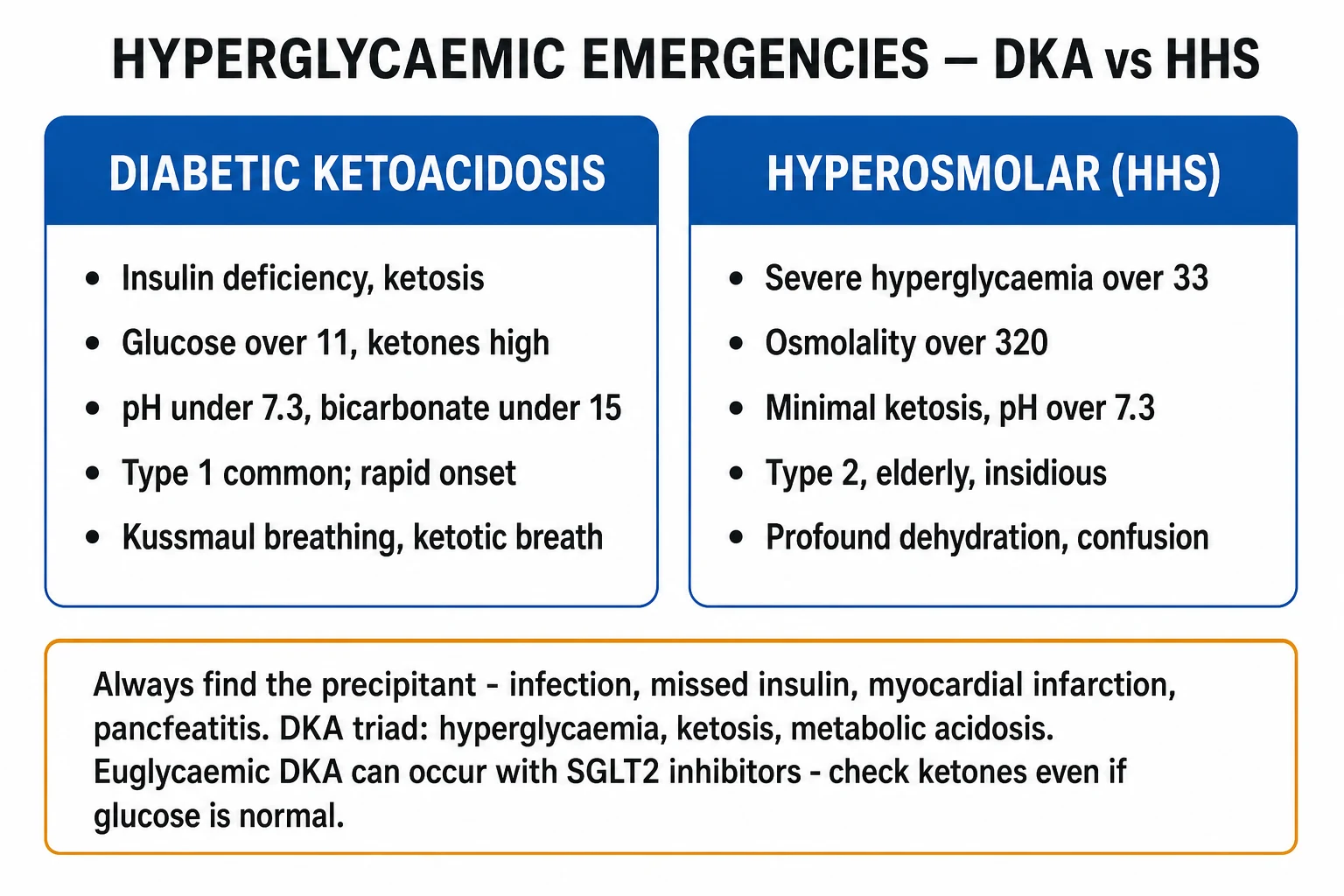
Diabetic ketoacidosis is defined by three biochemical abnormalities together: ketonaemia above 3 mmol/L (or moderate ketonuria above 2 plus on a dipstick), a metabolic acidosis with a venous pH below 7.3 and a bicarbonate below 18 mmol per litre, and hyperglycaemia with a blood glucose above 11 mmol per litre. DKA is graded by the severity of the acidosis — mild at a pH of 7.25 to 7.30, moderate at 7.00 to 7.24, and severe at a pH below 7.00. Euglycaemic DKA is the recognised variant in which the ketosis and the acidosis are present but the glucose is normal or only mildly raised; it occurs in pregnancy, starvation, the sulfonylurea-treated patient, and increasingly with the SGLT2 inhibitors, and it is missed if the clinician waits for a high glucose before checking ketones.[1]
Hyperosmolar hyperglycaemic state is defined by marked hyperglycaemia — typically above 30 mmol per litre — with a marked hyperosmolality above 320 milliosmoles per kilogram, without significant ketosis (ketones below 3 mmol per litre) and with only a mild acidosis (pH above 7.30, bicarbonate above 15 mmol per litre).[2][3] The distinction matters because the two states are managed differently: DKA is an insulin-deficiency emergency corrected by insulin, whereas HHS is a profound dehydration emergency corrected primarily by fluid, with insulin added cautiously.
Severe hypoglycaemia is a blood glucose below 3 mmol per litre (any glucose below 4 with symptoms is treated, hence the maxim "four is the floor"). It is severe when a third party is needed to treat it — a comatose, fitting or aggressive patient who cannot safely swallow. [1]
The three emergencies at a glance
Epidemiology and risk factors
DKA remains the commonest acute presentation of type-1 diabetes and the commonest cause of death in a young diabetic patient under thirty. A first presentation of type-1 diabetes accounts for around a quarter of DKA admissions, and the typical triggers in the known diabetic are an infection (pneumonia, urinary, gastroenteritis), a missed insulin dose or a pump failure, an acute coronary syndrome, alcohol, and pregnancy. HHS is a disease of the older type-2 patient with multiple comorbidities; the mortality is high at ten to twenty per cent, driven by the precipitant and the comorbidity rather than the biochemistry itself, and the usual triggers are an infection, a stroke, a myocardial infarction, or a new presentation of type-2 diabetes in a dehydrated elderly patient.[3]
Severe hypoglycaemia is overwhelmingly an iatrogenic complication of therapy — a misplaced insulin dose, a missed meal after a sulfonylurea or insulin, alcohol, renal failure reducing insulin clearance, or an acute illness. Sulfonylurea hypoglycaemia is the longest-lasting and the most dangerous, because the drug continues to drive insulin secretion for hours, and the patient must be observed and given a glucose infusion long after the initial recovery. [1]
Pathophysiology — one axis, three states
The three emergencies lie on a single axis of insulin action. In DKA, an absolute insulin deficiency removes the brake on lipolysis; free fatty acids flood the liver and are converted, through beta-oxidation, into the ketoacids beta-hydroxybutyrate and acetoacetate. The same deficiency leaves glucose stranded outside the cell, so the glucose rises and spills into the urine, taking water, sodium and potassium with it — explaining the profound dehydration and the total-body potassium deficit despite a normal or high serum potassium at presentation. The ketoacids are strong acids that consume bicarbonate, producing a high-anion-gap metabolic acidosis with a compensatory respiratory alkalosis (the deep sighing Kussmaul breathing). [1]
In HHS, a relative insulin deficiency is enough to cause severe hyperglycaemia (because the residual insulin suppresses lipolysis, so there is little ketone formation) but the profound osmotic diuresis over many days leaves the patient nine litres or more behind on water, producing the marked hyperosmolality and the depressed conscious level. The slow evolution lets the brain cells accumulate "idiogenic osmoles", so a too-rapid correction of the osmolality causes cerebral water shift and the osmotic demyelination syndrome.[3]
In hypoglycaemia, an excess of insulin (or a sulfonylurea) drives glucose into cells faster than it can be replaced; the brain, which depends on glucose, develops an energy deficit, producing the sympathetic response (sweating, tremor, palpitations, hunger) and then neuroglycopenia (confusion, seizure, coma). The adrenergic response blunts in the long-standing diabetic — hypoglycaemia unawareness — and the patient collapses with little warning. [1]
[1]Clinical presentation
The DKA patient is unwell and usually young: thirsty, polyuric, nauseated and vomiting, with abdominal pain that can mimic an acute abdomen, and the deep rapid Kussmaul respirations. The breath carries the sweet pear-drop smell of ketones (acetone). The conscious level ranges from alert through drowsy to comatose, and the dehydration is marked. The HHS patient is older, often type-2, and presents over days rather than hours: profound dehydration, weakness, and a depressed conscious level that can be the sole clue; focal deficits and seizures occur, and the precipitant (an infection, a stroke) may dominate the picture. The hypoglycaemic patient presents with the adrenergic features — sweating, tremor, palpitations, pallor, hunger and anxiety — followed, if untreated, by neuroglycopenia: confusion, aggression, seizure and coma. [1]
Differential diagnosis
The comatose, fitting or breathless diabetic patient has a differential, and the glucose, the ketones, the venous gas and the osmolality separate them. [1]
Diabetic ketoacidosis
- Young type-1, rapid onset over hours; Kussmaul breathing, ketotic breath, abdominal pain
- Glucose high (or normal in euglycaemic DKA), ketones above 3 mmol/L, pH below 7.3, bicarbonate below 18, high anion gap
- Manage with fluid, fixed-rate insulin 0.1 units/kg/h, potassium
- Precipitant: infection, missed insulin, MI, pregnancy, SGLT2 inhibitor
Hyperosmolar hyperglycaemic state
- Older type-2, onset over days; profound dehydration, depressed conscious level, may be the sole diabetic presentation
- Glucose typically above 30 mmol/L, osmolality above 320, ketones below 3 mmol/L, pH above 7.3
- Fluid is primary therapy; insulin 0.05 units/kg/h, cautious sodium correction
- Mortality 10 to 20 per cent; find the precipitant (infection, stroke, MI)
Severe hypoglycaemia
- On insulin or sulfonylurea; adrenergic features then neuroglycopenia (seizure, coma, aggression)
- Glucose below 3 mmol/L; resolves rapidly with glucose
- Glucose 25 g IV (50 mL of 50 per cent), or glucagon 1 mg IM; then find the cause
- Sulfonylurea causes the longest and most dangerous episodes
Lactic acidosis / sepsis / uraemia
- High anion-gap acidosis without ketones — metformin lactic acidosis, septic shock, renal failure
- Glucose variable; ketones low; lactate high, or uraemia on the biochemistry
- Treat the cause: stop metformin, dialyse, resuscitate sepsis
- May coexist with DKA — check ketones before assuming lactic acidosis alone
Investigations and diagnostic targets
The bedside panel is the same for DKA and HHS and is run within the first minutes: a capillary glucose, a blood or urinary ketone (beta-hydroxybutyrate is the modern standard, more sensitive than the dipstick), a venous blood gas for the pH, the bicarbonate and the base excess, urea and electrolytes for the potassium, sodium and renal function, a calculated osmolality (two times sodium plus glucose plus urea), a full blood count, and a blood culture, urine culture and chest radiograph to find the precipitant. An ECG is mandatory — the potassium disturbance and the silent myocardial infarction in the older diabetic are both common. The anion gap (sodium minus chloride minus bicarbonate, normally 10 to 18) is elevated in DKA and lactic acidosis. [1]
The targets during treatment are tracked on a flowchart: the glucose is checked hourly, and the ketones, the venous pH and the potassium are checked every two hours. Resolution of DKA is declared when the ketones fall below 0.6 mmol per litre, the pH rises above 7.3 and the bicarbonate is at least 18 mmol per litre.[1] The expected fall in glucose is three to five mmol per litre per hour, and the expected fall in ketones is at least 0.5 mmol per litre per hour.
Immediate management and resuscitation
Secure the airway, give high-flow oxygen to the acutely hypoxaemic, establish two large-bore intravenous cannulae, attach monitoring, and send the bedside panel. A urinary catheter is placed in the comatose or the anuric patient, and a nasogastric tube is placed if the conscious level is reduced (the vomiting DKA patient aspirates). The treating team is explicit about which emergency it is — DKA, HHS or hypoglycaemia — because the protocols diverge sharply. [1]
[1]The first 60 minutes of DKA in one breath
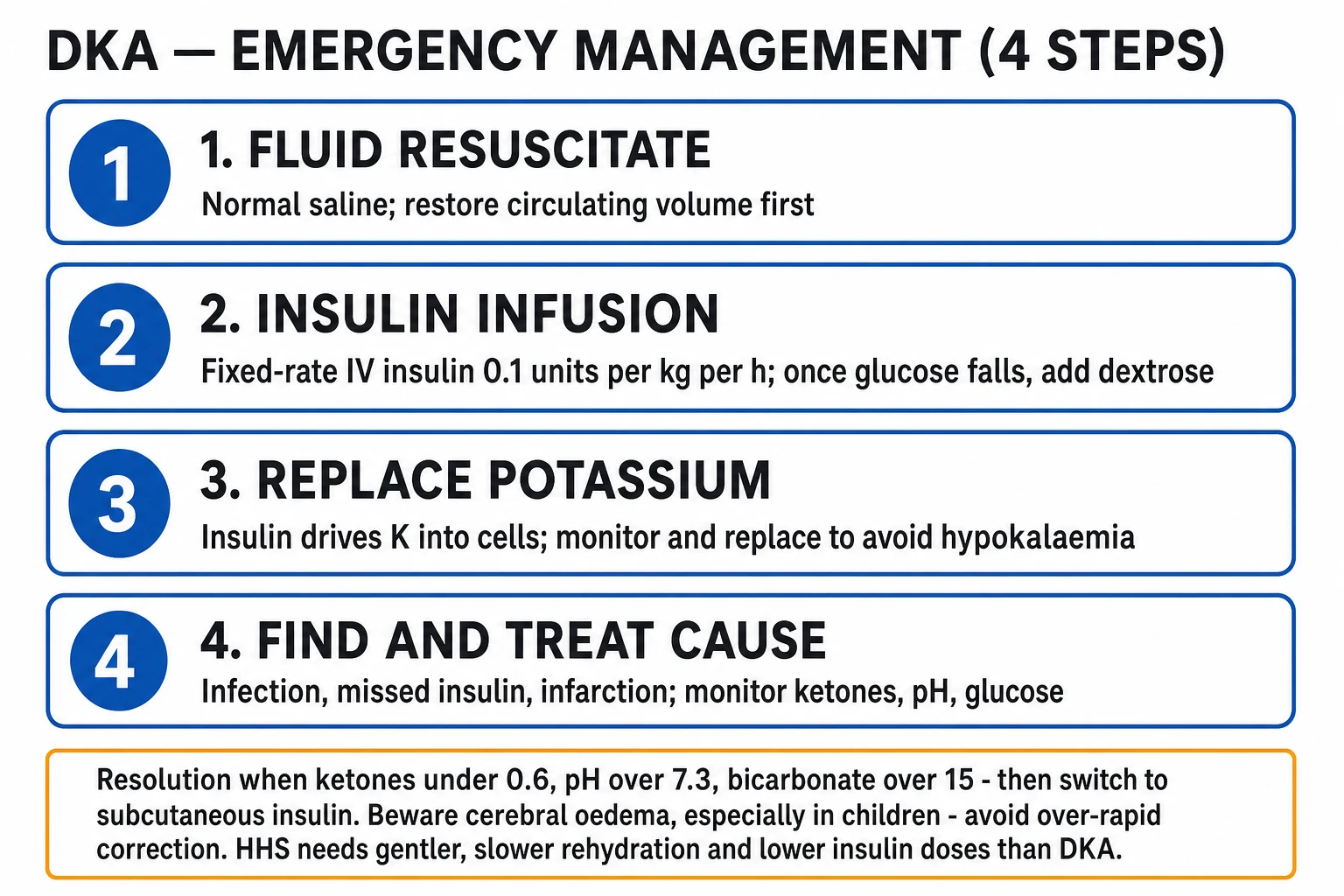
Fluid first: 0.9 per cent saline, 1 L over the first hour, then reassess. Start the fixed-rate intravenous insulin infusion at 0.1 units per kilogram per hour — a separate line, not into the fluid bag. Add potassium (40 mmol per litre, or 40 mmol of potassium chloride pre-mixed) to the fluid once the serum potassium is below 5.5 mmol per litre; give none if it is above 5.5 or the patient is anuric. When the blood glucose falls below 14 mmol per litre, switch the fluid to a glucose-containing bag (10 per cent glucose at 125 mL per hour) alongside a parallel 0.9 per cent saline bag, and continue the fixed-rate insulin unchanged. Track glucose hourly and ketones, pH and potassium every two hours. [1]
DKA management — fluid, insulin and potassium
The management of DKA rests on three simultaneous interventions: fluid, insulin and potassium, each with a precise dose and rationale.[1]
Fluid. 0.9 per cent saline, 1 L over the first hour, repeated to restore the circulating volume and the tissue perfusion. The rate is then adjusted to clinical need, typically 1 L over the next two hours and then 1 L every four to six hours, and the sodium and the haemodynamic response are watched. When the blood glucose falls below 14 mmol per litre, the fluid is changed to 10 per cent glucose at 125 mL per hour alongside the saline, so the fixed-rate insulin can continue to suppress the ketones without driving the glucose into hypoglycaemia. This is the single most common management error — stopping the insulin or under-treating the ketones once the glucose normalises, when the ketones are still being cleared. [1]
Insulin. The fixed-rate intravenous insulin infusion (FRIII) at 0.1 units per kilogram per hour is the modern standard, run from a separate syringe pump, replacing the older sliding-scale approach that produced slow ketone clearance and longer admissions. The aim is a glucose fall of three to five mmol per litre per hour and a ketone fall of at least 0.5 mmol per litre per hour; if either is too slow after the first hour, the insulin rate is increased by 1 unit per hour. The patient's usual basal (long-acting) insulin is continued throughout. [1]
Potassium. The serum potassium at presentation is a poor guide to the total-body deficit, which is typically 3 to 6 mmol per kilogram. Potassium chloride (40 mmol per litre, i.e. 40 mmol pre-mixed into each litre bag) is added to the fluid once the serum potassium is below 5.5 mmol per litre — none at all if the level is above 5.5 or the patient is anuric, and a higher concentration if the level is below 3.5 mmol per litre. The potassium is checked every two hours and the bag adjusted accordingly. [1]
DKA fluid, insulin and potassium
Resolution is declared when the ketones are below 0.6 mmol per litre, the pH is above 7.3 and the bicarbonate is at least 18 mmol per litre. The patient is then converted to a subcutaneous regimen — a long-acting insulin is given, the fixed-rate infusion is continued for thirty to sixty minutes to overlap, then stopped, and the patient eats — provided the precipitant is treated and the biochemistry is resolved.[1]
[1]HHS management — fluid first, insulin half
HHS is a dehydration emergency, not an insulin-deficiency emergency, so fluid is the primary therapy and insulin is added cautiously at half the DKA rate.[2][3] The patient is typically nine litres behind, often elderly with cardiac comorbidity, so the fluid is given carefully — 0.9 per cent saline, 1 L over the first hour, then a reassessment, and subsequent bags titrated to the sodium, the conscious level and the cardiovascular status (a slower rate in heart failure). The expected fall in glucose is three to five mmol per litre per hour; if the glucose is not falling with fluid alone, the insulin is started at 0.05 units per kilogram per hour.
The two cardinal dangers in HHS are the sodium shift and the osmolality correction. The corrected sodium (add 2 mmol per litre for every 5 mmol per litre of glucose above 5.5) is tracked, and the rise should not exceed 10 to 12 mmol per litre in twenty-four hours, because a rapid rise risks the central pontine myelinolysis — osmotic demyelination. The osmolality should not fall by more than 3 to 8 milliosmoles per kilogram per hour. The potassium is replaced as in DKA (40 mmol per litre once below 5.5 mmol per litre), and the glucose is checked hourly. [1]
The precipitant — an infection, a stroke, a myocardial infarction — is found and treated in parallel, because it is usually what kills the HHS patient, not the biochemistry. Prophylactic anticoagulation is given (the hyperosmolar state is prothrombotic), and the patient is managed on a high-dependency or intensive-care unit. [1]
Why HHS insulin is half the DKA dose
HHS has residual insulin — enough to suppress lipolysis (hence no ketones) but not enough to control the glucose. The profound dehydration and the slow cerebral adaptation mean that an aggressive insulin infusion would drop the glucose and the osmolality too fast, precipitating a fluid shift into the brain and the osmotic demyelination syndrome. So fluid comes first, the glucose often falls with fluid alone, and insulin is started at 0.05 units per kilogram per hour only if needed, with a gentler target than DKA. [1]
Hypoglycaemia management — glucose or glucagon, then the cause
Severe hypoglycaemia is a medical emergency reversed in seconds. The treatment depends on the conscious level and the intravenous access.[1]
If the patient is conscious and can swallow safely, give 15 to 20 g of oral fast-acting carbohydrate — three to four glucose tablets, or 150 to 200 mL of a glucose drink, or glucose gel — and recheck the glucose at ten to fifteen minutes, repeating if still below 4 mmol per litre, then follow with a long-acting carbohydrate (a sandwich, a biscuit, the next meal) to prevent a recurrence. [1]
If intravenous access is available, give glucose 25 g intravenously as 50 mL of 50 per cent dextrose (equivalently 100 mL of 25 per cent, or 250 mL of 10 per cent dextrose) into a large vein — the 50 per cent solution is irritant and should be given through a large cannula and flushed afterwards. The effect is dramatic within a minute. [1]
If there is no intravenous access, give glucagon 1 mg intramuscularly (or subcutaneously). Glucagon mobilises hepatic glycogen and works in ten to fifteen minutes; it is ineffective in the alcohol-intoxicated patient (glycogen depleted) and in the starving or the sulfonylurea-driven patient with no glycogen reserve, and in severe liver disease. [1]
After the immediate rescue, the cause is sought and fixed: the insulin or sulfonylurea dose is reviewed, the meal is restored, the renal function and the alcohol intake are checked, and the sulfonylurea patient is admitted and given a prolonged glucose infusion — the recurrent hypoglycaemia can last a day or more, and a single bolus is dangerous and insufficient. Octreotide is used for refractory sulfonylurea hypoglycaemia. Dexamethasone or hydrocortisone is given only if an underlying adrenal insufficiency is identified. Driving advice and a diabetes review follow before discharge. [1]
[1]Complications and pitfalls
The complications of DKA are cerebral oedema (the feared complication, especially in children and young adults — a warning is a headache, a falling conscious level, a rising blood pressure and a falling heart rate; the risk is increased by over-rapid fluid and by bicarbonate), hypokalaemia from the insulin-driven shift, hypoglycaemia from over-running the insulin, acute respiratory distress syndrome, and thromboembolism. The complications of HHS are the osmotic demyelination and the rapid sodium shift, the thromboembolism, and the consequences of the precipitant. The complications of hypoglycaemia are seizure, injury, arrhythmia (the prolonged QT of hypoglycaemia), and the recurrence — especially in the sulfonylurea patient discharged too soon. [1]
The recurring pitfalls are the inverse of the protocols: treating a number instead of the patient; stopping the fixed-rate insulin at a normal glucose instead of clearing the ketones; giving potassium at a level above 5.5 mmol per litre or to the anuric patient; using bicarbonate routinely; running the HHS insulin at the DKA rate and precipitating a fluid shift; treating hypoglycaemia with a single bolus and discharging a sulfonylurea patient; and forgetting that the older comatose diabetic may have a separate cause (a stroke, a sepsis, an opiate) on top of the glucose disturbance. [1]
Prognosis and disposition
DKA in a young adult, treated promptly by the modern protocol, has a mortality below one per cent, and the patient is admitted to a high-dependency bed with hourly glucose and two-hourly ketone, pH and potassium monitoring until resolution. HHS carries a ten to twenty per cent mortality, reflecting the age, the comorbidity and the precipitant rather than the biochemistry, and the patient is managed on an intensive-care or a high-dependency unit with close sodium and osmolality tracking and prophylactic anticoagulation. A severe hypoglycaemic patient is stabilised in the resuscitation bay, admitted for observation if the agent is a sulfonylurea or a long-acting insulin or if there is no clear reversible cause, and discharged with a cause review, a medication adjustment, and driving and sick-day rules if the episode was a simple missed meal with a short-acting agent. [1]
Special populations
Pregnancy lowers the DKA glucose threshold — euglycaemic DKA is commoner, the ketones rise faster, and the maternal acidosis threatens the fetus, so the protocol is run early and the obstetric team is involved. Children and young adults are at the highest risk of cerebral oedema, so the fluid is given more cautiously and bicarbonate is avoided. The elderly HHS patient with cardiac comorbidity is fluid-resuscitated gently and watched for overload and for the sodium shift. The sulfonylurea patient with severe hypoglycaemia is admitted and given a prolonged glucose infusion with octreotide for recurrence. The renal-failure patient has a prolonged insulin half-life and needs dose adjustment and glucose monitoring. The patient on an SGLT2 inhibitor may present with euglycaemic DKA and the drug is held. [1]
Criteria, protocols, trials and the viva pearls
The Fellowship candidate is examined on the precision of the diabetic-emergency protocol — the exact thresholds that define each state, the exact doses that treat it, and the exact sequence in which the drugs are given. This section consolidates the diagnostic criteria, the hour-by-hour protocols and the landmark evidence into a single exam-exhaustive reference, with the viva-ready pearls and the red flags. [1]
DKA diagnostic criteria — the triad in numbers
Diabetic ketoacidosis is defined by three biochemical abnormalities present together, and all three must be confirmed before the label is applied — a single high glucose is not DKA, and a single acidosis is not DKA. The contemporary Joint British Diabetes Societies and the American Diabetes Association consensus criteria require the following:[4][5]
- Hyperglycaemia: a blood glucose above 11 mmol per litre — or a known diabetic in whom the glucose may be near-normal in the euglycaemic variant.
- Ketonaemia: a blood beta-hydroxybutyrate above 3 mmol per litre, or a urinary ketone of 2 plus or more on the dipstick. The beta-hydroxybutyrate is the modern standard — it is the predominant ketoacid in DKA, it correlates with the severity and the response, and it falls predictably with the therapy, whereas the dipstick measures acetoacetate and can paradoxically rise as the patient improves.
- Acidosis: a venous pH below 7.30 and a bicarbonate below 18 mmol per litre (some pathways define DKA at a bicarbonate below 15 mmol per litre), with a high anion gap above the normal 10 to 18 in the absence of another cause. [1]
The severity is graded by the pH alone: mild at 7.25 to 7.30, moderate at 7.00 to 7.24, and severe below 7.00. The severe grade is the indication for the high-dependency or the intensive-care admission, the closer monitoring, and the consideration of the bicarbonate only in extremis.[5]
DKA diagnostic criteria — the four numbers
Mild DKA (pH 7.25 to 7.30)
- The ambulatory end of the spectrum; the patient is alert or mildly drowsy
- Managed on the assessment unit or the ward with the standard protocol and the close monitoring
- Resolution expected within 12 to 24 hours; the precipitant is sought and treated
Moderate DKA (pH 7.00 to 7.24)
- The commonest presentation; the patient is unwell with the Kussmaul breathing, the dehydration and the abdominal pain
- High-dependency admission for the hourly glucose and the two-hourly ketone, pH and potassium
- Watch for the falling potassium and the cerebral-oedema warning signs
Severe DKA (pH below 7.00)
- The patient is comatose or shocked; the highest risk of the cerebral oedema and the arrhythmia
- Intensive-care admission; consider the bicarbonate in extremis only, with the awareness of the cerebral-oedema risk
- A nasogastric tube for the reduced conscious level, a urinary catheter for the anuric, and the senior review
DKA management — the hour-by-hour protocol
The management of DKA rests on three simultaneous interventions — fluid, insulin and potassium — delivered together, never as substitutes, and tracked on an hourly flowchart.[1][4] The fixed-rate insulin clears the ketones, the fluid restores the circulating volume and the tissue perfusion, and the potassium prevents the insulin-driven hypokalaemia. The glucose switch at 14 mmol per litre prevents the iatrogenic hypoglycaemia and lets the insulin continue to clear the ketones without driving the glucose into the cell.
DKA — the first six hours at the bedside
Hour 0 — confirm and resuscitate
Confirm the triad with the bedside panel (the capillary glucose, the blood or urinary ketones, the venous gas, the urea and electrolytes). Secure the airway, give the high-flow oxygen to the hypoxaemic, establish the two large-bore cannulae, and start the 0.9 per cent saline 1 L over the first hour. Calculate the corrected sodium (add 2 mmol per litre for every 5 mmol per litre of glucose above 5.5). Continue the usual long-acting (basal) insulin at the usual dose and time.
Hour 0 to 1 — start the fixed-rate insulin and the potassium
Start the fixed-rate intravenous insulin infusion (FRIII) at 0.1 units per kilogram per hour from a separate syringe pump. Add the potassium chloride at 40 mmol per litre (40 mmol pre-mixed into each litre bag) once the serum potassium is below 5.5 mmol per litre — give none if it is above 5.5 or the patient is anuric, and a higher concentration if it is below 3.5.
Hour 1 — check the glucose fall
Recheck the capillary glucose at one hour. The expected fall is 3 to 5 mmol per litre per hour. If the glucose has not fallen by 3 mmol per litre after the first hour, increase the FRIII by 1 unit per hour. The expected fall in the ketones is at least 0.5 mmol per litre per hour; if it is slower, the FRIII is increased and the infusion set is checked.
Hour 2 — the glucose switch at 14
When the blood glucose falls below 14 mmol per litre, change the fluid to a 10 per cent glucose at 125 mL per hour running alongside a parallel 0.9 per cent saline bag, and continue the FRIII unchanged. The aim is to keep clearing the ketones without driving the glucose into hypoglycaemia — the commonest error is to stop or reduce the insulin at a normal glucose while the ketones persist.
Hours 2 to 6 — track the ketones, pH and potassium
Check the ketones, the venous pH and the serum potassium every two hours, and the glucose hourly. Adjust the potassium in the bag to the serum level. Watch for the cerebral-oedema warning (the headache, the falling conscious level, the rising blood pressure, the falling heart rate) — especially in the child and the young adult.
Resolution and the conversion
Declare the resolution when the ketones are below 0.6 mmol per litre, the pH is above 7.3 and the bicarbonate is at least 18 mmol per litre. Convert to the subcutaneous regimen: give the long-acting insulin, continue the FRIII for 30 to 60 minutes to overlap, then stop it, and let the patient eat. Treat the precipitant before the discharge.
HHS management — fluid first, insulin after, anticoagulate
HHS is a dehydration emergency, not an insulin-deficiency emergency. The fluid is the primary therapy; the insulin is added at half the DKA dose, and only after the fluid is running; and the prophylactic anticoagulation is given because the hyperosmolar state is profoundly prothrombotic.[2][3] The correction is deliberately slower than in the DKA, because the slow cerebral adaptation to the hyperosmolality means that a rapid fall precipitates the osmotic demyelination syndrome.
HHS — the slower, fluid-led protocol
Hour 0 — confirm and start the fluid
Confirm the HHS (the glucose typically above 30 mmol per litre, the osmolality above 320, the ketones below 3 mmol per litre, the pH above 7.3). Start the 0.9 per cent saline — 1 L over the first hour in the normo- or hyponatraemic patient, or a 0.45 per cent saline in the frankly hypernatraemic. Calculate the corrected sodium and the osmolality. Engage the intensive-care team and the diabetes team.
Hours 1 to 2 — the fluid, then the insulin
Continue the saline to restore the circulating volume; the expected glucose fall is 3 to 5 mmol per litre per hour on the fluid alone. Start the insulin at 0.05 units per kilogram per hour ONLY if the glucose is not falling with the fluid — the insulin before the fluid risks the osmotic shift and the cardiovascular collapse. Add the potassium at 40 mmol per litre once the level is below 5.5.
Hours 2 to 12 — track the sodium and the osmolality
Check the glucose hourly, the sodium and the osmolality every two to four hours, and the potassium every two hours. The osmolality should not fall by more than 3 to 8 milliosmoles per kilogram per hour, and the corrected sodium should not rise by more than 10 to 12 mmol per litre in 24 hours. Slow the fluid if the correction is too fast; watch for the fluid overload in the cardiac comorbidity.
Day 1 — the anticoagulation and the precipitant
Give the prophylactic low-molecular-weight heparin (the enoxaparin 40 mg subcutaneously daily) unless contraindicated — the hyperosmolar state is prothrombotic and the arterial and the venous thromboembolism are the common killers. Find and treat the precipitant (the infection, the stroke, the myocardial infarction) in parallel, because it is usually what kills the patient.
Resolution and the transition
Transition to the subcutaneous insulin once the biochemistry is stable and the patient is eating; the long-acting insulin overlaps the intravenous infusion for 30 to 60 minutes. The HHS patient often needs the long-term insulin or the oral therapy review before the discharge, and the multidisciplinary diabetes team is involved.
Why the insulin comes after the fluid in the HHS
The HHS has the residual insulin — enough to suppress the lipolysis (hence the minimal ketones) but not enough to control the glucose. The profound dehydration, often nine litres or more, and the slow cerebral accumulation of the idiogenic osmoles mean that an aggressive insulin infusion would drop the glucose and the osmolality too fast, pulling the water out of the brain and precipitating the osmotic demyelination. So the fluid comes first, the glucose often falls with the fluid alone, and the insulin is started at the half dose (0.05 units per kilogram per hour) only if the glucose is not falling. The cardinal rules: the fluid first, the insulin after, the slower correction, the anticoagulation. [1]
Severe hypoglycaemia — the rule of fifteen and the rescue ladder
Severe hypoglycaemia is reversed in seconds, but the rescue is only half the task — the cause is sought and fixed, and the sulfonylurea patient is admitted for the prolonged observation. The bedside rule is the rule of fifteen: give 15 g of the fast-acting carbohydrate, recheck the glucose at 15 minutes, repeat if it is still below 4 mmol per litre, and follow with the long-acting carbohydrate to prevent the recurrence.[6]
Hypoglycaemia — the rescue ladder
Conscious and can swallow — the rule of fifteen
Give 15 to 20 g of the fast-acting carbohydrate — three to four glucose tablets, 150 to 200 mL of a glucose drink, or the glucose gel. Recheck the glucose at 10 to 15 minutes; repeat if still below 4 mmol per litre. Follow with the long-acting carbohydrate (a sandwich, a biscuit, the next meal) to prevent the recurrence.
Reduced conscious level with the IV access — glucose 25 g IV
Give the glucose 25 g intravenously as 50 mL of the 50 per cent dextrose (or 100 mL of the 25 per cent, or 250 mL of the 10 per cent) into a large vein — the 50 per cent is irritant and is flushed afterwards. The effect is dramatic within a minute.
No IV access — glucagon 1 mg IM
Give the glucagon 1 mg intramuscularly (or subcutaneously); it mobilises the hepatic glycogen and works in 10 to 15 minutes. It is ineffective in the alcohol-intoxicated, the starved and the sulfonylurea-driven patient with no glycogen reserve, and in the severe liver disease.
After the rescue — find and fix the cause
Review the insulin or the sulfonylurea dose, the meal, the renal function, the alcohol, and the activity. The sulfonylurea patient is admitted for the prolonged glucose infusion because the hypoglycaemia recurs for hours; the octreotide is added for the refractory case. The long-acting insulin patient is observed for the duration of the insulin action.
Hypoglycaemia rescue — the key doses
The management differences at a glance
DKA management
- Fluid: 0.9 per cent saline 1 L over the first hour, then titrated; switch to 10 per cent glucose at 125 mL/h once the glucose is below 14
- Insulin: FRIII 0.1 units/kg/h from the start, in a separate line; continue the usual basal insulin
- Potassium: 40 mmol/L in the bag once below 5.5 mmol/L; check every 2 h
- Anticoagulation: not routine; monitoring: hourly glucose, two-hourly ketones, pH and potassium
- Correction rate: the glucose fall 3 to 5 mmol/L/h, the ketones 0.5 mmol/L/h or more
HHS management
- Fluid: 0.9 per cent saline 1 L over the first hour — the primary therapy; titrate to the corrected sodium
- Insulin: 0.05 units/kg/h, only AFTER the fluid, only if the glucose is not falling — half the DKA dose
- Potassium: 40 mmol/L in the bag once below 5.5 mmol/L
- Anticoagulation: prophylactic LMWH mandatory — the hyperosmolar state is prothrombotic
- Correction rate: the osmolality fall below 3 to 8 mOsm/kg/h; the sodium rise below 10 to 12 mmol/L in 24 h
Hypoglycaemia management
- Oral: 15 to 20 g fast carbohydrate (the rule of 15), recheck at 15 min, repeat if below 4
- IV: glucose 25 g as 50 mL of 50 per cent dextrose into a large vein
- IM: glucagon 1 mg if no IV access (useless if glycogen-depleted)
- Then: find and fix the cause; admit every sulfonylurea and long-acting insulin patient
- Octreotide for the refractory sulfonylurea hypoglycaemia
The landmark trials and the consensus
Glaser et al — risk factors for cerebral oedema in paediatric DKA (NEJM 2001)
New England Journal of Medicine
PMID 11172153
Key finding
A case-control study of 61 children with the DKA complicated by the cerebral oedema, matched to 181 controls, identifying the independent risk factors as a low partial pressure of carbon dioxide (the deep Kussmaul breathing), a high urea at the presentation (the severe dehydration), and the treatment with the bicarbonate. The lesser contributors were a smaller rise in the corrected sodium during the therapy and a higher rate of the fluid in the first four hours.
Practice change
The cerebral oedema is the feared DKA complication in the child and the young adult; the risk is heightened by the profound acidosis and the dehydration at the presentation and by the bicarbonate therapy, and it is mitigated by the cautious, protocolised fluid. The bicarbonate is avoided except in the extremis.
FLUID trial — infusion rates for paediatric DKA (NEJM 2018)
New England Journal of Medicine
PMID 29897851
Key finding
A two-by-two factorial randomised trial of 1,255 children with the DKA across 13 US emergency departments, comparing the fast versus the slow rehydration rate and the 0.9 per cent saline versus the 0.45 per cent saline. No significant difference in the neurologic outcomes (the memory and the IQ at 2 to 6 months), but a higher rate of the altered mental status during the treatment with the faster rehydration in one analysis. The cerebral oedema was rare in both arms.
Practice change
The fluid rate and the sodium content of the rehydration fluid do not materially affect the neurologic outcome in the paediatric DKA when given within the protocolised range — but the caution against the over-rapid rehydration persists, and the protocolised, reassessed fluid remains the standard.
NICE-SUGAR — intensive versus conventional glucose control (NEJM 2009)
New England Journal of Medicine
PMID 19318384
Key finding
A multicentre randomised trial of 6,104 critically ill adults, comparing the intensive glucose control (a target of 4.5 to 6.0 mmol per litre) against the conventional control (a target of 10 mmol per litre or below). The 90-day mortality was higher with the intensive control (27.5 per cent vs 24.9 per cent, p=0.02), driven by the severe hypoglycaemia (6.8 per cent vs 0.5 per cent).
Practice change
The tight glycaemic control of the earlier era harms the critically ill patient through the hypoglycaemia; the contemporary target of 8 to 10 mmol per litre is the standard, and the hypoglycaemia avoidance is a primary goal — directly relevant to the DKA glucose switch and the hypoglycaemia rescue.
Umpierrez — insulin analogs versus human insulin in DKA (Diabetes Care 2009)
Diabetes Care
PMID 19366972
Key finding
A randomised trial of 74 adults with the DKA, comparing the subcutaneous insulin aspart (0.3 units per kilogram followed by 0.1 units per kilogram per hour) against the intravenous regular insulin (the standard protocol). The outcomes — the time to the glucose control and the time to the DKA resolution — were equivalent, with the fewer hypoglycaemic events in the subcutaneous arm.
Practice change
The subcutaneous rapid-acting insulin is a feasible alternative to the intravenous infusion in the mild-to-moderate DKA without the severe dehydration or the shock, though the intravenous FRIII remains the standard for the moderate-to-severe and the intensive-care patient.
The Fellowship viva pearls — the high-yield answers
[1] [1] [1] [1] [1] [1] [1]Additional red flags
[1]Evidence and regional guidelines
The contemporary framework is the Joint British Diabetes Societies (JBDS) guideline, which sets the fixed-rate insulin infusion at 0.1 units per kilogram per hour, the 0.9 per cent saline first-hour fluid, the glucose switch at 14 mmol per litre, and the 40 mmol per litre potassium rule, and the updated HHS pathway with fluid first and insulin at 0.05 units per kilogram per hour.[1][2][3] The American Diabetes Association consensus and the ANZ local pathways align with the same doses. Despite the clarity of the guideline, adoption and outcomes remain uneven — a reminder that the protocol is only as good as its bedside execution.[1]
ANZ practice note. The DKA and HHS protocols follow the JBDS framework via the Australian Diabetes Society and local hospital diabetic-emergency pathways, which carry the same numbers — fixed-rate insulin 0.1 units per kilogram per hour for DKA, fluid-first with 0.05 units per kilogram per hour for HHS, and the glucose switch at 14 mmol per litre. The hypoglycaemia rescue — glucose 25 g intravenously or glucagon 1 mg intramuscularly — is standard across the ANZ diabetic-emergency pathway. [1]
SAQ — Severe DKA with cerebral oedema risk in a young adult
10 minutes · 10 marks
An 18-year-old woman with known type-1 diabetes (diagnosed at age nine, on a basal-bolus regimen) is brought to the emergency department by her parents after two days of a flu-like illness, vomiting, abdominal pain and increasing drowsiness. She missed her insulin injections for the last 36 hours. On arrival she is drowsy (GCS 13), dehydrated, with deep sighing Kussmaul respirations at 28 per minute and a sweet ketotic breath odour. BP 96/58, HR 128, SpO2 97 per cent on room air, temperature 37.9 degrees Celsius. The bedside venous gas shows glucose 34 mmol/L, pH 6.92, bicarbonate 6 mmol/L, potassium 5.8 mmol/L and beta-hydroxybutyrate 8.2 mmol/L. The corrected sodium is 144 mmol/L and the anion gap is 28.
SAQ — Hyperosmolar hyperglycaemic state in the elderly
10 minutes · 10 marks
A 78-year-old man with type-2 diabetes (on metformin and gliclazide), hypertension and ischaemic heart disease is brought to the emergency department by his wife after four days of increasing drowsiness, thirst and polyuria. Over the last 24 hours he has become barely rousable. On arrival he is profoundly dehydrated, GCS 10 (E3V3M4), with dry mucosae and reduced skin turgor. Temperature 37.4 degrees Celsius, BP 104/64, HR 108 in sinus rhythm, RR 18, SpO2 95 per cent on room air. The bedside venous gas shows glucose 52 mmol/L, pH 7.32, bicarbonate 18 mmol/L, sodium 132 mmol/L, potassium 4.6 mmol/L and urea 24 mmol/L. Beta-hydroxybutyrate is 1.2 mmol/L. The corrected sodium is 150 mmol/L and the calculated osmolality is 340 mOsm/kg.
Exam pearls
- DKA triad: ketones above 3 mmol/L, pH below 7.3, glucose above 11 mmol/L — graded by pH (mild 7.25 to 7.30, moderate 7.00 to 7.24, severe below 7.00).
- DKA therapy is fluid (0.9 per cent saline 1 L over the first hour), insulin (FRIII 0.1 units/kg/h) and potassium (40 mmol/L once below 5.5 mmol/L) — given together, never as substitutes.
- Switch to a glucose-containing fluid once the glucose is below 14 mmol/L — and keep the fixed-rate insulin running to clear the ketones.
- HHS is fluid-first: 0.9 per cent saline 1 L over the first hour, insulin at 0.05 units/kg/h, watch the sodium and the osmolality.
- Hypoglycaemia: glucose 25 g IV (50 mL of 50 per cent), or glucagon 1 mg IM; then find the cause — admit every sulfonylurea patient.
- Continue the patient's basal insulin through a DKA admission; do not stop it.
- Bicarbonate is not routine — reserved for the profoundly acidotic patient in extremis, and it carries a cerebral-oedema risk.
- Euglycaemic DKA (SGLT2 inhibitor, pregnancy, starvation) is missed if you wait for a high glucose before checking ketones.
- The HHS mortality is 10 to 20 per cent, driven by the precipitant and the comorbidity — find and treat the infection, stroke or MI. [1]
Red flags
[1]References
- [1]Sharma A, Rengarajan L, Narendran P Guidelines for the management of diabetes-related ketoacidosis (DKA) have been poorly adopted and implemented, resulting in a lack of improvement in outcomes Diabet Med, 2025.PMID 39928758
- [2]Mustafa OG, Haq M, Dashora U Management of Hyperosmolar Hyperglycaemic State (HHS) in Adults: An updated guideline from the Joint British Diabetes Societies (JBDS) for Inpatient Care Group Diabet Med, 2023.PMID 36370077
- [3]Scott AR, Joint British Diabetes Societies (JBDS) for Inpatient Care Management of hyperosmolar hyperglycaemic state in adults with diabetes Diabet Med, 2015.PMID 25980647
- [4]Savage MW, Dhatariya K, Kilvert A, et al. Joint British Diabetes Societies guideline for the management of diabetic ketoacidosis Diabet Med, 2011.PMID 21255074
- [5]Kitabchi AE, Umpierrez GE, Miles JM, Fisher JN Hyperglycemic crises in adult patients with diabetes Diabetes Care, 2009.PMID 19564476
- [6]Seaquist ER, Anderson J, Childs B, et al. Hypoglycemia and diabetes: a report of a workgroup of the American Diabetes Association and the Endocrine Society Diabetes Care, 2013.PMID 23589542
- [7]Glaser N, Barnett P, McCaslin I, et al. Risk factors for cerebral edema in children with diabetic ketoacidosis. The Pediatric Emergency Medicine Collaborative Research Committee of the American Academy of Pediatrics N Engl J Med, 2001.PMID 11172153
- [8]Kuppermann N, Ghetti S, Schunk JE, et al. Clinical Trial of Fluid Infusion Rates for Pediatric Diabetic Ketoacidosis N Engl J Med, 2018.PMID 29897851