EM · Electrical and lightning injury
Electrical and lightning injury
Also known as Electrocution · Electrical burn · Lightning strike · High-voltage injury · Keraunopathy
Electrical and lightning injury — low-voltage (under 1000 V) shocks cause local contact burns and arrhythmia; high-voltage (over 1000 V) injury drives deep tissue destruction along the current path with rhabdomyolysis, myoglobinuria, compartment syndrome and cardiac arrest; lightning causes cardiopulmonary arrest, Lichtenberg figures and tympanic rupture. Management is ABCDE trauma resuscitation, ECG monitoring for 4 to 6 hours, creatine kinase and urine output surveillance, fasciotomy for compartment syndrome, and treating every case as blunt trauma. Distinguished from thermal burn, tricyclic poisoning and blunt trauma. ACEM-primary, globally tagged.
On this page & tools
Your progress
Saved locally on this device.
Target exams
Electrical and lightning injury is a trauma-toxicology hybrid: the patient is shocked, thrown, burned and crushed at once, and the surface wound almost always understates the damage beneath. The Fellowship candidate must separate three distinct mechanisms — low voltage (household, under 1000 V), high voltage (over 1000 V) and lightning — because each has a different lethal threat, a different monitoring requirement and a different disposition. Every case is resuscitated as blunt trauma first, then investigated for the hidden deep injury.[1]
Definition and classification
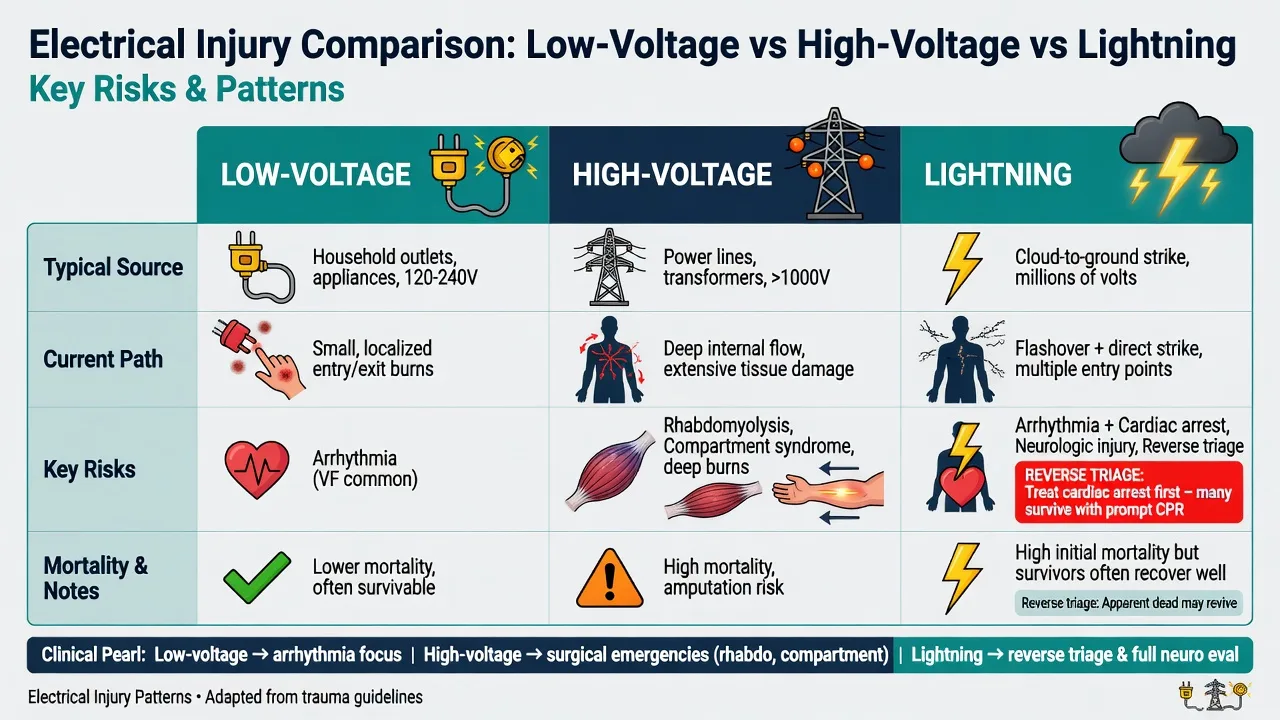
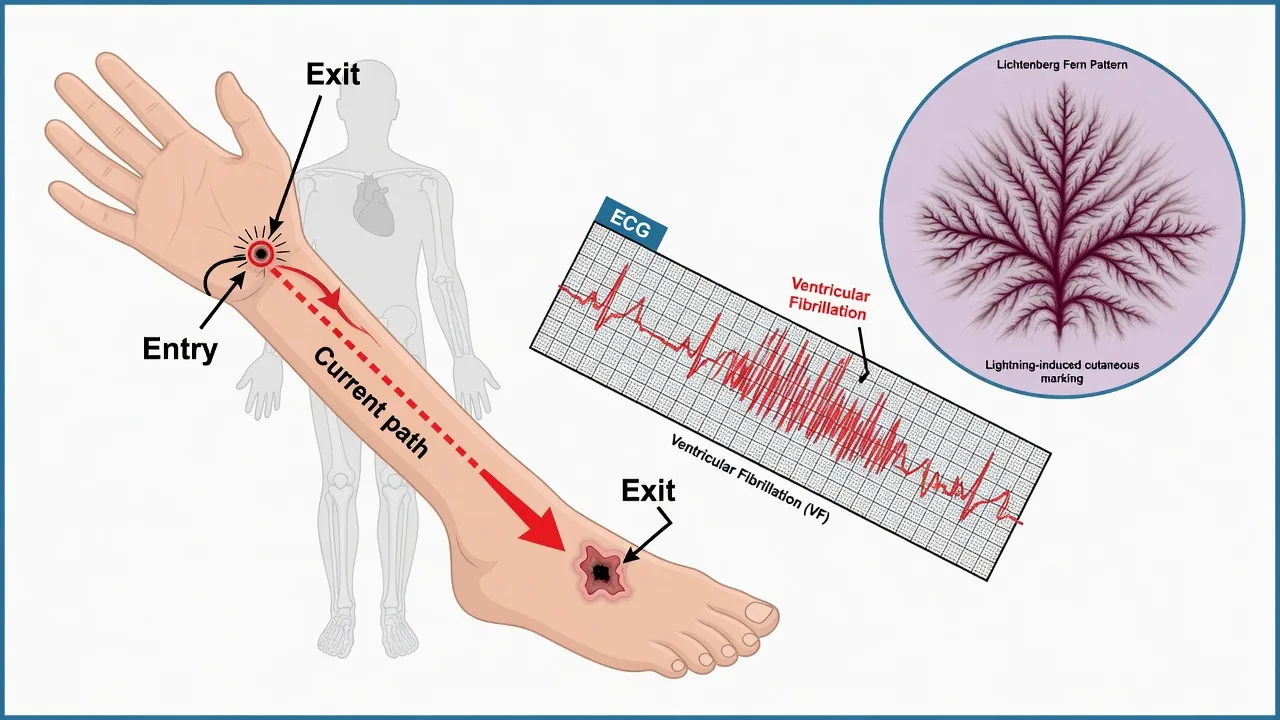
An electrical injury is tissue damage from current passing through the body. Three categories are recognised. Low-voltage injury (under 1000 V, typically the 230 to 240 V domestic supply) causes a local contact burn at the entry point and a risk of arrhythmia, but the current rarely crosses deep tissue. High-voltage injury (over 1000 V — power lines, railway overheads, substation equipment) drives current across the whole body, producing deep muscle and nerve destruction, rhabdomyolysis, compartment syndrome and cardiac arrest. Lightning is a separate entity: a massive, near-instantaneous unidirectional discharge of millions of volts and tens of thousands of amperes that behaves as a single direct-current pulse and produces cardiopulmonary arrest and characteristic neurocutaneous signs.[1][3]
[1]Epidemiology and risk
Electrical injury is uncommon but preventable, clustering in electrical workers (linesmen, electricians, construction), in children at home (flex chewing, socket probes) and in outdoor recreation for lightning (golf, hiking, fishing, sport). Cardiac arrest from ventricular fibrillation is the leading cause of immediate death in low- and high-voltage exposure; in lightning, simultaneous cardiac and respiratory arrest dominate. The case fatality is highest in high-voltage contact with a hand-to-hand or hand-to-foot pathway, where the current traverses the heart and thorax.[1][6]
Pathophysiology — Joule heating, tetany and the lightning pulse
Tissue damage is governed by Joule's law: heat generated is proportional to current squared times resistance times contact time ($H = I^2Rt$). Current, not voltage, is what destroys tissue, and the organs of lowest resistance (nerve, muscle, blood vessel) conduct best while bone — of highest resistance — heats most and cooks the muscle around it. This is why a high-voltage injury shows a tiny entry wound yet extensive deep necrosis tracking along bone.[5]
[1]Alternating current at mains frequency is the most dangerous waveform: it induces tetanic flexor spasm at around 10 to 20 mA (trapping the hand on the conductor) and throws the heart into ventricular fibrillation at around 100 mA. Direct current produces a single convulsive throw, hurling the victim and causing secondary blunt trauma. Lightning is a unidirectional mega-amp pulse that simultaneously depolarises the entire myocardium, producing asystole; the intrinsic pacemaker often restarts, but the medullary respiratory centre remains stunned, so the victim develops secondary hypoxic ventricular fibrillation unless ventilated.[3][4]
Current thresholds — what each milliampere does
The clinical effect of current is threshold-dependent, and the Fellowship candidate should know the breakpoints that separate a tingle from cardiac arrest. [1]
1 mA
- Perception threshold — a faint tingle
- No injury, no risk
10 to 20 mA
- Tetanic flexor spasm begins ("no let-go")
- Flexors stronger than extensors — victim grips the source
- Contact time lengthens — Joule heating accumulates
50 mA
- Severe tetany, respiratory arrest from intercostal and diaphragmatic spasm
- Pain and exhaustion; reversible if released
100 mA
- Ventricular fibrillation — the lethal cardiac threshold for AC at mains frequency
- Cardiac arrest unless defibrillated within minutes
Greater than 1000 mA (1 A)
- Sustained current — deep tissue coagulation along the path
- Internal burns, rhabdomyolysis, compartment syndrome
Clinical presentation
The presentation ranges from a fully alert patient with a small contact burn to a patient in cardiac arrest. The entry and exit wounds should be sought and mapped — they are often small, charred, painless punctures at flexural creases, and an arc burn may char the flexor surface of a joint as the current jumps across it. High-voltage victims are frequently thrown or fall, so a full blunt-trauma secondary survey is mandatory: intracranial, cervical-spine, intrathoracic and intra-abdominal injury, plus long-bone and pelvic fractures. [1]
Low voltage (under 1000 V)
- Small contact burn at entry point; little deep damage
- Risk of arrhythmia (VF, ectopics) at or soon after contact
- Often alert and well on arrival; tetany may have thrown the patient
- Monitor 4 to 6 h; discharge if asymptomatic with a normal ECG
High voltage (over 1000 V)
- Small entry/exit wounds hiding extensive deep necrosis along bone
- Rhabdomyolysis with dark urine (myoglobinuria), rising CK
- Compartment syndrome of involved limbs; vascular and nerve injury
- Cardiac arrest, arrhythmia; admit with 24 h telemetry and surgical review
Lightning strike
- Cardiopulmonary arrest — asystole with secondary hypoxic VF
- Keraunoparalysis: transient limb paralysis, pallor, vasoconstriction (resolves over hours)
- Lichtenberg figures (ferning), tympanic membrane rupture, cataracts
- Apply reverse triage in mass casualty — ventilate the apnoeic first
Lightning-specific findings include Lichtenberg figures (a transient, fern-like, non-thermal skin pattern that is the pathognomonic cutaneous signature of lightning and fades within hours), keraunoparalysis (a transient flaccid paralysis and vasoconstriction of the limbs that resolves over hours and must not be mistaken for spinal injury), tympanic membrane rupture (examine every lightning victim's ears), and delayed cataracts.[3]
Differential diagnosis — what else causes this picture
The Fellowship candidate must distinguish the electrical mechanism from its mimics, several of which co-exist after a high-voltage fall or an enclosed-space arc. [1]
Thermal / arc / flash burn
- Surface flash burn from the arc, no current crossing the body
- No deep track, no myoglobinuria, normal CK
- Managed as a standard burn (TBSA, Parkland, airway)
- Differentiated by history: did current pass through the patient?
Tricyclic antidepressant poisoning
- Wide QRS, tachycardia, anticholinergic toxidrome, hypotension
- No entry/exit wound, no contact history
- Treat with sodium bicarbonate bolus 1 to 2 mmol/kg IV
- A cardiac arrest with no trauma may be TCA, not electrical
Blunt trauma (the throw or the fall)
- Tetany or the throw ejects the victim — secondary TBI, spinal, long-bone, visceral injury
- May dominate the presentation and obscure the electrical injury
- Treat as major trauma; full secondary survey and imaging
- Do not anchor on the small entry wound and miss the epidural
Chemical burn
- History of a chemical conductor or battery rupture
- Copious water irrigation, specific antidote (e.g. calcium gluconate for hydrofluoric acid)
- No arrhythmia signature unless systemic absorption
Cyanide or carbon monoxide (co-existing enclosed fire)
- An arc in an enclosed burning space adds smoke inhalation toxins
- Lactate above 10 mmol/L suggests cyanide; give hydroxocobalamin
- Carboxyhaemoglobin for CO; 100 per cent oxygen
Bedside assessment
Assess every electrical-injury patient through the trauma primary survey (ABCDE) with cervical-spine control until cleared, because the throw and the fall generate blunt injury independently of the shock. Map the entry and exit wounds, perform a focused neurovascular examination of all four limbs (compartment syndrome is time-critical), inspect the tympanic membranes in lightning, and examine the eyes (delayed cataract). Pregnancy status is checked in women — even a minor maternal shock carries a fetal risk. [1]
Investigations
Investigations screen for the three hidden threats: arrhythmia, rhabdomyolysis and occult trauma. A 12-lead ECG and continuous cardiac monitoring are mandatory on every patient; creatine kinase (peak around 24 hours, with rhabdomyolysis defined by a CK above about 1000 U/L), urine myoglobin and urinalysis (a positive blood dipstick with no red cells on microscopy is myoglobinuria), urea and electrolytes, troponin and venous gas (acidosis reflects injury severity) are the core bloods. Add amylase or lipase for pancreatic injury, and cross-section imaging (CT) driven by the trauma survey. Bloods are repeated at intervals because CK and potassium rise as muscle necrosis evolves.[2][5]
Immediate management and resuscitation
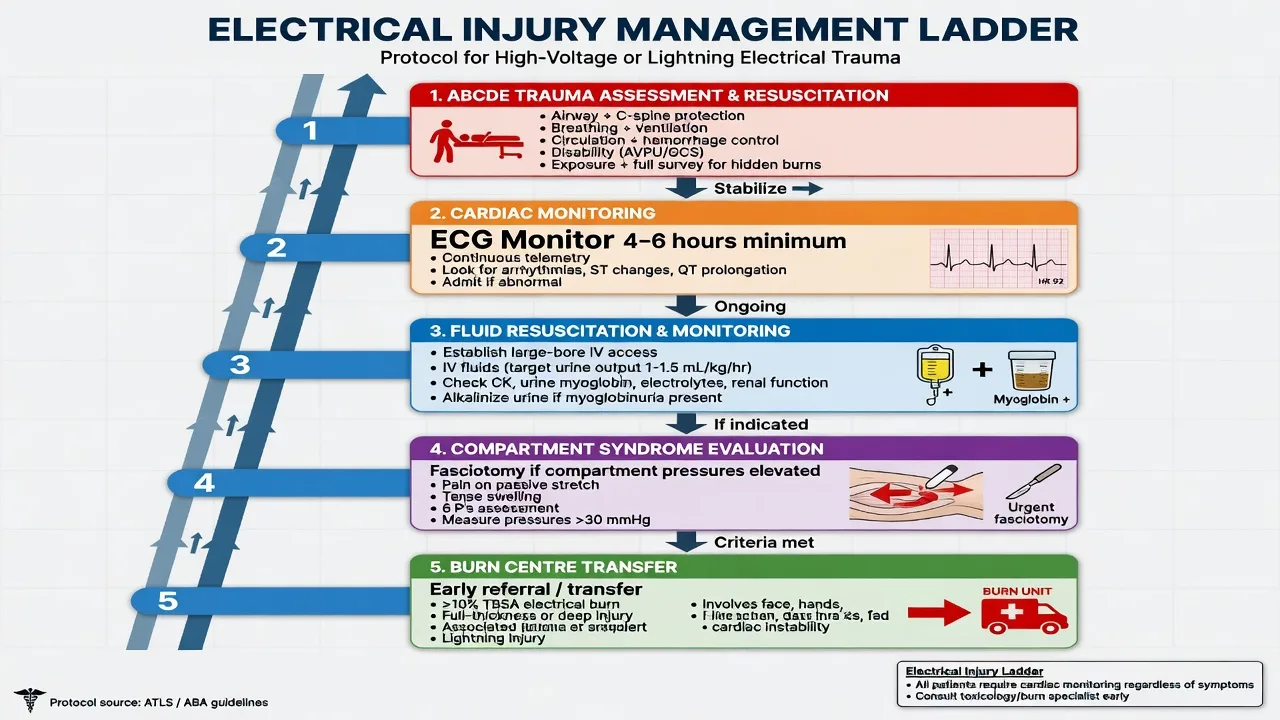
Resuscitate as blunt trauma first, then address the electrical-specific threats. The scene must be made safe — never touch a victim still in contact with a live source. [1]
[1]Treat cardiac arrest in an electrical or lightning victim with the standard ALS algorithm — prolonged and aggressive cardiopulmonary resuscitation is justified, especially in lightning, where young otherwise-fit victims are often fully salvageable once oxygenated.[4]
Definitive management — monitoring, fluids and fasciotomy
Three time-critical interventions follow the initial resuscitation: cardiac monitoring, rhabdomyolysis fluid therapy, and compartment-syndrome surgery. The monitoring duration is set by the voltage and the presentation: an asymptomatic low-voltage exposure with a normal ECG is monitored for 4 to 6 hours and discharged with a safety-net if it remains well; any high-voltage contact, any symptomatic patient, any abnormal ECG or any loss of consciousness is admitted for at least 24 hours of telemetry.[1][2]
Rhabdomyolysis is treated with intravenous isotonic crystalloid titrated to a urine output of 1 to 1.5 mL per kilogram per hour in the adult (2 to 3 mL per kilogram per hour in the severe case), guided by serial CK and electrolytes; alkalinisation of the urine and mannitol are not routine per the Eastern Association for the Surgery of Trauma guideline, and bicarbonate is reserved for severe metabolic acidosis or hyperkalaemia.[5]
Compartment syndrome complicates deep high-voltage necrosis and is a clinical diagnosis — pain on passive stretch out of proportion, a tense woody compartment, and paraesthesia — supported by a compartment pressure within 30 mmHg of the diastolic blood pressure. Early fasciotomy is the definitive treatment and has a narrow golden period; delayed decompression is the leading preventable cause of amputation in high-voltage injury.[6][7]
Deep tissue injury — the path of current
Current does not damage tissue uniformly: it follows the path of least resistance, and that path dictates the injury. Tissue resistance ranks nerve less than blood vessel less than muscle less than skin less than fat less than bone. Current therefore races through nerves, vessels and muscle — damaging them by a combination of Joule heating, electroporation (electric-field disruption of cell membranes) and electroconformational denaturation of proteins — while bone, of highest resistance, absorbs the most heat and cooks the muscle surrounding it. The deep track is invisible from the surface, which is the central reason a high-voltage entry wound looks trivial while the limb beneath is dying. [1]
[1]Management — a stepwise protocol
[1]Subtypes and special scenarios
Lightning mass-casualty — reverse triage. In a lightning strike on a group, the normal trauma triage order is inverted: the apparently dead, apnoeic victim is resuscitated first. The lightning pulse arrests the heart in asystole, the intrinsic pacemaker often restarts spontaneously, but the respiratory centre remains paralysed — without ventilation the patient descends into secondary hypoxic ventricular fibrillation and dies. The walking wounded can wait.[3]
Paediatric oral-commissure burn. A child chewing a live flex sustains a deep burn at the angle of the mouth. The injury looks localised but risks delayed labial-artery haemorrhage one to three weeks later as the eschar sloughs. Refer to a specialist unit and explicitly warn the parents about delayed bleeding. [1]
Pregnancy. Even a minor maternal low-voltage shock can cause fetal loss; arrange fetal monitoring and obstetric review for any pregnant patient. [1]
TASER and conducted-energy weapons. Largely benign in the adult; a brief period of cardiac monitoring is reasonable in the symptomatic patient, the pregnant patient, or where the dart has struck the chest. [1]
Complications and pitfalls
The complications are immediate (cardiac arrest, ventricular arrhythmia, blunt trauma from the throw), early (rhabdomyolysis with acute kidney injury, compartment syndrome requiring fasciotomy, hyperkalaemia, posterior shoulder dislocation from tetany) and delayed (peripheral neuropathy, autonomic dysfunction, cataracts, complex regional pain and psychological sequelae). The classic pitfalls are assuming a small surface wound means minor injury, discharging a low-voltage patient without the 4 to 6 hour ECG, missing compartment syndrome behind a painful limb, anchoring on the electrical injury and missing an epidural or a splenic injury from the fall, and forgetting delayed labial-artery bleeding in the paediatric mouth burn.[6][7]
Complications in detail
Electrical injury wounds the patient across every system, and the complications are best grouped by the onset and the mechanism. [1]
Cardiac (immediate to early)
- Ventricular fibrillation at around 100 mA AC — immediate cardiac arrest
- Asystole from DC and lightning — the heart often auto-restarts if ventilated
- Atrial and ventricular ectopics, sinus tachycardia, conduction blocks (RBBB, bifascicular)
- Myocardial contusion and stun; troponin rise; usually non-occlusive
Neurological (immediate to delayed)
- Immediate: transient loss of consciousness, seizure, confusion, amnesia
- Keraunoparalysis (lightning): transient flaccid limb paralysis, resolves over hours
- Spinal cord transection from vertebral fracture or direct current injury
- Delayed: peripheral neuropathy, reflex sympathetic dystrophy, cataracts
Vascular and burns
- Entrance and exit wounds — small, charred, painless punctures
- Arc burns charring the flexor creases of joints
- Delayed arterial thrombosis and rupture (days later) as vessel wall coagulates
- Paediatric mouth-commissure burn with delayed labial-artery bleed
Renal (early)
- Rhabdomyolysis — CK above 1000 U/L, myoglobinuria (blood-positive dipstick, no red cells)
- Pigment nephropathy progressing to acute kidney injury
- Treated with fluid loading to urine 1 to 1.5 mL/kg/h
- Hyperkalaemia, hypocalcaemia, hyperphosphataemia from cell lysis
Musculoskeletal and compartment
- Compartment syndrome from deep oedema and necrosis — pain on passive stretch
- Fasciotomy within the golden period
- Posterior shoulder dislocation from violent tetanic contraction
- Limb amputation in extensive high-voltage necrosis
Other
- Tympanic membrane rupture from lightning blast overpressure
- Cataracts — often bilateral, may be delayed for months
- GI: ileus, hepatic injury, pancreatic injury (check amylase)
- Psychological: PTSD and anxiety; high-voltage workers need long-term support
Key evidence
EAST rhabdomyolysis practice management guideline
Am J Surg 2022
Key finding
Urine output target 1 to 1.5 mL/kg/h; no routine alkalinisation.
Predictors of limb amputation in electrical injury
Burns 2023
Key finding
High voltage, trans-thoracic path and delayed fasciotomy predict amputation.
Golden period of fasciotomy in high-voltage burn
Ann Burns Fire Disasters 2023
Key finding
Fasciotomy within 6 to 12 h preserves limb salvage.
Electrical injury causing ventricular arrhythmias
Br Heart J 1987
Key finding
Ventricular arrhythmia immediate or delayed after electrical injury.
Cardiac arrhythmia risk after electrical injury
PLoS One 2025
Key finding
Abnormal ECG, LOC and high voltage predict arrhythmia — admit.
Immediate (within minutes)
- Cardiac arrest — VF (AC) or asystole (DC/lightning)
- Apnoea from respiratory-centre stun or tetanic intercostal spasm
- Loss of consciousness, seizure, amnesia
- Secondary blunt trauma from the throw or the fall
Early (hours to days)
- Rhabdomyolysis with AKI and hyperkalaemia
- Compartment syndrome — fasciotomy window
- Arrhythmia, conduction block, troponin rise
- Vessel thrombosis, posterior shoulder dislocation
Delayed (weeks to months)
- Cataracts (bilateral; lightning and head-path)
- Peripheral neuropathy, complex regional pain
- Labial-artery haemorrhage in paediatric mouth burn
- PTSD, anxiety, return-to-work issues
The complications of electrical injury
CURRENT
VF, asystole, arrhythmia, conduction block, myocardial contusion
Rhabdomyolysis, myoglobinuria, pigment AKI
Apnoea from respiratory-centre stun or tetanic spasm
Compartment syndrome, tetanic posterior shoulder dislocation
Cataracts, tympanic membrane rupture
LOC, seizure, keraunoparalysis, delayed neuropathy
Secondary blunt injury, entrance and exit burns
Prognosis and disposition
Mortality is dominated by the initial cardiac arrest; survivors of high-voltage injury face a high rate of limb amputation, chronic neuropathic pain and lifelong psychological morbidity. Disposition follows the voltage and the presentation: asymptomatic low-voltage with a normal ECG after 4 to 6 hours is discharged with a safety-net; high-voltage, symptomatic, abnormal-ECG or any loss-of-consciousness case is admitted under a surgical or burns service with telemetry; the intubated or unstable patient goes to intensive care.[1][2]
Special populations
Children are at risk of the deep oral-commissure burn and its delayed labial-artery bleed; pregnant women require fetal monitoring after any shock; the elderly and comorbid tolerate the fluid load of rhabdomyolysis therapy poorly and need careful titration; electrical and outdoor-construction workers need occupational-health and safety follow-up to prevent recurrence. [1]
Evidence and regional guidelines
The contemporary framework follows ATLS for the trauma component, the Eastern Association for the Surgery of Trauma rhabdomyolysis guideline for fluid therapy, and the regional burns-centre pathway for wound care and transfer.[5] Recent emergency-department reviews consolidate the assessment and the monitoring intervals, and multicentre data identify the predictors of amputation that mandate early surgical referral.[1][6]
ANZ practice note. Resuscitation follows ATLS and the Australian Resuscitation Council. The 4 to 6 hour rule for asymptomatic low-voltage exposure with a normal ECG, the 24 hour telemetry rule for high-voltage or symptomatic cases, and transfer to a designated burns centre for high-voltage and lightning injury are the ANZ standard via the state trauma and burns networks. [1]
Who needs admission after electrical injury
SHOCK
Any transient or sustained LOC mandates telemetry
Over 1000 V contact — admit for 24 h telemetry
Blunt injury from the throw or the fall — admit as trauma
Abnormal ECG, arrhythmia, chest pain — admit and monitor
Myoglobinuria, CK above 1000 U/L — admit for fluid therapy
Exam pearls
- Joule's law: heat $\propto I^2Rt$. Current, not voltage, kills; contact time is fatal because tetany locks the hand on the source.
- Small wound, big injury. A high-voltage entry wound is tiny — the deep track along bone is what amputates limbs.
- Lightning = reverse triage. In a group strike, resuscitate the apnoeic "dead" first — the heart auto-restarts, the respiratory centre does not.
- Lichtenberg figures = lightning. Transient ferning plus tympanic rupture is pathognomonic.
- 4 to 6 h, then go. Asymptomatic low-voltage with a normal ECG is safe to discharge after a 4 to 6 hour telemetry window.
- Oral-commissure burn bleeds late. Warn parents about labial-artery haemorrhage one to three weeks out.
- AC vs DC. AC causes tetany ("no let-go") and VF at around 100 mA; DC causes a single throw and tends to asystole. Lightning is the extreme DC pulse.
- 100 mA kills. That is the ventricular fibrillation threshold for mains-frequency AC — well within the reach of a domestic socket.
- Resistance ranks nerve < vessel < muscle < skin < fat < bone. Bone cooks the muscle around it; that is the deep track the entry wound hides.
- Blood on the dipstick, no red cells. Myoglobinuria — the bedside signature of rhabdomyolysis. Start fluids on the finding.
- Hyperkalaemia peaks fast. Massive muscle breakdown releases potassium by the gram — check it early and repeat before the QRS widens.
- Urine output 1 to 1.5 mL/kg/h. The EAST target for rhabdomyolysis; no routine mannitol or bicarbonate.
- Compartment pressure within 30 mmHg of diastolic. Clinical diagnosis — pain on passive stretch, tense compartment — fasciotomise within the 6 to 12 hour golden period.
- Posterior shoulder dislocation. Tetany dislocates the shoulder posteriorly — examine both shoulders on the secondary survey.
- Keraunoparalysis resolves in hours. Do not confuse it with spinal injury — but keep precautions if the mechanism supports trauma.
- Pregnant patient — always fetal monitoring. Amniotic fluid conducts to the fetus; even a trivial shock can cause fetal loss.
- Tympanic rupture = think lightning. Examine both ears on every lightning victim — a ruptured drum in an unwitnessed collapse is the clue.
- Cataracts are delayed. Bilateral, weeks to months out, especially with lightning and head-path current — warn and follow up ophthalmology.
- Make the scene safe first. Never touch a victim still in contact with a live source — the rescuer becomes the next patient.
- Ventilate the apnoeic lightning victim. The heart auto-restarts; the respiratory centre does not. Ventilation alone may reverse the secondary arrest — never give up early.
- Map entry AND exit. The exit may be larger or absent (broad earth contact); do not let a small wound reassure you about the deep track.
- Troponin and CK both, serially. They peak around 24 hours; a single normal value on arrival is meaningless because the muscle is still breaking down.
- Reverse triage only in lightning mass-casualty. Resuscitate the apnoeic first; the walking wounded can wait. This does NOT apply to other trauma scenes. [1]
SAQ — Lightning mass-casualty with Lichtenberg figures and reverse triage
10 minutes · 10 marks
Four bushwalkers are struck by a single lightning bolt while sheltering under a ridge-top gum tree during a thunderstorm in the Blue Mountains. On arrival the paramedics find Patient A (male, 28 years) apnoeic and pulseless; Patient B (female, 30 years) is conscious but cannot move her legs, which are pale, cool and areflexic; Patient C (male, 25 years) is ambulant with minor abrasions; Patient D (female, 26 years) is alert but complains of deafness with a bloody discharge from the left ear. Patient A has a fern-like, pinkish, non-blanching skin pattern across his chest and abdomen. The scene has been confirmed safe. The paramedics ask for triage and resuscitation guidance.
SAQ — Low-voltage domestic shock with syncope and an abnormal ECG
10 minutes · 10 marks
A 35-year-old man (weight 80 kg) presents to the emergency department 30 minutes after a domestic 240-volt mains shock sustained while changing a light fitting with the power allegedly isolated. He describes being thrown to the floor and a brief loss of consciousness of under a minute, but is now alert (GCS 15) with no chest pain. There is a small charred entry wound on the right index finger and an exit wound on the right forearm. Observations: HR 96, BP 138/86, RR 18, SpO2 99 per cent on room air. The 12-lead ECG shows sinus rhythm with occasional ventricular ectopics and non-specific ST-T changes. Potassium 4.2 mmol/L, troponin 14 ng/L, CK 850 U/L.
Red flags
[1]References
- [1]Smith I. Assessment and Management of Electrical Injuries in Adults in the Emergency Department Cureus, 2026.PMID 42147553
- [2]Yazici R, et al. Prevalence and risk factors of developing cardiac arrhythmia in patients presenting to the emergency department with electrical injuries PLoS One, 2025.PMID 41364707
- [3]Samia AM, et al. Cutaneous Manifestations of Lightning Injury: A Review of the Literature Skinmed, 2023.PMID 37634096
- [4]Jensen PJ, Thomsen PE, Bagger JP, Naylor PD, Baandrup U. Electrical injury causing ventricular arrhythmias Br Heart J, 1987.PMID 3566986
- [5]Sawhney JS, et al. Management of rhabdomyolysis: A practice management guideline from the Eastern Association for the Surgery of Trauma Am J Surg, 2022.PMID 34836603
- [6]Pedrazzi N, et al. Predictors for limb amputation and reconstructive management in electrical injuries Burns, 2023.PMID 36031494
- [7]Putri AC, et al. The Evaluation of a Golden Period of Fasciotomy for High Voltage Electrical Burn Injury Patients With Compartment Syndrome Ann Burns Fire Disasters, 2023.PMID 38680908