EM · Team-based care and CRM
Team-based care and crisis resource management in the emergency department
Also known as Crisis resource management · Non-technical skills · Teamwork in the emergency department · Closed-loop communication · SBAR and ISBAR handover · Situational awareness · Fixation error · Authority gradient · Psychological safety · Team debrief
Team-based care and crisis resource management (CRM) in the emergency department — the non-technical skills (leadership, communication, situational awareness, decision-making, resource management) translated from aviation to medicine; the allocated team roles and the team leader who stands back; closed-loop communication and the structured ISBAR/SBAR handover; the three levels of situation awareness and the three fixation errors; authority gradient and psychological safety (CUS, two-challenge rule, leader inclusiveness); the hot debrief and plus-delta; simulation and in-situ latent-threat identification; error prevention through checklists and cognitive aids (WHO surgical checklist, Pronovost central-line bundle); and the differential of team failures — solo-practice collapse, communication breakdown, authority-gradient suppression, fixation error. ACEM-primary, globally tagged.
On this page & tools
Your progress
Saved locally on this device.
Target exams
Red flags
The emergency department is a team operation. A patient in septic shock, in cardiac arrest, or in haemorrhagic collapse is cared for not by a single clinician but by a team of doctors, nurses, paramedics, technicians and allied health staff working under time pressure, in a noisy environment, on a patient whose diagnosis is undifferentiated. The clinical knowledge that resuscitates that patient is necessary but not sufficient: the team's non-technical skills — how it leads, communicates, shares its mental model, allocates its resources, and resists cognitive error — determine whether the clinical knowledge is delivered at all. The formal study of these skills is crisis resource management (CRM), a framework translated from the aviation industry after the recognition that most aeroplane crashes were caused not by mechanical failure but by failures of the crew's communication, leadership and decision-making under stress. The translation to medicine — begun by Gaba, Howard and colleagues in anaesthesia in the 1980s and 1990s, and now embedded across anaesthesia, surgery, emergency medicine, intensive care and obstetrics — is an explicit domain of the Fellowship examination. Buljac-Samardzic and colleagues' umbrella review of CRM in healthcare confirms that structured team training produces measurable improvements in teamwork behaviours, safety culture and, in higher-quality studies, patient outcomes.[2][3]
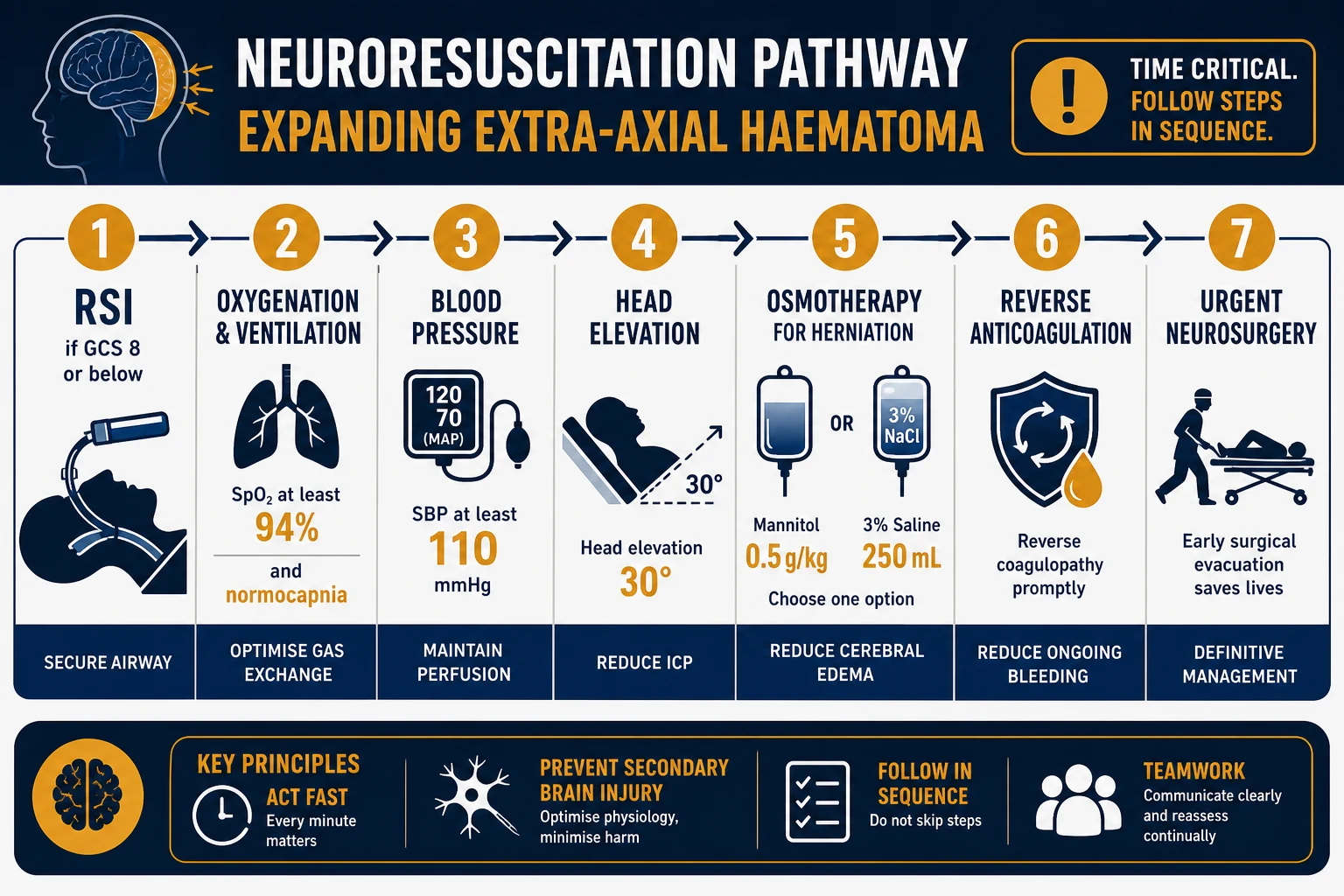
Definition and scope — what CRM is, and is not
Crisis resource management is the set of non-technical skills that a team uses to manage a dynamic, high-stakes event: leadership (allocating roles, setting priorities, standing back), communication (closed-loop, structured handover), situation awareness (perceiving, comprehending, projecting), decision-making (recognising and revising under uncertainty), and resource management (people, equipment, time). It is the complement of, not the substitute for, clinical knowledge: a perfectly coordinated team executing the wrong plan still harms the patient, and a brilliant clinician working solo in an uncoordinated team misses the diagnosis. Team-based care is the broader construct — the organisation of clinical work around defined teams with allocated roles, a shared mental model and a flattened hierarchy, whether in the resuscitation bay, on a cardiac arrest, on a trauma call, or in the day-to-day running of the department. CRM is the skill set; team-based care is the system in which the skill set operates.[2][3]
The CRM framework — the original aviation principles, translated
The original aviation Crew Resource Management identified that cockpit crews failed not because the pilots could not fly but because they did not communicate, did not share their mental model, did not speak up when they saw the error, and did not allocate tasks. The principles that followed have been refined by Gaba and others into the anesthetic crisis resource management framework that the emergency physician now inherits, and the seven core elements are reproduced in every CRM curriculum.[3]
[1]The CRM framework is distinct from, and complementary to, the clinical algorithm. The algorithm tells the team what to do; CRM tells the team how to do it together. A resuscitation that runs the algorithm perfectly but fails to allocate roles, share the mental model, or speak up against the leader will still fail the patient. [1]
TeamSTEPPS — the formalised team-training system
TeamSTEPPS — Team Strategies and Tools to Enhance Performance and Patient Safety — is the structured team-training program developed by the US Department of Defense and the Agency for Healthcare Research and Quality (AHRQ), and is the dominant team-training curriculum deployed across emergency departments in the United States and, in adapted form, internationally.[1] It is the operational translation of CRM principles into a teachable, deployable package — a set of named competencies, a set of named tools, and a structured implementation method (assess, train, sustain). TeamSTEPPS makes explicit what CRM leaves abstract: the junior nurse who would otherwise have no script is given CUS, the team leader who would otherwise have no template is given the brief, and the team that would otherwise have no shared mental model is given STEP. The four core competencies are the framework on which the toolkit is built.[1][2]
Communication
- The team exchanges information clearly and accurately, in real time, regardless of hierarchy
- Tools: SBAR/ISBAR handoff, call-out (the announcement of critical information to the whole team), check-back (the closed-loop readback), I-PASS handoff
- Failure mode: information held by one member and not received by the others — the silent assumption
Leadership
- The leader directs, coordinates, allocates resources, and ensures the team has a shared mental model
- Tools: brief (pre-event plan, who does what), huddle (ad-hoc realignment when the situation changes), debrief (post-event plus-delta)
- Failure mode: the leader who performs procedures and loses the overview
Situation monitoring
- The team continuously scans and reassesses the patient, the team, the environment, and the progress toward the goal — the active form of situation awareness applied across the team
- Tools: STEP cross-check (Status of the patient, Team members, Environment, Progress toward goal)
- Failure mode: task fixation, the tunnel on one task to the exclusion of the whole picture
Mutual support
- The team anticipates each other’s needs, redistributes workload, provides feedback, and asserts on safety concerns
- Tools: task assistance (offer before being asked), feedback (timely, respectful, specific), CUS, the two-challenge rule
- Failure mode: the steep authority gradient that suppresses the voice, and the workload pile-up on the fatigued member
The four competencies are mutually reinforcing: communication enables leadership, situation monitoring enables mutual support, and mutual support sustains the situation awareness the leader needs to lead. The competencies are not personality traits but learnable, drillable skills, and the TeamSTEPPS tools are the concrete scripts through which they are practised. The Fellowship candidate is expected to name the four competencies, the toolkit under each, and the failure mode each tool exists to prevent.[1]
The TeamSTEPPS situation-monitoring cross-check
STEP
The vital signs, the rhythm, the trajectory, the response to intervention — is the patient better, worse, or unchanged since the last cycle?
Who is here, what is each doing, who is fatigued, who is unoccupied — the leader reallocates workload to match capability and to relieve the exhausted
The bay, the equipment, the blood products, the family, the arriving consultant, the noise, the clock — the factors outside the patient that constrain or enable the resuscitation
Is the team closer to the objective — ROSC, source control, haemostasis, disposition — than it was 5 minutes ago? If not, the plan must change
Team roles in the emergency department
The emergency department operates with allocated team roles, each with a defined responsibility, and the allocation is made before the need for it arises — at the start of the shift, at the start of the arrest call, and on the arrival of the trauma patient. In the resuscitation team the roles are: the team leader who stands back and directs; the airway operator who manages the airway, ventilation and the front-of-neck access; the compressor who performs chest compressions and is rotated every two minutes; the defibrillator operator who analyses rhythm and delivers shocks; the drugs operator who prepares and administers drugs; the timekeeper and scribe who records interventions and cycle times; and the runner who fetches equipment and blood products.[11]
In the broader ED team the roles extend beyond the resuscitation bay: the team leader (typically the senior registrar or consultant), the treating clinician and treating nurse, the nurse-in-charge coordinating flow, the triage nurse, the consulting specialties (medical, surgical, critical care), the allied health (social work, physiotherapy), and the ward liaison for disposition. Manser's review of teamwork in dynamic clinical domains establishes that role clarity — knowing who does what, and who is in charge — is the single strongest predictor of effective team performance in emergencies.[3]
The resuscitation team mapped to ABCDE
The Fellowship candidate must be able to allocate the resuscitation team's roles onto the primary survey, because the ABCDE structure is the shared mental model that makes the allocation explicit and exhaustive. Each domain of the primary survey is owned by a named operator, and the team leader oversees the whole without owning any single domain. The mapping is the practical answer to the question "who is doing what, and who is in charge?"[11]
The resuscitation team — five named roles mapped to the patient
ROLES
The team member who fetches equipment, blood products, and the difficult-airway trolley; manages the warmers, the rapid infuser, and the blood gas analyser. Without the runner, the resuscitation stops for want of kit.
The airway doctor or nurse who owns the airway, the ventilation, the front-of-neck access, and the end-tidal CO2. Reports the view, the tube, and the trace to the leader through closed loop.
The named team leader — senior registrar or consultant — who does not touch the patient but calls the decisions, names the next step aloud, ensures every loop closes, and periodically summarises the picture. The leader owns the overview, never the procedure.
The compressor and the defibrillator operator own the circulation and the rhythm; the drugs operator owns the vasopressor, the fluid, and the antidote; the procedure operator owns the intercostal drain, the central line, theFAST scan. Each reports back through closed loop.
The team member who records every intervention, every drug with dose and time, every rhythm, every cycle time, and every response. The scribe’s record is the medico-legal note, the debrief feed, and the leader’s memory when the leader is task-saturated.
Allocating the resuscitation team on patient arrival — the 60-second sequence
Team leader calls the team together and allocates roles by name BEFORE the patient arrives or within 60 seconds of arrival: "I am the team leader and I will not touch the patient. Aisha owns the airway. Ben owns the defibrillator and the compressors. Chen owns the drugs. Davina is the scribe and timekeeper. Erik is the runner." Every role is named, every name is acknowledged.
The airway operator assesses and secures the airway with c-spine control if trauma; reports the airway status and the oxygen saturation through closed loop. The leader calls the next step — "prepare for RSI" — and the airway operator acknowledges.
The breathing operator assesses the chest — the rate, the effort, the symmetry, the breath sounds, the SpO2 — and reports. The leader calls the oxygen, the bronchodilator, the needle decompression, or the intubation as the findings dictate, each through closed loop.
The circulation operator assesses the pulse, the blood pressure, the perfusion, the capillary refill; secures two large-bore cannulae; takes the bloods. The leader calls the fluid, the blood product, the vasopressor, or the massive transfusion protocol. The drugs operator prepares and administers through closed loop.
The scribe records every intervention, every drug with dose and time, every rhythm, every cycle. The leader periodically summarises the picture aloud — the diagnosis, the interventions, the response, the plan — to keep the team on a shared mental model and to surface the omission.
The team leader stands back — the central CRM principle
The team leader's role is to stand back and maintain the situational awareness, not to perform the procedures. This is the single most-tested CRM principle in the Fellowship examination, and it is the principle most often violated in practice. The leader who intubates, who compresses, or who scans loses the overview of the patient, the team and the environment, and that loss is the proximate cause of the missed deterioration, the overlooked reversible cause, and the failure to escalate. The leader who intubates is no longer watching the rhythm, the drugs, the family, the clock, or the consultant walking through the door.[11]
The standing-back leader does four things: calls the decisions (the rhythm, the drug, the next step); names the next step aloud so the whole team shares the mental model; ensures every instruction is acknowledged through closed-loop communication; and periodically summarises the situation aloud — the diagnosis, the interventions, the response, the plan — so that the team holds a shared picture and the errors of omission surface. The standing-back leader also recognises fatigue and rotates the team, calls for senior or specialty help early, and makes the decision to terminate or to continue. The principle generalises beyond the arrest: the registrar leading the deteriorating ward patient, the consultant running the multiple-casualty incident, and the consultant teaching a junior at the bedside all stand back and direct rather than perform.[2]
[1]Closed-loop communication
The communication in the high-acuity setting is closed-loop: the leader gives a specific, directed instruction by name and by dose; the receiver reads it back to confirm; and the receiver confirms its administration. The loop is closed only by the final confirmation, which prevents the silent assumption that an instruction was followed when it was not. The communication is brief, loud enough to be heard, and free of the ambiguous phrasing that produces the wrong drug, the wrong dose or the wrong patient.[11][2]
The closed-loop communication — three spoken turns
LOOP
"Sarah, give adrenaline 1 milligram intravenously." The instruction names the person, the drug, the dose, and the route, and uses no ambiguous phrase such as "give the adrenaline" or "push the epi"
"Adrenaline 1 milligram intravenously, drawing up." The readback confirms the operator heard and understood exactly what the leader intended; a mismatch is caught before administration, not after
"Adrenaline 1 milligram intravenously given at 12:04." The final confirmation closes the loop; the scribe documents the drug, the dose, the route, and the time, and the leader moves on
The unclosed loop — the leader says "give the adrenaline", no one reads it back, and the leader assumes it was given — is the proximate cause of the missed drug in the failed resuscitation
The closed-loop principle applies not only to drugs but to every instruction under pressure: "Tom, check the blood pressure and call it out", "Priya, call the cath lab and ask them to expect the patient", "Marco, get the ultrasound on the chest". Each is acknowledged, executed, and reported back. The team that does not close the loop is the team in which the assumed-but-not-given adrenaline, the assumed-but-not-called consultant, and the assumed-but-not-checked allergy cause the harm. [1]
The structured handover — ISBAR and SBAR
The structured handover at the arrival of the patient, the transfer of care, or the telephone referral ensures that the receiving team inherits an accurate picture of the patient, the interventions and the plan without having to reconstruct it. The dominant structure is SBAR (Situation, Background, Assessment, Recommendation), formalised by Haig and colleagues at Kaiser Permanente as a shared mental model that reduces the variation and the omission in clinical handover. SBAR was designed to flatten the authority gradient: by giving the caller a structured script that ends with an explicit recommendation, it forces the junior who would otherwise say "what do you think, doctor?" to instead state "I think this patient has septic shock and needs fluids and antibiotics now."[6]
The variant used across the ACEM and ILCOR curriculum is ISBAR, which adds an Identifier at the front — the patient's name, age and location — so that the receiver knows immediately who and where the patient is. The ambulance-to-ED handover extends further to IMIST-AMBO (Identifier, Mechanism/Medical complaint, Injuries/Information, Signs, Treatment/ Trends; Assessment, Mechanism/Medical, Background, Other information), a structure developed for paramedic-to-ED handover that ensures the receiving team captures the prehospital story in a standardised order. [1]
The structured handover — six elements in order
ISBAR
Name, age, sex, location, and the name and role of the person giving the handover — "This is Dr Lee, registrar. The patient is John Smith, a 64-year-old man in resus bay 2."
The presenting problem and its timeframe — "Brought in by ambulance 10 minutes ago after a witnessed collapse at home, now in pulseless electrical activity."
The relevant past history, medications, allergies, and the premorbid state — "Known ischaemic heart disease, on aspirin and atorvastatin, no known allergies, independent at home."
The current findings — vital signs, examination, the working diagnosis, the investigations done — "Pulse 30, blood pressure unrecordable, airway patent, IV access in situ, bedside ultrasound shows a pericardial effusion."
The ask — what the caller needs from the receiver, with a timeframe — "I need the cardiology team and the echo here now for what I believe is a pericardial tamponade."
I-PASS — the handoff mnemonic validated to reduce medical error
Where ISBAR/SBAR is the generic communication structure (useful for the single phone call, the single referral, the single escalation), I-PASS is the handover structure designed and validated specifically for the shift-to-shift transfer of care, where the volume of information is large, the receiver is taking over continuity, and the risk of the missed task is high. The mnemonic was developed by Starmer, Spector, Sectish and the I-PASS study group and validated in the I-PASS study, a cluster-randomised trial across nine paediatric residency programs in which the introduction of the I-PASS handoff bundle reduced medical errors by 23 per cent and preventable adverse events by 30 per cent, without a change in workflow duration.[12][13]
The structured shift handover — five elements
I-PASS
A one-word stability stratification — stable, “watcher” (at risk of deterioration), or unstable — that tells the receiver immediately how closely to watch the patient
The summary statement — the presenting problem, the working diagnosis, the hospital course, the current state, the active issues tonight
The to-do list — each outstanding task with the responsible person and the timeframe: “recheck the haemoglobin at 22:00, transfuse if below 70, call surgery if it drops”
The plan-if: “if the blood pressure drops, give a 500 mL saline bolus and call me; if the patient becomes distressed, this is what I think is happening and this is what I would do” — the receiver inherits not just the task list but the anticipated contingencies
The receiver reads back the summary, the action list, and the contingencies in their own words — the closed-loop confirmation that the handover was received accurately. This is the step that closes the handoff loop
I-PASS Handoff Study (Starmer et al, 2014)
Prospective, cluster-randomised (by residency program), pre-post with intervention and control sites, 9 paediatric residency programs, ~10,740 patient admissions
Population: Paediatric residency programs across North America; handoff training intervention delivered to residents
Comparator: Standard handoff practice (pre-intervention at the same sites, and concurrent control sites)
Key finding
Medical errors fell 23% (24.5 to 18.8 per 1000 patient-days; rate ratio 0.77, 95% CI 0.62–0.96); preventable adverse events fell 30% (4.7 to 3.3 per 1000 patient-days). No change in handoff duration or verbal-pagination rate. Written handoff quality improved.
Practice change
A structured, trained, closed-loop handoff bundle is among the few interventions in patient safety shown in a rigorous multi-site trial to reduce medical error and preventable harm. The mechanism — illness severity up front, an explicit action list, contingency planning, and readback by the receiver — generalises to every shift-to-shift handover in the ED.
The I-PASS and SBAR/ISBAR structures serve different purposes and are complementary, not competing. SBAR/ISBAR is for the single episode of communication (the phone call to the consultant, the escalation to the boss, the referral); I-PASS is for the transfer of continuity (the end-of-shift handover, the ward round handover, the ED-to-ward handover). The Fellowship candidate should know both, should recognise that SBAR is the open-ended script and I-PASS the continuity script, and should be able to apply the right structure to the situation.[12][13]
[1]Situation awareness — the three levels
Situation awareness, formalised by Endsley in the human-factors literature, is the perception of the elements in the environment, the comprehension of their meaning, and the projection of their status into the near future. The model has three levels, and the loss of any one of them degrades the team's decision-making.[3]
Level 1 is perception — the gathering of the raw data, the vital signs, the monitor, the examination findings, the rhythm strip, the family at the bedside. Level 2 is comprehension — the integration of that data into a working picture, the recognition that the hypotensive, tachycardic, oliguric patient with the lactate of 6 is in shock, and the distinction of the type. Level 3 is projection — the anticipation of what will happen next, the recognition that this patient will arrest in the next 10 minutes unless the source is found and treated, and the preparation for it. The team leader's standing-back role exists to preserve all three levels; the leader who is hands-on at the airway loses perception of the monitor, comprehension of the trajectory, and projection of the next deterioration. [1]
The threats to situation awareness are the same threats the CRM framework catalogues: task fixation (the tunnel on one task to the exclusion of all else), cognitive tunnel (the single working diagnosis that excludes the alternatives), interruptions, fatigue, noise, and information overload. The countermeasures are the structured ABCDE reassessment at every cycle, the explicit summary aloud, the invitation of dissent, and the rotation of the fatigued. [1]
Fixation error and cognitive bias
The fixation error is the failure to revise a working diagnosis in the face of contradictory information, and it is the non-technical-skill failure that the team leader must actively counter. The clinician who anchors on the first diagnosis — the "gastroenteritis" that is actually septic shock, the "panic attack" that is pulmonary embolism, the "asthma" that is the tension pneumothorax — pursues the wrong treatment while the patient deteriorates. Croskerry's work on cognitive bias in emergency medicine establishes that diagnostic error is dominated not by knowledge gaps but by cognitive failures — anchoring, premature closure, availability, confirmation bias, search-satisficing — and that these are amplified by stress, fatigue and time pressure.[10]
This and nothing else
- The clinician fixates on a single diagnosis and excludes all others — the abdominal pain called gastroenteritis that is mesenteric ischaemia, the chest pain called musculoskeletal that is the infarct
- The most dangerous of the three because the contrary evidence is actively filtered out
- Defence: the structured ABCDE reassessment, the explicit naming of at least three alternative diagnoses aloud, the forced question "what else could this be?"
This and then everything else
- The clinician abandons the working diagnosis at the first contrary finding and pursues a long list of alternatives without prioritisation
- Causes cognitive overload, scattered investigation, and delayed definitive treatment
- Defence: maintain a leading diagnosis with an active differential, return to the primary survey, and treat the immediately life-threatening first
Everything but this
- The clinician refuses to consider the obvious or the life-threatening diagnosis — the young woman with breathlessness in whom pulmonary embolism is dismissed because "she is too young"
- The mirror image of the first type: the right answer is excluded from the start
- Defence: the explicit kill-chain question "what will kill this patient in the next hour?", and the rule that no diagnosis is excluded without evidence
The cognitive biases that drive fixation error are universal, and they are mitigated not by exhortation but by structured process. The leader who names the alternatives aloud, who asks the team "what am I missing?", who invites the dissenting opinion, and who performs the structured ABCDE reassessment at every cycle is the leader who resists fixation. The leader who intubates in silence and pursues the first diagnosis is the leader who misses the tension pneumothorax.[10]
Decision-making under uncertainty — recognition-primed and shared
The team leader in the ED rarely has the complete information that the textbook algorithm assumes; the decision to intubate, to thrombolyse, to activate the massive transfusion protocol, or to transfer to the angiography suite is made on partial data, under time pressure, with the diagnosis still forming. The CRM and human-factors literature, drawing on Gary Klein's work on naturalistic decision-making, distinguishes two modes the leader uses. Recognition-primed decision-making (RPD) is the experienced clinician's pattern-matching: the leader recognises the situation as a type seen before, retrieves the action that worked then, mentally simulates whether it will work now, and acts — fast, and accurate when the pattern is genuinely familiar. Analytical (comparative) decision-making is the deliberate generation and weighing of alternatives — slower, more reliable in the novel case, but cognitively expensive and slow under load.[10]
The skilled ED leader uses both, and knows when to switch. RPD is fast and right when the pattern is classic (the anaphylaxis, the obvious STEMI, the witnessed VF arrest); it is fast and wrong when the pattern is a trap (the "gastroenteritis" that is septic shock, the "COPD" that is the tension pneumothorax). The defence against the RPD trap is the deliberate switch to analysis at the structured reassessment: at every cycle, or whenever the patient is not responding as expected, the leader stops, names the working diagnosis aloud, names at least three alternatives aloud, and asks the team "what am I missing?" — the forced return to analytical mode that breaks the fixation.[10]
Recognition-primed (RPD)
- The leader pattern-matches the situation to a familiar type, retrieves the action that worked before, mentally simulates it, and acts
- Fast, low cognitive cost, accurate when the pattern is genuinely familiar and not a trap
- Use: the classic, the time-critical, the previously-seen pattern — the anaphylaxis, the STEMI, the VF arrest
- Failure mode: the pattern that looks familiar but is not — the fixation error, the anchoring bias
Analytical (comparative)
- The leader deliberately generates the differential, weighs the alternatives against the evidence, and chooses the best-supported option
- Slower, higher cognitive cost, more reliable in the novel or the ambiguous case
- Use: the undifferentiated, the not-responding, the atypical — the diagnostic dilemma, the deteriorating patient without a working diagnosis
- Failure mode: analysis paralysis, the delayed action in the time-critical case
Authority gradient and psychological safety
The authority gradient is the perceived power distance between team members — the steepness of the hierarchy — and a steep gradient suppresses the subordinate who sees the error. The junior nurse who watches the wrong drug drawn up, the registrar who sees the misplaced tube, the paramedic who heard the wrong handover: each holds a piece of information that could avert the harm, and each, in a steep-gradient team, does not speak. The CRM literature is unequivocal that the steep authority gradient is a leading contributor to adverse events, and that the flattened, psychologically safe team is the safer team.[2][3]
Psychological safety is the shared belief that the team is safe for interpersonal risk-taking — that one can ask a question, voice a concern, admit an error, or challenge a senior without fear of humiliation or punishment. Amy Edmondson's work, and its extension into healthcare by Nembhard and Edmondson, establishes that psychological safety is the substrate on which speaking-up behaviour, error reporting and learning depend. The team leader creates it by leader inclusiveness — the explicit invitation of dissent, the thanks for the challenge, the acknowledgement of error — and by modelling fallibility ("I might be wrong here; tell me what you see"). [1]
Graded assertiveness — the script to speak up the gradient
The structured speaking-up tools are only effective if the team member knows how to escalate when the first verbal concern is met with dismissal. Graded assertiveness is the technique of escalating the language and the authority of the challenge in proportion to the unmet safety risk, and it is the operational defence against the steep gradient that kills patients. The clinician who would otherwise go silent after a single rebuffed "doctor, are you sure that’s the right dose?" is given a graded ladder of phrases that climb from the polite inquiry to the unambiguous safety stop, with each rung understood and accepted in advance by the whole team.[1][2]
The graded assertiveness ladder — three rungs of escalating concern
CUS
The opening rung — a polite, non-accusatory naming of the worry: “I am concerned that the potassium is rising.” It opens the door without confrontation and lets the leader self-correct with face intact
The second rung, when the first is unheeded — a stronger, more personal escalation: “I am uncomfortable continuing the potassium infusion until we have a repeat level.” It signals that the team member is no longer at ease with the plan
The third and final rung — the unambiguous safety stop: “This is a safety issue. I am stopping the infusion.” The phrase is the trigger that obliges the team to halt and reassess, and is the verbal equivalent of pulling the fire alarm
The graded assertiveness ladder — a worked example in the ED
Open with C — the concern. Nurse: "Dr Khan, I am concerned that this patient’s systolic has dropped from 110 to 76 since the metoprolol." The phrase is polite, names the worry, and invites the leader to reconsider.
If unheeded, climb to U — the discomfort. Leader (dismissive): "It’s fine, his rate’s come down nicely." Nurse: "Dr Khan, I am uncomfortable giving the second dose of metoprolol while his pressure is falling." The escalation is explicit, the discomfort is owned, and the second dose is the named safety-critical step.
If still unheeded, invoke S and the two-challenge rule. Leader (still dismissive): "Give the dose." Nurse: "This is a safety issue. I have raised this twice. I am not giving the second metoprolol until we reassess the blood pressure and call the boss." The two-challenge threshold is met; the nurse escalates to the nurse-in-charge and the consultant.
The loop closes on the reassessment. The consultant attends, the metoprolol is held, the patient’s dropping pressure is recognised as early cardiogenic shock, the plan changes. The graded assertiveness averted the harm — and the post-event debrief names the nurse’s escalation as the save.
The debrief
The debrief after the event — resuscitation, critical incident, cardiac arrest, or the difficult shift — is the mechanism by which the team learns from the event, the individual processes the emotional impact, and the system identifies the improvement points. The debrief is brief, structured, non-judgemental, and focused on team performance and system factors rather than individual blame. Tannenbaum and Cerasoli's meta-analysis confirms that team debriefs improve performance across healthcare, military, and aviation settings, with larger effects when the debrief is structured and when the whole team participates.[5]
The two main forms are the hot debrief, run immediately after the event with the team present and still in the room, and the cold debrief, run days later with a structured review of the record, the team's reflections, and the system findings. The hot debrief is brief — five to 10 minutes — and uses the plus-delta format: what went well (the plus) and what to change next time (the delta). The cold debrief is longer, multidisciplinary, and feeds into the formal incident review or root cause analysis. The omission of either is the omission of the learning opportunity, and the omission of the hot debrief is additionally the omission of the immediate psychological support that protects the team from the second-victim effect.[5][11]
Simulation — rehearsal and latent-threat identification
The team competencies of CRM are taught and maintained through simulation training, which allows the team to rehearse the rare and the high-stakes scenarios in a safe environment. Salas and colleagues' meta-analysis confirms that team training — and simulation-based team training in particular — improves team performance, with the largest effects when the training is structured, when it includes the actual clinical team, and when it is repeated.[4]
The variant with the greatest ED yield is in-situ simulation, run in the actual resuscitation bay with the actual on-shift team and the actual equipment. In-situ simulation achieves what the simulation centre cannot: it identifies the latent safety threats — the missing kit, the broken defibrillator, the inaccessible drug, the unclear pathway, the team that does not know each other's names — that exist in the real environment and surface only when the team is stressed. The in-situ simulation that finds a latent threat and fixes it before the real patient arrives is one of the highest-yield interventions in ED safety. The regular, multidisciplinary, realistic simulation is the foundation of the competent emergency team.[4][11]
The empirical case for in-situ simulation in the ED is anchored in Patterson and colleagues' high-risk emergency department study, in which 54 in-situ simulations over 12 months identified 50 distinct latent safety threats — equipment failures, missing supplies, unclear roles, inaccessible drugs, and knowledge gaps — that the team then corrected before a real patient was exposed to them.[14] The finding generalises: the latent safety threat is invisible until the team is stressed, and only in-situ simulation stresses the actual team in the actual environment. The simulation centre teaches the skill; the in-situ simulation finds the broken defibrillator, the empty suction, the locked cupboard, and the team who do not know each other's names.[4][14]
Patterson et al — in-situ simulation in a high-risk ED (2013)
Prospective observational study; 54 in-situ simulations conducted over 12 months in a high-acuity emergency department (paediatric and adult) with the actual on-shift clinical teams
Population: ED physicians, nurses, and technicians on their actual shifts, in the actual resuscitation bays, with the actual equipment
Comparator: No comparator; pre-post threat identification and team-training assessment
Key finding
50 latent safety threats identified across 54 simulations (mean 0.9 per simulation) — equipment failures, medication-access problems, knowledge gaps, and system/role failures. Teamwork scores improved significantly over the study period.
Practice change
In-situ simulation is a high-yield method for surfacing latent safety threats that are invisible in routine operations and that the simulation centre cannot find. The ED that runs regular in-situ simulation finds and fixes its broken systems before the real patient arrives.
Human factors — the systems approach to ED error
The discipline of human factors (ergonomics) is the applied science of designing systems, equipment and processes that fit the cognitive and physical limits of the humans who work within them, and it is the conceptual scaffold beneath every CRM intervention. The ED is a human-factors challenge of the highest order: high cognitive load, frequent interruption, time pressure, noisy environment, shift fatigue, and a heterogeneous patient population with undifferentiated illness. The human-factors analysis of ED error shifts the question from "who failed?" to "what system allowed a competent clinician to fail?" — and the answer is almost always a system that asked the human to do what humans do badly (hold information in memory, sustain vigilance, resist bias under stress) without an engineered defence.[10]
The organising model is James Reason's Swiss cheese model of accident causation. The healthcare system is conceived as a series of defensive layers — the clinician's knowledge, the team's communication, the checklist, the double-check, the alarm, the supervisor — each of which has holes (the fatigue, the distraction, the ambiguous order, the silenced alarm, the absent supervisor). An error reaches the patient and causes harm only when the holes in every layer align momentarily, allowing the trajectory of accident opportunity to pass through. The implication is twofold: first, no single layer is reliable on its own — the defence-in-depth principle demands multiple, independent layers; second, the proximate human error at the sharp end is rarely the root cause — the latent conditions (the undersupplied kit, the ambiguous protocol, the inadequate staffing, the untrained team) set the holes in the layers, and they are the real target of the system fix.[3]
Sharp end — active failures
- The errors made by the clinician at the point of care — the wrong dose, the missed allergy, the un-closed loop, the fixation error, the un-called senior
- Often visible and often blamed; the proximate cause of the harm
- Examples: the registrar who gives the wrong dose, the nurse who does not read back, the leader who intubates and loses oversight
- Addressed by CRM skills: closed-loop communication, role allocation, situation awareness, graded assertiveness
Blunt end — latent conditions
- The systemic conditions that set the holes in the defensive layers — the understaffing, the inadequate training, the broken equipment, the ambiguous protocol, the inaccessible drug, the absent supervisor, the punishing culture
- Often invisible until an event surfaces them; the root cause that the human-factors analysis seeks
- Examples: the ED without an in-situ simulation program, the trust that punishes error reporting, the design of the resus bay that puts the suction out of reach
- Addressed by systems engineering: checklists, cognitive aids, in-situ simulation, just culture, staffing, environmental design
The common human-factors contributors to ED error are the conditions the system must engineer against: interruptions (the cognitive cost of switching tasks compounds across a shift; each interruption doubles the error rate on the interrupted task), cognitive overload (the team holding more information than working memory supports), fatigue and sleep deprivation (the night-shift cognitive performance parallels legal alcohol intoxication), noise and poor lighting, inaccessible or poorly designed equipment, ambiguous labelling and similar drug names, and the punishing culture that suppresses error reporting and prevents learning. The countermeasures are the CRM toolkit plus the engineered defences: the quiet zone for the prescribing step, the standardised drug storage, the barcode verification, the checklist, the cognitive aid, and — above all — the just culture that distinguishes the honest error (to be learned from) from the reckless act (to be sanctioned).[10][3]
Error prevention — checklists and cognitive aids
The checklist and the cognitive aid are the engineered defences that offload memory and vigilance in the high-stress environment, and they are among the few interventions in patient safety with randomised-trial evidence of mortality reduction. Haynes and colleagues' global trial of the WHO surgical safety checklist reduced complications by 36 per cent and mortality by 47 per cent across eight hospitals in high-, middle- and low-income settings — an effect size rarely matched by any drug in medicine.[7] Pronovost and colleagues' central-line bundle, built around a five-item checklist, reduced catheter-related bloodstream infections in Michigan intensive care units to near-zero and sustained the reduction.[8] The mechanism is the same in both: the checklist forces the steps that evidence shows save lives, offloads the memory of the fatigued, and flattens the gradient by giving every team member — nurse, registrar, consultant — the same script from which to challenge an omission.
The cognitive aid — the algorithm wall chart, the drug-dosing card, the Broselow tape for paediatric weight-based dosing — works by the same principle. The arrest algorithm printed on the wall beside the bed does not replace the leader's knowledge; it ensures that the fatigued leader at 03:00 does not omit the amiodarone, does not forget the reversible cause, and gives the registrar a reference from which to challenge. The ILCOR Education, Implementation and Teams consensus endorses cognitive aids as a standard of resuscitation.[11]
[1] [1]Management — applying CRM at the bedside, with closed-loop drug administration
The clinical management of the deteriorating or arrested patient is inseparable from its team management: the right drug given to the wrong patient, or the right dose assumed-but-not-given, fails the patient as surely as the wrong diagnosis. The team leader applies CRM by allocating roles, standing back, and directing every drug through closed-loop communication. The high-yield drugs the team leader must know by name and dose — because the drugs operator and the scribe look to the leader for the dose and the route — are: adrenaline 1 mg intravenously or intraosseously every three to five minutes in cardiac arrest (or 500 micrograms intramuscularly for anaphylaxis); amiodarone 300 mg intravenously after the third shock in shockable rhythms (then 150 mg after the fifth); calcium chloride 1 g intravenously (10 mL of 10 per cent) for hyperkalaemia or calcium-channel-blocker toxicity; 10 per cent dextrose 25 g (250 mL) intravenously for hypoglycaemia in the adult; naloxone 0.4 mg intravenously, titrated in 0.04 to 0.1 mg increments, for opioid toxicity; and tranexamic acid 1 g intravenously over 10 minutes for traumatic haemorrhage, repeated at 1 g over 8 hours. Each is spoken aloud by name and dose, read back by the operator, confirmed on administration, and documented by the scribe.[11]
[1] [1] [1]Differential — the modes of team failure
When a resuscitation fails or a patient is harmed, the team failure that contributed is rarely a single event; it is a pattern. The patterns below are the high-yield diagnoses the Fellowship candidate must distinguish, because each carries a different countermeasure and a different lesson for the debrief and the system review.[2][9]
Solo-practice failure
- The single clinician attempts to manage the deteriorating patient alone — no team assembled, no roles allocated, no help called
- The classical ED failure: the registrar who "manages" the septic patient at the bedside without a nurse, a senior, or a structured response
- Countermeasure: assemble the team early, allocate roles, and call the senior before the arrest, not after
Communication breakdown
- The information is held by one team member and not received by the others — the closed loop that is not closed, the handover that omits the critical detail, the readback that is skipped
- The Joint Commission identifies communication as the leading root cause of sentinel events
- Countermeasure: closed-loop communication for every critical order, the structured ISBAR handover, and the explicit summary aloud at each cycle
Authority-gradient suppression
- The subordinate sees the error and does not speak — the junior nurse who watches the wrong drug, the registrar who sees the misplaced tube, the paramedic who heard the wrong handover
- The steep hierarchy is the proximate cause; the subordinate has the information but no script to voice it
- Countermeasure: psychological safety, leader inclusiveness, CUS, the two-challenge rule, and a flattened, named-team culture
Fixation error
- The team anchors on the first diagnosis and pursues it despite contradictory evidence — the asthma that is the tension pneumothorax, the gastroenteritis that is septic shock
- A cognitive failure amplified by stress and fatigue, not a knowledge gap
- Countermeasure: structured ABCDE reassessment at every cycle, explicit naming of three alternatives, and the forced question "what else could this be?"
Resource and coordination failure
- The team, the equipment, the blood products, or the help do not arrive in time — the un-summoned consultant, the un-found difficult-airway trolley, the un-activated massive transfusion protocol
- A failure of resource management and anticipation, distinct from a failure of clinical knowledge
- Countermeasure: the team leader stands back, anticipates one step ahead, calls for help early, and runs the pre-event brief
Common errors and pitfalls
The recurring failures are those the framework exists to prevent. The leader who performs procedures loses situational awareness and oversight; the leader stands back and directs. The unclosed loop — the leader gives the order, no one reads it back, and the leader assumes it was followed — is the proximate cause of the missed drug. The steep authority gradient suppresses the subordinate who sees the error; the flat, psychologically safe team invites the dissent. The unaddressed fixation error anchors the team on the wrong diagnosis; the structured reassessment and the explicit naming of alternatives break it. The absent or unstructured debrief throws away the learning and the support; the plus-delta hot debrief captures both. The simulation without fidelity — the wrong team, the wrong environment, the unrealistic scenario — identifies nothing; the in-situ simulation with the actual team finds the latent threats. The checklist run during rather than before the procedure is noise; the checklist is a pre-procedure cognitive aid. The cognitive aid that is not displayed — the arrest algorithm in the drawer, the drug-dosing card in the folder — fails when the fatigued leader needs it. The team without role allocation — everyone at the bedside, no one in charge — is the team that misses the reversible cause. The help called too late is the help that arrives after the arrest. [1]
Evidence and regional guidelines
The evidence base for team-based care and CRM in healthcare is grounded in the translation of aviation Crew Resource Management by Gaba and colleagues, and synthesised in Manser's review of teamwork in dynamic clinical domains, in the Buljac-Samardzic umbrella review of CRM in healthcare, and in the Buljac-Samardzic systematic review of team-effectiveness interventions.[2][1][3] The team-training evidence is consolidated in Salas and colleagues' meta-analysis of team training, and the debrief evidence in Tannenbaum and Cerasoli's meta-analysis.[4][5] The structured handover is anchored in Haig and colleagues' SBAR work, the checklist evidence in Haynes and Pronovost, the team-behaviour outcome link in Mazzocco, the cognitive-error literature in Croskerry, and the resuscitation-specific CRM in the ILCOR Education, Implementation and Teams consensus.[6][7][8][9][10][11]
ANZ practice note. The Australian Resuscitation Council and New Zealand Resuscitation Council (ANZCOR) publish guidelines on team resuscitation and crisis resource management that mandate allocated roles, a standing-back team leader, closed-loop communication and a structured debrief.[11] The Australian Commission on Safety and Quality in Health Care (ACSQHC) embeds teamwork, communication and structured handover in the National Safety and Quality Health Service (NSQHS) Standards, in particular Standard 1 (Clinical Governance) and Standard 6 (Communicating for Safety). The ACEM positions teamwork and leadership as core Fellow attributes in the ACEM Curriculum Framework, and the ACEM Policy on the Emergency Medicine Workforce specifies the team-based model of ED care. The Australian Patient Safety Foundation and the state-based incident-reporting systems capture the team-failure events for system learning.
SAQ — The team leader in the cardiac arrest
10 minutes · 10 marks
You are the consultant on shift when the arrest call sounds for a 64-year-old man in the waiting room. On your arrival in the resuscitation bay the team is assembling: two nurses, a registrar, an intern and a technician. The monitor shows a ventricular fibrillation. You take the role of the team leader.
SAQ — The near-miss from the fixation error and the steep authority gradient
10 minutes · 10 marks
A junior nurse on the resuscitation team notices that the patient who is being treated for a presumed asthma exacerbation has absent breath sounds on the right side and a deviated trachea, but her verbal concern is dismissed twice by the team leader. The patient deteriorates and a tension pneumothorax is eventually recognised and decompressed. The patient survives.
Exam pearls
- CRM = non-technical skills: leadership, communication, situation awareness, decision-making, resource management — the how, complementing the algorithm's what.
- Team leader stands back: the single most-tested CRM principle; the leader who intubates, compresses or scans has lost the overview.
- Closed-loop communication = LOOP: Leader directs by name and dose, Operator reads back, Operator confirms, Pre-empt the silent assumption. The unclosed loop is the missed drug.
- ISBAR = Identify, Situation, Background, Assessment, Recommendation. SBAR drops the Identifier. IMIST-AMBO extends the ambulance-to-ED handover.
- Situation awareness has three levels: perception (gather data), comprehension (integrate to a working picture), projection (anticipate the next deterioration).
- Fixation error has three types: this-and-nothing-else (the dangerous one), this-and-then-everything-else (the scattered one), everything-but-this (the excluded one). Defence: ABCDE reassessment, name three alternatives aloud, "what else could this be?"
- Authority gradient: steep gradient suppresses voice; psychological safety invites it. CUS = Concerned, Uncomfortable, Safety. Two-challenge rule = voice twice, escalate.
- Plus-delta debrief: what went well (plus) and what to change (delta), hot and brief, with the whole team.
- Checklists save lives by evidence: Haynes WHO surgical checklist (complications down 36 per cent, mortality down 47 per cent); Pronovost central-line bundle (CLABSI near-zero).
- In-situ simulation finds latent threats that the simulation centre cannot — run it in the real bay with the real team.
- TeamSTEPPS = the formalised US team-training program (AHRQ) with four core competencies — communication, leadership, situation monitoring, mutual support — and a toolkit under each: SBAR, call-out, check-back, I-PASS (communication); brief, huddle, debrief (leadership); STEP (situation monitoring); CUS, two-challenge rule, task assistance (mutual support).
- I-PASS = the validated shift handoff — Illness severity, Patient summary, Action list, Situation awareness and contingency planning, Synthesis by receiver (readback). The I-PASS study (Starmer 2014, NEJM) cut medical errors 23% and preventable adverse events 30%. ISBAR is for the single episode; I-PASS is for the transfer of continuity.
- STEP = the TeamSTEPPS situation-monitoring cross-check — Status of the patient, Team members, Environment, Progress toward goal. The structured scan the leader runs at each cycle to preserve situation awareness across the team.
- Graded assertiveness = CUS (I am Concerned, I am Uncomfortable, this is a Safety issue) + the two-challenge rule (voice twice, then escalate or assume control of the safety-critical step). Assertiveness, not aggression — escalate language and clarity, not volume.
- Swiss cheese model (Reason) = defence in depth — every defensive layer has holes; harm occurs only when holes align across all layers. Sharp end = active failures by the clinician at the point of care; blunt end = latent conditions (staffing, equipment, culture, protocol) that set the holes. The root cause analysis must reach the blunt end.
- Decision-making under uncertainty — recognition-primed (RPD: pattern-match, retrieve, simulate, act — fast, right when the pattern is genuine) vs analytical (generate and weigh alternatives — slower, reliable in the novel case). The unexpected non-response to treatment is the trigger to switch from RPD to analytical and re-examine the diagnosis.
- Task management and workload — delegate to match capability, rotate the fatigued every ~2 minutes during compressions, call for help early (before the arrest, not after), and think one step ahead. Task saturation in the leader is the proximate cause of the missed deterioration.
- Brief / huddle / debrief — the three TeamSTEPPS leadership events: brief (before, builds the shared mental model), huddle (ad-hoc, realigns when the situation changes), debrief (after, plus-delta). The team that runs all three learns from every event. [1]
Red flags
[1]References
- [1]Buljac-Samardzic M, Doekhie KD, van Wijngaarden JDH. Interventions to improve team effectiveness within health care: a systematic review of the past decade Hum Resour Health, 2020.PMID 31915007
- [2]Buljac-Samardzic M, Alexandrova Katalin N, Lopes S, et al. What Do We Really Know About Crew Resource Management in Healthcare?: An Umbrella Review on Crew Resource Management and Its Effectiveness J Patient Saf, 2021.PMID 34852415
- [3]Manser T. Teamwork and patient safety in dynamic domains of healthcare: a review of the literature Acta Anaesthesiol Scand, 2009.PMID 19032571
- [4]Salas E, DiazGranados D, Klein C, et al. Does team training improve team performance? A meta-analysis Hum Factors, 2008.PMID 19292013
- [5]Tannenbaum SI, Cerasoli CP. Do team and individual debriefs enhance performance? A meta-analysis Hum Factors, 2013.PMID 23516804
- [6]Haig KM, Sutton S, Whittington J. SBAR: a shared mental model for improving communication between clinicians Jt Comm J Qual Patient Saf, 2006.PMID 16617948
- [7]Haynes AB, Weiser TG, Berry WR, et al. A surgical safety checklist to reduce morbidity and mortality in a global population N Engl J Med, 2009.PMID 19144931
- [8]Pronovost P, Needham D, Berenholtz S, et al. An intervention to decrease catheter-related bloodstream infections in the ICU N Engl J Med, 2006.PMID 17192537
- [9]Mazzocco K, Pettiti DB, Fong KT, et al. Surgical team behaviors and patient outcomes Am J Surg, 2009.PMID 18789425
- [10]Croskerry P. Achieving quality in clinical decision making: cognitive strategies and detection of bias Acad Emerg Med, 2002.PMID 12414468
- [11]Greif R, Bhanji F, Bigham BL, et al. Education, Implementation, and Teams: 2020 International Consensus on Cardiopulmonary Resuscitation and Emergency Cardiovascular Care Science With Treatment Recommendations Resuscitation, 2020.PMID 33098918
- [12]Starmer AJ, Spector ND, Srivastava R, et al. Changes in medical errors after implementation of a handoff program N Engl J Med, 2014.PMID 25372088
- [13]Starmer AJ, Spector ND, Srivastava R, Allen AD, Landrigan CP, Sectish TC. I-pass, a mnemonic to standardize verbal handoffs Pediatrics, 2012.PMID 22232313
- [14]Patterson MD, Geis GL, Falcone RA, LeMaster T, Wears RL. In situ simulation: detection of safety threats and teamwork training in a high risk emergency department BMJ Qual Saf, 2013.PMID 23258390