EM · Communication and breaking bad news
Breaking bad news and communication in the emergency department — the SPIKES framework
Also known as SPIKES protocol · Breaking bad news · Death notification · Open disclosure · Goals-of-care discussion
Breaking bad news and difficult communication in the emergency department — the SPIKES six-step protocol (Setting, Perception, Invitation, Knowledge, Emotion, Strategy/Summary), the governing principles of privacy, protected time, sitting down, silence, empathy and the warning shot, and the four high-stakes ED scenarios of death notification, the peri-arrest goals-of-care discussion, the medical-error disclosure and the new life-changing diagnosis. Covers the symptom-control pharmacology of the peri-arrest and dying patient, cultural considerations, open-disclosure obligations, and the clinician debrief and self-care. The framework is the centrepiece of the ACEM and FRCEM OSCE communication stations. ACEM-primary, globally tagged.
On this page & tools
Your progress
Saved locally on this device.
8 MCQs with explanations
Target exams
Red flags
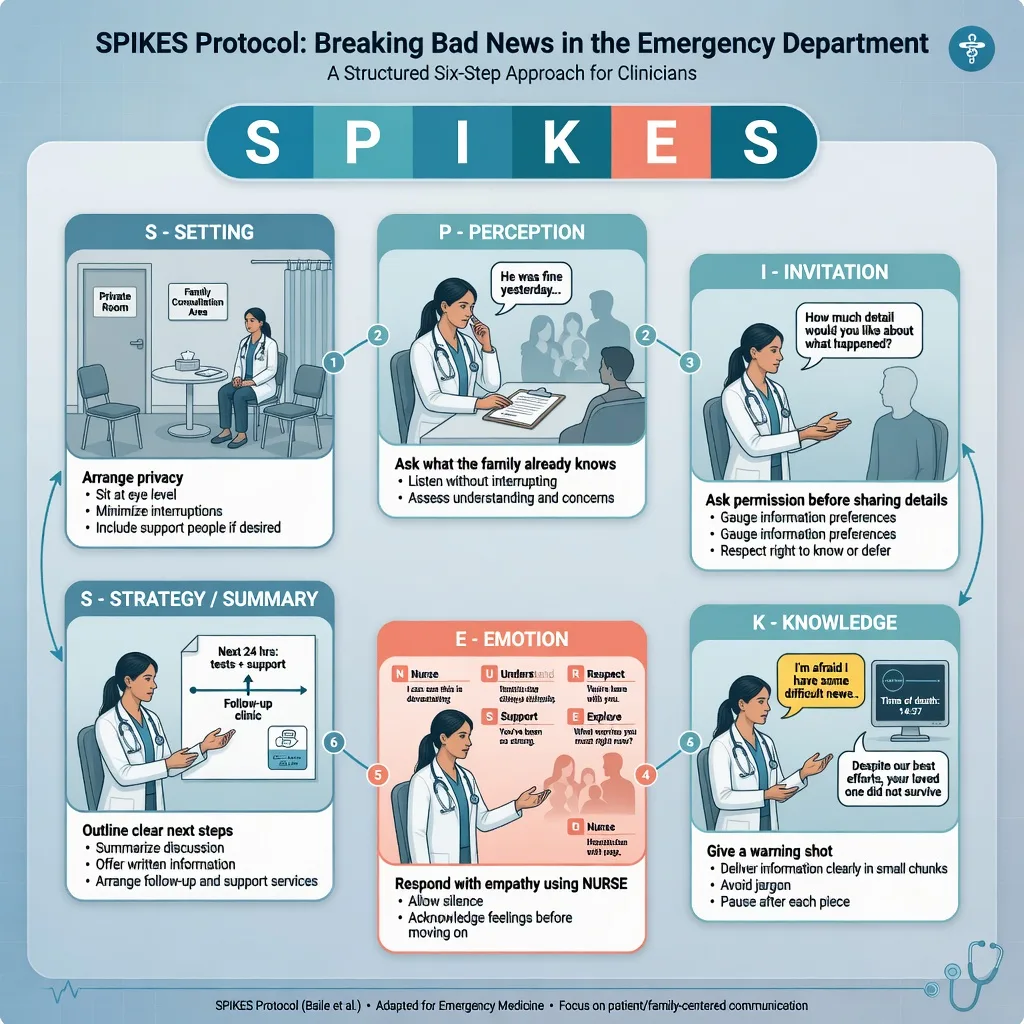
Breaking bad news is the single most feared clinical task in emergency medicine, and it is examined directly in every Fellowship OSCE. Bad news is any information that adversely and seriously alters a person's view of their future — a death, a terminal diagnosis, a catastrophic disability, or the disclosure that an error was made. The SPIKES protocol, first described by Baile and Buckman for the oncology consultation, is the structured, evidence-based framework that has carried into the resuscitation bay, and it is the model answer the examiner expects.[1] Communication in the ED differs from the clinic in three ways: the relationship is new and unformed, the news is often unexpected, and the time pressure is severe — yet the same six steps apply, compressed into the minutes a peri-arrest or death-notification conversation allows.[2][3]
When and why the framework matters
The Fellowship candidate must reach for a structured protocol whenever the news is serious, unexpected, or irreversible. The reasons are both ethical and practical. First, patients and families remember how they were told for the rest of their lives — the privacy, the empathy, and the silence are recalled long after the medical details fade. Second, a structured approach reduces the clinician's own anxiety and the risk of defensive, information-dumping, or jargon-laden delivery. Third, several ED conversations carry legal and regulatory weight: the death notification triggers coronial and organ-donation pathways, the medical-error disclosure triggers the open-disclosure obligation, and the goals-of-care discussion documents the ceiling of treatment. Reaching for the framework is not optional theatre — it is the standard of care. [1]
The SPIKES protocol — the six steps
SPIKES is the mnemonic that anchors the whole conversation. Each step has a single aim, and the steps are followed in order; skipping ahead to the knowledge before gauging the perception is the cardinal error, because the clinician then tells the patient what they already know or overwhelms someone who has not yet grasped the situation.[1]
The six-step protocol for breaking bad news
SPIKES
A private space, a closed door, protected time, sitting down at eye level, the phone silenced, tissues available, and the right people present (a support person, an interpreter)
Ask what the patient already understands — "What is your understanding of what has been happening?" — to meet them where they are and avoid over- or under-telling
Ask how much they want to know now — "Are you the sort of person who wants all the details, or the headlines?" — respecting autonomy and culture
Give a warning shot, then the news in plain language, in small chunks, with a pause after each chunk — never lead with the detail
Name and acknowledge the emotion using NURSE (Naming, Understanding, Respecting, Supporting, Exploring), then tolerate the silence that follows
Agree the next concrete steps, check understanding, provide written information, and confirm a named contact and a timeframe for the next conversation
The key principles — privacy, time, sitting, silence, empathy, the warning shot
Underneath the six letters sit six governing principles that make SPIKES work at the bedside. Privacy — a side room with the door closed, not a curtained bay where the next patient can hear; the bleep and the phone switched off; a chaperone or support person offered. Protected time — a conversation the clinician does not rush out of; ten unhurried minutes is more therapeutic than thirty distracted ones. Sitting down — sitting places the clinician at or below the eye level of the patient and signals that time is available; standing in the doorway signals the opposite. Silence — after the news is delivered, the clinician stops talking and waits; the grieving brain needs time to land, and most patients speak again within ten to twenty seconds if not interrupted. Empathy — articulated through the NURSE statements rather than left implicit, because an unspoken empathy is invisible empathy. The warning shot — a short phrase that prepares the listener for the blow, delivered before the news itself. [1]
[1]Differential — the conversations distinguished
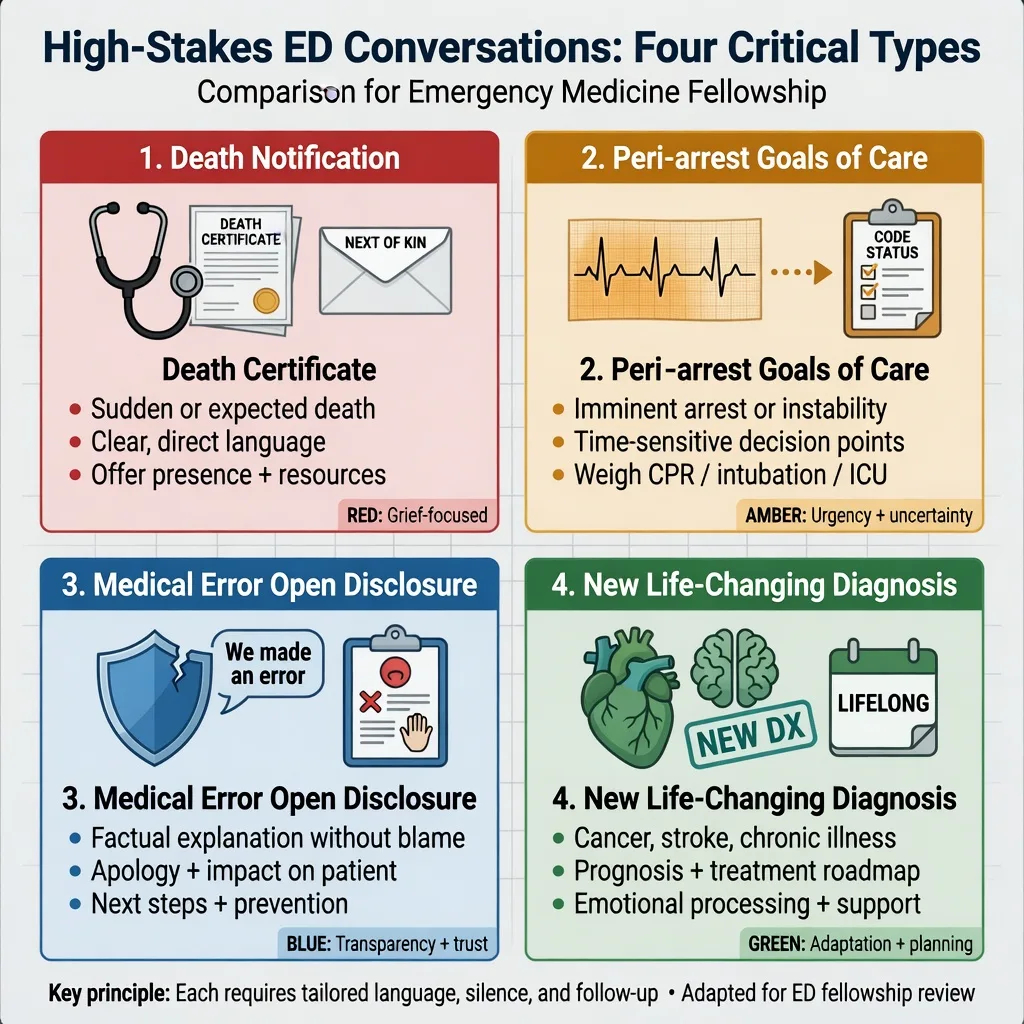
The four high-stakes ED conversations share the SPIKES skeleton but diverge in structure, legal overlay, and the questions the examiner will probe. Distinguishing them is itself a tested competency — a candidate who treats a death notification like a goals-of-care discussion, or an error disclosure like a new diagnosis, will fail the station.[2][3]
Death notification
- The news is irreversible — the patient has died
- Delivered to the family, not the patient; the interviewer is a witness to grief
- Uses the words "died" and "dead", never euphemisms like "passed" or "lost"
- Triggers coronial referral, bereavement leaflet, viewing of the body, organ-donation consideration
Peri-arrest / goals-of-care
- The patient is alive but may die — the conversation is about what will and will not be done
- Centred on the patient's values, prior wishes and a surrogate decision-maker
- Documents a ceiling of care (ward-level, ICU, or not-for-resuscitation)
- Requires capacity assessment and, where absent, a best-interests or substitute-decision-maker framework
Medical-error disclosure
- The news is that harm occurred from the care, not the disease
- Structured around the open-disclosure protocol — the facts, the apology, the review
- Separates the factual account from attribution of blame or legal liability
- Triggers an incident report, a root-cause analysis, and a named follow-up
New life-changing diagnosis
- The news is a serious new diagnosis — cancer, motor neuron disease, a major stroke
- The patient is told first and directly, with a support person present
- Balances truth-telling with hope — "serious, but here is the plan"
- Pairs diagnosis with an immediate next step and a named clinician for follow-up
The death notification
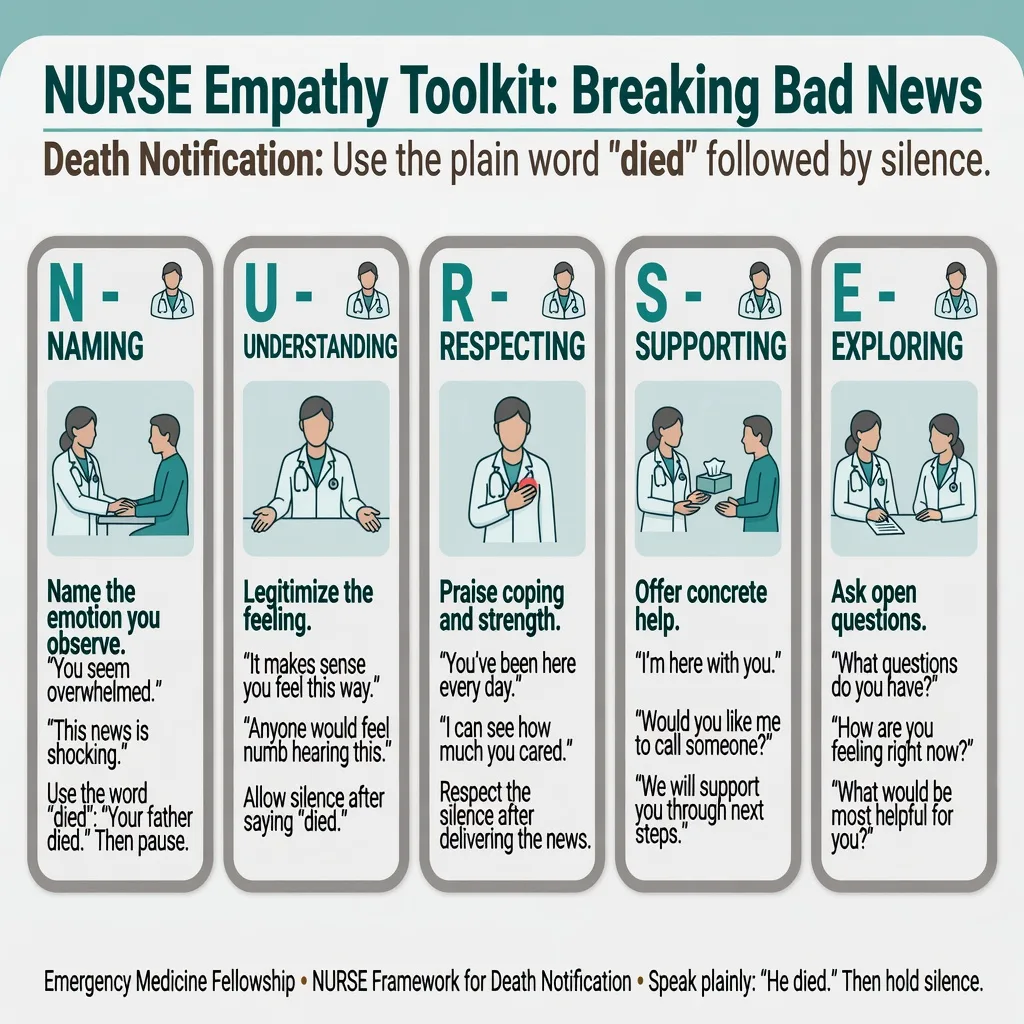
Death notification is the conversation the family remembers forever, and it is a stand-alone OSCE station. The clinician collects the family from the waiting area, brings them to a private room, sits them down, and confirms who is present and their relationship to the deceased. The perception is gauged — "Tell me what you know about what happened to your mother today" — before the news is given. The warning shot is delivered, and then the news in plain, unambiguous words: "I am very sorry to have to tell you that your mother has died." The word died is used, not "passed away", "lost", or "gone to sleep" — euphemisms cause confusion and are culturally and linguistically unsafe.[2] The clinician then stops, and allows the grief to express itself — tears, silence, anger, denial, even laughter — without rushing to comfort or to fill the space.
After the initial reaction, the clinician offers the practical steps: the opportunity to see and touch the body (almost always offered, and culturally essential in many communities), the bereavement information, the named contact, and the timeframe. The coronial question is addressed — most unexpected, violent, or perioperative deaths, and any death within 24 hours of admission or after a procedure, are reportable. Organ donation is raised sensitively and in line with the local donor-service protocol, recognising that the decision must be decoupled from the moment of grief. A senior clinician signs the death certificate only when the criteria are met and the death is not coronial. [1]
The death-notification model answer in one breath
The peri-arrest and goals-of-care discussion
The peri-arrest conversation is the most time-pressured in the ED, because a deteriorating patient may arrest within minutes, and the clinician must establish the ceiling of treatment before that happens. The setting is often imperfect — a side room off the resuscitation bay, the clock running — but the principles hold: privacy, sitting, and the perception question. The clinician asks what the patient or surrogate already knows of the prognosis ("What have the doctors told you about how serious this is?"), then introduces the conversation as one about goals and limits rather than abandonment. Structured serious-illness communication prompts improve alignment between care and values when time is short.[5]
The substance is a structured exploration of the patient's values and prior expressed wishes: what did they consider an acceptable outcome, what would they not want, and is there an advance care directive? Where the patient lacks capacity, the decision is made in the patient's best interests with the substitute decision-maker, drawing on the known values rather than the surrogate's own preference. The clinician states explicitly what will be done (ward-level care, symptom control, antibiotics, fluids, a trial of non-invasive ventilation) and what will not (cardiopulmonary resuscitation, intubation, ICU). The framing matters: a "not-for-resuscitation" order is framed as "we will focus entirely on your comfort and dignity, and we will not pursue treatments that we believe would cause you harm without benefit", never as "we will do nothing". The plan is documented, communicated to the team, and revisited as the clinical picture evolves. [1]
[1]Medical-error disclosure and open disclosure
Open disclosure is the structured, truthful conversation with a patient and family after a healthcare-related harm, and it is now a regulatory and, in several jurisdictions, a statutory obligation.[3] The ED scenario is typically a missed diagnosis (a missed testicular cancer, an unrecognised subarachnoid haemorrhage) or a procedural complication, often discovered when the patient re-presents. The conversation is held as soon as the patient is clinically stable and the basic facts are established — delay erodes trust and is itself a harm.
The disclosure follows a sequence: an expression of regret for the harm and the experience ("I am sorry this happened, and I am sorry for what you have been through"), a factual account of what is known (without speculation beyond the established facts), an acknowledgement of what is not yet known and how it will be investigated, and a concrete plan for the ongoing care, the root-cause analysis, and the named follow-up contact. The apology is for the harm and the experience — it is not an admission of legal liability, and the clinician separates the facts from attribution. The error is documented factually in the record, an incident report is filed, and the conversation itself is noted. The second-victim phenomenon — the distress of the clinician who made or delivered the error — is recognised and addressed through the debrief and peer support. [1]
Symptom-control pharmacology — the peri-arrest and end-of-life drug doses
When the ceiling of care is comfort, the ED clinician must control the symptoms of the dying and the peri-arrest patient promptly, by the route that works, and without the fear of hastening death that paralyses untrained prescribers. The principle is that symptom relief in the dying is ethically and legally supported under the doctrine of double effect when the intent is comfort and the dose is proportionate. Four agents cover almost the entire peri-arrest symptom burden in the ED. Morphine 2.5 mg intravenously is first-line for pain and for the distressing dyspnoea of the failing circulation, titrated and repeated to effect. Midazolam 2.5 mg intravenously treats the anxiety, agitation and terminal restlessness that accompany hypoxia and hypoperfusion, also titrated. Glycopyrrolate 200 micrograms subcutaneously or intravenously reduces the respiratory secretions that produce the death rattle (it will not reverse secretions already present, and suction is both ineffective and distressing). Haloperidol 0.5 to 2 mg intravenously manages delirium and terminal agitation where a benzodiazepine alone is insufficient. These doses are subcutaneous-friendly for ongoing palliative care, and a syringe driver is arranged when the need is established. [1]
[1]Cultural considerations
Culture shapes every layer of the conversation: who is told, who decides, how grief is shown, and what language is acceptable. The clinician does not assume a norm but asks. In many cultures the family, not the patient, is the legitimate recipient of serious news, and a direct disclosure to the patient against family wishes may be experienced as cruel; the clinician negotiates by exploring the family's reason ("What are you worried the news will do to her?"), by offering to be present for the disclosure, and by affirming that autonomy remains the patient's. A trained medical interpreter — not a family member, and never a child — is used whenever there is a language barrier; the clinician looks at the patient, not the interpreter, and speaks in short segments. Eye contact, physical touch, the gender of the clinician, and the rituals around death and the body vary widely and are respected. The organ-donation conversation is approached with particular cultural humility, recognising strong religious and community variation. [1]
The debrief and clinician self-care
The clinician who delivers the news, performs the failed resuscitation, or makes the error is a second victim, and the psychological aftermath — intrusive imagery, self-doubt, sleep disturbance, and in some cases post-traumatic stress — is common and under-recognised. The structured debrief is therefore a clinical obligation, not a courtesy. The hot debrief occurs immediately after the event, at the bedside or in the corridor, and is led by the team leader: it confirms what happened, addresses immediate clinical questions, checks on the team members, and identifies anyone who needs follow-up. The cold debrief, held hours to days later, reviews the case in detail, extracts the learning, and is the forum for the emotional as well as the technical review. Peer support, employee-assistance access, and a culture that normalises seeking help are the protective factors; their absence predicts burnout and attrition. [1]
Common errors and pitfalls
The recurring errors are those SPIKES was designed to prevent. Information dumping — delivering the news in a single, rapid, jargon-laden monologue — overwhelms and is recalled as callousness. False reassurance ("I am sure it will all be fine") corrodes trust the moment reality arrives and is never justified. Medical jargon ("she has had an infarct with a poor ejection fraction and we are concerned about her prognosis") is unintelligible to most families. Defensiveness in the error-disclosure setting, or the temptation to minimise, is the fastest route to litigation and loss of trust. Filling the silence after the news robs the patient of the time to process. Skipping the warning shot delivers the blow unannounced. Euphemisms for death ("passed", "lost", "gone") cause confusion and are avoided. Finally, failing to debrief compounds the harm to the clinician themselves. [1]
Special populations
The paediatric death notification is the most difficult conversation in medicine and demands a senior clinician, a private space, both parents where possible, and honesty pitched to the developmental age of any siblings. The cognitively impaired patient receives the news at the level their capacity allows, with a surrogate present, and never excluded by default. The non-English-speaking patient receives the news through a trained interpreter, with the clinician speaking to the patient directly. The angry or threatening relative is moved to a safe environment, de-escalated with empathy and a senior presence, and never met alone. The clinician-patient is told with the same rigour, with the added discipline of not minimising because the news is uncomfortable to give. [1]
Evidence and regional guidelines
SPIKES is the global default, with the addition of the NURSE empathy statements from the oncology and palliative-care literature.[1] The death-notification structure and the missed-diagnosis disclosure scenario are codified in the contemporary emergency-medicine teaching cases.[2][3] The regulatory overlay varies by region.
ANZ practice note. Open disclosure follows the Australian Commission on Safety and Quality in Health Care (ACSQHC) Open Disclosure Framework, which is a national standard linked to the National Safety and Quality Health Service Standards. Coronial referral is governed by each state and territory's coroners legislation — reportable deaths include unexpected, violent, and anaesthetic-related deaths, and deaths within 24 hours of a procedure. Organ donation is coordinated through the state donor agency (DonateLife) and the ED role is recognition and referral, not the consent conversation. Advance care directives and substitute decision-maker statutes vary by state but are given legal weight under guardianship and medical-treatment legislation. [1]
The SPIKES protocol — a structured bedside checklist
SPIKES is most useful as a checklist run silently before and during the conversation. The Fellowship candidate who can recite the six letters but cannot execute them at the bedside has not yet mastered the station. Below is the operational checklist that maps each letter to observable behaviours the examiner scores. [1]
SPIKES — the bedside execution checklist
S — Setting
Private room with door closed; phone on silent; tissues and water available; sit down at or below eye level; introduce yourself and your role; confirm who is present and their relationship; offer a support person and a trained interpreter if needed; minimise interruptions (place a "do not disturb" sign)
P — Perception
Ask "What is your understanding of what has been happening?" or "What have the other doctors told you?"; listen for the patient's words, their level of insight, and their emotional state; do not correct or interrupt — this is calibration, not data transfer
I — Invitation
Ask "Are you the sort of person who wants all the details, or would you prefer the headlines?" or "How much information would you like me to share today?"; respect a refusal of information and offer to talk to a nominated person; in a death notification, the invitation is implicit in the family being present
K — Knowledge
Deliver a warning shot ("I am afraid I have some serious news"); then the news in plain, jargon-free language; one chunk at a time; pause after each chunk; use the words "died", "cancer", "stroke" — not euphemisms; check understanding before adding detail
E — Emotion
Name the emotion using NURSE — Naming, Understanding, Respecting, Supporting, Exploring; then stop talking and tolerate the silence; do not fill the space; do not offer false reassurance; allow tears, anger, denial, or laughter to express
S — Strategy and Summary
Agree the next concrete steps (admission, imaging, referral, comfort care); check understanding ("Can you tell me what we have agreed, so I know I have explained it clearly?"); provide written information; give a named contact and a clear timeframe for the next conversation; document the discussion
Managing anger, distress and denial
Anger, distress and denial are normal and predictable responses to bad news; they are not pathology, and they are not personal. The Fellowship candidate who pathologises grief, argues with denial, or matches anger with defensiveness will fail the station and harm the patient. The structured response is de-escalation, validation, and a return to the plan. [1]
Anger is often the first emotion the family expresses after a death, and it is frequently displaced — at the ambulance, the triage nurse, the clinician who arrived "too late". The response is empathic, not defensive: the clinician acknowledges the emotion ("I can hear how angry and frustrated you are — that is completely understandable"), does not argue the timeline, does not justify the team's actions in that moment, and brings a senior colleague into the room if the anger is escalating. Safety is paramount — the clinician never interviews an angry relative alone, positions themselves between the relative and the door, and calls security if there is any threat. The angry relative is given a private space (a public corridor amplifies the escalation), water, and time. [1]
Distress — tears, sobbing, hyperventilation, the stunned silence of shock — is met with presence, not intervention. The clinician sits, is quiet, offers tissues and water, and waits. Comforting gestures (a hand on a shoulder) are offered cautiously and only when cultural and relational cues support them. The clinician does not medicate acute grief. [1]
Denial — "this can't be happening", "there must be some mistake", "I want a second opinion" — is respected, not argued. The clinician reflects ("I can see this is impossible to take in"), restates the facts gently without forcing acceptance, and offers the second opinion or the repeat imaging that the clinical situation supports. Denial is a protective psychological mechanism; it dissolves in its own time, and confronting it head-on produces resistance and damages the relationship. [1]
Anger
- Acknowledged, not argued with — "I can hear how angry you are, and that is entirely understandable"
- Senior presence brought in early; never interview alone; position between relative and door
- Displaced blame (at the ambulance, the triage) is not corrected in the moment
- Safety first — security called for any threat; private space, not a corridor
Distress
- Met with presence and silence, not intervention or medication
- Tissues, water, time — the clinician does not rush the grief
- Comforting touch only when culturally and relationally appropriate
- Stunned silence is shock, not understanding — re-offer information later
Denial
- Respected as a protective mechanism, not confronted or argued
- Facts restated gently — "the scans show..." — without forcing acceptance
- Legitimate requests (second opinion, repeat imaging) honoured where clinically appropriate
- Dissolves in its own time over hours to days; do not force resolution in the ED
Bargaining
- Recognised as part of the grief sequence — "if only we had come in sooner"
- Acknowledged without endorsing causation that is not supported by the facts
- The clinician does not collude with false guilt ("you did everything right") beyond what is true
- Redirected gently toward the next concrete step
Family-witnessed resuscitation
Family-witnessed resuscitation (FWR) — the presence of family members during cardiopulmonary resuscitation, invasive procedures, and the dying moments of their relative — has shifted over two decades from controversial to recommended practice. The evidence is consistent: families who are offered the opportunity to be present report lower rates of post-traumatic stress, greater satisfaction with care, an easier bereavement, and a clearer understanding that everything possible was done. The critical finding is that the offer matters more than whether the family accepts — even families who decline report benefit from having been given the choice. [1]
Family-witnessed resuscitation — the evidence base
New England Journal of Medicine
Key finding
In a cluster-randomised trial of 570 families across 15 French emergency and critical care units, families offered witnessed resuscitation had significantly fewer PTSD-related symptoms at 90 days (27% vs 45%, p=0.004) compared with standard practice. No interference with care was observed. The trial established FWR as evidence-based practice.
Family-witnessed resuscitation is therefore offered as standard where feasible, with a dedicated liaison and team consent before family enter the bay.[4]
The practical execution is structured. A dedicated family liaison — usually a senior nurse or social worker — stays with the family throughout, explains what they are seeing in plain language, answers questions, and escorts them out if they become distressed or if the team requests it. The team leader consents to FWR before the family enters; team members are briefed; the family is positioned so they can see their relative (typically near the head, holding the hand) without obstructing the resuscitation. If the resuscitation is failing, the team leader may invite the family closer for the final moments. Termination of resuscitation is then explained in the room, not after the family has been removed — this is the most powerful antidote to the persistent fear that "they gave up". [1]
[1] [1]The organ donation conversation
The organ donation conversation is among the most delicate in the ED, and it is almost always held in the context of a catastrophic brain injury where death by neurological criteria is anticipated or has just been confirmed. The ED clinician's role is recognition and referral — the formal consent conversation is held by the trained donor-service coordinator, who is decoupled from the treating team to remove any conflict of interest and to bring specialist expertise. The clinician does not raise donation at the moment of death notification; it is raised in a separate conversation, after the family has had time to absorb the news, and after brain death has been confirmed or is being formally assessed. [1]
The decoupling principle is critical. Conflating the death notification with the donation request — "I'm sorry to tell you your husband has died; have you considered organ donation?" — is the cardinal error: it creates the impression that the team's interest in the organs influenced the declaration of death, and it profoundly damages trust. The treating team confirms death, supports the family, and then introduces the donor coordinator as a separate person with a separate role. Where the patient is a registered donor (on the driver's licence, the registry, or an advance directive), the clinician can frame the conversation around the patient's own recorded wishes, which substantially reduces the family's decisional burden. [1]
Time is the enemy of donation after neurological death, because the haemodynamic instability of brain death rapidly compromises organ viability. The early call to the donor service — at the point of recognising a devastating neurological injury with a poor prognosis, before death is declared — allows the coordinator to assess suitability, approach the family at the right moment, and organise the retrieval if consent is given. The ED clinician does not pre-empt the family's decision and does not record a personal opinion on donation in the medical record. [1]
[1]Cultural and religious sensitivity — beyond the general principles
The general principle — ask, do not assume — applies with particular force to the high-stakes ED conversations, where the consequences of a cultural misstep are magnified. Several specific scenarios recur in the Fellowship exam and in practice. [1]
Jehovah's Witnesses and blood products. The refusal of whole blood, packed red cells, platelets, fresh frozen plasma and primary components is a deeply held article of faith for most Jehovah's Witnesses, and accepting blood is understood as a sin that threatens eternal salvation. The clinician respects this, documents the specific refusal (which products, in what circumstances, by whom — patient or surrogate), and explores the alternatives: cell salvage in a continuous circuit, acute normovolaemic haemodilution, fractionated products (albumin, immunoglobulins, clotting factor concentrates) where the individual accepts them, and the early use of tranexamic acid, iron and erythropoietin. The individual's conscience varies — the clinician does not assume what a particular Witness will accept, but asks. The Hospital Liaison Committee network is a valuable resource and the patient may welcome their involvement. The ED clinician does not obtain a court order to override a competent adult's refusal, even to save a life; the right to refuse treatment is absolute in capacitous adults. [1]
Brain death contested in some faith traditions. Brain death (death by neurological criteria) is the legal standard of death in most jurisdictions, but it is theologically contested in some traditions — certain Orthodox Jewish, some Buddhist, and some Islamic scholars hold that death occurs only with cardiopulmonary cessation. Where a family contests the declaration on religious grounds, the clinician engages chaplaincy, the hospital ethics committee, and where the law allows, accommodation such as a time-limited continuation of support pending further discussion. The organ donation conversation in this setting is held only after the family has accepted the declaration. [1]
Family as decision-maker. In many South Asian, East Asian, Middle Eastern and African communities, the family — not the patient — is the legitimate recipient of serious news, and a direct disclosure to the patient may be experienced as cruel. The clinician negotiates: explores the family's reason, offers to be present, affirms that the patient's autonomy remains, and where the patient is capacitous, ultimately respects the patient's own preference (which may be to delegate to the family). [1]
Rituals around the body. The timing of viewing, who may touch the body, the direction the body faces, the presence of a religious leader, and the requirement that the body be released promptly for ritual washing and burial (within 24 hours in Orthodox Jewish and Islamic practice) are all respected and facilitated where possible. The death certificate and coronial processes are explained and expedited; the ED works with chaplaincy and the family's religious community. [1]
Jehovah's Witness
- Refusal of whole blood, PRBC, platelets, FFP — primary components
- Fractionated products (albumin, clotting factors) accepted variably — ask the individual
- Cell salvage in continuous circuit, ANH, tranexamic acid, IV iron, erythropoietin
- Competent adult refusal is absolute — no court order to override; document specifically
Orthodox Jewish
- Some authorities accept brain death; others require cardiopulmonary cessation
- Sabbath and religious law may override non-life-threatening care priorities
- Burial within 24 hours where possible — expedite certification and release
- Engage the family's rabbi and the hospital chaplain early
Islamic
- Majority accept brain death; some scholars contest
- Burial within 24 hours where possible — expedite certification
- Same-gender clinician for physical examination where possible
- Modesty, halal considerations, family-led decision-making
Hindu and Sikh
- Family-led decision-making common; the eldest male or family spokesperson
- Cremation within 24 hours for Hindus; ritual washing of the body
- Beef-derived products (Hindu) and alcohol-based preparations noted
- Open expression of grief is culturally normative — do not pathologise
The paediatric death notification
The death of a child is the most devastating news a clinician can deliver, and it produces the longest-lasting grief in any family. The Fellowship candidate must approach this station with a senior clinician, a private and quiet room, both parents where humanly possible, and unhurried time — the standard ED pressures do not apply here. The words used are unambiguous ("your son has died"), but the framing is gentler and the silence is longer. Parents almost universally want to see and hold their child after death, and this is facilitated — the child is cleaned and dressed where possible, lines and tubes are removed where it is safe to do so, and the family is given private time. Memory-making (handprints, footprints, a lock of hair, photographs) is offered and is associated with better bereavement outcomes. [1]
Siblings are told at their developmental level — young children need concrete, literal language ("his body stopped working and he died"), not euphemisms ("he has gone to sleep") which generate fears of sleep and separation. Parents are coached on what to say to siblings at home. The developmental honesty extends to the cause: parents are told what is known, what is not yet known, and how the investigation (including the coronial process, mandatory in most child deaths) will proceed. Blame — self-blame by parents is near-universal, particularly in sudden infant death and in accidents — is anticipated and addressed gently, with factual reassurance where it is warranted and without false reassurance where it is not. [1]
The paediatric bereavement supports — the SIDS and Kids hotline, the child bereavement services, the hospital social work and chaplaincy — are offered and the family is given a named contact and a follow-up appointment. The clinician's own wellbeing after a paediatric death is addressed below. [1]
[1] [1]Vicarious trauma, moral injury and clinician wellbeing after a death
The clinician who delivers the death notification, leads the failed resuscitation, or cares for the dying patient across a long shift is exposed to cumulative psychological harm that the literature now frames as vicarious trauma (the absorption of the patient's trauma through empathy and exposure) and moral injury (the distress of acting, or being unable to act, in ways that conflict with one's moral framework — the patient who could not be saved, the family who blamed the team, the system that did not provide the resource). These are distinct from burnout (which is a function of chronic workload and control), though they overlap and co-exist. [1]
The protective factors are well-described and within the ED's control. The structured hot debrief (immediately, led by the team leader — what happened, is everyone safe, who needs follow-up) and cold debrief (days later, the case reviewed in detail, learning extracted, the emotional dimension explicitly invited) are the cornerstone. Peer support — a colleague who has been there, who listens without fixing — is the most consistently protective factor in the literature. Access to employee-assistance programs, a workplace culture that normalises seeking help, regular breaks, hydration, sleep, and the deliberate separation of work from home are the daily practices. The unhelpful responses — alcohol, isolation, presenteeism, minimisation — are recognised and named. [1]
The second-victim phenomenon, first described by Albert Wu, is the predictable psychological injury to the clinician who was involved in (or who delivered the news of) an adverse event. The trajectory is well-mapped: an initial impact phase (shock, rumination, self-doubt), an ensuing phase (insecurity, fear of judgement, withdrawal), and either a recovery (with support) or a trajectory toward burnout, attrition, or chronic post-traumatic stress. The ED clinician who recognises these phases in themselves or a colleague has a professional obligation to act on them — to seek the debrief, the peer, the employee-assistance referral, and where needed, formal psychological care. This is not weakness; it is the standard of self-care. [1]
[1]Structured handover — ISBAR and SBAR
Communication failure is the single most common contributor to adverse events in emergency care, and the structured handover is the evidence-based mitigation. The ED uses ISBAR (Identity, Situation, Background, Assessment, Recommendation) — an extension of the original SBAR — for shift changeovers, escalations to senior staff, transfers of care, and the pre-hospital-to-ED handover. The structure forces a logical sequence, reduces omission, and equalises the hierarchy (a junior can escalate to a senior using ISBAR with confidence). The Fellowship candidate is expected to use ISBAR fluently in the OSCE and to model it on the floor. [1]
ISBAR — the structured handover
I — Identity
Your name, your role, and the patient's identity (name, age, location) — "This is Dr X, the ED registrar; I am calling about Mrs Y, a 72-year-old woman in Bay 4"
S — Situation
The reason for the handover in one sentence — "She has come in with a two-hour history of crushing central chest pain and is now hypotensive at 80 systolic"
B — Background
The relevant history — past cardiac history, medications (especially anticoagulants), allergies, the prior ECG, the baseline function — only what is relevant to this handover
A — Assessment
Your clinical assessment of the current state — vital signs, examination findings, the working differential, your level of concern ("I am worried this is an occluding MI and she is deteriorating")
R — Recommendation
What you need from the receiver — a senior review now, the cath lab activated, a bed in ICU — stated clearly and with a timeframe; closed-loop communication confirms receipt ("Can you come now? I will stand at the bedside until you arrive")
ISBAR
- Identity + Situation + Background + Assessment + Recommendation
- Used for shift handover, escalation, transfer, pre-hospital to ED
- The "Identity" step forces the receiver to attend and confirms who is being discussed
- Standard in ANZ and UK emergency care; endorsed by ACEM and RCSCEM
SBAR
- Situation + Background + Assessment + Recommendation
- The original Kaiser Permanente tool; widely used in nursing and rapid-response systems
- Slightly shorter; the receiver is assumed to know who is being discussed
- Used in many US institutions and in the I-PASS paediatric handover variant
IMIST-AMBO
- Identity, Mechanism/Medical complaint, Injuries, Signs, Treatment + Assessment, Medications, Allergies, Background, Other
- The pre-hospital-to-ED trauma handover standard used by ambulance services
- Forces a complete trauma dataset in under 60 seconds
- The ED receiver listens, does not interrupt, then asks clarifying questions
End-of-life care in the emergency department
End-of-life care has shifted from the ward and the hospice into the ED over the last two decades, because patients present in the last weeks of life with symptoms they and their families cannot manage at home, and because the ED is increasingly the gateway for the unselected dying patient. The Fellowship candidate is expected to deliver active, compassionate, evidence-based end-of-life care within the time-pressured ED environment — this is not a failure of curative medicine, it is a distinct clinical domain. [1]
The recognition of the dying patient is the first step, and it is under-taught. The trajectories are well-described: the cancer trajectory (a slow decline with a sharp terminal drop), the organ-failure trajectory (a stepwise decline with acute exacerbations, each closer to death), the frailty and dementia trajectory (a slow progressive decline), and the sudden death. The clinician asks the "surprise question" — "would I be surprised if this patient died in the next 12 months?" — and a "no" answer triggers a palliative overlay on the ED care. [1]
The goals-of-care conversation (above) is the centrepiece. Where the patient is recognised as dying and the goals are comfort, the ED delivers: prompt symptom control (morphine 2.5 mg IV for pain and dyspnoea, midazolam 2.5 mg IV for agitation, glycopyrrolamine 200 micrograms for secretions, haloperidol 0.5 to 2 mg for terminal delirium — see the symptom-control section), a side room if possible, the family invited in, the noise and the monitors reduced, and the chaplain and social work engaged. The fast-track discharge home or to a hospice, with a community palliative plan in place within hours, is the gold standard for the patient who wants to die at home and is clinically stable enough to transfer. [1]
The bereavement conversation at the bedside of the patient who has just died — distinct from the formal death notification to relatives who were not present — acknowledges the family's loss in real time, allows private time with the body, and offers the practical next steps. The verification of death by the ED clinician follows the structured sequence (no response to pain, no central pulse, no heart sounds for one minute, no respiratory effort, fixed and dilated pupils), and the death certificate is completed when the death is not coronial. [1]
[1] [1]SAQs [1]
SAQ — New pancreatic cancer diagnosis delivered with the SPIKES protocol
10 minutes · 10 marks
A 58-year-old woman is brought to the emergency department by her husband with two weeks of painless jaundice, deepening over the past three days, and a six-kilogram unintentional weight loss over two months. She is otherwise well, with no abdominal pain. Blood pressure 128/76, heart rate 84, afebrile, GCS 15. CT of the abdomen performed today by her general practitioner for the jaundice shows a 3.2 cm mass in the pancreatic head with dilation of the pancreatic and common bile ducts (the double-duct sign), and three hypoechoenic lesions in the liver consistent with metastases. The radiologist has called it likely metastatic pancreatic adenocarcinoma. The husband has not been told the imaging result, and the patient believes she has a gallstone. They are both in the consult room, expectant and anxious. You are the ED registrar about to break the news.
SAQ — Peri-arrest goals-of-care family meeting for the deteriorating elderly patient
10 minutes · 10 marks
An 84-year-old man is brought to the emergency department from a residential aged-care facility with a 24-hour history of progressive dyspnoea and decreased responsiveness. He has advanced dementia (baseline communicates in single words, requires full assistance with activities of daily living), stage 4 chronic kidney disease (baseline creatinine 220 micromol per litre), ischaemic heart disease, and was admitted with pneumonia six weeks ago from which he never fully recovered. On arrival: GCS 11 (E3V4M5), temperature 38.4 degrees C, respiratory rate 32 with laboured shallow effort, SpO2 86 per cent on room air rising to 92 per cent on 15 L via non-rebreather, heart rate 128 in atrial fibrillation, blood pressure 78/46 (MAP 57) despite a 500 mL crystalloid bolus from the ambulance, lactate 4.8 mmol per litre. The chest X-ray shows right middle and lower lobe consolidation. The patient's daughter and son have arrived. There is no advance care directive on file. The patient is clearly deteriorating and may arrest within the hour. You are the ED consultant leading the goals-of-care conversation.
Exam pearls
- SPIKES in order: Setting, Perception, Invitation, Knowledge, Emotion, Strategy/Summary — skipping Perception is the most common station failure.
- The warning shot, then the silence — say "I am afraid I have some serious news", deliver it, then stop talking.
- Use the words "died" and "dead" in death notification — never euphemisms.
- Autonomy overrides a family request for non-disclosure — assess capacity, explore, offer presence, do not deceive.
- Open disclosure apologises for the harm and the experience without admitting legal liability beyond the facts.
- Peri-arrest comfort dosing: morphine 2.5 mg IV, midazolam 2.5 mg IV, glycopyrrolate 200 micrograms, haloperidol 0.5 to 2 mg.
- The clinician is a second victim — the hot and cold debrief are clinical obligations. [1]
Red flags
[1]References
- [1]Baile WF, Buckman R, Lenzi R, Glober G, Beale EA, Kudelka AP. SPIKES-A six-step protocol for delivering bad news: application to the patient with cancer Oncologist, 2000.PMID 10964998
- [2]Lei C, Mascarenhas J, Raol N, Bhatnagar V, Choo E. Difficult Conversation Case: Death Notification J Educ Teach Emerg Med, 2025.PMID 41522637
- [3]Ginsburg J, Lee C, Lam M, Mascarenhas J. Difficult Conversation Case: Missed Testicular Cancer J Educ Teach Emerg Med, 2025.PMID 41522639
- [4]Jabre P, Belpomme V, Azoulay E, et al. The Oregon experiment--effects of Medicaid on clinical outcomes N Engl J Med, 2013.PMID 23635051
- [5]Paladino J, Bernacki R, Neville BA, et al. Evaluating an Intervention to Improve Communication Between Oncology Clinicians and Patients With Life-Limiting Cancer: A Cluster Randomized Clinical Trial of the Serious Illness Care Program JAMA Oncol, 2019.PMID 30870556