EM · ED systems, safety and professional
Patient disposition and safety-netting in the emergency department
Also known as Admit, observe or discharge · ED disposition decision · Safety-net advice · Discharge counselling · Observation unit / clinical decision unit · Short-stay unit · Return precautions
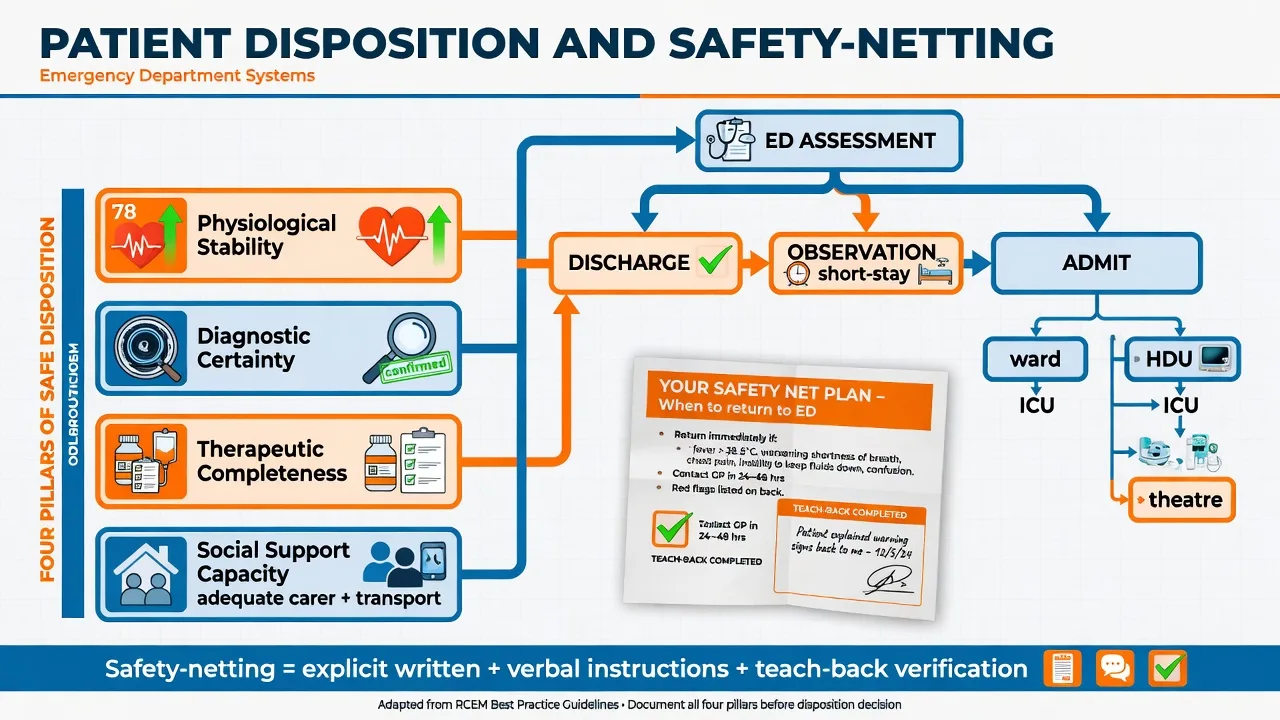
Patient disposition and safety-netting in the emergency department — the decision that governs where a patient goes after ED assessment: discharge, observation or short-stay unit, or inpatient admission (ward, HDU, ICU, theatre). The decision rests on four pillars (physiological stability, diagnostic certainty, therapeutic completeness, and social or support capacity), and is applied through the admission criteria (physiological instability, uncontrolled pain, an abnormal investigation needing action, and social factors) and the discharge criteria (stable observations, controlled symptoms, a clear diagnosis or documented plan, and follow-up arranged). The observation or short-stay unit is defined as protocol-driven short-duration care for the patient who is not yet safe for discharge but does not need inpatient admission. Safety-net advice is made adequate by being specific, written, condition-based, and accompanied by a plan and a check of understanding. The differential running through every decision is the patient who should not be discharged — the masked high-risk diagnosis, the frail elder, the socially isolated, the patient whose observations have not normalised, and the patient who cannot comply with the safety-net advice. ACEM-primary, globally tagged.
On this page & tools
Your progress
Saved locally on this device.
Target exams
Red flags
Related topics
- Breaking bad news and communication in the emergency department — the SPIKES framework
- Clinical handover and the ISBAR framework in the emergency department
- End-of-life care and goals-of-care discussions in the emergency department
- Consent, capacity and the medico-legal framework in the emergency department
- Syncope — the emergency department approach and risk stratification
Patient disposition is the single decision that converts ED assessment into an outcome: where does this patient go next, and how do we make sure they are safe once they have gone there. The decision is made thousands of times a day, under time pressure and with incomplete information, and it is the ED decision most often associated with adverse events and medico-legal claims — because every patient discharged home carries the small but real risk of an unrecognised high-risk diagnosis, an unobserved deterioration, or a result that comes back abnormal to an empty room. The discipline of disposition is therefore the discipline of refusing to discharge on assumption: stability is demonstrated, not assumed; the diagnosis is named or explicitly deferred with a plan; the safety-net advice is specific and written; and the social capacity to manage at home is confirmed. The work is examined directly in the Fellowship OSCE (the discharge counselling station) and woven through every high-stakes SAQ on the deteriorating or undifferentiated patient.[3][1]
Definition and scope
Disposition is the destination decision taken at the end of ED assessment, and it has five possible outputs: discharge to the community, observation in an emergency medicine observation or short-stay unit, inpatient admission to a ward or higher level of care (HDU or ICU), transfer to another facility for definitive care, or — in the patient who has died — referral for coronial review and bereavement support of the family. The decision is not a single binary moment but a structured judgement that weighs four inputs: the patient’s physiological stability, the certainty of the diagnosis, the completeness of immediate treatment, and the social and support capacity available at home. A patient who fails any one of these is not safely discharged. [1]
Safety-netting is the second half of the same act. It is the structured advice given at discharge — and the systems behind that advice — that allow a patient or carer to recognise deterioration and return promptly. Effective safety-netting is not a verbal "come back if you’re worried" but a specific, written, condition-based set of return triggers, delivered in the patient’s language, accompanied by a follow-up plan, and checked for understanding.[3] Disposition and safety-netting together are the efferent limb of emergency care: the quality of an ED is measured not only by how well it resuscitates but by how safely it discharges.
ANZ scope note. The Australasian College for Emergency Medicine defines disposition as a core Fellow competence and publishes policy on emergency medicine short-stay units, access block and the patient safety risks of prolonged ED boarding. Coronial referral is mandatory for certain deaths and for deaths within a defined interval of an ED attendance or a procedure, and varies by state and territory statute. [1]
The disposition decision — the four pillars
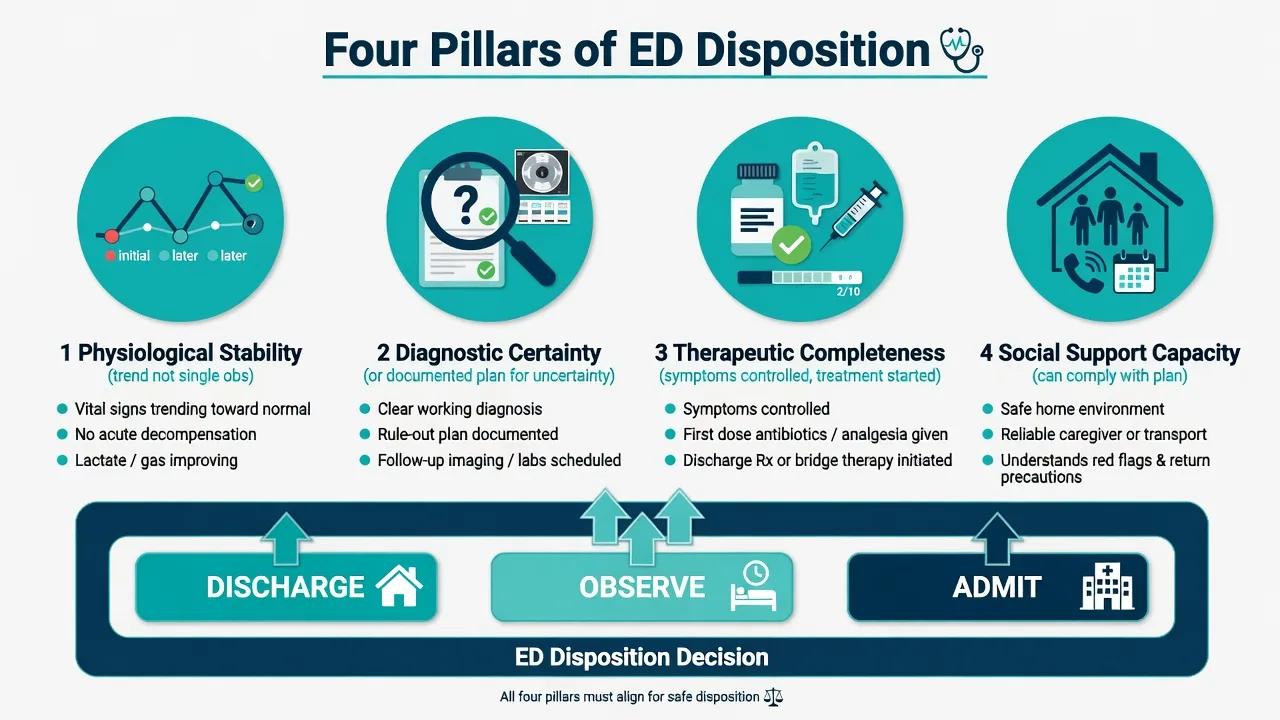
Every disposition decision rests on four pillars, and a candidate who can articulate them can defend any disposition in a viva. None is sufficient on its own; together they define safe discharge. [1]
The four pillars of the disposition decision
SDTS
Physiological stability demonstrated over time, not assumed from a single normal reading — the trend, the trajectory, and the response to treatment
A clear diagnosis, or an explicitly documented working diagnosis with a defensible plan for the unresolved uncertainty
Immediate treatment completed or a workable plan to complete it at home — analgesia, antiemetic, antibiotics, splint, dressing
A safe home, a responsible adult where one is required, the means to follow the advice (telephone, transport, finances), and the cognitive and linguistic capacity to comply
The pillars are tested in sequence. A patient with a perfect diagnosis but abnormal observations is not discharged. A patient with normal observations but an unexplained critical result is not discharged. A patient who is physiologically stable and diagnostically certain but lives alone and cannot walk to the toilet is not discharged. The disposition decision is therefore a conjunctive judgement: failure of any one pillar redirects the patient toward observation or admission.[1]
Admission criteria — the four gates
Admission is triggered when any one of four gates is crossed. The Fellowship candidate who can name and apply these gates can defend an admission decision and, more importantly, can recognise the patient being inappropriately pushed toward discharge. [1]
Physiological instability is the clearest gate. An abnormal vital sign that has not normalised, or a deteriorating trajectory despite treatment, mandates admission. The Royal College of Physicians NEWS2 score aggregates respiration rate, oxygen saturation, supplementary oxygen, systolic blood pressure, pulse, consciousness and temperature; a NEWS2 of 5 or more is the validated threshold for urgent clinician review and is the most widely adopted bedside marker of instability.[2] A patient who required a fluid bolus to normalise blood pressure is admitted, because the response to a bolus predicts nothing about whether the blood pressure will hold; a patient in fast atrial fibrillation that has not been controlled is admitted; a patient with an oxygen requirement that will not wean is admitted.
Uncontrolled pain is the second gate. Pain that has not been brought to a tolerable level with reasonable ED analgesia — opioid titration, nerve block, antiemetic for a migraine — is not sent home to "see how it goes". Severe renal colic that has not settled, abdominal pain without a diagnosis and without control, and the headache that has not responded to the standard bundle all meet this gate, because uncontrolled pain signals an incomplete diagnostic or therapeutic process and predicts representation. [1]
An abnormal investigation needing action is the third gate. A new acute kidney injury, a potassium of 6.2 mmol/L, a troponin rise, a metabolic acidosis, an international normalised ratio above the therapeutic range with bleeding, a lactate above 2 mmol/L that has not cleared, a hyponatraemia of 124 mmol/L with confusion — these are not bundled into a discharge summary; they are acted upon in hospital. The discipline is to ask, before discharge, whether every abnormal result has been explained and either acted on or explicitly and safely deferred with a plan. [1]
Social factors are the fourth and most easily underestimated gate. The elderly patient who lives alone and cannot mobilise to the toilet after a fall, the patient with no responsible adult after procedural sedation, the patient whose home is unsafe (no electricity, an unsafe partner, stairs that cannot be managed with a splint), the patient who depends on a carer who is absent — all meet the social gate. Discharge to an unsafe environment converts a medical success into a fall, a pressure injury, a re-presentation, or a coronial case. [1]
[1]Discharge criteria — the four gates
Discharge is permitted only when four gates are all met. The candidate who lists these four, and demonstrates each one for the patient in front of them, has defended a discharge. [1]
The four discharge gates
SCCF
Vital signs normal and stable over time, NEWS2 in the low band, no ongoing requirement for supplemental oxygen beyond baseline
Pain controlled to a tolerable level with an oral regimen the patient can continue at home; nausea, breathlessness and other distressing symptoms manageable out of hospital
A definitive diagnosis, or a documented working diagnosis with a defensible differential and a defined plan for the remaining uncertainty
A named follow-up — general practitioner, clinic, specialty — and a results follow-up pathway that guarantees any pending critical result is seen, acted on, and the patient recalled
The fourth gate — follow-up arranged, with a results follow-up pathway — is the one most often neglected. A culture sent from the ED that grows an organism two days later, a troponin that rises, a computed tomography report that describes an incidentaloma, a cervical spine that the radiologist later reports as not cleared: each is a result that must reach a clinician who acts on it, and the discharged patient must be recallable. A "the GP will sort it out" assumption is not a results pathway. The pathway names who sees the result, within what timeframe, and how the patient is contacted.[3]
Model answer — defending a discharge in a viva
To defend a discharge I demonstrate each of the four gates explicitly. First, stable observations — I show the trend over the attendance, confirm the NEWS2 is low, and confirm the patient is off supplemental oxygen or back to their baseline requirement. Second, controlled symptoms — I confirm the pain score is tolerable and the patient has an oral analgesic regimen to take home. Third, a clear diagnosis or clear plan — I name the diagnosis or, where it remains uncertain, document the working diagnosis, the differential, and the reason I am confident a high-risk diagnosis is excluded. Fourth, follow-up arranged with a results pathway — I name who the patient will see, when, and how pending results will be chased and the patient recalled. Only then is the discharge defensible. [1]
The observation and short-stay unit — when to observe
Between discharge and inpatient admission sits the observation unit (also called the clinical decision unit, emergency medicine unit, or short-stay unit). It is a defined area, staffed by emergency medicine, that delivers protocol-driven care for a short, defined period — typically up to 24 hours, extended in some units to 48 hours — to patients who are not yet safe for discharge but do not need inpatient admission.[4][6] The unit is not a holding pen and it is not a substitute for an inpatient bed; it is a structured care environment with written protocols for the conditions it manages.
The classic indications are conditions that resolve or that need a short period of serial assessment or treatment: chest pain requiring serial troponins and a rule-out protocol, mild to moderate asthma or chronic obstructive pulmonary disease exacerbation needing nebulisers and a short observation, mild pancreatitis, minor head injury needing a period of neurological observation, intoxication awaiting safe sobering, renal colic awaiting pain control and urology review, cellulitis needing intravenous antibiotics for 24 hours, and undifferentiated symptoms such as syncope or a transient ischaemic attack needing a workup that can be completed within the unit’s timeframe.[5]
Suitable for the observation unit
- Stable observations, NEWS2 low
- A protocol exists for the condition (chest pain, mild asthma, minor head injury)
- A clear expected outcome within 24 to 48 hours
- The patient is independently mobile or needs only minimal assistance
Not suitable — needs inpatient admission
- Haemodynamic instability, ongoing oxygen requirement beyond baseline, or a deteriorating trend
- A diagnosis that needs inpatient workup or a specialty team (e.g. stroke, sepsis source control)
- Social complexity beyond a short protocol (no safe discharge destination, cognitive impairment needing supervision)
- A likely stay beyond the unit maximum — the unit is not a queue for an inpatient bed
The contraindication list matters more than the indication list, because the error that harms patients is placing an unstable patient in the observation unit instead of an inpatient or higher level of care. A patient who needs inpatient-level care, who is haemodynamically unstable, whose diagnosis requires an inpatient workup, or whose social complexity exceeds a short protocol is an admission, not an observation patient.[6]
Differential — the patient who should not be discharged
The differential that runs through every disposition decision is not a list of diseases but a list of patients: the patients whom discharge will harm. Every Fellowship candidate must be able to name them, because the examiner sets a scenario in which a benign-looking patient is, in fact, one of these, and the candidate who discharges them fails. [1]
The masked high-risk diagnosis
- Acute coronary syndrome with a negative initial troponin and an atypical presentation
- Aortic dissection or ruptured abdominal aortic aneurysm with pain that has settled
- Mesenteric ischaemia with early, non-specific abdominal pain and a near-normal examination
- Subarachnoid haemorrhage with a sentinel headache that the patient calls a migraine
- Ectopic pregnancy in a woman of reproductive age with any abdominal pain or bleeding
- Pulmonary embolism, sepsis, or a time-critical stroke where the window for treatment is closing
The physiologically unstable patient
- A patient whose observations have not normalised, or whose trend is worsening despite treatment
- A patient still requiring supplemental oxygen, still tachycardic, still hypotensive after a bolus
- A patient with a NEWS2 of 5 or more that has not been reviewed by a senior clinician
- A patient who deteriorated in the ED and has not been observed through a stable period
The patient who cannot comply with safety-netting
- Cognitive impairment, delirium, or intoxication that prevents understanding of the advice
- A language barrier addressed without a trained interpreter
- No responsible adult where one is required (after sedation, after a head injury, in early pregnancy bleeding)
- No telephone, no transport, no finances — the social incapacity to act on the advice
The patient with a pending critical result
- Cultures, extended troponins, a computed tomography report not yet finalised, a cervical spine not yet cleared
- Any result that, if abnormal, would change the disposition
- A results follow-up pathway that has not been set up before the patient leaves
Safety-net advice — specific, written, condition-based
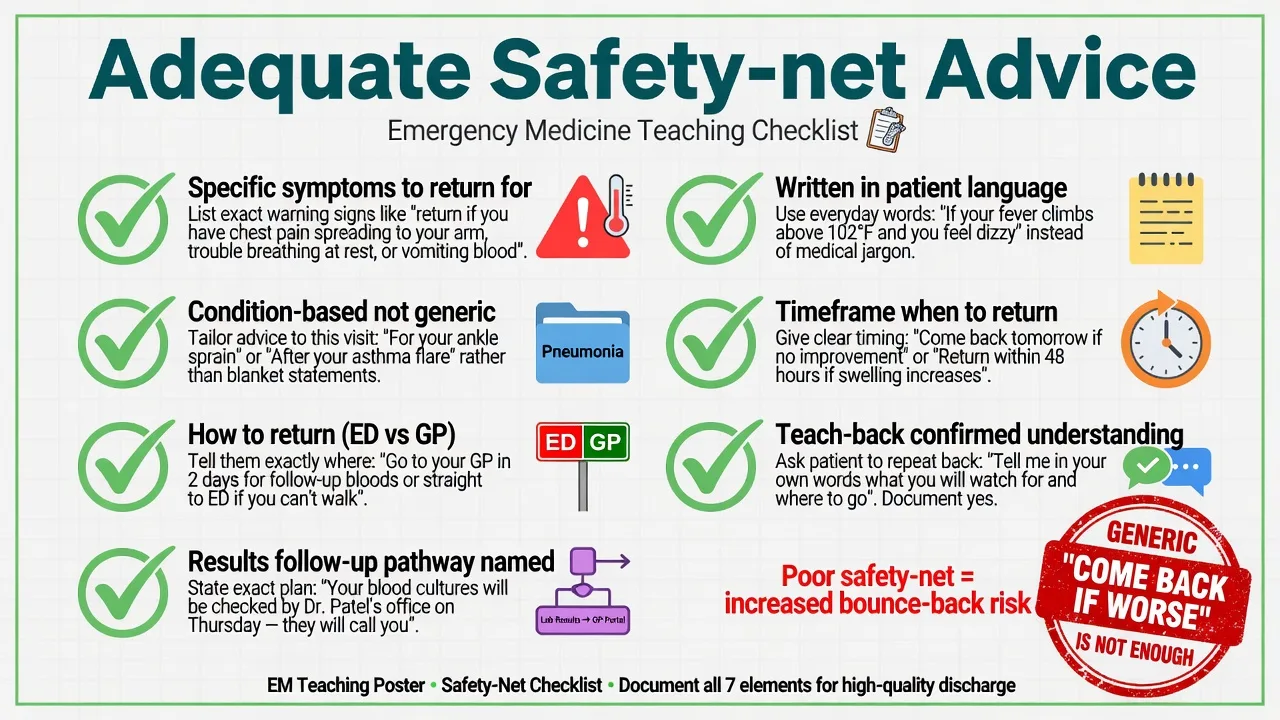
Safety-net advice is the structured information that allows a discharged patient or carer to recognise deterioration and return. The Fellowship candidate who delivers "come back if you feel worse" has failed the OSCE. Adequate safety-netting has four features, and each is tested. [1]
The four features of adequate safety-net advice
SWCP
Quantified, concrete return triggers — not "if worse" but "if you cannot keep fluids down for 24 hours, if your pain gets worse despite the painkillers, if you develop a fever above 38.5 degrees, or if you become drowsy or confused"
A written advice sheet, in the patient’s own language, with the diagnosis, the return triggers, the medications, and who to contact — given to the patient and a copy filed in the record
Tailored to the specific diagnosis — the concussion advice is not the chest pain advice is not the abdominal pain advice; each condition has its own red flags
A named follow-up, a defined timeframe, and a teach-back check — ask the patient to repeat the triggers and the plan in their own words
The discipline is to make the advice specific enough that a non-clinician can act on it. "Return immediately if you develop any of the following" — followed by a numbered list of concrete triggers — is the structure. The written sheet carries the diagnosis in plain language, the medications with doses, the follow-up, and the return triggers. The condition-based nature means the clinician reaches for the sheet that matches the diagnosis: the head injury sheet for a concussion, the chest pain sheet for a low-risk cardiac presentation, the abdominal pain sheet for a resolving colic, the first-seizure sheet for the post-ictal patient. And the plan-and-check step — teach-back — converts advice from a monologue into a confirmed understanding.[3]
[1]Discharge management — medications, advice and follow-up
The discharge is not complete until the patient leaves with a workable bundle of medications, advice, and a follow-up plan. The discharge prescription is built around simple, effective oral agents with defined doses, and the candidate must be able to state the agent, the dose, the route, the interval, and the maximum, because the SAQ rewards the specific regimen and not the generic "analgesia". [1]
The four-drug discharge analgesic and antiemetic bundle
PANO
Paracetamol 1 g orally every 6 hours, maximum 4 g per day in an adult — first-line for pain and fever, safe in pregnancy and renal disease
Ibuprofen 400 mg orally every 8 hours with food, or naproxen 500 mg orally every 12 hours — for inflammatory and colicky pain; avoided in renal impairment, pregnancy, active bleeding, and with a proton pump inhibitor in the older patient
Ondansetron 4 mg orally every 8 hours, or metoclopramide 10 mg orally every 8 hours — for nausea and migraine; metoclopramide avoided in young women (dystonia) and bowel obstruction
A short course of a weak opioid only where the non-opioid regimen is insufficient — codeine 30 mg with paracetamol every 6 hours, or oxycodone 5 mg every 6 hours, with a written ceiling and the safety-net triggers for drowsiness
Adjuncts complete the bundle. An oral rehydration solution is given for the patient with vomiting, diarrhoea, or poor intake — small volumes frequently, with the advice to return if oral intake cannot be maintained. Laxatives are prescribed with any opioid course. Splints, dressings and crutches are fitted and the patient taught their use. Anticoagulants (such as enoxaparin 40 mg subcutaneously daily for the immobilised patient) are prescribed where the venous thromboembolism risk warrants. Antibiotics, where indicated, are sent with the agent, the dose, the route, the duration, and the reason — for example, amoxicillin–clavulanate 875 mg/125 mg orally every 12 hours for five days for a cellulitis, with the safety-net to return if the redness spreads or the patient becomes systemically unwell. Each prescription is reconciled against the patient’s existing medications, the allergies are confirmed, and the follow-up — general practitioner, clinic, or specialty — is named with a timeframe.[3]
Errors and pitfalls
The recurring disposition errors fall into two opposites and several around them. The first opposite is discharging the unstable patient — sending a patient home on a single improved reading while the trend is still abnormal, or on an assumption that a bolus has fixed the problem. The second opposite is admitting everyone — the defensive disposition that fills the ward with patients who could have been discharged or observed, contributes to access block, and paradoxically harms the genuinely unwell by delaying their care. Between them sit the named errors: discharging before pending critical results, on the assumption that the result will be normal and someone will chase it; anchoring on a benign diagnosis and missing the masked high-risk one; verbal-only safety-net advice that the patient neither heard nor understood; generic "come back if worse" that gives the patient no concrete trigger; ignoring the social assessment and discharging to an unsafe home; discharging the patient who cannot comply with the advice — cognitive impairment, no interpreter, no responsible adult; and inadequate discharge against medical advice (DAMA) counselling, where the patient leaves against advice without a documented capacity assessment, a warning, a offered treatment, and a written record. [1]
Regional and legal framework
The legal and policy scaffold for disposition is region-specific in its instruments but common in its principles: the clinician must act in the patient’s best interests, must respect the autonomous refusal of a patient with capacity, must document the decision and its basis, and must ensure the patient is discharged to a safe environment with a means to return. [1]
ANZ practice note. The Australasian College for Emergency Medicine publishes policies on emergency medicine short-stay units, on access block, and on the standards for discharge and follow-up. The coroner must be notified of certain deaths, including deaths within a defined interval of an ED attendance, a procedure, or an anaesthetic, with the interval and the categories set by each state and territory’s coroners legislation. Discharge against medical advice is managed with a documented capacity assessment, a warning of the foreseeable risks, an offer of the recommended treatment, and a signature; a patient with capacity may leave, and the clinician does not detain. [1]
Special populations
The paediatric patient is disposition-decided with the parent: the safety-net advice is given to the responsible adult, in their language, with a teach-back check, and the return triggers are explicit (a febrile child returns if the fever persists beyond a defined interval, if the child becomes drowsy or irritable, if oral intake falls, if the rash does not blanch). The threshold to admit or observe the febrile child under three months, or the child with signs of serious bacterial illness, is the lowest of any group. The frail elderly patient — discussed above — is admitted or observed at the lowest threshold, with a mandatory social assessment, a falls and cognitive screen, and a medication reconciliation. The pregnant patient has a lower threshold for admission and observation throughout, with the fetus assessed and the obstetric team involved. The immunocompromised patient — neutropenic, post-transplant, on biologics — has a lowered threshold for admission and blood cultures are taken before any discharge. The patient with a cognitive, language, or sensory barrier receives the safety-net advice through a trained interpreter or a carer, and the discharge is delayed or converted to observation if the advice cannot be delivered in a form the patient or carer can act on.[3]
Evidence and guidelines
The evidence base for disposition safety draws on three streams. First, the deteriorating-patient literature: the ACADEMIA study demonstrated that a high proportion of in-hospital cardiac arrests, deaths, and unanticipated intensive care admissions are preceded by documented physiological deterioration in the hours before the event — the afferent failure to recognise and act on abnormal observations that defines the patient discharged or de-escalated in error.[1] Second, the physiological scoring literature: validation of early warning scores in the emergency department showed that a single aggregated physiological score predicts adverse outcome and admission, anchoring the NEWS2 threshold of 5 or more as the bedside marker of instability.[2] Third, the observation-unit and safety-netting literature: the chest pain evaluation registry established the safety and efficiency of the emergency department chest pain observation protocol;[4] contemporary reviews define the operational standards for the observation unit[6] and the admission criteria for the short-stay unit;[5] and the recent emergency-nursing review codifies the elements of effective safety-netting in the emergency department — specific, written, condition-based, with a plan and a check of understanding.[3] The systematic review of 72-hour return visits quantifies the patient who re-presents after discharge and the factors that predict it — older age, frailty, social isolation, and a discharge in which the safety-net was inadequate.[7]
SAQs
SAQ — The conjunctive discharge decision in the frail elder with ureteric colic
10 minutes · 10 marks
A 78-year-old woman who lives alone in a first-floor unit with stairs presents with six hours of left flank pain radiating to the groin with two episodes of vomiting. A non-contrast CT confirms a 5 mm left distal ureteric stone with hydronephrosis but no perforation or obstruction. After morphine 5 mg intravenously and metoclopramide 10 mg she is now pain-free. Observations are stable over two hours: BP 138/82, HR 88, RR 18, SpO2 97 per cent on room air, afebrile, GCS 15, NEWS2 of 1. Creatinine 96 micromol per litre (baseline 92 four months ago), WCC 11.2, CRP 18, haemoglobin 122. A urine culture has been sent and is pending. She mobilises slowly with a frame and her daughter who brought her has gone home. She is keen to be discharged tonight.
SAQ — Safety-netting the post-first-seizure discharge in a non-English-speaking patient
10 minutes · 10 marks
A 32-year-old man is about to be discharged from the emergency department after a witnessed, self-terminating first generalised tonic-clonic seizure 90 minutes ago. The CT brain is normal, the ECG is normal, glucose and electrolytes are normal, and he has fully recovered to his cognitive baseline. He has been referred to the first-seizure clinic in two weeks and an outpatient EEG is booked. He speaks Mandarin as his primary language and has limited English. His partner, who witnessed the event, has gone to collect the car. The junior doctor has just told him verbally, in English, to 'come back if it happens again', and he is walking out the door. You stop him.
Exam pearls
- Stability is demonstrated, not assumed — a single normal reading proves nothing; the trend, the trajectory, and the response to treatment are the evidence, and NEWS2 of 5 or more is the bedside threshold for senior review and for admission.
- The four admission gates and the four discharge gates are the spine of every disposition viva — name them, apply them, and demonstrate each one for the patient in the stem.
- The observation unit is protocol medicine, not a holding pen — it has indications and contraindications, and the unstable patient is an admission, not an observation.
- Safety-net advice is SWCP — Specific, Written, Condition-based, Plan and check; "come back if worse" fails the station.
- The patient who should not be discharged is the differential: masked high-risk diagnosis, physiologically unstable, unable to comply, pending critical result — and the frail elder is all four at once.
- The results follow-up pathway is a discharge gate — a pending critical result is never discharged to a hope that someone will call; the pathway names who sees it and within what timeframe. [1]
Red flags
[1]References
- [1]Kause J, Smith G, Prytherch D, Parr M, Flabouris A, Hillman K, Intensive Care Society (UK) and Australian and New Zealand Intensive Care Society Clinical Trials Group. A comparison of antecedents to cardiac arrests, deaths and emergency intensive care admissions in Australia and New Zealand, and the United Kingdom--the ACADEMIA study Resuscitation, 2004.PMID 15325446
- [2]Subbe CP, Gao H, Soers J, Kruger M, Gao F. Validation of physiological scoring systems in the accident and emergency department Emerg Med J, 2006.PMID 17057134
- [3]Gorick H. How to provide effective safety netting in the emergency department Emerg Nurse, 2025.PMID 40624849
- [4]Graff LG, Dallara J, Ross MA, Joseph AJ, Ittzko I, Barkan D, Hahn S, Espinosa J, King F, Babu K. Impact on the care of the emergency department chest pain patient from the chest pain evaluation registry (CHEPER) study Am J Cardiol, 1997.PMID 9294982
- [5]Capone F, Salzano A, D’Antonio D, Ambrosino P, Molaro M, De Luca S, Bossone E, Galderisi M, Lanza GA, Limongelli G. Admission criteria for a cardiovascular short stay unit: a retrospective analysis on a pilot unit Intern Emerg Med, 2021.PMID 33770369
- [6]Caspers C, Rachamin L, Hegazy R, Mayer-Pifo N, Roever L, Mariotti G, Scqui S, Engelen M, Heidari P, Seethapathy H, Charytan DM, Desai N, Spinner ML, Mehrotra P, Scirica BM, Traub SJ, O’Kane P, Berg DD. State of the Art: Observation Units in the Emergency Department, an Interim Practice Update and Policy Review J Am Coll Emerg Physicians Open, 2026.PMID 41847352
- [7]Steel PAD, Quirke MC, Chegou NN, van Hoving DJ. Outcomes of 72-hour emergency department return visits requiring hospital admission in older adults: a nationally representative analysis BMC Geriatr, 2026.PMID 42215907