EM · Medical error and patient safety
Medical error and patient safety in the emergency department
Also known as Open disclosure · Adverse event and near miss · Root cause analysis · Just culture · Incident reporting · Sentinel event · Never event
Medical error and patient safety in the emergency department — the systems approach via Reason's Swiss cheese model with the distinction between active failures (sharp end) and latent failures (blunt end), the differential of event categories (near miss, no-harm incident, adverse event, sentinel event, never event, negligence), the open disclosure protocol and the statutory duty of candour, incident reporting (what, when and how), the steps of root cause analysis, the common ED errors (diagnostic — missed MI, SAH and AAA; medication — dosing and allergy; procedural), just culture and the Marx algorithm distinguishing human error from reckless conduct, and the second victim. ACEM-primary, globally tagged.
On this page & tools
Your progress
Saved locally on this device.
Target exams
Red flags
Related topics
- Breaking bad news and communication in the emergency department — the SPIKES framework
- Consent, capacity and the medico-legal framework in the emergency department
- Patient disposition and safety-netting in the emergency department
- Acute coronary syndromes (STEMI, NSTEMI and unstable angina)
- Subarachnoid haemorrhage
- Abdominal aortic aneurysm (ruptured and intact)
Medical error and patient safety sit at the centre of modern emergency medicine practice, and they are examined directly in Fellowship SAQ, OSCE communication and multiple-choice questions. The emergency department is, by its nature, an error-prone environment: undifferentiated patients, time pressure, cognitive overload, frequent interruptions, shift handovers, a noisy and crowded physical plant, and patients who cannot give a reliable history. Makary and Daniel's widely cited estimate placed medical error among the leading causes of death in the United States, ahead of respiratory disease, and the emergency department is the setting in which many of those errors originate or are first missed.[1] The trainee must hold two ideas in tension at every encounter — that error is inevitable because humans work in imperfect systems, and that harm from error is reducible by the disciplined application of a safety framework. The framework below resolves that tension: error is understood through the systems lens of Swiss cheese, harm is disclosed openly and promptly, incidents are reported so the system can learn, root causes are analysed rather than individuals blamed, and a just culture decides when conduct is honest error and when it is reckless.
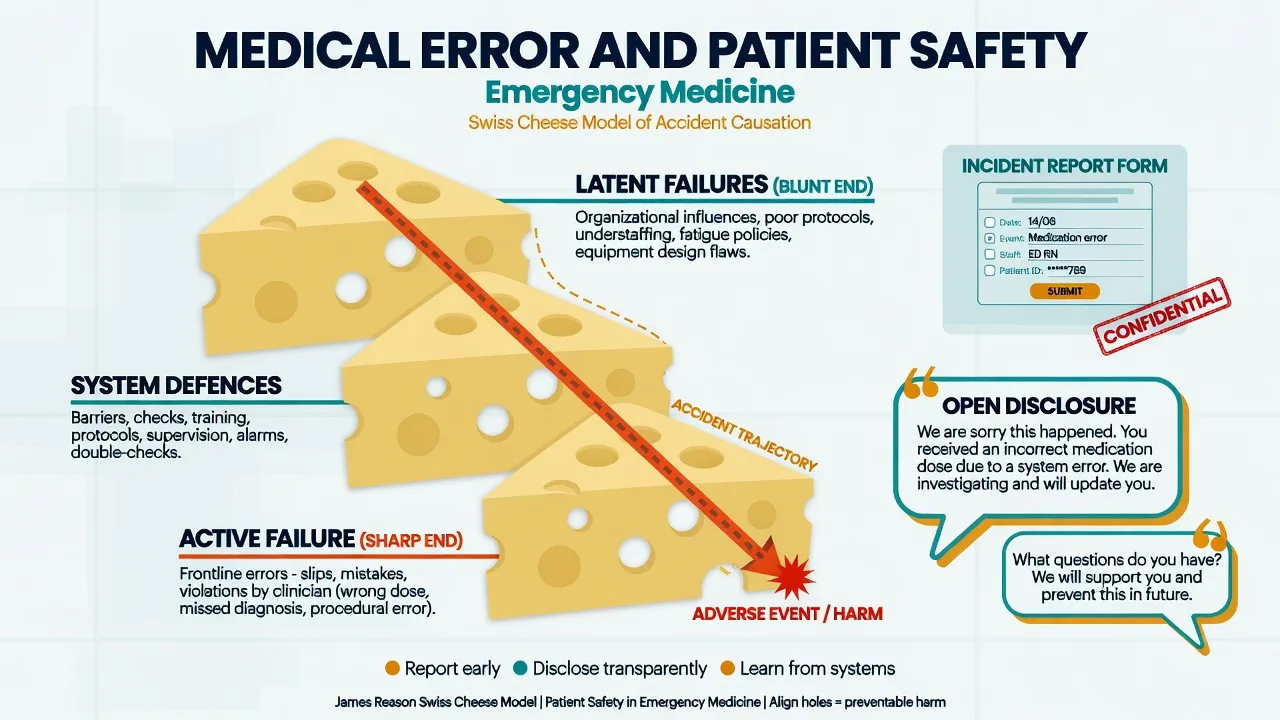
The scope and the vocabulary
A shared vocabulary is the first requirement, because the response to an event depends entirely on what kind of event it is. Medical error is the failure of a planned action to be completed as intended, or the use of a wrong plan to achieve an aim — it is a process failure, whether or not it reaches the patient and whether or not it causes harm. An adverse event is an injury caused by medical management rather than by the underlying disease process, and it is the outcome that error, omission or system failure may produce. The two are not synonymous: an error may cause no harm, and an adverse event may arise without any identifiable error. The remaining categories refine the gradient between a system that nearly failed and one that did fail, and the examiner tests the distinction relentlessly.[1]
A near miss is an event that had the potential to cause harm but did not, either by chance or by timely recovery — the wrong drug drawn up but checked and discarded before administration, the near-allergen given but the patient was not in fact allergic. A no-harm incident reaches the patient but causes no detectable harm. A sentinel event is an unexpected occurrence involving death, serious physical or psychological injury, or the risk thereof, that signals the need for immediate investigation and response — wrong-site surgery, suicide of an inpatient, abduction of an infant, administration of incompatible blood. A never event is a particularly grave subset, a wholly preventable serious incident that should never occur if available preventive measures are in place. Negligence, finally, is a legal finding, not a clinical one: care that fell below the accepted standard of a reasonably competent practitioner and caused harm. The clinician at the bedside classifies the event to decide the response; the lawyer determines negligence, never the clinician. [1]
[1]The systems approach — Swiss cheese and active versus latent failures
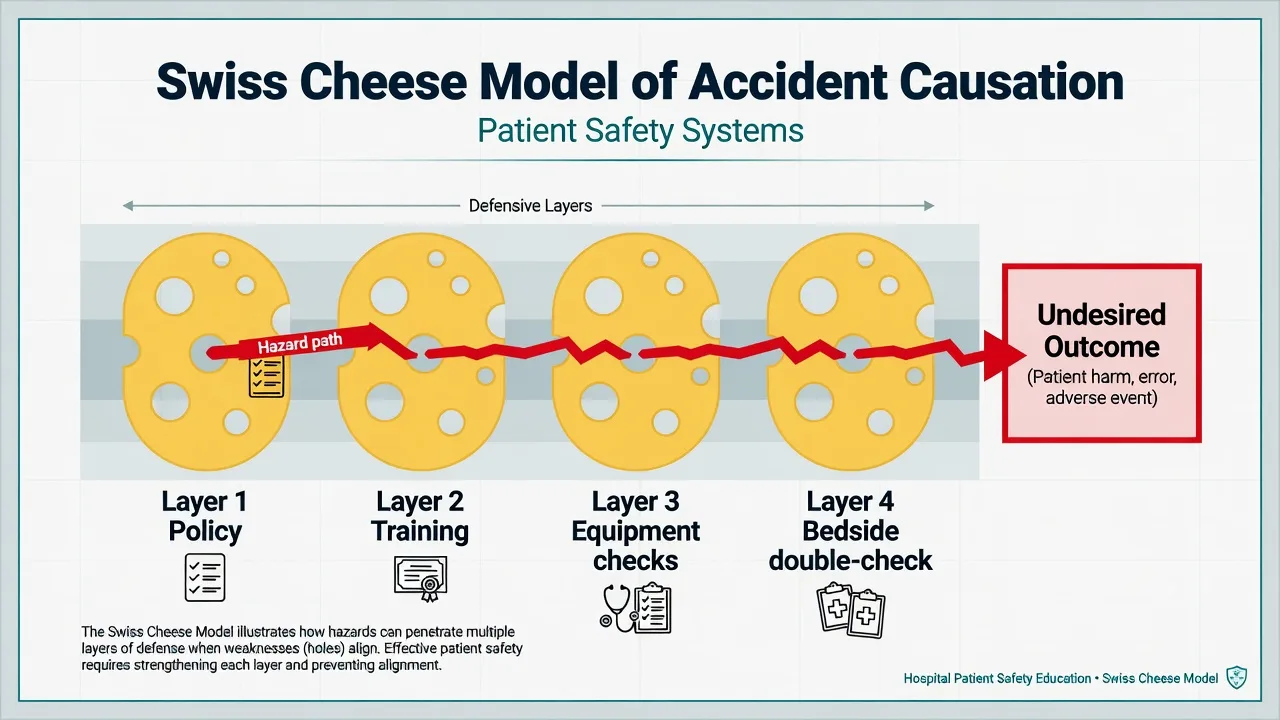
The modern understanding of medical error is built on James Reason's systems model, often called the Swiss cheese model. In any complex organisation, harm is prevented by layers of defence — alarms, double-checks, protocols, training, supervision, barriers — each represented as a slice of cheese. No defence is perfect; each has holes, created by design flaws, worn equipment, fatigue, production pressure or absent supervision. An accident occurs only when the holes in every layer momentarily align and a hazard passes all the way through to the patient. The corollary is the most important sentence in patient safety: error is not eliminated by exhorting individuals to be more careful, but by designing systems in which the holes are fewer, smaller and less likely to align. Reason's axiom frames the whole field — we cannot change the human condition, but we can change the conditions under which humans work.[1]
The model distinguishes two kinds of failure that combine to produce harm. Active failures are the unsafe acts committed by people at the sharp end, in direct contact with the patient — the slip (a lapse of attention, the right plan executed wrongly), the lapse (a memory failure, the forgotten allergy), the mistake (a wrong plan from faulty knowledge or reasoning) and the violation (a deliberate departure from a rule). Active failures are immediate, visible and often the focus of uninformed blame. Latent failures are the delayed consequences of decisions taken at the blunt end, far from the patient — staffing rosters that are too thin, equipment that is poorly maintained, protocols that are ambiguous, a culture that punishes reporting, design flaws that make the wrong drug easy to pick. Latent failures are the resident holes in the cheese, present long before the event and waiting for an active failure to pass through them. A serious investigation that concludes "the nurse gave the wrong drug" has described the active failure and stopped; a real root cause analysis keeps asking why until it reaches the latent failure that made the error both possible and likely. [1]
[1]Differential — the event categories distinguished
The event categories are not academic labels; each carries a different response, a different reporting pathway and a different expectation of investigation. A candidate who treats a near miss like a sentinel event, or a no-harm incident like negligence, mishandles the station. The five categories below recur in every classification question, and distinguishing them is a tested competency.[1][4]
Near miss
- Had the potential for harm but did not reach or harm the patient — prevented by chance or by timely recovery
- The richest source of learning: report every near miss because the system almost failed and the next alignment may not be caught
- No patient harm, so no open disclosure required, but full incident reporting and system review
- High value because near misses outnumber harmful events many times over
No-harm incident
- Reached the patient but caused no detectable harm — a lab result filed to the wrong chart that was noticed before action
- Reportable and reviewable to find the latent failure, even though no patient was harmed
- No disclosure of harm (none occurred), but the patient may be informed that an error was made and corrected
- Distinguished from near miss by whether the event reached the patient
Adverse event
- Caused harm by medical management — a hospital-acquired pressure injury, a drug rash, a fall on the ward
- Requires incident reporting and, where the harm is significant, open disclosure to the patient
- Investigation scaled to severity — local review for minor harm, full root cause analysis for serious harm
- May or may not involve error: some adverse events are known unavoidable complications of appropriate care
Sentinel event
- Unexpected occurrence involving death, serious harm, or the risk thereof — wrong-site procedure, retained foreign body, incompatible transfusion, inpatient suicide
- Triggers immediate (within hours) notification and a mandatory, formal investigation, typically root cause analysis
- Reported to the external regulator (TJC in the US, ACSQHC in ANZ, CQC in the UK) within a defined window
- The signal event that the whole safety system is built to detect and respond to
Never event
- A wholly preventable serious incident that should never occur if preventive barriers are in place — wrong patient, wrong site, wrong procedure, retained object, incompatible blood
- A subset of sentinel event, defined by national lists (NQF serious reportable events, NHS Never Events)
- Implies a known preventive measure failed, so investigation focuses on why the barrier was absent or bypassed
- Often externally reportable and publicly accountable
Negligence
- A legal finding, not a clinical one — care that fell below the standard of a reasonably competent practitioner and caused harm
- Never the bedside diagnosis; the clinician describes the event factually and leaves the legal determination to the court
- May coexist with an adverse event, a sentinel event or an error, but is a separate question
- Distinguished by the standard-of-care test and causation, judged in retrospect by peers
Open disclosure — the protocol and the duty
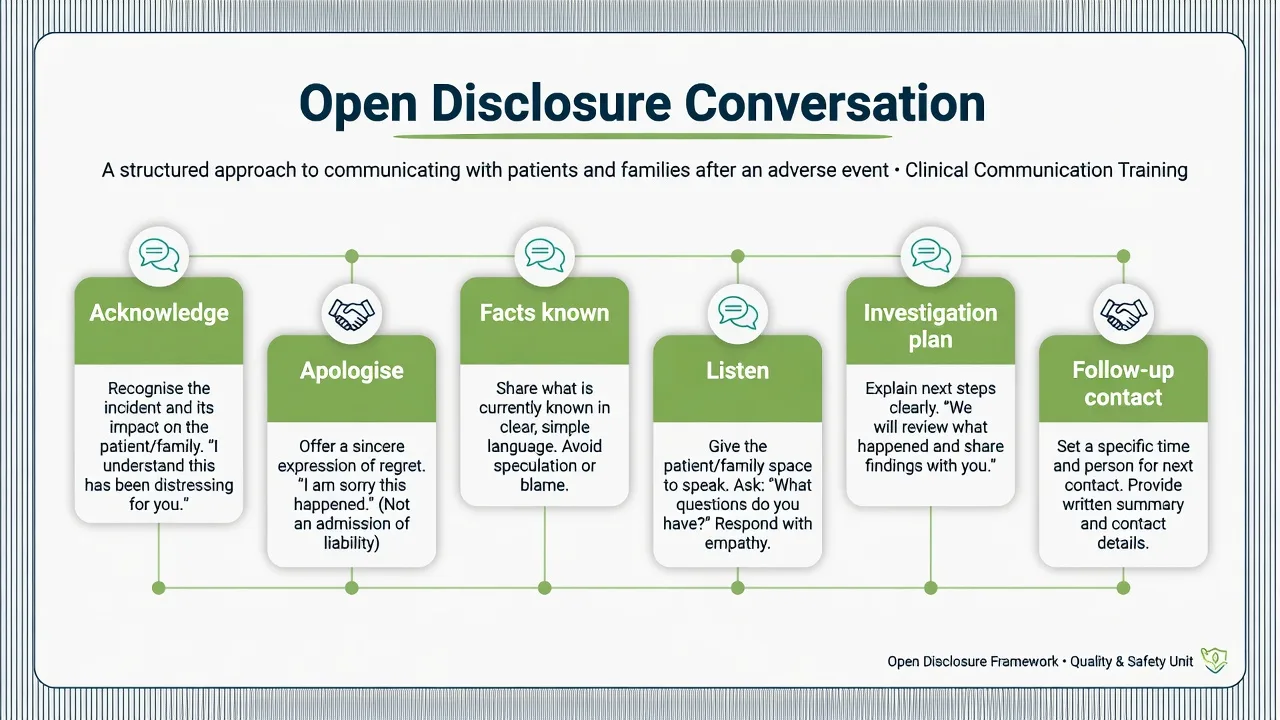
Open disclosure is the structured, frank and timely discussion of a patient safety incident with the patient, their family and their carers. It rests on the ethical principle of candour — the duty to be open about harm — and on the empirical observation that disclosure, accompanied by a genuine apology and an explanation, preserves trust and reduces, rather than increases, the likelihood and cost of litigation. Gallagher and colleagues showed that the overwhelming majority of patients want full disclosure of errors, including an explicit acknowledgement that an error occurred, an apology, and information about how the harm will be addressed and how recurrence will be prevented; clinicians, by contrast, systematically underestimate how much patients want to know and overestimate the legal risk of disclosure.[2] Kachalia and colleagues demonstrated that hospitals adopting communication-and-resolution programs — formal disclosure, apology, explanation and where appropriate early compensation — saw reductions in malpractice claims, faster claim resolution and lower total costs, directly contradicting the fear that disclosure invites litigation.[3]
The protocol that the Fellowship candidate is expected to apply is the staged open disclosure conversation, distilled here in the elements common to the ACSQHC Open Disclosure Framework used across Australasia and the statutory Duty of Candour operating in the United Kingdom. [1]
The staged open disclosure conversation
OPEN
Disclose as soon as the incident is recognised and the patient is able — ideally within 24 hours, in a private setting, with the right people present (the treating clinician leading, and family or carer invited)
Describe factually what happened and what is known so far, acknowledge the harm, and offer a sincere apology — an apology is not an admission of legal liability and is protected by apology legislation in most jurisdictions
Outline the clinical consequences of the harm, what is being done to treat it, and what will happen next — the investigation, the timeline, who will communicate findings
Commit to a formal open disclosure meeting once the investigation is complete, share the findings and the system changes, give a single point of contact, and document the conversation in the record
Several boundaries govern the conversation and are themselves examinable. The clinician leading disclosure describes facts and acknowledges harm, but does not allocate fault, name other staff as negligent, or admit legal liability on behalf of the organisation — questions of liability and compensation are referred to the appropriate channel. Disclosure is not a single event but a process: an initial conversation as soon as practicable, and a formal meeting once the investigation findings are available. Disclosure should occur even when the patient cannot be told directly — the unconscious or deceased patient's family receives the disclosure on the patient's behalf. Where a patient lacks capacity, the disclosure is made to the substitute decision-maker under the same principles that govern consent. [1]
Incident reporting — what, when and how
Incident reporting is the mechanism by which a healthcare system converts an event into learning. Its purpose is not to punish or to apportion blame but to capture the facts of the event, its contributory factors and its outcome, so that the latent failures can be found and removed before the next alignment of holes. The obligation is to report the what — a factual account of what happened, untainted by speculation or attribution — as soon as the patient is safe and the immediate clinical situation is managed. The when is promptly: within the shift in which the event is recognised, and certainly before the people involved have dispersed and memory decays. The how is the local incident-management system, the electronic form through which the event is recorded and routed for review — RLDatix, Safeguard or the equivalent in Australasia; the Learn From Patient Safety Events (LFPSE) system in the United Kingdom, which replaced the National Reporting and Learning Service.[1]
The rule of thumb is that every actual harm event and every near miss is reportable, because the near miss reveals a latent failure as clearly as the harmful event and is far more common. Underreporting is near-universal: even in mature safety cultures, only a fraction of identifiable events are captured, the deficit largest for near misses and events without obvious harm. The drivers of underreporting are cultural (fear of blame, fear of reputational or career damage), structural (a cumbersome form, no feedback on what changed) and cognitive (uncertainty about whether an event is reportable). The remediation is a blame-free reporting culture, a simple and accessible reporting mechanism, and a visible feedback loop so that staff see that reports lead to change. A report is a factual document, not a confession and not an accusation. [1]
Model answer — the incident report you would file
Root cause analysis
Root cause analysis is the structured, retrospective investigation that follows a serious event, a sentinel event or a recurring pattern of incidents. Its aim is to identify the systemic causes — the latent failures — that combined to produce the event, so that corrective action can be designed and the event prevented from recurring. It is explicitly not a vehicle for attributing individual blame, and an analysis that stops at the active failure ("the resident gave the wrong dose") has failed in its central purpose. The discipline of the method is to keep asking why until the question reaches a system cause that the organisation can change, and to phrase every causal statement so that it links a cause to the event it produced. [1]
The steps of root cause analysis are the structure the examiner expects, and each carries a specific task. [1]
The steps of a root cause analysis
FLOWEDS
Convene a multidisciplinary team led by someone independent of the event, define the event to be analysed, set the scope and the timeline
Reconstruct what happened from the record, statements, equipment and environment — then describe what should have happened (the gap is where the analysis begins)
For each gap, ask why it happened, and ask why again — the five-whys technique or a fishbone diagram drives the search from the proximate active failure toward the latent root cause
Phrase each finding as a cause-and-effect statement linking a specific cause to the event, avoiding blame language and "the clinician failed" formulations
Design actions that act on the root cause, ordered by the hierarchy of controls — eliminate or force-function first, then simplify, then standardise, then educate and policy (the weakest layer)
Assign each action a named owner, a deadline and a measure of success; a recommendation without an owner and a measure is not an action
Feed the findings back to the staff involved and to the wider department, embed the change, and re-measure at a defined interval to confirm the fix held
The recurring failure of root cause analysis is to convert the investigation into blame dressed as analysis, by locating the cause inside a person rather than inside the system. A second failure is to generate a long list of recommendations without owners, deadlines or measures, so that nothing changes and the event recurs. The test of a good analysis is whether its actions, if implemented, would actually prevent the event — and whether those actions act on the latent cause, not merely on the clinician who happened to be last in the chain. [1]
Common ED errors — diagnostic, medication and procedural
The emergency department concentrates the conditions under which error thrives, and three categories dominate both the harm and the malpractice data. Grenon and colleagues' analysis of closed malpractice claims confirmed the patterns that recur in every emergency department: diagnostic error is the single largest source of serious harm and litigation, medication error is the most frequent error overall, and procedural error, though less common, produces the gravest individual events.[4]
Diagnostic error in the emergency department is the failure to make a time-critical diagnosis that was reasonable to make on the available information. The high-yield examples are the diagnoses whose miss is both common and catastrophic. Missed acute coronary syndrome presents atypically — the younger patient, the woman, the diabetic with silent ischaemia, the patient whose chest pain is attributed to musculoskeletal or gastrointestinal causes without an adequate risk assessment. Missed subarachnoid haemorrhage is the thunderclap headache called a migraine and sent home without a computed tomogram or lumbar puncture; sentinel bleeds are missed in the days before the catastrophic rupture, and a normal CT does not exclude subarachnoid haemorrhage within the window that warrants lumbar puncture. Missed abdominal aortic aneurysm is the older patient with back or flank pain attributed to musculoskeletal or renal causes without palpation of the aorta or a scan. Missed aortic dissection, ectopic pregnancy, pulmonary embolism and spinal epidural abscess complete the recurring list. The latent failures are cognitive — anchoring on a benign diagnosis, premature closure, the search-satisficing error — and environmental: interruptions, fatigue, access block, and the absence of decision support.[4]
Medication error is the most common error type in the emergency department, and it clusters into wrong drug, wrong dose, wrong route, wrong patient and missed allergy. Ten-fold dosing errors (1 mg given as 10 mg, 0.1 mg given as 1 mg) arise from misplaced decimals, ambiguous prescriptions and the mg-versus-microgram trap. Look-alike, sound-alike drug pairs (hydralazine and hydroxyzine, dopamine and dobutamine) are selected wrongly from crowded shelves. Allergy is not checked because the prescribing pathway does not force the question. Paediatric weight-based dosing is the single highest-risk medication area, because every paediatric dose is a calculation and every calculation can be wrong by a factor of ten. Insulin and anticoagulants are the drugs whose errors cause the gravest harm. The latent failures are the absence of forcing functions, the storage of dangerous drugs on open shelves, the lack of an integrated electronic prescribing and allergy record, and the production pressure that dispenses with the double-check. [1]
Procedural error is less frequent but more severe event by event: wrong-site and wrong-patient procedures, retained foreign bodies, unrecognised complications (the failed lumbar puncture, the displaced chest tube, the arterial cannulation of a vein), and the procedure performed without consent or on the wrong side. The latent failures here are the absence of a surgical safety checklist, the bypassed timeout, the unmarked site, and the hierarchical team in which the nurse who sees the error does not speak. [1]
Management of the harmed patient — the immediate clinical response
The immediate response to a medical error is the patient, not the paperwork. The first duty is to recognise and treat the harm the event caused, to stabilise the patient, and only then to preserve evidence, document, report and disclose. In the emergency department this most often means the management of a medication error or an allergic reaction, where the corrective action is the prompt administration of a reversal agent or an antidote, with the dose, route and monitoring that the situation demands. [1]
[1]Alongside the clinical response, the immediate phase has three further duties that the examiner tests. Preserve the evidence: the ampoule, the syringe, the infusion bag and the mislabelled wristband are retained, because they may be needed for the investigation. Document contemporaneously and factually: the event, the time, the assessment, the intervention and the response are recorded in the medical record, without speculation, without attribution of fault, and without any alteration — the record is the primary evidence in any later investigation, and a tampered record is both a regulatory and a criminal matter. Escalate: the senior clinician, the department lead and the incident-reporting pathway are engaged, and where the harm is serious, open disclosure begins. [1]
Culture — just culture and the second victim
The framework of error, disclosure, reporting and analysis is sustained by the culture in which it operates. A blame culture — in which error is met with punishment and the question asked after every event is "who did this?" — is self-defeating: it drives reporting underground, conceals the latent failures, and guarantees that the next alignment of holes will not be prevented. A just culture, articulated by David Marx, replaces blame with a tested distinction between the kinds of human conduct that produce error, and it matches the response to the conduct rather than to the outcome. The axiom of just culture is that the severity of harm is irrelevant to the culpability of the act: a fatal error may be blameless honest error, and a harmless act may be culpable recklessness.[5]
The just-culture test — matching the response to the conduct
JUST
Culpability turns on what the person did and the risk they took, not on whether harm resulted — a near miss from reckless conduct is as culpable as a death from the same conduct
A slip, lapse or mistake by a competent clinician working in good faith is managed by support, system redesign and review of the conditions, not by sanction
At-risk behaviour — a reasonable person knowingly taking a shortcut or an unjustified risk — is met with coaching, not punishment, to return the conduct to the safe path
Conduct that knowingly and unjustifiably risks harm — disabling a safety device, working impaired, ignoring a known critical step for no defensible reason — is managed through the disciplinary pathway
The clinician who causes or is associated with patient harm becomes a second victim, a term coined by Albert Wu. The syndrome is a predictable and serious occupational injury: shock, guilt, self-doubt, intrusive recall, sleep disturbance, loss of confidence, and, in the most affected, burnout, depression and post-traumatic stress. Ong and colleagues' systematic review confirmed that second victim syndrome is common across healthcare professions and that structured peer support, a clear just-culture response, and timely access to psychological care reduce its severity and duration.[5] The department's duty to the clinician after an event is therefore parallel to its duty to the patient: support, not isolation; a fact-based, blame-free investigation; and a named peer supporter. A department that consumes its clinicians after error is one that will not retain them and will not learn.
A taxonomy of error — the five domains
The event categories (near miss, adverse event, sentinel event, never event) describe the outcome of an incident; the error-type taxonomy describes its nature — where in the care process the failure occurred. Both axes are examinable, and both must be applied to the same event: a missed aortic dissection is, at once, an adverse event (outcome), a diagnostic error (nature), and — if the standard of care was breached — potentially negligence (legal). The taxonomy below, derived from the World Health Organization's International Classification for Patient Safety and the National Coordinating Council for Medication Error Reporting and Prevention (NCC MERP) index, sorts every error into one of five domains, each with its own signature failures, its own prevention strategies and its own recurring ED examples.[4][11]
Diagnostic
- The failure to make, delay in making, or making of a wrong diagnosis that was reasonable on the available information — the single largest source of serious ED harm and malpractice
- Three modes: missed diagnosis (the SAH sent home as migraine), delayed diagnosis (the ACS workup parked for the abdominal pain that came first), wrong diagnosis (the PE treated as anxiety)
- Drivers: cognitive biases (anchoring, premature closure, search-satisficing), atypical presentations, time pressure, interruptions, and absent decision support
- Highest-yield misses: ACS, SAH, aortic dissection, AAA, PE, ectopic pregnancy, spinal epidural abscess, necrotising fasciitis, meningococcaemia
Treatment
- The wrong plan executed, or the right plan executed wrongly — wrong drug, wrong dose, wrong route, wrong patient, wrong time, wrong rate
- Ten-fold dosing errors (misplaced decimals, mg-versus-microgram), look-alike/sound-alike selection, omitted or duplicate therapy, the wrong infusion rate on a vasoactive drug
- The most common error type overall; insulin, anticoagulants, opioids and concentrated electrolytes cause the gravest harm per event
- Prevention: CPOE with clinical decision support, bar-code medication administration, smart pumps with dose-error reduction software, independent double-checks
Preventive
- The failure to provide an indicated prophylactic or screening intervention — missed vaccination, omitted thromboprophylaxis, no fall-risk assessment, a missed diabetic foot screen
- Often invisible at the moment — harm accrues days to weeks later (the DVT from omitted chemoprophylaxis, the pressure injury from a missed reposition schedule)
- Common in the ED boarded patient: omitted VTE prophylaxis, missed decubitus care, omitted stress-ulcer prophylaxis in the prolonged-stay patient
- Detected by audit and bundle compliance, not by the bedside error report — a systems-performance measure
Communication
- The failure of information to reach the right person at the right time — the handover gap, the unescalated abnormal result, the critical value not closed the loop
- Handover failures are the dominant subtype: the resus patient signed over without the pending troponin, the deterioration not escalated to the senior, theDisposition plan not communicated to the nurse
- Includes the unread referral letter, the un-transcribed verbal order, the critical imaging result filed without a named recipient
- Prevention: structured handover tools (SBAR, I-PASS), read-back of verbal orders, electronic result acknowledgement, closed-loop communication
System / other
- The latent, organisational failures that set the conditions for the active failures above — understaffing, equipment failure, access block, crowding, fatigue, the absent protocol
- Not a single clinician's act but the blunt-end decisions: the thin night roster, the broken defibrillator, the unstocked trolley, the look-alike ampoule shelved together
- Includes equipment malfunction, supply-chain failures, IT downtime, and the ambient conditions (noise, interruption density, boarding)
- These are the root causes RCA is designed to reach — the holes that engineering, staffing and design must close, not the clinician at the sharp end
Error prevention — the engineered defences
The hierarchy of controls, encountered above in the corrective actions of root cause analysis, is the master framework for prevention, and every validated patient-safety technology is an instance of it. The strongest defence is the force-function — a physical or logical barrier that makes the error impossible: the gas-pin index that prevents the wrong cylinder fitting the wall outlet, the patient wristband that must be bar-code-scanned before the drug is given, the prefilled syringe that cannot deliver ten times the dose. Below it sit constraints and simplification (limiting the available concentrations, removing dangerous drugs from open shelves, standardising the equipment), then standardisation and protocols (the single insulin infusion protocol, the standard sepsis bundle), then redundancy and double-checks (the independent dual check on a paediatric calculation), and weakest of all policy, training and reminders (the poster, the in-service, the "be careful"). Bates and colleagues showed that computerised physician order entry (CPOE) with clinical decision support cut the rate of serious medication errors by more than half — a forcing-function deployed at scale — and Poon and colleagues showed that bar-code technology reduced non-timing administration errors by over 50 per cent and potential adverse drug events by nearly as much.[6][7] The candidate must know each technology, what it prevents, what it cannot prevent, and the new failure modes it introduces.[8]
CPOE with CDS
- Computerised physician order entry with clinical decision support — forces legible, complete, allergy-checked orders; flags dose ranges, drug interactions, duplications and renal adjustments
- Bates (JAMA 1998): reduced serious medication errors by 55 per cent in a quasi-experimental before-and-after study
- Strengths: eliminates transcription error, embeds the allergy and weight check, enables standard order sets
- New failure modes: alert fatigue (clinicians override 90 per cent of alerts), wrong-patient orders from a crowded order screen, selection errors from drop-down menus, downtime failures
BCMA
- Bar-code medication administration — the nurse scans the patient wristband and the drug barcode; the system verifies the five rights (right patient, drug, dose, route, time) at the bedside
- Poon (NEJM 2010): reduced non-timing administration errors by 41.4 per cent and potential adverse drug events by 27.3 per cent in a quasi-experimental study across 17 units
- Strengths: the bedside force-function that catches wrong-patient and wrong-drug errors the pharmacist and prescriber missed
- New failure modes: workarounds (scanning the barcode from a worksheet not the wristband, affixing barcodes to the scanner), unscannable or missing barcodes, the false sense of safety that omits the clinical check
Smart pumps (DERS)
- Infusion pumps with dose-error reduction software (DERS) — a drug library hard-codes concentration, usual dose range and soft/hard limits; the pump alarms or blocks an out-of-range infusion
- Reduces the wrong-rate errors on high-risk infusions (noradrenaline, insulin, heparin, opioid PCA) that cause the gravest IV harm
- Strengths: catches the ten-fold rate error and the mis-programmed concentration; logs compliance and library use for audit
- New failure modes: the bypass — running the infusion on "basic" mode without the library defeats the safety software entirely, and is the commonest reason smart pumps fail to prevent harm
Checklists
- A structured, brief cognitive aid that forces the critical steps at a high-risk transition — the WHO surgical safety checklist at anaesthesia induction, before incision, and at sign-out; the ED intubation checklist; the central-line bundle
- Haynes (NEJM 2009): the 19-item WHO checklist reduced global surgical mortality from 1.5 to 0.8 per cent and inpatient complications from 11 to 7 per cent across eight diverse hospitals
- Strengths: standardises the team, forces the timeout and site-marking, surfaces the unspoken allergy and equipment gap
- New failure modes: tick-box compliance ("did we say the words?") without the genuine team pause, degraded into theatre for audit
Independent double-check
- Two clinicians, separately and without cueing each other, verify a high-risk calculation or infusion — paediatric weight-based doses, chemotherapy, insulin, heparin, concentrated electrolytes, neuromuscular blockers
- A medium-strength redundancy control — catches calculation and selection errors that a single fatigued mind misses
- Strengths: effective for the genuine independent check (two minds, no anchoring); the standard for paediatric and oncology dosing
- New failure modes: the dependent check ("I read you the dose, you agree") provides no independent redundancy; over-use on every drug produces check fatigue and checkbox ritual
Simulation training
- In-situ or centre-based rehearsal of high-risk, low-frequency events — the ED airway crisis, the paediatric arrest, the massive transfusion — in a psychologically safe environment with structured debrief
- Builds the non-technical skills (leadership, communication, situational awareness, teamwork) that fail in real crises, and exposes the latent system failures in the actual clinical environment during in-situ sims
- Strengths: identifies latent hazards (the missing drug, the broken equipment, the unclear role allocation) before a real patient is harmed; CRM and TeamSTEPPS-derived
- New failure modes: ineffective without debrief and faculty; a "fun" exercise without system follow-through does not change outcome
Bates — CPOE and serious medication errors (JAMA 1998)
JAMA
PMID 9794308
Key finding
A quasi-experimental before-and-after study at Brigham and Women's Hospital evaluating computerised physician order entry with a team intervention on the rate of serious medication errors (those with the potential for permanent harm). Non-intercepted serious medication errors fell by 55 per cent (from 10.7 to 4.86 per 1000 patient-days), with the largest fall in ordering-stage errors.
Practice change
The landmark evidence that CPOE with clinical decision support — a forcing-function at the prescribing stage — cuts serious medication error by more than half, and the foundation for the global mandate that prescribing be electronic.<Cite id='6' />
Poon — bar-code technology for medication administration (NEJM 2010)
New England Journal of Medicine
PMID 20445181
Key finding
A quasi-experimental study across 17 medical and surgical units implementing bar-code medication administration (BCMA) and an electronic medication-administration record. Non-timing errors in medication administration fell by 41.4 per cent and potential adverse drug events by 27.3 per cent; timing errors (late or early doses) fell by 27.3 per cent.
Practice change
Established the bar-code wristband scan as the bedside force-function that catches wrong-patient and wrong-drug errors the upstream layers missed, and underpins the modern closed-loop medication system.<Cite id='7' />
Haynes — the WHO surgical safety checklist (NEJM 2009)
New England Journal of Medicine
PMID 19144931
Key finding
A prospective multinational before-and-after study of a 19-item surgical safety checklist (sign in, time out, sign out) across eight hospitals in high-, middle- and low-income settings. Death fell from 1.5 to 0.8 per cent and inpatient complications from 11.0 to 7.0 per cent after checklist introduction, with no increase in operating time.
Practice change
The proof that a simple, cheap, structured checklist — a cognitive forcing-function at a high-risk transition — saves lives globally, and the template for every ED resus, airway and procedural checklist.<Cite id='8' />
Cognitive biases and diagnostic error
Diagnostic error is not usually a gap in knowledge; it is a failure of reasoning under the cognitive load of the emergency department. The dual-process theory of Croskerry frames the mind as two systems: the fast, intuitive, pattern-recognising System 1 that operates most ED encounters, and the slow, analytic, rule-based System 2 that engages for the atypical or the undifferentiated. Most diagnostic errors arise from System 1 — a heuristic that is fast and usually right, but that produces predictable, classifiable biases when it is applied to the case that does not fit the pattern. The recurring biases are themselves examinable, and naming them is the first step to counteracting them.[4][11]
Anchoring
- Locking onto the first salient feature — "this is a migraine" — and fitting all subsequent data to that frame, discounting the features that do not fit
- The classic driver of the missed SAH and missed ACS: the early benign label that the later red flags cannot dislodge
- Counter: deliberately generate at least one alternative diagnosis (the "what else could this be?" question)
Premature closure
- Accepting a diagnosis before it has been fully verified — "it looks like X, so it is X" — and closing the search before the evidence is in
- Common when the presentation is classic-appearing or when pressure to disposition is high
- Counter: the explicit "have I considered enough? what would make me change my mind?" before disposition
Search-satisficing
- Calling off the search once the first abnormality is found — the second fracture missed because the first was seen, the second foreign body, the second overdose agent
- The radiology and the trauma-survey trap: finding one injury and stopping
- Counter: complete the full survey or the full image review after the first finding, by design
Availability
- Estimating probability by how easily examples come to mind — over-diagnosing what was recently seen, under-diagnosing what was not
- The Monday-morning effect: every chest pain looks like the dissection you missed last week
- Counter: base the prior on the actual base rate, not on the recent memorable case
Diagnostic momentum
- A label, once applied by a prior clinician or the referral letter, acquires inertia and is accepted without independent re-evaluation
- The " admitted for cellulitis" patient whose necrotising fasciitis is not reconsidered because the label was inherited
- Counter: re-derive the diagnosis from the primary data on every reassessment
Framing / commission bias
- Framing: being swayed by how the information is presented (the agitated referral, the "frequent flyer" label). Commission bias: the tendency to act (admit, scan, treat) to avoid missing something, sometimes causing harm from over-investigation
- Both distort the objective prior; the frequent-flyer label suppresses the genuine acute presentation
- Counter: re-state the presenting complaint in neutral terms; weigh the cost of action against the cost of inaction
Handover and communication failures
Handover is the highest-risk transition in the patient's journey, and the emergency department — with shift changes every eight to twelve hours, inter-departmental transfers, sign-over to inpatient teams, and the constant flow of boarding patients — is the densest handover environment in the hospital. The Joint Commission identified communication failure as the root cause in the majority of sentinel events, and handover failure is the dominant communication failure: the critical pending result not handed over, the decompensation not escalated, the disposition plan lost between nurses, the verbal order not read back. The remedy is the structured handover — a forced framework that standardises the content and the sequence so that nothing is omitted — and the evidence base for it is strong.[9]
Two frameworks dominate. SBAR (Situation, Background, Assessment, Recommendation) is the brief, situation-specific tool — the nurse calling the registrar about a deteriorating patient, the escalation of a critical result. I-PASS (Illness severity, Patient summary, Action list, Situation awareness and contingency planning, Synthesis by receiver) is the comprehensive shift handover tool, designed for the transfer of care at the end of a shift. Starmer and colleagues showed that implementation of the I-PASS handoff program reduced medical errors by 23 per cent and preventable adverse events by 30 per cent across nine paediatric residency programmes — one of the few interventions with level-1 evidence for harm reduction in handover.[9]
The structured shift handover
I-PASS
Open with a one-word stability grade — stable, "watcher" (guarded, watch closely), or unstable — so the receiver instantly knows where to focus first
A concise summary of the presenting complaint, the key findings, the working diagnosis, and the course so far — the headline, not the full history
The tasks remaining, each with a named owner and a timeframe — the pending troponin to be checked and acted on, the CT to be reviewed, the family to be called
Foresee what may go wrong and state the plan: "if the BP drops, give a 500 mL bolus and call me"; the receiver takes over not just the patient but the anticipated deterioration
The receiver reads back, summarises, and asks questions — the closed-loop confirmation that the handover was received and understood, and the step most often skipped
Starmer — I-PASS handoff program (NEJM 2014)
New England Journal of Medicine
PMID 25372088
Key finding
A prospective pre-/post-intervention study with a concurrent control across nine paediatric residency programmes implementing the I-PASS handoff bundle (standardised handover structure, faculty training, written and oral components). Medical errors fell by 23 per cent (from 24.5 to 18.8 per 100 admissions) and preventable adverse events by 30 per cent, with no change in handover duration or workflow.
Practice change
Level-1 evidence that a structured handover tool — a cognitive forcing-function at the highest-risk transition — substantially reduces harm, and the basis for the global adoption of I-PASS-style handover in ED and ward practice.<Cite id='9' />
High-alert medications — the small list that causes the large harm
The Institute for Safe Medication Practices (ISMP) defines a short list of high-alert medications — drugs that bear a heightened risk of causing significant patient harm when used in error. They are not the most frequently mis-used drugs, but they are the ones whose error is most likely to be catastrophic. The emergency department uses several of them on every shift, and the candidate must know each drug, its characteristic error, and the engineered mitigation that closes the hole.[4]
Insulin
- The "units" written as "U" and misread as a zero (10 U read as 100); the sliding-scale dose misread; the infusion rate error
- Mitigation: write "units" in full (CPOE removes the abbreviation), standard insulin infusion protocol with a single concentration, independent double-check of the infusion rate
- Harm: severe hypoglycaemia, seizure, permanent neurological injury
Anticoagulants
- Heparin infusion rate errors, enoxaparin dose omitted or doubled, warfarin continued pre-procedure, DOAC dose not renal-adjusted
- Mitigation: weight-based heparin protocol, independent double-check, renal-function-driven DOAC dosing, anticoagulation stewardship
- Harm: catastrophic bleeding (or thrombosis from omission); the leading drug class in fatal medication error
Opioids and sedatives
- Ten-fold morphine dosing, the over-sedated procedural-sedation patient, the opioid-naïve patient given a long-acting agent
- Mitigation: standardised weight-based dosing, naloxone immediately available, capnography in procedural sedation, the opioid infusion on a smart pump
- Harm: respiratory depression, hypoxic brain injury, death — the reversal agent (naloxone 0.4 mg IV) must be in every resus bay
Concentrated electrolytes
- Potassium chloride concentrate, hypertonic saline (3 per cent), magnesium sulfate — fatal when given as a rapid IV push instead of a controlled infusion
- Mitigation: removal from ward/ED stock (pure elimination control), storage in the pharmacy only, premixed standard concentrations, smart-pump administration
- Harm: fatal arrhythmia (potassium), central pontine myelinolysis and haemorrhage (rapid hypertonic saline) — a classic never-event drug
Neuromuscular blockers / sedation
- Suxamethonium, rocuronium, propofol, ketamine — given to the patient who cannot be intubated or ventilated, or without a prepared airway trolley
- Mitigation: mandatory airway equipment check and difficult-airway assessment before RSI, capnography from the first breath, the apnoeic-oxygenation and back-up plan
- Harm: cannot-intubate-cannot-ventilate arrest, awareness, hypoxic injury — the drug is safe only with the system around it
Adrenergic infusions
- Noradrenaline, adrenaline, vasopressin, dobutamine — titrated to the wrong rate, on the wrong concentration, with the wrong label
- Mitigation: standard concentrations in the drug library, smart-pump with DERS, dedicated central line, label on the line at the connector
- Harm: hypertensive crisis, extreme vasoconstriction with limb ischaemia, fatal arrhythmia from rapid push
The second victim — trajectory and support
The clinician who causes or is associated with patient harm becomes a second victim, a term coined by Albert Wu to describe the predictable, serious occupational injury that follows an adverse event.[10] The syndrome is far more common than is acknowledged: most clinicians will be a second victim at least once in their career, and the symptoms — shock, guilt, self-doubt, intrusive recall, sleep disturbance, loss of confidence, social withdrawal, and in the most affected, burnout, depression and post-traumatic stress — can persist for months and end careers. Ong and colleagues' systematic review confirmed that structured peer support, a clear just-culture response, and timely access to psychological care reduce its severity and duration.[5][10]
Scott described a predictable six-stage trajectory of the second-victim experience that frames the support a department must provide: (1) chaos and accident response — the immediate clinical management of the patient; (2) intrusive reflections — the relentless replay of "what if"; (3) restoring personal integrity — seeking reassurance and searching for whether one is a competent clinician; (4) enduring the inquisition — the investigation, the incident report, the fear of sanction and litigation; (5) obtaining emotional first aid — reaching for support, often from colleagues and family, and finding it wanting or absent; (6) moving on — which takes one of three paths: dropping out (leaving the profession), surviving (coping but diminished), or thriving (using the experience to improve the system). The department's duty is to ensure the clinician lands on the thriving path, not the dropping-out path. [1]
[1]Supporting a colleague after an adverse event — the immediate and ongoing response
- Immediate — separate the clinician from the next clinical task. (a) Ensure the patient is being managed by another senior clinician, so the involved clinician is not the one continuing the resuscitation of the patient they harmed. (b) Offer a quiet space and a trusted colleague to sit with them — they are in shock and should not drive home alone.
- Within hours — the first peer contact. (a) A trained peer supporter, or a trusted senior, makes contact in person, listens without judgement, and does not investigate, advise on fault, or minimise. (b) Normalise the second-victim experience — the symptoms are a predictable injury, not a sign of incompetence. (c) Do not discuss the event in the corridor or in earshot of others; confidentiality protects the clinician and the patient.
- Within days — explain the just-culture process. (a) Walk the clinician through the incident report, the RCA, and the just-culture test, so the process is understood and not feared. (b) Confirm whether the conduct is honest error (managed by support and system redesign), at-risk behaviour (coached), or reckless (disciplinary) — and communicate that determination clearly and promptly. (c) Address the question every second victim asks first: "am I going to be reported / fired / sued?"
- Ongoing — the structured support pathway. (a) Offer formal referral to the employee assistance program, the clinician health program (AHPRA / GMC practitioner-health pathway), or a psychologist with expertise in medical trauma. (b) Agree a graded return to the clinical area and the task that caused the event — do not force an immediate return to the same scenario. (c) Schedule follow-up at defined intervals; the trajectory lasts weeks to months, not days.
- System learning — close the loop. (a) Feed the findings of the RCA back to the clinician, so they see that the system cause was found and addressed — this is itself therapeutic and the single biggest determinant of the thriving path. (b) Where the clinician wishes, involve them in the system change that prevents recurrence — turning the second-victim experience into the improvement that gives it meaning.
The immediate response to a medication error — a structured sequence
Responding to a suspected medication error in the ED — the order of the actions
- Recognise and treat the patient first — stop the offending drug. (a) The first action is always the patient, not the paperwork: stop the infusion, withdraw the drug, assess the ABC and the vital signs. (b) Give the reversal agent or antidote appropriate to the drug and the severity (see the antidote key fact above) — naloxone for opioid, flumazenil for benzodiazepine, protamine for heparin, prothrombin complex concentrate plus vitamin K for warfarin, intramuscular adrenaline for anaphylaxis. (c) Reassess the response; have a second dose ready.
- Escalate to the senior. (a) Notify the consultant in charge, the nurse-in-charge, and — for a serious event — the duty manager and the on-call executive. (b) For a sentinel event, the notification clock starts now (external reporting within the regulator's window). (c) Ensure the patient is in a monitored area with the right level of care for the harm caused.
- Preserve the evidence. (a) Retain the ampoule, the syringe, the infusion bag, the giving set and the mislabelled wristband — sealed, labelled, and sent to pharmacy, not discarded. (b) Do not alter or delete the medication administration record; the electronic audit trail is itself evidence. (c) Note the batch number for a suspected adverse-drug-reaction report.
- Document contemporaneously and factually. (a) Record the event, the time, the assessment, the intervention and the response in the medical record — factually, without speculation and without attribution of fault. (b) A clearly marked, time-stamped late addendum is permitted if a detail is recalled later; deleting, rewriting or back-dating is never permitted and is a regulatory and criminal matter. (c) Record the patient's clinical state and the ongoing monitoring plan.
- Report and begin open disclosure. (a) File the incident report within the shift, via the local incident-management system (RLDatux / Safeguard / LFPSE), with a factual account of what happened. (b) Begin open disclosure to the patient and family as soon as the patient is stable — OPEN (Open early, Provide facts and an apology, Explain consequences and plan, Name next steps). (c) An apology is not an admission of legal liability and is protected in most jurisdictions; concealment, not candour, drives litigation.
- Refer for investigation and support. (a) Refer serious events for formal root cause analysis (FLOWEDS), engaging a multidisciplinary team independent of the event. (b) Trigger the second-victim support pathway for the clinician involved — peer support within hours, structured follow-up, and a just-culture determination of the conduct. (c) Close the loop: feed the RCA findings and the corrective actions back to the staff and embed the change, then re-measure to confirm the fix held.
Common errors and pitfalls
The recurring failures are those the framework exists to prevent. Blaming the individual at the active failure converts every event into a witch-hunt and guarantees the latent cause persists. Failing to disclose — out of fear, embarrassment or poor advice — breaches the duty of candour, erodes trust and increases litigation. Altering the medical record after an event, in any form — deleting, rewriting, back-dating, or "tidying" an entry — is the single act most fatal to a clinician's defence and is itself a regulatory and criminal matter. Delaying disclosure until the investigation is complete inverts the protocol: the initial conversation happens within a day, the formal meeting follows the findings. Stopping the root cause analysis at the active failure ("the resident forgot to check the allergy") produces a recommendation for re-education and leaves the latent failure intact. Recommendations without owners or measures generate action plans that are never implemented or never checked. A punitive response to honest error destroys reporting and learning. Ignoring the second victim abandons a colleague at the moment of greatest need. Reporting only the harmful events and never the near misses throws away the richest source of system learning. Asking "who" instead of "why" after every event is the diagnostic error of the safety system itself. [1]
Evidence and regional guidelines
The systems approach to medical error is grounded in James Reason's human-factors work and the Institute of Medicine report To Err is Human, and its modern epidemiology is captured by Makary and Daniel, whose estimate placed medical error among the leading causes of death in the United States.[1] The disclosure literature is anchored by Gallagher's study of patient and physician attitudes and by Kachalia's evaluation of communication-and-resolution programs, which together establish that disclosure with apology reduces rather than increases litigation.[2][3] The diagnostic-error burden is documented in the closed-claims analysis of Grenon and colleagues, which confirms that diagnostic error dominates emergency medicine malpractice and that its root causes are system and cognitive, not individual.[4] The second-victim literature is synthesised in Ong and colleagues' systematic review of support interventions.[5] The statutory and policy overlay differs by region but converges on the same principles of candour, structured investigation and just culture.
ANZ practice note. The Australian Commission on Safety and Quality in Health Care (ACSQHC) publishes the Open Disclosure Framework (version 2.1), the national standard for disclosure, and the Root Cause Analysis: A Guide for Health Service Boards and Executives and Clinical Leaders. The National Safety and Quality Health Service (NSQHS) Standards, in particular Standard 1 (Clinical Governance) and Standard 2 (Partnering with Consumers), require incident monitoring, open disclosure and a just culture. Incident reporting runs through state-based systems feeding the national aggregate. The Australian Health Practitioner Regulation Agency (AHPRA) administers the mandatory-notification provisions of the Health Practitioner Regulation National Law — a practitioner must notify if another practitioner places the public at substantial risk of harm through impairment, intoxication, a significant departure from standard, or sexual or other boundary misconduct, and the threshold is risk, not a concluded finding. The coroner must be notified of any reportable death — unexpected, unnatural, violent, or from anaesthetic or within a defined window of surgery — and the body and any device are not disturbed without coronial authority. Apology legislation in each state protects a genuine apology from being used as an admission of liability. [1]
SAQ — Ten-fold morphine error: open disclosure to the family
10 minutes · 10 marks
A 72-year-old man with chest pain was prescribed IV morphine 1 mg. The resident administered IV morphine 10 mg at 14:20, a ten-fold error. The patient developed a respiratory rate of 6 and SpO2 88% on room air. Naloxone 0.4 mg IV at 14:25 produced full reversal. He is now stable on monitoring. The patient's wife is at the bedside and asks why he 'stopped breathing'. The consultant is in resus with another patient.
SAQ — Second victim: supporting a resident after a fatal diagnostic miss
10 minutes · 10 marks
A 48-year-old woman presented overnight with epigastric pain and vomiting. The ED senior registrar discharged her with a diagnosis of gastritis. She represented in cardiac arrest 9 hours later with a massive inferior STEMI and could not be resuscitated. The morning consultant identifies the diagnostic miss at the handover. The senior registrar is sitting alone in the resus bay, staring at the wall, visibly shaking, and has just said 'I killed her'. The consultant has 20 minutes before the morning shift begins.
Exam pearls
- Error versus adverse event versus negligence: error is a process failure; adverse event is the resulting harm; negligence is a legal finding, never the bedside diagnosis.
- Active versus latent failure: the sharp-end unsafe act (slip, lapse, mistake, violation) is the active failure; the blunt-end system condition (staffing, design, culture, equipment) is the latent failure that made it possible and likely — keep asking why until you reach the latent cause.
- Swiss cheese: defences in depth, each with holes; harm occurs when the holes align — system redesign reduces the holes; exhortation does not.
- Open disclosure — OPEN: Open early, Provide the facts and an apology, Explain consequences and plan, Name next steps and follow up.
- Incident report — what, when, how: the facts, within the shift, via the local incident system; report every near miss, not only the harm events.
- Root cause analysis — FLOWEDS: Frame, Lay out the timeline, Open with the causal questions (five whys), Write causal statements, Engineer corrective actions (force-function first), Drive and delegate (named owner, deadline, measure), Share and sustain.
- Hierarchy of controls: force-function and eliminate (strongest), simplify and standardise (medium), policy and training (weakest) — an analysis that ends in a poster has chosen only the weakest layer.
- Just culture — JUST: Judge the behaviour not the outcome, Unintentional error is consoled, Safe-choice drift is coached, Truly reckless conduct is sanctioned.
- Never alter the record — document factually, contemporaneously, and add a clearly marked late addendum if needed.
- The second victim — peer support and a just-culture response, not isolation.
- The disclosure–apology paradox — disclose more, get sued less; concealment, not candour, drives litigation.
- Error-type taxonomy — the five domains: diagnostic (missed/delayed/wrong), treatment (wrong drug/dose/route/rate/patient), preventive (omitted prophylaxis/screening), communication (handover/result/escalation failure), system (staffing/equipment/crowding) — classify both the outcome AND the nature.
- NCC MERP index: grades medication errors A–I by outcome (A circumstances, B no-harm, C–D no harm with monitoring, E–F temporary harm, G–H permanent/near-death, I death) — outcome-graded, distinct from the just-culture conduct test.
- CPOE with CDS (Bates, JAMA 1998): cut serious medication errors by 55 per cent — the forcing-function at prescribing; beware alert fatigue and wrong-patient selection from drop-downs.
- BCMA (Poon, NEJM 2010): bar-code scan of wristband and drug cut administration errors by 41 per cent — the bedside force-function; beware workarounds (scanning a worksheet, not the wristband).
- Smart pumps with DERS: drug-library hard limits catch the wrong-rate error on noradrenaline, insulin, heparin — but only when run IN the library; bypassing to "basic" mode defeats the safety software entirely and is the commonest reason smart pumps fail to prevent harm.
- The WHO surgical safety checklist (Haynes, NEJM 2009): 19 items cut mortality from 1.5 to 0.8 per cent globally — the template for every ED airway, resus and procedural checklist.
- I-PASS handover (Starmer, NEJM 2014): Illness severity, Patient summary, Action list, Situation awareness/contingency, Synthesis by receiver — reduced errors by 23 per cent and preventable harm by 30 per cent.
- High-alert medications (ISMP): insulin, anticoagulants, opioids/sedatives, concentrated electrolytes (KCl, hypertonic saline), neuromuscular blockers, adrenergic infusions — the short list that causes the large harm; keep antidotes and double-checks for these specifically, even on the busy shift.
- Cognitive biases: anchoring (locked first label), premature closure (accepted too soon), search-satisficing (first finding ends the search), availability, diagnostic momentum (inherited label), framing — counter with a mandated diagnostic time-out, the rule of three, and the red-flag checklist.
- Closed-loop communication: sender states dose/route/units, receiver reads back verbatim, sender confirms — the defence against the misheard verbal order and the unacknowledged critical result.
- Second victim — Scott's six stages: chaos and accident response, intrusive reflections, restoring personal integrity, enduring the inquisition, obtaining emotional first aid, moving on (dropping out / surviving / thriving) — the department's duty is to land the clinician on the thriving path, beginning with peer contact within hours.
- The reversal agents: naloxone 0.4 mg IV (opioid), flumazenil 0.2 mg IV (benzodiazepine, caution seizure threshold), protamine 1 mg per 100 units heparin, PCC 25–50 units/kg plus vitamin K 5–10 mg (warfarin/major bleeding), IM adrenaline 0.5 mg (anaphylaxis). [1]
Red flags
[1]References
- [1]Makary MA, Daniel M. Medical error-the third leading cause of death in the US BMJ, 2016.PMID 27143499
- [2]Gallagher TH, Waterman AD, Ebers AG, Fraser VJ, Levinson W. Patients' and physicians' attitudes regarding the disclosure of medical errors JAMA, 2003.PMID 12597752
- [3]Kachalia A, Sands K, Niel MV, Bozic K, Huddleston J, Uphold J, Landon BE, Shojania K, Mello MM. Effects Of A Communication-And-Resolution Program On Hospitals' Malpractice Claims And Costs Health Aff (Millwood), 2018.PMID 30395501
- [4]Grenon V, Szymonifka J, Adler-Milstein J, Ross J, Sarkar U. Factors Associated With Diagnostic Error: An Analysis of Closed Medical Malpractice Claims J Patient Saf, 2023.PMID 36631023
- [5]Ong TSK, Goh CN, Tan EKYE, Sivanathan KA, Tang ASP, Tan HK, Ng QX. Second Victim Syndrome Among Healthcare Professionals: A Systematic Review of Interventions and Outcomes J Healthc Leadersh, 2025.PMID 40485771
- [6]Bates DW, Leape LL, Cullen DJ, Laird N, Petersen LA, Teich JM, Burdick E, Hickey M, Kleefield S, Shea B, Vander Vliet M, Seger DL. Effect of computerized physician order entry and a team intervention on prevention of serious medication errors JAMA, 1998.PMID 9794308
- [7]Poon EG, Keohane CA, Yoon CS, Ditmore M, Bane A, Levtzion-Korach O, Moniz T, Rothschild JM, Kachalia AB, Hayes J, Churchill WW, Lipsitz S, Whitaker AD, Bates DW, Gandhi TK. Effect of bar-code technology on the safety of medication administration N Engl J Med, 2010.PMID 20445181
- [8]Haynes AB, Weiser TG, Berry WR, Lipsitz SR, Breizat AH, Dellinger EP, Herbosa T, Joseph S, Kibatala PL, Lapitan MC, Merry AF, Moorthy K, Reznick RK, Taylor B, Gawande AA. A surgical safety checklist to reduce morbidity and mortality in a global population N Engl J Med, 2009.PMID 19144931
- [9]Starmer AJ, Spector ND, Srivastava R, West DC, Rosenbluth G, Allen AD, Nobel EL, Treadway KA, Bostwick SB, Ohlhauser CD, Liou JW, Chan T, Baez P, Gorman DA, Johnston DC, Lee KC, Schuster MA, Landrigan CP, I-PASS Study Group. Changes in medical errors after implementation of a handoff program N Engl J Med, 2014.PMID 25372088
- [10]Wu AW. Medical error: the second victim. The doctor who makes the mistake needs help too BMJ, 2000.PMID 10720336
- [11]Winters B, Custer J, Galvagno SM Jr, Colantuoni E, Kapoor SG, Lee H, Goode V, Robinson K, Nakhasi A, Pronovost P, Newman-Toker D. Diagnostic errors in the intensive care unit: a systematic review of autopsy studies BMJ Qual Saf, 2012.PMID 22822241