EM · Disaster & mass casualty
Disaster and mass casualty
The disaster and mass casualty management: the disaster cycle, the START triage, the incident command system, the surge capacity, the decontamination for the chemical/biological/radiological incident, and the ethical framework of the greatest good for the greatest number.
On this page & tools
Your progress
Saved locally on this device.
Target exams
Red flags
The disaster and the mass casualty incident (the MCI) is the event in which the number or the type of casualties exceeds the normal capacity of the emergency medical services, and it requires the shift from the individual standard of care to the population standard — the greatest good for the greatest number. The Fellowship candidate must know the disaster cycle, the START triage, the incident command system, the surge capacity, and the decontamination, because the MCI is the ultimate test of the emergency physician's ability to manage the system, not just the patient.[1][1]

The disaster cycle
The disaster management is a cycle of four phases. Prevention: the mitigation of the hazard (the building codes, the fire safety, the public health). Preparedness: the planning, the training, the stockpiling, the drills, the mutual aid agreements. Response: the activation, the triage, the treatment, the transport, the incident command. Recovery: the return to the normal, the psychological support, the debrief, the review and the improvement. The emergency physician is involved primarily in the response, but the preparedness (the drills and the plans) determines the quality of the response.[1][1]
The START triage
The Simple Triage and Rapid Treatment (START) is the standard adult pre-hospital triage tool, designed to categorise each patient in under 60 seconds based on three physiological parameters: the ability to walk, the respiratory rate, the radial pulse or the capillary refill, and the ability to follow the commands.[1]
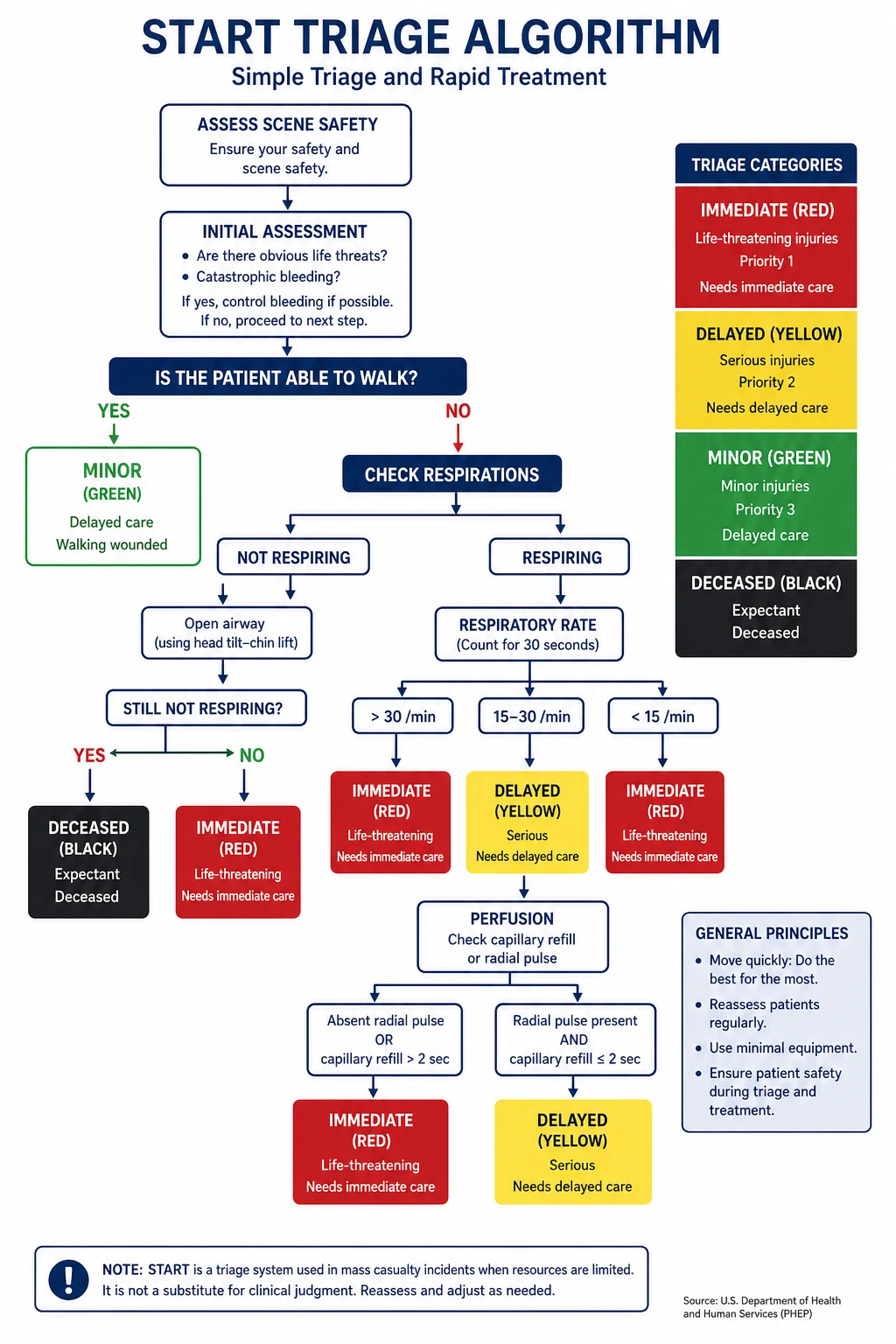
The four categories: Immediate (Red) — the life-threatening but salvageable injury that needs the urgent intervention (the airway obstruction, the tension pneumothorax, the exsanguinating haemorrhage). Delayed (Yellow) — the significant injury that can wait (the open fracture, the abdominal injury without the shock). Minimal (Green) — the minor injury (the walking wounded). Expectant (Black) — the unlikely-to-survive injury given the available resources (the extensive burns with the inhalation injury in the MCI). The expectant category is the ethical hardest: the patient who would survive in the normal setting but cannot in the MCI because the resources must go to those with the better prognosis. The reassessment is continuous — the patient whose condition changes moves between the categories.[1][1]
The SALT triage
The Sort, Assess, Lifesaving interventions, Treatment/Transport (SALT) triage is the national all-hazards mass-casualty triage guideline, developed by a multidisciplinary working group sponsored by the US Centers for Disease Control and published in 2008. It was designed to overcome the principal limitation of START — the inability to deliver any intervention at the point of triage — by authorising a small set of rapid, reversible, life-saving interventions during the categorisation itself.[3]
The SALT sequence is a four-step algorithm: [1]
- Sort — a global, ten-second sweep that groups the casualties by the ability to follow the commands, the purposeful movement, and the peripheral pulse. The walking are sorted last; those who cannot move and have no pulse are the priority for the individual assessment.
- assess — an individual, thirty-second assessment of each casualty, using the five physiological pillars: control the catastrophic external haemorrhage, open the airway, assess the breathing, assess the perfusion, and assess the consciousness.
- Lifesaving interventions — performed at the point of triage by the triage team: the catastrophic-haemorrhage control (the tourniquet, the wound packing), the airway positioning, the needle chest decompression for the tension pneumothorax, and the auto-injector antidote for the known nerve-agent exposure. These are the only interventions that justify a pause in triage, because each one can convert an expectant casualty into a salvageable casualty within seconds.
- Treatment/Transport — the casualty is tagged Immediate, Delayed, Minimal, Expectant, or Dead, and routed to the colour-coded bay. [1]
The SALT triage algorithm — the second-by-second sequence
Sort (global, 60 s)
Walk to the designated area (Minimal, held back). Wave or purposeful movement after the verbal command (assess next). Still, no purposeful movement (assess first). No pulse after opening the airway (Dead or Expectant).
Lifesaving interventions (at the point of triage)
Control the catastrophic external haemorrhage (tourniquet, packing). Open the airway (head tilt if no cervical-spine concern, jaw thrust if suspected). Needle chest decompression for the tension pneumothorax. Auto-injector antidote for the known nerve-agent exposure.
Assess (individual, 30 s)
Five pillars: haemorrhage, airway, breathing (rate and effort), circulation (radial pulse, capillary refill), and consciousness (obeys commands, postures, unresponsive).
Assign the category
Immediate (Red): life threat, salvageable after a single intervention. Delayed (Yellow): serious injury, can wait. Minimal (Green): walking wounded. Expectant (Black): unlikely to survive given the available resources. Dead.
Treatment and transport
Reassess continuously — a casualty who deteriorates is re-tagged. Transport priority: Red first, Yellow next, Green last, Dead and Expectant held until the load clears.
START
- Adult-only, pre-hospital, rapid (under 60 s per casualty)
- Three physiological triggers: walking, breathing, radial pulse or perfusion, obeys commands
- No intervention at the point of triage — categorises only
- Four categories: Immediate, Delayed, Minimal, Expectant
- Simple to teach; may under-triage the casualty who needs one airway manoeuvre
SALT
- All-hazards, all-ages (with the paediatric adaptation), national US guideline
- Adds the lifesaving interventions at the point of triage
- Sort (global) then Assess (individual) sequence
- Five categories including the interim Dead assessment
- More accurate but slower; needs the trained triage team
The paediatric MCI — JumpSTART
The JumpSTART paediatric triage adapts START for the child aged one to eight years, because the child's maintenance of a higher respiratory rate, the different physiological reserve, and the inability to follow the commands invalidate the adult thresholds. The key modifications: a child who is apnoeic after the five-second airway-opening attempt is given five rescue breaths; if the breathing resumes the child is Immediate, if not the child is Expectant or Dead; the respiratory-rate cut-off is raised (under 15 or over 45 per minute); and the perfusion and the command-following steps are adapted to the developmental stage. The infant under one year is triaged with the paediatric assessment triangle and the best clinical judgement — there is no validated tool. [1]
[1]The incident command system
The Incident Command System (ICS) is the structured management hierarchy that coordinates the multi-agency response to the MCI. The Incident Commander has the overall authority and does NOT treat patients — the commander coordinates. Under the commander are the Operations (the medical, the fire, the police), the Planning (the intelligence, the situation awareness), the Logistics (the supplies, the transport, the communication), and the Finance. The hospital incident command (the HICS) manages the hospital's internal response — the surge capacity, the staff recall, the bed management, the public information, the family liaison, and the security. The communication is structured (the radio channels, the situation reports, the briefings) and the span of control is maintained (one supervisor for three to seven reports).[1]

The medical incident command roles
Within the ICS, the medical branch is organised around four functional officer roles, each with a defined task and a defined place, so that no officer leaves their post to treat a casualty.[1]
- The Medical Commander (the Incident Commander) — the single overall authority. Activates and terminates the plan, declares the MCI, requests the external assistance, liaises with the police, the fire, and the public health, and authorises the major decisions (the lockdown, the decontamination, the diversion, the release of the information). Does NOT treat.
- The Triage Officer — the most experienced clinician who can think in populations, not patients. Categorises every casualty on the arrival and continuously re-triages. Holds the triage tags and the master casualty list. Reports the casualty flow to the commander.
- The Treatment Officer — runs the treatment bays, each colour-coded (the red bay, the yellow bay, the green bay). Allocates the medical and the nursing staff to the bays, ensures the standard of care is maintained within each category, and escalates the deteriorating casualty back to the triage officer for the re-categorisation.
- The Transport (Staging) Officer — controls the ambulance flow and the destination hospitals, maintains the even distribution of the casualties across the receiving facilities (to prevent any one hospital being overwhelmed), and records the destination of every transported casualty for the family liaison and the records. [1]
The first fifteen minutes of the hospital MCI response
0 to 2 min — notification and activation
The call comes in. The duty consultant activates the mass casualty plan, declares the MCI, and assumes the role of the medical commander. The switchboard recalls the off-duty staff and notifies the executives, the blood bank, the theatre, the intensive care, and the security.
2 to 5 min — lockdown and clearance
The security locks down all the non-essential entrances. The ED clears the existing patients — the rapid disposition of the stable, the transfer of the admitted to the wards, the diversion of the walk-ins to a holding area. The decontamination tent is erected at the designated entrance if the mechanism is CBRN.
5 to 10 min — surge build-out
The additional treatment spaces are opened — the corridors, the waiting room, the day-case unit, the ambulatory care area. The equipment caches are broken out. The staff arrive and are assigned to the colour-coded bays by the treatment officer.
10 to 15 min — first casualties arrive
The walking wounded arrive first (they self-evacuate); the seriously injured arrive later by ambulance. The triage officer meets every casualty at the door, tags, and routes. The commander holds the global picture and the external communication.
Continuous — reassess and re-distribute
The triage officer re-triages; the transport officer re-distributes; the commander re-balances the load. The plan is terminated only when the casualty flow ends and the last casualty is disposed.
The surge capacity and the ED response
The hospital activates its mass casualty plan on the notification. The ED clears the existing patients (the rapid disposition), opens the additional treatment spaces (the corridors, the waiting room, the day-case units), recalls the staff (the off-duty, the on-call), and prepares the equipment and the supplies (the blood products, the surgical trays, the pharmaceuticals). The first patients to arrive are often the walking wounded (who self-evacuate) — the most seriously injured arrive later by ambulance. The ED receives the triaged patients and applies the treatment by the triage category (the red patients first, the green last). The continuous triage and the reassessment are essential — the patient who was green may deteriorate to yellow or red.[1]
The ED lockdown, the surge capacity, and the staff recall
The hospital response to the MCI is built on three pillars: the lockdown of the facility, the surge of the internal resources, and the recall of the staff. The lockdown secures every entrance — only the designated casualty entrance is open, and only after the decontamination if the mechanism is CBRN — to prevent the contaminated self-presenter from entering the ED and closing it down. The lockdown also keeps the worried-well and the family out of the clinical area; a separate family-information centre is opened and staffed. [1]
The surge capacity is built in three tiers: the conventional capacity (the normal staffed beds), the contingency capacity (the adapted spaces — the corridors, the day-case units, the recovery room — with the normal staff-to-patient ratios), and the crisis capacity (the improvised spaces with the reduced staff-to-patient ratios, the altered standards of care, and the mass-triage thresholds). The progression from the conventional to the crisis is a deliberate decision by the commander, declared and documented, because the crisis standard of care is the legal and ethical threshold at which the greatest-good-for-the-greatest-number replaces the individual standard.[1][8]
The staff recall is the off-duty and the on-call roster, activated by the single phone call to the switchboard. The recall is tiered: the trauma team first, then the surgical and the anaesthetic teams, then the ward and the intensive-care staff for the bed clearance. The recalled staff are badged and directed to the colour-coded bays. [1]
[1] [1]The decontamination
The chemical, biological or radiological incident requires the decontamination of the casualties before their entry to the ED, to prevent the contamination of the facility and the staff. The decontamination zone is set up outside the ED (the tent, the dedicated shower), the casualties undress (removing 80 to 90 per cent of the contamination), shower with the water and the soap, and are triaged after the decontamination. The staff in the decontamination zone wear the PPE (the Level A, B or C by the hazard). The specific antidotes (the atropine and the pralidoxime for the nerve agent, the hydroxocobalamin for the cyanide) are available in the ED. The hospital lockdown prevents the contaminated self-presenters from entering the facility without the decontamination.[1][1]
The decontamination in depth
The decontamination of the chemical, biological or radiological (CBRN) casualty is the non-negotiable precondition of the ED treatment, because a contaminated casualty in the ED contaminates the facility, the staff, and the downstream casualties — and the secondary contamination of the healthcare worker is a recognised cause of the ED closure and the staff casualty.[8]
The decontamination sequence has three steps: [1]
- Remove the clothing — the single most effective step, removing 80 to 90 per cent of the contamination. The clothing is cut off, bagged, sealed, and labelled, and treated as the contaminated waste.
- The water-and-soap shower — the low-pressure, lukewarm (not hot — the vasodilatation increases the absorption) shower, from the head down, with the attention to the hair, the skin folds, the nails, and the wounds. The high-pressure jet is avoided — it drives the contaminant into the skin and aerosolises it. The run-off is contained.
- The drying, the re-triage, and the dressing — the decontaminated casualty is dried, re-triaged (the decontamination may reveal or change the category), dressed in the clean clothing, and routed to the treatment bay. [1]
The personal protective equipment (PPE) of the decontamination team is graded by the hazard: Level A (the fully-encapsulating gas-tight suit with the self-contained breathing apparatus, the SCBA — for the unknown or the high-vapour hazard), Level B (the splash-protective suit with the SCBA — the most common level for the ED decontamination team), Level C (the splash-protective suit with the air-purifying respirator, the APR — for the known, low-concentration hazard), and Level D (the work uniform — no respiratory protection, only for the cold zone). The decontamination team never works below Level B in an unknown incident. [1]
Level A
- Fully-encapsulating gas-tight suit
- SCBA (self-contained breathing apparatus)
- Maximum skin and respiratory protection
- For the unknown, high-vapour, or immediately-dangerous atmosphere
- Hot, restrictive, time-limited (about 20 min of work)
Level B
- Splash-protective chemical-resistant suit
- SCBA (positive-pressure)
- High respiratory protection, good splash protection
- The standard for the hospital decontamination team
- The most common level in the ED decon zone
Level C
- Splash-protective chemical-resistant suit
- Air-purifying respirator (APR) with the agent-specific cartridge
- For the KNOWN agent at the KNOWN, low concentration
- Lighter and cooler; depends on the correct cartridge and the ambient oxygen
Level D
- Work uniform, no respiratory protection
- For the cold zone (clean support area) only
- No protection against the chemical hazard
The decontamination of the CBRN casualty — the line that never crosses back
The hot zone (exclusion)
The contaminated area. Only the Level A or B team enters. The casualty is met here, undressed, and the clothing is bagged.
The warm zone (decontamination)
The shower corridor. The casualty is washed head-to-toe with the lukewarm water and the soap. The run-off is contained. The team is in Level B.
The cold zone (clean)
The ED. The decontaminated casualty enters here only. The clean staff work in Level D. The line between the warm and the cold zone is the controlled boundary — nothing crosses back.
The staff decontamination
The decon team is decontaminated at the end of the shift (the suit washed, removed in sequence, the inner clothing checked). The team rotation prevents the heat exhaustion in the suit.
Treatment and the specific antidotes
The chemical, biological and radiological casualty is treated after the decontamination, with the agent-specific antidote alongside the standard airway-breathing-circulation support. The nerve agent (the organophosphate, the sarin, the VX): the atropine 2 mg intravenously, repeated every 5 to 10 minutes until the secretions dry and the bronchospasm resolves (the end-point is the clinical drying of the secretions, not a fixed total dose), plus the pralidoxime 30 mg/kg intravenously over 15 to 30 minutes to regenerate the acetylcholinesterase. The cyanide (the enclosed-fire smoke, the industrial exposure): the hydroxocobalamin 70 mg/kg intravenously (the adult 5 g), which binds the cyanide to form the cyanocobalamin and is given on the clinical suspicion, not the laboratory confirmation. The biological and the radiation casualty: the supportive care — the airway, the fluids, the anti-emetic, the empiric antibiotic for the suspected biological agent (the ciprofloxacin for the anthrax, the doxycycline for the plague), and the marrow support for the acute radiation syndrome. [1]
The active shooter and the intentional mass-casualty event
The active shooter event is the prototypical intentional MCI, and the Hartford Consensus redefined the response around a single principle: the cause of the preventable death in these events is the exsanguinating extremity haemorrhage, and the response is the integration of the law-enforcement, the fire, and the EMS to deliver the rapid haemorrhage control and the rapid extrication — not the traditional secure-then-stage-then-enter sequence.[5][6]
The civilian response to the active shooter in the building is the Run, Hide, Fight: the Run (evacuate if the safe path exists), the Hide (in the locked, darkened, silenced room, behind the cover, if the evacuation is impossible), and the Fight (the absolute last resort, the committed, collective, aggressive action against the shooter). The medical response at the scene is the THREAT sequence — Threat suppression, Haemorrhage control, Rapid Extrication to safety, Assessment, and Transport.[5]
The Hartford Consensus articulated the warm zone concept: the area where the shooter is no longer active but the scene is not yet secured. The traditional fire-and-EMS doctrine of "stage until secured" was replaced by the rescue task force — the joint team of the armed law-enforcement and the protected EMS — that enters the warm zone to deliver the rapid haemorrhage control and the extrication of the casualties who would otherwise bleed to death while the scene is cleared.[6]
[1]The blast injury — the four mechanisms
The explosive event injures by four distinct mechanisms, and the recognition of the mechanism predicts the injury pattern and guides the investigation.[7]
- The primary blast injury — the effect of the high-pressure over-pressure wave on the gas-filled organs. The tympanic-membrane rupture is the most sensitive marker (its presence indicates the significant exposure and mandates the search for the blast lung and the hollow-organ injury). The blast lung (the pulmonary contusion with the alveolar rupture and the air embolism) presents with the dyspnoea, the haemoptysis, and the hypoxia, often with the delay of hours; the chest X-ray shows the bilateral "butterfly" infiltrates. The gastrointestinal barotrauma (the bowel perforation, the mesenteric ischaemia) may declare late.
- The secondary blast injury — the penetrating injury from the bomb fragments and the environmental projectiles (the glass, the nails, the shrapnel). The multi-site penetrating injury with the retained foreign bodies is the pattern; the imaging is the whole-body CT.
- The tertiary blast injury — the blunt injury from the casualty being thrown by the wind, or crushed by the collapsing structure. The whole-body blunt-trauma pattern — the head injury, the fractures, the internal-organ injury — is managed with the standard ATLS.
- The quaternary blast injury — all the other: the burns (the flash and the airway inhalation), the crush injury and the rhabdomyolysis, the asphyxia (the confined-space carbon-monoxide and cyanide), the psychological injury, and the exacerbation of the chronic illness. [1]
Primary (over-pressure)
- Gas-filled organs: tympanic membrane, lung, bowel
- Tympanic rupture = the marker of the significant exposure
- Blast lung: dyspnoea, haemoptysis, hypoxia, the butterfly infiltrates
- May evolve over hours — observe and re-image
- Air embolism risk under the positive-pressure ventilation
Secondary (fragments)
- Penetrating, multi-site, the retained foreign bodies
- Whole-body CT for the projectile tracking
- The leading cause of the mortality in the modern blast event
- Manage with the penetrating-trauma ATLS
Tertiary (thrown or crushed)
- Blunt injury from the wind or the collapse
- Head injury, fractures, the internal-organ injury
- Crush injury with the rhabdomyolysis and the hyperkalaemia
- Standard blunt-trauma ATLS
Quaternary (other)
- Burns, inhalation, crush, the asphyxia
- CO and cyanide in the enclosed-space blast
- Psychological injury, the exacerbation of the chronic illness
- Often missed in the acute focus on the other three
The paediatric mass-casualty incident
The paediatric MCI is the special situation that strains every adult-centred system: the children are triaged with the JumpSTART (or the paediatric assessment triangle for the infant), the weight-based drug dosing and the equipment sizing are a logistical challenge in the surge, and the family-reunification and the child-protection issues dominate the recovery phase. The paediatric casualty is more vulnerable to the decontamination hypothermia (the high surface-area-to-mass ratio), to the rapid fluid loss, and to the anxiety-driven deterioration. The paediatric surge plan pre-stages the Broselow tape, the weight-based drug chart, and the paediatric equipment cache, and identifies the paediatric-capable receiving hospitals for the distribution. [1]
[1]Lerner et al. (Disaster Med Public Health Prep 2008) — the SALT national triage guideline
Document
The multidisciplinary working-group consensus on the mass-casualty triage, sponsored by the US Centers for Disease Control
Method
Systematic review of the existing triage tools (START, CareFlight, Sacco, the Triage Sieve) against the published evidence, the simulation modelling, and the expert consensus
Output
The Sort-Assess-Lifesaving interventions-Treatment/Transport (SALT) all-hazards triage guideline — the proposed US national standard
Key innovation
The lifesaving interventions performed at the point of triage (haemorrhage control, airway opening, needle decompression, the auto-injector antidote)
Bottom line
The SALT guideline is the evidence-based, all-hazards triage tool that addresses the principal limitation of START — the inability to deliver the rapid reversible intervention at the point of triage.
Lerner et al. (Prehosp Emerg Care 2010) — SALT in the simulated MCI
Design
Prospective simulation — the paramedic teams triaged the standardised simulated casualties with the SALT and the START tools in a randomised crossover
Result
SALT produced fewer under-triage errors than START, at the cost of a small increase in the over-triage; the inter-rater reliability was moderate
Implication
The SALT trade-off (more over-triage, less under-triage) is the desired direction in the MCI — the under-triage is the lethal error
Bottom line
The simulation evidence that supported the adoption of SALT as the all-hazards triage standard; the real-world validation remains limited.
Jacobs (World J Surg 2014) — the Hartford Consensus on the active shooter
Document
The report of the Joint Committee to Create a National Policy to Enhance Survivability from Mass-Casualty Shooting Events
Problem
The preventable death in the active shooter event is the exsanguinating extremity haemorrhage; the traditional secure-then-stage EMS doctrine left the casualties to bleed to death in the warm zone
Framework
THREAT — Threat suppression, Haemorrhage control, Rapid Extrication, Assessment, Transport; the integrated law-enforcement-fire-EMS response and the rescue task force
Bottom line
The Hartford Consensus redefined the active-shooter response around the rapid haemorrhage control and the warm-zone entry — the doctrine that places the tourniquet before the triage tag.
Sasser et al. (Prehosp Emerg Care 2006) — the blast lung injury
Document
The CDC / National Center for Injury Prevention and Control review of the blast lung injury
Injury
The primary-blast pulmonary contusion — the alveolar rupture, the haemorrhage, the air embolism, and the delayed hypoxia
Presentation
Dyspnoea, haemoptysis, hypoxia, the bilateral butterfly infiltrates on the chest X-ray; may evolve over hours
Management
Supportive — the oxygen, the judicious positive-pressure ventilation (low tidal volume, low plateau pressure, the caution with PEEP), the treat-as-the-acute-respiratory-distress-syndrome approach
Bottom line
The defining reference for the blast lung — the over-pressure injury that evolves, that risks the air embolism under the positive pressure, and that demands the observation of every significant-blast casualty.
Wanner et al. (Dela J Public Health 2019) — chemical disaster preparedness for the hospital
Document
The review of the chemical-disaster preparedness for the hospitals and the emergency departments
Core pillars
The hazard vulnerability analysis, the decontamination capability (the tent, the shower, the PPE cache), the staff training and the drills, the antidote stockpile, and the lockdown protocol
Key risk
The secondary contamination of the healthcare worker and the ED closure from the unrecognised or the undecontaminated casualty
Bottom line
The hospital chemical-disaster preparedness rests on the lockdown, the decontamination zone, the graded PPE, and the drilled staff — the rehearsed plan is the only plan that works in the real event.
Differential diagnosis
The "differential" in the mass casualty is twofold: the triage category that sets the priority and the intensity of the treatment, and the mechanism that sets the pattern of the injury and the public-health response. [1]
- The triage category — the Immediate (Red) vs the Delayed (Yellow) vs the Minimal (Green) vs the Expectant (Black): the Immediate is the life-threatening but salvageable (the airway obstruction, the tension pneumothorax, the exsanguinating haemorrhage); the Delayed can wait (the open fracture, the stable abdominal injury); the Minimal is the walking wounded; the Expectant is the unlikely-to-survive given the available resources (the 80 per cent burn with the inhalation injury). The error is the over-triage (the delayed called "immediate" overwhelms the red bay) or the under-triage (the immediate called "delayed" costs the life).
- The blast — the multi-system injury from the pressure wave: the tympanic membrane rupture, the blast lung, the hollow-organ rupture, the traumatic amputation, and the tertiary blunt injury from being thrown.
- The chemical — the nerve agent (the sarin, the VX) with the cholinergic crisis (the miosis, the salivation, the seizures), the vesicant (the mustard) with the skin and the airway blistering, and the cyanide with the rapid collapse and the cherry-red skin.
- The biological — the incubation delay of hours to days distinguishes it from the chemical: the anthrax, the plague, the smallpox and the viral haemorrhagic fever, where the containment and the public-health notification are the priority.
- The radiation — the acute radiation syndrome after the whole-body exposure (the nausea, the lymphopenia, the marrow suppression), the local cutaneous injury from the contamination, and the risk to the staff without the decontamination. [1]
Common pitfalls
The recurring errors are: treating patients individually instead of triaging; the commander treating patients; the ED being overwhelmed by the walking wounded before the serious casualties arrive; not clearing the ED before the arrival; not recalling the staff early enough; the contaminated patient entering the ED without decontamination; and the failure to debrief and learn after the event. [1]
Clinical pearls for the examination
[1] [1] [1] [1] [1] [1]SAQ — Mass-casualty triage and the incident command
10 minutes · 10 marks
A bus carrying 40 passengers has overturned on a rural highway. Twenty casualties are triaged at the scene, and the first five walk into your emergency department within 15 minutes of the notification. You are the duty consultant and you activate the mass-casualty plan.
SAQ — The chemical incident and the decontamination
10 minutes · 10 marks
A chemical plant release sends 30 casualties to your emergency department. Several are convulsing, drooling, and wheezing; two walked into the resus bay unannounced before the lockdown was enacted, and a nurse has now developed the pinpoint pupils and the bronchorrhoea.
Red flags
[1]References
- [1]Sarin RR, et al. Core Disaster Medicine Education (CDME) for Emergency Medicine Residents in the United States Prehosp Disaster Med, 2019.PMID 31455462
- [2]Rossaint R, Bouillon B, Cerny V, et al. The European guideline on management of major bleeding and coagulopathy following trauma: sixth edition Crit Care, 2023.PMID 36859355
- [3]Lerner EB, Schwartz RB, Coule PL, et al. Mass casualty triage: an evaluation of the data and development of a proposed national guideline Disaster Med Public Health Prep, 2008.PMID 18769263
- [4]Lerner EB, Schwartz RB, Coule PL, et al. Use of SALT triage in a simulated mass-casualty incident Prehosp Emerg Care, 2010.PMID 19947863
- [5]Jacobs L The Hartford Consensus: how to maximize survivability in active shooter and intentional mass casualty events World J Surg, 2014.PMID 24615600
- [6]Jacobs LM, McSwain NE Jr, Rotondo MF, et al. Improving survival from active shooter events: the Hartford Consensus J Trauma Acute Care Surg, 2013.PMID 23694864
- [7]Sasser SM, Sattin RW, Hunt RC, et al. Blast lung injury Prehosp Emerg Care, 2006.PMID 16531371
- [8]Wanner GK, Atti S, Jasper E. Chemical Disaster Preparedness for Hospitals and Emergency Departments Dela J Public Health, 2019.PMID 34467061