EM · Disaster preparedness and hospital incident command
Disaster preparedness — hospital incident command, surge capacity, MCI triage, decontamination and the PICE classification
Also known as Hospital Incident Command System · HICS · Mass casualty incident preparedness · Surge capacity · SALT triage · START triage · PICE nomenclature · CBRNE preparedness · Crisis standards of care
Disaster preparedness in the emergency department — the systems and planning layer the consultant is accountable for, distinct from the bedside MCI response: the PICE nomenclature that classifies the event, the Hospital Incident Command System (HICS) that commands the response, the surge continuum from conventional to contingency to crisis and the crisis standards of care it invokes, the SALT and START mass-casualty triage tools and the shift to a population standard of care, the decontamination procedure and PPE for the CBRNE event, the specific antidotes with their doses, and the planning of mutual aid, redundant communication and staged evacuation. ACEM-primary, globally tagged.
On this page & tools
Your progress
Saved locally on this device.
Target exams
Red flags
Related topics
- Team-based care and crisis resource management in the emergency department
- The Australasian Triage Scale — categories, validity, reliability and the under-triaged patient
- Patient disposition and safety-netting in the emergency department
- Medical error and patient safety in the emergency department
- Breaking bad news and communication in the emergency department — the SPIKES framework
Disaster preparedness is the systems and planning layer of the emergency response to an event whose casualties overwhelm the normal capacity of the health service. It is distinct from the bedside management of the mass casualty incident, which is covered in the trauma disaster topic: this topic is what the consultant — the future emergency physician accountable for a department and a hospital — must know to plan, command, surge, triage, decontaminate, communicate and evacuate before and during the event. The Fellowship examiner tests the systems layer through SAQs on hospital activation and surge, OSCE stations on decontamination and crisis communication, and SCQ items on triage category and surge stage. The central principle that governs every decision is the shift from the individual standard of care to the population standard: the greatest good for the greatest number.[1][4]
Definition and scope — what disaster preparedness is, and the MCI threshold
A disaster is an event whose demand exceeds the available resources to deliver care; a mass casualty incident (MCI) is the subset in which the number, the type or the acuity of casualties exceeds the normal capacity of the emergency medical services and the receiving hospitals. The definition is relational, not absolute: a five-casualty motor-vehicle crash is a routine event in a major trauma centre and an MCI in a rural hospital. The threshold is crossed when the system can no longer deliver the standard of care it would deliver to a single patient, and the response shifts to a population standard in which resources are allocated to maximise the number of survivors rather than to optimise the outcome of any one individual.[1][4]
Disaster preparedness is the pre-event phase of the disaster cycle (mitigation, preparedness, response, recovery): the plans, the stockpiles, the memoranda of understanding, the staff training, the drills and the command structure that determine whether the response succeeds. The evidence is consistent that hospitals that drill and exercise deliver a measurably better response, and that the absence of a tested plan is the strongest predictor of a failed response.[12][8] The emergency physician's role spans the cycle: the pre-event plan and drill in the preparedness phase, the incident command and the triage in the response phase, and the debrief and the system review in the recovery phase.
The PICE nomenclature — classifying the event, not the casualties
The Potential Injury Creating Event (PICE) nomenclature, developed by Koenig and colleagues, is the system that classifies the disaster itself along four axes so that a hospital, a region or a nation can communicate the nature and the magnitude of an event in a standardised string.[1] PICE does not classify the casualties (that is the job of triage); it classifies the event, and it does so along dimensions that map directly onto the operational response.
The clinical value of PICE is operational: the project axis dictates the pattern of injury (a geological event produces crush and blunt trauma; a parasitological event produces infectious surge) and the decontamination requirement (a technological chemical release demands decon; a pandemic demands isolation); the capacity-modifier axis dictates whether the hospital can function or must evacuate; and the severity-modifier axis dictates whether mutual aid will help. The Fellowship candidate is expected to classify a named event along the axes and to derive the operational consequences.[1]
MCI types — mass casualty, CBRNE and pandemic
The three operational archetypes of MCI impose distinct demands on command, surge, triage, infection control and communication, and the preparedness plan must address each.[4][12]
Mass casualty trauma
- Sudden onset, finite scene (bus crash, building collapse, mass shooting, blast), predominantly blunt and penetrating trauma arriving over hours
- Command focus: triage, surgical and theatre surge, blood product supply, rapid disposition to free resuscitation bays
- No decontamination required unless blast was chemical; infection control not the primary demand
- Triage tool: SALT or START at scene; greatest-good-greatest-number applies to operative and blood-product allocation
CBRNE (chemical, biological, radiological, nuclear, explosive)
- May be covert (biological agent incubates over days; radiation contamination is invisible); chemical and explosive are sudden and obvious
- Decontamination is mandatory and precedes ED entry — a contaminated self-presenter can shut a department down
- Triage occurs AFTER decontamination for chemical/radiological casualties; agent-specific antidotes (atropine/pralidoxime, hydroxocobalamin) must be stockpiled
- PPE levels A to D; scene safety and staff protection are non-negotiable; the first responder can become the second casualty
Pandemic / infectious surge
- Slow onset (days to weeks), sustained, escalating; no finite scene — the whole region and every hospital affected simultaneously, so mutual aid is exhausted
- Demand is staff-intensive (critical care, ventilation) and sustained over months; the surge continuum is invoked and may reach crisis standards of care
- Infection control, cohorting, isolation capacity and PPE supply dominate; routine elective work is suspended to free capacity
- Triage is resource-based (ventilator, ICU bed allocation) using an ethically defensible scoring framework under crisis standards, not scene-based SALT
The CBRNE acronym is worth expanding: Chemical (nerve agents, cyanide, pulmonary agents, vesicants), Biological (anthrax, plague, smallpox, viral haemorrhagic fever, pandemic respiratory virus), Radiological (dirty bomb, reactor accident — contamination and acute radiation syndrome), Nuclear (detonation — blast, thermal, radiation combined), and high-Explosive (the blast component, often the co-existing trauma). The CBRNE preparedness literature confirms that structured, scenario-specific training measurably improves both individual responder performance and hospital system response.[12]
Hospital Incident Command System — the command structure
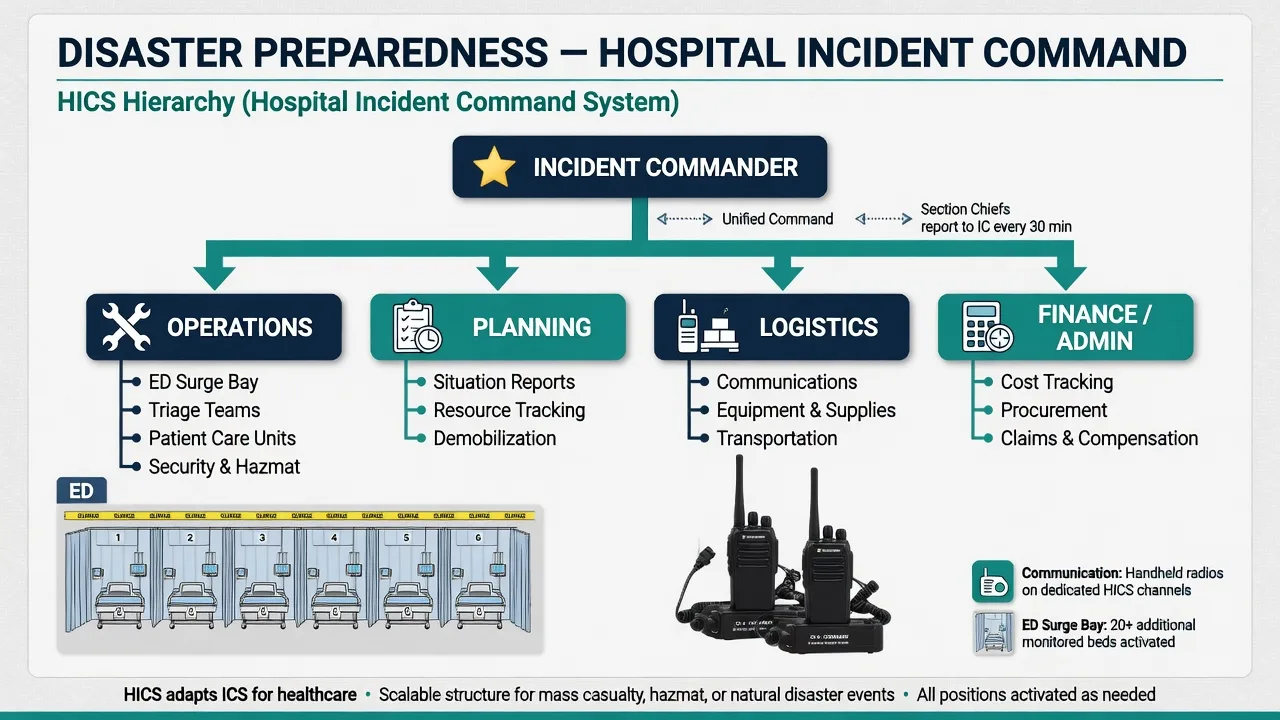
The Hospital Incident Command System (HICS) is the structured management hierarchy a hospital activates to coordinate its internal response to any emergency that exceeds routine operations. HICS is the hospital adaptation of the Incident Command System (ICS) used by fire, police and emergency services, and its purpose is to extend the chain of command, the span of control, the unity of command and the common terminology of ICS into the hospital so that the hospital integrates seamlessly with the pre-hospital and the multi-agency response.[8]
The Hospital Incident Command System — the command and general staff
HICS
A single named individual (usually the senior ED consultant or the executive on call) who has overall authority for the hospital response and does NOT treat patients — the commander coordinates, allocates resources, and is the single point of decision
The Command Staff around the IC: the Public Information Officer (single voice to media and public), the Safety Officer (monitors hazards and can stop any unsafe action), the Liaison Officer (coordinates with external agencies — ambulance, police, public health, other hospitals), and Medical-Technical Specialists (subject experts, e.g. toxicology, radiation)
The four General Staff sections report to the IC: Operations (does the work — patient care, security, facilities), Logistics (gets the resources — staff, supplies, equipment, communications), Planning (intelligence, situation status, the Incident Action Plan), and Finance/Administration (tracks costs, time, procurement, compensation)
Span of control is three to seven reports per supervisor (optimal five); unity of command means every responder has one and only one supervisor; common terminology and a single incident radio channel prevent the confusion that kills the response
The activation is tiered. HICS level 3 (advisory/alert) is the lowest — monitoring a developing situation, no surge yet. HICS level 2 (partial activation) — a developing incident likely to affect hospital operations; selected command and general staff positions activated. HICS level 1 (full activation) — the full command structure stood up for a major incident. The Incident Commander declares the level and the activation, and the declaration is documented on the ICS-201 Incident Briefing form (the initial situation, the resources, the objectives). The Planning section produces the Incident Action Plan (IAP) for each operational period (typically 12 hours), and the response is managed through the planning P cycle (Plan, Prepare, Execute, Assess).[8]
[1]Surge capacity and the surge continuum — conventional to crisis
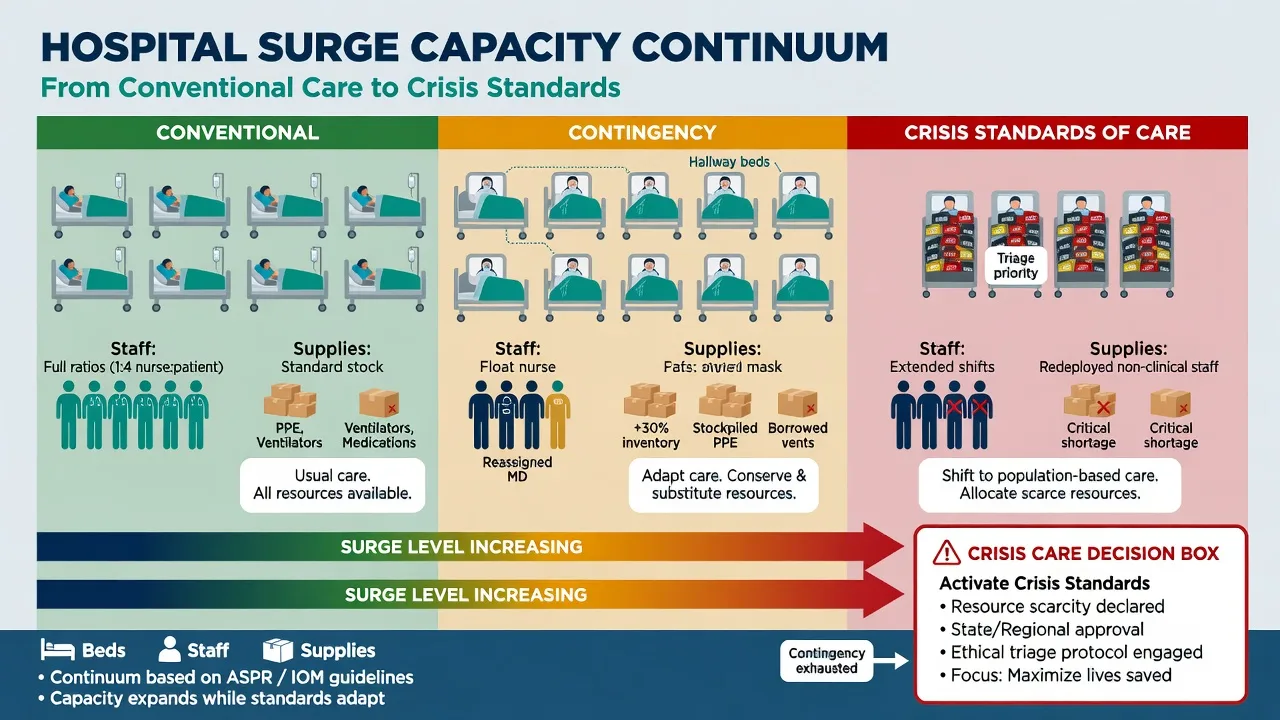
Surge capacity is the ability of a hospital to expand its care delivery beyond normal operations to meet an increased demand. The framework that organises it is the surge continuum, articulated by Hick, Christian and the CHEST consensus, which distinguishes three progressively strained states of operation and ties each to a defined set of clinical decisions.[5][4][6]
The three operational levers of surge capacity are the 3Ss: Staff (recall off-duty staff, redeploy from non-clinical and elective areas, use mutual-aid staff and volunteer clinicians with credentialing fast-tracked), Stuff (beds, ventilators, monitors, oxygen, PPE, blood products, pharmaceuticals — stockpiled and cached, with supply chains and burn-rate tracking), and Structure/Space (open additional treatment areas — corridors, waiting room, day-case units, field tents; cohort patients; convert wards). The reverse-triage instrument — the rapid discharge or downgrade of inpatients whose care can safely be deferred — is the means by which inpatient capacity is freed in the first hours of a surge.[5][6][7]
Crisis standards of care are the most ethically loaded element of preparedness. They are the pre-planned, jurisdiction-wide, ethically vetted rules that govern the allocation of scarce life-sustaining resources when demand exceeds supply: a ventilator goes to the patient most likely to survive with it, not to the first arrival or the most privileged. The CHEST consensus and the COVID-19 experience establish that crisis standards must be declared explicitly, applied uniformly through a triage team (not the treating clinician), reviewed continuously, and reversed as soon as capacity allows. The treating emergency physician does NOT make the scarce-resource allocation decision alone at the bedside in crisis; a separate triage officer or committee applies the standard, precisely to remove the moral burden from the bedside clinician.[4][6][7]
Triage in the MCI — SALT, START and jumpSTART
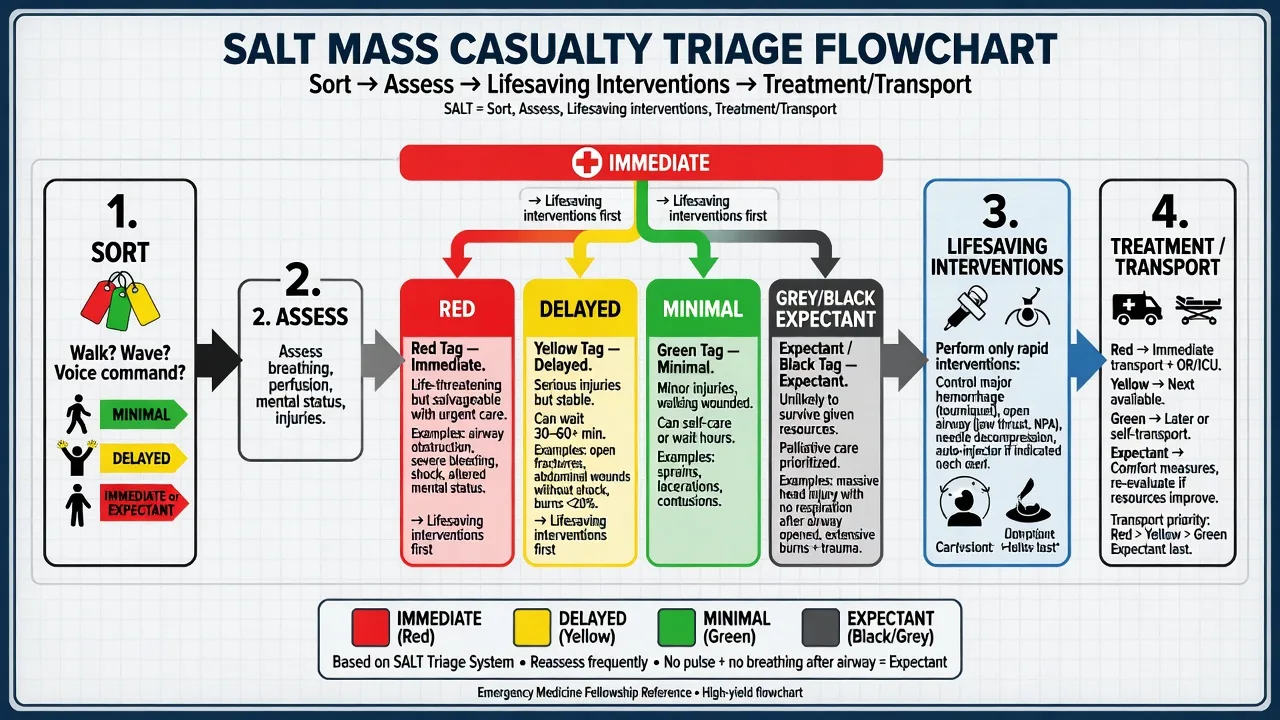
Triage in the mass casualty incident is the process that sorts casualties by urgency and by survivability under the population standard of care, and it is the operational expression of the greatest-good principle. Two tools dominate the Fellowship curriculum: SALT (the proposed national guideline) and START (the older, widely taught adult tool), with jumpSTART for children.[2][3][11]
SALT — Sort, Assess, Lifesaving interventions, Treatment and Transport
SALT was proposed as the national mass-casualty triage guideline by Lerner and the national expert panel after a systematic evaluation of the existing triage tools, and it was designed to overcome the limitations of START — particularly its inability to deliver any intervention at the point of triage and its variable performance in children.[2] SALT adds a step that START omits: the lifesaving intervention performed at the moment of triage.
The SALT mass-casualty triage sequence (Lerner national guideline)
SALT
Global sort first — ask casualties to walk (initially Minimal/Green), to wave/purposeful movement (initially Delayed/Yellow), and those still or with obvious life threat are assessed first (initially Immediate/Red). This is a quick first pass; individual assessment then follows
For each casualty in turn, control catastrophic haemorrhage, open the airway (chin lift, recovery position if breathing), and decompress tension pneumothorax if trained and equipped. Give an auto-injector antidote for a chemical agent. These lifesaving interventions are done BEFORE final category assignment
Assess for: able to obey commands / purposeful? has peripheral pulse? not in respiratory distress? haemorrhage controlled? All yes → Minimal or Delayed. Any no → Immediate. Unlikely to survive given resources → Expectant. Apnoeic after interventions → Dead
Triage category sets the order and destination of treatment and transport: Immediate (Red) first, Expectant (Grey/Black) given comfort care, Minimal (Green) last and often self-evacuate. Continuous reassessment — a casualty who deteriorates moves category
START and jumpSTART — the older tools
START (Simple Triage and Rapid Treatment) is the adult pre-hospital tool that categorises by three physiological parameters in under 60 seconds: the ability to walk (Minimal), then for the non-walkers the respiratory rate (apnoeic → reposition airway; if still apnoeic → Dead; over 30 per minute → Immediate), the perfusion (capillary refill over two seconds or no radial pulse → Immediate), and the mentation (unable to obey commands → Immediate). The remainder are Delayed. START performs well in adult blunt trauma but has no intervention step and is unreliable in children — which is the principal reason SALT was developed.[2][11] jumpSTART adapts START for children under eight years: it modifies the respiratory criterion (apnoeic children receive five rescue breaths; if breathing resumes → Immediate) and the mentation criterion, recognising that children compensate physiologically and collapse late.[3][11]
SALT
- Proposed national guideline (Lerner 2008); designed to fix START limitations
- Adds LIFESAVING INTERVENTIONS at triage: haemorrhage control, airway opening, tension decompression, antidote auto-injector
- Works for adults AND children; global sort then individual assessment
- Five categories: Immediate, Expectant, Delayed, Minimal, Dead — Expectant explicit
START
- Older, widely taught, adult-only tool; categorises by RR (over 30), perfusion (cap refill over 2 s), mentation (obeys commands)
- No intervention step — purely a sorting tool
- Unreliable in children (use jumpSTART), variable accuracy in mixed and paediatric populations
- Four categories: Immediate, Delayed, Minimal, Expectant/Dead — over- and under-triage are the errors
The two triage errors the examiner tests are over-triage (a less urgent casualty called Immediate, which overwhelms the red bay and consumes resources that should go to the truly immediate) and under-triage (a truly immediate casualty called Delayed, who deteriorates or dies while waiting). Over-triage is generally considered the more dangerous error in the early phase, because it degrades the whole response; under-triage is more dangerous to the individual casualty. The accuracy of prehospital triage protocols is moderate at best, which is why continuous reassessment and re-triage are mandatory.[13][11]
Decontamination — zones, procedure and PPE
The chemical, biological or radiological casualty must be decontaminated before entry to the ED, because a contaminated casualty who enters the department contaminates the facility, the staff and the downstream patients, and can shut the ED down entirely.[9] The procedure is set up outside the ED in three zones: the hot zone (the contaminated area, where casualties arrive and undress), the warm zone (the decontamination shower itself, where staff in PPE perform the wash), and the cold zone (the clean ED, which the casualty enters only after decon).
The procedure is gross decon then technical decon. Gross decon is the removal of clothing, which alone removes 80 to 90 per cent of surface contamination; it is the single highest-yield step. Technical decon is a systematic wash with lukewarm water and soap (or a dilute bleach solution for certain agents), working from the cleanest area to the dirtiest, with attention to wounds, hair, skin folds and under nails; the run-off is contained and treated as hazardous waste. Contaminated wounds are irrigated, and foreign bodies are removed. Triage occurs after decon for chemical and radiological casualties — a principle that conflicts with the emergency physician's instinct to treat first, and which the preparedness drill must rehearse.[9]
[1]The paediatric casualty poses specific decontamination challenges: children are more vulnerable to hypothermia (use warmed water and warmed towels), must be kept with their carer to avoid psychological harm, may not be able to walk through a shower, and require weight-based dosing of any antidote; the paediatric decon literature emphasises a dedicated paediatric decon lane with appropriately sized equipment and a chaperone.[9]
Management — the specific antidotes in the CBRNE event
The chemical casualty is managed after decontamination with the agent-specific antidote alongside standard airway-breathing-circulation support. The high-yield antidotes the emergency physician must know by agent, dose, route and rationale are reproduced below; each is given on the clinical suspicion, not the laboratory confirmation, because the laboratory confirmation takes hours the casualty does not have.[10]
The nerve agent (organophosphate — sarin, VX, tabun, soman; or agricultural pesticide) inhibits acetylcholinesterase, producing a cholinergic crisis (the SLUDGE-mud syndrome: salivation, lacrimation, urination, defecation, GI upset, emesis, miosis, urination, diaphoresis, muscle fasciculation). The antidote is atropine 2 mg intravenously (or the auto-injector 2 mg intramuscularly), repeated every five to 10 minutes until the secretions dry and the bronchospasm resolves — the end-point is the clinical drying of the secretions, not a fixed total dose, and severe exposures may require tens of milligrams. Pralidoxime (2-PAM, pralidoxime chloride) 600 mg intramuscularly (or 25 to 50 mg per kg intravenously over 15 to 30 minutes) reactivates the acetylcholinesterase and must be given early, before the enzyme-organophosphate complex "ages" and becomes irreversibly bound (the ageing time is minutes for soman, hours for sarin).[10] The cyanide casualty (enclosed-fire smoke inhalation, industrial exposure, prolonged shock with high lactate and a narrow anion gap) is treated with hydroxocobalamin 70 mg per kg intravenously (the adult 5 g), which binds cyanide to form cyanocobalamin (vitamin B12) and is given on the clinical suspicion, not the laboratory confirmation.[10] The biological, radiological and nuclear casualty is managed with supportive care — airway, ventilation, fluids, anti-emetics — plus the agent-specific countermeasure (empiric ciprofloxacin or doxycycline for anthrax and plague, marrow-supportive cytokines for acute radiation syndrome, and the specific antiviral where one exists).
Planning — mutual aid, communication and evacuation
The planning domain of preparedness covers the three functions that fail first in a real event: getting help from outside (mutual aid), maintaining information flow (communication), and moving patients when the hospital cannot function (evacuation).[4][8]
Mutual aid is the pre-arranged agreement between hospitals, regions and jurisdictions to share staff, beds, blood, equipment and pharmaceuticals when one facility is overwhelmed. It takes the form of inter-hospital memoranda of understanding, regional health-emergency arrangements (in Australia the state health emergency arrangements and the Australian Health Management Plan for Pandemic Influencence, AHMPPIL/AHMPEPI), and larger instruments such as the US Emergency Management Assistance Compact (EMAC) and the National Disaster Medical System (NDMS). The principle is that the agreements are signed and tested before the event, not negotiated during it, and that they specify credentialing (so a recalled or borrowed clinician can work immediately), liability, cost-sharing and the logistics of movement.[8]
Communication is the function that fails most often, because every system depends on the one it replaces. The preparedness plan therefore mandates redundancy: the primary system (mobile phones and landlines) fails when the network is overloaded or the tower loses power, so the back-up (two-way radios on a dedicated incident channel, satellite phones, and runners) must be ready and rehearsed. A single incident radio channel and common terminology prevent the cross-talk that paralyses a multi-agency response. The Public Information Officer is the single voice to the media and the public — the one message, the staged briefing, the avoidance of the rumour that spreads faster than the truth. Internal communication uses the structured situation report (SITREP) at defined intervals and the Incident Action Plan for each operational period.[8]
Evacuation is the progressive movement of patients out of a facility that cannot safely function (fire, flood, structural failure, contamination, sustained power loss). It is staged: horizontal evacuation first (patients moved laterally to an adjacent safe area on the same floor), then vertical (down the stairs or by lift to a lower or adjacent building), then total (off-site, to a receiving hospital under mutual aid). The plan must specify the patient-tracking system (so every patient is accounted for at every stage), the transport assets, the staff-to-patient ratios for the sickest, and the order of movement (the ambulatory first to clear the way, then the stable, then the ventilated and the sickest with the most staff). The receiving hospitals must be pre-warned and the patient acuity spread so that the evacuation does not simply transfer the disaster to the next facility.[4]
Differential — routine emergency versus MCI
The differential the examiner most often asks of this topic is not a list of diseases but the distinction between the routine emergency and the mass casualty incident — because the operational and ethical response inverts between the two.[1][4]
Routine emergency
- Demand is within capacity; every patient receives the full individual standard of care
- Triage (ATS) assigns PRIORITY (how soon) within the system — no patient is denied care
- Command is the usual ED and hospital hierarchy; no incident command activation
- Resources used without limit to optimise each individual outcome; ethics is individual autonomy and best interest
Mass casualty incident
- Demand exceeds capacity; standard of care shifts to the POPULATION standard (greatest good for the greatest number)
- Triage (SALT/START) assigns CATEGORY and may deny or defer care — the Expectant patient receives comfort care only
- Hospital Incident Command System is activated; a single Incident Commander coordinates, not the usual hierarchy
- Resources allocated to maximise total survivors; ethics is utilitarian and resource-based, applied by a triage team under declared crisis standards
The internal MCI (disaster inside the hospital)
- A fire, a flood, a power failure, a contamination, a VIP-related disturbance — the disaster is INSIDE, not arriving from outside
- Same command and surge principles, but the immediate priority is facility safety and evacuation, not reception of casualties
- Often declared by the hospital itself; the trigger is the loss of a critical function (power, water, oxygen, IT, theatre, ED access)
- Distinguished from the external MCI by the source of the threat and the priority of protecting the in-situ patients and staff
The transition from routine to MCI is declared, not drifted into: a defined authority (the senior ED consultant, the on-call executive, the Incident Commander) declares the MCI, which activates the command structure, the surge plan and the population standard. Equally important is the stand-down: the declaration that the surge is over, the crisis standards are reversed, and the individual standard of care is restored — a decision that is also explicit, documented and communicated.[4]
Errors and pitfalls
The recurring failures of disaster preparedness and response are the failures the framework exists to prevent. The incident commander who treats patients loses the overview of the hospital and the response — the commander coordinates. The absence of a lockdown at a chemical incident allows the contaminated self-presenter to walk through the front door and shut the ED down. Over-triage overwhelms the red bay with casualties who should be yellow, consuming the resources reserved for the truly immediate. The failure to recognise that the first casualties are the least injured leaves the ED unprepared when the seriously injured arrive by ambulance later. Staff recall that is too slow means the surge is not met in the first critical hours. The single communication channel with no redundancy fails when the network overloads and the response goes silent. Crisis standards drifted into rather than declared load the bedside clinician with the moral burden of an allocation decision that should sit with a separate triage team under a pre-vetted framework. The plan on the shelf that was never drilled fails on the day, because the staff do not know their roles and the latent gaps (the missing decon tent, the broken radio, the expired antidote stock) surface only under stress.[8][12]
Evidence and regional guidelines
The evidence base for disaster preparedness spans the PICE nomenclature (Koenig), the SALT national triage guideline (Lerner) and its pilot (Cone), the surge continuum and crisis-standards consensus (Hick, Christian, the CHEST consensus), the COVID-19 surge experience (Dichter and the Minnesota coordination work), HICS implementation (Jovan), the CBRNE training literature (Malek), the paediatric decontamination review (Alshaikh), the nerve-agent pharmacology (Schaffer), the triage-protocol overview 30 years after START (Streckbein), and the triage-accuracy data (Shaltout).[1][2][3][4][5][6][7][8][9][10][11][12][13]
ANZ practice note. The Australian Health Management Plan for Pandemic Influenza (AHMPPI) and the broader Australian Health Emergency Response Plan (AUSHEMP) frame the national health-sector response, with each state operating a health emergency response arrangement (the State Health Emergency Response Plan / State Health Emergency Coordination Centre). ACEM publishes a policy on disaster and mass casualty preparedness that positions the emergency physician in the incident command and triage roles. The National Critical Care and Trauma Response Centre (NCCTRC) in Darwin provides national deployable medical teams and training (MTET — Medical Assistance Teams). Triage in the MCI uses SALT or START depending on jurisdiction; the Australasian Triage Scale governs routine ED triage but is not the MCI tool. [1]
Exam pearls
- The shift is from the individual to the population standard of care — the greatest good for the greatest number governs every MCI decision, and it is what distinguishes the MCI from the routine emergency.
- PICE classifies the event, not the casualties — four axes (Project, Impact, Capacity modifiers, Severity modifiers); the project axis drives injury pattern and decontamination demand, the capacity axis drives evacuation, the severity axis drives mutual aid.
- HICS: the Incident Commander coordinates and never treats — command staff (PIO, Safety, Liaison, Medical-Technical) plus four general staff sections (Operations, Logistics, Planning, Finance/Admin); activation tiered 3 to 1; span of control three to seven.
- The surge continuum: conventional → contingency → crisis, with crisis standards of care declared explicitly, applied by a separate triage team, and reversed as soon as capacity allows — the bedside clinician does not make the allocation decision alone.
- SALT is the proposed national guideline (Lerner 2008) — Sort, Assess, Lifesaving interventions, Treatment/transport — and it adds the intervention step (haemorrhage control, airway, tension decompression, antidote) that START lacks; START is adult-only and unreliable in children (use jumpSTART).
- The two triage errors are over-triage (overwhelms the red bay, degrades the whole response) and under-triage (the individual deteriorates); continuous reassessment corrects both.
- Decontamination: gross decon first (undress removes 80 to 90 per cent), then technical decon (soap and lukewarm water); three zones (hot, warm, cold); PPE levels A to D; triage AFTER decon for chemical/radiological casualties; never downgrade protection until the agent is confirmed.
- Nerve agent: atropine 2 mg IV/IM repeated to drying of secretions (clinical end-point) + pralidoxime early before the enzyme ages; cyanide: hydroxocobalamin 70 mg/kg IV (5 g adult) on suspicion.
- The first casualties are usually the least injured walking wounded — the seriously injured arrive later by ambulance; do not be lured into a false sense of capacity.
- Communication fails first and most often — plan redundancy (radios, satellite, runners), a single incident channel, and the single PIO voice; mutual aid and evacuation agreements are signed and tested before the event. [1]
Exam practice
SAQ — Mass casualty incident: coach rollover with thirty casualties and hospital activation
10 minutes · 10 marks
It is 08:00 on a Tuesday. Ambulance control notifies your mixed urban emergency department that a coach has rolled on the Pacific Highway twelve kilometres away, with an estimated thirty casualties including several children. Your ED has twelve treatment bays and is at eighty per cent occupancy, with two resuscitation bays occupied. The next-closest trauma centre is ninety minutes away. You are the consultant in charge. No casualties have arrived yet.
SAQ — CBRNE incident: nerve agent release at a railway station with contaminated self-presenters
10 minutes · 10 marks
At 18:00 multiple casualties begin arriving at your emergency department by private vehicle from the central railway station, where an unknown substance has been released. Three ambulatory patients are wheezing, drooling, profusely diaphoretic and pinpoint-eyed; two further patients are unconscious and in respiratory distress with visible fasciculations. Ambulance control then alerts you that thirty more symptomatic casualties are en route, with no scene decontamination performed. Two of the walking casualties have already walked through the main triage area into the waiting room. You are the consultant in charge.
Red flags
[1]References
- [1]Koenig KL, Dinerman N, Kuehl AE. Disaster nomenclature--a functional impact approach: the PICE system Acad Emerg Med, 1996.PMID 8816190
- [2]Lerner EB, Schwartz RB, Coule PL, et al. Mass casualty triage: an evaluation of the data and development of a proposed national guideline Disaster Med Public Health Prep, 2008.PMID 18769263
- [3]Cone DC, Brooks AJ, Biddinger PD, et al. Pilot test of the SALT mass casualty triage system Prehosp Emerg Care, 2009.PMID 19731169
- [4]Christian MD, Sprung CL, Joynt GM, et al. Introduction and executive summary: care of the critically ill and injured during pandemics and disasters: CHEST consensus statement Chest, 2014.PMID 25144202
- [5]Hick JL, Christian MD, Sprung CL. Allocating scarce resources in disasters: emergency department principles Ann Emerg Med, 2012.PMID 21855170
- [6]Dichter JR, Devereaux AV, Litton E, et al. Mass Critical Care Surge Response During COVID-19: Implementation of Contingency Strategies - A Preliminary Report of Findings From the Task Force for Mass Critical Care Chest, 2022.PMID 34499878
- [7]Dichter JR, Maddox TM, Sasson C, et al. The Minnesota Critical Care Working Group 1: Monitoring and Coordinating Statewide Critical Care Surge Response in the COVID-19 Pandemic, March 2020 Through July 1, 2021 Chest, 2025.PMID 39622470
- [8]Jovan JD, Majumdar A, Wiebe N. Implementation of the Hospital Incident Command System in response to the COVID-19 pandemic in the United States: A systematic review J Emerg Manag, 2024.PMID 39545433
- [9]Alshaikh E, et al. Pediatric Decontamination Considerations in CBRN Events: A Scoping Review Disaster Med Public Health Prep, 2025.PMID 41321230
- [10]Schaffer DH, Hahn B, Baud FJ, Borron SW. Nerve Agents 2026.PMID 29630210
- [11]Streckbein S, Ostermann H, Waydhas C. [Triage protocols for mass casualty incidents : An overview 30 years after START] Unfallchirurg, 2016.PMID 25648872
- [12]Malek A, et al. Effectiveness of Chemical, Biological, Radiological, Nuclear, Explosive (CBRNE) Event-Response Training in a Hospital Setting: A Scoping Review Disaster Med Public Health Prep, 2025.PMID 41431954
- [13]Shaltout AE, et al. Accuracy and Timeliness of Prehospital Global Triage System Protocols in Mass Disasters: A Systematic Review of Systematic Reviews Cureus, 2025.PMID 41127758