EM · Mass-gathering and event medicine
Mass-gathering and event medicine — PICE classification, casualty prediction and event medical planning
Also known as Mass-gathering medicine · Event medicine · Mass gathering medical care · PICE classification · Potential injury creating event · Patient presentation rate · PPR · Transport to hospital rate · TTHR · MIMMS · Crowd crush · Compressive asphyxia · Event medical planning · Festival medicine
Mass-gathering and event medicine — the provision of healthcare to defined crowds at planned events and the planning required to do it safely. The WHO functional definition of a mass gathering (a crowd with the potential to strain the planning and response resources of the host community; an operational threshold of 1000 or more attendees) and the distinction from a mass casualty incident (the casualty-generating event that shifts the standard of care to the population — the greatest good for the greatest number). The PICE (Potential Injury Creating Event) classification of any event by Type (planned or unplanned, primary or secondary), Category (static or dynamic), Status (controlled or uncontrolled) and Stage (0 to 4 by need for outside aid). The four event archetypes — sport, concert, pilgrimage and festival — and the casualty profile of each. The pre-event medical plan: the structured risk assessment, casualty prediction by the Arbon patient presentation rate (1 to 2 per 1000 attendees for most events, rising to 5 per 1000 for high-risk events; transport to hospital rate roughly 5 to 20 per cent of presentations), staffing (one medical team per 10,000 to 25,000 attendees, scaled to risk), the equipment cache and the transport matrix linking patient acuity to the receiving hospital. On-event triage with SALT (Sort, Assess, Lifesaving interventions, Treatment and Transport) within the MIMMS command framework. The high-yield presentations of heat illness, alcohol and recreational drug intoxication (MDMA hyperthermia and hyponatraemia), and crowd crush (compressive asphyxia, not trampling). The differential of the minor versus the major incident, the escalation triggers that convert one to the other, and the regional framework (the WHO public health guidance for mass gatherings; ACEM and the AHPPC; the UK EPRR and NHS Major Incident procedures). ACEM-primary, globally tagged.
On this page & tools
Your progress
Saved locally on this device.
8 MCQs with explanations
Target exams
Red flags
Mass-gathering medicine is the provision of healthcare to defined crowds at planned events, and the planning required to do it safely. It sits upstream of disaster medicine: where disaster management responds to the unforeseen, mass-gathering medicine predicts, prevents and contains. The Fellowship candidate is expected to classify any event by the PICE system, predict casualty numbers from attendance and event type, design a medical plan covering staffing, equipment and transport, run triage within an event, and recognise the point at which a routine gathering escalates into a mass casualty incident. The discipline was built by Arbon and colleagues, whose 2001 predictive model remains the foundation of casualty forecasting, and consolidated by the international consensus work of Turris, Hutton, Ranse and the World Health Organization.[1][2][6][1]
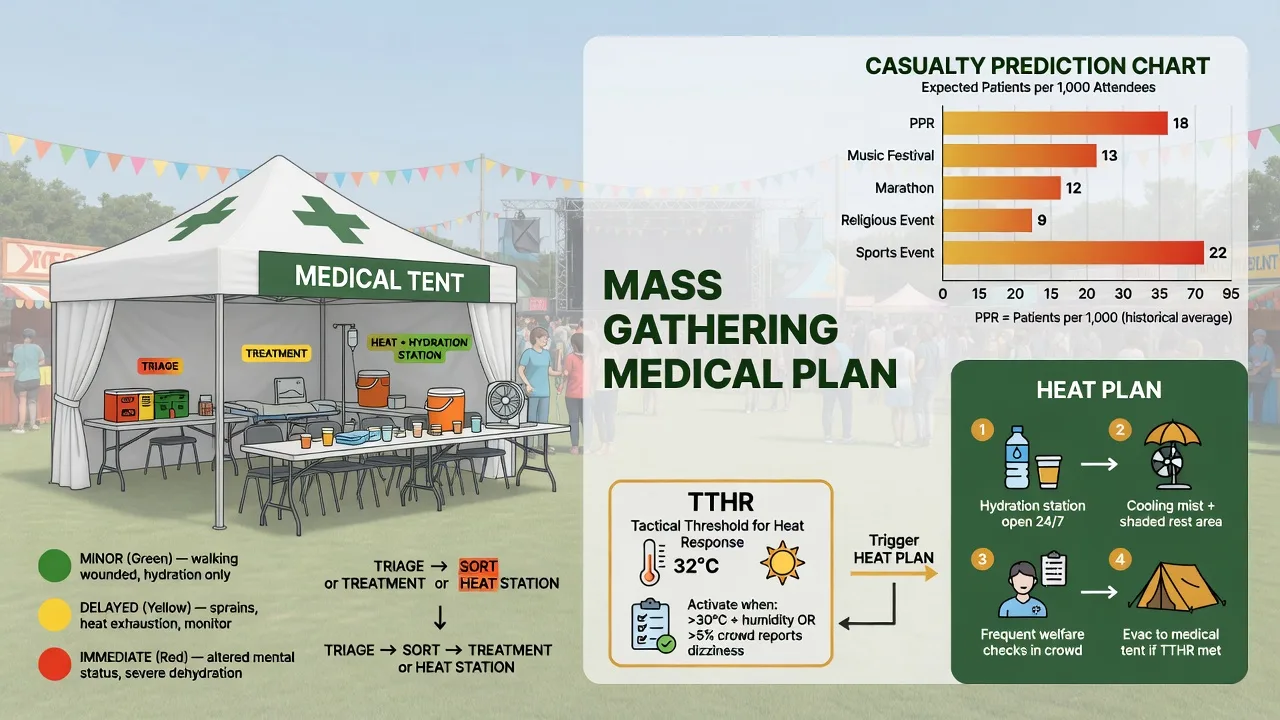
Definition and scope
A mass gathering is defined by the World Health Organization as "a number of people at a specific location for a specific purpose for a defined period of time that has the potential to strain the planning and response resources of the community, state or nation hosting it".[1] A commonly used operational threshold is 1000 or more attendees, although the international consensus and the Arbon review both note that smaller crowds with adverse features (extreme heat, remote location, recreational drug use) can strain resources equally — the definition is functional, not numerical.[9][2] What matters is whether the crowd exceeds the baseline capacity of local emergency services, not the head count alone.
The cardinal distinction is from a mass casualty incident. A mass casualty incident (MCI) is the situation in which the number or the type of casualties exceeds the normal capacity of the responding services, and the standard of care shifts from the individual to the population — the greatest good for the greatest number. A mass gathering is a planned crowd that may or may not generate casualties; an MCI is the casualty-generating event itself. A mass gathering that overwhelms its medical cover becomes an MCI. Nocera and Garner formalised this for the Australian context by arguing that the word "disaster" should be retired in favour of "mass casualty incident", because the operational threshold is casualty load relative to resources, not the dramatic quality of the event.[11][10] The candidate must hold both definitions, because the bridge between them — escalation — is the single most testable concept in event medicine.
The PICE classification
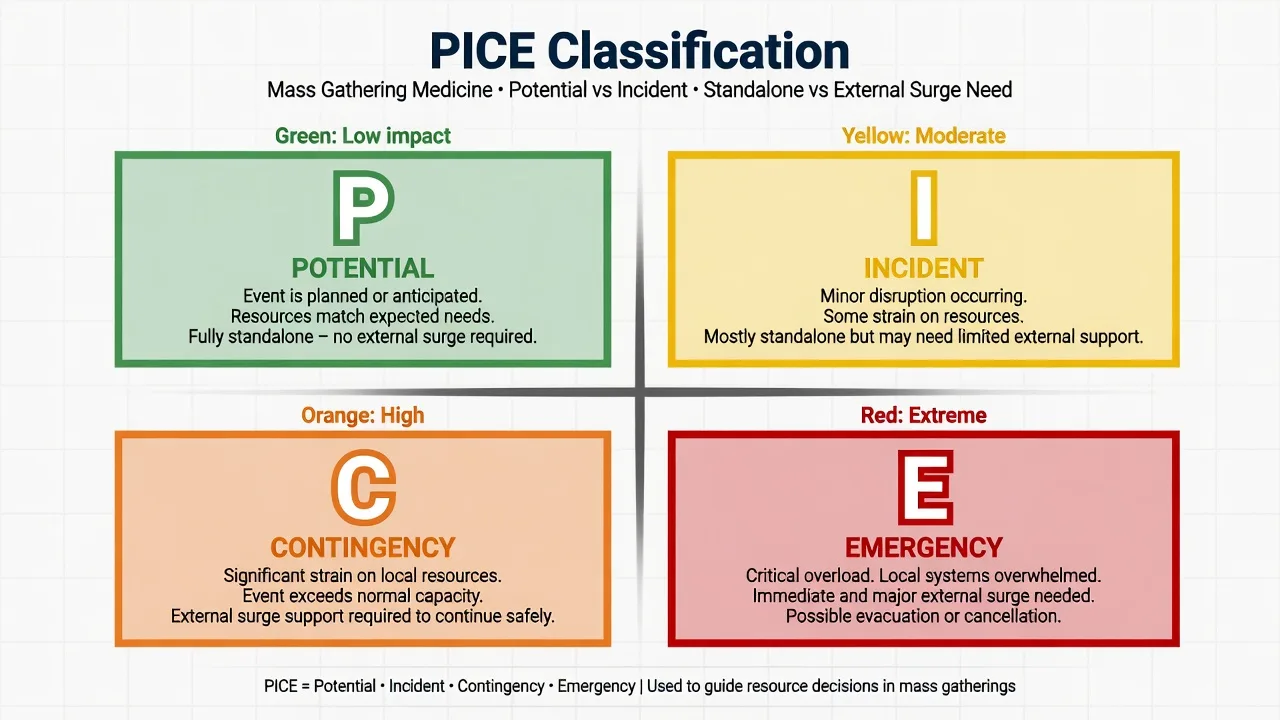
The PICE system (Potential Injury Creating Event) classifies any event, planned or unplanned, along four axes, and it gives the candidate a single compact string to describe an event's medical profile. The Type axis describes the cause of the event (planned or unplanned; primary or secondary). The Category axis describes whether casualties are confined to one site (static) or spread across several (dynamic). The Status axis describes whether the situation is contained (controlled) or still evolving (uncontrolled). The Stage axis describes the extent of outside medical aid required, from stage 0 (none) through stages 1 to 4 (local, regional, national, international).[10]
A routine ticketed concert might therefore be classified as planned, static, controlled, stage 0 — a P/SC0 event. The same concert with an active crowd crush becomes planned, static, uncontrolled, stage 2 or 3. A multi-stage street festival spread across a city is dynamic by category, even before any casualty occurs. The Type descriptors are the highest-yield for the exam: a planned event (concert, pilgrimage, football match, festival) is one the medical system knew about in advance, in contrast to an unplanned event (earthquake, bus crash, structural fire). A primary event is the source of casualties itself, whereas a secondary event generates casualties as a consequence of another disaster — the crush that occurs during the evacuation of a fire, or the heat illness outbreak that follows a power failure at an indoor event.[10][2]
[1]Event types — sport, concert, pilgrimage and festival
The casualty profile of a mass gathering is dominated by its event type, and the four archetypes the candidate must distinguish each carry a predictable pattern of presentation.[1][2]
Sport
- Marathons and mass-participation endurance events: exertional heat illness, hyponatraemia from over-hydration, exertional collapse, cardiac arrest in middle-aged recreational runners; football and stadium sport: blunt trauma, missile injury, crowd crush at entry and exit
- PPR moderate to high (1 to 3 per 1000); predictable, time-clustered (peaks at finish line or full-time)
- Planning emphasis: cooling stations and IV fluids for endurance events; controlled entry and exit flow for stadiums; AED coverage along the course
- A bounded, static, controlled event in PICE terms — the most predictable archetype
Concert and music festival
- The highest-risk archetype for young adults: alcohol and recreational drug intoxication (MDMA, GHB, ketamine, cocaine, novel psychoactive substances), MDMA-related hyperthermia and hyponatraemia, acoustic trauma, crowd crush at the front of stage, dehydration
- PPR high (2 to 5 per 1000 at outdoor festivals); the single largest determinant of variability across event types
- Planning emphasis: cooling areas and "chill-out" zones, drug-checking and harm reduction, naloxone and benzodiazepine availability, front-of-stage crowd-density monitoring, plentiful free water to prevent both dehydration and the over-hydration that causes MDMA hyponatraemia
- May be bounded (ticketed arena) or unbounded (street festival); PPR doubles at outdoor multi-day events
Pilgrimage
- Hajj and Umrah in Saudi Arabia, the Kumbh Mela in India, World Youth Day: the largest gatherings on earth — the Hajj alone hosts more than 2 million pilgrims over days, with a casualty profile dominated by crowd crush, heat illness in older pilgrims, communicable disease (meningococcal disease, respiratory viruses) and exacerbation of chronic cardiopulmonary disease
- Crowd crush at the ritual sites (the Jamarat bridge, Mina) has produced the deadliest single mass-gathering events in history, with deaths in the thousands over minutes
- Planning emphasis: pre-travel vaccination (quadrivalent meningococcal, influenza), crowd engineering at the ritual pinch points, dense fixed medical posts along the route, public-health surveillance and infectious disease isolation, heat mitigation with misting and shade
- Static by location but dynamic by the moving crowd; public-health and crowd dynamics dominate over trauma
Festival and civic event
- New Year celebrations, cultural and religious festivals, air shows, fireworks displays: heterogeneous and often unbounded, with mixed age groups, alcohol, and pyrotechnic and burn risk
- PPR moderate (1 to 2 per 1000); variable by weather, time of day and alcohol availability
- Planning emphasis: dispersed medical posts for an unbounded footprint, burn and blast injury readiness around pyrotechnics, paediatric lost-child protocols, robust public transport and crowd egress planning
- Often dynamic by category — casualties spread across a city centre rather than a single venue
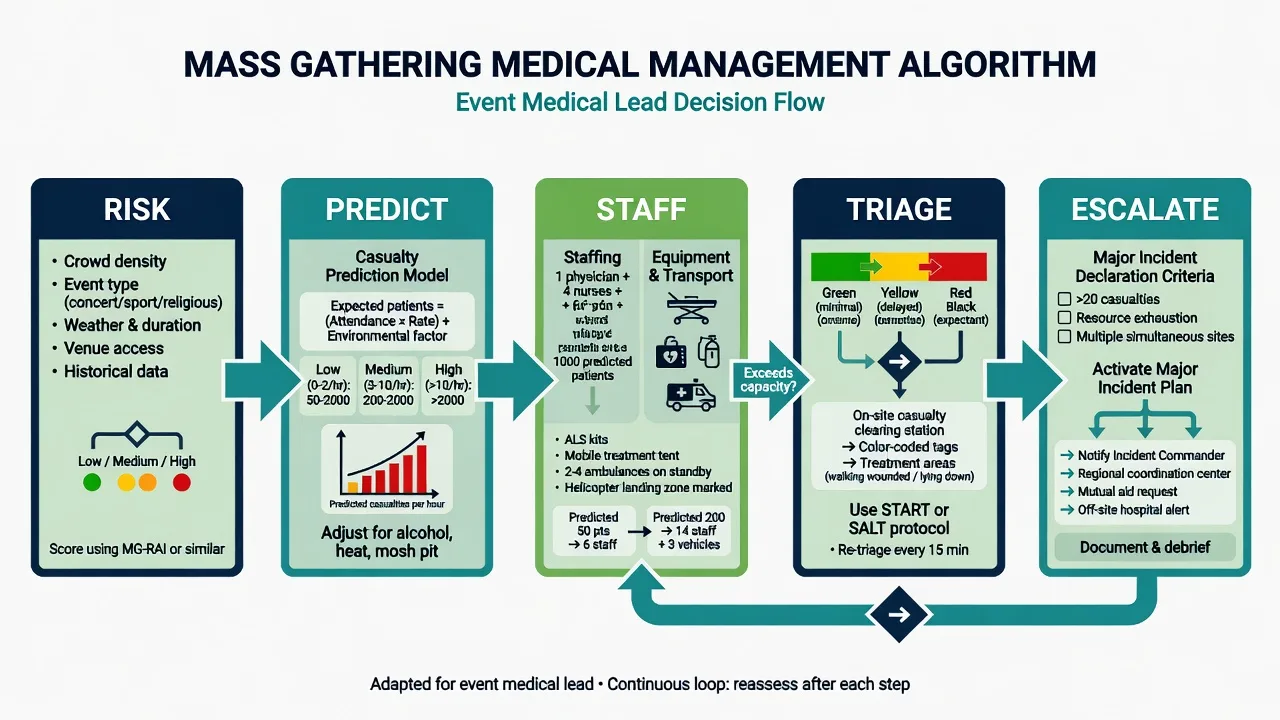
Pre-event medical planning — the structured risk assessment
A mass-gathering medical plan begins months before the event with a structured risk assessment, and Jaslow and colleagues' Medical Director checklist for the National Association of EMS Physicians remains the operational template.[4] The assessment catalogues the foreseeable hazards (crowd size, demographic, event type, weather, duration, venue layout, entry and exit routes, drug and alcohol use, history of previous events at the site) and converts each into a mitigation: a medical post, a transport asset, a piece of equipment, a crowd-flow control measure. The plan also defines the command structure (who is medical commander, how medical comms run, how medical liaises with police and event promoter), the public-health surveillance, the agreed receiving hospital(s), and the escalation criteria. The NAEMSP checklist and the state-legislation surveys both emphasise that the legal authority for medical care at a mass gathering varies by jurisdiction — in many Australian states and US jurisdictions the event promoter bears a statutory duty to provide medical cover, and the medical director signs off the plan.[4][5]
The six domains of an event medical plan
MEDPLAN
Define the medical mission in one sentence — what casualties are predicted, what the on-site team will manage, what will be transported
Estimate the patient presentation rate and the transport to hospital rate from attendance, event type and weather; size the team against these figures
Deploy medical posts, ambulances and equipment to match the casualty geography — density at the front of stage, dispersion along a marathon course
Plan the escalation — the trigger criteria, the command handover, the additional resources, the receiving hospital notification, the conversion to an MCI
Establish links: medical-to-police-to-promoter comms, the designated receiving hospital, the retrieval service, public-health surveillance
After-action review — collect the minimum data set, run the debrief, feed the lessons into the next event plan
Casualty prediction — the patient presentation rate and the transport rate
The quantitative core of the medical plan is the prediction of how many patients will present and how many will require transport to hospital, and the Arbon predictive model is the standard method.[1] Arbon and colleagues' 2001 retrospective analysis of more than 200 South Australian events produced a regression model in which the patient presentation rate (PPR) — the number of patients per 1000 attendees — is predicted from event type, crowd mood, whether the event is bounded or unbounded, indoor or outdoor, weather, attendance and duration. The model gave a median PPR of around 1 to 2 per 1000 attendees for most events, rising to 5 per 1000 for high-risk events such as outdoor rock concerts in hot weather; unbounded (free, street) events run higher than bounded (ticketed, fenced) events.[1][3] The transport to hospital rate (TTHR) is consistently 5 to 20 per cent of the PPR — roughly 1 to 2 patients per 10,000 attendees — and is the figure that sizes the ambulance and the receiving-hospital demand. The nonlinear refinement of the model (Arbon 2018) confirmed that casualty rates rise more steeply than linearly with attendance, so a doubling of crowd size more than doubles the expected patient load.[3]
Staffing, equipment and transport
Staffing is sized against the predicted casualty load, and the widely used rule of thumb is one medical team (a doctor, a nurse and first responders, with a paramedic crew) per 10,000 to 25,000 attendees at a low-risk event, scaled up for high-risk archetypes such as outdoor music festivals or endurance events.[4] The team composition must include a senior decision-maker empowered to discharge on site, because on-site disposition — treating and releasing the minor presentations — is the load-shedding mechanism that keeps the local emergency department functional; Hutton and colleagues demonstrated that the presence of on-site medical services at outdoor music festivals measurably reduces emergency department presentations during and after the event.[8]
The equipment cache is determined by the predicted presentation profile: a resuscitation capability at each medical post (defibrillator, advanced airway, oxygen, suction, opiate and benzodiazepine antagonists), wound care and splinting for minor trauma, intravenous fluids and cooling capability for heat illness, and a mass-casualty triage kit held in reserve against escalation. The transport matrix maps patient acuity to destination — minor presentations managed and discharged on site, moderate cases transported to the designated receiving hospital by on-site ambulance, and time-critical cases (cardiac arrest, major trauma, heat stroke) retrieved directly to a tertiary centre, with pre-notification.[4][10]
Triage at events
On-event triage operates at two levels. For the routine stream of individual presentations, the Australasian Triage Scale (or its regional equivalent) is applied at the medical post. For the casualty surge that exceeds capacity, a mass-casualty triage tool is required — SALT (Sort, Assess, Lifesaving interventions, Treatment and Transport) is the contemporary standard, validated for adult and paediatric use, and is preferred to START because it permits lifesaving interventions (control of catastrophic haemorrhage, airway opening, needle decompression) during the triage sweep rather than deferring them to the treatment sector.[14][10] The command framework within which triage runs is MIMMS (Major Incident Medical Management and Support), whose seven CSCATT pillars — Command, Safety, Communication, Assessment, Triage, Treatment, Transport — give the on-site commander the operational checklist.[11][10]
[1]Differential — minor versus major incident
The "differential" in event medicine is the operational decision at the moment the casualty load builds: is this still a minor incident within the capacity of the on-site team, or has it become a major incident requiring the shift to the population standard of care? The distinction is the trigger for everything that follows — command activation, MIMMS CSCATT, SALT, the transport matrix, and the notification of the receiving hospital.[10][11]
Minor incident — on-site capacity
- Casualty load within the predicted range and the staffed capacity; individual standard of care preserved
- Presentation profile: lacerations and abrasions, alcohol intoxication, blisters and foot care, headache and dehydration, minor heat exhaustion, minor recreational drug effects
- Management: standard individual ABCDE, ATS triage, treat and release on site; no command activation, no SALT, no transport matrix beyond the routine ambulance
- The default state of a well-planned event — the medical plan worked
Major incident — exceeds capacity
- Casualty load exceeds the staffed capacity OR a single catastrophic mechanism (crowd crush, structural collapse, fire, mass drug toxicity) is present
- Presentation profile: crowd crush with compressive asphyxia, multiple heat strokes in a heat wave, mass MDMA toxicity, blast injury from pyrotechnics, structural collapse
- Management: shift to the population standard — greatest good for the greatest number; activate MIMMS command and CSCATT; deploy SALT triage; open the transport matrix; notify the receiving hospital to declare an internal major incident; declare expectant category where resources demand it
- The state the plan was built to prevent but must be ready to manage
Crowd crush, heat illness, alcohol and recreational drugs
The three highest-yield presentations at mass gatherings are crowd crush, heat illness, and alcohol and recreational drug toxicity — and the candidate must know each at consultant depth. [1]
Crowd crush is the deadliest single mechanism at mass gatherings, and its mechanism is compressive asphyxia, not trampling. At crowd densities above 4 to 5 people per square metre individuals lose control of their own movement, the crowd behaves as a fluid, and pressure transmits in waves through the mass; the victim dies of positional or compressive asphyxia while still upright, often without falling. The 1989 Hillsborough stadium disaster (97 deaths), the 2010 Love Parade in Duisburg (21 deaths) and the recurrent stampedes at the Hajj — including the 2015 Mina crush — are the archetypes.[12][13] Management is rapid extrication, ABCDE with attention to airway and breathing, and anticipation of crush syndrome: the trapped limb releases potassium, myoglobin and lactic acid on reperfusion, producing hyperkalaemic cardiac arrest, hypovolaemic shock and pigment-induced acute kidney injury. Pre-extrication intravenous fluid loading (where access is possible), and post-release management of rhabdomyolysis with isotonic saline, bicarbonate and renal-dose dopamine or equivalent, prevent the reperfusion death that Peiris and colleagues' historical review of wartime crush established.[12]
Heat illness at mass gatherings runs the spectrum from heat cramps through heat exhaustion to exertional heat stroke, and outdoor endurance and music events are the dominant settings. Heat stroke is the emergency: core temperature above 40 degrees Celsius with central neurological dysfunction, managed by immediate aggressive cooling — cold-water immersion is the gold standard, with evaporative or ice-pack cooling where immersion is impractical — and intravenous fluids. The candidate should cross-refer to the heat-illness topic for the cooling protocol and the criterion-based diagnosis. [1]
Alcohol and recreational drugs drive a disproportionate share of presentations at concerts and festivals. Ethanol intoxication is the bulk; MDMA causes the two testable emergencies — hyperthermia (which mimics and merges with heat stroke) and hyponatraemia from water overconsumption in the attempt to prevent dehydration; the MDMA patient at a hot festival may present with both simultaneously and requires active cooling, sodium correction guided by the sodium concentration, and benzodiazepines for agitation and seizure threshold. GHB causes rapid loss of consciousness with rapid spontaneous recovery; ketamine and the novel psychoactive substances ("legal highs") produce a variable dissociative and sympathomimetic picture. Agitation is managed with titrated benzodiazepines (for example diazepam 5 to 10 mg orally or intravenously), hyperthermia with active cooling, and opiate overdose with naloxone.[8]
Escalation — when a mass gathering becomes a mass casualty
The conversion of a minor incident to a major incident is the decision point on which the entire plan turns, and the candidate must be able to name the escalation triggers. The triggers are the casualty load exceeding prediction by a defined margin; the loss of treatment space; the loss of staff (through fatigue or contamination); the loss of command or communications; a single catastrophic mechanism (crowd crush, structural collapse, fire, mass drug toxicity); and the security threat (active violence, device, evacuation). On any one of these the medical commander declares a major incident, activates MIMMS CSCATT, deploys SALT triage, opens the transport matrix, and notifies the receiving hospital to declare its own internal major incident. The expectant category — the patient who would survive under normal resources but cannot in the surge — is the ethical hardest decision in event medicine and is reserved for the declared major incident, never for routine on-site care.[10][11]
[1]Common errors and pitfalls
The recurring failures are those the planning is meant to prevent. Under-resourcing against the predicted PPR — staffing to political comfort rather than to the Arbon figure — is the cardinal error and is unmasked only when the casualty wave arrives. No command structure leaves the on-site team as a collection of individual responders with no coordinated triage, transport or communication. A single point of failure in communications (one radio channel, one repeater) renders the medical commander deaf at the moment of the surge. Ignoring the weather in the risk assessment — heat, storm, lightning — converts a low-risk event into a high-risk one overnight. No agreed receiving hospital sends transports to an unprepared emergency department. No decontamination capability for the chemical, biological or radiological contamination that recreational drug labs or pyrotechnics can produce. No debrief and no data collection — without the minimum data set that Turris and colleagues specified, the event generates no learning and the next event repeats the same errors.[6][7]
Model answer — a 50,000-attendee summer music festival medical plan
Evidence and regional guidelines
The evidence base for mass-gathering medicine was founded by Arbon's 2001 predictive model and 2007 review, refined in the 2018 nonlinear model, and consolidated by the international consensus Delphi work of Steenkamp and colleagues and the minimum-data-set work of Turris, Hutton, Ranse and the Branson group.[1][2][3][9][6][7][8] The operational standards come from the Jaslow NAEMSP Medical Director checklist and the state-legislation surveys.[4][5] The disaster-management and MCI principles come from Born and colleagues and from Nocera and Garner's Australian nomenclature work.[10][11] Crush syndrome is reviewed historically by Peiris, the religious-mass-gathering public-health burden by Al-Tawfiq, and the SALT triage tool by Ren and colleagues.[12][13][14]
ANZ practice note. The World Health Organization public-health guidance for mass gatherings is the regional anchor, supplemented by the Australian Health Protection Principal Committee (AHPPC) guidance and the state emergency-management arrangements. ACEM does not publish a standalone event-medicine policy but addresses mass-gathering medical care through its disaster and pre-hospital position statements and the broader clinical-quality framework. The Australasian Triage Scale (ATS) is applied at the on-site medical post for individual presentations; MIMMS, with the CSCATT command structure, is the standard major-incident framework and SALT the standard triage tool. The Arbon predictive model is the casualty-forecasting standard. State legislation in several Australian jurisdictions imposes a duty on event promoters to provide medical cover proportionate to the risk, and the medical director signs off the plan. [1]
Exam pearls
- Definition of a mass gathering: a crowd with the potential to strain the planning and response resources of the host community; operational threshold 1000 or more attendees, but functional rather than numerical.[9][1]
- Mass gathering versus mass casualty incident: a mass gathering is a planned crowd; an MCI is a casualty-generating event. The bridge is escalation.
- PICE = four axes: Type (planned/unplanned, primary/secondary), Category (static/dynamic), Status (controlled/uncontrolled), Stage (0 to 4).[10]
- Arbon PPR = 1 to 2 per 1000 attendees for most events, up to 5 per 1000 for high-risk; TTHR = 5 to 20 per cent of PPR.[1][3]
- Event archetypes: sport (exertional), concert (drugs, MDMA), pilgrimage (crush, communicable disease), festival (heterogeneous, unbounded).
- Crowd crush = compressive asphyxia, not trampling: density above 4 to 5 per square metre; anticipate crush syndrome on extrication.[12]
- MDMA at a hot festival = hyperthermia plus hyponatraemia: cool, correct sodium, benzodiazepines for agitation.
- Escalation triggers: casualty load exceeding prediction, loss of treatment space, loss of staff, loss of command or comms, single catastrophic mechanism, security threat.[10]
- MIMMS CSCATT: Command, Safety, Communication, Assessment, Triage, Treatment, Transport.
- Triage tool: SALT preferred over START (lifesaving intervention at triage).[14]
- Minimum data set: the Turris and Hutton consensus is the post-event reporting standard; without it, no learning.[6][7]
Short answer questions
SAQ — Mass-gathering medical cover at an outdoor music festival
10 minutes · 10 marks
A 35-year-old woman is brought to the on-site medical post at a 40,000-attendee outdoor summer music festival on day two of a three-day event. The ambient temperature is 34 degrees Celsius. She is agitated, sweating profusely, and has been drinking freely from the water points. A companion reports she took 'two pills' approximately four hours ago. Her heart rate is 142 and regular, blood pressure 158/92, respiratory rate 28, GCS 13 (confused, disoriented), and a finger-prick glucose is 7.2 mmol/L. Rectal temperature is 41.1 degrees Celsius. The medical post has two doctors, four nurses, four first responders, two ambulances and a resuscitation bay. Twenty other patients have presented in the past hour, mostly with minor injuries, alcohol intoxication and heat exhaustion. The senior event medical commander asks you to manage this patient and advise on the wider event posture.
SAQ — Event medical planning and the escalation to a mass casualty incident
10 minutes · 10 marks
You are the designated medical director for a ticketed, single-day football derby with a 60 000-seat stadium. Pre-match intelligence has flagged a long-standing rivalry, with previous incidents of crowd disorder and one pitch invasion in the past five years. Kick-off is 16:00; gates open at 14:00. The stadium has four entry gates, four exit gates, and the closest receiving hospital is 8 km away with a major trauma centre 15 km away. You have six months to prepare. The local ambulance service has confirmed two dedicated ambulances for the event and one supervisor. You are asked to develop the medical plan and present it to the event control for sign-off.
Red flags
[1]References
- [1]Arbon P, Bridgewater FHG, Smith C. Mass gathering medicine: a predictive model for patient presentation and transport rates Prehosp Disaster Med, 2001.PMID 11875799
- [2]Arbon P. Mass-gathering medicine: a review of the evidence and future directions for research Prehosp Disaster Med, 2007.PMID 17591185
- [3]Arbon P, Zeitz K, Drew T, De Silva M, Domoney J. Nonlinear Modelling for Predicting Patient Presentation Rates for Mass Gatherings Prehosp Disaster Med, 2018.PMID 29962363
- [4]Jaslow D, Yancey A, Milsten A. Mass gathering medical care. National Association of EMS Physicians Standards and Clinical Practice Committee Prehosp Emerg Care, 2000.PMID 11045418
- [5]Jaslow D, Drake M, Lewis J. Characteristics of state legislation governing medical care at mass gatherings Prehosp Emerg Care, 1999.PMID 10534032
- [6]Turris SA, Lund A, Hutton A, Bowles R, Abroug H, Blanchard IE, Carter T, Gaschk D, Gray S, Khori M, Munn MB, Shah MI, Arbuthnot K. Measuring the Masses: Domains Driving Data Collection and Analysis for the Health Outcomes of Mass Gatherings (Paper 3) Prehosp Disaster Med, 2021.PMID 33602378
- [7]Turris SA, Lund A, Hutton A, Bowles R, Abroug H, Blanchard IE, Carter T, Gaschk D, Gray S, Khori M, Munn MB, Shah MI. Measuring the Masses: A Proposed Template for Post-Event Medical Reporting (Paper 4) - CORRIGENDUM Prehosp Disaster Med, 2021.PMID 33818337
- [8]Hutton A, Ranse J, Munn MB, Cranmer H, Lund A, Turris SA. Does the Presence of On-Site Medical Services at Outdoor Music Festivals Affect Attendees' Planned Alcohol and Recreational Drug Use? Prehosp Disaster Med, 2021.PMID 34187607
- [9]Steenkamp M, Cranmer H, Hutton A, Archer F, Ranse J, Lund A, Turris SA. Exploring International Views on Key Concepts for Mass-gathering Health through a Delphi Process Prehosp Disaster Med, 2016.PMID 27212053
- [10]Born CT, Briggs SM, Ciraulo DL, Frykberg ER, Hammond JS, Hirsch EF, Lhowe DW, O'Neill PA, Palanca A, Petrone SJ, Rutherford EJ, Tinkoff GH. Disasters and mass casualties: I. General principles of response and management J Am Acad Orthop Surg, 2007.PMID 17602028
- [11]Nocera A, Garner A. Australian major incident nomenclature: it may be a 'disaster' but in an 'emergency' it is just a mess ANZ J Surg, 2001.PMID 11277146
- [12]Peiris D, Garrett P, Smith C, Bolland J, Southgate E. A historical perspective on crush syndrome: the clinical application of its pathogenesis, established by the study of wartime crush injuries J Clin Pathol, 2017.PMID 27920043
- [13]Al-Tawfiq JA, Benkouiten S, Memish ZA. Public health preparedness and infectious disease risk management across religious mass gatherings: a comparative analysis of Hajj, Umrah, Arba'een and Kumbh Mela J Travel Med, 2026.PMID 41934233
- [14]Ren D, DeLuca L, Garvin T, et al. Evaluation of Pediatric Triage Decisions Using the SALT (Sort, Assess, Life-saving Intervention, Treatment/Transport) Triage System across Training Levels Disaster Med Public Health Prep, 2025.PMID 41339328