EM · Australasian Triage Scale
The Australasian Triage Scale — categories, validity, reliability and the under-triaged patient
Also known as Australasian Triage Scale · ATS · Emergency triage · Five-level triage scale · Triage nurse assessment · Under-triage and over-triage · Time-to-treatment threshold · Triage validity and reliability · Inter-rater agreement (weighted kappa) · Did not wait
The Australasian Triage Scale (ATS) — the five-level urgency scale used across Australian and New Zealand emergency departments, jointly endorsed by ACEM and the Australian College of Nursing. The five categories with their maximal acceptable times to clinical treatment (ATS 1 immediately, 2 within 10 minutes, 3 within 30 minutes, 4 within 60 minutes, 5 within 120 minutes); construct and criterion validity (ATS category predicts mortality, admission, ICU and resource use — Doherty's stepwise inpatient mortality); reliability and inter-rater agreement measured by weighted kappa (fair-to-moderate, ~0.3–0.6, never perfect, best at the extremes); the triage nurse's role and scope of practice (brief assessment, category allocation, first-line measures, re-triage, escalation); Considine's physiological discriminators that mandate up-triage; the differential of the under-triaged patient (anchoring, atypical or occult presentation, communication barrier, ignored carer concern, system overload, premature closure); comparison with the Manchester Triage System and the Emergency Severity Index; and the did-not-wait rate as a departmental quality marker. ACEM-primary, globally tagged.
On this page & tools
Your progress
Saved locally on this device.
Target exams
Red flags
Related topics
- Team-based care and crisis resource management in the emergency department
- Patient disposition and safety-netting in the emergency department
- Medical error and patient safety in the emergency department
- Acute coronary syndromes (STEMI, NSTEMI and unstable angina)
- Sepsis and septic shock — the emergency department approach
- The sick child and paediatric resuscitation
- Acute ischaemic stroke
Triage is the process of sorting patients by clinical urgency to determine the order and priority of treatment, performed within minutes of arrival at the emergency department and before a full clinical assessment is possible. In Australia and New Zealand the instrument used is the Australasian Triage Scale (ATS), a five-level urgency scale jointly endorsed by the Australasian College for Emergency Medicine (ACEM) and the Australian College of Nursing (formerly ACEN), and mandated across virtually every public ED in the region.[1] Each category carries a maximal acceptable time to the initiation of treatment (the doctor or nurse practitioner assessment, or the first therapeutic intervention), and that threshold — not the discharge time — is the operational definition the candidate must reproduce verbatim. Triage is not diagnosis: the triage nurse allocates urgency from a brief, structured assessment, and the category governs the patient's whole early journey through the department — how quickly they are seen, where they wait, what is initiated at the door, and how the department measures its own performance.[1][1]
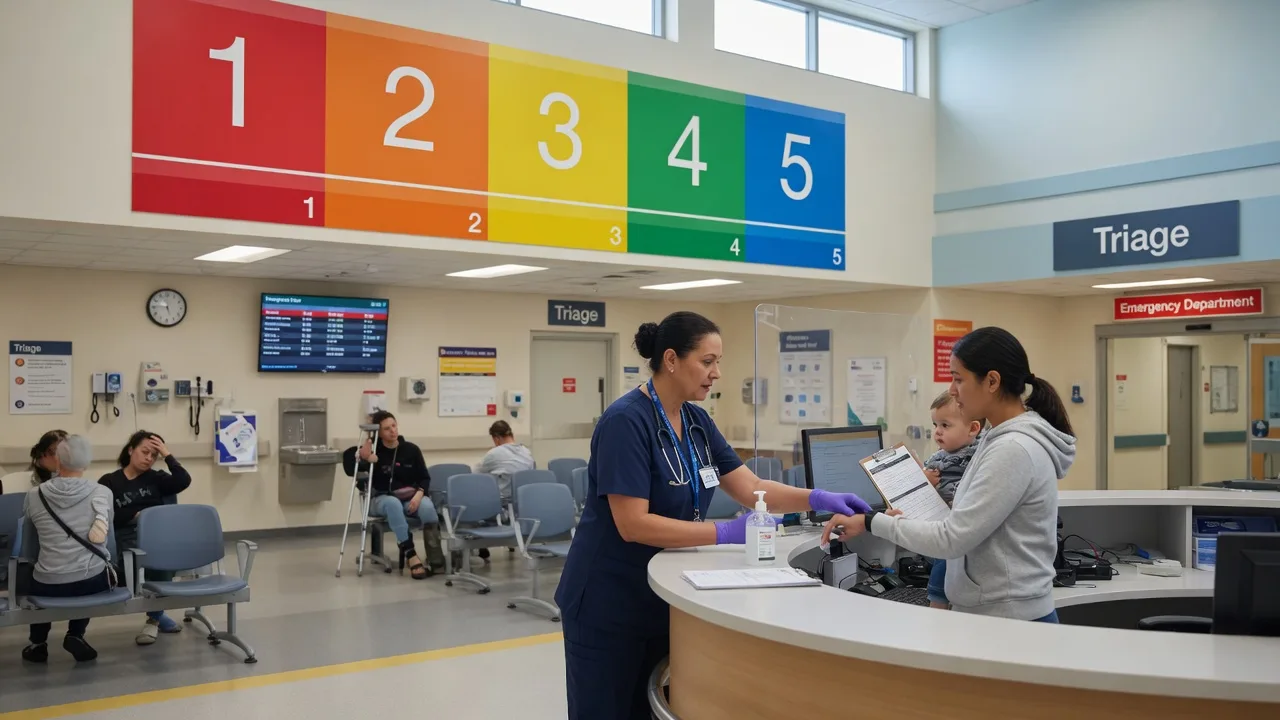
Definition and scope — what triage is, and what it is not
Triage derives from the French verb trier, "to sort," and its modern form was refined on the battlefield, where limited resources had to be allocated to the soldiers most likely to survive with prompt treatment. The translation to civilian emergency medicine retains the same premise: demand outstrips the immediate capacity to assess and treat, and so a rapid, structured decision is required to allocate the scarce resource — clinician time — to those who need it first. The ATS, introduced in the mid-1990s from the earlier National Triage Scale, is the ANZ instantiation of that decision, and it is the single most consequential minute of the patient's ED stay, because the category assigned at the door determines the safety of the subsequent wait.[1]
The distinction the candidate must hold is between urgency and diagnosis. Triage asks one question — how quickly should this patient be seen? — and answers it on the available data: presenting complaint, a brief targeted look, and a set of vital signs. It does not, and cannot, arrive at a definitive diagnosis, and the category is therefore a probability statement about the risk of deterioration, not a statement about what is wrong. A patient with central chest pain is ATS 2 not because the diagnosis is myocardial infarction but because the probability of a time-critical, life-threatening condition is high enough that the wait must be under 10 minutes. A patient with sprained ankle is ATS 4 not because the diagnosis is benign but because the probability of deterioration in the next hour is low. The scale measures risk, not certainty, and the failure to grasp this distinction is the root of every under-triage error.[1][2]
The framework — the five ATS categories
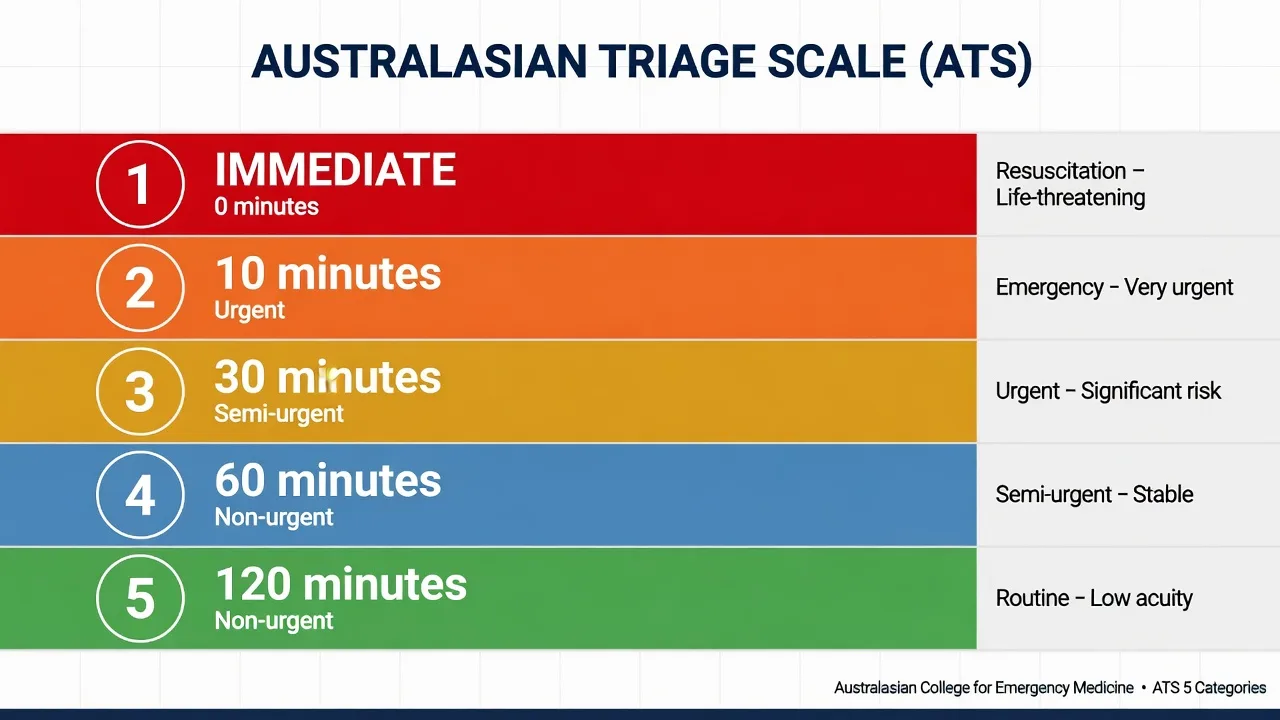
The ATS is a five-level ordinal scale, with each level defined by a descriptor of clinical urgency and a maximal acceptable time to the initiation of treatment. ACEM's policy reproduces the five categories as follows, and the candidate must be able to state the threshold for each.[1]
| ATS | Descriptor | Maximal time to treatment |
|---|---|---|
| 1 | Immediately life-threatening — requires resuscitation | Immediately (within seconds) |
| 2 | Imminently life-threatening — emergency care required | Within 10 minutes |
| 3 | Potentially life-threatening or situational urgency | Within 30 minutes |
| 4 | Potentially serious or situational urgency (not life-threatening) | Within 60 minutes |
| 5 | Less urgent or administrative | Within 120 minutes |
The five ATS categories — maximal acceptable time to treatment initiation
Validity — does the scale measure urgency?
Validity asks whether the ATS measures what it claims to measure — clinical urgency, defined as the risk of an adverse outcome if treatment is delayed. The evidence for ATS validity is strong and converges from several angles. Criterion validity is demonstrated by the relationship between the triage category and hard outcomes: across large cohorts, inpatient mortality, admission rate, intensive-care admission, length of stay, and resource utilisation all rise in a stepwise fashion as the category becomes more urgent. Doherty and colleagues showed that inpatient mortality climbed from ATS 5 through to ATS 1 in three New South Wales regional base hospitals, establishing that the category assigned at the door predicts who dies as an inpatient — the strongest single test of whether the scale measures what it claims.[4] Construct validity is shown by the correlation between category and resource use: more urgent categories consume more investigations, more senior staff time, and more interventions, exactly as a valid urgency scale should predict.[1]
A related but distinct concept is the link between the failure of the threshold (the patient who waits beyond the maximal time) and adverse outcome. Richardson demonstrated that ED overcrowding — operationally, access block and prolonged waiting — was associated with a measurable increase in 10-day mortality, even after adjustment for acuity. The implication for triage is direct: the thresholds exist because delay beyond them costs lives, and the validity of the scale is grounded in that demonstrated harm.[6]
The validity of a triage scale can be undermined by under-triage (assigning a less urgent category than is warranted, with the patient waiting beyond the safe time) and over-triage (assigning a more urgent category than is warranted, which diverts resources). Under-triage is the dangerous error: the patient is left in the waiting room beyond the point at which treatment would have prevented deterioration. Over-triage is the safer, though inefficient, error, and a degree of over-triage is built into a system that values safety — most departments tolerate over-triage rates higher than under-triage rates precisely because the asymmetry of harm favours it.[4]
Reliability and inter-rater agreement
Reliability asks a different question: given the same patient, would two different triage nurses assign the same category? Inter-rater agreement on a five-level ordinal scale is conventionally measured by the weighted kappa statistic, which credits near-agreement (ATS 3 vs ATS 4) more than gross disagreement (ATS 1 vs ATS 5) and corrects for agreement expected by chance. The ATS reliability literature, built on scenario-based studies (written cases, video cases, and simulated patients) and on live-patient audits, converges on a weighted kappa in the fair-to-moderate range, typically 0.3 to 0.6, and never perfect.[5][11]
Considine and colleagues examined emergency nurses' performance on paper and video scenarios and found agreement that was acceptable at the extremes — almost every nurse assigns ATS 1 to an unconscious patient and ATS 5 to a suture removal — but degraded sharply in the middle categories, where ATS 3 and ATS 4 are genuinely difficult to separate.[5] Gerdtz and colleagues dissected the sources of that inconsistency across two companion studies: task complexity (the presentation with multiple or ambiguous cues), the subjectivity of the complaint (pain and distress are harder to weigh than a measurable vital sign), and the cue structure (whether the salient information was fixed and obvious or variable and buried) all drove agreement down. Their simulation work showed that removing objective cues forced nurses onto subjective judgement, and consistency fell.[7][11]
[1]The implication for the candidate is that the ATS is valid but imperfectly reliable — it sorts correctly in aggregate, but the individual category assignment carries measurable error, and that error is the substrate of the under-triage event. The paediatric systematic review by van Veen and colleagues, comparing the available five-level scales in children, found broadly similar reliability profiles across the ATS, Manchester Triage System, Paediatric Canadian Triage and Acuity Scale and the Emergency Severity Index, with none reaching the near-perfect agreement the early developers hoped for.[10]
The triage nurse role and scope of practice
Triage is performed by a registered nurse — typically a senior, experienced ED nurse with formal triage training — and the role is broader than category allocation alone. Gerdtz's foundational work on triage nurses' decision-making and scope of practice established that the triage assessment is a rapid, pattern-recognition-driven judgement synthesising the presenting complaint, a brief visual and verbal assessment, and (where measured) vital signs, completed in two to five minutes under constant interruption.[1][2] The triage nurse allocates the ATS category, initiates first-line measures (see below), identifies isolation requirements for the infectious or behavioural-risk patient, communicates with relatives, and manages the flow of patients into the department. Scope of practice is jurisdiction-defined but, across ANZ, includes nurse-initiated diagnostics (ECG, urinalysis, point-of-care glucose, pregnancy test) and nurse-initiated analgesia and antipyretics within standing-order protocols.[1][1]
The triage nurse also carries the re-triage responsibility. Patients who wait beyond a short interval, who report new or worsening symptoms, who are brought back by a concerned relative, or whose vital signs trend adversely must be reassessed and the category revised upward where warranted. The waiting-room collapse is, almost without exception, a failure of re-triage: the patient deteriorated after the initial allocation, the change was not detected, and the category was never revised. Structured re-triage at defined intervals (commonly every 30 to 60 minutes for ATS 3 and above) is the engineered defence.[1]
The triage nurse's role — six elements beyond the number
TRIAGE
Allocate the ATS level from the brief assessment of complaint, appearance and vital signs — the single most time-sensitive decision of the patient's early ED journey
Reassess waiting patients at defined intervals (every 30–60 min for ATS 3 and above) and revise the category upward on any deterioration, new symptom, or relative concern
ECG within 10 min for chest pain, analgesia for pain, antipyretic for fever, simple dressing for bleeding wound, elevation and ice for injury, glucose for the altered patient
Identify the infectious patient (fever, rash, travel) for isolation, and the behavioural-risk or violent patient for security and safe-room placement
Brief history from relatives, carers, paramedics or the GP; communication barriers (language, deafness, dementia) signal higher under-triage risk and demand extra care
Call the senior nurse or doctor for the patient who is unstable or whose category cannot be safely assigned; the triage nurse is empowered to up-triage and to summon help, never to down-triage alone
Physiological discriminators — the objective anchor
The principal defence against the subjectivity that erodes reliability is Considine's work on physiological discriminators: objective, measurable vital-sign criteria that mandate up-triage when deranged, regardless of how well the patient appears. Considine and colleagues derived these discriminators from a large ED cohort by identifying the vital-sign thresholds that independently predicted the need for admission, intensive care, or emergent intervention, and they are now embedded in the Emergency Triage Education Kit as the objective safety net beneath the subjective assessment.[3][1]
The discriminator principle generalises: a single abnormal vital sign in a patient who "looks well" is a more powerful predictor of deterioration than the global impression, and the triage nurse who up-triages on the deranged respiratory rate of 32 in the breathless elderly patient has applied the defence correctly. The patient who is tachypnoeic, hypoxic, or hypotensive is not ATS 4 regardless of the complaint, and the candidate who justifies the up-triage on the discriminator scores the mark.[3]
Management and first-line treatment initiated at triage
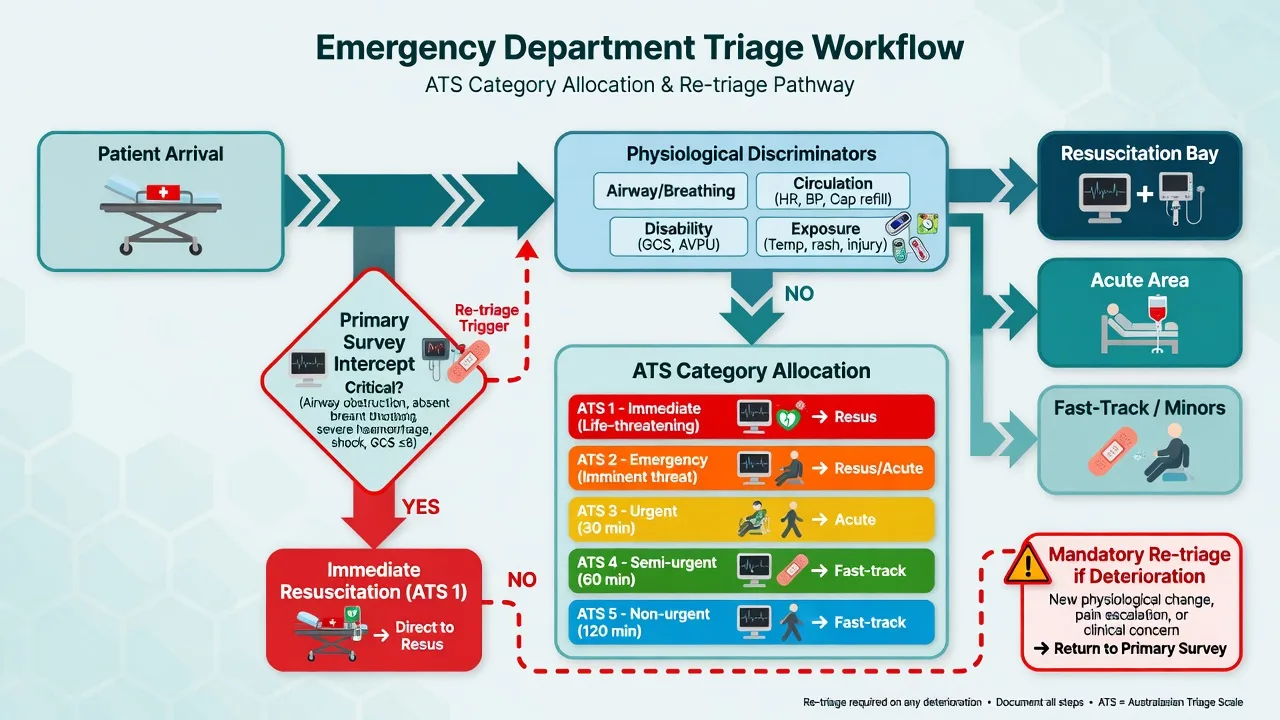
Treatment at triage is brief, targeted, and governed by standing-order protocols that permit the nurse to act before the formal clinician assessment. The high-yield interventions, each with a defined agent, dose, route and rationale, are listed below; the principle is that the patient who meets a threshold should not wait for analgesia, an ECG, or a fever-reducing agent merely because the doctor has not yet arrived.[1][12]
For the patient with suspected acute coronary syndrome, the triage nurse initiates the chest-pain pathway: a 12-lead ECG within 10 minutes of arrival (and shown to a clinician within 10 minutes), aspirin 300 mg orally (chewed, unless contraindicated by true allergy or active bleeding), cardiac monitoring, and the acquisition of venous access. For pain, the standing-order ladder begins with paracetamol 1 g orally for mild-to-moderate pain, ibuprofen 400 mg orally for musculoskeletal pain where not contraindicated, and escalates to morphine 5 mg intravenously, titrated in 1 to 2 mg increments, for severe pain (renal colic, fracture, burns). Forero and colleagues documented that time to initial analgesia in Australian EDs was often prolonged and that morphine was under-used — a finding that motivated the move to nurse-initiated analgesia at triage.[12] For fever, paracetamol 1 g orally (or weight-based in children, 15 mg per kg) is standard. For nausea and vomiting, ondansetron 4 mg orally or intravenously (weight-based in children). For the hypoglycaemic patient, immediate point-of-care glucose and, if low, oral glucose or intravenous 10 per cent dextrose. For the wounded patient, a simple dressing and elevation.
Each of these is documented at triage — the agent, the dose, the route, the time, and the response — so that the treating clinician inherits a patient in whom first-line care has already begun. The closed-loop principle applies: the triage nurse initiates, the treating team continues, and the handover records what was given.[1][12]
Differential — the under-triaged patient: why a patient is allocated below their true urgency
The under-triage event is the triage failure that harms, and the Fellowship candidate must be able to dissect its causes as a differential, because each cause carries a different countermeasure. The patient allocated ATS 4 who collapses in the waiting room with a pulmonary embolism, an occult sepsis, or an aortic dissection is the archetype, and the contributors below are the diagnoses the analysis must distinguish.[5][11]
Anchoring on a benign first impression
- The triage nurse anchors on a single, reassuring feature — "it's just indigestion," "it's gastro" — and never revises when the contradictory data arrives
- The classical under-triage mechanism: the central chest pain labelled musculoskeletal, the vomiting elderly patient labelled gastroenteritis who has mesenteric ischaemia
- Countermeasure: the structured re-triage at intervals, the explicit question "what would make this higher?", and Considine's physiological discriminators applied on every assessment
Atypical or occult presentation
- The elderly, the diabetic, the immunocompromised, and the pregnant patient who do not display the textbook signs of the time-critical illness — the septic elderly patient with a normal temperature and a mild confusion, the diabetic with a silent infarct, the elderly with an atypical SAH
- The physiology is deranged (the discriminator is there) but the presentation is muted, and the global "looks well" impression overrides the abnormal sign
- Countermeasure: weight the objective vital sign over the subjective impression; lower the index of suspicion and the up-triage threshold in the elderly, the immunocompromised, and the chronically unwell; never accept "looks well" when the respiratory rate is 30
Communication barrier
- Language difference, deafness, dementia, intoxication, or developmental disability prevents the patient from communicating the severity or the red-flag feature
- The pain is severe but unexpressed; the symptom pattern is unrevealed; the patient who cannot speak for themselves is systematically under-triaged
- Countermeasure: use the interpreter (in person or phone) at triage, involve the carer or family, observe behaviour (the patient who is still, withdrawn, or guarding is in severe pain or distress), and apply the physiological discriminators regardless of the history
Pain under-assessment
- Pain is under-scored and under-treated, and severe pain is itself a marker of high acuity that warrants a more urgent category
- The renal-colic patient with 9-out-of-10 pain allocated ATS 4, the fractured femur in the elderly given nothing and left to wait
- Countermeasure: document a numerical pain score at triage, treat to the score (nurse-initiated analgesia), and up-triage severe pain (10 out of 10, or any severe visceral pain) to at least ATS 2 or 3
Ignored carer or relative concern
- The relative who says "this is not normal for him, he is not this confused" holds a piece of information that the unfamiliar triage nurse does not have, and dismissing it is a recognised contributor to under-triage
- The baseline is unknown to the nurse; the carer knows it; the change is real but not visible
- Countermeasure: record and weight the carer concern, document "carer states this is a significant change from baseline," and use it to up-triage where the picture is ambiguous
System overload and access block
- When the department is overcrowded, the waiting room is full, and access block is severe, the triage nurse is pressured — implicitly or explicitly — to "manage" the queue, and the bias drifts toward down-triage
- Not a conscious error but a systems pressure that shifts the threshold; the climbing did-not-wait rate is the tell-tale
- Countermeasure: the threshold is a ceiling, not a target, and is not negotiable on workload; escalate to the nurse-in-charge and the consultant when load threatens compliance; the did-not-wait rate and the compliance data are reported and acted on at the departmental level
Premature closure and cognitive bias
- The triage nurse closes the assessment before the salient cue is gathered — the ECG not done because "it's probably muscular," the glucose not checked because "she's not diabetic," the temperature not taken
- Premature closure, availability bias (the recent benign case), and search-satisficing (the first reassuring feature found) all drive under-triage
- Countermeasure: the standing-order checklist at triage (ECG for chest pain, glucose for altered state, vital signs on every patient) is the engineered defence against cognitive bias, applied to every patient regardless of impression
The over-triaged patient is the safer counterpart: the sprained ankle allocated ATS 3 "to be sure," the anxious young person with chest pain allocated ATS 2. Over-triage diverts a stretcher and a clinician from a genuinely urgent patient, and at scale it erodes departmental function, but the individual patient is not harmed by being seen sooner. A well-designed triage system tolerates a higher over-triage rate than under-triage rate because the asymmetry of harm — a late-seen ATS 1 versus an over-fast ATS 4 — overwhelmingly favours over-triage.[4]
Common errors and pitfalls
The recurring failures are those the framework exists to prevent. Treating the threshold as a target — the ATS 2 patient seen at nine minutes because "that's the threshold" — inverts the logic; the threshold is the outside limit, and the patient should be seen as soon as the team is able. Failing to re-triage is the proximate cause of the waiting-room collapse; every patient who waits beyond a short interval must be reassessed, and the structured re-triage at 30- to 60-minute intervals is the defence. Anchoring on the complaint — "it's just gastro" — without applying the physiological discriminators misses the septic patient behind the reassuring label. Under-assessing pain leaves the patient in severe pain and, because severe pain is itself a marker of acuity, under-triages them. Ignoring the carer concern discards the single most useful piece of collateral in the cognitively impaired or atypical presentation. The did-not-wait patient written off as non-urgent — the patient who leaves unseen is not, in aggregate, a low-acuity patient; the did-not-wait population carries a measurable rate of subsequent adverse events, and a climbing did-not-wait rate is a system safety signal.[13] The single-nurse down-triage — the nurse who, alone, revises a category downward without a second assessment — removes the safety net; down-triage requires a second opinion. The vital signs not measured — the temperature, the oxygen saturation, the respiratory rate not taken because the patient "looks well" — removes the objective anchor on which the discriminator defence depends.[3][5]
Evidence and regional guidelines
The evidence base for the ATS is anchored in the validity and reliability literature summarised above: Doherty's criterion-validity study linking category to inpatient mortality, Considine's physiological-discriminator work and her scenario-based reliability studies, Gerdtz's decision-making and consistency studies, Richardson's overcrowding-mortality link, and the comparative systematic reviews (van Veen on paediatric scales, van der Wulp and Cooke on Manchester).[4][3][5][7][6][10][9][8] The did-not-wait literature, exemplified by Blake and colleagues' regional Australian data, frames the patient-who-leaves as a quality indicator rather than a patient problem.[13]
ANZ practice note. The ATS is the mandated triage instrument across Australian and New Zealand public EDs, governed by the ACEM Policy on the Australasian Triage Scale (P06), which defines the five categories, the thresholds, and the triage nurse's role.[1] The Emergency Triage Education Kit (ETEK), developed by the Australian College of Nursing with federal Department of Health funding, is the standard training resource and embeds Considine's physiological discriminators and the re-triage requirement.[1] ACEM's Access Block and Emergency Department Overcrowding statements link the ATS thresholds to the overcrowding-mortality evidence (Richardson) and frame triage-compliance and did-not-wait data as core departmental quality metrics reported in the National Emergency Access Target (NEAT) framework — the target that a defined proportion of patients complete their ED journey within four hours.
Exam pearls
- Five categories, five thresholds — verbatim: ATS 1 immediately; 2 within 10 minutes; 3 within 30 minutes; 4 within 60 minutes; 5 within 120 minutes. Each is the maximal acceptable time to the initiation of treatment.
- Triage measures urgency, not diagnosis — the category is a probability statement about the risk of deterioration if treatment is delayed.
- Validity = the scale predicts outcome: Doherty showed inpatient mortality rises stepwise from ATS 5 to ATS 1; the category assigned at the door predicts who dies as an inpatient.
- Reliability = inter-rater agreement: weighted kappa fair-to-moderate (0.3–0.6), never perfect, best at the extremes (ATS 1 and 5), worst in the middle (ATS 3 vs 4).
- Considine's physiological discriminators up-triage: deranged RR, HR, SBP, SpO2, GCS or temperature mandates a more urgent category regardless of how well the patient looks.
- The triage nurse does more than allocate a number: TRIAGE — Triage category, Re-triage, Initiate first-line care, Assess isolation and risk, Gather collateral, Escalate.
- The under-triaged patient — know the differential: anchoring, atypical/occult presentation, communication barrier, pain under-assessment, ignored carer concern, system overload, premature closure. Each has its own countermeasure.
- Over-triage is the safer error — tolerate a higher over-triage rate than under-triage rate because the asymmetry of harm favours it.
- Did-not-wait is a system signal, not a patient problem — the climbing rate tracks overcrowding and subsequent adverse events.
- ATS vs Manchester vs ESI: ATS is urgency/time-based; Manchester is algorithm/flowchart-based; ESI blends urgency with predicted resource use. [1]
Exam practice
SAQ — Triage category assignment in chest pain
10 minutes · 10 marks
A 58-year-old man walks into the emergency department triage area complaining of 40 minutes of central crushing chest pain radiating to his left arm, with diaphoresis and nausea. He is a current smoker with hypertension and a strong family history of ischaemic heart disease. At triage he is anxious, pale and diaphoretic: BP 148/92, HR 104, RR 22, SpO2 97 per cent on room air, temperature 36.8 degrees Celsius, pain score 8 out of 10. The triage nurse asks you what ATS category to assign and what to initiate at the door.
SAQ — Triage of the febrile toddler
10 minutes · 10 marks
A 14-month-old boy is brought to the emergency department triage by his mother with a six-hour history of fever to 39.2 degrees Celsius measured at home, irritability, and reduced oral intake. There is no cough, rash, or localising symptom. On triage he is alert but clingy, cries with examination, and has warm peripheries with a capillary refill of 2 seconds. RR 42, HR 150, SpO2 97 per cent on room air. The mother states he is not his usual self. The triage nurse asks you what ATS category to assign and what to initiate.
Red flags
[1]References
- [1]Gerdtz M. Australian triage nurses' decision-making and scope of practice Aust J Adv Nurs, 2000.PMID 11878360
- [2]Gerdtz MF, Bucknall TK. Triage nurses' clinical decision making. An observational study of urgency assessment J Adv Nurs, 2001.PMID 11529955
- [3]Considine J, LeVasseur SA, Villanueva E. Development of physiological discriminators for the Australasian Triage Scale Accid Emerg Nurs, 2002.PMID 12568450
- [4]Doherty SR, Hore CT, Curran SW. Inpatient mortality as related to triage category in three New South Wales regional base hospitals Emerg Med (Fremantle), 2003.PMID 14631700
- [5]Considine J, LeVasseur SA, Charles A, et al. The Australasian Triage Scale: examining emergency department nurses' performance using computer and paper scenarios Ann Emerg Med, 2004.PMID 15520712
- [6]Richardson DB. Increase in patient mortality at 10 days associated with emergency department overcrowding Med J Aust, 2006.PMID 16515430
- [7]Gerdtz MF, Chu M, Collins M, et al. Influence of task properties and subjectivity on consistency of triage: a simulation study J Adv Nurs, 2007.PMID 17445021
- [8]Cooke MW, Jinks S. Does the Manchester triage system detect the critically ill? J Accid Emerg Med, 1999.PMID 10353042
- [9]van der Wulp I, van Stel HF. Reliability and validity of the Manchester Triage System in a general emergency department patient population in the Netherlands: results of a simulation study Emerg Med J, 2008.PMID 18573959
- [10]van Veen M, Steyerberg EW, Ruige M, et al. Reliability and validity of triage systems in paediatric emergency care Scand J Trauma Resusc Emerg Med, 2009.PMID 19712467
- [11]Gerdtz MF, Considine J, Sands N, et al. Factors influencing consistency of triage using the Australasian Triage Scale: implications for guideline development Emerg Med Australas, 2009.PMID 19682012
- [12]Forero R, McCarthy S, Hillman K. Prevalence of morphine use and time to initial analgesia in an Australian emergency department Emerg Med Australas, 2008.PMID 18377403
- [13]Blake DF, Boom FA, Finlay K, et al. 'Did not waits': a regional Australian emergency department experience Emerg Med Australas, 2014.PMID 24708003