EM · ED systems, safety and professional
Retrieval and inter-hospital transfer
Also known as Inter-hospital transfer · Secondary retrieval · Aeromedical retrieval · Patient transport · Drip-and-ship · Time-critical transfer · Specialist retrieval
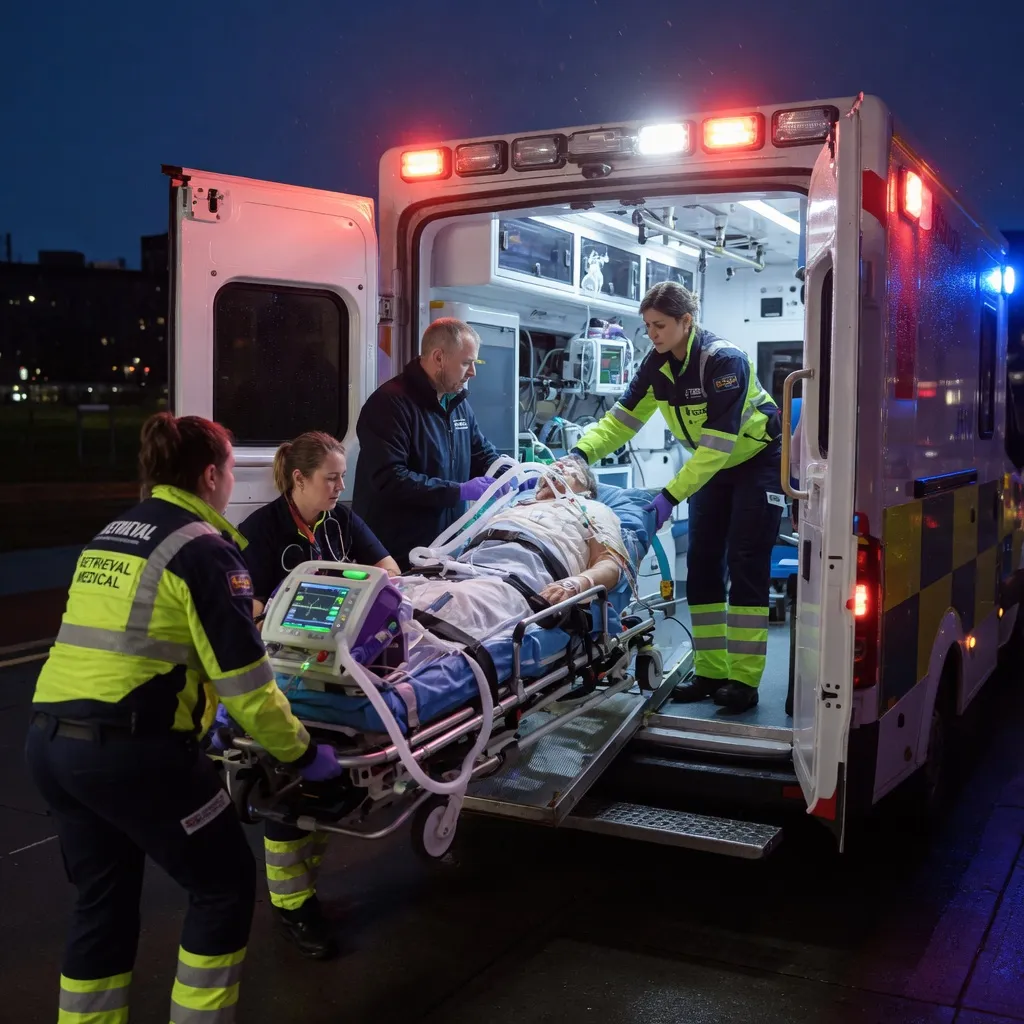
Retrieval and inter-hospital transfer is the structured process of moving a patient between facilities (or from scene to facility) to deliver a level or type of care the referring site cannot provide. The decision rests on three transfer types — time-critical (STEMI door-to-balloon, stroke thrombolysis and thrombectomy windows), specialist (trauma, burns, neurosurgery, paediatric, neonatal, ECMO), and repatriation — each with its own urgency, mode, and team. Pre-transfer packaging converts an unsafe move into a safe one: secure the airway (RSI before transfer for the patient with GCS 8 or less), secure the lines (two large-bore IVs, an arterial line, central access for the unstable), secure the monitors (ECG, SpO2, NIBP, capnography), secure the ventilation (mechanical ventilator with set parameters), and secure the sedation (morphine 2.5 mg with midazolam 2.5 mg, titrated). Mode — road, fixed-wing, or rotary — is chosen on distance, physiology, weather, and the time-versus-stability trade-off. Team composition (physician-staffed versus paramedic/nurse) is matched to the predicted deterioration risk. The governing differential is the decision itself: stay-and-play (resuscitate to stability first) versus scoop-and-run (load and go, manage on the move), with the time-critical bypass (direct to PCI, to thrombolysis, to a trauma centre) as the third path. Transport-related deterioration — hypoxia, hypotension, hypothermia, gas expansion at altitude, line and tube loss, undetected desaturation — is the central risk, and the discipline is to minimise it by preparation, not improvisation. ACEM-primary, globally tagged.
On this page & tools
Your progress
Saved locally on this device.
Target exams
Red flags
Related topics
- Patient disposition and safety-netting in the emergency department
- Clinical handover and the ISBAR framework in the emergency department
- Trauma team leadership
- Team-based care and crisis resource management in the emergency department
- Acute coronary syndromes (STEMI, NSTEMI and unstable angina)
- Acute ischaemic stroke
Retrieval and inter-hospital transfer is the system by which a patient is moved from a place that cannot deliver definitive care to a place that can. It looks like a logistical problem and is examined as a clinical one. The Fellowship candidate is expected to make three linked judgements: whether to transfer (the decision, weighed against the alternatives of treating locally or withdrawing), how to transfer (the mode and the team), and how to package the patient so that the journey itself does not cause harm. Each judgement carries specific doses, times, and physiological reasoning — a STEMI has a first-door-to-balloon target of 90 minutes for direct arrival and 120 minutes for inter-facility transfer; an ischaemic stroke has a 4.5-hour thrombolysis window and a 24-hour thrombectomy window that transfer must not erode; an intubated patient at altitude will lose a third of any pneumothorax space to gas expansion. Transport of the critically ill is associated with a measurable rate of adverse events — equipment failure, hypoxaemia, hypotension, and the loss of lines and tubes — that preparation is designed to prevent, and the recurring exam point is that the most dangerous moment in a critical illness is the moment the patient leaves the resuscitation bay.[1][2]
Definition and scope
Retrieval is the movement of a patient for clinical reasons. It has two anatomical forms: primary retrieval, from the scene of illness or injury to the first hospital (pre-hospital), and secondary retrieval, between hospitals (inter-hospital transfer). The Fellowship exam is overwhelmingly about secondary retrieval, because that is the decision the emergency medicine consultant owns. Secondary retrieval is then classified by its clinical urgency into three types, each with its own logic and its own errors.[2]
Time-critical transfer is one in which the definitive treatment has a closing window and transfer to the delivering centre is the treatment: primary percutaneous coronary intervention (PCI) for ST-elevation myocardial infarction, thrombolysis and mechanical thrombectomy for ischaemic stroke, urgent decompression for an extradural haematoma, source control for a patient in septic shock. The clock starts at first medical contact, and the mode, the route, and the receiving centre are chosen to protect the window, not the convenience of the system. Specialist transfer is for the patient who needs a service the referring hospital cannot provide — major trauma to a trauma centre, burns to a burns unit, neurosurgery, cardiac surgery, paediatric intensive care, extracorporeal membrane oxygenation, a neonatal team. Time matters but is measured in hours, and packaging can be more complete. Repatriation is the return of a patient to a local hospital closer to home once definitive care is complete; time is measured in days, and stability is the prerequisite. [1]
ANZ scope note. The Royal Flying Doctor Service and the state-based aeromedical and retrieval services (CareFlight, LifeFlight, Rescue helicopter services, Ambulance Victoria Adult and Paediatric Retrieval, NETS for neonates and children) operate across distances measured in hundreds to thousands of kilometres. The Australasian College for Emergency Medicine publishes policy on retrieval medicine, regionalisation of services, and the credentialling of retrieval physicians; the College of Intensive Care Medicine has guidance on minimum standards for the transport of the critically ill. Distances, sparse services, and weather mean that the decision to transfer in ANZ is inseparable from the decision to fly, and the candidate must reason about both. [1]
The transfer decision — three judgements
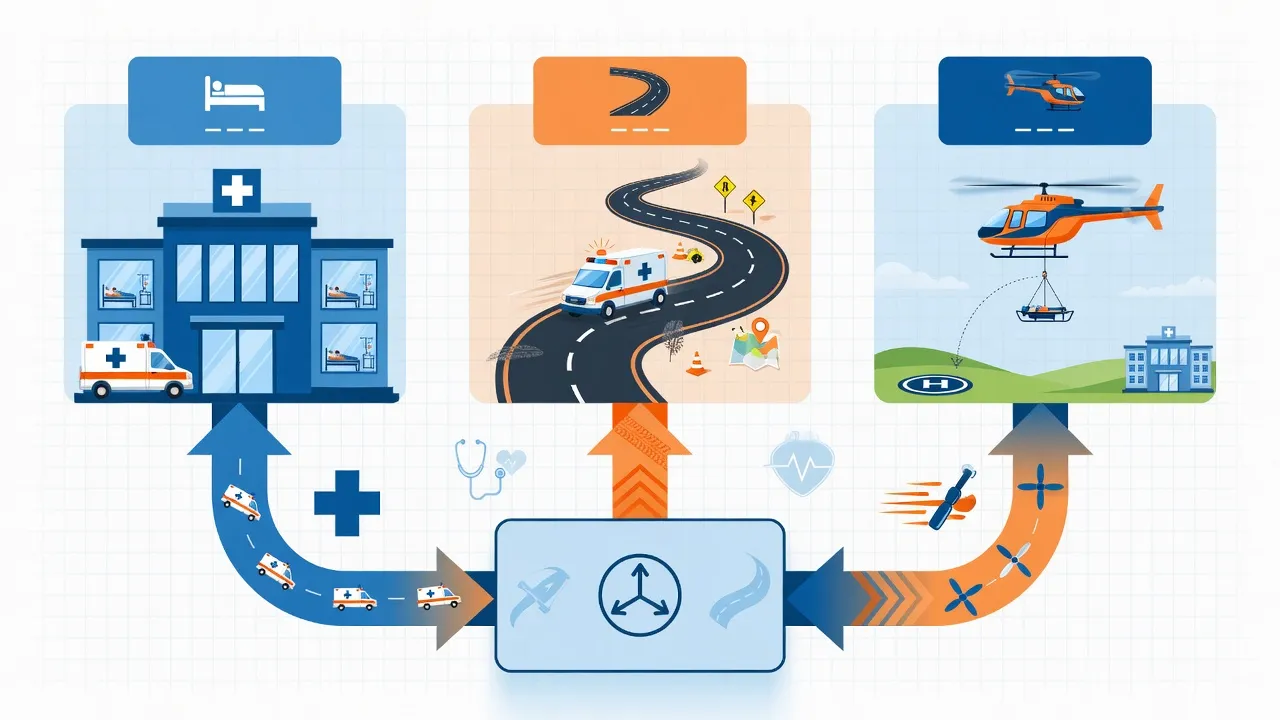
Every transfer decision is three linked judgements, and a candidate who separates them in a viva can defend any retrieval. None is taken in isolation; each constrains the next. [1]
The three judgements of retrieval
WMT
Is transfer the right decision — weighed against treating locally, awaiting a visiting team, or, in the dying patient, not transferring at all. A patient with a limitation of medical treatment order, or one whose prognosis is futile, may be harmed by an aggressive transfer; the conversation with the family and the receiving team precedes the logistics.<Cite id="9" />
Road, fixed-wing, or rotary; physician-staffed, nurse/paramedic, or specialist team (paediatric, ECMO, neonatal). The choice is governed by distance, the patient’s physiological stability, weather, and the time-versus-preparation trade-off.
The preparation that converts an unsafe move into a safe one: airway secured, lines secured, monitors on, ventilation set, sedation running, pneumothorax drained, cuff pressure set, team briefed, receiving bed confirmed.
The judgements are tested in order. Whether is the senior decision and is the one most often defaulted: the registrar arranges the logistics before a consultant has confirmed that transfer is, in fact, the right call. How is the mode-and-team decision, governed by distance and physiology. Transfer/packaging is the operational execution. A candidate who launches into packaging without first defending the decision has failed the viva. [1]
Differential — the decision: stay-and-play vs scoop-and-run vs time-critical bypass
The differential that runs through retrieval is not a list of diseases but the decision itself. Every retrieval is one of three patterns, and the examiner sets a scenario to test whether the candidate can recognise which pattern applies and apply the right packaging logic. [1]
Stay-and-play (resuscitate to stability, then transfer)
- The patient is physiologically unstable and time is on the patient side — the definitive window is not about to close
- Adequate resuscitation in the referring centre (airway, ventilation, lines, fluid or blood, vasoactive infusion) before departure reduces transport-related deterioration
- Applies to most specialist transfers: stabilise the intubated trauma patient, correct potassium before transfer, control seizures before the move
- Risk: over-stabilising in a time-critical problem — thrombolysing a stroke at 3 hours when thrombectomy is available, or delaying PCI in a STEMI to insert a central line
Scoop-and-run (load and go, manage on the move)
- A time-critical problem where every minute erodes the definitive window — catastrophic trauma with exsanguination, an evolving extradural with impending herniation
- Only the life-saving packaging is done at scene: catastrophic haemorrhage controlled, airway secured if possible en route, chest decompressed
- The vehicle becomes the resuscitation bay; the team works on the move
- Risk: scoop-and-run without the essential packaging is abandonment — the patient arrives worse than they left
Time-critical bypass (direct to definitive centre)
- STEMI bypasses the non-PCI hospital for a PCI centre; ischaemic stroke within the thrombectomy window bypasses the non-thrombectomy hospital; major trauma bypasses the non-trauma hospital
- Pre-hospital triage identifies the patient who meets the bypass criteria; the referring hospital does not stop the clock for investigations it cannot act on
- Drip-and-ship (thrombolyse then transfer) is reserved for patients who cannot reach thrombectomy within the window; the choice is governed by distance and time, not preference
- Risk: stopping in a non-definitive centre for non-actionable tests that consume the definitive window
The eFAST randomised study by Brun and colleagues is the empirical anchor for the stay-and-play versus scoop-and-run debate in blunt trauma: performing prehospital extended FAST did not delay the time to operating theatre in the unstable patient, supporting a brief, focused assessment that does not sacrifice the time-critical transfer.[8]
Time-critical transfers — the named windows
The Fellowship candidate must state the time targets precisely, because the SAQ rewards the number and not the approximation. [1]
For ST-elevation myocardial infarction, the international standard is a first medical contact-to-balloon time of 90 minutes for a patient arriving directly at a PCI centre, and 120 minutes for a patient requiring inter-facility transfer — targets that exist because time-to-reperfusion is a continuous determinant of myocardial salvage and mortality. The systematic review by Zahran and colleagues quantifies the mortality penalty of inter-facility transfer delay: every additional 30 minutes of door-to-balloon time is associated with a measurable rise in in-hospital mortality, which is precisely why time-critical bypass — direct routing of the STEMI to a PCI centre by pre-hospital services — is built into regional STEMI networks.[5] The general principle is that a non-PCI hospital receiving a STEMI does not delay the transfer for serial troponins, echocardiography, or routine bloods that will not change the disposition: it activates the PCI centre, packages the patient, and moves.
For ischaemic stroke, intravenous alteplase is licensed within 4.5 hours of symptom onset; mechanical thrombectomy is effective up to 6 hours for all comers and up to 24 hours for selected patients with a computed-tomography perfusion or magnetic-resonance imaging mismatch (DAWN and DEFUSE-3 criteria). The retrieval implication is identical: the patient who can reach thrombectomy within the window bypasses or moves; the patient who cannot is drip-and-ship thrombolysed at the referring centre and then transferred.[6]
Pre-transfer packaging and drug management — airway, lines, monitors, ventilation, sedation
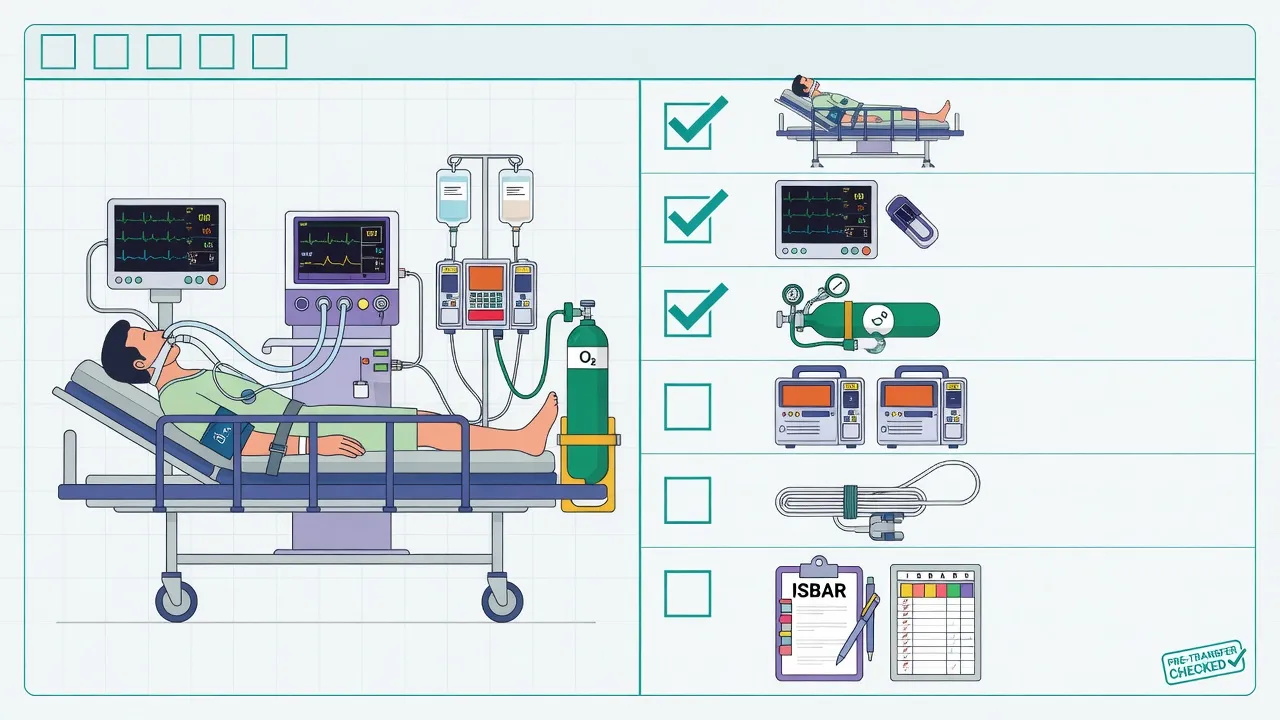
Packaging is the discipline that distinguishes a safe retrieval from a dangerous one. The principle is that any deterioration predicted to occur during the journey is anticipated and prevented before departure, because the noise, vibration, restricted access, and reduced monitoring of a moving vehicle strip away the clinical signs relied on at the bedside. The packaging mnemonic is airway, lines, monitors, ventilation, sedation — every item secured before the wheels leave the tarmac.[1][2]
Pre-transfer packaging — secure the five systems
ALMVS
A patient with a Glasgow Coma Scale score of 8 or less, or with a predicted deteriorating course, is intubated before transfer — not during it. Rapid sequence intubation with an induction agent (ketamine 1 to 2 mg per kg or propofol 1 to 2 mg per kg) and a paralysing agent (rocuronium 1.2 mg per kg or suxamethonium 1.5 mg per kg) secures the airway in a controlled environment; the tube is firmly secured, the cuff pressure is set, and a supraglottic device and a surgical airway kit travel with the patient
Two large-bore intravenous cannulae minimum; an arterial line for beat-to-beat blood pressure in any haemodynamically unstable patient or on any vasoactive infusion; central venous access where vasoactive drugs, hypertonic saline, or prolonged venous access are required. Every line is secured with the dressing and the fixation that will survive vibration
Continuous ECG, continuous pulse oximetry, non-invasive blood pressure cycling at least every five minutes, and continuous waveform capnography for every intubated patient — capnography is the single monitor that confirms tube position, ventilation adequacy, and the early sign of a falling cardiac output
A mechanical transport ventilator with set mode, rate, tidal volume, fraction of inspired oxygen, and positive end-expiratory pressure documented; a bag-valve-mask and an oxygen cylinder of adequate duration for the journey plus 50 percent reserve are carried as back-up
Adequate sedation and analgesia are running before departure — an agitated patient self-extubates or displaces lines in transit. The standard retrieval sedation regimen combines morphine 2.5 mg with midazolam 2.5 mg, drawn together and titrated, or as a continuous infusion; a paralysing infusion is added for the patient who is fighting the ventilator
The named sedation dose — morphine 2.5 mg with midazolam 2.5 mg, combined and titrated — is the standard adult retrieval analgesic-sedative combination in ANZ practice: the two agents are drawn into the same syringe and given in 1 to 2 mL boluses to achieve a calm, analgesed patient who tolerates the ventilator. An antiemetic (ondansetron 4 mg) accompanies it, because vomiting in a supine, semi-restrained patient is an aspiration risk. For the haemodynamically unstable patient, morphine is replaced by fentanyl (50 to 100 micrograms) to avoid the histamine release and the preload reduction. Every dose is documented, every infusion is labelled, and a written drug chart travels with the patient.[2]
[1]Aeromedical physiology — what altitude, vibration, and acceleration do to a patient
Aeromedical retrieval adds a set of physiological stresses that road transport does not, and the Fellowship candidate is expected to reason about each. The dominant stress is altitude: even a pressurised cabin is pressurised to a cabin altitude of roughly 1500 to 2400 metres, equivalent to a partial pressure of oxygen that is lower than at sea level and an ambient pressure that allows gases to expand. [1]
[1]The measurable consequences are well documented. An undrained pneumothorax at cabin altitude becomes a tension pneumothorax; a sealed bowel anastomosis leaks; an endotracheal tube cuff filled with air at sea-level pressure over-inflates and may cause tracheal mucosal ischaemia — or, conversely, an under-filled cuff leaks as the surrounding pressure drops. Delorenzo and colleagues measured cuff pressures in patients transported by helicopter and confirmed significant deviations from the safe range, supporting the practice of measuring and adjusting cuff pressure before take-off, at cruise, and after landing.[7] Beyond Boyle’s law, acceleration and deceleration in fixed-wing aircraft shift blood volume and may worsen preload in the head-up or head-down orientation; vibration and noise raise the threshold for detecting clinical deterioration and fatigue the crew; cold in an unpressurised or partially heated cabin causes hypothermia, with the secondary coagulopathy and arrhythmia, so the patient is wrapped and the fluids and blood products are warmed. Reduced ambient oxygen at cabin altitude lowers the arterial oxygen tension; a patient saturating at 94 percent at sea level may desaturate in flight, and the fraction of inspired oxygen is adjusted upward for any marginally oxygenated patient.
Model answer — SpO2 falls from 97 to 84 percent in the helicopter
A fall in saturation in flight is decomposed into the four mechanisms that govern gas exchange and equipment under transport stress. First, the tube — has it migrated or been dislodged by vibration or patient movement? Confirm tube position, bilateral air entry, and the capnography trace; if the trace is lost, exclude dislodgement before assuming anything else. Second, the cuff — altitude gas expansion may have over-pressurised or under-pressurised the cuff, causing either leak or obstruction; measure cuff pressure and adjust to 20 to 30 cm of water. Third, the lung — an unrecognised or developing pneumothorax has expanded at altitude into a tension pneumothorax; examine for tracheal shift, unilateral air entry, and haemodynamic compromise, and decompress if suspected. Fourth, the ventilator and the gas supply — confirm the fraction of inspired oxygen has not altered, the circuit is intact, and the oxygen cylinder has adequate reserve. Increase the fraction of inspired oxygen, correct the cause, and document; descend to a lower cabin altitude is the final lever if the cause cannot be corrected in flight. [1]
Modes of transfer — road, fixed-wing, rotary
Mode is chosen on distance, physiology, weather, and the time-versus-stability trade-off. Each mode has a domain in which it is correct and a domain in which it is wrong. [1]
Road ambulance
- Distances up to around 100 to 150 km, or where weather closes the airspace
- Lowest physiological stress — no altitude gas expansion, no acceleration G-effects, no cabin pressure issues; full access to the patient throughout
- The only mode that allows a travelling team to physically reach and work on the patient at any moment
- Slower over distance; subject to traffic, road conditions, and the geometry of moving a stretcher through confined spaces
Fixed-wing (aeroplane)
- Long distances — typically above 250 km, and routinely inter-city or inter-state in ANZ
- Faster cruise speed and longer range than rotary; smoother ride at altitude; weather-tolerant relative to a helicopter
- Pressurised cabin allows cruise at altitude, but introduces Boyle’s law stresses (gas expansion, cuff pressure) and the reduced ambient oxygen; requires a fixed airport-to-airport transfer with a road leg at each end
- Logistically heavier: two road legs, an airport turnaround, and a longer mobilisation time than rotary
Rotary-wing (helicopter)
- Distances of roughly 50 to 250 km; primary scene retrieval; point-to-point between hospital helipads
- Speed of mobilisation, door-to-door without the airport road legs, and the ability to land at scene or on a hospital pad
- Cruise speed and range are lower than fixed-wing; vibration, noise, and confined-space access are worse than fixed-wing or road; very weather-sensitive; most helicopters are unpressurised, so cabin altitude equals true altitude
- Operating cost and crew workload are high; the decision to fly is the decision that the time saved justifies the physiological cost
The candidate trap is to choose a mode on speed alone. A 500 km transfer by helicopter, with two road legs and a refuelling stop, may take longer than a fixed-wing transfer with the same road legs, and exposes the patient to more vibration and more cabin-altitude stress. Conversely, a 60 km transfer across congested urban roads is faster by helicopter than by road. The decision is made by the retrieval service on the total time from bed-to-bed, the patient’s tolerance of the physiological stresses, and the weather. [1]
Team composition — who should travel
The team composition is matched to the predicted deterioration risk, not to a fixed roster. Three models dominate: a physician-staffed team (a retrieval doctor with a nurse or paramedic), a nurse/paramedic team, and a specialist team (paediatric, neonatal, ECMO, cardiac). [1]
Matching the team to the risk
RTS
A patient predicted to need an in-flight intervention — a re-intubation, a vasoactive up-titration, a chest decompression, a transfusion — travels with a physician-staffed team. The evidence base, including the work by Laverty and colleagues, is that physician-staffed aeromedical retrieval is associated with fewer adverse events and improved survival in the high-acuity cohort.<Cite id="4" />
A neonate travels with a neonatal retrieval team (a neonatologist and a neonatal nurse with an incubator and neonatal ventilator); a patient on ECMO travels with an ECMO team; a patient on an intra-aortic balloon pump travels with a perfusionist or a cardiology team. The team is defined by the equipment the patient depends on
A stable, intubated, well-sedated patient on a fixed ventilation and infusion regimen may travel safely with an experienced nurse/paramedic team, with a retrieval physician available by phone. The skill mix is calibrated to the lowest-acuity scenario the team can manage without external help
The empirical anchor is the cohort study by Laverty and colleagues on primary aeromedical crew composition, which examined whether physician-staffed teams change clinical outcomes and found a measurable benefit in the high-acuity subgroup; the general principle is that the sicker the patient and the more interventions predicted en route, the stronger the case for a physician on the team.[4]
Risks — transport-related deterioration
Transport-related deterioration is the central risk of retrieval, and the Fellowship SAQ rewards the candidate who can list the categories, give the mechanism, and state the prevention. The transport of critically ill patients is associated with adverse events in roughly 15 to 30 percent of transfers in published series, ranging from minor equipment failures to hypoxaemia, hypotension, and the loss of lines and tubes.[1][2]
Physiological deterioration
- Hypoxaemia — reduced ambient oxygen at altitude, ventilator circuit disruption, tube migration, pneumothorax expansion
- Hypotension — vasodilation from sedation, position change, acceleration G-effects, interruption of a vasoactive infusion
- Hypothermia — cold cabin, infused cold fluids, exposure during packaging; the secondary coagulopathy and arrhythmia follow
- Raised intracranial pressure — coughing, vomiting, hypoxia, hypercapnia; the head-injured patient is the most vulnerable to a poorly managed transfer
Equipment and technical failure
- Battery failure on a monitor, ventilator, or syringe driver — every device has a back-up battery and a back-up device
- Oxygen exhaustion — calculated for the journey plus a 50 percent reserve
- Tube and line loss — vibration and patient movement dislodge the endotracheal tube, the chest drain, the arterial line
- Cuff pressure deviation at altitude — measured and corrected before and during flight
System and communication failure
- No confirmed receiving bed or receiving clinician — the patient arrives to a closed unit
- Poor handover at the receiving centre — the structured ISBAR handover is the tool that prevents it
- A limitation-of-medical-treatment order that does not travel with the patient — the patient is escalated against their documented wishes, or under-escalated in the absence of the order
- Family not informed — the patient arrives at the receiving centre with no family awareness of the move
The study by Street and colleagues on the impact of limitation-of-medical-treatment orders during unplanned transfers underscores the handover risk: an order made at the referring centre must be communicated, documented, and re-confirmed at the receiving centre, or the transfer converts a goals-of-care decision into an unintended escalation or de-escalation.[9]
Special populations
Paediatric and neonatal retrieval is performed by specialist teams (NETS in ANZ, equivalent regional services internationally) with paediatric or neonatal consultants, paediatric ventilators and drug doses calculated by weight, and an incubator for the neonate; the physiology and the equipment differ from adult retrieval, and a non-specialist team managing a deteriorating neonate in flight is the model of an avoidable adverse event. The pregnant patient is transferred in the left lateral position to relieve aortocaval compression, with obstetric and midwifery involvement and a plan for delivery en route. ECMO retrieval mobilises a specialist perfusion and intensive care team with a mobile ECMO circuit; the patient on an intra-aortic balloon pump travels with the pump, a cardiac-trained nurse or perfusionist, and a plan for pump failure. The head-injured patient is the archetype of the high-risk transfer — intubated, paralysed, ventilated to a target partial pressure of carbon dioxide, with an arterial line, capnography, intracranial pressure monitoring (if in place), and a documented neurological examination before departure; any hypoxia, hypotension, or hypercapnia in transit worsens the secondary brain injury. The patient at the end of life may be transferred for palliative reasons (repatriation to a local hospital closer to family), and here the calculus inverts: the goal is comfort, the packaging is the symptom control, and the limitation-of-medical-treatment order travels with the patient.[9]
Errors and pitfalls
The recurring retrieval errors fall into the three judgements and a few around them. The first is the wrong decision — transferring a patient who should have been treated locally, treating locally a patient whose window was closing, or transferring a patient whose goals of care were comfort. The second is the under-packaged transfer — intubated but not paralysed, no arterial line, no capnography, an unsecured chest drain, an unset cuff pressure; the patient arrives worse. The third is the wrong mode — a helicopter for a short, congested road transfer that would have been faster; a fixed-wing for a transfer whose two road legs consume the time saved. Around these sit the named errors: delaying the time-critical transfer for non-actionable investigations; failing to drain the pneumothorax before flight; failing to set and re-check the cuff pressure at altitude; calculating oxygen for the journey without a reserve; departing without a confirmed receiving bed or clinician; a poor handover at the receiving centre that loses the clinical narrative; the limitation-of-medical-treatment order that does not travel; and drip-and-ship thrombolysis chosen without checking that thrombectomy remains achievable.[1][3]
Regional framework
The legal and operational scaffold is region-specific in its instruments but common in its principles: the decision is made with the receiving centre, the patient is packaged to a defined standard, the team is matched to the risk, and the handover is structured. [1]
ANZ practice note. ACEM publishes policy on retrieval medicine and on the role of the emergency physician in retrieval; the College of Intensive Care Medicine publishes minimum standards for transport of the critically ill. State-based services — the Royal Flying Doctor Service for primary and long-distance retrieval, the state rescue helicopter services, and the state-based adult (e.g. Adult Retrieval Victoria) and paediatric (NETS) retrieval services — coordinate time-critical and specialist transfers. Vast distances mean fixed-wing retrieval is disproportionately represented relative to the UK or US. [1]
Evidence and guidelines
The evidence base draws on four streams. First, the adverse-event literature: the review by Droogh and colleagues — "Inter-hospital transport of critically ill patients; expect surprises" — codified the high rate of in-transit events and the principle that anticipation and preparation, not improvisation, prevent them; the comprehensive review by Wilcox and colleagues (Interfacility Transport of Critically Ill Patients, Critical Care Medicine) updated the operational standards.[1][2] Second, the crew-composition literature: Laverty and colleagues' cohort study on primary aeromedical crew composition provides the empirical anchor for the physician-versus-paramedic debate in high-acuity retrieval.[4] Third, the time-critical transfer literature: the systematic review by Zahran and colleagues on inter-hospital transfer for primary PCI quantifies the mortality cost of transfer delay, and the narrative review by Palaiodimou and colleagues codifies the drip-and-ship decision rules in stroke.[5][6] Fourth, the aeromedical physiology literature: Delorenzo and colleagues' measurement of intracuff pressure changes in helicopter-transported patients is the empirical basis for the cuff-pressure rule.[7] The prehospital eFAST randomised study by Brun and colleagues anchors the stay-and-play versus scoop-and-run debate in blunt trauma.[8] The study by Severino and colleagues on the patient experience of inter-hospital transfer from the emergency department, and by Street and colleagues on limitation-of-medical-treatment orders during transfer, frame the system and ethical dimensions.[3][9]
SAQ — Head injury packaging for aeromedical retrieval
10 minutes · 10 marks
A 34-year-old man arrives at a regional hospital after a high-speed motor vehicle collision. His Glasgow Coma Scale score is 7, the left pupil is dilated and unreactive, and the computed tomography shows a large left extradural haematoma with midline shift. The nearest neurosurgical centre is 320 kilometres away and a physician-staffed fixed-wing aeromedical retrieval team has been tasked.
SAQ — Time-critical transfer for primary percutaneous coronary intervention
10 minutes · 10 marks
A 62-year-old woman presents to a hospital without percutaneous coronary intervention capability 40 minutes after the onset of crushing central chest pain and diaphoresis. The ECG shows 3 mm of ST elevation in the anterior leads, the blood pressure is 110 over 70, and she has been given aspirin 300 mg. The nearest primary PCI centre is 75 kilometres away by road.
Exam pearls
- The retrieval decision is three judgements, not one — whether (the decision to transfer), how (mode and team), and the packaging. A candidate who launches into packaging without defending the decision fails the viva.
- Time-critical bypass is a routing, not a packaging, decision — STEMI, stroke in the thrombectomy window, and major trauma bypass the nearest facility for the definitive centre; the clock starts at first medical contact.
- The named time targets — first door-to-balloon 90 minutes (direct) and 120 minutes (transfer); stroke thrombolysis within 4.5 hours; thrombectomy up to 24 hours for selected patients.
- Packaging is the mnemonic ALMVS — Airway, Lines, Monitors, Ventilation, Sedation; every item secured before departure.
- The named sedation regimen is morphine 2.5 mg with midazolam 2.5 mg combined and titrated; fentanyl substitutes for morphine in the unstable patient.
- Boyle’s law governs the flight — gas volumes expand around 30 percent at cabin altitude; pneumothoraces are drained, cuff pressures are set and re-checked, the bowel is decompressed.
- Capnography is non-negotiable for the intubated transfer — it confirms tube position, ventilation, and the early sign of a falling cardiac output.
- Team composition follows risk — physician-staffed teams benefit the high-acuity patient; specialist teams (paediatric, neonatal, ECMO) travel with the equipment the patient depends on.
- The handover at the receiving centre is structured ISBAR, and the limitation-of-medical-treatment order travels with the patient. [1]
Red flags
[1]References
- [1]Droogh JM, Smit M, Absalom AR, Ligtenberg JJM, Zijlstra JG. Inter-hospital transport of critically ill patients; expect surprises Crit Care, 2012.PMID 22326110
- [2]Wilcox SR, Mittal S, O’Halloran KP, Saia MK, Mian Q, Hua M, Branson RD, Davis DP, Ouellet P, Papadimos TJ, Barjaktarevic I, Al-Yehmadi V, Brodie D, Mahotra A, Moss J, Galvagno SM, Blakeman TC, Dries DJ, Majumdar R, Boer W, Bernhard M, Busch M, Chipman M, Varon J, Bolek A, Euteneuer F, Maehara T, Barsness J, Rosenberg AL, O’Connor P, Thomas E, Reerson-Pope K, Kling P, Warrier S, Wheeler AP. Interfacility Transport of Critically Ill Patients Crit Care Med, 2022.PMID 36106970
- [3]Severino F, Liu J, Damodar D, Singh M, Hansraj J, Khan F, Hunte A, Kestenbaum L, O’Connor K, Sinert R. Interhospital transfers from the emergency department: a mixed-methods study on their characteristics and contextual factors influencing their quality CJEM, 2026.PMID 41811642
- [4]Laverty C, Bade R, Gorelick A, Goh S, Richardson D, Tan PK. Primary aeromedical retrieval crew composition: Do different teams impact clinical outcomes? A descriptive systematic review CJEM, 2020.PMID 33084563
- [5]Zahran A, Othman H, Eltagy M, Mohamed H, Mohamed O, Almaghraby A, El-Shitany N, El-Menyar A. Interhospital transfer versus direct admission for percutaneous coronary intervention in patients with acute ST-segment elevation myocardial infarction: a systematic review and meta-analysis Clin Res Cardiol, 2025.PMID 41396303
- [6]Palaiodimou L, Papageorgiou NM, Bakola E, Theodorou A, Romoli M, Sarraj A. Drip and ship in patients with acute ischemic stroke: a narrative review Ther Adv Neurol Disord, 2025.PMID 41063760
- [7]Delorenzo A, Hore CT, Faux SG, Marasco S, Kennedy MP, Chong BW, Shepherd S. Endotracheal Tube Intracuff Pressure Changes in Patients Transported by a Helicopter Emergency Medical Service: A Prospective Observational Study Air Med J, 2021.PMID 34172227
- [8]Brun PM, Bessereau J, Chenaitia H, Pradel AL, Denfant C, Ilcane M, Peyronnet C, Koch FX, Bousteba S, Steinmetz E, Hubert S, Billeres X. Stay and play eFAST or scoop and run eFAST? That is the question! Am J Emerg Med, 2014.PMID 24332906
- [9]Street M, Mohebbi M, Branley D, Ehsani S, Crespigny R, Crock C, Boucher S, Manias E. Analysis of the impact of limitation of medical treatment orders during unplanned transfers from sub-acute care to Emergency Departments Australas Emerg Nurs J, 2016.PMID 26601595