EM · Clinical handover and ISBAR
Clinical handover and the ISBAR framework in the emergency department
Also known as ISBAR handover · SBAR communication · Clinical handover · Patient handoff · Transfer of care communication · ED-to-ICU handover · Shift change handover · Paramedic-to-ED handover · IMIST-AMBO · I-PASS handoff
Clinical handover and the ISBAR framework in the emergency department — the structured transfer of information and responsibility at every care transition; the six elements of ISBAR (Identify, Situation, Background, Assessment, Recommendation) and how the Identifier distinguishes ISBAR from its parent SBAR; the alternative and extended structures (SBAR, ISOBAR, IMIST-AMBO for paramedic-to-ED, I-PASS for the trainee-to-trainee handoff); the six ED handover types (triage-to-treatment, shift change, ED-to-ward, ED-to-ICU, ED-to-retrieval, ED-to-theatre) and the emphasis, recipient and risk profile of each; the applied steps of a structured handover from preparation through the receiver's readback to the explicit transfer of responsibility; the communication pitfalls (information loss, the hierarchical failure, time-pressure truncation, the receiver multitasking); the differential of handover failure modes with the verbal-only handover as the information-loss default; and the ANZ/UK/US/EU standards (ACSQHC NSQHS Standard 6, WHO Communication During Patient Handovers 2007, AHRQ TeamSTEPPS, Joint Commission National Patient Safety Goal). ACEM-primary, globally tagged.
On this page & tools
Your progress
Saved locally on this device.
Target exams
Red flags
Related topics
- Team-based care and crisis resource management in the emergency department
- Patient disposition and safety-netting in the emergency department
- Breaking bad news and communication in the emergency department — the SPIKES framework
- Medical error and patient safety in the emergency department
- Trauma team leadership
- The primary survey (ABCDE) — the trauma assessment framework
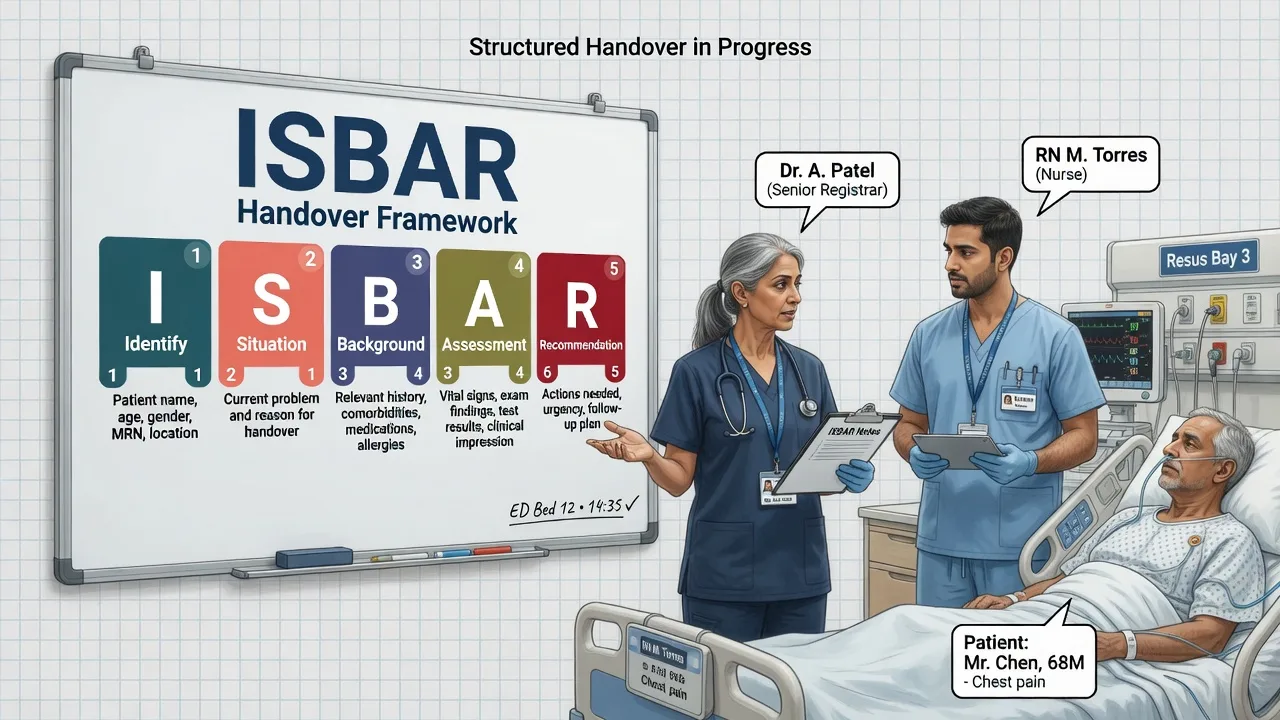
The emergency department is a handover engine. Every patient who enters generates at least one — the paramedic at the triage door — and most generate several: triage to the treating clinician, the treating clinician to the next shift, the emergency physician to the inpatient team, the inpatient team to the intensive-care or theatre team, and, for the transferred patient, the ED team to the retrieval crew. At each transition two things move: the information about the patient, and the responsibility for the patient. A handover that transfers the information but not the responsibility leaves two teams each believing the other is in charge; a handover that transfers the responsibility but not the information places the receiving team in front of a patient whose diagnosis, allergies, drugs and trajectory it does not know. Communication failure is repeatedly identified as the leading root cause of sentinel events, and the handover is its highest-risk moment.[3][1] The defence is the structured handover — a mnemonic that imposes a shared mental model on the transfer so that no element depends on memory, on hierarchy, or on the time available. The dominant structure across the ANZ, UK and ILCOR curriculum is ISBAR.[1][6]
Definition and scope — handover is information plus responsibility
A clinical handover is the transfer of professional responsibility and accountability for some or all aspects of care for a patient — or a group of patients — to another person or professional group.[1] The definition carries two obligations that must both be met. The first is the transfer of information: the patient's identity, the presenting problem, the relevant history, the current physiological state, the investigations and their results, the treatments given, the working diagnosis, and the plan. The second is the transfer of responsibility: the explicit statement that the receiving team now owns the patient, with the timeframe and the conditions attached. A handover that delivers only the first is an information dump without a hand-off; a handover that delivers only the second is a baton-pass into the dark. The structured handover exists to guarantee that both halves occur, in an order that the receiver can absorb, every time.
The handover is distinct from the conversation. The conversation is open-ended, two-way, and ongoing; the handover is structured, time-bounded, and concludes with a confirmed transfer. The handover is also distinct from documentation — the written note is the record, but the spoken handover is where the ambiguity is resolved, the questions answered, and the responsibility transferred. The best handover has both: a spoken ISBAR and a written summary that agree.[1]
The framework — ISBAR, the six elements in order
ISBAR stands for Identify, Situation, Background, Assessment, Recommendation. The structure is the Australian and New Zealand variant of the original SBAR, with the Identifier added at the front so that the receiver knows immediately who and where the patient is, and who is speaking. Each element carries a defined content, and the order is fixed because it moves from the certain to the uncertain: identity first (never wrong), then the current problem, then the context, then the working state, and finally the ask. The receiver builds the picture in the order a clinician thinks — who, what's wrong, what's the background, where are we now, what do we do next.[1][6]
The structured handover — six elements in order
ISBAR
The patient name, age, sex and location, and the name and role of the person giving — and receiving — the handover. "This is Dr Lee, ED registrar. The patient is John Smith, a 64-year-old man in resus bay 2." Identity first because every other element is meaningless if the receiver does not know who and where the patient is.
The presenting problem and its timeframe — the reason for the handover right now. "Brought in by ambulance 20 minutes ago after a witnessed collapse at home, now in pulseless electrical activity, six minutes of CPR and one milligram of adrenaline given in the field."
The relevant past history, the medications, the allergies, and the premorbid state — only what bears on this patient and this problem, not the whole chart. "Known ischaemic heart disease, on aspirin and atorvastatin, no known allergies, independent at home."
The current findings — vital signs, examination, the working diagnosis, the investigations done and their results. "Pulse 30, blood pressure unrecordable, airway patent, two large-bore cannulae in situ, bedside ultrasound shows a pericardial effusion, potassium 4.2."
The ask — what the caller needs from the receiver, stated as an explicit instruction with a timeframe, not a question. "I need the cardiology team and the echo here now for what I believe is a pericardial tamponade — can you take over while I prepare for drainage?"
The structure is recursive: a handover can be one sentence (the rapid triage handover) or ten minutes (the complex ED-to-ICU handover), but it follows the same five elements. The discipline is to keep the elements in order and to resist the temptation to begin with the recommendation — the junior who opens with "I need you to come now" has not given the receiver the information on which to decide whether to come.[1]
SBAR — the parent structure, and why ISBAR adds the Identifier
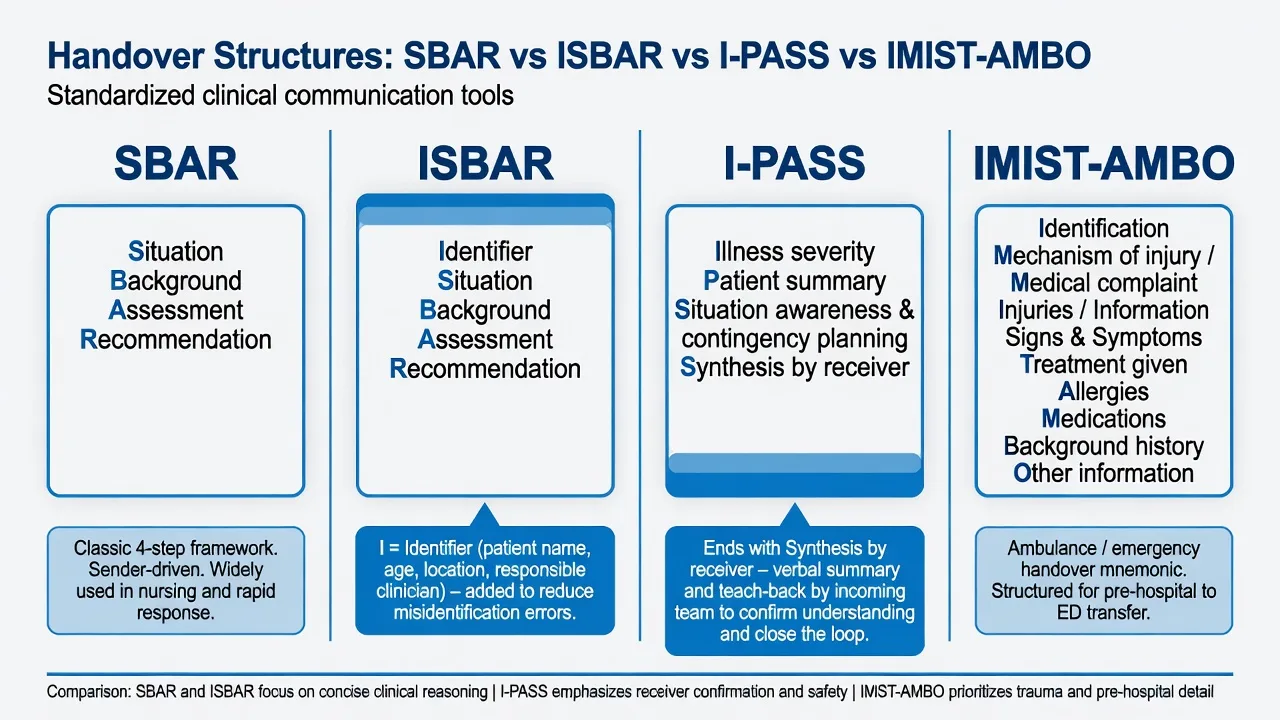
SBAR — Situation, Background, Assessment, Recommendation — was formalised by Haig and colleagues at Kaiser Permanente as a shared mental model that reduces the variation and the omission in clinical handover.[1] The structure was designed with one purpose that bears directly on the recommendation element: to flatten the authority gradient. By giving the caller a structured script that ends with an explicit recommendation, SBAR forces the junior who would otherwise say "what do you think, doctor?" to instead state "I think this patient is in septic shock and needs fluids and antibiotics now." The recommendation, not the question, is the point of the structure.
ISBAR is SBAR with the Identifier added at the front. The addition is not cosmetic: a handover that opens with the situation before the identity has the receiver searching for the patient rather than hearing the problem, and on the telephone — where the caller's identity is not visible — the absence of an identifier is the proximate cause of the wrong-patient and wrong-team errors. The Identifier states three things: who the patient is (name, age, location), who is giving the handover (name and role), and who is receiving it. ISBAR is the structure mandated across the NHS, the ANZ resuscitation curricula, and the ACEM communication competencies; SBAR remains the structure taught in the AHRQ TeamSTEPPS curriculum in the United States.[1][8]
Alternative and extended structures — ISOBAR, IMIST-AMBO, I-PASS
ISBAR is not the only structured handover, and the Fellowship candidate must know the alternatives because each is matched to a different transition. The variants extend or re-order ISBAR to fit the information demands of the specific handover.[4][5]
ISOBAR adds an O for Objective observations between the Identifier and the Background — formalising the vital signs and the examination as a discrete element rather than folding them into the Assessment. ISOBAR is the standard nursing handover structure across many ANZ and UK services, and it suits the shift handover where the objective observations trend is the data the oncoming nurse most needs. [1]
IMIST-AMBO is the paramedic-to-ED handover, developed for the prehospital-to-hospital transition where the receiving team must capture the prehospital story in a standardised order before the paramedic departs. The first half — IMIST — captures the prehospital data: Identifier, Mechanism or Medical complaint, Injuries or Information, Signs (the vital signs), Treatment and Trends. The second half — AMBO — captures the hospital-relevant context: Assessment, Mechanism or Medical, Background, Other information. The trauma scoping review by Harthi and colleagues confirms that the structured paramedic-to-trauma-team handover reduces information loss and improves the reliability of the captured dataset compared with the unstructured verbal report.[4]
I-PASS is the trainee-to-trainee handoff developed and trialled by Starmer, Spector and Landrigan in the I-PASS study, the landmark randomised trial of a handoff bundle. I-PASS stands for Illness severity, Patient summary, Action list, Situation awareness and contingency planning, and Synthesis by receiver. The first four elements structure the data; the Synthesis by receiver is the readback — the receiving clinician summarises the patient back to the giver, which is the step that closes the loop and catches the omission. The I-PASS trial showed a 23 per cent reduction in medical errors and a 30 per cent reduction in preventable adverse events across nine paediatric residency programmes — among the strongest evidence in patient safety that a structured handover saves patients from harm.[2]
ISBAR
- The ANZ/UK standard, six elements: Identify, Situation, Background, Assessment, Recommendation
- Used for the telephone referral, the inter-team transfer, the paramedic handover and the shift change across most clinical settings
- The Identifier (name, age, location, clinician identity) distinguishes it from SBAR and is the safeguard against wrong-patient and wrong-team errors on the telephone
SBAR
- The parent structure, four elements: Situation, Background, Assessment, Recommendation — formalised by Haig at Kaiser Permanente
- The AHRQ TeamSTEPPS standard in the United States; identical to ISBAR without the front-loaded Identifier
- Designed to flatten the authority gradient by ending in an explicit recommendation rather than a question
ISOBAR
- Seven elements: Identifier, Situation, Objective observations, Background, Assessment, Recommendation
- The Objective element elevates the vital signs and the examination into a discrete step — suited to the nursing shift handover and the trend-dependent patient
- Standard nursing handover structure across many ANZ and UK services
IMIST-AMBO
- The paramedic-to-ED handover: IMIST (Identifier, Mechanism/Medical complaint, Injuries/Information, Signs, Treatment/Trends) then AMBO (Assessment, Mechanism/Medical, Background, Other)
- Matched to the prehospital-to-hospital transition where the receiving team must capture the field story before the paramedic departs
- Reduces information loss in the trauma handover compared with the unstructured verbal report
I-PASS
- The trainee-to-trainee handoff: Illness severity, Patient summary, Action list, Situation awareness and contingency planning, Synthesis by receiver
- The Synthesis by receiver is the readback that closes the loop; the Action list and the contingency planning are the elements ISBAR folds into the Recommendation
- The I-PASS trial cut medical errors by 23 per cent and preventable adverse events by 30 per cent — the strongest trial evidence for structured handover
The applied steps of a structured handover
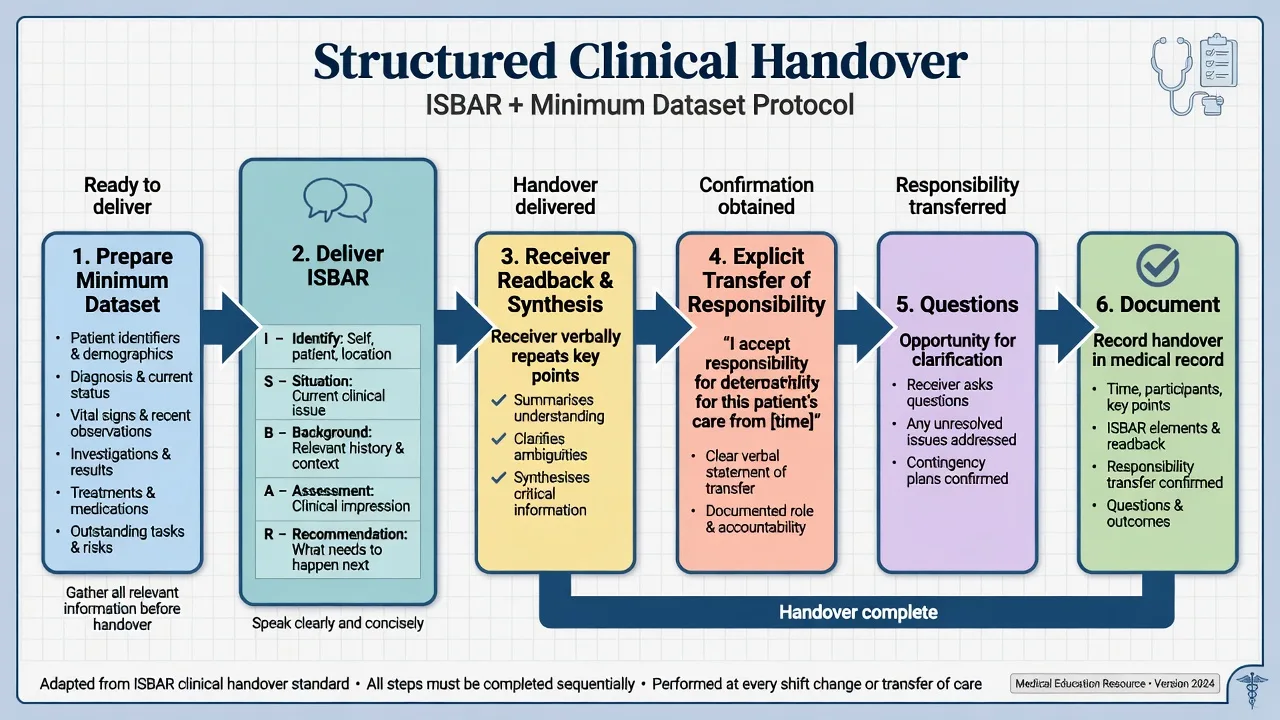
A structured handover is not only the mnemonic; it is a sequence of steps around the mnemonic that protect it from the conditions — interruption, time pressure, multitasking — that degrade it. The applied steps are the same whether the handover is at the bedside, at the triage door, or on the telephone.[1][7]
[1]The step most often omitted is the fourth — the readback — and the step most often assumed-but-not-stated is the fifth. The readback is the engineered defence against the information loss that the verbal-only handover produces; the explicit transfer of responsibility is the defence against the patient who belongs to no team. Each step is cheap, none requires technology, and each closes a failure mode that the unstructured handover leaves open.[2]
The six ED handover types — and what each emphasises
The emergency department runs six distinct handover types, and the Fellowship candidate must distinguish them because each has a different recipient, a different risk profile, and a different emphasis within the ISBAR structure.[1]
Triage-to-treatment handover is the handover from the triage nurse to the treating clinician, brief and prioritised: identity, the presenting complaint, the triage category and the vital signs, the time-critical concerns. The emphasis is the triage decision and the time-critical red flag (the chest pain, the stroke, the sepsis) that must not wait. [1]
Shift change handover is the transfer of the whole patient cohort from the outgoing to the oncoming clinician and nurse, run for each patient or as a board round. The emphasis is the trend — where the patient has been, where they are, and where they are going — and the outstanding tasks (the result awaited, the scan pending, the referral made). The shift handover is the highest-volume handover and the one most exposed to information loss through abbreviation; the systematic reviews confirm that ISBAR-based shift handovers reduce the omission of critical tasks.[8][7]
ED-to-ward handover is the transfer of the stable admitted patient to the inpatient team. The emphasis is the working diagnosis, the treatments given and their response, the outstanding investigations and their follow-up responsibility, the allergies and the medications, and the safety-netting instructions — what should bring the ward team to escalate. The failure mode is the result that no one follows up because each team believes the other owns it. [1]
ED-to-ICU handover is the transfer of the critically ill patient, the highest-acuity handover and the one with the least margin for information loss. The emphasis is the physiological state and the trajectory (the vital signs, the lactate, the vasopressors and their doses, the respiratory support), the interventions and their timing (the intubation, the lines, the drugs), the working diagnosis and the contingency plan, and the family. The ICU handover must convey every drug dose, every line, and every result, because the ICU will not re-derive them.[3]
ED-to-retrieval handover is the transfer to the aeromedical or road-retrieval crew (the Royal Flying Doctor Service in Australia, the ambulance critical-care team). The emphasis is the stability for transport, the interventions that must continue in transit (the ventilator settings, the infusions and their concentrations, the blood products), the risks of the transfer (the deteriorating airway, the non-invasive ventilation that will not hold), and the receiving unit and its expectations. The retrieval handover is bidirectional — the ED hands over to the crew, and the crew hands over to the receiving unit — and the loss of a critical detail (the tension pneumothorax that was needle-decompressed, the second unit of blood that is running) is the loss that kills in transit. [1]
ED-to-theatre handover is the transfer of the patient who proceeds directly to surgery — the ruptured abdominal aortic aneurysm, the haemorrhage needing damage control, the caesarean section. The emphasis is the operative indication, the resuscitation so far (the blood given, the vasopressors, the estimated blood loss), the airway and the aspiration risk, the allergies, and the consent. The theatre handover runs in parallel with the resuscitation and is the handover most compressed by time pressure; the WHO surgical safety checklist sign-in is the structured confirmation that follows.[1]
Management — delivering ISBAR in practice with worked handover examples
The handover is best learned from the worked example, and the discipline shows most clearly when the handover must convey drug doses and physiological values accurately — because a dose communicated wrongly is a dose given wrongly. The two examples below demonstrate the structure and the dose-communication discipline. [1]
[1] [1]In both examples the Recommendation is an explicit ask with a timeframe, not a question — and the doses (noradrenaline 0.3 micrograms per kilogram per minute, ceftriaxone 1 gram, metronidazole 500 milligrams, vasopressin 0.03 units per minute, alteplase 10 milligrams then 90 milligrams) are stated by name and dose because the receiving team will continue or adjust them. A handover that conveys "she's on a bit of noradrenaline" conveys nothing the ICU can act on. [1]
Communication pitfalls — why handovers fail
The handover fails for a small number of recurring reasons, and the Fellowship candidate must name them because each carries a different countermeasure.[3][1]
Information loss is the single commonest failure and the one the structured handover exists to prevent. The verbal-only handover — unstructured, undocumented, unrepeated — loses an estimated and variable fraction of the critical information at every transition, and the lost elements are disproportionately the time-critical ones (the allergy, the potassium trend, the vasopressor dose, the contingency plan). The countermeasure is the structured minimum dataset delivered in the fixed order and closed by the readback.[2]
The hierarchical failure is the suppression of the junior who holds a piece of the information. The registrar who knows the lactate is rising, the nurse who heard the wrong allergy, the intern who was not given the chance to ask — each holds information that the structured handover is meant to surface, and each, in a steep-gradient team, does not speak. ISBAR and SBAR were designed to flatten the gradient by giving the junior a script that ends in an explicit recommendation; the countermeasure is the structure itself and the culture that lets the junior use it.[1]
Time pressure truncates the handover. The emergency physician under pressure to clear the bay, the paramedic due on the next job, the consultant called to the next arrest — each abbreviates, and the abbreviation is not random: the elements most often cut are the Background (the allergies, the medications) and the Assessment (the trend, the working diagnosis), which are precisely the elements that drive the next error. The countermeasure is the protected handover — the closed event that is not sacrificed to flow — and the discipline that no handover, however urgent, omits the identifier and the readback. [1]
The receiver multitasking is the failure in which the handover is delivered to a receiver who is doing something else — writing a note, answering a page, scanning a board. The information enters a divided attention and is lost. The countermeasure is the rule that the handover is delivered to a receiver who stops, faces the giver, and reads back.[5]
The transfer-without-responsibility is the failure in which the information is conveyed but no one states who now owns the patient. Two teams each believe the other is in charge, and the patient belongs to no one. The countermeasure is the explicit, spoken transfer — "the patient is now yours, I will hand back at the ward round" — confirmed by the receiver.[1]
Differential — the modes of handover failure
When a patient is harmed at a transition, the handover failure is rarely a single event; it is a pattern, and the patterns below are the high-yield diagnoses the candidate must distinguish because each carries a different lesson for the incident review.[3][1]
Verbal-only handover
- The default failure mode — unstructured, undocumented, unrepeated; the giver says what they remember and the receiver hears what they can
- The single commonest cause of information loss; the lost elements are disproportionately the time-critical ones (allergy, potassium trend, vasopressor dose, the contingency plan)
- Countermeasure: the structured ISBAR minimum dataset delivered in the fixed order and closed by the receiver readback; the written record that agrees with the spoken handover
Hierarchical failure
- The junior who holds the information does not give it — the registrar with the rising lactate, the nurse with the wrong allergy, the intern not invited to ask
- A steep authority gradient suppresses the recommendation; the ask becomes a question or is never made
- Countermeasure: ISBAR/SBAR designed to flatten the gradient by ending in an explicit recommendation; a culture of leader inclusiveness and invited dissent
Time-pressure truncation
- The handover abbreviated under pressure to clear the bay, finish the shift, or reach the next job — the Background and the Assessment are the elements most often cut
- The truncation is not random: it drops the allergies, the medications, the trend and the working diagnosis that drive the next error
- Countermeasure: the protected handover as a closed event, never sacrificed to flow; no handover, however urgent, omits the identifier and the readback
Receiver multitasking
- The handover delivered to a receiver who is writing, paging, or scanning the board — the information enters a divided attention and is lost
- Distinct from the verbal-only handover: the structure is present but the receiver is not
- Countermeasure: the handover delivered to a receiver who stops, faces the giver, and reads back; the handover-CEX and similar tools assess exactly this
Transfer-without-responsibility
- The information is conveyed but no one states who now owns the patient — two teams each believe the other is in charge
- The baton-pass into the dark: the receiving team has the information but does not know it is responsible; the result awaited belongs to no one
- Countermeasure: the explicit spoken transfer — "the patient is now yours" — confirmed by the receiver, with the timeframe and the conditions attached
Common errors and pitfalls
The recurring failures are those the structure exists to prevent. The verbal-only handover is the information-loss default; the structured ISBAR is the countermeasure. The handover that omits the explicit transfer of responsibility leaves two teams each believing the other is in charge; the spoken transfer, confirmed by the receiver, is the countermeasure. The readback that is skipped leaves the omission undetected until the harm; the I-PASS Synthesis is the engineered defence. The handover given under time pressure, with the receiver multitasking, loses the critical detail; the protected, closed handover is the countermeasure. The recommendation shaped as a question — "what do you think, doctor?" — fails to flatten the gradient; the explicit ask is the point of the structure. The handover that begins with the recommendation before the identity and the situation has the receiver deciding without the information; the order is fixed, certain to uncertain. The handover that conveys the drug but not the dose — "she's on a bit of noradrenaline" — conveys nothing the next team can act on; every drug is named and dosed. The shift handover that drops the outstanding task — the result awaited, the scan pending, the referral made — is the handover that produces the unowned result; the Action list is the countermeasure. The documented handover that disagrees with the spoken one is a record that misleads; the two must agree. [1]
Evidence and regional guidelines
The evidence base for the structured handover is anchored in Haig's formalisation of SBAR as a shared mental model that reduces variation and omission in clinical communication, and consolidated in the I-PASS trial, the landmark randomised study by Starmer, Spector and Landrigan that demonstrated a 23 per cent reduction in medical errors and a 30 per cent reduction in preventable adverse events across nine paediatric residency programmes after implementation of the I-PASS handoff bundle.[1][2] The malpractice-claims analysis by Humphrey and colleagues establishes that communication and handoff failures recur in claims with high-severity harm, confirming the handover as a leading liability exposure as well as a safety exposure.[3] The trauma-handover scoping review by Harthi and colleagues, the ED handover-quality study by Gheri and colleagues using the Handoff CEX scale, and the systematic reviews by Lazzari, Yari and Rasiya confirm across settings — prehospital, ED, ICU, nursing shift — that the structured ISBAR or SBAR handover reduces information loss and improves the reliability of the transferred dataset compared with the unstructured verbal report.[4][5][6][7][8]
ANZ practice note. The Australian Commission on Safety and Quality in Health Care (ACSQHC) mandates structured clinical handover as a requirement of the National Safety and Quality Health Service (NSQHS) Standards, in particular Standard 6, Communicating for Safety, which requires effective communication at all transitions of care including at handover, and the documentation of the handover.[1] The Australian Resuscitation Council and New Zealand Resuscitation Council (ANZCOR) embed ISBAR in the team-resuscitation guidelines. The ACEM Curriculum Framework positions structured communication and handover as core Fellow competencies under the Communicator and Collaborator domains. The state-based incident-reporting systems (for example, the NSW Incident Information Management System) capture the handover-failure events for system learning, and the open-disclosure framework applies when a handover failure has caused harm.
Exam practice
SAQ — Paramedic-to-trauma-team handover in polytrauma: IMIST-AMBO and the protected handover
10 minutes · 10 marks
A 24-year-old unrestrained male driver is brought to your major trauma centre by an intensive-care paramedic crew 35 minutes after a high-speed motor vehicle crash at 110 km per hour. The car struck a tree after rolling three times. He was trapped for 15 minutes and extracted by the fire service. On arrival he is talking in short sentences, GCS 14, with an obvious flail segment of the right chest wall, a deformed and swollen left femur, and blood at the urethral meatus. Blood pressure 104 over 68, heart rate 124, respiratory rate 28, SpO2 92 per cent on 15 litres via a non-rebreather mask. The paramedic has 45 seconds to hand over before being redirected to the next case.
SAQ — ED-to-ICU handover in septic shock: ISBAR, the readback, and the explicit transfer of responsibility
10 minutes · 10 marks
You are the ED consultant managing a 64-year-old man with septic shock from a urinary source who has been in the resuscitation bay for four hours. He is intubated and ventilated, blood pressure 78 over 40 on noradrenaline at 0.3 micrograms per kilogram per minute, heart rate 120, lactate 5.2 mmol per litre (down from 7.1), two litres of Hartmann solution and 500 mL of 4 per cent albumin given, one gram of ceftriaxone and 500 mg of metronidazole given at 14:00, and urine output 10 mL per hour. The ICU consultant has arrived to accept the patient and the ICU bed is ready.
Exam pearls
- ISBAR = SBAR + Identifier. The I (name, age, location, clinician identity) is the safeguard against wrong-patient and wrong-team errors, especially on the telephone; SBAR drops it.
- The order is fixed, certain to uncertain: identity, situation, background, assessment, recommendation. Never open with the recommendation.
- The recommendation is an explicit ask with a timeframe, not a question. "I need you to come now" — the point of the structure is to flatten the authority gradient.
- I-PASS: Illness severity, Patient summary, Action list, Situation awareness and contingency planning, Synthesis by receiver. The Synthesis is the readback — the step that closes the loop and catches the omission. The I-PASS trial cut medical errors by 23 per cent and preventable adverse events by 30 per cent.
- IMIST-AMBO is the paramedic-to-ED handover (IMIST = Identifier, Mechanism/Medical complaint, Injuries/Information, Signs, Treatment/Trends; AMBO = Assessment, Mechanism/Medical, Background, Other).
- The single commonest handover failure is information loss, and the single commonest cause of information loss is the verbal-only, unstructured, un-repeated handover. The countermeasure is the structured minimum dataset closed by the readback.
- The two things that must transfer at every handover: information AND responsibility. State the transfer aloud — "the patient is now yours" — and confirm it is received.
- The six ED handover types: triage-to-treatment, shift change, ED-to-ward, ED-to-ICU, ED-to-retrieval, ED-to-theatre. Each has a different emphasis and a different risk profile.
- The four communication pitfalls: information loss, the hierarchical failure, time-pressure truncation, the receiver multitasking. Each has a named countermeasure.
- Standards: ACSQHC NSQHS Standard 6 (Communicating for Safety); WHO Communication During Patient Handovers 2007; AHRQ TeamSTEPPS SBAR; Joint Commission National Patient Safety Goal on hand-off communication. [1]
Red flags
[1]References
- [1]Haig KM, Sutton S, Whittington J. SBAR: a shared mental model for improving communication between clinicians Jt Comm J Qual Patient Saf, 2006.PMID 16617948
- [2]Starmer AJ, Spector ND, Srivastava R, et al. Changes in medical errors after implementation of a handoff program N Engl J Med, 2014.PMID 25372088
- [3]Humphrey KE, Sundberg M, Milliren CE, et al. Frequency and Nature of Communication and Handoff Failures in Medical Malpractice Claims J Patient Saf, 2022.PMID 35188927
- [4]Harthi N, Almuwallad A, Albargi H, et al. Trauma handover practices between ambulance clinicians, emergency department staff and trauma teams: scoping review BMC Emerg Med, 2026.PMID 41588499
- [5]Gheri F, Presti C, Donnarumma F, et al. Assessing Handover Quality in the Emergency Department: Evaluating Communication Between EMS and Triage Nurses Using the Handoff CEX Italian Scale J Emerg Nurs, 2026.PMID 40833308
- [6]Lazzari C, Rabottini M. The use of Introduction, Situation, Background, Assessment, and Recommendation handover in the COVID-19 pandemic and non-COVID clinical settings: a systematic review and meta-analysis Front Health Serv, 2025.PMID 40851885
- [7]Yari M, Izadi-Avanji FS, Sabery M. Assessment of clinical handover among ICU nurses based on the structured ISBAR model (2025) BMC Nurs, 2026.PMID 41943136
- [8]Rasiya A, Raheem UA. Shift Transition Communication Among Nurses: A Systematic Review of ISBAR and SBAR-Based Structured Handover Tools Nurs Open, 2026.PMID 42338059