EM · Procedural & diagnostic ED skills
Burn dressing and wound care in the emergency department
Also known as Burn dressing · Burn wound care · Burn cooling · Burn first aid · Escharotomy
Burn dressing and wound care in the ED — the burn-depth assessment (superficial, superficial dermal, deep dermal, full-thickness), the TBSA estimation by the rule of nines and the Lund-Browder chart (children), the cooling with cool running water for 20 minutes within 3 hours of injury, the dressing selection (cling film for transfer, silver sulfadiazine, hydrocolloid), the Parkland fluid-resuscitation trigger (3 to 4 mL per kg per per cent TBSA of Hartmann's in the first 24 hours, half in the first 8), the escharotomy for the circumferential full-thickness burn, the aetiology-specific care (scald, contact, chemical, electrical), and the analgesia and tetanus cover. ACEM-primary, globally tagged.
On this page & tools
Your progress
Saved locally on this device.
5 MCQs with explanations
Target exams
Red flags
Burn dressing and wound care is the procedural encounter that follows the primary survey of a burn-injured patient. After the airway and breathing are secured, the emergency clinician must cool the wound, assess its depth and extent, calculate whether fluid resuscitation is needed, select and apply the right dressing for the phase of care, recognise the circumferential burn that needs an escharotomy, and arrange the appropriate disposition. The Fellowship candidate must treat the burn wound as a structured procedure: a stepwise technique, the right dressing for the depth and the setting, accurate analgesia, and the discipline to exclude the chemical contaminant and the compartment syndrome before discharging.[1][3]
Definition, scope and indications
Burn wound care encompasses the emergency-department interventions applied to the skin after a thermal, scald, contact, chemical or electrical injury: first-aid cooling, depth and surface-area assessment, cleansing and debridement, dressing selection and application, escharotomy for the constricting eschar, tetanus prophylaxis, and the trigger and calculation of fluid resuscitation. The indications are any partial- or full-thickness burn, any burn with an inhalation component, any chemical or electrical injury, and any burn meeting referral criteria to a specialist centre. Superficial erythema (first-degree, sunburn-like) needs only simple analgesia and a moisturiser — it is not a wound-care procedure and does not count towards the total body surface area.[3]
Contraindications and cautions
There are no absolute contraindications to cooling and dressing a burn, but several cautions modify the technique. Cooling is withheld or shortened in the hypothermic, the elderly, the small child and the patient with a large surface-area burn, in whom ongoing cooling causes a dangerous core-temperature drop — warm the irrigation water and stop cooling once the wound is cooled and the patient is normothermic. Cleansing and debridement are deferred when the patient is haemodynamically unstable or has an unsecured airway; cover the wound with cling film and resuscitate first. Chemical burns are decontaminated before any dressing is applied — applying a dressing over an active alkali or hydrofluoric acid seals the agent against the skin and deepens the injury. Escharotomy is contraindicated through unburned skin in the haemodynamically unstable patient who needs resuscitation first, and is unnecessary in the partial-thickness burn, which remains elastic. [1]
Relevant anatomy — skin layers and the burn-depth assessment
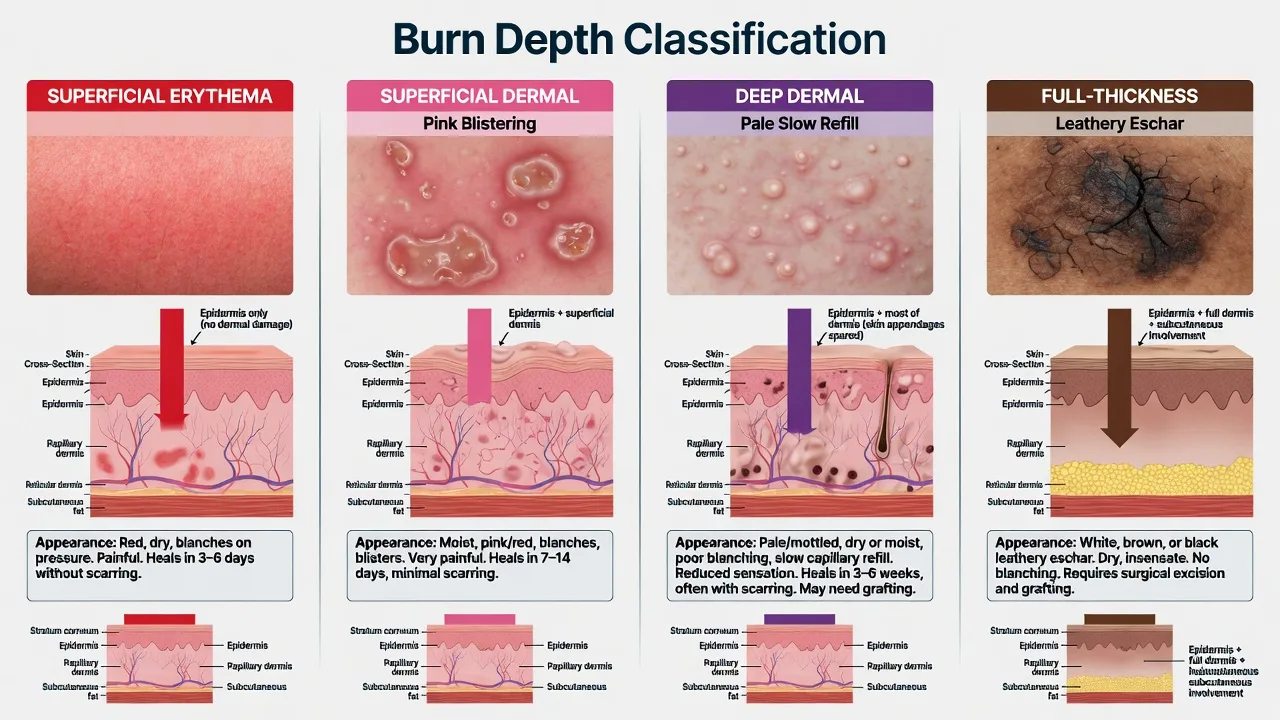
The skin has two layers: the outer epidermis and the thicker dermis carrying the adnexal structures (hair follicles, sweat and sebaceous glands) from which re-epithelialisation occurs. Burn depth is classified by how far the thermal injury penetrates, and depth is the single most important determinant of healing potential and dressing choice. Depth is assessed clinically at the bedside on appearance, sensation and capillary refill, often re-evaluated over the first 48 hours as the burn evolves.[3]
Superficial (erythema)
- Red, dry, painful — like a sunburn; no blisters
- Epidermis only; NOT counted towards TBSA
- Heals in 3 to 5 days without scarring
- Simple oral analgesia and a moisturiser; no dressing needed
Superficial dermal
- Pink, moist, blistering, very painful; brisk capillary refill
- Epidermis and superficial dermis; adnexa survive
- Counted in TBSA; heals in 10 to 14 days
- A non-adherent or hydrocolloid dressing; fluid resuscitation if over 10 per cent TBSA
Deep dermal
- Pale or dark red, slow capillary refill, less painful
- Damage extends deep into the dermis
- Heals in 3 to 8 weeks; scarring likely; may need grafting
- Refer to a burns centre; surgical assessment for debridement
Full-thickness
- White, waxy, leathery (eschar) or charred; dry and painless (nerves destroyed)
- Full dermal destruction; no adnexa survive; cannot heal spontaneously
- Needs surgical excision and grafting
- Escharotomy if circumferential; cling film or a saline dressing for transfer
TBSA estimation — the rule of nines, Lund-Browder and the palm method
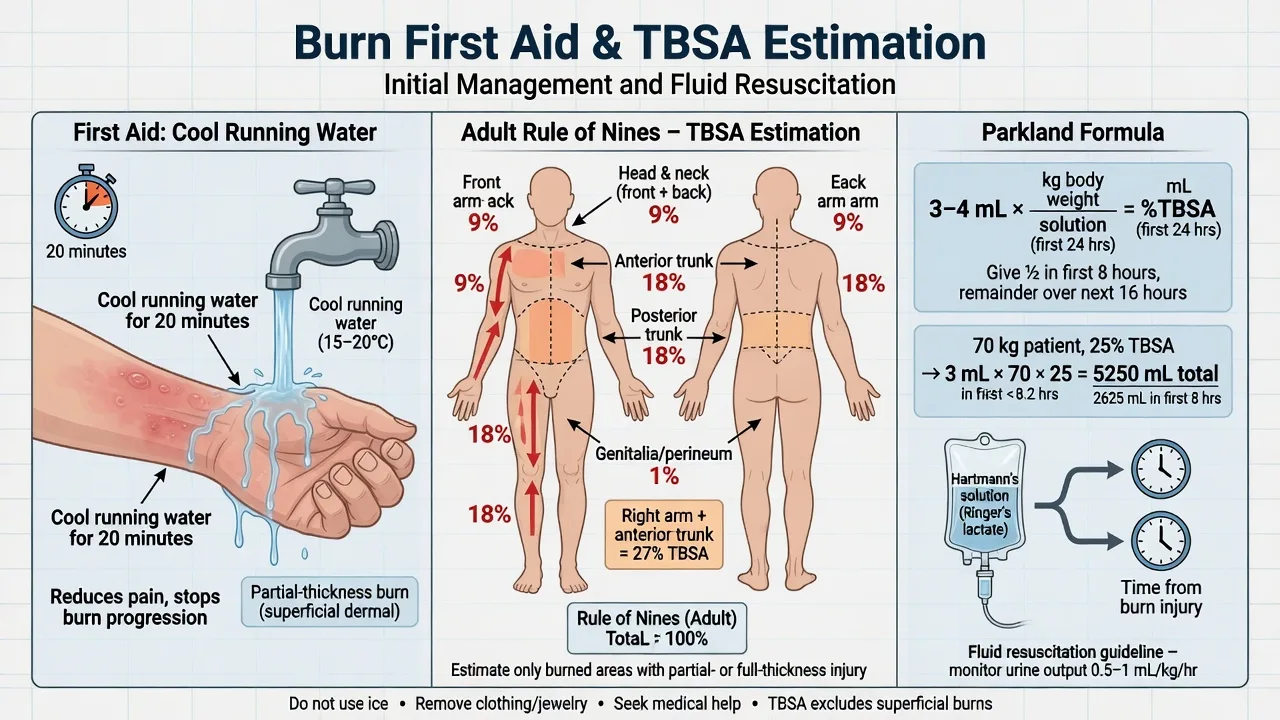
Accurate estimation of the total body surface area burned (TBSA) drives the fluid-resuscitation calculation and the referral decision, and only partial- and full-thickness burns are counted — superficial erythema is excluded. The rule of nines is the adult bedside tool: head and neck 9 per cent, each upper limb 9 per cent, each lower limb 18 per cent, anterior trunk 18 per cent, posterior trunk 18 per cent, perineum 1 per cent. The palm method — the patient's own palm including the fingers represents roughly 1 per cent TBSA — is the quick estimator for small or scattered burns. The Lund-Browder chart corrects the rule of nines for age and is mandatory in children, whose head is proportionally larger (18 per cent in the infant) and limbs smaller than the adult; using the adult rule of nines in a child materially underestimates the head contribution and overestimates the limbs.[3]
The Parkland formula and the resuscitation targets
Equipment — the burn dressing tray
The bedside set-up for a burn wound covers three phases: cooling, assessment, and dressing. The tray holds sterile gloves, gown and drafte, chlorhexidine or saline for irrigation, debridement forceps and scissors for loose non-viable epidermis and blisters, cling film (polyvinyl chloride food wrap) for the temporary transfer dressing, paraffin gauze (Jelonet or Bactigras) as a non-adherent primary layer, silver sulfadiazine 1 per cent cream (SSD, Flamazine), hydrocolloid or foam dressings for superficial partial-thickness burns managed as an outpatient, a sterile drape and a number-11 or -15 scalpel blade for escharotomy, diathermy if available, and tetanus prophylaxis. A bladder catheter and a fluid-warming set are added for the resuscitation-phase burn. The cooling is delivered by tap water or saline at 15 to 25 degrees Celsius through clean towels or a shower attachment — never ice, which causes vasoconstriction and deepens the injury.[1]
Patient preparation, analgesia and consent
Burns are painful, and adequate analgesia is a prerequisite for any wound assessment or dressing change, not an afterthought. The partial-thickness burn with intact nerve endings is exquisitely tender; the full-thickness burn is painless (the nerves are destroyed) but the surrounding dermal rim is not. Consent is taken where possible, explaining the cooling, the cleansing, the dressing choice and the likely need for re-assessment at 48 hours when burn depth often declares itself. [1]
[1]Stepwise technique — the burn wound-care sequence
The procedure runs to a sequence so that cooling, assessment, decontamination, dressing and the resuscitation trigger are each addressed in the right order. [1]
Burn wound care, in order
- Cool first — apply cool running water at 15 to 25 degrees Celsius for 20 minutes, within 3 hours of the burn. Cooling reduces tissue temperature, arrests the thermal injury, reduces oedema, depth and pain, and is the single evidence-based first-aid intervention. In the ED use saline or clean towels soaked in cool water; never apply ice. Stop cooling once the wound is cooled and the patient approaches hypothermia, especially with large surface-area burns.[1]
- Decontaminate — for a chemical burn, copious water irrigation for at least 20 minutes (longer for alkali — up to 1 to 2 hours, pH-paper checked); brush dry powders off before irrigation; apply calcium gluconate gel for hydrofluoric-acid burns. Do not dress a chemical burn until decontamination is complete.
- Assess depth and TBSA — examine the wound for colour, blisters, capillary refill and sensation to assign depth; chart the TBSA with the rule of nines (adult) or the Lund-Browder chart (child); use the palm method for small or scattered areas. Exclude erythema from the count.
- Cleanse and debride — irrigate with saline; debride loose non-viable epidermis and large flaccid blisters (small intact blisters over a non-weight-bearing area may be left as a biological dressing); remove tar with a lipid-based solvent (e.g. polysorbate or liquid paraffin), never by force.
- Apply the dressing for the phase of care — cling film for transfer and assessment; a non-adherent primary layer plus a hydrocolloid or foam for the definitive outpatient dressing; silver sulfadiazine where a specialist centre or the local pathway requests it.
- Trigger resuscitation — start the Parkland formula for adults over 10 per cent TBSA (children over 5 per cent); check the clock against burn time.
- Tetanus and disposition — check the tetanus status and immunise as indicated; apply the burns-centre referral criteria.
Dressing selection by depth and phase of care
The dressing is chosen for the burn depth and the phase of care (transfer, ED observation, definitive outpatient management, or surgical referral). Cling film is the universal ED and transfer dressing: it is non-adherent, transparent (allowing ongoing wound inspection without removal), occlusive (reducing pain by protecting exposed nerve endings from air), and sterile when taken from a fresh roll laid on rather than wrapped tightly. Silver sulfadiazine 1 per cent (SSD, Flamazine) is a broad-spectrum topical antimicrobial applied to the partial- and full-thickness burn in centres that use it; it is not applied to the face, to a chemical burn before decontamination, in pregnancy near term, or in the sulfa-allergic patient, and it separates slough and requires daily dressing changes that are painful. The contemporary meta-analytic evidence is that silver dressings (SSD and nanocrystalline silver) reduce infection and length of stay compared with non-silver dressings, but SSD is not superior to modern silver-releasing or biosynthetic dressings and is increasingly displaced by them.[2] Hydrocolloid and foam dressings are the definitive choice for clean superficial partial-thickness burns managed as an outpatient: they maintain a moist healing environment, reduce pain, and need changing every 3 to 7 days rather than daily. Paraffin gauze (Jelonet) is the simple non-adherent primary layer for the small clean burn. For the paediatric scald, the local paediatric-burns pathway commonly uses a non-adherent gauze (e.g. Xeroform or Mepitel) with SSD as an alternative; the evidence in mixed-depth paediatric scalds shows comparable outcomes between the two, and the dressing is chosen for comfort and ease of review.[6]
Cling film
- ED and inter-hospital transfer dressing; transparent and occlusive
- Apply as a sheet laid on, not wrapped tightly (limb swelling)
- Use on any depth while awaiting assessment or transfer
- NOT a definitive dressing — exchange for a primary layer and secondary dressing
Silver sulfadiazine 1%
- Topical antimicrobial for partial- and full-thickness burns where the pathway requests it
- Avoid on the face, in sulfa allergy, near-term pregnancy, before decontamination
- Needs painful daily dressing changes; stains
- Not superior to modern nanocrystalline silver or biosynthetic dressings
Hydrocolloid / foam
- Definitive outpatient dressing for clean superficial partial-thickness burns
- Moist wound environment; low pain; changed every 3 to 7 days
- Best for small to medium areas without infection
- Avoid on heavily exudative or infected full-thickness burns
Paraffin gauze (Jelonet)
- Simple non-adherent primary layer for the small clean burn
- Cheap, widely available; the secondary layer is gauze and bandage
- Can dry and adhere if left too long
- A fallback when nothing else is available
Drug doses — analgesia, tetanus and the antibiotic caution
The pharmacology of burn wound care is analgesia, tetanus prophylaxis, and — critically — the avoidance of routine prophylactic antibiotics. Intravenous morphine 0.1 mg/kg (5 to 10 mg in the adult) titrated is first-line for the painful partial-thickness burn; ketamine 0.1 to 0.2 mg/kg intravenously or 3 to 4 mg/kg intramuscularly is the alternative for the dissociative analgesia that preserves airway and blood pressure, and the agent of choice for procedural dressing changes. Intranasal fentanyl 1.5 mcg/kg is the paediatric bridge analgesic. Tetanus prophylaxis follows the standard schedule — tetanus toxoid and immunoglobulin according to the patient's immunisation history and the wound's contamination. Prophylactic systemic antibiotics are NOT recommended for the routine burn: they do not prevent infection, they select resistant organisms, and the burn is best kept clean by topical antiseptics and timely debridement. Systemic antibiotics are reserved for the established infection (cellulitis, wound sepsis) or the contaminated wound (e.g. a farm or water-related injury).[3]
The fluid resuscitation — the Parkland formula trigger
Burn wound care runs in parallel with fluid resuscitation, and the TBSA assessment at step 3 triggers the calculation. The Parkland formula is the starting point: 3 to 4 mL per kilogram per per cent TBSA of Hartmann's solution (compound sodium lactate) over the first 24 hours, of which half is given in the first 8 hours from the time of the burn and the remainder over the next 16 hours.[4] The classic Parkland is 4 mL/kg/%TBSA; the Australasian and New Zealand Burn Association (ANZBA) and much current practice favour 3 to 4 mL/kg/%TBSA with the dose titrated down to avoid fluid creep. The clock starts at burn time, not ED arrival — a patient presenting 3 hours after a 30 per cent burn still owes the first half of the formula over the next 5 hours. Resuscitation is triggered at over 10 per cent TBSA in the adult and over 5 per cent in the child, with a urinary catheter placed for burns over 20 per cent to titrate the infusion to a urine output of 0.5 mL/kg/h in the adult (1 mL/kg/h in the child under 30 kg). Children receive a maintenance fluid with dextrose in addition, because their glycogen stores are limited. Over-resuscitation (fluid creep) causes pulmonary and soft-tissue oedema and the abdominal compartment syndrome; under-resuscitation causes hypovolaemic shock and deepening of the burn. The formula is a guide, not a rule — titrate to the urine output.[4]
Escharotomy — the circumferential burn
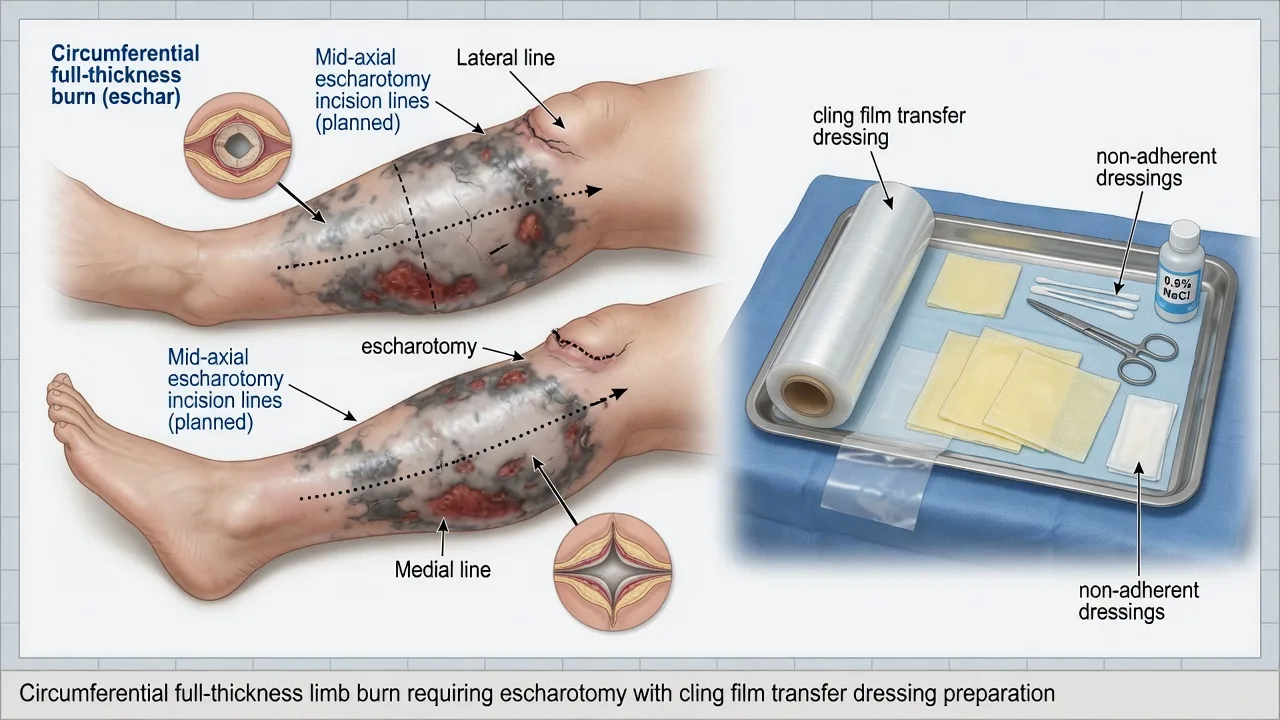
A circumferential full-thickness burn of a limb becomes an inelastic eschar that cannot expand as the underlying tissue swells; the rising sub-eschar pressure produces a compartment syndrome that threatens the limb. A circumferential burn of the chest wall restricts chest-wall expansion and compromises ventilation, and a circumferential burn of the neck or trunk can do the same to the airway and the abdomen. Escharotomy is the surgical release — a full-thickness incision through the eschar down to the subcutaneous fat, splitting the constricting leather along the longitudinal axis of the limb or the chest. Because full-thickness eschar is insensate, the incision is performed without analgesia in the deep layer, though the patient is usually given analgesia for the surrounding partial-thickness rim. Limb escharotomy runs along the mid-lateral and mid-medial lines of the limb, avoiding the neurovascular bundles at the medial elbow and the wrist, and crossing joints with a zig-zag to prevent contracture. Chest escharotomy runs along the anterior axillary lines bilaterally, joined by a subcostal transverse incision across the epigastrium, releasing the chest cage. Bleeding is controlled with diathermy or pressure. If the compartment pressure remains elevated after escharotomy, a fasciotomy is the next step — a deeper incision through the fascia, typically performed by a surgeon in theatre.[5]
Differential diagnosis — the burn aetiologies and how their care differs
The Fellowship candidate must distinguish the burn aetiologies because each modifies the wound-care sequence, the decontamination step and the systemic assessment. The four core aetiologies examined are the scald, the contact, the chemical and the electrical.[3]
Scald (hot liquid)
- Hot water, tea, soup, steam; depth varies with temperature and contact time
- Often superficial to deep dermal; a scald in a child raises non-accidental injury if the pattern is inconsistent or glove-and-stocking
- Standard cooling, cleansing and dressing; assess for NAI in children and vulnerable adults
- Outcome generally good; small clean scalds managed as an outpatient
Contact (hot object)
- Hot metal, exhaust pipe, iron; a deep localised burn at the contact site
- Often deep dermal or full-thickness at the point of contact; the boundary is sharp
- Cool, assess depth, dress; the deep contact burn may need early grafting
- Watch for a circumferential contact burn of a digit or limb needing an escharotomy
Chemical
- Acid, alkali, hydrofluoric acid, phenol; the injury deepens until the agent is removed
- DECONTAMINATE FIRST — copious water irrigation for at least 20 min, longer for alkali; brush off dry powders; calcium gluconate gel for hydrofluoric acid
- No dressing until decontamination complete; check pH paper
- Hydrofluoric acid causes hypocalcaemia and hyperkalaemia — systemic toxicity needs IV calcium gluconate
Electrical
- Low- or high-voltage; small entry/exit surface injury with deep muscle, nerve and vessel damage along the current path
- Treat as a wound PLUS a systemic injury — ECG, creatine kinase, myoglobinuria, cardiac monitoring for 24 h
- Cool the surface burn, dress it, but the deep injury may need a fasciotomy for compartment syndrome
- High-voltage injury causes rhabdomyolysis — target a urine output of 1 to 1.5 mL/kg/h and consider sodium bicarbonate for pigment-induced kidney injury
Complications — wound, procedure and disease-related
The complications of burn wound care fall into three groups. Wound-related complications are infection (the burn is a culture medium; the signs are advancing erythema, purulent discharge, systemic sepsis), delayed healing and scarring, and the conversion of a superficial to a deep burn from under-resuscitation, infection or ongoing thermal injury. Procedure-related complications are hypothermia from over-zealous cooling of a large burn, pain from an under-analgesed dressing change, and the adherence of a dressing left too long. Disease-related complications are the compartment syndrome from a circumferential burn (the missed escharotomy), the Curling stress ulcer in the major burn (prophylaxis with a proton-pump inhibitor), the hyperkalaemia from tissue destruction, the rhabdomyolysis of the electrical injury, and the systemic inflammatory response syndrome that accompanies a burn over 30 per cent TBSA. The chemical burn adds the specific toxicities (hypocalcaemia and hyperkalaemia in hydrofluoric-acid injury, systemic phenol toxicity), and the electrical injury adds the delayed arrhythmia.[3][5]
Pitfalls and practical tips
The pitfalls are the inverse of the structured technique. Cooling with ice or ice water causes vasoconstriction and deepens the burn — use cool running water at 15 to 25 degrees Celsius. Failing to start the Parkland clock from burn time under-delivers the first 8-hour half. Counting erythema in the TBSA over-resuscitates. Using the adult rule of nines in a child mis-estimates the head and limbs — use the Lund-Browder chart. Wrapping cling film tightly around a limb that will swell creates a tourniquet — lay it on as a sheet. Applying silver sulfadiazine before decontaminating a chemical burn seals the agent against the skin. Dressing a circumferential full-thickness burn without assessing the distal perfusion misses the compartment syndrome. Prescribing prophylactic antibiotics for a clean burn selects resistance and does not prevent infection. Forgetting tetanus at the first dressing is a common omission. The practical tips are the opposite: cool with running water for 20 minutes within 3 hours, lay cling film on rather than wrap it, chart the TBSA with the right chart for the age, decontaminate chemical burns to a neutral pH, Doppler the distal pulses of every circumferential limb burn, and document the analgesia and tetanus on the first dressing.[1]
Post-procedure care and disposition
Disposition is driven by the burns-centre referral criteria and the patient's physiology. The referral criteria (ANZBA and American Burn Association, broadly concordant) are: TBSA over 10 per cent in the adult (over 5 per cent in the child); any full-thickness burn over 5 per cent; burns of the face, hands, feet, genitalia, perineum or major joints; electrical and chemical burns; inhalation injury; circumferential burns of the limbs or chest; burns in high-risk patients (elderly, diabetic, immunocompromised, pregnant); and burns with associated trauma or non-accidental injury concern. The patient meeting criteria is transferred to a specialist burns centre after cooling, dressing with cling film, analgesia, the start of the Parkland formula and stabilisation. The patient below the criteria with a small clean superficial partial-thickness burn is discharged with a hydrocolloid or foam dressing, oral analgesia, a written burn-care plan, tetanus cover, and a fixed 24- to 48-hour re-review for depth reassessment and dressing check. The discharge advice names the infection red flags (spreading erythema, increasing pain after the first 24 hours, purulent discharge, systemic fever) and the ischaemia red flags (a cold or paraesthetic distal limb).[3]
Special populations
The child has a thinner skin (a scald at a given temperature burns deeper), a larger surface-area-to-mass ratio (greater relative fluid loss), and a TBSA estimated with the Lund-Browder chart; fluid resuscitation is triggered at over 5 per cent TBSA, and a maintenance dextrose-containing fluid is added to the Hartmann's resuscitation. A scald in a child with an inconsistent history, a glove-and-stocking distribution or a delay in presentation raises non-accidental injury and mandates safeguarding referral. The elderly patient has thinner skin and more comorbidity, cools to hypothermia faster, and needs a lower threshold for resuscitation and admission. The pregnant patient is resuscitated to a higher target and needs fetal monitoring for the major burn. The diabetic patient is at higher infection risk and slower healing; the anticoagulated patient bleeds more at escharotomy. The chemical and electrical populations are managed as the differential above dictates — decontamination first, systemic toxicity assessed.[3][6]
Evidence and regional guidelines
The contemporary evidence and guideline framework supports cool running water as the first-aid intervention, the Parkland or modified-Brooke formula for resuscitation, the avoidance of routine prophylactic antibiotics, and the early escharotomy for the circumferential burn. The 2026 systematic review confirmed that cool running water within 3 hours of injury reduces burn depth, pain and time to heal, and is the single best-evidenced community and ED intervention.[1] The 2026 meta-analysis of silver dressings showed a reduction in infection and length of stay with silver-containing dressings over non-silver dressings, but no clear superiority of silver sulfadiazine over modern nanocrystalline silver or biosynthetic dressings, and a higher pain burden with daily SSD changes.[2] The Parkland-versus-modified-Brooke comparison supports the trend to a lower resuscitation volume (3 to 4 mL/kg/%TBSA) titrated to urine output, avoiding fluid creep.[4] The escharotomy remains the standard surgical release for the circumferential deep burn, with enzymatic debridement emerging as an adjunct that may reduce the need for surgical escharotomy in selected centres.[5] The paediatric scald evidence supports non-adherent dressings as comparable to SSD for mixed-depth injuries, with the choice driven by comfort and ease of review.[6]
ANZ practice note. The Australasian and New Zealand Burn Association (ANZBA) pathway governs practice: cool running water for 20 minutes within 3 hours for first aid, the TBSA charted with the Lund-Browder chart in children, the Parkland formula at 3 to 4 mL/kg/%TBSA of Hartmann's (compound sodium lactate) with half in the first 8 hours from burn time, cling film for transfer, and the standard referral criteria to the state burns centre (over 10 per cent TBSA adult, over 5 per cent child, full-thickness over 5 per cent, special-site burns, electrical, chemical, inhalation, circumferential and high-risk patients). Escharotomy is performed at the receiving centre or by the retrieval team for the limb or chest with compromised perfusion or ventilation; prophylactic systemic antibiotics are not recommended. [1]
SAQs — exam practice
SAQ — Mixed-depth scald of the forearm and hand: dressing selection by depth and phase
10 minutes · 10 marks
A 34-year-old man is brought to the emergency department one hour after a hot-oil scald to the right forearm and the dorsum of the right hand. He is haemodynamically stable (BP 132/78, HR 104, SpO2 98 per cent on room air) but in severe pain. The burn is a mixture of superficial dermal (pink, blistering, very painful, brisk capillary refill, covering roughly 5 per cent TBSA of the forearm), deep dermal (pale, slow capillary refill, less painful, roughly 3 per cent TBSA) and a single full-thickness patch on the dorsal hand (white, waxy, painless). The retrieval team laid cling film on for transfer. His TBSA is 8 per cent and he is below the adult resuscitation threshold of 10 per cent.
SAQ — Tetanus prophylaxis in a contaminated barbecue burn with unknown immunisation history
10 minutes · 10 marks
A 67-year-old woman sustained a 6 per cent TBSA partial-thickness burn to the right lower leg and thigh when her long skirt caught fire at a garden barbecue. The wound is visibly contaminated with soil, ash and charred fabric. She is haemodynamically stable, her last tetanus immunisation is unknown, and she has no documented record. The wound has been cooled, irrigated and debrided in the ED and dressed with cling film pending transfer to the regional burns centre.
Exam pearls
- Cool first and properly — cool running water for 20 minutes within 3 hours; never ice; stop if the patient cools.
- Only partial- and full-thickness burns count — erythema is excluded; use the Lund-Browder chart in children.
- Parkland clock from burn time — 3 to 4 mL/kg/%TBSA Hartmann's, half in the first 8 hours, titrate to 0.5 mL/kg/h urine (1 mL/kg/h child).
- Cling film for transfer — lay it on, never wrap a limb that will swell.
- Silver sulfadiazine — topical antimicrobial, not for the face or before decontamination, and no longer superior to modern silver dressings.
- Escharotomy for the circumferential full-thickness burn — longitudinal mid-axial limb incisions, anterior-axillary plus subcostal chest incisions; fasciotomy if the pressure stays high.
- No routine prophylactic antibiotics — keep the wound clean and debride; reserve antibiotics for established infection or a contaminated wound.
- Chemical decontamination first — copious water for at least 20 minutes, longer for alkali, calcium gluconate for hydrofluoric acid; no dressing until the pH is neutral. [1]
Red flags
[1]References
- [1]Holbert MD, Bozarth MA, Eswara JR, et al. Cool Running Water as a First Aid Treatment for Burn Injuries Ann Emerg Med, 2026.PMID 40985917
- [2]Chen Z, Yu Y, Wang J, et al. Efficacy and Safety of Silver Sulfadiazine Dressings and Nanocrystalline Silver Dressings on Burns: A Systematic Review and Meta-Analysis J Clin Nurs, 2026.PMID 41862967
- [3]Kiwan O, Iwuagwu O. What You Need to Know About: Assessment of Burns and Initial Management Br J Hosp Med (Lond), 2025.PMID 41134176
- [4]Alotaibi AM, Alharbi AA, Almutairi RM, et al. The impact of resuscitation strategies on burn patient outcomes: Parkland vs. modified Brooke's Int J Burns Trauma, 2025.PMID 41278384
- [5]Grunherz L, Schiefer JL, Grunherz F, et al. Enzymatic debridement for circumferential deep burns: the role of surgical escharotomy Burns, 2023.PMID 36604280
- [6]Alessio-Bilowus D, Callahan A, Yan S, et al. Xeroform gauze versus silver sulfadiazine for mixed-depth pediatric scald injuries: A retrospective study JPRAS Open, 2025.PMID 39717711