EM · Carbon monoxide poisoning
Carbon monoxide poisoning
Also known as CO poisoning · Carboxyhaemoglobinaemia · The silent killer
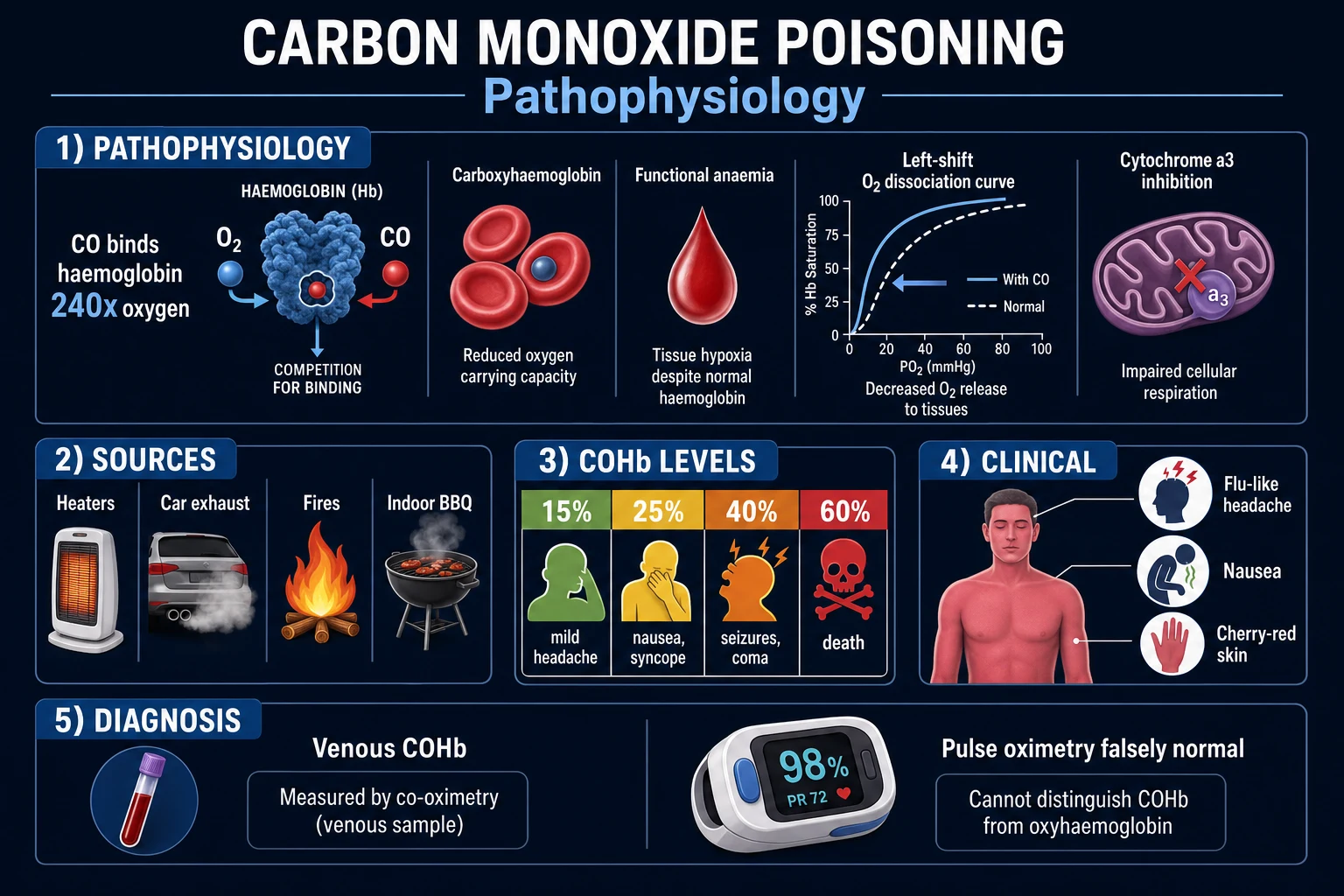
Carbon monoxide poisoning — the colourless, odourless gas that binds haemoglobin about 240 times more avidly than oxygen, left-shifting the oxyhaemoglobin dissociation curve and producing tissue hypoxia with a falsely normal pulse oximetry. The sources (the faulty heater, the car exhaust, the enclosed fire, the indoor barbecue), the clinical (the headache, the nausea, the confusion, the flu-like illness in multiple household members, the rare cherry-red skin), the diagnosis (the venous carboxyhaemoglobin level), and the management (100 per cent oxygen via a non-rebreather mask; hyperbaric oxygen for the severe — the loss of consciousness, the neurological deficit, the pregnancy, the COHb over 25 per cent). The delayed neurological sequelae — the cognitive impairment and the parkinsonism at 2 to 40 days. ACEM-primary, globally tagged.
On this page & tools
Your progress
Saved locally on this device.
Target exams
Red flags
Carbon monoxide poisoning is the commonest cause of death from an inhaled toxin, and it kills because it hides — a colourless, odourless gas that masquerades as a flu-like illness, produces a normal pulse oximetry reading, and leaves no external sign until the patient loses consciousness. The Fellowship candidate must hold the diagnosis in mind whenever the presentation is vague, recognise that pulse oximetry is falsely reassuring, and understand the mechanism (the haemoglobin affinity, the left-shifted curve, the tissue hypoxia) that drives every clinical and therapeutic decision.[2] The two trials the examiner expects by name — Weaver (NEJM 2002) supporting hyperbaric oxygen, and Scheinkestel (MJA 1999) finding no benefit — define the regional practice tension the candidate must articulate.[1][3]

Definition and classification
Carbon monoxide (CO) is an colourless, odourless, non-irritant gas produced by the incomplete combustion of any carbon-containing fuel. Acute carbon monoxide poisoning is a toxic exposure producing tissue hypoxia through the formation of carboxyhaemoglobin (COHb), and it is classified by severity into mild (COHb under 20 per cent, a headache and nausea), moderate (COHb 20 to 40 per cent, a confusion and a syncope) and severe (COHb over 40 per cent, a seizure, a coma, and a cardiovascular collapse). The COHb level itself correlates poorly with symptoms and outcome — the clinical severity and the end-organ injury drive management, not the number alone, because the tissue hypoxia, the inflammatory cascade, and the lipid peroxidation persist after the COHb has been cleared.[2]
Severity and the carboxyhaemoglobin level
Pathophysiology — the mechanism
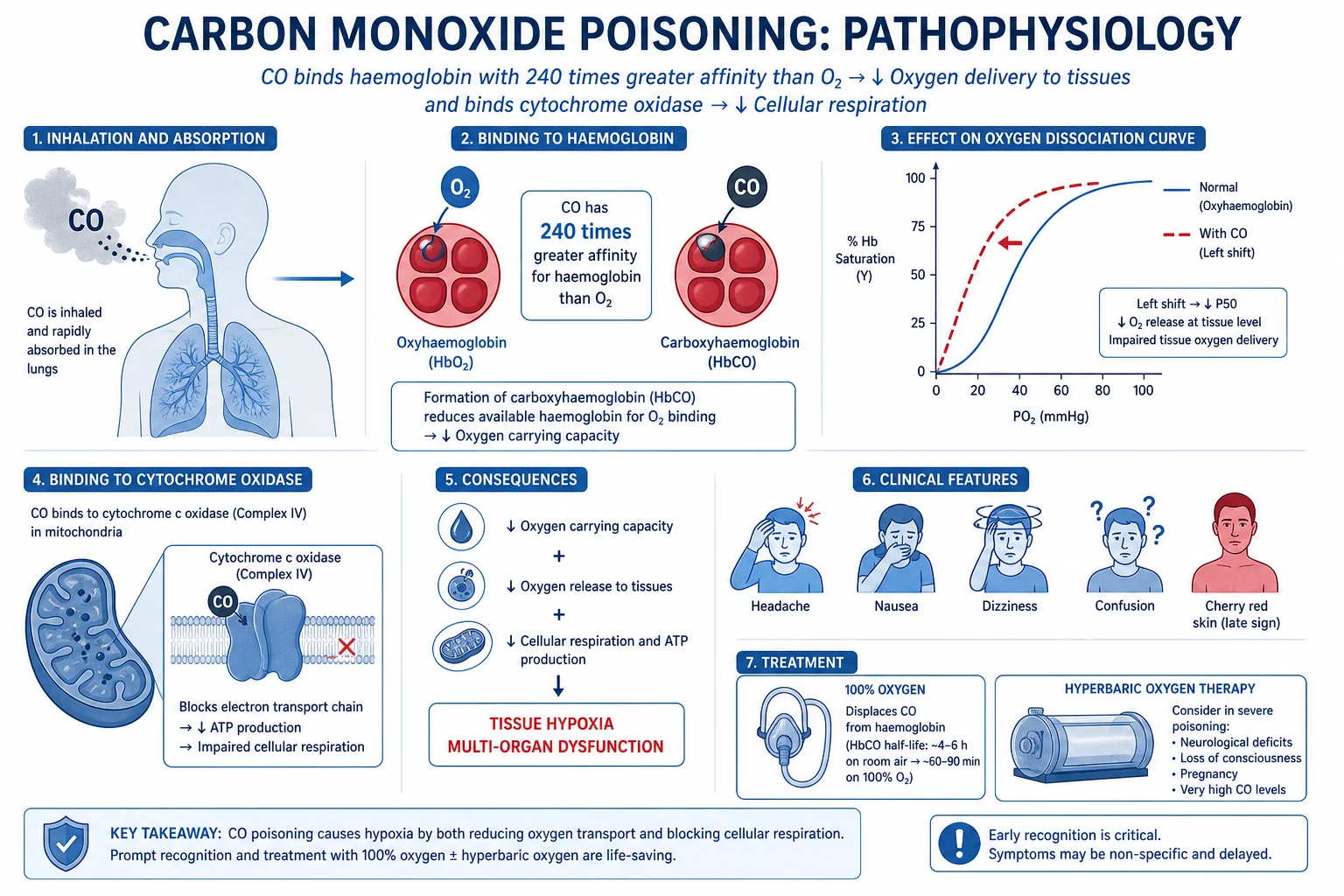
The toxicity of carbon monoxide is built on three mechanisms, and the Fellowship candidate must be able to explain each from first principles. First, CO binds haemoglobin with an affinity about 240 times that of oxygen, forming carboxyhaemoglobin; this both removes that haemoglobin from oxygen transport and, because the binding of one CO molecule increases the oxygen affinity of the remaining sites on the tetramer, left-shifts the oxyhaemoglobin dissociation curve. The left shift means that the haemoglobin holds onto its oxygen more tightly at the tissue level — so even the oxygen that is bound is not released. The combined effect is a profound reduction in oxygen delivery to metabolically active tissue (brain and heart first) without any change in the partial pressure of oxygen in arterial blood, which is why the PaO2 stays near normal.[2]
Second, carbon monoxide binds the haem group of mitochondrial cytochrome c oxidase (complex IV), directly impairing oxidative phosphorylation and shifting the cell to anaerobic metabolism, with a lactic acidosis. Third, the recovery phase generates a delayed inflammatory cascade — neutrophil activation, myeloperoxidase release, the peroxidation of brain lipids, and apoptosis — that produces the delayed neurological sequelae days to weeks after the COHb has normalised. CO also binds myoglobin, causing a myocardial and skeletal-muscle dysfunction (a troponin leak and a rhabdomyolysis).
[5] [1]The half-life of carboxyhaemoglobin is the central pharmacological fact of treatment. On room air it is roughly 4 to 6 hours (about 320 minutes); on 100 per cent oxygen via a non-rebreather mask it falls to about 60 to 80 minutes; and on 100 per cent oxygen at 2.5 to 3 atmospheres absolute (hyperbaric) it falls to about 20 to 23 minutes. This is the rationale for 100 per cent oxygen in every patient and the additional rationale — beyond the half-life alone — for hyperbaric oxygen in the severe case. [1]
Sources and epidemiology
Carbon monoxide is produced wherever carbon-based fuel burns incompletely, and the exposure is often occult. The classical sources the candidate must list are a faulty or unflued gas heater (the commonest domestic cause in winter), a car exhaust (deliberate self-harm in an enclosed garage; also occupational for mechanics and toll-booth workers), an enclosed-space house fire (combined with cyanide from burning plastics and an inhalation airway injury), an indoor barbecue or charcoal burner (BBQ in a tent or a caravan), a wood-burning stove, a blocked flue or chimney, a portable generator used indoors after a storm, and a methlyene chloride exposure (paint stripper, which is metabolised in the liver to carbon monoxide and produces a delayed, prolonged poisoning). [1]
Domestic (heater, stove, fireplace)
- Faulty or unflued gas heater — the classic winter presentation
- Multiple household members (and pets) symptomatic simultaneously
- Symptoms improve when the patient leaves the house and recur on return
- Carbon-monoxide alarm history — ask, and arrange a home check
Fire / smoke inhalation
- Enclosed-space house fire — combined CO and cyanide plus airway injury
- Soot, singed nasal hairs, hoarse voice mandate early intubation
- High lactate and a low conscious level suggest co-existing cyanide
- Treat both toxins empirically in the unconscious fire survivor
Deliberate self-harm
- Car exhaust in an enclosed garage — typically a high COHb
- Methylene chloride (paint stripper) ingestion produces delayed CO
- Assess mental health and safeguarding after resuscitation
- Mandatory co-ingestion screen
Occupational
- Mechanics, toll-booth workers, firefighters, forklift drivers indoors
- Chronic low-level exposure — chronic headache, fatigue, poor concentration
- Identify and remove from the source; notify the workplace
The incidence in the developed world is roughly 50,000 emergency visits a year in the United States with several thousand deaths; in ANZ the winter cluster around unflued gas heating is the recurrent public-health story. Children, pregnant women, the elderly, and patients with ischaemic heart disease are more sensitive at any given COHb level, and the fetus is at particular risk because fetal haemoglobin binds CO even more avidly and the fetal COHb runs 10 to 15 per cent above the maternal level with a slower clearance. [1]
Clinical presentation — the great mimicker
Carbon monoxide poisoning is the great mimicker of the emergency department because its early symptoms are non-specific. The classical triad is a headache (the commonest symptom, present in around 90 per cent, typically a dull frontal or band-like headache), nausea and vomiting, and lethargy or confusion. As the COHb rises the patient develops a dyspnoea and a chest pain (myocardial ischaemia — the troponin leak is common and predicts a worse outcome), a visual disturbance, a ataxia, a syncope, a seizure, and ultimately coma and cardiovascular collapse. The cherry-red skin colour often taught in textbooks is a pre-mortem rarity — it is a sign of severe, late poisoning and is absent in the great majority; its absence never excludes the diagnosis, and teaching it as a common sign is a classic examiner trap.[2]
The single most powerful clinical clue is a flu-like illness affecting several members of the same household (or its pets) at the same time, particularly in winter, particularly improving when they leave the house. A second clue is the patient who returns repeatedly with the same non-specific symptoms. Carbon monoxide poisoning is missed precisely because it looks like a viral illness, a migraine, a gastroenteritis, or a simple syncope — the Fellowship candidate must keep it on the differential for any of these presentations. [1]
[1]Differential diagnosis
The differential is the differential of the non-specific presentation, and carbon monoxide sits on the list of each of them as much as they sit on its list. The Fellowship candidate must distinguish the mimics by the history, the examination, the COHb level, and the concurrent investigations. [1]
Carbon monoxide poisoning
- Headache, nausea, confusion; multiple family members; winter; source history
- Pulse oximetry falsely normal; venous COHb elevated
- May have a metabolic acidosis, a troponin leak, an abnormal ECG
- Improves with 100% oxygen; arrange a home-source check
Influenza / viral illness
- Fever, coryza, myalgia; one family member then others over days
- No source history; normal COHb
- SpO2 reflects true oxygenation
- Symptomatic; exclude CO before settling on flu in a household cluster
Cyanide poisoning (fire survivor)
- Enclosed-space fire with plastics; rapid collapse, a high lactate
- COHb may be elevated too — co-poisoning is the rule
- Bitter-almond breath (unreliable); a metabolic acidosis out of proportion
- Empirical hydroxocobalamin in the unconscious fire survivor
Methaemoglobinaemia
- History of an oxidising drug (dapsone, nitrates, local anaesthetics)
- Cyanosis unresponsive to oxygen; a chocolate-brown blood
- Pulse oximetry reads around 85%; co-oximetry diagnostic
- Methylene blue 1 to 2 mg/kg IV in the symptomatic patient
Sepsis or meningitis
- Fever, focal signs, a rash; an altered conscious level
- Normal COHb; a lactate and a inflammatory response
- Blood cultures, a lumbar puncture, antibiotics early
- Do not let the headache and confusion bypass a septic work-up
Migraine / tension headache
- A stereotyped recurrent history; no source; one patient only
- Normal COHb; normal oxygenation and acid-base
- Resolves with simple analgesia or a triptan
- A diagnosis of exclusion in the new persistent headache
Bedside assessment
Assess and resuscitate in parallel. Remove the patient from the source immediately and give 100 per cent oxygen from the moment of first contact — the paramedic and the triage nurse must not wait for a doctor. Airway — assess for an inhalation injury in the fire survivor (soot in the mouth, singed nasal hairs, a hoarse voice, stridor); intubate early before oedema closes the airway. Breathing — high-flow 100 per cent oxygen via a non-rebreather mask at 15 L/min from the outset; bag-valve-mask ventilation with 100 per cent oxygen if the patient is unconscious or hypoventilating, with a low threshold for rapid sequence intubation in the comatose patient. Circulation — cardiac monitoring (arrhythmia and ischaemia are common), IV access, blood pressure; treat hypotension with a balanced crystalloid bolus. Disability — document the Glasgow Coma Scale (GCS), reproduced because it is examined: eye opening (4 spontaneous, 3 to speech, 2 to pain, 1 none), verbal response (5 oriented, 4 confused, 3 inappropriate words, 2 incomprehensible sounds, 1 none) and motor response (6 obeys commands, 5 localises pain, 4 withdraws, 3 abnormal flexion, 2 abnormal extension, 1 none), for a maximum of 15; record the pupils, the blood glucose, and a focused neurological examination, because the neurological baseline determines whether the patient meets the hyperbaric threshold — any loss of consciousness, however brief, is a hyperbaric referral criterion. Exposure and environment — ask explicitly about the source (heater, fire, exhaust, barbecue, generator), the other household members, and any carbon-monoxide alarm. [1]
Investigations and the carboxyhaemoglobin level
The diagnosis rests on a measured carboxyhaemoglobin level, and the test is a venous or arterial sample run through a co-oximeter — a venous sample is sufficient for the diagnosis and is preferred for ease. A standard blood gas analyser without co-oximetry calculates the oxygen saturation from the PaO2 and therefore gives a falsely normal saturation; only a co-oximeter measures COHb directly. [1]
The key investigations
A full panel is sent in the moderate and severe case: a venous or arterial blood gas (for the acid-base status, the lactate, and the true oxygenation), a full blood count, electrolytes, a troponin and a 12-lead ECG (myocardial ischaemia and arrhythmia are common and predict outcome), a beta-hCG in any woman of childbearing age (pregnancy is a hyperbaric indication), a creatine kinase and a urine myoglobin (rhabdomyolysis from prolonged immobility or a seizure), and a computed tomography of the brain in the patient with a depressed conscious level, focal signs, or a seizure to exclude alternative or concurrent pathology. In the fire survivor, send a blood cyanide level if available and treat empirically on suspicion. An ECG and a troponin are mandatory even in the mildly symptomatic patient, because a silent myocardial injury is common and is itself a marker of worse long-term outcome.[2]
Immediate management — 100 per cent oxygen via a non-rebreather
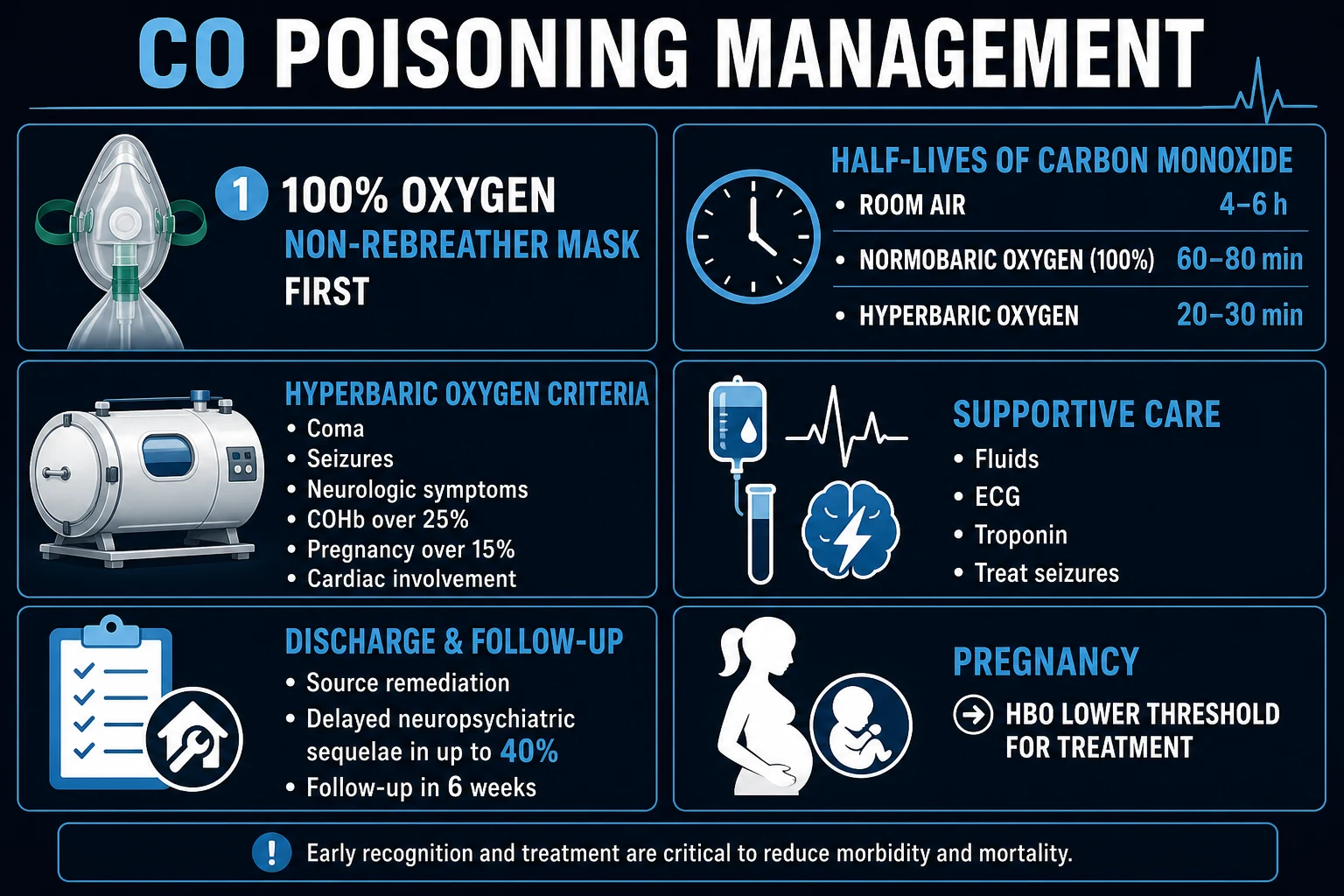
The immediate management of every suspected case is 100 per cent oxygen via a non-rebreather mask at 10 to 15 L/min, started at the scene and continued without interruption until the COHb is under 5 per cent and the patient is asymptomatic. The aim is to displace carbon monoxide from haemoglobin — at 100 per cent inspired oxygen the COHb half-life falls from about 4 to 6 hours on room air to about 60 to 80 minutes — and to supersaturate the plasma-dissolved oxygen enough to support tissue delivery despite the bound haemoglobin. Continue the oxygen for a minimum of 6 hours in the symptomatic patient, longer if symptoms persist.[2]
Oxygen and the half-life
Adjunctive care treats the symptoms and the complications. Headache and muscle pain are managed with paracetamol 1 g orally or morphine 2.5 to 5 mg intravenously titrated. Nausea and vomiting are treated with ondansetron 4 mg intravenously. Seizures are terminated with lorazepam 4 mg intravenously (repeated once, then a second-line agent) along the status-epilepticus ladder, while the underlying hypoxia is corrected. Cerebral oedema in the severely encephalopathic patient is managed with the head of the bed elevated to 30 degrees, normocapnia, and mannitol 0.5 g per kilogram intravenously or hypertonic saline if the signs are life-threatening. A metabolic acidosis with a pH below 7.1 is treated with the correction of the hypoxia first; sodium bicarbonate is reserved for refractory acidosis because it can worsen the tissue CO2 load and the left shift. A pregnant patient receives continuous 100 per cent oxygen for several times the normal half-life because the fetal COHb clears far more slowly. [1]
Hyperbaric oxygen — the indications
Hyperbaric oxygen delivers 100 per cent oxygen at 2.5 to 3 atmospheres absolute, shortening the COHb half-life to about 20 minutes and, more importantly, reducing the incidence of the delayed neurological sequelae in the Weaver trial. The standard indications (the Undersea and Hyperbaric Medical Society, broadly mirrored internationally) are a loss of consciousness (transient or sustained), any neurological deficit or abnormal mental status (a Glasgow Coma Scale under 15, a confusion, a seizure, a focal sign), cardiovascular instability or ischaemia, a metabolic acidosis (a lactate over 10 mmol per litre or a pH under 7.1), a COHb over 25 per cent, and pregnancy with any COHb elevation (the fetal threshold is lower). The aim is to deliver the first treatment within 6 hours where possible, and most protocols use three treatments within 24 hours.[1][2]
[4] [1]The evidence base is contested and the Fellowship candidate must hold both views. The Weaver trial (NEJM 2002) randomised 152 patients to three hyperbaric treatments versus one normobaric session and found a halving of cognitive sequelae at six weeks (25 per cent versus 46 per cent) and a sustained benefit at twelve months, supporting hyperbaric oxygen for the severely poisoned patient.[1] The Scheinkestel trial (MJA 1999), an Australian randomised study of a larger and sicker cohort, found no benefit and a possible signal of harm, which has shaped the more conservative ANZ approach.[3] The methodological differences (the chamber pressure, the number of sessions, the time to treatment, the case mix) explain the divergence, and the practical synthesis is that hyperbaric oxygen is reasonable and recommended for the severe case while its routine use in mild and moderate poisoning is not established.
Delayed neurological sequelae
The delayed neurological sequelae are the complication that makes carbon monoxide poisoning a follow-up disease and not just a resuscitation. After an apparent full recovery, 2 to 40 days (classically 2 to 40 days) after the exposure, the patient develops a cognitive impairment (a poor concentration, a short-term memory loss, an executive dysfunction), a mood and personality change (an irritability, a depression), a parkinsonism (a bradykinesia, a rigidity, a gait disturbance, classically with basal-ganglia changes on imaging), and occasionally a persistent vegetative state. The syndrome affects up to 40 per cent of severely poisoned patients treated with normobaric oxygen alone; some recover over a year, many do not. The pathophysiology is a delayed inflammatory and demyelinating injury to the basal ganglia and the subcortical white matter, and the rationale for hyperbaric oxygen in the severe case is largely the reduction of this delayed injury demonstrated in the Weaver trial.[1][2]
Every patient, however mild, is counselled before discharge about the possibility of the delayed sequelae and given written advice to return (or to attend their general practitioner) if cognitive, mood, or movement symptoms emerge in the following six weeks. A follow-up cognitive assessment at four to six weeks is ideal and is the practice in many centres. [1]
Subtypes and scenarios
The Fellowship case is often a scenario, and the common ones follow. Pregnancy — the fetus is exquisitely sensitive because fetal haemoglobin binds CO more avidly and the fetal COHb runs 10 to 15 per cent above the maternal level with a slower clearance; any pregnant patient with a symptomatic CO exposure is a hyperbaric referral at a lower threshold (a COHb over 15 to 20 per cent, or any sign of fetal distress), with 100 per cent oxygen continued for several half-lives and obstetric involvement for the fetal monitoring. The fire survivor — an enclosed-space house fire produces combined carbon monoxide and cyanide poisoning from burning plastics, plus an inhalation airway injury; treat both toxins empirically (100 per cent oxygen plus hydroxocobalamin 5 g intravenously in the unconscious or acidaemic fire survivor), intubate early for the airway signs, and liaise with the burns centre. Chronic and low-dose exposure — the mechanic or the household with a faulty heater presents with chronic headache, fatigue, and poor concentration; the COHb may be only mildly elevated, the diagnosis is clinical, and the management is removal from the source, 100 per cent oxygen for a short period, and a workplace or home environmental assessment. Methylene chloride exposure (paint stripper) is metabolised to carbon monoxide in the liver, producing a delayed and prolonged poisoning with a COHb that continues to rise after removal from the source; treat with prolonged 100 per cent oxygen. [1]
Complications and pitfalls
The complications are cardiac and neurological. A myocardial injury (a troponin leak, an ECG ischaemia, a regional wall-motion abnormality) is common in moderate to severe poisoning and predicts a worse long-term mortality; a cardiac arrhythmia is the commonest cause of early death. A rhabdomyolysis from prolonged immobility, a compartment syndrome, or a seizure causes a myoglobinuric acute kidney injury. A skin blistering and a alopecia are occasional late cutaneous signs. The delayed neurological sequelae are the dominant late complication and are discussed above. [1]
The pitfalls are the inverse of the management. Relying on the pulse oximetry is the cardinal error — a normal SpO2 never excludes CO poisoning. Missing the household cluster and labelling it influenza is the classic diagnostic error. Stopping the oxygen too early because the symptoms have eased allows the COHb to rebound. Treating the COHb number rather than the patient — the loss of consciousness and the neurological deficit drive the hyperbaric decision, not the level alone. Forgetting pregnancy — every woman of childbearing age has a beta-hCG. Ignoring co-poisoning in the fire survivor — cyanide is the partner toxin and needs empirical treatment. Not counselling on the delayed sequelae is the discharge pitfall; the patient who returns in three weeks with confusion has not been told. [1]
Prognosis and disposition
The mortality is driven by the severity, the loss of consciousness, the age, and the cardiac injury; a troponin-positive patient has a worse long-term cardiovascular mortality even after a single poisoning. The mild, asymptomatic patient with a COHb under 10 per cent on presentation who becomes asymptomatic on 100 per cent oxygen may be discharged after the source has been made safe (the fire service or the gas company checks the home) and after the delayed-sequalae counselling. The moderate patient is observed on 100 per cent oxygen for at least 6 hours, admitted if symptomatic, and considered for hyperbaric referral. The severe patient — any loss of consciousness, neurological deficit, pregnancy, cardiac ischaemia, COHb over 25 per cent — is referred for hyperbaric oxygen if available and admitted to a monitored bed regardless. Every discharged patient is warned to return if cognitive, mood, or movement symptoms emerge in the following six weeks. [1]
Special populations
The pregnant patient is managed at a lower threshold for hyperbaric oxygen because of the fetal sensitivity; 100 per cent oxygen is continued for longer, and the obstetric team is involved for the fetal monitoring. The child presents more often with a subtle or non-specific picture (a nausea, a behavioural change) and tolerates the oxygen and the chamber well; paediatric weight-based doses apply to adjunctive drugs. The elderly and the patient with ischaemic heart disease are symptomatic at a lower COHb and have a worse outcome; the threshold for hyperbaric referral is lower. The fire survivor is treated empirically for combined CO and cyanide. The chronically exposed worker is removed from the source and referred for occupational assessment. The patient with a methaemoglobinaemia or a co-existing anaemia decompensates at a lower COHb because the functional oxygen reserve is smaller. [1]
Evidence and regional guidelines
The evidence base is built on three references the Fellowship candidate must know. The Weaver trial (NEJM 2002) is the definitive supportive study, demonstrating a halving of cognitive sequelae at six weeks and a sustained benefit at twelve months with three hyperbaric oxygen sessions within 24 hours in moderately and severely poisoned patients.[1] The Weaver review (NEJM 2009) is the contemporary clinical-practice reference that codifies the mechanism, the diagnosis, and the management used here.[2] The Scheinkestel trial (MJA 1999) is the Australian randomised study that found no benefit and a possible signal of harm with hyperbaric oxygen, and which underpins the more conservative ANZ practice.[3] The methodological differences — the pressure (2.5 versus 3 atmospheres), the number of sessions, the delay to treatment, and the case mix — explain the divergence.
ANZ practice note. The regional evidence tension is explicit: the Weaver trial (US, NEJM 2002) supports hyperbaric oxygen for the severely poisoned patient, while the Scheinkestel trial (ANZ, MJA 1999) found no benefit and a possible harm. ANZ practice reflects this — hyperbaric oxygen is used selectively, generally reserved for the patient with a loss of consciousness, a neurological deficit, a pregnancy, a cardiac ischaemia, or a COHb over 25 per cent, and discussed case-by-case with the on-call hyperbaric unit. The winter public-health response to a household cluster (unflued gas heating, fire-service and gas-company home checks, the carbon-monoxide alarm) is a routine part of the discharge. One hundred per cent oxygen via a non-rebreather mask remains the universal first treatment, and the delayed-neurological-sequelae counselling is given before every discharge.[2][3]
Co-oximetry and the dyshaemoglobins
A standard pulse oximeter and a standard blood-gas analyser both fail in carbon monoxide poisoning because they assume haemoglobin is either oxy- or deoxyhaemoglobin. The co-oximeter is the only device that resolves the full spectrum, and the Fellowship candidate must know which species each instrument measures and why the displayed numbers lie. [1]
Pulse oximetry (SpO2)
- Two wavelengths (660 nm red, 940 nm infrared); assumes only O2Hb and HHb
- COHb absorbs at 660 nm almost identically to O2Hb — reads COHb as if it were O2Hb
- Displayed saturation falsely normal (97 to 99%) even at a lethal COHb
- Never use to exclude CO; a normal SpO2 is meaningless here
Standard ABG analyser
- Measures PaO2, then calculates SaO2 from the dissociation curve
- PaO2 stays near normal — CO does not lower dissolved oxygen
- Calculated saturation looks normal — the hidden hypoxaemia
- Reports a normal-looking gas in a dying patient
Co-oximeter (4+ wavelengths)
- Measures O2Hb, HHb, COHb and metHb directly by spectrophotometry
- Reports a true fractional saturation and the COHb percentage
- A venous sample is sufficient — arterial only if an ABG is otherwise needed
- The only diagnostic test for carboxyhaemoglobin
The oxygen delivery ladder
The aim of oxygen therapy is to maximise the inspired fraction (FiO2) to drive CO off haemoglobin and to supersaturate the plasma-dissolved oxygen that bypasses the bound haemoglobin. The non-rebreather mask is the ED workhorse; the ventilator is the only device that delivers a guaranteed 100 per cent. [1]
Non-rebreather mask
- 10 to 15 L/min; FiO2 ~0.6 to 0.9 depending on fit and flow
- The ED standard for every suspected CO poisoning — start at first contact
- COHb half-life ~60 to 80 min on 100% oxygen
- One-way valves and reservoir bag; ensure the bag stays inflated
Bag-valve-mask (100% O2)
- FiO2 close to 1.0 with an oxygen reservoir attached at 15 L/min
- Use for the unconscious or hypoventilating patient pre-intubation
- Two-person technique, oropharyngeal airway, gastric decompression
- Bridge to rapid sequence intubation
Mechanical ventilator
- FiO2 of 1.0 — a guaranteed 100% oxygen, the only true 100%
- For the intubated, the comatose, or the failing patient
- Target normocapnia; avoid permissive hypercapnia in the brain-injured
- Bridge to, or continuation through, hyperbaric therapy
Hyperbaric chamber
- 100% O2 at 2.5 to 3 ATA; COHb half-life ~20 to 23 min
- Increases dissolved plasma oxygen ~6-fold, bypassing bound haemoglobin
- Reserved for the severe case meeting criteria; needs transfer
- Three treatments within 24 h per the Weaver protocol
Emergency management algorithm
Carbon monoxide poisoning — the ED algorithm
Remove from the source and give 100% oxygen from first contact — the paramedic and triage nurse do not wait for a doctor; high-flow oxygen via a non-rebreather at 10 to 15 L/min from the moment of arrival.
Assess and resuscitate in parallel — airway (look for inhalation injury in the fire survivor: soot, singed nasal hairs, hoarse voice), breathing (100% oxygen; RSI if comatose), circulation (cardiac monitor, IV access, treat hypotension), disability (document the GCS and a neuro baseline — any loss of consciousness is a hyperbaric criterion).
Send a venous co-oximeter sample for the COHb level plus a venous gas, lactate, troponin, 12-lead ECG, beta-hCG in every woman of childbearing age, FBC and electrolytes, CK and urine myoglobin.
Reassess the COHb against the clinical picture — not the number alone: loss of consciousness, neurological deficit, pregnancy, cardiac ischaemia, metabolic acidosis, or a COHb over 25 per cent trigger the hyperbaric referral.
Continue 100% oxygen without interruption for at least 6 hours, longer if symptomatic; repeat the COHb and do not stop the oxygen until COHb is under 5 per cent and the patient is asymptomatic.
Treat the complications in parallel — seizures (lorazepam), cerebral oedema (head up 30 degrees, normocapnia, osmotherapy), myocardial ischaemia (cardiology), rhabdomyolysis (fluids).
In the fire survivor with a high lactate or coma, give empirical hydroxocobalamin 5 g IV for suspected concomitant cyanide — do not wait for a level.
Arrange disposition — discharge the asymptomatic mild case after source safety and counselling; admit the moderate; refer the severe for hyperbaric oxygen and admit to a monitored bed regardless.
Counsel every patient before discharge on the delayed neurological sequelae (2 to 40 days) and arrange a 4 to 6 week cognitive follow-up.
The pivotal trials
Weaver — hyperbaric oxygen for acute carbon monoxide poisoning (NEJM 2002)
New England Journal of Medicine
PMID 12362006
Key finding
A double-blind randomised trial of 152 patients with symptomatic CO poisoning randomised to three hyperbaric oxygen treatments within 24 hours versus a single normobaric (sham) session. Cognitive sequelae at six weeks was halved in the hyperbaric group (25% vs 46%, p=0.007), and the benefit persisted at six and twelve months.
Practice change
The pivotal trial underpinning hyperbaric oxygen for the severely poisoned patient — it defined the three-treatment within-24-hour protocol and established cognitive sequelae as the patient-centred endpoint. Blinding and a sham control address the limitations of earlier work.
Scheinkestel — hyperbaric vs normobaric oxygen in CO poisoning (MJA 1999)
Medical Journal of Australia
PMID 10092916
Key finding
An Australian randomised trial of 191 patients — a larger and sicker cohort, including unconscious and pregnant patients — comparing hyperbaric versus normobaric oxygen using a higher-pressure protocol. No benefit from hyperbaric oxygen was found, with a signal toward worse neurological outcomes at one month.
Practice change
The counter-evidence that anchors the more conservative ANZ approach, in which hyperbaric oxygen is used selectively rather than routinely. The divergence from Weaver is explained by case mix, chamber pressure, number of sessions, and delay to treatment.
Rose — carbon monoxide pathogenesis and future therapy (AJRCCM 2017)
American Journal of Respiratory and Critical Care Medicine
PMID 27753502
Key finding
A definitive mechanistic review integrating CO binding to haemoglobin (the 240-fold affinity and left shift), cytochrome c oxidase inhibition, myoglobin binding, neuroinflammation and lipid peroxidation — and surveying emerging therapies (neuroprotective agents, scavenger molecules) beyond oxygen.
Practice change
The contemporary pathophysiology reference explaining why COHb levels correlate poorly with outcome — tissue injury, mitochondrial poisoning and inflammation persist after the COHb clears — justifying management driven by clinical severity rather than the number alone.
Hampson — practice recommendations for CO poisoning (AJRCCM 2012)
American Journal of Respiratory and Critical Care Medicine
PMID 23087025
Key finding
A consensus statement from the Undersea and Hyperbaric Medical Society faculty codifying the diagnostic criteria (COHb thresholds), the 100% oxygen standard, and the hyperbaric indications — loss of consciousness, neurological deficit, cardiovascular instability, metabolic acidosis, COHb over 25%, and pregnancy.
Practice change
The guideline reference underpinning the hyperbaric referral criteria used worldwide — the single source the Fellowship candidate cites for the indication list.
Severity tiers and disposition
Mild (COHb under 20%)
- Headache, nausea, malaise; normal mental state
- 100% oxygen for 6 hours; repeat COHb until under 5%
- Discharge if asymptomatic and source made safe
- Counsel on delayed sequelae; GP follow-up at 4 to 6 weeks
Moderate (COHb 20 to 40%)
- Confusion, syncope, chest pain; may have ECG changes
- 100% oxygen continuously; admit for observation
- Consider hyperbaric referral — especially any syncope
- Troponin and serial ECG; treat myocardial ischaemia
Severe (COHb over 40%)
- Seizure, coma, collapse, cardiovascular instability
- Refer for hyperbaric oxygen if any criterion met
- Admit to a monitored bed regardless of chamber access
- RSI if GCS under 8; treat cerebral oedema and seizures
Clinical pearls — the examiner's panel
[1] [1] [1] [1] [1] [1] [1] [1] [1] [1] [1] [1] [1] [1] [1] [1] [1]Exam pearls
- Mechanism: CO binds haemoglobin about 240 times more avidly than oxygen, left-shifts the oxyhaemoglobin dissociation curve, and impairs cytochrome oxidase → tissue hypoxia with a falsely normal PaO2 and SpO2.
- Pulse oximetry is falsely normal — a standard oximeter cannot distinguish COHb from O2Hb; only a co-oximeter measures COHb. A normal SpO2 never excludes CO.
- Sources: faulty or unflued heater, car exhaust, enclosed-space fire, indoor barbecue, generator indoors, methylene chloride (paint stripper, metabolised to CO).
- Clinical clue: a flu-like illness in several household members (and pets) at once, in winter, improving away from home.
- Cherry-red skin is rare — a late pre-mortem sign; its absence never excludes the diagnosis.
- Oxygen: 100 per cent via a non-rebreather at 10 to 15 L/min for at least 6 hours; COHb half-life falls from 4 to 6 h on room air to 60 to 80 min on 100% oxygen.
- Hyperbaric indications: loss of consciousness, neurological deficit, pregnancy, cardiac ischaemia, metabolic acidosis, COHb over 25 per cent.
- Hyperbaric half-life: about 20 to 23 min at 100 per cent oxygen and 2.5 to 3 atmospheres absolute.
- Delayed neurological sequelae: cognitive impairment and parkinsonism at 2 to 40 days; counsel every patient.
- Two trials by name: Weaver (NEJM 2002) — supports HBO; Scheinkestel (MJA 1999) — no benefit, shapes the conservative ANZ practice.
- Fire survivor: combined CO and cyanide — treat both; early intubation for the airway signs. [1]
Exam practice
SAQ — Carbon monoxide poisoning presenting as syncope in a pregnant woman
10 minutes · 10 marks
A 28-year-old woman who is 26 weeks pregnant is brought to the emergency department by ambulance after a syncopal episode at home. She had complained of a frontal headache, nausea and dizziness for several hours beforehand; her husband has the same headache. The symptoms began after they turned on an old unflued gas heater in their lounge room for the first time this winter. On arrival she is drowsy but rousable (GCS 14), complaining of a headache. BP 102/64, HR 110, RR 22, SpO2 99 per cent on a non-rebreather at 15 L/min started by the paramedics. The finger-prick glucose is 5.6 mmol/L. The 12-lead ECG shows 1 mm ST depression in leads V4 to V6. The venous co-oximetry reports a carboxyhaemoglobin of 32 per cent. The lactate is 2.8 mmol/L and the high-sensitivity troponin is mildly elevated at 45 ng/L (upper reference 14).
SAQ — Enclosed-space house fire with combined carbon monoxide and cyanide poisoning
10 minutes · 10 marks
A 52-year-old man is brought to the emergency department twenty minutes after being pulled unconscious from a house fire that involved a fully involved lounge room with extensive burning of synthetic furnishings and plastics. He was trapped for an estimated fifteen minutes. On arrival he is comatose (GCS 6, E1V1M4), with soot in his mouth and oropharynx, singed nasal hairs, and a hoarse, stridulous cry when stimulated. BP 84/52, HR 132, RR 8 and shallow, SpO2 90 per cent on 15 L oxygen via a non-rebreather. He is cool peripherally. Venous gas: pH 7.10, lactate 11.5 mmol/L, bicarbonate 12. The venous carboxyhaemoglobin is 38 per cent. The 12-lead ECG shows a sinus tachycardia with diffuse ST changes. The paramedics have given 100 per cent oxygen and one bolus of intravenous fluid.
Red flags
[1]References
- [1]Weaver LK, Hopkins RO, Chan KJ, et al. Hyperbaric oxygen for acute carbon monoxide poisoning N Engl J Med, 2002.PMID 12362006
- [2]Weaver LK. Clinical practice. Carbon monoxide poisoning N Engl J Med, 2009.PMID 19297574
- [3]Scheinkestel CD, Bailey M, Myles PS, et al. Hyperbaric or normobaric oxygen for acute carbon monoxide poisoning: a randomised controlled clinical trial Med J Aust, 1999.PMID 10092916
- [4]Hampson NB, Piantadosi CA, Thom SR, Weaver LK. Practice recommendations in the diagnosis, management, and prevention of carbon monoxide poisoning Am J Respir Crit Care Med, 2012.PMID 23087025
- [5]Rose JJ, Wang L, Xu Q, McTiernan CF, et al. Carbon Monoxide Poisoning: Pathogenesis, Management, and Future Directions of Therapy Am J Respir Crit Care Med, 2017.PMID 27753502