EM · Cyanide poisoning
Cyanide poisoning
Also known as Cyanide toxicity · Histotoxic hypoxia · Smoke inhalation cyanide · Cytochrome oxidase poisoning
Cyanide poisoning — the histotoxic toxin that halts cellular respiration by binding the ferric iron of cytochrome c oxidase (complex IV), shutting oxidative phosphorylation and forcing every tissue into anaerobic metabolism. The emergency source is the enclosed-space house fire (cyanide released from burning plastics, wool and polyurethane), and the patient is the unconscious fire survivor with soot in the mouth, a high lactate and a metabolic acidosis out of proportion to the carboxyhaemoglobin level — co-existing carbon monoxide is the rule. The clinical signs are rapid collapse, seizure and coma, an initial hypertension then bradycardic cardiovascular collapse, and the rare cherry-red skin from venous oxygen that the tissues cannot extract. Management is 100 per cent oxygen, empirical hydroxocobalamin 70 mg per kilogram (adult 5 g) intravenously — the preferred antidote because it does not cause hypotension or methaemoglobinaemia — and sodium thiosulfate 12.5 g intravenously. The smoke-inhalation kit (amyl or sodium nitrite) is avoided because methaemoglobinaemia worsens the co-existent carbon monoxide poisoning. ACEM-primary, globally tagged.
On this page & tools
Your progress
Saved locally on this device.
8 MCQs with explanations
Target exams
Red flags
Cyanide poisoning is the textbook histotoxic toxin and the partner of carbon monoxide in the unconscious fire survivor. The Fellowship candidate must understand that cyanide kills not by failing to deliver oxygen to the cell but by blocking the cell from using it — cyanide binds the ferric iron of cytochrome c oxidase (complex IV), halts the electron transport chain, and forces every tissue into anaerobic metabolism within seconds. The result is a profound lactic acidosis with blood that is fully oxygenated yet useless to the tissues, a venous oxygen saturation that is abnormally high, and the rare cherry-red skin that reflects venous blood still carrying its oxygen.[2][6] The decision the examiner tests is the empirical one: the unconscious patient pulled from an enclosed-space house fire with soot in the mouth and a lactate at or above 10 mmol per litre gets hydroxocobalamin before any cyanide level returns, while the nitrite kit is withheld because it would worsen the co-existent carbon monoxide poisoning.[4][5]
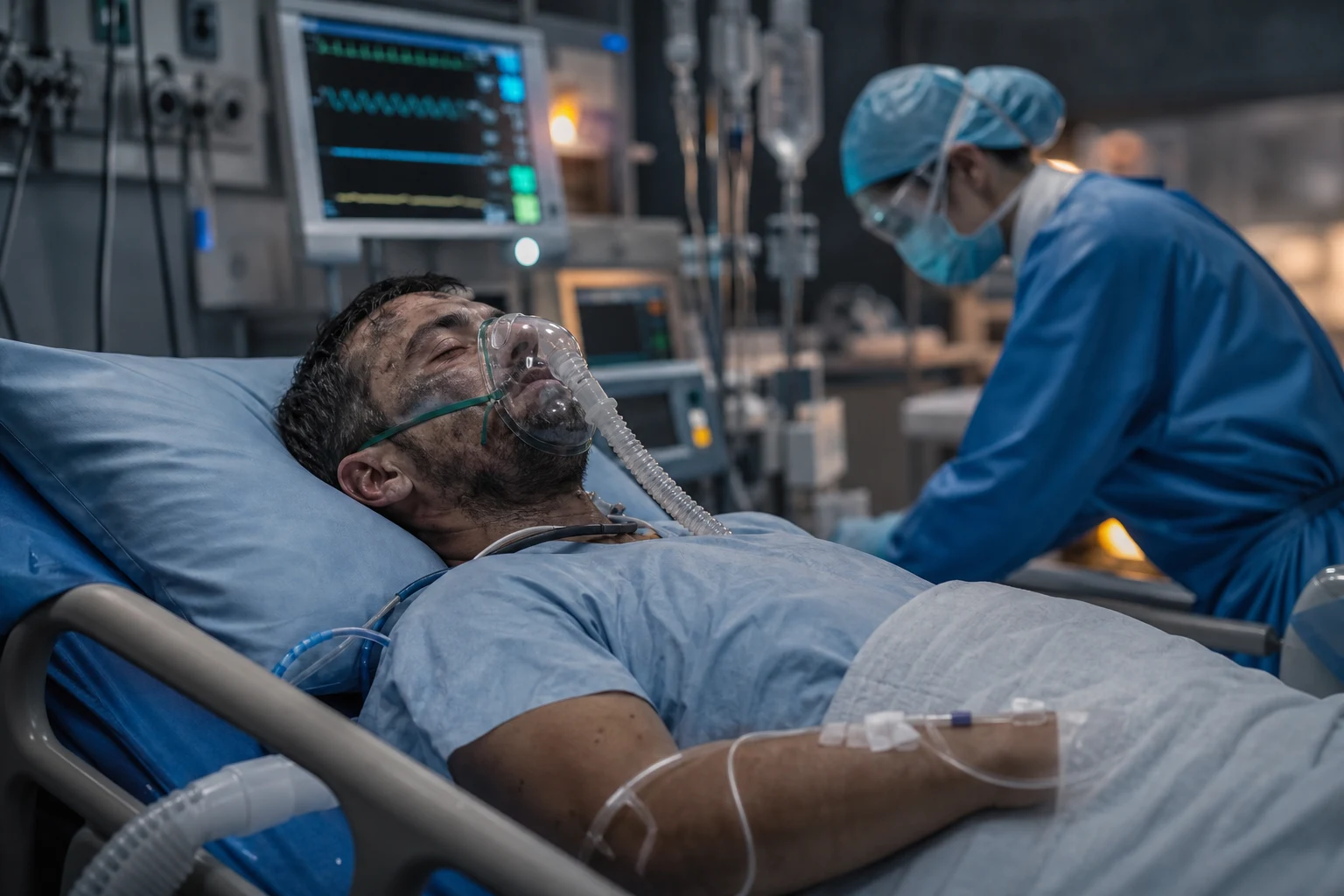
Definition and classification
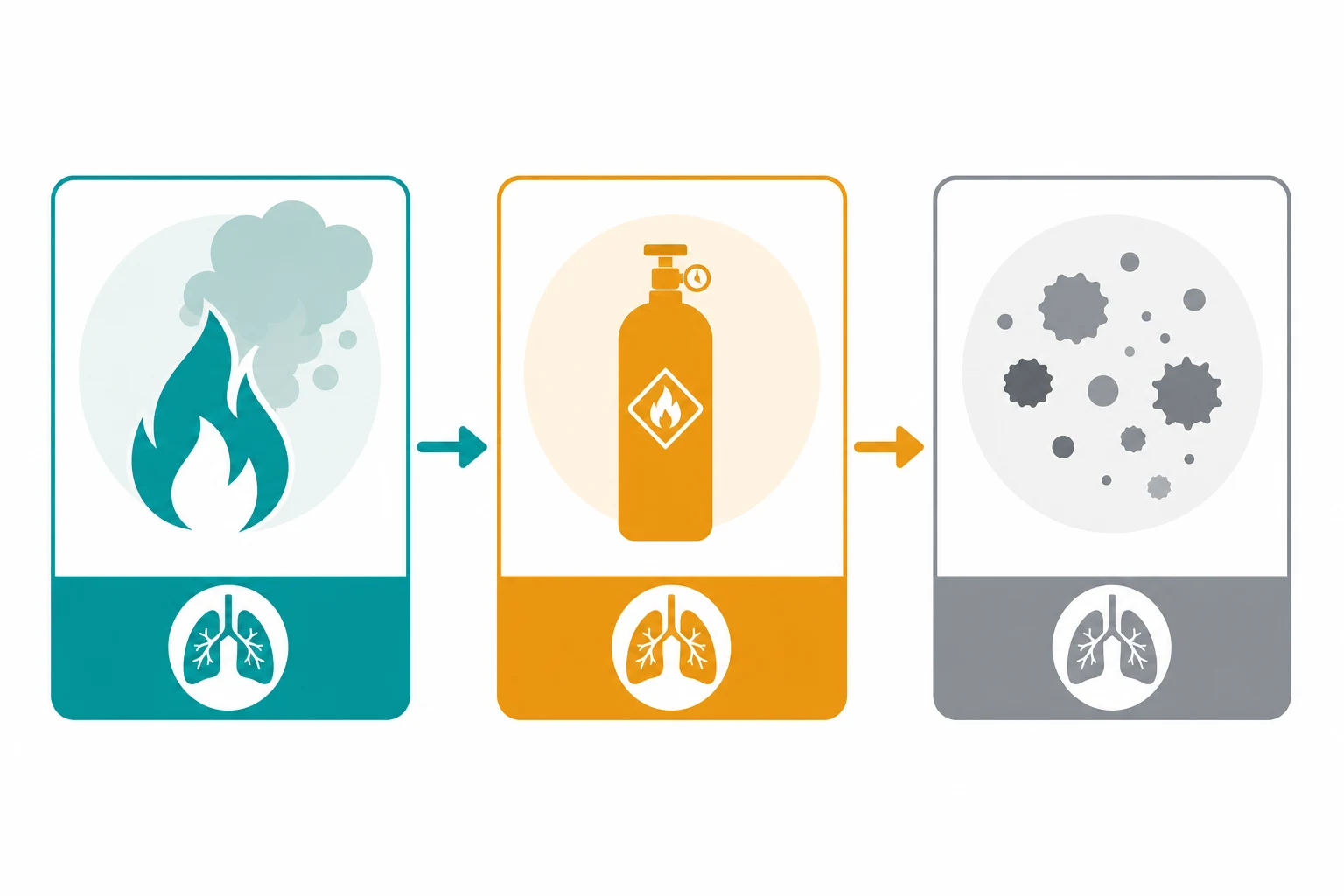
Cyanide is a rapidly acting cellular toxin that blocks oxidative phosphorylation. Acute cyanide poisoning arises from three broad sources the candidate must list. Smoke inhalation from an enclosed-space fire is the dominant emergency-department source: burning plastics, polyurethane (foam furniture), wool, silk and paper release hydrogen cyanide alongside carbon monoxide, and the trapped, unconscious fire survivor is the classic presentation.[1] Industrial and laboratory exposure includes electroplating, metal cleaning, gold and silver extraction (the cyanidation process), fumigation, and the manufacture of synthetic fibres and plastics; the salt form (potassium or sodium cyanide) releases hydrogen cyanide gas on contact with acid or water. Ingestion covers the deliberate self-harm ingestion of a cyanide salt, the iatrogenic infusion of sodium nitroprusside (which releases cyanide as a metabolite), and the consumption of amygdalin (apricot, peach or cherry kernels; "laetrile" alternative-medicine preparations) which releases cyanide on enzymatic hydrolysis in the gut.[2][6]
Cyanide is classified clinically by source and by severity. The smoke-inhalation case is the Fellowship prototype and is almost always a mixed carbon monoxide and cyanide exposure with an additional inhalation airway injury. The pure cyanide salt ingestion or inhalation is rarer in the community but carries a near-uniform mortality because the dose is massive and the onset is in minutes. Nitroprusside toxicity is slower and iatrogenic, presenting as a rising lactate and a metabolic acidosis during a high-dose or prolonged infusion. [1]
Pathophysiology — cellular hypoxia and the high lactate
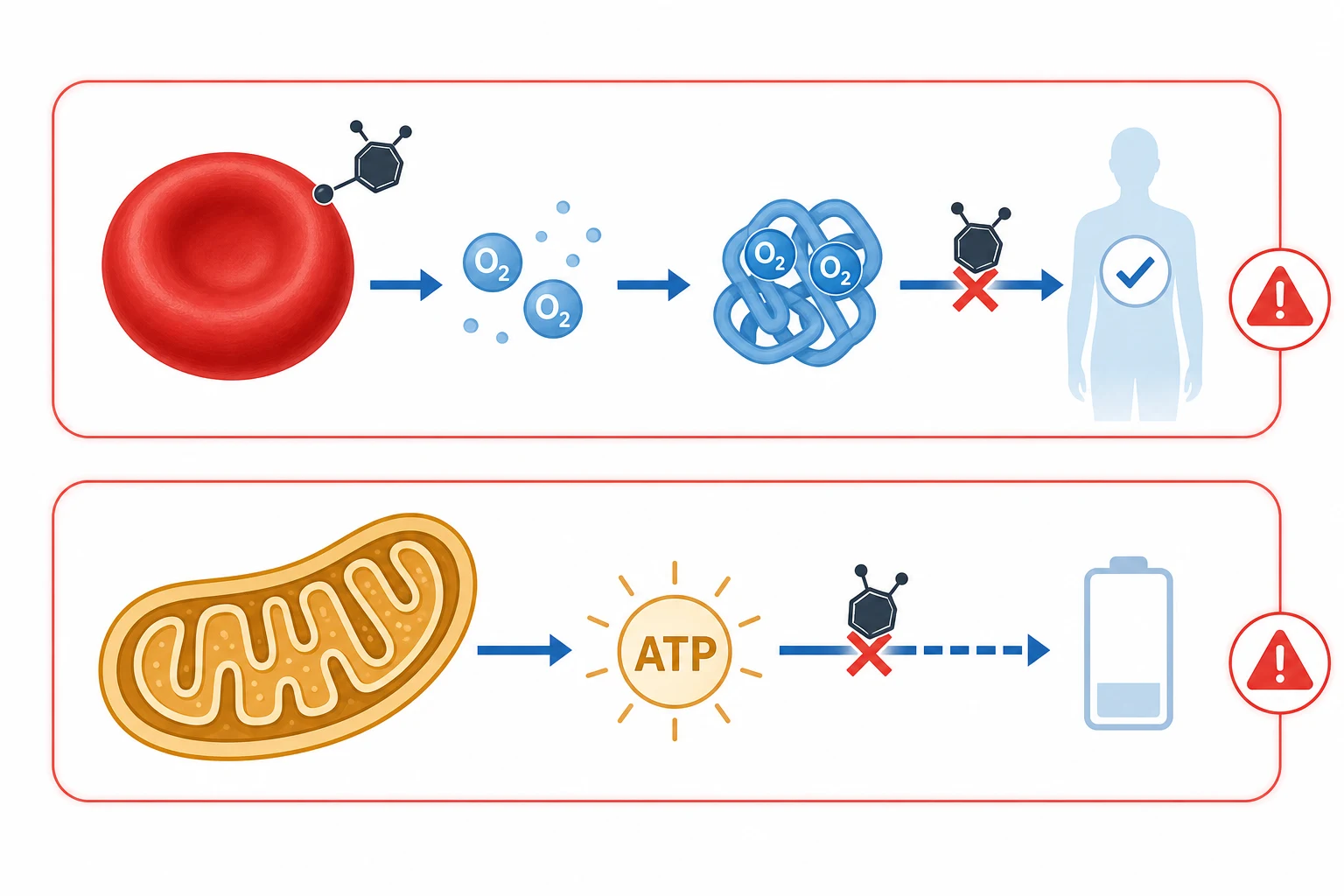
The mechanism is the single most examined fact in the topic and the candidate must explain it from first principles. Cyanide (the CN⁻ ion) binds the ferric iron (Fe³⁺) of cytochrome a3 within cytochrome c oxidase, complex IV of the mitochondrial electron transport chain. Binding halts electron transfer to molecular oxygen, so oxidative phosphorylation stops and the cell can no longer generate ATP aerobically. Every tissue is forced onto anaerobic glycolysis within seconds, generating lactate rapidly; the lactate is the bedside signature of the toxin.[2][6]
The mechanism in one chain
The consequences follow directly. Because the tissues cannot extract oxygen from the blood, the venous oxygen saturation rises and the arteriovenous oxygen difference narrows — this is "histotoxic hypoxia," a state in which the arterial blood is well oxygenated yet the cells starve. The brain and the heart, the most oxygen-dependent organs, fail first: the patient develops agitation, confusion, seizure and coma, and an initial transient hypertension (a catecholamine surge and the carotid-body chemoreflex) gives way to bradycardia, hypotension and cardiogenic shock as the myocardium fails.[2][5] Cyanide also inhibits the antioxidant enzyme catalase and glutathione reductase, contributing to oxidative injury once the cytochrome block is overcome.
[1]Detoxification in the body is slow and occurs principally through rhodanese (thiosulfate sulfurtransferase), a mitochondrial enzyme in the liver and kidney that transfers a sulfur atom from thiosulfate to cyanide, converting it to the far less toxic thiocyanate which is excreted by the kidney. The pathway is limited by the small endogenous pool of thiosulfate, which is why exogenous sodium thiosulfate is an antidote: it provides the rate-limiting sulfur donor. Hydroxocobalamin offers a second, faster route — it binds cyanide directly and stoichiometrically to form cyanocobalamin (vitamin B12), which is renally cleared.[5]
Sources and epidemiology
Smoke inhalation is the commonest cause of cyanide exposure presenting to the emergency department, and the source is the combustion of nitrogen-containing materials in an enclosed space: polyurethane foam (furniture and mattresses), plastics, wool, silk, melamine and nitrile polymers. Baud and colleagues demonstrated in 1991 that a substantial proportion of victims of enclosed-space house fires have elevated blood cyanide concentrations on arrival, and that the cyanide burden is independent of the carboxyhaemoglobin level — cyanide and carbon monoxide are parallel rather than surrogate toxins.[1] Industrial exposure concentrates in electroplating, metallurgy (gold and silver extraction), chemical synthesis, and fumigation; laboratory and jewellery-workshop accidents account for occasional salt exposures. Sodium nitroprusside, infused for hypertensive emergencies, releases cyanide and thiocyanate; toxicity is prevented and treated with sodium thiosulfate. Amygdalin ingestion (apricot-kernel or laetrile preparations) is a rare but recognised cause, classically in the alternative-medicine or home-pressing-fruit-juice context.[2][6]
Smoke inhalation (enclosed fire)
- Burning plastics, foam, wool release HCN alongside CO
- Unconscious fire survivor; soot in mouth, hoarse, airway injury
- Mixed CN + CO is the rule — treat both empirically
- Empirical hydroxocobalamin at the bedside before any level
Industrial / laboratory
- Electroplating, gold/silver extraction, fumigation, chemical synthesis
- Salt (KCN, NaCN) releases HCN on contact with acid or water
- Often a witnessed workplace exposure with a clear history
- Massive-dose ingestion or inhalation; decontaminate and PPE
Ingestion (salt / amygdalin)
- Deliberate self-harm with a cyanide salt — rapid, near-uniform mortality
- Amygdalin in apricot/peach kernels or laetrile preparations
- Enzymatic hydrolysis releases CN in the gut; onset minutes to hours
- Activated charcoal if early; hydroxocobalamin and thiosulfate
Nitroprusside (iatrogenic)
- High-dose or prolonged sodium nitroprusside infusion
- Slower onset; rising lactate and metabolic acidosis
- Prevent with sodium thiosulfate in the infusion bag
- Stop the infusion; give thiosulfate; hydroxocobalamin if severe
Clinical presentation
The presentation is dominated by the rapidity of onset and the severity of the cellular hypoxia. In a massive inhalation or ingestion the patient collapses within seconds to minutes, with seizure, coma and apnoea; in the smoke-inhalation case the onset is harder to time because the patient is already unconscious from the combined toxins and the airway injury. The candidate must hold the full picture:[2][6]
The airway and respiratory signs in the fire survivor are those of an inhalation injury — soot in the mouth and nostrils, singed nasal and facial hair, carbonaceous sputum, a hoarse voice and stridor — and mandate early intubation before oedema closes the airway. The neurological progression is agitation and anxiety, headache and dizziness, then seizure, coma and fixed dilated pupils as the brain fails; anoxic brain injury and a delayed parkinsonism of the basal ganglia follow in survivors. The cardiovascular course is characteristic: an initial transient hypertension from the catecholamine surge and the peripheral chemoreceptor response, followed by bradycardia, hypotension and cardiogenic shock with arrhythmia and cardiac arrest as the myocardium and the conducting system fail. The skin is classically cherry-red because the venous blood remains oxygenated (the tissues cannot extract the oxygen) and because cyanide does not shift the oxyhaemoglobin curve; this sign, like the cherry-red skin of carbon monoxide, is a late and uncommon finding and its absence never excludes the diagnosis. The bitter-almond smell on the breath is detected by only 40 to 60 per cent of the population (a genetic trait) and is wholly unreliable clinically.[6]
[1]Differential diagnosis
The differential is narrow at the bedside and turns on the lactate, the source history, and the co-existent carbon monoxide level. The Fellowship candidate must distinguish the mimics because the management diverges sharply — particularly the avoidance of the nitrite kit in the smoke-inhalation patient. [1]
Cyanide poisoning (smoke)
- Enclosed fire with plastics; rapid collapse, seizure, coma
- Lactate ≥10 mmol/L; metabolic acidosis out of proportion to COHb
- Soot in mouth; high venous O₂; cherry-red skin (rare)
- 100% oxygen + hydroxocobalamin 70 mg/kg IV; do NOT use nitrites
Carbon monoxide poisoning
- Any source of incomplete combustion; co-exists with cyanide in fire
- Headache, nausea, confusion; cherry-red skin (also rare)
- COHb elevated on co-oximetry; SpO₂ falsely normal
- 100% NRB oxygen; hyperbaric for severe; treat co-existent CN empirically
Sepsis / septic shock
- Fever, source, inflammatory response; hypotension
- Lactate raised but usually lower; source on work-up
- No soot or airway injury; normal COHb and venous O₂
- Antibiotics, fluids, source control, vasopressors
Methaemoglobinaemia
- History of an oxidising drug (dapsone, nitrates, local anaesthetics)
- Cyanosis unresponsive to oxygen; chocolate-brown blood
- Pulse oximetry reads ~85%; co-oximetry diagnostic
- Methylene blue 1 to 2 mg/kg IV (avoid in G6PD)
Severe lactic acidosis (shock, DKA)
- Hypotension, hypoperfusion; or hyperglycaemia with ketosis
- Lactate high; venous O₂ low (tissues extracting maximally)
- No fire or industrial source; metabolic work-up diagnostic
- Treat the underlying shock or the ketoacidosis
The decisive discriminator in the fire survivor is the lactate level: a venous or arterial lactate at or above 10 mmol per litre in an unconscious fire victim is, in the absence of profound shock alone, the bedside surrogate for cyanide and is the trigger for empirical hydroxocobalamin.[4][6] The carbon monoxide level is sent at the same time and treated in parallel, because the two toxins co-exist and one does not exclude the other.
Bedside assessment
Assess and resuscitate in parallel, and protect the staff — contaminated clothing, vomitus and the exhaled gas of a cyanide-salt ingestion are hazardous; remove and double-bag the clothing and ventilate the room. Airway — in the fire survivor, look for the inhalation-injury signs (soot in the mouth, singed nasal hair, hoarse voice, stridor) and intubate early before oedema closes the airway. Breathing — give 100 per cent oxygen via a non-rebreather mask at 15 L per minute from the moment of first contact; ventilate with bag-valve-mask and 100 per cent oxygen if the patient is unconscious or apnoeic, with a low threshold for rapid sequence intubation. Circulation — cardiac monitoring (arrhythmia and ischaemia), IV access, treat hypotension with a balanced crystalloid bolus and then a vasopressor if shock persists. Disability — document the Glasgow Coma Scale, reproduced because the depth of coma determines the urgency: eye opening (4 spontaneous, 3 to speech, 2 to pain, 1 none), verbal response (5 oriented, 4 confused, 3 inappropriate words, 2 incomprehensible sounds, 1 none) and motor response (6 obeys commands, 5 localises pain, 4 withdraws, 3 abnormal flexion, 2 abnormal extension, 1 none), for a maximum of 15; record the pupils, the blood glucose and a focused neurological examination, because the neurological baseline and the presence of seizure determine the urgency and the prognosis. Exposure and environment — establish the source (fire, industrial, ingestion, nitroprusside), the duration of exposure, the enclosed nature of the space, and any co-ingestants.[4]
Investigations and the lactate surrogate
The diagnosis is clinical and the treatment is empirical; the confirmatory blood cyanide level is rarely available within the timeframe of the resuscitation and should not delay the first dose of antidote. The bedside surrogate is the lactate: a venous or arterial lactate at or above 10 mmol per litre in a fire survivor has a high sensitivity for clinically significant cyanide poisoning and is the trigger for empirical hydroxocobalamin.[4][6]
The key investigations
A full panel is sent in parallel: a blood gas (for the acid-base status and the lactate), electrolytes and renal function, a blood glucose (hypoglycaemia suggests profound cellular failure), a 12-lead ECG and troponin (myocardial injury is common), a beta-hCG in any woman of childbearing age, and a blood cyanide level for retrospective confirmation if available. A computed tomography of the brain is reserved for the patient whose coma or seizure is disproportionate to the toxin, to exclude a concurrent head injury or stroke. In the smoke-inhalation patient, a bronchoscopy may be performed once stable to grade the inhalation injury. [1]
Immediate management and resuscitation
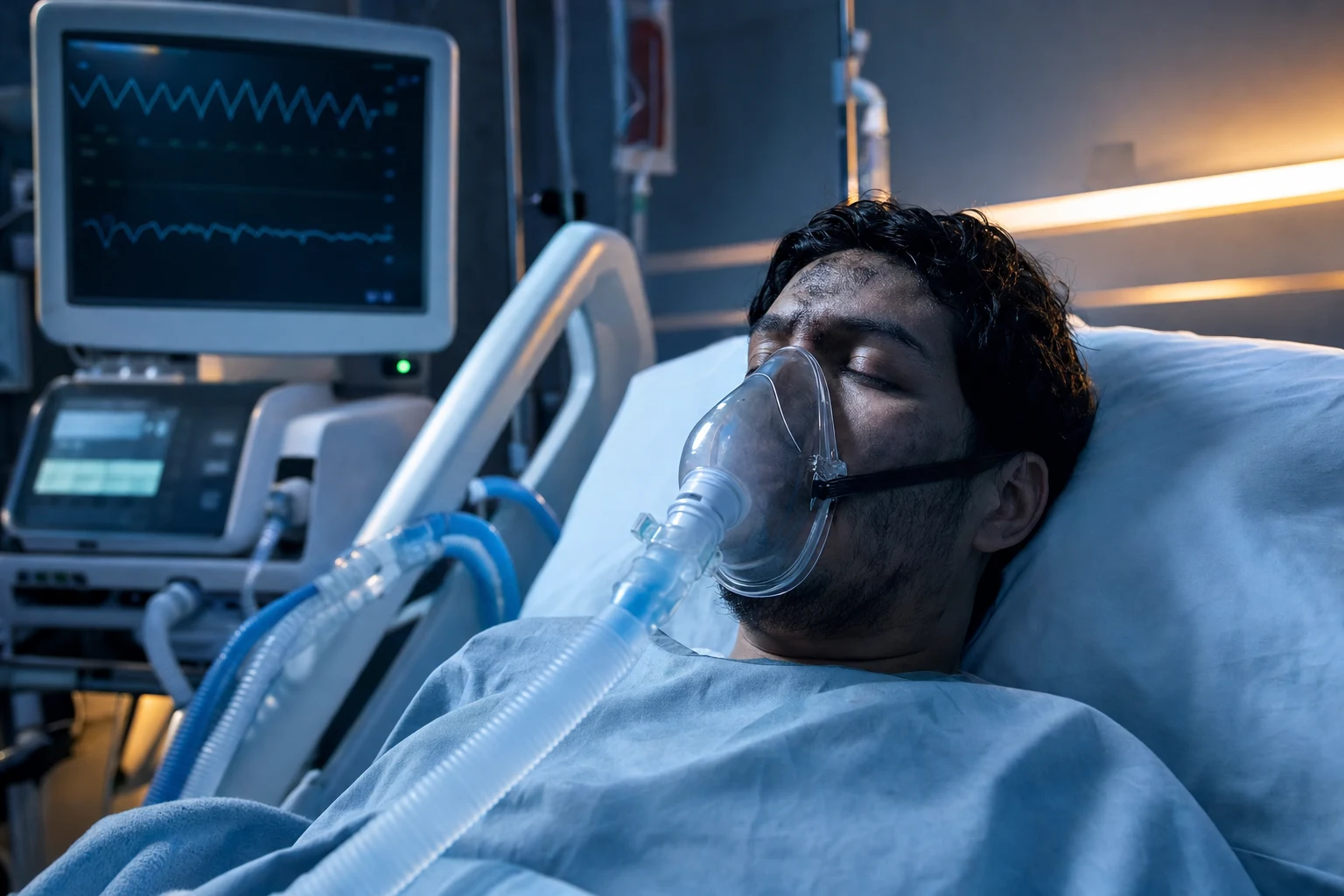
Resuscitation follows ABCDE with 100 per cent oxygen as the universal first treatment. 100 per cent oxygen via a non-rebreather mask at 10 to 15 L per minute is started at the scene and continued without interruption; it does not displace cyanide from cytochrome oxidase directly, but it raises the dissolved plasma oxygen, maximises the small residual aerobic capacity of the partially inhibited cell, and synergises with every antidote. The oxygen is continued for a minimum of 24 hours after the exposure or until the patient is stable and the lactate has normalised.[4]
The immediate management
The airway in the fire survivor is the time-critical step: the inhalation-injury signs mandate rapid sequence intubation early, before the oedema progresses to complete obstruction. Seizures are terminated with lorazepam 4 mg intravenously (or midazolam 5 to 10 mg intravenously) along the status-epilepticus ladder while the underlying hypoxia and acidosis are corrected. Hypotension is treated with a balanced crystalloid bolus (250 to 500 mL aliquots) and an early vasopressor (noradrenaline) if shock persists, recognising that the myocardium is failing. Sodium bicarbonate is reserved for a pH below 7.1 that is refractory to oxygen and antidote, because it can worsen the tissue CO₂ load and the intracellular acidosis. [1]
Definitive management — the antidotes
The antidote of choice is hydroxocobalamin, and the candidate must know the dose, the rationale, and the reasons it is preferred over the alternatives. [1]
Hydroxocobalamin — the antidote of choice
Hydroxocobalamin binds cyanide directly and stoichiometrically, forming cyanocobalamin (vitamin B12) which is excreted by the kidney; the reaction is immediate and does not depend on an enzyme, so onset is faster than the thiosulfate route. It causes neither hypotension nor methaemoglobinaemia, which is why it is the preferred antidote in the smoke-inhalation patient (in whom the diagnosis is presumptive and co-existent carbon monoxide is the rule) and in the hypotensive patient.[3][4] Borron and colleagues, in a prospective study of smoke-inhalation victims, established the safety and the clinical effect of hydroxocobalamin in this setting.[3] The predictable and harmless side effects — a red discoloration of the skin and the urine that lasts for several days, and a transient rise in blood pressure from scavenging of nitric oxide — must be explained to staff and to the patient, because the red urine can otherwise be mistaken for haematuria or rhabdomyolysis.[5]
Sodium thiosulfate is the second-line or combination antidote. It provides the rate-limiting sulfur donor for the rhodanese pathway, accelerating the conversion of cyanide to thiocyanate. The adult dose is 12.5 g intravenously (25 mL of the 50 per cent solution, or as the 25 per cent paediatric preparation); the paediatric dose is 400 mg per kilogram. Its onset is slower than hydroxocobalamin because it depends on the mitochondrial rhodanese, so it is given in combination with hydroxocobalamin for severe poisoning rather than as a substitute, and it is the antidote of choice for nitroprusside-associated cyanide toxicity.[5][2]
[1]Dicobalt edetate is a third alternative that chelates cyanide directly, but it causes severe hypotension in the absence of cyanide and is therefore reserved for the confirmed pure cyanide case (an industrial or ingestion exposure with a certain diagnosis); it has no place in the empirical treatment of the smoke-inhalation patient, in whom the diagnosis is presumptive.[5]
Subtypes and scenarios
The smoke-inhalation case is the Fellowship prototype and the scenario above. The candidate must treat the combined cyanide and carbon monoxide, secure the airway for the inhalation injury, and liaise with the burns centre. The pure cyanide-salt ingestion or inhalation is rarer but lethal within minutes; decontamination, 100 per cent oxygen, hydroxocobalamin and sodium thiosulfate are given together, and the staff must be protected from the off-gassing hydrogen cyanide. Nitroprusside-associated cyanide toxicity is slower and iatrogenic, presenting as a rising lactate and metabolic acidosis during a high-dose or prolonged infusion; the management is to stop or reduce the nitroprusside and give sodium thiosulfate, with hydroxocobalamin reserved for the severe case. Prevention — by adding sodium thiosulfate to the nitroprusside infusion or limiting the dose and the duration — is the standard.[2][6] Amygdalin ingestion (apricot-kernel or laetrile preparations) releases cyanide on gut hydrolysis; onset is minutes to hours and the management is activated charcoal if early, 100 per cent oxygen, hydroxocobalamin and sodium thiosulfate. Pregnancy — hydroxocobalamin is the preferred antidote in pregnancy because it does not cause methaemoglobinaemia in the fetus, and 100 per cent oxygen is continued for longer.
Complications and pitfalls
The complications are the consequences of the cellular hypoxia and of the resuscitation. Anoxic brain injury is the dominant morbidity in survivors; a delayed parkinsonism of the basal ganglia (with globus pallidus changes on imaging, akin to carbon monoxide) may emerge over weeks. Cardiogenic shock and arrhythmia are the commonest causes of early death. Acute kidney injury follows the prolonged hypotension, and methaemoglobinaemia is a complication of the (inappropriate) nitrite kit rather than of the toxin itself. The red skin and urine of hydroxocobalamin is benign but must be distinguished from haemolysis and rhabdomyolysis. [1]
The pitfalls are the inverse of the management. Waiting for the cyanide level is the cardinal error — the treatment is empirical and the level rarely returns in time. Using the nitrite kit in a smoke-inhalation patient worsens the co-existent carbon monoxide and the oxygen delivery. Forgetting the co-existent carbon monoxide is the second-toxin pitfall; the COHb is sent and treated in parallel. Underestimating the airway — the inhalation injury closes fast, and the delayed intubation is the avoidable death. Treating the hypotension with the wrong antidote — dicobalt edetate in a patient who does not have cyanide — causes the very collapse it is meant to reverse. Failing to protect the staff from a cyanide-salt ingestion (off-gassing hydrogen cyanide from clothing and vomitus) is the occupational hazard.[4][5][6]
Prognosis and disposition
The mortality is driven by the source, the dose, and the time to antidote. The pure cyanide-salt ingestion carries a near-uniform mortality because the dose is massive and the onset is within minutes; the smoke-inhalation case has a better prognosis if the combined toxins and the airway are managed early, but the unconscious fire survivor with a lactate at or above 10 mmol per litre remains a high-mortality presentation. Every patient receiving an antidote is admitted to intensive care for ongoing monitoring of the airway, the cardiovascular status, the lactate, and the acid-base balance. Survivors are followed up for the delayed neurological sequelae — the cognitive impairment and the parkinsonism — over the weeks following the exposure, mirroring the follow-up of the carbon monoxide patient. The patient on nitroprusside is managed on the ward or the high-dependency unit with the infusion reduced or stopped and the lactate monitored. [1]
Special populations
The fire survivor is the prototype and is treated empirically for combined cyanide and carbon monoxide plus the inhalation airway injury. The pregnant patient receives hydroxocobalamin (safe in pregnancy) and prolonged 100 per cent oxygen, with obstetric involvement for the fetal monitoring. The child is dosed by weight — hydroxocobalamin 70 mg per kilogram, sodium thiosulfate 400 mg per kilogram — and the inhalation-injury airway is intubated with a low threshold. The patient on nitroprusside is managed with the infusion reduced or stopped and sodium thiosulfate, reserving hydroxocobalamin for the severe case. The industrial or laboratory worker is decontaminated before entering the department to protect the staff from off-gassing hydrogen cyanide. [1]
Evidence and regional guidelines
The evidence base is built on the references the Fellowship candidate must know. Baud and colleagues (NEJM 1991) demonstrated that a substantial proportion of victims of enclosed-space house fires have elevated blood cyanide concentrations on arrival, independent of the carboxyhaemoglobin level — the foundational paper establishing cyanide as a partner toxin in smoke inhalation.[1] Beasley and Glass (Occupational Medicine 1998) is the pathophysiology and treatment-recommendations reference that codifies the mechanism and the antidote options.[2] Borron and colleagues (Annals of Emergency Medicine 2007) is the prospective study establishing the safety and the clinical effect of hydroxocobalamin in the smoke-inhalation patient.[3] Reade and the Australian Resuscitation Council (Emergency Medicine Australasia 2012) is the ANZ review of the management of cyanide poisoning and the regional consensus that the empirical treatment of the unconscious fire survivor with a high lactate is standard.[4] Borron (Current Pharmaceutical Biotechnology 2012) is the antidotes review covering hydroxocobalamin, the nitrite kit, dicobalt edetate and sodium thiosulfate.[5] Parker-Cote and colleagues (Clinical Toxicology 2018) is the contemporary review of the diagnostic challenges, including the lactate surrogate and the unreliability of the bitter-almond smell.[6]
ANZ practice note. The Australasian approach, codified in the Reade review (EMA 2012) and the Australian Resuscitation Council guidance, is to treat the unconscious fire survivor empirically: 100 per cent oxygen, secure the airway early for the inhalation injury, and administer hydroxocobalamin 70 mg per kilogram (adult 5 g) intravenously when the lactate is at or above 10 mmol per litre or the clinical picture is consistent, without waiting for a cyanide level. The nitrite kit is avoided in the smoke-inhalation patient because of the methaemoglobinaemia risk in co-existent carbon monoxide. Sodium thiosulfate 12.5 g intravenously is given in combination with hydroxocobalamin for severe poisoning, and is the antidote of choice for nitroprusside-associated cyanide toxicity. Many urban fire and ambulance services in Australia and New Zealand carry hydroxocobalamin for pre-hospital administration to the unconscious fire survivor, reflecting the consensus that the antidote is time-critical. [1]
Exam pearls
- Mechanism: cyanide binds the ferric iron (Fe³⁺) of cytochrome a3 in cytochrome c oxidase (complex IV), halting oxidative phosphorylation and forcing anaerobic glycolysis — a high lactate with a high arterial and venous oxygen.
- The lactate surrogate: a lactate at or above 10 mmol per litre in a fire survivor is the bedside trigger for empirical hydroxocobalamin — do not wait for the cyanide level.
- The antidote of choice: hydroxocobalamin 70 mg per kilogram (adult 5 g) intravenously over 15 minutes; no hypotension, no methaemoglobinaemia — preferred in the smoke-inhalation and the hypotensive patient.
- The antidote to avoid: the nitrite kit (amyl or sodium nitrite) in the smoke-inhalation patient — induced methaemoglobinaemia worsens the co-existent carbon monoxide and the oxygen delivery.
- The partner toxin: co-existent carbon monoxide is the rule in the fire survivor — send the COHb and treat it in parallel with 100 per cent oxygen (and hyperbaric referral for the severe case).
- The cherry-red skin and the bitter-almond smell are classic but unreliable; their absence never excludes cyanide, and only 40 to 60 per cent of people can smell the almond. [1]
Model answer — A 48-year-old man pulled unconscious from an enclosed house fire, GCS 6, soot in the mouth, hoarse, lactate 14 mmol/L, ABG pH 7.08, COHb 22%. Outline the immediate management.
Immediate management. The diagnosis is combined cyanide and carbon monoxide poisoning with an inhalation airway injury. The lactate of 14 mmol per litre is the bedside surrogate for cyanide and is the trigger for empirical antidote; the COHb of 22 per cent confirms the partner toxin. Do not wait for a cyanide level — it is rarely available in time. [1]
Resuscitate in parallel. Airway — the hoarseness and the soot in the mouth are inhalation-injury signs; intubate now by rapid sequence induction before oedema closes the airway. Breathing — 100 per cent oxygen via the ventilator from the moment of intubation, continued for at least 24 hours; this treats both the cyanide (synergistic with the antidote) and the carbon monoxide (shortens the COHb half-life to about 60 to 80 minutes). Circulation — cardiac monitoring, two large-bore cannulae, a balanced crystalloid bolus for the hypotension, and an early vasopressor if shock persists. [1]
Empirical hydroxocobalamin 5 g intravenously over 15 minutes is given now — it binds cyanide directly to form cyanocobalamin, causes no hypotension and no methaemoglobinaemia, and is the preferred antidote in the smoke-inhalation patient. Sodium thiosulfate 12.5 g intravenously is given in combination for the severe poisoning. Do not use the nitrite kit — the induced methaemoglobinaemia would worsen the co-existent carbon monoxide and the already-compromised oxygen delivery. [1]
Continue 100 per cent oxygen, reassess the lactate and the gas, and admit to intensive care. Discuss the carbon monoxide with the on-call hyperbaric unit given the loss of consciousness and the neurological involvement. Liaise with the burns centre for the inhalation injury. [1]
Exam practice
SAQ — Smoke-inhalation cyanide: empirical hydroxocobalamin in the unconscious fire survivor
10 minutes · 10 marks
A 52-year-old man is pulled unconscious from an enclosed-space house fire started by a polyurethane mattress and foam furniture, and arrives by ambulance 25 minutes later. He has soot in his mouth and nostrils, singed nasal hair and a hoarse voice. GCS 6 (E1V1M4); the blood pressure was 168/94 in the ambulance and is now 84/52; heart rate 128, respiratory rate 8 and irregular, SpO2 92 per cent on 15 L oxygen via a bag-valve-mask. The venous gas shows pH 7.02, PaO2 9.8 kPa, lactate 13.6 mmol per litre, and co-oximetry shows a carboxyhaemoglobin of 28 per cent. The intensive-care team is 15 minutes away.
SAQ — Pure cyanide toxicity: the high-lactate collapse differential and staff safety
10 minutes · 10 marks
A 47-year-old electroplating worker is brought to the emergency department 20 minutes after collapsing at work while cleaning a vat with potassium cyanide and hydrochloric acid. He is unconscious, GCS 7 (E1V2M4), with an initial blood pressure of 162/96 then falling to 88/50, heart rate 54, respiratory rate 28 then apnoeic, SpO2 95 per cent on 15 L oxygen. The venous gas shows pH 7.10, PaO2 13.4 kPa, lactate 11.8 mmol per litre, and co-oximetry shows carboxyhaemoglobin 2 per cent and methaemoglobin 1 per cent. One of the nurses can smell bitter almonds. There is no fire or smoke exposure and the colleague confirms the vat-cleaning history.
SAQ — Cyanide from smoke inhalation in pregnancy: combined CN and CO management
10 minutes · 10 marks
A 31-year-old woman who is 34 weeks pregnant is pulled unconscious from an enclosed house fire caused by a burning polyurethane sofa. She has soot in the nostrils and oropharynx, singed eyebrows and a hoarse voice, GCS 5 (E1V1M3), blood pressure 96/58, heart rate 132, respiratory rate 6, SpO2 90 per cent on 15 L oxygen via bag-valve-mask. The venous gas shows pH 7.04, lactate 12.4 mmol per litre, and co-oximetry shows carboxyhaemoglobin 31 per cent. The obstetric and ICU teams are en route.
SAQ — Hydroxocobalamin mechanism and the antidote comparison
10 minutes · 10 marks
A 44-year-old industrial chemist is brought to the emergency department after a witnessed collapse in a gold-extraction plant while handling potassium cyanide. He is unconscious, GCS 6, with an initial blood pressure of 172/98 falling to 80/44, heart rate 48, respiratory rate 4, SpO2 94 per cent on 15 L oxygen. The venous gas shows pH 7.06, PaO2 13.8 kPa, lactate 12.1 mmol per litre, COHb 2 per cent. The toxicology registrar asks you to justify the antidote strategy and explain the mechanism of each agent from first principles.
Red flags [1]
[1]References
- [1]Baud FJ, Barriot P, Toffis V, et al. Elevated blood cyanide concentrations in victims of smoke inhalation N Engl J Med, 1991.PMID 1944484
- [2]Beasley DM, Glass WI. Cyanide poisoning: pathophysiology and treatment recommendations Occup Med (Lond), 1998.PMID 10024740
- [3]Borron SW, Baud FJ, Barriot P, Imbert M, Bismuth C. Hydroxocobalamin for severe acute cyanide poisoning by ingestion or inhalation Am J Emerg Med, 2007.PMID 17543660
- [4]Reade MC, Davies SR, Morley PT, Dennett J, Jacobs IC; Australian Resuscitation Council. Review article: management of cyanide poisoning Emerg Med Australas, 2012.PMID 22672162
- [5]Borron SW. Antidotes for acute cyanide poisoning Curr Pharm Biotechnol, 2012.PMID 22352728
- [6]Parker-Cote JL, Brewer KL, Meggs WJ. Challenges in the diagnosis of acute cyanide poisoning Clin Toxicol (Phila), 2018.PMID 29417853