EM · Consent, capacity and medico-legal
Consent, capacity and the medico-legal framework in the emergency department
Also known as Informed consent · Capacity assessment · Doctrine of necessity · Mental Health Act and schedules · Chemical and physical restraint · Police blood sample request
Consent, capacity and the medico-legal framework in the emergency department — informed consent and its five elements (nature, purpose, risks, alternatives, consequences of refusal), the four-stage test of capacity (understanding, retention, weighing, communicating) with the principles of presumption, and that capacity is decision-specific and time-specific, emergency treatment without consent under the common-law doctrine of necessity, restraint (chemical, physical and the legal basis), the Mental Health Act and involuntary detention schedules, the police request for a blood sample, and child protection including the mature minor and mandatory reporting. Covers the pharmacology of acute agitation — midazolam, droperidol and olanzapine with doses. ACEM-primary, globally tagged.
On this page & tools
Your progress
Saved locally on this device.
8 MCQs with explanations
Target exams
Red flags
Consent and capacity are the medico-legal backbone of every emergency department encounter, and they are examined directly in Fellowship SAQ and OSCE stations. The emergency setting distorts the usual rules: patients arrive unknown, the relationship is unformed, decisions are time-critical, intoxication and delirium are common, and the law carves specific exceptions for the emergency that does not exist in the clinic. The trainee must hold two principles in tension at every bedside — autonomy, the patient's right to determine what is done to their body, and the duty of care, the obligation to treat where treatment is needed and consent cannot be obtained. The framework below resolves that tension: valid consent requires capacity, capacity is assessed by a four-stage test, and where capacity and consent are both absent in a life-threatening emergency, the common-law doctrine of necessity permits treatment. [1]
The scope of consent in the emergency department
Consent is the voluntary, informed and specific agreement of a patient to a proposed investigation or treatment. Three features make a consent valid: it is given by a patient with capacity, it is informed (the patient has received the material information), and it is voluntary (free of coercion or undue influence). Consent may be express — spoken or written, required for significant procedures, anaesthesia, sedation, blood transfusion and high-risk treatment — or implied, inferred from the patient's conduct, such as extending an arm for a cannula or cooperating with examination. The emergency department leans heavily on implied consent for the routine assessment of the alert, oriented patient, but the moment a needle, a blade, a blood product, a sedative or a restraint is contemplated, express consent is the standard. Consent is procedure-specific: consent to suture a laceration does not extend to reducing a fracture, and consent to one operation does not extend to a second. Consent may be withdrawn at any time, and the withdrawing patient must be respected as if they had never consented, provided they retain capacity.
Implied consent
- Inferred from the patient's conduct — extending an arm for a cannula, rolling up a sleeve for a blood pressure, opening the mouth for examination
- The everyday default for the routine assessment of the alert, oriented patient who presents voluntarily to the emergency department
- Sufficient for history, examination, venepuncture, cannulation, routine blood tests and basic imaging
- Insufficient the moment a significant intervention is contemplated — a procedure, sedation, a blood product, a restraint — at which point express consent is required
Express (spoken) consent
- A verbal agreement after disclosure of the nature, purpose, risks, alternatives and consequences
- Suitable for low-to-moderate-risk procedures — suturing a laceration, reducing a dislocation, lumbar puncture, urinary catheterisation
- Should be witnessed and documented in the record: what was explained, what was agreed, and by whom
- May be withdrawn at any time; the withdrawing patient is treated as if they had never consented, provided they retain capacity
Express (written) consent
- A signed consent form recording the disclosure and the agreement
- Required for significant procedures, anaesthesia, procedural sedation, blood transfusion, high-risk or irreversible treatment, and most operative interventions
- The signature evidences the consent; it does not constitute it — a signed form without a genuine disclosure conversation is not valid consent
- Particular weight in the medico-legal record, and expected for anything carrying a material risk of death, disability or disfigurement
Informed consent — the five elements
Informed consent is not a signature on a form; it is a conversation in which the clinician discloses the information a reasonable person in the patient's position would want. The modern standard, set in the Australian High Court in Rogers v Whitaker and reaffirmed by the United Kingdom Supreme Court in Montgomery v Lanarkshire, replaced the old "what would a reasonable doctor disclose" test with the reasonable patient standard: the clinician must disclose what a prudent patient would regard as significant to their decision. Five elements make a disclosure complete.[1]
The five elements of informed consent disclosure
NPRAC
What the investigation or treatment actually is — in plain language, what will be done to the patient
Why it is proposed — the expected benefit and the clinical reason for recommending it
The material risks — common and serious adverse outcomes a reasonable patient would want to know, including death, disability, bleeding, allergy and the specific procedure-specific risks
The reasonable alternatives, including the option of no treatment, so the patient weighs the choice against something real
What is likely to happen if the patient declines — the natural history untreated, framed without coercion
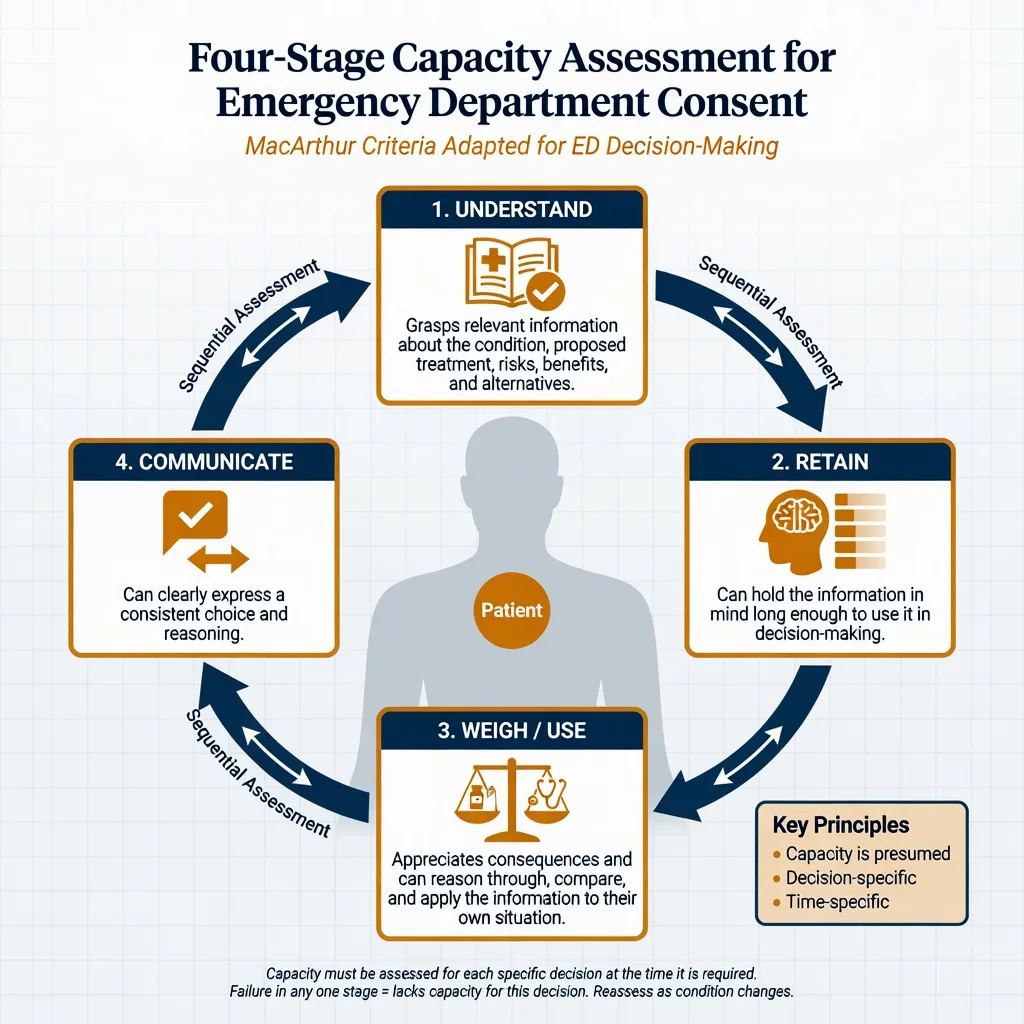
Capacity assessment — the four-stage test
Capacity is the cognitive and functional ability to make a specific decision at a specific time. Appelbaum's authoritative account frames capacity as decision-making competence judged at the bedside, and the test codified in the United Kingdom Mental Capacity Act 2005 is the structure the Fellowship examiner expects.[1] Capacity is assessed for this decision, now: a patient may have capacity to consent to analgesia but not to refuse life-saving surgery, and capacity to refuse in the morning may be lost to delirium by evening. The four-stage test asks whether the patient can do each of the following, after the clinician has explained the nature, purpose, risks, alternatives and consequences in plain language appropriate to the patient.
[1]Three governing principles accompany the test and are themselves examinable. Capacity is presumed in every adult unless incapacity is established on the balance of probabilities; the burden falls on the clinician who wishes to override. All practicable steps to support the decision must be exhausted before incapacity is found — treat the hypoglycaemia, reverse the opioid, call the interpreter, allow the alcohol to metabolise, address pain. An unwise decision is not of itself evidence of incapacity: the patient who refuses a transfusion for religious reasons, or who declines chemotherapy, may be entirely capacitous, and eccentricity or a value the clinician rejects does not remove capacity.[1] Capacity is also decision-specific and time-specific: re-assess when the clinical state or the decision changes.
Model answer — the capacity assessment to perform
Differential — the decision scenarios distinguished
The consent decision in the emergency department takes a different shape for each scenario, and distinguishing them is itself a tested competency. A candidate who treats the intoxicated refuser like the psychotic patient, or the mature minor like the delirious elderly patient, will mishandle the station. The five scenarios below recur in SAQ stems and OSCE communication assessments. [1]
The intoxicated patient
- Intoxication does not of itself remove capacity — assess on the specific decision
- Re-assess when the blood alcohol or drug level falls; capacity may return within hours
- Where intoxication precludes assessment and the emergency is immediate, treat under necessity
- Document the level, the assessment, and the plan to re-assess when sober
The delirious patient
- Acute confusional state with fluctuating cognition is a common and reversible cause of incapacity
- Identify and treat the precipitant — sepsis, hypoxia, hypoglycaemia, drug withdrawal
- Capacity assessment is unreliable until the delirium lifts; treat under necessity in the interim
- Distinguished from dementia by acute onset, inattention and fluctuation rather than chronic stable deficit
The acutely psychotic patient
- Capacity is impaired when delusional belief overrides reasoning about treatment
- Assess on the decision — a psychotic patient may retain capacity for a simple procedural consent
- Treatment of the mental illness itself falls under mental-health legislation, not ordinary consent
- Risk to self or others may justify involuntary detention and scheduled treatment
The patient with dementia
- Capacity is decision-specific — may retain capacity for a minor procedure but lack it for complex discharge decisions
- Re-assess at the time of the decision, not on the historical label
- Involve family and substitute decision-makers, but do not delegate the assessment to them
- Recognise that dementia with superimposed delirium loses capacity that may be regained when delirium clears
The mature minor
- A child who understands the treatment may consent alone — the Gillick test
- Parental refusal cannot override a competent child, and parental consent cannot force a competent child
- Assess understanding directly with the child, away from parental pressure
- Where the child lacks capacity and parents refuse life-saving treatment, seek the court or guardianship order
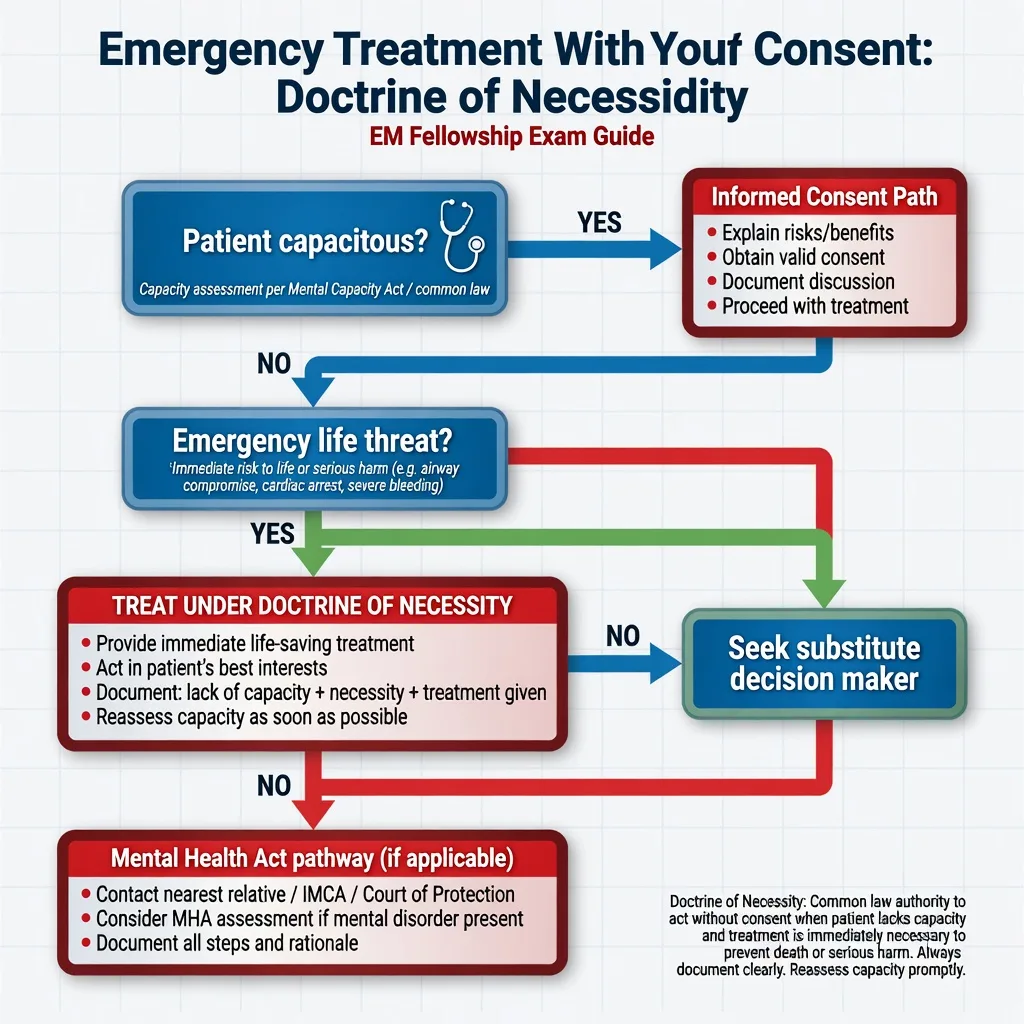
Emergency treatment without consent — the doctrine of necessity
Where an adult lacks capacity and treatment is immediately necessary to save life or prevent serious deterioration, the common-law doctrine of necessity renders the treatment lawful. The doctrine applies when three conditions hold: the patient lacks capacity for the decision, the treatment is necessary (life-saving or to prevent serious harm), and the treatment is that which a reasonable person in the patient's position would accept. The doctor acts in the patient's best interests, taking into account the patient's known values, prior wishes and any advance directive. In the United Kingdom the Mental Capacity Act 2005 codifies this for adults, so that emergency treatment of an incapable adult is given under the Act's best-interests provisions rather than bare common law; in Australia and New Zealand the common-law doctrine operates alongside state guardianship legislation. The doctrine does not extend to elective, non-urgent or discretionary treatment, and it does not permit treatment that the patient, while capacitous, has validly refused in an advance directive. Where there is time, the registrar or consultant must be involved, the assessment and the necessity documented in the contemporaneous record, and the patient or substitute decision-maker informed as soon as practicable. [1]
[1]Restraint and the pharmacological management of acute agitation
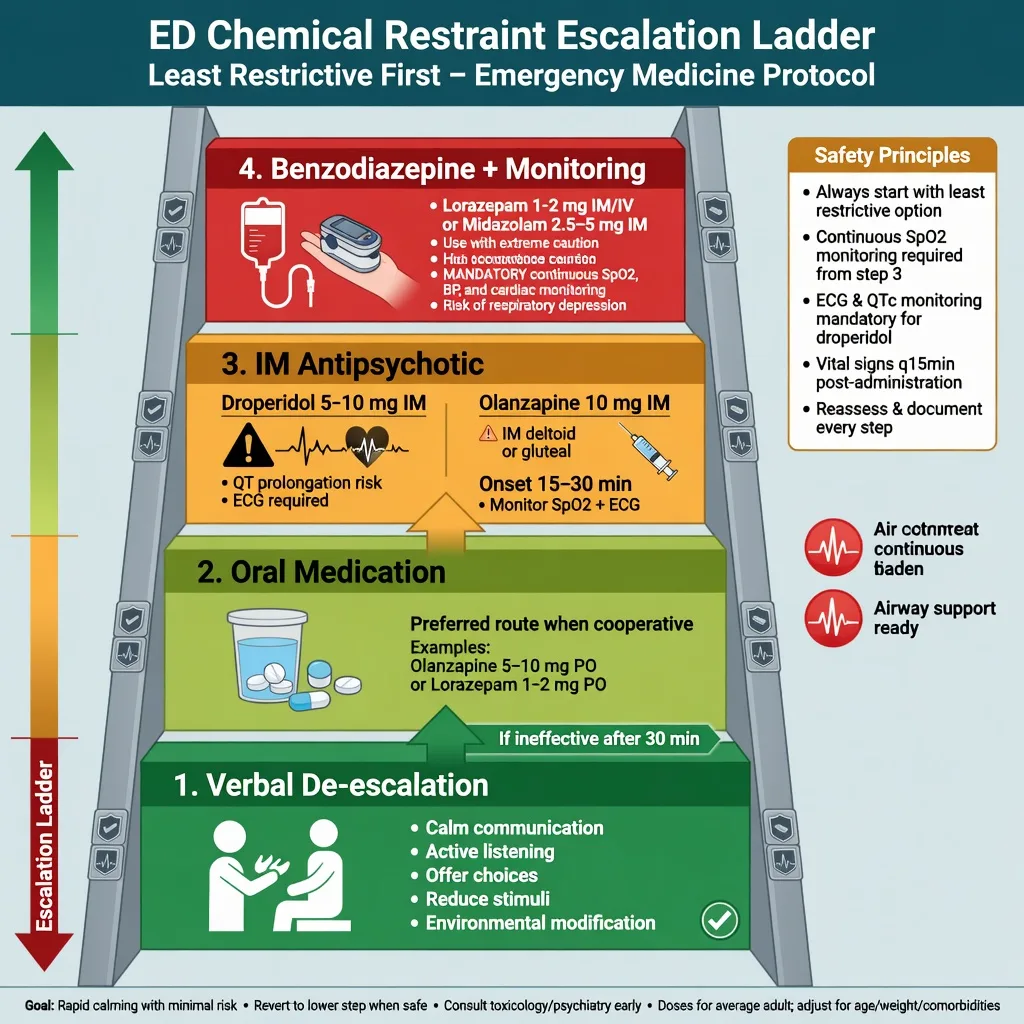
Restraint in the emergency department is the deliberate restriction of a patient's freedom, and it is lawful only when it is proportionate, necessary and the least restrictive option available, and only for as long as the indication persists. Restraint divides into physical — manual holding by staff, mechanical devices and seclusion — and chemical, the use of sedative medication to control dangerous agitation. Physical restraint carries the risks of rhabdomyolysis, positional asphyxia, aspiration, deep venous thrombosis and sudden death, and chemical restraint carries the risks of oversedation, respiratory depression, hypotension, paradoxical disinhibition and, with some agents, QT prolongation and dystonia. The systematic review of chemical restraint confirms that it is effective at achieving behavioural control but that the evidence base is modest and the harms real, so the decision to restrain is a clinical and legal act, documented and reviewed.[2]
The pharmacological management of severe acute behavioural disturbance follows a stepwise escalation: verbal de-escalation and oral medication first where the patient will accept it, then intramuscular medication when the patient is a danger to themselves or others and oral is refused or impractical. The three first-line agents and their emergency doses are droperidol, olanzapine and midazolam, all given intramuscularly for the acutely agitated patient, with the choice guided by the suspected cause and the comorbidities. [1]
[1]The randomised comparison of intramuscular droperidol, olanzapine, midazolam and lorazepam for methamphetamine-associated agitation found droperidol and olanzapine effective for sustained control and midazolam effective but with a higher requirement for additional sedation, supporting droperidol as the first-line agent for undifferentiated agitation.[3] Combination therapy (a "sedation duo" of droperidol plus midazolam) is widely used for the most severely agitated patient but amplifies the respiratory and cardiovascular risks, and post-administration monitoring — pulse oximetry, blood pressure, level of consciousness and, for droperidol, the electrocardiogram — is mandatory until the patient is calm and arousable. Physical restraint, where used, is released as chemical sedation takes effect, never maintained as a substitute for treatment.
The escalation ladder for acute behavioural disturbance — verbal, oral, parenteral, restraint
1 — Verbal de-escalation (always first)
A single trained clinician engages at an angle, not face-on, at two arms length, calm and non-confrontational. Offer choices — a seat, a drink, food, a low-stimulus room, oral medication. The aim is a collaborative, voluntary reduction in arousal. The Project BETA consensus established that the majority of agitated patients settle with competent verbal de-escalation alone, and that every restraint episode represents a failure of this step.
2 — Oral medication (the voluntary chemical step)
Where the patient accepts medication but remains agitated, give olanzapine 5 to 10 mg orally (orodispersible), or risperidone 1 to 2 mg oral liquid, or lorazepam 1 to 2 mg orally, alone or in combination. The oral route is safer, slower, and respects autonomy; it is the underused middle step between words and an intramuscular injection.
3 — Intramuscular medication (the involuntary chemical step)
For the patient who is a danger to self or others and refuses or cannot take oral medication, give droperidol 5 to 10 mg IM as first-line, midazolam 5 to 10 mg IM for stimulant-driven agitation, or olanzapine 5 to 10 mg IM (never co-administered with an IM benzodiazepine). Pre-dose observations including a 12-lead ECG for any dopamine antagonist, and bedside glucose for every patient.
4 — Physical restraint (the last resort)
A minimum of five trained staff, a team leader coordinating the limbs and head, a planned move announced aloud, supine or seated positioning never prone. Physical restraint is held only until chemical sedation takes effect, then released limb by limb as arousal falls. The prone position and prolonged struggle are the proximate causes of restraint-related sudden death.
5 — Post-restraint monitoring and review
Continuous pulse oximetry and direct visual observation until calm and arousable; blood pressure and respiratory rate every 15 minutes; cardiac monitoring where a dopamine antagonist was given. Document the indication, the team, the agents and doses, the duration of each limb of restraint, and the debrief. A formal debrief of staff and, later, of the patient is mandatory after every restraint.
Physical restraint
- Manual holding, mechanical devices (belts, cuffs) or seclusion — a deliberate restriction of freedom of movement
- Lawful only when proportionate, necessary, least restrictive, time-limited, and documented — an assault in law otherwise
- A LAST RESORT after de-escalation and chemical sedation have failed or are unsafe to attempt
- Risks: positional asphyxia (especially prone), rhabdomyolysis, aspiration, deep venous thrombosis, hyperthermia, and sudden death
- Document: the indication, the team, the technique, the duration limb-by-limb, and the monitoring; release as chemical sedation takes effect
Chemical restraint
- The use of sedative medication to control dangerous agitation when the patient lacks capacity to consent to it
- Distinct from therapeutic sedation (e.g. for a procedure) to which the patient consents — the intent defines the category
- First-line IM droperidol 5 to 10 mg; midazolam 5 to 10 mg for stimulant agitation; olanzapine 5 to 10 mg orally where accepted
- Risks: oversedation, respiratory depression, hypotension, QT prolongation, paradoxical disinhibition, dystonia, falls in the elderly
- Same documentation standard as physical restraint plus the agent, dose, route, and the physiological monitoring to follow
The evidence base for the escalation ladder and the agent selection is anchored by the two Project BETA consensus statements on verbal de-escalation and on psychopharmacology, by the large droperidol-versus-olanzapine observational cohort of Isbister, by the contemporary parenteral-sedation synthesis of Isoardi, and by the forensic review of restraint-related sudden death by Tyr.[4][5][6][7][8] The geriatric safety data underpin the dose-reduction principle for the older patient.[9]
Project BETA De-escalation Workgroup — verbal de-escalation consensus (West J Emerg Med 2012)
Western Journal of Emergency Medicine
PMID 22461917
Key finding
The American Association for Emergency Psychiatry consensus establishing ten domains of verbal de-escalation of the agitated patient. It reframes agitation as a medical emergency and establishes that the majority of patients settle with competent verbal engagement, and that every restraint is a partial failure of de-escalation.
Practice change
De-escalation is the mandatory first step and a measurable competency; the trainee must be able to describe its domains in an OSCE.
Project BETA Psychopharmacology Workgroup — the graded drug ladder (West J Emerg Med 2012)
Western Journal of Emergency Medicine
PMID 22461918
Key finding
The companion consensus on the psychopharmacology of agitation. Endorses the oral-first, intramuscular-second, intravenous-last ladder with droperidol, olanzapine, haloperidol, midazolam and lorazepam as the core agents, and warns explicitly against the routine haloperidol-benzodiazepine cocktail of uncritically mixed doses.
Practice change
The oral-first philosophy and the agent-by-agent selection rather than the reflexive '5 and 2' cocktail is the modern standard.
Isbister and colleagues — droperidol or olanzapine for acute behavioural disturbance (Ann Emerg Med 2017)
Annals of Emergency Medicine
PMID 27974168
Key finding
A large prospective observational study of over 1000 episodes of acute behavioural disturbance sedated with droperidol or olanzapine by the oral, intramuscular and intravenous routes, as monotherapy or in combination. Both agents were effective and safe at the doses used, with low rates of intubation and clinically significant QT effects, supporting the safety of high-dose droperidol for undifferentiated agitation.
Practice change
Droperidol at 10 mg doses is effective and acceptably safe for undifferentiated severe agitation, vindicating its reinstatement after the 2001 black-box warning.
Isoardi and colleagues — the best approach to parenteral sedation (Clin Toxicol 2026)
Clinical Toxicology
PMID 41355751
Key finding
A contemporary synthesis of the parenteral-sedation evidence concludes that droperidol is the most effective single agent across both the undifferentiated and stimulant phenotypes, and that the combination of an antipsychotic with a benzodiazepine achieves the most rapid and sustained control in the most severely agitated, at the cost of higher respiratory-depression and airway risk.
Practice change
Droperidol first-line; add midazolam for the refractory or the most severe; ketamine is the rescue agent where airway capability exists.
Casey and colleagues — comparative safety of sedation agents in the geriatric ED (J Am Geriatr Soc 2025)
Journal of the American Geriatrics Society
PMID 40275439
Key finding
The Geriatric Emergency Department Guidelines 2.0 systematic review quantifying the elevated risk of every agent on the ladder in older adults — oversedation, falls, delirium, hypotension and QT-related events were all more frequent than in younger patients.
Practice change
Halve the dose and widen the interval in the elderly, prefer oral wherever possible, and escalate to the smallest effective parenteral dose under close monitoring.
Tyr and colleagues — sudden death during restraint of agitated individuals, Sweden (J Forensic Sci 2026)
Journal of Forensic Sciences
PMID 41292063
Key finding
A national forensic review of restraint-related sudden deaths in agitated individuals over three decades. The recurring pattern was severe agitation, hyperthermia, prolonged physical struggle, and a prone or hog-tied position, frequently with stimulant intoxication — the classical excited-delirium constellation.
Practice change
Prolonged prone restraint of the hyperthermic, struggling patient is dangerous; abolish the motor struggle fast with chemical sedation and cool actively.
The Mental Health Act and involuntary detention
The Mental Health Act of each jurisdiction provides the legal authority to detain and treat a person with a mental illness who meets defined criteria, separate from and additional to the common-law capacity framework. Detention is justified when a person has a mental illness or mental disorder of a nature or degree that warrants treatment in hospital and their health or safety, or the safety of others, is at risk, and they cannot or will not consent to admission. The Act authorises a defined assessment and treatment pathway, documented on a statutory form called a schedule, and it confers on authorised clinicians the power to detain, examine and treat over the patient's objection, within time limits and subject to review. [1]
The emergency doctor's role is to recognise the patient who meets the criteria, to complete or request the statutory documentation, to arrange transfer to a mental-health service or an authorised bed, and to provide medical clearance that addresses the physical causes of the presentation before psychiatric assessment. Three principles recur in every jurisdiction: the criteria are about mental illness and risk, not about capacity alone; the schedule is a legal document, completed accurately and served on the patient with a statement of their rights; and a medical cause for the disturbance — hypoglycaemia, sepsis, intracranial bleed, drug toxicity — must be excluded or treated before a behavioural presentation is attributed to mental illness, because detaining and sedating a delirious patient without investigating is a fatal error. [1]
The detention criteria every Mental Health Act schedule requires
ADMIT
A mental illness or mental disorder of a nature and degree that warrants hospital treatment — a clinical judgement, not merely a behavioural disturbance
A risk to the health or safety of the person or to others — suicidality, self-harm, violence, neglect, or grave inability to care for self
A reversible organic cause — hypoglycaemia, sepsis, intracranial bleed, drug toxicity, hypoxia — must be excluded or treated before the presentation is attributed to mental illness
The person cannot or will not consent to voluntary admission — capacity alone does not authorise detention, but refusal combined with illness and risk does
There is treatment available in hospital that the person needs, and no less restrictive option will suffice — the least-restriction principle
Section 2 — admission for assessment
- UK Mental Health Act 1983, application by nearest relative or approved mental-health professional, supported by two medical recommendations
- For assessment of a suspected mental disorder, up to 28 days, non-renewable
- The patient may appeal to a tribunal within the first 14 days
- The emergency-department equivalent in many ANZ jurisdictions is the Schedule 1 (NSW) or Assessment Order (Victoria)
Section 3 — admission for treatment
- For treatment of an established mental disorder, initially 6 months, renewable for further 6-month and then yearly periods
- Requires the same application and two medical recommendations, but the diagnosis must be specified
- The patient may apply to a tribunal in the first 6 months and once in each renewal period
- The ANZ equivalent is the Treatment Order (Victoria) or continued-treatment detention under the state Act
Section 4 — emergency assessment
- An emergency admission for assessment on ONE medical recommendation, up to 72 hours
- Used only when obtaining a second opinion would cause undesirable delay and the criteria are met
- Converts to a Section 2 if a second recommendation is obtained within 72 hours
- The doctor must have personally examined the patient within the previous 24 hours
Section 5(2) — holding power
- Allows the doctor in charge of an inpatient (or a nominated deputy) to hold an informal inpatient already in hospital for up to 72 hours
- A waiting-room or ED holding power is NOT a Section 5(2) — the patient must already be an admitted inpatient
- Section 5(4) is the equivalent nurses holding power, up to 6 hours, pending a doctor
- Bought time to complete a formal Mental Health Act assessment, not a treatment authority
Section 136 — police removal
- A police power to remove a person appearing to suffer from a mental disorder from a public place to a place of safety, for up to 24 hours
- Used where the person is in need of immediate care or control in the interests of themselves or others
- The place of safety is increasingly the emergency department, making the ED the entry point for many Section 136 detentions
- The ED must provide a safe, observed setting and medical assessment, not a custodial cell
Police requests — the blood sample and the disclosure of information
The emergency department is the interface between clinical care and law enforcement, and two requests recur: the police request to take a blood sample from a patient, and the police request for patient information. Each is governed by specific statute, not by the ordinary law of consent. In Australia and New Zealand, road-transport legislation permits a doctor to take a blood sample from an unconscious or incapable driver following a motor-vehicle crash, without consent, for the purpose of determining the blood alcohol or drug concentration; the sample is taken within the statutory time window, the chain of custody is preserved, and the patient is informed afterwards. This statutory authority overrides the usual requirement for consent, and the doctor is protected from assault and battery provided the statutory conditions are met. [1]
Disclosure of patient information to police is the more common and more contested request. The default is confidentiality: information is released only with the patient's consent, under a warrant or subpoena, or under a statutory exception. Statutory exceptions include the mandatory reporting of certain communicable diseases, the notification of knife and gunshot wounds in jurisdictions that require it, and disclosure necessary to prevent a serious and imminent threat to the life or health of an identifiable person. The doctor faced with a police request identifies the legal basis before disclosing, documents it, and discloses only the minimum information necessary. Where no lawful basis exists, the request is declined, however insistent the officer. [1]
Child protection — consent in minors and mandatory reporting
Children present two distinct medico-legal questions: who may consent to their treatment, and what must be done when abuse is suspected. A parent or guardian generally consents for a child, but a child who is Gillick competent — who has sufficient understanding and intelligence to appreciate the treatment, its purpose, risks and alternatives — may consent alone, and that consent is valid and binding. The test is functional, not age-based, and is assessed directly with the child. A competent child's consent overrides parental objection, and equally a competent child's refusal cannot be overridden by parental consent, though the courts in some jurisdictions retain a discretion to authorise treatment in the child's best interests where a mature minor refuses life-saving care. [1]
The second duty is the protection of the child from harm. Every jurisdiction imposes a mandatory reporting obligation on clinicians who form a reasonable belief that a child is being or has been abused or neglected — physically, sexually, emotionally or through neglect. The duty is to report to the statutory child-protection authority, promptly and without attempting the full investigation oneself, and the report is protected by qualified privilege. Suspicious injuries — inconsistent histories, injuries discordant with the developmental age, patterned bruising, delayed presentation, fractures of different ages — trigger the duty regardless of the parent's demeanour. Where a parent refuses life-saving treatment for an incapacitated child, the clinician treats under the doctrine of necessity and simultaneously seeks an emergency order from the court or guardianship tribunal, because parental refusal cannot be permitted to cause the child's death or serious harm. [1]
Advance directives, guardianship and substitute decision-makers
When an adult loses capacity, the law supplies a hierarchy of authority to decide on their behalf, and at the top of that hierarchy may sit the patient's own earlier instruction. Three instruments recur across jurisdictions and are examined in SAQ and OSCE stations: the advance directive (the patient's prior refusal or request, made while capacitous), the substitute decision-maker (a guardian, attorney or 'person responsible' authorised to decide on the patient's behalf), and the guardianship tribunal or court (the statutory authority that appoints guardians and resolves disputes). The emergency doctor's task is to identify whether any of these applies, to give effect to a valid advance refusal, and to consult the substitute decision-maker where time permits — and where none exists and the emergency is immediate, to act under the doctrine of necessity. [1]
[1]The statutory advance directive
- Made under statute — the UK Advance Decision to Refuse Treatment (Mental Capacity Act 2005, ss 24-26), the Australian Advance Health Directive, the US state living will or POLST
- A statutory refusal of life-sustaining treatment that is valid and applicable is binding and must be honoured, even if death results
- A statutory request for treatment is informative but not absolutely binding — the clinician weighs it in the best-interests balance
- Verify validity and applicability at the bedside; if the directive is clear and current, do not treat over it
The common-law advance directive
- An informal written or spoken refusal made while capacitous, valid in jurisdictions that recognise the common law (including Australia and Canada)
- A clear, contemporaneously documented oral refusal (a recorded 'I never want a transfusion' to a GP) may carry the same weight as a written document
- The burden falls on the clinician to establish whether a valid refusal exists; if it may exist and cannot be excluded, treat to preserve life and seek a ruling
- Less certain than the statutory form — the more clearly documented, the more binding
The statement of wishes / values
- A non-binding record of the patient's values, beliefs and preferences, used to inform a best-interests decision when no binding directive exists
- Not a refusal and not a request — it guides the substitute decision-maker and the clinician, it does not command them
- Particularly important in jurisdictions that emphasise substituted judgement (what would this person have wanted?) over pure best interests
- Always sought and recorded, never substituted for the formal capacity-and-consent analysis
The substitute decision-maker is the person legally authorised to consent to or refuse treatment for an adult who lacks capacity. Every jurisdiction defines a hierarchy, and the clinician works down it until a decision-maker is found: a court- or tribunal-appointed guardian with healthcare powers first; then an enduring guardian or healthcare attorney appointed by the patient while capacitous; then the statutory 'person responsible' — typically a spouse, then an unpaid carer, then a close relative. The substitute decision-maker must act in the patient's best interests (or, where the law requires, by substituted judgement), must not be directed by their own interests, and may not refuse life-sustaining treatment unless the statute and the patient's known wishes permit it. [1]
Guardian (tribunal-appointed)
- Appointed by a guardianship tribunal or court for a person who lacks capacity and has no informal decision-maker
- May be a family member, a friend, or the Public Guardian (the statutory official of last resort)
- Holds defined powers — healthcare, accommodation, services — that may be limited or plenary
- The highest authority in the hierarchy; a guardian's decision overrides other family members
Enduring guardian / healthcare attorney
- Appointed by the patient while capacitous, under an enduring instrument that survives the onset of incapacity
- Activated only when the patient loses capacity, and limited to the powers the instrument grants
- In Australia, an enduring guardian (personal/healthcare); in the UK, a Lasting Power of Attorney for Health and Welfare; in the US, a healthcare proxy or power of attorney
- May consent or refuse on the patient's behalf, subject to the instrument's scope and the best-interests test
The "person responsible" (statutory hierarchy)
- The default substitute decision-maker where no guardian or attorney exists, defined by statute (in NSW, the Guardianship Act hierarchy)
- Typically: a spouse or de facto partner; then an unpaid primary carer; then a close friend or relative
- Used for everyday treatment decisions of an incapable adult, including in the emergency department
- If no person responsible can be identified, treat under the doctrine of necessity and notify the guardianship tribunal
Financial power of attorney
- Distinct from a healthcare attorney — authority over property and finances only, not over medical treatment
- A common source of confusion in the emergency department: the financial attorney cannot consent to or refuse a procedure
- Relevant to discharge planning and the settling of accounts, not to the consent decision
- Identify which instrument the family member holds before accepting their authority over a treatment decision
The decision pathway when an adult lacks capacity in the emergency department
1 — Establish incapacity on the four-stage test
Confirm the patient lacks capacity for the specific decision, after all practicable steps (treating reversible causes, calling the interpreter, allowing intoxication to clear). Document the assessment limb by limb. If capacity is restored, consent is obtained from the patient directly.
2 — Identify any advance directive
Search the record, the patient's belongings, the GP, the family, and the state advance-care-planning register. If a valid, current, applicable advance directive refuses the treatment, honour it. If it requests treatment, weigh it in the best-interests balance.
3 — Identify the substitute decision-maker
Work down the hierarchy: tribunal-appointed guardian, then enduring guardian or healthcare attorney, then the statutory person responsible. Contact them, explain the decision, and obtain consent. Document who was spoken to and what they decided.
4 — If emergency and no decision-maker — treat under necessity
Where treatment is immediately necessary to save life or prevent serious deterioration and no directive or decision-maker is available, treat under the doctrine of necessity in the patient's best interests, and notify the substitute decision-maker and the guardianship tribunal as soon as practicable.
5 — If non-urgent and no decision-maker — seek guardianship
For elective or non-urgent treatment where no decision-maker exists, do not treat under necessity; refer to the guardianship tribunal for the appointment of a guardian, who can then consent or refuse on the patient's behalf.
Model answer — the substitute decision-maker in the resuscitation bay
Mandatory reporting and statutory disclosure — the full framework
Beyond the capacity and consent framework, the emergency doctor carries a set of statutory duties to report — to child-protection authorities, to public-health units, to police — that override the ordinary duty of confidentiality. These duties are non-discretionary: once the reasonable belief is formed, the report must be made, and qualified privilege protects the clinician who reports in good faith. The categories below recur in Fellowship SAQs and OSCEs, and the trainee must know which trigger a mandatory report, which require patient consent, and which permit (but do not require) disclosure. [1]
Child abuse and neglect
- MANDATORY in every jurisdiction for clinicians who form a reasonable belief that a child is being or has been abused — physically, sexually, emotionally or through neglect
- Report to the statutory child-protection authority (the NSW Child Protection Helpline, UK local-authority children’s social care, US state Child Protective Services) promptly, without conducting the full investigation oneself
- The trigger is reasonable belief, not proof — the clinician need not be certain, only to have a genuine concern on reasonable grounds
- Protected by qualified privilege; the report itself is not a breach of confidentiality
Elder abuse
- Mandatory or expected (varies by jurisdiction) to report abuse, neglect or financial exploitation of an older person, particularly in residential care
- Triggered by unexplained injuries, untreated pressure areas, malnutrition, dehydration, over- or under-medication, sudden financial changes, a controlling carer
- Report to the state elder-abuse helpline, the public guardian or adult-protective services; in residential aged care, to the Aged Care Quality and Safety Commission
- Capacity is often the central question — assess it, because an abused elder with capacity may refuse intervention
Notifiable communicable diseases
- MANDATORY notification to the public-health authority of specified diagnoses — tuberculosis, meningococcal disease, measles, pertussis, HIV, viral hepatitis, syphilis, and many others on the jurisdiction’s schedule
- The laboratory and the clinician may both have a duty to notify (laboratory and medical notification); the clinician notifies the clinical diagnosis, the laboratory the confirmed result
- Allows contact tracing, outbreak detection and public-health response — the report is made on clinical suspicion, not only on confirmation, for the most urgent diseases (e.g. meningococcal disease)
- Not a breach of confidentiality; the patient is informed that notification is required
Gunshot wounds
- MANDATORY notification to police in jurisdictions that require it (New South Wales, several Canadian provinces) for any wound inflicted by a firearm
- The statutory duty overrides confidentiality; the patient is informed that the notification will be made
- Distinguished from the clinical management — stabilise and resuscitate first; the notification follows and does not delay treatment
- A knife or stab wound is separately scheduled in some jurisdictions (see below) — know the local statute
Knife and stab wounds
- MANDATORY notification to police in jurisdictions that list them (New South Wales under the Crimes Act provisions, several Canadian provinces)
- Applies to wounds inflicted by a blade or sharp instrument in defined circumstances; does not include accidental lacerations (a kitchen knife dropped on a foot)
- The duty is to notify the fact of the wound and the patient’s identity, not to release the whole clinical record
- Where the patient is the alleged perpetrator rather than the victim, the legal position differs — seek senior and legal advice
Domestic and family violence
- PERMITTED disclosure (and in some jurisdictions expected) to protect a person at risk, even without consent, where there is a serious and imminent threat to life or health
- The duty is to ask, to believe, to validate, to assess safety, and to offer referral to a domestic-violence service — and to document
- Confidentiality yields to safety where the threat is serious and imminent; otherwise the patient’s consent governs disclosure
- Mandatory reporting of adult domestic violence is uncommon — the principle is empowerment and safety planning, not unilateral report
Domestic violence — child exposure
- Where a child has witnessed or been exposed to domestic violence, the mandatory child-protection reporting duty applies independently of the adult victim’s wishes
- A child present in a household where violence occurs is a child at risk, and the report is made to the child-protection authority
- Distinguished from the adult victim, whose exposure may be reportable only with consent or under the serious-imminent-threat exception
- Document the child’s involvement and the report made
The mandatory-reporting workflow in the emergency department
1 — Form the reasonable belief
Recognise the trigger — the inconsistent injury history, the patterned bruise, the communicable diagnosis, the gunshot or stab wound. The threshold is reasonable belief on reasonable grounds, not proof or certainty. Document the objective findings that ground the belief.
2 — Identify the reporting target and the legal basis
Determine which statutory authority receives the report (child protection, elder abuse, public health, police) and under which statute. Confirm the duty is mandatory rather than merely permissible — the two have different consent implications.
3 — Inform the patient where appropriate
For child, elder, and notifiable-disease reports, the patient (and family) is generally informed that the report is being made — transparency preserves the therapeutic relationship and is itself protective. An exception arises where informing the patient would endanger a child or another person.
4 — Make the report promptly
Telephone the authority for the urgent cases (a child at immediate risk, meningococcal disease, an active gunshot wound) and follow with the written statutory form within the required time (often 24 to 48 hours). Do not delay treatment for the report.
5 — Document the report and the basis
Record the objective findings, the reasonable belief formed, the authority notified, the time and the person spoken to, and the information disclosed. Qualified privilege protects the report made in good faith; the documentation is the clinician’s protection.
6 — Continue the clinical care and safety plan
The report is not the end of the encounter — discharge planning, safety planning for the domestic-violence victim, antibiotic prophylaxis and follow-up for the communicable disease, and the safeguarding of the child in collaboration with the authority all continue. Coordinate with social work and the safeguarding team.
Model answer — the gunshot wound and the police at the bedside
Common errors and pitfalls
The recurring errors are those the framework is designed to prevent. Assuming incapacity from intoxication or unwise choice is the most common — capacity must be assessed on the specific decision, and an eccentric or self-harming refusal by a capacitous adult must be honoured. Treating without assessing capacity when there is time to do so exposes the clinician to battery and undermines autonomy. Over-treating under necessity — applying the doctrine to elective or non-urgent care — exceeds its scope. Undocumented restraint is both unsafe and legally exposed: the indication, the agents and doses, the duration of physical restraint, and the monitoring must be written in the record. Failing to exclude a medical cause before attributing agitation to mental illness or intoxication misses the intracranial bleed, the hypoglycaemia, the sepsis. Disclosing to police without a lawful basis breaches confidentiality and the statute. Letting parents refuse a child's life-saving treatment without invoking the court or necessity is an avoidable death. Forgetting the advance directive that refuses treatment, and treating over it, violates the patient's autonomy at its most vulnerable. [1]
Evidence and regional guidelines
The four-stage test of capacity is the common-law test codified in the United Kingdom Mental Capacity Act 2005 and articulated in the clinical literature by Appelbaum, whose account remains the bedside standard.[1] The reasonable-patient standard for informed consent is set by Rogers v Whitaker (Australia, 1992) and Montgomery v Lanarkshire (United Kingdom, 2015). The pharmacology of acute agitation draws on the systematic review of chemical restraint and the comparative trials of intramuscular agents.[2][3] The statutory overlay — mental-health legislation, road-transport blood-sample provisions, mandatory reporting and guardianship — varies by region.
ANZ practice note. Each state and territory has its own mental-health Act: in New South Wales the Mental Health Act 2007 allows detention of a mentally ill or mentally disordered person on the certificate of an authorised doctor (the Schedule 1 document), with police assistance under section 9 and transport under section 81; Victoria's Mental Health Act 2014 uses Assessment Orders and Temporary Treatment Orders. Road-transport legislation in each state permits blood sampling of the incapable driver after a crash. Mandatory reporting of child abuse is governed by the state's children-and-young-persons legislation (the NSW Children and Young Persons (Care and Protection) Act 1998, reporting to the Child Protection Helpline). Confidentiality is framed by the Australian Privacy Principles and the Health Records Act. [1]
SAQ — Capacity assessment in the intoxicated patient refusing a CT head
10 minutes · 10 marks
A 45-year-old man is brought to the emergency department by ambulance 30 minutes after an unwitnessed fall down a flight of stairs, with a brief loss of consciousness at the scene and two episodes of vomiting. He smells strongly of alcohol, his speech is slurred, and his gait is unsteady, but he opens his eyes to voice and is orientated to person and place (GCS 15). Blood pressure 142/88, heart rate 96, respiratory rate 18, SpO2 97 per cent on room air, glucose 5.8 mmol/L. He has a 4-cm occipital scalp laceration with a large haematoma. He repeatedly refuses a CT head and suturing, stating he is fine and wants to go home. His wife, who is present, reports he drank at least half a bottle of whisky before the fall.
SAQ — Gillick competence and emergency contraception in a fifteen-year-old
10 minutes · 10 marks
A 15-year-old girl presents alone to the emergency department at 22:00 requesting emergency contraception after unprotected intercourse 18 hours ago with her 16-year-old boyfriend. She is articulate, doing well academically, and explicitly asks that her parents not be informed. She is medically well, takes no regular medication, has no contraindications, and is afebrile. She understands that emergency contraception is not one hundred per cent effective and that a pregnancy test in three weeks is advised. No parent or guardian is present and none can be reached tonight.
Exam pearls
- The five elements of consent disclosure: Nature, Purpose, Risks, Alternatives, Consequences of refusal — NPRAC.
- The four-stage capacity test: understand, retain, weigh, communicate — failure of any single limb is incapacity for that decision at that time.
- Capacity is presumed, decision-specific, time-specific, and an unwise decision is not of itself incapacity — assess on the specific decision, not the label.
- Emergency treatment of an incapable adult is lawful under the doctrine of necessity (or the Mental Capacity Act best-interests provisions); document the assessment and the necessity.
- A valid advance directive refusing treatment is binding, even in a life-threatening emergency — establish its validity and applicability before treating.
- Restraint: proportionate, necessary, least restrictive, documented and monitored; first-line IM doses are droperidol 5 to 10 mg, midazolam 5 to 10 mg, olanzapine 5 to 10 mg orally.
- Exclude a medical cause before attributing agitation to mental illness — do not sedate and detain a delirious patient without investigating.
- The mature minor (Gillick) may consent alone; parental refusal of a child's life-saving treatment triggers the court or guardianship pathway and treatment under necessity.
- Police blood sample: lawful under road-transport statute for the incapable driver, without consent, within the time window; police disclosure requires consent, warrant, or a statutory exception.
- The advance directive is binding only when valid, current and applicable — a refusal of 'antibiotics for a terminal infection' does not refuse surgery for a perforated appendix.
- The substitute decision-maker hierarchy: tribunal-appointed guardian, then enduring guardian / healthcare attorney, then the statutory 'person responsible' (spouse, carer, close relative) — work down it.
- A financial power of attorney is NOT a healthcare decision-maker — never accept a financial attorney's consent for a procedure.
- Mandatory reporting: child abuse and notifiable communicable diseases are reportable on reasonable belief; gunshot wounds (and stab wounds in some jurisdictions) are notified to police under statute and override confidentiality.
- Elder abuse screen every geriatric ED patient — unexplained injuries, untreated pressure areas, malnutrition, over-medication, a controlling carer; assess capacity, because an abused elder with capacity may decline intervention.
- Mental Health Act: ADMIT — Appear mentally ill, Danger present, Medical cause excluded, Incapacity or refusal, Treatment available and necessary; UK sections 2 (28-day assessment), 3 (6-month treatment), 4 (72-hour emergency, one doctor), 5(2) (inpatient holding), 136 (police removal).
- A Mental Health Act schedule signed inaccurately is void — the detention it purports to authorise becomes false imprisonment; sign only what you have examined and believe.
- Geriatric sedation: halve every dose (droperidol 2.5 to 5 mg, olanzapine 2.5 to 5 mg, midazolam 2.5 mg), prefer the oral route, and monitor longer.
- Restraint documentation: the indication, the team, the technique, the agents and doses, the duration limb-by-limb, the monitoring, and the debrief — undocumented restraint is an undocumented assault.
- Disclose the minimum necessary, to the authority entitled, under the statute that authorises it — never release the full record to a curious officer without a warrant or a specific statutory basis. [1]
Red flags
[1]References
- [1]Appelbaum PS. Clinical practice. Assessment of patients' competence to consent to treatment N Engl J Med, 2007.PMID 17978292
- [2]Muir-Cochrane E, Oster C, Grotto J, Gerace A, Mosel K, Crompton D, Dean K, Delmar C, Frost L, Hobbs T, Irons F, Simpson A. The effectiveness of chemical restraint in managing acute agitation and aggression: A systematic review of randomized controlled trials Int J Ment Health Nurs, 2020.PMID 31498960
- [3]Cole JB, Herold M, Foss T, Barra M, Edwards A, Trafton SE, Anderson G, Ode A, Mooney R, Hoppe J, Horowitz BZ. Intramuscular droperidol, olanzapine, midazolam, or lorazepam to treat methamphetamine intoxication in the emergency department Am J Emerg Med, 2026.PMID 41740194
- [4]Richmond JS, Berlin JS, Fishkind AB, Holloman GH Jr, Zeller SL, Wilson MP, Rifai MA, Ng AT. Verbal De-escalation of the Agitated Patient: Consensus Statement of the American Association for Emergency Psychiatry Project BETA De-escalation Workgroup West J Emerg Med, 2012.PMID 22461917
- [5]Wilson MP, Pepper D, Currier GW, Holloman GH Jr, Feifel D. The psychopharmacology of agitation: consensus statement of the american association for emergency psychiatry project Beta psychopharmacology workgroup West J Emerg Med, 2012.PMID 22461918
- [6]Isbister GK, Calver LA, Page CB, Stokes B, Bogema SC, Downes MA, Berling I, Greene SL. Droperidol or Olanzapine, Intramuscularly or Intravenously, Monotherapy or Combination Therapy for Sedating Acute Behavioral Disturbance Ann Emerg Med, 2017.PMID 27974168
- [7]Tyr A, Lindeman E, Tamsen F, Thiblin I, Zilg B. Incidents of sudden death during restraint of agitated individuals in Sweden between 1992 and 2024 J Forensic Sci, 2026.PMID 41292063
- [8]Isoardi KZ, Cole JB, Hoffman RS, Isbister GK. What is the best approach for parenteral sedation to manage severe acute behavioral disturbance in the emergency department? Clin Toxicol (Phila), 2026.PMID 41355751
- [9]Casey MF, Elder NM, Fenn A, Niznik J, Khoujah D, Cole JB, Cardon Z, Ding M, Goukasian N, Moreton E, Koehl JL, Magidson PD, Skains RM, Tyler K, Liu SW, Geriatric Emergency Department Guidelines Medication Safety Group. Comparative Safety of Medications for Severe Agitation: A Geriatric Emergency Department Guidelines 2.0 Systematic Review J Am Geriatr Soc, 2025.PMID 40275439