EM · Geriatric and behavioural emergencies
Delirium in the elderly
Also known as Acute confusional state · Acute brain failure · Toxic confusional state · Delirium in older people · Hypoactive delirium
Delirium in the elderly — the acute, fluctuating disturbance of attention and cognition that is the commonest behavioural presentation in patients over 65 and an under-recognised medical emergency with a 30-day mortality of 10 to 30 per cent. The three motor subtypes (hyperactive, hypoactive, mixed), the DELIRIUM mnemonic of precipitants (Drugs, Electrolytes and dehydration, Lack of drugs or withdrawal, Infection, Reduced sensory input, Intracranial, Urinary or faecal, Myocardial or metabolic), the bedside screens (4AT and the Confusion Assessment Method), and the management ladder — treat the cause, reorient the environment, and reserve a low-dose antipsychotic (haloperidol 0.5 to 2 mg IV or PO, olanzapine 2.5 to 5 mg PO) for distress or danger, avoiding benzodiazepines except in alcohol or benzodiazepine withdrawal. ACEM-primary, globally tagged.
On this page & tools
Your progress
Saved locally on this device.
5 MCQs with explanations
Target exams
Red flags
Delirium in the elderly is an acute, fluctuating disturbance of attention and cognition caused by a medical condition, a drug, or a withdrawal state. It is the commonest behavioural presentation in patients over 65 attending the emergency department, and it is an under-recognised medical emergency: between 8 and 10 per cent of older ED patients are delirious at presentation, the figure rising sharply in the admitted and the postoperative, and the 30-day mortality sits at 10 to 30 per cent.[3] Yet delirium is missed in roughly half of cases at the bedside — most often because the quiet, withdrawn, hypoactive patient is mistaken for tired or demented, or because the clinician accepts "confused" as a diagnosis rather than reading it as the symptom of a medical illness that it is. The Fellowship candidate is examined on every layer of this: recognising the syndrome, reproducing the bedside screens, working the differential, and prescribing a rational drug ladder that avoids the sedatives that worsen it.[1]
Definition and classification
Delirium is defined by its acute onset (hours to days), its fluctuating course, and its core deficit — a disturbance of attention and awareness — that is not explained by pre-existing dementia and that is attributable to a medical condition, an intoxicant, or a withdrawal state. The attention deficit is the sine qua non: the patient cannot sustain, shift, or focus attention, and this is what distinguishes delirium from dementia and depression at the bedside. Three motor subtypes are recognised because they predict detection, cause, and prognosis, and the examiner expects all three named. [1]
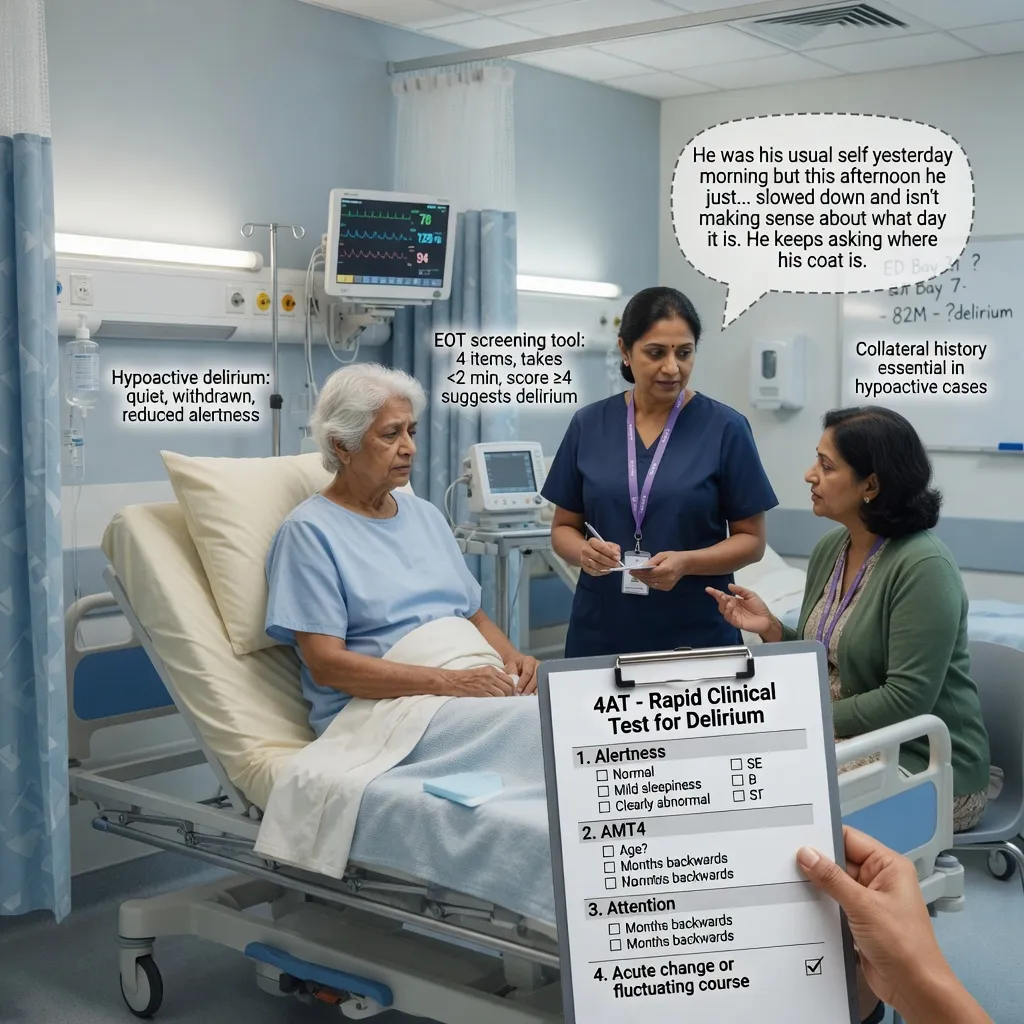
The hyperactive subtype is the dramatic and the over-recognised picture — agitation, restlessness, hallucinations, delusions, shouting, pulling at lines, sympathetic overdrive. It is the patient the security team meets first, and it is consequently the easiest to diagnose and to treat. The hypoactive subtype is the opposite and the dangerous picture — quiet, withdrawn, lethargic, slow, minimally responsive, with reduced motor activity and soft or sparse speech. It is the most common subtype in the ED, it is the most often missed, and it carries the worst prognosis, partly because the precipitant festers unrecognised and partly because hypoactivity is itself a marker of more severe brain dysfunction. The mixed subtype alternates between the two, or combines features of each across the course of a day. Recognising hypoactive delirium is the single highest-yield diagnostic behaviour the emergency clinician can develop, and it is the centrepiece of every OSCE on the confused elderly patient. [1]
Epidemiology and risk factors
Delirium is a disease of vulnerability meeting insult. The prevalence in older ED patients is 8 to 10 per cent, rising to 25 to 40 per cent among older medical inpatients and over 50 per cent after hip fracture or in intensive care. It is independently associated with a doubled length of stay, a markedly increased rate of new institutionalisation, accelerated long-term cognitive decline (delirium accelerates the trajectory of pre-existing dementia), and a 30-day mortality of 10 to 30 per cent — figures that place delirium in the same prognostic band as acute myocardial infarction or sepsis.[3]
Risk is best understood as a product of predisposing and precipitating factors, the classic model of Inouye. Predisposing factors are the patient's reserve: age over 75, pre-existing dementia or cognitive impairment, frailty, sensory impairment (uncorrected hearing or vision), polypharmacy (especially anticholinergic load), functional dependence, and alcohol misuse. Precipitating factors are the insults: infection, dehydration and electrolyte disturbance, drugs (added, withdrawn, or accumulated), hypoxia, surgery and anaesthesia, environmental change and sleep deprivation, urinary retention and faecal impaction, pain, and any acute medical illness. A patient with high reserve tolerates a large insult; a patient with low reserve (the demented, frail, dehydrated elderly patient) tips into delirium at the touch of a single constipation episode or a new anticholinergic. This is why the assessment must characterise both the patient and the precipitant, and why the single most preventable cause is iatrogenic drug load. [1]
Pathophysiology
No single mechanism explains delirium, and the working model integrates several. The most consistent finding across four decades of research is central cholinergic deficiency — anticholinergic drugs precipitate delirium reliably, and serum anticholinergic activity correlates with severity. The corollary is the dopaminergic excess hypothesis: dopamine drives agitation and psychosis, dopamine agonists precipitate delirium, and dopamine antagonists (the antipsychotics) treat it. Neuroinflammation is the modern pillar — acute illness and surgery provoke a systemic cytokine response (interleukin-1, interleukin-6, tumour necrosis factor) that activates cerebral microglia, disrupts the blood-brain barrier, and disturbs neurotransmission, particularly in the vulnerable aged brain. Sleep-wake disruption, disturbance of the hypothalamic-pituitary axis, and impaired cerebral oxidative metabolism complete the picture. The clinical implication is that delirium reflects widespread but potentially reversible network dysfunction — and that the ageing brain's diminished cholinergic reserve and heightened microglial reactivity explain why an insult that passes unnoticed at 30 provokes acute brain failure at 80. [1]
[1]Clinical presentation
The presentation is acute onset over hours to days, a fluctuating course that is typically worse at night and towards evening ("sundowning"), and a core of inattention with disorganised thinking. The history is taken from the family, the carer, the care-home staff, or the GP — collateral history is mandatory, because the patient cannot give it and because the discriminator from dementia is the change from baseline. Ask specifically: "Is this how she normally is? When did it start? Has it been coming and going?" A collateral-confirmed acute change from baseline is delirium until proven otherwise. [1]
The examination looks for the syndrome and for the precipitant. Cognitive and behavioural signs include disorientation (especially to time, then place), rambling or irrelevant speech, perceptual disturbances (visual or tactile hallucinations, misidentifications), delusions (often persecutory and transient), sleep-wake reversal, and lability or emotional distress. The precipitant signs are sought in parallel: the temperature and respiratory rate for infection, the oxygen saturation and chest for pneumonia, the urine dip and a bladder scan for retention or urinary tract infection, the abdomen for distension and constipation, the neurology for a focal deficit suggesting stroke or subdural, the drug chart for the culprit, the glucose for hypoglycaemia, and the observations for hypoxia, hypotension, or sepsis. Hypoactive delirium is identified by the patient who is flat, slow, and stares — and it is the picture that earns the most vigilance because it is so easily dismissed. [1]
The precipitants of delirium — the ED search list
DELIRIUM
Anticholinergics, opioids, benzodiazepines, anticonvulsants, steroids, digoxin; newly added, withdrawn, or accumulated in renal or hepatic failure
Hyponatraemia, hypernatraemia, hypoglycaemia, hypercalcaemia, uraemia; hypovolaemia and acute kidney injury
Withdrawal — alcohol (delirium tremens), benzodiazepines, opioids; the missed withdrawal in the admitted older drinker
Urinary tract, pneumonia, cellulitis, biliary, intra-abdominal, central nervous system; the commonest single precipitant in the elderly
Uncorrected deafness or blindness, lost hearing aids or glasses, unfamiliar environment, sleep deprivation and sensory overload of the ED
Stroke, intracerebral or subdural haemorrhage, subdural haematoma after a fall, meningitis, encephalitis, tumour, seizure or post-ictal state
Urinary retention (especially in the man with prostatic obstruction), catheter blockage, faecal impaction — three causes a bladder scan and a rectal exam will find in minutes
Myocardial infarction (the silent elderly infarct presents as confusion), heart failure, hypoxia, hypothyroidism or thyroid storm, hepatic failure, pain, and unrecognised hypothermia
Differential diagnosis
The differential is the "three Ds and a fourth" — delirium, dementia, depression, and (rarely in the elderly) a primary psychotic illness. Distinguishing them is a guaranteed Fellowship question because it determines everything downstream: a dementia work-up is an outpatient cognitive assessment, a delirium work-up is an emergency search for a treatable precipitant. The discriminator at the bedside is the level of consciousness and the time course: delirium is acute, fluctuating, and clouded; dementia is insidious, day-to-day stable, and clear until late; depression is subacute over weeks, with intact attention and a depressed mood; primary psychosis is rare in the elderly, has systematised and chronic delusions, and a clear sensorium.[3]
Dementia
- Insidious onset over months to years; day-to-day stability rather than acute fluctuation
- Attention is intact until late; level of consciousness is normal — the patient is awake and orientated to person throughout
- Memory is the early and prominent deficit (especially recent memory); the collateral confirms a slow decline from a long-established baseline
- Delirium is frequently superimposed on dementia — the rule is: an acute change from the dementia baseline is delirium until excluded
Depression
- Onset over weeks rather than hours; a sustained low mood, anhedonia, and biological symptoms precede the apparent confusion
- Attention is testable and largely intact; level of consciousness is normal; the patient may answer "I do not know" rather than confabulate
- A prior psychiatric history and a gradual withdrawal from activity are the clues; cognitive slowing (pseudodementia) reverses with treatment of the mood disorder
Primary psychosis
- Rare as a new diagnosis in the elderly; new-onset psychosis in an older person is an organic cause (delirium, dementia with Lewy bodies, or a focal lesion) until proven otherwise
- Level of consciousness and attention are preserved; delusions are systematised and persistent rather than fluctuating and fleeting
- Hallucinations are auditory rather than the visual or tactile hallucinations typical of delirium; the diagnosis of exclusion is made only after a full delirium work-up is negative
A practical rule anchors the differential: in the emergency department, acute confusion in an elderly patient is delirium until a thorough assessment proves otherwise. Dementia and depression are conclusions reached after the precipitant search is complete, not assumptions that short-circuit it. [1]
Bedside assessment — the 4AT and the Confusion Assessment Method
Two tools dominate the bedside screen. The 4AT is the rapid screen — under two minutes, no special training, ideal for the ED triage or the bay. The Confusion Assessment Method (CAM) is the diagnostic algorithm — it formalises the features the clinician is already eliciting and is the reference standard for a bedside diagnosis of delirium. Every Fellowship candidate must reproduce both.[1][2]
The 4AT comprises four domains scored to a total; a score of 4 or more is probable delirium. The components are alertness (normal 0, abnormal 4), the abbreviated four-item mental test (age, date of birth, place, current year; 0 errors scores 0, one to two errors score 1, three to four errors score 2), attention assessed by months of the year backwards (seven or more correct scores 0, fewer or refusal scores 1, cannot start scores 2), and acute change or fluctuating course (present scores 4, absent scores 0). The 4AT was validated in a large diagnostic accuracy study of acute medical patients and performs well in the ED where brevity and no-training administration matter.[2]
The CAM requires four features, and the diagnostic rule is feature 1 AND feature 2 AND (feature 3 OR feature 4). It is the algorithm most likely to be quoted in the viva, and it must be reproduced exactly. [1]
The algorithm is sensitive and specific when administered by a trained clinician, and its components map directly onto the clinical features the examiner will probe. Inattention (feature 2) is the keystone: it is present in every delirium, it is what distinguishes delirium from dementia at the bedside, and it is tested formally with the months-of-the-year-backwards task or the days-of-the-week-backwards task. A patient who cannot recite the months backwards has inattention, and in the setting of acute onset and fluctuation that is delirium. [1]
Investigations
Investigations serve to find and to treat the precipitant, and the panel is broad because the precipitant is anywhere in the body. The first-line ED work-up is: a bedside glucose (mandatory and immediate — hypoglycaemia is reversible in minutes and missing it is inexcusable), a venous or arterial blood gas (pH, lactate, sodium, potassium, glucose, haemoglobin), a full blood count and C-reactive protein, urea, creatinine and electrolytes with calcium, liver function tests and a thyroid-stimulating hormone, a urine dipstick and sent culture, a chest X-ray, and a 12-lead ECG (the silent elderly infarct, arrhythmia, and the QT interval that will govern the antipsychotic choice). Drug levels are checked where relevant — lithium, digoxin, anticonvulsants — and a alcohol level and toxicology screen where withdrawal or intoxication is plausible. Blood cultures are taken before antibiotics if sepsis is suspected. [1]
Neuroimaging — a non-contrast CT brain — is performed when there is a focal neurological deficit, a seizure, a head injury or fall with possible intracranial bleeding, a rapidly declining conscious level, or no identifiable precipitant after the first-line work-up. A lumbar puncture follows if meningitis or encephalitis is suspected, or after a negative CT where fever and altered consciousness demand it. Cognitive screening with the 4AT or the CAM is performed and documented, not merely observed; an undocumented delirium is one that the receiving team will re-miss. [1]
[1]Immediate management — treat the cause, reorient the environment, then the drug
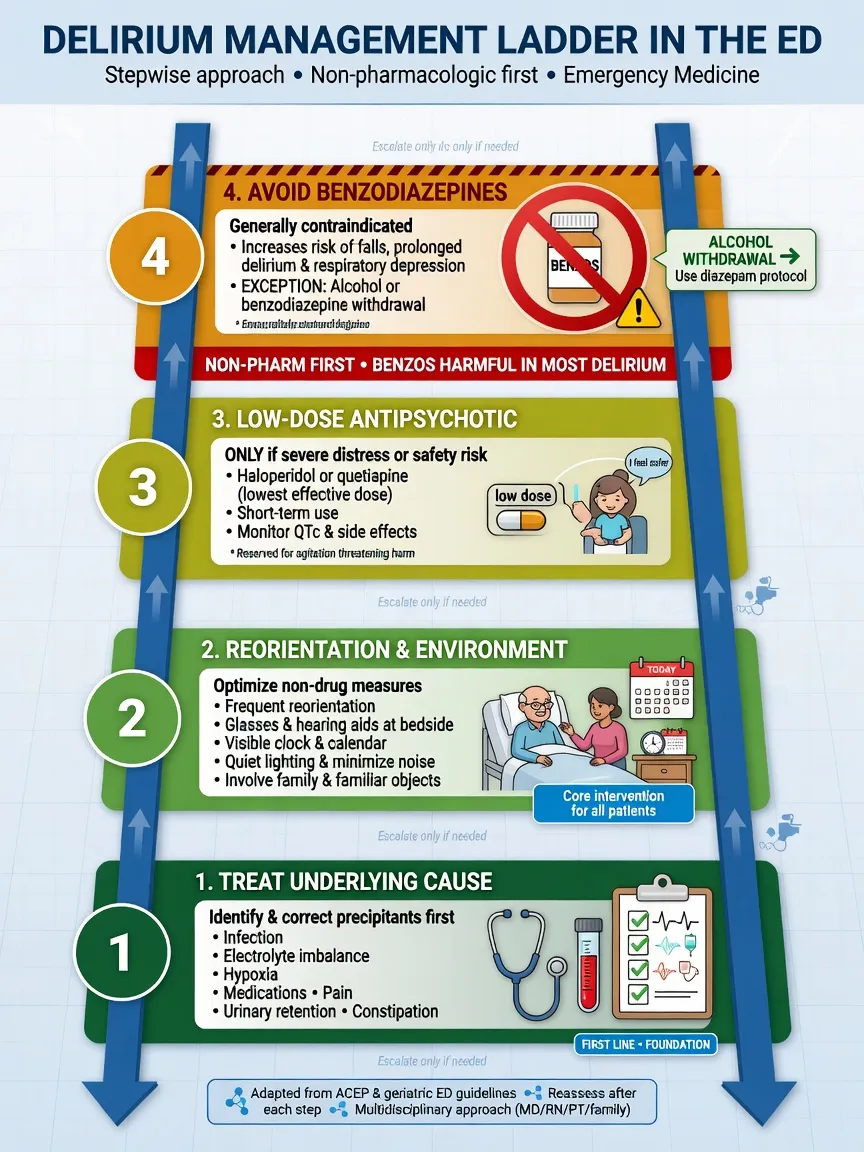
Delirium is a symptom, and the definitive treatment is to find and to treat the precipitant while keeping the patient safe. Management proceeds in three layers, in order, and the drug is the last layer, not the first. [1]
First, treat the precipitant. This is the layer that saves lives. Give antibiotics for sepsis, fluid for dehydration, insulin and potassium for hyperkalaemia, dextrose for hypoglycaemia, oxygen for hypoxia, bladder drainage for retention, enemas and laxatives for faecal impaction, naloxone for opioid toxicity, thiamine for the alcoholic, and stop the offending drug. Delirium that persists after the precipitant is treated is managed supportively while the brain recovers — recovery lags correction by hours to days. [1]
Second, the non-pharmacological bundle. This is genuinely therapeutic, not merely kind, and it shortens the duration of delirium. Sit the patient in a quiet, well-lit bay with a window to orient to daylight; provide and reinsert the hearing aids and glasses; reorient at every contact with name, place, date, and reason for attendance; encourage family presence and bring familiar objects from home; maintain hydration and nutrition; ensure sleep by clustering overnight observations and minimising noise; promote mobility and avoid restraint; manage pain and constipation; and review and de-prescribe the anticholinergic load. Restraint — physical or chemical — is the failure of this layer and is itself a predictor of harm. [1]
Third, pharmacological treatment for distress or danger only. A low-dose antipsychotic is reserved for the patient whose agitation, distress, or behaviour endangers themselves (pulling lines, refusing essential treatment, climbing out of bed) or others, and only after non-pharmacological measures and precipitant treatment have failed. The doses are deliberately low, titrated, and given by the safest effective route. [1]
The pharmacological ladder for agitated delirium — agent, dose, route, and caveat
The first-line agent in the haemodynamically stable patient without Parkinson disease or a prolonged QT is haloperidol 0.5 to 2 mg intravenously or orally, repeated after 30 to 60 minutes if required and titrated to effect; the intramuscular route is reserved for the genuinely uncooperative patient and the elderly receive the lowest end of the range (0.5 mg).[4] The second-line oral option is olanzapine 2.5 to 5 mg orally, or risperidone 0.25 to 0.5 mg orally, both useful when an oral route is acceptable and acceptable to the patient. The total haloperidol dose in the elderly rarely exceeds 5 mg in 24 hours, and an ECG is monitored when repeat dosing is given intravenously because of QT prolongation and the small but real risk of torsades de pointes.
The benzodiazepine is avoided in delirium. Lorazepam 0.5 to 1 mg orally or intravenously is reserved for the patient in whom an antipsychotic is contraindicated — Parkinson disease or the neuroleptic-malignant syndrome — or for the specific case of alcohol or benzodiazepine withdrawal, where a benzodiazepine is first-line (the withdrawal itself is the delirium, and the GABA agonist treats the cause). Giving a benzodiazepine for non-withdrawal agitated delirium worsens and prolongs the confusion and is a common and serious error. [1]
Subtypes and special scenarios
Delirium takes specific shapes that the examiner probes. Delirium superimposed on dementia is the commonest ED picture — the demented patient who acutely worsens — and the rule is that any acute change from the dementia baseline is delirium until excluded, with the same precipitant search. Postoperative delirium complicates up to half of hip-fracture repairs and major surgery in the elderly; prevention (the bundled care of the Hospital Elder Life Program) is the evidence base, and treatment is the precipitant search layered on top. Alcohol withdrawal and delirium tremens is the one scenario where a benzodiazepine is first-line, using a symptom-triggered regimen, because the withdrawal itself is the delirium and the GABA-agonist treats the cause; thiamine precedes glucose to avoid Wernicke. Parkinson-related delirium demands care: haloperidol, olanzapine, and risperidone precipitate a neuroleptic-malignant crisis and wreck motor control, so quetiapine 12.5 to 25 mg orally is the antipsychotic of choice and the precipitant (often the dopaminergic drug schedule) is addressed first. Terminal delirium in the dying patient is managed with opioids for pain, low-dose antipsychotics for distress, and benzodiazepines for refractory agitation, framed as comfort care.[4]
Complications and pitfalls
The complications are the consequences of the missed or the mistreated. Missing hypoactive delirium — accepting "quiet and drowsy" as the baseline — is the cardinal error; the precipitant festers, the patient aspirates or sepses, and the window for reversal closes. Attributing acute confusion to dementia is the mirror error and is the single most common diagnostic pitfall; the rule that acute change is delirium until proven otherwise closes it. Over-sedation with an antipsychotic or a benzodiazepine causes hypotension, falls, respiratory depression, aspiration, and paradoxical worsening of the confusion; the elderly receive the lowest effective dose. Physical and chemical restraint are predictors of harm and are used only when there is imminent danger to the patient or others, documented, reviewed, and removed at the earliest moment. Missing a subdural, an intracranial bleed, hypoglycaemia, hypoxia, or sepsis behind the label of "confused" is the catastrophic miss that the structured precipitant search is designed to prevent. Iatrogenic anticholinergic and sedative load perpetuates the delirium and is the first thing the drug chart is audited for. [1]
[1]Prognosis and disposition
The prognosis is sobering and the disposition reflects it. Delirium is associated with a 30-day mortality of 10 to 30 per cent, a doubled length of stay, a markedly increased rate of new institutionalisation, and accelerated long-term cognitive decline — and the hypoactive subtype carries the worst of each.[3] Recovery is not instantaneous: even after the precipitant is treated, cognitive recovery lags by days to weeks, and a substantial minority never return to their pre-delirium baseline. The disposition decision therefore favours admission — the patient is admitted unless a single, fully reversible precipitant has been identified and treated, the patient has recovered to their documented baseline, and safe supervision and follow-up are in place. Discharge with an unresolved or an unexplained delirium is unsafe and invites representation and harm. The discharge summary documents the cognitive screen, the precipitant, the drug changes made, and a clear plan for the general practitioner and the community team, because the post-delirium patient remains at high risk of recurrence.
Special populations
The patient with pre-existing dementia is the largest special group and the highest-yield examination scenario; the discipline is to never accept dementia as the explanation for an acute change. The very old and frail patient has the lowest reserve and tips into delirium at the lightest insult, demanding a correspondingly careful precipitant search and the gentlest drug dosing. The sensory-impaired patient — the deaf without the hearing aid, the sightless without the glasses — is re-equipped on arrival, because the uncorrected sensory impairment is both a precipitant and a barrier to assessment. The non-English-speaking patient is assessed through a trained interpreter (never a family member) because the language barrier hides the inattention and the thought disorder that the screen depends on. The care-home resident arrives with a handover that often names the precipitant — a fall, a fever, a drug change — and that handover is sought and read before the assessment is concluded. [1]
Evidence and regional guidelines
The Confusion Assessment Method, developed and validated by Inouye and colleagues in 1990, remains the reference-standard bedside diagnostic algorithm and is the tool most likely to be quoted in the examination.[1] The 4AT, validated in a large diagnostic accuracy study of acute medical patients, is the rapid no-training screen that fits the ED triage environment.[2] The interface between delirium and dementia — the demonstration that delirium accelerates cognitive decline and that the two are related rather than competing diagnoses — is the modern evidence base for treating every acute change as delirium until proven otherwise.[3] Pharmacological treatment is supported by modest evidence; the Cochrane review of drug therapy for delirium finds low-quality evidence that antipsychotics relieve agitation and distress but no convincing evidence that they alter the duration or the mortality of delirium, which is why they are reserved for distress or danger rather than given routinely.[4]
ANZ practice note. The Australian Commission on Safety and Quality in Health Care recognises delirium as a clinical deterioration priority and the Care of the Confused Hospitalised Older Person standard underpins inpatient care; the ACEM geriatric emergency medicine guidance applies in the ED. A substitute decision-maker — the person responsible, defined by the guardianship legislation of each state and territory — consents when the delirious patient lacks capacity, and restraint is governed by the relevant mental health and guardianship acts. Capacity is decision-specific and reassessed as the delirium resolves. [1]
Exam pearls
- Hypoactive delirium is the trap. The quiet, withdrawn elderly patient is the most missed and the worst-prognosis subtype; suspect it, screen for it, and document the screen.
- Attention is the core deficit. Test it formally — months of the year backwards — and inattention in the setting of acute fluctuation is delirium.
- The CAM rule is 1 + 2 + (3 or 4): acute onset and fluctuation (mandatory), inattention (mandatory), and either disorganised thinking or an altered level of consciousness.
- Never attribute new acute confusion to dementia. Dementia is insidious and stable; an acute fluctuating change is delirium with a treatable precipitant.
- The benzodiazepine is contraindicated in delirium — except in alcohol or benzodiazepine withdrawal, where it is first-line, because the withdrawal is the delirium.
- Always check a bedside glucose — hypoglycaemia mimics delirium and is reversible in minutes.
- The drug chart is the commonest cause and the first intervention; audit the anticholinergic load, the opioids, the benzodiazepines, and any newly started or ceased medicine.
- Disposition favours admission. Delirium carries a 30-day mortality of 10 to 30 per cent; discharge is reserved for the patient with a fully treated single precipitant, recovered to baseline, with safe supervision. [1]
SAQ — The 4AT screen and the confused elderly woman at the front door
10 minutes · 10 marks
An 82-year-old woman is brought to the emergency department by her daughter, who reports her mother has been not herself for two days — intermittently drowsy, rambling that strangers are in the house, and forgetting that her daughter visited that morning. She has known mild vascular dementia, lives alone, and normally cooks her own meals and manages her own tablets. On arrival she is afebrile, HR 92, BP 138/82, RR 18, SpO2 96 per cent on room air, GCS 14, and bedside glucose is 6.4 mmol/L.
SAQ — Hypoactive delirium masking septic shock in the aged-care resident
10 minutes · 10 marks
A 78-year-old man from a residential aged-care facility is brought to the emergency department with two days of increasing drowsiness and reduced mobility. He is normally conversational but today is barely rousable, makes only monosyllabic responses, and stares blankly at the ceiling. Temperature 38.6 degrees Celsius, HR 124, BP 82/50 (MAP 60) after 500 mL of saline en route, RR 28, SpO2 92 per cent on room air. The chest is dull at the right base with coarse crackles. Bedside glucose is 7.8 mmol/L. The triage nurse has charted dementia — presumed baseline.
Red flags
[1]References
- [1]Inouye SK, van Dyck CH, Alessi CA, Balkin S, Siegal AP, Horwitz RI. Clarifying confusion: the confusion assessment method. A new method for detection of delirium Ann Intern Med, 1990.PMID 2240918
- [2]MacLullich AMJ, Shenkin SD, Goodacre S, et al. The 4 'A's test for detecting delirium in acute medical patients: a diagnostic accuracy study Health Technol Assess, 2019.PMID 31397263
- [3]Fong TG, Davis D, Growdon ME, Albuquerque A, Inouye SK. The interface between delirium and dementia in elderly adults Lancet Neurol, 2015.PMID 26139023
- [4]Finucane AM, Jones L, Hassanien OA, et al. Drug therapy for delirium in terminally ill adults Cochrane Database Syst Rev, 2020.PMID 31960954