EM · Behavioural and mental health emergencies
Mental health and behavioural emergencies
Also known as Psychiatric emergency · Medical clearance of the psychiatric patient · Suicide risk assessment · Acute agitation and rapid tranquillisation · Acute psychosis in the emergency department · Mental Health Act and involuntary detention
Mental health and behavioural emergencies — the medical clearance of the psychiatric patient (excluding the organic cause: hypoglycaemia, hypoxia, sepsis, intracranial lesion, toxidrome, delirium), the structured risk assessment for self-harm, suicide and violence to others, the Mental State Examination, and psychiatric referral. The specific presentations: the suicidal patient (SAD PERSONS, means, plan, intent, safe disposition), the acutely psychotic patient (schizophrenia versus drug-induced; haloperidol 5 mg IM, olanzapine 10 mg PO), and the anxious or agitated patient (de-escalation, lorazepam 1 to 2 mg IV or PO, rapid tranquillisation ladder with droperidol and midazolam). Includes the Mental Health Act framework, involuntary detention, and the four-stage test of capacity. ACEM-primary, globally tagged.
On this page & tools
Your progress
Saved locally on this device.
8 MCQs with explanations
Target exams
Red flags
Related topics
- Consent, capacity and the medico-legal framework in the emergency department
- Delirium in the elderly
- Breaking bad news and communication in the emergency department — the SPIKES framework
- Acute agitation and rapid tranquillisation
- Deliberate self-harm and suicide risk assessment
- The Mental Health Act and compulsory treatment in the emergency department
- DKA, HHS and hypoglycaemia
- Opioid poisoning and the opioid toxidrome (emergency department diagnosis and management)
Mental health and behavioural presentations are among the commonest and the most contested reasons for emergency department attendance, and they are examined relentlessly at Fellowship because they sit at the junction of medicine, psychiatry and the law. The emergency clinician's job is not to make a definitive psychiatric diagnosis; it is to exclude the organic cause, to assess the immediate risk of harm, to stabilise the behaviour that endangers the patient or staff, and to invoke the legal framework that allows detention and treatment when the patient will not or cannot consent. The discipline rests on one unshakeable principle: a behavioural disturbance is organic until a focused assessment proves otherwise, because the patient sedated and detained for a psychiatric illness that is in fact hypoglycaemia, hypoxia, sepsis, an intracranial bleed or a toxidrome is the catastrophic and avoidable death that the structured assessment is designed to prevent.[1]
Definition and the medical–psychiatric interface
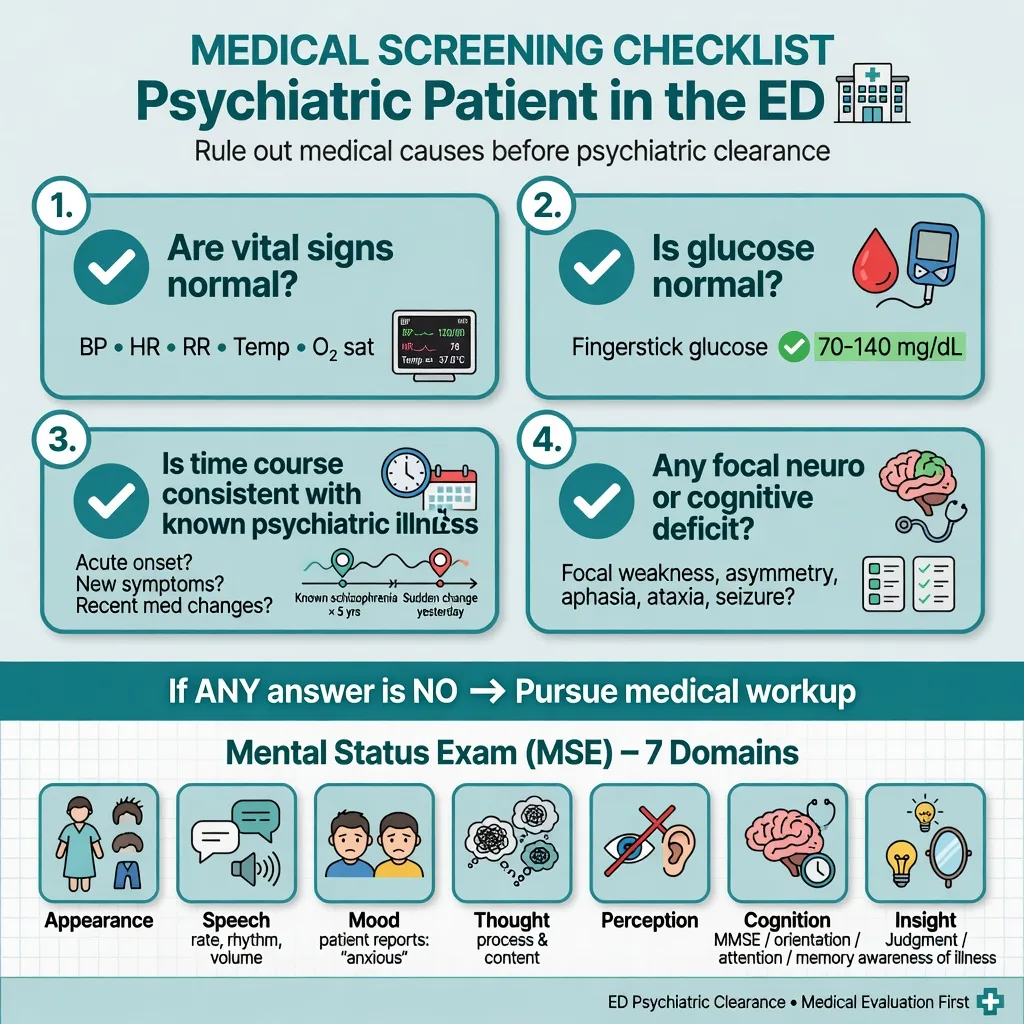
A behavioural emergency is any presentation in which disturbed thought, mood, perception or behaviour is the chief complaint or the dominant feature, and where the immediate task is to determine whether the disturbance arises from a primary psychiatric illness or from a medical illness that is mimicking one. The two are not mutually exclusive — the patient with established schizophrenia may develop sepsis, the chronic alcoholic may present in delirium tremens, the depressed patient may have taken a lethal overdose — and the interface is where the error lives. Medical clearance is the process by which the emergency clinician establishes that no organic cause requiring acute medical treatment has been missed before the patient is handed to psychiatric services; it is not a rubber stamp, and it never excludes a thoughtful search for the precipitant. The concept has been refined as medical screening rather than medical clearance, recognising that the goal is a focused, evidence-based assessment rather than an exhaustive panel of normal results.[1]
The emergency clinician holds four simultaneous responsibilities that structure the whole encounter: protect the patient and the staff from immediate harm; identify and treat any organic contributor; assess the risk of self-harm, suicide and violence; and arrange the right disposition under the right legal authority, whether that is voluntary care, involuntary detention, or admission for a medical illness. Each is examined in its own SAQ and OSCE station, and the candidate who collapses them into a single step — reaching for the sedative, or signing the schedule, before the glucose and the observations are done — fails the station and harms the patient. [1]
Medical clearance — excluding the organic cause
Medical clearance is the most important and the most misunderstood step in the behavioural presentation. The term is a misnomer: it is impossible to "clear" a patient of all medical illness in the emergency department, and the aim is instead to identify the subset of patients in whom an organic cause is driving or contributing to the disturbance. The yield of routine, indiscriminate investigation in the well-appearing psychiatric patient is low, and modern guidance moves away from blanket panels toward a focused assessment guided by the history, the examination and the observations.[1] The indiscriminate computed tomography scan, the routine lumbar puncture and the panel of "baseline" bloods in the asymptomatic patient add cost, delay and false positives without changing management. What is mandatory is a focused, structured assessment that no organic cause escapes.
The organic screen proceeds in three layers. The first layer is the history and the collateral, taken from the patient where possible, from family, carers, police, the general practitioner and the prior record — onset and time course, the premorbid baseline, a drug and alcohol history, the psychiatric and medical history, the current medications (especially lithium, anticonvulsants, antipsychotics and the newly ceased or started), and any recent physical symptoms. An acute change from a known baseline is the single most powerful clue to an organic cause. The second layer is the examination and the observations: a full set of vital signs (temperature, heart rate, blood pressure, respiratory rate, oxygen saturation and a pain score), a focused neurological examination for focal deficit, meningism or a fluctuating conscious level, and a search for the signs of intoxication, withdrawal, infection or endocrine disturbance. Abnormal vital signs are never explained by a primary psychiatric illness — fever, hypoxia, tachycardia and hypertension demand a medical cause. The third layer is the focused investigation, guided by the findings: a bedside glucose in every patient (mandatory and immediate), a venous or arterial blood gas where intoxication, acidosis or electrolyte disturbance is plausible, an electrocardiogram where a cardiotoxic overdose or a QT-prolonging drug is in play, urine and serum drug screens where the result will change management, a computed tomography brain where there is a focal deficit, a seizure, a head injury, a rapidly declining conscious level, or new psychosis in an older patient, and a lumbar puncture where meningitis or encephalitis is suspected. [1]
[1]Differential diagnosis (the mimics distinguished)
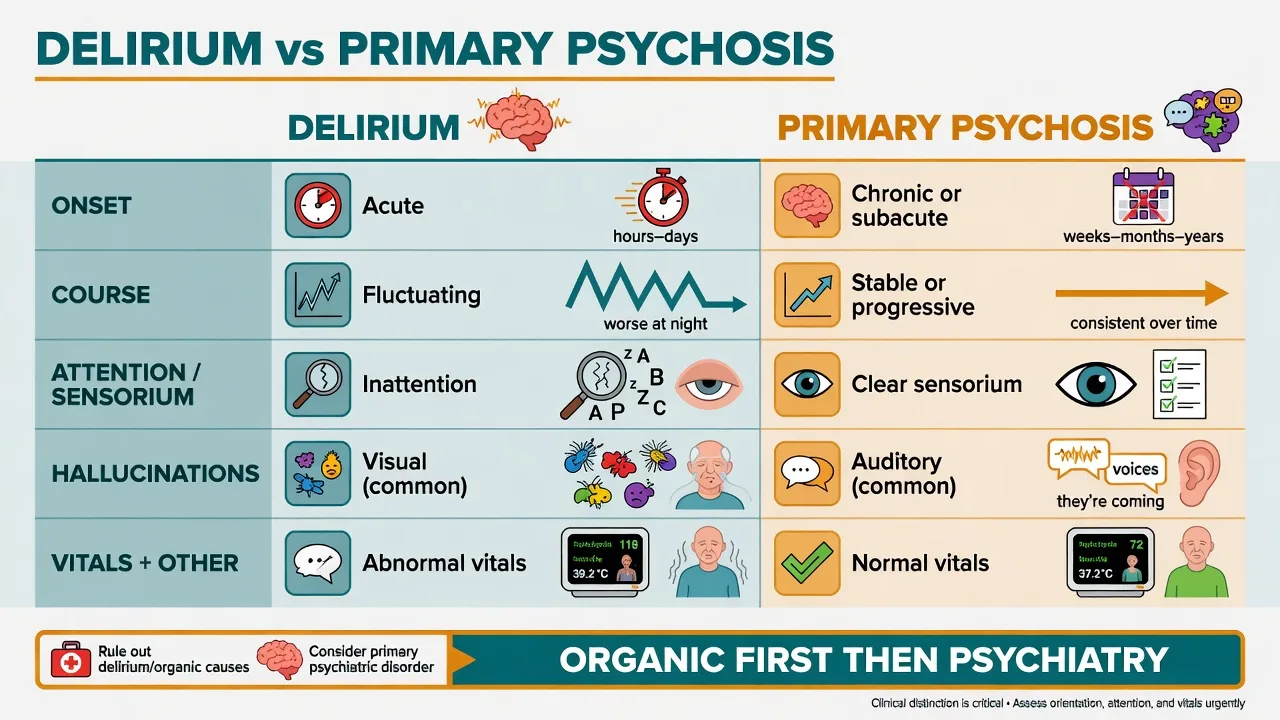
The differential of altered behaviour in the emergency department divides into the organic — a medical illness disturbing brain function — and the functional — a primary psychiatric illness. The discriminator at the bedside is rarely a single feature; it is the constellation of the time course, the observations, the cognitive state and the type of perceptual disturbance. The organic mimics must be excluded first because their treatment is medical and their neglect is fatal, and the functional diagnoses are reached only after the organic search is complete. The emergency clinician must distinguish delirium (acute, fluctuating, inattention, often visual hallucination, abnormal observations) from the chronic psychotic illness (systematised delusions, auditory hallucination, clear sensorium, normal observations), and both from the intoxication and withdrawal states that can produce either picture.[1]
Delirium (organic brain dysfunction)
- Acute onset over hours to days, fluctuating course, clouded consciousness and inattention — the core deficit
- Visual, tactile or olfactory hallucination; fleeting, poorly formed delusions; disorientation worse at night
- Abnormal observations are common — fever, hypoxia, tachycardia point to the precipitant (sepsis, hypoxia, retention)
- Reversed by treating the cause; never sedate and detain without investigating
Hypoglycaemia
- Onset minutes to hours; agitation, confusion, bizarre behaviour, seizures, coma — anything is possible
- Tremor, sweating, tachycardia, hunger; can mimic intoxication or psychosis exactly
- Bedside glucose is diagnostic and the treatment (25 to 50 mL of 50% dextrose IV, or 1 mg glucagon IM) reverses it in minutes
- Always check glucose first in any behavioural disturbance; a missed hypoglycaemia is an inexcusable death
Toxidrome (intoxication or withdrawal)
- Sympathomimetic (cocaine, methamphetamine, MDMA): agitation, mydriasis, tachycardia, hypertension, hyperthermia
- Anticholinergic: agitation, dry skin, mydriasis, urinary retention; the red as a beet, dry as a bone, mad as a hatter triad
- Opioid, sedative and alcohol withdrawal (delirium tremens at 48 to 96 hours): agitation, autonomic storm, tremor, hallucination
- Drug history, vital sign pattern and a tox screen guide treatment; withdrawal is treated with benzodiazepine, intoxication with sedative
Intracranial lesion
- Subdural or intracerebral haemorrhage, tumour, abscess, posterior circulation stroke — all present with acute behavioural change
- New psychosis over age 40, a focal deficit, a seizure, a head injury, fluctuating consciousness, or visual hallucination demands imaging
- Posterior circulation stroke causes vertigo, ataxia, visual loss and altered arousal that may be mistaken for intoxication
- Computed tomography brain for any red flag; never attribute a first presentation or a focal sign to primary psychiatry
Primary psychiatric illness
- Schizophrenia: systematised, chronic delusions, auditory hallucination, formal thought disorder, a clear sensorium and normal observations
- Bipolar mania: elevated or irritable mood, pressured speech, grandiosity, reduced sleep need, hyperactivity
- A diagnosis of exclusion in the ED — reached only after the organic search is negative and the picture fits a known or a classical syndrome
- First-episode psychosis is investigated more aggressively than a relapse of an established illness
The Mental State Examination
The Mental State Examination is the structured, observational framework that converts the bedside encounter into reproducible findings, and every Fellowship candidate must be able to deliver it in the order and the language the examiner expects. It is performed at the bedside from the first moment of the assessment and it is documented in the seven classical domains. The findings distinguish the organic from the functional, the psychotic from the mood disorder, and they form the evidence on which psychiatric referral, the Mental Health Act and the disposition rest. [1]
The Mental State Examination — the seven domains
MSE
Self-care, eye contact, psychomotor activity (retardation, agitation, catatonia), rapport, cooperation, disinhibition, signs of self-harm or drug use
Rate, rhythm, volume, amount — pressured (mania), slow (depression), mutism (catatonia), dysarthria (organic)
Subjective mood (how the patient says they feel) and objective affect (what is observed) — congruent or incongruent, labile, flat, reactive
Thought form (logical, flight of ideas, loosening of associations, thought block) and thought content (delusions, obsessions, phobias, suicidal and homicidal ideation, thought broadcast or insertion)
Hallucinations (auditory, visual, tactile, olfactory) and illusions — auditory in primary psychosis, visual or tactile in organic, depersonalisation and derealisation
Orientation, attention (months backwards), memory, executive function — impaired cognition and inattention point to an organic cause or delirium
Whether the patient recognises they are unwell, accepts treatment, and can weigh the consequences — central to the capacity assessment and the disposition
The highest-yield observations are those that discriminate the organic from the functional. Visual, tactile or olfactory hallucination suggests an organic cause (delirium, intoxication, temporal lobe epilepsy, Lewy body dementia) and is rare in primary schizophrenia, where hallucination is predominantly auditory. Disorientation and inattention indicate an organic brain disturbance until proven otherwise, and they are tested formally with the months-of-the-year-backwards task. New onset after age 40, a fluctuating conscious level, a focal neurological sign or abnormal vital signs each demand an organic search before a psychiatric label is applied. Formal thought disorder — loosening of associations, knight's-move thinking, neologisms — is the hallmark of schizophrenia; flight of ideas points to mania; thought blocking, thought withdrawal, thought broadcast and passivity phenomena (the feeling that thoughts or actions are controlled by an outside agency) are first-rank Schneiderian symptoms of schizophrenia that the examiner will quote in the data-viva. [1]
Risk assessment — self-harm, suicide and violence
Risk assessment is the second pillar of the encounter, and it is dynamic: the risk is reassessed whenever the situation changes, never recorded once and forgotten. The assessment covers three domains — risk of self-harm and suicide, risk of harm to others (violence), and risk of self-neglect or exploitation — and it draws on the history, the mental state, the collateral and the known epidemiological risk factors. The aim is not to predict the future with a single number but to stratify risk into low, moderate or high and to match the disposition to the stratification. The candidate must be able to name the established suicide risk factors, to take a structured suicide assessment (ideation, plan, intent, means, access to lethal means, protective factors), and to reproduce the common screening tools.[2]
The SAD PERSONS scale is a widely taught mnemonic that estimates the short-term suicide risk from seven demographic and clinical factors; it was designed as a teaching and screening aid, not as a sole determinant of disposition, and its predictive value is modest. The recent validation study confirms that it stratifies risk usefully but should never replace a structured clinical assessment and a careful exploration of intent and access to means.[2]
The SAD PERSONS suicide risk score
SAD PERSONS
Male sex — men complete suicide more often, women attempt more often
Age under 19 or over 45 years — the young and the elderly are at elevated risk
A current depressive illness or hopelessness — the single strongest predictor
A prior suicide attempt — the most powerful single historical risk factor
Alcohol misuse or current intoxication — disinhibits and impairs judgement
Active psychosis, delusions, command hallucinations, or cognitive impairment
A specific, organised plan and preparation — intent made operational
Social isolation, separation, unemployment, recent loss
Chronic medical illness, terminal illness, or chronic pain
Violence risk is assessed from the history of prior violence (the best predictor of future violence), current intoxication, active psychosis with persecutory delusions or command hallucinations directed at a specific person, personality disorder, and the immediate behaviour in the department. The patient who is threatening, posturing, carrying a weapon or escalating requires a planned, staffed response — de-escalation first, a designated safe area, removal of access to weapons, sufficient trained staff, and rapid tranquillisation or restraint when de-escalation fails and danger is imminent. [1]
The suicidal patient
The patient who has attempted or is threatening suicide is one of the highest-yield OSCE stations and the most common psychiatric SAQ. The assessment is sequential: medical stabilisation first, then the risk assessment, then the disposition. The overdose, the laceration, the hanging or the fall is assessed and treated as a medical emergency before the psychiatric assessment begins — the paracetamol level, the ECG for tricyclic widening, the salicylate level, the chest X-ray and the blood gas come first, because a patient who dies of an untreated paracetamol hepatotoxicity while awaiting the mental-health team has been failed at the first step. [1]
The structured suicide assessment elicits, in order: ideation (presence, frequency, intensity, duration), plan (specificity, lethality, preparation, rehearsal), intent (the stated determination to die, distinguished from ambivalence or a cry for help), access to means, reasons for living and protective factors (family, children, faith, future orientation), the trigger (loss, conflict, legal or financial crisis, relapse of mental illness), and the psychiatric history (prior attempts, known illness, current treatment, recent discharge from psychiatric care — a high-risk window). A patient with active intent, a specific plan and access to lethal means is high risk and is not discharged; a patient with passive ideation, no plan, strong protective factors and willingness to engage with a safety plan and follow-up may be managed in the community with urgent psychiatric review. [1]
Model answer — the suicide risk assessment in the ED
The acutely psychotic patient
Acute psychosis presents with delusions, hallucinations, disorganised speech and behaviour, and impaired insight, and the emergency task is to distinguish the first episode or the relapse of a primary psychotic illness from the organic and the drug-induced causes. Schizophrenia produces systematised, chronic delusions, auditory hallucination, formal thought disorder and negative symptoms, with a clear sensorium and normal observations. Drug-induced psychosis — from amphetamines, cannabis, hallucinogens, phencyclidine, cocaine or the synthetic cathinones — produces an acute, fluctuating picture with prominent sympathetic overdrive (mydriasis, tachycardia, hypertension, hyperthermia), visual as much as auditory hallucination, and a history or a tox screen that confirms exposure. The distinction matters because the management differs: a drug-induced psychosis is managed with sedation, supportive care and observation while the drug clears, whereas a primary psychosis is managed with an antipsychotic and psychiatric admission. [1]
The first-episode psychosis is investigated more aggressively than a relapse, because the organic differential is wider and the diagnostic stakes are higher. New psychosis over age 40, the presence of any focal neurological sign, a seizure, a head injury, a fluctuating conscious level or visual hallucination mandates a computed tomography brain and a broader organic workup — the posterior circulation stroke, the subdural haematoma, the cerebral abscess, the autoimmune or the infective encephalitis, the temporal lobe epilepsy and the metabolic encephalopathy all present with psychotic features and are missed when the disturbance is attributed prematurely to schizophrenia. The capacity to consent to treatment is often impaired by the delusional belief overriding reasoning, and the treatment of the mental illness itself proceeds under mental-health legislation rather than ordinary consent. [1]
The anxious and the agitated patient
The anxious patient arrives with a panic attack, an acute stress reaction, an exacerbation of a generalised anxiety disorder, or the dyspnoea and tremor of hyperthyroidism or hypoglycaemia that the history and the observations must distinguish. The assessment excludes the medical mimics — thyrotoxicosis, hypoglycaemia, hypoxia, the cardiac cause of palpitation (a supraventricular tachycardia or an atrial fibrillation), the pulmonary embolism presenting as panic, and the caffeine or stimulant excess — before the presentation is attributed to a primary anxiety disorder. Management begins with verbal reassurance and a calm environment, and a short-acting benzodiazepine is reserved for the patient in whom the anxiety is severe and unresponsive to reassurance. Lorazepam 1 to 2 mg orally or intravenously is the preferred agent in the emergency department because its reliable intramuscular absorption, its predictable onset and its lack of active metabolites make it safer than diazepam or midazolam in the patient whose observations are at the margin. [1]
The agitated patient is the highest-acuity behavioural presentation because the agitation may escalate to violence against self, staff or other patients within minutes. Management proceeds along a graded ladder, and the first rung is always de-escalation: a calm, non-confrontational approach, a quiet low-stimulation environment, the removal of triggers and of access to weapons, verbal engagement that respects the patient's autonomy, the offer of food, drink and oral medication, and sufficient trained staff present to allow a safe retreat if the situation deteriorates. De-escalation succeeds in the majority of cases and is the only intervention that carries no pharmacological risk; it is a skill the OSCE examiner assesses directly. When de-escalation fails and the patient is a danger to themselves or others, rapid tranquillisation or, rarely, physical restraint is required, and the patient is monitored throughout. [1]
Immediate management of acute behavioural disturbance (the pharmacological ladder)
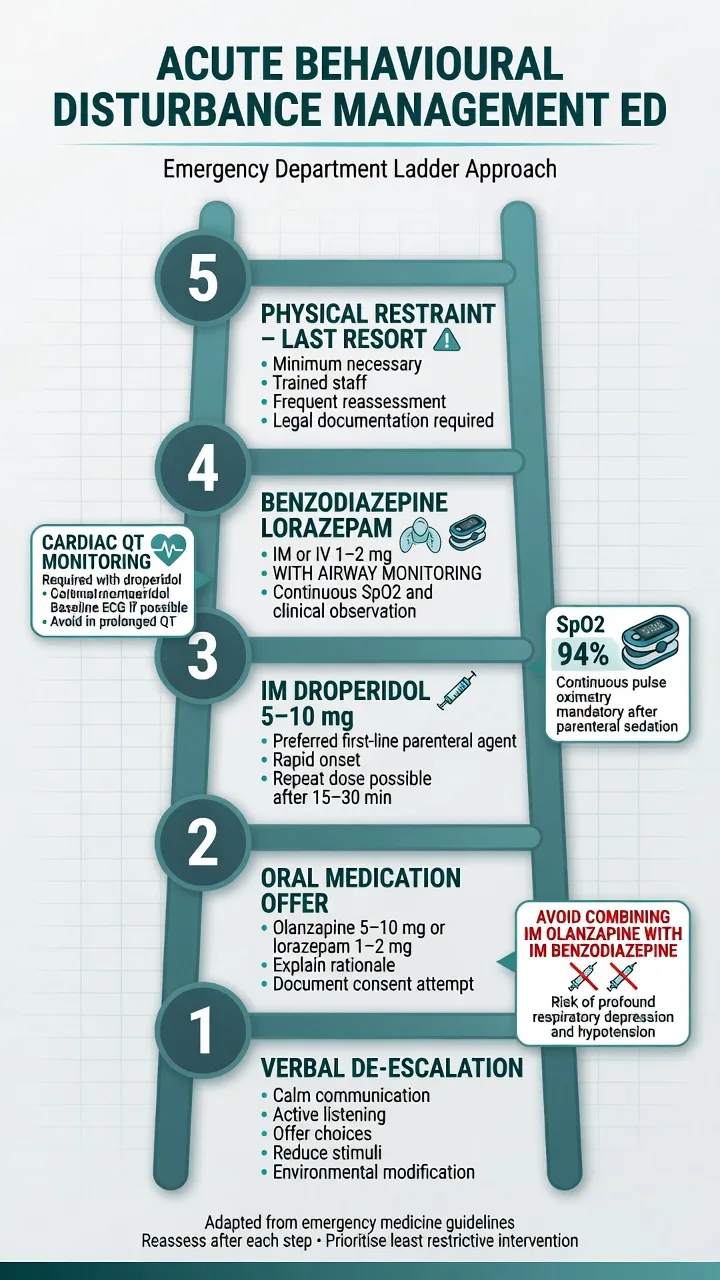
The pharmacological management of severe acute agitation follows a stepwise escalation, and the candidate must be able to deliver the agent, the dose, the route, the timing and the monitoring for each rung. The ladder begins with the oral route wherever the patient will accept it, escalates to the intramuscular route when oral is refused or impractical and the patient is a danger, and reserves the intravenous route for the most extreme agitation in a setting with full monitoring. The choice of agent is guided by the suspected cause (a dopamine antagonist for psychosis, a benzodiazepine for sedative or alcohol withdrawal or for the undifferentiated patient), the comorbidities (avoid an antipsychotic in Parkinson disease or with a prolonged QT), and the requirement for cardiac and airway monitoring. The umbrella review of pharmacological management of acute agitation in psychiatric patients confirms that antipsychotics and benzodiazepines are both effective, that combination therapy is widely used for the most severe cases, and that the evidence base for any single preferred regimen remains modest.[3]
The randomised comparison of intramuscular droperidol, olanzapine, midazolam and lorazepam for methamphetamine-associated agitation found droperidol and olanzapine effective for sustained behavioural control, midazolam effective but requiring additional sedation more often, supporting droperidol as a first-line agent for undifferentiated severe agitation.[4] Post-administration monitoring is mandatory until the patient is calm and arousable: pulse oximetry, blood pressure, respiratory rate, level of consciousness and, for any dopamine antagonist, a periodic ECG for QT prolongation. The combination "sedation duo" of droperidol with midazolam is widely used for the most severely agitated patient but amplifies the respiratory and cardiovascular risks. Physical restraint, where used, is released as chemical sedation takes effect, never maintained as a substitute for treatment, and is documented with the indication, the duration, the monitoring and the review.
Model answer — rapid tranquillisation for the severely agitated patient
Capacity, the Mental Health Act and involuntary detention
Two distinct legal frameworks govern the patient with mental illness in the emergency department, and confusing them is a common and serious error. Capacity — assessed by the four-stage test of understanding, retention, weighing and communicating — determines whether a patient can consent to or refuse treatment for any decision, including a psychiatric treatment, and capacity is presumed, decision-specific and time-specific. The Mental Health Act is a separate statutory framework that authorises the detention and treatment of a person with a mental illness or mental disorder of a nature or degree that warrants hospital treatment, where their health or safety or the safety of others is at risk, and where they cannot or will not consent. A patient may have capacity to refuse a blood transfusion and yet meet the criteria for involuntary detention for a mental illness; a patient may lack capacity through delirium and yet not meet the criteria for the Mental Health Act, because delirium is a medical illness treated under the doctrine of necessity rather than under mental-health legislation. [1]
The emergency clinician's role under the Mental Health Act is to recognise the patient who meets the criteria, to complete or request the statutory documentation (the schedule, the section, or the equivalent form for the jurisdiction), to arrange transfer to a mental-health service or an authorised bed, and to provide the medical screening that excludes an organic cause before psychiatric assessment. Three principles apply in every jurisdiction: the criteria concern mental illness and risk, not capacity alone; the documentation is a legal instrument completed accurately and served on the patient with a statement of their rights; and a medical cause for the disturbance — hypoglycaemia, sepsis, intracranial bleed, drug toxicity — must be excluded or treated before the behavioural presentation is attributed to mental illness, because detaining and sedating a delirious patient without investigation is a fatal error. The doctrine of necessity governs the emergency treatment of any patient — psychiatric or medical — who lacks capacity and faces serious harm, and treatment under necessity is documented contemporaneously with the assessment and the reason. [1]
Psychiatric referral and disposition
The disposition follows the risk stratification and the capacity assessment, and it takes one of four paths. The patient at high risk of suicide or with an acute psychotic illness is admitted to a psychiatric unit, voluntarily if they will accept it and involuntarily under the Mental Health Act if they will not and they meet the criteria. The patient at moderate risk with a treatable presentation — a resolved overdose, a plan without current intent, engagement with follow-up — is managed with a safety plan, means restriction, an urgent community mental-health review within 24 to 72 hours, and the involvement of family or carer. The patient at low risk with a situational crisis, no intent, strong protective factors and good social support is discharged with written advice, a safety plan and a routine general-practitioner or community follow-up. The patient with a primary medical illness driving the presentation — the delirium, the intoxication, the overdose, the intracranial bleed — is admitted or managed under the medical team, with psychiatric consultation as needed, and is never transferred to a psychiatric bed until the medical illness is treated. [1]
The referral to the mental-health service is structured and complete: the presenting complaint, the medical screening performed and the results, the Mental State Examination, the risk assessment with the specific findings on ideation, plan, intent and means, the capacity assessment, the relevant history and collateral, the current medications and allergies, and the suggested disposition. A vague referral — "patient depressed, please review" — invites delay and error. The handover is documented and the patient remains the emergency department's responsibility until physically transferred or discharged. [1]
Special populations
Adolescents presenting with self-harm or a first-episode psychosis are managed jointly with child and adolescent mental-health services, with attention to family dynamics, bullying, abuse, substance use and the developmental context; the threshold for admission is lower and the capacity assessment is developmentally calibrated. Older patients with new behavioural disturbance carry a high probability of an organic cause — delirium, infection, a subdural after a fall, a stroke, a drug interaction — and the rule that acute change is organic until proven otherwise applies with full force; an antipsychotic is dosed at the lowest end of the range (haloperidol 0.5 to 2 mg) because of the QT risk and the Black Box warning on dementia-related psychosis. The intoxicated patient is reassessed as the level falls, because the risk assessment and the capacity assessment are unreliable while intoxication persists, and admission or observation until sober is the safe default where the presentation is serious. Pregnant and postpartum patients are assessed for perinatal mental illness — postpartum psychosis is a psychiatric emergency with a high risk of infanticide and suicide, and it demands urgent admission. The intellectually disabled or autistic patient requires a patient, adapted assessment, a familiar carer present, and recognition that the behavioural disturbance may reflect pain, constipation, infection or sensory overload rather than a psychiatric relapse. [1]
Complications and pitfalls
The recurring errors are those the structured approach is designed to prevent. Missing the organic cause — attributing agitation, psychosis or confusion to a primary psychiatric illness before the glucose, the observations and the focused workup are done — is the cardinal and the catastrophic error, and it kills the patient with the missed hypoglycaemia, the missed intracranial bleed, the missed sepsis or the missed toxidrome. Over-sedation and under-monitoring — giving a large dose of a dopamine antagonist or a benzodiazepine without cardiac and airway monitoring — causes hypotension, respiratory depression, aspiration, falls and torsades de pointes. The neuroleptic malignant syndrome — rigidity, fever, autonomic instability and altered consciousness hours to days after an antipsychotic — is a life-threatening complication that must be distinguished from serotonin syndrome (clonus, hyperreflexia, mydriasis) and malignant hyperthermia, and managed with cessation, cooling, supportive care and, in severe cases, dantrolene or bromocriptine. Prolonged or undocumented physical restraint is unsafe and legally exposed, and restraint is released as sedation takes effect. Therapeutic nihilism — assuming the chronic schizophrenic patient is "just relapsed" without assessment — misses the intercurrent medical illness. Confidentiality breaches — disclosing to family or police without consent or a lawful basis — breach the statute and the trust. Failure to detain a patient who clearly meets the criteria, out of reluctance or time pressure, leaves a high-risk patient in the community with predictable consequences. [1]
Evidence and regional guidelines
The evidence base for emergency mental-health practice draws on the medical-screening literature, the validated suicide-risk tools and the comparative trials of rapid-tranquillisation agents. The medical-screening literature confirms that a focused, history-and-examination-guided assessment identifies the organic causes that matter, and that indiscriminate routine investigation of the asymptomatic psychiatric patient is low-yield and counterproductive.[1] The SAD PERSONS scale, validated recently alongside the NO HOPE scale, stratifies short-term suicide risk usefully but with modest predictive value, reinforcing that no score replaces the structured clinical assessment.[2] The pharmacology of acute agitation is supported by an umbrella review of antipsychotic and benzodiazepine regimens and by head-to-head randomised comparisons, including the trial of intramuscular droperidol, olanzapine, midazolam and lorazepam for methamphetamine-associated agitation that supports droperidol as a first-line agent.[3][4]
ANZ practice note. Each Australian state and territory and New Zealand has its own mental-health Act — in New South Wales the Mental Health Act 2007 allows detention of a mentally ill or mentally disordered person on the certificate of an authorised doctor (the Schedule 1 document), with police assistance under section 9 and transport under section 81; Victoria's Mental Health Act 2014 uses Assessment Orders and Temporary Treatment Orders. The Australasian College for Emergency Medicine publishes guidance on the management of mental health presentations in the emergency department, emphasising a recovery-oriented approach, the exclusion of organic causes, and the role of the emergency clinician in assessment, stabilisation and referral rather than definitive psychiatric care. Capacity is assessed under the common law and the guardianship legislation of each state, restraint is governed by the relevant mental-health and guardianship acts, and the person responsible consents when the patient lacks capacity. [1]
Exam pearls
- Medical clearance is medical screening, not a rubber stamp — a focused, history-and-examination-guided assessment that excludes the organic cause; routine indiscriminate investigation of the asymptomatic psychiatric patient is low-yield.
- Glucose, observations and cognition are the three bedside tests that exclude the commonest organic causes; abnormal vital signs are never explained by a primary psychiatric illness.
- Visual, tactile or olfactory hallucination, new psychosis over 40, a focal sign, fluctuating consciousness, or disorientation each demand an organic search and often a computed tomography brain before a psychiatric label.
- The Mental State Examination is delivered in seven domains — Appearance and behaviour, Speech, Mood and affect, Thought, Perception, Cognition, Insight and judgement — and the discriminating findings (auditory versus visual hallucination, formal thought disorder, passivity phenomena) drive the syndromal diagnosis.
- SAD PERSONS scores Sex, Age, Depression, Previous attempt, Ethanol, Rational thinking loss, Organised plan, No social support, Sickness; a score of 5 or more is high risk and the patient is not discharged.
- Rapid tranquillisation ladder — de-escalation, then oral, then intramuscular; haloperidol 5 mg IM, droperidol 5 to 10 mg IM, olanzapine 10 mg PO, lorazepam 1 to 2 mg IV or PO, midazolam 5 to 10 mg IM; monitor cardiac and airway throughout.
- Capacity and the Mental Health Act are different frameworks — capacity is decision-specific and presumed; the Act authorises detention for mental illness and risk; a delirium is treated under necessity, not the Act.
- Means restriction — securing firearms, limiting medication supply, a safety plan with a trusted holder — is the single most effective suicide-prevention intervention in the ED. [1]
Red flags
SAQ — Mental health assessment in the ED: the first presentation of psychosis and the medical screen
10 minutes · 10 marks
A 28-year-old man with no prior psychiatric history is brought to the emergency department by his flatmate at 02:00 after two weeks of progressive social withdrawal, paranoid beliefs that his food is being poisoned, and three days of auditory hallucinations. He has not seen a GP for years and takes no regular medication. On arrival he is dishevelled, guarded, and smells of cannabis. Observations: temperature 37.8 degrees C, HR 104, BP 142/88, RR 20, SpO2 98 per cent on room air, GCS 14, finger-prick glucose 5.6 mmol/L. He refuses physical examination and is intermittently internally preoccupied.
SAQ — Acute agitation and the Mental Health Act in the ED: the involuntary detention decision
10 minutes · 10 marks
A 36-year-old man is brought to the emergency department by ambulance and police after he was found on a railway bridge threatening to jump. He has a known diagnosis of schizoaffective disorder, is on olanzapine 15 mg and valproate 800 mg daily, but has not taken either for the past five days. He has no fixed address and is not registered with a GP. On arrival he is shouting, sweating, pacing and refuses to sit down. Observations: HR 122, BP 156/94, RR 22, SpO2 98 per cent on room air, glucose 5.9 mmol/L. He is threatening to leave and says nothing will stop him from ending his life tonight.
References
- [1]Ünlü L, Özdemir F, Akıllı A. Medical Screening of Adult Psychiatric Patients Presenting to the Emergency Department Ann Emerg Med, 2026.PMID 42233919
- [2]Sanz-Gómez S, et al. Predictive validity of the SAD PERSONS and NO HOPE scales in a sample of suicide cases Front Psychol, 2025.PMID 40342345
- [3]Uribe ES, et al. Pharmacological management of acute agitation in psychiatric patients: an umbrella review BMC Psychiatry, 2025.PMID 40133850
- [4]Cole JB, Herold M, Foss T, Barra M, Edwards A, Trafton SE, Anderson G, Ode A, Mooney R, Hoppe J, Horowitz BZ. Intramuscular droperidol, olanzapine, midazolam, or lorazepam to treat methamphetamine intoxication in the emergency department Am J Emerg Med, 2026.PMID 41740194