EM · Behavioural and mental health emergencies
Acute agitation and rapid tranquillisation
Also known as Acute agitation · Rapid tranquillisation · Chemical restraint · Severe behavioural disturbance · The agitated patient in the ED · Excited delirium · De-escalation of the agitated patient
Acute agitation in the emergency department — the behavioural emergency defined by motor overactivity, emotional distress and imminent danger to self, staff or others. De-escalation first (verbal, environmental, autonomy-respecting), then the graded pharmacological ladder: oral (olanzapine 5 to 10 mg PO, lorazepam 1 to 2 mg PO) then intramuscular rapid tranquillisation (droperidol 5 to 10 mg IM, olanzapine 5 to 10 mg IM, midazolam 5 to 10 mg IM, haloperidol 5 mg IM). Post-administration monitoring (airway, SpO2, BP, ECG for QT). Restraint complications — positional asphyxia, excited-delirium death, rhabdomyolysis, neuroleptic malignant syndrome, torsades de pointes. The organic mimics (hypoxia, hypoglycaemia, sepsis, intracranial, post-ictal, toxidrome) excluded first. Differential of delirium versus psychosis versus intoxication versus withdrawal. ACEM-primary, globally tagged.
On this page & tools
Your progress
Saved locally on this device.
Target exams
Red flags
Related topics
- Mental health and behavioural emergencies
- Delirium in the elderly
- Consent, capacity and the medico-legal framework in the emergency department
- Alcohol and benzodiazepine withdrawal (emergency department recognition and management)
- The toxidrome approach and the general management of the poisoned patient
- The Mental Health Act and compulsory treatment in the emergency department
Acute agitation is one of the commonest and most dangerous behavioural presentations in the emergency department, and it sits at the centre of the Fellowship examination because it forces the candidate to integrate safety, medical diagnosis, psychopharmacology and the law in real time. The agitated patient is in motor and emotional overdrive, has lost behavioural control, and is on a trajectory towards violence unless the trajectory is interrupted. The disciplined emergency response is built on a single principle: de-escalation first, pharmacology second, restraint last, with the organic cause sought and treated throughout, never assumed away. The patient who is sedated and restrained for a psychiatric illness that is in fact hypoglycaemia, hypoxia, sepsis, an intracranial bleed or a toxidrome is the catastrophic and avoidable death that the structured approach is designed to prevent.[3]
Definition and classification
Acute agitation is a state of severe motor restlessness, mental excitement, and behavioural distress that carries an imminent risk of harm to the patient, staff, or others. It is a syndrome, not a diagnosis: it is the visible end-state of any one of a dozen different underlying processes — a primary psychotic illness, a drug intoxication or withdrawal, a metabolic or infectious encephalopathy, a head injury, or an acute exacerbation of dementia — and the emergency clinician's task is to recognise the syndrome, contain the immediate danger, and then work back to the cause. Rapid tranquillisation (also called chemical restraint or acute pharmacological behavioural control) is the administration of a sedative agent to a patient who is severely agitated and unresponsive to de-escalation, in order to reduce the agitation, to allow essential assessment and treatment, and to prevent harm.[2]
Classification is by the underlying mechanism rather than the surface behaviour, because the right drug depends on the cause. The four broad drivers are: dopaminergic excess (a primary psychotic illness, a stimulant intoxication, or a manic episode), GABA-ergic deficiency (alcohol or benzodiazepine withdrawal), cholinergic or anticholinergic disturbance (a drug effect, a toxidrome), and diffuse brain dysfunction (delirium from any medical cause). The same motor restlessness reflects each, and the discriminator is the history, the observations, the cognitive state and the type of perceptual disturbance — not the level of agitation itself.[3]
[1]Epidemiology and risk factors
Acute agitation accounts for a rising share of emergency department attendances, driven by methamphetamine and other stimulant use, by the contraction of community mental-health services, and by an ageing population with dementia-related behavioural disturbance. Staff injury is a direct and measurable consequence: physical and verbal assault is a leading source of occupational harm in emergency nursing and medicine, and the agitated patient is its principal source. The risk of harm is asymmetric across populations. The elderly are more sensitive to the sedative, anticholinergic and cardiovascular effects of every agent on the ladder, and they carry the highest risk of falls, over-sedation and QT-related arrhythmia.[6] The intoxicated patient combines agitation with respiratory and cardiovascular compromise that any sedative may amplify. The medically unwell patient — the septic, the hypoxic, the post-ictal, the encephalopathic — is the patient in whom sedation unmasks a suppressed airway and in whom restraint precipitates death. Restraint itself carries measurable mortality: a recent forensic review of restraint-related sudden deaths confirms a recurring pattern of severe agitation, hyperthermia, prolonged struggle and prone positioning preceding the arrest.[7]
Pathophysiology
The motor and behavioural overactivity of acute agitation reflects dysregulation of the central neurotransmitter systems that govern arousal, perception and behavioural control, and the mechanism depends on the cause. Dopaminergic excess underlies the agitated psychosis of schizophrenia, the manic episode of bipolar disorder, and the sympathomimetic toxicity of amphetamines, cocaine and the synthetic cathinones; dopamine drives both the productive symptoms (delusions, hallucinations) and the motor overdrive, which is why the dopamine antagonists — the typical and atypical antipsychotics — control it. GABA-ergic deficiency is the mechanism of alcohol and benzodiazepine withdrawal: the brain, adapted to chronic GABA enhancement and chronically up-regulated glutamatergic tone, decompensates when the agent is withdrawn, producing tremor, autonomic storm, hallucination and seizure; GABA-agonist replacement with a benzodiazepine treats the cause. Cholinergic disturbance — typically anticholinergic excess from antihistamines, antispasmodics or tricyclic antidepressants — produces the classic agitated, dry, flushed, mydriatic picture, and physostigmine or supportive care is the answer.[3]
The extreme of the dopamine and noradrenaline surge is excited delirium syndrome: a state of severe agitation, hyperthermia, autonomic instability, pain indifference, and exceptional physical struggle, classically seen in chronic stimulant users and in those with psychiatric illness who have struggled against restraint. The pathophysiology integrates a massive central catecholamine surge with peripheral skeletal-muscle breakdown (rhabdomyolysis, hyperkalaemia, metabolic acidosis), cardiovascular collapse, and a fatal arrhythmia. The forensic and emergency literature on excited delirium is contested in its terminology but consistent in its message: agitation with hyperthermia is a time-critical medical emergency, and prolonged physical struggle — particularly prone restraint — is associated with sudden death.[7]
[1]Clinical presentation
Acute agitation declares itself at triage. The patient is unable to sit still, paces the bay, is verbally loud or threatening, postures towards staff or other patients, damages property, or attempts to leave against advice. The clinician observes motor overactivity, an irritable or fearful affect, formal or fragmented thought disorder, and a varying degree of perceptual disturbance. The cues to imminent violence are well-described and the trained clinician reads them consciously: clenched fists, a fixed stare, pacing that accelerates, a shift from verbal to physical posturing, possession of a weapon, or a sudden silence after escalating noise. The first clinical task is to recognise these cues, to summon help, to control the environment (remove other patients, clear exits, remove potential weapons), and to assemble enough trained staff that the patient can be approached safely.[1]
The atypical agitation is the masked organic, and it is the highest-yield trap. Agitation that is new in an older patient, that arises in a patient with no psychiatric history, that accompanies abnormal vital signs (fever, hypoxia, tachycardia, hypertension), that follows a seizure or a head injury, or that coexists with a focal neurological sign, is organic until proven otherwise. The classical mimics are hypoglycaemia (the bedside glucose is diagnostic and the treatment is minutes away), hypoxia from any respiratory cause, sepsis and other infections, intracranial lesions (subdural or intracerebral haemorrhage, posterior circulation stroke, encephalitis), the post-ictal state, and the toxidromes (sympathomimetic, anticholinergic, serotonin, withdrawal). Each must be sought before a primary psychiatric label is applied, because each requires specific medical treatment that no amount of sedation provides.[3]
Differential diagnosis — distinguished
The differential of acute agitation is built around the mechanism, and the discriminator at the bedside is the constellation of time course, observations, cognitive state and drug exposure. The organic causes must be excluded first because they are the ones that kill the patient sedated without investigation. Apathy is irrelevant; the disciplined emergency clinician works through a structured differential at every agitation encounter, because the same motor restlessness that announces a relapse of schizophrenia announces a subdural haematoma, a salicylate overdose or a methamphetamine psychosis.[3]
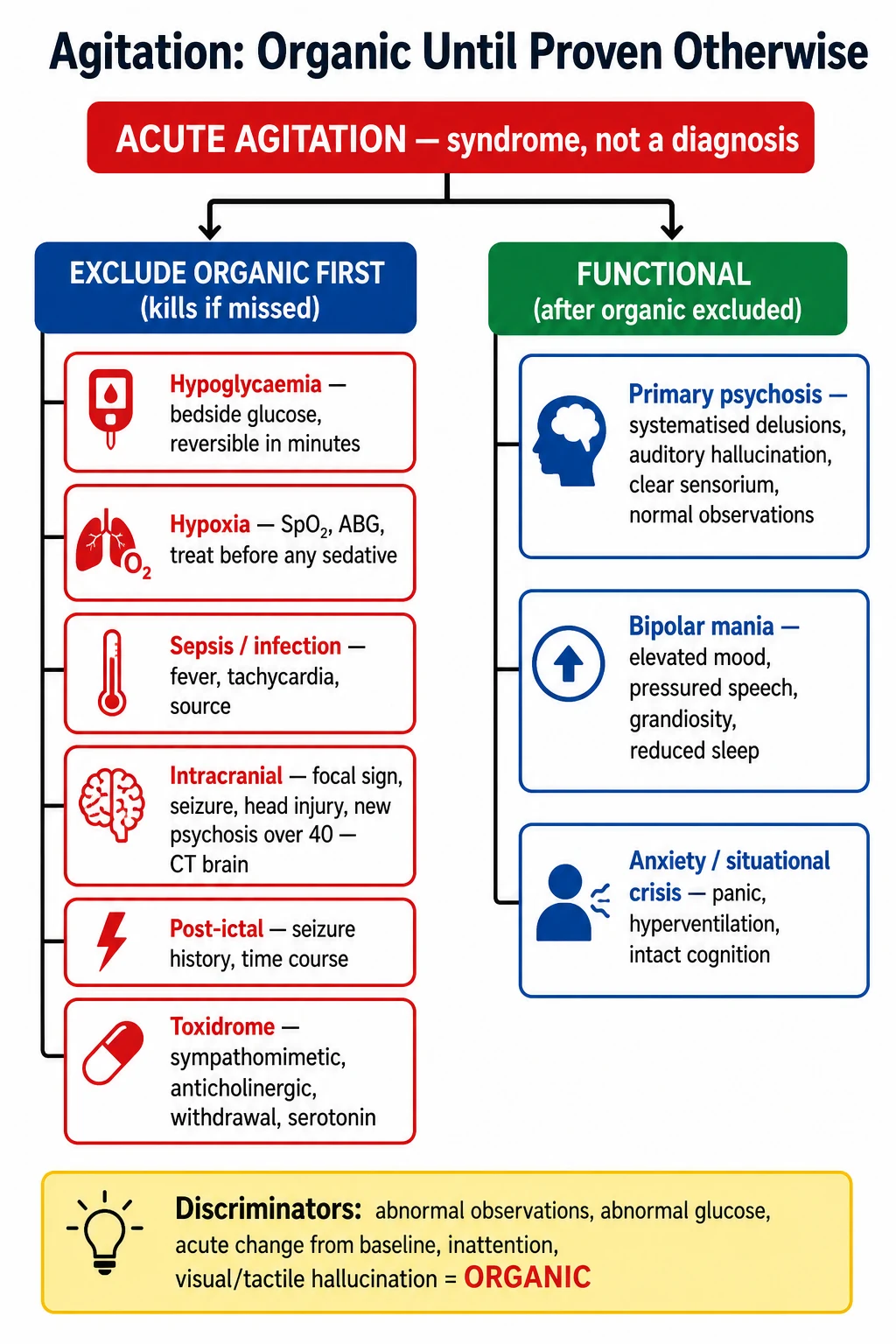
Delirium (organic brain dysfunction)
- Acute onset over hours to days, fluctuating course, clouded consciousness and inattention — the core deficit
- Visual, tactile or olfactory hallucination; fleeting, poorly formed delusions; disorientation worse at night
- Abnormal observations are common — fever, hypoxia, tachycardia point to the precipitant (sepsis, hypoxia, retention)
- Reversed by treating the cause; sedation is the lowest effective dose, restraint is avoided
Primary psychotic illness
- Schizophrenia: systematised chronic delusions, auditory hallucination, formal thought disorder, a clear sensorium and normal observations
- A relapse in a known patient is less investigated than a first episode; first-episode psychosis is imaged and worked up
- Bipolar mania: elevated or irritable mood, pressured speech, grandiosity, reduced sleep need, hyperactivity
- Diagnosis of exclusion in the ED — reached only after the organic search is negative and the picture fits a known or classical syndrome
Intoxication
- Sympathomimetic (methamphetamine, cocaine, MDMA, cathinones): agitation, mydriasis, tachycardia, hypertension, hyperthermia
- Anticholinergic: agitation, dry flushed skin, mydriasis, urinary retention — the red as a beet, dry as a bone, mad as a hatter triad
- Hallucinogens, phencyclidine: bizarre behaviour, dissociation, fluctuating motor signs, nystagmus
- Drug history, vital sign pattern and a tox screen guide treatment; benzodiazepine is the universal sedative; droperidol is effective for stimulant agitation
Withdrawal (alcohol or sedative)
- Tremor, sweating, tachycardia, hypertension, nausea, anxiety beginning 6 to 12 hours after last drink, peaking in delirium tremens at 48 to 96 hours
- Visual and tactile hallucination, disorientation, autonomic storm, seizure; the only agitation where benzodiazepine is first-line
- A symptom-triggered benzodiazepine regimen (CIWA-assisted) is the treatment; thiamine precedes glucose to avoid Wernicke
- A dopamine antagonist given alone does not control withdrawal and may precipitate delirium tremens
Dementia with behavioural disturbance
- Chronic cognitive decline with an acute behavioural change — the change is usually a superimposed delirium, an unmet need, or a drug effect
- Pain, constipation, urinary retention, infection, or environmental change are the commonest precipitants
- Low-dose antipsychotic only for distress or danger; non-pharmacological measures first; Black Box warning on antipsychotics in dementia
- A collateral history from the carer, the baseline function, and the precipitant search dominate the assessment
Excited delirium
- The extreme: hyperthermia, agitation, autonomic storm, pain indifference, exceptional struggle, often in chronic stimulant use
- A time-critical medical emergency — sedate, cool, treat hyperkalaemia and acidosis, avoid prolonged or prone restraint
- Rhabdomyolysis, acute kidney injury, hyperkalaemic arrhythmia and sudden death are the complications
- Mortality is associated with prolonged struggle and restraint; the priority is rapid chemical control and active cooling, not physical containment
Causes of acute agitation — the structured aetiological framework
Because the right drug is chosen by the cause, the candidate must be able to generate a complete aetiological framework at the bedside, not a list. The causes divide into four functional families — the psychiatric, the organic medical, the withdrawal states, and the drug intoxications — and the discriminator between them is the same at every agitation encounter: the time course, the observations, the cognitive state, the drug and alcohol history, and the collateral account of the premorbid baseline. A first-ever presentation of agitation, an abnormal observation, a fluctuating conscious level, a focal sign, or an acute change from a known baseline each shift the probability towards an organic or a toxic cause and demand the medical work-up before a psychiatric label is applied.[3]
Psychiatric causes (functional)
- Schizophrenia and other primary psychoses — systematised delusions, auditory hallucination, formal thought disorder, a clear sensorium and normal observations
- Bipolar mania — elevated or irritable mood, pressured speech, grandiosity, hyperactivity, reduced sleep need, sometimes psychotic
- Severe anxiety, panic or adjustment disorder — situational, alert, orientated, autonomic surge proportionate to the distress
- A diagnosis of exclusion in the ED — reached only after the organic search is negative; a relapse in a known patient is less investigated than a first episode, which is imaged and worked up
Organic medical causes
- Metabolic — hypoglycaemia (the bedside glucose is the first test), hyperglycaemia or DKA, hyponatraemia, hypercalcaemia, uraemia, hepatic encephalopathy
- Hypoxia from any respiratory cause, hypercapnia causing agitated confusion, a low-flow state with cerebral hypoperfusion
- Sepsis and CNS infection — meningitis, encephalitis; the fever and the signs point the way but may be muted in the elderly or immunocompromised
- Intracranial — subdural or intracerebral haemorrhage, subarachnoid, posterior-circulation stroke, mass lesion, raised intracranial pressure; image the first-episode, the head-injured, the anticoagulated and the focal-sign patient
Withdrawal states
- Alcohol withdrawal — tremor, sweating, tachycardia, hypertension, nausea and anxiety from 6 to 12 hours, peaking in delirium tremens at 48 to 96 hours; the only agitation where a benzodiazepine is first-line
- Benzodiazepine withdrawal — anxiety, tremor, insomnia, perceptual disturbance and seizure; clinically identical to alcohol withdrawal; treated with a long-acting benzodiazepine taper
- Opioid withdrawal — agitation is moderate, autonomic storm is present but the patient is miserable rather than violent; not life-threatening in the adult, treated symptomatically
- GABA-agonist replacement treats the cause; a dopamine antagonist alone does not control withdrawal and may precipitate delirium tremens
Drug intoxication
- Sympathomimetic — methamphetamine, cocaine, MDMA, the synthetic cathinones; agitation, mydriasis, tachycardia, hypertension, hyperthermia; droperidol first-line, benzodiazepine for the autonomic storm and hyperthermia
- Anticholinergic — antihistamines, antispasmodics, tricyclics; red as a beet, dry as a bone, mad as a hatter; supportive care, physostigmine in selected cases
- Serotonergic — SSRIs, SNRIs, tramadol, MAOIs; clonus, hyperreflexia, autonomic instability; withdraw the agent, cyproheptadine, cooling and benzodiazepine
- Hallucinogens and phencyclidine — bizarre behaviour, dissociation, fluctuating motor signs, horizontal nystagmus; benzodiazepine and a quiet environment
Sympathomimetic (amphetamine, cocaine, cathinones)
- Hyperadrenergic: mydriasis, tachycardia, hypertension, hyperthermia, diaphoresis, agitation and psychosis
- Risk: hyperthermia, rhabdomyolysis, hypertensive emergency, intracranial haemorrhage, torsades, sudden death (excited delirium)
- Treatment: benzodiazepine is the universal sedative and the first-line antihypertensive; droperidol for sustained control; active cooling; avoid beta-blockers alone (unopposed alpha)
Anticholinergic (antihistamines, antispasmodics, TCA)
- Peripheral: dry skin and mucosae, mydriasis, urinary retention, ileus, tachycardia; central: agitation, delirium, hallucination
- Risk: hyperthermia, seizure, dysrhythmia (the sodium-channel blockade of the tricyclic widens the QRS)
- Treatment: benzodiazepine, cooling, sodium bicarbonate for the QRS widening of the tricyclic; physostigmine in selected, monitored, pure anticholinergic poisoning
Serotonergic (SSRI, SNRI, tramadol, MAOI, linezolid)
- The triad of clonus (inducible or spontaneous), hyperreflexia and autonomic instability; agitation, diaphoresis, tremor, mydriasis
- Risk: hyperthermia, seizure, rigidity, multi-organ failure; fatal in severe cases
- Treatment: stop the serotonergic agent, benzodiazepine, cooling, cyproheptadine; never give a dopamine antagonist that may worsen it
Hallucinogen and phencyclidine (LSD, psilocybin, PCP, ketamine)
- Bizarre, dissociated behaviour; fluctuating motor signs, impulsivity, pain indifference; horizontal and vertical nystagmus (PCP)
- Risk: self-injury, hyperthermia, rhabdomyolysis, hypertensive crisis; PCP psychosis may be prolonged
- Treatment: a quiet, low-stimulus environment, benzodiazepine for agitation and autonomic surge; avoid unnecessary physical restraint
Bedside assessment and investigations
The assessment of the agitated patient is conducted in parallel with containment, not after it. Safety first: summon security and enough trained staff, remove other patients and weapons, control exits, and approach with a calm, non-confrontational manner. The ABCDE survey runs immediately: the airway is at risk in the agitated, exhausted, or post-ictal patient; the breathing is assessed for hypoxia, acidotic breathing, or a toxidrome pattern; the circulation for shock, hypertension, or a dysrhythmia; the disability for the glucose (mandatory and immediate — hypoglycaemia mimics almost every behavioural disturbance and is reversed in minutes), the conscious level, the pupil size, and any focal neurological sign; the exposure for the temperature, the injury, the track marks, the MedicAlert, and the signs of self-harm or drug use.[3]
The observations are the single most powerful discriminator of the organic from the functional. Fever, hypoxia, tachycardia, hypertension and an abnormal respiratory rate are never explained by a primary psychiatric illness. A fever with agitation is excited delirium, sepsis, serotonin syndrome, neuroleptic malignant syndrome, anticholinergic toxicity, or withdrawal delirium until the cause is found. Hypoxia is hypoxia — it is treated first, before any sedative is given, because sedation in the hypoxic patient precipitates respiratory arrest. The bedside glucose is checked in every agitated patient, without exception. A focused neurological examination looks for a focal deficit, meningism, a fluctuating conscious level, the clonus and hyperreflexia of serotonin syndrome, or the lead-pipe rigidity of neuroleptic malignant syndrome.[3]
The collateral history — from police, family, carers, the general practitioner, and the prior record — supplies the time course, the premorbid baseline, the drug and alcohol history, the current medications, and any recent physical or psychiatric symptoms. An acute change from a known baseline is the single most powerful clue to an organic cause, and it is obtainable only from someone who knew the patient before. Investigation is focused and guided by these findings, never a blanket panel; indiscriminate computed tomography and routine lumbar puncture in the well-appearing relapsing psychiatric patient add cost and false positives without changing management.[3]
Immediate management — de-escalation first
De-escalation is the first intervention, the most effective intervention, and the only intervention that carries no pharmacological risk; it succeeds in the majority of agitated patients when performed by trained staff, and it is examined directly in the OSCE. The Project BETA consensus defines the principles: respect the patient's personal space, do not be provocative, establish verbal contact, use concise and short language, identify wants and feelings, listen closely, agree or agree to disagree, set clear limits, offer choices and optimism, and debrief the staff afterwards.[1]
The ten domains of verbal de-escalation (Project BETA)
DE-ESCALATE
Move to a quiet, low-stimulation area; remove other patients and visitors; dim harsh lighting; reduce noise
One trained clinician communicates, ideally at an angle rather than directly face-on; respect personal space, two arms lengths where possible
Remove potential weapons and ensure staff can retreat; staff sufficient in number to make a safe exit if the patient escalates
Use concise sentences, repeat if needed, avoid jargon; the agitated brain cannot process complex information
Offer food, drink, a blanket, a seat, oral medication; choice restores autonomy and de-escalates
Do not argue with delusions; agree with the patient where possible, agree to disagree where not
Active listening; identify the wants and the feelings under the behaviour; the patient who feels heard de-escalates
Non-confrontational posture, hands visible, calm tone, no sudden movements, no sarcasm or threats
De-escalation takes time; rushing or cornering the patient is the most common cause of failure
Throughout: glucose, observations, a focused exam, the collateral history; agitation is organic until excluded
A specific environmental bundle supports the verbal work: a designated low-stimulus room with two exits, the removal of weapons and ligature points, the constant presence of trained staff, the offer of food, drink and oral medication, and the visible readiness of physical support if the situation deteriorates. Restraint equipment and a resuscitation trolley are immediately available but kept out of sight. When de-escalation succeeds, the patient is engaged in the assessment, accepts oral medication if offered, and is monitored continuously while the organic work-up proceeds. [1]
The ED approach — safety first, then the parallel medical and behavioural tracks
The disciplined ED approach runs two tracks in parallel from the first minute: the safety and containment track (de-escalation, environmental control, security staff, restraint as the last resort) and the medical track (identify and reverse the organic cause — glucose, oxygen, infection, toxin, intracranial). The two tracks never run sequentially, because the patient who is sedated before the glucose is checked is the patient who dies of hypoglycaemia. The sequence below is the order in which the trained team acts at the bedside.[1][3]
The ED approach to acute agitation — the parallel safety and medical sequence
0 to 2 minutes — safety first, mobilise the team
Summon security and enough trained staff (a minimum of five for any planned restraint); move other patients away; control the exits; remove weapons; never approach alone. Personal safety is non-negotiable — the staff member who is injured cannot help the patient. Confirm the team leader and the role of each person before any approach.
2 to 5 minutes — de-escalation and environment
A single trained clinician engages at an angle, not face-on, at two arms length; a calm, non-confrontational manner; concise language; choices offered (a seat, a drink, oral medication). The low-stimulus room with two exits, no ligature points, visible but unobtrusive staff. Most agitated patients settle with this alone when it is performed competently.
5 to 10 minutes — the bedside medical screen in parallel
Bedside glucose (mandatory, every patient, before any sedative); full vital signs including temperature (fever with agitation is excited delirium, sepsis, serotonin or NMS until proven otherwise); pulse oximetry (hypoxia is treated before any sedative is given); a focused neurological examination for a focal deficit, meningism, clonus or rigidity; an ECG where a dopamine antagonist is contemplated.
10 to 20 minutes — identify and reverse the reversible
Treat the hypoglycaemia with oral or IV glucose; the hypoxia with oxygen and respiratory support; the sepsis with cultures and antibiotic; the toxin with the specific antidote or supportive toxicology; the suspected intracranial lesion with the CT brain. The agitation often settles as the cause is treated — the patient who is agitated because he is hypoxic stops being agitated when he is oxygenated.
20 to 30 minutes — oral pharmacology if accepted
Offer oral lorazepam 1 to 2 mg, olanzapine 5 to 10 mg, or droperidol where a fast onset is desired. Oral acceptance restores autonomy, signals de-escalation, and carries the lowest pharmacological risk; it is the rung that the largest number of patients settle on.
30 minutes onward — IM rapid tranquillisation if escalating
When oral is refused and the danger persists, climb to intramuscular: droperidol 5 to 10 mg IM (undifferentiated or suspected stimulant), haloperidol 5 mg IM with promethazine (primary psychotic), midazolam 5 to 10 mg IM (stimulant or undifferentiated), lorazepam 1 to 2 mg IM (withdrawal). Document the indication, the capacity assessment, and the agent; then monitor.
Refractory — physical restraint, then release
Physical restraint is the last resort for imminent serious danger that pharmacology cannot safely contain: applied by sufficient trained staff using a recognised technique, held for the minimum time, the patient never prone, and released as chemical sedation takes effect. Continuous monitoring of airway, breathing and circulation throughout; the aim is to release restraint, never to maintain it.
Definitive management — the pharmacological ladder
When verbal de-escalation fails, the patient continues to pose an imminent danger, and oral medication is refused or impractical, the pharmacological ladder is climbed one rung at a time. The ladder is built on three principles: the oral route is preferred wherever accepted; the intramuscular route is the standard for the dangerous patient who refuses oral; and the intravenous route is reserved for the extreme case in a fully monitored setting, because the risk of respiratory depression and hypotension is greatest intravenously and the onset is fastest. The agent is chosen by the suspected cause, the comorbidities, and the requirement for monitoring.[2][4]
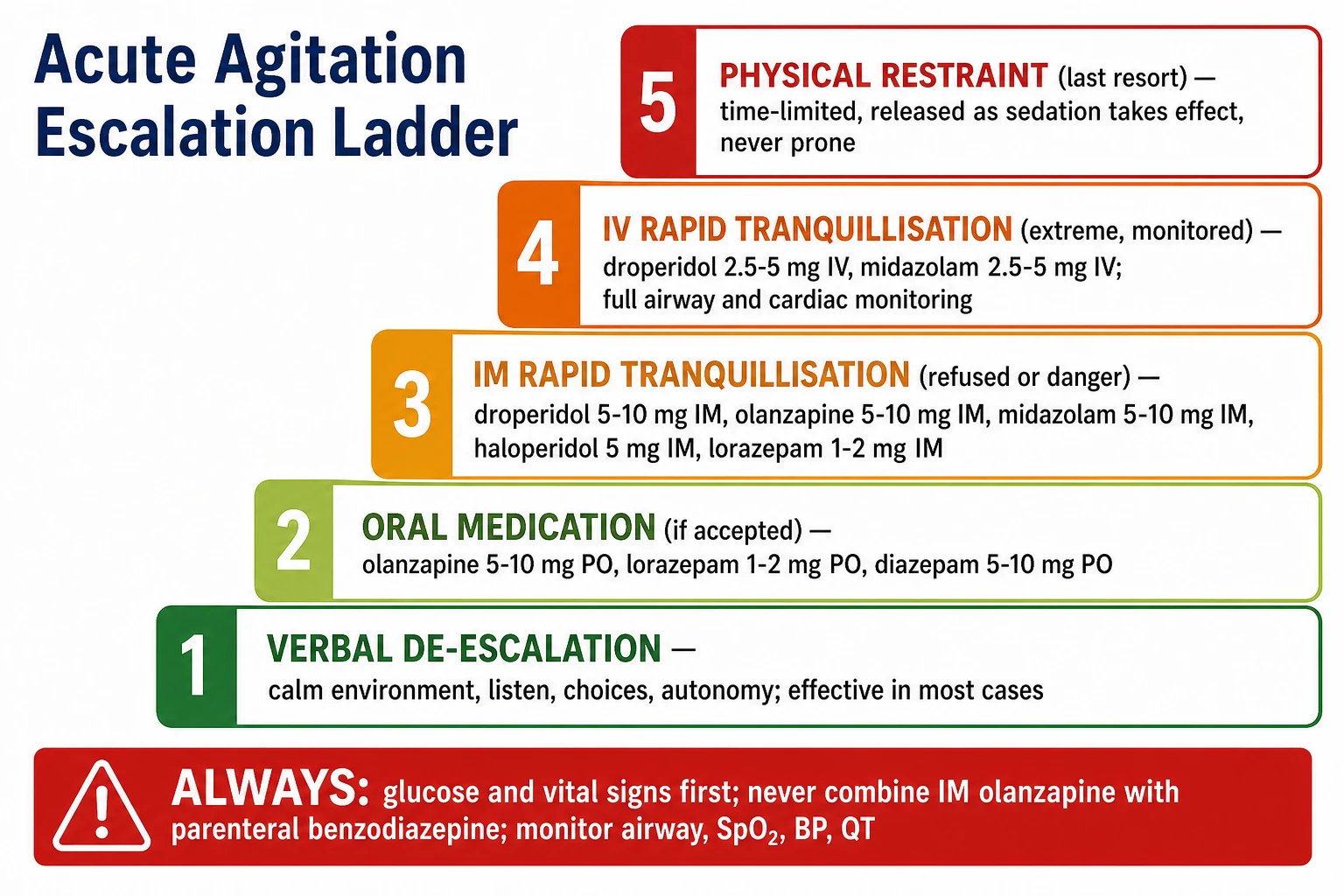
The Cochrane review of haloperidol for psychosis-induced aggression or agitation (rapid tranquillisation) confirms that haloperidol is more effective than placebo and at least as effective as comparator agents for the psychotic agitated patient, with the usual trade-offs of extrapyramidal side effects and QT prolongation.[4] The randomised comparison of intramuscular droperidol, olanzapine, midazolam and lorazepam for methamphetamine-associated agitation found droperidol and olanzapine effective for sustained behavioural control, with midazolam effective but more often requiring additional sedation; the trial supports droperidol as a first-line agent for severe stimulant agitation.[5] A separate head-to-head trial of haloperidol, droperidol, olanzapine and the combinations confirmed that combination therapy (an antipsychotic with a benzodiazepine) achieves more rapid and more sustained control of severe agitation than any single agent, at the cost of a higher sedation burden.[8]
[1]The classic combination regimens, where used, are documented and understood for what they are. The "B-52" or "Haldol 5, Ativan 2, Cogentin 1" (haloperidol 5 mg, lorazepam 2 mg, benztropine 1 mg intramuscularly) combines a dopamine antagonist, a benzodiazepine and an anticholinergic to control psychosis, settle distress and prevent acute dystonia; it is effective for the severely agitated psychotic patient with normal observations and a normal QT. The haloperidol with promethazine combination — trialled extensively in the Brazilian rapid-tranquilisation literature — provides deep, sustained sedation with a lower dystonia rate than haloperidol alone.[8] Each of these combinations must be matched to the patient: avoided in the elderly, in the haemodynamically compromised, in the patient with a long QT, and never combined with intramuscular olanzapine.
Landmark evidence — the trials and consensus that define modern practice
Project BETA De-escalation Workgroup — verbal de-escalation consensus (West J Emerg Med 2012)
Western Journal of Emergency Medicine
PMID 22461917
Key finding
The American Association for Emergency Psychiatry consensus on the verbal de-escalation of the agitated patient. Defines the ten domains of de-escalation and establishes that the majority of agitated patients settle with verbal techniques performed by trained staff, making de-escalation — not medication — the first and most effective intervention.
Practice change
The foundational modern statement that de-escalation precedes pharmacology; the framework examined directly in the OSCE and embedded in every subsequent guideline.
Project BETA Psychopharmacology Workgroup — the graded drug ladder (West J Emerg Med 2012)
Western Journal of Emergency Medicine
PMID 22461918
Key finding
The companion consensus on the psychopharmacology of agitation. Endorses the oral-first, intramuscular-second, intravenous-last ladder with droperidol, olanzapine, haloperidol, midazolam and lorazepam as the core agents; warns explicitly against combining intramuscular olanzapine with a parenteral benzodiazepine.
Practice change
Defines the agent selection and the route hierarchy still taught and practised; the pharmacological backbone of US, UK and ANZ guidance.
Isbister and colleagues — droperidol or olanzapine, oral/IV/IM, mono- or combination (Ann Emerg Med 2017)
Annals of Emergency Medicine
PMID 27974168
Key finding
A large prospective observational study of over 1000 episodes of acute behavioural disturbance sedated with droperidol or olanzapine, by the oral, intramuscular and intravenous routes, as monotherapy or in combination. Droperidol was effective across the spectrum, with a low rate of serious adverse events; the combination of droperidol with a benzodiazepine was not associated with the hypoxia and hypotension seen with the olanzapine-benzodiazepine combination.
Practice change
Established droperidol as a safe and effective first-line agent for undifferentiated severe agitation across the routes, and reframed the QT risk as modest and manageable with monitoring.
Martel and colleagues — droperidol vs ziprasidone vs lorazepam for undifferentiated agitation (Acad Emerg Med 2021)
Academic Emergency Medicine
PMID 32888340
Key finding
A multicentre randomised double-blind trial of intramuscular droperidol, ziprasidone and lorazepam for acute undifferentiated agitation in the emergency department. Droperidol achieved adequate sedation faster and more reliably than ziprasidone or lorazepam, with no significant difference in adverse events.
Practice change
Randomised evidence supporting droperidol as a first-line intramuscular agent for the undifferentiated agitated ED patient, ahead of both an atypical antipsychotic and a benzodiazepine.
Cole and colleagues — droperidol, olanzapine, midazolam or lorazepam for methamphetamine agitation (Am J Emerg Med 2026)
American Journal of Emergency Medicine
PMID 41740194
Key finding
A randomised comparison of the four standard agents for methamphetamine-associated agitation. Droperidol and olanzapine produced more sustained behavioural control; midazolam was effective but more often required a second dose; all were safe with monitoring.
Practice change
Droperidol is the first-line agent for severe stimulant (methamphetamine) agitation, the dominant agitation phenotype in modern Australasian and North American practice.
Cole and colleagues — ketamine versus haloperidol for severe prehospital agitation (Clin Toxicol 2016)
Clinical Toxicology
PMID 27102743
Key finding
A prospective prehospital study of ketamine 4 mg/kg IM versus haloperidol for severe agitation requiring paramedic sedation. Ketamine sedated faster but was associated with a higher rate of intubation and emergence phenomena; haloperidol was slower but carried a lower airway-intervention rate.
Practice change
Ketamine 4 mg/kg IM produces rapid dissociative control of the most severe prehospital agitation, but the intubation rate means it is reserved for specialist and retrieval use with full airway equipment immediately available — not for the routine ED bay.
Hernández-Rodríguez and colleagues — real-time QTc after low-dose droperidol (Am J Emerg Med 2022)
American Journal of Emergency Medicine
PMID 34959024
Key finding
A prospective real-time ECG study of the QTc interval after low-dose droperidol in ED patients. Droperidol produced a small, dose-dependent QTc prolongation that was rarely clinically significant at the doses used for agitation, and torsades de pointes was not observed.
Practice change
Reframed the cardiovascular risk of droperidol: the QT effect is real but modest at agitation doses, and a measured pre-sedation QTc with post-dose monitoring is the practical safeguard rather than avoidance of the drug.
Casey and colleagues — comparative safety of sedation agents in the geriatric ED (J Am Geriatr Soc 2025)
Journal of the American Geriatrics Society
PMID 40275439
Key finding
A geriatric ED comparative-safety study quantifying the elevated risk of every agent on the ladder in older adults — over-sedation, falls, delirium, hypotension and QT-related events were all more frequent than in younger patients, with the benzodiazepines carrying the highest delirium and fall signal.
Practice change
In the elderly, dose at the lowest end of every range, prefer a low-dose dopamine antagonist over a benzodiazepine, check the QT, and avoid benzodiazepines except for withdrawal — the BEERS-list principle applied to acute agitation.
Tyr and colleagues — sudden death during restraint of agitated individuals, Sweden 2015 to 2022 (J Forensic Sci 2026)
Journal of Forensic Sciences
PMID 41292063
Key finding
A national forensic review of restraint-related sudden deaths in agitated individuals over eight years. The recurring pattern was severe agitation, hyperthermia, prolonged physical struggle and prone positioning preceding the arrest — a triad that should prompt immediate chemical control and release of restraint.
Practice change
The operational rule — sedate early, never restrain prone, never maintain restraint once sedation takes effect — is grounded in forensic mortality data, not opinion.
Ostinelli and colleagues — Cochrane review of haloperidol for rapid tranquillisation (Cochrane DB Syst Rev 2017)
Cochrane Database of Systematic Reviews
PMID 28758203
Key finding
The Cochrane systematic review of haloperidol for psychosis-induced aggression or agitation confirms that haloperidol is more effective than placebo and at least as effective as comparator agents, with the trade-off of extrapyramidal side effects and QT prolongation.
Practice change
Haloperidol remains an evidence-supported first-line dopamine antagonist for psychotic agitation, paired with promethazine to reduce dystonia and to deepen sedation.
Huf and colleagues — Cochrane review of haloperidol plus promethazine for aggression (Cochrane DB Syst Rev 2016)
Cochrane Database of Systematic Reviews
PMID 27885664
Key finding
The Cochrane review of the haloperidol-promethazine combination for psychosis-induced aggression finds it more effective than placebo, with a lower acute dystonia rate than haloperidol alone — the combination that underpins the Brazilian rapid-tranquillisation literature and the deep-sedation option for the severely agitated psychotic patient.
Practice change
Haloperidol with promethazine is an evidence-based combination for the severely agitated psychotic patient with a normal QT, providing deep and sustained sedation with less dystonia than haloperidol alone.
Isoardi and colleagues — the best approach to parenteral sedation (Clin Toxicol 2026)
Clinical Toxicology
PMID 41355751
Key finding
A contemporary synthesis of the parenteral-sedation evidence concludes that droperidol is the most effective single agent across the undifferentiated and stimulant phenotypes, that the combination of an antipsychotic with a benzodiazepine achieves the most rapid and sustained control of the most severe agitation, and that ketamine is reserved for refractory excited delirium in a setting with full airway capability.
Practice change
The current consensus that droperidol is first-line, combination therapy for the most severe, and ketamine a specialist rescue — the framework the Fellowship candidate is expected to articulate.
The rapid-tranquillisation monitoring timeline — from the syringe to the safe disposition
Before the dose — record the baseline
A pre-sedation set of observations (heart rate, blood pressure, respiratory rate, SpO2, temperature), a measured level of consciousness, a bedside glucose, and — where a dopamine antagonist will be used — a 12-lead ECG with a measured QTc. Document the capacity assessment, the indication, the agent, the dose and the route.
0 to 15 minutes — the highest-risk window
Continuous pulse oximetry, continuous visual observation by a trained clinician, blood pressure and respiratory rate every 15 minutes. The airway is watched for obstruction, the chest for the slow rise of opiate or benzodiazepine depression, the colour for cyanosis. The patient is never left alone in this window.
15 to 60 minutes — assess efficacy and the arousal level
Reassess the agitation at 10 to 15 minute intervals; the aim is calm and rousable, never unconscious. If the patient is not yet calm, a second dose of the same agent (or an agent from a different class) is given and the clock restarts. If the patient is over-sedated, the airway manoeuvres and reversal proceed (see below).
60 minutes onward — the QT and the complications
After any dopamine antagonist, repeat the 12-lead ECG; a QTc above 500 ms, or a rise above 60 ms from baseline, raises the threshold for further antipsychotic doses and prompts electrolyte correction. Watch for acute dystonia (oculogyric crisis, torticollis — treat with benztropine or diphenhydramine), akathisia (restlessness — treat with a benzodiazepine or propranolol) and the early neuroleptic malignant syndrome (rigidity, fever — stop, cool, supportive care).
Reversal of over-sedation — airway, ventilation, antidote
An unrousable patient with a slow respiratory rate and desaturation is in respiratory arrest until proven otherwise: open the airway, bag-valve-mask ventilation, call for the airway team. Give naloxone if opioid coingestion is plausible (titrate 100 microgram aliquots to avoid the withdrawal storm). Give flumazenil for the benzodiazepine only where the airway and ventilation are supported and the risk of precipitating a seizure in the dependent patient is accepted.
Before disposition — the safety clearance
The patient is observed until fully rousable, the observations are within an acceptable range, the QT is acceptable, and the cause has been established. Only then is the medical clearance signed, the mental-health assessment offered, and the disposition (ward, mental-health unit, or discharge) decided.
Post-administration monitoring
A sedated patient is a monitored patient, and the post-administration period is the window in which the harm occurs. After any parenteral sedative, the patient is observed continuously by a trained clinician with pulse oximetry, blood pressure, respiratory rate, level of consciousness and — for any dopamine antagonist — a periodic 12-lead ECG for QT prolongation. The sedation is assessed at 10 to 15 minute intervals and the level of arousal is documented: the aim is a calm, rousable patient, never an unconscious one. Over-sedation — an unrousable patient, a slow respiratory rate, desaturation, hypotension — is reversed stepwise: airway opening, bag-valve-mask ventilation, flumazenil for the benzodiazepine (with caution in the dependent patient, who may seize), and naloxone if opioid coingestion is suspected.[2]
[1]Physical restraint
Physical restraint is the last rung of the ladder, reserved for the patient whose behaviour poses an imminent and serious danger that cannot be contained by de-escalation or by rapid tranquillisation, and in whom pharmacological control cannot be safely achieved first. It is a temporary measure: applied by sufficient trained staff using a recognised technique, held for the minimum time necessary, and released as chemical sedation takes effect. The patient is monitored continuously throughout restraint — airway, breathing, circulation, level of consciousness — and any change is acted on immediately.[7]
The complications of physical restraint are serious and well-documented. Positional asphyxia — typically in the prone or hobble position — restricts diaphragmatic movement and venous return, and the combination of a struggling patient, obesity, and prolonged restraint is associated with sudden death. Rhabdomyolysis and acute kidney injury follow prolonged struggle against restraint, particularly in the agitated, hyperthermic patient. Soft-tissue and neurovascular injury occurs at the wrists and ankles. Psychological harm — to the patient and to the staff — is real, and the post-incident debrief is part of the management. The forensic literature on restraint-associated sudden death in agitated individuals emphasises the recurring triad of severe agitation, prolonged struggle, and prone positioning; the operational lesson is to sedate early, to avoid prone restraint, and to release restraint as soon as it is safe.[7]
[1]Special subtypes and scenarios
Each subtype of agitation has a preferred first agent, and the candidate is expected to match the agent to the cause. [1]
Model answer — agent selection by cause
- Undifferentiated severe agitation (cause unknown): droperidol 5 to 10 mg IM is first-line, with haloperidol 5 mg IM (plus promethazine) as the alternative where the picture is primarily psychotic; check the ECG and the glucose first.
- Suspected stimulant agitation (methamphetamine, cocaine, cathinones): droperidol 5 to 10 mg IM first-line; midazolam 5 to 10 mg IM as an alternative or adjunct for the sympathomimetic patient; benzodiazepine and active cooling for hyperthermia; monitor for rhabdomyolysis and hyperkalaemia.
- Alcohol or benzodiazepine withdrawal: a benzodiazepine is first-line — lorazepam 1 to 2 mg IM or IV, or diazepam 5 to 10 mg PO; a symptom-triggered regimen (CIWA-guided) once oral is tolerated; thiamine before glucose; do not give a dopamine antagonist alone.
- Primary psychotic agitation: haloperidol 5 mg IM with promethazine, or olanzapine 5 to 10 mg PO or IM; the antipsychotic treats the underlying psychosis as well as the agitation.
- The elderly agitated patient: haloperidol 0.5 to 2 mg IM or IV at the lowest effective dose, with ECG monitoring for QT; avoid benzodiazepines except for withdrawal (they prolong delirium and increase falls); a comparative geriatric study confirms that all agents carry elevated risk in this group and the dose must be the lowest effective.[6]
- Excited delirium (hyperthermia, autonomic storm, struggle): rapid chemical control with a high-dose benzodiazepine (lorazepam or midazolam) plus droperidol; active cooling with evaporative and ice-water methods; treat hyperkalaemia (insulin, dextrose, calcium); treat acidosis; consider intubation and ventilation for the refractory case; ketamine 4 mg/kg IM in the specialist or pre-hospital setting for dissociative control; never maintain prone restraint.
- The paediatric agitated patient: weight-based dosing throughout; the threshold for a medical cause is lower; involve child and adolescent mental health early; haloperidol, olanzapine, lorazepam and midazolam are all used, weight-adjusted; restraint is avoided where possible.
Special situations in depth — alcohol withdrawal, excited delirium, and the paediatric patient
Three special situations account for a disproportionate share of the morbidity, the mortality and the examination marks, and each has a management that diverges from the default ladder. The candidate is expected to recognise each within the first minute and to apply the correct, cause-specific response rather than the generic droperidol-first pathway.[7]
Acute behavioural disturbance in alcohol withdrawal
The agitated patient in alcohol withdrawal is the one agitation where a benzodiazepine is unambiguously first-line, because the mechanism is GABA-ergic deficiency and a dopamine antagonist given alone neither controls the withdrawal nor prevents its progression to delirium tremens and seizure. The clinical picture is the autonomic storm — tremor, sweating, tachycardia, hypertension, nausea, anxiety — progressing to perceptual disturbance and disorientation. A symptom-triggered benzodiazepine regimen (CIWA-Ar-guided in the cooperative patient, lorazepam or diazepam IM/IV in the uncooperative) treats the cause; thiamine precedes glucose to prevent Wernicke encephalopathy; a dopamine antagonist (haloperidol) is added only as an adjunct for refractory psychosis, never as a substitute for the benzodiazepine. The withdrawal must be excluded in every agitated patient with an alcohol history, because the agitated patient sedated with droperidol alone for presumed psychiatric illness who is in fact withdrawing is the patient who seizures overnight. [1]
Excited delirium syndrome
Excited delirium is the extreme of the central catecholamine surge — severe agitation, hyperthermia, autonomic instability, pain indifference and exceptional physical struggle, classically in the chronic stimulant user and in those with psychiatric illness who have struggled against restraint. It is a time-critical medical emergency, not a containment problem, and its mortality is associated with prolonged struggle, prone positioning and delayed chemical control. The pathophysiology integrates the central dopamine and noradrenaline surge with peripheral skeletal-muscle breakdown (rhabdomyolysis, hyperkalaemia, metabolic acidosis), cardiovascular collapse and a fatal arrhythmia. The terminology is contested in the forensic and the ethics literature, but the clinical and operational message is consistent: agitation with hyperthermia is excited delirium, and the response is rapid chemical control, active cooling, correction of hyperkalaemia and acidosis, and the avoidance of prolonged or prone restraint.[7][16]
Excited delirium — the time-critical management bundle
Recognise — hyperthermia plus agitation
The trigger is agitation with a core temperature, typically above 39 to 40 degrees Celsius, in a stimulant user or a patient who has struggled. The picture is autonomic storm: tachycardia, hypertension, diaphoresis, and pain indifference. This is not a psychiatric containment problem; it is a medical emergency with a clock.
Rapid chemical control — do not wait for restraint
High-dose benzodiazepine (lorazepam or midazolam, repeated to effect) plus droperidol for the dopamine-driven component. Ketamine 4 mg/kg IM is the rescue for the refractory case in a specialist setting with airway capability. The aim is to abolish the motor struggle that is generating the hyperthermia, the acidosis and the rhabdomyolysis.
Active cooling — evaporative and ice-water
Remove clothing, mist with water, fan vigorously, apply ice packs to the neck, axillae and groins; consider cold intravenous fluids and, in the extreme case, immersive ice-water or even cardiopulmonary bypass. The temperature must fall fast — every minute of hyperthermia drives further muscle breakdown.
Correct the metabolic derangement
Treat the hyperkalaemia (insulin-dextrose, calcium chloride for membrane stabilisation), the acidosis (ventilation, bicarbonate in selected cases), and the rhabdomyolysis (aggressive isotonic fluid to target a high urine output). Check the creatine kinase, the troponin, the renal function and the coagulation — the picture may evolve into multi-organ failure and disseminated intravascular coagulation.
Airway and ventilation for the refractory case
The patient who cannot be controlled, who is persistently hyperthermic, or who has a falling conscious level is intubated and ventilated — paralysis abolishes the muscle activity driving the hyperthermia and the acidosis. Full monitoring, arterial line, and intensive-care admission follow.
Never maintain prone restraint
The forensic literature is consistent: prone or hobble restraint in the hyperthermic, struggling patient is the restraint that precedes sudden death from positional asphyxia and hyperkalaemic arrhythmia. If restraint is needed at all, it is supine or lateral, held for the minimum time, and released as the chemical sedation takes effect.
Paediatric agitation
The agitated child is approached with the same principles but a different pharmacology: weight-based dosing throughout, a lower threshold for a medical cause (the first presentation of an infection, a metabolic disorder, a seizure, or an ingestion is more common than a primary psychiatric illness in the young child), and the early involvement of the child and adolescent mental-health team. Oral midazolam (0.5 mg/kg) or oral lorazepam is offered first; intramuscular olanzapine, haloperidol, lorazepam and midazolam are all used, weight-adjusted, for the child who cannot be safely de-escalated. Physical restraint is avoided where possible and, when unavoidable, is applied by staff trained in paediatric restraint with the minimum force and the shortest duration. The developmental stage governs the approach — the autistic or intellectually disabled child may be agitated by pain, constipation, infection or sensory overload, and a familiar carer, a quiet environment and a patient, adapted assessment may de-escalate where no drug can. [1]
Alcohol withdrawal agitation
- Autonomic storm, tremor, visual and tactile hallucination, disorientation; the only agitation where benzodiazepine is first-line
- CIWA-guided symptom-triggered benzodiazepine; thiamine before glucose; haloperidol only as adjunct for refractory psychosis
- Never sedate with a dopamine antagonist alone — it does not treat the withdrawal and may precipitate delirium tremens and seizure
- Excluded in every agitated patient with an alcohol history
Excited delirium
- Hyperthermia, agitation, autonomic storm, pain indifference, exceptional struggle; usually chronic stimulant use
- Rapid chemical control (benzodiazepine plus droperidol; ketamine rescue), active cooling, correct hyperkalaemia and acidosis
- Time-critical medical emergency; mortality with prolonged struggle and prone restraint
- Consider intubation for the refractory case; never maintain prone restraint
Paediatric agitation
- Weight-based dosing; lower threshold for a medical cause; involve child and adolescent mental health early
- Oral midazolam or lorazepam first; IM olanzapine, haloperidol, lorazepam, midazolam weight-adjusted if needed
- Avoid physical restraint; when unavoidable, trained staff, minimum force, shortest duration
- Autistic or disabled child — consider pain, constipation, infection, sensory overload before a psychiatric label
Pregnant agitated patient
- Agents of established pregnancy safety — haloperidol has the longest record of the antipsychotics
- Benzodiazepines used cautiously, especially third trimester (neonatal withdrawal, floppy baby)
- Treat the underlying cause; the maternal airway and the fetal monitoring are additional concerns
- Engage obstetrics and psychiatry early; capacity and consent assessed under the relevant legislation
Complications and pitfalls
The complications of acute agitation and its management are the direct consequences of over-sedation, of restraint, and of the missed organic cause. Over-sedation produces respiratory depression, hypotension, aspiration, falls and arrest; it is prevented by titration, by the correct route, and by continuous monitoring. Acute dystonia and akathisia follow dopamine antagonists — dystonia within hours to days, treated with benztropine or diphenhydramine; akathisia with a benzodiazepine or propranolol. QT prolongation and torsades de pointes complicate droperidol, haloperidol and olanzapine, particularly in the elderly, the hypokalaemic and the patient on other QT-prolonging drugs; a pre-sedation ECG with a measured QTc is the safeguard. Neuroleptic malignant syndrome — rigidity, fever, autonomic instability, altered consciousness, raised creatine kinase, hours to days after an antipsychotic — is distinguished from serotonin syndrome (clonus, hyperreflexia, mydriasis) and managed with cessation, cooling, benzodiazepine, supportive care and dantrolene or bromocriptane in severe cases. Restraint-related injury and sudden death — positional asphyxia, rhabdomyolysis, hyperkalaemic arrhythmia — follow prolonged or prone restraint, particularly in the hyperthermic patient.[7]
The diagnostic pitfalls are the ones the structured approach is designed to prevent. Missing the organic cause — attributing agitation to a primary psychiatric illness before the glucose, the observations and the focused work-up — is the cardinal and catastrophic error. Combining intramuscular olanzapine with a parenteral benzodiazepine is the classic pharmacological error. Giving a dopamine antagonist alone to a withdrawing patient does not treat the withdrawal and may precipitate delirium tremens. Reaching for restraint before rapid tranquillisation prolongs struggle and increases the risk of sudden death. Inadequate post-sedation monitoring misses the patient who has over-sedated and arrested. Failing to document the indication, the alternatives, the dose, the monitoring and the review leaves the clinician and the patient legally exposed. [1]
Prognosis and disposition
The disposition follows the cause and the response. The patient who has been rapidly tranquillised is observed until fully rousable, the observations are within an acceptable range, and the cause has been established. A patient with a primary medical cause — the hypoglycaemia reversed, the sepsis treated, the subdural identified — is admitted or managed under the medical team. A patient with a primary psychiatric illness who has been stabilised is referred to mental health for assessment, with the medical screening completed and documented; admission is voluntary where the patient consents and involuntary under the relevant mental-health Act where they do not and the criteria are met. The patient who remains a danger to themselves or others despite adequate sedation is admitted to a place of safety with one-to-one observation. The intoxicated patient is observed until sober and the risk and capacity assessments are repeated as the level falls, because both are unreliable while intoxication persists. The handover to the receiving team is structured (ISBAR) and documents the presentation, the medical screening, the agents and doses given, the monitoring, the response, and the plan.[3]
Special populations
The elderly agitated patient is dosed at the lowest end of every range, with a pre-sedation ECG, a low threshold for an organic cause, and a careful audit of the drug chart for the offending agent; benzodiazepines are avoided except for withdrawal because they prolong delirium and increase falls. The paediatric agitated patient is dosed by weight, with a lower threshold for a medical cause, and with child and adolescent mental-health involvement early. The intoxicated patient is reassessed as the level falls. The pregnant agitated patient is managed with agents of established safety in pregnancy — haloperidol has the longest safety record of the antipsychotics — and benzodiazepines are used cautiously, particularly in the third trimester, because of the neonatal withdrawal and floppy-baby syndrome. The anticoagulated agitated patient with a head injury has an early CT brain because the intracranial bleed is common and lethal and is excluded before sedation is deepened. The intellectually disabled or autistic patient requires a patient, adapted assessment, a familiar carer present, and recognition that the behavioural disturbance may reflect pain, constipation, infection or sensory overload rather than a psychiatric relapse.[3]
Evidence and regional guidelines
The evidence base for the management of acute agitation draws on consensus guidance, on the rapid-tranquillisation trials, and on the forensic literature on restraint. The Project BETA consensus of the American Association for Emergency Psychiatry, published in 2012 across several papers, remains the foundational modern statement: de-escalation first, then a graded pharmacological ladder (droperidol, olanzapine, haloperidol, midazolam, lorazepam), restraint last, and continuous monitoring throughout.[1][2][3] The Cochrane review of haloperidol for psychosis-induced aggression or agitation confirms that haloperidol is more effective than placebo and at least as effective as comparator agents, with the trade-off of extrapyramidal and QT effects.[4] The randomised trials — Cole and colleagues for methamphetamine-associated agitation, and Baldaçara and colleagues for emergency psychiatric room agitation — provide head-to-head evidence supporting droperidol as a first-line agent and combination therapy for the most severely agitated.[5][8] The geriatric comparative-safety study quantifies the elevated risk of every agent in the elderly and supports the lowest-effective-dose principle.[6] The forensic review of restraint-associated sudden deaths documents the recurring pattern of agitation, struggle, prone positioning and death, and underpins the operational rule to sedate early, avoid prone restraint, and release restraint as soon as it is safe.[7]
ANZ practice note. Each Australian state and territory and New Zealand has its own mental-health Act; in New South Wales the Mental Health Act 2007 allows the detention of a mentally ill or mentally disordered person on the certificate of an authorised doctor, with police assistance and transport provisions; Victoria's Mental Health Act 2014 uses Assessment Orders and Temporary Treatment Orders. The doctrine of necessity governs the emergency treatment of any incapacitous patient, including the rapid tranquillisation of the agitated patient who lacks capacity and faces serious harm; the treatment is documented contemporaneously with the assessment of capacity, the indication, and the agent chosen. Restraint is governed by the relevant mental-health and guardianship acts, and the ACEM guidance on the management of mental-health-related behavioural emergencies in the ED applies. Capacity is decision-specific and reassessed as the agitation settles. [1]
SAQ — Rapid tranquillisation with intramuscular droperidol for undifferentiated severe agitation
10 minutes · 10 marks
A 34-year-old, 80 kg man is brought to the emergency department by police under a mental-health section. He is acutely psychotic, shouting, posturing at staff and has already struck a security officer. Verbal de-escalation has failed over 15 minutes, he refuses oral medication, and his behaviour poses an imminent risk to himself and others. Bedside glucose is 6.1 mmol/L, heart rate 112, blood pressure 154/92, oxygen saturation 98%, and a 12-lead ECG shows a QTc of 430 ms.
SAQ — Alcohol-related aggression in the emergency department
10 minutes · 10 marks
A 47-year-old man is brought to the ED by ambulance at 22:00. He is profoundly intoxicated, verbally abusive, and actively lashing out at nursing staff. His companion reports a 30-year history of heavy daily alcohol intake with the last drink earlier that evening. Observations: heart rate 118, blood pressure 168/98, temperature 37.6°C, oxygen saturation 96%, glucose 5.4 mmol/L. He smells strongly of alcohol, is tremulous, and his speech is slurred. He has no focal neurological deficit and a GCS of 13 (E3 V5 M6).
Exam pearls
- De-escalation is always first, and it is examined directly — name the Project BETA principles, demonstrate the technique, and never reach for the syringe before the verbal engagement has been attempted.
- Never combine intramuscular olanzapine with a parenteral benzodiazepine — the additive sedation, hypotension and respiratory depression is the classic pharmacological error.
- Glucose before sedation, every patient, without exception — hypoglycaemia mimics agitation and is reversed in minutes; missing it is inexcusable.
- Check the QT before droperidol or haloperidol in the cardiac patient, the elderly, the electrolyte-disturbed, or anyone on a QT-prolonging drug.
- Benzodiazepine is first-line for withdrawal; antipsychotic is first-line for psychosis — match the agent to the mechanism, and the undifferentiated patient gets droperidol.
- Aim for calm and rousable, never unconscious — over-sedation is the complication that kills; titrate, monitor, and have flumazenil, naloxone and airway equipment immediately available.
- Hyperthermia with agitation is excited delirium — a time-critical medical emergency: rapid chemical control, active cooling, treat hyperkalaemia and acidosis, never maintain prone restraint.
- Restraint is a last resort, time-limited, and released as chemical sedation takes effect — prolonged or prone restraint is associated with sudden death.
- The doctrine of necessity governs the emergency treatment of the incapacitous agitated patient — document the capacity assessment, the indication, the alternatives, the agent, and the monitoring.
- Capacity and the Mental Health Act are separate frameworks — capacity is decision-specific and time-specific, presumed and reversible; the Mental Health Act authorises detention and treatment of the mentally ill patient who meets the criteria. [1]
Red flags
[1]References
- [1]Richmond JS, Berlin JS, Fishkind AB, Holloman GH, Zeller SL, Wilson MP, Rifai MA, Ng AT. Verbal De-escalation of the Agitated Patient: Consensus Statement of the American Association for Emergency Psychiatry Project BETA De-escalation Workgroup West J Emerg Med, 2012.PMID 22461917
- [2]Wilson MP, Pepper D, Currier GW, Feifel D, Allen MH. The psychopharmacology of agitation: consensus statement of the american association for emergency psychiatry project Beta psychopharmacology workgroup West J Emerg Med, 2012.PMID 22461918
- [3]Stowell KR, Florence P, Harman HJ, Glick RL. Psychiatric evaluation of the agitated patient: consensus statement of the american association for emergency psychiatry project Beta psychiatric evaluation workgroup West J Emerg Med, 2012.PMID 22461916
- [4]Ostinelli EG, Hussein M, Ahmed R, Gerna G, Rasmussen J, Bo M, Furukawa TA, Adams CE. Haloperidol for psychosis-induced aggression or agitation (rapid tranquillisation) Cochrane Database Syst Rev, 2017.PMID 28758203
- [5]Cole JB, Herold M, Foss T, Barra M, Edwards A, Trafton SE, Anderson G, Ode A, Mooney R, Hoppe J, Horowitz BZ. Intramuscular droperidol, olanzapine, midazolam, or lorazepam to treat methamphetamine intoxication in the emergency department Am J Emerg Med, 2026.PMID 41740194
- [6]Casey MF, Smith MD, Ratzlaff A, Buchanan K, Roberts B, Kang C, Minamoto S, Pearson C, Chary M. Comparative Safety of Medications for Severe Agitation: A Geriatric Emergency Department Guidelines 2.0 Systematic Review J Am Geriatr Soc, 2025.PMID 40275439
- [7]Tyr A, Voigt K, Druid H, Winge M, Jakobsson S, Höglund P, Björkenstam E, Hansson B, Rådbo S, Fattah S. Incidents of sudden death during restraint of agitated individuals in Sweden between 1992 and 2024 J Forensic Sci, 2026.PMID 41292063
- [8]Baldaçara L, Ferreira GR, Lopes V, Bressan RA, Conforti AB, Jackowski AP, Zugman A, Pellegrino RL. Rapid tranquilization for agitated patients in emergency psychiatric rooms: a randomized trial of olanzapine, ziprasidone, haloperidol plus promethazine, haloperidol plus midazolam and haloperidol alone Braz J Psychiatry, 2011.PMID 21537720
- [9]Huf G, Alexander J, Gandhi P, Allen MH. Haloperidol plus promethazine for psychosis-induced aggression Cochrane Database Syst Rev, 2016.PMID 27885664
- [10]Isbister GK, Calver LA, Page CB, Stokes B, Bogema SC, Downes MA, Berling I, Greene SL. Droperidol or Olanzapine, Intramuscularly or Intravenously, Monotherapy or Combination Therapy for Sedating Acute Behavioral Disturbance Ann Emerg Med, 2017.PMID 27974168
- [11]Cole JB, Moore JC, Nystrom PC, Orozco BS, Stellpflug SJ, Bredenkamp DB, Starr SS, Kornrud RL, Lick MC, Larson B, Engebretsen KM, Ho JD. A prospective study of ketamine versus haloperidol for severe prehospital agitation Clin Toxicol (Phila), 2016.PMID 27102743
- [12]Hernández-Rodríguez L, Bellolio F, Cabrera D, Mattson AE, Cowl CT, Lee MS, Minter KE, Campbell RL. Prospective real-time evaluation of the QTc interval variation after low-dose droperidol among emergency department patients Am J Emerg Med, 2022.PMID 34959024
- [13]Alshehri AM, Crowley KE, Lupi KE, Kim CS, Medado-Prado AM, Pflaumer-Caarls MH, Bellolio MF. Evaluation of droperidol use in the emergency department: a retrospective analysis of QTc prolongation and adverse events BMC Emerg Med, 2024.PMID 39695417
- [14]Martel ML, Driver BE, Miner JR, Biros MH, Cole JB, Bachmann LM, Fossabrook TR, Frascone RJ, Heegaard WG, Kennedy KM, Larson JT, Moore JC, Salzman JG, Stellpflug SJ, Takhar SS, Tijiou TG. Randomized Double-blind Trial of Intramuscular Droperidol, Ziprasidone, and Lorazepam for Acute Undifferentiated Agitation in the Emergency Department Acad Emerg Med, 2021.PMID 32888340
- [15]Isoardi KZ, Cole JB, Hoffman RS, Isbister GK. What is the best approach for parenteral sedation to manage severe acute behavioral disturbance in the emergency department? Clin Toxicol (Phila), 2026.PMID 41355751
- [16]Elliott C, Wilson L. The Hennepin Healthcare Forced Ketamine Studies, Excited Delirium, and Police Violence Hastings Cent Rep, 2025.PMID 41091048