EM · Geriatric and special-population emergencies
Geriatric falls and immobility
Also known as Falls in the elderly · Older person fall · Recurrent falls · Mechanical fall · The long lie · Immobility and deconditioning
Geriatric falls and immobility — the multifactorial geriatric syndrome in which an older person comes to rest unintentionally on the ground, and the spiral of deconditioning that follows. Falls affect a third of community-dwelling over-65s each year and half of over-80s, and they are the leading cause of injury death in older adults. The ED assessment is the multifactorial search: orthostatic vital signs, gait (the Timed Up and Go, abnormal over 12 seconds), cognition (the 4AT, score 4 or more is probable delirium), the drug chart (STOPP/START and the fall-risk-increasing drugs — benzodiazepines, antipsychotics, opioids, antihypertensives), and vision. Investigation targets the consequence — a hip X-ray for the fractured neck of femur and a CT head for the head strike, where age 65 or over is itself a Canadian CT Head Rule criterion. Management treats the precipitant, fixes the fracture (the femoral nerve block and early surgery), deprescribes the culprit drugs, and layers on physiotherapy, an occupational therapy home visit, and vitamin D for the deficient. The differential is syncope, occult sepsis, and stroke — the masked infective fall and the unwitnessed collapse with amnesia are the traps. ACEM-primary, globally tagged.
On this page & tools
Your progress
Saved locally on this device.
12 MCQs with explanations
Target exams
Red flags
Falls and immobility in the elderly form the commonest and most consequential geriatric syndrome the emergency clinician encounters. About a third of community-dwelling people over 65 fall each year, the proportion rising to one in two of those over 80, and falls are the leading cause of injury-related death in older adults.[1] Yet the fall is rarely the disease — it is the final common pathway of a multifactorial failure of postural control, in which an acute insult (an infection, a new drug, an arrhythmia, a volume deficit) tips a patient whose homoeostatic reserve has already narrowed. The Fellowship candidate is examined on every layer: distinguishing the fall from syncope, sepsis, and stroke; reproducing the bedside screens for gait, cognition, and orthostasis; deprescribing the fall-risk-increasing drugs; and arranging the multifactorial intervention that the PROFET trial showed reduces further falls.[3][5]
Definition and classification
A fall is defined as an event that results in a person coming to rest unintentionally on the ground, on a floor, or at a lower level, as a consequence of any circumstance that is not a sustaining major intrinsic event (a seizure, a stroke, or a cardiac arrest) or an overwhelming external hazard. The definition is deliberately broad because it captures the unwitnessed collapse and the slide from a chair alongside the dramatic syncope, and it forces the clinician to ask why a compensated patient decompensated. The "long lie" — the time the patient spends stranded on the floor before being found — is itself a clinical entity, because the lie generates rhabdomyolysis, hypothermia, pressure injury, and dehydration independently of the injury that caused it. [1]
Classification is by mechanism and by consequence. Intrinsic falls arise within the host — sensory failure (poor vision, proprioceptive loss, vestibular disease), central failure (cognitive impairment, slow processing, gait apraxia, parkinsonism), and motor failure (sarcopenia, weakness, foot pathology). Extrinsic falls arise from the environment — loose rugs, poor lighting, uneven steps, slippery floors, ill-fitting footwear, the absence of grab rails. Situational falls describe the postural challenge itself — standing up, turning, reaching, descending stairs, rushing to the toilet. The classification matters because the intervention targets the failing domain: the spectacle prescription, the home hazard, the vasodilator dose, or the gait aid. A single fall in a frail elder is treated with the same scrutiny as a recurrent faller, because the first fall is the strongest predictor of the second. [1]
Epidemiology and risk factors
About 30 per cent of community-dwelling people aged 65 and over fall each year, rising to 50 per cent of those aged over 80; 5 to 10 per cent of falls cause a major injury, and falls are the leading cause of both fatal and non-fatal injury in older adults.[1][5] Among care-home residents the annual fall rate approaches 50 per cent, and a faller who is discharged from the ED has roughly a one-in-three chance of falling again within months. A fractured neck of femur carries a one-year mortality of 20 to 30 per cent and a high rate of new institutionalisation, figures that place a single fall among the most consequential events in an older person's life.
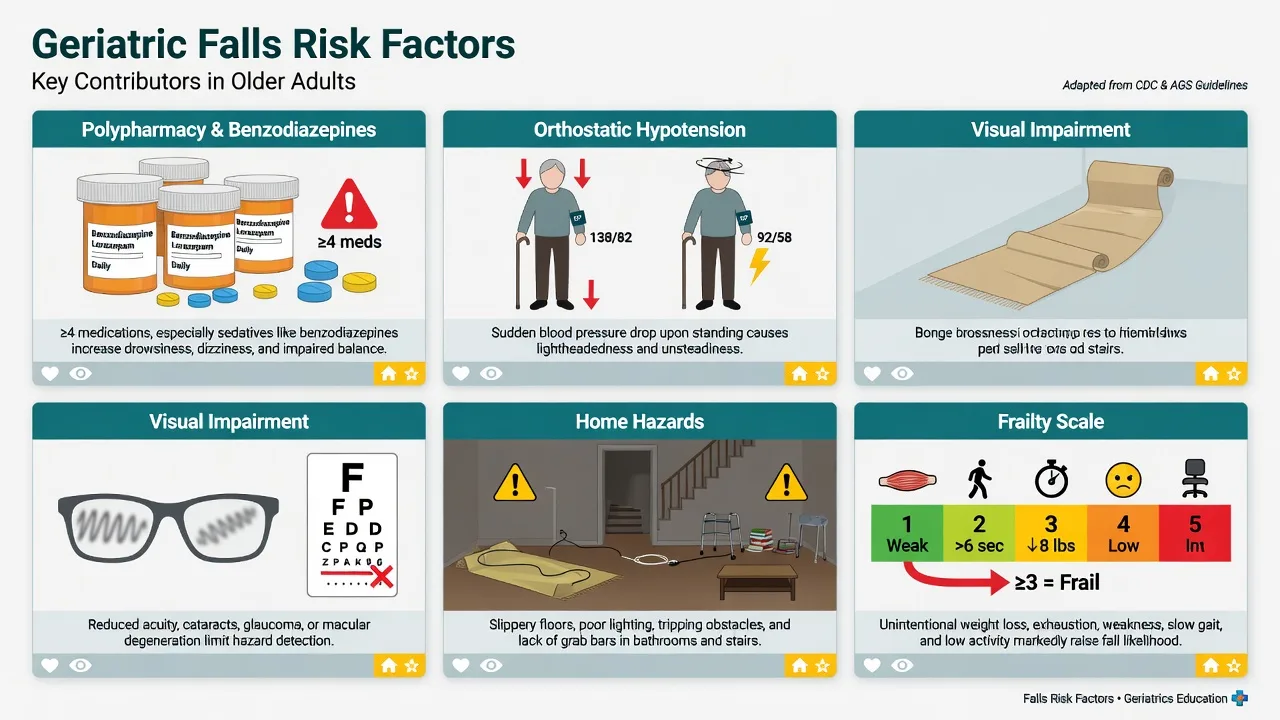
Risk factors are best understood as the multiplicative product of predisposing and acute factors, mirroring the delirium model. Predisposing factors are the narrowed reserve: age over 80, prior falls, gait and balance impairment, lower-extremity weakness, visual impairment, cognitive impairment and dementia, polypharmacy (five or more drugs, and any fall-risk-increasing drug), orthostatic hypotension, incontinence, depression, foot problems, and home hazards. Acute precipitants are the insults: infection (the masked pneumonia or urinary infection), dehydration and electrolyte disturbance, new or recently increased drugs (sedatives, vasodilators, hypoglycaemics), arrhythmia, anaemia, hypoglycaemia, acute illness, and surgery. The patient with high reserve absorbs an insult; the patient with low reserve — the deconditioned, demented, polypharmacy-laden elder — falls at the touch of a single dose change.[4]
Pathophysiology — the homoeostatic reserve model
Postural control is maintained by the integration of three sensory inputs (visual, proprioceptive, vestibular), central processing (attention, processing speed, motor planning), and motor output (strength, coordination, reaction time). The system has substantial redundancy, which is why a younger adult tolerates the loss of one input. With ageing, every layer declines: visual acuity and contrast sensitivity fall, proprioceptive conduction slows, vestibular hair-cell numbers drop, reaction time lengthens, muscle mass is lost (sarcopenia), and the attentional cost of walking rises until walking is no longer automatic. The system is then balanced on a knife-edge, and any acute insult — a febrile illness, a new benzodiazepine, a volume deficit that drops the standing blood pressure, an arrhythmia that under-perfuses the brain — is enough to exceed the diminished reserve and produce a fall. [1]
[1]Clinical presentation
The presentation is the fall, the injury, and the precipitant, and the history must characterise all three. The collateral history is mandatory, because the older faller frequently has amnesia for the event and cannot distinguish a stumble from a blackout. Ask the witness: Was there a warning? Did the patient lose consciousness, and for how long? Was there pallor, sweating, or a slow recovery (vasovagal), a sudden drop with no warning (cardiac), a seizure-like movement or tongue-biting (seizure), or a focal deficit afterwards (stroke)? Was there chest pain, palpitation, or dyspnoea before? Had the patient just stood up (orthostatic), turned the head (carotid sinus or vertebrobasilar), or rushed to the toilet (situational and post-micturition)? How long was the patient on the floor (the long lie)? What drugs is the patient on, and what has changed? [1]
The examination looks for the injury, for the precipitant, and for the consequence of the lie. The injury screen examines the head (laceration, bruising, the battle sign and raccoon eyes of a base-of-skull fracture), the spine for tenderness, the pelvis and the hip (the shortened, externally-rotated leg of a fractured neck of femur, the pubic-rami tenderness of an insufficiency fracture), the wrist (a Colles fracture), and any painful weight-bearing joint. The precipitant screen measures the temperature, the respiratory rate, the oxygen saturation, the chest, the urine, the abdomen, the heart (murmurs, the irregular pulse of atrial fibrillation), and the drug chart. The consequence-of-the-lie screen looks for pressure injury, hypothermia, dehydration, and measures the creatine kinase and renal function for rhabdomyolysis. The atypical presentation is the rule rather than the exception: the elderly patient who falls because of an occult pneumonia or urinary infection, the patient who is simply "off legs" and cannot get up, and the patient who is found on the floor in delirium. [1]
Differential diagnosis
The differential is the central examination question, because the management of syncope, sepsis, and stroke is utterly different from the management of a mechanical fall, and the label determines everything downstream. The discriminating feature at the bedside is the presence and quality of any loss of consciousness, the time course of recovery, and the presence of focal neurology or systemic illness.[4]
Syncope
- Transient loss of consciousness with rapid onset, brief duration, and complete spontaneous recovery, due to global cerebral hypoperfusion
- The patient recalls or the witness confirms a brief blackout with a prompt recovery; the fall is the consequence of the loss of postural tone, not the primary event
- Cardiac syncope — exertional, no prodrome, abnormal ECG, structural heart disease — is the high-risk mimic that mandates admission; vasovagal has a prodrome and situational triggers
- The discriminator from a mechanical fall: in syncope there WAS a loss of consciousness; ask the witness and the patient directly
Occult sepsis
- The masked infective fall — pneumonia, urinary infection, bacteraemia, and cholangitis present as a fall or as delirium in the elderly, often without a fever
- The fall is the decompensation of a chronically narrowed reserve by an acute infective insult; the precipitant is found on the septic screen (temperature, respiratory rate, chest, urine, bloods)
- The discriminator: a fall without an obvious mechanical trigger, a new delirium or functional decline, an abnormal lactate, raised inflammatory markers, or an abnormal urine or chest X-ray
- Missing sepsis behind the label of a fall is a catastrophic and avoidable harm — every older faller receives a septic screen
Stroke
- Focal neurological deficit, usually of sudden and witnessed onset; the fall is the loss of postural tone from the deficit, the seizure, or the inattention of the stroke itself
- Posterior circulation stroke causes vertigo, ataxia, diplopia, and a fall without an obvious limb weakness; the brainstem signs are sought deliberately
- The discriminator: a focal deficit, a last-known-well time, a FAST-positive examination, or an altered cognition that does not fluctuate; the CT or MRI angiogram confirms
- A fall with a new focal deficit, a seizure, or a fluctuating consciousness after a head strike is a stroke or an intracranial bleed until imaging proves otherwise
Orthostatic hypotension and cardiac dysrhythmia
- Orthostatic hypotension: a drop of 20 mmHg systolic or 10 mmHg diastolic within three minutes of standing; often drug-induced (vasodilators, diuretics, alpha-blockers) or volume-depleted
- Cardiac dysrhythmia: the sudden, no-prodrome collapse, the abnormal ECG (heart block, atrial fibrillation, prolonged QT, Brugada), the structural heart disease; the high-risk mimic
- Carotid sinus syndrome causes syncope on head turning or a tight collar; vertebrobasilar insufficiency causes vertigo and ataxia on head turning
- The discriminator: the ECG, the orthostatic vitals, and — where indicated — the cardiac monitoring and the echocardiogram
Post-ictal and other mimics
- Post-ictal state after an unwitnessed seizure: tongue-biting, incontinence, prolonged confusion, slow recovery, a known seizure disorder
- Hypoglycaemia mimics anything and is excluded first with a bedside glucose; alcohol and benzodiazepine withdrawal, drug toxicity, and a subdural haematoma after a previous fall complete the list
- A drop attack — a sudden loss of postural tone without loss of consciousness, often vertebrobasilar — recovers instantly on the floor
- The discriminator: the bedside glucose first, then the collateral history, the drug screen, and — in the head-struck or anticoagulated patient — the CT brain
A practical rule anchors the differential: in the emergency department, an older faller is presumed to have a medical precipitant until a thorough assessment proves otherwise, and the label of a "mechanical fall" is a conclusion reached after the search, not an assumption that short-circuits it. [1]
Bedside assessment — orthostatic vitals, gait, cognition, drugs, vision
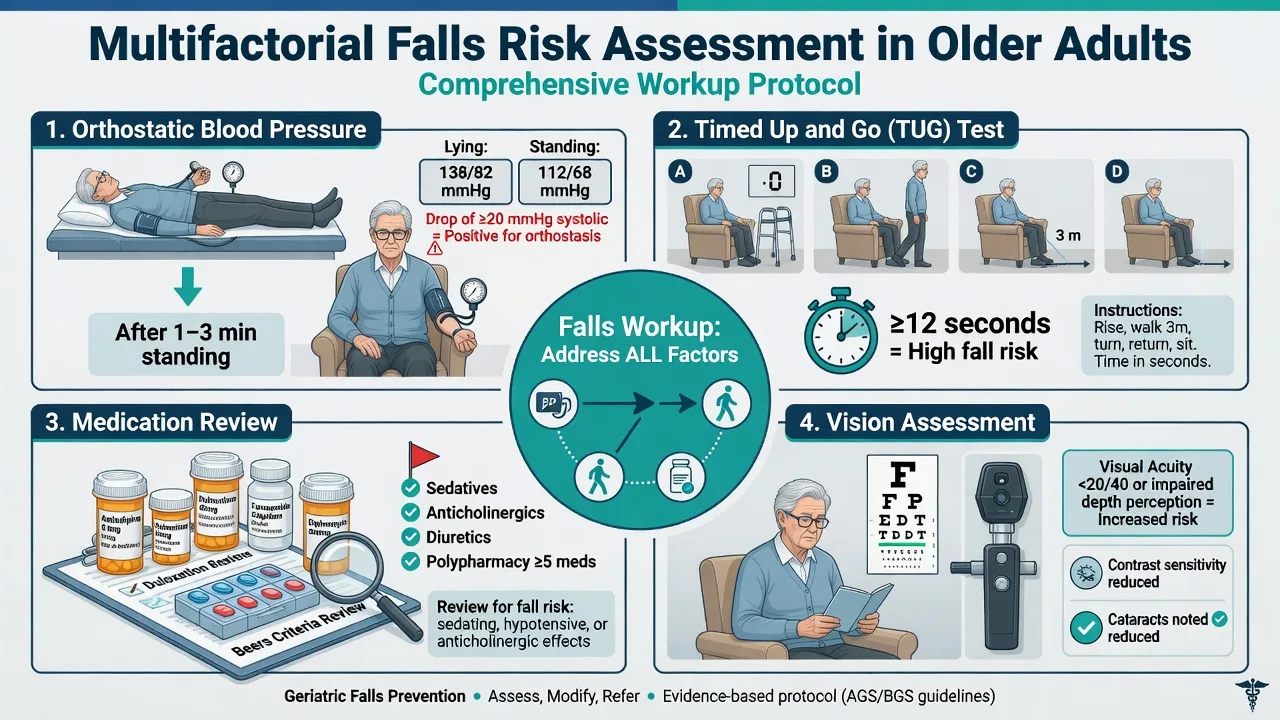
The multifactorial assessment is the centrepiece of the Fellowship question, and every domain must be examined and documented. The first screen is the orthostatic vital signs: blood pressure and heart rate supine and again after one and three minutes of standing; a drop of 20 mmHg systolic or 10 mmHg diastolic, or a rise in heart rate over 20 beats per minute on standing, defines orthostatic hypotension and is frequently drug-induced. The gait is assessed with the Timed Up and Go test — the patient rises from a chair, walks three metres, turns, walks back, and sits; a time over 12 seconds, or an unsteady turn, a shuffling or freezing gait, or the need to use the arms to rise, identifies the high-risk faller.[2] The cognition is screened with the 4AT, because delirium is both a precipitant and a consequence of a fall; a score of 4 or more is probable delirium and changes the disposition. The drug chart is audited against STOPP/START version 2 and the fall-risk-increasing drug classes.[6]
The vision is checked — does the patient have their glasses, when were they last tested, is there a cataract — because uncorrected visual impairment is a potent, modifiable risk factor. The feet and footwear are examined for neuropathy, deformity, and ill-fitting slippers. The cardiovascular examination listens for the murmur of aortic stenosis (the exertional syncope), checks the pulse for atrial fibrillation, and considers carotid sinus massage in the patient with a suggestive history (performed with monitoring and after excluding a carotid bruit). The neurological examination looks for the focal deficit, the parkinsonism, the sensory neuropathy, and the cerebellar sign. The functional assessment — how the patient mobilises at home, what aids they use, who is there — frames the discharge decision. A fall assessment that omits any one of these domains is incomplete, and the Fellowship examiner marks the candidate who reproduces the full set. [1]
The older-faller collateral history — the seven questions
SPLATT
Chest pain, palpitation, dyspnoea, dizziness, vertigo, warning — was this cardiac, vasovagal, or orthostatic?
A previous fall is the single strongest predictor of the next; ask how many in the last year and whether they are increasing in frequency
Where did it happen — the top of the stairs (visual, environmental), the bedside on standing (orthostatic, post-micturition), the bathroom (wet floor, situational)?
What was the patient doing — standing up, turning, reaching, rushing to the toilet, exerting (cardiac), head turning (carotid sinus, vertebrobasilar)?
The long lie — how long before they were found; predicts rhabdomyolysis, hypothermia, pressure injury, and mortality
Head strike (CT head indication), hip pain (#NOF), and tongue-biting or incontinence pointing to a seizure
Investigations
Investigations serve the precipitant and the consequence. The first-line panel is a bedside glucose (hypoglycaemia is reversible in minutes and mimics anything), a venous blood gas (lactate, pH, electrolytes, haemoglobin), a full blood count and C-reactive protein, urea, creatinine and electrolytes (volume status and acute kidney injury), calcium, a urine dipstick and sent culture, and a chest X-ray — this is the septic and metabolic screen that finds the masked pneumonia and the urinary infection. Drug levels are checked where relevant (lithium, digoxin, anticonvulsants), a thyroid-stimulating hormone is reasonable in the recurrent faller, and a troponin is sent when cardiac ischaemia is plausible. Creatine kinase is measured after any long lie, to detect rhabdomyolysis before the renal failure declares itself. A 12-lead ECG is mandatory in every older faller, read deliberately for the ischaemia, the heart block, the atrial fibrillation, the prolonged QT, the Brugada pattern, and the left ventricular hypertrophy that suggests a structural cause. [1]
The injury-directed imaging is chosen by the mechanism. A hip X-ray — an anteroposterior and a lateral — is performed for any hip pain or inability to weight-bear, and a single inadequate view is never accepted; if the X-ray is negative but the suspicion remains, an MRI or a CT is the next step, because occult fractures of the femoral neck are missed on plain film in a meaningful minority. A pelvic X-ray is taken for pubic-rami or sacral tenderness. A CT head is performed in any head-struck older patient, because age 65 or over is itself a Canadian CT Head Rule high-risk criterion, and anticoagulation or a bleeding disorder lowers the threshold further still.[7] The Canadian CT Head Rule also mandates CT for a Glasgow Coma Scale (the eye-opening, verbal, and motor responses, scored from 3 to 15) below 15 at two hours, a suspected open or depressed skull fracture, any sign of a base-of-skull fracture, vomiting, or a dangerous mechanism — and the rule is reproduced because the examiner expects it named. The anticoagulated faller with a head strike is scanned regardless of the GCS, because intracranial bleeding is frequently delayed and clinically silent at first. Cervical-spine imaging follows the Canadian C-spine rule where neck pain or a dangerous mechanism is present.
Immediate management — analgesia, treat the cause, reverse the anticoagulant
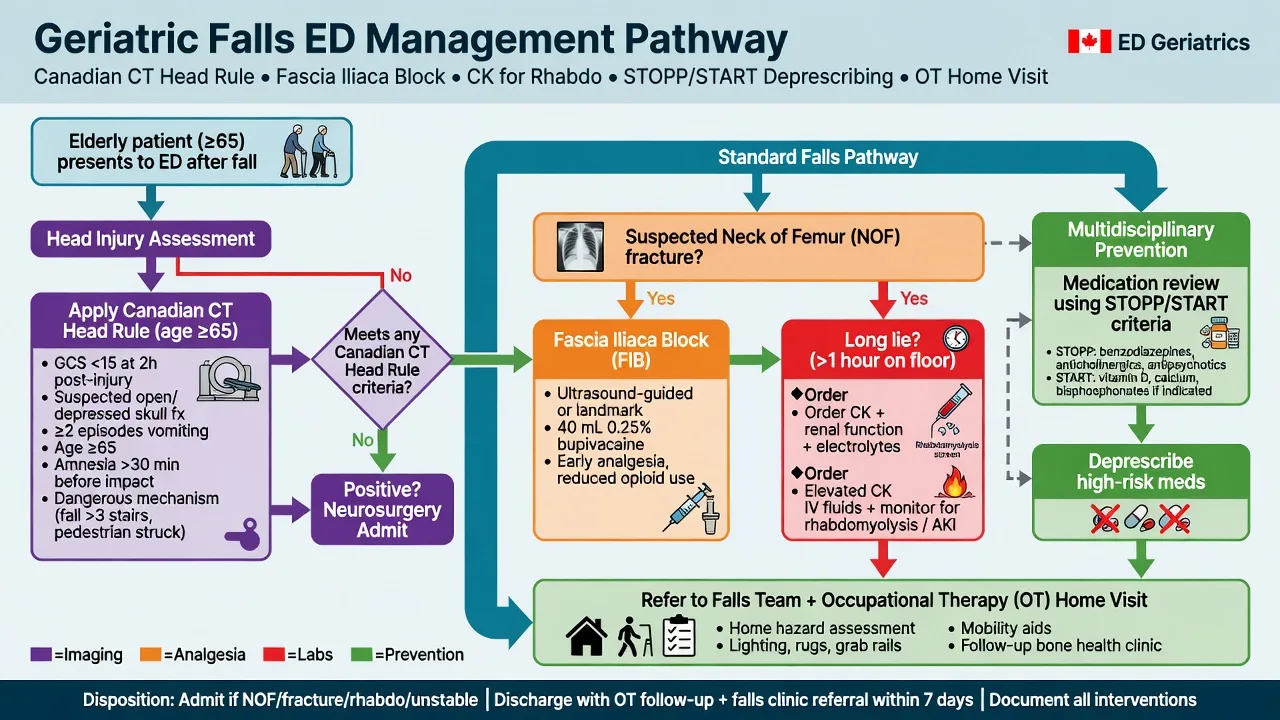
Immediate management proceeds in parallel — the injury is treated, the precipitant is treated, and the consequences of the lie are treated at the same time. Analgesia for the fractured neck of femur is opioid-sparing and multimodal, because the elderly are exquisitely sensitive to opioids and a dose that is reasonable in a younger adult causes the delirium, the respiratory depression, and the hypotension that precipitate the next fall. Paracetamol 1 g intravenously or orally is the baseline, and a fascia-iliaca (femoral nerve) compartment block with 20 mL of 0.25 per cent bupivacaine or 0.5 per cent ropivacaine is the opioid-sparing regional technique that controls the hip pain and avoids the sedation.[5] A small opioid dose — morphine 2.5 mg intravenously, titrated, or fentanyl 25 micrograms — is reserved for breakthrough pain, and the patient is observed for the sedation and the hypotension that warn of over-treatment. The anticoagulated faller with an intracranial bleed on the CT is reversed without delay — idarucizumab 5 g intravenously for dabigatran, a four-factor prothrombin complex concentrate at 25 to 50 units per kilogram for the warfarin or direct oral factor Xa inhibitor, alongside intravenous vitamin K — and the haematology and neurosurgical teams are involved early.
The precipitant is treated as it is identified. Antibiotics and fluids for the occult pneumonia or urinary infection that precipitated the fall, intravenous fluids for the volume depletion and the orthostatic drop, dextrose for the hypoglycaemia, pacing for the malignant bradycardia, rate or rhythm control for the atrial fibrillation, and oxygen for the hypoxia. Delirium precipitating the fall is managed as a medical emergency with its own precipitant search, not sedated. The consequences of the long lie are managed directly — warming for the hypothermia, intravenous fluids and renal monitoring for the rhabdomyolysis, pressure care and repositioning, and a low threshold for fluids to protect the kidney. The early orthopaedic referral for the fractured neck of femur is made as soon as the diagnosis is confirmed, because surgery within 36 hours of the fracture improves the outcomes and the mortality, and the delay is a measurable harm. [1]
Definitive management — the multifactorial intervention
The definitive management is the multifactorial intervention, and the evidence base is the PROFET trial — a randomised controlled trial of an ED-based multifactorial intervention in older fallers that reduced further falls and improved functional outcomes.[3] The intervention is layered, and the candidate reproduces each layer.
The multifactorial falls intervention — the layers in order
First, treat the precipitant. Antibiotics for the infection, fluids for the volume deficit, rate control for the atrial fibrillation, dextrose for the hypoglycaemia, and stop the offending drug. The fall that persists after the precipitant is treated is managed by the remaining layers. [1]
Second, fix the fracture and mobilise early. Surgical fixation of the fractured neck of femur within 36 hours, early mobilisation on day one to prevent the deconditioning spiral, and a structured physiotherapy programme of strength-and-balance training (the Tai Chi and the Otago exercise programmes have the strongest evidence) restore the gait and the confidence.[5][8]
Third, the occupational therapy home visit. An occupational therapist assesses the home for the hazards — loose rugs, poor lighting, the absence of grab rails and banisters, the unsafe bathroom — and arranges the aids, the adaptations, and the personal alarm that allow a safe discharge. The home visit is the single most effective environmental intervention. [1]
Fourth, deprescribe the fall-risk-increasing drugs. Audit the chart against STOPP/START version 2 and the FRID classes — benzodiazepines, antipsychotics, sedating antihistamines, opioids, vasodilators (the two-or-more antihypertensive classes), hypoglycaemics (the sulfonylurea and the sliding-scale insulin), and the anticholinergic load — and stop or reduce them before discharge.[6] This is the layer the examiner most often tests.
Fifth, the targeted adjuncts. Vitamin D supplementation (cholecalciferol 800 to 1000 IU daily) for the deficient patient — the evidence supports correction of deficiency, not routine supplementation of all fallers.[8] Visual correction and the cataract extraction, footwear and podiatry, pacemaker insertion for the documented cardioinhibitory carotid sinus syndrome, and cardiology referral for the structural and the rhythm cause.
Fall assessment by mechanism — the cardinal triage question
The single most important branch point in the older-faller assessment is whether the fall was mechanical, syncope-mediated, or metabolic/toxic in origin, because the workup, the disposition, and the downstream referral diverge completely. The discriminator is the presence, quality, and duration of any loss of consciousness, reconstructed from the patient and — more reliably — the witness. A fall with a brief, fully-recovered loss of consciousness is syncope until proven otherwise; a fall with no loss of consciousness but a clear environmental or postural trigger is mechanical (but still requires the precipitant search); and a fall with preceding systemic illness, altered biochemistry, or a drug effect is metabolic or toxic. The fourth category — the unwitnessed collapse with amnesia — is treated as syncope-plus and receives the full cardiac and neurological screen, because the older patient who simply found themselves on the floor is the classic presentation of a high-risk cardiac cause. [1]
Mechanical fall
- No loss of consciousness — the patient recalls the trip, the slip, or the loss of balance, and the descent to the ground
- A clear environmental or postural trigger: the loose rug, the wet bathroom floor, the poor lighting, the ill-fitting slipper, the turn on the stairs, or the reach for a high shelf
- The patient who trips over their own feet while walking, or who freezes on turning (parkinsonism), or whose legs give way from deconditioning and sarcopenia
- The workup targets the injury, the gait, the home hazard, and the modifiable sensory and motor deficits; the label is earned only after the precipitant search excludes sepsis, dysrhythmia, and the drug effect
Syncope-mediated fall
- A transient loss of consciousness with rapid onset, brief duration, and complete spontaneous recovery, due to global cerebral hypoperfusion — the fall is the consequence of the loss of postural tone
- Vasovagal: a prodrome of nausea, warmth, sweating, and tunnel vision, with a situational trigger (prolonged standing, emotion, venepuncture); a prompt recovery once supine
- Cardiac: the sudden, no-prodrome collapse with an abnormal ECG (heart block, atrial fibrillation, prolonged QT, Brugada, ischaemia), structural heart disease, or an exertional trigger; the high-risk mimic that mandates admission and a cardiology workup
- Carotid sinus syndrome and vertebrobasilar insufficiency cause syncope on head turning; post-micturition and post-prandial syncope are situational; the orthostatic vitals, the ECG, the echocardiogram, and the monitoring strip are the discriminating tests
Metabolic / toxic fall
- A fall driven by an acute derangement of biochemistry or a drug effect rather than a mechanical or primary cardiac event; the loss of consciousness may be incomplete, fluctuating, or absent
- Hypoglycaemia (the sulfonylurea or the insulin, especially nocturnal) mimics anything and is excluded first with a bedside glucose; electrolyte disturbance (hyponatraemia, hypo- and hyperkalaemia, hypocalcaemia) causes weakness, confusion, and arrhythmia
- Occult sepsis and dehydration lower the blood pressure and the consciousness; anaemia and acute blood loss cause exertional presyncope and syncope; uraemia and hepatic encephalopathy depress the central nervous system
- Drug toxicity and withdrawal — benzodiazepine and opioid over-sedation, alcohol intoxication and withdrawal, anticholinergic delirium, lithium toxicity — are sought from the drug chart and the collateral; the workup is the blood gas, the electrolytes, the drug levels, and the septic screen
Intrinsic and extrinsic risk factors — the structured audit
The risk-factor audit is the backbone of the multifactorial assessment, because each identified factor is a target for a specific intervention, and the count of factors predicts the probability of the next fall. The Fellowship examiner expects the candidate to organise the factors into the intrinsic (host) and extrinsic (environmental and pharmacological) domains, to name the strongest individual predictors (age over 75, prior falls, gait and balance impairment, and the use of fall-risk-increasing drugs), and to translate each into an action — the spectacle prescription, the deprescribed benzodiazepine, the grab rail, the pacemaker, the exercise programme.[1][4]
Intrinsic (host) factors
- Age over 75 — the single strongest demographic predictor; the proportion of community fallers rises from a third at 65 to a half at 80 as the homoeostatic reserve narrows
- Prior falls — the strongest single predictor of the next; a patient who has fallen once is two to three times more likely to fall again within the year
- Cognitive impairment and dementia — slows processing, impairs attention and dual-tasking, and is both a precipitant and a barrier to the history; screen with the 4AT and the MoCA or MMSE
- Gait and balance impairment — the Timed Up and Go over 12 seconds, a shuffling or wide-based gait, the inability to tandem walk or stand on one leg; sarcopenia and lower-extremity weakness underlie most
- Visual impairment — reduced acuity, contrast sensitivity, and depth perception (cataracts, macular degeneration, glaucoma, uncorrected refractive error); each line of acuity lost increases the fall risk
- Orthostatic hypotension — a drop of 20 mmHg systolic or 10 mmHg diastolic within three minutes of standing; frequently drug-induced, autonomic, or volume-depleted
- Depression — an independent risk factor through psychomotor retardation, inattention, and the sedating effect of antidepressants; screen and treat
- Foot pathology and neuropathy — hallux valgus, deformity, callus, sensory neuropathy (diabetes, alcohol), and the over-pronated foot; podiatry and footwear are modifiable
Extrinsic (environmental and drug) factors
- Polypharmacy — five or more medications independently predicts falls, and the risk rises steeply with each additional drug; the count and the anticholinergic load are both audited
- Fall-risk-increasing drugs (FRIDs) — benzodiazepines and Z-drugs, antipsychotics, sedating antihistamines (first-generation), opioids, two or more antihypertensive classes, sulfonylureas, and high-anticholinergic-load drugs; each is a STOPP/START version 2 flag
- Environmental hazards — loose rugs and mats, slippery floors, poor lighting (especially on stairs and at night), uneven steps, the absence of grab rails and banisters, trailing electrical cords, low chairs and beds that are hard to rise from
- Footwear — backless slippers, worn or high heels, loose or overlarge shoes; the firm, low-heeled, thin-soled, well-fitting shoe is the target
- Assistive-device misuse — the wrong-height walking stick or frame, the discarded or unmaintained aid, the four-wheel frame used on the stairs
- Alcohol — acute intoxication and the cumulative ataxic and hypoglycaemic effect of chronic excess, interacting with sedating drugs
The ED multifactorial workup — the protocolised assessment
The multifactorial assessment is not a checklist performed in sequence but a set of parallel domains, each documented, that together define the precipitant, the consequence, and the disposition. The Fellowship candidate reproduces the full set; the candidate who omits the orthostatic vitals, the 4AT, or the drug-chart audit fails the question. [1]
The ED multifactorial fall assessment — the order of operations
1. Vitals including orthostatic blood pressure
Temperature, heart rate, respiratory rate, oxygen saturation, blood pressure, and blood glucose on arrival. Then measure supine blood pressure and heart rate, and repeat after 1 and 3 minutes of standing (or sitting up if the patient cannot stand); a drop of 20 mmHg systolic or 10 mmHg diastolic, or a rise of 20 bpm, defines orthostatic hypotension. Hypoglycaemia is excluded first at the bedside glucose.
2. Cognitive assessment — 4AT, MMSE, or MoCA
Screen every older faller for delirium with the 4AT (alertness, AMT-4, attention by months backwards, acute change; a score of 4 or more is probable delirium). The MMSE or the MoCA quantifies the baseline cognitive impairment that is both a precipitant and a barrier to discharge. A new delirium is a medical emergency with its own precipitant search; never discharge a delirious faller.
3. Gait and balance observation — the Timed Up and Go
Observe the patient rise from a chair, walk 3 metres, turn, walk back, and sit. The Timed Up and Go over 12 seconds, the use of the arms to rise, an unsteady turn, a shuffling or freezing gait, or a wide-based or ataxic walk identifies the high-risk faller. The inability to stand on one leg or to tandem-walk further stratifies the balance deficit.
4. Medication review — STOPP/START version 2 and the FRID audit
Audit the entire drug list against STOPP/START version 2. Flag every fall-risk-increasing drug — benzodiazepines and Z-drugs, antipsychotics, first-generation sedating antihistamines, opioids, two or more antihypertensive classes, sulfonylureas, and high-anticholinergic-load drugs. Calculate the anticholinergic burden. Plan the deprescribing — taper and stop the culprit before discharge, substitute where needed (gliclazide for glibenclamide, an SSRI for a TCA), and document.
5. Vision, feet, and footwear
Ask when the patient last had their glasses tested and whether they had them on at the time of the fall; examine for cataract. Examine the feet for neuropathy, deformity, and callus; inspect the footwear for fit, sole, and heel. Refer to optometry and podiatry as indicated.
6. Cardiovascular and neurological examination
Listen for the murmur of aortic stenosis (exertional syncope), check the pulse for atrial fibrillation, and consider carotid sinus massage (with monitoring, after excluding a bruit) in the suggestive history. Examine for the focal deficit, parkinsonism (the festinating shuffling gait, the freezing on turning), the sensory neuropathy, and the cerebellar sign.
7. Investigations — FBC, glucose, calcium, TSH, B12, ECG, imaging
Full blood count and CRP (anaemia, infection), renal function and electrolytes (volume status, AKI), calcium (hypo- and hypercalcaemic weakness), glucose and HbA1c, TSH (thyroid dysfunction is a reversible fall precipitant), B12 and folate (the neuropathy and the cognitive impairment of deficiency), a urine dipstick and culture, a chest X-ray, and a mandatory 12-lead ECG (ischaemia, block, atrial fibrillation, prolonged QT, Brugada). Creatine kinase after any long lie. CT head for any head strike where age 65 or over meets the Canadian CT Head Rule; hip and pelvic X-ray for pain or inability to weight-bear.
8. Functional and social assessment
How does the patient mobilise at home, what aids do they use, who is there, what is the home environment, is there a personal alarm, how far is help? Frame the discharge decision and the occupational therapy home visit.
Cognitive and gait screening tools — the bedside repertoire
The Fellowship candidate is expected to name the tool, reproduce the score, and state the threshold that changes management. The 4AT screens for delirium (a precipitant and a consequence), the MMSE and the MoCA quantify cognitive impairment, and the Timed Up and Go and the Berg Balance Scale quantify the gait and balance deficit that underlies most falls.[2]
4AT
- The rapid (under one minute) bedside delirium screen: Alertness (0 or 1), AMT-4 (0 to 4), Attention by months backwards (0 or 2), Acute change or fluctuation (0 or 4)
- A score of 4 or more is probable delirium; a score of 1 to 3 suggests possible delirium and warrants further assessment
- Performed on every older faller, because delirium is both a precipitant of the fall (the inattentive patient) and a consequence (the head strike, the sepsis), and a delirious faller is not discharged
MMSE (Mini-Mental State Examination)
- A 30-point test of orientation, registration, attention and calculation, recall, language, and visuospatial function; takes 5 to 10 minutes
- A score of 24 to 30 is normal, 18 to 23 mild-to-moderate impairment, and 17 or below severe impairment; screens for the baseline dementia that frames the discharge
- Less sensitive than the MoCA to mild cognitive impairment and to frontal-executive dysfunction; the MoCA is preferred where early dementia is suspected
MoCA (Montreal Cognitive Assessment)
- A 30-point test more sensitive than the MMSE to mild cognitive impairment; emphasises frontal-executive function, attention, and visuospatial ability (the domains most relevant to postural control)
- A score of 25 or below suggests cognitive impairment; one extra point is added for 12 years or fewer of education
- The tool of choice for detecting the early dementia and the mild cognitive impairment that impair dual-task gait and raise the fall risk
Timed Up and Go (TUG)
- Rise from a standard chair, walk 3 metres, turn, walk back, and sit — timed; takes under a minute and needs no special equipment
- Over 12 seconds identifies the high-risk faller; over 14 seconds predicts falls with higher sensitivity; over 30 seconds indicates the patient needs assistance to mobilise
- The qualitative observation is as important as the time: the use of the arms to rise, the unsteady turn, the freezing, the short steps, and the near-miss
Berg Balance Scale
- A 14-item, 56-point test of static and dynamic balance (sitting, standing, reaching, turning, transferring, single-leg stance); takes 15 to 20 minutes
- A score of 45 to 52 indicates a medium fall risk, 36 to 44 a high fall risk, and below 36 a very high risk of falls; a drop of several points signals decline
- Used by physiotherapy to quantify the balance deficit, to set the exercise programme, and to track the response to the strength-and-balance training
Fall prevention — the evidence base
The evidence for falls prevention is among the strongest in geriatric medicine, and the Fellowship examiner expects the candidate to cite the landmark trials and the meta-analytic estimates. Exercise interventions, multifactorial assessment, home-hazard modification in high-risk fallers, cataract surgery, and pacemaker insertion for cardioinhibitory carotid sinus syndrome each have randomised-trial or meta-analytic support; routine vitamin D supplementation of the non-deficient faller does not.[8]
PROFET — Prevention of Falls in the Elderly Trial (Close, Lancet 1999, PMID 10023893)
Design
Randomised controlled trial — 397 community-dwelling over-65s presenting to an ED after a fall
Intervention
A structured multifactorial assessment and intervention (medical, physiotherapy, occupational therapy) delivered from the ED vs usual care
Key findings
At one year, the intervention group had a significantly lower risk of further falls (odds ratio 0.39, 95% CI 0.16 to 0.94), fewer functional limitations, and a lower rate of hospital admission
Bottom line
Established the ED-based multifactorial falls intervention as effective — the justification for the ED role in falls prevention, and the trial the examiner expects named
Sherrington 2017 — Exercise to prevent falls in older adults: updated meta-analysis (Br J Sports Med, PMID 27707740)
Design
Systematic review and meta-analysis — 88 randomised controlled trials, 19,478 participants
Intervention
Exercise interventions (balance and functional exercises, Tai Chi, strength and resistance, multiple types) vs control
Key findings
Exercise reduced the rate of falls by about 23% (rate ratio 0.77, 95% CI 0.71 to 0.83) and the number of people who fell by about 15%; balance and functional exercises, and programmes with a higher challenge to balance and 3 or more hours per week, had the largest effect
Bottom line
Exercise is the single most effective component of falls prevention, with the greatest benefit from balance-challenging programmes of 3 or more hours per week — the Otago and Tai Chi programmes exemplify the high-yield format
DO-HEALTH — Bischoff-Ferrari 2020, vitamin D, omega-3, and exercise in older adults (JAMA, PMID 33170239)
Design
2 × 2 × 2 factorial randomised controlled trial — 2,157 healthy adults aged 70 and over across five European centres
Intervention
Vitamin D3 2000 IU/day, omega-3 fatty acids 1 g/day, and a home strength-training exercise programme, alone and in combination, vs placebo, over three years
Key findings
None of the three interventions — vitamin D, omega-3, or home exercise — significantly reduced the rate of falls, infections, or the six-minute walk distance in this healthy, replete population; vitamin D did not prevent falls in the non-deficient elder
Bottom line
Routine vitamin D supplementation does not prevent falls in healthy, non-deficient older adults — correct deficiency, but do not supplement routinely; the 2024 USPSTF recommendation against routine vitamin D rests on this evidence
USPSTF 2024 — Interventions to prevent falls in community-dwelling older adults (JAMA, PMID 38833246)
Type
United States Preventive Services Task Force recommendation statement, 2024
Recommendation
Exercise interventions for community-dwelling adults 65 and over at increased risk of falls (Grade B); a multifactorial intervention for high-risk fallers (Grade C); recommends AGAINST routine vitamin D supplementation to prevent falls in those without deficiency (Grade D)
Evidence base
Exercise reduces falls by about 20 to 25%; multifactorial interventions show a smaller, less consistent benefit confined to high-risk groups; vitamin D shows no benefit and a possible harm (renal stones, hypercalcaemia) in the replete
Bottom line
The current primary-care and ED reference standard — exercise for all at-risk elders, a multifactorial intervention for the high-risk faller, and vitamin D only for the documented deficiency
Clinical pearls — high-yield exam points
[1] [1] [1] [1] [1] [1] [1] [1] [1] [1] [1] [1] [1] [1] [1] [1] [1] [1] [1] [1] [1]Subtypes and special scenarios
Several scenarios recur in the examination. The anticoagulated faller is scanned at the first sign of a head strike, because intracranial bleeding is frequently delayed and clinically silent, and the reversal is delivered without delay once a bleed is confirmed. The long lie generates its own morbidity — rhabdomyolysis with creatine kinase in the tens of thousands, acute kidney injury, hypothermia, pressure injury, and dehydration — and the assessment measures the creatine kinase and the renal function and warms and rehydrates the patient. The recurrent faller is a high-risk patient who demands a full multifactorial intervention and a community falls-team referral, because the recurrent fall is the one that breaks the hip. The fractured neck of femur is the injury with the orthopaedic, the anaesthetic, and the geriatric pathways — the femoral nerve block for analgesia, the surgery within 36 hours, the early mobilisation, the venous thromboembolism prophylaxis, and the bone-health review for the underlying osteoporosis. The head-injured faller is imaged by the Canadian CT Head Rule, and the small intracranial bleed is observed or operated as the neurosurgical guidance dictates. The care-home resident arrives with a handover that often names the precipitant — a fall at the bedside, a drug change, a temperature — and the same multifactorial search applies, with attention to the goals of care and the ceiling of treatment. The cognitively impaired faller is assessed with the 4AT and a collateral, because the cognitive impairment is both a precipitant and a barrier to the history. [1]
Complications and pitfalls
The complications are the injury, the consequence of the lie, and the loss of confidence. The fractured neck of femur carries a one-year mortality of 20 to 30 per cent and a high rate of new institutionalisation. The intracranial bleed in the anticoagulated faller is the catastrophic miss when the CT is omitted. Rhabdomyolysis and acute kidney injury follow the long lie and are detected late without the creatine kinase. Hypothermia, pressure injury, and dehydration complete the morbidity of the lie. Deconditioning — the loss of muscle and balance that follows even a few days of bed rest in the elderly — sets up the next fall, which is why early mobilisation is mandatory. The loss of confidence and the fear of falling cause a self-imposed restriction of activity that accelerates the deconditioning spiral and the social withdrawal. The pitfalls are the diagnostic: the label of the "mechanical fall" that hides the sepsis, the stroke, or the arrhythmia; the failure to scan the anticoagulated head-strike faller; the omission of the orthostatic vitals and the 4AT; the failure to deprescribe the FRIDs; and the discharge of the recurrent faller without a multifactorial plan. [1]
[1]Prognosis and disposition
The prognosis is sobering and the disposition favours admission for the injurious fall, the delirious faller, the septic faller, the anticoagulated head-strike faller, and the patient who cannot safely mobilise. The one-year mortality after a fractured neck of femur sits at 20 to 30 per cent, the recurrent faller is at high risk of the next injurious fall, and the long lie itself predicts a poorer outcome. Discharge is reasonable only when a single, fully reversible precipitant has been identified and treated, the patient can mobilise safely, the cognition and the observations are at baseline, the anticoagulation is reviewed, the FRIDs are deprescribed, and a safe environment — the family, the community falls team, the personal alarm, and the GP follow-up — is in place. The discharge safety-net is documented explicitly: the precipitant and its treatment, the drug changes, the planned physiotherapy and occupational therapy, the falls-team referral, and the return precautions. A faller who is discharged without this safety-net represents and falls again, and the next fall is the one that breaks the hip. [1]
Special populations
The anticoagulated faller is the highest-risk single group, scanned early and reversed promptly; the reversal agent and the dose are reproduced in the immediate-management section. The cognitively impaired faller is assessed through a collateral and a 4AT, and the cognitive impairment is both a precipitant and a barrier. The care-home resident is assessed within the care-home's goals of care and ceiling of treatment, because the injurious fall may be the event that triggers the end-of-life conversation. The rural or isolated elder is asked about the personal alarm and the distance to help, because the long lie is the consequence of the alarm that was not pressed and the help that did not come. The patient at the end of life is managed within the goals of care — the injurious fall may be the natural event of the dying trajectory, and the burden of investigation and surgery is weighed against the comfort and the wishes of the patient. [1]
Evidence and regional guidelines
The epidemiology of falls in the community, established by Tinetti and colleagues in 1988, identified the risk-factor profile that still underpins the multifactorial intervention, and the Timed Up and Go test, validated by Podsiadlo and Richardson in 1991, remains the bedside gait screen.[1][2] The PROFET trial, published by Close and colleagues in 1999, established that an ED-based multifactorial intervention in older fallers reduced further falls and improved functional outcomes, and it remains the evidence base for the ED role.[3] Ganz and colleagues, in a 2007 JAMA review, set out the individualised multifactorial risk assessment that the Fellowship examiner still quotes.[4] The 2011 American Geriatrics Society and British Geriatrics Society guideline summarised the multifactorial intervention into the components that are reproduced at the bedside.[5] STOPP/START version 2, published by O'Mahony and colleagues in 2015, is the reference standard for the deprescribing of potentially inappropriate medications in the faller.[6] The Canadian CT Head Rule, derived by Stiell and colleagues in 2001, governs the imaging of the head-struck older faller and names age 65 or over as a criterion.[7] The 2024 United States Preventive Services Task Force recommendation statement recommends exercise interventions for community-dwelling adults over 65 at increased risk, and a multifactorial intervention for high-risk fallers, while recommending against routine vitamin D supplementation in those without deficiency.[8]
ANZ practice note. The Australian Commission on Safety and Quality in Health Care "Preventing Falls and Harm from Falls in Older Care" standard and the equivalent New Zealand guidance underpin hospital and aged-care falls prevention. The ACEM geriatric emergency medicine guidance applies in the ED, with emphasis on the multifactorial assessment and the safe disposition. Capacity is decision-specific and assessed under the guardianship and mental-health legislation of each state and territory; a substitute decision-maker consents when the faller lacks capacity, and the goals of care are framed within the advance care directive where one exists. [1]
Exam practice
SAQ — Multifactorial falls assessment in the elderly with the long lie
10 minutes · 10 marks
An 82-year-old woman who lives alone is brought to the emergency department by ambulance after being found on the floor of her bathroom by a neighbour, having last been seen well approximately twelve hours earlier. She is on temazepam 10 mg nocte, ramipril 10 mg daily, furosemide 40 mg daily, gliclazide 80 mg daily, and amitriptyline 25 mg nocte for neuropathic pain. On arrival she is cold at 34.8 degrees Celsius, GCS 14, blood pressure 96/58 supine and 78/44 on standing, heart rate 96, respiratory rate 18, SpO2 94 per cent on room air, and bedside glucose 3.6 mmol/L. She has a bruise over the right temple and cannot weight-bear on the right hip. She does not recall losing consciousness. The collateral history from the neighbour confirms a twelve-hour long lie.
SAQ — Syncope workup: the high-risk cardiac cause
10 minutes · 10 marks
A 76-year-old man is brought to the emergency department after collapsing while walking to the letterbox. There was no warning, no prodrome, and no incontinence or tongue-biting. He recovered fully within thirty seconds but is amnestic for the event. His wife witnessed the collapse and confirms the sudden onset and the rapid, complete recovery. He has a prior anterior STEMI with primary PCI and a stent two years ago, hypertension, and type 2 diabetes. On arrival: GCS 15, blood pressure 132/78, heart rate 48 and regular, no murmur, no focal neurology. The 12-lead ECG shows a bifascicular block — right bundle branch block with left anterior fascicular block — and a PR interval of 240 ms.
Exam pearls
- There is no such thing as just a fall. Every older faller has a reason; the label of the mechanical fall is a conclusion reached after the search, never an assumption that short-circuits it.
- The long lie predicts mortality. Ask how long the patient was on the floor, and check the creatine kinase and the renal function for the rhabdomyolysis.
- Age 65 or over is a Canadian CT Head Rule criterion. Any head-struck older patient is scanned, and anticoagulation lowers the threshold further still; reproduce the rule by name.
- Occult sepsis is the commonest single medical precipitant. Every older faller receives a temperature, a respiratory rate, a chest, a urine, and a blood gas — the pneumonia and the urinary infection present as a fall.
- Deprescribe before discharge. The benzodiazepine, the antipsychotic, the opioid, and the second antihypertensive are the fall-risk-increasing drugs that STOPP/START version 2 flags; stop them, and document the change.
- Vitamin D is for the deficient. Correct the deficiency, but do not supplement routinely; the 2024 USPSTF recommends against routine supplementation in the non-deficient faller.
- The femoral nerve block is opioid-sparing analgesia. Twenty mL of 0.25 per cent bupivacaine controls the hip pain and avoids the sedation that causes the next fall.
- Early surgery for the fractured neck of femur. Surgery within 36 hours improves the mortality; the delay is a measurable harm, and the orthopaedic referral is made on the confirmation of the fracture.
- The PROFET trial justifies the ED role. An ED-based multifactorial intervention in older fallers reduced further falls and improved functional outcomes — the ED is where the prevention begins.
- The anticholinergic burden predicts the fall. Sum the anticholinergic load of the drug chart (the ACB or the ARS); a higher burden independently predicts falls, delirium, and cognitive decline, and the first step in deprescribing is the identification and substitution of the highest-burden drug.
- Anaemia is a reversible fall precipitant. Acute or chronic blood loss (the occult gastrointestinal bleed, the anticoagulated patient) presents as exertional presyncope, syncope, or the fall; a full blood count and a haemodynamic assessment are part of every fall workup, and the positive faecal immunochemical test in the iron-deficient faller prompts the endoscopy.
- The disposition decision is the crux of the question. Discharge is reasonable only when a single, fully reversible precipitant has been identified and treated, the patient can mobilise safely, the cognition and the observations are at baseline, the anticoagulation is reviewed, the FRIDs are deprescribed, and a safe environment — the family, the community falls team, the personal alarm, and the GP follow-up — is in place.
- The Berg Balance Scale and the Falls Efficacy Scale quantify the deficit and the fear. The Berg (under 45 indicates a high fall risk) and the Falls Efficacy Scale (the fear of falling that drives the deconditioning spiral) are the physiotherapy and the psychology tools that frame the structured rehabilitation, and the candidate who names them shows the depth.
- B12, folate, and TSH are the reversible metabolic precipitants. The subacute combined degeneration and the cognitive impairment of B12 deficiency, the neuropathy of folate deficiency, and the myopathy and the bradycardia of thyroid dysfunction are the reversible metabolic precipitants of the fall that the first-line blood panel is designed to find. [1]
Red flags
[1]References
- [1]Tinetti ME, Speechley M, Ginter SF. Risk factors for falls among elderly persons living in the community N Engl J Med, 1988.PMID 3205267
- [2]Podsiadlo D, Richardson S. The timed Up & Go: a test of basic functional mobility for frail elderly persons J Am Geriatr Soc, 1991.PMID 1991946
- [3]Close J, Ellis M, Hooper R, Glucksman E, Jackson S, Swift C. Prevention of falls in the elderly trial (PROFET): a randomised controlled trial Lancet, 1999.PMID 10023893
- [4]Ganz DA, Bao Y, Shekelle PG, Rubenstein LZ. Will my patient fall? JAMA, 2007.PMID 17200478
- [5]Panel on Prevention of Falls in Older Persons, American Geriatrics Society and British Geriatrics Society. Summary of the Updated American Geriatrics Society/British Geriatrics Society clinical practice guideline for prevention of falls in older persons J Am Geriatr Soc, 2011.PMID 21226685
- [6]O'Mahony D, O'Sullivan D, Byrne S, O'Connor MN, Ryan C, Gallagher P. STOPP/START criteria for potentially inappropriate prescribing in older people: version 2 Age Ageing, 2015.PMID 25324330
- [7]Stiell IG, Wells GA, Vandemheen KL, et al. The Canadian CT Head Rule for patients with minor head injury Lancet, 2001.PMID 11356436
- [8]US Preventive Services Task Force. Interventions to Prevent Falls in Community-Dwelling Older Adults: US Preventive Services Task Force Recommendation Statement JAMA, 2024.PMID 38833246
- [9]Sherrington C, Michaleff ZA, Fairhall N, et al. Exercise to prevent falls in older adults: an updated systematic review and meta-analysis Br J Sports Med, 2017.PMID 27707740
- [10]Bischoff-Ferrari HA, Vellas B, Rizzoli R, et al. Effect of Vitamin D Supplementation, Omega-3 Fatty Acid Supplementation, or a Strength-Training Exercise Program on Clinical Outcomes in Older Adults: The DO-HEALTH Randomized Clinical Trial JAMA, 2020.PMID 33170239