EM · Toxicology and environmental emergencies
Alcohol and benzodiazepine withdrawal (emergency department recognition and management)
Also known as Alcohol withdrawal syndrome · Delirium tremens · Alcohol withdrawal seizure · Benzodiazepine withdrawal · CIWA-Ar withdrawal · Alcohol hallucinosis
ACEM emergency-department approach to alcohol and benzodiazepine withdrawal: GABA-glutamate pathophysiology, staged clinical presentation through to delirium tremens, CIWA-Ar-guided benzodiazepine-ladder management, and the thiamine-before-glucose safety rule.
On this page & tools
Your progress
Saved locally on this device.
Target exams
Red flags
Related topics
- The toxidrome approach and the general management of the poisoned patient
- Delirium in the elderly
- Sepsis and septic shock — the emergency department approach
- Status epilepticus
- Electrolyte emergencies — potassium and sodium
- Coma and GCS assessment
- Opioid poisoning and the opioid toxidrome (emergency department diagnosis and management)
Alcohol and benzodiazepine withdrawal are the clinical expressions of the same neuroadaptation: chronic enhancement of inhibitory GABA-A signalling and chronic dampening of excitatory NMDA signalling drive the brain to downregulate inhibition and upregulate excitation to defend a set-point, so that abrupt removal of the agent leaves an unopposed glutamatergic, hyperadrenergic brain. The Fellowship candidate must grade the syndrome with the CIWA-Ar, treat with a long-acting benzodiazepine that self-tapers through its active metabolites, give thiamine before glucose to prevent Wernicke encephalopathy, and refuse the trap of attributing agitation to withdrawal until sepsis, hyponatraemia, hypoglycaemia, hepatic encephalopathy and an intracranial bleed have been excluded. Benzodiazepine withdrawal is the mirror image and is tapered, never reversed — flumazenil is contraindicated because it precipitates intractable seizures.[2][3][6]
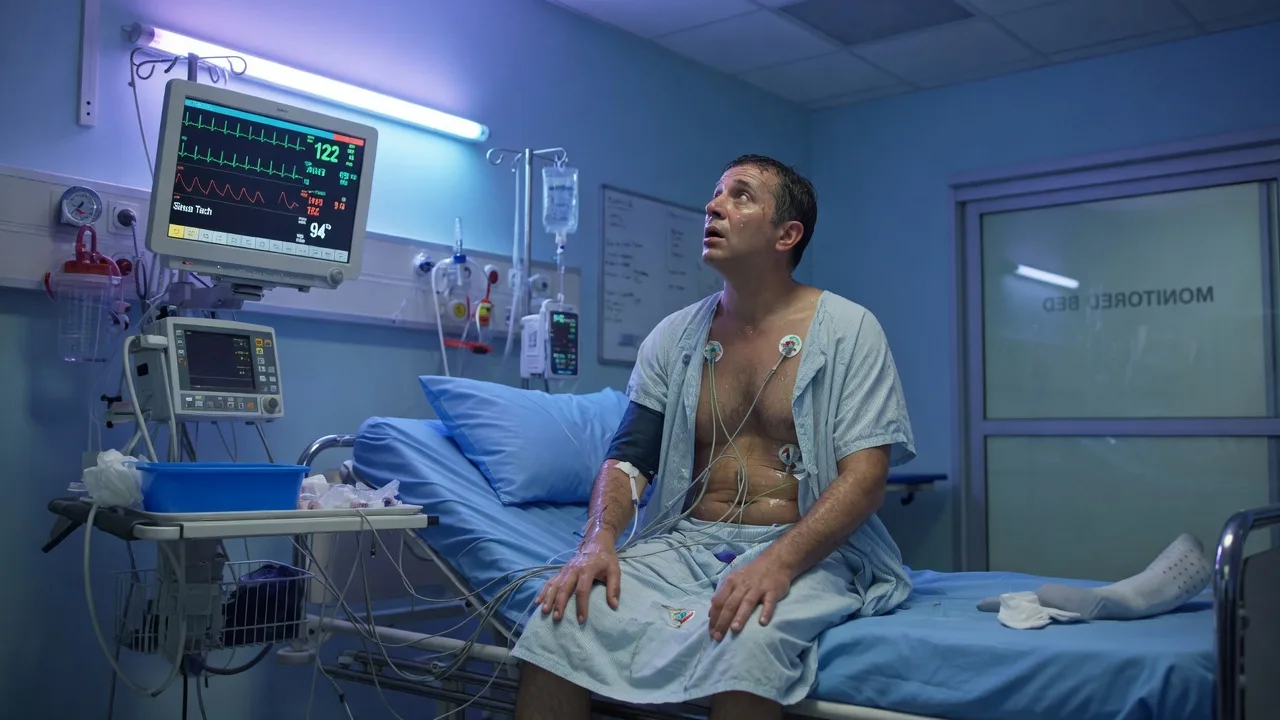
Definition and classification
Alcohol withdrawal syndrome is the cluster of autonomic and neuropsychiatric signs and symptoms that follows the abrupt cessation of, or a substantial reduction in, heavy and prolonged ethanol intake. The syndrome is graded by severity and unfolds along a recognisable timeline. Minor withdrawal (6 to 24 hours after the last drink) is tremor, anxiety, insomnia, nausea, vomiting, craving and mild sympathetic overactivity — tachycardia, hypertension and a low-grade fever. Alcoholic hallucinosis (12 to 48 hours) is vivid perceptual disturbance — typically visual but also tactile (formication) or auditory — with an otherwise clear sensorium; the patient knows the hallucinations are not real, distinguishing the state from delirium. Withdrawal seizures (24 to 48 hours) are generalised tonic-clonic, brief, and occur one to several times in a cluster; status epilepticus is rare and, when it occurs, should prompt a search for an alternative cause. Delirium tremens (48 to 96 hours, occasionally up to two weeks) is the severe end: clouding of consciousness, disorientation, severe agitation, vivid hallucinations, marked autonomic hyperactivity (tachycardia, hypertension, fever, profuse sweating), and the risk of cardiovascular collapse, aspiration and death.[3][6]
Benzodiazepine withdrawal is clinically and mechanistically analogous. It follows the abrupt cessation of, or a major reduction in, a benzodiazepine taken regularly for weeks or more, and ranges from a mild anxiety–insomnia–tremor picture through perceptual disturbance, depersonalisation, myoclonus and autonomic instability to, in the severe case, withdrawal seizures and a delirium that resembles delirium tremens. The candidate must remember that benzodiazepine withdrawal can be protracted, with a milder anxiety and sensory-disturbance phase persisting for weeks after the acute syndrome settles, and that it is precipitated iatrogenically by flumazenil.[8]
Epidemiology and risk factors
Alcohol withdrawal is among the commonest reasons a medical or surgical inpatient deteriorates, and a frequent emergency presentation in its own right. The risk is concentrated in the heavy, prolonged drinker — typically more than eight standard drinks daily for more than two weeks — who then stops abruptly because of an intercurrent event: admission to hospital, surgery, an infective illness, pancreatitis, a head injury, or incarceration. The risk and the severity of a given withdrawal episode are predicted by the prior withdrawal history: a patient who has had delirium tremens or a withdrawal seizure is substantially more likely to do so again, a phenomenon of kindling in which each withdrawal episode sensitises the brain to ever-worse subsequent episodes. Additional risk factors are the quantity and duration of intake, the abruptness of cessation, concurrent medical illness (infection, liver disease, pancreatitis), older age, and a low serum ethanol on arrival. Benzodiazepine withdrawal is similarly predictable from dose, duration and abruptness: patients on a benzodiazepine for more than two to four weeks, those on high doses, those on short-acting agents (alprazolam, lorazepam), and those who stop suddenly are at greatest risk.[2][6]
Pathophysiology — GABA downregulation and glutamate upregulation
The mechanism is the same for alcohol and for the benzodiazepines, and the candidate must trace each clinical feature back to the receptor. Ethanol, across the blood concentrations of chronic heavy drinking, potentiates the inhibitory GABA-A receptor (it binds an allosteric site and increases chloride influx) and inhibits the excitatory NMDA glutamate receptor. The brain, defending its excitatory–inhibitory balance, downregulates GABA-A receptor density and function and upregulates NMDA receptor expression so that, in the presence of ethanol, the brain functions near-normally. Benzodiazepines, which bind the GABA-A receptor at their own allosteric site and enhance chloride influx in the presence of GABA, drive exactly the same compensatory downregulation of GABAergic tone over weeks of use.[3][6]
When the agent is withdrawn abruptly, the brake is removed but the compensation remains: there is too little GABAergic inhibition and too much NMDA-mediated excitation. The result is an unopposed glutamatergic, hyperadrenergic state. The excess excitatory drive generates the tremor, the agitation, the myoclonus and, when it reaches the seizure threshold, the generalised withdrawal seizure. The loss of GABAergic inhibition in the locus coeruleus drives noradrenergic surges responsible for the tachycardia, the hypertension, the sweating, the fever and the anxiety. Calcium flux through upregulated NMDA receptors is the substrate of the kindling phenomenon — each withdrawal episode leaves a lower seizure threshold for the next. The same neuroadaptation explains why a long-acting GABA-A agonist (a benzodiazepine with active metabolites) is the rational, evidence-based treatment: it restores the missing inhibition gradually and its own slow clearance gives the receptors time to re-regulate.[2][3]
[1] [1] [1]Clinical presentation — the timeline and the four stages
The candidate must know the timeline and the clinical features of each stage, because severity and disposition are read from where on the timeline the patient sits and how fast the picture is escalating.
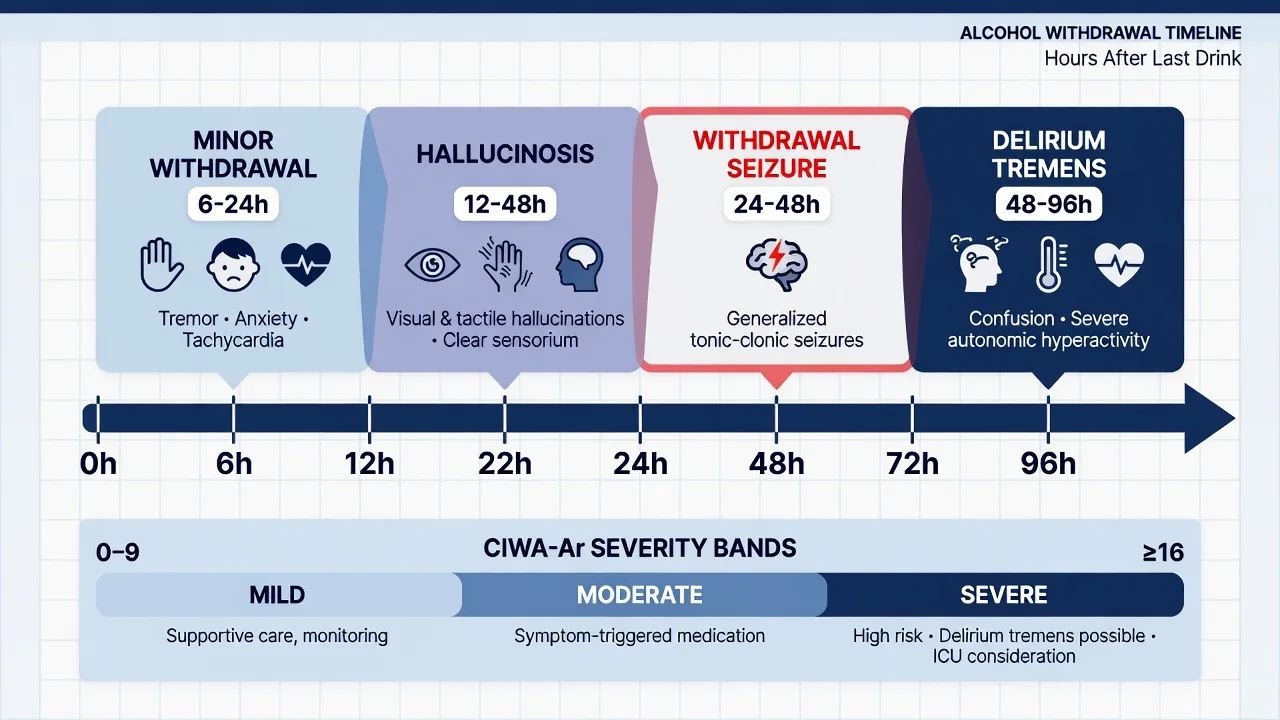
WITHDRAWAL
Onset 6 to 24 h after the last drink; minor withdrawal (tremor, anxiety, insomnia)
Hallucinosis at 12 to 48 h — visual or tactile hallucinations with a CLEAR sensorium
Coarse tremor, agitation, tachycardia, hypertension — the sympathetic overactivity of mild to moderate withdrawal
Fever with marked autonomic hyperactivity heralds delirium tremens
48 to 96 h — clouded consciousness, severe agitation, vivid hallucinations, autonomic storm; mortality 1 to 5 per cent
Follows abrupt REDUCTION or cessation of heavy prolonged intake; quantity and duration matter
Tachycardia, hypertension, sweating — proportional to severity; the basis of the CIWA-Ar scoring
Generalised tonic-clonic at 24 to 48 h; treat with benzodiazepine, NOT an antiepileptic
The revised Clinical Institute Withdrawal Assessment, 10 items, max 67 — the severity scale of record
Diazepam or chlordiazepoxide — long half-life with active metabolites gives the self-taper
Minor withdrawal presents within hours: a coarse tremor of the outstretched hands, anxiety, irritability, insomnia, nausea and vomiting, and sympathetic overactivity (a heart rate above 100, a blood pressure above the patient's baseline, sweating). The patient is fully oriented and the sensorium is clear. Alcoholic hallucinosis adds vivid visual or tactile hallucinations (the classic is formication — a sensation of insects crawling on or under the skin) but, again, with a clear sensorium and intact orientation; the patient may describe the hallucinations as obviously unreal. Withdrawal seizures are generalised tonic-clonic, brief, occur 24 to 48 hours after the last drink, and cluster over a few hours; they are rare beyond 48 hours, and a seizure later than this, a focal seizure, or status epilepticus should trigger a search for an alternative cause (intracranial bleed, infection, metabolic derangement, trauma). Delirium tremens is the life-threatening endpoint: the sensorium clouds, the patient becomes disoriented, agitated and uncooperative, vivid hallucinations dominate the picture, and the autonomic storm reaches its peak — a heart rate above 120, a blood pressure above 160 systolic, a fever above 38.5°C, and profuse sweating. Without treatment, delirium tremens carries a mortality of one to five per cent from arrhythmia, hyperthermia, cardiovascular collapse or aspiration; with prompt benzodiazepine-based care the mortality is well below one per cent.[3][6]
Benzodiazepine withdrawal presents with the same palette in a milder, often more protracted form: anxiety, tremor, insomnia, perceptual disturbance (photophobia, hyperacusis, depersonalisation, the sensation of movement), sweating, palpitations, and, in the severe case, myoclonus and a generalised seizure. Perceptual disturbance with a clear sensorium is characteristic. The syndrome begins within one to four days of stopping a long-acting agent and within hours to a day of stopping a short-acting agent (alprazolam, lorazepam), reflecting the half-life.[8]
[1]Differential diagnosis — the agitated alcoholic
The agitated, tremulous, hallucinating patient with a heavy drinking history is the classic withdrawal presentation, but the candidate must hold withdrawal as a diagnosis of informed exclusion: the same patient population is prey to several other acutely dangerous, treatable conditions whose agitation will be misattributed to withdrawal if the clinician does not look. Sepsis, hyponatraemic encephalopathy, hypoglycaemia, hepatic encephalopathy, Wernicke encephalopathy, an intracranial bleed (the alcoholic who has fallen), thyrotoxicosis, the toxidromes (sympathomimetic, anticholinergic, serotonin syndrome, neuroleptic malignant syndrome) and hypoxia all mimic withdrawal and may coexist with it. [1]
Alcohol withdrawal
- Tremor, agitation, tachycardia, hypertension, sweating, insomnia 6 to 96 h after cessation of heavy intake
- CIWA-Ar proportional to severity; sensorium clear early, clouded in DTs
- Tactile and visual hallucinations; no focal neurological deficit; low-grade fever only
- Responds to benzodiazepine; thiamine before glucose; exclude the mimics first
Sepsis / CNS infection
- Fever, tachycardia, hypotension or a rising lactate with a clear source (pneumonia, cellulitis, SBP, biliary)
- Confusion disproportionate to the autonomic picture; a soft sign of withdrawal
- Blood cultures, lactate, urinalysis, CXR; treat within the first hour with fluids and antibiotics
- NEVER attribute fever and agitation in the alcoholic to withdrawal alone — find the source
Hyponatraemic encephalopathy
- Confusion, seizures, headache; a serum sodium that has fallen rapidly
- Alcoholics with beer potomania, vomiting, SIADH, or thiazide use are at risk
- Correct slowly to avoid osmotic demyelination; hypertonic saline only if seizures or coma
- Send sodium on every tremulous alcoholic; a low sodium explains the seizure that is NOT withdrawal
Wernicke encephalopathy
- The classic triad of ataxia, ophthalmoplegia (nystagmus, lateral rectus palsy, conjugate gaze palsy) and confusion
- Frequently INCOMPLETE in alcoholics; any acute confusion in a heavy drinker is Wernicke until proven otherwise
- Give high-dose thiamine 500 mg IV three times daily BEFORE glucose; MRI shows mammillary body signal change
- Missed Wernicke progresses to irreversible Korsakoff amnestic syndrome
Intracranial bleed (subdural)
- The alcoholic who has fallen; fluctuating conscious level, headache, focal deficit or a seizure
- Coagulopathy from liver disease raises the risk and the size of the bleed
- CT head without contrast; correct coagulopathy; neurosurgery for the expanding collection
- A late seizure, a focal seizure, or status epilepticus is NOT simple withdrawal — image it
Hepatic encephalopathy
- Confusion, asterixis (a flapping tremor), constructional apraxia and a falling conscious level in chronic liver disease
- Triggered by infection, a GI bleed, constipation, electrolyte disturbance or over-diuresis
- Lactulose and rifaximin; treat the trigger; asterixis may be confused with the withdrawal tremor
- Asterixis is a metabolic flap, not the rhythmic coarse tremor of withdrawal
Sympathomimetic / anticholinergic / serotonin
- Agitation, tachycardia, hypertension, hyperthermia, tremor and myoclonus from cocaine, amphetamine, anticholinergics or SSRIs
- Sweating and hyperreflexia (sympathomimetic, serotonin) vs dry skin and urinary retention (anticholinergic)
- History and toxidrome recognition; benzodiazepines and cooling; cyproheptadine for serotonin syndrome
- A polydrug user may have withdrawal AND a toxidrome together — send a drug screen
The clinical rule the examiner rewards: in the agitated alcoholic, run the generic agitation workup — a glucose, a venous gas, an electrolyte panel including sodium and magnesium, a full septic screen, an ECG, and a CT head if there is any focal deficit, a seizure beyond 48 hours, a fall or head injury, or a failure to settle with adequate benzodiazepine — and treat withdrawal in parallel, not as the default.[6]
Bedside assessment
The bedside assessment runs in parallel with resuscitation. Secure the airway, give oxygen to the hypoxaemic patient, establish intravenous access, attach monitoring (heart rate, blood pressure, oxygen saturation, temperature), and run an ABCDE. The focused history establishes the quantity, the duration and the timing of the last drink; any previous withdrawal, seizure or delirium tremens episode; the concurrent medical and surgical conditions; the drug history (including benzodiazepines, antidepressants, anticoagulants); and the social context (access, supports, prior detoxification). The examination documents the vital signs and the autonomic tone, the hydration, the mental state and the orientation, the gait (Wernicke ataxia is broad-based and cerebellar), the eye movements (nystagmus, lateral rectus palsy, conjugate gaze palsy of Wernicke), the signs of chronic liver disease, and the search for a source of sepsis (chest, abdomen, cellulitis, meningism). A bedside glucose is checked at once on every patient.[6]
Investigations — the CIWA-Ar and the exclusion panel
The CIWA-Ar is the named severity scale of record for alcohol withdrawal, and the candidate must be able to reproduce its components. The revised Clinical Institute Withdrawal Assessment for Alcohol (CIWA-Ar), published by Sullivan and colleagues in 1989, is a 10-item, observer-rated scale scored from 0 (none) to a maximum of 67.[1] It is the instrument that drives the symptom-triggered benzodiazepine regimen, and the score is interpreted against published thresholds. The 10 items are nausea and vomiting, tremor, paroxysmal sweats, anxiety, agitation, tactile disturbances, auditory disturbances, visual disturbances, headache or head fullness, and orientation and clouding of sensorium. The first nine are each scored 0 to 7; orientation and clouding is scored 0 to 4. A total below 8 to 10 is mild withdrawal and generally does not require pharmacotherapy; 8 to 15 (or 10 to 15) is moderate and merits a benzodiazepine; above 15 to 20 is severe, predicts delirium tremens, and warrants a high-dependency bed and intravenous therapy.[1][6]
CIWA-Ar — the 10 items and the treatment thresholds
The investigation panel serves two functions: it quantifies the withdrawal (the CIWA-Ar, repeated at fixed intervals), and it excludes the mimics and identifies the comorbidity. Send electrolytes including sodium, magnesium, potassium, phosphate and glucose (the magnesium is often low and its correction reduces the seizure risk; the sodium excludes hyponatraemic encephalopathy); liver function tests and coagulation (the baseline of chronic liver disease and the anticoagulation that magnifies a bleed); renal function and amylase or lipase (hepatorenal syndrome and pancreatitis complicate the picture); a venous or arterial blood gas (acid–base, lactate, the acidosis of sepsis or alcoholic ketoacidosis); a creatinine kinase (rhabdomyolysis after a seizure, a fall, or prolonged immobility); an ethanol level (a low or undetectable level in a known heavy drinker supports withdrawal) and a toxicology screen (paracetamol, salicylate, opioids, benzodiazepines — the polysubstance user); a 12-lead ECG (QT prolongation, atrial fibrillation, the dysrhythmia of hypokalaemia or hypomagnesaemia); a chest radiograph and urinalysis (the source of sepsis); and a blood culture if the patient is febrile. CT head is performed if there is a focal deficit, a seizure beyond 48 hours, a fall or head injury, an failure to settle with adequate benzodiazepine, or any atypical feature.[5][6]
Immediate management and resuscitation
Resuscitation is ABCDE with three alcohol-specific priorities layered on: control the agitation and the seizure risk with a benzodiazepine, give thiamine before any glucose, and search for and treat the mimics. Run the ABCDE: open and protect the airway (the agitated patient is at risk of aspiration; the left lateral position and suction help), give high-flow oxygen to the hypoxaemic patient, establish intravenous access, and attach monitoring. Treat an active seizure with intravenous lorazepam 4 mg (repeated after 10 minutes) or intravenous diazepam 10 mg, exactly as in any status epilepticus protocol — the drug is a benzodiazepine because the mechanism is glutamatergic and GABA-deficient. Correct hypoglycaemia ONLY after thiamine: check the bedside glucose at once, and if it is low give thiamine 100 mg intravenously followed by 50 mL of 50 per cent dextrose (or 250 mL of 10 per cent dextrose). The order matters.[3][5][6]
[1]Give folate 1 mg (the malnourished alcoholic is folate-deficient) and replace magnesium (a low magnesium lowers the seizure threshold and refractory hypomagnesaemia drives refractory hypokalaemia; give magnesium sulphate 1 to 2 g intravenously over an hour, repeated to normalise the level). Treat dehydration with balanced crystalloid. Place the patient in a calm, low-stimulation environment — the syndrome is driven by arousal, and noise, light and restraint worsen it. Begin the CIWA-Ar scoring at once, and repeat it at fixed intervals (every one to two hours in the active phase) to drive the symptom-triggered benzodiazepine regimen.[5][6]
Severe alcohol withdrawal — the first hour
ABCDE first: airway in the left lateral position with suction, high-flow oxygen, two large-bore cannulae, full monitoring including capnography.
Bedside glucose immediately — if low, give thiamine 100 mg IV FIRST, then 50 mL of 50 per cent dextrose; the order is non-negotiable.
Score the CIWA-Ar and read the trajectory — a score above 15 to 20, autonomic instability, or any seizure escalates to high-dependency or ICU.
Begin intravenous diazepam 10 to 20 mg (or lorazepam 1 to 2 mg in hepatic failure), repeated every 1 to 2 h by CIWA-Ar until calm-but-rousable.
Give thiamine 100 mg IV (500 mg IV three times daily if Wernicke suspected), folate 1 mg, and magnesium sulphate 1 to 2 g IV if the level is low.
Send the exclusion panel — electrolytes, LFTs, coagulation, CK, lactate, VBG, ethanol level, paracetamol and salicylate, ECG, CXR, urinalysis, blood cultures.
CT head if any focal deficit, seizure beyond 48 h, a fall, or failure to settle with adequate benzodiazepine — never default to withdrawal.
Treat any identified sepsis within the first hour with fluids and antibiotics; correct electrolytes; engage addiction medicine.
Definitive management — the benzodiazepine ladder
The benzodiazepines are the evidence-based first-line treatment for alcohol withdrawal: the Mayo-Smith meta-analysis and the 2017 American Society of Addiction Medicine guideline established that they reduce the severity of withdrawal, prevent seizures and delirium tremens, and are the only drug class to do so, and the Cochrane review (Amato 2010) confirmed that, among the benzodiazepines, no single agent is clearly superior but the long-acting agents (diazepam, chlordiazepoxide) are preferred for their self-tapering pharmacokinetics.[2][4] Two dosing strategies are used. Fixed-schedule therapy gives a predetermined dose on a predetermined schedule, tapered over several days. Symptom-triggered therapy gives benzodiazepine only when the CIWA-Ar exceeds a threshold (commonly 8 to 10), with the dose and the interval driven by the score; it produces a lower cumulative dose, a shorter stay and equivalent or better outcomes, and is the preferred strategy wherever the nursing capacity exists for frequent CIWA-Ar scoring.[2][6]
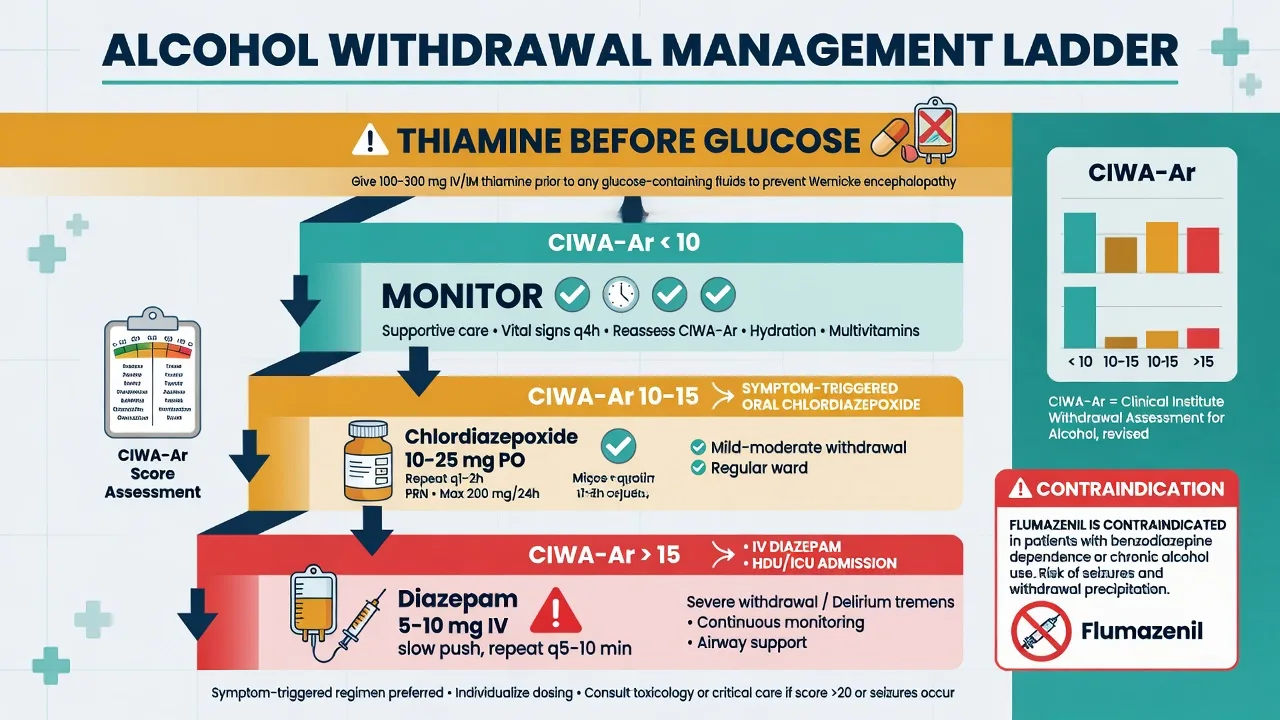
The benzodiazepine regimens for alcohol withdrawal
The mild to moderate patient (CIWA-Ar 8 to 15) is managed on a monitored ward with oral chlordiazepoxide 10 to 25 mg every six hours on day one, tapering over five to seven days, plus thiamine, folate and hydration, and CIWA-Ar monitoring. The moderate to severe patient (CIWA-Ar above 15 to 20, or with autonomic instability, a seizure, or early delirium tremens) is admitted to a high-dependency or intensive care bed and managed with intravenous diazepam: a diazepam loading regimen gives diazepam 10 to 20 mg intravenously, repeated every one to two hours until the patient is calm but rousable, after which the long half-life of diazepam and its active metabolite (desmethyldiazepam, half-life up to 100 hours) delivers a smooth self-taper. Lorazepam 1 to 2 mg intravenously every one to two hours is the alternative in hepatic failure, the elderly, and the patient in whom a shorter half-life is desirable; oxazepam 15 to 30 mg orally is the oral equivalent in hepatic impairment, as it has no active metabolites.[3][6]
Phenobarbital is the second-line agent for the benzodiazepine-refractory patient: a long-acting barbiturate that potentiates GABA-A at a distinct site, given at 130 to 260 mg intramuscularly or intravenously, repeated, with close respiratory monitoring; it is increasingly used in emergency-department and ICU protocols for severe withdrawal. An alpha-2 agonist (clonidine or dexmedetomidine) is reserved as an adjunct for refractory autonomic hyperactivity that has not responded to adequate benzodiazepine loading — it is NEVER a substitute for the benzodiazepine and does not protect against seizures. Antipsychotics (haloperidol, olanzapine) have NO first-line role: they lower the seizure threshold, prolong the QT, and do not treat the underlying GABA-glutamate imbalance; they are reserved for the patient with hallucinosis or psychosis that persists after adequate benzodiazepine loading, with ECG monitoring.[6]
[1]Landmark trials and evidence
Saitz 1994 — the original symptom-triggered RCT
Randomised double-blind controlled trial, urban teaching hospital, n = 164 inpatients
Population: Adult inpatients with alcohol withdrawal, CIWA-Ar eligible
Practice change
The foundation trial: symptom-triggered benzodiazepine therapy guided by the CIWA-Ar delivers less drug, a shorter stay, and equivalent control — the strategy now adopted worldwide.
Daeppen 2002 — symptom-triggered vs fixed-schedule
Randomised treatment trial, n = 117 consecutive inpatients
Population: Adult inpatients meeting alcohol withdrawal criteria
Practice change
Reaffirms that symptom-triggered dosing outperforms fixed schedules on cumulative drug exposure without sacrificing safety, especially in mild to moderate withdrawal.
Rosenson 2013 — phenobarbital adjunct RCT
Prospective randomised double-blind placebo-controlled trial, two emergency departments, n = 44
Population: ED patients with moderate to severe alcohol withdrawal
Practice change
A single intramuscular phenobarbital dose, layered on symptom-triggered lorazepam, reduced ICU use and benzodiazepine demand — the evidence base for the phenobarbital-augmented ED pathway.
Lee 2024 — phenobarbital in the ED, systematic review and meta-analysis
Systematic review and meta-analysis of ED-based phenobarbital for alcohol withdrawal
Population: Adult ED patients with acute alcohol withdrawal across multiple studies
Practice change
The contemporary synthesis: ED phenobarbital-augmented pathways safely reduce ICU admissions and benzodiazepine burden, consolidating phenobarbital as a viable first-line or second-line ED agent.
Chlordiazepoxide
- Long half-life with active metabolite desmethyldiazepam — the self-taper
- Oral; 10 to 25 mg every 6 h on day 1 tapering over 5 to 7 days
- First-line for mild to moderate ward-based withdrawal
- Avoid in hepatic failure — oxidative metabolism accumulates and over-sedates
Diazepam
- Long half-life (up to 48 h) plus active metabolite (up to 100 h) — the smoothest self-taper
- Oral or IV; 10 to 20 mg IV loading repeated by CIWA-Ar for severe withdrawal
- First-line for severe withdrawal in high-dependency or ICU
- Avoid in hepatic failure and the elderly — same oxidative-metabolite accumulation
Lorazepam
- No active metabolites; glucuronidated and renally cleared
- 1 to 2 mg IV every 1 to 2 h; the agent of choice in hepatic failure and the elderly
- Shorter half-life requires more frequent dosing and risks inter-dose breakthrough
- Preferred when a shorter, more titratable action is needed or liver function is impaired
Oxazepam
- No active metabolites; glucuronidated and renally cleared — the oral equivalent of lorazepam
- 15 to 30 mg orally in hepatic impairment
- Slower onset; not ideal for acute severe withdrawal
- Use when an oral agent is needed in liver disease
Phenobarbital
- Long-acting barbiturate; potentiates GABA-A at a distinct site from benzodiazepines
- 130 to 260 mg IM or IV, repeated; second-line or adjunct for refractory withdrawal
- Reduced ICU admission and benzodiazepine demand when layered on in the ED
- Respiratory monitoring essential; synergistic respiratory depression with benzodiazepines
Model answer — first 30 minutes of severe alcohol withdrawal (CIWA-Ar 22, tremulous, hallucinating, HR 122, BP 175/100)
ABCDE. Airway patent, left lateral position, suction; high-flow oxygen by mask; two large-bore cannulae; full monitoring including capnography. Bedside glucose at once — if low, give thiamine 100 mg intravenously FIRST, then 50 mL of 50 per cent dextrose. Send bloods: electrolytes including sodium, magnesium and phosphate, liver function and coagulation, renal function, amylase, CK, lactate, VBG, ethanol level, paracetamol and salicylate, toxicology screen, beta-hCG if applicable; ECG (QT); CXR; urinalysis; blood cultures if febrile; CT head if any fall, focal deficit, or atypical feature. [1]
Pharmacotherapy. This is severe withdrawal (CIWA-Ar 22): admit to high-dependency or intensive care. Begin intravenous diazepam 10 to 20 mg, repeated every 1 to 2 hours by the CIWA-Ar until the patient is calm but rousable, then allow the long-acting metabolites to self-taper; the alternative is intravenous lorazepam 1 to 2 mg every 1 to 2 hours if there is hepatic failure. Give thiamine 100 mg intravenously (500 mg IV three times daily if Wernicke is suspected), folate 1 mg, and magnesium sulphate 1 to 2 g intravenously if the magnesium is low. Balanced crystalloid for dehydration; treat any identified sepsis within the first hour with fluids and antibiotics; correct electrolyte disturbances. Re-score the CIWA-Ar every 1 to 2 hours and titrate. Begin phenobarbital if benzodiazepine-refractory. Engage the addiction-medicine service and plan the thiamine continuation and the linkage to outpatient care. [1]
Benzodiazepine withdrawal — taper, do not reverse
Benzodiazepine withdrawal is managed by the opposite of what the candidate might expect in an overdose: instead of reversal, the offending agent is reinstated as a long-acting formulation and tapered slowly. The rational regimen is to switch the patient to a long-acting benzodiazepine (diazepam is the standard, because its long half-life smooths the inter-dose trough) and to taper at approximately 10 per cent of the daily dose every one to two weeks over weeks to months, depending on the starting dose and the patient's tolerance. The acute, severe presentation — tremor, autonomic instability, myoclonus, or a seizure after abrupt cessation — is treated in the short term with oral or intravenous diazepam or lorazepam to settle the syndrome, then converted to the tapering regimen.[8]
Flumazenil is contraindicated. The benzodiazepine-dependent patient given flumazenil is precipitated into an acute, severe withdrawal with a high risk of refractory generalized seizures that do not respond to standard anticonvulsants, because flumazenil acutely strips the receptor of the benzodiazepine that has been keeping the downregulated GABAergic system functional. The UK National Poisons Information Service survey by Veiraiah and colleagues documented the high rate of adverse events — seizures, arrhythmia, agitation — when flumazenil is given empirically in the mixed or unknown benzodiazepine overdose, which is precisely the overdose profile of the dependent patient.[7] Flumazenil has a narrow, defined role: the reversal of iatrogenic over-sedation in a known, non-dependent patient (e.g. post-procedural sedation), and the paediatric, accidental, single-agent benzodiazepine ingestion. It has no role in the emergency-department management of the suspected mixed overdose or the benzodiazepine-dependent patient, where the airway and breathing are supported and the withdrawal is managed by taper.[7][8]
[1]Benzodiazepine withdrawal — the structured taper
Establish the agent, the daily dose, and the duration — short-acting high-dose users (alprazolam) are at highest risk of severe withdrawal.
Convert to an equivalent dose of a long-acting agent — diazepam is standard because its long half-life smooths the inter-dose trough.
Stabilise on the converted dose for one to two weeks before any reduction.
Reduce by approximately 10 per cent of the daily dose every one to two weeks — slower if withdrawal symptoms emerge.
Treat the acute severe presentation (seizure, severe autonomic instability) with IV diazepam or lorazepam first, then move to the taper.
DO NOT give flumazenil — it precipitates refractory seizures in the dependent patient.
Engage addiction medicine and arrange structured psychological support for the protracted phase.
Flumazenil indicated
- Reversal of iatrogenic over-sedation in a known non-dependent patient (e.g. post-procedural sedation)
- Paediatric, accidental, single-agent benzodiazepine ingestion
- Reversal challenge in a select, monitored, benzodiazepine-naive patient with a pure overdose
- Given in a setting with full airway and seizure-rescue capacity
Flumazenil contraindicated
- Known or suspected chronic benzodiazepine use or dependence — precipitates refractory seizures
- Mixed or unknown overdose (especially co-ingestion of a proconvulsant such as a TCA)
- Seizure history or seizure on presentation
- Empirical use in the agitated, unknown-overdose patient — the NPIS data show excess harm
Subtypes and scenarios
The exam-favoured scenarios are five. The alcohol-withdrawal seizure presents as a generalised tonic-clonic convulsion 24 to 48 hours after the last drink; the treatment is a long-acting benzodiazepine (intravenous lorazepam 4 mg or diazepam 10 mg to terminate, then oral chlordiazepoxide or a diazepam taper to prevent recurrence), NOT an antiepileptic drug — the seizure is glutamatergic and GABA-deficient, it does not recur once the benzodiazepine loading is adequate, and the patient does not require long-term antiepileptic therapy. A seizure outside the typical window, a focal seizure, or status epilepticus mandates a CT head and a search for an alternative cause.[3] Delirium tremens is the ICU-level emergency: clouding of consciousness, severe agitation, vivid hallucinations and an autonomic storm, managed in a high-dependency or intensive care bed with intravenous diazepam or lorazepam by frequent bolus or infusion, an alpha-2 agonist adjunct for refractory autonomic hyperactivity, intravenous fluids, cooling for hyperthermia, thiamine and folate, and the active exclusion of sepsis and the other mimics. The post-operative or hospitalised patient who cannot drink develops withdrawal as an inpatient; prophylactic CIWA-Ar monitoring and a prophylactic benzodiazepine regimen (typically chlordiazepoxide tapering over five to seven days) are started at admission for every known heavy drinker. The patient with hepatic failure is managed with lorazepam or oxazepam — no active metabolites, glucuronidated and renally cleared — because chlordiazepoxide and diazepam, with their long-acting oxidative metabolites, accumulate and over-sedate. Wernicke encephalopathy is the ever-present overlap: any acute confusion, ataxia, ophthalmoplegia or nystagmus in a heavy drinker is Wernicke until proven otherwise, and is treated empirically with high-dose thiamine 500 mg intravenously three times daily — the clinical triad is frequently incomplete, and missed Wernicke progresses to the irreversible Korsakoff amnestic syndrome.[5][6]
[1] [1]Complications and pitfalls
The complications are the consequences of the unopposed excitatory state and of the treatment. Withdrawal seizures and delirium tremens are the disease itself; aspiration and respiratory depression complicate the over-sedated or over-loaded patient; arrhythmia (atrial fibrillation, torsades from QT prolongation) is driven by electrolyte disturbance and autonomic surge; rhabdomyolysis and acute kidney injury follow a seizure, a fall, or prolonged immobility; Wernicke–Korsakoff syndrome is the catastrophic complication of missed or delayed thiamine; and osmotic demyelination is the iatrogenic complication of over-rapid sodium correction in the hyponatraemic alcoholic.[5]
The pitfalls are several. The first is missing the mimics — attributing agitation, fever or a seizure to withdrawal without excluding sepsis, hyponatraemia, hypoglycaemia, hepatic encephalopathy, Wernicke and an intracranial bleed. The second is giving glucose before thiamine and precipitating Wernicke. The third is under-treating with subtherapeutic benzodiazepine doses out of a fear of over-sedation, allowing the withdrawal to kindle into seizures and delirium tremens. The fourth is the mirror error of over-treating a mild withdrawal with high-dose intravenous benzodiazepine, causing respiratory depression and aspiration. The fifth is using an antipsychotic first-line — it lowers the seizure threshold, prolongs the QT, and does not treat the mechanism. The sixth is using an antiepileptic for the alcohol-withdrawal seizure, when a benzodiazepine is the rational and evidence-based choice. The seventh is giving flumazenil to the benzodiazepine-dependent patient and precipitating refractory seizures.[6][7]
Prognosis and disposition
The prognosis of alcohol withdrawal is excellent when it is recognised early and treated with an adequate benzodiazepine regimen; the mortality of treated delirium tremens is well below one per cent, and the untreated mortality of one to five per cent reflects cardiovascular collapse, arrhythmia, hyperthermia and aspiration. Disposition is dictated by the severity and the trajectory. The mild patient (CIWA-Ar below 8 to 10, minimal autonomic signs) may be managed with monitoring and oral chlordiazepoxide on a general ward, or discharged with a short oral chlordiazepoxide taper, thiamine, folate, advice and an addiction-medicine referral. The moderate patient (CIWA-Ar 8 to 15) is admitted for an oral symptom-triggered benzodiazepine regimen with CIWA-Ar monitoring. The severe patient (CIWA-Ar above 15 to 20, autonomic instability, a seizure, or early delirium tremens) is admitted to a high-dependency or intensive care bed for intravenous diazepam or lorazepam and close monitoring. Every patient receives thiamine (continued orally after discharge), folate, the correction of electrolyte disturbances, the treatment of any intercurrent illness, and a planned linkage to addiction-medicine and social services.[6]
Special populations
The patient with chronic liver disease or hepatic failure is managed with lorazepam or oxazepam — short-acting, no active metabolites, glucuronidated and renally cleared — because chlordiazepoxide and diazepam accumulate and over-sedate. The elderly patient is more sensitive to benzodiazepines, is prone to delirium and falls, and frequently takes interacting medications (opioids, anticoagulants); lower doses and closer monitoring are used. The pregnant patient is managed identically — untreated severe withdrawal is dangerous to the fetus, and a benzodiazepine is the agent of choice; the aim is a controlled, symptom-triggered regimen to avoid fetal distress, with obstetric and addiction-medicine involvement. The post-operative or hospitalised patient is the candidate for prophylaxis: every known heavy drinker admitted to hospital is screened and started on a CIWA-Ar-monitored prophylactic chlordiazepoxide regimen to prevent the inpatient development of withdrawal. The chronic benzodiazepine user who presents in withdrawal is reinstated on a long-acting agent (diazepam) and tapered at 10 per cent every one to two weeks.[8]
Evidence and regional guidelines
The contemporary framework rests on four pillars. The Mayo-Smith meta-analysis (JAMA 1997), the foundation document, established that the benzodiazepines are the drug class of choice for alcohol withdrawal, that they reduce seizures and delirium tremens, and that symptom-triggered therapy (driven by the CIWA-Ar) outperforms fixed-schedule therapy on cumulative dose and duration.[2] The Cochrane review (Amato 2010) confirmed the benzodiazepine class effect, found no single agent clearly superior, and supported the long-acting agents on pharmacokinetic grounds.[4] The Schuckit NEJM review (2014) is the standard reference for delirium tremens and the staged clinical picture.[3] The CIWA-Ar itself (Sullivan, British Journal of Addiction 1989) is the named scale of record and must be reproduced by the candidate.[1] The Jasti systematic review (Academic Emergency Medicine 2025) is the contemporary evidence that giving dextrose before thiamine is associated with an excess of Wernicke encephalopathy, formalising the thiamine-first rule.[5] The Long emergency-medicine review (American Journal of Emergency Medicine 2017) is the current EM overview.[6] The Veiraiah National Poisons Information Service survey (Emergency Medicine Journal 2012) documents the harm of empirical flumazenil in the mixed or benzodiazepine-dependent overdose.[7] The Lader review (British Journal of Clinical Pharmacology 2014) is the reference for benzodiazepine harm reduction and the tapering regimen.[8] Beyond the guideline and review literature, the symptom-triggered strategy is anchored by the Saitz randomised trial (JAMA 1994) and the Daeppen randomised trial (Archives of Internal Medicine 2002), which together established that CIWA-Ar-driven dosing lowers cumulative benzodiazepine exposure without compromising control.[9][10] The Rosenson phenobarbital RCT (Journal of Emergency Medicine 2013) and the Lee systematic review (Academic Emergency Medicine 2024) define the contemporary role of phenobarbital as an ED adjunct that reduces ICU admission and benzodiazepine demand.[11][12]
SAQ — Severe alcohol withdrawal and CIWA-Ar scoring
10 minutes · 10 marks
A 52-year-old man is brought to the emergency department 30 hours after his last drink. He is tremulous, diaphoretic and agitated, with a heart rate of 128 bpm, blood pressure 178/104 mmHg, temperature 38.1°C and oxygen saturation 97% on room air. He reports vivid visual hallucinations but is oriented to person and place. His bedside glucose is 4.2 mmol/L. A CIWA-Ar score is calculated at 23.
SAQ — Delirium tremens with concurrent Wernicke encephalopathy
10 minutes · 10 marks
A 61-year-old chronic heavy drinker presents 72 hours after his last drink with clouded consciousness, marked agitation, a broad-based ataxic gait when he tries to stand, bilateral sixth-nerve palsy and coarse horizontal nystagmus. His heart rate is 142 bpm, blood pressure 192/110 mmHg, temperature 39.2°C, and he is profusely diaphoretic. A bedside glucose is 3.1 mmol/L.
Exam pearls
- The mechanism in one breath: chronic ethanol potentiates GABA-A and inhibits NMDA; the brain downregulates GABA and upregulates NMDA; abrupt cessation leaves unopposed glutamatergic excitation — the tremor, the seizures, the autonomic storm.
- The timeline: minor withdrawal 6 to 24 h, hallucinosis 12 to 48 h, seizures 24 to 48 h, delirium tremens 48 to 96 h. The window predicts the danger.
- The CIWA-Ar is 10 items, scored 0 to 67; treat at 8 to 10, escalate above 15 to 20. Reproduce it.
- Thiamine 100 mg IV BEFORE any glucose — give it to every heavy drinker on arrival.
- A long-acting benzodiazepine is first-line: chlordiazepoxide orally, diazepam loading intravenously. Symptom-triggered beats fixed-schedule.
- The alcohol-withdrawal seizure is treated with a benzodiazepine, NOT an antiepileptic — the mechanism is glutamatergic.
- In hepatic failure use lorazepam or oxazepam — no active metabolites.
- Delirium tremens is an ICU emergency with autonomic storm, clouding of consciousness and mortality — do not under-treat.
- Benzodiazepine withdrawal is tapered, never reversed — flumazenil is contraindicated, it precipitates refractory seizures.
- Agitation in the alcoholic is a diagnosis of informed exclusion — exclude sepsis, hyponatraemia, hypoglycaemia, hepatic encephalopathy, Wernicke and intracranial bleed first, and treat withdrawal in parallel. [1]
Red flags
[1]References
- [1]Sullivan JT, Sykora K, Schneiderman J, Naranjo CA, Sellers EM. Assessment of alcohol withdrawal: the revised clinical institute withdrawal assessment for alcohol scale (CIWA-Ar) Br J Addict, 1989.PMID 2597811
- [2]Mayo-Smith MF, for the American Society of Addiction Medicine Working Group on Pharmacological Management of Alcohol Withdrawal. Pharmacological management of alcohol withdrawal. A meta-analysis and evidence-based practice guideline. American Society of Addiction Medicine Working Group on Pharmacological Management of Alcohol Withdrawal JAMA, 1997.PMID 9214531
- [3]Schuckit MA. Recognition and management of withdrawal delirium (delirium tremens) N Engl J Med, 2014.PMID 25427113
- [4]Amato L, Minozzi S, Davoli M, Vecchi S. Benzodiazepines for alcohol withdrawal Cochrane Database Syst Rev, 2010.PMID 20238336
- [5]Jasti J, El-Hayek G, Karunaratne T, Hanna A. Prevalence of Wernicke's Encephalopathy When Receiving Dextrose Before Thiamine: A National Study of Veterans Acad Emerg Med, 2025.PMID 40873301
- [6]Long D, Long B, Koyfman A. The emergency medicine management of severe alcohol withdrawal Am J Emerg Med, 2017.PMID 28188055
- [7]Veiraiah A, Phua CW, Leman P, Greene SL. Flumazenil use in benzodiazepine overdose in the UK: a retrospective survey of NPIS data Emerg Med J, 2012.PMID 21785147
- [8]Lader M. Benzodiazepine harm: how can it be reduced? Br J Clin Pharmacol, 2014.PMID 22882333
- [9]Saitz R, Mayo-Smith MF, Roberts MS, Redmond HA, Bernard DR, Calkins DR. Individualized treatment for alcohol withdrawal. A randomized double-blind controlled trial JAMA, 1994.PMID 8046805
- [10]Daeppen JB, Gache P, Landry U, Sekera E, Schweizer V, Gloor S, Yersin B. Symptom-triggered vs fixed-schedule doses of benzodiazepine for alcohol withdrawal: a randomized treatment trial Arch Intern Med, 2002.PMID 12020181
- [11]Rosenson J, Clements C, Simon B, Vieaux J, Graffman S, Vahidnia F, Wisner D, Lam-Jp A, Adler M, Kilgore J, Farnen J, Mallat A, Herring A, Alter H. Phenobarbital for acute alcohol withdrawal: a prospective randomized double-blind placebo-controlled study J Emerg Med, 2013.PMID 22999778
- [12]Lee CM, Chang YT, Lin JW, Lee CC, Lee WC, Cheng YC, Hsieh MJ, Fang CC, Chen SC. Phenobarbital treatment of alcohol withdrawal in the emergency department: A systematic review and meta-analysis Acad Emerg Med, 2024.PMID 37923363