EM · Drowning
Drowning
Also known as Submersion injury · Non-fatal drowning · Wet drowning
Drowning — the respiratory impairment from submersion or immersion in a liquid, a primary respiratory failure produced by aspiration and laryngospasm, and a leading cause of preventable death in the young. The chain of survival (early rescue, early CPR, early advanced life support); the management (ABCDE, 100 per cent oxygen, intubation and lung-protective ventilation with a tidal volume of 6 mL/kg and PEEP for the severe case, targeted temperature management at 32 to 36 degrees for the comatose post-arrest patient, no routine prophylactic antibiotics, cervical spine immobilisation only for a diving injury); and the prognostication (submersion time, water temperature, CPR duration, initial GCS, initial rhythm — asystole carries the worst prognosis). The differential — immersion hypothermia, the diving injury, and occult trauma. ACEM-primary, globally tagged.
On this page & tools
Your progress
Saved locally on this device.
8 MCQs with explanations
Target exams
Red flags
Drowning is a respiratory injury masquerading as a cardiac arrest — and that single insight governs every decision in the first ten minutes. A patient pulled from the water is hypoxic because they aspirated liquid, or because their glottis closed in laryngospasm, or both; the heart stops only as the late consequence of that hypoxia. The Fellowship candidate must approach drowning as a primary respiratory failure, drive the resuscitation toward oxygenation and ventilation before circulation, and resist the three classic examiner traps — routine cervical immobilisation, routine antibiotics, and early prognostic surrender.[1] The two references the examiner expects by name are the Szpilman review (NEJM 2012), which codifies the mechanism and the classification, and the Szpilman drowning chain of survival (Resuscitation 2014), which replaced the old "drown-proofing" teaching with a five-link chain that maps directly onto prehospital and emergency department practice.[1][2]
Definition and classification
The universally accepted definition, agreed at the 2002 World Congress on Drowning and adopted by the WHO and ILCOR, is: drowning is the process of experiencing respiratory impairment from submersion or immersion in a liquid. The terms that were retired — "near-drowning" (survival, however brief), "secondary drowning" (a delayed deterioration), "dry drowning" versus "wet drowning", and "silent drowning" — are obsolete, confuse clinicians, and are no longer used; the candidate who writes them in an SAQ loses marks. Outcomes are now described only as death, morbidity, or no morbidity, and the event is either fatal or non-fatal drowning.[1]
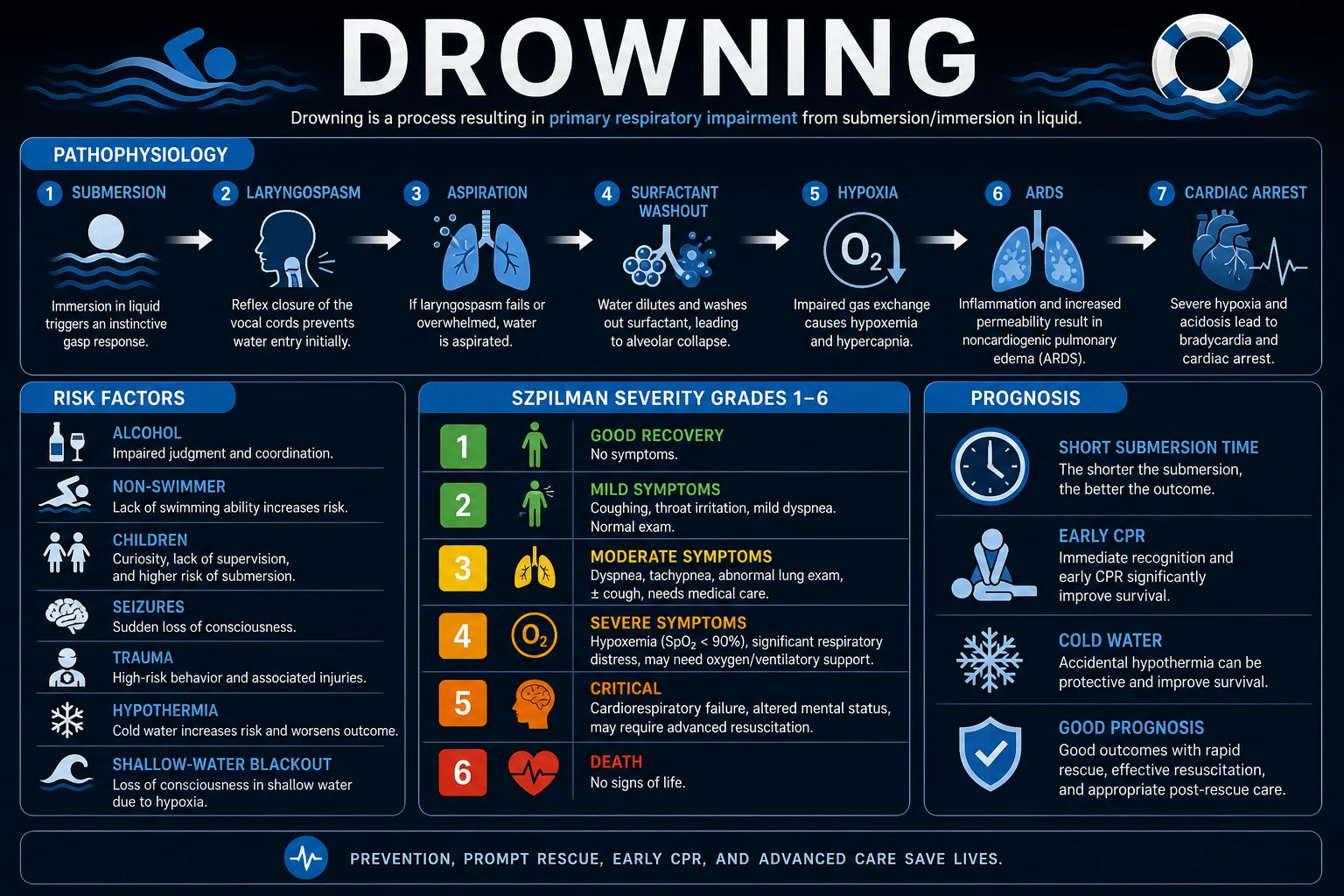
Severity at the bedside is graded on the Szpilman classification, a six-level scale built on clinical signs at the scene and refined on arrival, which the Fellowship candidate must be able to reproduce because it dictates observation versus intubation versus the intensive care unit: [1]
Szpilman drowning severity classification
The definition hinges on two terms the candidate must separate cleanly, because they describe different mechanisms of injury and carry different management implications: [1]
Submersion
- The whole body, including the face and the airway, is under the surface of the liquid
- Airway–liquid contact is direct; aspiration and laryngospasm are the mechanisms
- The classic drowning event — a child sinking to the bottom of a pool, a swimmer pulled under by a current
- Respiratory impairment is the rule; the severity scales with the Szpilman classification
Immersion
- The face remains above the surface; the airway is NOT in direct contact with the liquid
- Injury is driven by hydrostatic, thermal, or hydrostatic-reflex mechanisms, not aspiration
- Cold shock, the diving reflex, immersion hypothermia, and the hydrostatic squeeze on venous return
- A true immersion may still progress to submersion if the victim becomes unconscious and sinks — the two are a continuum
Obsolete and current terminology
The terminology of drowning has been deliberately pruned, and the Fellowship candidate must use only the 2002 consensus terms. The retired terms — and the reasons they were retired — are examined because they still appear in old texts and in the public vocabulary: [1]
Retired term
- "Near-drowning" — survival for more than 24 hours; retired because outcome is now binary (fatal/non-fatal)
- "Secondary drowning" — a delayed deterioration hours later; retired because deterioration is expected surfactant injury, not a separate disease
- "Dry drowning" vs "wet drowning" — aspiration versus laryngospasm; retired because alveolar injury is universal and the distinction is unreliable
- "Silent drowning" / "active drowning" — a media construct; drowning is clinically silent and not loud
Current term
- Drowning — respiratory impairment from submersion or immersion in a liquid
- Fatal drowning — death from the drowning event
- Non-fatal drowning — survival after the event, with or without morbidity
- Non-fatal drowning with morbidity / without morbidity — the three outcome states
Pathophysiology — the mechanism
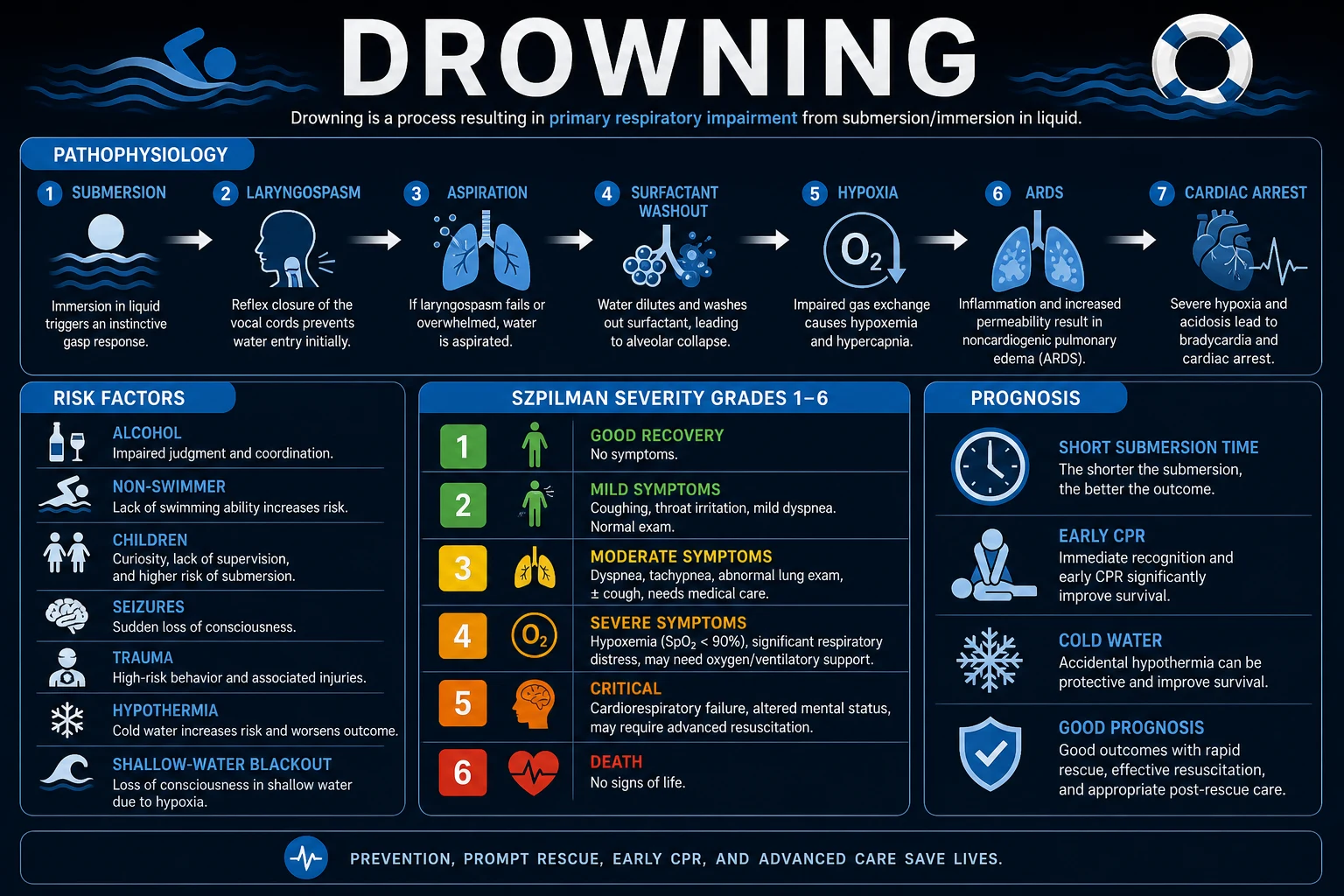
The injury of drowning is hypoxia, and the mechanism unfolds in a predictable sequence the candidate must trace from first principles. When the face is submerged the diving reflex (bradycardia, peripheral vasoconstriction, apnoea) and breath-holding buy a little time, but within seconds the rising partial pressure of carbon dioxide and the falling oxygen tension force an involuntary gasp. A variable volume of liquid is aspirated, and two things follow. First, the liquid washes out and inactivates pulmonary surfactant, producing alveolar collapse, atelectasis, ventilation-perfusion mismatch, and a non-cardiogenic pulmonary oedema from alveolar-capillary injury. Second, the liquid and the laryngeal irritation trigger laryngospasm, which in turn worsens the asphyxia. The net effect is a profound hypoxaemia with a respiratory and metabolic acidosis.[1]
[1]The cardiovascular collapse is a secondary event. As the arterial oxygen tension falls, the myocardium becomes ischaemic, bradycardia gives way to asystole or pulseless electrical activity, and the cardiac arrest is almost always a hypoxic, non-shockable rhythm. The rare shockable rhythm (ventricular fibrillation) suggests a primary cardiac cause — a long-QT swimmer, a cold-water coronary, a blunt chest injury — and changes the resuscitation. Whether saltwater or freshwater changes the clinical course is the third examiner trap: the historical distinctions (freshwater haodilution and haemolysis versus saltwater hypertonic pulmonary oedema) are clinically irrelevant at the volumes actually aspirated, and the management is identical.[1]
Freshwater aspiration
- Hypotonic relative to plasma; historically taught to cause haemolysis and electrolyte derangement
- At the volumes actually aspirated (2 to 4 mL/kg) there is NO clinically significant haemodilution, haemolysis, or electrolyte shift
- Surfactant washout, atelectasis, and V/Q mismatch are the mechanism — identical to seawater
- Management is identical: oxygenation, ventilation, lung-protective strategy
Seawater aspiration
- Hypertonic relative to plasma; historically taught to draw fluid into the alveoli and cause hypertonic pulmonary oedema
- Again, at realistic aspirated volumes there is no meaningful electrolyte or fluid shift — experimentally a small rise in serum sodium and magnesium only
- Surfactant washout is the dominant mechanism, exactly as in freshwater
- Management is identical — the saltwater/freshwater question is an examiner trap, not a clinical fork
Epidemiology and risk
Drowning is a leading cause of unintentional death worldwide and, in ANZ, the commonest cause of accidental death in children after motor vehicle trauma. The bimodal age distribution is the key epidemiological fact: toddlers (1 to 4 years) drown in home pools, baths, and dams after a lapse in supervision, and adolescents and young men drown in open water (beaches, rivers, rock platforms) after alcohol, risk-taking, or a strong current. Other risk groups are the elderly (a fall into water, a medical event in the bath), patients with epilepsy (a seizure in or near water), people with a prolonged-QT syndrome (a swimming-triggered arrhythmia), tourists and migrants unfamiliar with local surf, and workers on or near water. Alcohol is detectable in roughly a quarter to a half of adolescent and adult drownings and is the single most important modifiable risk factor.[1]
The location shapes the resuscitation. A pool drowning implies clean water, a witnessed event, and a short submersion time — a good prognosis. A surf, river, or dam drowning implies cold or contaminated water, an unwitnessed event, a longer submersion time, and a worse prognosis. Cold water is a double-edged sword: it accelerates hypothermia and exhaustion, but it also activates the diving reflex and cools the brain, and a child submerged in ice water for a prolonged period may recover neurologically intact — this is the basis of the rule "no one is dead until warm and dead". [1]
Clinical presentation
The presentation spans the spectrum from a fully alert child who coughed and spluttered in a pool to a cold, cyanotic, apnoeic adult in cardiac arrest. The mild case is alert or mildly distressed, coughing, with normal or near-normal oxygen saturation and clear or scattered lung sounds. The moderate case is dyspnoeic, tachypnoeic, hypoxaemic on pulse oximetry, with crepitations or wheeze and sometimes pink frothy sputum from the pulmonary oedema. The severe case is agitated or comatose, profoundly hypoxaemic, may be in respiratory or cardiopulmonary arrest, and shows the signs of a metabolic acidosis (a rapid, deep, or gasping respiration if still breathing). [1]
[1]The history must establish the four prognostic facts at the first assessment: the submersion time (witnessed and timed, or unknown), the water temperature (warm pool versus cold surf or ice water), the CPR time (bystander CPR and the time to ROSC), and the initial rhythm at the scene. The mechanism — a dive from a height, a fall, a surf accident, a seizure in the bath — directs the secondary survey toward a cervical or a head injury. [1]
Differential diagnosis
The differential is the differential of the unconscious or hypoxic patient pulled from water, and the Fellowship candidate must distinguish the mimics because the management diverges — particularly the decision to immobilise the cervical spine, to treat a toxin, or to rewarm aggressively. [1]
Drowning (submersion asphyxia)
- Witnessed submersion, a respiratory arrest or hypoxia, aspiration of water
- Pulmonary oedema, hypoxaemia, a non-shockable rhythm
- Resuscitate toward oxygenation first; intubate the severe case; no routine c-spine or antibiotics
Immersion hypothermia
- Prolonged cold-water exposure; a cold, pale, bradycardic patient
- Core temperature under 35 degrees; arrhythmia (atrial fibrillation, slow VF)
- Rewarm gently, handle gently (cold myocardium is irritable); treat the arrhythmia; resuscitate fully before prognosticating
Diving injury (cervical spine / head)
- A dive into shallow water, a fall from a height, a surfboard strike
- A focal neurological deficit, a cervical spine tenderness, a loss of consciousness on impact
- Immobilise the cervical spine from the outset; CT the cervical spine; manage as a trauma patient in parallel with the drowning
Occult trauma (submerged victim)
- A fall from a bridge or a boat, a watercraft strike, a submersion in a fast river
- External signs of injury, a seatbelt or a handlebar pattern, a chest or an abdominal injury
- Full trauma survey once the airway and breathing are controlled; do not anchor on the drowning alone
Primary cardiac arrest in water
- A swimmer who collapses in the water without a submersion history
- A shockable rhythm (VF) on the monitor; a long-QT or a coronary history
- Treat as a cardiac arrest — defibrillate early; the submersion is the consequence, not the cause
Seizure in water
- A known epilepsy, a witnessed convulsion in the bath or pool
- A post-ictal state, a tongue bite, an incontinence
- Manage the airway and the hypoxia, then the seizure; the drowning is the secondary event
Bedside assessment — the ABCDE
Assess and resuscitate in parallel, and treat drowning as a respiratory emergency throughout. Remove the patient from the water, protect from further heat loss, and begin oxygen at the first contact. Airway — assess the airway and the level of consciousness; suction any vomitus or water (the volume is small and most is in the stomach); prepare for rapid sequence intubation if the patient is comatose, cannot protect the airway, or fails to oxygenate. Breathing — give 100 per cent oxygen via a non-rebreather mask at 15 L/min from the outset; apply continuous positive airway pressure or non-invasive ventilation to the hypoxaemic but alert patient; bag-valve-mask ventilation with 100 per cent oxygen if apnoeic, and a low threshold for intubation. Circulation — apply the cardiac monitor, establish intravenous or intraosseous access, check the pulse and the blood pressure; if no pulse, begin CPR immediately (the chain of survival mandates early bystander CPR), and continue through the differential of the rhythm. [1]
[1]Disability — document the Glasgow Coma Scale (GCS), reproduced because it is examined: eye opening (4 spontaneous, 3 to speech, 2 to pain, 1 none), verbal response (5 oriented, 4 confused, 3 inappropriate words, 2 incomprehensible sounds, 1 none) and motor response (6 obeys commands, 5 localises pain, 4 withdraws, 3 abnormal flexion, 2 abnormal extension, 1 none), for a maximum of 15; check the pupils and the blood glucose, because the GCS and the initial rhythm are the bedside prognostic anchors. Exposure and environment — remove the wet clothing, dry and warm the patient, estimate the submersion time and the water temperature, and complete a secondary survey for the signs of trauma or hypothermia. [1]
Investigations
The investigations follow the resuscitation; they never delay oxygen. A venous or arterial blood gas quantifies the hypoxaemia, the acidosis, and the lactate, and is the single most useful test — a persisting metabolic acidosis signals ongoing hypoperfusion and predicts a worse outcome. An electrolyte panel excludes a dysnatraemia from large-volume aspiration (rare but real) and a derangement from immersion. A 12-lead ECG (once the immediate resuscitation allows) screens for a primary arrhythmia — a long-QT, a Brugada pattern, an ischaemia — that may have caused the collapse in the water and that mandates a cardiology referral in the survivor. A chest radiograph identifies the pulmonary oedema, the aspiration pattern, the atelectasis, and later the pneumonia; the initial film often underestimates the lung injury, which evolves over hours. [1]
The key investigations
In the moderate and severe case add a full blood count, a coagulation screen and a creatine kinase (a rhabdomyolysis and a disseminated intravascular coagulation are recognised late complications), a troponin (a myocardial injury from the hypoxia), and a core temperature (a low-reading thermometer is essential — a standard thermometer reads 34 degrees at its floor and will miss profound hypothermia). A computed tomography of the head and the cervical spine is reserved for the patient with a head injury, a focal deficit, a diving mechanism, or a failure to recover consciousness, and is not a routine resuscitation tool. [1]
Resuscitation — the chain of survival
The Szpilman drowning chain of survival (Resuscitation 2014) is the framework the examiner expects, and it replaces the older, vaguer "prevent, recognise, rescue, provide" sequence with five operational links.[2]
CREST
Drowning resuscitation — the operational sequence
Recognise the drowning and the silent victim; remove from the water as quickly and as safely as possible (reach, throw, wade, row, swim)
Open the airway; check breathing and pulse simultaneously — do not spend more than 10 seconds on the pulse check
Begin rescue breaths FIRST: five initial rescue breaths, each over 1 second, to recruit the surfactant-depleted alveoli
If no pulse (or in doubt), start chest compressions at a 30:2 ratio with continued rescue breaths; in-water rescue breathing by a trained rescuer if feasible
Apply oxygen at 100 per cent as soon as equipment arrives; attach a defibrillator/AED to identify the rhythm — a shockable rhythm redirects the resuscitation
On arrival in the ED: full ABCDE, 100 per cent oxygen via non-rebreather, monitor and IV/IO access; blood gas, glucose, ECG, core temperature
Escalate respiratory support — NIV/CPAP for the alert hypoxaemic patient, rapid sequence intubation and lung-protective ventilation for the comatose or failing patient
Address hypothermia with active rewarming (warm IV fluid, forced-air blanket); immobilise the cervical spine ONLY for a diving or traumatic mechanism
In cardiac arrest: continue the ALS algorithm with adrenaline 1 mg IV every 3 to 5 minutes; the rhythm is usually non-shockable (asystole/PEA) and the priority remains oxygenation
Reassess continuously — the patient who "recovers" can deteriorate from a delayed surfactant injury over the next several hours; observe the moderate case for at least 6 hours
The defining feature of the drowning resuscitation is that rescue breaths come first. Because the arrest is hypoxic, the 30:2 ratio of standard CPR is modified in the drowning context to favour early oxygenation — five initial rescue breaths, then a 30:2 ratio, and the emphasised need for trained rescuers to provide in-water rescue breathing where possible. The bystander who begins CPR immediately, and particularly the one who provides rescue breaths, doubles or triples the chance of survival without neurological sequelae; this is why the chain emphasises early bystander CPR above all other links.[2]
[1]In the emergency department the resuscitation continues with 100 per cent oxygen via a non-rebreather mask at 15 L/min in the spontaneously breathing patient, escalating to non-invasive ventilation (CPAP 5 to 10 cm of water) for the pulmonary oedema, and to rapid sequence intubation for the comatose, the apnoeic, or the patient who fails to oxygenate. In cardiac arrest, adrenaline 1 mg intravenously every 3 to 5 minutes is given along the standard ALS algorithm, with the recognition that the underlying rhythm is almost always non-shockable and that the priority remains oxygenation and ventilation.[3]
Definitive management
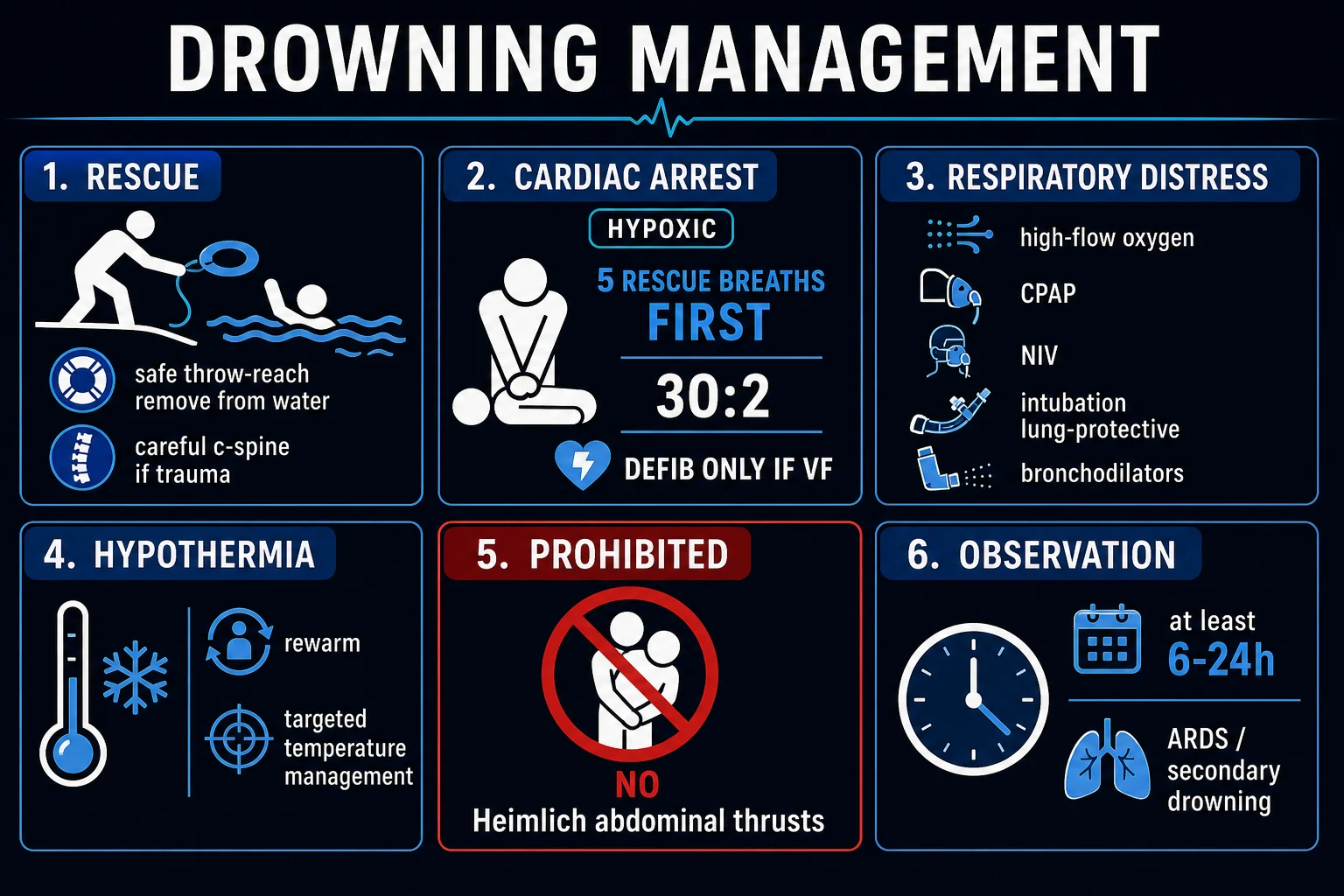
Once the patient is oxygenated and ventilated, the definitive management addresses the lung injury, the brain, the temperature, and the questions of antibiotics and the cervical spine. Ventilation of the intubated patient uses a lung-protective strategy: a tidal volume of 6 mL per kilogram of predicted body weight, a positive end-expiratory pressure (PEEP) titrated from 5 up to 10 or 15 cm of water to hold the surfactant-depleted alveoli open, and permissive hypercapnia (a higher than normal arterial carbon dioxide tolerated, with a pH above 7.20) to minimise the tidal volume and the barotrauma. The pulmonary oedema often requires high PEEP, and the FiO2 is weaned as the oxygenation improves.[1]
[1]Advanced respiratory support and the refractory case
The respiratory failure of drowning ranges from mild hypoxaemia to a severe acute respiratory distress syndrome that resists conventional ventilation. The escalation ladder, and the trigger thresholds, are examined because the drowning lung is exquisitely recruitable but also fragile — surfactant-depleted alveoli collapse and re-open with each cycle, and over-distension worsens the injury.[5]
High-flow nasal cannula / NIV
- First escalation for the alert, cooperative, hypoxaemic patient (Szpilman grade 2 to 3)
- CPAP 5 to 10 cm of water holds the surfactant-depleted alveoli open and reduces the work of breathing
- Trial in the alert patient; abandon for the comatose, the tiring, or the patient who cannot protect the airway
- A rising respiratory rate, a falling saturation, or an altered conscious state on NIV is a failure — intubate, do not increase FiO2 alone
Intubation and lung-protective ventilation
- Definitive airway for the comatose, the apnoeic, the failing NIV, or the grade 4 to 6 patient
- Rapid sequence intubation; pre-oxygenate with 100 per cent oxygen; anticipate a hypotensive induction (the hypoxic myocardium)
- Tidal volume 6 mL/kg predicted body weight, PEEP 5 to 15 cm of water, permissive hypercapnia with pH above 7.20
- The pulmonary oedema fluid often floods the circuit — have suction ready and do not disconnect (loss of PEEP derecruits the lung)
Prone positioning
- For the severe ARDS (PaO2/FiO2 below 150) unresponsive to high PEEP, exactly as for any severe ARDS
- Improves oxygenation by recruiting dependent alveoli and reducing shunt
- Sustained 16-hour cycles; the benefit is mortality reduction in severe ARDS, extrapolated to the drowning lung
Exogenous surfactant
- Rationale: the core injury is surfactant washout and inactivation — replacement targets the mechanism directly
- Case reports and small paediatric series show rapid oxygenation improvement; no randomised trial in drowning
- Reserved for the refractory case with severe hypoxaemia failing lung-protective ventilation — not routine
- Cost and availability limit use; an ICU-level decision, often in concert with a retrieval/ECMO centre
ECMO (VA / VV)
- The salvage therapy for refractory hypoxaemia (VV-ECMO) or refractory cardiac arrest/hypothermia (VA-ECMO)
- Consider when PaO2/FiO2 is below 80 despite optimised ventilation, or for the profoundly hypothermic arrest unresponsive to conventional rewarming
- Extracorporeal rewarming is the definitive treatment for the profoundly hypothermic drowned patient (core temperature below 28 degrees) — "warm and dead" resuscitation
- Early referral to an ECMO-capable centre is part of the retrieval plan; the candidate names it, does not manage it alone
Targeted temperature management (TTM) is indicated for the comatose adult after a cardiac arrest from drowning, at the same 32 to 36 degrees used for any post-arrest patient, maintained for at least 24 hours, with the avoidance of fever thereafter. There is no evidence that a deeper or a colder target benefits the drowned brain beyond the standard post-arrest protocol, and hypothermia is harmful in the patient who is already profoundly cold from submersion — rewarm to the target, do not over-cool. Prophylactic antibiotics are NOT given routinely. The contaminated water raises the fear of infection, but the evidence shows that prophylactic antibiotics do not prevent pneumonia after drowning, they increase resistance, and they obscure the diagnosis of a true pneumonia; reserve antibiotics for a confirmed or a strongly suspected infection — a fever, a rising white cell count, a new infiltrate, or a positive culture.[1][3]
The cervical spine is immobilised only when the mechanism supports it — a dive from a height, a fall into shallow water, a watercraft collision, a focal neurological deficit, or a complaint of neck pain. The rate of cervical spine injury in drowning is low (under 0.5 per cent in most series) and the rate in non-diving submersions is close to zero; blanket immobilisation of every drowning victim delays airway management and ventilation and is explicitly discouraged. [1]
Adjunctive drug doses follow the symptoms: paracetamol 1 g orally or morphine 2.5 to 5 mg intravenously titrated for pain or agitation; ondansetron 4 mg intravenously for the vomiting that accompanies the resuscitation; lorazepam 4 mg intravenously (repeated once, then a second-line agent) for a seizure, along the status-epilepticus ladder, while the hypoxia is corrected; and a balanced crystalloid bolus of 10 mL per kilogram for hypotension, repeated cautiously because the pulmonary oedema limits the fluid tolerance. Mannitol 0.5 g per kilogram intravenously or hypertonic saline is reserved for the clinical signs of cerebral oedema, with the head of the bed elevated to 30 degrees.[1]
Temperature management — TTM, hypothermia, and the irritable myocardium
Temperature management in drowning is a double task: deliver targeted temperature management to the comatose post-arrest survivor, and rewarm the patient who arrives profoundly hypothermic from cold-water submersion. The two goals overlap but are not the same, and the candidate must not confuse "induced hypothermia" (a therapy) with accidental hypothermia (an injury).[6]
Mild hypothermia (32 to 35 degrees)
- A therapeutic target for the comatose post-arrest adult — hold at 32 to 36 degrees for at least 24 hours
- In the patient who is already mildly hypothermic, do not rewarm past 36 degrees; avoid fever for 72 hours
- Active fever control with paracetamol and cooling devices
Moderate hypothermia (28 to 32 degrees)
- Risk of arrhythmia rises; the myocardium is irritable and bradycardic
- Rewarm slowly at 0.25 to 0.5 degrees per hour with warm IV fluid and forced-air blanket; handle gently
- Atrial fibrillation and slow ventricular fibrillation may appear — defibrillation is often ineffective until warmer
Severe hypothermia (below 28 degrees)
- High risk of cardiac arrest, often asystole or slow VF; pulses may be hard to detect
- Active internal rewarming — warmed humidified oxygen, warm IV fluid (39 degrees), gastric/bladder lavage
- Consider extracorporeal rewarming (VA-ECMO/cardiopulmonary bypass) for cardiac arrest or core below 28 degrees — the definitive "warm and dead" therapy
Prognostication
Prognostication in drowning is the question the Fellowship candidate will be asked, and the honest answer is that no single factor is decisive — the outcome is read from a cluster of prehospital facts, and the candidate must know which factors predict a good and a bad outcome. The poor-prognosis factors are a submersion time over 5 to 10 minutes (the longer the immersion, the worse the hypoxic brain injury), warm water (cold water cools the brain and protects it, so a warm-water drowning carries a worse prognosis than a cold-water drowning of the same duration), a CPR time over 25 to 30 minutes without a ROSC, an initial GCS of 3 or an absent motor response, an initial rhythm of asystole (the worst), and a persistent metabolic acidosis. The good-prognosis factors are a short submersion, cold water, an early bystander CPR with an early ROSC, a higher initial GCS, and a shockable or a perfusing rhythm on arrival.[1][3]
The prognostic anchors
The single most important rule — and the one the examiner probes — is that no one is dead until warm and dead. A child pulled from ice water after a prolonged submersion, in asystole, may recover neurologically intact after a full resuscitation and a rewarming to a core temperature near 35 degrees; the candidate must resuscitate fully and use the cluster of prognostic factors, not a single time cutoff, before a decision to cease resuscitation. Modern multimodal prognostication (the clinical examination at 72 hours, the electroencephalogram, the somatosensory evoked potentials, and the neuroimaging) is applied at the same timepoints as for any post-arrest patient, and never earlier.[3]
Subtypes and scenarios
The Fellowship case is often a scenario, and the common ones follow. The child in a home pool — a witnessed, short submersion, clean water, a rapid bystander CPR; the best prognosis, and the case that demands a full resuscitation because the potential for an intact recovery is high. The adolescent in cold surf — alcohol, a strong current, a long submersion time, a cold core temperature; resuscitate and rewarm in parallel, treat as a primary respiratory arrest with a hypothermia overlay, and prognosticate late. The diver — a dive from a height into shallow water, a risk of a cervical spine injury and a head injury; immobilise the cervical spine from the outset, scan the cervical spine, and manage the trauma in parallel with the drowning. The swimmer who collapses — a shockable rhythm on the monitor suggests a primary cardiac arrest (a long-QT, a Brugada, a coronary event) and the resuscitation prioritises defibrillation; the submersion is the consequence, not the cause. The seizing patient in the bath — a known epilepsy, a post-ictal state; manage the airway and the hypoxia, then the seizure, and address the underlying epilepsy before discharge. [1]
Complications and pitfalls
The early complications are respiratory and neurological. A non-cardiogenic pulmonary oedema (acute respiratory distress syndrome) develops over hours and is the commonest reason for an intensive care admission; an aspiration pneumonitis and a secondary pneumonia (often with unusual waterborne organisms — Aeromonas, Vibrio, Pseudomonas in saltwater, leptospires in freshwater) follow in a minority. A hypoxic brain injury and its cerebral oedema dominate the late course. The late complications include a rhabdomyolysis with an acute kidney injury, a disseminated intravascular coagulation, and a haemolysis (particularly after freshwater aspiration).[1]
The pitfalls are the inverse of the management. Immobilising the cervical spine of every victim is the commonest error — it is reserved for the diving or the traumatic mechanism. Giving prophylactic antibiotics is the second; they do not prevent pneumonia and they breed resistance. Treating the rhythm before the oxygenation is the third — the arrest is hypoxic, and defibrillation without oxygenation is futile. Prognosticating too early, on a single factor or a single time cutoff, is the fourth — the candidate who calls a cold-water submersion after 30 minutes without a rewarming has missed the lesson. Discharging the mild case too soon is the fifth — the patient who "looks fine" after a submersion can deteriorate over the next several hours from a surfactant-mediated lung injury, and a period of observation is mandatory. Forgetting the primary cardiac cause in the swimmer who collapsed — the long-QT, the Brugada, the coronary — is the discharge pitfall; the survivor needs a cardiology work-up, an ECG, and often an echocardiogram. [1]
Prognosis and disposition
The mortality and the neurological outcome follow the prognostic anchors above. The mild case (Szpilman grade 1) — alert, normal oxygen saturation, normal chest — is observed for 4 to 6 hours and discharged if it remains asymptomatic with a normal respiratory examination and a normal oxygen saturation; warn the patient to return for any cough, breathlessness, or fever. The moderate case (grades 2 and 3) — abnormal lung sounds or a pulmonary oedema, a hypoxaemia — is admitted for supplemental oxygen and observation, with non-invasive ventilation or intubation as the gas exchange dictates. The severe case (grades 4 to 6) — a pulmonary oedema with shock, a respiratory arrest, or a cardiopulmonary arrest — is admitted to the intensive care unit, intubated and ventilated with the lung-protective strategy, and managed with targeted temperature management if comatose post-arrest. Every survivor of a moderate or a severe drowning is reviewed before discharge for the underlying cause — the epilepsy, the long-QT, the alcohol, the unsupervised pool fence — and the public-health and the safeguarding referral is part of the discharge. [1]
Special populations
The child has the best and the worst prognosis in the same patient: a short, witnessed, cold-water submersion carries an excellent potential for an intact recovery, and a long, warm-water submersion carries the worst; resuscitate fully in every case. The pregnant patient is resuscitated as the non-pregnant, with a left lateral tilt after 20 weeks and an early obstetric involvement for the fetal monitoring; the maternal oxygenation is the fetal oxygenation. The elderly patient often has a medical precipitant — a cardiac event, a stroke, a seizure, a medication — that caused the collapse in the water, and the work-up must include the precipitant. The hypothermic patient is resuscitated and rewarmed gently, with a low-reading thermometer and a recognition that a cold, bradycardic myocardium is irritable and that rough handling can precipitate a ventricular fibrillation. The patient with a long-QT or a Brugada syndrome who collapses on immersion needs a cardiology referral and a consideration of an implantable defibrillator, and the family screening is part of the discharge. The diver with a cervical spine injury is managed with immobilisation and imaging in parallel with the drowning. [1]
Utstein style — uniform data reporting for drowning
The drowning literature was, for decades, uninterpretable because no two studies used the same terms or the same outcome measures — "near-drowning" meant different things, the denominators were inconsistent, and the survival figures could not be compared. The Utstein style for drowning (Idris et al., Resuscitation 2003), modelled on the successful Utstein template for cardiac arrest, was written to fix this, and the Fellowship candidate must know it because it defines the vocabulary the guidelines and the registries now use.[4]
The Utstein template standardises three things: the definitions (drowning as respiratory impairment from submersion or immersion, with fatal/non-fatal outcomes — the very terms adopted at the 2002 World Congress), the core data set that every drowning report must capture, and the outcome measures that allow comparison across studies and registries. The core data set is the practical heart of the template, and it maps directly onto the history the clinician takes at the bedside. [1]
The Utstein core data set for a drowning report
Utstein-defined term
- Drowning — respiratory impairment from submersion/immersion
- Fatal drowning — death results from the drowning
- Non-fatal drowning — survival after the event
- Resuscitation — defines the time intervals (submersion time, CPR time, ROSC time) that the template requires
Utstein-excluded term
- Near-drowning (replaced by fatal/non-fatal)
- Wet/dry drowning (no anatomical basis)
- Secondary drowning (no separate entity)
- Active/passive/silent drowning (media terms, not Utstein)
The candidate who can name the Utstein template, explain its purpose (uniform reporting so the literature and the registries become interpretable), and list its core data set demonstrates the level of understanding the Fellowship examiner rewards — it shows that the candidate understands drowning not just as a clinical event but as a public-health and research discipline.[4]
Evidence and regional guidelines
The evidence base for drowning is built on three references the Fellowship candidate must know, and it is thinner than for many emergencies — the randomised trial is largely absent and practice is built on observational data, expert consensus, and the ILCOR review. The Szpilman review (NEJM 2012) is the definitive contemporary reference; it codifies the definition (retiring "near-drowning" and "dry drowning"), the mechanism (the small aspirated volume and the surfactant injury), the Szpilman classification, the management (oxygen, ventilation, the lung-protective strategy, TTM, no routine antibiotics, no routine c-spine), and the prognostic factors.[1] The Szpilman drowning chain of survival (Resuscitation 2014) replaced the older drowning-prevention sequence with the five-link chain — context, rescue, emergency, support, treatment — and emphasised the early rescue breaths in the bystander CPR as the single biggest determinant of survival.[2] The Szpilman and Morgan editorial (Resuscitation 2018) reframes drowning as a resuscitation disease and argues that the chain of survival, applied early and correctly, is the intervention that works — there is no magic drug, only oxygen, ventilation, CPR, and the chain.[3]
ANZ practice note. Drowning is a high-profile public-health issue in ANZ, with the beach, the surf, the home pool, and the inland waterway as the recurring venues, and Royal Life Saving and Surf Life Saving as the institutional response. ANZ practice follows the Szpilman chain of survival and the ILCOR recommendations: early rescue, early rescue breaths in the bystander CPR, 100 per cent oxygen and a low threshold for intubation in the emergency department, the lung-protective ventilation for the intubated patient, the targeted temperature management at 32 to 36 degrees for the comatose post-arrest, no routine prophylactic antibiotics, and cervical spine immobilisation only for the diving or the traumatic mechanism. The "no one is dead until warm and dead" rule is applied strictly in the cold-water submersion, and Extracorporeal Membrane Oxygenation (ECMO) and extracorporeal rewarming are considered in the refractory cardiac arrest and the profound hypothermia in a centre with the capability. The public-health discharge — the pool fence, the supervision, the alcohol, the surf-safety — is a routine part of the survivor's discharge and is a recurrent OSCE communication theme. [1]
Landmark trials and evidence
The evidence base for drowning is observational and consensus-driven — there are no large randomised trials of the core interventions, and the Fellowship candidate must be able to cite the landmark references by name and explain what each established. [1]
Szpilman — Drowning (NEJM 2012)
Narrative review and consensus
Population: Comprehensive review of drowning pathophysiology, classification, and management
Key finding
Codified the 2002 consensus definition (retiring near-drowning and dry drowning), the Szpilman six-grade classification, the small-volume aspiration mechanism, the lung-protective ventilation strategy, TTM, no routine antibiotics, and no routine cervical immobilisation
Practice change
The definitive contemporary reference; every Fellowship answer on drowning is anchored here
Szpilman — Drowning Chain of Survival (Resuscitation 2014)
Expert consensus / framework
Population: Prehospital and bystander management of drowning
Key finding
Replaced the old prevent-recognise-rescue-provide sequence with a five-link chain (context, rescue, emergency, support, treatment) and emphasised that early rescue-breath-first bystander CPR is the single biggest determinant of survival
Practice change
The framework the examiner expects; rescue breaths before compressions is the drowning-specific modification to CPR
Idris et al. — Utstein Style for Drowning (Resuscitation 2003)
Consensus guideline / reporting template
Population: Uniform reporting of drowning data across studies and registries
Key finding
Standardised the definitions, the core data set (scene, victim, time, resuscitation, outcome), and the outcome measures — the foundation that made the drowning literature interpretable and that underpins the 2002 terminology
Practice change
The reason 'near-drowning' and 'dry drowning' were retired; defines the documentation every clinician should capture
Szpilman & Morgan — Management for the Drowning Patient (Chest 2021)
Comprehensive clinical review
Population: Practical ED and ICU management of the drowning patient
Key finding
Updated and detailed the respiratory support ladder (high-flow nasal cannula, NIV, lung-protective ventilation, prone, surfactant, ECMO) and reaffirmed no routine antibiotics and no routine cervical immobilisation
Practice change
The modern operational reference for respiratory support escalation, including surfactant and ECMO as rescue therapy
Weuster et al. — ECMO after drowning Hypothermia (ASAIO J 2016)
Single-centre case series
Population: Patients with severe accidental hypothermia after drowning managed with ECMO
Key finding
Demonstrated that extracorporeal membrane oxygenation and extracorporeal rewarming can salvage the profoundly hypothermic drowned patient refractory to conventional rewarming — supporting the 'warm and dead' resuscitation principle
Practice change
ECMO is the definitive therapy for refractory hypothermia and cardiac arrest after cold-water drowning; early referral is part of retrieval
Szpilman & Morgan — Is Drowning a Mere Matter of Resuscitation? (Resuscitation 2018)
Editorial / commentary
Population: The conceptual framing of drowning as a resuscitation disease
Key finding
Argued that the chain of survival, applied early and correctly, is the intervention that works — there is no magic drug, only oxygen, ventilation, CPR, and the chain; reframed prognostication around the cluster of prehospital factors
Practice change
The philosophical reference — drowning is preventable and the resuscitation chain, not pharmacology, determines outcome
Exam pearls
- Definition: drowning is the respiratory impairment from submersion or immersion in a liquid; "near-drowning", "dry drowning", and "secondary drowning" are obsolete and lose marks.
- Mechanism: hypoxia from aspiration and laryngospasm; surfactant washout and atelectasis; the heart stops late and the arrest is hypoxic and non-shockable.
- Aspirated volume is small: roughly 2 to 4 mL/kg is enough; the freshwater-versus-saltwater distinction is clinically irrelevant.
- Chain of survival: context (prevent and recognise), rescue (early), emergency (early activation), support (early bystander CPR with rescue breaths first), treatment (early advanced life support).
- Rescue breaths first: the arrest is hypoxic — five initial rescue breaths, then 30:2; bystander CPR with rescue breaths is the biggest determinant of survival.
- Oxygen: 100 per cent via a non-rebreather at 15 L/min; CPAP 5 to 10 cm of water for the pulmonary oedema; intubate the comatose, the apnoeic, or the patient who fails to oxygenate.
- Lung-protective ventilation: tidal volume 6 mL/kg predicted body weight, PEEP 5 to 15 cm of water, permissive hypercapnia with a pH above 7.20.
- TTM: 32 to 36 degrees for the comatose adult post-arrest, for at least 24 hours; rewarm the profoundly cold to the target, do not over-cool.
- No routine antibiotics: prophylactic antibiotics do not prevent pneumonia; reserve them for a confirmed or a strongly suspected infection.
- No routine c-spine: immobilise only for a diving mechanism, a fall, a watercraft strike, a focal deficit, or neck pain.
- Prognosis: poor with a long submersion, warm water, a CPR over 25 to 30 minutes, a GCS of 3, and asystole (the worst); good with a short submersion, cold water, an early ROSC, and a higher GCS.
- "No one is dead until warm and dead": resuscitate and rewarm fully before prognosticating, particularly in the cold-water child.
- Primary cardiac cause: a shockable rhythm in a swimmer suggests a long-QT, a Brugada, or a coronary event — defibrillate and refer for a cardiology work-up.
- Three examiner traps: routine c-spine, routine antibiotics, early prognostic surrender — name them and avoid them.
- Submersion vs immersion: submersion places the airway under liquid (aspiration, the core of drowning); immersion keeps the airway above liquid (cold shock, diving reflex, hypothermia). Hypothermia without respiratory impairment is NOT drowning.
- Saltwater vs freshwater: clinically irrelevant at the volumes actually aspirated (2 to 4 mL/kg) — both cause hypoxia via surfactant washout; do not change management for either.
- Pathophysiology sequence: laryngospasm → aspiration → surfactant washout → atelectasis/V-Q mismatch → hypoxaemia → hypoxic, non-shockable arrest. The heart stops because the lungs failed.
- Respiratory support ladder: HFNC/NIV (alert grade 2 to 3) → intubation with lung-protective ventilation (grade 4 to 6, failing NIV) → prone → surfactant → ECMO. The threshold to intubate is low.
- Surfactant for refractory ARDS: targets the mechanism (surfactant washout); case-reports/series only, no RCT; a rescue therapy for refractory hypoxaemia, not routine.
- ECMO: VV-ECMO for refractory hypoxaemia; VA-ECMO/cardiopulmonary bypass for refractory cardiac arrest or profound hypothermia (core below 28 degrees) — the definitive "warm and dead" rewarming.
- Irritable myocardium: a cold, bradycardic heart fibrillates with rough handling; defibrillation is often ineffective below 30 degrees (one shock, then rewarm before repeating); confirm pulse with ultrasound, not palpation alone.
- Utstein style: the 2003 Idris template standardised drowning definitions, the core data set (scene, victim, time, resuscitation, outcome), and outcomes — the reason the old terms were retired.
- Late deterioration: the patient who "looks fine" can deteriorate over hours from a delayed surfactant injury; observe the moderate case for at least 6 hours, and warn about return for any cough or breathlessness.
- Waterborne organisms: Aeromonas, Vibrio, Pseudomonas (saltwater), leptospires (freshwater) — the pneumonia organisms, treated only when infection is confirmed, never prophylactically.
- Late complications: rhabdomyolysis with AKI, DIC, haemolysis — check CK and coagulation in the moderate and severe case.
- The shockable rhythm: VF in a swimmer is a primary cardiac event (long-QT, Brugada, coronary) — the submersion is the consequence; defibrillate and arrange cardiology referral and family screening. [1]
Exam practice
SAQ — Saltwater submersion with severe acute respiratory distress syndrome
10 minutes · 10 marks
A 24-year-old competent swimmer is brought to the emergency department thirty minutes after being pulled unconscious from the surf at a patrolled beach. Lifeguards estimate a submersion time of approximately five minutes; bystander cardiopulmonary resuscitation was commenced immediately with five rescue breaths before compressions. On arrival he is comatose (GCS 7, E1V2M4), cyanotic, with copious pink frothy sputum from the mouth. BP 96/60, HR 122, RR 32 and laboured, SpO2 84 per cent on 15 L of oxygen via a non-rebreather mask. Auscultation reveals bilateral coarse crepitations and wheeze. Core temperature 35.4 degrees by a low-reading tympanic probe. Venous blood gas: pH 7.18, PCO2 38 mmHg, PO2 52 mmHg, HCO3 14 mmol/L, lactate 6.8 mmol/L. The chest radiograph shows bilateral diffuse alveolar infiltrates consistent with acute respiratory distress syndrome. He has just been intubated by the retrieval team for failing non-invasive ventilation.
SAQ — Cold-water submersion in a child with profound hypothermia and cardiac arrest
10 minutes · 10 marks
A 7-year-old boy is brought to the emergency department by the retrieval team after falling through the ice on a farm dam. The submersion time is estimated at thirty-five minutes. He was in asystole at the scene and cardiopulmonary resuscitation with five rescue breaths first has been in progress for twenty-five minutes. On arrival he is in asystole on the monitor, cold to the touch, with a core temperature of 26 degrees measured by a low-reading oesophageal probe. His pupils are fixed and dilated. The retrieval team report that he was apnoeic and pulseless throughout, and the capillary glucose is 3.2 mmol/L. He is intubated and ventilated with 100 per cent oxygen.
Red flags
[1]References
- [1]Szpilman D, Bierens JJLM, Handley AJ, Orlowski JP. Drowning N Engl J Med, 2012.PMID 22646632
- [2]Szpilman D, Webber J, Quan L, et al. Creating a drowning chain of survival Resuscitation, 2014.PMID 24911403
- [3]Szpilman D, Morgan PJ. Is drowning a mere matter of resuscitation? Resuscitation, 2018.PMID 29928958
- [4]Idris AH, Berg RA, Bierens J, Bossaert L, Branche CM, Gabrielli A, et al. Recommended guidelines for uniform reporting of data from drowning: the Utstein style Resuscitation, 2003.PMID 14580734
- [5]Szpilman D, Morgan PJ. Management for the Drowning Patient Chest, 2021.PMID 33065105
- [6]Weuster M, Haneya A, Panholzer B, Kluter T, van der Brelie M, et al. The Use of Extracorporeal Membrane Oxygenation Systems in Severe Accidental Hypothermia After Drowning: A Centre Experience ASAIO J, 2016.PMID 26579978