EM · Immunocompromised host and febrile neutropenia
Immunocompromised host and febrile neutropenia
Also known as Febrile neutropenia · Neutropenic sepsis · Neutropenic fever · Fever in the immunocompromised host
Febrile neutropenia is the oncological emergency defined by an absolute neutrophil count below 0.5 × 10⁹ per litre together with a single oral temperature of 38.3 degrees or higher (or two readings 38.0 degrees or higher an hour apart) in a patient on cytotoxic chemotherapy, with a haematological malignancy, or after stem-cell transplant. It is treated as a time-critical sepsis equivalent: blood cultures first, then empirical broad-spectrum intravenous antibiotic within one hour — piperacillin-tazobactam 4.5 g IV, ceftazidime 2 g IV, meropenem 1 g IV or cefepime 2 g IV; add vancomycin 1.5 g IV for line infection or MRSA; add aciclovir 10 mg/kg IV for HSV or VZV; add caspofungin for suspected fungal infection. The MASCC risk index stratifies the high-risk patient (admitted, intravenous) from the low-risk (may be discharged on oral ciprofloxacin). The differential is tumour lysis syndrome, the transfusion reaction and drug fever. ACEM-primary, globally tagged.
On this page & tools
Your progress
Saved locally on this device.
5 MCQs with explanations
Target exams
Red flags
Related topics
Febrile neutropenia is the time-critical oncological emergency in which chemotherapy-induced myelosuppression meets fever. The neutrophil is the body's first-line defence against bacterial and fungal invasion; when it fails, infection proliferates unchecked and the usual inflammatory signs — swelling, exudate, consolidation on a radiograph — are blunted or absent. Fever may be the only sign that a life-threatening bacteraemia is underway. The Fellowship candidate must treat the febrile neutropenic patient as a sepsis equivalent: cultures first, empirical broad-spectrum intravenous antibiotic within sixty minutes, source control, and a structured risk assessment to separate the high-risk patient who needs admission from the selected low-risk patient who may be managed as an outpatient.[1][2]
Definition and classification
Febrile neutropenia is defined by the conjunction of neutropenia and fever. Neutropenia is an absolute neutrophil count below 0.5 × 10⁹ per litre (500 per microlitre), or a count below 1.0 × 10⁹ per litre that is expected to fall below 0.5. Fever is a single oral temperature of 38.3 degrees Celsius or higher, or two readings of 38.0 degrees or higher taken at least one hour apart. The definition requires a predisposing state — recent cytotoxic chemotherapy, a haematological malignancy such as acute leukaemia or lymphoma, or a solid-organ or stem-cell transplant on immunosuppression.[1]
Depth and duration of neutropenia carry prognostic weight. Profound neutropenia (count below 0.1 × 10⁹ per litre) and prolonged neutropenia (anticipated to last more than seven days) define the IDSA high-risk patient together with any significant comorbidity or uncontrolled cancer. The high-risk patient is admitted for intravenous antibiotics; the low-risk patient, with short-lived expected neutropenia, no comorbidity and a good MASCC score, may be a candidate for oral outpatient therapy. This single high-versus-low distinction drives every subsequent decision in the emergency department.[1][2]
Epidemiology and risk factors
Febrile neutropenia is the commonest life-threatening complication of cancer chemotherapy and remains a leading cause of cancer-treatment mortality. Overall mortality sits around 5 to 10 per cent; in those who develop septic shock it approaches 50 per cent. The risk rises with the intensity of the regimen — acute leukaemia induction and stem-cell transplant conditioning produce the deepest and longest neutropenia — and with patient factors of age over 65, advanced-stage cancer, poor performance status, open wounds, recent surgery, and concurrent use of corticosteroids or other immunosuppressants.[1]
The microbiological landscape has shifted over three decades. Historically Gram-negative bacilli (Pseudomonas aeruginosa, Escherichia coli, Klebsiella) dominated and drove the early mortality. The widespread use of indwelling central venous catheters and fluoroquinolone prophylaxis brought a rise in Gram-positive bacteraemia — coagulase-negative staphylococci, viridans-group streptococci, enterococci including vancomycin-resistant strains. The current threat is the multidrug-resistant organism: extended-spectrum beta-lactamase producers, carbapenemase-producing Enterobacteriaceae, and resistant Pseudomonas. Fungal infection — candidiasis and invasive aspergillosis — complicates the patient with prolonged neutropenia and broad-spectrum antibiotic exposure.[1][3]
Pathophysiology
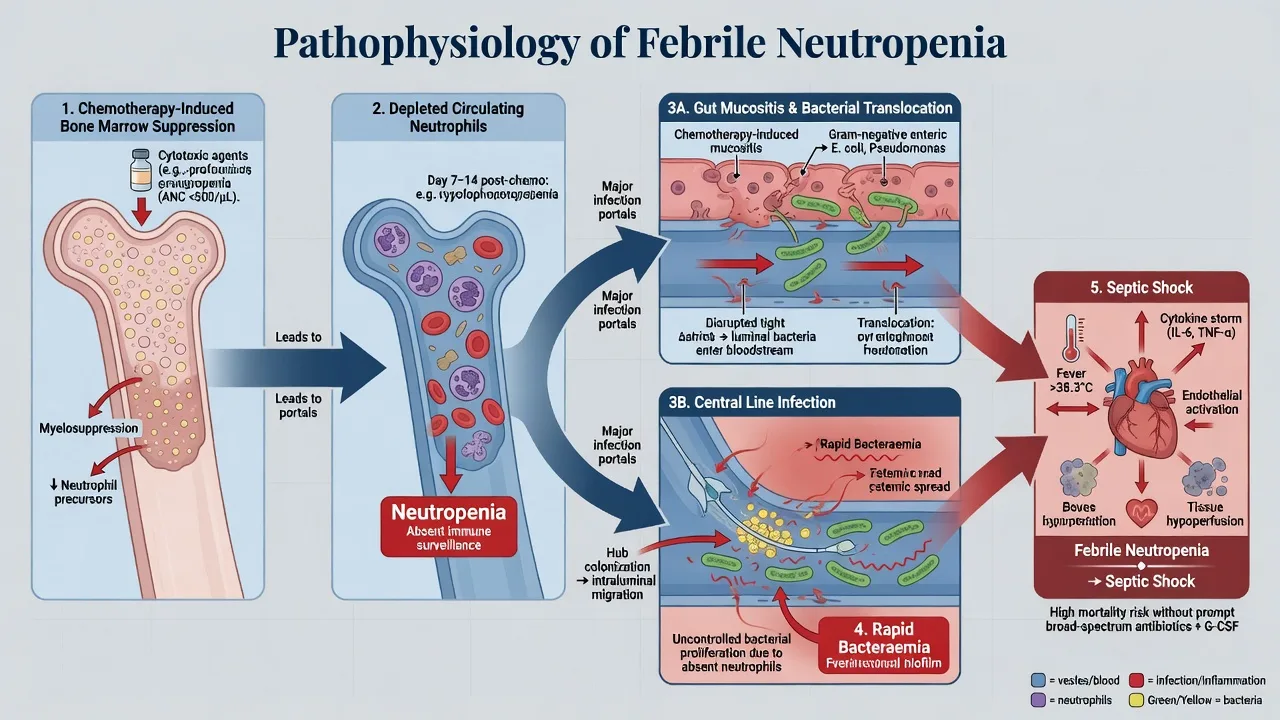
Two consequences of cytotoxic therapy combine to produce the emergency. First, the chemotherapy destroys rapidly dividing bone-marrow precursors, depleting circulating neutrophils within seven to fourteen days of a cycle; the loss of phagocytic and oxidative killing removes the primary barrier to bacterial and fungal invasion. Second, the same cytotoxic effect strips the mucosal lining of the gut and the oropharynx, producing mucositis — a breach through which endogenous flora translocate into the bloodstream. An indwelling central venous catheter adds a direct conduit for skin organisms into the great veins.[1]
The clinical implication is twofold. The patient can bacteraemic within hours of a fever, with progression to septic shock and multi-organ failure, because the neutrophil-mediated containment that normally localises infection is absent. And the inflammatory response itself is blunted — the neutrophil drives much of the pus, swelling and radiographic consolidation that usually mark infection — so the source may be clinically silent. A chest radiograph may be clear in the face of a pneumonic bacteraemia, and a perianal abscess may be felt only as pain without the overlying erythema that an immunocompetent patient would mount. [1]
[1]Clinical presentation
The presentation is fever in the context of recent chemotherapy, a known malignancy, or a transplant. The fever may be high and abrupt, or it may be low-grade and the patient profoundly unwell. The critical step is to hunt for a focus while never allowing the hunt to delay the antibiotic. Examine the mouth for mucositis, the skin for cellulitis, embolic lesions or a tunnel-tract infection, the perianal region for tenderness (but never perform a digital rectal examination), the respiratory system for focal signs, and the urine for a source. Inspect every lumen of the central venous catheter for erythema, purulence or pain along its tunnel.[1]
Atypical and severe presentations must be recognised at the bedside. Hypotension, tachypnoea, confusion, a raised lactate or hypothermia mark severe sepsis and demand immediate resuscitation, broadened antimicrobial cover and intensive-care involvement. Rigors during or immediately after a blood-product transfusion point to a transfusion reaction rather than infection — a distinction made on timing and on the temporal relationship to the unit. The patient on long-term steroids or with adrenal suppression may present in an Addisonian crisis triggered by the same infection; a low cortisol picture should not deflect from the febrile-neutropenia protocol. [1]
[1]Differential diagnosis
Not every fever in a cancer patient is infection, and several non-infective causes mimic febrile neutropenia closely enough to trap the candidate. The distinction rests on biochemistry, on timing relative to a drug or transfusion, and on the neutrophil count itself — tumour lysis, a transfusion reaction and a drug fever all sit alongside febrile neutropenia in the post-chemotherapy patient, and may coexist with it. [1]
Tumour lysis syndrome
- Onset 12 to 72 hours after cytotoxic therapy for a high-turnover tumour (leukaemia, lymphoma); fever may accompany cell breakdown
- Hyperkalaemia, hyperphosphataemia, hypocalcaemia, hyperuricaemia, acute kidney injury — the metabolic fingerprint of massive cell lysis
- Aggressive hydration, rasburicase or allopurinol, management of hyperkalaemia and renal replacement; antibiotics only if infection is also present
- Both may coexist — send the biochemistry in every febrile post-chemo patient
Transfusion reaction
- Fever ± rigors during or within four hours of a blood product; may be febrile non-haemolytic, haemolytic, or anaphylactic
- Haemolysis (raised LDH, indirect bilirubin, falling haemoglobin), hypotension, urticaria; positive direct antiglobulin test in haemolytic reactions
- Stop the transfusion, maintain intravenous access with saline, return unit and samples to blood bank, antipyretic ± adrenaline for anaphylaxis
- Coexisting febrile neutropenia must still be covered with antibiotics — the two are not mutually exclusive
Drug fever
- Insidious fever in a patient on a culprit agent (bleomycin, cytarabine, growth factors, allopurinol, antibiotics); relative bradycardia may be absent
- Otherwise well, no focus, normal lactate; fever resolves 24 to 72 hours after drug cessation and recurs on rechallenge
- Stop the suspect drug where possible; treat infection empirically until excluded rather than attributing fever to a drug prematurely
- A diagnosis of drug fever in the neutropenic patient is one of exclusion — never let it delay the antibiotic
Non-neutropenic sepsis or cytokine release
- Fever with a focus or a positive culture but a neutrophil count above 0.5 × 10⁹ per litre; standard sepsis pathway applies
- Cytokine-release syndrome (CAR-T, blinatumomab) produces high fevers and hypotension within days of therapy; IL-6 inhibition with tocilizumab for severe cases
- Treat as sepsis first; recheck the count; specific therapy for cytokine release only when sepsis is excluded
- A normal or recovering neutrophil count moves the patient out of the febrile-neutropenia protocol but not out of the sepsis bundle
Investigations and the source search
Investigations run in parallel with, never before, the first antibiotic dose. Confirm the neutropenia with a full blood count and differential. Take two sets of blood cultures — one peripheral and one drawn from each lumen of the central venous catheter — because a differential time-to-positivity of two hours or more between the line and the peripheral sample identifies a catheter-related bloodstream infection. Send urea and electrolytes, liver function tests, coagulation, C-reactive protein, lactate and a venous gas for the perfusion and acid–base state. A urine microscopy and culture, a chest radiograph, and swabs of any skin or line-site focus are routine.[1]
Targeted tests follow the focus and the clinical context. Send stool for culture and Clostridioides difficile toxin if there is diarrhoea. Request viral polymerase-chain-reaction panels for respiratory viruses, herpes simplex and cytomegalovirus in the relevant patient. When fungal infection is suspected — prolonged febrile neutropenia, a new pulmonary nodule with a halo sign, sinus pain — send a serum galactomannan and a beta-D-glucan, and obtain a high-resolution chest computed-tomogram. A lumbar puncture is reserved for the patient with meningism or a new neurological deficit, and only after coagulation is checked and platelets corrected if low; it is never an emergency test in the thrombocytopenic patient. [1]
The diagnostic panel at a glance
The MASCC risk index
The Multinational Association of Supportive Care in Cancer (MASCC) risk index stratifies the febrile neutropenic patient by the probability of a severe medical complication, and is the tool the candidate uses to justify inpatient versus outpatient care. A score of 21 or more identifies low risk; a score below 21 identifies high risk and mandates admission and intravenous antibiotics. The index is built from the bedside clinical variables that predict an uncomplicated course.[3]
| Variable | Finding | Points |
|---|---|---|
| Burden of illness | No or mild symptoms | 5 |
| Moderate symptoms | 3 | |
| Severe symptoms or moribund | 0 | |
| Hypotension | Absent (systolic above 90 mmHg) | 5 |
| Chronic obstructive pulmonary disease | Absent | 4 |
| Solid tumour or no previous fungal infection | Yes | 4 |
| Dehydration requiring parenteral fluids | Absent | 3 |
| Outpatient at onset of fever | Yes | 3 |
| Age below 60 years | Yes (not scored in children) | 2 |
The maximum score is 26. The index is robust for both solid and haematological malignancies, though it is less reliable in the profoundly neutropenic stem-cell transplant recipient, in whom anticipated neutropenia of more than seven days alone defines high risk regardless of the score.[3] The Clinical Index of Stable Febrile Neutropenia (CISNE) is an alternative score used in some European centres; it weighs performance status, the underlying tumour, and comorbidity. For the Fellowship candidate, the MASCC index and the IDSA high-risk definition together drive the disposition: high risk for admission, low risk for the oral-outpatient pathway in the selected patient.
Risk stratification at a glance
Immediate management — empirical antibiotics within one hour
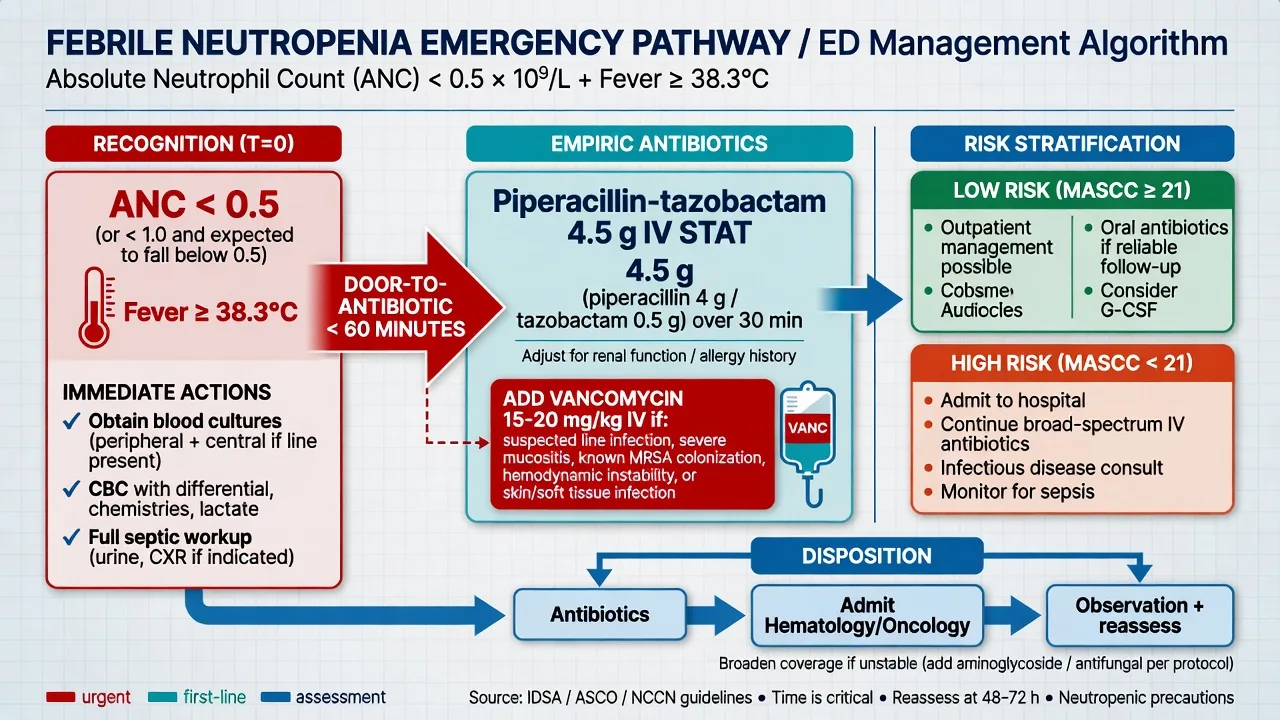
The febrile neutropenic patient is managed exactly as a septic patient with one added rigour: the antibiotic must be given within sixty minutes of arrival. Stabilise the airway and breathing, give high-flow oxygen to the hypoxaemic or shocked patient, establish two large-bore intravenous cannulae or use the central line, and attach cardiac monitoring. Apply the Hour-1 sepsis bundle — blood cultures drawn before the antibiotic, a 30 mL per kilogram crystalloid bolus for hypotension or a lactate above 2 mmol per litre, and an early vasopressor (noradrenaline) if the fluid does not hold the mean arterial pressure.[1][2]
The antibiotic is given the moment the cultures are drawn. The principle is a single anti-pseudomonal beta-lactam at full dose, with escalation agents added for specific clinical triggers. A routine aminoglycoside is not recommended, because the nephrotoxicity of stacking it with vancomycin and the inherent renal vulnerability of the oncology patient outweigh any benefit in the empirical phase.[1]
The first 60 minutes of febrile neutropenia in one breath
Recognise the syndrome — a single oral temperature of 38.3 degrees or higher in a patient on chemotherapy or with a haematological malignancy, an absolute neutrophil count below 0.5 × 10⁹ per litre. Apply the Hour-1 sepsis bundle: oxygen, access, monitoring, blood cultures from a peripheral site and from each lumen of the central line, lactate and a venous gas. Give a 30 mL per kilogram crystalloid bolus for hypotension or lactataemia, and start noradrenaline early if the fluid does not restore the pressure. Then give the empirical antibiotic within sixty minutes — piperacillin-tazobactam 4.5 g intravenously, or ceftazidime 2 g intravenously, meropenem 1 g intravenously or cefepime 2 g intravenously as alternatives. Add vancomycin 1.5 g intravenously for line infection or MRSA, aciclovir 10 mg per kilogram intravenously for HSV or VZV, and caspofungin for suspected fungal disease. Compute the MASCC score, find and control the source, and admit the high-risk patient to high-dependency or intensive care. [1]
Empirical antibiotic regimen — agent, dose, route, timing
The empirical regimen is an anti-pseudomonal beta-lactam at a dose that achieves reliable serum levels against Pseudomonas aeruginosa, the organism that drove the historical mortality and still defines the cover required. Any one of the following monotherapy regimens is acceptable first-line:[1]
- Piperacillin-tazobactam 4.5 g intravenously every six to eight hours — the most widely used first-line agent.
- Ceftazidime 2 g intravenously every eight hours — a third-generation anti-pseudomonal cephalosporin.
- Cefepime 2 g intravenously every eight hours — a fourth-generation cephalosporin, broader than ceftazidime.
- Meropenem 1 g intravenously every eight hours — reserved for a known resistant organism, recent broad-spectrum exposure, or severe sepsis where ESBL production is plausible. [1]
Escalation agents are added for defined triggers, not routinely. Vancomycin 1.5 g intravenously every twelve hours (or 15 to 20 mg per kilogram) is added when there is suspected catheter-related or tunnel-tract infection, known MRSA colonisation, severe mucositis on fluoroquinolone prophylaxis, haemodynamic instability, or a positive blood culture for a beta-lactam-resistant Gram-positive organism. Aciclovir 10 mg per kilogram intravenously every eight hours is added when mucocutaneous herpes simplex or varicella-zoster is suspected, or for the stem-cell transplant patient on prophylaxis failure. Caspofungin — a 70 mg loading dose then 50 mg daily intravenously — is added for suspected invasive fungal disease and is preferred to amphotericin B for its lower nephrotoxicity.[1]
[1]The empirical drug doses
Escalation, de-escalation and antifungal cover
The febrile neutropenic patient is reassessed continuously rather than treated by a single prescription. Haemodynamic deterioration within the first hours — new hypotension, a rising lactate, ongoing tachycardia — mandates broadening the cover (the addition of vancomycin, a switch to meropenem, and an early review for source control) and escalation of the level of care. Persistent fever at 72 hours on appropriate broad-spectrum cover prompts a full reassessment: repeat the examination, repeat the cultures, image for an occult focus, and review the antimicrobial spectrum against the local antibiogram.[1]
Empirical antifungal therapy is added when fever persists beyond four to seven days of broad-spectrum antibacterial cover in a patient with prolonged neutropenia, or when a new pulmonary or sinus lesion appears. The echinocandins (caspofungin, micafungin) are preferred for empirical cover of invasive candidiasis because they are less nephrotoxic than amphotericin B and avoid the infusion reactions of the lipid formulations; amphotericin B and voriconazole or posaconazole are reserved for suspected mould disease (invasive aspergillosis, mucormycosis). The beta-D-glucan and galactomannan assays, and a high-resolution chest computed-tomogram showing the halo sign or a crescent, guide the mould-specific therapy.[1]
De-escalation follows the culture results. A documented Gram-negative bacteraemia with a sensitive isolate is narrowed to the targeted agent after 48 to 72 hours of clinical response; a coagulase-negative staphylococcal line infection that is uncomplicated is treated with targeted vancomycin and the line retained, while a tunnel infection or persistent bacteraemia mandates line removal. Granulocyte colony-stimulating factor (filgrastim 5 micrograms per kilogram per day subcutaneously) is not routine but is considered in the high-risk patient with profound, prolonged neutropenia, a documented infection unresponsive to therapy, or a life-threatening fungal infection, where shortening the neutropenic phase may change the outcome.[1]
Subtypes and scenarios
The high-risk-versus-low-risk distinction shapes the entire pathway. High-risk patients — anticipated neutropenia beyond seven days, any significant comorbidity (hypotension, renal failure, uncontrolled cancer), or a MASCC score below 21 — are admitted for inpatient intravenous antibiotics, with intensive care for the unstable. Low-risk patients — a MASCC score of 21 or more, short anticipated neutropenia, no comorbidity, reliable social circumstances — may, after a period of observation, be discharged on oral ciprofloxacin 750 mg twice daily plus amoxicillin-clavulanate 875 mg twice daily with a twenty-four-hour review, twice-daily temperature checks, and clear return criteria.[2]
Several specific syndromes carry their own management. Perianal neutropenic cellulitis presents as perianal pain in the absence of an external abscess; the diagnosis is clinical and by imaging, the digital rectal examination is contraindicated, and surgical drainage is reserved for a true abscess once counts recover. Neutropenic enterocolitis (typhlitis) presents with right-lower-quadrant pain, fever and diarrhoea in the profoundly neutropenic patient; computed-tomography shows caecal wall thickening, and management is bowel rest, nasogastric decompression, broad-spectrum antibiotics covering anaerobes and Gram-negatives, and surgery only for perforation. Severe mucositis predisposes to viridans-group streptococcal bacteraemia, which can precipitate acute respiratory distress syndrome and septic shock within hours. Central-line infection demands paired cultures, targeted vancomycin, and line removal for a tunnel infection, a port abscess, or persistent or metastatic bacteraemia.[1]
Complications and pitfalls
The feared complication is septic shock with multi-organ failure, the commonest cause of death in febrile neutropenia and the reason for the sixty-minute antibiotic target. Acute kidney injury follows the sepsis itself and is compounded by nephrotoxic stacking — vancomycin with an aminoglycoside or amphotericin in the oncology patient on other nephrotoxic agents is a recurring and avoidable injury. Invasive fungal disease, missed in the first days, declares itself as pulmonary cavitation, sinus invasion or cerebral abscess once the neutrophil count recovers, by which point the outcome is grim.[1]
The recurring pitfalls invert the protocol. The first is delaying the antibiotic for cultures or a focus — the single most dangerous error, because the cultures take a day and the patient may not have it. The second is performing a digital rectal examination in the patient with perianal pain, seeding bacteraemia through a denuded mucosa. The third is routine empirical vancomycin, which adds nephrotoxicity without benefit when there is no line infection or MRSA risk. The fourth is missing a fungal infection in the patient with prolonged fever on broad-spectrum cover. The fifth is treating the low-risk patient as high-risk — unnecessary admission, intravenous therapy and line exposure that the MASCC index was designed to prevent. The sixth is withholding the stress-dose steroid in the patient on long-term steroids who becomes Addisonian behind the sepsis. [1]
Prognosis and disposition
Treated promptly within the first hour, an uncomplicated febrile neutropenia resolves over days as the neutrophil count recovers and the antibiotic controls the bacteraemia. All high-risk patients are admitted, the unstable to intensive care and the stable-but-high-risk to a high-dependency or oncology ward with continuing intravenous antibiotics, daily review and a plan for de-escalation or escalation at 72 hours. The selected low-risk patient may be discharged on oral therapy with a structured follow-up — a documented next-day review, a carer at home, a thermometer, a clear fever-or-unwell return pathway, and proximity to the hospital. Mortality overall is 5 to 10 per cent and is driven by the organism (Pseudomonas, resistant Gram-negatives, mould), the depth and duration of neutropenia, the timeliness of the antibiotic, and the development of septic shock.[1][3]
Special populations
Children present with the same definition but the MASCC index is not validated in the under-18, so paediatric practice generally admits all febrile neutropenic children for intravenous antibiotics, with cefepime or piperacillin-tazobactam as first-line. Stem-cell transplant recipients carry the highest risk of all — profound neutropenia for two to three weeks, mucosal damage from conditioning, and graft-versus-host disease on top — and are managed as high-risk with a low threshold for empirical antifungal and antiviral cover. The non-chemo immunocompromised patient — solid-organ transplant on tacrolimus and mycophenolate, HIV with a low CD4 count, the patient on chronic steroids or biologics — sits outside the strict febrile-neutropenia definition but shares the principle of blunted inflammation, broad cover and a low threshold for atypical organisms (listeria, pneumocystis, cryptococcus, CMV). The patient on long-term steroids warrants a stress-dose hydrocortisone when shock is refractory to fluid and vasopressors, because adrenal suppression may underlie the vasoplegia.[1][2]
Evidence and regional guidelines
The contemporary framework rests on the IDSA 2011 guideline (Freifeld and colleagues), which sets the definition, the monotherapy anti-pseudomonal beta-lactam regimen, the defined add-vancomycin triggers, the empirical antifungal addition at four to seven days, and the high-risk-versus-low-risk disposition.[1] The ASCO and IDSA joint 2018 outpatient guideline update (Taplitz and colleagues) operationalises the low-risk oral pathway — oral ciprofloxacin plus amoxicillin-clavulanate, with structured follow-up and clear return criteria — and defines the clinical and social criteria a patient must meet to leave hospital.[2] The MASCC risk-index validation (Klastersky and colleagues, 2013) confirms the 21-point cutoff across both solid and haematological malignancies and anchors the risk-stratification step.[3] The NCCN, the European ECIL and the AGITG guidelines align on the same principles; the ECIL guidance is more directive on the empirical echinocandin and on multidrug-resistant-organism cover.
ANZ practice note. Australasian emergency and oncology practice follows the IDSA doses — piperacillin-tazobactam 4.5 g intravenously every six to eight hours as the default first-line monotherapy, with ceftazidime, cefepime or meropenem as alternatives, vancomycin added for line infection or MRSA, aciclovir for HSV or VZV, and an echinocandin for suspected fungal disease. The eviQ protocols, hosted by New South Wales Health, are the locally authoritative cancer-treatment references and guide both the empirical regimens and the low-risk outpatient pathway used across Australian and New Zealand cancer centres. Local antibiograms govern the choice when multidrug-resistant organisms are prevalent; the door-to-antibiotic target of sixty minutes is embedded in the hospital sepsis pathways and in the cancer-services accreditation standards. [1]
SAQ — febrile neutropenia with septic shock in a chemotherapy patient
10 minutes · 10 marks
A 58-year-old man with acute myeloid leukaemia, day 9 of induction chemotherapy with cytarabine and daunorubicin (the 7+3 regimen), is brought to the resuscitation bay with rigors and confusion. Heart rate 124, blood pressure 84/52 mmHg, respiratory rate 28, SpO2 94 per cent on room air, capillary refill 4 seconds, temperature 39.1 degrees. The tunneled central venous catheter exit site is clean but the tunnel tract is tender and erythematous over a 4 cm span. Absolute neutrophil count 0.2 × 10⁹ per litre, platelets 24 × 10⁹ per litre, lactate 3.8 mmol per litre.
SAQ — pneumonia in a renal transplant recipient at four months
10 minutes · 10 marks
A 46-year-old woman, four months after a deceased-donor kidney transplant, on tacrolimus, mycophenolate mofetil 1 g twice daily and prednisolone 10 mg daily, presents with five days of progressive exertional dyspnoea, a dry cough and a low-grade fever. She is hypoxic — SpO2 88 per cent on room air, rising to 95 per cent on 6 litres via a simple mask — with bilateral diffuse interstitial infiltrates on the chest radiograph and a respiratory rate of 30. She has taken valganciclovir and cotrimoxazole prophylaxis since the transplant. Lactate dehydrogenase 520 units per litre, C-reactive protein 85, white cell count normal.
Exam pearls
- Febrile neutropenia = ANC below 0.5 × 10⁹ per litre plus a single oral temperature of 38.3 degrees or higher, in a patient on chemotherapy or with a haematological malignancy — a time-critical sepsis equivalent.
- Door-to-antibiotic target is 60 minutes — cultures first (peripheral plus each line lumen), then the antibiotic; never delay the dose for a focus or a result.
- Empirical monotherapy: piperacillin-tazobactam 4.5 g, ceftazidime 2 g, cefepime 2 g or meropenem 1 g intravenously — a single anti-pseudomonal beta-lactam at full dose.
- Add vancomycin 1.5 g (or 15 to 20 mg/kg) for a line or tunnel infection, MRSA, severe mucositis on fluoroquinolone prophylaxis, or shock — not routinely.
- Add aciclovir 10 mg/kg for HSV or VZV; add caspofungin (70 mg then 50 mg) for suspected fungal disease — the defined escalation agents.
- MASCC 21 or more = low risk (oral ciprofloxacin ± amox-clav as an outpatient); below 21 = high risk (admit, intravenous).
- Never perform a digital rectal examination in the neutropenic patient with perianal pain — perianal cellulitis is diagnosed clinically and by imaging.
- Persistent fever at four to seven days = empirical antifungal — echinocandin first, amphotericin or a mould-active azole for suspected aspergillosis or mucormycosis.
- Distinguish tumour lysis syndrome (hyperkalaemia, hyperphosphataemia, hypocalcaemia, hyperuricaemia, AKI), the transfusion reaction and drug fever from febrile neutropenia — all may coexist with it.
- Stress-dose hydrocortisone for the steroid-dependent patient in refractory shock — adrenal suppression may underlie the vasoplegia. [1]
Red flags
[1]References
- [1]Freifeld AG, Bow EJ, Sepkowitz KA, et al. Clinical practice guideline for the use of antimicrobial agents in neutropenic patients with cancer: 2010 update by the infectious diseases society of america Clin Infect Dis, 2011.PMID 21258094
- [2]Taplitz RA, Kennedy EB, Bow EJ, et al. Outpatient Management of Fever and Neutropenia in Adults Treated for Malignancy: American Society of Clinical Oncology and Infectious Diseases Society of America Clinical Practice Guideline Update J Clin Oncol, 2018.PMID 29461916
- [3]Klastersky J, Paesmans M, Georgala A, et al. The Multinational Association for Supportive Care in Cancer (MASCC) risk index score: 10 years of use for identifying low-risk febrile neutropenic cancer patients Support Care Cancer, 2013.PMID 23443617