EM · Paediatric fever and serious bacterial illness
Paediatric fever and serious bacterial illness (the febrile child in the emergency department)
Also known as Febrile child · Paediatric fever · Fever without source · Serious bacterial illness · NICE traffic light system
The febrile child — the NICE traffic-light system (green low risk, amber intermediate, red high risk), the identification of the serious bacterial illness (the urinary tract infection, the pneumonia, the meningitis, the sepsis, the osteomyelitis, the septic arthritis), and the approach by age: the neonate under 28 days (full septic workup, admit, intravenous cefotaxime plus ampicillin), the infant 1 to 3 months (septic workup if unwell, ceftriaxone 50 mg per kilogram if serious bacterial illness suspected), the child over 3 months (focused assessment, the urine, the chest X-ray). The drug doses (ceftriaxone 50 mg per kilogram IV, cefotaxime 50 mg per kilogram IV, ampicillin 50 mg per kilogram IV, paracetamol 15 mg per kilogram) and the differential (the viral illness, the roseola, the Kawasaki disease). ACEM-primary, globally tagged.
On this page & tools
Your progress
Saved locally on this device.
8 MCQs with explanations
Target exams
Red flags
The febrile child is the commonest and the most high-stakes paediatric presentation in the emergency department. Most fevers are viral and self-limiting, but a small minority conceal a serious bacterial illness — a urinary tract infection, a pneumonia, a meningitis, a sepsis, an osteomyelitis, or a septic arthritis — and the emergency clinician's job is to find that minority without over-investigating the majority. The Fellowship candidate must stratify risk with the NICE traffic-light system, apply an age-based workup (the neonate under 28 days, the infant 1 to 3 months, the child over 3 months), reproduce the empiric antibiotic doses, and distinguish the bacterial illness from its viral, exanthematous and vasculitic mimics.[1][2]
Definition and classification
Fever in a child is a body temperature of 38 degrees Celsius or higher, measured in the axilla in the under-five and orally or tympanically in the older, cooperative child. Fever without source denotes a febrile child in whom the history and examination have not yet identified a focus — the group at highest risk of an occult serious bacterial illness. Serious bacterial illness is the collective term for the bacterial infections that threaten life or limb in a child: the urinary tract infection, the lobar pneumonia, the bacterial meningitis, the bacteraemic sepsis, the osteomyelitis and the septic arthritis. The decisive classification is not the temperature height but the child's appearance and the age band: an unwell neonate is high risk regardless of how low the fever, whereas a well, playful three-year-old with a high fever is low risk. The NICE traffic-light system operationalises that judgement into green, amber and red categories.[1]
Pathophysiology
Fever is the hypothalamic upward reset of the body's temperature set-point, driven by endogenous pyrogens (interleukin-1, interleukin-6, tumour necrosis factor) released from monocytes and macrophages in response to a microbial stimulus. The prostaglandin-E2 pathway is the final common mediator, which is why paracetamol and ibuprofen — both prostaglandin synthetase inhibitors — abolish it. The febrile child differs from the febrile adult in three mechanisms. First, the immature immune system of the neonate and young infant fails to localise infection, allowing bacteraemia and rapid dissemination. Second, the smaller circulating volume makes dehydration from fever-driven insensible losses and reduced feeding a clinical threat within hours. Third, the open fontanelle and the incompletely myelinated brain raise the seizure threshold, so febrile convulsions cluster between six months and five years. These mechanisms dictate why age, not temperature, governs the workup. [1]
Epidemiology and risk factors
Fever is the reason for up to a third of all paediatric emergency presentations. The yield of a serious bacterial illness tracks inversely with age: it is highest in the neonate (around 10 to 15 per cent have an SBI), falls to 8 to 10 per cent in the 1-to-3-month infant, and drops below 2 per cent in the febrile child over three years. The organisms shift with age and vaccination status. The neonate is prey to group B streptococcus, Escherichia coli and Listeria monocytogenes — the pathogens that colonise the maternal genital tract and that cefotaxime plus ampicillin target. The older infant and child acquire pneumococcus, meningococcus, and the urinary pathogens (Escherichia coli, Proteus, Klebsiella). Haemophilus influenzae type b is now rare where conjugate vaccination is universal, but re-enters the differential in the unimmunised or the immunocompromised child. Risk factors that raise the pre-test probability of an SBI include a sickle-cell or asplenic state, an indwelling central line, a congenital urinary tract anomaly, an immunodeficiency, and the under-vaccinated child.[2][3]
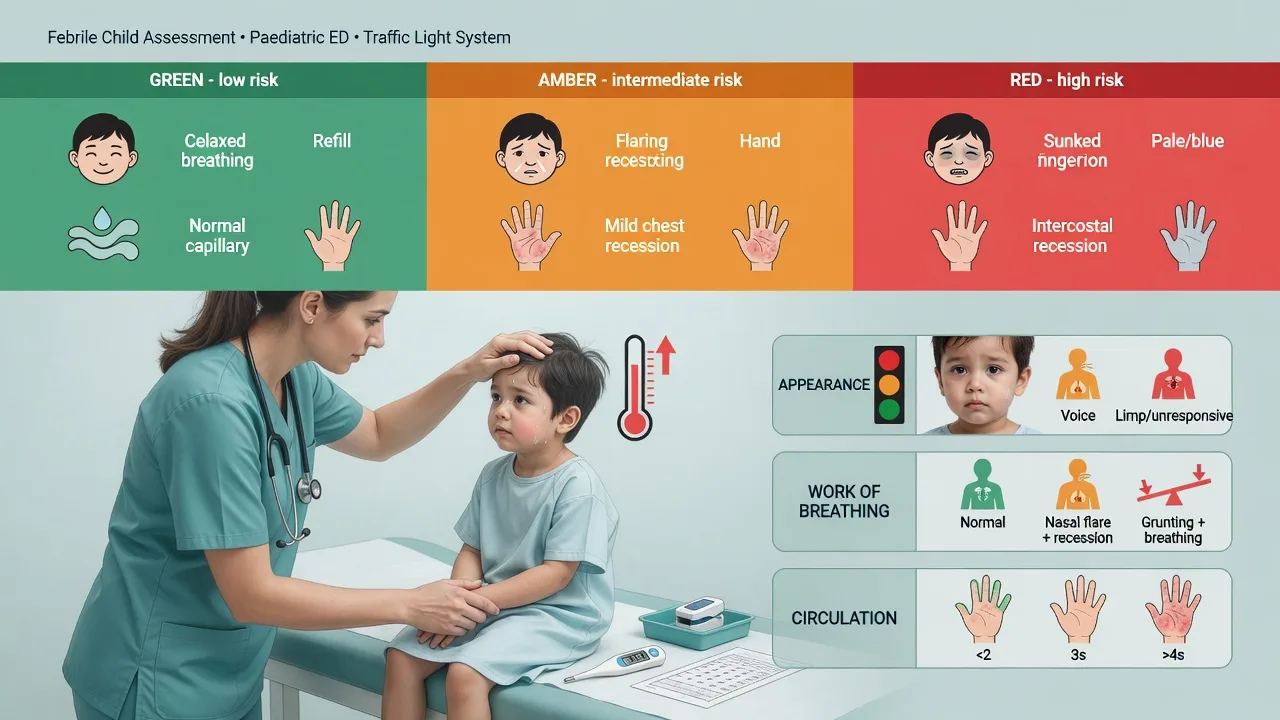
The NICE traffic-light system
The NICE traffic-light system is the risk-stratification centrepiece of the febrile-child guideline (NICE CG160, updated 2019). It assigns every febrile child to one of three colour bands from the colour, the activity, the respiratory effort, the hydration and the vital signs, and the band then dictates the workup and the disposition. The red band (high risk) mandates paediatric assessment, a full septic screen, intravenous antibiotics and admission; the amber band (intermediate risk) mandates paediatric assessment and a selective workup with admission considered; the green band (low risk) allows discharge with a safety-net and advice to return. [1]
The NICE traffic-light system — the discriminating features
The validation studies confirm that the red features carry the highest individual yield for a serious bacterial illness — particularly the petechial rash, the grunting, the mottled skin and the altered responsiveness — while the green features reliably identify the child safe for discharge. The amber band is the decision zone where the age, the fever duration and the focused tests resolve the uncertainty.[1][2]
[1]Clinical presentation
The history captures the fever height, duration and pattern, any focused symptoms (a cough, a strained micturition or dysuria, a limp or a refusing-to-weight-bear limb, an earache, a rash), the feeding and the fluid intake, the urine output (the wet-nappy count in the infant), the immunisation status, and any sick contacts. The examination is systematic and starts with the paediatric assessment triangle — the appearance, the work of breathing, and the circulation to the skin — observed before the child is touched. A full top-to-toe follow: the tympanic or axillary temperature, the colour and the capillary refill, the respiratory rate and effort (recession, grunting, nasal flaring), the oxygen saturation, the heart rate, the hydration state (mucous membranes, skin turgor, sunken fontanelle), the rash and its blanching, the ears and throat (but do not attribute fever to teething alone), the chest, the abdomen, and every joint for warmth and reluctance to move. A limb the child refuses to move, in the absence of trauma, is septic arthritis or osteomyelitis until imaging and blood tests prove otherwise. [1]
Differential diagnosis
The differential of the febrile child splits into the serious bacterial illnesses (the target of the workup) and the benign viral and exanthematous mimics (the diagnosis of exclusion). The Fellowship candidate must hold both lists at once — to find the treatable bacterial illness and to recognise the self-limiting mimic. [1]
Viral upper respiratory infection
- Coryza, cough, sore throat; the child looks well between fever spikes
- Low-grade fever; normal hydration and activity
- Normal urine, no respiratory distress
- Supportive; antipyretics; safety-net
Roseola (HHV-6)
- High fever for 3 to 5 days in a well-looking 6-to-24-month infant, then a maculopapular rash as the fever breaks
- The rash appears after the defervescence — the diagnostic clue
- No focus; normal examination once fever settles
- Supportive; febrile seizure is the main complication
Kawasaki disease
- Fever for 5 days or more plus 4 of 5: bilateral non-purulent conjunctivitis, polymorphous rash, oral changes (strawberry tongue, cracked lips), extremity changes (oedema, desquamation), cervical lymphadenopathy
- Risk of coronary artery aneurysm if untreated
- Not an infection — needs intravenous immunoglobulin and aspirin within 10 days
- Refer urgently to paediatrics; do not wait for confirmation
Measles
- Prodrome of fever, coryza, cough, conjunctivitis; Koplik spots on the buccal mucosa
- Maculopapular rash descending from the hairline
- Under-vaccinated child; notifiable disease
- Supportive; isolate; notify public health
Drug fever or post-immunisation
- Fever within 48 hours of a vaccination
- Well child; no focus
- Self-limiting over 1 to 2 days
- Antipyretics; reassurance
Bedside assessment
The bedside assessment fuses the traffic-light colour assignment with the search for a focal bacterial source. Determine the colour band from the five domains (colour, activity, respiration, hydration, and the "other" red features), then hunt for a focus: examine the ears and throat (otitis media, tonsillitis — though do not over-attribute fever to these), the chest (a pneumonia, a bronchiolitis), the abdomen (a tender abdomen, a UTI), the urine (the commonest occult SBI in the unwell infant), the limbs and the spine (osteomyelitis, septic arthritis, discitis), the skin (cellulitis, the petechial rash of meningococcaemia), and the central nervous system (the bulging fontanelle, the altered responsiveness, the photophobia). Use AVPU — Alert, responds to Voice, responds to Pain, Unresponsive — to grade the level of consciousness rapidly. The observation window of four hours, with repeated vital signs and a re-examination once the fever has been treated, is a powerful discriminator and is built into the NICE pathway for the intermediate-risk child. [1]
Investigations
The investigation strategy is age- and colour-band-driven, not blanket. For the high-risk (red) child and every febrile neonate, a full septic screen is mandatory: blood cultures, a full blood count and CRP, a venous or capillary gas with the lactate, a urinalysis and urine culture obtained by catheter or suprapubic aspirate (a bag specimen is contaminated and unacceptable for culture in the unwell infant), and a chest X-ray if there are respiratory signs. A lumbar puncture is performed when meningitis is suspected and there is no contraindication, sending the CSF for cell count, protein, glucose, gram stain, culture and meningococcal and pneumococcal PCR. Procalcitonin is more sensitive than CRP for an invasive bacterial infection and informs the decision to treat in the borderline infant. For the intermediate-risk (amber) child, the workup is selective — a urine is always sent in the under-three, bloods and a chest X-ray are added for the respiratory or systemically unwell, and an LP is reserved for the clinical picture of meningitis. For the low-risk (green) child, a clean-catch urine (if a source is not evident and the fever is unexplained) and a safety-net suffice.[2][3]
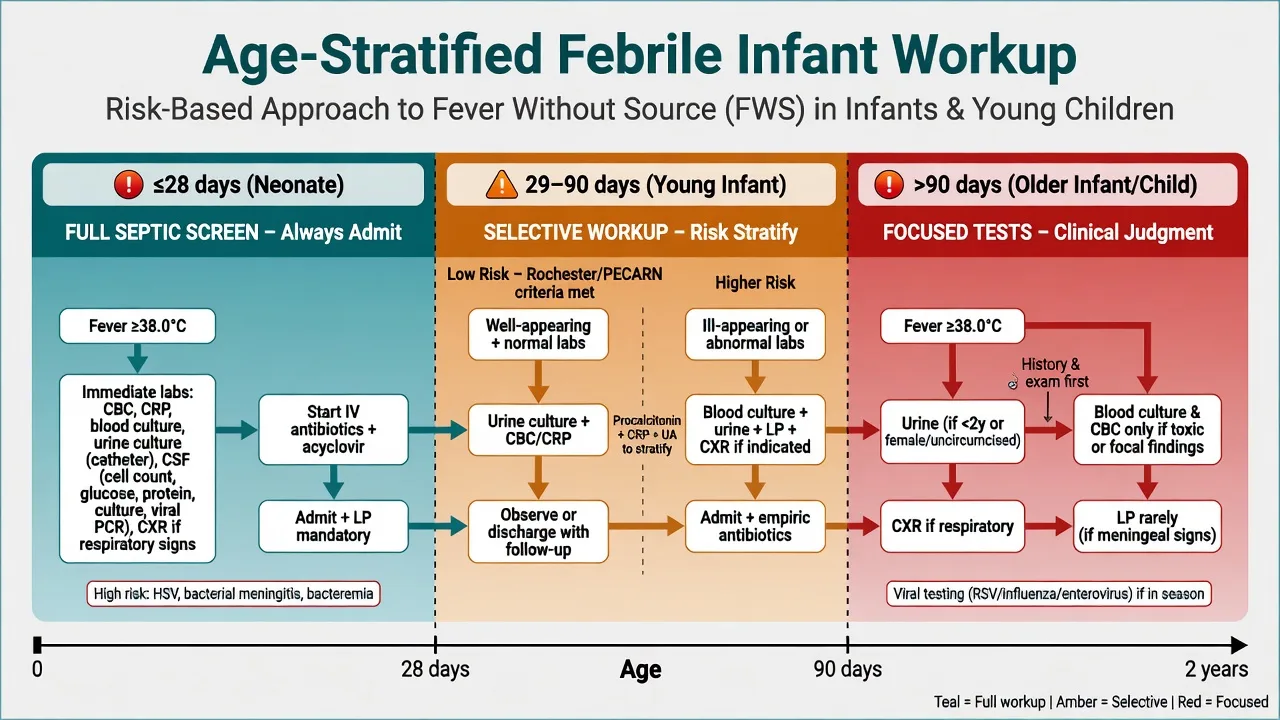
Age-stratified approach
The age band is the single most powerful modifier of the workup, because the immune maturity, the likely organism and the reliability of the clinical appearance all change across the first months of life. [1]
The three age bands of the febrile child
NEO — INF — CHILD
High risk by age alone. Full septic screen (blood, urine, CSF, chest X-ray), admit, and intravenous cefotaxime plus ampicillin. Ceftriaxone is avoided — it causes biliary sludging and displaces bilirubin, risking kernicterus.
At least amber (intermediate) risk with any fever. Paediatric assessment; full workup if unwell or red features; ceftriaxone 50 mg per kilogram if a serious bacterial illness is suspected or the child is unwell.
Traffic-light system governs the workup. Green: focused assessment, urine, safety-net, discharge. Amber: selective workup and observation. Red: full septic screen, IV ceftriaxone 50 mg per kilogram, admit.
The neonate under 28 days is managed on the assumption of bacteraemia until proven otherwise: a temperature of 38 degrees or higher (or hypothermia, which is just as ominous) triggers a full septic screen including the lumbar puncture, admission, and intravenous cefotaxime plus ampicillin — the ampicillin covers Listeria, which cefotaxime misses and which is a real neonatal pathogen. The 1-to-3-month infant sits in the decision zone: a well-looking infant with a green profile and a normal urine may be observed and safety-netted, but any red or amber feature mandates a full workup, admission and ceftriaxone 50 mg per kilogram intravenously. Contemporary multicentre data show substantial variation in how febrile infants between 61 and 90 days are evaluated, reinforcing the rule that this age band is never discharged on clinical appearance alone.[3]
Immediate management and resuscitation
Stabilise the airway, give oxygen to any child in respiratory distress or shock, and establish access — intravenous or, after two failed attempts or 90 seconds, intra-osseous. Treat shock with a 10 mL per kilogram bolus of isotonic crystalloid, reassessing after each bolus and stopping at the first sign of hepatomegaly or a rising work of breathing; in the neonate and the septic child, 10 mL per kilogram aliquots are safer than the 20 mL per kilogram adult dose. Draw blood cultures before the antibiotic whenever practical, but never delay the antibiotic for the culture or the lumbar puncture. Give the first empiric antibiotic dose within the first hour — the timing tracks the survival in meningococcal and pneumococcal sepsis. Treat fever with paracetamol 15 mg per kilogram orally or rectally (every 4 to 6 hours, maximum 60 mg per kilogram per day in the child, 30 mg per kilogram per day in the neonate) or ibuprofen 10 mg per kilogram every 6 to 8 hours in the child over three months — for distress, not to chase a number. [1]
[1]Definitive management and drug doses
Once the source is identified, the therapy narrows to the organism and the focus. A confirmed urinary tract infection in the older child is treated with oral cefalexin or trimethoprim for three to five days, with intravenous ceftriaxone 50 mg per kilogram reserved for the toxic, the dehydrated, or the under-three-month infant. A lobar pneumonia receives oral amoxicillin (high-dose, 90 mg per kilogram per day in divided doses) for the uncomplicated child, with intravenous ceftriaxone 50 mg per kilogram for the hospitalised. Bacterial meningitis receives ceftriaxone 50 mg per kilogram IV every 12 hours (max 2 g) plus dexamethasone 0.15 mg per kilogram every 6 hours before or with the antibiotic, and ampicillin 50 mg per kilogram IV every 6 hours if listeria is on the list. A septic joint or osteomyelitis receives ceftriaxone 50 mg per kilogram IV daily and an urgent orthopaedic opinion for washout. Meningococcal septicaemia receives ceftriaxone 50 mg per kilogram IV immediately, with fluid resuscitation and the paediatric intensive-care pathway. Paracetamol 15 mg per kilogram and ibuprofen 10 mg per kilogram manage the fever and the pain throughout. [1]
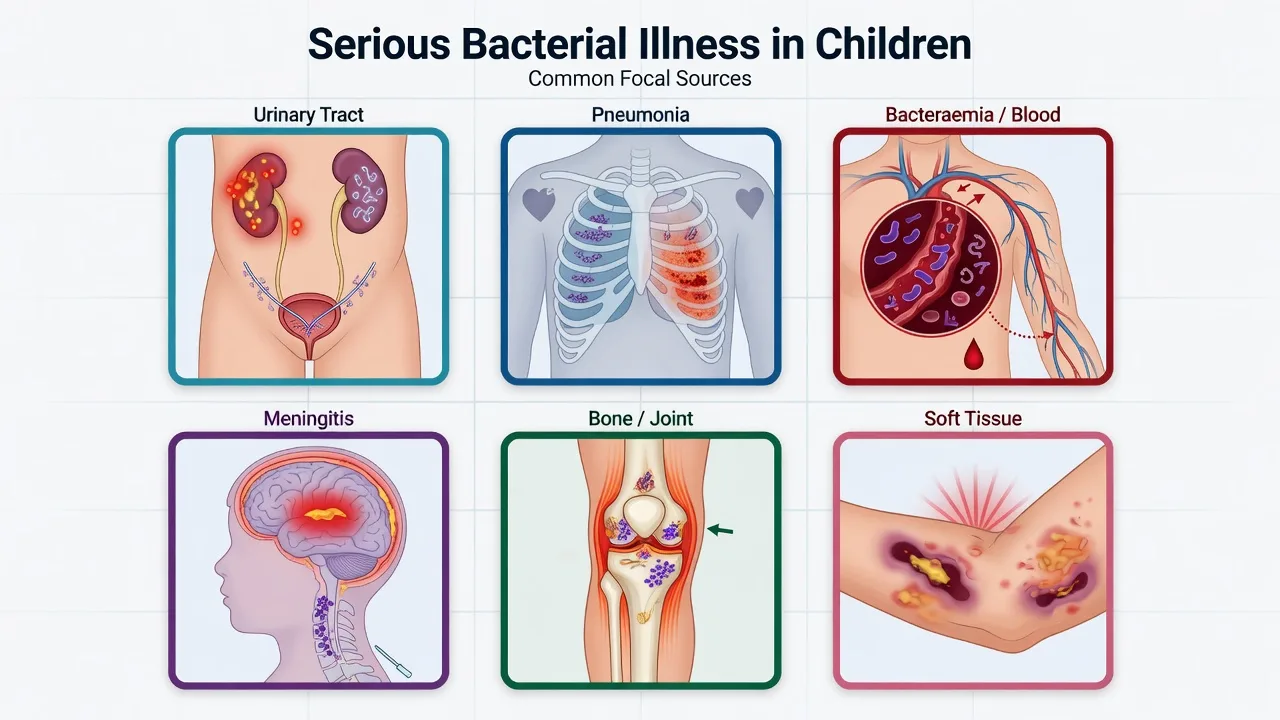
The serious bacterial illnesses
The six serious bacterial illnesses share a febrile presentation but differ in their focus, their organism and their trap. The urinary tract infection is the commonest occult SBI in the unwell infant and the under-two with fever without source; the urine is the single highest-yield test in this group, obtained by catheter or suprapubic aspirate. The pneumonia presents with tachypnoea, recession, grunting and hypoxia; the chest X-ray confirms a consolidation, but the clinical picture — the work of breathing — drives the decision to treat, not the radiograph. The bacterial meningitis presents with the bulging fontanelle, the altered responsiveness, the photophobia and the petechial rash; the lumbar puncture and the empiric ceftriaxone-dexamethasone regimen are the examinational centrepiece, and the antibiotic is never delayed for the imaging. The sepsis is the systemic endpoint — the cold, mottled, tachycardic child with a prolonged capillary refill and a rising lactate — and is managed on the paediatric sepsis pathway with fluid boluses, early antibiotics and vasopressors. The osteomyelitis presents with a limb the child refuses to use, point tenderness over a long-bone metaphysis, and a limp; the Kocher-equivalent features (fever, refusal to bear weight, raised inflammatory markers) guide the imaging with X-ray then MRI. The septic arthritis is the orthopaedic emergency of the swollen, hot, held-still joint — the irritable hip is septic until proven otherwise, distinguished from transient synovitis by the fever, the raised CRP and the inability to bear weight. [1]
Complications and pitfalls
The complications of a missed serious bacterial illness are the failure mode of the febrile-child pathway: a bacteraemia progresses to septic shock and multi-organ failure; an untreated meningitis leaves deafness, epilepsy and cognitive loss; a missed Kawasaki disease grows coronary aneurysms and infarcts the child years later; a delayed septic arthritis destroys the joint and seeds growth-plate ischaemia. The pitfalls cluster on four errors. First, over-reliance on the temperature — the height of the fever does not predict the SBI, and the response to paracetamol does not distinguish bacterial from viral. Second, trusting the appearance in the neonate — the neonate localises infection poorly and can look deceptively well between bacteraemic spikes; age alone mandates the workup. Third, the contaminated bag urine — a bag specimen has a 30 per cent contamination rate and must never be cultured in the unwell infant; use the catheter or the suprapubic aspirate. Fourth, attributing the fever to teething or to a viral exanthem before excluding the SBI — every febrile infant gets the urine, and a rash is described, not dismissed. [1]
Prognosis and disposition
The prognosis of the febrile child is overwhelmingly good: the great majority have a self-limiting viral illness and recover within days. The mortality and the morbidity concentrate in the neonate, the immunocompromised, and the child who presents late with meningococcal or pneumococcal sepsis, where the case-fatality still runs to 5 to 10 per cent even with optimal care. Disposition follows the colour band and the age: the neonate and every red-band child are admitted; the amber-band child is admitted or observed for four hours with a repeat assessment; the green-band child is discharged with a written safety-net — return immediately if the child has a non-blanching rash, becomes difficult to rouse, is not drinking, or the fever lasts five days. The safety-net is a clinical and a medico-legal requirement, not a courtesy. [1]
Special populations
The neonate under 28 days is managed at the highest level of caution: every fever is a full septic workup, admission and intravenous cefotaxime plus ampicillin, with ceftriaxone avoided. The infant under 3 months sits in the amber band as a default and is never discharged on appearance alone; the workup and the disposition follow the colour assignment and the urine result. The immunocompromised, neutropenic or asplenic child is treated as septic until proven otherwise at any age and any appearance — ceftriaxone 50 mg per kilogram IV on arrival, and a low threshold to broaden to piperacillin-tazobactam or meropenem. The child with a central line or a congenital urinary tract anomaly raises the pre-test probability of a device-related or a recurrent infection and is worked up accordingly. The under-vaccinated child brings Haemophilus influenzae type b and measles back into the differential and is a public-health notification when measles or meningococcal disease is confirmed. [1]
Evidence and regional guidelines
The contemporary framework is the NICE clinical guideline CG160 "Feverish illness in children", which formalises the traffic-light system, the age-stratified workup and the empiric antibiotic choices used throughout this topic. The validation evidence rests on two bodies of work: the systematic analysis of how the vital signs identify the child with a serious infection,[2] and the prospective validation of the predictive value of the NICE red features in acutely ill children, which confirmed that the high-risk features — the altered responsiveness, the grunting, the mottled skin and the petechial rash — carry the highest yield for a serious bacterial illness.[1] Multicentre data on the 61-to-90-day infant underline the persistent variation in evaluation and reinforce a conservative, age-driven approach in this band.[3]
ANZ practice note. The risk-stratification principles and the empiric antibiotic choices mirror the Royal Australasian College of Physicians and the local paediatric infectious-diseases protocols, which align with the NICE framework. Meningococcal disease, measles and tuberculosis are notifiable in all Australian states and New Zealand; chemoprophylaxis of the close contacts of a meningococcal case uses rifampicin or a single dose of ciprofloxacin, and the public-health unit is notified from the emergency department. Weight-based dosing uses the Broselow tape or the formula (age in years plus 4) times 2 in kilograms when the weight is unknown. [1]
Contemporary risk-stratification tools — beyond the traffic-light system
The NICE traffic-light system is robust for the child over three months, but its discrimination is weaker in the infant under three months, where the clinical appearance is unreliable and the SBI rate is highest. Two European and North American protocols have been validated to refine the workup of the febrile infant 0 to 90 days and are now examined alongside the NICE framework. The Step-by-Step approach, developed in the Basque Country by Gomez and Mintegi, is the most widely adopted in Europe and Australasia.[4] The PECARN febrile-infant prediction rule, derived from the American Paediatric Emergency Care Applied Research Network, is the most widely adopted in North America.[5] Both aim to identify the low-risk infant who can be observed without a lumbar puncture and discharged without empiric antibiotics — but neither replaces the neonatal rule that every febrile infant under 28 days receives the full septic workup.
The Step-by-Step approach (Gomez, Pediatrics 2016)
Design
Prospective multicentre study of 2,185 febrile infants under 90 days across 11 Spanish paediatric emergency departments
The approach
A sequential, stepwise triage: Step 1 — assess for ill appearance or a focus of infection; if present, treat as high risk. Step 2 — check the age and the laboratory markers (procalcitonin, CRP, urinalysis); if abnormal, treat as high risk. Step 3 — the remaining low-risk infants (well-appearing, over 21 days, normal markers, normal urine) are observed without empiric antibiotics
Key finding
The Step-by-Step approach missed fewer invasive bacterial infections than the Rochester criteria and performed comparably to the Lab-score, with a lower rate of unnecessary hospitalisation and antibiotic exposure
Bottom line
The most validated European protocol for the 0-to-90-day febrile infant — uses procalcitonin as the discriminating biomarker and proceeds stepwise from clinical appearance to laboratory to observation, reserving the LP and empiric antibiotics for the high-risk infant
The PECARN febrile-infant prediction rule (Kuppermann, JAMA Pediatr 2019)
Design
Prospective cross-sectional study of 1,826 febrile infants 60 days and younger across 26 North American emergency departments in the PECARN network
The rule
Identifies infants at low risk of serious bacterial infection using: a normal urinalysis, an absolute neutrophil count below 4,090 per microlitre, and a procalcitonin below 1.71 nanograms per millilitre (or CRP below 20.3 if procalcitonin unavailable). Meeting ALL three criteria classifies the infant as low risk
Key finding
Among infants classified as low risk by all three biomarker criteria, the rate of any SBI was 0.3 per cent and of invasive bacterial infection was 0 per cent. The rule was more accurate than the Rochester and Boston criteria
Bottom line
The PECARN rule allows a subset of febrile infants under 60 days to be safely managed without empiric antibiotics or lumbar puncture — but the neonate under 28 days is excluded and always receives the full workup regardless of biomarker profile
Occult bacteraemia
Occult bacteraemia is the presence of pathogenic bacteria in the bloodstream of a febrile child who has no obvious focal infection and who looks well enough that the bacteraemia is not suspected clinically. Before the pneumococcal conjugate vaccine (PCV7, introduced 2000; PCV13, introduced 2010), the pneumococcus was the dominant cause of occult bacteraemia in the 3-to-36-month child with a high fever (39 degrees or higher) and a white-blood-cell count above 15,000, carrying a 3 to 5 per cent bacteraemia rate in that population and a real risk of progression to meningitis, pneumonia or sepsis.[9] In the post-vaccine era, the pneumococcal bacteraemia rate has fallen by over 90 per cent, and occult bacteraemia is now uncommon — but it has not disappeared. The residual risk concentrates in the unvaccinated child, the immunocompromised child, the asplenic or sickle-cell child, and the child in a region where vaccine coverage is incomplete. The organism list has also shifted: Escherichia coli (often from a urinary source), Salmonella, Neisseria meningitidis, and the non-vaccine-serotype pneumococci now dominate.
[1]The six serious bacterial illnesses — the exam comparison
The Fellowship candidate must hold the six serious bacterial illnesses — the urinary tract infection, the pneumonia, the meningitis and sepsis, the osteomyelitis and septic arthritis, and the bacterial gastroenteritis — as a structured comparison, because each has a distinct focus, organism, discriminating test and empiric therapy. [1]
The six SBIs in the febrile child
U — P — M — O — G
The commonest occult SBI in the unwell infant under two; the urine is the highest-yield test, obtained by catheter or suprapubic aspirate; Escherichia coli is the organism; oral cefalexin in the older child, ceftriaxone in the toxic or under-three-month infant.
Tachypnoea, recession, grunting, hypoxia; the work of breathing drives the treatment, not the radiograph; oral amoxicillin high-dose in the uncomplicated child, ceftriaxone in the hospitalised.
The bulging fontanelle, the altered responsiveness, the petechial rash; ceftriaxone plus dexamethasone for meningitis, ceftriaxone alone for sepsis; the antibiotic is never delayed for the scan.
The limb the child refuses to use, the held-still joint, the point tenderness over the metaphysis; ceftriaxone and the urgent orthopaedic washout; the Kocher criteria distinguish the septic hip from the transient synovitis.
Bloody or mucoid diarrhoea with fever; Salmonella, Shigella, Campylobacter, E. coli; stool culture is the test; most are self-limiting — antibiotics are reserved for the invasive disease and the immunocompromised.
UTI
- Commonest occult SBI in the febrile infant under two; up to 7 per cent of febrile infants have a UTI
- Escherichia coli is the organism in 80 per cent; Proteus, Klebsiella, Enterococcus fill the remainder
- Obtain the urine by catheter or suprapubic aspirate in the unwell infant — a bag specimen is contaminated and unacceptable for culture; a clean catch is acceptable in the toilet-trained
- Dipstick positive nitrite or leucocyte esterase supports but does not confirm; the culture is the gold standard (over 100,000 CFU per mL catheter, any growth from SPA)
- Oral cefalexin or trimethoprim for 3 to 5 days in the older child; ceftriaxone 50 mg per kilogram IV in the toxic, dehydrated, or under-three-month infant
Pneumonia
- Tachypnoea is the most sensitive sign; recession, grunting, nasal flaring, and hypoxia raise the severity
- Streptococcus pneumoniae is the commonest bacterial cause in the vaccinated child; Mycoplasma in the school-age child; Staphylococcus aureus in the post-viral child
- The chest X-ray confirms the consolidation but the WORK OF BREATHING drives the treatment — treat the child, not the radiograph
- Oral amoxicillin 90 mg per kilogram per day (high-dose) for the uncomplicated child; add or switch to macrolide for the atypical; ceftriaxone 50 mg per kilogram IV for the hospitalised
Meningitis and sepsis
- The bulging fontanelle, the altered responsiveness, the photophobia, the neck stiffness (absent in the open-fontanelle infant); the petechial or purpuric rash signals meningococcaemia
- Neonate: group B strep, E. coli, Listeria. Infant: pneumococcus, meningococcus. Child: pneumococcus, meningococcus
- Lumbar puncture for cell count, protein, glucose, Gram stain, culture, and the meningococcal and pneumococcal PCR; CT before LP only if there is a focal deficit, papilloedema, prolonged seizure, or coma
- Ceftriaxone 50 mg per kilogram IV every 12 hours (max 2 g) plus dexamethasone 0.15 mg per kilogram every 6 hours before or with the first antibiotic dose; cefotaxime plus ampicillin in the neonate; add aciclovir if HSV encephalitis is suspected
Osteomyelitis and septic arthritis
- The limb the child refuses to use, the held-still joint, the point tenderness over a long-bone metaphysis, the inability to weight-bear
- Staphylococcus aureus is the commonest (including MRSA); Kingella kingae in the under-two; Streptococcus pyogenes; Salmonella in sickle-cell disease
- Blood cultures, CRP and ESR (both raised), X-ray (often normal early, periosteal reaction after 10 to 14 days), MRI is the gold standard for osteomyelitis; ultrasound for the joint effusion
- Ceftriaxone 50 mg per kilogram IV daily (or flucloxacillin or cefazolin for staphylococcal disease) and the urgent orthopaedic washout for the septic joint; the Kocher criteria separate the septic hip from the transient synovitis
Bacterial gastroenteritis
- Bloody or mucoid diarrhoea with fever and abdominal pain; distinguishes from the viral gastroenteritis (afebrile watery diarrhoea)
- Salmonella, Shigella, Campylobacter jejuni, enteroinvasive and enterohaemorrhagic E. coli (including STEC), Yersinia
- Stool culture (and the PCR panel) is the diagnostic test; a full blood count, CRP and electrolytes for the systemically unwell
- Most are self-limiting with oral rehydration; antibiotics reserved for Salmonella bacteraemia, severe Shigella dysentery, the immunocompromised, and the under-three-month infant with Salmonella (high risk of invasive disease)
Detailed age-stratified workup — the three bands compared
The NICE guideline splits the febrile child into three age bands because the immune maturity, the likely organism, the reliability of the clinical examination, and the empiric antibiotic all shift across the first months of life. The Fellowship candidate must reproduce the exact workup and antibiotic for each band. [1]
Under 28 days (neonate)
- High risk by AGE ALONE — every fever (38 degrees or higher, or a hypothermia below 36 degrees) triggers the full septic screen regardless of appearance
- Full workup: blood cultures, FBC and CRP, venous gas with lactate, urine by catheter or suprapubic aspirate, lumbar puncture (CSF for cell count, protein, glucose, Gram stain, culture, viral PCR including HSV), chest X-ray if respiratory signs
- Empiric antibiotics: cefotaxime 50 mg per kilogram IV every 12 hours PLUS ampicillin 50 mg per kilogram IV every 6 to 8 hours — the ampicillin covers Listeria, which cefotaxime misses; ceftriaxone is avoided (bilirubin displacement, biliary sludging)
- Add aciclovir 20 mg per kilogram IV every 8 hours if HSV encephalitis is suspected (seizure, vesicular rash, maternal HSV, CSF lymphocytosis with a low glucose); MANDATORY admission
1 to 3 months
- At least amber (intermediate) risk by default with any fever; paediatric assessment is mandatory; never discharge on appearance alone
- Full workup if unwell or any red features: blood cultures, FBC, CRP, procalcitonin, urine by catheter or SPA, LP if clinical concern; consider the Step-by-Step or PECARN protocol to stratify
- Empiric antibiotics: ceftriaxone 50 mg per kilogram IV once daily if an SBI is suspected or the child is unwell; add ampicillin 50 mg per kilogram IV if listeria is suspected (rare beyond the neonatal period)
- Admit if unwell, if any red feature, or if the workup is abnormal; a well-looking infant with a normal urine, normal markers, and a green profile may be observed for 4 hours with a re-assessment and a safety-net
3 to 6 months
- Investigate if unwell (any red or amber feature) OR if the fever is 39 degrees or higher; the well-looking infant with a lower fever and a normal urine may be observed
- Mandatory: urine by clean catch or catheter (the UTI rate justifies universal testing in the under-six-month febrile infant); add bloods (FBC, CRP, procalcitonin) and a chest X-ray for the respiratory or systemically unwell
- LP is reserved for the clinical picture of meningitis — not performed routinely in the absence of neurological signs
- Empiric antibiotics: ceftriaxone 50 mg per kilogram IV if an SBI is confirmed or suspected; admit if unwell or if markers are abnormal; the well infant with a normal urine may be discharged with a safety-net after observation
Over 6 months
- The traffic-light system governs the workup; the clinical appearance is now more reliable and the SBI rate has fallen below 5 per cent
- Green: focused assessment, urine if no focus is found, safety-net, discharge. Amber: urine always, bloods and chest X-ray selectively, observe for 4 hours. Red: full septic screen, IV ceftriaxone, admit
- No routine blood cultures or LP in the well-looking child with fever without source; the urine is the single highest-yield test
- Empiric antibiotics: ceftriaxone 50 mg per kilogram IV (max 2 g) for the red-band child or confirmed SBI; oral therapy (amoxicillin, cefalexin) for the focal, uncomplicated SBI; discharge the green-band child with antipyretics and a safety-net
The febrile neonate under 28 days — the mandatory workup
Recognise the fever (or the hypothermia)
Any temperature of 38 degrees Celsius or higher in a neonate is high risk by age alone. A hypothermia below 36 degrees is equally ominous — the neonate may present cold, not hot, and this is just as concerning. Apply the paediatric assessment triangle and the ABCDE.
Resuscitate and establish access
Give oxygen for respiratory distress or shock. Establish intravenous access or, after two failed attempts or 90 seconds, an intraosseous line. Treat shock with 10 mL per kilogram boluses of isotonic crystalloid, reassessing after each.
Draw the full septic screen
Blood cultures, a full blood count and CRP, a venous or capillary gas with lactate, a procalcitonin, and a urine obtained by catheter or suprapubic aspirate (NEVER a bag specimen in the unwell neonate). Send the HSV PCR on the blood and CSF if the maternal history or the presentation suggests it.
Perform the lumbar puncture
Send the CSF for cell count, protein, glucose (paired with a simultaneous blood glucose), Gram stain, culture, and the viral PCR panel including HSV. The LP is performed UNLESS contraindicated (a focal neurological deficit, papilloedema, prolonged seizure, coma, or a coagulopathy) — in which case it is deferred and the antibiotics are not delayed.
Give the empiric antibiotics
Cefotaxime 50 mg per kilogram IV every 12 hours PLUS ampicillin 50 mg per kilogram IV every 6 to 8 hours. Ceftriaxone is avoided in the neonate. Add aciclovir 20 mg per kilogram IV every 8 hours if HSV encephalitis is suspected.
Admit and observe
Admit to the paediatric ward or the neonatal unit for observation, serial vital signs, and the culture results. The neonate is never discharged from the emergency department with a fever.
The febrile infant 3 to 6 months — the decision pathway
Assign the traffic-light band
Use the NICE five domains — colour, activity, respiration, hydration, and the other red features. The infant 3 to 6 months with a fever is at least amber by default; a green profile requires a normal appearance, normal activity, normal hydration, and no red features.
Send the mandatory urine
A urine sample is obtained from EVERY febrile infant under six months — clean catch, catheter, or suprapubic aspirate. The UTI is the commonest occult SBI in this age band and the urine is the single highest-yield test.
Investigate based on the band and the fever height
If unwell (any red or amber feature) OR the fever is 39 degrees or higher: add blood cultures, FBC, CRP, procalcitonin, and a chest X-ray for respiratory signs. The LP is reserved for the clinical picture of meningitis.
Decide: treat, observe, or discharge
Ceftriaxone 50 mg per kilogram IV if an SBI is confirmed or suspected; admit if unwell or if the markers are abnormal. The well-looking infant with a normal urine, normal markers, and a green profile may be observed for 4 hours with a re-assessment and a safety-net discharge.
Safety-net on discharge
A written safety-net: return immediately if the child develops a non-blanching rash, becomes difficult to rouse, stops feeding, has a seizure, or the fever lasts five days or more. Document the advice and the planned review.
Antipyretic and fluid management
Antipyretics are given for the child's DISTRESS, not to normalise the temperature or to separate the bacterial from the viral illness — the response to paracetamol does neither. The over-use of alternating paracetamol and ibuprofen, driven by parental anxiety about the number on the thermometer, is a common and harmful practice that obscures the clinical course, delays the recognition of a deteriorating child, and risks hepatotoxicity and renal toxicity. The Fellowship candidate must reframe the parent's expectation: the temperature is a sign, not a target, and the comfort of the child is the goal. [1]
Paracetamol
- First-line antipyretic; inhibits the prostaglandin-E2 synthesis in the hypothalamus
- Dose: 15 mg per kilogram orally or rectally every 4 to 6 hours; maximum 60 mg per kilogram per day in the child, 30 mg per kilogram per day in the neonate (use with caution under one month)
- Safe in all age bands from the neonate onward (dose-adjusted); the over-dose causes the centrilobular hepatic necrosis via the toxic NAPQI metabolite
- Give for DISTRESS, not for the temperature; do not alternate routinely with ibuprofen
Ibuprofen
- Non-steroidal anti-inflammatory; inhibits the peripheral and the central cyclo-oxygenase
- Dose: 10 mg per kilogram every 6 to 8 hours orally; maximum 30 mg per kilogram per day; licensed for the child over three months and over 5 kg
- Avoid in dehydration (renal toxicity), in asthma (bronchospasm in the sensitive child), and in the under-three-month infant; the over-dose causes the renal failure and the gastrointestinal bleeding
- Useful when the paracetamol alone is insufficient for the distressed child; do not alternate routinely
Physical cooling
- Tepid sponging is NOT recommended — it causes the vasoconstriction, the shivering, and the discomfort without a sustained benefit
- Remove excessive clothing; maintain a comfortable ambient temperature; encourage the oral fluids
- NEVER use ice water, alcohol baths, or fans — these are dangerous and ineffective
- The fever is a host response, not a disease; the comfort, not the number, is the target
Antipyretic dosing at a glance
Admission and disposition criteria
The disposition of the febrile child is decided by the age, the traffic-light band, the workup findings, and the safety-net. The Fellowship candidate must be able to state the admission criteria precisely. [1]
The admission decision — who goes home, who stays
Admit — mandatory
The neonate under 28 days with any fever; the child of any age with a red-band profile; the child with a confirmed or strongly suspected SBI; the child with a non-blanching rash; the immunocompromised, neutropenic or asplenic child with a fever; the child who fails to improve after 4 hours of observation.
Observe and reassess — the 4-hour window
The amber-band child over 3 months with a normal or pending workup is observed for 4 hours with serial vital signs and a re-examination after the fever has been treated. If the child converts to green and the workup is reassuring, discharge with a safety-net. If the child deteriorates or the markers are abnormal, admit and treat.
Discharge with a safety-net — the green-band child
The child over 3 months with a green-band profile, a normal or reassuring workup (a normal urine, no respiratory distress, normal markers), and a clear source is discharged with antipyretics, a written safety-net advice, and a planned review. The safety-net: return immediately if the child has a non-blanching rash, becomes difficult to rouse, stops drinking, has a seizure, or the fever lasts 5 days or more.
The safety-net is a medico-legal requirement
Document the advice given, the specific return criteria, and the planned follow-up. A verbal come-back-if-worried is inadequate — the parent must be given a written, specific list of the red flags that mandate the immediate return. The safety-net is the last line of defence against the missed SBI.
Meningococcal chemoprophylaxis
The close contacts of a confirmed or suspected case of meningococcal disease require the chemoprophylaxis within 24 hours of the index case's presentation, because the secondary attack rate among the household contacts is 500 to 1,000 times the background rate. The emergency clinician initiates the notification and the chemoprophylaxis from the department, before the public-health team takes over. [1]
[1]Kawasaki disease — complete and incomplete
Kawasaki disease is the febrile vasculitis of childhood that the Fellowship candidate must never miss, because the untreated case grows the coronary artery aneurysm that infarcts the child weeks to years later. The complete Kawasaki disease requires the fever for five days or more plus four of the five criteria: bilateral non-purulent conjunctivitis, polymorphous rash, oral changes (strawberry tongue, cracked and red lips), extremity changes (oedema, erythema, periungual desquamation), and the cervical lymphadenopathy (at least 1.5 cm, usually unilateral).[8]
Procalcitonin — the discriminating biomarker
The procalcitonin is the prohormone of the calcitonin that rises within 4 to 6 hours of a systemic bacterial infection, making it both earlier and more sensitive than the CRP for the invasive bacterial illness. The NICE guideline does not mandate it, but the Step-by-Step and the PECARN protocols build on it as the single most discriminating biomarker in the febrile infant. [1]
Neonatal herpes simplex virus — the stealth pathogen
The neonatal HSV is the infection that the Fellowship candidate must hold alongside the bacterial differential, because the presentation is non-specific and the untreated mortality approaches 80 per cent. The three presentations are the SEM disease (skin, eye, mucous membrane), the disseminated disease (the multi-organ failure, the hepatitis, the pneumonitis), and the CNS disease (the encephalitis, the seizures, the lethargy). The classic vesicular rash is ABSENT in up to 40 per cent of the cases, and the fever may be the only sign. [1]
[1]The paediatric sepsis bundle — Surviving Sepsis Campaign
The febrile child who progresses to the septic shock is managed on the paediatric sepsis bundle derived from the 2020 Surviving Sepsis Campaign international guidelines for children.[6]
Surviving Sepsis Campaign 2020 — paediatric septic shock and sepsis-associated organ dysfunction (Weiss, PCCM 2020)
Scope
The international guideline for the management of the paediatric sepsis and the septic shock, replacing the 2012 iteration; covers the recognition, the resuscitation, the antibiotics, the vasoactive agents, and the supportive care
Key resuscitation recommendations
The first hour: establish the access (IV or IO within 5 minutes), draw the blood cultures without delaying the antibiotics, give the broad-spectrum antibiotics within 1 hour, and run the fluid boluses of 10 to 20 mL per kilogram of balanced crystalloid — reassessing after each, up to 40 to 60 mL per kilogram in the first hour. STOP at the hepatomegaly, the gallop, or the rising work of breathing — the unmonitored fluid kills
Vasoactive agents
Adrenaline (epinephrine) 0.05 to 0.5 micrograms per kilogram per minute for the cold shock with the low cardiac output; noradrenaline (norepinephrine) for the warm shock with the low systemic vascular resistance. Start the vasoactive EARLY in the refractory shock — do not chase the blood pressure with ever more fluid
Bottom line
The paediatric sepsis is managed on the bundle principle: the recognition within minutes, the access and the cultures, the antibiotic within the hour, the titrated fluid in 10 to 20 mL per kilogram aliquots, and the early vasoactive agent for the refractory shock. The mortality of the paediatric septic shock falls from over 30 per cent to under 5 per cent when the bundle is delivered within the first hour
SAQ — NICE traffic-light risk stratification in the febrile toddler
10 minutes · 10 marks
A 2-year-old boy is brought to the emergency department by his parents with a 12-hour history of fever (38.9 degrees Celsius axillary), reduced oral intake, and irritability. On examination he is pale, intermittently consolable, has a capillary refill of 3 seconds, a respiratory rate of 42 with mild subcostal recession, heart rate 148, and SpO2 96 per cent on room air. He has no rash, no focal source, and a moist mouth after taking a sip of juice. The parents report he has not smiled during the assessment.
SAQ — The febrile infant under 3 months: the workup, the risk stratification, and the empiric antibiotics
10 minutes · 10 marks
A 6-week-old ex-term infant (weight 4.5 kg) is brought to the emergency department with a one-day history of a fever measured at 38.4 degrees Celsius axilla. The pregnancy and the delivery were uncomplicated, the mother has no history of the genital herpes simplex, and the infant is feeding normally with the normal wet nappies. On examination the infant is alert, pink, smiling, and interactive, with no focal findings, a normal fontanelle, a clear chest, moist mucosae, a capillary refill of 2 seconds, and a normal tone. There is no rash.
Exam pearls
- Age is the master variable: the neonate under 28 days is high risk and gets cefotaxime plus ampicillin; the infant 1 to 3 months is amber and gets ceftriaxone 50 mg per kilogram if unwell; the child over 3 months is governed by the traffic-light system.
- Ceftriaxone is avoided in the neonate because of biliary sludging and bilirubin displacement — use cefotaxime plus ampicillin.
- The urine is the highest-yield test in the febrile infant without a focus — obtain it by catheter or suprapubic aspirate, never by bag, in the unwell child.
- Antipyretics are given for distress, not to normalise the temperature; the response to paracetamol does not separate bacterial from viral illness.
- A fever for five days or more raises Kawasaki disease — look for the conjunctivitis, the oral changes and the extremity change, and refer before the coronary aneurysm forms.
- A petechial or non-blanching rash with a fever is meningococcal septicaemia until proven otherwise — give ceftriaxone 50 mg per kilogram immediately and notify public health.
- A limb the febrile child refuses to use is septic arthritis or osteomyelitis until imaging and bloods prove otherwise — never discharge as a sprain without excluding infection.
- Procalcitonin above 0.5 nanograms per millilitre is the threshold the Step-by-Step protocol uses to escalate; above 1.71 is the PECARN low-risk cut-off. It is the single most discriminating biomarker for the invasive bacterial illness — more sensitive than the CRP, but a normal value does not exclude the SBI.
- In the post-PCV13 era, occult pneumococcal bacteraemia is vanishingly rare in the fully vaccinated child — the residual risk is the under-vaccinated, the immunocompromised, the asplenic, and the infant under 90 days. The routine blood culture is not indicated for a well-looking vaccinated child with fever without source.
- The Step-by-Step approach and the PECARN rule refine the workup of the 0-to-90-day and the 0-to-60-day febrile infant respectively — both use procalcitonin as the key biomarker, and both exclude the neonate under 28 days from the low-risk pathway.
- Incomplete Kawasaki disease presents with the fever for five days and only two or three criteria — it is more common in the infant under one year, the exact age band at the highest coronary-aneurysm risk. An unexplained irritable infant with a raised CRP and ESR is the incomplete Kawasaki until the echo proves otherwise.
- Neonatal HSV presents non-specifically — the vesicular rash is absent in up to 40 per cent. Add aciclovir 20 mg per kilogram IV every 8 hours to the neonatal empiric regimen for any seizure, vesicular rash, maternal HSV history, unexplained hepatitis, or a CSF lymphocytosis with a low glucose.
- Meningococcal chemoprophylaxis goes to the household and kissing contacts within 24 hours — ciprofloxacin 500 mg orally as a single dose in the adult, or rifampicin 5 mg per kilogram every 12 hours for four doses in the child. The index case also needs it before discharge if treated with penicillin alone.
- Paracetamol 15 mg per kilogram every 4 to 6 hours (max 60 mg/kg/day in the child, 30 mg/kg/day in the neonate); ibuprofen 10 mg per kilogram every 6 to 8 hours (max 30 mg/kg/day, over 3 months). Give one agent for distress — do not alternate to chase the temperature. [1]
Red flags
[1]References
- [1]Kerkhof E, Lakhanpaul M, Termming S, et al. The predictive value of the NICE red traffic lights in acutely ill children PLoS One, 2014.PMID 24633015
- [2]Thompson M, Van den Bruel A, Verbakel J, et al. How well do vital signs identify children with serious infections in paediatric emergency care? Arch Dis Child, 2009.PMID 19608555
- [3]Aronson PL, Ramgopal SS, Mistry RD, et al. Variation in Evaluation and Management of Febrile Infants 61 to 90 Days Old J Pediatr, 2026.PMID 41921773
- [4]Gomez B, Mintegi S, Bressan S, et al. Validation of the Step-by-Step Approach in the Management of Young Febrile Infants Pediatrics, 2016.PMID 27382134
- [5]Kuppermann N, Dayan PS, Levine DA, et al. A Clinical Prediction Rule to Identify Febrile Infants 60 Days and Younger at Low Risk for Serious Bacterial Infections JAMA Pediatr, 2019.PMID 30776077
- [6]Weiss SL, Peters MJ, Alhazzani W, et al. Surviving Sepsis Campaign International Guidelines for the Management of Septic Shock and Sepsis-Associated Organ Dysfunction in Children Pediatr Crit Care Med, 2020.PMID 32032273
- [7]Milcent K, Faesch S, Gras-Le Guen C, et al. Use of Procalcitonin Assays to Predict Serious Bacterial Infection in Young Febrile Infants JAMA Pediatr, 2016.PMID 26595253
- [8]McCrindle BW, Rowley AH, Newburger JW, et al. Diagnosis, Treatment, and Long-Term Management of Kawasaki Disease: A Scientific Statement for Health Professionals From the American Heart Association Circulation, 2017.PMID 28356445
- [9]Benito-Fernández J, Mintegi S, Pocheville-Gurutzeta I, et al. Pneumococcal bacteremia in febrile infants presenting to the emergency department 8 years after the introduction of pneumococcal conjugate vaccine in the Basque Country of Spain Pediatr Infect Dis J, 2010.PMID 20592642